


INTRODUCTION
Vole populations are prone to multi-annual fluctuations known as cycles and conventionally subdivided into 4 phases (Krebs and Myers, Reference Krebs and Myers1974). The single-factor hypotheses proposed to explain these fluctuations have provided very partial answers only (Krebs, Reference Krebs1996; Stenseth et al. Reference Stenseth, Bjornstadt and Falck1996, Reference Stenseth, Saitoh and Yoccoz1998, Reference Stenseth, Viljugrein, Saitoh, Hansen, Kittilsen, Bolviken and Glöckner2003; Hansson, Reference Hansson2001, Reference Hansson, Craig and Pawlowski2002; Lidicker, Reference Lidicker2002; Korpimäki et al. Reference Korpimaki, Brown, Jacob and Pech2004). A consensus has gradually formed around multi-factor hypotheses attributing these cycles to a combination of intrinsic and extrinsic processes, including ageing of the population, which is thought to be instrumental at certain crucial points in the demographic cycle (Lidicker, Reference Lidicker1988, Reference Lidicker1991; Boonstra, Reference Boonstra1994; Krebs, Reference Krebs1996). Because their actions are specific, predation and parasitism are among the factors believed to best explain shifts in population age structure. Parasitism is often mentioned (Keymer and Dobson, Reference Keymer and Dobson1987; Oksanen and Ericson, Reference Oksanen and Ericson1987; Scott and Dobson, Reference Scott and Dobson1989) but seldom studied in this context (Haukisalmi et al. Reference Haukisalmi, Henttonen and Tenora1988; Holmes, Reference Holmes1995); and yet it relates to or interacts with most of the potential regulating factors (predation, malnutrition and stress in particular).
The hypothesis that parasites are one factor regulating animal populations is an old one (Nicholson, Reference Nicholson1933). Many more recent studies suggest that parasites affect various aspects of voles' lives (Boonstra et al. Reference Boonstra, Krebs and Beacham1980; Scott & Dobson, Reference Scott and Dobson1989; Poulin, Reference Poulin1999), particularly their survival and breeding rates (Boonstra et al. Reference Boonstra, Krebs and Beacham1980; Hoogenboom and Dijkstra, Reference Hoogenboom and Dijkstra1987; Munger and Karasov, Reference Munger and Karasov1991; Telfer et al. Reference Telfer, Bennett, Bown, Cavanagh, Crespin, Hazel, Jones and Begon2002, Reference Telfer, Bennett, Bown, Carslake, Cavanagh, Hazel, Jones and Begon2005). However, few studies argue that parasites are instrumental in regulating vole populations (Descoteaux and Mihok, Reference Descoteaux and Mihok1986). Moreover, until now, research into the relationship between parasitism and vole populations has generally concentrated on the impact of parasite species acting individually (Scott, Reference Scott1987; Gregory, Reference Gregory1991; Boonstra, Reference Boonstra1977; Boonstra et al. Reference Boonstra, Krebs and Beacham1980; Soveri et al. Reference Soveri, Henttonen, Rudback, Schildt, Tanskanen, Husu-Kallio, Haukisalmi, Sukura and Laakkonen2000; Fichet et al. Reference Fichet-Calvet, Kia, Giraudoux, Quéré, Delattre and Ashford2004). Studies of the action of a parasite community are rare (Kisielewska and Zubczewska, Reference Kisielewska and Zubczewska1973; Kovalchuk, Reference Kovalchuk1984; Soveri et al. Reference Soveri, Henttonen, Rudback, Schildt, Tanskanen, Husu-Kallio, Haukisalmi, Sukura and Laakkonen2000) although logically this is the level of organization at which any approach to the regulatory impact of parasitism should be positioned.
Our earlier work in Franche Comté (France) on Water Vole, Arvicola terrestris, population fluctuations indicates that population ageing occurs in the abundance and decline phases of this species (Cerqueira, Reference Cerqueira2001; Cerqueira et al. Reference Cerqueira, De Sousa, Gabrion, Giraudoux, Quéré and Delattre2006). We have sought to draw on this to ask whether a numerical response is observed in a parasite community (cestodes and nematodes) during the abundance and decline phases of the A. terrestris population cycle.
MATERIALS AND METHODS
Study sites and study population dynamics
Vole samples were collected from 7 districts of the Doubs department (Franche-Comté, eastern France): Avoudrey, Bulle, Les Fourgs, Reugney-Bolandoz, Sombacour, By and Vernierfontaine, located on the 2nd and 3rd plateaux of the Jura mountains (altitude 600–1200 m). Since 1950 the entire department has seen far-reaching changes in its landscape with the spectacular development of periodic outbreaks of A. terrestris (regular 6-year cycles for half a century; Delattre et al. Reference Delattre, Damange, Pascal and Habert1988; Giraudoux et al. Reference Giraudoux, Delattre, Habert, Quéré, Deblay, Defaut, Duhamel, Moissenet, Salvi and Truchetet1997) and considerable interaction between landscape changes and host communities. Much of the arable land is currently converted to grassland favoured by voles (Delattre et al. Reference Delattre, Giraudoux, Baudry, Quéré and Fichet1996). Yet most districts are structured by hedgerow networks and copses, often adjoining the villages, and by predominantly coniferous forests.
The study was conducted in November and December, outside the vole breeding season. Because the population cycles are out-of-step at regional scale (Giraudoux et al. Reference Giraudoux, Delattre, Habert, Quéré, Deblay, Defaut, Duhamel, Moissenet, Salvi and Truchetet1997; Duhamel et al. Reference Duhamel, Quéré, Delattre and Giraudoux2000; Fichet et al. Reference Fichet-Calvet, Jomâa, Ben Ismail and Ashford2000), we chose populations that were in their low-density, growth, abundance or decline phases. A sampling protocol, detailed elsewhere (Cerqueira et al. Reference Cerqueira, De Sousa, Gabrion, Giraudoux, Quéré and Delattre2006), was used to spread collection so that the different cycle phases were studied over a 2-year period (1995–1996). In most districts, the abundance phase was particularly long (18 months–4 years). We considered it to be a key phase in the cycle and so it was subdivided into 2 periods: (i) an abundance phase, where density had been high for less than 1 year, and (ii) a pre-decline phase, where the population had been abundant for more than 1 year.
Vole capture and autopsy
Voles were captured using traps set directly in their galleries. The traps were inspected 3 times a day for 2 days. After capture, the animals were killed by cervical dislocation and autopsied immediately to look for helminths. The body cavities (thoracic and abdominal), the liver and the digestive system were examined. All helminths found in the course of examination were preserved, nematodes in 70° alcohol and cestodes in 10% formaldehyde. Parasite species were determined by current best practices (Tenora and Murray, Reference Tenora and Murray1980).
Measurements and statistical procedures
Changes in the parasite community of 7 A. terrestris populations were monitored by 2 commonly used diversity indices, (i) the Brillouin Index (BI), which is particularly useful for calculating parasite diversity (Magurran, Reference Magurran1988) and simultaneously yields an evaluation of species diversity and abundance (Piélou, Reference Piélou1975), and (ii) the individual parasite species richness (IPSR) index, for the number of parasite species present in a host individual.
The indices were calculated for each cycle phase. Normality, homogeneity and equality of variance were tested by classical statistical tests (Kolmogorov–Sminov test, Bartlett test) (Scherrer, Reference Scherrer1984; Sokal and Rohlf, Reference Sokal and Rohlf1995). We applied a general linear model relating Brillouin's index or the IPSR index to 3 predictive factors: cycle phase, landscape (open or closed) and host sex. A first ANOVA was conducted to test for any significant relationship between the dependent factor (Brillouin or IPSR) and the predictive factors. A second ANOVA (type III) tested the statistical significance of each of the factors and their interactions. ANOVAs followed by post-hoc testing, (Fisher test) were used for investigating the effects of the rodent phase on parasite species richness and diversity. Results were considered significant at the 5% level.
RESULTS
Vole sampling and parasite identification
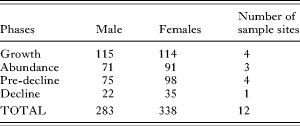
During the 2 study years, 621 A. terrestris were captured and categorized by sex and population cycle phase (Table 1). Ten parasite species and 2 parasite genera were identified including 5 nematodes (Syphacia nigeriana, Trichuris muris, Capillaria murissilvatici, Capillaria sp., Heligmosomoïdes laevis) and 7 cestodes (Taenia tenuicollis, Taenia taeniaeformis, Taenia crassiceps, Echinococcus multilocularis, Anoplocephala dentata, Paranoplocephaloïdes omphaloïdes, Aprostatandrya sp.).
Number of Arvicola terrestris examined (by sex and population cycle phase)
Evolution of parasitism with vole population cycle phases
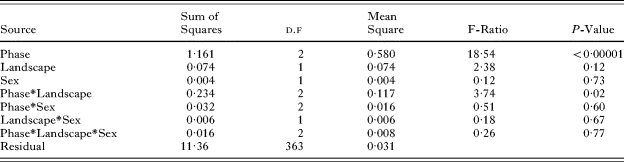
The general linear model analysis demonstrated that Brillouin's index was highly significantly influenced by vole phase (P<0·00001, Table 2) but not by landscape and host sex. Weak interaction between landscape and phase was observed (P=0·02, Table 2).
Results of the general linear model for the effect of phase, landscape and sex on the Brillouin index
(The anova for the Brillouin index is highly significant (F-ratio, d.f. (11, 363)=4·51, P<0·00001).)
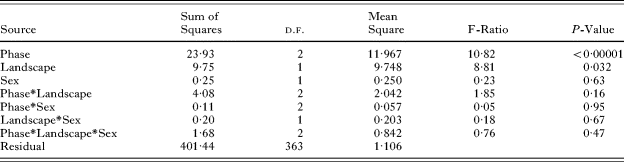
The general linear model analysis demonstrated that IPSR was highly significantly influenced by vole phase (P<0·00001, Table 3) and by landscape (P=0·003) but not by host sex. However, there was no effect of interaction between landscape and phase on IPSR (P>0·10, Table 3).
Results of the general linear model for the effect of phase, landscape and sex on parasite species richness
(The anova for parasite species richness is highly significant (F-ratio, d.f. (11, 363)=3·66, P<0·00001).)
In males, the Brillouin Index (BI) varied significantly with the population cycle phase (ANOVA: P=0·0184; F=3·394 and d.f.=3) (Fig. 1A). Fisher's test showed populations in pre-decline and decline phases were significantly different from those in the other 2 phases. The Brillouin Index and so parasite abundance and diversity were significantly higher (BI=2·520) during these 2 phases than in the growth and abundance phases. Individual parasite species richness (IPSR) varied with population cycle phase (ANOVA: P<0·0001; p=10·173 and d.f.=3) (Fig. 1B). It was higher for populations in the decline phases than for populations in the growth and abundance phases.
Changes in the Brillouin and IPSR indices with Arvicola terrestris population cycle phases for males. (A) Brillouin Index. (B) IPSR Index.
*All significant. n.s., Non-significant

For females, the Brillouin index differed significantly between phases (ANOVA: P<0·0001; p=11·323 and d.f.=3) (Fig. 2A). It was significantly higher in populations in the pre-decline and decline phases. Individual parasite species richness (IPSR) also differed with phase (ANOVA: P<0·0001; p=7·409 and d.f.=3) (Fig. 2B). It was significantly higher for females from pre-decline and decline phases.
Changes in the Brillouin and IPSR indices with Arvicola terrestris population cycle phases for females. (A) Brillouin Index. (B) IPSR Index.
*All significant. n.s., Non-significant

DISCUSSION
Evolution of parasitism depending on vole population cycle phase
Our results show a correlation between parasitism and vole cycle phases. The lack of locality replicates may suggest a regional difference in parasitism. However, our analyses showed a highly significant effect of phase with no effect or only a weak effect of landscape on parasitism (Brillouin's index and parasite species richness (IPSR)). Host sex appears also to have no effect on parasitism.
Both indices (IB and IPSR) are consistently higher during the pre-decline and decline phases for males and females alike. It can be concluded therefore that there is a numerical response of the sampled parasite community (12 species of cestode and nematode) as the host population cycles through these 2 phases.
The parasite numerical response displays a relatively long time lag compared with changes in vole population density. BI and IPSR values are higher during the pre-decline and decline phases whereas vole populations began their growth phases 1 or even 2 or 3 years previously (Cerqueira et al. Reference Cerqueira, De Sousa, Gabrion, Giraudoux, Quéré and Delattre2006). Accordingly, parasite intensity levels are often higher at times when vole population densities have passed their peaks. These findings show that parasite intensity levels in a cyclic population do not depend solely on host population density levels although attempts are sometimes made to correlate the two (Haukisalmi and Henttonen, Reference Haukisalmi and Henttonen1990; Morand and Poulin, Reference Morand and Poulin1998; Arneberg, Reference Arneberg2002; Fichet et al. Reference Fichet-Calvet, Giraudoux, Quéré, Ashford and Delattre2003) but also and perhaps primarily on host population cycle phase. In vole populations, knowledge of the cyclic or non-cyclic character of the study populations therefore becomes a precondition for analysing variations in parasitism with population density.
Parasitism and population regulation
Some examples of parasite numerical response to host population density variations have been reported (Haukisalmi and Henttonen, Reference Haukisalmi and Henttonen1993; Cavanagh et al. Reference Cavanagh, Lambin, Bennett, Ergon, Graham, Van Soolingen, Telfer and Begon2003). However, they do not make prior judgements about the regulating role of those parasites. Examples of vertebrate population regulation by a single parasite remain rare and have only been confirmed in 2 instances; that of Lagopus lagopus scotticus in Scotland (Hudson et al. Reference Hudson, Dobson and Newborn1992; Hudson and Dobson, Reference Hudson and Dobson1998) and that of Soay sheep on Saint-Kilda (Gulland, Reference Gulland1992; Gulland and Fox, Reference Gulland and Fox1992), their population fluctuations being determined by the nematodes Trichostrongylus tenuis and Ostertagia circumcincta, respectively. In both cases, a series of harmful events (malnutrition, stress, depression in food intake, weakening of the immune system, etc.) precedes the parasitism and leads to a cyclic demographic pattern similar to that proposed by Boonstra (Reference Boonstra1994) to explain the cyclic ageing of microtine populations. Among the helminths we identified, no single species appeared capable of inducing a high death rate in A. terrestris populations. Without making prior judgements about the effects of a particular parasite species on host mortality, effects of which have been demonstrated for Heligmosomoïdes polygyrus in particular in other microtide species (Scott, Reference Scott1987), it can be observed that the state of the host population in the pre-decline phase is amenable to increased parasite species richness and more intensive parasitism. This could be because of the immune-system deficiency of the host populations. Under such circumstances, parasitism together with other factors (predation) may accelerate and amplify population decline.
At this stage of our study, the scope of our observations may suffer from several shortcomings in the sampling protocol and the correlational character of our analyses. The present results could be explained by alternative hypotheses: (i) regional differences in parasite transmission; (ii) a decrease in vole population size causing a subsequent decline in the abundance and diversity of the parasite community.
CONCLUSION AND PROSPECTS
The multi-factor hypotheses proposed suggest that even harmless parasites may cause sizeable demographic changes in hosts through interaction such as predation (Ives and Murray, Reference Ives and Murray1997) and nutrition (Gulland, Reference Gulland1992). Unfortunately, no protocols are available for testing such multi-factor hypotheses (Hixon et al. Reference Hixon, Pacala and Sandin2002). In the absence of such tests, it is tempting to turn to experimental approaches limited to the analysis of a reduced number of factors (Tompkins and Begon, Reference Tompkins and Begon1999). This approach has been used for several years now to test hypotheses attributing a role to predation in determining vole population cycles. It has produced highly debatable results (Korpimäki et al. Reference Korpimaki, Klemola, Norrdahl, Oksanen, Oksanen, Banks, Batzli and Henttonen2003). Integrative studies conducted at adequate spatial and temporal scales (i.e. the scales at which the biological phenomena studied occur) are a more suitable approach, despite their constraints (Stenseth et al. Reference Stenseth, Saitoh and Yoccoz1998). Any understanding of the role of parasite mechanisms seems to require simultaneous investigation of (i) seasonal, annual and cyclic variations in vole population density and age structure across the range of the most commonly used habitats and over at least 1 multi-annual fluctuation; (ii) changes in vole population immune systems over the same range of habitats; (iii) variations in prevalence of multi-parasitism including micro- and macro-parasites with direct and indirect cycles.
The choice of biological models is certainly decisive in this approach. In this respect, populations exhibiting a wide variety of patterns of fluctuation, like A. terrestris, are a judicious choice and a valuable asset.
We thank the staff of the crop protection agencies of Franche-Comté (Services Régionaux de Protection des Végétaux and Fédérations Régionales de Défense contre les Organismes Nuisibles) for providing data about the abundance of vole populations in the various districts of the Doubs and C. Sutcliffe for re-reading the English manuscript. The Ministry for Scientific Research and the CNRS ‘Sustainable Interactions’ Network provided financial support.


