Numerous studies have linked early initiation and greater frequency of substance use during early adolescence to a number of maladaptive outcomes. Initiation and use during the early adolescent years have robust risk implications for high-risk sexual behavior (Crockett, Raffaelli, & Shen, Reference Crockett, Raffaelli and Shen2006), academic problems (Lynskey & Hall, Reference Lynskey and Hall2000), and criminal behavior (Odgers et al., Reference Odgers, Caspi, Nagin, Piquero, Slutske, Milne and Moffitt2008). Early alcohol use also poses substantial risk for driving under the influence, motor vehicle accidents, and accidental injury to self and others (Hingson, Edwards, Heeren, & Rosenbloom, Reference Hingson, Edwards, Heeren and Rosenbloom2009). Similarly, early initiation and greater frequency of substance use during early adolescence is a precursor for the progression of substance use dependence and substance use disorders (Moss, Chen, & Yi, Reference Moss, Chen and Yi2014). Consequences of such problems in adulthood include financial difficulties, unemployment, and relationship conflict (Cerda et al., Reference Cerdá, Moffitt, Meier, Harrington, Houts, Ramrakha and Caspi2016; Patton et al., Reference Patton, Coffey, Lynskey, Reid, Hemphill, Carlin and Hall2007). Given the evidence linking early substance use to progression in substance use disorders and later difficulties in adaptive functioning, it is important to aid prevention efforts by identifying the factors that predict substance use during early adolescence.
Research on adolescent substance use has emphasized the contribution of social contexts, including adolescents’ relationships with parents. Considerable research has linked nurturant-involved parenting, defined as high warmth and support and low hostility and rejection (Conger et al., Reference Conger, Conger, Elder, Lorenz, Simons and Whitbeck1992), to adolescent substance use (Velleman, Templeton, & Copello, Reference Velleman, Templeton and Copello2005). Specifically, adolescents who experience harsh, rejecting, and inconsistent parenting are at an elevated risk for tobacco and alcohol use (Zucker, Donovan, Masten, Mattson, & Moss, Reference Zucker, Donovan, Masten, Mattson and Moss2008). Findings support social learning and negative reinforcement of coercive behaviors as specific risk mechanisms (Patterson, Reid, & Dishion, Reference Patterson, Reid and Dishion1992). Other studies have examined parental involvement, support, and monitoring, and the findings suggest that providing structure and management of youth behaviors help prevent adolescent substance use over time (Beach, Lei, Brody, Yu, & Philibert, Reference Beach, Lei, Brody, Yu and Philibert2014; Pires & Jenkins, Reference Pires and Jenkins2007). These strategies are particularly effective, because they prevent adolescent deviance and exposure to deviant peer influences, which are salient contexts for adolescent substance use (Leung, Toumbourou, & Hemphill, Reference Leung, Toumbourou and Hemphill2014).
According to a developmental psychopathology perspective, however, it is important to consider that different pathways might lead to a similar outcome (Cicchetti & Rogosch, Reference Cicchetti and Rogosch1996). Negative affect regulation models have highlighted internalizing symptoms, such as anxiety, as important risks for substance use, positing that anxious individuals use substances to lessen the debilitating symptoms of anxiety (Sher, Reference Sher1991). Similarly, other models suggest that internalizing problems are linked to greater substance use by affecting individuals’ expectations, interpersonal skill deficits, and/or coping motives (Hussong, Jones, Stein, Baucom, & Boeding, Reference Hussong, Jones, Stein, Baucom and Boeding2011; Siennick, Widdowson, Woessner, & Feinberg, Reference Siennick, Widdowson, Woessner and Feinberg2016). This study extends substance use research among early adolescents by examining whether a pathway through adolescent social anxiety symptoms and their potentially deleterious effects on adolescents’ efficacy to refuse substances links lower levels of nurturant-involved parenting to more frequent drunkenness, cigarette use, and marijuana use among early adolescents. Substance refusal efficacy is defined as confidence in refusing substances if offered by friends or peers (Scheier, Botvin, Diaz, & Griffin, Reference Scheier, Botvin, Diaz and Griffin1999).
Expanding Our Concept of Risk: A Social Anxiety Pathway to Adolescent Substance Use
Adolescence is a heightened risk period for increasing social anxiety symptoms and disorders (Wittchen & Fehm, Reference Wittchen and Fehm2001), which are characterized by greater anticipation and perceptions of social threat, heightened fears of negative evaluation, and lower confidence in navigating the social realm successfully (Heimberg, Brozovich, & Rapee, Reference Heimberg, Brozovich, Rapee, Stefan and Hofmann2010). Social anxiety symptoms tend to increase across childhood and adolescence, and clinical-level symptoms typically onset during adolescence, on average (Kessler et al., Reference Kessler, Berglund, Demler, Jin, Merikangas and Walters2005). Adolescent brain development might contribute to increasing symptoms by heightening adolescent self-awareness and sensitivity to the perceptions of others in the social realm (Tillfors & van Zalk, Reference Tillfors, van Zalk, Ranta, La Greca, Garcia-Lopez and Marttunen2015).
Families where parents express less warmth and support and engage in hostile and rejecting behaviors are theorized to place adolescents at greater risk for heightened social anxiety symptoms by altering children's internal working models of the self and interpersonal relationships (Ainsworth, Reference Ainsworth1989; Groh et al., Reference Groh, Fearon, Bakermans-Kranenburg, van IJzendoorn, Steele and Roisman2014). Cold, rejecting parenting undermines adolescents’ trust that their parents will be consistent and will intervene when they need help. In the context of these rejecting relationships, children develop internal working models of interpersonal relationships that are characterized by more emotional and behavioral dysregulation, particularly during social interactions (Brody & Ge, Reference Brody and Ge2001; Kretschmer et al., Reference Kretschmer, Sentse, Meeus, Verhulst, Veenstra and Oldehinkel2016). Previous research indicates that socially anxious youth experience greater parental rejection, greater parental control, and lower parental warmth than nonanxious youth (Bögels, van Oosten, Muris, & Smulders, Reference Bögels, van Oosten, Muris and Smulders2001; Bruch, Rivet, Heimberg, & Levin, Reference Bruch, Rivet, Heimberg and Levin1997; Festa & Ginsburg, Reference Festa and Ginsburg2011). In addition, adolescents who experience greater parental rejection (Lieb et al., Reference Lieb, Wittchen, Höfler, Fuetsch, Stein and Merikangas2000) and lower warmth (Knappe, Beesdo-Baum, Fehm, Lieb, & Wittchen, Reference Knappe, Beesdo-Baum, Fehm, Lieb and Wittchen2012) are at heightened risk for social anxiety disorders. The impact of parenting on social anxiety symptoms is particularly robust during early adolescence. In a large, longitudinal study, van Oort et al. (Reference van Oort, Greaves-Lord, Ormel, Verhulst and Huizink2011) found that lower levels of nurturant-involved parenting were most strongly associated with social anxiety symptoms in early adolescence compared to later adolescence.
A few studies also highlight that interconnections between the family context and social anxiety pose risk for substance use. Socially anxious women who also experience low family support/connectedness and high family hostility exhibit the highest rates of alcohol use disorders 1 year later compared to nonanxious women and women with more positive family relationships (Buckner & Turner, Reference Buckner and Turner2009). Other studies show that individuals who experience a combination of high social anxiety and greater parental acceptance of marijuana use exhibit more marijuana-related problems compared to individuals with lower social anxiety and lower parental acceptance of marijuana use (Ecker & Buckner, Reference Ecker and Buckner2014).
Social anxiety symptoms might also link lower levels of nurturant-involved parenting to early adolescent substance use over time by undermining adolescents’ social skills that are crucial to substance avoidance (Hussong et al., Reference Hussong, Jones, Stein, Baucom and Boeding2011). We examined adolescent substance refusal efficacy, or lack thereof, as an interpersonal skills deficit that could explain associations between adolescent social anxiety symptoms and more frequent adolescent substance use. According to self-efficacy theory, individuals’ confidence and judgments that they are able to perform behaviors (i.e., self-efficacy) guides their decisions to engage in behaviors. Anxiety is identified as one potential influence on self-efficacy (Bandura, Reference Bandura1986).
The key features of social anxiety might overwhelm adolescents with fear about potential social consequences. This fear might hamper adolescents’ confidence that they can assert themselves in social contexts (Lillehoj, Trudeau, Spoth, & Wickrama, Reference Lillehoj, Trudeau, Spoth and Wickrama2004), including those involving encouragement to use substances. Individuals with heightened social anxiety symptoms report lower levels of self-efficacy for avoiding heavy drinking than individuals with lower levels of social anxiety symptoms (Burke & Stephens, Reference Burke and Stephens1997). Similarly, Gilles, Turk, and Fresco (Reference Gilles, Turk and Fresco2006) found that individuals with a combination of greater social anxiety, lower refusal efficacy, and positive expectancies for use reported greater alcohol consumption. Although these studies show that individuals with social anxiety concurrently experience lower efficacy to refuse substances, no studies to our knowledge speak to the directional and prospective associations between social anxiety symptoms and substance refusal efficacy.
Substance refusal efficacy is a well-established predictor of a multitude of substance use outcomes. During a developmental period that is characterized by increases in social reward seeking (Tillfors & van Zalk, Reference Tillfors, van Zalk, Ranta, La Greca, Garcia-Lopez and Marttunen2015) and peer influence (Steinberg & Monahan, Reference Steinberg and Monahan2007), adolescents might lack confidence that they can refuse substances without alienating peers. According to self-efficacy theory, individuals engage in behaviors based on their judgment that they can successfully perform the behavior (Bandura, Reference Bandura1986); thus, adolescents who lack the confidence to refuse substances might be at risk for using substances more frequently. Cross-sectional (Choi, Krieger, & Hecht, Reference Choi, Krieger and Hecht2013; Connor, Gullo, Feeney, Kavanagh, & Young, Reference Connor, Gullo, Feeney, Kavanagh and Young2014) and longitudinal (Connor, George, Gullo, Kelly, & Young, Reference Connor, George, Gullo, Kelly and Young2011; Hiemstra, Otten, & Engels, Reference Hiemstra, Otten and Engels2012) studies have supported this contention. In addition, substance use prevention programs have aimed at improving adolescent refusal efficacy as a method for preventing substance use (Redmond et al., Reference Redmond, Spoth, Shin, Schainker, Greenberg and Feinberg2009). Some findings indicate that refusal efficacy mediates the impact of randomized preventative interventions on adolescent alcohol use (Botvin, Schinke, Epstein, Diaz, & Botvin, Reference Botvin, Schinke, Epstein, Diaz and Botvin1995; Komro et al., Reference Komro, Perry, Williams, Stigler, Farbakhsh and Veblen-Mortenson2001). Other studies do not find that adolescents’ refusal skills mediate the impact of programs on alcohol use (Wynn, Schulenberg, Kloska, & Laetz, Reference Wynn, Schulenberg, Kloska and Laetz1997; Wynn, Schulenberg, Maggs, & Butler, Reference Wynn, Schulenberg, Maggs and Zucker2000); however, there is evidence that these findings depend on adolescents beliefs that drinking is socially unacceptable (Donaldson, Piccinin, Graham, & Hansen, Reference Donaldson, Piccinin, Graham and Hansen1995). Thus, adolescents’ levels of fears and insecurities about the social realm might pose a unique and important context for considering the impact of substance refusal efficacy on adolescent substance use.
Parent and Adolescent Gender Differences
Most studies of substance use and internalizing pathways have solely examined mothers’ parenting or a composite score of mothers and fathers, which ignores or masks potentially unique contributions of mothers and fathers to adolescent outcomes. Mothers and fathers can play different roles in family systems. For example, mothers generally spend more time in daily caregiving, including activities and conversation, with adolescents than do fathers (Crouter & McHale, Reference Crouter and McHale1993). Mothers also tend to engage in more warm and supportive parenting and generally have closer relationships with adolescents than do fathers (Holmbeck, Paikoff, & Brooks-Gunn, Reference Holmbeck, Paikoff, Brooks-Gunn and Bornstein1995; Tein, Roosa, & Michaels, Reference Tein, Roosa and Michaels1994). In contrast, fathers typically engage in more leisure time (Holmbeck et al., Reference Holmbeck, Paikoff, Brooks-Gunn and Bornstein1995) and weekend social activities (Parke, Reference Parke, Bradford Wilcox and Kovner Kline2013). Citing evolutionary perspectives, scholars suggest that fathers play a larger role in preparing children for social interaction and identifying potentially threatening situations in their external environment (Bögels & Perotti, Reference Bögels and Perotti2011), and research has found that fathers play a unique role in children's social competence (Laible & Carlo, Reference Laible and Carlo2004).
Due to mothers’ greater engagement in daily caregiving, adolescents’ might be more sensitive and frequently exposed to hostile, rejecting, and unsupportive mothering; thus, lower levels of nurturant-involved mothering might pose a greater risk for adolescent substance use. Some research suggests that mothers’, but not fathers’, knowledge of adolescents’ drinking is associated with less drinking (Padilla-Walker, Nelson, Madsen, & Barry, Reference Padilla-Walker, Nelson, Madsen and Barry2008). Other studies, however, have found fathers’ nurturant-involved parenting poses unique risk for greater illicit drug use among late adolescents after controlling for mothers’ parenting (Schwartz et al., Reference Schwartz, Zamboanga, Ravert, Kim, Weisskirch, Williams and Finley2009). The social context and peers have a robust influence on adolescent substance use (Dishion & Owen, Reference Dishion and Owen2002); thus, fathers might be more salient influences on adolescent substance use than are mothers due to their important role in socializing youth. In addition, there is evidence that fathers’ parenting has a stronger influence on social anxiety than does mothers’ parenting (Bögels, Stevens, & Majdandzic, Reference Bögels and Perotti2011), although few studies have examined the unique roles of fathers and mothers parenting in relation to adolescent social anxiety. Our examination of both mothers and fathers in the same model is a notable contribution to the research on substance use and internalizing pathways, because it will help identify the unique or shared contributions of mothers and fathers to substance use through the proposed pathway.
This study also examines adolescent gender differences in the proposed pathways. Parenting practices appear to have similar influences on adolescent girls’ and boys’ substance use (Piko & Balázs, Reference Piko and Balázs2012; Schinke, Fang, & Cole, Reference Schinke, Fang and Cole2008). In contrast, the association between social anxiety and adolescent substance use might vary as a function of gender. Men with greater social anxiety exhibit greater risk for cigarette dependence (Buckner & Vinci, Reference Buckner and Vinci2013) and greater severity of marijuana-related problems (Buckner, Heimberg, & Schmidt, Reference Buckner, Heimberg and Schmidt2011) in comparison to women. Thus, we investigate whether youth gender moderated the links among nurturant-involved parenting, adolescent social anxiety symptoms, substance refusal efficacy, and substance use, although we do not assert specific hypotheses.
The Current Study
Using a four-wave longitudinal design, we examined nurturant-involved parenting in the Fall of sixth grade as a risk for increasing social anxiety symptoms (Spring sixth grade), which in turn potentially erodes adolescents’ efficacy to refuse substances (seventh grade) and leads to more frequent drunkenness, marijuana use, and cigarette use during eighth grade. Based on theory and empirical research, we hypothesize that adolescent social anxiety, and subsequent substance refusal efficacy, may explain the association between nurturant-involved parenting prior to adolescence and later adolescent substance use. We controlled for prior levels of social anxiety symptoms and substance refusal efficacy (Fall sixth grade) to provide an examination of change over time. In addition, we accounted for adolescents’ early initiation of substances (Fall sixth grade) to provide a more stringent test of the proposed pathways to adolescent substance use. Independent effects of mothers’ and fathers’ parenting were examined in the same model, which acknowledges the interconnected nature of family relationships as well as the unique contributions of family members to adolescent development. Finally, this study examined youth gender differences in associations, expanding beyond mean level differences in substance use and clarifying whether pathways are similar or different for adolescent males and females.
Method
Participants
This study utilized a subsample of 687 two-parent families from the Promoting School–Community University Partnerships to Enhance Resilience (PROSPER) project; a partnership-based delivery system for evidence-based interventions designed to reduce adolescent substance use initiation (Spoth, Greenberg, Bierman, & Redmond, Reference Spoth, Greenberg, Bierman and Redmond2004). Participants in the PROSPER project were from 28 rural and small-town communities in Iowa and Pennsylvania. Communities that included (a) school district enrollment from 1,300 to 5,200, and (b) at least 15% of the student population eligible for free or reduced-cost lunches were eligible for participation (for more information, see Spoth, Guyll, Lillehoj, Redmond, & Greenberg, Reference Spoth, Guyll, Lillehoj, Redmond and Greenberg2007). Communities were blocked on school district size (enrollment) and geographic location, and then they were randomly assigned to the partnership intervention or comparison conditions. Intervention communities selected and oversaw the implementation of one family and one school evidence-based intervention. Students who were in sixth grade at Wave 1 (W1) of data collection were eligible to participate. A total of 10,849 students (approximately 90% of those eligible) across two cohorts (spaced 1 year apart) completed baseline assessments in schools beginning in the Fall of sixth grade. Questionnaires continued annually during the Spring of 6th through 12th grades. On average, 88% of students completed in-school assessments at each data collection point for the larger study.
A random subsample of 2,267 families from the second cohort of the larger project were selected and recruited through mail, telephone, and in-person visits to participate in the family-based program; 979 (43%) participated. During a home visit, questionnaires were completed independently by adolescents, mothers, and, if present, fathers. Home visits were conducted during the Fall and Spring of sixth grade and annually thereafter in the Spring of seventh through eighth grades. Retention rates were 83%, 82%, and 80% during the Spring of sixth through eighth grades, respectively. We excluded 292 families from the in-home sample: 188 were excluded because they were not married or were not in a marriage-like relationship.Footnote 1
The current study analyzed a subsample of 687 two-parent families from the family-based program (either married or cohabiting). Thirty-seven percent of this subsample (n = 257) were in the control condition of the larger study, 54% (n = 369) were in the intervention condition, and 9% were not consistently grouped (n = 61). Families that included dual-biological parents characterized 73% of the subsample (n = 499). Fifty-five percent (n = 273) of dual-biological parent families were in the intervention condition of the larger study. In cases where a partner was not a nonbiological parent, the family was included in the sample if the child and parents considered the nonbiological partner to be a parental figure. Of mothers, 97.5% were biological mothers (N = 670), 1.5% (N = 10) were stepmothers, and 1% (N = 7) were adoptive mothers. Of fathers, 80.2% were biological fathers (N = 551), 18.5% (N = 127) were stepfathers, and 1.3% (N = 9) were adoptive fathers. Adolescent females comprised 52% of the sample. The sample was primarily European American (90%), with 6.3% Hispanic, 1.2% African American, 0.06% Asian, and 1.9% other. During sixth grade, the mean age for adolescents was 11.3 years (SD = 0.49). Mothers were 38.7 years old on average (SD = 6.05), and fathers were 41.1 years on average (SD = 7.14). We compared those who participated in the in-home assessment to the larger sample on a number of variables. Comparisons indicated that youth who participated in the in-home assessments were somewhat less likely to engage in deviant behavior, less likely to initiate substances, and perceived fewer benefits of using substances.
Measures
Nurturant-involved parenting (Fall sixth grade)
Nurturant-involved parenting was a latent variable with four manifest indicators: support, positive affect, hostility, and rejection. Data on each of these indicators was collected during the in-home family assessments. Mothers and fathers rated the extent to which six items described their support for adolescents on a 5-point scale (never true = 1 to always true = 5; Spoth, Redmond, & Shin, Reference Spoth, Redmond and Shin1998). Support was the first manifest indicator. Example items include “I spend one-on-one time with my child to let him or her know I care” and “I show support when my child talks about what he or she wants to be when they grow up.” Mothers and fathers completed the Affective Quality of the Relationship Scale, Parent to Youth (Spoth et al., Reference Spoth, Redmond and Shin1998). Mothers and fathers indicated how frequently in the last month they engaged in specific behaviors on a 7-point scale (always = 1 to never = 7). Positive affect was the second manifest indicator and was measured using three items focusing on how often parents: let the child know s/he really cares for the child; appreciated him/her, his/her ideas; and acts loving and affectionate toward the child (all reverse coded; Spoth et al., Reference Spoth, Redmond and Shin1998). Parent hostility (i.e., negative affect) toward youth was the third manifest indicator and was measured with three items capturing how often parents got angry with their child; shouted or yelled at their child; and insulted or swore at their child during disagreements (Spoth et al., Reference Spoth, Redmond and Shin1998). Rejection was the fourth manifest variable and was measured with five items that assessed mothers’ and fathers’ feelings toward their child on a 5-point scale (strongly agree = 1 to strongly disagree = 5; Spoth et al., Reference Spoth, Redmond and Shin1998). A sample item was “I feel this child has a number of faults.” Cronbach αs for mothers’ and fathers’ support, positive affect, hostility, and rejection ranged from 0.76 to 0.88. The latent variable was scaled so that higher values reflected more nurturant-involved parenting.
Adolescent social anxiety symptoms (Fall and Spring sixth grade)
Adolescent social anxiety symptoms were assessed during the Spring of sixth grade (i.e., mediator) and during the Fall of sixth grade in order to assess change over time. Social anxiety symptoms were a latent variable with two manifest indicators. Adolescents reported on the 18-item Social Anxiety Scale for Adolescents (La Greca & Lopez, Reference La Greca and Lopez1998) and indicated how true each item was for themselves on a 5-point scale (not at all = 1 to all the time = 5). Although previous research has sometimes treated the Social Anxiety Scale for Adolescents as having three subscales (fear of negative evaluation and two social avoidance subscales), a factor analysis indicated that two factors, a fear of negative evaluation and a social avoidance subscale, were a better fit in this sample for both measurement occasions. The first manifest indicator was an 8-item fear of negative evaluation subscale. A sample item was “I worry about being teased.” The second manifest indicator was a 10-item social avoidance subscale. A sample item was “I feel shy around people I don't know.” The latent variable was scaled so that higher values reflected greater social anxiety symptoms. Cronbach αs for the fear of negative evaluation and social avoidance subscales ranged from 0.87 to 0.93. Data on each of these indicators were collected during the in-home assessments.
Adolescent substance refusal efficacy (Fall sixth grade and Spring seventh grade)
Substance refusal efficacy was assessed during the Spring of seventh grade (i.e., mediator) and during the Fall of sixth grade in order to assess change over time. Substance refusal efficacy was a latent variable with three manifest indicators. Adolescents rated their confidence that they could refuse alcohol, cigarettes, and marijuana if offered by a friend (3 items) on a 5-point scale (not at all confident = 1 to very confident = 5; Redmond et al., Reference Redmond, Spoth, Shin, Schainker, Greenberg and Feinberg2009). Each item was used as a manifest indicator of refusal efficacy. Higher scores reflected greater substance refusal efficacy. Cronbach αs for the full scale were 0.97 and 0.91 during sixth and seventh grades, respectively. Data on each of these indicators were collected during the in-home assessments.
Substance use (Fall sixth grade Spring eighth grade)
Early initiation of substances was assessed in the Fall of sixth grade to control for the effect of early use on subsequent substance use and to provide a more stringent test of the proposed pathway. Adolescents reported on 3 items indicating if they had ever been drunk, used marijuana, or used cigarettes (0 = no, 1 = yes; Elliot, Ageton, Huizinga, Knowles, & Canter, Reference Elliot, Ageton, Huizinga, Knowles and Canter1983; Williams, Toomey, McGovern, Wagenaar, & Perry, Reference Williams, Toomey, McGovern, Wagenaar and Perry1995). Adolescent reports were coded to indicate if they had ever initiated at least one of the three substances (0 = no, 1 = yes). Five percent of youth (n = 30) indicated that they had initiated at least one substance, and 50% of these youth (n = 15) were in the intervention condition of the larger study.
During eighth grade, adolescents reported on the frequency of getting drunk and using marijuana during the last year (not at all = 1 to more than 12 times = 5; Elliot et al., Reference Elliot, Ageton, Huizinga, Knowles and Canter1983; Williams et al., Reference Williams, Toomey, McGovern, Wagenaar and Perry1995). Adolescents also reported on the frequency of cigarette use during the past month on a 5-point scale (not at all = 1 to more than once a week = 5; Elliot et al., Reference Elliot, Ageton, Huizinga, Knowles and Canter1983; Williams et al., Reference Williams, Toomey, McGovern, Wagenaar and Perry1995). Approximately 11% and 5% of adolescents reported getting drunk and using marijuana at least once in the last year, respectively. Approximately 7% of adolescents reported using cigarettes at least once in the past month. Rates for drunkenness and cigarettes are equivalent to rates reported by larger, national samples; marijuana use in the current study was lower (Miech, Johnston, O'Malley, Bachman, & Schulenberg, Reference Miech, Johnston, O'Malley, Bachman and Schulenberg2015). Higher scores for each of the three items reflected more frequent substance use. Single-item measures of substance use have shown acceptable reliability and validity in past research (Dollinger & Malmquist, Reference Dollinger and Malmquist2009). Data on each of these indicators were collected during the in-school assessments.
Covariates (Fall sixth grade)
We included several covariates in this study that were measured during the Fall of sixth grade. Parental alcohol problems were measured using eight items that asked mothers and fathers about their drinking problems in the past 12 months (often = 1 to never = 4; Simons, Johnson, Beaman, & Conger, Reference Simons, Johnson, Beaman and Conger1993). Items were reverse scored so that higher scores indicated greater alcohol problems, and scores were averaged across mothers and fathers. A sample item was “How often have you had family problems because of drinking too much?” This scale has been used in a number of prior studies and has demonstrated good reliability (α = 0.80; Simons et al., Reference Simons, Johnson, Beaman and Conger1993). Cronbach αs for the current study were 0.73 for mothers and 0.84 for fathers.
Parent psychopathology was measured using 29 items from the Symptom Checklist (Derogatis, Reference Derogatis1977). Parents indicated how much they were distressed or bothered by 29 symptoms during the last week (1 = not at all to 5 = extremely). Sample items were “nervousness or shakiness inside” and “crying easily.” Cronbach αs were for 0.95 and 0.92 for mothers and fathers, respectively. Parent education was scored from 0 (no grade completed) to 20 (doctoral degree). Family income was scored from 1 to 11 in $10,000 intervals (1 = $0–$10,000 to 11 = above $100,000). Biological parent was coded to indicate whether both parents were biological parents (1) or not (0). We also included study condition to indicate whether families were in the intervention (1) or control (0) condition of the larger study.
Analysis plan
All analyses were conducted using Mplus Version 7.4 (Muthén & Muthén, Reference Muthén and Muthén2013) using robust maximum likelihood estimation methods that do not rely on assumptions of normally distributed variables, as is often the case with substance use measures (McDonald & Ho, Reference McDonald and Ho2002). Three fit indices were used to assess the acceptability of each analytic model: the χ2 statistic, comparative fit index (CFI), and root mean square error of approximation (RMSEA). A nonsignificant χ2 statistic indicated good model fit. However, due to the large sample size, a significant χ2 was expected for most models. Therefore, other fit indices also were examined. Adequate model fit was indicated by CFI values of 0.90 to 0.95 (Hu & Bentler, Reference Hu and Bentler1999) and RMSEA values ranging from 0.06 to 0.08 (Browne & Cudeck, Reference Browne, Cudeck, Bollen and Long1993). Good model fit was indicated by CFI values greater than 0.95 and RMSEA values less than 0.05 (Browne & Cudeck, Reference Browne, Cudeck, Bollen and Long1993; Hu & Bentler, Reference Hu and Bentler1999). The significance level for all estimates was p < .05. Missing values were addressed using full information maximum likelihood estimation, a preferred technique for producing estimates with minimal bias (Schlomer, Bauman, & Card, Reference Schlomer, Bauman and Card2010).
This study tested a three-path mediated effect, in which two mediators (social anxiety symptoms and substance refusal efficacy) sequentially intervene between the independent variables (mothers’ and fathers’ nurturant-involved parenting) and the dependent variables (drunkenness, cigarette use, and marijuana use). Methods for testing a single-mediator model can be generalized to a three-path mediated effect (Taylor, MacKinnon, & Tein, Reference Taylor, MacKinnon and Tein2008). According to recommendations, we tested indirect effects using a bias-corrected bootstrapping procedure (5,000 draws; Taylor et al., Reference Taylor, MacKinnon and Tein2008). A bootstrapping procedure is preferable over other methods because (a) a normal sampling distribution is not assumed, and (b) more precise confidence intervals are produced, which (c) reduces Type I error rates, and (d) increases power (MacKinnon, Lockwood, & Williams, Reference MacKinnon, Lockwood and Williams2004). The bootstrapping approach produces a 95% confidence interval (CI). A 95% CI that does not contain zero indicates a significant mediating effect (Preacher, Rucker, & Hayes, Reference Preacher, Rucker and Hayes2007).
Substance use outcomes (eighth grade) were regressed on early substance use initiation (Fall sixth grade) and on all covariates in the model. Social anxiety symptoms (Spring sixth grade) and substance refusal efficacy (seventh grade) also were regressed on early substance use initiation to account for potential bidirectional effects between these constructs. For parsimony, we inspected bivariate correlations to determine if social anxiety symptoms (Spring sixth grade) and substance refusal efficacy (seventh grade) should be regressed on covariates in the model. We included a covariate path if any manifest indicators of social anxiety symptoms or substance refusal efficacy were significantly correlated with a control variable.
Finally, we used multigroup invariance tests to examine whether structural paths were consistent across (a) adolescent boys and girls and (b) control and intervention groups. We compared a model in which all loadings and structural paths were constrained to be equal across groups to a model in which structural paths were freely estimated. Group comparisons were conducted by evaluating change in the CFI between the two models, which is the preferred approach (compared to χ2 tests) with larger samples (i.e., N > 300; Cheung & Rensvold, Reference Cheung and Rensvold2002). A ΔCFI of 0.01 or greater indicated a significant change in model fit due to parameter constraints (Cheung & Rensvold, Reference Cheung and Rensvold2002).
Results
Preliminary analyses
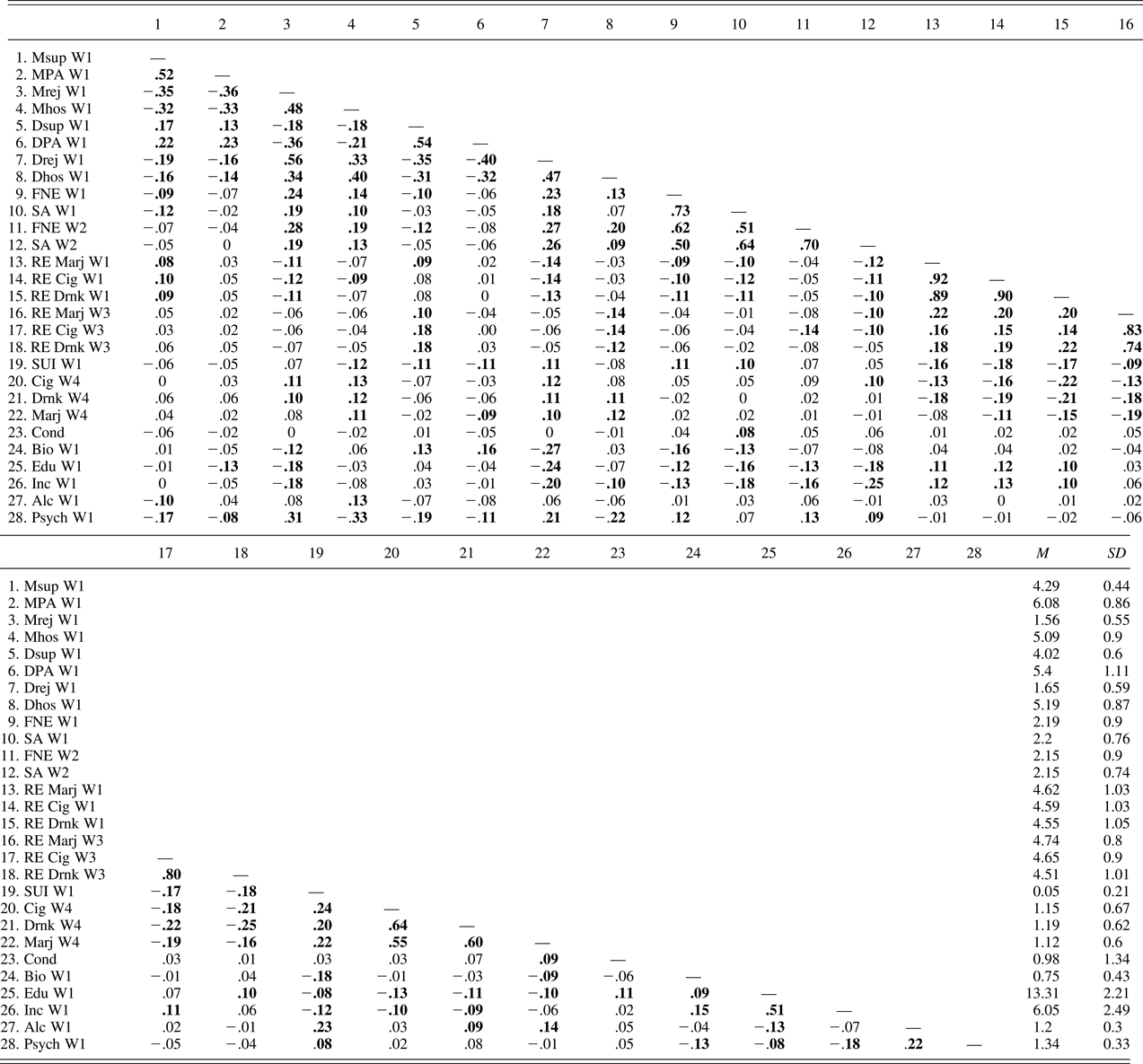
Descriptive and intercorrelations among variables are presented in Table 1. Correlations were in the expected directions. As expected, within-construct variables were highly correlated. Correlations between each indicator of mothers’ and fathers’ nurturant-involved parenting ranged from r = .17 to .56. Parent education and family income were significantly correlated with manifest indicators of social anxiety symptoms (Spring sixth grade) and substance refusal efficacy (seventh grade). In addition, correlations between social anxiety symptoms and parent psychopathology were statistically significant. Therefore, social anxiety and substance refusal efficacy were regressed on parent education and family income. Social anxiety also was regressed on parent psychopathology.
Descriptive statistics and intercorrelations between variables

Note: W1, Fall 6th grade; W2, Spring 6th grade; W3, 7th grade; W4, 8th grade; M, mother; D, Father; sup, support; PA, positive affect; hos, hostility; rej, rejection; FNE, fear of negative evaluation; SA, social avoidance; RE, refusal efficacy; cig, cigarettes; drnk, drunk; marj, marijuana; cond, study condition; bio, two biological parents; edu, parent education; inc, family income; alc, parent alcohol problems; psych, parent psychopathology. Bold estimates are significant at p < .05.
Primary analyses
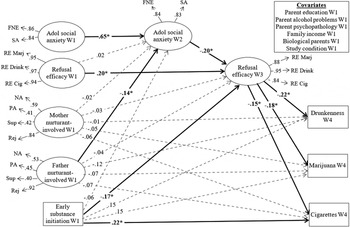
Model fit was good, χ2 (248) = 439.84, p = .00, CFI = 0.96, RMSEA = 0.03 (see Figure 1). The standardized regression estimate from Fall to Spring of sixth grade for social anxiety symptoms, as well as the standardized regression estimate from sixth to seventh grades for substance refusal efficacy, demonstrated some stability within these latent constructs. Adequate unshared variance was demonstrated, however, to support examining predictors of change within these constructs over time.
Model fit is χ2 (315) = 5303.33, p = 00, comparative fit index = 0.96, root mean square error or approximation = 0.04. Estimates are standardized coefficients. *Bold values are significant at p < .05. W1, Fall sixth grade; W2, Spring sixth grade; W3, seventh grade; W4, eighth grade. Correlations within W1 and W4 variables, as well as associations with covariates, are not depicted. The correlation between W1 mothers’ and fathers’ nurturant-involved parenting was 0.68. Social anxiety symptoms W2 and refusal efficacy W3 were regressed on parent education and family income. Social anxiety W2 was also regressed on parent psychopathology. Substance use W4 was regressed on social anxiety W2 and all covariants. Adol Sup, adolescent support; PA, positive affect; NA, negative affect; Rej, rejection; FNE, fear of negative evaluation; SA, social avoidance; RE, substance refusal efficacy items; Cig, cigarettes; Marj, marijuana.

Although several bivariate correlations among indicators of nurturant-involved parenting and adolescent substance use were statistically significant, in the full path model, mothers’ and fathers’ nurturant-involved parenting were not directly associated with adolescent substance use during eighth grade. Thus, we examined paths through adolescent social anxiety symptoms and substance refusal efficacy. We first examined whether mothers’ and fathers’ nurturant-involved parenting were associated with changes in adolescent social anxiety symptoms. Adolescents who had fathers that exhibited lower levels of nurturant-involved parenting experienced increases in adolescent social anxiety symptoms during sixth grade. Associations were not statistically significant for mothers’ nurturant-involved parenting. In turn, adolescents who experienced higher levels of social anxiety symptoms in sixth grade reported decreases in substance refusal efficacy by the end of seventh grade. Finally, adolescents who reported lower levels of substance refusal efficacy reported a higher frequency of drunkenness, marijuana use, and cigarette use by the end of eighth grade. These effects were significant over and above the influence of early substance initiation during sixth grade.
We then examined the significance of indirect effects. We first examined indirect effects from social anxiety symptoms (Spring of sixth grade) to greater substance use (eighth grade) through substance refusal efficacy (seventh grade). Greater social anxiety symptoms (Spring of sixth grade) placed adolescents at greater risk for drunkenness, b = 0.04, β = 0.04, 95% CI [0.004, 0.10], marijuana use, b = 0.03, β = 0.03, 95% CI [0.002, 0.10], and cigarette use, b = 0.03, β = 0.03, 95% CI [0.001, 0.09], by means of lowering their ability to refuse substances (seventh grade). Then, we extended our tests of indirect effects over three paths, in which father nurturant-involved parenting (Fall of sixth grade) was associated with social anxiety (Spring sixth grade), which was associated with decreases in substance refusal efficacy (Spring seventh grade), and finally, substance use (eighth grade). The indirect effect from fathers’ nurturant-involved fathering to drunkenness was statistically significant, b = 0.01, β = 0.01, 95% CI [0.001, 0.03]; however, these tests were not upheld across three paths for marijuana use, b = 0.01, β = 0.01, 95% CI [0.00, 0.03], or cigarette use, b = 0.005, β = 0.005, 95% CI [0.00, 0.03].
Multiple group invariance tests were conducted to evaluate whether findings differed for (a) boys and girls and (b) for individuals in the intervention and control conditions of the larger study. Associations did not significantly differ by adolescent gender (ΔCFI < .01). In addition, associations did not significantly differ for intervention and control groups (ΔCFI < .01). Thus, the model fit equally well for males and females, as well as individuals in the invention and control conditions.
Post hoc analyses
In follow-up analyses, we evaluated the possibility that the aggregation of mothers’ and fathers’ reports of drinking problems and psychopathology might obscure findings that have implications for adolescent substance use. Thus, we reran models with mothers’ and fathers’ drinking problems and psychopathology as separate covariates in the model. The inclusion of separate measures did not change the pattern of results. Mothers’ and fathers’ drinking problems and psychopathology were not significantly associated with social anxiety or adolescent substance use. Therefore, we retained the original model in favor of parsimony of presentation.
Discussion
Given the multitude of immediate and long-term implications of substance use during early adolescence (Crockett et al., Reference Crockett, Raffaelli and Shen2006; Moss et al., Reference Moss, Chen and Yi2014), it is critical that research examine the factors and processes leading to substance use during early adolescence. Prior research linking parenting to adolescent substance use has emphasized a “deviance” pathway in which parenting behaviors buffer or place adolescents at greater risk for deviant (antisocial) behaviors and/or deviant peer affiliations. In line with a developmental psychopathology perspective that emphasizes that individuals might follow different paths to the same outcome (Cicchetti & Rogosch, Reference Cicchetti and Rogosch1996), other scholars have expanded beyond deviance models to highlight the importance of internalizing symptoms for substance use. In particular, negative affect regulation models posit that anxious or depressed individuals might engage in greater substance use as a method of coping with their distressing symptoms (Sher, Reference Sher1991), while other models have highlighted expectations for substance use and social skills deficits as other explanatory mechanisms (Hussong et al., Reference Hussong, Jones, Stein, Baucom and Boeding2011). The current study expands on prior work by examining social anxiety as an alternative risk pathway linking parenting to early adolescent substance use. Specifically, we examined whether lower levels of nurturant-involved parenting affect adolescent substance use by placing adolescents at increased risk for adolescent social anxiety symptoms, which in turn undermine a key protective factor against substance use: adolescent substance refusal efficacy. Strengths of this study include a large sample, four waves of longitudinal data, an autoregressive design that captures change over time, and an examination of both mothers’ and fathers’ parenting.
We found that youth in families with lower levels of nurturant-involved fathering in sixth grade were at increased risk for social anxiety symptoms 6 months later. In turn, greater social anxiety symptoms decreased adolescents’ efficacy to refuse substances during seventh grade. Adolescents who lacked efficacy to refuse substances engaged in drunkenness, marijuana use, and cigarette use more frequently during eighth grade. Mothers’ nurturant-involved parenting did not heighten adolescent risk for social anxiety symptoms. At the bivariate level, parenting behaviors were significantly correlated with adolescent substance use; however, in the full structural model, the association between parenting behaviors and adolescent substance use were fully accounted for by increases in social anxiety symptoms and subsequent decreases in refusal efficacy.
Our findings suggest that adolescents who are in families where fathers are more hostile, rejecting, and less warm and supportive might feel that they cannot count on their father to respond if they need help. Therefore, they come to lack trust in interpersonal relationships generally, struggle with emotion regulation skills, and lack confidence in navigating the peer context successfully (Kretschmer et al., Reference Kretschmer, Sentse, Meeus, Verhulst, Veenstra and Oldehinkel2016; Lieberman, Doyle, & Markiewicz, Reference Lieberman, Doyle and Markiewicz1999). Our finding that this association was unique to fathers’ parenting after accounting for mothers’ parenting is consistent with prior research (Bögels et al., Reference Bögels, Stevens and Majdandžić2011) and might be due to more generalized differences in parenting that have been observed in families. Fathers typically play a unique role in children's social competence (Laible & Carlo, Reference Laible and Carlo2004) through greater engagement in leisure time (Holmbeck et al., Reference Holmbeck, Paikoff, Brooks-Gunn and Bornstein1995) and weekend social activities (Parke, Reference Parke, Bradford Wilcox and Kovner Kline2013) in comparison to mothers. According to evolutionary perspectives, these behaviors might reflect tendencies for fathers to promote future social interactions and identify potentially threatening situations, which are central to social anxiety (Bögels & Perotti, Reference Bögels and Perotti2011). Few studies have examined the unique roles of mothers’ and fathers’ parenting in relation to adolescent social anxiety symptoms; thus, our results represent an important contribution to the research on social anxiety symptoms. Furthermore, it is notable that rejection and hostility were the indicators primarily driving the nurturant-involved parenting latent construct in the current study. Previous research has supported the contribution of a number of parenting behaviors (i.e., rejection, support, and positive affect) to adolescent social anxiety symptoms. Our findings suggest, however, that fathers’ rejection and hostility might play key roles for increasing social anxiety symptoms in the context of other parenting behaviors (van Oort et al., Reference van Oort, Greaves-Lord, Ormel, Verhulst and Huizink2011).
In turn, we found that social anxiety symptoms undermine an interpersonal skill that is key to substance use prevention: efficacy to refuse substances in the peer context. Self-efficacy theory has noted anxiety as an important contributor to individuals’ confidence that they can successfully engage in behavior (Bandura, Reference Bandura1986). The key components of social anxiety symptoms, including greater anticipation and perceptions of social threat, heightened fears of negative evaluation, and lower confidence in navigating the social realm successfully (Heimberg et al., Reference Heimberg, Brozovich, Rapee, Stefan and Hofmann2010), likely overwhelm youth with fear of the social consequences if they assert themselves and reject substances offered by peers. Therefore, adolescents with greater social anxiety symptoms lack the confidence that they could refuse substances. Consistent as well with self-efficacy theory, our findings indicate that youth who lack confidence to refuse substances will ultimately fail to do so and will engage in substance use more frequently.
Our findings are consistent with prior studies that have found links between social anxiety symptoms, substance refusal efficacy, and substance use (Burke & Stephens, Reference Burke and Stephens1997; Gilles et al., Reference Gilles, Turk and Fresco2006). However, our study is the first to our knowledge to test and document longitudinal, sequential links among these constructs and demonstrate that effects of adolescent social anxiety symptoms on substance use 2 years later operate through reduced adolescent refusal efficacy. In addition, this study is the first to show that the harmful effects of this process are not specific to one substance; rather, the pathway predicted more frequent drunkenness, tobacco use, and marijuana use. It should be noted, however, that this study only examined substance use frequency. The amount of substance use at any one occasion also has important implications for adolescent development (Berg et al., Reference Berg, Kiviruusu, Karvonen, Kestilä, Lintonen, Rahkonen and Huurre2013). Measuring the amount of substance use during any one occasion or the total amount used might help identify patterns of problematic use among adolescents and should be considered in future research.
We found that fathers’ parenting had longer term effects on adolescent drunkenness 3 years later through adolescent social anxiety and substance refusal efficacy. The slightly smaller effect sizes between refusal efficacy and adolescent cigarette and marijuana use likely explain the lack of indirect effects from fathers’ parenting to youth cigarette and marijuana use. However, our findings show that lower nurturant-involved fathering is an important risk that sets the stage for cascading influences from increases in social anxiety to lower refusal efficacy, which places youth at risk for more frequent drunkenness, cigarette use, and marijuana use. Adolescent substance use is highly influenced by social contexts and peers (Marschall-Lévesque, Castellanos-Ryan, Vitaro, & Séguin, Reference Marschall-Lévesque, Castellanos-Ryan, Vitaro and Séguin2014); thus, the salient role of fathers in adolescent socialization (Lieberman et al., Reference Lieberman, Doyle and Markiewicz1999) might explain the long-term effects of fathers’ parenting on adolescent drunkenness in comparison to mothers. Few studies have examined the unique role of mothers and fathers, however, and scholars do note greater similarities than differences in mothering and fathering generally (see Fagan, Day, Lamb, & Cabrera, Reference Fagan, Day, Lamb and Cabrera2014, for a review). Moreover, our findings are inconsistent with other studies that have noted indirect effects of parenting on adolescent cigarette and marijuana use (e.g., Lac, Alvaro, Crano, & Siegel, Reference Lac, Alvaro, Crano and Siegel2009; van Ryzin, Fosco, & Dishion, Reference van Ryzin, Fosco and Dishion2012); therefore, future research will need to replicate the current findings.
In addition, the developmental timing of our findings is important. Studies have found that adolescent social anxiety symptoms peak during early to middle adolescence (12 or 13 years old; Miers, Blöte, de Rooij, Bokhorst, & Westenberg, Reference Miers, Blöte, De Rooij, Bokhorst and Westenberg2013). Other research has highlighted that parenting is more salient for social anxiety symptoms during early adolescence versus later adolescence (van Oort et al., Reference van Oort, Greaves-Lord, Ormel, Verhulst and Huizink2011). The middle school transition period might pose particular risk based on these associations, because it is a time when adolescents must navigate new school environments and adjust to disruptions in their adult and friend networks (Kingery, Erdley, & Marshall, Reference Kingery, Erdley and Marshall2011). Thus, links between nurturant-involved parenting and social anxiety symptoms might not hold during later developmental periods. Future research will need to examine whether these associations hold over a longer period of time and during other developmental periods.
In contrast to differences in findings based on parent gender, our findings did not reveal any adolescent gender differences in associations. These findings highlight the importance of fathers’ parenting behaviors for substance use regardless of adolescent gender. Evidence from recent cohorts indicates that rates of substance use are very similar for eighth-grade boys and girls (Johnston, O'Malley, Bachman, & Schulenberg, Reference Johnston, O'Malley, Bachman and Schulenberg2011). The results of the current study add to these findings and suggest that processes connecting parenting to substance use through social anxiety and substance refusal efficacy also are an equal risk for adolescent boys and girls.
Limitations
Although this study includes many strengths and contributions, limitations should be noted. First, youth report was used to measure adolescent social anxiety symptoms, refusal efficacy, and substance use, which potentially poses threats of shared method variance among these constructs and inflated associations among variables (Shadish, Cook, & Campbell, Reference Shadish, Cook and Campbell2002). We used parent report of nurturant-involved parenting as one approach of reducing method variance. Although some studies suggest that parents might be biased reporters of their own parenting behaviors (Gonzales, Cauce, & Mason, Reference Gonzales, Cauce and Mason1996), other research has found convergence between observational and parent reports on a number of parenting behaviors (Hawes & Dadds, Reference Hawes and Dadds2006).
Second, the sample consisted of primarily White and semirural families. Replication of these findings among more ethnically, racially, and geographically diverse samples is important in order to better understand whether these findings generalize to other populations. Future research also should replicate these findings among other family structures. Third, there were factors not accounted for in this study that might have important implications for the results. Broader aspects of the family context, such as sibling relationships (Whiteman, Jensen, & Maggs, Reference Whiteman, Jensen and Maggs2013) and interparental conflict (Fosco & Feinberg, Reference Fosco and Feinbergin press), have known effects on adolescent substance over and above parenting influences (Whiteman et al., Reference Whiteman, Jensen and Maggs2013). It will be important for future research to include other aspects of the family context in future research in order to reflect the multifaceted and interconnected nature of family influences on adolescent outcomes. In addition, although we accounted for the potential influence of parental psychopathology, a recent meta-analysis indicated that a substantial proportion of variance in social anxiety is explained by genetic risk, and genetic contributions were much stronger during childhood than adulthood (Scaini, Belotti, & Ogliari, Reference Scaini, Belotti and Ogliari2014). Adolescent substance use is also, in part, attributable to genetic influences (Rhee et al., Reference Rhee, Hewitt, Young, Corley, Crowley and Stallings2003). Thus, unmeasured genetic influences might affect the findings of this study, and it will be important for future research to account for these effects in future research.
Fourth, this study did not account for potential child-driven effects in which social anxiety, refusal efficacy, and substance use influence parenting behaviors over time. This is an important consideration given that previous research has noted bidirectional effects between parenting and adolescent substance use (Elkins, Fite, Moore, Lochman, & Wells, Reference Elkins, Fite, Moore, Lochman and Wells2014). To its strength, this study did account for the potential bidirectional influences among social anxiety, refusal efficacy, and substance use, and the results indicated that early initiation of substances was a risk for lowering adolescents’ efficacy to refuse substances. Future research should consider utilizing cross-lagged models that account for bidirectional associations and alternative patterns of influence (e.g., see Mak, Fosco, & Feinberg, Reference Mak, Fosco and Feinbergin press).
Fifth and finally, the effect size for the significant indirect effect was small; therefore, this result should be interpreted with caution. However, it should be acknowledged that this study spanned 3 years and accounted for autoregressive effects on both mediators. These effects were characterized by moderate stability; thus, a smaller effect size should be expected. Traditional guidelines for interpreting effect sizes do not account for autoregressive effects that reduce the size of the association between the predictors and outcomes (Adachi & Willoughby, Reference Adachi and Willoughby2015).
Conclusion
The broader literature that has connected parenting behaviors to adolescent substance use has often emphasized connections through deviance and deviant peer affiliations. Our findings expand the literature by demonstrating that parenting also is salient for youth social anxiety, which hampers youths’ confidence in navigating social situations and increases their risk for substance use. Of importance for prevention efforts, the influence of substance refusal efficacy was consistent for three different types of substance use (drunkenness, cigarette use, and marijuana use) and thus demonstrates the potential for intervening on this pathway and preventing multiple types of substance use. The results underscore the importance for substance use prevention programs to consider the ways in which social anxiety symptoms affect substance use behaviors by undermining adolescents’ efficacy to refuse substances in the peer context. In addition to targeting the family context and parenting behaviors, future prevention efforts might help socially anxious adolescents manage their social fears and develop the necessary interpersonal skills and confidence to refuse substances when offered by friends.