




No CrossRef data available.
Article contents
- Abstract
- ADD and ADHD That Includes Hyperactivity Are Dissociable Disorders
- Children With ADD, Like Adult Dysexecutive Syndrome Patients, Have a Primary Deficit in Working Memory
- Children With ADD, Like Adult Dysexecutive Syndrome Patients, Often Have Slow Processing Speeds
- A Motivational Component to ADD
- Discussion
- References
Attention-deficit disorder (attention-deficit/ hyperactivity disorder without hyperactivity): A neurobiologically and behaviorally distinct disorder from attention-deficit/hyperactivity disorder (with hyperactivity)
Published online by Cambridge University Press: 01 November 2005
Article contents
- Abstract
- ADD and ADHD That Includes Hyperactivity Are Dissociable Disorders
- Children With ADD, Like Adult Dysexecutive Syndrome Patients, Have a Primary Deficit in Working Memory
- Children With ADD, Like Adult Dysexecutive Syndrome Patients, Often Have Slow Processing Speeds
- A Motivational Component to ADD
- Discussion
- References
Abstract
Most studies of attention-deficit/hyperactivity disorder (ADHD) have focused on the combined type and emphasized a core problem in response inhibition. It is proposed here that the core problem in the truly inattentive type of ADHD (not simply the subthreshold combined type) is in working memory. It is further proposed that laboratory measures, such as complex-span and dual-task dichotic listening tasks, can detect this. Children with the truly inattentive type of ADHD, rather than being distractible, may instead be easily bored, their problem being more in motivation (underarousal) than in inhibitory control. Much converging evidence points to a primary disturbance in the striatum (a frontal–striatal loop) in the combined type of ADHD. It is proposed here that the primary disturbance in truly inattentive-type ADHD (ADD) is in the cortex (a frontal–parietal loop). Finally, it is posited that these are not two different types of ADHD, but two different disorders with different cognitive and behavioral profiles, different patterns of comorbidities, different responses to medication, and different underlying neurobiologies.
Preparation of this manuscript was supported by grants from NIDA (R01 DA19685-16A2) and the McDonnell Foundation (JSMF Grant 21002016). The author gratefully thanks Russ Barkley, Dante Cicchetti, Michael Posner, and Margaret Weiss for comments on an earlier draft of the manuscript. Of course, only the author bears responsibility for any errors in this paper.
Information
- Type
- Research Article
- Information
- Copyright
- © 2005 Cambridge University Press
I join the growing chorus of those who argue that attention-deficit/hyperactivity disorder (ADHD) of the “truly” inattentive subtype (what I will call “attention-deficit disorder” [ADD]) is a different disorder from ADHD where hyperactivity is present (e.g., Barkley, 2001; Cantwell, 1983; Carlson, 1986; Carlson & Mann, 2000; Goodyear & Hynd, 1992; Hynd, Lorys, Semrud–Clikeman, Nieves, Huettner, & Lahey, 1991; in particular see the outstanding paper by Milich, Balentine, & Lynam, 2001). Not only is “ADHD without hyperactivity” (ADHD of the predominantly inattentive type) an awkward locution, but it also tries to squeeze ADD into a box in which it does not belong. The term ADHD should be reserved for when hyperactivity is present (as the term implies), regardless of whether inattention is also present.
The points I make in this paper include the following: many individuals currently diagnosed with the inattentive subtype of ADHD appear to be misdiagnosed. ADD appears to be an instance of childhood-onset “dysexecutive syndrome.” ADD and ADHD are characterized by dissociable cognitive and behavioral profiles, different patterns of comorbidities, different responses to medication, and different underlying neurobiological problems. The core cognitive deficit of ADD is in working memory. Contrary to what many have claimed (that laboratory tests cannot capture the core cognitive deficits in ADD), I argue that complex-span and dual-task dichotic listening tasks can indeed capture them. The working memory deficit in many children with ADD is accompanied by markedly slowed reaction times, a characteristic that covaries with poorer working memory in general. Individuals with ADD are not so much distractible as easily bored and underaroused. I hypothesize that the DAT1 gene will be found to be more closely linked to ADHD than to ADD, whereas the DRD4 gene will be found to be more closely linked to ADD than to ADHD, and that the primary neural circuit affected in ADHD is frontal–striatal, whereas the primary neural circuit affected in ADD is frontal–parietal.
The current DSM-IV (American Psychiatric Association [APA], 1994) diagnostic guidelines list three subtypes of ADHD: (a) primarily inattentive, (b) primarily hyperactive and impulsive, or (c) both combined. ADHD conceived in this manner is by far the most commonly diagnosed psychological/behavioral disorder of childhood (e.g., Barkley, DuPaul, & McMurray, 1990; Szatmari, 1992; Weiss & Hechtman, 1979).
Individuals with ADHD of the inattentive subtype tend to be disorganized, easily pulled off course, forgetful, and inattentive (DSM-IV; APA, 1994). They tend to be disorganized mentally and physically. They tend to make careless mistakes, and are not good at paying close attention to detail. They have difficulty organizing their work, setting priorities, planning out a strategy, and remembering to do all required tasks. They have difficulty organizing their things and tend to be sloppy. They have trouble keeping track of their belongings and forget where they have put them, in part because they rarely put things away. If multiple items are needed for an assignment or task, they will typically forget one or more. They have trouble keeping track of multiple things held in mind, which can make arithmetic calculation, reading, or abstract problem solving difficult.
Individuals with ADHD of the inattentive type also tend to have a hard time sustaining focused attention on a task or activity. They are quite poor at following through on something to completion. They tend to get bored with a task fairly quickly and often abandon a task unfinished, bouncing from one partially begun project to another. They may have a hard time keeping their mind on any one thing at a time. When doing homework or reading, they often find their minds wandering. Because focusing deliberate, conscious attention on completing a task is so arduous or aversive for individuals with the inattentive subtype of ADHD, they tend to try to avoid beginning a task, procrastinate, may forget to write an assignment down, forget to bring home the materials needed to complete an assignment, or lose materials needed for an assignment.
In 1986 Baddeley coined the term dysexecutive syndrome to refer to adults who seem to have a deficient “central executive” and who thus appear to be disorganized, easily pulled off course, forgetful, and inattentive. As far as I know, dysexecutive syndrome has always been used with reference to adults. I would like to suggest that children with ADHD of the inattentive subtype provide an instance of the dysexecutive syndrome in children. Dysexecutive syndrome patients may go off on tangents or lose their train of thought. Individual skills, such as encoding an item into memory or retrieving an item from memory, are intact. However, dysexecutive patients “have problems in initiating [a chore], monitoring their performance, and . . using such information to adjust their behavior. As most tests concentrate on the building blocks or component skills and are less concerned with the integration of these skills into real-life tasks, many [dysexecutive] patients … perform adequately on frontal lobe tasks … In contrast, many everyday activities involving executive abilities require patients to organize, or plan their behavior over longer time periods or to set priorities in the face of two or more competing tasks” (Wilson, Evans, Emslie, Alderman, & Burgess, 1998, p. 214). It is on such everyday activities that the dysexecutive deficit is most evident. Dysexecutive patients often start out performing a task well, but quickly become sidetracked. It is hard for them to stay focused on the task at hand, and they commonly must be reminded of what it was they were supposed to be doing.
The DSM-IV cutoffs for the inattentive, hyperactive, and combined subtypes of ADHD were derived largely from research with young males, who are more prone to hyperactivity and impulsivity than are girls or older males or females. Hence, some individuals get miscategorized as inattentive-type ADHD, despite being hyperactive for their gender or age, because they are not significantly more hyperactive or impulsive than young boys (e.g., Carlson & Mann, 2002; deHaas & Young, 1984; Milich et al., 2001; Weiss, Worling, & Wasdell, 2003). Such individuals should be considered the combined type. In this article, I focus on individuals with ADD (those who meet the criteria for inattentive-type ADHD and who are not hyperactive, excluding those with significant hyperactivity even if subthreshold for a combined-type diagnosis according to current DSM criteria). There is considerable overlap between what I am calling “ADD” and what others have called “slow cognitive tempo” (SCT; e.g., Milich et al., 2001), but SCT includes additional features that characterize only a subset of children with ADD. I reserve use of the term ADHD for ADHD that includes prominent hyperactivity (which for all practical purposes means combined-type ADHD because predominantly hyperactive ADHD is so rare after the age of 6).
Children with combined-type ADHD have many of the above symptoms, but they also have great difficulty sitting still (APA, 1994). They are overactive (motor and verbal), restless, and always on the go. They are overly talkative, fidgety, and squirmy. They often do repetitive motions like wiggling their feet or tapping their pencil. They get up when remaining seated is expected. They can talk incessantly and have difficulty playing quietly.
They also tend to be impulsive (APA, 1994) and are inclined to be very disorganized and sloppy, because they are often too impatient to carefully attend to detail or to put things away. They can have trouble waiting their turn, may blurt out an answer before hearing the whole question, and may interrupt others. They may intrude on others' conversation or game, without considering beforehand that it might be inappropriate. Because they tend to act impulsively, they may run into the street without looking or grab a toy from another child.
ADD and ADHD That Includes Hyperactivity Are Dissociable Disorders
Whereas children with ADHD are frenetic and hyperactive, a significant proportion of children with ADD are exactly the opposite. A significant subset of children with ADD are hypoactive, sluggish, and very slow to respond (see Table 1). Children with ADHD are often insufficiently self-conscious; children with ADD tend to be overly self-conscious. Both groups tend to have social problems, but for different reasons. An ADHD child is likely to have social problems because he/she alienates other children by butting in, taking their things, failing to wait his or her turn, and in general, acting without having first considered the feelings of others (e.g., Lahey, Schaughency, Hynd, Carlson, & Niever, 1987). On the other hand, a child with ADD is likely to have social problems because of being too passive, shy, or withdrawn (e.g., Goodyear & Hynd, 1992; Hinshaw, 2002; Maedgen & Carlson, 2000). His or her quietness or slowness to respond may be misinterpreted by others as aloofness, disinterest, or unresponsiveness. Children with ADHD tend to be extroverted; children with ADD do not.
A comparison of the characteristics of ADHD and ADD

Because of their disruptive behavior, children with ADHD are more likely to be suspended or expelled from school (Weiss et al., 2003). Conduct disorder and aggressivity are far more commonly comorbid with ADHD than with ADD (e.g., Barkley et al., 1990; Barkley, DuPaul, & McMurray, 1991; Faraone, Biederman, Wever, & Russell, 1998; Edelbrock, Costello, & Kessler, 1984; Goodyear & Hynd, 1992; Lahey et al., 1987; Morgan, Hynd, Riccio, & Hall, 1996; Nigg, 2000; Weiss et al., 2003). Conversely, children with ADD are somewhat more prone to internalizing disorders such as anxiety or depression (or at least show a marked absence of externalizing disorders) and tend to be more socially isolated or withdrawn than are children with ADHD (Barkley et al., 1990, 1991; Faraone, Biederman, Wever, & Russell, 1998; Edelbrock, Costello, & Kessler, 1984; Goodyear & Hynd, 1992; Lahey et al., 1987; Morgan, Hynd, Riccio, & Hall, 1996; Nigg, 2000; Weiss et al., 2003). Reading and language deficits are more commonly comorbid with ADD than with ADHD (Faraone et al., 1998; Warner–Rogers, Taylor, Taylor, & Sandberg, 2000; Weiss et al., 2003; Willcutt & Pennington, 2000) as are problems with mental mathematical calculations (Carlson, Lahey, & Neeper, 1986; Hynd et al., 1991; Marshall, Hynd, Handwerk, & Hall, 1997; Morgan et al., 1996).
Most children with ADHD (perhaps as high as 90%; Barkley, 2001; Barkley et al., 1991; Milich et al., 2001; Weiss et al., 2003) respond positively to methylphenidate (Ritalin) and over two-thirds of such children respond positively to methylphenidate in moderate to high doses (Barkley, 2001; Barkley et al., 1991; Milich et al., 2001; Weiss et al., 2003). In contrast, a significant percentage of children with ADD are not helped by methylphenidate and those who are helped often do best at low doses (Barkley, 2001; Barkley et al., 1991; Milich et al., 2001; Weiss et al., 2003). Many individuals with ADD are helped by amphetamines, such as Adderall. There is considerable overlap in the mechanisms of action of methylphenidate and amphetamines, but there is a significant difference. Although both methylphenidate and amphetamines inhibit reuptake of dopamine and norepinephrine, only amphetamines also promote release of those neurotransmitters. Recent research also suggests that low doses of methylphenidate (the dosages likely to be efficacious in treating ADD) preferentially release norepinephrine in the rat brain (Ishimatsu, Kidani, Tsuda, & Akasu, 2002). Possible problems with the neural release of norepinephrine in ADD are relevant to motivational issues discussed later.
There is also some evidence for differential responsivity to nicotine. There are marked similarities in the neurobiological and psychological effects of nicotine and methylphenidate (e.g., Pomerleau, 1997). It has been hypothesized that individuals with ADHD who are not taking stimulant medication may try to self-medicate by smoking. Certainly, unmedicated adolescents with ADHD smoke far more than do their medicated ADHD peers and their non-ADHD peers (Whalen, Jamner, Henker, Gehricke, & King, 2003). Krause, Dresel, Krause, la Fougere, and Ackenheil (2003) report that individuals with ADHD are far more likely to smoke than are individuals with ADD: “It was striking how many of the 20- to 40-year-old patients in our group, who had shown symptoms of hyperactivity and impulsivity in childhood, were smokers: nine smoked and only three were non-smokers … The opposite was shown in the patients with only inattentive symptoms throughout their whole life: only two smoked, seven were non-smokers” (pp. 610–611; although note that Tercyak, Lerman, & Audrain, 2002, report the opposite).
Filipek, Semrud–Clikeman, Steingard, Renshaw, Kennedy, and Biederman (1997) report that individuals with ADHD who respond favorably to stimulant medication have the smallest caudate nuclei. There is now converging evidence for a primary disturbance in the striatum in children with ADHD. Both structural and functional neuroimaging studies report striatal abnormalities in children with ADHD. Structural magnetic resonance imaging studies consistently find smaller caudate volumes and reversed caudate asymmetry in those with ADHD (Aylward, Reiss, Reader, Singer, Brown, & Denckla, 1996; Castellanos, Elia, Kruesi, Gulotta, Mefford, Potter, Ritchie, & Rapoport, 1994; Castellanos et al., 1996; Filipek et al., 1997; Hynd, Hern, Novey, Eliopulos, Marshall, Gonzalez, & Voeller, 1993; Mataro, Garcia–Sanchez, Junque, Estevez–Gonzalez, & Pujol, 1997; Schrimsher, Billingsley, Jackson, & Moore, 2002), although the laterality of the differences and direction of left–right asymmetry have not always been consistent across studies. Functional neuroimaging studies report less striatal activity in ADHD children while they are performing response–inhibition tasks compared to age-matched controls (Durston, Tottenham, Thomas, Davidson, Eigsti, Yang, Ulug, & Casey, 2003; Lou, Hendriksen, & Bruhn, 1984; Lou, Hendriksen, Bruhn, Borner, & Nielsen, 1989; Teicher, Ito, Glod, & Barber, 1996; Vaidya, Austin, Kirkorian, Ridlehuber, Desmond, Glover, & Gabrieli, 1998; Zametkin, Liebenauer, Fitzgerald, King, Minkunas, Herscovitch, Yamada, & Cohen, 1993). Hyperactivity is more typically found after structural damage to the striatum than after structural damage to frontal cortex. Motor hyperactivity is not a prominent characteristic of frontal patients, although an impulsive, manic type of activity (such as marked verbosity) can sometimes be seen in frontal patients. In contrast, patients with Parkinson disease (where the primary disturbance is in the striatum) can show a kind of motor restlessness (called “akathisia”; Lang & Johnson, 1987).
Dopamine transporter (DAT) is the principal mechanism for reuptake of released dopamine. DAT is abundant in the striatum (Garris & Wightman 1994), where it is widely distributed and strategically located (Sesack, Hawrylak, Matus, Guido, & Levey, 1998). It is far less abundant and less well situated in the prefrontal cortex (Sanchez–Gonzalez & Cavada, 2003; Sesack et al., 1998). Hence, it plays a more important role in striatal function than in prefrontal function. DAT is the product of the DAT1 gene. Several studies report that commonly found polymorphisms in the DAT1 locus are associated with ADHD (Barr, Wigg, Bloom, Schachar, Tannock, Roberts, Malone, & Kennedy, 2000; Cook, Stein, Krasowski, Cox, Olkon, Kieffer, & Leventhal, 1995; Daly, Hawi, Fitzgerald, & Gill, 1999; Gill, Daly, Heron, Hawl, & Fitzgerald, 1997; Swanson et al., 2000; Waldman, Rowe, Abramowitz, Kozel, Mohr, Sherman, Cleveland, Sanders, Gard, & Stever, 1998). In a meta-analysis of 11 family-based studies, Cook (2000) found the association between the DAT1 gene and ADHD to be highly significant (p < .0001). It is important that levels of hyperactive–impulsive symptoms are correlated with the number of DAT1 high-risk alleles but levels of inattentive symptoms are not (Waldman et al., 1998). A role for polymorphisms of the DAT1 gene in ADHD is consistent with the centrality of the striatum in ADHD because DAT plays a particularly important role in the striatum. It is also consistent with the efficacy of methylphenidate in treating ADHD, because methylphenidate acts directly on DAT function (Dresel, Krause, LaFougere, Brinkbaumer, Kung, Hahn, & Tatsch, 2000; Seeman & Madras, 1998; Shenker, 1992; Volkow, Gur, Wang, Fowler, Moberg, Ding, Hitzemann, Smith, & Logan, 1998). Further, there is evidence that nicotine may act directly on DAT in a way similar to that of methylphenidate (Krause et al., 2003; Krause, Dresel, Krause, Kung, & Tatsch, 2000; Krause, Dresel, Krause, Kung, Tatsch, & Ackenheil, 2002). Indeed, DAT binding specifically in the striatum has been found to be related to motor hyperactivity but not to inattentive symptoms (Jucaite, Fernell, Halldin, Forssberg, & Farde, 2005).
If the striatum is potentially the primary site for neurobiological dysfunction in ADHD, what is the primary site for dysfunction in ADD? There has been far less research on ADD, especially excluding individuals misdiagnosed as having ADD rather than subthreshold combined-type ADHD. However, the neurobiological, cognitive, and behavioral profile of children with ADD strongly implicates a primary disturbance in prefrontal cortex. Whereas polymorphisms in the DAT1 gene are hypothesized to be more strongly linked to ADHD than ADD, the 7-repeat allele polymorphism of the DRD4 gene is more strongly linked to ADD then to ADHD (Rowe, Stever, Giedinghagen, Gard, Cleveland, Terris, Mohr, Sherman, Abramowitz, & Waldman, 1998). The dopamine receptor subtype, DRD4, is present in prefrontal cortex in humans, but not in the striatum (Meador–Woodruff, Damask, Wang, Haroutunian, Davis, & Watson, 1996). Hence, a link with the DRD4 gene implicates prefrontal, rather than striatal, involvement. In the human prefrontal cortex, mRNAs for the dopamine receptor subtypes (DRD1 and DRD4) are the most abundant, although the other dopamine receptor subtypes are present. In the human striatum, in contrast, receptors are abundant for, and limited to, D1, D2, and D3 (Meador–Woodruff et al., 1996). Similarly, in the rhesus monkey, DRD4 is densely localized to prefrontal cortex and the hippocampus, with significantly lower levels in the striatum (De La Garza & Madras, 2000). Although DRD4 and DRD5 expression is noticeably higher in the cortex than the striatum of the rhesus brain, levels of DRD1 and DRD2 mRNAs are noticeably higher in the striatum than in the cortex. Consistent with an association between DRD4 polymorphism and ADD is Auerbach, Benjamin, Faroy, Geller, and Ebstein's finding (2001) of a significant relation between individual differences in sustained attention and working memory on the one hand and polymorphism of the DRD4 gene on the other hand in normal infants (those with the 7-repeat allele performing worse). Also consistent with this is that DAT1 gene expression has been found to preferentially affect caudate volume, whereas DRD4 gene expression preferentially affects prefrontal gray matter volume (Durston et al., 2005). However, the finding that ADHD children with the DRD4 7-repeat allele required higher doses of methylphenidate is inconsistent with this (Hamarman, Fossella, Ulger, Brimacombe, & Dermody, 2004).
No brain region functions in isolation. The striatum has close links with prefrontal cortex and there is considerable evidence that a disturbance in frontal–striatal circuitry is found in ADHD (e.g., Casey et al., 1997; Castellanos, 1997; Hale, Hariri, & McCracken, 2000; Heilman, Voeller, & Nadeau, 1991). Brain regions participate in more than one circuit. The patterns of deficits often seen in ADD (such as problems with math calculation, language, and working memory, and lethargy (not due to depression) implicate a frontal–parietal circuit (e.g., Chochon, Cohen, van de Moortele, & Dehaene, 1999; Peers, Ludwig, Rorden, Cusack, Bonfiglioli, Bundesen, Driver, Antoun, & Duncan, 2005; Ravizza, Delgado, Chein, Becker, & Fiez, 2004; Rivera, Reiss, Eckert, & Menon, 2005; Simon, Mangin, Cohen, Le Bihan, & Dehaene, 2002; van Honk, Schutter, Putman, de Haan, & d'Alfonso, 2003).
Several groups have noted deficits in executive functions in children with ADHD (Bayliss & Roodenrys, 2000; Pennington & Ozonoff, 1996; Powell & Voeller, 2004); but, because so many of the children studied were hyperactive, many previous studies and theorists have emphasized deficits in inhibitory control, especially in motor inhibition (Barkley, 2000; Nigg, Blaskey, Huang–Pollock, & Rappley, 2002). I propose that the core executive function deficit in ADD is in working memory, as it is in patients with frontal cortex damage who suffer from a dysexecutive syndrome. If I am correct about the underlying neurobiological bases for ADD and ADHD it would hardly be surprising that executive functions would be compromised in both disorders, despite their being distinct disorders, given that ADHD a frontal–striatal circuit is disrupted and in ADD a frontal–parietal circuit is hypothesized to be most affected.
Children With ADD, Like Adult Dysexecutive Syndrome Patients, Have a Primary Deficit in Working Memory
The term working memory has been defined in a number of different ways. Goldman–Rakic (1987) used it to refer to holding information in mind. Baddeley (1992; Baddeley & Hitch, 1994) defined working memory as holding information in mind while simultaneously manipulating or transforming that information (maintenance + manipulation, or temporary storage + processing). Many have adopted that seminal model of working memory, including D'Esposito, Detre, Alsop, Shin, Atlas, and Grossman (1995), Miyake and Shah (1999), Petrides (1995), and Smith and Jonides (1999). Another prominent model of working memory is that of Engle, who defines working memory as the ability to (a) maintain selected information in an active, easily retrievable form while (b) blocking or inhibiting other information from entering that active state (i.e., maintenance + inhibition; Conway & Engle, 1994; Kane & Engle, 2000, 2002). This shares much in common with the influential thinking of Hasher and Zacks (1988) who have emphasized the inhibitory requirements of gating out irrelevant information from the mental workspace of working memory and deleting no longer relevant information from that limited-capacity workspace.
The perspectives of Baddeley and Engle share in common with my own (e.g., Diamond, 1990, 2002) that simply holding information in mind is not that taxing (unless the number of items becomes very large) and does not generally require involvement of dorsolateral prefrontal cortex (Brodmann's Areas 46 and 9). It is when holding information in mind must be combined with another operation, such as manipulation (which Baddeley emphasized) or inhibition (which Engle and I have emphasized), that cognitive capacity is truly taxed and the dorsolateral prefrontal cortex is required. I have argued that inhibition and holding information in mind are dissociable in that they can be independently varied, although it is their conjunction that requires dorsolateral prefrontal cortex involvement. There is general agreement that the dorsolateral prefrontal cortex is needed when one must both maintain information in mind and perform another operation (such as working with that information or inhibiting a strong response tendency; for reviews, see D'Esposito, Postle, & Rypma, 2000; Owen, 1997; Petrides, 1996; Smith, Jonides, Marshuetz, & Koeppe, 1998;).
Activation of the dorsolateral prefrontal cortex is more likely to be increased if you are asked to add numbers or repeat them backward (backward digit span) than if you are asked to simply repeat them (forward digit span). Simply repeating back digits in the order in which you have heard them does not require working with the information held in mind; it does not require working memory. Patients with prefrontal damage often show no impairment on forward digit span, although they perform worse than controls on backward digit span (Stuss & Benson, 1986). Mixed groups of children with ADHD and/or ADD also perform worse than controls on backward, but not forward, digit span (Mariani & Barkley, 1997; McInnes, Humphries, Hogg–Johnson, & Tannock, 2003; Milich & Loney, 1979; Shue & Douglas, 1992) and backward, but not forward, spatial span (McInnes et al., 2003).
Similarly, frontal patients and children with ADD have problems when they have to add or manipulate numbers in their head (Barkley et al., 1990; Benedetto–Nasho & Tannock, 1999; Hynd et al., 1991; Welsh & Pennington, 1988; Zentall & Smith, 1993) or when they have to compute two-step problems in their heads, although they can solve each step individually (Barbizet, 1970; Barkley, 1997; Luria, 1973). They can remember an item as well as anyone. Their deficit becomes evident as the number of items increases and as the demands on manipulating those items increase.
Frontal patients and children with ADD perform well on many assessment measures, leading some to argue that tests cannot capture their executive dysfunction (e.g., Barkley et al., 1991). It is easy to see why people would come to that conclusion. The tests used often measure short- or long-term memory rather than working memory. The tests people have used often focus on discrete skills (rather than the conjunction of holding information in mind plus manipulating it or exercising inhibition). Further, tests are often given in situations where there are minimal distractions and the examiner provides the executive functioning, such as repeatedly bringing the test taker back to the task at hand. Finally, frontal patients and children with ADD can have periods of excellent executive functioning; they just cannot perform reliably at that level. A single “snapshot” testing might catch a patient at an unrepresentatively high level of executive functioning. Better accuracy and reliability can be achieved if more than a single testing is administered.
I predict that complex-span tasks will prove exquisitely sensitive to ADD and will capture the essence of the cognitive problem of individuals with ADD. Complex-span tasks require transforming information held in mind under high-interference conditions (Dempster, 1981, 1985). When people discuss individual differences, or age-related differences, in working memory, they are often referring to differences in precisely these tasks.
One such complex-span task is the counting-span task (Case, Kurland, & Goldberg, 1982). On each trial, the participant is asked to count the number of blue dots, which appear embedded in a field of yellow dots, touching each blue dot and enumerating it. Immediately thereafter, the participant is to give the total number of blue dots for that display and the total number of blue dots for all preceding displays in correct serial order. This requires holding information in mind while executing another mental operation (counting), selectively attending to the blue dots while inhibiting attention to the yellow ones, updating the information held in mind on each trial, and keeping track of the order of the totals computed across trials (temporal order memory).
In the spatial-span task (Case, 1992a, 1992b), the participant inspects a 4 × 4 matrix on each trial, noting which cell is shaded. A filler pattern is then shown, and then an empty 4 × 4 grid. The participant is to point to the cell that had been shaded on that trial. Over several blocks of trials, the number of shaded cells gradually increases. Interference from prior trials and from the filler pattern is high.
The pattern-span task is similar to the spatial-span task. Several cells are shaded. The participant gets a quick look at the pattern. At test, one of the cells that had been shaded is now unshaded and the participant must point to that cell. The number of shaded cells increases until the participant's accuracy falls below criterion. Performance on the pattern-span task, as on the counting and spatial-span tasks, improves greatly between 5 and 11 years of age, when it starts to be asymptotic (Miles, Morgan, Milne, & Morris, 1996; Wilson, Scott, & Power, 1987).
In the compound stimulus visual information task (Pascual–Leone, 1970), the participant is taught a different novel response (e.g., raise your hand, clap your hands) for each of several different visual cues (e.g., a square shape or red color). After learning these to criterion, compound stimuli (e.g., a red square) are presented, each for 5 s, and the participant is to “decode the message” by producing every response called for by the stimuli. As on the above complex-span tasks, the number of correct responses increases until about 11 years of age (Case, 1972, 1995).
Two language-related complex-span tasks have been developed by Daneman and Carpenter (1980). The listening-span task (Daneman & Carpenter, 1980) requires processing auditorially presented sentences (sometimes being asked to verify the truthfulness of the sentence just read) while retaining, in correct temporal order, the final words of each preceding sentence. Performance on that improves from 6 years until at least 15 years and probably until the early 20s (Siegel, 1994). The reading-span task (Daneman & Carpenter, 1980) is similar, but participants read the sentences aloud themselves, rather than hearing someone else read them.
Performance across these complex-span tasks is remarkably consistent and shows exceptionally consistent developmental change. The counting and spatial-span tasks have been normed on large numbers of children over a wide age range. A meta-analysis by Case (1992a, 1992b) of 12 cross-sectional studies shows developmental progressions for these two measures that could not be more comparable (see Figure 1). In typically developing children, continuous and marked improvements are seen from 4.5 to 8 years of age, then continued, more gradual improvement until 10–11 years of age, with much more gradual improvement thereafter. The compound stimulus visual information task has also been administered to large numbers of children and is highly correlated with performance on Case's counting and spatial-span tasks. A mirror image of the close relation between improvements on complex-span tasks during early development is the remarkably similar developmental degradation during aging across letter, reading, spatial, and computation-span tasks (Park & Payer, 2005).

The scores for 4.5- to 15-year-old children on the number of items that can be held in mind (span) on the counting-span and spatial-span tasks. The data for the counting-span task are adapted from Crammond (1992) and those from the spatal-span task are adapted from Menna (1989). From “Normal development of prefrontal cortex from birth to young adulthood: Cognitive functions, anatomy, and biochemistry,” by A. Diamond. In Principles of Frontal Lobe Function, by D. T. Stuss and R. T. Knight (Eds.), 2002, London: Oxford University Press. Copyright 2002 by Oxford University Press. Reprinted with permission.
There is no research of which I am aware that looks at complex-span test performance in children with ADD, and almost none looking at this in children with broadly defined ADHD. One of the few studies examining the latter is the outstanding work of Westerberg, Hirvikoski, Forssberg, and Klingberg (2004). They administered a spatial-span task and found a striking difference between children with ADHD broadly defined and controls. The size of the group difference increased markedly with age due to floor effects at the youngest ages (see Figure 2). I predict that mathematical and linguistic complex-span tasks would show similarly striking group differences, that the differences would be even more dramatic if only children with ADD were included, and that marked differences at the youngest ages tested here, and at still younger ages, can be found with complex-span measures more appropriate for younger children.

The scores for 8- to 15-year-old children with and without ADHD on the number of items that can be held in mind (span) on a visuospatial-span task. The number of participants in the study was 80. The linear regression lines are for children with ADHD (darker line) and the control group (lighter line). WM, working memory. From “Visuospatial Working Memory Span: A Sensitive Measure of Cognitive Deficits in Children With ADHD,” by H. Westerberg, T. Hirvikoski, H. Forssberg, and T. Klingberg, 2004, Child Neuropsychology, 10. Copyright 2004 by Psychology Press (www.psypress.co.uk/journals.asp). Reprinted with permission.
Verbal presentation of material places a particularly high demand on working memory. Hence, it is proposed that verbal presentation of material is not the best instructional format for children with ADD. Findings of central auditory processing problems in many children with ADD (e.g., Gascon, Johnson, & Burd, 1986; Riccio, Hynd, Cohen, & Hall, 1994) may be largely due to working memory demands. Listening comprehension is highly correlated with both spatial and verbal working memory (e.g., Daneman & Carpenter, 1980; Just & Carpenter, 1992; McInnes et al., 2003). Indeed, a good part of the co-occurrence of language impairment with ADD may be due to the working memory demands of much linguistic processing. Children with ADHD broadly defined have no difficulty recalling discrete facts from verbally presented stories (that requires no working memory; Lorch, Milich, Sanchez, van den Broek, Baer, Hooks, Hartung, & Welsh, 2000; Pugzles Lorch, Milich, & Sanchez, 1998; Sanchez, Lorch, Milich, & Welsh, 1999; see also Aaron, Joshi, & Phipps, 2004; Ghelani, Sidhu, Jain, & Tannock, 2004). They show deficits, however, in comprehending complex causal relationships from those same stories (Aaron, Joshi, & Phipps, 2004; Ghelani, Sidhu, Jain, & Tannock, 2004; Lorch, Milich, Sanchez, van den Broek, Baer, Hooks, Hartung, & Welsh, 2000; Pugzles Lorch, Milich, & Sanchez, 1998; Sanchez, Lorch, Milich, & Welsh, 1999). Dichotic listening tasks, especially those that require multitasking (reporting what is heard in both ears; Lipschutz et al., 2001), I predict, should be as sensitive to detecting differences in performance between children with ADD and comparison groups as complex-span tasks. Higher working memory span and better performance on dichotic listening are highly correlated (Conway, Cowan, & Bunting, 2001). Indeed, tasks in the auditory domain, whether complex-span or dual-task dichotic listening, should be particularly sensitive to the problems of children with ADD for the reasons discussed above.
In my experience, there is often a trade-off between linguistic and spatial skills. Individuals with ADD are often superior in spatial reasoning and/or artistic drawing. The verbal component of schooling is enormous. Were spatial skills more emphasized in school, and verbal skills less so, children with ADD would show themselves to be far better students.
The name ADD implies a primary deficit in attention. It may seem odd, then, that I am proposing a primary deficit in working memory. It is perhaps a bit less odd when the close, intimate relation between memory and attention is appreciated. Focusing on information held in mind for several seconds might as easily be called focused or sustained attention as working memory. Behavioral (Awh & Jonides, 2001; Barnes, Nelson, & Reuter–Lorenz, 2001; de Fockert, Rees, Frith, & Lavie, 2001) and neuroimaging (Awh, Anllo–Vento, & Hillyard, 2000; Casey, Forman, Franzen, Berkowitz, Braver, Nystrom, Thomas, & Noll, 2001; LaBar, Gitelman, Parrish, & Mesulam, 1999) studies converge on the conclusion that the same neural system that is important for working memory is important for selective attention. Individual differences in working memory correspond to individual differences in selective attention (Conway, Tuholski, Shisler, & Engle, 1999; Kane, Bleckley, Conway, & Engle, 2001). The same prefrontal system that helps us selectively attend to stimuli in our environment (tuning out irrelevant stimuli) is the same system that helps us selectively keep our mind focused on the information we want to hold in mind in working memory.
Children With ADD, Like Adult Dysexecutive Syndrome Patients, Often Have Slow Processing Speeds
Another primary characteristic of a large subset of children with ADD is very slow reaction time and speed of processing (e.g., Barkley, Grodzinsky, & DuPaul, 1992; Holdnack, Moberg, Arnold, & Gur, 1995; Weiler, Holmes–Bernstein, Bellinger, & Waber, 2000; Westerberg et al., 2004). Many ADD children, although not all, appear sluggish, drowsy, spacey, lethargic, and markedly hypoactive (Barkley et al., 1990; Hynd, Nieves, Connor, Stone, Town, & Becker, 1989; Lahey & Carlson, 1991; Stanford & Hynd, 1994). They fit the criteria for having a sluggish cognitive tempo (SCT; Carlson & Mann, 2000, 2002; Frick et al., 1994; Goodyear & Hynd, 1992; Hartman, Willcutt, Rhee, & Pennington, 2004; Milich et al., 2001). The SCT classification, especially its features of daydreaming and drowsiness (not due to medication), which can be separate from slow speed, limits its applicability to only a subset of ADD children (Carlson & Mann, 2002).
Fast speed of processing is not an executive function, yet slow response rates are typical of patients with the dysexecutive syndrome. For reasons not yet fully understood, (a) frontal patients have slowed reaction times and can sometimes perform well on tasks on which they are typically impaired if given more time, (b) there is a strong, well-replicated relation between speed of processing and performance on executive function measures (Duncan, Burgess, & Emslie, 1995; Fry & Hale, 1996; Kail & Salthouse, 1994; Salthouse, 1992), (c) age-related improvements in speed of processing during childhood and adolescence are highly correlated with developmental improvements on complex-span tasks (Case et al., 1982; Hitch, Towse, & Hutton, 2001; Kail, 1992), and (d) age-related decline in the speed of processing from early through late adulthood is highly correlated with age-related decline in performance on complex-span tasks and related measures of executive function (Salthouse, 1992, 1993; Salthouse & Meinz, 1995).
Children's performance on the counting-span task is linearly related to the speed with which they can count the presented dots (Case et al., 1982). Similarly, the faster people can repeat back the word they have just heard, the more words they can hold in mind. As the speed of word repetition improves so too does word-span memory. When the speed at which adults and 6-year-olds can repeat back words is equated (by presenting adults with unfamiliar words), children and adults show equivalent word-span memory (Case et al., 1982). Similarly, when the speed at which adults and children can count is equated (by requiring adults to count in a foreign language), equivalent counting-span memory is found in adults and 6-year-olds.
The empirical relation between performance on complex-span tasks and generalized speed of processing might be due to any number of factors. Faster processing would mean that items do not need to be held in mind as long, reducing the demand on working memory. Faster processing and improved executive function performance may covary because they both reflect more efficient neural processing and improved signal/noise ratios, either because of systemwide improvements in the nervous system or because a better functioning prefrontal cortex improves signal/noise ratios for diverse neural regions, permitting faster and more efficient cognitive processing.
Whereas impaired working memory appears to be ubiquitous in ADD, slower speed of processing is not, although it is quite common. Similarly, although a great deal of the variance in performance on complex-span tasks can be accounted for by processing speed, controlling for speed does not eliminate all age-related differences in complex-span performance (Hitch et al., 2001). Speed and complex-span performance are correlated, but not perfectly so. Indeed, in a study of ADHD broadly defined, poor working memory, poor attentional inhibition, and disorganization were found to load a separate factor from sluggish cognitive tempo (Carlson & Mann, 2002).
Simple choice reaction-time tests would seem a reasonable way to obtain a quick and easy indication of whether a child's response speed is slowed or not. Westerberg et al. (2004) report that choice reaction-time performance differentiated children with ADHD broadly defined almost as well as did complex-span performance, and far better than performance on either a continuous performance task or a go/no-go measure. If one finds that a child with ADD has a slowed reaction rate, it does not necessarily follow, however, that a better instructional format for the child is to present material at a consistently slow rate if that might lead to boredom. Studies have shown that children with ADHD broadly perform poorly when material is presented at a constant slow rate (e.g., Sykes, Douglas, Weiss, & Minde, 1971), as do frontal patients (Rueckert & Grafman, 1998). However, if rates of presentation are intermixed, children with ADHD broadly defined are able to benefit from the greater processing time available for the more slowly presented items without that being counteracted by their attention wandering because the task is too easy and boring (Conte, Kinsbourne, Swanson, Zirk, & Samuels, 1986).
A Motivational Component to ADD
Although the literature and diagnostic manuals refer to children with ADD as easily distracted, I would like to propose that a more accurate description is that they are easily bored. Their problem lies more in motivation than it does in inhibition. Having lost interest in a project after only a short time, their attention drifts as they look for something else to engage their interest. Bored with the initial task, they abandon it before completion, moving on to the next project. It is not so much that external distraction derails them, as that they go looking for external (or internal) distraction because their interest in what they are supposed to be doing, or had started, has dwindled. (Sergeant, Oosterlaan, and colleagues have proposed a cognitive-energetic model of ADHD, which shares some features in common with what is being discussed here, but they have focused especially on aberrant reactions to reinforcement, which is different from the focus here, e.g., Luman, Oosterlaan, & Sergeant, 2005; Sergeant, Geurts, Huijbregts, Scheres, & Oosterlaan, 2003.)
Challenge or risk, something to literally get their adrenaline pumping, can be key to keeping their attention and to eliciting optimum performance from persons with ADD. In line with this, adults with ADD sometimes say they can focus better when driving if they speed than if they drive slowly. Children with ADHD broadly defined often perform normally on the continuous performance task when challenged by a fast presentation rate (Chee, Logan, Schachar, Lindsay, & Wachsmuth, 1989; van der Meere, Wekking, & Sergeant, 1991). Individuals with ADD, although typically shy, may engage in risk-taking and thrill-seeking activities, such as bungee jumping or riding roller coasters, as ways to experience a level of engagement they have difficulty sustaining in their daily lives. Computer and video games (which children with ADD can play for hours and hours) are fast paced, often with imminent danger keeping arousal high. Such games often rely on the execution of well-practiced associations between button presses and game features or well-practiced sequences of button presses, which children with ADD have no difficulty retrieving from their intact long-term memory and procedural memory. Executive function is taxed when conscious, top-down control is needed. The execution of any well-practiced skill, such a playing a computer game, is impaired by attempts to exert top-down control and is optimized by allowing older, subcortical systems to guide performance (e.g., Herrigel & Suzuki, 1953; Miller, Verstynen, Raye, Mitchell, Johnson, & D'Esposito, 2003).
Another way of looking at this is that if the neural systems of individuals with ADD have poorer signal/noise ratios, as would be consistent with slower speed of processing, then sustaining focused concentration on all the things that must be remembered and integrated for a task might well be more demanding for individuals with ADD. Hence, they would “burn out” on a task earlier than other folk and would need a greater infusion of adrenaline to fuel the system. Under the right circumstances, when sufficiently motivated, children with ADD (like patients with frontal cortex damage) can perform well, but it is hard for them to sustain that level of performance (frontal patients: Fuster, 1989; Stuss & Benson, 1986; children with ADHD broadly defined: Corkum & Siegel, 1993; Douglas & Peters, 1978; van der Meere & Sergeant, 1988).
Discussion
The thesis that has been presented here is that (a) ADD (ADHD of the inattentive subtype without hyperactivity) is a different disorder from ADHD that includes hyperactivity. The two differ in their cognitive and behavioral profiles, patterns of comorbidities, responses to medication, and underlying neurobiological disorder. (b) ADD provides an instance of childhood-onset dysexecutive syndrome. (c) The core cognitive deficit of ADD is in working memory. Instructional methods that place heavy demands on working memory will disproportionately disadvantage individuals with ADD. Although many have remarked on an executive function deficit in ADHD broadly defined, the overwhelming emphasis has been on a core deficit in inhibition, especially response inhibition, rather than in working memory (e.g., Barkley, 1997; Nigg, 2001; Pennington & Ozonoff, 1996). An emphasis on response inhibition is appropriate for ADHD that includes hyperactivity, but it is argued here that that emphasis is inappropriate for ADD, where the primary deficit is in working memory. (d) The working memory deficit in ADD should be detectable by standardized testing if measures such as complex-span and/or divided-attention dichotic-listening tests are used. Examples of several complex-span working memory measures were provided as were reasons why earlier attempts to capture the cognitive deficit in ADD children using standardized measures were unsuccessful. (e) Language problems often co-occur with ADD, and it is suggested that part of the reason might be that linguistic tasks, especially verbal ones, tax working memory so heavily. Spatial and artistic skills, however, are often preserved or superior in individuals with ADD. (f) The working memory deficit in many children with ADD is accompanied by markedly slowed reaction times, a characteristic that covaries with poorer working memory in general. (g) Individuals with ADD have difficulty maintaining a sufficiently high level of motivation to complete a task and grow bored quickly, perhaps tiring because the working memory demands of the task exhaust them. They go looking for something else to do or think about because they are bored, rather than being unable to inhibit the pull of distractions. Their problem is not so much that are distractible as that they are easily bored. When engaged in an activity they enjoy they are fully able to successfully ignore even potent distractions. To remedy a general lower arousal level, they may seek risks that increase their level of arousal and attentiveness.
References
REFERENCES
Aaron, P.,
Joshi, R. M., &
Phipps, J.
(2004).
A cognitive tool to diagnose predominantly inattentive ADHD
behaviour.
Journal of Attention Disorders
7,
125–135.Google Scholar
American Psychiatric Association.
(1994).
Diagnostic and statistical manual of mental disorders
(4th edition).
Washington, DC:
Author.
Auerbach, J. G.,
Benjamin, J.,
Faroy, M.,
Geller, V., &
Ebstein, R.
(2001).
DRD4 related to infant attention and information processing: A
developmental link to ADHD?
Psychiatric Genetics
11,
31–35.Google Scholar
Awh, E.,
Anllo–Vento, L., &
Hillyard, S. A.
(2000).
The role of spatial selective attention in working memory for
locations: Evidence from event-related potentials.
Journal of Cognitive Neuroscience
12,
840–847.Google Scholar
Awh, E., &
Jonides, J.
(2001).
Overlapping mechanisms of attention and spatial working
memory.
Trends in Cognitive Science
5,
119–126.Google Scholar
Aylward, E. H.,
Reiss, A. L.,
Reader, M. J.,
Singer, H. S.,
Brown, J. E., &
Denckla, M. B.
(1996).
Basal ganglia volumes in children with attention-deficit
hyperactivity disorder.
Journal of Child Neurology
11,
112–115.Google Scholar
Baddeley, A. D.
(1986).
Working memory.
Oxford:
Clarendon Press.
Baddeley, A. D., &
Hitch, G. J.
(1994).
Developments in the concept of working memory.
Neuropsychology
8,
485–493.Google Scholar
Barbizet, J.
(1970).
Prolonged organic amnesias. In
J. Barbizet (Ed.),
Human memory and its pathology (pp.
25–93).
San Francisco, CA:
W. H. Freeman.
Barkley, R. A.
(1997).
Behavioral inhibition, sustained attention, and executive functions:
Constructing a unifying theory of ADHD.
Psychological Bulletin
121,
65–94.Google Scholar
Barkley, R. A.
(2000).
A new look at ADHD: Inhibition, time, and self-control
[Video].
Barkley, R. A.
(2001).
The inattentive type of ADHD as a distinct disorder: What remains to
be done.
Clinical Psychology: Science and Practice
8,
489–493.Google Scholar
Barkley, R. A.,
DuPaul, G. J., &
McMurray, M. B.
(1990).
A comprehensive evaluation of attention deficit disorder with and
without hyperactivity.
Journal of Consulting and Clinical Psychology
58,
775–789.Google Scholar
Barkley, R. A.,
DuPaul, G. J., &
McMurray, M. B.
(1991).
Attention deficit disorder with and without hyperactivity: Clinical
response to three dose levels of methylphenidate.
Pediatrics
87,
519–531.Google Scholar
Barkley, R. A.,
Grodzinsky, G., &
DuPaul, G.
(1992).
Frontal lobe functions in attention deficit disorder with and
without hyperactivity: A review and research report.
Journal of Abnormal Child Psychology
20,
163–188.Google Scholar
Barnes, L. L.,
Nelson, J. K., &
Reuter–Lorenz, P. A.
(2001).
Object based attention and object working memory: Overlapping
processes revealed by selective interference effect in humans.
Progress in Brain Research
134,
471–481.Google Scholar
Barr, C. L.,
Wigg, K. G.,
Bloom, S.,
Schachar, R.,
Tannock, R.,
Roberts, W.,
Malone, M., &
Kennedy, J. L.
(2000).
Further evidence from haplotype analysis for linkage of the dopamine
D4 receptor gene and ADHD.
American Journal of Medical Genetics
96,
262–267.Google Scholar
Bayliss, D. M., &
Roodenrys, S.
(2000).
Executive processing and attention deficit hyperactivity disorder:
An application of the supervisory attentional system.
Developmental Neuropsychology
17,
161–180.Google Scholar
Benedetto–Nasho, E., &
Tannock, R.
(1999).
Math computation, error patterns and stimulant effects in children
with attention deficit hyperactivity disorder.
Journal of Attention Disorders
3,
121–134.Google Scholar
Cantwell, D. P.
(1983).
Diagnostic validity of the hyperactive child (attention deficit
disorder with hyperactivity) syndrome.
Psychiatric Developments
1,
277–300.Google Scholar
Carlson, C. L.
(1986).
Attention deficit disorder without hyperactivity: A review of
preliminary experimental evidence. In
B. B. Lahey &
A. E. Kazdin (Eds.),
Advances in clinical child psychology
(Vol. 9, pp.
153–175).
New York:
Plenum Press.
Carlson, C. L.,
Lahey, B. B., &
Neeper, R.
(1986).
Direct assessment of the cognitive correlates of attention deficit
disorders with and without hyperactivity.
Journal of Psychopathology Behavioral Assessment
8,
69–86.Google Scholar
Carlson, C. L., &
Mann, M.
(2000).
Attention-deficit/hyperactivity disorder, predominantly
inattentive subtype.
Child & Adolescent Psychiatric Clinics of North America
9,
499–510.Google Scholar
Carlson, C. L., &
Mann, M.
(2002).
Sluggish cognitive tempo predicts a different pattern of impairment
in the attention deficit hyperactivity disorder, predominantly inattentive
type.
Journal of Clinical Child and Adolescent Psychology
31,
123–129.Google Scholar
Case, R.
(1972).
Validation of a neo-Piagetian capacity construct.
Journal of Experimental Child Psychology
14,
287–302.Google Scholar
Case, R.
(1992a).
The role of the frontal lobes in the regulation of cognitive
development.
Brain and Cognition
20,
51–73.Google Scholar
Case, R.
(1992b).
The mind's staircase: Exploring the conceptual underpinnings of
children's thought and knowledge.
Hillsdale, NJ:
Erlbaum.
Case, R.
(1995).
Capacity-based explanations of working memory growth: A brief
history and reevaluation. In
F. E. Weinert &
W. Schneider (Eds.),
Memory performance and competencies: Issues in growth and
development (pp.
23–44).
Mahwah, NJ:
Erlbaum.
Case, R.,
Kurland, D. M., &
Goldberg, J.
(1982).
Operational efficiency and the growth of short-term memory
span.
Journal of Experimental Child Psychology
33,
386–404.Google Scholar
Casey, B. J.,
Castellanos, F. X.,
Giedd, J. N.,
Marsh, W. L.,
Hamburger, S. D.,
Schubert, A. B.,
Vauss, Y. C.,
Vaituzis, A. C.,
Dickstein, D. P.,
Sarfatti, S. E., &
Rapoport, J. L.
(1997).
Implication of right frontostriatal circuitry in response inhibition
and attention-deficit/hyperactivity disorder.
Journal of the American Academy of Child and Adolescent
Psychiatry
36,
374–383.Google Scholar
Casey, B.,
Forman, S.,
Franzen, P.,
Berkowitz, A.,
Braver, T.,
Nystrom, L.,
Thomas, K., &
Noll, D.
(2001).
Sensitivity of prefrontal cortex to changes in target probability: A
functional MRI study.
Human Brain Mapping
13,
26–33.Google Scholar
Castellanos, F. X.
(1997).
Toward a pathophysiology of attention-deficit/hyperactivity
disorder.
Clinical Pediatrics
36,
381–393.Google Scholar
Castellanos, F. X.,
Elia, J.,
Kruesi, J. J. P.,
Gulotta, C. S.,
Mefford, I. N.,
Potter, W. Z.,
Ritchie, G. F., &
Rapoport, J. L.
(1994).
Cerebrospinal fluid monoamine metabolites in boys with
attention-deficit hyperactivity disorder.
Psychiatry Research
52,
305–316.Google Scholar
Castellanos, F. X.,
Giedd, J. N.,
Marsh, W. L.,
Hamburger, S. D.,
Vaituzis, A. C.,
Dickstein, D. P.,
Sarfatti, S. E.,
Vauss, Y. C.,
Snell, J. W.,
Lange, N.,
Kaysen, D.,
Krain, A. L.,
Ritchie, G. F.,
Rajapakse, J. C., &
Rapoport, J. L.
(1996).
Quantitative brain magnetic resonance imaging in
attention-deficit/hyperactivity disorder.
Archives of General Psychiatry
53,
607–616.Google Scholar
Chee, P.,
Logan, G.,
Schachar, R.,
Lindsay, P., &
Wachsmuth, R.
(1989).
Effects of event rate and display time on sustained attention in
hyperactive, normal and control children.
Journal of Abnormal Child Psychology
17,
371–391.Google Scholar
Chochon, F.,
Cohen, L.,
van de Moortele, P. F., &
Dehaene, S.
(1999).
Differential contributions of the left and right inferior parietal
lobules to number processing.
Journal of Cognitive Neuroscience
11,
617–630.Google Scholar
Conte, R.,
Kinsbourne, M.,
Swanson, J.,
Zirk, H., &
Samuels, M.
(1986).
Presentation rate effects on paired associate learning by attention
deficit disordered children.
Child Development
57,
681–687.Google Scholar
Conway, A. R. A.,
Cowan, N., &
Bunting, M. F.
(2001).
The cocktail party phenomenon revisited: The importance of working
memory capacity.
Psychonomic Bulletin and Review
8,
331–335.Google Scholar
Conway, A. R. A., &
Engle, R. W.
(1994).
Working memory and retrieval: A resource-dependent inhibition
model.
Journal of Experimental Psychology: General
123,
354–373.Google Scholar
Conway, A. R. A.,
Tuholski, S. W.,
Shisler, R. J., &
Engle, R.
(1999).
The effect of memory load on negative priming: An individual
differences investigation.
Memory and Cognition
27,
1042–1050.Google Scholar
Corkum, P. V., &
Siegel, L. S.
(1993).
Is the continuous performance task a valuable research tool for use
with children with attention-deficit-hyperactivity disorder?
Journal of Child Psychology and Psychiatry
34,
1217–1239.Google Scholar
Cook, E. H., Jr.,
Stein, M. A.,
Krasowski, M. D.,
Cox, N. J.,
Olkon, D. M.,
Kieffer, J. E., &
Leventhal, B. L.
(1995).
Association of attention-deficit disorder and the dopamine
transporter gene.
American Journal of Human Genetics
56,
993–998.Google Scholar
Cook, E. J.
(2000).
Genetics of psychiatric disorders: Where have we been and where are
we going?
American Journal of Psychiatry
157,
1039–1040.Google Scholar
Crammond, J.
(1992).
Analyzing the basic cognitive developmental processes of children
with specific types of learning disability. In
R. Case (Ed.),
The mind's staircase: Exploring the conceptual underpinnings of
human thought and knowledge (pp.
285–303).
Hillsdale, NJ:
Erlbaum.
Daly, G.,
Hawi, Z.,
Fitzgerald, M., &
Gill, M.
(1999).
Mapping susceptibility loci in attention deficit hyperactivity
disorder: Preferential transmission of parental alleles at DAT1, DBH and
DRD5 to affected children.
Molecular Psychiatry
4,
192–196.Google Scholar
Daneman, M., &
Carpenter, P.
(1980).
Individual differences in working memory and reading.
Journal of Verbal Learning and Verbal Behavior
19,
450–466.Google Scholar
de Fockert, J.,
Rees, G.,
Frith, C., &
Lavie, N.
(2001).
The role of working memory in visual selective attention.
Science
291,
1803–1806.Google Scholar
deHaas, P. A., &
Young, R. D.
(1984).
Attention styles of hyperactive and normal girls.
Journal of Abnormal Child Psychology
12,
531–546.Google Scholar
De La Garza, R., &
Madras, B. K.
(2000).
[(3)H]PNU-101958, a D(4) dopamine receptor probe,
accumulates in prefrontal cortex and hippocampus of non-human primate
brain.
Synapse
37,
232–244.Google Scholar
Dempster, F. N.
(1981).
Memory span: Sources of individual and developmental
differences.
Psychological Bulletin
89,
63–100.Google Scholar
Dempster, F. N.
(1985).
Short-term memory development in childhood and adolescence.
In
C. J. Brainerd &
M. Pressley (Eds.),
Basic processes in memory development: Progress in cognitive
development research.
New York:
Springer–Verlag.
D'Esposito, M.,
Detre, J. A.,
Alsop, D. C.,
Shin, R. K.,
Atlas, S., &
Grossman, M.
(1995).
The neural basis of the central executive system of working
memory.
Nature
378,
279–281.Google Scholar
D'Esposito, M.,
Postle, B. R., &
Rypma, B.
(2000).
Prefrontal cortical contributions to working memory: Evidence from
event-related fMRI studies.
Experimental Brain Research
133,
3–11.Google Scholar
Diamond, A.
(1990).
The development and neural bases of memory functions, as indexed by
the A-not- and delayed response tasks, in human infants and infant
monkeys.
Annals of the New York Academy of Sciences
608,
267–317.Google Scholar
Diamond, A.
(2002).
Normal development of prefrontal cortex from birth to young
adulthood: Cognitive functions, anatomy, and biochemistry. In
D. T. Stuss &
R. T. Knight (Eds.),
Principles of frontal lobe function (pp.
466–503).
London:
Oxford University Press.
Dresel, S. K. J.,
Krause, K. H.,
LaFougere, C.,
Brinkbaumer, K.,
Kung, H. F.,
Hahn, K., &
Tatsch, K.
(2000).
Attention deficit hyperactivity disorder: Binding of
[99mTc]TRODAT-1 to the dopamine transporter before and after
methylphenidate treatment.
European Journal of Nuclear Medicine
27,
1518–1524.Google Scholar
Duncan, J.,
Burgess, P., &
Emslie, H.
(1995).
Fluid intelligence after frontal lobe lesions.
Neuropsychologia
33,
261–268.Google Scholar
Durston, S.,
Fossella, J. A.,
Casey, B. J.,
Hulshoff Pol, H. E.,
Galvan, A.,
Schnack, H. G.,
Steenhuis, M. P.,
Minderaa, R. B.,
Buitelaar, J. K.,
Kahn, R. S., &
van Engeland, H.
(2005).
Differential effects of DRD4 and DAT1 genotype on fronto-striatal
gray matter volumes in a sample of subjects with attention deficit
hyperactivity disorder, their unaffected siblings, and controls.
Molecular Psychiatry
22.Google Scholar
Durston, S.,
Tottenham, N. T.,
Thomas, K. M.,
Davidson, M. C.,
Eigsti, I.-M.,
Yang, Y.,
Ulug, A. M., &
Casey, B. J.
(2003).
Differential patterns of striatal activation in young children with
and without ADHD.
Biological Psychiatry
53,
871–878.Google Scholar
Edelbrock, C.,
Costello, A. J.,
Kessler, M. D.
(1984).
Empirical corroboration of attention deficit disorder.
Journal of the American Academy of Child and Adolescent
Psychiatry
23,
185–190.Google Scholar
Faraone, S. V.,
Biederman, J.,
Wever, W., &
Russell, R. L.
(1998).
Psychiatric, neuropsychological, and psychosocial features of
DSM-IV subtypes of attention-deficit/hyperactivity disorder:
Results from a clinically referred sample.
Journal of the American Academy of Child and Adolescent
Psychiatry
37,
185–193.Google Scholar
Filipek, P. A.,
Semrud–Clikeman, M.,
Steingard, R. J.,
Renshaw, P. F.,
Kennedy, D. N., &
Biederman, J.
(1997).
Volumetric MRI analysis comparing subjects having attention-deficit
hyperactivity disorder with normal controls.
Neurology
48,
589–601.Google Scholar
Frick, P. J.,
Lahey, B. B.,
Applegate, B.,
Kerdyck, L.,
Ollendick, T.,
Hynd, G. W.,
Garfinkel, B.,
Greenhill, L.,
Biederman, J.,
Barkley, R. A.,
McBurnett, K.,
Newcorn, J., &
Waldman, I.
(1994).
DSM-IV field trials for the disruptive behaviour disorders:
Symptom utility estimates.
Journal of the American Academy of Child & Adolescent
Psychiatry
33,
529–539.Google Scholar
Fry, A. F., &
Hale, S.
(1996).
Processing speed, working memory, and fluid intelligence: Evidence
for a developmental cascade.
Psychological Science
7,
237–241.Google Scholar
Garris, P. A., &
Wightman, R. M.
(1994).
Different kinetics govern dopaminergic transmission in the amygdala,
prefrontal cortex, and striatum: An in vivo voltametric
study.
Journal of Neuroscience
14,
442–450.Google Scholar
Gascon, G.,
Johnson, R., &
Burd, L.
(1986).
Central auditory processing and attention deficit disorders.
Journal of Child Neurology
1,
27–33.Google Scholar
Ghelani, K.,
Sidhu, R.,
Jain, U., &
Tannock, R.
(2004).
Reading comprehension and reading related abilities in adolescents
with reading disabilities and attention-deficit/hyperactivity
disorder.
Dyslexia
10,
364–384.Google Scholar
Gill, M.,
Daly, G.,
Heron, S.,
Hawl, Z., &
Fitzgerald, M.
(1997).
Confirmation of association between attention deficit hyperactivity
disorder and a dopamine transporter polymorphism.
Molecular Psychiatry
2,
311–313.Google Scholar
Goldman–Rakic, P. S.
(1987).
Development of cortical circuitry and cognitive function.
Child Development
58,
601–622.Google Scholar
Goodyear, P., &
Hynd, G.
(1992).
Attention-deficit disorder with and without hyperactivity:
Behavioral and neuropsychological differentiation.
Journal of Clinical Child Psychology
21,
273–305.Google Scholar
Hale, T. S.,
Hariri, A. R., &
McCracken, J. T.
(2000).
Attention deficit/hyperactivity disorder: Perspectives from
neuroimaging.
Mental Retardation and Developmental Disabilities
6,
214–219.Google Scholar
Hamarman, S.,
Fossella, J.,
Ulger, C.,
Brimacombe, M., &
Dermody, J.
(2004).
Dopamine receptor 4 (DRD4) 7-repeat allele predicts methylphenidate
dose response in children with attention deficit hyperactivity disorder: A
pharmacogenetic study.
Journal of Child and Adolescent Psychopharmacology
14,
564–574.Google Scholar
Hartman, C. A.,
Willcutt, E. G.,
Rhee, S. H., &
Pennington, B. F.
(2004).
The relation between sluggish cognitive tempo and DSM-IV
ADHD.
Journal of Abnormal Child Psychology
32(5),
491–503.Google Scholar
Hasher, L., &
Zacks, R. T.
(1988).
Working memory, comprehension, and aging: A review and a new
view. In
G. H. Bower (Ed.),
The psychology of learning and motivation: Advances in research and
theory
(Vol. 22, pp.
193–225).
San Diego, CA:
Academic Press.
Heilman, K. M.,
Voeller, K. S., &
Nadeau, S. E.
(1991).
A possible pathophysiologic substrate of attention deficit
hyperactivity disorder.
Journal of Child Neurology
6,
76–81.Google Scholar
Herrigel, E., &
Suzuki, D. T.
(1953).
Zen in the art of archery.
New York:
Pantheon Books.
Hinshaw, S. P.
(2002).
Preadolescent girls with attention-deficit/hyperactivity
disorder: I. Background characteristics, comorbidity, cognitive and social
functioning, and parenting practices.
Journal of Consulting and Clinical Psychology
70,
1086–1098.Google Scholar
Hitch, G. J.,
Towse, J. N., &
Hutton, U.
(2001).
What limits children's working memory span? Theoretical
accounts and applications for scholastic development.
Journal of Experimental Psychology: General
130,
184–198.Google Scholar
Holdnack, J. A.,
Moberg, P. J.,
Arnold, S. E., &
Gur, R. C.
(1995).
Speed of processing and verbal learning deficits in adults diagnosed
with attention deficit disorder.
Neuropsychiatry, Neuropsychology, and Behavioral Neurology
8,
282–292.Google Scholar
Hynd, G.,
Nieves, N.,
Connor, R.,
Stone, P.,
Town, P., &
Becker, M.
(1989).
Attention deficit disorder with and without hyperactivity: Reaction
time and speed of cognitive processing.
Journal of Learning Disabilities
22,
573–580.Google Scholar
Hynd, G. W.,
Hern, K. L.,
Novey, E. S.,
Eliopulos, D.,
Marshall, R.,
Gonzalez, J. J., &
Voeller, K. K.
(1993).
Attention deficit-hyperacitivity disorder and asymmetry of the
caudate nucleus.
Journal of Child Neurology
8,
339–347.Google Scholar
Hynd, G. W.,
Lorys, A. R.,
Semrud–Clikeman, M.,
Nieves, N.,
Huettner, M. I., &
Lahey, B. B.
(1991).
Attention deficit disorder without hyperactivity: A distinct
behavioral and neurocognitive syndrome.
Journal of Child Neurology
6,
37–43.Google Scholar
Ishimatsu, M.,
Kidani, Y.,
Tsuda, A., &
Akasu, T.
(2002).
Effects of methylphenidate on the membrane potential and current in
neurons of the rat locus coeruleus.
Journal of Neurophysiology
87,
1206–1212.Google Scholar
Jucaite, A.,
Fernell, E.,
Halldin, C.,
Forssberg, H., &
Farde, L.
(2005).
Reduced midbrain dopamine transporter binding in male adolescents
with attention-deficit/hyperactivity disorder: Association between
striatal dopamine markers and motor hyperactivity.
Biological Psychiatry
57,
229–238.Google Scholar
Just, M. A., &
Carpenter, P. A.
(1992).
A capacity theory of comprehension: Individual differences in
working memory.
Psychological Review
99,
122–149.Google Scholar
Kail, R.
(1992).
Processing, speed, speech rate, and memory.
Developmental Psychology
28,
899–904.Google Scholar
Kail, R., &
Salthouse, T. A.
(1994).
Processing speed as a mental capacity.
Acta Psychologica
86,
199–225.Google Scholar
Kane, M. J.,
Bleckley, M.,
Conway, A. R., &
Engle, R. W.
(2001).
A controlled-attention view of working-memory capacity.
Journal of Experimental Psychology: General
130,
169–183.Google Scholar
Kane, M. J., &
Engle, R. W.
(2000).
Working-memory capacity, proactive interference, and divided
attention: Limits on long-term memory retrieval.
Journal of Experimental Psychology
26,
336–358.Google Scholar
Kane, M. J., &
Engle, R. W.
(2002).
The role of prefrontal cortex in working-memory capacity, executive
attention, and general fluid intelligence: An individual-differences
perspective.
Psychonomic Bulletin & Review
9,
637–671.Google Scholar
Krause, K. H.,
Dresel, S. H.,
Krause, J.,
Kung, H. F., &
Tatsch, K.
(2000).
Increased striatal dopamine transporter in adult patients with
attention deficit hyperactivity disorder: Effects of methylphenidate as
measured by single photon emission computed tomography.
Neuroscience Letters
285,
107–110.Google Scholar
Krause, K. H.,
Dresel, S. H.,
Krause, J.,
Kung, H. F.,
Tatsch, K., &
Ackenheil, M.
(2002).
Stimulant-like action of nicotine on striatal dopamine transporter
in the brain of adults with attention deficit hyperactivity
disorder.
International Journal of Neuropsychopharmacology
5,
111–113.Google Scholar
Krause, K.-H.,
Dresel, S. H.,
Krause, J.,
la Fougere, C., &
Ackenheil, M.
(2003).
The dopamine transporter and neuroimaging in attention deficit
hyperactivity disorder.
Neuroscience & Biobehavioral Reviews
27,
605–613.Google Scholar
LaBar, K. S.,
Gitelman, D. R.,
Parrish, T. B., &
Mesulam, M.
(1999).
Neuroanatomic overlap of working memory and spatial attention
networks: A functional MRI comparison within subjects.
NeuroImage
10,
695–704.Google Scholar
Lahey, B. B., &
Carlson, C.
(1991).
Validity of the diagnostic category of attention deficit disorder
without hyperactivity: A review of the literature.
Journal of Learning Disabilities
24,
110–120.Google Scholar
Lahey, B. B.,
Schaughency, E.,
Hynd, G.,
Carlson, C., &
Niever, C.
(1987).
Attention deficit disorder with and without hyperactivity:
Comparison of behavioral characteristics of clinic referred
children.
Journal of the American Academy of Child and Adolescent
Psychiatry
26,
718–723.Google Scholar
Lang, A. E., &
Johnson, K.
(1987).
Akathisia in idiopathic Parkinson's disease.
Neurology
37,
477–480.Google Scholar
Lipschutz, B.,
Kolinsky, R.,
Damhaut, P.,
Wikler, D., &
Goldman, S.
(2001).
Attention-dependent changes of activation and connectivity in
dichotic listening: Evidence from two studies.
NeuroImage,
13,
S327.Google Scholar
Lorch, E. P.,
Milich, R.,
Sanchez, R. P.,
van den Broek, P.,
Baer, S.,
Hooks, K.,
Hartung, C., &
Welsh, R.
(2000).
Comprehension of televised stories in boys with attention
deficit/hyperactivity disorder and nonreferred boys.
Journal of Abnormal Psychology
109,
321–330.Google Scholar
Lou, H. C.,
Hendriksen, L., &
Bruhn, P.
(1984).
Focal cerebral hypoperfusion in children with dysphasia and/or
attention deficit disorder.
Archives of Neurology
41,
825–829.Google Scholar
Lou, H. C.,
Hendriksen, L.,
Bruhn, P.,
Borner, H., &
Nielsen, J. B.
(1989).
Striatal dysfunction in attention deficit and hyperkinetic
disorder.
Archives of Neurology
46,
48–52.Google Scholar
Luman, M.,
Oosterlaan, J. A., &
Sergeant, J.
(2005).
The impact of reinforcement contingencies on AD/HD: A review and
theoretical appraisal.
Clinical Psychology Review
25,
183–213.Google Scholar
Luria, A. R.
(1973).
The working brain: An introduction to neuropsychology.
New York:
Basic Books.
Maedgen, J. W., &
Carlson, C. L.
(2000).
Social functioning and emotional regulation in the attention deficit
hyperactivity disorder subtypes.
Journal of Clinical Child Psychology
29,
30–42.Google Scholar
Marshall, R. M.,
Hynd, G. W.,
Handwerk, M. J., &
Hall, J.
(1997).
Academic underachievement in ADHD subtypes.
Journal of Learning Disabilities
30,
635–642.Google Scholar
Mariani, M., &
Barkley, R. A.
(1997).
Neuropsychological and academic functioning in preschool boys with
attention deficit hyperactivity disorder.
Developmental Neuropsychology
13,
111–129.Google Scholar
Mataro, M.,
Garcia–Sanchez, C.,
Junque, C.,
Estevez–Gonzalez, A., &
Pujol, J.
(1997).
Magnetic resonance imaging measurement of the caudate nucleus in
adolescents with attention-deficit hyperactivity disorder and its
relationship with neuropsychological and behavioural measures.
Archives of Neurology
54,
963–968.Google Scholar
McInnes, A.,
Humphries, T.,
Hogg–Johnson, S., &
Tannock, R.
(2003).
Listening comprehension and working memory are impaired in
attention-deficit hyperactivity disorder irrespective of language
impairment.
Journal of Abnormal Child Psychology
31,
427–443.Google Scholar
Meador–Woodruff, J. H.,
Damask, S. P.,
Wang, J.,
Haroutunian, V.,
Davis, K. L., &
Watson, S. J.
(1996).
Dopamine receptor mRNA expression in human striatum and
neocortex.
Neuropsychopharmacology
15,
17–29.Google Scholar
Menna, R.
(1989).
Working memory and development: An EEG Investigation.
Unpublished manuscript,
University of Toronto.
Miles, C.,
Morgan, M. J.,
Milne, A. B., &
Morris, E. D. M.
(1996).
Developmental and individual differences in visual memory
span.
Current Psychology
15,
53–67.Google Scholar
Milich, R.,
Balentine, A. C., &
Lynam, D. R.
(2001).
ADHD combined type and ADHD predominantly inattentive type are
distinct and unrelated disorders.
Clinical Psychology: Science and Practice
8,
463–488.Google Scholar
Milich, R. S., &
Loney, J.
(1979).
The factor composition of the WISC for hyperkinetic/MBD
males.
Journal of Learning Disabilities
12,
491–495.Google Scholar
Miller, B. T.,
Verstynen, T.,
Raye, C. L.,
Mitchell, K. J.,
Johnson, M. K., &
D'Esposito, M.
(2003).
The role of dorsolateral PFC in refreshing just-activated
information: A TMS study.
Society of Neuroscience,
287,
211.Google Scholar
Miyake, A., &
Shah, P.
(1999).
Models of working memory: Mechanisms of active maintenance and
executive control.
New York:
Cambridge University Press.
Morgan, S. T.,
Hansen, J. C., &
Hillyard, S. A.
(1996).
Selective attention to stimulus location modulates the steady-state
visual evoked potential.
Proceedings of the National Academy of Sciences
93,
4770–4774.Google Scholar
Nigg, J. T.
(2000).
On inhibition/disinhibition in developmental psychopathology:
Views from cognitive and personality psychology and a working inhibition
taxonomy.
Psychological Bulletin
126,
220–246.Google Scholar
Nigg, J. T.
(2001).
Is ADHD an inhibitory disorder?
Psychological Bulletin
127,
571–598.Google Scholar
Nigg, J. T.,
Blaskey, L. G.,
Huang–Pollock, C. L., &
Rappley, M. D.
(2002).
Neuropsychological executive functions and DSM-IV ADHD
subtypes.
Journal of the American Academy of Child and Adolescent
Psychiatry
41,
59–66.Google Scholar
Owen, A. M.
(1997).
The functional organization of working memory processes within human
lateral frontal cortex: The contribution of functional
neuroimaging.
European Journal of Neuroscience
9,
1329–1339.Google Scholar
Park, D. C., &
Payer, D.
(2005).
Working memory across the adult life span. In
E. Bialystok &
F. Craik (Eds.),
Lifespan cognition: Mechanisms of change.
Oxford:
Oxford University Press.
Pascual–Leone, J. A.
(1970).
A mathematical model for transition in Piaget's developmental
stages.
Acta Psychologia
32,
301–345.Google Scholar
Peers, P. V.,
Ludwig, C. J. H.,
Rorden, C.,
Cusack, R.,
Bonfiglioli, C.,
Bundesen, C.,
Driver, J.,
Antoun, N., &
Duncan, J.
(2005).
Attentional functions of parietal and frontal cortex.
Cerebral Cortex.Google Scholar
Pennington, B. F., &
Ozonoff, S.
(1996).
Executive functions and developmental psychopathology.
Journal of Child Psychology and Psychiatry
37,
51–87.Google Scholar
Petrides, M.
(1995).
Functional organization of the human frontal cortex for mnemonic
processing: Evidence from neuroimaging studies.
Annals of the New York Academy of Sciences
769,
85–96.Google Scholar
Petrides, M.
(1996).
Specialized systems for the processing of mnemonic information
within the primate frontal cortex.
Philosophical Transactions of the Royal Society of London
351,
1455–1462.Google Scholar
Pomerleau, C. S.
(1997).
Co-factors for smoking and evolutionary psychobiology.
Addiction
92,
397–408.Google Scholar
Powell, K. B., &
Voeller, K. K.
(2004).
Prefrontal executive function syndromes in children.
Journal of Child Neurology
19,
785–797.Google Scholar
Pugzles Lorch, E.,
Milich, R., &
Sanchez, R. P.
(1998).
Story comprehension in children with ADHD.
Clinical Child and Family Psychology Review
1,
163–178.Google Scholar
Ravizza, S. M.,
Delgado, M. R.,
Chein, J. M.,
Becker, J. T., &
Fiez, J. A.
(2004).
Functional dissociations within the inferior parietal cortex in
verbal working memory.
NeuroImage
22,
562–573.Google Scholar
Riccio, C. A.,
Hynd, G. W.,
Cohen, M. J.,
Hall, J.
(1994).
Comorbidity of central auditory processing disorder and
attention-deficit hyperactivity disorder.
Journal of the American Academy of Child and Adolescent
Psychiatry
33,
849–857.Google Scholar
Rivera, S. M.,
Reiss, A. L.,
Eckert, M. A., &
Menon, V.
(2005).
Developmental changes in mental arithmetic: Evidence for increased
functional specialization in the left inferior parietal cortex.
Cerebral Cortex.Google Scholar
Rowe, D. C.,
Stever, C.,
Giedinghagen, L. N.,
Gard, J. M.,
Cleveland, H. H.,
Terris, S. T.,
Mohr, J. H.,
Sherman, S.,
Abramowitz, A., &
Waldman, I. D.
(1998).
Dopamine DRD4 receptor polymorphism and attention deficit
hyperactivity disorder.
Molecular Psychiatry
3,
419–426.Google Scholar
Rueckert, L., &
Grafman, J.
(1998).
Sustained attention deficits in patients with lesions of posterior
cortex.
Neuropsychologia
36,
653–660.Google Scholar
Salthouse, T. A.
(1992).
Influence of processing speed on adult age differences in working
memory.
Acta Psychologica
79,
155–170.Google Scholar
Salthouse, T. A.
(1993).
Speed mediation of adult age differences in cognition.
Developmental Psychology
29,
722–738.Google Scholar
Salthouse, T. A., &
Meinz, E. J.
(1995).
Aging, inhibition, working memory, and speed.
Journal of Gerontology Series B, Psychological Sciences and Social
Sciences
50,
297–306.Google Scholar
Sanchez, R. P.,
Lorch, E. P.,
Milich, R., &
Welsh, R.
(1999).
Comprehension of televised stories by preschool children with
ADHD.
Journal of Clinical Child Psychology
28,
376–385.Google Scholar
Sanchez–Gonzalez, M. A., &
Cavada, C.
(2003).
Dopamine transporter expression in the primate brain.
Paper presented at the Society for Neuroscience, 33rd Annual
Meeting [2003 Abstract Viewer/Itinerary Planner].
Schrimsher, G. W.,
Billingsley, R. L.,
Jackson, E. F., &
Moore, B. D.
(2002).
Caudate nucleus volume asymmetry predicts attention-deficit
hyperactivity disorder (ADHD) symptomatology in children.
Journal of Child Neurology
17,
877–884.Google Scholar
Seeman, P., &
Madras, B. K.
(1998).
Anti-hyperactivity medication: Methylphenidate and
amphetamine.
Molecular Psychiatry
3,
386–396.Google Scholar
Sergeant, J. A.,
Geurts, H.,
Huijbregts, S.,
Scheres, A., &
Oosterlaan, J.
(2003).
The top and the bottom of ADHD: A neuropsychological
perspective.
Neuroscience & Biobehavioral Reviews
27,
583–592.Google Scholar
Sesack, S. R.,
Hawrylak, V. A.,
Matus, C.,
Guido, M. A., &
Levey, A. I.
(1998).
Dopamine axon varicosities in the prelimbic division of the rat
prefrontal cortex exhibit sparse immunoreactivity for the dopamine
transporter.
Journal of Neuroscience
18,
2697–2708.Google Scholar
Shenker, A.
(1992).
The mechanism of action of drugs used to treat attention-deficit
hyperactivity disorder: Focus on catecholoamine receptor
pharmacology.
Advanced Pediatrics
39,
337–382.Google Scholar
Shue, K. L., &
Douglas, V. I.
(1992).
Attention deficit hyperactivity disorder and the frontal lobe
syndrome.
Brain and Cognition
20,
104–124.Google Scholar
Siegel, L.
(1994).
Working memory and reading: A lifespan perspective.
International Journal of Behavioural Development
17,
109–124.Google Scholar
Simon, O.,
Mangin, J.-F.,
Cohen, L.,
Le Bihan, D., &
Dehaene, S.
(2002).
Topographical layout of hand, eye, calculation, and language-related
areas in the human parietal lobe.
Neuron
33,
475–487.Google Scholar
Smith, E. E., &
Jonides, J.
(1999).
Storage and executive processes in the frontal lobes.
Science
283,
1657–1661.Google Scholar
Smith, E. E.,
Jonides, J.,
Marshuetz, C., &
Koeppe, R. A.
(1998).
Components of verbal working memory: Evidence from
neuroimaging.
Proceedings of the National Academy of Sciences
95,
876–882.Google Scholar
Stanford, L. D., &
Hynd, G. W.
(1994).
Congruence of behavioral symptomatology in children with ADD/H,
ADD/WO, and learning disabilities.
Journal of Learning Disabilities
27,
243–253.Google Scholar
Stuss, D. T., &
Benson, D. F.
(1986).
The frontal lobes.
New York:
Raven Press.
Swanson, J. M.,
Flodman, P.,
Kennedy, J.,
Spence, M. A.,
Moyzis, R.,
Schuck, S.,
Murias, M.,
Moriarty, J.,
Barr, C.,
Smith, M., &
Posner, M.
(2000).
Dopamine genes and ADHD.
Neuroscience and Biobehavioral Reviews
24.Google Scholar
Sykes, D. H.,
Douglas, V. I.,
Weiss, G., &
Minde, K.
(1971).
Attention in hyperactive children and the effect of methylphenidate
(Ritalin).
Journal of Child Psychology and Psychiatry
12,
129–139.Google Scholar
Szatmari, P.
(1992).
The epidemiology of attention-deficit hyperactivity
disorders. In
G. Weiss (Ed.),
Child and adolescent psychiatry clinics of North America: Attention
deficit disorder (pp.
361–372).
Philadelphia, PA:
Saunders.
Teicher, M. H.,
Ito, Y.,
Glod, C. A., &
Barber, N. I.
(1996).
Objective measurement of hyperactivity and attentional problems in
ADHD.
Journal of the American Academy of Child and Adolescent
Psychiatry
35,
334–342.Google Scholar
Tercyak, K. P.,
Lerman, C., &
Audrain, J.
(2002).
Association of attention-deficit hyperactivity disorder symptoms
with levels of cigarette smoking in a community sample of
adolescents.
Journal of the American Academy of Child and Adolescent
Psychiatry
41,
799–805.Google Scholar
Vaidya, C. J.,
Austin, G.,
Kirkorian, G.,
Ridlehuber, H. W.,
Desmond, J. E.,
Glover, G. H., &
Gabrieli, J. D.
(1998).
Selective effects of methylphenidate in attention deficit
hyperactivity disorder: A functional magnetic resonance study.
Proceedings of the National Academy of Sciences of the United States
of America
95,
14494–14499.Google Scholar
van der Meere, J., &
Sergeant, J.
(1988).
Acquisition of attentional skill in pervasively hyperactive
children.
Journal of Child Psychology and Psychiatry
29,
301–310.Google Scholar
van der Meere, J.,
Wekking, E. E.,
Sergeant, J.
(1991).
Sustained attention and pervasive hyperactivity.
Journal of Child Psychology and Psychiatry, and Allied
Disciplines
2,
275–284.Google Scholar
van Honk, J.,
Schutter, D. J.,
Putman, P.,
de Haan, E. H., &
d'Alfonso, A. A.
(2003).
Reductions in phenomenological, physiological and attentional
indices of depressive mood after 2 Hz rTMS over the right parietal cortex
in healthy human subjects.
Psychiatry Research
120,
95–101.Google Scholar
Volkow, N. D.,
Gur, R. C.,
Wang, G.-J.,
Fowler, J. S.,
Moberg, P. J.,
Ding, Y.-S.,
Hitzemann, R.,
Smith, G., &
Logan, J.
(1998).
Association between decline in brain dopamine activity with age and
cognitive and motor impairment in healthy individuals.
American Journal of Psychiatry
155,
344–349.Google Scholar
Waldman, I. D.,
Rowe, D. C.,
Abramowitz, A.,
Kozel, S. T.,
Mohr, J. H.,
Sherman, S. L.,
Cleveland, H. H.,
Sanders, M. L.,
Gard, J. M., &
Stever, C.
(1998).
Association and linkage of the dopamine transporter gene and
attention deficit hyperactivity disorder in children: Owing to diagnostic
subtype and severity.
American Journal of Human Genetics
63,
1767–1776.Google Scholar
Warner–Rogers, J.,
Taylor, A.,
Taylor, E., &
Sandberg, S.
(2000).
Inattentive behaviour in childhood: Epidemiology and implications
for development.
Journal of Learning Disabilities
33,
520–536.Google Scholar
Weiler, M. D.,
Holmes–Bernstein, J.,
Bellinger, D. C., &
Waber, D. P.
(2000).
Processing speed in children with attention
deficit/hyperactivity disorder, inattentive type.
Child Neuropsychology
6,
218–234.Google Scholar
Weiss, G., &
Hechtman, L.
(1979).
The hyperactive child syndrome.
Science
205,
1348–1354.Google Scholar
Weiss, M.,
Worling, D., &
Wasdell, M.
(2003).
A chart review study of the inattentive and combined types of
ADHD.
Journal of Attention Disorders
7,
1–9.Google Scholar
Welsh, M. C., &
Pennington, B. F.
(1988).
Assessing frontal lobe functioning in children: Views from
developmental psychology.
Developmental Neuropsychology
4,
199–230.Google Scholar
Westerberg, H.,
Hirvikoski, T.,
Forssberg, H., &
Klingberg, T.
(2004).
Brief report-visuo-spatial working memory span: A sensitive measure
of cognitive deficits in children with ADHD.
Child Neuropsychology
10,
155–161.Google Scholar
Whalen, C.,
Jamner, L. D.,
Henker, B.,
Gehricke, J. G., &
King, P. S.
(2003).
Is there a link between adolescent cigarette smoking and
pharmacotherapy for ADHD?
Psychology of Addictive Behaviors
17,
332–335.Google Scholar
Willcutt, E. G., &
Pennington, B. F.
(2000).
Comorbidity of reading disability and
attention-deficit/hyperactivity disorder: Differences by gender and
subtype.
Journal of Learning Disabilities
33,
179–191.Google Scholar
Wilson, B. A.,
Evans, J. J.,
Emslie, H.,
Alderman, N., &
Burgess, P.
(1998).
The development of an ecologically valid test for assessing patients
with a dysexecutive syndrome.
Neuropsychological Rehabilitation
8,
213–228.Google Scholar
Wilson, J. T. L.,
Scott, J. H., &
Power, K. G.
(1987).
Developmental differences in the span of visual memory for
pattern.
British Journal of Developmental Psychology
5,
249–255.Google Scholar
Zametkin, A.,
Liebenauer, L. L.,
Fitzgerald, G. A.,
King, A.,
Minkunas, D.,
Herscovitch, P.,
Yamada, E., &
Cohen, R.
(1993).
Brain metabolism in teenagers with attention deficit hyperactivity
disorder.
Archives of General Psychiatry
50,
333–340.Google Scholar
Zentall, S. S., &
Smith, Y. S.
(1993).
Mathematical performance and behavior of children with hyperactivity
with and without coexisting aggression.
Behavior Research and Therapy.Google Scholar

A comparison of the characteristics of ADHD and ADD
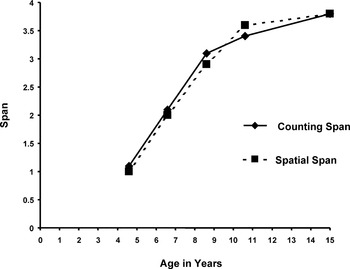
The scores for 4.5- to 15-year-old children on the number of items that can be held in mind (span) on the counting-span and spatial-span tasks. The data for the counting-span task are adapted from Crammond (1992) and those from the spatal-span task are adapted from Menna (1989). From “Normal development of prefrontal cortex from birth to young adulthood: Cognitive functions, anatomy, and biochemistry,” by A. Diamond. In Principles of Frontal Lobe Function, by D. T. Stuss and R. T. Knight (Eds.), 2002, London: Oxford University Press. Copyright 2002 by Oxford University Press. Reprinted with permission.
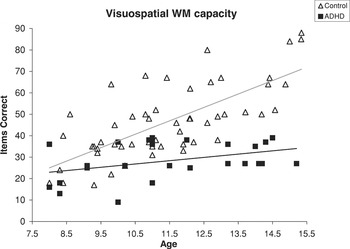
The scores for 8- to 15-year-old children with and without ADHD on the number of items that can be held in mind (span) on a visuospatial-span task. The number of participants in the study was 80. The linear regression lines are for children with ADHD (darker line) and the control group (lighter line). WM, working memory. From “Visuospatial Working Memory Span: A Sensitive Measure of Cognitive Deficits in Children With ADHD,” by H. Westerberg, T. Hirvikoski, H. Forssberg, and T. Klingberg, 2004, Child Neuropsychology, 10. Copyright 2004 by Psychology Press (www.psypress.co.uk/journals.asp). Reprinted with permission.
 You have
Access
- 314
- Cited by