Introduction
The woody stem is unique with regard to the selective regime it exerts on the organisms living within it. Unlike many other habitats, wood provides protection from parasites and predators (Walczyńska, Reference Walczyńska2010) and sufficient and seasonally invariable amounts of food (Haack & Slansky, Reference Haack, Slansky, Slansky and Rodriguez1987). However, stem tissues contain polymers that are difficult to digest (cellulose, lignin) and lack nutrients, especially nitrogen. Therefore, animals living inside a tree stem need energetically costly adaptations for food utilisation, such as complex enzyme sets, including cellulases, which is unique in the animal world or symbiotic relationships with microorganisms (Haack & Slansky, Reference Haack, Slansky, Slansky and Rodriguez1987). The nutritional quality of a stem decreases towards the centre, with wood (xylem) being the least nutritious tissue (Haack & Slansky, Reference Haack, Slansky, Slansky and Rodriguez1987). This makes the case study of a xylem-feeder and its demanding environment an interesting system for the study of life history traits.
Generally, mutual relationships among life history traits, such as growth, development and body mass, are of fundamental importance for fitness. They define the number and size of the offspring. The achievement of large body mass and, therefore, the maximization of reproductive success is possible via a larger initial (=egg) mass or by a prolongation of time of development, but not necessarily by an increase in growth rate (Arendt, Reference Arendt1997 and references therein). Moreover, the factors selecting large body size may at the same time select for slow growth (Arendt, Reference Arendt1997). Gotthard (Reference Gotthard, Atkinson and Thorndyke2001), summarizing the results of the models by Arendt (Reference Arendt1997), Abrams et al. (Reference Abrams, Leimar, Nylin and Wiklund1996) and some other published empirical data, wrote that under conditions of limited time for growth, an optimal growth strategy depends on how fitness relates to body size, developmental time and growth rate.
The case of insects is somewhat specific with regard to their life histories. Their growth is discrete and divided into stages separated by moults, during which weight is lost (Chapman, Reference Chapman1998). Moreover, the time of the switch from the pupal to adult stage demands the synchronisation with suitable environmental conditions (Chapman, Reference Chapman1998). Age at maturity seems to play a major role for males competing for the access to females, while for females, it is size at maturity that is more important for fitness (De Block & Stoks, Reference De Block and Stoks2003). It frequently results in a size dimorphism between females and males (Fairbairn, Reference Fairbairn1997; Esperk & Tammaru, Reference Esperk and Tammaru2006). Reproductive strategy of females involves dividing the limited resources among offspring in order to maximize her fitness, while the fitness of offspring increases with the amount of energy invested in it (Smith & Fretwell, Reference Smith and Fretwell1974). Such a strategy may be affected by various physiological and environmental factors (Stearns, Reference Stearns1992; Honĕk, Reference Honĕk1993; Fox & Czesak, Reference Fox and Czesak2000). Many authors point out the considerable unexplained variance in female reproductive strategy observed across insect species (Honĕk, Reference Honĕk1993; Klingenberg & Spence, Reference Klingenberg and Spence1997; Javoiš & Tammaru, Reference Javoiš and Tammaru2004), meaning that the mechanisms behind it are still far from clear. One of the environmental factors responsible for female reproductive output is temperature, which may play a role at different developmental stages (Fox & Czesak, Reference Fox and Czesak2000; Stillwell & Fox, Reference Stillwell and Fox2005; Berger et al., Reference Berger, Walters and Gotthard2008). Detailed descriptions of the life histories of wood-feeding insects (mostly those of economic importance) have been made on several occasions (Shibata, Reference Shibata1987; Akbulut & Linit, Reference Akbulut and Linit1999; Kato et al., Reference Kato, Yamada and Shibata2000; Smith et al., Reference Smith, Bancroft and Tropp2002; Zhou & Togashi, Reference Zhou and Togashi2006), but they generally do not relate this to the evolutionary response to natural selection in this specific habitat.
The aim of the present study was to determine the life history traits of a cerambycid beetle, Aredolpona rubra (L.), such as growth rate, development time and body size at maturity. The discreteness of the growth pattern observed in insects, associated with moultings, was also taken into account. The results concerning other life history traits, namely the number and size of eggs per female, have already been detailed in Walczyńska (Reference Walczyńska2008a). However, the subject of the reproductive strategy of A. rubra was not completely explored; and, in the current study, these data were supplemented with the temperature-dependence of reproductive parameters. Walczyńska (Reference Walczyńska2008a) found the significant negative relationship of fecundity vs. time during the reproductive season, and with no relationship to female size. Here, two hypotheses are tested to explain the former result: (i) fecundity of A. rubra females depends on the temperature experienced during pupa stage; and (ii) fecundity increases with the temperature faced during the egg-laying period.
Growth, development and size were evaluated for larvae cultured at three temperature regimes under experimental conditions in a bioenergetic experiment as earlier described in Walczyńska (Reference Walczyńska2009). Simultaneous research on these three crucial life history traits allowed elucidation of the interrelations among them, while relating them to the published data on reproductive strategy enables discussion on a general life strategy of a given species. Lastly, comparison of the life history traits of cerambycid beetles made across the available literature and based on that the evolutionary consequences of occupying a particular niche inside a tree are discussed.
All in all, the three points presently studied were: (i) growth and development pattern of A. rubra; (ii) temperature-dependence of reproductive strategy of A. rubra females; and (iii) interspecific comparison of life history traits among wood-feeders. The main value of the study is a thorough examination of selection forces in a system consisting of a demanding habitat and a ‘living-in’ organism. The life history of a wood-feeder is described as resulting from the evolutionary pressure of environmental factors, such as food quality, temperature and mortality, while the interspecific comparison within a guild reveals the sources and consequences of habitat heterogeneity. Different patterns of growth and development among living organisms constitute one of the main interests of evolutionary biologists (Stearns, Reference Stearns1992; Abrams et al., Reference Abrams, Leimar, Nylin and Wiklund1996; Arendt, Reference Arendt1997; Gotthard, Reference Gotthard, Atkinson and Thorndyke2001). It is so because each of them is unique and provides the better understanding of the mechanisms behind natural selection. The current research is valuable in that matter because it regards the untypical environment. Moreover, the data of growth patterns inside wood are scarce and incomplete because of the difficulty with working on that system. Finally, these results may easily be applicable to forest entomology and conservation biology.
Materials and methods
Studied species
The species studied was Aredolpona (=Stictoleptura,=Corymbia) rubra (Coleoptera: Cerambycidae), the larvae of which live within dead trees, mostly pine. This species belongs to the model community of Coleoptera in pine forests in Poland (Gutowski et al., Reference Gutowski, Buchholz, Kubisz, Osowska and Sućko2006). The adults leave the wood from June to September and live for about a further ten days (Walczyńska, Reference Walczyńska2008a). A female lays on average 200 (Walczyńska, Reference Walczyńska2008a) and up to 700 eggs (Dominik & Starzyk, Reference Dominik and Starzyk2004) in crevices of partly decayed wood. The larvae dwell in sapwood and later in heartwood. They moult six times (Walczyńska, Reference Walczyńska2010). The whole life cycle lasts 1–3 years, generally 2–3 years (Dominik & Starzyk, Reference Dominik and Starzyk2004). Like many other wood-feeding species, A. rubra has relatively slow growth and low rates of consumption and respiration, which is also reflected in the values of the bioenergetic efficiency indicators (Walczyńska, Reference Walczyńska2007, Reference Walczyńska2008b). The individuals examined in all stages of the study were collected in the Niepołomice Forest near Kraków, Poland. The larvae were removed from pine stumps, as described in Walczyńska (Reference Walczyńska2010), while the adults were collected from nylon net traps stretched out above the pine stumps, as detailed in Walczyńska (Reference Walczyńska2008a).
Growth calculation
Beetle larvae of different ages were extracted from pine stumps in April 2006, as described in Walczyńska (Reference Walczyńska2010). Each individual was assigned to a particular larval instar based on its head capsule width, for the ranges defined in Walczyńska (Reference Walczyńska2010). Larvae were kept individually in pine slices enclosed between glass plates, and all the slices were divided into three experimental groups: constant 11 °C, constant 24 °C, and seasonally changing temperature (Walczyńska, Reference Walczyńska2009). The one-year experiment was split into four parts, and all the pine slices were changed during the intervals between the successive parts (Walczyńska, Reference Walczyńska2009). Growth curves and developmental times were estimated for larvae from each treatment for the first series of the experiment (lasting from 31 May–1 June to 19–31 July, 2006), whilst the occurrence of moultings and body size of pupating larvae were recorded during the entire study. For growth rate estimation, the larvae from each temperature treatment were sorted from the smallest to the largest. The relative growth rate of each larva was calculated according to the formula (Waldbauer, Reference Waldbauer1968):
 $$RGR = ({\rm ln}M_2 - {\rm ln}M_1 )T^{ - 1}, $$
where: RGR, relative growth rate; M 2, body mass of a larva at the end of the measurement period; M 1, body mass of a larva at the beginning of the measurement period; and T, the duration of the measurement period. The use of natural logarithms in the above equation relates to the exponential character of growth generally assumed for insects (Dyar, Reference Dyar1890, after Etilé & Despland, Reference Etilé and Despland2008; Abrams et al., Reference Abrams, Leimar, Nylin and Wiklund1996; Tammaru, Reference Tammaru1998; D'Amico et al., Reference De Block and Stoks2001; Stern, Reference Stern2001; see also Tammaru & Esperk, Reference Tammaru and Esperk2007 for a critique). For further analyses, only the positive RGR values were used (54 out of 66, while from 17 larvae losing weight, six moulted in that or the next experimental series, and three pupated during that or the next series). In the next step, the time required for the achievement of a particular body size was calculated as:
 $$T = ({\rm ln}M_l - {\rm ln}M_{i - 1} )RGR_i^{ - 1}, $$
where: T, time needed to attain the body mass I; M i, body mass of a larva I; M i–1, body mass of a previous (=smaller) larva in the dataset; and RGR i, relative growth rate of a larva i. In this way, growth curves specific for given temperature regimes were obtained. In addition, data from Walczyńska (Reference Walczyńska2007), calculated in the same manner, were incorporated for comparison. Larvae in that experiment were reared at a constant temperature of 17 °C, under conditions similar to natural ones.
Developmental observation
During the entire experiment, larvae were checked for moultings about once every week. Two parameters were noted for each moulting larva: (i) body mass from the beginning of the measurement period; and (ii) the mean head capsule width for this period. Next, the time required to reach the body mass achieved at each moult was calculated from the growth curve equation, estimated as described in a previous paragraph. The time values were further used to present graphically the head capsule width, matching the body mass for a given moulting, as a function of time, for each individual independently.
In the case of pupation, a pupa and the chitin remnants were weighed. The pupa was then placed in a 30–35ml plastic container, lined with moist tissue paper. The duration of the pupa stage, body mass and the sex of the adult were recorded. Moreover, sex differences in weight loss during pupation were assessed using the three mass ratios: chitin remnants to pupa, pupa to larva and adult to larva.
Temperature dependence of reproductive strategy
The effect of temperature on female reproductive output was examined to explain the result of Walczyńska (Reference Walczyńska2008a) on decreasing female fecundity vs. time during the reproductive season. Reproductive parameters taken from Walczyńska (Reference Walczyńska2008a) were checked for a standard linear relationship with temperature. Dependent factors were associated with the number of eggs laid (three variables: number of eggs, number of eggs per day, number of eggs per day and per unit of female size given in mm of forewing length), and the mean body mass of newly hatched larvae (two variables: mean body mass and mean body mass per unit of female size). Independent factors in the analyses were: (i) mean temperature for a period of two weeks preceding the eclosion of an adult, in order to estimate an effect on a pupa stage, and (ii) mean temperature for a period of eggs deposition. Because of the small sample sizes, each parameter was analyzed independently (N = 10 analyses in total). The analyses were conducted in Statistica 8 software.
Climatic data
The climatic data used derived from the Łazy Meteorological Station, about 15km south-east of the site of adult collection, for the pupa period, and the Krakow Meteorological Station for the egg-laying period (adults used in an earlier purely reproductive study (Walczyńska, Reference Walczyńska2008a) were caught in the field just after eclosion and cultured in Krakow in outdoor environmental conditions). In both cases, the mean temperature was calculated from the daily means.
Results
Growth and development
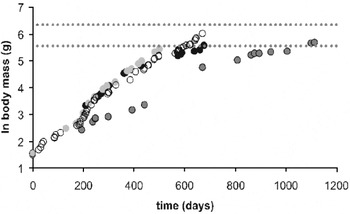
The curves for 17 °C, seasonally changing temperature with a mean at 21 °C, and 24 °C are similar (fig. 1). Accordingly, larvae would need about 600 days to reach the body mass required for pupation, as indicated by the horizontal dotted lines (the means for males and females pupating during the study), while larvae from 11 °C would need about 1000 days to achieve this state. In the case of the oldest larvae, a deceleration of growth rate was observed for both 17 °C and 24 °C treatments.
Growth curves of A. rubra larvae from different temperature treatments (detailed description in the text). The mean for the whole period of measurements in the seasonally changing temperature treatment is 21 °C. Dotted horizontal lines depict the mean body mass of larvae pupating during the experiment (males: lower value; females: higher value). Values on x-axis present estimated age of larvae ( 11 °C; ○ 17 °C;
 21 °C; ● 24 °C).

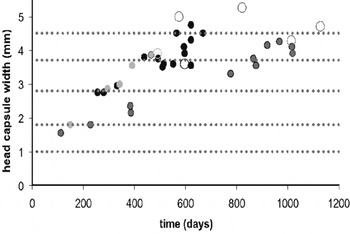
During the course of the experiment, 42 larvae moulted. The ages of moulting larvae are shown in fig. 2. This relationship presented together with the ranges of head width values delimiting the subsequent larval instars (horizontal dotted lines), as defined in Walczyńska (Reference Walczyńska2010), show relatively good correspondence (fig. 2). Some mismatches are visible in the case of older instars which could be caused by significant variability in this age-group or by the inaccuracies in head width measurement, as discussed in Walczyńska (Reference Walczyńska2010).
The head capsule width value (y) and the calculated age of larvae (x) moulting during the course of the experiment (description in the text). The mean for the whole period of measurements in the seasonally changing temperature treatment is 21 °C. The open circles represent mean values for the larvae which metamorphosed into males (lower value) and females (higher value) in each treatment of the experiment independently. Dotted horizontal lines delimit the ranges of head capsule width for subsequent larval instars, as estimated in Walczyńska (Reference Walczyńska2010) ( 11 °C; 21 °C; ● 24 °C).

Based on 28 larvae pupating during the experiment, an increase in the duration of the pupa stage with decreasing temperature (from about 1.5–2 weeks at 24 °C to 8–12.5 weeks at 11 °C) was recorded. However, the temperature itself did not influence the successful completion of this stage – in both treatments, the success of metamorphosis from larva to adult was about 70%.
The loss of mass associated with the disposal of chitin remnants during metamorphosis was similar for both sexes (about 2.5%). The overall weight loss during metamorphosis to the pupa stage consisted of about 25% of mass for each sex, whilst weight loss associated with metamorphosis from larva to adult was higher in males (57% of mass) than in females (41%). The mean body mass of females at maturity was 0.296g (0.214–0.402g; N = 6), while the mean for males was 0.109g (0.057–0.246g; N = 12). The mean head capsule width of larvae before pupation in females was 4.9mm (4.3–5.5mm; N = 8), whereas in pupating males this value averaged 4.0mm (3.2–4.8mm; N = 17). The average head capsule width for males and females from each treatment are presented as open circles in fig. 2.
Discussion
Life history traits of A. rubra
The analysis of temperature-dependent growth curves reveals two important points: (i) a similar course of the curves in the temperature range from 17 °C to 24 °C may signify some level of growth canalization; and (ii) mismatches from the general pattern found in the last instars (figs 1 and 2) corroborate Tammaru & Esperk's (Reference Tammaru and Esperk2007) conclusions that the relative growth rate of insects is slower in the last instar. Generally, the results obtained show clearly that developmental time in this species lasts several years. Based on the growth curve estimated for 11 °C and on the information that the annual temperature in the Niepołomice Forest averages 8 °C (Suliński, Reference Suliński and Kleczkowski1981), A. rubra's development time for this population was estimated to be three to four years.
Sex-based differences in the final head capsule width of metamorphosed larvae suggest that females moult at least one more time than males. In consequence, the mean body mass of females constitutes more than double the body mass of males. Weight loss during metamorphosis from larva to adult was found to be higher in males, but differences did not occur until the pupa-to-imago phase. This may be caused by the more wasteful strategy of males, the body mass of which is not as strictly related to fitness as in females (Nylin & Gotthard, Reference Nylin and Gotthard1998).
As stated by Arendt (Reference Arendt1997), under some circumstances slow growth may be advantageous. However, according to the existing literature (e.g. Haack & Slansky, Reference Haack, Slansky, Slansky and Rodriguez1987 and references therein) it seems that in the case of wood-feeders, plasticity in growth rate (at a level of an individual) is highly restricted. In consequence, the strategy that allows for attaining a large body size could be either large initial body mass or prolonged development. Because the habitat within woody stems is relatively safe (Walczyńska, Reference Walczyńska2010) but very difficult to attain for larval recruits (Banno & Yamagami, Reference Banno and Yamagami1991 and references therein; Walczyńska, Reference Walczyńska2008a), the optimal strategy for an average wood-feeder is to lay many eggs of small size and to opt for a prolonged development time.
The role of temperature in reproductive strategy
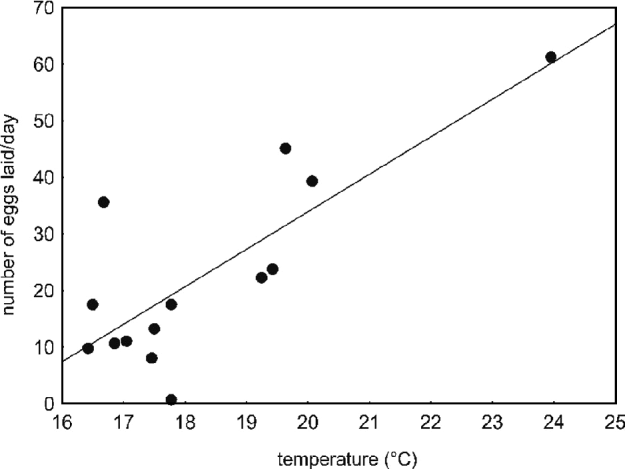
The results of the analyses of the temperature effect on reproductive parameters of A. rubra females show: (i) a lack of a relationship between the examined reproductive variables and temperature during the pupa stage; (ii) an increase in the number of eggs laid with rising temperature during the egg-laying period, with the most significant results obtained for the number of eggs laid per day (R2 = 0.63, P = 0.0007; fig. 3); and (iii) a tendency to increase body mass in newly hatched larvae with rising temperature during the egg-laying period (R2 = 0.23, P = 0.0805). However, temperature is highly correlated with the progress of time during the reproductive season (R2 = 0.48; P = 0.0057), suggesting that temperature may not be the only factor responsible for the relationship between fecundity vs. time during the growing season.
The relationship between the individual number of eggs laid per day (Walczyńska, Reference Walczyńska2008a) and the mean temperature during an egg-laying period).

The strong relationship of fecundity in A. rubra females vs. time during the reproductive season (females that eclose early in a season lay more eggs than those eclosing late), as described by Walczyńska (Reference Walczyńska2008a), could be partly explained by the effect of temperature on females during the egg-laying period, but not during the pupa period, therefore supporting hypothesis (ii). Moreover, an increase in the total amount of resources, concerning both the number and size of eggs, was noted with increasing temperature, which was previously recorded also for Drosophila spp. (Avelar, Reference Avelar1993, after Ernsting & Isaaks, Reference Ernsting and Isaaks1997). Lastly, the stronger effect of temperature on fecundity than on egg size is in agreement with a theoretical model by Winkler & Wallin (Reference Winkler and Wallin1987), who showed that the variability in the amount of resources allocated to each offspring should be lower than that allocated to total reproductive output.
An interesting feature is the importance of the length of the egg-laying period on temperature-dependent fecundity, although these variables were not related when temperature was not included in the analysis (Walczyńska, Reference Walczyńska2008a). This phenomenon could be explained in two ways: (i) activity during egg-laying depends on the quality of a female, i.e. her expected lifetime duration, while the possibility of such prediction of lifetime duration was recorded, e.g. by Javoiš & Tammaru (Reference Javoiš and Tammaru2004) for a lepidopteran species, the Shaded Broad-bar moth, Scotopteryx chenopodiata (L.), or (ii) high temperature produces an increase in the activity of a reproducing female, which is energetically costly and shortens her lifespan (e.g. Berger et al., Reference Berger, Walters and Gotthard2008).
In summary, temperature during the egg laying period, but not that experienced by a female during the pupal stage, seems to be responsible for the negative relationship between fecundity vs. time during the growing season, as earlier found by Walczyńska (Reference Walczyńska2008a). Yet, the two environmental factors are clearly correlated (although the sample sizes were too small to check for the residues of temperature after removing time effect). This probably means that the exact time in a season when a female ecloses is of key-importance in terms of female fitness. Another factor influencing the relationship found may be the decreasing body mass of females with season, which was not recorded in Walczyńska (Reference Walczyńska2008a), probably because of the small sample sizes then used, but was one of the results of a theoretical model of A. rubra's life history optimization (Walczyńska et al., Reference Walczyńska, Dańko and Kozłowski2010).
Interspecific comparison
Another factor potentially responsible for the pattern of reproductive strategy in A. rubra, discussed in Walczyńska (Reference Walczyńska2008a), is the breeding strategy. Organisms using for their reproduction the energy stored during growth are called after Stearns (Reference Stearns1992), ‘capital breeders’ as opposed to ‘income breeders’, using energy acquired during the reproductive period. The comparison across Cerambycidae shows that taxonomic position is the most important discriminating factor; for example, the subfamily Lamiinae represents income breeding (Linsley, Reference Linsley1959; Shibata, Reference Shibata1987; Smith et al., Reference Smith, Bancroft and Tropp2002; Togashi, Reference Togashi2007), whereas the Cerambycinae exhibit a capital breeding strategy (Shibata, Reference Shibata1987). Aredolpona rubra (subfamily: Lepturinae) seems to show a capital breeding strategy because of its relatively short adult lifespan (Walczyńska, Reference Walczyńska2008a) and the onset of egg laying soon after a female's eclosion and copulation (A. Walczyńska, personal observation). Thus, this issue seems to be dependent on phylogeny rather than on the niche occupied by the species inside a tree, because according to the literature, subfamilies of Cerambycidae are not restricted to particular woody tissues. The similar tendency of taxonomic dependency of breeding strategy was previously found in Lepidoptera (Tammaru & Haukioja, Reference Tammaru and Haukioja1996).
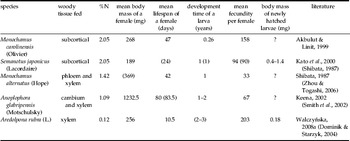
Lastly, reproductive parameters of A. rubra were compared with available data for other cerambycid species (table 1). Despite the small sample sizes and a lack of complete data sets, some patterns are clearly discernable. Females of bigger species tend to live longer as imagos than females of smaller species (R2 = 0.75, P=0.0578), while maximal development time of larvae depend on the quality of woody tissue of living (R2 = 0.90, P = 0.014). The latter corroborates the results in Walczyńska (Reference Walczyńska2010), though the lists of species compared here and then only partially overlap. The lack of any other relationships with body mass and wood quality may well be caused by the considerable variability of reproductive traits, such as fecundity. The values given in table 1 are mostly the averages from the results of experiments taken under different conditions. For example, the coefficient of variation (CV) of mean fecundity per A. glabripennis female, calculated across five datasets (Keena, Reference Keena2002 and citations therein), was 62%, while the CV of a respective female's lifespan was only 32%.
Reproductive parameters of cambio- and xylophagous cerambycids according to the available literature.

The %N values indicate the mean nitrogen content in a given woody tissue fed (calculated as in Walczyńska, Reference Walczyńska2010). Values given in parentheses derive from the articles cited in parentheses.
Conclusions
To sum up, the current study, together with the previously published data on reproductive strategy of females, give a complete view of a life history of a xylophage, A. rubra. Particular life history trait patterns are in accordance with the general view of the characteristics of a wood-feeder (slow growth, long development, relatively big size: e.g. Haack & Slansky, Reference Haack, Slansky, Slansky and Rodriguez1987), though research on the whole life history in an evolutionary context gives a remarkable insight into that subject. The xylem-feeder's life history is driven by the low quality of food on the one side and relatively low predatory pressure on the other, and the reproductive strategy is to lay many small eggs, whilst a moment of eclosion within a reproductive season is crucial for fitness in view of temperature experienced during egg-laying period (Walczyńska et al., Reference Walczyńska, Dańko and Kozłowski2010 and the present study).
Furthermore, an interspecific comparison within wood-feeding guild illustrates that wood as a habitat is not only pretty demanding for its inhabitants but also heterogenic; the life strategy of a species changes with the horizontal depth of its wood boring niche (Walczyńska, Reference Walczyńska2010 and the present study). The knowledge gained in the current study may be applied to both pest control in forestry and conservation of rare and endangered insect species.
Acknowledgements
I thank Richard Shefferson and Hugh Loxdale for editing the text and for very helpful comments on a previous version of the manuscript. The meteorological data were kindly provided by the Institute of Geography and Spatial Management, Jagiellonian University. The work was supported by the Polish Ministry of Science and Higher Education, grant 2 P04C 083 28.