Introduction
Guinea has a very long traditional history of rice growing. Eustache de la Fosse, in his 1479–1480 travelogue Voyage à la côte occidentale d'Afrique, mentioned that rice was being cultivated on a large scale in Guinea – this was long before the Portuguese introduced Asian Oryza sativa rice varieties to the country. In 1885, Steude described the African cultivated rice species Oryza glaberrima from a sample collected in Guinea (Godon, Reference Godon1991). Currently, rice is cultivated on an area of 600,000 ha, representing more than 40% of the total cultivated area of Guinea. The per capita rice consumption level of 90 kg/year is one of the highest in Africa. National demand for rice is rapidly increasing, but improvements in productivity are sluggish. The rise in national production is due mainly to the expansion of the rice-growing area rather than to any increase in crop yield (ORIZA-Guinée, Reference Oriza-Guinée2005).
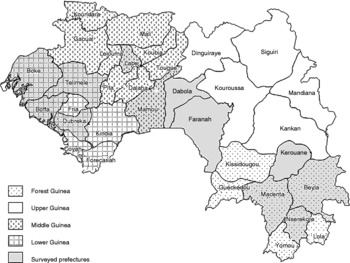
Rice is grown throughout Guinea (Fig. 1). Slash-and-burn cropping of upland rice is the most widespread practice, accounting for 65% of the rice-growing area. It is used in all regions, but particularly in forest Guinea (FG) and middle Guinea (MG), in a broad range of morpho-pedological units, rainfall regimes and soil fertility levels. Lowland rice cultivation in freshwater (fluviomarine plains, inland floodplains and lowlands) under highly varied soil water conditions (shallow to deep water and even floating rice, groundwater rice, irrigated rice with various degrees of irrigation control) is important in upper Guinea (UG) and Maritime or lower Guinea (LG). The ‘mangrove’ rice cultivation, with many variants depending on the extent of salinity control measures, represents 16% of the total rice-growing area and is limited to LG (Boun et al., Reference Boun, Souaré, Bah and Bayo2001). This high diversity in rice-growing ecosystems makes Guinea an important reservoir of rice genetic diversity in West Africa (Ghesquière and Second, Reference Ghesquière and Second1983). The country is a centre of diversification of the cultivated species O. glaberrima (Portèrs, Reference Portèrs1950) and has been proposed for in situ conservation of African rice varieties (Bezançon, Reference Bezançon1995).
Distribution of the 16 prefectures where villages and farm were surveyed in the four natural regions of Guinea.

For several decades, improved rice varieties have been disseminated (Dalton and Guei, Reference Dalton and Guei2003), and the Institut National de Recherche Agronomique de la Guinée (IRAG) has selected and disseminated high-yielding varieties suitable for each type of rice cultivation system and each natural region of the country. In 1996, IRAG, in collaboration with the Service National de la Promotion Rurale et de la Vulgarisation (SNPRV) and the West African Rice Development Association (WARDA), began a large-scale participative assessment and dissemination of new upland rice varieties created by WARDA. These varieties, derived from interspecific O. sativa × O. glaberrima crosses, are known by the generic name NERICA, i.e. ‘new rice for Africa’ ( Jones et al., Reference Jones, Dinkuhn, Aluko and Semon1997). The experience of the Green Revolution in Asia showed how the introduction of improved rice varieties can lead to the disappearance of local varieties (Bellon et al., Reference Bellon, Pham, Jackson, Maxted, Ford-Lloyd and Hawkes1997). In Guinea, the impact of the introduction of new improved varieties on the diversity of local rice varieties is thus a serious concern. To assess the situation, we conducted a survey of the varietal diversity of rice used and preserved in situ by farmers in the four natural regions of the country.
Apart from the number of varieties cultivated per farm or village, there is very little published information on descriptors of in situ diversity of cultivated species. We attempted to fill this gap by adapting the Simpson's biodiversity indices (Simpson, Reference Simpson1947; Maguran, Reference Maguran1988) used to describe the diversity of species in natural environments. Here, we present our survey results, propose new parameters and concepts for describing the in situ varietal diversity of cultivated species, and analyse the status of rice in situ diversity in Guinea in terms of risk of erosion.
Materials and methods
Sampling of villages and farms
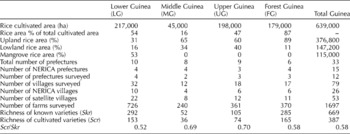
In each of the four natural regions of Guinea, the prefectures in which NERICA rice varieties were recently introduced in one or several villages were identified and one or two of these villages (hereafter called NERICA villages) were selected randomly (Fig. 1). For each selected NERICA, two to three neighbouring villages (hereafter called satellite villages) known to trade with the NERICA village were also sampled. The satellite villages represented almost 70% of the total number of surveyed villages. The total number of villages surveyed in each region was about 5% of the total number in the region. In each selected village, about 10% of the total number of village farms was sampled randomly. In all, 1697 farms in 79 villages were assessed (Table 1).
Sampling information and rice cultivation data in the four regions of Guinea

Survey on the knowledge and use of rice varieties
Inventory of known varieties at the village level
In collaboration with a focus group of knowledgeable rice farmers, a list of all rice varieties which had existed in the village was drawn up to constitute the list of known varieties in the village or village's richness of known variety (Skv). The farmers were then asked to classify each of the varieties on the list in one of the following categories: local variety (LV), improved variety (IV) and NERICA variety.
Quantification of rice varieties use at the village level
After the Skv were drawn up, each surveyed farmer was interviewed in order to determine his or her knowledge of each variety in the Skv list and, for each year over the period 1996–2001, those Skv varieties that had been cultivated (Scf). The survey was carried out in 2002 in FG and LG, and in 2003 in MG and UG. A use frequency matrix was determined for each variety known in the village and for each year of the survey period.
Data analysis
The following indicators of variety use and diversity index were calculated on a village scale for each year of the survey and for each type of variety, LV, IV and NERICA: the number of cultivated varieties or richness of cultivated variety (Scv), the mean number of varieties cultivated per farmer (Scf), Shannon's diversity index of cultivated varieties of the village (Hcv) and the evenness index of cultivated varieties of the village Ecv = exp(Hcv)/(Scv) (Maguran, Reference Maguran1988). Regional differences were assessed for each indicator, and each type of variety through ANOVA using village scale data.
Identification of major and minor rice varieties in the villages
In each village, each cultivated variety was classified in the ‘major variety’ category when the number of farms in which it was cultivated in 2001 was over 50% of the farms surveyed in the village, or in the ‘minor variety’ category when it was below 50%.
National and regional inventory of the number of distinct rice varieties
The per-village lists of richness of known and cultivated varieties, Skv and Scv, were pooled to obtain regional lists of the number of known varieties (Skr) and the number of cultivated varieties (Scr). Finally, the regional lists were pooled to obtain a national list.
Results
Varietal diversity at village levels
Varietal richness
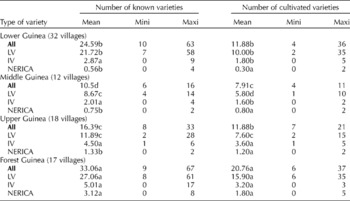
The richness of known varieties at the village level (Skv) varied significantly (P>0.001) according to regions, despite significant intra-region variability (Table 2 and Supplementary Table S1). FG was by far the top region, with a mean Skv of 33 and a maximum Skv of 67, while MG had the lowest Skv. The number of known LV and IV was proportional to the total Skv. In all regions and villages, LV accounted for a major share of the Skv, i.e. 72–88%, while NERICA varieties represented around 10% of the known varieties, except in LG where they only represented 2% of the Skv. The differences between regions for Skv paralleled differences noted in the extent and history of rice growing in the regions.
Number of known and cultivated varieties per village in 2001 in the four regions of Guinea
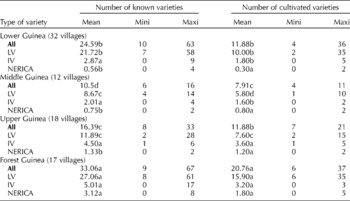
LV, local varieties; IV, improved varieties; IV include NERICA. For a given category of variety, mean values of known varieties or cultivated varieties followed with the same letter (a, b, c or d) are not significantly different.
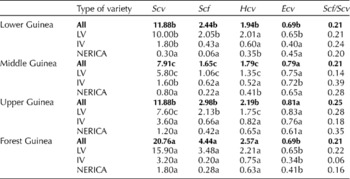
The variation in the number of cultivated varieties per village (Scv) resembled the Skv patterns, but the differences, although highly significant (P>0.001), were not as great between regions (Table 2). Here again, FG was by far the top region, with a mean of more than 20 Scv (maximum 37) per village in 2001, while in MG, the mean Scv was only 7.9 for the same year. In all regions, LV accounted for 80–85% of the Scv, except in the UG region, where they only represented 68%. NERICA varieties represented about 10% of the cultivated varieties except in LG (only 3%). Shannon's diversity index H calculated at the village level (Table 3 and Table S2) confirmed the Scv variation pattern. Inter-region differences are highly significant. The highest Hcv values were observed in FG and the lowest MG and UG. Intra-regional variations in Hcv index remained important. Since sample size or richness has an influence on the value of the diversity index, it was not possible to compare Hcv value for different categories of varieties.
Use rate of varieties and diversity index in 2001 calculated at the village level for the four regions of Guinea

LV, local varieties; IV, improved varieties; IV include NERICA; Scv, number of cultivated varieties per village; Scf, number of cultivated varieties per farm; Hcv, Shannon's diversity index of cultivated variety per village; Ecv, Shannon's index of evenness of cultivated variety per village. For a given parameter, mean value of variety of the same categories followed with the some letter (a, b or c) are not significantly different (P>0.001).
The average Scv/Skv ratios calculated at the village level varied markedly between regions: 47% in LG and 70% in MG for all the varieties, and 46% (LG) to 67% (MG) for LV. The ratios were higher for modern varieties, ranging from 62% in LG to 80% in UG. Inter-regional variability in the Scv/Skv ratio was especially high: 56, 60, 87 and 100% in FG, LG, UG and MG, respectively.
Recent evolution of varietal richness at the village level
The Scv increased in all regions during 1996–2001 (Table 3) ranging from 25 to 33% according to region. Both LV and IV were affected, but the latter to a much greater extent (40–80%) as compared to LV (around 10–30%). The relative increase in IV seemed to be much less marked in the two main rice-growing regions, i.e. FG and LG.
NERICA cultivation, which was nil in 1996, rose sharply over the 1996–2001 period, but the patterns varied between regions. In 2001, these varieties accounted for 19% of IV in LG to more than 55% in FG. The number of non-NERICA IV also increased from 10% in FG to 50% in UG. The NERICA contribution to the IV Scv increase thus varied considerably between regions: 40% in LG and UG, 60% in MG and 80% in FG.
Varietal use and evenness of varietal diversity
The number of varieties cultivated by each farmer (Scf) varied significant (P>0.001) according to region (Table 3). The mean Scf for FG villages was 4.44, with a maximum of 100, whereas the mean Scf were about 2.50 in LG and UG and only 1.65 in MG. There also was a relatively high intra-regional variability in Scf. In some UG villages, not all farms cultivated rice and, thus, the Scf was less than one.
The Scf/Scv ratios were small, 20–34%, and varied little between regions when all the varieties were taken into account. Regional differences in the Scf/Skv ratio were greater for IV (6–39%) and NERICA (16–36%). In a given region, the Scf/Skv ratio was not the same for the different rice variety categories (LV, IV and NERICA), but no general trend was noted, and it was never over 40% for any category or in any region.
The evenness index (Ecv) calculated at the village level (Table 3) is generally much less than one, indicating a high variability in the number of farmers cultivating each of the varieties cultivated in the villages. The inter-regional differences of Ecv are significant (P>0.05); the highest values are observed in MG and UG regions. In these regions, the relatively low varietal richness Scv was compensated by a higher use rate of each variety. This could reflect that in these regions the cultivation conditions were not as diversified, or that there was a lower level of technical know-how or requirements with respect to rice varieties. The very low minimum values of Ecv index in each region highlighted the presence in each region of villages where no IV was cultivated.
Substantial differences in Ecv index according to the varietal categories exist. The higher Ecv index obtained in MG and UG for improved varieties suggests that there were a small number of IV in each village but each IV was cultivated in a greater proportion of farms.
There were considerable differences between and within regions in the number of major varieties per village (Table S3). FG was by far ahead, with a mean of 2.7 major varieties per village and a maximum of 10 major varieties, whereas the number of major varieties was only 0.75 in MG. Major varieties represented, on average, 10–15% of the varieties cultivated in each village. However, some villages in all regions had no major varieties. Most of the major varieties came under the LV category. Depending on the regions, IV accounted for only 10–30% of the major varieties in the villages, while NERICA represented only 5% of the major varieties, except in MG, where they represented 30%.
Varietal diversity at regional and national levels
Varietal richness at the region level
The total number of known distinct varieties (Skr) and of cultivated distinct varieties (Scr), identified in the sample of 1697 farms surveyed in the four regions, were 669 and 387, respectively. The absolute values of varietal wealth, in terms of both Skr and Scr, were much higher in the FG and LG regions when compared with the two other regions (Table 1). But when the number of surveyed farms is also considered, the difference of LG decreased for Scr. The Scr/Skr ratio was 58% on a national scale, and varied markedly between regions, i.e. from 52% in LG to 70% in UG.
Regionally and nationally eminent rice varieties
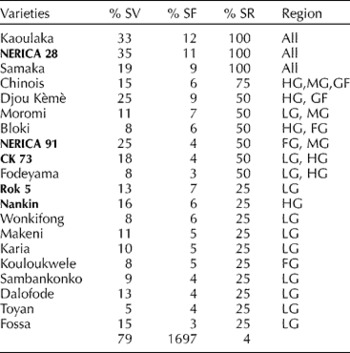
The lists of the 20 rice varieties cultivated by the highest number of surveyed farms in each region and at the national scale are presented in Table 4 and Table S4. In LG, no variety was cultivated in more than 50% of the villages, while this was the case for at least three to four varieties in the other regions. In FG and UG, regionally eminent rice varieties were found to be cultivated in 75% of the villages. Almost all of the 20 most-cultivated varieties of each region were grown in more than 20% of the villages in the region. However, a much lower proportion of farms cultivated the most eminent variety of each region, ranging from 16 to 31% depending on the region. Only six regionally eminent rice varieties were cultivated on more than 10% of the farms in LG, MG and UG, with 12 recorded in GF.
List of the 20 most eminent rice varieties at the national level

LG, Lower Guinea; MG, Middle Guinea; UG, Upper Guinea; FG, Forest Guinea. % NSF, % NSV and % NSR, respectively, percentage of surveyed farmers, villages and regions, out of the total, cultivating the variety. Variety name in bold: improved variety.
There was no systematic correlation between the regional eminence and the status of ‘major variety’ on an individual village scale. For instance, in FG, NERICA 91 was present in 76% of the villages but only cultivated on 11% of the farms. Since it was widely disseminated, this was a regionally eminent variety but it was not a major variety on an individual village scale. In the same region, the Samaka variety was present only in 53% of the villages but cultivated in 31% of the farms. The regional notoriety of Samaka was based on the fact that it was a major variety in several villages.
LV accounted for 70–85% of the 20 regionally eminent varieties, as also observed at the village level. NERICA varieties, on the other hand, only represented 5% of the varieties in LG, MG and UG, and 10% in FG.
There were a very low number of nationally eminent varieties. Only eight varieties were present in more than one region, and only three of them were present in all four regions and cultivated on more than 10% of the surveyed farms. The five leading nationally eminent varieties were also those cultivated in the greatest number of villages and farms.
Of the 20, five varieties cultivated on the highest number of farms nationally were improved varieties, while two were NERICA, with NERICA 28 ranking second nationally eminent variety. Most of the LV on this list had, at some time in the past, undergone mass selection in research stations and had been disseminated by the extension services.
Discussion
The present survey of varietal diversity, conducted simultaneously on a farm, village, regional and national scale, is one of the first, if not the first, assessment of this kind on cultivated plants in general, and specifically on rice. The names of the varieties, farms and villages were carefully recorded, thus facilitating future time course studies on the evolution of rice varietal diversity in Guinea.
Our village sampling was biased by our initial decision to focus the study in and around villages where new upland rice varieties had recently been disseminated. This choice was based on the hypothesis that these villages only differed from others by the fact that they had been included in the new improved rice variety dissemination operation and that this operation increased the risk of loss of local varieties. For logistical reasons, the prefecture sampling was not evenly balanced between regions, but the total number of surveyed villages and farms was proportional to the relative extent of rice growing in the regions. The results thus provide a baseline estimation of regional diversity.
The basis of our analysis is variety name, but because in traditional cropping systems, a given genotype can be commonly known under different names in different villages, so diversity with respect to names is often an unreliable indicator of prevailing genetic diversity. However, in a parallel study characterizing 170 accessions collected in 14 villages of LG, with 12 molecular markers, Barry (Reference Barry2006) did not identify any accessions of the same genotype under different names, while the majority of accessions having the same name did have the same or rather close genotypes. This good consistency of varietal names confirms the reliability of the name based analysis in the case of rice in Guinea.
Current rice varietal diversity in Guinea
The numbers of cultivated varieties recorded in the farms and villages were comparable to those published previously (Lambert, Reference Lambert1985; Dennis, Reference Dennis1987; Vaughan and Chang, Reference Vaughan and Chang1992; Lando and Mak, Reference Lando and Mak1994; Kshirsagar et al., Reference Kshirsagar, Pandey and Bellon2002; Pham et al., Reference Pham, Morin, Sebastian, Abrigo, Calibo, Quilloy, Hipolito, Jackson, Engels, Brown and Jackson2002), i.e. several dozens of rice varieties per village and several varieties per farm in different Asian countries. The number of known and cultivated varieties per farm, per village and per region seemed to be closely related to the history and extent of rice growing in the region and to he importance of rice in the local diet. Rice resources were therefore most diversified in LG and FG, where rice is a staple food, as compared to the much lower rice varietal diversity in MG and UG regions where fonio (Digitaria exilis), sorghum and millet are the main traditional staple foods. These regional differences reflect actual varietal richness, as the relationship between name based varietal diversity and genetic diversity is good (Barry, Reference Barry2006), but it may also reflect the fact that in LG and FG, farmers perceive varietal diversity in a more dissected form than in MG and UG.
The Scf/Scv ratio ranged from 0.06 to 0.4 and the evenness index Ecv values were much lower than the maximum of 1.0. This indicated that the proportions of farmers who used each variety of the village were low and heterogeneous. The Ecv values were relatively high for improved varieties, specially in UG and MG indicating that, in these regions, the improved varieties were used by a important and homogeneous proportion of farmers.
The major and minor varietal classification confirmed the information derived from the diversity index. Only a small proportion of varieties (10–15% overall) were cultivated by more than 50% of the farmers in each village, while the other varieties were each only cultivated by 5–20% of the farmers.
According to the survey of regionally and nationally eminent varieties, few varieties were present in several villages within a region or in several regions within the country. Even regionally and/or nationally eminent varieties were seldom cultivated by more than 10–15% of the farmers at the scale considered. Moreover, most of these varieties, either LV or IV, had recently been disseminated by the extension services. The situation in Guinea therefore differs substantially from the overall setting in Asia where the Green Revolution has led to the adoption of a small number of IV by a high percentage of farmers, leading to the disappearance of many LV.
The current rice varietal diversity pattern observed at different scales is typical of the subsistence farming system. The farm is clearly the basic decision unit regarding diversity management. The rather important varietal diversity maintained at the individual farm level reflects the multiplicity of constraints (heterogeneities of the cropping environment, constraints of cropping practices, etc.) and/or objectives (harvest for the shortage period, grain quality, etc.) farmers have to face. The high share of LV among the diversity managed by individual farmers reflects the predominance of low management and low input cropping systems. The presence of improved varieties confirms the farmers' openness to innovation and to the government policy of promoting improved varieties, as far as they answer their concerns.
Village varietal diversity is mainly the addition of the diversity managed by individual farmers. The differences between Scf and Scv as well as the low values of the E index reflect the diversity of the rice-growing environments at the village level and the diversity of farmers' cropping strategies. However, the implementation of the individual farmers' strategies and related varietal maintenance decisions rely upon the diversity and varieties exchange mechanisms prevailing at the village level.
Regional diversity reflects the agro-ecological diversity and specificities of each region, as well as the history and the extent of rice-growing systems, and the importance of rice in the local diet. For instance, the high diversity observed in FG is mainly related to the age and the extent of upland rice cropping in a relatively homogenous forest ecosystem, while, in LG, it is related to the diversity of rice-growing ecosystems composed of uplands, fresh water lowlands and mangroves areas. Regional diversity indirectly determines the amount of diversity at the individual village and farm levels, because informal exchanges of varieties among neighbouring villages and farms remain the main way of access to new rice varieties.
Recent changes and future prospect for rice varietal diversity in Guinea
The survey of Scv over the 1996–2001 period highlighted an increase in the number of rice varieties cultivated per farm and per village in the four regions. Many phenomena, which may differ for the different varietal categories, could explain this apparent increase. For LV, it is likely that the Scv increase was mainly associated with the survey method, which was based on farmers' recollection of practices over several previous years. Farmers more accurately recalled varieties that they had cultivated in 2001 (the year before the survey) than those they grew 7 years earlier. The increase in Scv of IV was partially associated with the recollection effect noted above and by the vigorous extension operations undertaken by SNPRV, with the support of IRAG and WARDA. These operations involved a broad range of IV, not solely NERICA varieties, so there was a concomitant increase in the adoption of non-NERICA IV. Contradicting the Scv evolution patterns, the Scv/Skv ratios, which ranged from 0.45 to 0.87, indicated a substantial varietal loss. Actually, the differences observed between Scv and Skv highlight the dynamic aspect of in situ use and conservation of rice varieties in Guinea. Farmers regularly introduce and test new varieties, and then they keep or reject them, which means that they are familiar with many more varieties than they actually cultivate.
Several new upland rice IV, especially NERICA 28 and NERICA 91, have become regionally and/or nationally eminent varieties within 6–7 years. These figures underline the efficiency of government policies to influence farmers' decisions, as these varieties were only recently disseminated by the extension services. They also raise concerns about the conservation of pre-existing varieties. Many reassuring answers can be proposed to such concerns. First, over the last years, the extension services have also contributed to the wide dissemination of some LV varieties, bringing them up to the status of regional or nationally eminent varieties. Second, regionally and/or nationally eminent varieties were seldom cultivated by more than 10–15% of farmers at the scale considered. Third, the number of cultivated varieties did not decrease in the farms or in the villages during this period. And fourth, the new IV varieties adopted by farmers – on account of the positive selective value of their features – complement, rather than compete with, the pre-existing varieties. Our initial field observations seem to confirm this complementarity. The short growth cycle of these new varieties makes them especially attractive since early harvests are beneficial during shortage periods. They also give farmers more cropping flexibility and enable them to increase the rice-growing area on their farms, or even to expand into zones where the rainy season is shorter. This is especially the case in MG where, because of their short cycle, new IV have been integrated into potato-based cropping systems, thus substantially increasing the upland rice-growing area. These new IV give farmers an opportunity to broaden the range of rice varieties with different crop cycle lengths on their farms.
Likewise, in the short term, the introduction of IV seems to be an enhancing and not a threatening factor to varietal diversity. However, it is difficult to predict the medium and long-term effects. A detailed survey of rice varieties in two LG villages indicates a 25–45% increase in the number of cultivated varieties per village between 1980 and 2002 (Barry, Reference Barry2006). It also indicates that LV, especially the major ones, was exposed to genetic contamination. Therefore, the medium and long-term effects of the introduction of new varieties need to be monitored not only in terms of LV replacement but also in terms of their adulteration.
Another trait of the current rice varietal diversity which should be taken into account when considering the prospects of in situ conservation is the heterogeneity in the proportion of farmers who cultivate each variety in a village, as expressed by low values of the evenness index and the existence of major and minor varieties. If we assume that the risk of loss of a variety in a given village depends on these proportions, then minor varieties incur high loss risks. This risk would be particularly high in LG and FG, where Ecv/Hcv ratios are small compared with those in MG and UG. But, direct interpretation of the E index assumes that all the varieties have the same use-value. This hypothesis is seldom confirmed as each variety has a set of specific properties and, thus, a specific use-value. Moreover, analysis of the genetic structure of local varieties in LG, using molecular markers (Barry, Reference Barry2006) has revealed that some minor varieties include rare alleles or rare allelic combinations which make them particularly valuable in terms of diversity conservation. Thus, the loss risk analysis should take into account not only the proportion of users, but also the intrinsic use-value and the genetic specificity held by the variety.
Rice varietal diversity in Guinea should be analysed in the framework of factors that influence farmers' concerns, as proposed by Bellon (Reference Bellon1996). Farmers' decisions that have an impact on crop diversity are motivated by a large number of criteria including preferred agro-morphological traits, cropping systems, plot characteristics, crop population size and varietal origin. In Guinea, rice is cropped mainly by subsistence farmers, who have a large set of concerns: heterogeneity of the cropping environment, availability of labour and capital, different uses of rice in the diet, generation of sub-products, etc. They therefore need to cultivate a range of varieties, each addressing one or more of the above-mentioned concerns. Minor varieties are cultivated in specific niches or for specific uses. New upland IV are included in the set of varieties maintained by farmers because they perform better than the LV in terms of growth duration. But the LV continue to perform better for low management and low input systems or for straw production. Therefore, the IV are included in the farmers' varietal set without discarding the LV.
Access to new IV apart, other factors that influence farmers' decisions of varietal diversity management, and/or regional or national dynamics of rice varietal diversity, have remained unchanged so far in Guinea, or have evolved very slowly. So, overall, the short-term loss risk of rice varieties, either major or minor, is low. However, a more detailed analysis of the varietal diversity dynamics in LG (Barry, Reference Barry2006) has highlighted that the deterioration of soil fertility in the upland ecosystems is leading farmers to switch from rice to crops that are less sensitive to soil fertility, like peanut. Thus, rice varieties cultivated in these areas have a high risk of loss. Therefore, beyond the effect of the introduction of new varieties, there is a need to continuously monitor the major factors which influence the dynamics of rice diversity in Guinea. We hope IRAG and/or WARDA will have the necessary resources to establish such a monitoring system or, at least, to implement some time course studies.
Acknowledgements
The French Ministry of Foreign Affairs and the Centre de Coopération en Recherche Agronomique pour le Développement provided funding for this research.