Implications
The present research suggests that increased floor space and greater opportunity for interaction between sows and piglets from days 3 to 25 of lactation results in improved maternal behaviour in sows and improved social behaviour in piglets, without increasing piglet mortality in this period. Therefore, temporary confinement early postpartum may provide an intermediary step preceding loose-sow housing, that offers overall improvement in both sow and piglet welfare.
Introduction
Growing societal concern for the welfare of confined farm animals (e.g. Vanhonacker et al., Reference Vanhonacker, Verbeke, Van Poucke, Buijs and Tuyttens2009) has seen farrowing crates (FCs) criticised on the basis that they restrict sow movement and natural behaviour. Loose housing of sows and their litters in pens may be a viable alternative to FCs. While loose-housed sow lactation systems are thought to improve sow welfare by increasing the opportunity for sows to move around, there is also evidence of improved maternal behaviour in these systems (e.g. Cronin et al., Reference Cronin, Simpson and Hemsworth1996), which may in turn benefit the piglets in terms of social development (Oostindjer et al., Reference Oostindjer, Bolhuis, Mendl, Held, van den Brand and Kemp2011b).
Providing sows with increased space during lactation, however, can lead to a greater risk of piglet crushing (reviewed by Morrison et al., Reference Morrison, Cronin and Hemsworth2011). The majority of pre-weaning piglet mortalities occur within the first 2 to 3 days postpartum and are mainly caused by crushing, although this is closely tied to nutritional status and thermal environment (Johnson and Marchant-Forde, Reference Johnson and Marchant-Forde2009). Brief confinement of sows around parturition and in early lactation, when piglet mortality risk is greatest, is effective in limiting neonatal mortality to rates similar to those achieved with continuous confinement in conventional FCs (Moustsen et al., Reference Moustsen, Hales, Lahrmann, Weber and Hansen2013; Hales et al., Reference Hales, Moustsen, Nielsen and Hansen2015). Thus temporary confinement early postpartum may be a valuable intermediary step preceding loose-sow housing.
Play is a rewarding activity and is thus considered to be a behavioural indicator of a positive affective state in animals (e.g. see review by Held and Špinka, Reference Held and Špinka2011). Aggression, on the other hand, can lead to fighting-induced injuries and pain, as well as fear, and so is considered a behavioural indicator of a negative affective state in recipient animals (Hemsworth et al., Reference Hemsworth, Mellor, Cronin and Tilbrook2015). Harmful manipulative behaviours in piglets may also be a behavioural indicator of a negative affective state in both the piglet displaying the behaviour, as it may be redirected behaviour arising from frustration, as well as the recipient, because of possible consequences for injuries and pain. Research is warranted to examine the relationships between sow lactation housing and the prevalence of these behaviours because of the implications for piglet welfare.
This research was conducted as a series of three experiments. These experiments examined the effects of temporary confinement early postpartum, followed by loose-sow housing, on pig welfare and behaviour. It was hypothesised that pigs transferred to lactation pens (LPs) at day 3 postpartum will have improved welfare, as indicated by sow and piglet behaviour and injuries as well as piglet mortalities, in comparison with those housed in FCs throughout lactation.
Material and methods
All animal procedures were conducted with prior ethical approval from the University of Melbourne animal ethics committee under requirement of the Victorian Prevention of Cruelty to Animals Act 1986 in accordance with the National Health and Medical Research Council/Commonwealth Scientific and Industrial Research Organisation/Australian Animal Commission Australian code of practice for the care and use of animals for scientific purposes.
Animals and experimental design
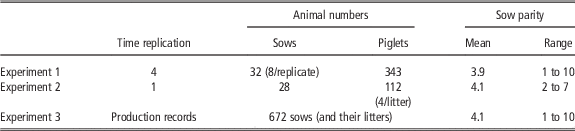
In three experiments, this research examined the effects of replacing conventional FCs with LPs at 3 days postpartum until weaning on sow and piglet welfare and behaviour. Experiments 1 and 2 examined behaviour, injuries and growth, whereas experiment 3 examined piglet mortality during the experimental period. Each experiment was conducted using Landrace×Large-White breed pigs and were located in the same sow farrowing and lactation unit at a commercial piggery in South West Victoria, Australia. The average mean daily ambient temperature for spring, summer, autumn and winter in the year when the experiments were conducted were 21.1°C, 26.5°C, 21.3°C and 14.7°C, respectively. Details relating to the animals utilised in each experiment are summarised in Table 1. For all experiments, sows and their litters were randomly allocated to two treatments. Both the control (FC) and the experimental (LP) sows farrowed in standard commercial farrowing accommodation where they remained until an average of 3 days (range 2 to 5 days) postpartum (referred to as day 3). At day 3, FC animals were transferred from crated farrowing accommodation to crated lactation accommodation that was located in a different shed. Also at day 3, LP animals were transferred from crated farrowing accommodation to loose-sow pens in the lactation shed. The animals were studied from day 3 of lactation until weaning, which occurred at an average of 24 days (range 19 to 26 days) postpartum.
Summary of animals detailsFootnote 1

1 Experiment 1 conducted over 5 months. Experiment 2 conducted over 2 months. Experiment 3 used litter size and mortality data over a 12-month period.
Housing and management of animals
Sows were moved from group gestation housing to FCs 7 days before expected parturition. At day 3 of lactation, each sow and litter unit was randomly allocated to either the FC or LP treatment group and transferred to the respective housing treatments (referred to as day 3). In experiments 1 and 2 litter sizes were equalised to 10 to 11 piglets/litter, using the production system’s standard cross-fostering procedure, prior to treatment allocation. Sows and piglets remained in their treatment pens until piglets were weaned. It was standard practice at this piggery to house about a quarter of the lactating sows and their piglets in LP at day 3 of lactation, and stockpeople were equally familiar with managing sows and piglets under both housing systems. There was very minimal cross-fostering outside of the first 3 days of lactation, and if it did occur it remained within treatment. In experiment 1, sows from FC and LP treatments were housed in the same lactation shed. However, in experiments 2 and 3 FC sows were housed in a different lactation shed to LP sows, although these sheds were adjacent to each other and managed by the same stockpeople.
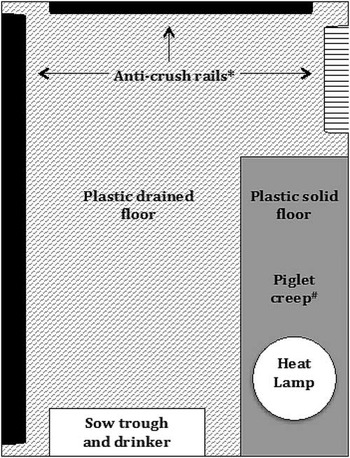
In all three experiments, the finger design (four prongs) FCs used were typical of conventional systems. The internal sow crate dimensions were 2.0×0.6 m, within a total area measuring 2.0×1.5 m. The LP used in experiment 1 (1.8×2.5 m) provided a floor space of 4.5 m2 and had sloping anti-crush bars and a heated creep with solid flooring (~1.23×0.45 m) (Figure 1). Following experiment 1, the design of the LP were modified by the farm management, such that in experiments 2 and 3 the pens were slightly smaller in floor space (1.7×2.4 m, total area of 4.08 m2), although the creep dimensions were comparable (Figure 1). In addition, the anti-crush guards in experiments 2 and 3 extended further from the wall and at a curved angle in comparison with experiment 1 and a metal structural support for the creep area was moved from near the corner of the creep to the centre of the creep wall. In all three experiments the LP flooring was plastic and allowed drainage. No bedding was provided. Both FC and LP were fitted with a built-in trough for feed delivery and water was supplied ad libitum for sows and piglets. During lactation sows were manually fed 4.0 kg of standard commercial lactation pelleted diet (13.7 MJ/kg dry matter, and 17.85% protein) in the morning, with a top up offered in the afternoon as required. Creep feed was offered to piglets from 12 days of age until weaning.
Layout of lactation pen. Dimensions: experiment 1: length=250 cm, width=180 cm; experiments 2 and 3: length=240 cm, width 170 cm. *In experiments 2 and 3 anti-crush guards extend further from the wall and were curved compared with experiment 1. #Creep dimensions comparable in all experiments (length=123 cm, width 45 cm).

Data collection
Behaviour
In experiment 1, nursing behaviour was observed for 24 sows and their litters and behavioural time budgets were observed for 96 piglets (4 focal piglets/litter for 24 litters). In experiment 2, behavioural time budgets were observed for 112 piglets (4 focal piglets/litter for 28 litters) and the behavioural response of sows to an audio recording of an unfamiliar piglet squealing (maternal responsiveness test (MRT)) were recorded for 28 sows.
Four focal piglets per litter were selected immediately after transfer to lactation housing treatments. Focal piglets were balanced for sex and obvious runts (piglets displaying signs of illness/injury or weighing <1.2 kg) were excluded. To allow for individual identification, different symbols were marked on the back of focal piglets using black stock-marker. The same focal piglets were observed throughout lactation and piglets were remarked before each recording day.
Nursing behaviour was continuously recorded from 0700 to 1700 h using overhead video cameras (Signet CCD mini colour camera, model QV-3694; Techbrands, Guangdong, China) that were connected to a digital video recorder (TECHview 16 Channel stand-alone DVR, model QV-3039; Techbrands). These cameras did not have night vision. The behavioural time budgets of focal piglets in experiment 1 were recorded using a handheld camcorder (Panasonic camcorder, model NV-DS60; Panasonic Corporation, Osaka, Japan). Pens/crates were video recorded for 30 s at a time over four 1 h periods (commencing at 0800, 0900, 1020 and 1130 h), continuously rotating between litters in a standardised sequence. The behavioural time budgets of focal piglets in experiment 2 was continuously recorded from 1100 to 1300 using overhead video cameras, the same as those used to record nursing behaviour (described above). Recording times were determined by production schedules. The response of sows to the MRT was continuously recorded using GoPro cameras (GoPro model Hero3 white edition; GoPro Inc., San Mateo, CA, USA). Details of behavioural observations are outlined below.
Nursing behaviour
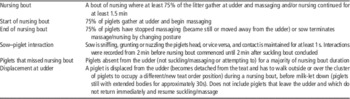
From video records, nursing frequency and duration as well as piglet behaviour during nursing (interactions with the sow, missing nursing, displacements at the udder) were continuously observed by one person on days 4, 11 and 18 of lactation. Table 2 provides a description of behaviours recorded around nursing.
Description of sow and piglet behaviours observed around nursing

Piglet behavioural time budgets
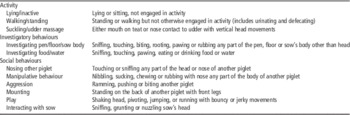
Piglet behavioural time budgets were obtained from video records at days 4, 11 and 18 of lactation. In experiment 1, the behaviour of focal piglets in each of the 30 s video scans (total of 60 scans per pen/crate per day) was observed. In experiment 2, the behaviour of focal piglets was observed using instantaneous point sampling at 30-s intervals (240 sample points/day). A single person conducted observations of piglet activity, investigatory and social behaviours, as described in Table 3.
Description of the behaviour observed in studying the time budget of behaviour of the piglets (adapted from Oostindjer et al., Reference Oostindjer, Bolhuis, Mendl, Held, van den Brand and Kemp2011a)

Maternal responsiveness test
On the morning of days 12 and 19 of experiment 2, the behavioural response of sows to an audio recording of an unfamiliar piglet squealing was assessed. This test involved broadcasting a pre-recorded sound of a piglet squealing from a portable stereo unit (80 decibels at a distance of 1 m, Digitech mini sound level meter, model QM-1589; Techbrands) and observing the response of the sows. The sound level of 80 decibels is equivalent to that measured at 2 m from the squeal of a live piglet (Hutson et al., Reference Hutson, Price and Dickenson1993). This test was adapted from that used by Cronin et al. (Reference Cronin, Simpson and Hemsworth1996). However, so that each sow would be exposed to the same stimulus, this research used a sound recording of a piglet that was unfamiliar to all sows. Previous research has shown that sows are more attentive towards piglets when a piglet squeal recording is played at 80 decibels than when no squeal is played (Hutson et al., Reference Hutson, Price and Dickenson1993).
To conduct the MRT, the experimenter quietly entered the shed 5 min after sows received their first feed delivery for the day (~08:00 h). After waiting 3 s at the shed entrance, the experimenter slowly walked down the aisle pausing for 3 s in front of each crate/pen (<1 m distance between observer and sow) and applying the stimulus from a portable stereo unit hanging around their neck (i.e. stimulus applied for 3 s). The behavioural response of each sow to the stimulus was recorded. These observations were conducted six times in succession (i.e. 6 tests/sow) on each testing day (days 12 and 19), which took ~2 min (each shed) to complete. To assess the effectiveness of the stimulus applied in the present study, on day 11 the experimenter followed the exact same protocol as that described above, only without applying the piglet vocalisation stimulus (control test).
The sow behaviours recorded in the control test and the MRT included head up (number of tests, out of the six tests, in which then sow lifted her head from feeding), grunt occurrence (the number of tests, out of the six tests, in which the sow grunted in the direction of the observer or her own piglets) and grunt frequency (the total number of grunts from the sow in the direction of the observer or her own piglets, over the six tests).
Skin injuries
In experiments 1 and 2, the number of skin lesions on each sow and focal piglet were counted. In experiment 1 this was done at days 11 and 18 of lactation, whereas in experiment 2 this was done at days 4, 11 and 18. The same assessment described by Karlen et al. (Reference Karlen, Hemsworth, Gonyou, Fabrega, Strom and Smits2007) was used to assess skin injuries for sows and piglets, however only fresh lesions were recorded (i.e. any skin injury that appeared red or inflamed indicating it had been obtained recently).
Piglet growth
Each focal piglet in experiment 1 was weighed at day 3 and again at weaning. These data were used to calculate the average growth of focal piglets per litter from day 3 until weaning (g/day).
Piglet mortality
In experiment 3, the production records of 672 sows that farrowed in the 12 months from December 2013 were obtained. It is standard practice on the farm where this research was conducted for computer records on the number of piglets at transfer to the lactation treatment (day 3) as well as the date and death of piglets (but not the reason) throughout lactation to be kept. Thus, these records enabled the collation of data on the number of piglets at transfer to FC or LP treatments (day 3) and the number of piglet mortalities from day 3 until weaning.
Statistical analysis
All analyses were conducted using SPSS statistical package (SPSS 22.0; SPSS Inc., Chicago, IL, USA). The duration of nursing bouts, number of piglets that missed nursing bouts and number of piglet displacements at the udder (experiment 1) did not conform to a normal distribution (quantile–quantile plots and histograms) and were square root transformed before analysis. The proportion of nursing bouts terminated by the sow (experiment 1) and all piglet behavioural time budgets (experiments 1 and 2) were analysed as relative frequencies and consequently were arcine-square root transformed before analysis. In experiments 1 and 2, mounting behaviour was rarely recorded (experiment 1 – mean=0.05 (range=0.00 to 0.18), experiment 2 – mean=0.13 (range=0.00 to 1.11), % of total observations, per focal piglet per litter) and will not be further discussed.
Piglet measurements were calculated for each of the four focal piglets studied and then averaged for each litter. In experiment 1, behaviour and skin injuries were analysed using GLM models. Repeated observations on the same sow/litter were taken into account by including a repeated effect of day within sow/litter. The model included day, FC or LP housing treatment, and their interaction as fixed effects, while time replicate was included in the model as a random effect and sow parity as a covariate. In experiment 2, behaviour and skin lesions were analysed using a general linear model with repeated measures function. This model included day, housing treatment, and their interaction as fixed effects and sow parity as a covariate. Least significant differences were assessed at each day separately when significant treatment×day interactive effect was found. A univariate ANOVA was used to examine treatment effects on piglet weight gain (experiment 1) with replicate included in the model as a random variable. Mann–Whitney U tests were used to (1) compare the behaviour of sows in the control test to that when the stimulus was applied, and (2) test for treatment differences in the MRT at days 12 and 19 (experiment 2). Spearman’s rank correlations were used to examine the relationship between sow behaviour in the control test at day 11 and that in the MRT at days 12 and 19.
Data on piglet mortality (number of piglets that died per litter from transfer (day 3 of lactation) to weaning) were discrete. A GLM with an underlying Poisson distribution was fitted to this variable. This function transforms data to a linear regression with a logarithmic function. Treatment, sow parity and week of farrowing along with corresponding two and three-way interaction terms were included in the model, while number of piglets at transfer was included as a covariate. If an interaction term was not significant (P>0.05), it was removed from the model. For simplicity, sow parities six to 10 were grouped into a single category of sows greater than or equal to parity 6 (parity 6 n=58, parity 7 n=77, parity 8 n=38, parity 9 n=11, parity 10 n=1; sows⩾parity 6, n=185, 27.5% of total sows). A total of 12 sows farrowed twice in the recorded period (1.79%). For these sows, each farrowing was recorded and analysed as separate data.
Results
Experiment 1
Nursing behaviour
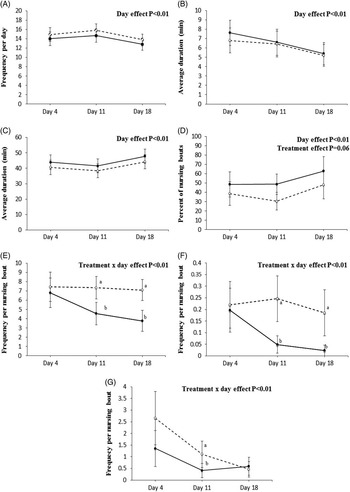
The effects of housing treatment on nursing behaviour at days 4, 11 and 18 of lactation are presented in Figure 2. There was no effect of housing on the frequency (P=0.15; Figure 2A) or duration (P=0.31; Figure 2B) of nursing bouts, or on the inter-nursing interval (P=0.12; Figure 2C). The percentage of sow-terminated nursing bouts tended to be higher in FC treatment (P=0.06; Figure 2D). There were differences due to day (litter age) on all of these variables with the frequency (F 2,22=10.9 P<0.01) and duration (F 2,22=23.2 P<0.01) of nursing bouts declining over time, while the inter-nursing interval (F 2,22=9.54 P<0.01) and proportion of sow terminated bouts (F 2,22=5.28 P<0.01) increased (Figure 2). There were treatment×day interaction effects on the frequency of sow–piglet interactions around nursing (F 2,22=5.95 P<0.01), the number of piglets missing nursing bouts (F 2,22=4.08 P<0.05) and displacements at the udder (F 2,22=3.11 P<0.05). At days 11 and 18, FC sows interacted less frequently with the piglets than LP sows, although piglets in FC missed fewer nursing bouts on these days (Figure 2E and F). Farrowing crate piglets were displaced less frequently than LP piglets at day 11, but there was no difference in piglet displacements at the udder at days 4 or 18 (Figure 2G).
Effects of farrowing crate (solid) and lactation pen (dashed) housing on piglet behaviour during nursing bouts observed between 0700 and 1700 h at days 2, 11 and 18 of experiment 1. Behaviours observed were (A) the frequency, (B) duration, (C) inter-nursing interval and (D) proportion of sow terminated nursing bouts, (E) the frequency of sow–piglet interactions around nursing, and the numbers of piglets (F) missing nursing bouts and (G) displaced at the udder. Means (back-transformed means for B, D, F and G) per sow (for A, B, C, D and E) or per nursing bout per sow (for F and G)±95% confidence interval are reported. a,bWithin a day, means with different superscripted letters differ (P≤0.05).

Piglet behavioural time budgets
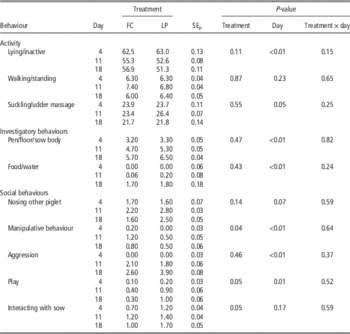
Probability values and means for the main and interactive effects of housing and day on piglet behaviour in experiment 1 are presented in Table 4. Housing significantly affected the frequency of manipulative behaviours (F 1,22=4.81 P<0.05), which was higher in FC than LP, but both the frequency of piglet interactions with the sow (F 1,20=4.27 P=0.05) and play behaviour (F 1,22=4.49 P=0.05) were higher in LP than FC. Litter age significantly affected many piglet behaviours. Time spent lying (F 2,22=24.1 P<0.01) and suckling (F 2,22=3.50 P=0.05) declined from day 4 to 18, whereas investigatory behaviours (investigating the pen (F 2,22=18.5 P<0.01) and investigating/eating food (F 2,22=40.8 P<0.01), as well as some social behaviours (aggression (F 2,22=106 P<0.01), manipulative behaviour (F 2,22=13.7 P<0.01) and play (F 2,22=7.89 P=0.01) increased over the same period.
Experiment 1: behaviour of piglets in farrowing crates (FC) or lactation pens (LP) from 0800 and 1230 h on days 4, 11 and 18 postpartum Footnote 1

SEp=pooled standard error of the mean.
1 Data were arcsine-square root transformed before analysis. Back-transformed means (% of observations the behaviour was observed, per focal piglet per litter)±pooled SE are presented. a,bWithin a row, means with different superscripted letters differ (P≤0.05).
Skin injuries
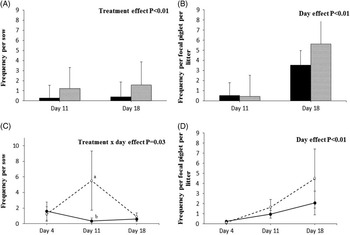
The effects of housing on the number of skin injuries sustained by sows and piglets at days 11 and 18 of experiment 1 are presented in Figure 3A and B. Skin injuries for sows were higher in LP than FC (F 1,27=6.90, P=0.01) but there was no effect of day on sow skin injuries (P>0.05). Treatment had no effect on piglet skin injuries (P>0.05), but skin injuries increased with time (F 1,30=84.4, P<0.01).
Effects of farrowing crate (solid) and lactation pen (striped/dashed) housing on skin lesions for (A) sows and (B) piglets at days 11 and 18 of experiment 1, and for (C) sows and (D) piglets at days 2, 11 and 18 of experiment 2. Back-transformed means (per sow or per focal piglet per litter) ±95% confidence interval are presented. a,bWithin a day, means with different superscripted letters differ (P≤0.05).

Piglet growth
There was no housing effect on piglet daily weight gain from day 3 until weaning in experiment 1 (means (±SEM) were 240 (10.1) and 230 (12.3) g/day for FC and LP piglets in experiment 1, respectively; P=0.64).
Experiment 2
Piglet behavioural time budgets
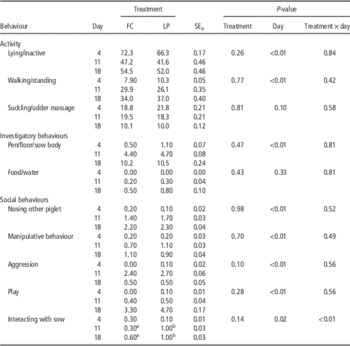
Probability values and means for the main and interactive effects of housing and day on piglet behaviour in experiment 2 are presented in Table 5. There was an interaction effect of housing×day on piglet interactions with the sow (F 2,48=6.86, P<0.01), but for no other observed behaviours (P>0.05; Table 5). More piglet interactions with the sow were observed in LP at days 11 and 18. There were no main effects of housing for any observed behaviours (P>0.05, Table 5). Most piglet behaviours were affected by day (litter age), with the exception of suckling behaviour (P>0.05) and time spent investigating food (P>0.05). Lying behaviour declined from day 4 to 18 (F 2,48=6.15, P<0.01), while time spent walking (F 2,48=8.40, P<0.01), investigating the pen (F 2,48=7.58, P<0.01), nosing (F 2,48=18.0, P<0.01) or manipulating (F 2,48=5.57, P<0.01) other piglets and playing (F 2,48=11.6, P<0.01) increased over the same period. Aggressive behaviour increased over time, although peaking at day 11 (F 2,48=7.02, P<0.01; Table 5).
Experiment 2: behaviour of piglets in farrowing crates (FC) or lactation pens (LP) from 1100 and 1300 h on days 4, 11 and 18 postpartum Footnote 1

SEp=pooled standard error of the mean.
1 Data were arcsine-square root transformed before analysis. Back-transformed means (% of observations the behaviour was observed, per focal piglet per litter)±pooled SE are presented. a,bWithin a row, means with different superscripted letters differ (P≤0.05).
Maternal responsiveness test
Sows responded more frequently to the researcher when the recording of the piglet vocalisation was played at day 12 (‘head up’ Z=−2.20, P=0.03; ‘grunt occurrence’ Z=−2.24, P=0.03; ‘grunt frequency’ Z=−2.16, P=0.03) and day 19 (‘head up’ Z=−2.57, P=0.01; ‘grunt occurrence’ Z=−2.48, P=0.01; ‘grunt frequency’ Z=−2.56, P=0.01) than to the researcher when no piglet vocalisation was played (control test). Sow behaviour in the control test at day 11 was not related to that in the MRT at day 12 (‘head up’ r=0.14, P=0.49; ‘grunt occurrence’ r=0.24, P=0.23; ‘grunt frequency’ r=0.21, P=0.28) or day 19 (‘head up’ r=0.24, P=0.22; ‘grunt occurrence’ r=0.25, P=0.21; ‘grunt frequency’ r=0.24, P=0.23). However, sow behaviour in the MRT at day 12 was related to that in the MRT at day 19 (‘head up’ r=0.73, P<0.01; ‘grunt occurrence’ r=0.48, P<0.01; ‘grunt frequency’ r=0.53, P<0.01).
Sows in the LP responded to the MRT by lifting their heads at each application of stimulus more often than FC sows. The median number of tests in which FC and LP sows lifted their heads at day 12 were, respectively, 0 (range 0 to 1) and 2 (range 0 to 5) (Z=−3.67, P<0.001), and at day 19 were, respectively, 0 (range 0 to 2) and 2 (range 0 to 5) (Z=−3.61, P<0.001). However, neither the frequency of tests in which sow grunted (day 12, Z=−0.97, P=0.51; day 19, Z=−0.55, P=0.73) nor the frequency of grunts per test (day 12, Z=−0.87, P=0.54; day 19, Z=−0.41, P=0.80) was affected by housing. The median value for both FC and LP sows in these two tests was 0.
Skin injuries
The effects of housing on the frequency of skin injuries sustained by sows and piglets at days 11 and 18 of lactation in experiment 2 are presented in Figure 3C and D. There were interaction effects of housing and day on skin injuries sustained by sows (F 2,50=4.50, P<0.05). Sows in FC and LP had similar skin injuries at days 4 and 18, but LP sows had more skin injuries at day 11. There was no main effect of housing on skin injuries in piglets (P>0.05), nor was there a treatment×day interaction (P>0.05), but injuries increased over time (F 2,50=4.84, P<0.05).
Experiment 3
Piglet mortality
There was a tendency for there to be more piglets per litter in the FC than in the LP at the beginning of treatment (means for the number of piglets at transfer for sows assigned to LP and to FC, respectively, were 10.2 and 10.4 piglets, F 1,659=3.61, P=0.06), and sows in the LP were of a higher parity than those in the FC (4.15 v. 3.51, F 1,669=25.2, P<0.01). The number of piglet mortalities per litter from day 3 until weaning (mean (±SEM) number of piglet mortalities in LP and FC treatments, respectively, were 0.63 (0.06) and 0.64 (0.07) per litter) was not affected by housing (P=0.17), sow parity (P=0.15) or week of farrowing (P=0.29), nor were any of the interaction terms significant (P>0.05).
Discussion
The results of this research suggests that, following temporary confinement in a FC, loose-sow housing with increased floor space from days 3 to 28 of lactation results in improved maternal behaviour in sows and improved social behaviour in piglets, without increasing risks to piglet mortality in this period.
Maternal behaviour
As has been found by other studies (Cronin and Smith, Reference Cronin, Lefébure and McClintock1992; Cronin et al., Reference Cronin, Simpson and Hemsworth1996), there were more interactions between sows and piglets around nursing in the LP in experiment 1 and during the time budget observations in LP in experiments 1 and 2. Piglets may have had greater accessibility to the sow’s head in LP because of the larger floor space and no restriction imposed by the crate. On the other hand, loose-housed sows are better able to orient themselves towards piglets, which may be more conducive to the development and display of maternal behaviour. Pigs communicate using a combination of visual and olfactory cues as well as vocalisations, and to some extent parental behaviour is manipulated by the offspring (Broom and Fraser, Reference Broom and Fraser2010). As such, differentiating between interactions initiated by piglets and those initiated by the sow is obviously difficult. Nevertheless, how the interaction is initiated may be less important than the outcome of the interactions, in terms of the development of both maternal behaviour in the sow and social behaviour in the piglet (discussed later).
In the present research, the frequency and duration of nursing bouts declined over time, while the interval between bouts increased. These observations have previously been reported in both domestic and wild-type sows (see Jensen, Reference Jensen1988). Experiment 1 found no effects of lactation housing on these variables, although nursing behaviour was only observed during daylight hours. Pedersen (Reference Pedersen, Moustsen, Nielsen and Kristensen2015) conducted observations in both day and night time periods, and found that sows that were loose housed during parturition and for 3 days postpartum nursed more frequently and had a shorter inter-nursing interval than sows that were confined for this period. However, there was no effect of housing on nursing duration. Experiment 1 also found that sows in FC tended to terminate more nursing bouts than LP sows. Other research suggests that loose-housed sows terminate more nursing bouts than crated sows in the first 3 days of lactation (Pedersen, Reference Pedersen, Moustsen, Nielsen and Kristensen2015) but the reverse is seen at mid to late lactation (Pedersen et al., Reference Pedersen2011). Pedersen et al. (Reference Pedersen2011) proposed that reduced accessibility to the udder in FC increases competition and fighting for teats and this disrupts the sow. Indeed, more teat fights were reported in crates, and when teat fights occurred more piglets missed the milk-let down (Pedersen et al., Reference Pedersen2011). Although the present research did not record fighting at the udder, it found that in LP more piglets were displaced during nursing at day 11, and there were more missed nursing bouts at days 11 and 18.
In the study by Pedersen et al. (Reference Pedersen2011), loose-housed sows were confined only during parturition, whereas in Pedersen (Reference Pedersen, Moustsen, Nielsen and Kristensen2015) they were not confined at all. By contrast, in the present research, sows were confined in FC from 7 days before parturition until day 3 of lactation. Confinement during parturition and early lactation may disrupt the establishment of nursing behaviour and maternal bonding. Indeed, other research has shown that nursing behaviour establishes more quickly when sows farrow in pens with straw than in crates (Cronin and Smith, Reference Cronin, Lefébure and McClintock1992), and that loose-housed sows form stronger social bonds with their piglets early in lactation (Pedersen, Reference Pedersen, Moustsen, Nielsen and Kristensen2015). The importance of maternal behaviour in the days immediately preceding parturition on subsequent sow behaviour requires further research.
In the present research, FC sows lifted their heads less frequently in the MRT than sows in LP. Similar results were reported by Cronin et al. (Reference Cronin, Simpson and Hemsworth1996), and Thodberg et al. (Reference Thodberg, Jensen and Herskin2002) found that sows in crates took longer to react as they moved to a lying position when an audio recording of a screaming piglet was played. While the present study found no housing effects on sow vocalisations in the MRT, other studies have found that crated sows vocalise less towards their piglets in a MRT (Cronin et al., Reference Cronin, Simpson and Hemsworth1996) and a litter separation test (Thodberg et al., Reference Thodberg, Jensen and Herskin2002). Both Cronin et al. (Reference Cronin, Simpson and Hemsworth1996) and Thodberg et al. (Reference Thodberg, Jensen and Herskin2002) tested sows at day 3 of lactation, a period where sows in the natural environment would be staying in close proximity to their litters (Jensen, 1986 and Reference Jensen1988), whereas the present research tested sows at days 12 and 19 of lactation. Under natural conditions, piglets at this age are typically integrated into the sounder and moving increasingly greater distances from the sow (Jensen, 1986 and Reference Jensen1988). This could correspond to reduced vigilance from the sow. Further, Hutson et al. (Reference Hutson, Price and Dickenson1993) found that sow attentiveness towards piglets increased with audio playback volume, but only influenced lying behaviour at a loud volume (>92 decibels). Thus, the MRT with a playback volume of 80 decibels utilised by the present research may have been masked by the general noise levels in the shed and, consequently, reduced sow responsiveness.
There are several points that need to be considered when interpreting the results of the MRT. First, sows were tested while feeding, rather than during a ‘risky’ postural change, and the experimenter remained in sight. However, sows in the present research were more responsive to an experimenter standing at the front of the pen/crate playing a recording of a piglet vocalisation (i.e. MRT) than when no was vocalisation played (i.e. control). Further, sow behaviour in the control test was not related to that in the MRT at either day 12 or 19 of lactation, but sow behaviour in the MRT at days 12 and 19 was related. Thus, in addition to the present test being conducted at feeding and in the presence of the experimenter, the playback of a piglet vocalisation per se contributed to the sow’s behavioural response in the MRT. Second, sows may habituate to the MRT over time (Held et al., Reference Held, Mason and Mendl2006), and, in the present study, sows were consecutively tested in the same building. However, the median and range for variables recorded in the MRT barely changed between days 12 and 19. The short length of the test (2 min) and time between testing days (7 days) may have minimised habituation. Third, the piglet vocalisations used in the MRT were recorded when the animal was isolated and restrained by the experimenter. It has been suggested that vocalisations under these conditions could differ from those observed in an actual piglet crush, and therefore affect the strength of the sow’s response in the MRT (Illmann et al., Reference Illmann, Neuhauserová, Pokorná, Chaloupková and Šimečková2008). Nonetheless, in the present research each sow in both treatments were tested using the same methodology and effects of housing treatment on sow responsiveness were found.
Piglet behaviour
Although there were no effects of housing on general piglet activity (lying, walking, suckling) in the present research, piglets spent significantly more time playing in LP in experiment 1. It is generally accepted that play is an indicator of positive affective state (see review Held and Špinka, Reference Held and Špinka2011), and, in young pigs, play is considered a suitable and sensitive indicator of welfare (Newberry et al., Reference Newberry, Wood-gush and Hall1988; Brown et al., Reference Brown, Klaffenböck, Nevison and Lawrence2015). The increased space in LP may have made it physically easier for play behaviour to be expressed. Alternatively, as found by Chaloupková et al. (Reference Chaloupková, Illmann, Bartoš and Špinka2007), enrichment of the pre-weaning environment, through the provision of increased space and environmental and social stimulation, may have improved overall piglet welfare and therefore the piglet’s motivation to engage in play. While play increased in experiment 1, manipulative behaviour was reduced in LP. Manipulative behaviour may be a re-directed behaviour that is indicative of a lack of environmental enrichment or overcrowding (Dybkjær, Reference Dybkjær1992). Oostindjer et al. (Reference Oostindjer, Bolhuis, Mendl, Held, van den Brand and Kemp2011b) found reduced manipulative behaviour and increased play behaviour in piglets raised in a lactation environment enriched with space and straw, although sow confinement per se had no effect.
In contrast to experiment 1, experiment 2 did not find effects of lactation housing on play or manipulative behaviour. It is not immediately clear why the results differed between the two experiments. The design of LP (e.g. less space in experiment 2) and differences in the behavioural sampling methodology (60 sample points over 4 h in experiment 1 v. 240 sample points over 2 h in experiment 2) may have contributed. Social factors, such as individual variation and group dynamics, may also affect the prevalence of positive and negative social behaviours (Sih, Reference Sih2013). Brown et al. (Reference Brown, Klaffenböck, Nevison and Lawrence2015) found variability in play behaviour during lactation both between and within litters of piglets, although litter was a much stronger source of variation. Nonetheless, the results from experiment 1, considered with those reported by others (Chaloupková et al., Reference Chaloupková, Illmann, Bartoš and Špinka2007; Oostindjer et al., Reference Oostindjer, Bolhuis, Mendl, Held, van den Brand and Kemp2011b), indicate that play may be increased and manipulative behaviour may be decreased with the provision of increased space during the lactation period.
Similar to the finding of Oostindjer et al. (Reference Oostindjer, Bolhuis, Mendl, Held, van den Brand and Kemp2011b), there was no treatment effect on nasal contact with other piglets or aggression in the present research. The benefits of improved welfare during lactation may well persist beyond weaning (e.g. Chaloupková et al., Reference Chaloupková, Illmann, Bartoš and Špinka2007; Oostindjer et al., Reference Oostindjer, Bolhuis, Mendl, Held, van den Brand and Kemp2011b; Martin et al., Reference Martin, Ison and Baxter2015). However, Verdon et al. (Reference Verdon, Morrison and Hemsworth2016) found that piglets reared in an enriched single litter, loose sow pen were just as aggressive in the 2 h post-mixing at weaning as those reared in FC. The long-term effects of sow lactation housing on piglet social behaviour will benefit from more research. Neither the present research, nor that conducted by Oostindjer et al. (Reference Oostindjer, Bolhuis, Mendl, Held, van den Brand and Kemp2011b) found effects of sow housing on piglet investigative or feeding-related behaviours. Piglets learn to eat solid food by observing the sow (Oostindjer et al., Reference Oostindjer, van den, Kemp and Bolhuis2011a), but the feeding system in LP in the present research did not allow piglets to actively observe the sow eating.
Skin injuries
In the present research, sows in LP sustained more skin injuries than those in FC. There are several possible explanations for this result. First, in comparison with FC sows, LP sows had more freedom to move about and perform postural changes (e.g. Bøe et al., Reference Bøe, Cronin and Andersen2011; Pedersen, Reference Pedersen, Moustsen, Nielsen and Kristensen2015). Some postural changes, such as descending from standing to lying or rolling, may also qualitatively differ between the two housing systems. Consequently, sows in LP in the present study may have undergone a period of adjustment, during which they had to learn how to change posture in the new environment. Second, previous research suggests that skin lesions and lying-down behaviour is associated with flooring, particularly if no substrate is provided (reviewed by Baxter et al., Reference Baxter, Lawrence and Edwards2011). Anecdotally, the plastic flooring used in the LP in the present study may be slippery when wet. This could have contributed to difficulties sows may have had in changing posture or moving about the pen, and consequently may have contributed to increased injuries. Further, although piglet protection features are a necessity in loose-housed sow lactation systems, sows prefer to use solid sloped or vertical walls over farrowing rails as a support while lying (see Baxter et al., Reference Baxter, Lawrence and Edwards2011). Thus, the piglet protection rails used in LP in the present research may have been uncomfortable to lean against or caused injury to the sows. Third, increased interaction with piglets in the LP would likely contribute to increased scratches. There were no effects of treatment on piglet skin injuries in this research, which were possibly obtained from fighting among pen mates. However, rough play and collisions with the pen fittings and walls as well as rubbing on hard surfaces during suckling (Baxter et al., Reference Baxter, Lawrence and Edwards2011) may also result in injuries.
Piglet growth and mortality
There was no treatment effect on piglet growth rate in the present research. This research used focal piglets, balanced for sex and size, to obtain weight gain data and therefore housing effects on the extreme (i.e. very small or very large) piglets may not have been apparent. However, these results are comparable with those reported by others (Condous et al., Reference Condous, Plush, Tilbrook and van Wettere2016; Verdon et al., Reference Verdon, Morrison and Hemsworth2016).
There is a significant body of research indicating that liveborn piglet mortality increases when sows are loose housed around farrowing, primarily due to an increase in the incidence of crushing (e.g. Cronin et al., Reference Cronin and Smith2000; Moustsen et al., Reference Moustsen, Hales, Lahrmann, Weber and Hansen2013; Hales et al., Reference Hales, Moustsen, Nielsen and Hansen2014; Condous et al., Reference Condous, Plush, Tilbrook and van Wettere2016). In the present research, loose housed sows were temporarily confined during farrowing and for 3 days postpartum while others remained in crates throughout lactation, and no difference in piglet mortality was found. These results are comparable with other research that has examined temporary confinement of gilts (Lambertz et al., Reference Lambertz, Petig, Elkmann and Gauly2015) and sows (Hales et al., Reference Hales, Moustsen, Nielsen and Hansen2015; Condous et al., Reference Condous, Plush, Tilbrook and van Wettere2016) around parurition and up until 3 to 7 days postpartum. However, this research contrasts that of Chidgey et al. (Reference Chidgey, Morel, Stafford and Barugh2015) who found higher piglet mortality when sows were loose housed from 4 days postpartum until weaning, although the authors noted that mortality rates were low, compared to the industry average. Thus, piglet mortality in LP appears to be, at the very least, similar to that when sows are confined in FC, as long as loose-housed sows are temporarily confined for 3 to 4 days following parturition.
Conclusion
Following temporary confinement in a FC, this research has found that loose-sow housing, with increased floor space and greater opportunity for interaction between sows and piglets from days 3 to 28 of lactation, may result in improved maternal behaviour in sows and improved social behaviour in piglets, without increasing piglet mortality in this period. While these results suggest an improvement in piglet welfare in the loose pens from day 3 of lactation, further and more extensive observations on piglet behaviour, both pre- and post-weaning, and maternal behaviour are required.
Acknowledgements
This research was funded by the Australian Pork Cooperative Research Centre (project 1C–113). The authors would like to thank staff from the AWSC that contributed to this project, and in particular Tracie Storey. The authors also thank the owners and staff of the participating piggery for their collaboration on this research.