1. Introduction
The aquaculture that emerged in the late 1970s along the southwest area in Taiwan has brought about considerable economic benefits. Since aquaculture is a water-consumptive industry, the demand for water in that area has also increased significantly in the past 30 years. Because of the inadequacy of surface water, aquacultural farmers are forced to pump groundwater, which has caused severe ground subsidence problems. This in turn led to certain environmental losses (e.g., Huang, Reference Huang1990, Reference Huang1997). From 1992 to 1994, the estimated costs of prevention of ground subsidence and replacement spent by the central government amounted to at least US$472.82 million (Council of Agriculture, 1995b). To prevent the land from suffering further subsidence, from 1995 to 2000 and in 2003, the government implemented the First Phase and the Second Phase of Ground Subsidence Prevention Projects, which aimed to eliminate ground subsidence through industry adjustment and management of groundwater use. These projects, however, did not work as planned. For example, one of the quantitative targets in the First Phase Project was to reduce the aquaculture areas from 52,000 hectares before the project was launched to 22,000 hectares by 2000 (Council of Agriculture, 1995a), but according to the review reports from the Second Phase Project in 2003, there are still 41,000 hectares of aquacultural farms in Taiwan (Council of Agriculture, 2003b). Using the town of Budai, located in Chia-Yi county, as an example because of its serious ground subsidence condition, the paper will first construct the relationship between groundwater use and the externality ground subsidence, taking into account each individual farmer's behavior. This relationship is then incorporated into an economic model to determine how the government, with a limited budget, can effectively retire both legal and illegal fish farms based on the extent of the external impact of pumping groundwater in an individual area, so as to mitigate the ground subsidence problem through a subsidy policy.
Direct control of groundwater pumpage had been adopted by Taiwan's government in the past. The regulation, however, forced more aquacultural farmers to pump groundwater illegally and made the problem of ground subsidence even worse. An incentive tool, such as water fees, has also been considered by the government to lower the demand for groundwater in recent years, but it could not be implemented because of the opposition of farmers. In 1997, a subsidy based on the Synthetic Development Planning Project of Chia-Yi (Chia-Yi County Government, 1987) was first used in the county where the annual ground subsidence level was more than 8 cm. In the project, the county government proposed to establish an exclusive aquaculture zone in How-Mei village, and offered US$1,636 per hectare of compensation to farmers who were willing to retire their land. Since the proposed subsidy included both legal and illegal fish farms, the policy triggered a debate about its legality and hence was called off after a brief period of implementation. Only the How-Mei exclusive zone project still exists at present. Also, insufficient funding from the local government caused the subsidy to be unsuccessful (Ministry of Audit, 2006). Another complication is that the amount of the proposed subsidy was far less than the profit reported by the Fisherman Family Economic Survey (Council of Agriculture, 1998) at that time. Thus, most farmers could not view the subsidy as an incentive to retire their land.
From a social justice perspective, it may be controversial to include both legal and illegal fish farms for a subsidy in this research. But if the subsidy could generate sufficient incentives to ensure all aquacultural farms remained retired, then an immediate benefit is the reduction in annual preventive or replacement costs, caused by ground subsidence from both legal and illegal farmers. According to one report (Council of Agriculture, 1995b), these costs totaled around US$45.13 million from 1992 to 1994. That is, US$15.04 million would be needed annually to resolve the damages from ground subsidence in Chia-Yi county. Thus, as long as not enough fish farms are retired to resolve the ground subsidence problem at its origin, this kind of cost could become routine expenditure of the government and could increase year by year. Moreover, at present, the government has provided aid and relief support for natural disasters to all farmers in this area. If aquacultural farmers were made to retire the land, then such expenditures could be completely avoided.
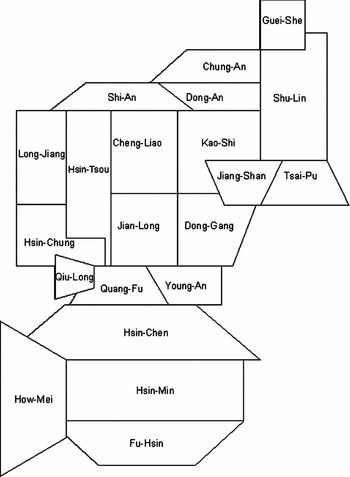
In order to focus on the issue of ground subsidence from aquaculture farms, the study selects aquacultural farms in the following 21 coastal villages along the Chia-Nan Plain groundwater watershed (figure 1): Guei-She, Chung-An, Shu-Lin, Shi-An, Dong-An, Long-Jiang, Hsin-Tsou, Cheng-Liao, Kao-Shi, Tsai-Pu, Jian-Long, Dong-Gang, Jiang-Shan, Hsin-Chung, Qiu-Long, Guang-Fu, Young-An, Hsin-Chen, How-Mei, Hsin-Min, and Fu-Hsin village. Currently, 40 per cent of the land in Budai is occupied by both legal and illegal aquacultural farmers (Industrial Technology Research Institute, ITRI, 2004). Combining this with the fact that the total output from the secondary and tertiary degree industries is relatively low (Chia-Yi County Government, 2005), the coastal areas in the town of Budai are typical places where ground subsidence is caused by the aquaculture industry.
Budai township

2. Subsidy
For most people, subsidizing environmental polluters goes against the principle of ‘fairness and justice’. Baumol and Oates (Reference Baumol and Oates1988) once pointed out that a subsidy policy increases profits for the manufacturers that created the pollution and thus violates the polluter-pays principle. Moreover, if a subsidy does not have an appropriate supplementary regulation to restrain other polluters who may try to enter the market, the subsidy system may have the effect of reducing pollution in the short run, but in the long run it could attract more manufacturers to enter the industry, and the total amount of pollution may increase (Polinsky, Reference Polinsky1979). However, when political and social factors such as lobby groups' intervention or possible resistance from polluters that belong to lower-income levels are considered, a subsidy is still one of the important options for a government in the policy decision (Fredrikson, Reference Fredrikson1997). Subsidizing aquacultural farmers, who are considered to belong to one of the underprivileged groups in Taiwan, is largely based on political considerations. However, the government in the past often neglected the external impact caused by the interdependence of aquacultural farmers' groundwater use when forming and implementing a subsidy policy. Owing to the flowing nature of groundwater under the surface, when aquacultural farmers pump groundwater within the same watershed, this affects all of their ground subsidence levels. In other words, an individual aquacultural farmer's groundwater pumping not only causes ground subsidence in his own location, but also causes a certain extent of ground subsidence in neighboring areas (Shi, Reference Shi2000; Chang, Reference Chang2000; Huang, Reference Huang2000). In designing a subsidy policy to mitigate environmental pollution from agriculture, Smith (Reference Smith1995) indicated that it should consider the characteristics of the farm land, such as slope, soil characteristics, and its deposition of pesticide on the environment. However, given the fact that this information is usually unknown to policy makers, what the government usually does is to set an upper ceiling and accept all payments of a subsidy demanded by farmers as long as what they ask for is lower than the ceiling. Under this circumstance, the government would pay the same price to ensure the farm lands are retired from aquaculture, regardless of the extent to which they affect the environment, which is clearly inefficient (Babcock et al., Reference Babcock, Lakshminarayan, Wu and Zilberman1996, Reference Babcock, Lakshminarayan, Wu and Zilberman1997). To take into account geographical differences, such as soil characteristics and farmers' interdependence during production, studies by Carpentier et al. (Reference Carpentier, Bosch and Batie1998) and Kramer et al. (Reference Kramer, McSweeny, Kerns and Stravros1984) assumed an exogenous relationship between production and its effect on the environment. Khanna et al. (Reference Khanna, Yang, Farnsworth and Onal2003), on the other hand, considered an endogenously determined relationship between the portion of soil transported from a land parcel to a water body, and land use decisions of all parcels along a flow path to determine a cost-effective land enrollment pattern for reducing off-site sediment loadings. The results show that when this endogeneity of sediments is ignored, a larger amount of land would be enrolled unnecessarily as the environmental target becomes more stringent. It also implies that the total subsidy payment could be lower if the interdependence of groundwater used by aquacultural farmers within the same watershed is considered.
Based on the experience of the subsidy adopted in Chia-Yi county, the amount of subsidy plays an important role in determining farmers' willingness to be enrolled in the program. Thus, the subsidy proposed in this study involves full compensation to farmers' for losses in profits attributable to each unit of retired land. Since the land in Budai is not appropriate to grow plants with high economic value, farmers in this area have no other choice but to undertake aquaculture. Therefore, using only the profit from aquaculture, production should be able to reflect the opportunity cost of retiring the land in this area.
Compared with other regulation policies, such as taxes, one advantage of using a subsidy is its follow-up monitoring process and the certainty of the amount of groundwater use. For example, an inappropriate tax rate may lead to the over or under use of groundwater. In addition, because of the recent progress in satellite image technology, the government can easily check whether the retired land parcel has been illegally used again by aquacultural farmers.
3. Economic model
Groundwater use and ground subsidence
In general, two different approaches can be used to estimate the relationship between groundwater use and ground subsidence. The first approach, which requires less information and can be adopted easily, uses regression techniques by employing historical data on groundwater use and ground subsidence levels. However, because of its simplicity, it may not always reflect this relationship accurately. The second approach, which relies on hydrology and soil science, takes into account information such as soil void ratios, existing groundwater drawdowns, and consolidated settlement of different soil types in determining ground subsidence levels. But this approach requires more information than is generally available. Research following this approach that has been conducted in Taiwan typically must assign values exogenously to many unknown parameters regarding the characteristics of soil type and its void ratio (Shi, Reference Shi2000; Chang, Reference Chang2000; Huang, Reference Huang2000). Therefore, the relationship between groundwater use and ground subsidence is expressed in terms of a set that includes several different bundles of parameter values and which cannot be easily incorporated into economic models. Because of the unavailability of some detailed soil type data in Taiwan, the first approach will be used in this study.
Aquacultural farmers who pump groundwater within the same watershed would mutually affect each other's ground subsidence levels. However, the extent of the external impact from each individual farmer would decrease with an increase in distance (Chang, Reference Chang2000). Therefore, we can write the relationship between groundwater use and ground subsidence for year t in village j of the town of Budai as the following function
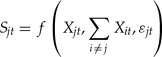
In equation (1), S jt represents the ground subsidence level in village j during year t, X jt represents the amount of groundwater pumped by aquacultural farmers in village j in the same year, and X it represents the pumpage of groundwater by aquacultural farmers in neighboring village i. Hence, Σi≠jX it shows the total level of groundwater pumped in neighboring village i. The error term ϵjt is used to represent unknown reasons that cause ground subsidence. The external effects of pumping from a given village to another should depend on the distance between them. Because of the limited information on how far this externality will reach, the current study assumes that the externality of water usage in each village only affects its adjacent village, and the impact of pumping on other non-adjacent villages can be ignored. From the demarcation of administrative areas, the range of impact of external effects is about 1,000 meters.Footnote 1
Because the available data include ground subsidence levels in 21 villages, as well as the total pumpage between years 2000 and 2004, they form a panel data structure. Thus, equation (1) could be further specified as

In equation (2), the time invariant constant term αj represents the unobserved characteristics that affect ground subsidence. Putting the subscript j on this intercept term means the ‘individuality’ of each village is considered. The term β3⋅(Σi≠jX it) ⋅ X jt describes the interaction in pumping groundwater between village j and neighboring villages, while the term β2 ⋅ Σi≠jX it describes the effects of pumping groundwater on the ground subsidence in village j from each of j's adjacent village. By employing the collected data to estimate the parameters in equation (2), this equation can be rewritten as

where
Ŝj represents the estimated ground subsidence level in village j;
 represents the estimated unobserved characteristics that affect ground subsidence in village j;
- , , and are the estimated parameters for the related groundwater use terms from regression.
 represents the estimated unobserved characteristics that affect ground subsidence in village j;
 ,
 , and
 are the estimated parameters for the related groundwater use terms from regression.
Subsidy and optimal groundwater use
In order to prevent further subsidence of the land, we assume that the government is currently only concerned with the land subsidence level in 2005. Therefore, it tries to set a reasonable target subsidence level that may comply with its budget for a subsidy based on the subsidence level in 2004. In addition, because of the limited data on the number of farmers in each village, farmers within the same village are grouped into a representative farm. Therefore, the optimal behavior on groundwater use is specified in terms of the type of each village studied. The economic model that manages groundwater use by each village to meet the pre-specified standards for year 2005 at a minimum subsidy payment is as follows
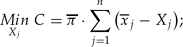




where
C represents the total subsidy expenditures by the government;
- represents the average profit for pumping one unit of groundwater by aquacultural farmers;
- represents the pumpage of groundwater by aquacultural farmers in village j before the implementation of the subsidy policy;
X j represents the pumpage of groundwater by aquacultural farmers in village j after the implementation of the subsidy policy;
h j represents the ground subsidence level set by the government for village j.
Equation (4) represents the amount of minimum subsidy expenditures by the government for aquacultural farmers when the environmental standard is achieved. The unit profit from groundwater use  multiplied by the amount of groundwater use before the subsidy
 is the total profit without any regulation. Because most farmers in this area are now raising tilapia, eel, perch, porgy, milkfish, and white shrimp, we assume that the profit by pumping one cubic meter of groundwater is the same for all aquacultural farmers. When the regulation is implemented, the aquacultural farmers need to adjust the quantity of groundwater use to X j. Thus,
 is the total reduced profit of aquacultural farmers on the coast of Budai caused by the regulation. In this research, we assume that the amount of reduced profit is the subsidy payment to aquacultural farmers. The average subsidy per unit of reduced pumpage does not vary with changes in total reduced pumpage. When the farmers are fully compensated after the regulation, they may be more willing to cooperate with the government.
Equation (5) represents the relationship between estimated ground subsidence and use of groundwater. Equation (6) shows the target ground subsidence levels set by the government. We consider two different scenarios of ground subsidence control. In scenario 1, the government sets a ceiling for each village, which requires that the ground subsidence level caused by the use of groundwater in 2005 should not exceed a specific ratio a(0<a<1) of the ground subsidence level caused by the use of groundwater in 2004. For example, if  is the ground subsidence level of village j in 2004, then equation (6) becomes

In scenario 2, the ground subsidence caused by the use of groundwater in each village cannot exceed a given ratio of the average ground subsidence level caused by groundwater use in all of the coastal areas. For example, if  is the average ground subsidence level for the 21 villages in 2004, and
 (=
 ) represents the average individual time invariant effects on ground subsidence in all of the coastal areas within the same year, equation (6) then becomes
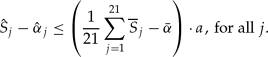
Equation (7) requires that the pumpage of groundwater should be kept at a level no greater than the level of 2004. This also means that the fish farm size in each village cannot exceed beyond the current level. Equation (8) is the condition that limits the endogenous variables to be non-negative.
4. Data
The required data for the research include the amount of groundwater use, ground subsidence levels, and the profit for each unit of groundwater use. The ground subsidence levels in the 21 villages of Budai are from the annual monitoring and survey report by ITRI (2004). The amount of groundwater use varies according to the varieties of fish cultivated, but there is a close relationship for the ratio between the area of fish farms and consumption of water (Chen et al., Reference Chen, Liang, Lai, Chen and Chien1999). Therefore, although there is no complete survey of groundwater use in Taiwan, we can still estimate the amount of groundwater used through the areas of fish farms. Based on another study of the aquaculture industry in Chia-Yi county by Chen et al. (Reference Chen, Liang and Lai1996), 1.71 cubic meters of groundwater per square meter (m2) are needed by farmers during one year. Multiplying this number by the areas for fish farms in 21 villages from the 2000 to 2004 survey in Budai (Taiwan Aerial Survey and Remote Sensing Society, 2005), we can estimate the groundwater used in each village. Because the amount of groundwater used is assumed to be proportional to the area of fish farms, the reduction of pumpage expressed by ( - X i)in the model could also be viewed as the area of fish farms that should face retirement.
The average profit per square meter of fish farms in 2005 (using the price in 2000 as a base) is estimated using data from the most recent 2002 Fisherman Family Economy Survey (Council of Agriculture, 2003a). Using the sizes of farms from different species as a weight, the profit is estimated to be US$0.67/m2. This implies that the profit for pumping one cubic meter of groundwater is US$0.39. Multiplying the profit for pumping one cubic meter of groundwater by the estimated total groundwater use in 2004, which is around 38.89 million cubic meters (ITRI, 2004), we find that the total profit of aquacultural farms in Budai in 2004 was US$14.96 million.
According to the 2002 Fisherman Family Economy SurveyFootnote 2 (Council of Agriculture, 2003a) for Taiwan, approximately 89 per cent of aquaculture farms are less than 5 hectares in size and can be regarded as small farms. The remaining 11 per cent of aquaculture farms are greater than 5 hectares in size and are considered as large farms. In general, the profit of aquacultural farms also varies depending on the species of fishes and the size of cultivation. However, we find that the profit per hectare for small farms is not significantly different from that for large farms.Footnote 3 This finding may be due to the fact that most aquaculture lands in Taiwan were inefficiently operated by people who are older and less well educated. Large farms hence did not necessarily yield higher profits. Moreover, the majority of both small and large farms raised several species at the same time in order to reduce the risks they faced due to price fluctuations (Ministry of Economic Affairs, 2001). These facts suggest that the conceptual model based on average water usage and unit profits in the Budai county would be a reasonable and appropriate approach and that such a model would generate meaningful and useful results in practice.
5. Results
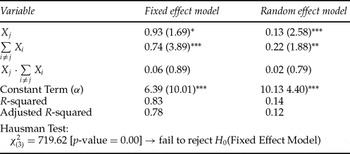
The statistical software E-Views (version 4.0, 2002) is used to conduct the regression analyses as represented by equation (2). Before examining any variable coefficients, the first question investigated was whether the relationship between ground subsidence and pumpage of groundwater in these areas is best described through a fixed-effects or a random-effects model. In the Hausman regression output shown in table 1, the results indicate that the fixed-effects model provides a better description of this relationship. The groundwater use by each village and its neighborhood is found to have a significant effect on ground subsidence levels. Because of the colinearity between X j and X j ⋅ Σi≠jX i,Footnote 4 the coefficient of interaction term X j ⋅ Σi≠jX i is positive, but not statistically significant. The related literature, however, shows that the interaction of groundwater use should play an important role in determining the ground subsidence level (Shi, Reference Shi2000; Chang, Reference Chang2000; Huang, Reference Huang2000). Hence, we still keep this term for the following economic analysis to avoid the problem of omitting variables (Johnston and Dinardo, Reference Johnston and Dinardo1997). Therefore, equation (2) becomes

Results of fixed effect and random effect model

Notes: t-statistics are in parentheses. *Significant at the 10% level. **Significant at the 5% level. ***Significant at the 1% level.
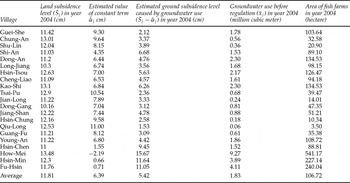
The constant term reported in equation (11) represents the average of the individual effects for each village. It implies that when the region lies completely retired, the average annual ground subsidence level will still be 6.39 cm. More background information, such as groundwater usage, areas of fish farms, ground subsidence levels, and individual effects from the fixed effect model in the 21 villages are listed in table 2. Noteworthy in the table is the negative constant term for How-Mei village. It means that the ground in this area rises when the farmers and their neighbors all stop pumping groundwater. This phenomenon might be caused by ground displacement due to a previous earthquake (Huang, Reference Huang2000). Deducting each individual's estimated constant term  , we get an estimate of the ground subsidence level solely from groundwater use. The positive correlation coefficients found among variables
 ,
 , and
 imply that areas with more groundwater use are usually the ones with higher ground subsidence levels.
Table 2 shows that the average ground subsidence level for year 2004 in these areas is 11.81 cm. Subtracting this number from the average unobserved factors leading to ground subsidence  in equation (11), the estimated subsidence level caused by the consumption of groundwater in year 2004 is computed to be 5.42 cm. Using this as a benchmark, we further simulate four target subsidence levels where each aquacultural farmer must have at least 20 per cent, 40 per cent, 60 per cent, and 80 per cent improvement in ground subsidence in year 2005 under Scenario 1. That is, the ground subsidence levels caused by the consumption of water under these required improvement ratios should not be over 4.34 cm, 3.25 cm, 2.17 cm, and 1.08 cm, respectively. Such a regulation sets a uniform standard for all farmers no matter what their present cultivation size is. If we omit the externality from groundwater use, then it looks like the regulation requires large farmers to reduce water use further to meet the standard, and it is in favor of small farmers. Since small farmers comprise the majority in this area, the rationale behind this is to lower any possible opposition from small farmers and allow the policy to be implemented more smoothly.
Background information for the coastal areas in Budai township

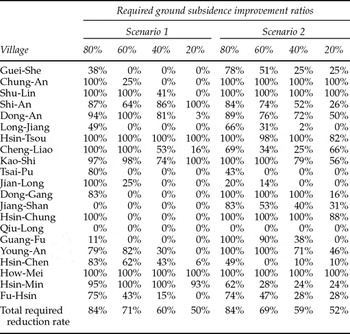
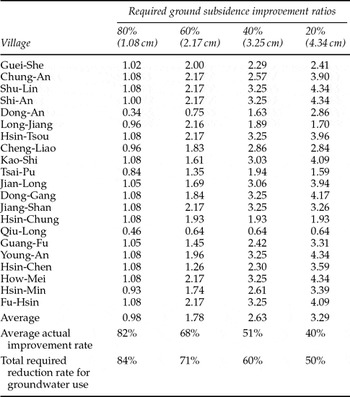
The optimum is solved in a non-linear programming manner through the CONOPTFootnote 5 solver in the General Algebraic Model System (Brooke et al., Reference Brooke, Kendrick and Meeraus1992). The results (table 3) indicate that small farmers do benefit from this kind of regulation, since most of them either do not need to reduce groundwater use or only have to make a minor adjustment. On the other hand, only about half of large farmers are affected under this scenario, but the required groundwater reduction rates are more than 93 per cent for them under each required improvement ratio on the ground subsidence level. These large farms that need to lie nearly completely retired are located in the central (Hsin-Tsou, Kao-Shi, and Shi-An) and southern parts (How-Mei and Hsin-Min) of Budai township.
Required groundwater reduction rate in each village

In Scenario 2, the target is solely based on each village's ground subsidence level from groundwater use in year 2004. Like Scenario 1, each village is required to maintain its ground subsidence levels in order to not exceed a given ratio of the benchmark year, which is obtained from  in table 2. The same 20 per cent, 40 per cent, 60 per cent, and 80 per cent required improvement ratios used in Scenario 1 are applied to determine the upper bound in Scenario 2. This kind of regulation considers the characteristic of farmers' current stage, such as the amount of water used and ground subsidence levels. The farmers may perceive this as fair compared with Scenario 1.
In Scenario 2, a majority of the areas do not need to reduce the same ratio of consumption of groundwater to meet the environmental target (table 3). For example, areas with a serious ground subsidence problem and more groundwater use (such as Hsin-Chen, Hsin-Min, and Fu-Hsin villages) do not need to reduce more fish farms accordingly at all. Some mid-sized farms, such as those in Chung-An and Shu-Lin villages need to leave all their land retired under almost each required improvement ratio; the farms that are located in the central part will only be affected when the regulation is rigid. The regulation, however, has more impact on farmers who are in the northeast (Chung-An, Shu-Lin, Hsin-Tsou, and Kao-Shi villages) area. They need to reduce their water use by 50 per cent under each regulation standard. The only two other villages that have been affected relatively more are located in the west (Hsin-Chung village) and southwest (How-Mei village) areas. This indicates that each farm's location, but not its size, determines how it will be affected by the regulation in this scenario.
The simulation results of our study under both scenarios imply that when the spatial interaction caused by the pumpage of ground water is considered in the model, the reduction of groundwater in neighboring areas could be helpful in solving the ground subsidence problem. At the same time, even though the regulation standard in Scenario 2 looks fair to farmers and is set proportionally to their previous subsidence levels, the responsibility of achieving environmental goals is not evenly shared by all aquacultural farmers.
Because of the external impact of ground subsidence on the neighborhood, How-Mei village, which has been proposed by the Chia-Yi county government as the exclusive zone of aquaculture in the future, needs to completely lie retired under both scenarios. Therefore, if a subsidy policy and aquaculture exclusive zone are used together to mitigate the ground subsidence problem, then it is necessary to re-examine whether its neighboring Fu-Hsin and Hsin-Tsou villages, which are found to be scarcely affected under the regulation, are more suitable areas.
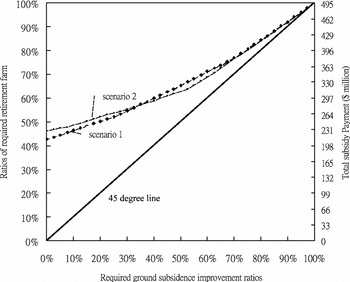
Table 3 shows that the percentages of areas for fish farms that need to lie retired are all higher than the required improvement ratios on ground subsidence set by the government, and the gap becomes bigger when the standards are less rigid. Therefore, under the circumstance that the subsidy expenditure is based on the areas of retired farms, the government should set a tighter standard and make every dollar spent on improving ground subsidence more effective. Figure 2, which depicts the total subsidy expenditures and the required groundwater reduction under various required improvement ratios from 0 per cent to 100 per cent, also confirms this policy implication. When the regulation is less stringent, the government has to pay a relatively higher amount of subsidy in order to respond to the dramatically reduced groundwater usage. When the required improvement ratio is under 35 per cent, the total subsidy payment in Scenario 2 is higher than that in Scenario 1. When 35 per cent to 65 per cent required improvement ratios are imposed, the total expenditure in Scenario 1 is higher. The largest gap between these two scenarios, however, is no more than US$0.52 million, and the curves that represent the total subsidy payment in both scenarios nearly coincide when tighter control standards are imposed.
Regulation, subsidy payment, and retired farm ratio

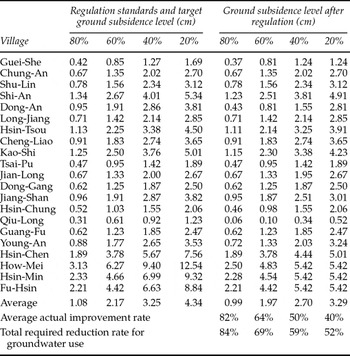
The results in tables 4 and 5 show that even when the ground subsidence levels are set to be no more than 1.08 cm, 2.17 cm, 3.25 cm, and 4.34 cm under Scenario 1, the final average ground subsidence levels are 0.98 cm, 1.78 cm, 2.63 cm, and 3.29 cm in Scenario 1. On the average, 0.99 cm, 1.97cm, 2.7 cm, and 3.29 cm can be reached under the same required improvement ratios in Scenario 2. Therefore, the environmental goal is overachieved when the interactions of farmers' water pumping behavior are considered. That is, 82 per cent, 68 per cent, 51 per cent, and 40 per cent and 82 per cent, 64 per cent, 50 per cent, and 40 per cent actual improvement ratios, respectively, have been reached when the original 80 per cent, 60 per cent, 40 per cent, and 20 per cent standards are set under these two scenarios. In fact, more than half of the areas have a lower final ground subsidence level than the standards. However, the gap between the total required reduction rate of groundwater use and the actual ground subsidence improvement rate still exists and becomes bigger when the standards are less rigid. Thus, the policy implication that more stringent environmental standards should be used would still apply here when the target ground subsidence levels are overachieved.
Ground subsidence levels under regulation standards – Scenario 1

Ground subsidence levels under regulation standards – Scenario 2

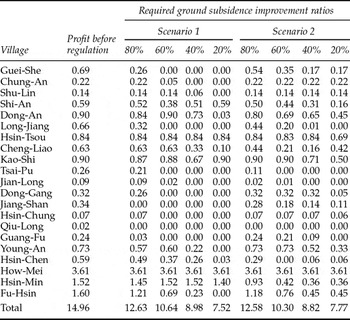
In Scenario 1, the government needs to pay US$12.63 million, US$10.64 million, US$8.98 million, and US$7.52 million, respectively, to achieve the pre-specified 80 per cent, 60 per cent, 40 per cent, and 20 per cent ground subsidence improvement targets (table 6). On the other hand, US$12.58 million, US$10.3 million, US$8.82 million, and US$7.77 million are needed correspondingly to achieve the goals in Scenario 2 (table 6). Given the fact that the final average land subsidence levels under both scenarios are almost the same as those indicated in tables 4 and 5, it may not make much of a difference for the government to determine whether the regulation should set an equal standard or be based on each village's current land subsidence levels.
Subsidy payment for each village (million)

6. Conclusion
Since aquacultural farmers are considered as members of an underprivileged group in society, the government, in practice, is unable to impose any tax or any command and control policy on them to reduce groundwater usage. Under the proposed subsidy and two regulation schemes in which aquacultural farmers can receive full compensation for every unit of profit loss as a result of the reduction in groundwater use, this research tried to determine the size of fish farms and the priority along the coastal areas in Budai township that need to be retired, based on the extent of the external effects of pumping groundwater. The lack of related soil type data forced the study to use regression analysis to estimate the relationship between groundwater use and ground subsidence. Even if accuracy may be sacrificed to some extent because of the simplicity of the regression approach, what we gained is its applicability and compatibility to the economic model.
To implement the subsidy more smoothly, this study considered two regulation schemes. The first regulation is in favor of small farmers and requires large farmers to undertake more improvements in terms of their ground subsidence levels. Thus, the benchmark used for setting the required improvement ratio is the average land subsidence level for the whole coastal area. The results indicate that smaller farmers are scarcely affected under the regulation, but only less than half of large farmers need to lower their groundwater use to meet the standards. However, these large farmers need to retire nearly all their land even under the less rigid required improvement ratio. On the other hand, the impacts of the second regulation that considers fairness in terms of the farmers' perception depend mainly on farm location but not its size. There is no significant difference, however, on the total required expenditure for retiring land, and the environmental goal is overachieved under these two schemes. Thus, the government can freely choose either of these control policies according to large and small farmers' attitude regarding the subsidy policy.
Fish farms in Budai township that need to be retired are spread unevenly and depend on which regulation scheme is used. This implies that when the spatial interactions caused by pumping groundwater are considered in the model, the responsibility for achieving the targets of environmental control is not equally shared by all aquacultural farmers. According to the plans of the Chia-Yi county government, How-Mei village in Budai will become an exclusive zone of aquaculture, but the village needs to completely lie retired in order to slow down ground subsidence under all simulated situations. Owing to the external impacts of groundwater use, it is necessary to re-examine whether neighborhood areas, such as Fu-Hsin and Hsin-Tsou villages, which are found to be affected less by the regulations, are more suitable areas.
It might be controversial to include both legal and illegal farmers for the proposed subsidy. However, comparing the required annual payment to retire all the fish farms, which is US$14.96 million as proposed by the study, with the annual prevention and replacement expenditure caused by farmers' illegal groundwater pumpage from 1992 to 1994, which is US$15.04 million, it is less expensive to mitigate the ground subsidence problem through the subsidy. As one can expect, the central government will continue spending money on the ground subsidence problem as long as groundwater is overused in this area. Therefore, the central government should instead consider providing enough funding to the local government for subsidy use until enough fish farms are retired. In addition, the government should immediately determine the eligibility for subsidy by recording each farmer's current size and raised species to prevent the entrance of new farmers. Compared with other regulation policies, such as tax or direct control on groundwater use, the subsidy policy is easier in terms of monitoring. This is because policymakers only need to make sure that no production activity takes place on each land parcel that is paid to be retired. Technically, it can be done through commercial high-resolution satellite images.
The percentages of areas for fish farms that need to lie retired are found to be higher than the percentages of each required ground subsidence improvement set by the government, and the gap becomes larger when the standards are less rigid. Therefore, under the circumstance in which the subsidy expenditure is based on the areas of farms lying retired, the government should set tighter standards to raise the amount of reduced ground subsidence level that each dollar spent can get when the budget allows.
In this study, the land selection criteria for retirement were based on the externalities of groundwater use by each aquacultural farmer, which is implicitly assumed to be dictated by the government. However, we only determined the amount of required fish farms for retirement in each village, and not the optimal length of the contract. This is because the latter depends on the available budget of the local government, which is highly uncertain. The limited five-year historical land subsidence level records may affect the accuracy of the regression analysis. The simulation results, however, do offer policymakers a guideline in allocating their limited annual budget to subsidize aquaculture industry once certain environmental goals are set.