The genotype of individuals greatly affects the milk concentration of casein: goats with strong (AA) and weak (FF) genetic profiles will produce milk with αs1-casein content of around 7 g/l and 0·9 g/l respectively (Martin et al. Reference Martin, Ollivier-Bousquet and Grousclaude1999). Milk protein synthesis depends on amino acids taken up by the mammary gland. The amount of amino acids available for this synthesis depends on the amounts of microbial cells and by-pass protein deriving from the rumen.
There should be a link between the genotype that determines different casein levels in milk and the efficiency of use of the available nutrients. Very few studies have been conducted on the interactions between polymorphism at the alpha-s1 casein locus and nutrition. De la Torre et al. (Reference De la Torre, Serradilla, Gil Extremera and Sanz Sampelayo2008) report that a greater efficiency in nitrogen and energy utilization of goats with strong alleles v. weak alleles may explain the differences in milk composition between the two genetic groups. Moreover, this efficiency is strongly influenced by the characteristics of the diet.
It has been demonstrated that food preferences can depend on physiological state (Kyriazakis et al. Reference Kyriazakis, Tolkamp and Emmans1999; Villalba & Provenza, Reference Villalba and Provenza1999). Studies on goats highlighted that lactation stage affects feed selection in extensive (Mellado et al. Reference Mellado, Rodriguez, Villarreal and Olvera2005) and intensive feeding systems (Fedele et al. Reference Fedele, Claps, Rubino, Calandrelli and Pilla2002).
It seems that ruminants are able to relate the sensory properties of a feed to the post-ingestive feedback signals learned from experience (Provenza et al. Reference Provenza1995). In particular, different studies have shown that foods that meet requirements for energy and nitrogen are preferred (Villalba & Provenza, Reference Villalba and Provenza1997a, Reference Villalba and Provenzab).
The aim of this research was to assess whether a different genetic aptitude for producing casein can affect diet selection and milk composition in lactating goats, by making available to them feeds with differing chemical-nutritive characteristics.
Materials and Methods
Animals and feeding management
Sixteen Girgentana goats (3rd and 4th lactation), homogeneous for milk production (0·8±0·1 kg/d), days of lactation (110±15 d) and body weight (37·6±5·1 kg) were selected from a flock of 120 goats deriving from three farms located in different areas of Sicily. Animals were divided into two groups, eight homozygous for strong (AA) and eight homozygous for weak (FF) alleles, as characterized by isoelectric focusing (IEF) in ultrathin polyacrylamide gels according to Erhardt et al. (Reference Erhardt, Juszczak, Panicke and Krick-Saleck1998) and allele specific-polymerase chain reactions (AS-PCR) at the CSN1S1 locus for the strong A and weak F alleles according to Leroux et al. (Reference Leroux, Mazure and Martin1992). Moreover, the absence of null allele at αs2- and β-casein loci was ascertained with PCR-RFLP (Ramunno et al. Reference Ramunno, Longobardi, Pappalardo, Rando, Di Gregorio, Cosenza, Mariani, Pastore and Masina2001) and AS-PCR (Rando et al. Reference Rando, Pappalardo, Captano, Di Gregorio and Ramunno1996) reactions, respectively. Prior to starting the study and during the trials the health status was evaluated based on behaviour, rectal temperature, heart rate, quality of respiration, cough, nasal discharge, eye discharge, faecal consistency, haematological and haematochemical profiles, and somatic cells count (SCC).
All the animals were housed in individual pens with mangers subdivided into five separate containers. Goats were offered alfalfa pelleted hay, two sources of starch (whole barley and whole maize) and two sources of protein (whole faba bean and pelleted sunflower cake). In each pen water and salt were always available. The pre-experimental period consisted of a 7-d period, during which the animals received a mixed ration of 1·5 kg of hay and 0·2 kg of each concentrate; a 10-d period during which goats received, separately, 1·5 kg of hay and a quantity of each concentrate gradually increasing from 0·2 to 0·7 kg. Taking into account that intakes tended to increase for each increment of concentrates supplied, we did not increase further the amount supplied, to avoid risks of metabolic diseases. The adaptation period lasted 7 d during which the animals received the experimental diet consisting of 1·5 kg of hay and 0·7 kg for each concentrate feed. The experimental period lasted 3 weeks (5–26 May).
Data collection and analysis
Individual intake of each feed was measured daily, on the basis of residuals. Every three days individual milk production was recorded and milk samples were individually collected from the morning and evening milking. Three samples for each feed were analysed for dry matter (DM), crude protein (CP) (AOAC, 1990), structural carbohydrates (Van Soest et al. Reference Van Soest, Robertson and Lewis1991), water-soluble carbohydrates (WSC) by a modified anthrone method (Deriaz, Reference Deriaz1961), starch by an enzymic procedure (Megazyme International Ireland Ltd., Bray, Co. Wicklow), protein fractions according to Licitra et al. (Reference Licitra, Hernandez and Van Soest1996).
Milk samples, consisting of proportional volumes of morning and evening milk, were analysed for lactose, fat, protein and SCC by an infrared method (Combi-foss 6000, Foss Electric, Hillerød, Denmark). Total nitrogen (TN), non-protein nitrogen (NPN) and non-casein nitrogen (NCN) were determined by FIL-IDF standard procedures (1964). From these nitrogen fractions, total protein (TN∗6·38) and casein [(TN−(NCN∗0·994))∗6·38] were calculated. Milk urea content was determined using a differential pH meter (CL10, Eurochem, Savona, Italy).
Blood samples were collected, from all subjects, every three days before feeding, by jugular venipuncture, using vacutainer tubes (Terumo Corporation, Tokyo, Japan) with K3-EDTA. Blood samples were clotted at room temperature for 1 h and centrifuged at 1360 g for 10 min; sera were separated and stored at −20°C until analysed. Sera were analysed with commercially available kits by means of a u.v. spectrophotometer (model Slim SEAC, Firenze, Italy). Serum concentrations of the following parameters were determined: albumin, total protein, total cholesterol, bilirubin, urea, glucose, NEFA, triglycerides, glutamate oxalacetate transaminases (GOT) and glutamate pyruvate transaminases (GPT).
Statistical analysis
Pre-experimental data for DM intake, milk production and composition were analysed using a one-way ANOVA. Individual data for intake, diet selection, diet composition, milk production and composition, and blood parameters were analysed using the GLM procedure for repeated measures of SPSS (SPSS for Windows, SPSS Inc., Chicago IL, USA). Milk production (means of the 3 weeks) was used as a covariate in fat, protein, lactose, casein and urea analysis. As covariance was never significant (P>0·05) it was not included in the statistical model.
Results
The health status of goats, checked during the trial, was good: no clinical or subclinical signs of disease were observed. Values of rectal temperature, heart rate, respiratory rate, digestive function and SCC were within the normal range. The haematochemical trends obtained in the two groups were within the physiological range for the goat (Kramer & Hoffmann, Reference Kramer, Hoffmann, Kaneko, Harvey and Bruss1997). Moreover the monitoring of GOT and GPT in all subjects showed the absence of hepatic diseases. No statistical differences were found in blood parameters, between groups (data not reported).
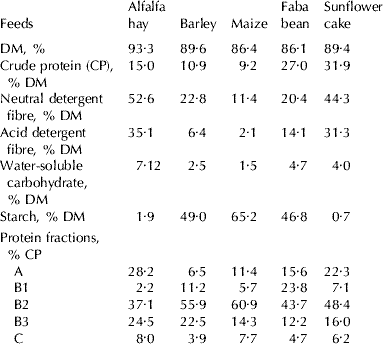
Table 1 shows the chemical composition of the five feeds. Cereal grains, maize and barley contained different levels of carbohydrates [respectively: starch, 65·2 and 49·0% DM; neutral detergent fibre (NDF), 11·4 and 22·8% DM]. Sunflower cake and faba bean were characterized by a high protein content and a different carbohydrate composition (respectively: starch, 0·7 and 46·8% DM; NDF, 44·3 and 20·4% DM); moreover, true protein in faba bean was more rapidly degradable than in sunflower, as demonstrated by the higher levels of the soluble fraction (B1), and the lower level of the neutral-detergent insoluble nitrogen (B3).
Chemical composition of the available feeds
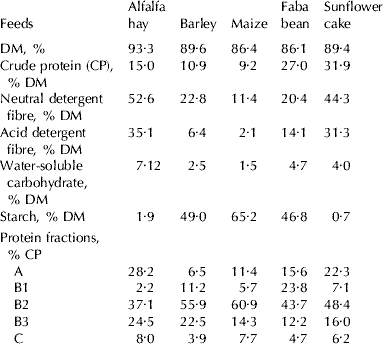
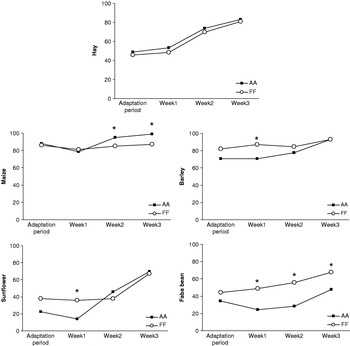
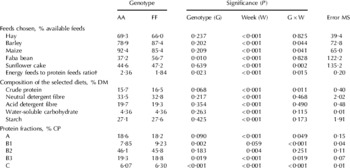
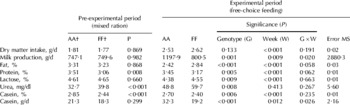
Table 2 shows results for feed choice and composition of the selected diets. On average goats from both groups showed a strong preference for maize, barley and hay, whereas they consumed less high-protein feeds. The genotype significantly influenced feeding behaviour: selection activity towards faba bean was significantly lower in AA group. Other significant group×week interaction effects are highlighted in Fig. 1: during week 1 AA goats selected less sunflower and barley, whereas from week 2 they selected more maize, compared with FF group. As a consequence of this selective activity the resulting energy-rich to protein-rich feeds ratio was significantly higher in AA group. Despite the differences in feed selection, the CP and carbohydrate contents of the selected diets were surprisingly similar in both groups. As for true protein, the soluble fraction (B1) and the indigestible fraction (C) were significantly lower in the diet selected by AA group.
Hay, maize, barley, sunflower and faba bean selection (% of each available DM amount) in AA (▪) and FF (○) goats; * P<0·05.

Composition of the selected diets (% dry matter, DM) and feeds chosen (% of available feed)

† Maize plus barley intake/faba bean plus sunflower intake (g DM/d)
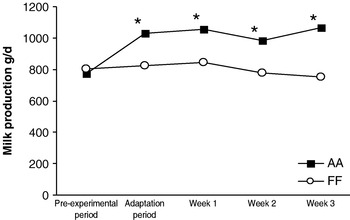
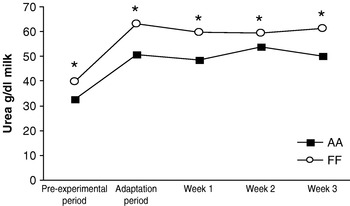
Table 3 shows results for DM intake, milk yield and composition. Total DM intake was not affected by genotype. AA goats, starting from the adaptation period, increased their milk production reaching values significantly higher than FF goats (Fig. 2). Percentages of protein and casein, as expected for the genotypes studied, were significantly higher in the group with strong alleles (AA), whereas lactose was higher in the group with weak alleles (FF). As a consequence of the increased milk production, AA goats achieved a mean casein production 68% higher than FF goats. Milk urea was significantly higher in the FF goats, since the pre-experimental period (Fig. 3). Fat percentages, noticeably lower compared with those recorded during the pre-experimental period, were significantly lower in AA goats.
Milk production (g/d) in AA (▪) and FF (○) goats; * P<0·05.

Milk urea (g/dl milk) in AA (▪) and FF (○) goats; * P<0·05.

Dry matter intake, milk production and composition and casein yield

† Genetic variants; see text for details
Discussion
In our experimental conditions, with the animals left free to choose their diet, intake was particularly high, on average equal to 170 g DM/kg metabolic body weight. According to INRA recommendations (Morand-Fehr & Sauvant, Reference Morand-Fehr, Sauvant and Jarrige1988), similar levels of DM and protein intake correspond to the requirements of a goat weighing 70 kg (compared with about 40 kg in our experimental conditions) and producing 4 l/d (compared with about 1 l). Despite this high nutrient input, goats did not show any clinical signs of metabolic disorders and blood parameters were within the normal range of values. Feeding behaviour shown by goats, when free to choose their diet, can probably explain this response: all the goats, during the experimental period, strongly increased selection towards hay and sunflower, the most fibrous feeds (Fig. 1); this behaviour seems to support the hypothesis that ruminants are able to select their diet in order to attenuate ruminal acidosis (Cooper et al. Reference Cooper, Kyriazakis and Oldham1996; Phy & Provenza, Reference Phy and Provenza1998; Abijaoudé et al. Reference Abijaoudé, Morand-Fehr, Tessier, Schmidely and Sauvant2000a; Keunen et al. Reference Keunen, Plaizier, Kyriazakis, Duffield, Widowski, Lindinger and McBride2002). Moreover, goats selected on average 83 and 89% of the available barley and maize but only 47% and 46% of faba bean and sunflower, preferring the high-energy and low-protein feeds over the high-energy and high-protein feeds. This selective behaviour suggests that goats increased energy intake without paying the metabolic price of an excessive protein intake. The capability of ruminants to respond to nutritional imbalances by modifying their feeding behaviour has been shown by Villalba & Provenza (Reference Villalba and Provenza1996, Reference Villalba and Provenza1997a) and it seems linked to the perception of post-ingestive feedback signals related to the sensory properties of foods; in fact the animals can learn the negative or positive nutritional consequence of foods from their own experience (Provenza, Reference Provenza1995; Duncan et al. Reference Duncan, Ginane, Elston, Kunaver and Gordon2006). We cannot exclude the possibility that a supply of a low-protein roughage might have resulted in a reduction of protein intake, also limiting the high energy input. However, using a poor quality roughage, which is generally associated with low palatability (Greenhalgh & Reid, Reference Greenhalgh and Reid1971) would bring with it the risk of this aspect, more than nutritional and metabolic motivations linked to genotype, exercising a confounding effect on selective behaviour.
As regards genotype effect, there are very few reports on the relationships between αs1-casein polymorphism and nutrition. Schmidely et al. (Reference Schmidely, Meschy, Tessier and Sauvant2002) and de la Torre et al. (Reference De la Torre, Serradilla, Gil Extremera and Sanz Sampelayo2008), in controlled feeding conditions, found greater intakes and a better diet efficiency in goats with strong alleles. In our experiment we did not find any intake differences between groups. However, the genotype significantly influenced feeding behaviour: selection activity towards faba bean was significantly higher in FF group. Moreover, during week 1 AA goats selected less sunflower and barley, whereas from week 2 until the end of the trial they selected more maize, compared with FF group. On average, this behaviour resulted in a higher ratio of energy-feeds to protein-feeds in AA goats (Table 2). In this way AA goats probably improved the efficiency of microbial protein synthesis and increased the availability of amino acids for mammary protein synthesis. In fact, it has been widely demonstrated that milk protein concentration is positively influenced by energy concentration of the diet (Nocek & Russel, Reference Nocek and Russel1988; Coulon et al. Reference Coulon, Dupont, Pochet, Pradel and Duployer2001; Pulina et al. Reference Pulina, Nudda, Battacone, Fancellu, Francesconi, Cannas and Pulina2008). Surprisingly the different feeding behaviours in the two genotypes did not result in different contents of CP and carbohydrates in the selected diets. It should be taken into account, however, that even foods formulated to be isocaloric or isonitrogenous may differ functionally (Atwood et al. Reference Atwood, Provenza, Villalba and Wiedmeier2006) so creating nutritional characteristics beyond the scope of gross analysis. For example, in our experiment, AA goats consumed lower highly soluble (B1) and insoluble (C) true protein fractions, compared with FF goats, probably obtaining lower losses of protein, in terms of NH3-N and in terms of totally indigestible protein (Licitra et al. Reference Licitra, Hernandez and Van Soest1996). For starch-rich feeds, maize being less degradable than barley (Sauvant, Reference Sauvant1997; Hadjipanayiotou, Reference Hadjipanayiotou2004) and with a higher proportion of ruminal escape starch, is supposed to affect the rumen fermentation pattern (Casper & Schingoethe, Reference Casper and Schingoethe1989) and microbial protein synthesis (Offner et al. Reference Offner, Bach and Savant2003) and to be more efficiently used for milk production compared with barley (Nocek & Tamminga, Reference Nocek and Tamminga1991).
At the start of the pre-experimental period the goats, fed with a mixed ration of 1500 g of pelleted hay and 200 g of each feed used during the trial, were not able to select their diet. Under those conditions, goats produced similar amounts of milk. However, starting from the free-choice adaptation period, milk production tended to increase significantly in AA group, even though the goats were well beyond the peak of lactation. To our knowledge there are no reports in the literature of similar productive differences between AA and FF genetic types. Schmidely et al. (Reference Schmidely, Meschy, Tessier and Sauvant2002) report that, when feeding practice is monitored, AA and FF goats have similar milk production, concluding that a direct effect of the genotype for αs1-casein on milk production is unlikely. As our goats, at the beginning of the trial, were homogeneous in terms of milk production and lactation stage, it is possible that, during the experimental period, giving the animals the opportunity to select their diet, the different feeding behaviour between groups induced different efficiencies of nutrient utilization for milk secretion; it seems to suggest an indirect effect of genotype on milk yield by way of the difference in selective activity.
Total milk protein content was obviously closely related to the casein content. On the basis of the classification of Martin et al. (Reference Martin, Ollivier-Bousquet and Grousclaude1999) AA goats should have produced milk with 0·6% more casein than FF goats. In our study, milk casein content was only 0·3 percentage points higher in group AA. This result may be related to the ‘dilution’ effect on casein content of the higher milk production in AA group. Moreover, Caravaca et al. (Reference Caravaca, Amills, Jordana, Angiolillo, Aguera, Aranda, Menéndez-Buxadera, Sanchez, Carrizosa, Urrutia, Sànchez and Serradilla2008) recently highlighted that breed-specific genetic and/or environmental factors can modulate the impact of the αs1-casein gene polymorphism on its synthesis rate.
Important differences between groups were seen for milk urea levels, which were significantly higher in FF goats. High concentrations of milk urea in ruminants are a consequence of excessive dietary CP (Broderick, Reference Broderick2003; Cannas, Reference Cannas and Pulina2004) or an inadequate balance between protein and non-structural carbohydrate sources, both in quantitative terms and in rumen degradability (Hristov & Ropp, Reference Hristov and Ropp2003; Moharrery, Reference Moharrery2004) indicating a low efficiency of microbial synthesis. In the present study, urea levels were already higher in FF group during the pre-experimental period, when the animals were fed with the same diet, similarly to the finding of Schmidely et al. (Reference Schmidely, Meschy, Tessier and Sauvant2002) ; this difference tended to increase during free-choice feeding. In fact FF goats, selecting a diet with a worse combination of energy and protein feeds, compared with AA group, probably reached a lower efficiency of transfer of nitrogen into milk protein. Moreover, a diet higher in highly soluble protein and lower in rumen-escape protein, was characterized by higher protein losses and lower milk protein levels.
Milk fat content, in both groups, was low in comparison with previous results (Todaro et al. Reference Todaro, Scatassa and Giaccone2005; Avondo et al. Reference Avondo, Bonanno, Pagano, Valenti, Di Grigoli, Alicata, Galofaro and Pennisi2008) on Girgentana goats and was lower than protein content. This phenomenon of inversion of fat and protein percentages is not rare in goats (Pulina et al. Reference Pulina, Nudda, Battacone, Fancellu, Francesconi, Cannas and Pulina2008) during spring at mid lactation (Abijaoudé et al. Reference Abijaoudé, Morand-Fehr, Tessier, Schmidely and Sauvant2000b; Bocquier et al. Reference Bocquier, Rouel, Domalain and Chilliard2000; Morand-Fehr et al. Reference Morand-Fehr, Tessier, Meschy and Sauvant2000); it can be related to the combined effects of lactation stage, day length (these conditions are consistent with our experimental conditions) and nutritional factors (Kawas et al. Reference Kawas, Lopes, Danelon and Lu1991; Santini et al. Reference Santini, Lu, Potchoiba, Fernandez and Coleman1992; Chilliard et al. Reference Chilliard, Ferlay, Rouel and Lamberet2003) such as the low content of roughage in the diet selected by our goats, on average equal to 36% of DM. In this regard, according to INRA guidelines for goats, to maintain a good level of milk fat, forage should never be less than 40% of the ration (Morand-Fehr & Sauvant, Reference Morand-Fehr, Sauvant and Jarrige1988).
The percentage of fat, which was similar in the two genetic groups before the experiment started, decreased significantly thereafter in the AA group. Such a finding has not been reported previously; indeed, the opposite is reported (Grosclaude et al. Reference Grosclaude, Ricordeau, Martin, Remeuf, Vassal and Bouillon1994; Barbieri et al. Reference Barbieri, Manfredi, Elsen, Ricordeau, Bouillon, Grosclaude, Mahé and Bibé1995; Chilliard et al. Reference Chilliard, Rouel and Leroux2006). As milk fat percentage is closely linked to production levels, as suggested for protein, it is more likely that the lower percentage observed in AA goats was the result of a ‘dilution’ effect, rather than a direct result of genetic origin.
During the 3-week experimental period goats of both groups increased body weight by about 2 kg. Taking into account that, even consuming similar amounts of nutrients, AA goats ate more energy feeds and produced more milk but with a lower level of fat, it could be hypothesized that a different partitioning of energy between tissue deposition and milk synthesis occurred (Kawas et al. Reference Kawas, Lopes, Danelon and Lu1991) as a consequence of the different proportion of feeds in the selected diet.
Conclusions
In conclusion, goats ate much more protein and energy than their apparent requirements; however, the genetic aptitude to produce higher casein levels induced AA goats to improve their energy and protein input, achieving an unexpected increase in the yield of milk, which was richer in protein and lower in urea. These results seem to demonstrate that interactions probably occurred between genetic polymorphism at the αs1-casein locus, diet selection and the efficiency of nutrient transfer into milk. Further research is needed to understand the role of endocrinal and metabolic mechanisms involved in these interactions.