





Introduction: Recentring East Africa in the global history of cowrie shells
The association between cowrie shells and the African continent is both long-standing and profound. It is evident in the widespread historical use of cowries for decorating everyday objects and clothing, as well as in items signifying political power and social prestige. Cowries also played crucial roles in rituals and religious practices, featuring in shrine offerings and divination. This enduring significance is inseparable from their historical use as currency, especially in West Africa during the transatlantic slave trade. In one of the most widely read slave narratives, Olaudah Equiano recounts being sold for 172 ‘little white shells’, a detail that illustrates the role of cowries within the monetary practices of the slave trade.Footnote 1 As Jan Hogendorn and Marion Johnson argue in their seminal study of the ‘shell money of the slave trade’, among all imported goods entering West Africa in the Atlantic period, cowries had probably ‘the most universal effect, over the widest geographical area, on the common people of West Africa’.Footnote 2 Yet when the long-term history of cowries is approached from a different geographical perspective, East Africa emerges as a significant, though far less studied, part of their monetary history.
Cowries are the hard, glossy exoskeletons of small marine molluscs that became one of the most widely used currencies across several African regions.Footnote 3 Of the approximately 250 known cowrie species that inhabit tropical waters, only two were used as currency in sub-Saharan Africa: Monetaria (M.) moneta from the Maldives, and M. annulus from Zanzibar and the wider East African coastal zone. The former is smaller and cream-coloured, with a triangular shape and knobbly surface, whereas the latter is ovoid and smooth, marked by a golden ring encircling a grey or purplish-blue dorsum.Footnote 4
Historians and anthropologists, particularly those working on West Africa, have examined cowries extensively, exploring their role as a regional currency,Footnote 5 their interactions with other forms of money,Footnote 6 their relationship to market growth and state consolidation,Footnote 7 and their symbolic and ritual uses,Footnote 8 including in counting and writing systems.Footnote 9 Recently, scholars have situated cowries within broader global histories, showing how they can serve as a powerful entry point for tracing enduring connections between African societies and the wider world.Footnote 10 Introduced to West Africa overland via North Africa, M. moneta was already circulating widely across the markets of the Middle Niger by the eleventh century, later spreading to Mauritania, Hausaland, the Ivory Coast, and the Niger Delta.Footnote 11 From the fifteenth century onward, it was requested by West African traders in their dealings with Europeans, especially in relation to the transatlantic slave trade. M. annulus, by contrast, was consistently rejected.Footnote 12
Yet from the 1840s onward, M. annulus became central to West African economies, as the rapid expansion of palm oil exports and other commercial commodities generated an unprecedented demand for currency that was met through massive imports of cowries from Zanzibar: in less than two decades, 14 billion shells from East Africa were introduced into the region, triggering a gradual but accelerating depreciation in the value of cowries.Footnote 13 What Johnson defined as the ‘great cowrie inflation’ has become a pivotal moment in West African historiography, variously explained as the outcome of traders’ pragmatic openness to monetary innovation, as a driver of regional and uneven price instability, and as a process shaped by West African political authorities and, later, British colonial intervention.Footnote 14 These interpretations, however, have tended to pay comparatively limited attention to the conditions of cowrie supply and to the reorganization of procurement networks in East Africa, leaving the infrastructures that sustained the nineteenth-century cowrie trade largely unexplored.Footnote 15
This gap reflects a broader historiographical pattern: East African cowries have remained marginal in the global history of cowries, with few exceptions.Footnote 16 Several factors help explain this marginalization. Africanist scholarship on cowries has traditionally privileged West Africa, given the centrality of shells in the slave trade and regional economies.Footnote 17 In East Africa, by contrast, the use of cowries as currency was geographically uneven: shells did not circulate as widely as other commodity currencies and remained largely confined to the Great Lakes region. Nor did East African cowries become major exports within European or Indian Ocean trade circuits, comparable to ivory, gum copal, or the trade in enslaved people. Traded intensively only for a relatively brief period, they have been described as a ‘windfall commodity’, of both sudden and short-lived commercial significance.Footnote 18 Archaeological research has further contributed to this marginalization. On many Swahili coastal sites, the abundance and availability of cowries encouraged the assumption that they had little value, leading to their relative neglect in excavation reports and interpretative frameworks.Footnote 19 Yet their documented presence at coastal and inland East African sites, in West African archaeological contexts, and as far as slave quarters in Virginia, tells a different story, one that becomes fully visible only when East African cowries are situated within broader regional and transoceanic histories.Footnote 20
This article integrates M. annulus into the global history of cowries and contends that nineteenth-century monetary transformations in West Africa cannot be fully grasped without attending to the reorganization of procurement networks, labour regimes, and commercial infrastructures in the Western Indian Ocean.Footnote 21 At the same time, it argues that the same infrastructures that channelled shells toward West Africa were later reoriented toward Buganda and the Great Lakes region, thereby connecting the monetary histories of East and West Africa. Central to this reorganization was a stratified chain of labour—from the women and children who collected the shells to labourers employed in processing operations in Zanzibar—together with procurement networks involving Swahili, Arab, South Asian, and European traders, without which the monetary function of cowries could not have been sustained. Recentring East African cowries within the history of shell money reveals the structural interconnections between money supply, monetary circulation, and currency formation, showing that monetary history cannot be understood without integrating into the analysis the infrastructures that made money available.
Against this background, the article explores the convergent contingencies that connected production in the Western Indian Ocean to monetary change in West Africa and the redirection of shells into East African inland trading circuits, analysing four interconnected contexts: (1) the large-scale acceptance of East African cowries in West Africa and the resulting inflation; (2) the establishment of a direct commercial route from Zanzibar to West Africa; (3) the sourcing and processing of cowries in Zanzibar; and (4) the integration of cowries within the currency system of Buganda and neighbouring polities. Across these contexts, the article follows the circulation of cowries as a form of money that underpinned everyday transactions and enabled long-distance trade, while showing how changes in their supply could both sustain and destabilize monetary systems. In doing so, it treats circulation not as a neutral movement across space but as a historically situated process shaped by commercial strategies, imperial interests, fiscal structures, extractive labour systems, and ecological conditions.Footnote 22 Treating circulation in this way brings into focus two central questions running through these contexts: (1) why did cowries become institutionalized as currency in some regions but not others, and (2) what specific conjunctions of supply, political authority, and spatial conditions made this possible?
That cowries could function as currency in the markets of Buganda and in the palm oil trade of West Africa points to the existence of overlapping monetary spaces that become fully visible only through a supply-side perspective. Tracing how cowries were sourced and supplied reveals how currency systems could be reshaped by developments unfolding thousands of miles away, bringing into the same analytical frame the circulation and use of currencies and the labour, procurement networks, and commercial infrastructures that sustained their monetary value. By reconstructing these dynamics across distant monetary arenas, this article contributes to global history by showing how a supply-side approach can situate processes conventionally studied within separate regional historiographies within a connected history of monetary change.Footnote 23
East African cowries in West Africa: Palm oil trade, inflation and monetary transformation
The introduction of M. annulus into West Africa in the mid-nineteenth century formed part of a longer trajectory of European attempts to circulate East African cowries in a region where M. moneta had long circulated as currency. Archaeological and historical evidence indicates that small quantities of M. annulus had already reached West Africa before the nineteenth century.Footnote 24 In the eighteenth century, French and British vessels exported significant quantities of cowries from the Lamu archipelago in Kenya, primarily to India, but also in attempts to access West African markets, while the Dutch similarly attempted to introduce M. annulus from Mozambique.Footnote 25 Despite these efforts, West African merchants largely rejected the shells: being larger and materially distinct, M. annulus was not recognized as the same currency.
The fate of these rejected shells points to the broader circuits into which East African cowries circulated before their large-scale acceptance in West Africa. Archaeological evidence from eighteenth-century Virginia suggests that shells rejected by West African traders were carried across the Atlantic. As Barbara Heath argues, they were transported on slave ships and later used for ornamental and monetary purposes by enslaved communities in plantation contexts in North America and the Caribbean.Footnote 26 The rejection of M. annulus in West African markets did not therefore mark its disappearance from global trade, but rather its redirection into alternative circuits, showing how choices made in West African markets could shape material and monetary practices among African diasporic communities across the Atlantic.
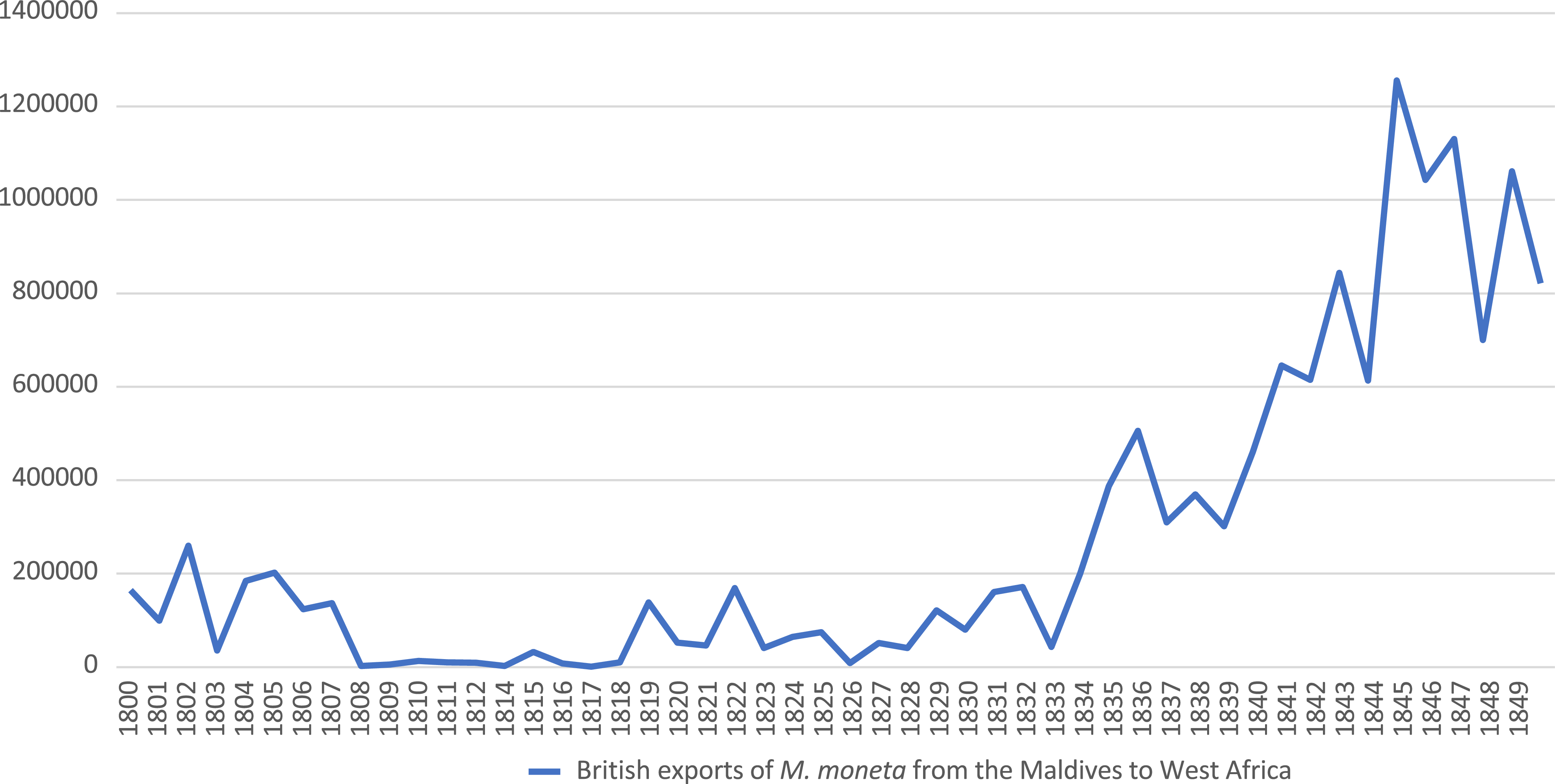
The conditions that eventually enabled the large-scale introduction of M. annulus into West Africa were shaped by the restructuring of West African export commerce following the British abolition of the transatlantic slave trade in 1807, which caused a sharp decline in cowrie exports from the Maldives, reducing them to negligible levels after centuries of expanding production and trade. From the 1820s onward, however, demand for cowries resumed, driven by the rapid expansion of new West African exports, particularly palm oil, and by the continuing—albeit illegal—trade in enslaved people, primarily to Brazil (see Figure 1). British traders initially relied on the substantial stockpiles of cowries amassed during the height of the slave trade. When these reserves dwindled, they resumed importing cowries from the Maldives and at the same time sought alternative sources of M. moneta in Ceylon, the Philippines, and Singapore.Footnote 27 It was precisely when exports of Maldivian cowries peaked in the mid-1840s, and more precisely in October 1845, that the Picciola, a ship commissioned by the Hamburg-based trader Alfred Jacob Hertz to purchase cowrie shells in the Maldives, arrived in Zanzibar. The ship’s captain, Jacob Schmidt, had first attempted to secure cowries in the Maldives but was denied access. He thus turned to Zanzibar, where he acquired M. annulus, which he then transported to Whydah in the Kingdom of Dahomey. There, to the surprise of many—including perhaps Captain Schmidt himself—the shells were accepted by Portuguese traders still engaged in the slave trade.Footnote 28
British exports of M. moneta from the Maldives, 1800–50 (lbs. avoirdupois). No data are available for 1813. Source: Author’s elaboration based on Jan Hogendorn and Marion Johnson, The Shell Money of the Slave Trade, 2nd edn (Cambridge University Press, 2003), 67.

Several contingencies created the conditions for West African traders to accept M. annulus. One key factor was the surging demand for currency driven by the rapid expansion of the palm oil trade. Used as lubricant for industrial machinery and railway carriages, as well as in the manufacture of soap and candles, palm oil became indispensable to the European industrial economy.Footnote 29 Exports from West Africa grew dramatically—from 250,000 lbs in 1807 to an annual average of 47,712,000 lbs by the 1840s—becoming Britain’s most significant import from the region.Footnote 30 The importance of West African palm oil was further reinforced by the Crimean War (1854–56), which disrupted the export of tallow from the Black Sea and drove up demand for alternative lubricants and raw materials.Footnote 31
In West Africa, palm oil production extended from Guinea to the Cameroons, with its core zones located between the Gold Coast and Old Calabar.Footnote 32 According to Robin Law, in regions such as Yorubaland and Dahomey the use of cowries as currency was closely tied to the structure of palm oil production. While large plantations were controlled by chiefs and kings, a substantial share of output came from small-scale producers, many of whom were women.Footnote 33 As these producers sold their palm oil in small quantities, cowries, with their small denominational value, were essential for these transactions. Unlike in the slave trade, where cowries were traded by weight, in the palm oil economy shells were counted individually, reflecting a shift toward smaller-scale exchanges.Footnote 34 This transition from large-batch, weight-based transactions to disaggregated, count-based exchanges may also help explain why M. annulus could now find acceptance. In a context where shells were now counted individually in small quantities rather than weighed in bulk, availability may have mattered more than differences in size, shape, and colour, particularly given the growing demand for large quantities of low-denomination currency.
The British officer Captain Cruickshank attested to the vital importance of cowries for the palm oil trade, observing that:
The introduction of the cowrie-shell and its application to this purpose supplied the desideratum necessary for the prosecution of the trade in palm-oil, the supply of which is found to fluctuate according to the supply of the cowries. If these have been exhausted in the stores of the merchants, no oil is brought to the market unless in such small quantities as may be required for immediate consumption; and although the manufacture of oil may go on in the meantime, in the expectation of new importations of cowries, yet if these be long delayed, the activity of the labourer slackens and finally ceases; the object of his labour being to obtain what to him is tantamount to ready cash, which he can apply in any manner he thinks fit.Footnote 35
A further factor in the acceptance of M. annulus was the rising price of Maldivian cowries. During the 1840s, M. moneta became scarce and its price surged on the London market, rising rapidly from £100 to £120 per ton.Footnote 36 The constrained supply of Maldivian shells partly reflected the long-term consequences of intensive harvesting during the slave trade era, as well as the low short-run elasticity of supply, which limited its capacity to respond rapidly to the growing demand generated by the expansion of the palm oil trade.Footnote 37 For European traders, M. annulus was significantly cheaper than Maldivian cowries: by the mid-1840s, a centner (112 lbs) containing 45,000–48,000 M. moneta cost US$8–9 in the Maldives, whereas a centner of the larger M. annulus, containing 18,000–20,000 shells, cost as little as US$0.75 in Zanzibar.Footnote 38 As M. moneta became scarce, the price of East African cowries in West African markets rose from US$8–9 to US$12 per centner, generating substantial profits for European firms.Footnote 39
The constrained supply of Maldivian shells, combined with rising prices and expanding demand for small-denomination currency, created favourable conditions for the introduction of East African cowries, and with them new incentives to build the commercial infrastructures that would sustain their large-scale procurement and shipment from Zanzibar.
Transoceanic connections: Commerce, infrastructure, and the East African cowrie trade
The Western Indian Ocean had long been part of interconnected trade circuits, and knowledge about the location and availability of cowries in specific coastal and island zones pre-dated the arrival of European commercial firms. What changed in the mid-nineteenth century was the reconfiguration of these networks to support expanding European commercial interests, at a time when diplomatic and international trading activities in Zanzibar were intensifying.Footnote 40 In this context, the ocean functioned increasingly as a space of resource extraction,Footnote 41 where natural resources were redirected toward new interoceanic circuits, linking East and West Africa in a more structural and sustained way.
Two key developments enabled the large-scale export of cowries from East Africa. First, European traders began employing small sailing ships with a carrying capacity between 150 and 200 tons, capable of sailing directly from Zanzibar to ports in West Africa.Footnote 42 This marked a significant departure from earlier transoceanic trade patterns. Previously, the strong currents and winds along the West African coast, particularly near Cape Verde, had made direct northbound voyages from the Indian Ocean to West Africa extremely difficult for large ships. During the transatlantic slave trade, therefore, cowries from the Maldives were shipped to Europe—often as ballast in the hulls of merchant vessels—and from there purchased by traders and re-exported to West Africa to buy enslaved people.Footnote 43 Thus, the use of smaller vessels made it possible to carry shells directly from Zanzibar to West Africa, shortening the route and making the trade commercially profitable.Footnote 44 Second, Portuguese trading houses still active in the slave trade in West Africa acquired cowries from German traders, paying for them in Spanish dollars. When these coins were brought back to Zanzibar, German firms used them to purchase ivory, gum copal, cloves, and hides for export to Germany.Footnote 45 In this way, the direct East-to-West Africa route became integral to the wider commercial strategies of German trading houses.
The pioneering trade expeditions by Hertz were soon followed by other commercial houses. In 1849, another Hamburg-based company, Wm. O’Swald & Co., joined Hertz in the cowrie trade and quickly rose to a leading position. To avoid price competition in West Africa, the two German firms negotiated an agreement designed also to keep their operations secret, particularly from American, British, and French potential competitors in Zanzibar.Footnote 46 The French commercial agent Édouard Loarer, stationed in Zanzibar at the time of the first cowrie exports, reported that the captain of a German ship had claimed that the shells were ‘shipped to the Baltic gates’ and sold ‘with advantage to the porcelain factories in Saxony ’.Footnote 47 While probably a deliberate misdirection, the statement illustrates the secrecy surrounding the trade.
The cowrie trade became a strategic and lucrative niche controlled by German firms, operating alongside the larger and more visible imports in textiles, glass beads, and metal wire, and exports of ivory, hides, and copal, sectors that were dominated by British and American traders and the sultan of Zanzibar.Footnote 48 Though less conspicuous, this specialized circuit was no less integral to Zanzibar’s nineteenth-century commercial landscape.
The profits generated by the cowrie trade prompted further European interests, notably from French commercial companies based in Marseille. The firm Victor Régis joined in 1857, followed by Hansing and Cie. and Roux de Frassinet and Cie. Between 1851 and 1869, European companies exported an average of 1,870 tons of M. annulus per year, approximately 35,000 tons in total, or about 14 billion shells. According to Hogendorn and Johnson, this volume exceeded in weight and nearly equalled in number, the total shipments of M. moneta by the Dutch and the British traders in the eighteenth century and by the British between 1800 and 1850.Footnote 49 By the 1860s, M. annulus had displaced M. moneta as the dominant cowrie currency in Lagos and inland as far as Abeokuta; by the 1890s, most of the cowries in use in Togo and Yorubaland were M. annulus.Footnote 50
The scale of these imports had profound monetary consequences. The massive imports from Zanzibar contributed significantly to the dramatic depreciation in the value of cowries and to a broader loss of confidence in them as a viable medium of exchange. In coastal regions east of the Volta, especially in Whydah and Lagos, the decline in value was particularly pronounced. In Lagos in 1867, eighty ‘heads’ of cowries (one head = 2,000 shells) exchanged for £5; by 1879, the same amount fetched £4; and by 1889, only half a pound. As a consequence, British silver coins increasingly displaced cowries from commercial transactions in Lagos.Footnote 51 In Dahomey, depreciation followed a similar trajectory: exchange rates fell from 6,000 cowries to the silver dollar in 1857 to 10,000 by 1871.Footnote 52 From the coastal zones, inflation spread inland through commercial redistribution, as traders moved cowries toward areas where they retained greater purchasing power. The process was uneven, however: in regions like the lower Niger, Ilorin, and Hausaland, depreciation was delayed and shaped by distinct local dynamics; by the 1890s, nonetheless, exchange rates in many inland markets had deteriorated substantially.Footnote 53
As depreciation intensified and purchasing power declined, cowries ceased to function effectively as a store of value and a stable unit of account. As Jane Guyer noted, this loss of value disproportionately affected women, who relied on shells for everyday transactions, including the sale of palm oil, an impact that became even more pronounced with the subsequent demonetization of cowries by the British.Footnote 54 This monetary instability not only destabilized indigenous economic and political systems, but also contributed to the reconfiguration of monetary regimes in ways that facilitated colonial occupation. While this transition was neither uniform nor immediate, the relationship between inflation, declining state power, and the rise of colonial monetary authority constitutes a central dimension of the historical transition from cowrie-based monetary systems to colonial currencies, one that cannot be fully addressed here.Footnote 55
This inflationary process cannot be reduced to internal market dynamics or the commercial operations of European trading houses alone: it depended on the mobilization of labour, extractive practices, and complex intermediation networks across East Africa, which are examined in the following section.
Producing cowries: Labour, intermediation, and supply in Zanzibar
Long before German involvement, East African cowries circulated within Western Indian Ocean trade networks. By the mid-eighteenth century, Portuguese traders were engaged in the cowrie trade: from the Quirimbas, they supplied shells to the French colony of Île de France (Mauritius), where they were used in trade with India in exchange for coins and provisions.Footnote 56 According to an 1811 British report, Zanzibar’s main exports included ‘slaves, elephant’s teeth, raw dammer, rhinoceros’ hides and horns, cowries, wax, turtle-shells, coir, cocoanuts, &c.’.Footnote 57 In 1835, the traveller William Ruschenberger observed that British ships stopped at the Comoro Islands for provisions, paying with cowries, glass beads and ‘other trifles’.Footnote 58 By the early 1840s, the town of Pate (present-day Kenya) was known as a centre for cowrie collection, although the trade was reportedly in decline.Footnote 59 Around the same time, Loarer noted that Zanzibar’s traders showed limited interest in cowries, purchasing them only when they had ‘nothing better to do’. They exported them to Bombay, where they were sometimes used as currency alongside the dominant Maldivian shells. Loarer reported that only small quantities could be found in any given locality, but that considerable amounts could be obtained by placing orders at least three months in advance.Footnote 60 Cowries were also used in Zanzibar for the production of lime.Footnote 61 When Captain Schmidt arrived on board the Picciola in 1845, he found piles of M. annulus for sale in the local market, suggesting that shells were readily available as a commercial commodity.
German traders did not, therefore, initiate the cowrie trade in East Africa; rather, they expanded upon pre-existing, though relatively limited, regional networks of production and exchange. The unprecedented surge in demand from West Africa, however, fundamentally reshaped both the scale and organization of this trade. Meeting it required a significant intensification of cowrie procurement and the coordination of supply networks. As the most important commercial centre of the Western Indian Ocean, Zanzibar assumed a central role: its established infrastructure, merchant networks and financial resources made it an ideal base from which European traders could organize the large-scale collection, processing, and export of cowries.Footnote 62 Yet cowries did not only originate in Zanzibar: their procurement depended on a vast regional network stretching across the Western Indian Ocean, through which shells collected along thousands of miles of coastline and on numerous offshore islands were channelled toward Zanzibar harbour before being processed and exported.
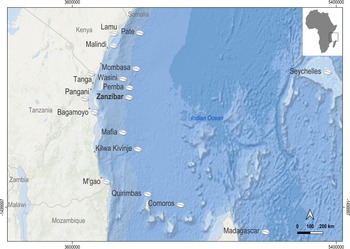
In Zanzibar, European firms relied primarily on the Banyan merchant community as their main interlocutors.Footnote 63 Upon receiving orders from European firms, Banyan traders commissioned Arab and Swahili intermediaries to procure cowries from a range of collection sites and to transport them to Zanzibar. Cowries were gathered at low tide along the coast stretching from Ras Hafun in Somalia to Mozambique, as well as on the offshore islands (see Figure 2). The richest collection areas included Pemba, Mombasa, Malindi, Mafia, and Lamu, though the most prolific production zone was the Quirimbas in northern Mozambique, particularly Ilha do Ibo.Footnote 64 From Kilwa Kivinje to Mafia, cowries were particularly abundant, whereas north of Pangani they were scarce. The Comoros, Seychelles, and Madagascar also became important sources for the cowrie trade. Shell size varied by location: cowries north of Cape Delgado tended to be larger, whereas those from Mozambique were described as ‘les plus parfaits’,Footnote 65 being smaller and therefore more highly valued.
Major collection and export zones of M. annulus in the Western Indian Ocean during the nineteenth century. Background map: ESRI Ocean; Reference System: WGS84/Equal Earth Greenwich (EPSG:8857).

The available evidence suggests that women and children played the central role in cowrie collection. Loarer wrote that ‘Cowries are collected at low tide on all large beaches … the work is carried out by women and children; while gathering occurs throughout the year, the calmer periods—October, November and December, and April, May and June—prove most favourable.’Footnote 66 During an anti-slavery patrol, British Captain W. Cope Devereux recounted mistakenly seizing a mtepe (a Swahili vessel) found to be transporting female cowrie pickers rather than enslaved individuals.Footnote 67 Cowries were not gathered as dead shells washed ashore but were collected at low tide while the mollusc was still alive, a condition necessary to make them suitable for trade.Footnote 68 Unlike the collection of other molluscs—such as pearl oysters, which required diving and specialized skills—cowrie collection was carried out in intertidal zones, making the task more accessible to women and children.Footnote 69 Little information survives about this labour or how it was organized, an absence that may reflect the limited attention Europeans devoted to forms of labour associated with women and children and requiring little specialized skill.
After collection, the shells were left in the sun to dry, allowing the molluscs inside to decay, and then stored until sold to intermediaries for export to Zanzibar.Footnote 70 The identity of these intermediaries varied by location. In Wasini (present-day Kenya), Burton observed that ‘the Banyans have been forbidden to deal in cowries, and the native merchants have all the profits such as they are’.Footnote 71 By contrast, in Tanga he found that a group of Bohras specialized in the cowrie trade.Footnote 72 In Ilha do Ibo, the Afro-Portuguese community played a central role in trading cowries toward Mozambique and Zanzibar. Footnote 73 This geographical variation points to a fragmented but interconnected commercial landscape, in which access to supply and the organization of trade were shaped by local dynamics, commercial hierarchies and existing merchant networks. As information and commodities moved through these layered relationships, key elements of maritime and commercial expertise were appropriated and redirected by European commercial interests.Footnote 74
Direct contracts between European agents and local suppliers further illustrate these dynamics. In 1857, Wm. O’Swald & Co. contracted the Arab trader Abdallah bin Dulab to procure cowries from Manombo, on the west coast of Madagascar, from where dhows regularly transported high-quality cowries to Zanzibar at lower cost than those available locally.Footnote 75 Similarly, in 1860, Mr Mas, an agent of Victor Régis, advanced 10,000 Spanish piastres to the trader Mougni Abdallah Chatri to buy cowries, though the money was reportedly used instead to purchase enslaved individuals for the Spanish vessels Esperanza and Formosa Estrella.Footnote 76 The purchasing power of Spanish piastres varied significantly across collection zones and increased with distance from Zanzibar, reflecting local availability and asymmetries in commercial negotiation. Cowries were measured in kila (approximately 3.5 litres): one piastre bought 40–45 kila of cowries in Kilwa, 45–50 kila in M’gao in south-eastern Tanzania, 76.5 kila in Ilha do Ibo, and 81–83 kila in the Comoros.Footnote 77
During transport to Zanzibar, unprocessed cowries presented some practical challenges. As one source noted, they had to ‘be relegated to the bottom of the hold and … all merchandise that could be damaged either because of the smell or because of the myriads of larvae that swarm [had to] be carefully removed’.Footnote 78 Upon arrival, a sack weighing 112 lbs was sold to European firms for between US$0.50 and US$1.44.Footnote 79 The shells were then carried ‘in an extremely unclean, stinking state’ by locally hired porters to the so-called ‘house of the dead cowries’.Footnote 80
Unlike in the Maldives, where cowrie production operated under royal monopoly and shells were cleaned, processed, and packaged at the place of collection before being shipped to Malé for export, European firms in Zanzibar received cowries in an unprocessed state and relied on local labour to prepare them.Footnote 81 This often included formerly enslaved individuals. In 1860, British Consul Colonel Rigby liberated forty-four enslaved people, mainly young boys, many of whom were subsequently employed by German firms in the processing of cowries and copal.Footnote 82 The work involved first washing the shells, which were then laid out on the roofs of company buildings to dry. Once dried, labourers sorted them according to colour and size, as smaller, carefully selected shells fetched higher prices, maximizing returns. At the peak of the cowrie trade, Wm. O’Swald & Co. employed 150 labourers in these operations.Footnote 83
The most valuable were the so-called ‘light blue Zanzibar’ type, recognizable by their pale colour, bluish dorsum often circled by a yellow ring, and glossy surface. By contrast, the ‘dark blue Zanzibar’ type appeared greenish and dull and commanded lower prices.Footnote 84 Sorting by gloss and size responded to specific economic incentives linked to the role of M. annulus as currency in West Africa. Glossy shells were preferred for their resemblance to the more highly valued and increasingly scarce Maldivian cowries. Smaller shells were also economically advantageous: since cowries were traded in West Africa in count-based units such as the ‘head’ (typically 2,000 shells), a greater number per sack increased the potential value of each shipment. After sorting, cowries were stored awaiting export in dedicated ‘cowrie houses’, supervised by locally hired overseers.Footnote 85
Taken together, these stages highlight the relevance of attending to the materiality of money: cowries did not circulate as currency simply by virtue of their form but were transformed into money through labour-intensive practices of extraction, transport, cleaning, and sorting. Their monetary function thus depended on a stratified chain of labour involving collectors, porters, sorters, and overseers, through which the physical properties of cowries were standardized and rendered commensurable across distant markets.
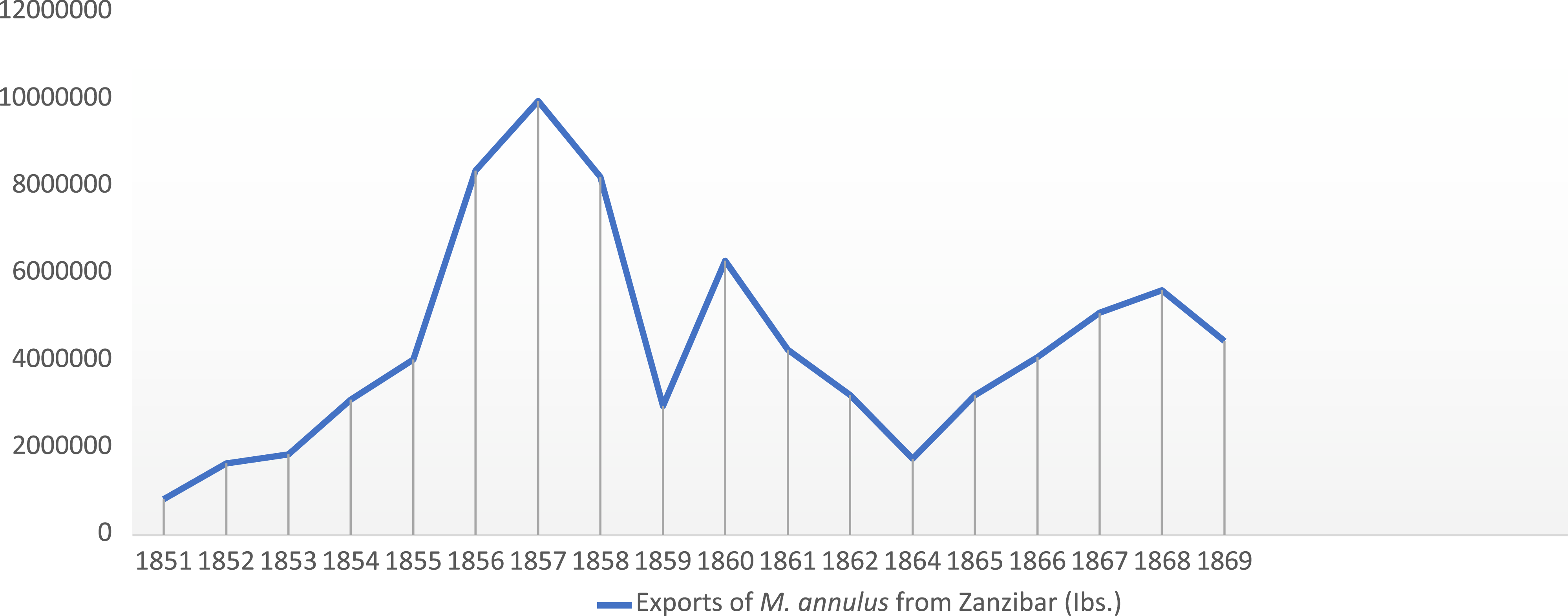
The cowrie trade began to decline from the late 1850s, soon after French companies entered the market: prices rose, quality deteriorated and demand in West Africa fell sharply (see Figure 3).Footnote 86 By the 1860s, competition between German and French companies continued, but exports to West Africa were modest in volume and fetched low prices.Footnote 87 The US consul in Zanzibar, Edward D. Ropes, observed that what had once been an extensive trade was steadily declining and likely to disappear.Footnote 88 By the 1880s the trade had largely collapsed, and after 1891 no significant shipments of cowries left East Africa.Footnote 89 In 1904, the British government formally prohibited their import into its West African colonies as part of a broader effort to replace cowries with imperial coinage.Footnote 90
German and French exports of M. annulus from Zanzibar, 1851–69 (lbs). No data are available for 1863. Source: Author’s elaboration based on Ernst Hieke, Zur Geschichte des Deutschen Handels mit Ostafrika, vol. 1 (Hans Christians, 1939), 283; Jan Hogendorn and Marion Johnson, The Shell Money of the Slave Trade, 2nd edn (Cambridge University Press, 2003), 76.

Viewed in isolation, this trajectory might suggest that the cowrie trade linking East and West Africa was a relatively short-lived episode—a mid-nineteenth-century commercial ‘boom’ with significant but temporally limited consequences. This reading, however, obscures the broader transformations set in motion by this period of intensified circulation. As exports to West Africa declined from the late 1850s, increasing quantities of cowries accumulated in Zanzibar and along the coast. This growing availability coincided with the intensification of Arab and Swahili merchant expeditions in the inland regions, where the expanding demand for ivory and enslaved people required an increased supply of currency. Cowries became a key medium of exchange in these inland trade circuits alongside other commodity currencies. The labour networks and commercial infrastructures that had sustained the transoceanic trade could be reoriented toward the interior: porters transported shells along inland routes and coastal traders that had coordinated procurement for export to West Africa could supply the growing demand from the Great Lakes region. The decline in West African demand did not, therefore, mark the end of cowrie circulation but its partial redirection, from transoceanic trade into regional circuits across East Africa. It was precisely in this period of redirected supply that cowries became institutionalized as currency in Buganda and the Great Lakes region, as the following section explores.
Cowries, political authority, and the making of a currency area in the Great Lakes region
M. annulus began to reach the kingdom of Buganda in small quantities from the Indian Ocean coast at the beginning of the nineteenth century, during the reign of kabaka (king) Semakookiro (c.1800–12). By the mid-nineteenth century, under kabaka Ssuna II (1830–57), cowrie use had become widespread.Footnote 91 This period coincided with the expansion of Buganda’s commercial relations with coastal traders, driven by the rapid expansion of demand for ivory and enslaved people. East African ivory was increasingly sought after in Europe and North America for the manufacture of luxury goods—such as carved figurines, combs, musical instruments, and billiard balls—feeding the demand of expanding middle-class consumers.Footnote 92 The trade in enslaved people also expanded significantly in the 1860s and 1870s. The Baganda sold captives to the Nyamwezi and coastal traders, who sold many of them in interior markets such as Bunyoro and Tabora rather than sending them to Indian Ocean ports.Footnote 93 Following the closure of Zanzibar’s slave markets in 1873, the slave trade became further internalized, as regional demand for enslaved agricultural labourers increased.Footnote 94
This commercial expansion required a medium of exchange capable of sustaining a higher volume of transactions. Arab and Swahili traders responded by introducing large quantities of cowries from the coast alongside cotton cloth. The shells moved through the same intermediary networks that had sustained the transoceanic trade, now reoriented toward interior demand, and reached Buganda via the caravan infrastructure that sustained the ivory and slave trades, with porters transporting cowries along inland routes connecting the coast to the Great Lakes region and embedding monetary mobility within the same labour-intensive systems that underpinned long-distance trade more broadly.Footnote 95
As the volume of shells in circulation increased, cowries moved from being a widely used medium of exchange to an officially sanctioned currency. Kabaka Mutesa I (1857–84) institutionalized their formal use, enforcing the payment of taxes in shells and fixing prices in the royal capital’s market: a stick with ten small fish cost 1 shell; a large tilapia, 5 shells; a chicken, 50 shells; a goat, 500 shells; and a cow, 2,000 shells.Footnote 96 Cowries—known in Buganda as simbi—were bored and strung in units of one hundred shells, called kiasa, which could be subdivided into halves of fifty and further into groups of ten, with five shells as the smallest unit.Footnote 97 This divisibility, combined with their low unit value, made them particularly suitable for everyday transactions. As John Roscoe, an Anglican missionary who reached Buganda in 1891, observed, most people buying salt, coffee berries, or tobacco sought only limited quantities, purchasing small packets for two or three cowries.Footnote 98
Cowries played a significant role not only as currency but also in the social and ceremonial life of Buganda. By the nineteenth century, they had become a central component of bridewealth payments, with typical amounts in the 1880s ranging between 1,000 and 4,000 shells. In 1899 bridewealth for peasants was standardized at a value equivalent to 10,000 shells, a sum comprising banana beer, barkcloth, salt, goats, and 5,000 shells.Footnote 99 Beyond marriage, they featured in ceremonial exchanges connected to childbirth and family rituals. These uses highlight their dual economic and symbolic function: cowries served both as means of exchange and as socially meaningful objects embedded in systems of reciprocity, status display, and ritual practice.
While long-distance trade played a central role in the emergence of a cowrie currency area, fiscal practices were equally important in consolidating their use.Footnote 100 Royal tax collectors counted the houses in each sub-district, assigning one cowrie to represent each house; once the assessment was completed, collection began. Typically, sub-chiefs were required to deliver a fixed number of cattle, while peasants provided barkcloth alongside a payment of 100 cowries.Footnote 101
Given the political centrality of Buganda within the interlacustrine region, the use of M. annulus as currency also extended into neighbouring polities, including Busoga, Bunyoro, Toro, Nkore, Rwanda, and the Haya kingdoms (see Figure 4), linked through regional trade networks connecting inland markets with the coast. Within these circuits, cowries were exchanged for a wide range of commodities, including salt, hides, iron tools, ivory, cattle, barkcloth, and ritual objects.Footnote 102 By the end of the nineteenth century, cowries had become a dominant currency across much of the Great Lakes region, including Buhaya, Buganda, Bunyoro, and Karagwe, a development made possible by the increased supply of M. annulus from the coast.Footnote 103 Tributary polities such as Kkooki and Kiziba paid taxes to Buganda partly in shells, while others contributed cattle, enslaved people, or fish, demonstrating the integration of cowries into broader systems of political obligation.Footnote 104
Main nineteenth-century trade route of M. annulus from the East African coast towards the interior, showing the polities of the Great Lakes region where cowries circulated as currency. Cowrie symbols along the route indicate the movement of shells inland. Background map: ESRI Ocean; Reference System: WGS84/Equal Earth Greenwich (EPSG:8857).

During the early years of British colonial rule, cowries remained essential to both the administration and the economy. The introduction of the silver Indian rupee in 1896 did not displace them: given its high value, the rupee was suited only to large-scale transactions—such as in the payment of staff wages and export trade—while cowries continued to serve for low-value payments. The strategic importance of maintaining adequate cowrie supply is illustrated by Governor MacDonald, who observed that shells had appreciated from 300 to 200 per rupee due to demand outstripping supply, and stressed that ‘[t]he supply of shells is a most important point for Uganda’.Footnote 105 From 1895 to 1896, the British imported 6 million bored and strung shells into Uganda, carried by porters along the same caravan routes that had channelled cowries inland from the coast since the mid-nineteenth century, highlighting the extent to which their circulation depended on labour-intensive transport systems.Footnote 106
Buganda and its neighbouring regions were the only areas in East Africa where cowries were firmly established as a recognized currency by the mid-nineteenth century. As in West Africa, their adoption as currency resulted from a combination of factors, including the influence of key traders, the enforcement of currency by political authorities, and periodic shortages of alternative media of exchange. Yet the fact that other regions connected to the East African coast through the ivory and slave trades adopted commodity currencies such as glass beads, cloth, and metal wires but not cowries, raises important analytical questions about the conditions under which shell money could become institutionalized. The answer likely lies in a specific conjunction of supply, political authority, and spatial conditions that distinguished the interlacustrine region from other areas integrated into the same long-distance trade networks. In nineteenth-century East Africa, centralized states comparable to those of West Africa were largely confined to the interlacustrine region, where political authorities exercised a similarly decisive role in regulating currency circulation.Footnote 107
In Buganda, cowries represented only the latest stage in a longer sequence of monetary transformations.Footnote 108 In the eighteenth century, blue beads known as ensinda had served as the prevailing means of exchange, controlled by the kabaka who regulated supply and thus their value.Footnote 109 Toward the end of the eighteenth century, ensinda gave way to smooth and bored ivory discs known as obusanga, manufactured by palace specialists under royal supervision.Footnote 110 Cowries shared important features with earlier currencies: they were perforated for stringing, facilitating counting and the creation of higher denominations; they had a relatively low fungibility; and they were embedded within systems of taxation and tribute that were regulated by the kabaka. Their stabilization as currency therefore depended not simply on circulation but on the interaction between political authority, fiscal integration, and relative scarcity inland.Footnote 111 This pattern supports Jane Guyer’s argument that the adoption and stabilization of controlled currencies in pre-colonial Africa tended to occur where centralized authorities could regulate supply and embed money within fiscal structures.Footnote 112 In this respect, cowries functioned not merely as instruments of trade but also as tools of governance, reinforcing the fiscal and administrative capacities of the Buganda state.
Spatial factors further shaped this distinctive monetary geography. Unlike West Africa, where cowries were entirely imported and thus retained scarcity value, M. annulus was abundant and readily available along the East African coast and in Zanzibar. This accessibility diminished their effectiveness as currency in coastal settings and neighbouring areas, where shells lacked the distance-based value that generally enhanced the monetary worth of imported commodities. Buganda, by contrast, had no direct access to these supply zones: traders from the kingdom rarely travelled to the coast, and the inflow of cowries depended largely on coastal merchants reaching the interior.Footnote 113 This relative scarcity enabled the kabaka to regulate their circulation and sustain their value.
Taken together, these dynamics show that the institutionalization of cowries in Buganda was not simply the result of their circulation as a neutral medium of exchange, but a historically situated process shaped by the interaction among supply, political authority, commercial strategies and spatial conditions. The increased availability of shells in Zanzibar following their large-scale exploitation for transoceanic trade, combined with their growing circulation inland, created the conditions under which they could become stabilized as currency in Buganda and neighbouring polities.
This nineteenth-century consolidation was itself built on a much longer history of cowrie circulation in inland East Africa. Archaeological findings confirm the presence of M. annulus at a wide range of interior sites dating from 400 ce onward, suggesting that inland communities incorporated these shells into regional exchange systems linking the coast to the hinterland long before the development of the European cowrie trade.Footnote 114 This archaeological record is reinforced by linguistic data: Yao speakers, for example, adopted their term for cowries (simbi) from Swahili speakers between the seventh and twelfth centuries, indicating sustained processes of linguistic and commercial interaction.Footnote 115 The circulation of M. annulus thus points to a long and complex history of exchange, one that extends beyond European commercial involvement and imperial strategies and is grounded in local material practices and networks of exchange.
Conclusion
This article has traced the trajectories of East African cowries across interconnected monetary arenas in order to reconsider their place within nineteenth-century African and global monetary circulation. Recentring East Africa does not merely extend a predominantly West African narrative; it alters the scale at which monetary transformations can be seen and interpreted. The ‘great cowrie inflation’, long analysed through the internal dynamics of West African markets and European commercial strategies, appears instead as the product of interconnected monetary, commercial, and labour regimes linking West Africa to the Western Indian Ocean. Viewed from Zanzibar, the export of M. annulus emerges as the outcome of intersecting processes: price fluctuations in Maldivian shells, the expansion of the palm oil trade, the mobilization of extractive labour networks, local commercial intermediation, and imperial interests. West African monetary instability was therefore structurally connected to East African regimes of procurement, a connection that a demand-centred historiography has tended to obscure.
Foregrounding the supply side highlights dynamics that conventional monetary histories have often rendered invisible. Cowries did not circulate as currency simply by virtue of their form: they were transformed into money through labour-intensive practices of extraction, transport, cleaning, and sorting. Their monetary function depended on a stratified chain of actors—female and child collectors; porters; formerly enslaved labourers; Banyan, Arab, and Swahili intermediaries—whose knowledge and expertise were selectively appropriated and redirected toward external profit. Infrastructures of money supply were also, inevitably, infrastructures of negotiation, intermediation, and asymmetrical power relations.
The case of Buganda shows that circulation alone does not explain the institutionalization of cowries as currency. It was the interaction between increased supply, political authority, and spatial conditions that distinguished the interlacustrine region from other areas integrated into the same long-distance trade networks and created the conditions for shell money to function as a stable currency. Where centralized political authorities could regulate supply and embed money within fiscal structures, as in Buganda, cowries could become institutionalized. Where these conditions were absent, other commodity currencies prevailed. Monetary institutionalization in pre-colonial Africa was thus not the automatic outcome of commercial expansion but the product of specific and contingent configurations of power, space, and supply.
These nineteenth-century transformations, however, can be fully understood only when situated within a longer temporal arc. The presence of M. annulus at interior East African sites dating back to 400 ce, its appearance in West African archaeological contexts before the nineteenth century, and its circulation in slave quarters in eighteenth-century Virginia, as discussed by Heath, all indicate that the developments analysed here represented an intensification of much older patterns of cowrie circulation, pre-dating European commercial involvement and revealing the historical depth and geographical reach of the networks through which East African cowries circulated across African regions and into Atlantic diasporic spaces.Footnote 116
Paying attention to the specific materiality of M. annulus makes these overlapping spaces visible. The same object underpinned everyday transactions in the markets of Buganda, facilitated exchange within the expanding palm oil trade in West Africa, and sustained colonial provisioning in the Uganda Protectorate. Each context was shaped by distinct configurations of demand, supply, and political authority, yet all were connected through shared networks of procurement and circulation. The reorientation toward the Great Lakes of infrastructures that had previously channelled shells to West Africa connected monetary developments on opposite sides of the continent. This reveals how monetary systems in one region could be shaped by processes of production, exchange, and circulation unfolding thousands of miles away. More broadly, these trajectories underscore the interdependence of African regions and the transoceanic connections that linked them to wider global processes, suggesting that monetary history—wherever it is written—cannot be fully understood without attending to the infrastructures that made money available.
Acknowledgements
I would like to thank Gareth Austin, Bronwen Everill, Tony Hopkins, Samuel Sanchez, Thomas Vernet, and all the participants in the ‘African Economic History Seminar’ at Cambridge University and the seminar ‘Histoire de l’Océan Indien occidental. Sociétés, circulations, savoirs (VIIIe–XXe siècle)’ at the Institut des Mondes Africains in Paris for their extremely helpful comments and insights. I am also grateful to Yaari Felber-Seligman and Giacomo Macola for reading earlier versions of this article, and to Michaela De Giglio for drawing the maps. I wish to thank the four anonymous reviewers for their insightful comments and suggestions, which helped me significantly improve the original version of this article. Finally, I am deeply grateful to Abdelhakim Belhacel and Abdul Sheriff for generously sharing several important sources with me.
Financial support
Research for this article has been funded by the Gerda Henkel Foundation, grant number AZ 37/F/16 and by the European Union—Next Generation EU, Missione 4 Componente 1 CUP J53D23000530006.
Competing interests
The author declares none.
Karin Pallaver is Associate Professor of African History at the University of Bologna. Her research focuses on the social and economic history of nineteenth-century and early colonial East Africa, with particular attention to pre-colonial and colonial currencies, German and British colonialism in East Africa, and the history of female labour. She has published several book chapters and journal articles, including in History in Africa, the International Journal of African Historical Studies, the Journal of Eastern African Studies, African Economic History, and African Studies Review. She is the editor of Monetary Transitions: Currencies, Colonialism and African Societies (Palgrave Macmillan, 2022).


 Open access

