


Introduction
Social anxiety disorder is characterized by a profound fear and avoidance of social situations where negative evaluation may occur (Rapee & Heimberg, Reference Rapee and Heimberg1997). Research suggests that socially anxious individuals hold negative views of: their appearance, public speaking ability (Rapee & Lim, Reference Rapee and Lim1992; Rapee & Abbott, Reference Rapee and Abbott2006), personality (Wilson & Rapee, Reference Wilson and Rapee2006), and social skills (Clark & Arkowitz, Reference Clark and Arkowitz1975; Stopa & Clark, Reference Stopa and Clark1993). These negative self-conceptions are thought to maintain social anxiety because they increase expectations of negative evaluation from others (Rapee & Heimberg, Reference Rapee and Heimberg1997). Research has shown that positive changes to self-conceptions mediate the relationship between cognitive-behavioural therapy (CBT) and social anxiety reduction (Goldin et al. Reference Goldin, Jazaieri, Ziv, Kraemer, Heimberg and Gross2013), which highlights both the theoretical and clinical importance of identifying the ways in which negative self-conceptions are maintained in social anxiety.
Self-verification theory posits that individuals maintain their self-conceptions by subconsciously seeking, accepting and preferring feedback that is congruent with how they view themselves and by avoiding, rejecting and disliking incongruent feedback (Swann, Reference Swann, Suls and Greenwald1983). Existing research supports this theory. For example, by mid-childhood people show a preference for feedback that confirms their self-views (Cassidy et al. Reference Cassidy, Ziv, Mehta and Feeney2003), and people have been found to become more certain of their self-conceptions over time as they accrue supporting evidence (Swann, Reference Swann, Van Lang, Kruglanski and Higgins2012). Although receiving self-verifying feedback affords an individual several benefits such as greater perceived trust and intimacy in relationships and more harmonious interactions with others (North & Swann, Reference North and Swann2009), there may be drawbacks for people with negative self-conceptions. For example, researchers have observed a preference for negative feedback, and/or for interaction partners who offer critical or negative feedback, among populations with negative self-conceptions (Swann et al. Reference Swann, Hixon, Stein-Seroussi and Gilbert1990, Reference Swann, Hixon and Rond1992a –Reference Swann, Wenzlaff, Krull and Pelham c ), low self-esteem (Robinson & Smith-Lovin, Reference Robinson and Smith-Lovin1992; Giesler et al. Reference Giesler, Josephs and Swann1996), and depression (Swann et al. Reference Swann, Wenzlaff, Krull and Pelham1992c , Reference Swann, Wenzlaff and Tafarodi d ; Giesler et al. Reference Giesler, Josephs and Swann1996). People with low self-esteem also perceive their romantic partners’ sentiments as more negative than they actually are (Murray et al. Reference Murray, Holmes, Dolderman and Griffin2000) and view negative feedback as being more accurate in describing them than positive feedback (Robinson & Smith-Lovin, Reference Robinson and Smith-Lovin1992). Thus, while there are benefits associated with receiving self-verifying feedback, people with negative self-conceptions could be at a disadvantage because self-verification processes may perpetuate their negative self-views.
Given that socially anxious individuals tend to hold negative views of their appearance, public speaking ability (Rapee & Lim, Reference Rapee and Lim1992; Rapee & Abbott, Reference Rapee and Abbott2006), personality (Wilson & Rapee, Reference Wilson and Rapee2006), and social skills (Clark & Arkowitz, Reference Clark and Arkowitz1975; Stopa & Clark, Reference Stopa and Clark1993), self-verification theory suggests they would have a preference for negative feedback and an aversion to positive feedback. Although several researchers have observed a preference for negative feedback among socially anxious undergraduate students (Valentiner et al. Reference Valentiner, Skowronski, McGrath, Smith and Renner2011), others have found the opposite to be true (Weeks et al. Reference Weeks, Jakatdar and Heimberg2010). Thus, it remains unclear whether greater social anxiety is associated with a preference for negative feedback. More consistent findings have been reported in research examining whether social anxiety is related to an aversion to positive feedback. In undergraduate samples, for example, greater social anxiety has been found to predict lower perceived accuracy of positive feedback (Weeks et al. Reference Weeks, Heimberg, Rodebaugh and Norton2008b ), the discounting of positive events in social situations (Vassilopoulos & Banerjee, Reference Vassilopoulos and Banerjee2010), and a general aversion to positive feedback (Weeks et al. Reference Weeks, Jakatdar and Heimberg2010). Taken together, these studies suggest that self-verification processes may operate in social anxiety, with negative self-conceptions driving an aversion to positive feedback and a preference for negative feedback.
Fear of evaluation, and specifically fear of negative evaluation (FNE) and/or positive evaluation (FPE), has also been found to have an integral role in social anxiety (Rapee & Heimberg, Reference Rapee and Heimberg1997; Weeks et al. Reference Weeks, Heimberg and Rodebaugh2008a , Reference Weeks, Jakatdar and Heimberg2010). While studies’ findings have been inconsistent, FPE and FNE have been found to be related to preferences for both positive and negative feedback (Weeks et al. Reference Weeks, Jakatdar and Heimberg2010; Valentiner et al. Reference Valentiner, Skowronski, McGrath, Smith and Renner2011), and FPE predicts decreases in the perceived accuracy of, and increased discomfort with, positive feedback (Weeks et al. Reference Weeks, Heimberg, Rodebaugh and Norton2008b ). However, research has not yet examined whether FNE has a corresponding relationship with negative feedback (i.e. whether FNE predicts decreases in the perceived accuracy of, and discomfort with, negative feedback). Given the likely interrelationships among these processes and those posited in self-verification theory, it will be important to account for FPE and FNE in any examination of self-verification processes in social anxiety.
The study
In short, despite the potential importance of self-verification processes in maintaining social anxiety, little is known about how these processes manifest in socially anxious individuals, nor how they interact with FPE and FNE. Thus, the aim of the present study was to examine these processes in social anxiety with a focus on negative self-conceptions related to public-speaking ability. The effects of depression and self-esteem will be accounted for to determine the unique relationships of social anxiety, and the effects of FPE and FNE will be explored.
Drawing from the aforementioned theoretical models and empirical findings, we formulated five hypotheses to explore whether self-verification processes operate in social anxiety. It is hypothesized that, when given the choice between receiving positive or negative feedback, participants with higher levels of social anxiety will be more likely to seek negative feedback than participants with lower levels of social anxiety (hypothesis 1). It is hypothesized that participants with higher levels of social anxiety will rate positive feedback to be less accurate (hypothesis 2), and will report greater discomfort with positive feedback (hypothesis 3), compared to participants with lower levels of social anxiety. Finally, it is hypothesized that participants with higher levels of social anxiety will rate negative feedback to be more accurate (hypothesis 4), and will report less discomfort with negative feedback (hypothesis 5).
Method
Participants
Participation was open to all students at Macquarie University in 2013. The sample was comprised primarily of psychology undergraduates who signed up through an online recruitment site advertising the study. A flyer calling for the participation of ‘shy’ or ‘outgoing’ persons was also distributed around campus. These sampling methods initially resulted in high rates of social anxiety. In order to maximize variation in symptom levels for analyses, selective sampling was used to recruit an adequate sample at the lower end of the symptom spectrum for social anxiety. To achieve this, undergraduate psychology students who scored in the bottom 25% of their cohort for symptoms of social anxiety – as measured by a composite score of the Brief Fear of Negative Evaluation Scale (BFNES; Leary, Reference Leary1983), the Social Phobia Scale (SPS; Mattick & Clarke, Reference Mattick and Clarke1998), and the Social Interaction Anxiety Scale (SIAS; Mattick & Clarke, Reference Mattick and Clarke1998) – were individually invited to participate in the study. The BFNES, SPS, and SIAS are measures included in an annual survey battery administered at Macquarie University to first-year undergraduate psychology students. Students who wished to take part registered their interest through the online recruitment site. Their status as ‘invited’ was kept anonymous to ensure that the experimenter was blind to their symptom levels, thereby preserving the validity of the experimental procedure. The sample included 84 undergraduate students (29 men, 55 women) whose ages ranged from 17 to 48 years (mean = 19.3 years, s.d. = 4.02).
Materials
Participants completed self-report measures on demographic information, social anxiety, depressive symptoms, self-esteem, FPE and FNE. The measures were selected based on their reliability, validity, and brevity.
Social anxiety
The 20-item SPS (Mattick & Clarke, Reference Mattick and Clarke1998) utilizes a 5-point Likert scale (1–5) to assess fears related to being scrutinized during social activities. Scores range from 0 to 80, with higher scores indicating greater levels of social phobia/anxiety.
Depression
The 20-item Centre for Epidemiologic Studies Depression Scale (CES-D; Radloff, Reference Radloff1977) utilizes a 4-point Likert scale (0–3) to measure depressive symptomology. Scores range from 0 to 60, with higher scores indicating greater depressive symptoms.
Self-esteem
The 10-item Rosenberg Self-esteem Scale (RSES; Rosenberg, Reference Rosenberg1965) utilizes a 4-point Likert scale (1–4) to measure self-esteem. Scores range from 10 to 40, with higher scores indicating higher self-esteem.
Fear of positive evaluation
The 10-item Fear of Positive Evaluation Scale (FPES; Weeks et al. Reference Weeks, Heimberg and Rodebaugh2008a ) utilizes a 10-point Likert scale (0–9) to measure fears related to being positively evaluated by others. Scores range from 0 to 72, with higher scores indicating greater levels of fear related to being positively evaluated by others. For the purpose of reducing the response bias of acquiescence (i.e. the predisposition to answer all questions affirmatively), two reverse-scored items are included in the FPES. These items’ scores are not utilized in the calculation of the FPES total score, however, as the items are merely used to identify and exclude biased responses.
Fear of negative evaluation
The 12-item BFNES (Leary, Reference Leary1983) utilizes a 5-point Likert scale (1–5) to measure fears related to being negatively evaluated by others. Scores range from 12 to 60, with higher scores indicating greater fear of negative evaluation.
Public speaking ability scale
The Public Speaking Ability Scale (PSAS) was a tool used to deceive the participants in the present study. It is not a genuine measure. The PSAS contains six items related to various aspects of a speaker's performance that are scored on a scale from ‘Low/Poor’ (1) to ‘High/Excellent’ (10). In addition, the PSAS contains several sections that allow the PSAS scorer to note which scoring style they used when assessing a speaker, what they focused on during the speaker's performance, and the ability of the speaker. It also contains a section that allows the scorer to make miscellaneous comments about a speaker.
Procedure
All aspects of the study were approved by the Human Research Ethics Committee at Macquarie University, and all participants provided informed consent. This study involved the use of deception. First, to ensure the participation of shy and/or socially anxious individuals, advertisements for the study did not state that experimental procedure involved public speaking. Further, upon commencing their testing session, participants were led to believe that their public-speaking ability would be assessed by two researchers in an adjacent room. Before completing their speech, the participants were shown a blank version of the PSAS and it was explained to them that the two researchers would use the PSAS to assess their performance. They were then asked whether they would prefer to receive feedback pertaining to their weakness in public-speaking ability (i.e. negative feedback) or feedback pertaining to their strengths in public-speaking ability (i.e. positive feedback) after they had completed their speech. Their choice of positive or negative feedback comprised the first dependent variable of the study. Participants were given 1 minute preparation time before completing a 1-minute speech on a topic of their choice. The speech was recorded by video camera. Upon the completion of the speech, the researcher left the room with the camera, leaving the participant to complete several online questionnaires measuring social anxiety, depression, self-esteem, FPE, FNE and the demographic information of age and gender. The researcher returned to the room 10 minutes later with two pre-completed PSAS forms, which presented identical feedback to all participants. The forms were completed so that one was positive feedback, and the other was negative. The feedback was given to the participants in a counterbalanced order – regardless of the participants’ initial feedback preference – to control for order effects. Participants rated the positive and negative feedback in terms of how accurate it was and how comfortable they were with the feedback, each on a scale from 1 to 10. Higher ratings denoted greater perceived accuracy of, and greater comfort with, the feedback. The accuracy and comfort ratings of the positive feedback comprised the second and third dependent variables of the study; the accuracy and comfort ratings of the negative feedback, comprised the fourth and fifth dependent variables. The participants also rated how favourable or positive they thought the feedback was as a manipulation check used to ensure that the positive feedback was seen as significantly more favourable or positive than the negative feedback. Upon completing all requisite measures, participants were asked if they felt they had been deceived in any way. This question was asked to ensure the validity of the aforementioned procedure. SPSS software version 17 (SPSS Inc., USA) was used for all analyses.
Data analysis
Binary logistic regression was used to examine whether participants with higher levels of social anxiety were more likely to choose to receive negative feedback (hypothesis 1). Hierarchical linear regression was used to determine whether participants with higher levels of social anxiety rated positive feedback as less accurate, and/or reported greater discomfort with positive feedback (hypotheses 2 and 3), and whether participants with higher levels of social anxiety rated negative feedback as more accurate, and/or reported less discomfort with negative feedback (hypotheses 4 and 5).
Three steps were included in each analysis: depression and self-esteem were entered in step 1; social anxiety was entered in step 2 to examine its unique relationship over and above the effects of depression and self-esteem; and FPE and FNE were entered in step 3 to examine their role as moderators in the relationship between social anxiety and each of the outcome variables. Seven participants’ responses were removed from the analyses because they either guessed the deception of the study or failed to provide usable data as a result of completing a measure incorrectly. Consequently, the analyses were based on between 84 and 77 cases – an adequate size when using regression with five predictors (Field, Reference Field2009). Most statistical assumptions were met. However, analysis of the comfort ratings for positive feedback and the accuracy ratings for negative feedback revealed that the assumption of homoscedasticity had been violated, thus limiting the generalizability of the findings pertaining to these variables.
Results
Preliminary analyses
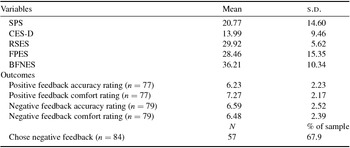
Table 1 shows the descriptive statistics for the five continuous predictors. The use of selective recruitment resulted in a sample with mean symptom levels of social anxiety above those found in typical community (mean = 14.4, s.d. = 11.2) and undergraduate samples (mean = 14.1, s.d. = 10.2) (Mattick & Clarke, Reference Mattick and Clarke1998). Social anxiety did not differ as a function of gender (t 82 = -1.30, p = 0.197), or age (β = 0.08, t 83 = 0.752, p = 0.454). A paired-samples t test was conducted as a manipulation check, and showed that participants perceived the positive feedback to be significantly more positive or favourable (mean = 7.69, s.d. = 1.36) than the negative feedback (mean = 4.55, s.d. = 1.90, t 73 = -10.00, p < 0.001).
Descriptive statistics for the five continuous predictors of the present study

SPS, Social Phobia Scale (Mattick & Clarke, Reference Mattick and Clarke1998); CES-D. Centre for Epidemiologic Studies Depression Scale (Radloff, Reference Radloff1977); RSES, Rosenberg Self-esteem Scale (Rosenberg, Reference Rosenberg1965); FPES, Fear of Positive Evaluation Scale (Weeks et al. Reference Weeks, Heimberg and Rodebaugh2008a ); BFNES, Brief Fear of Negative Evaluation Scale (Leary, Reference Leary1983).
Regression analyses
Hypothesis 1
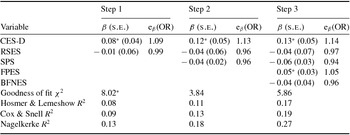
Logistic regression indicated that the odds of seeking negative feedback did not differ between individuals with high and low levels of social anxiety (see Table 2). This non-significant relationship did not support hypothesis 1, and remained after the inclusion of FPE and FNE in step 3 of the model. Higher levels of depression were associated with greater odds of seeking negative feedback, as was FPE.
Hierarchical logistic regression analysis for variables predicting negative feedback choice (n = 84)

OR, Odds ratio; CES-D, Centre for Epidemiologic Studies Depression Scale (Radloff, Reference Radloff1977); RSES, Rosenberg Self-esteem Scale (Rosenberg, Reference Rosenberg1965); SPS, Social Phobia Scale (Mattick & Clarke, Reference Mattick and Clarke1998); FPES, Fear of Positive Evaluation Scale (Weeks et al. Reference Weeks, Heimberg and Rodebaugh2008a ); BFNES, Brief Fear of Negative Evaluation Scale (Leary, Reference Leary1983).
* p < 0.05.
Hypothesis 2
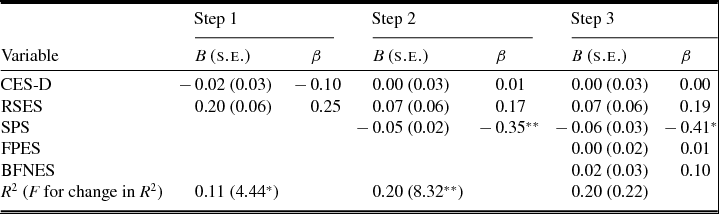
Higher levels of social anxiety were related to decreased accuracy ratings of positive feedback – as hypothesized – and social anxiety explained an additional 9% of variance in the model (see Table 3). This effect remained significant after the inclusion of FPE and FNE in step 3 of the model. Depression, self-esteem, FPE, and FNE were not significantly related to accuracy ratings of positive feedback.
Hierarchical multiple linear regression analysis for variables predicting accuracy ratings of positive feedback (n = 77)

CES-D, Centre for Epidemiologic Studies Depression Scale (Radloff, Reference Radloff1977); RSES, Rosenberg Self-esteem Scale (Rosenberg, Reference Rosenberg1965); SPS, Social Phobia Scale (Mattick & Clarke, Reference Mattick and Clarke1998); FPES, Fear of Positive Evaluation Scale (Weeks et al. Reference Weeks, Heimberg and Rodebaugh2008a ); BFNES, Brief Fear of Negative Evaluation Scale (Leary, Reference Leary1983).
* p < 0.05, ** p < 0.01.
Hypothesis 3
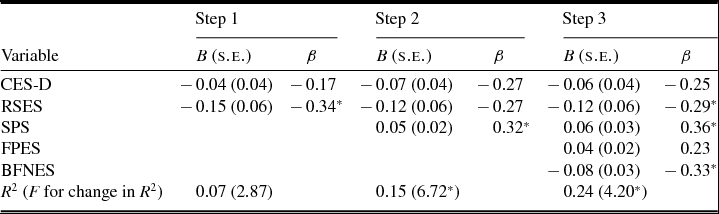
Table 4 shows the regression analysis for comfort ratings of positive feedback. Higher levels of social anxiety were associated with greater discomfort with positive feedback – as hypothesized – and higher self-esteem was related to greater comfort with positive feedback. However, these effects were moderated to become non-significant in step 3 of the model, after the inclusion of FPE and FNE. FNE was the only significant predictor in the full model, where higher levels of FNE were related to greater discomfort with positive feedback.
Hierarchical multiple linear regression analysis for variables predicting comfort with positive feedback (n = 77)

CES-D, Centre for Epidemiologic Studies Depression Scale (Radloff, Reference Radloff1977); RSES, Rosenberg Self-esteem Scale (Rosenberg, Reference Rosenberg1965); SPS, Social Phobia Scale (Mattick & Clarke, Reference Mattick and Clarke1998); FPES, Fear of Positive Evaluation Scale (Weeks et al. Reference Weeks, Heimberg and Rodebaugh2008a ); BFNES, Brief Fear of Negative Evaluation Scale (Leary, Reference Leary1983).
* p < 0.05, ** p < 0.01.
A follow-up cross-sectional mediation analysis was run between social anxiety, FNE, and positive feedback comfort ratings (PFCR) to determine whether FNE mediated the relationship between social anxiety and PFCR. In accordance with the recommendations made by Baron & Kenny (Reference Baron and Kenny1986) for testing cross-sectional mediation, social anxiety was regressed on both FNE and PFCR, and FNE was regressed on PFCR. PFCR were negatively associated with both social anxiety (β = -0.42, p < 0.001) and FNE (β = -0.47, p < 0.001), and social anxiety was positively associated with FNE (β = 0.69, p < 0.001). When social anxiety and FNE were included in one model, FNE remained a significant predictor of PFCR (β = -0.33, p = 0.022) and the relationship between social anxiety and PFCR became non-significant (β = -0.19, p = 0.173). This indicates that FNE mediated the negative relationship between social anxiety and PFCR (Baron & Kenny, Reference Baron and Kenny1986).
Hypothesis 4
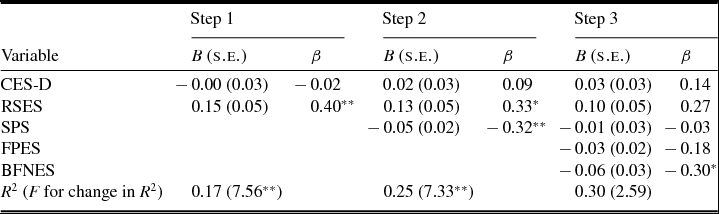
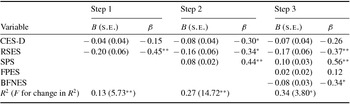
Higher levels of social anxiety were associated with higher accuracy ratings of negative feedback – as hypothesized – and the inclusion of social anxiety in step 2 of the model explained an additional 14% of variance in the model (see Table 5). This effect remained significant after the inclusion of FPE and FNE in step 3. Depression, self-esteem and FNE were also significant predictors of accuracy ratings, although the effect of depression in step 2 was accounted for by the inclusion of FNE in step 3.
Hierarchical multiple linear regression analysis for variables predicting accuracy ratings of negative feedback (n = 79)

CES-D, Centre for Epidemiologic Studies Depression Scale (Radloff, Reference Radloff1977); RSES, Rosenberg Self-esteem Scale (Rosenberg, Reference Rosenberg1965); SPS, Social Phobia Scale (Mattick & Clarke, Reference Mattick and Clarke1998); FPES, Fear of Positive Evaluation Scale (Weeks et al. Reference Weeks, Heimberg and Rodebaugh2008a ); BFNES, Brief Fear of Negative Evaluation Scale (Leary, Reference Leary1983).
* p < 0.05, ** p < 0.01.
Hypothesis 5
Higher levels of social anxiety were related to greater comfort with negative feedback – as hypothesized. The inclusion of social anxiety accounted for an additional 8% of variance in the model, and the effect remained significant with the inclusion of FPE and FNE in step 3 (see Table 6). Self-esteem was significant in steps 1 and 3 – where lower self-esteem was associated with greater comfort with negative feedback – and higher levels of FNE were related to greater discomfort with negative feedback.
Hierarchical multiple linear regression analysis for variables predicting comfort with negative feedback (n = 79)

CES-D, Centre for Epidemiologic Studies Depression Scale (Radloff, Reference Radloff1977); RSES, Rosenberg Self-esteem Scale (Rosenberg, Reference Rosenberg1965); SPS, Social Phobia Scale (Mattick & Clarke, Reference Mattick and Clarke1998); FPES, Fear of Positive Evaluation Scale (Weeks et al. Reference Weeks, Heimberg and Rodebaugh2008a ); BFNES, Brief Fear of Negative Evaluation Scale (Leary, Reference Leary1983).
* p <0.05.
Discussion
The present study examined the mechanisms of self-verification theory in the context of negative self-conceptions related to public speaking. The hypotheses received mixed support, but the results were generally consistent with self-verification theory operating in social anxiety in the processing of negative feedback, in particular. FPE and FNE also had interesting roles in the relationships between social anxiety and the seeking and processing of feedback.
Feedback seeking
Individuals with higher levels of social anxiety were no more or less likely to choose negative feedback than individuals with low levels of social anxiety. These results do not support the assumptions of self-verification theory, which would posit that socially anxious individuals should seek negative feedback, given their negative self-conceptions (Rapee & Lim, Reference Rapee and Lim1992; Rapee & Abbott, Reference Rapee and Abbott2006). This result thus adds to the discrepant findings of previous research (Weeks et al. Reference Weeks, Jakatdar and Heimberg2010; Valentiner et al. Reference Valentiner, Skowronski, McGrath, Smith and Renner2011). Weeks et al. (Reference Weeks, Heimberg and Rodebaugh2008a) suggest that social anxiety may be characterized, in part, by a general fear of evaluation, which could explain why socially anxious participants avoided positive and negative feedback equally. This avoidance of evaluative stimuli might also override the drive to seek out self-verifying feedback in socially anxious individuals.
Interestingly, FPE had a unique relationship with feedback seeking where participants with higher levels of FPE were less likely to seek positive feedback, as expected. By contrast, FNE was unrelated to avoidance of negative feedback, which is contrary to the notion of fear of negative evaluation. The most likely explanation to account for these findings is measurement error, as the scale used to measure FNE in the present study may capture an overall fear of evaluation, rather than FNE specifically. For example, six of the 12 items on the FNE measure ask about evaluation fears in general, rather than FNE specifically (e.g. ‘I worry about what other people will think of me even when I know it doesn't make any difference’ and ‘Other people's opinions of me do not bother me’). This is in contrast to the FPE measure, which has only one item that appears to pertain to fears of evaluation in general (i.e. ‘I try to choose clothes that will give people little impression of what I am like’). The relationship of the FNE measure to general fears of evaluation – rather than exclusively to fears of negative evaluation – may explain why greater FNE was not related to an avoidance of negative feedback in the present study.
It is worth noting that interpretation may be complicated by the possibly of participants seeking negative feedback in an attempt to gain constructive criticism. However, participants were told that the negative feedback only pertained to their weaknesses, not how they could address them. Furthermore, the manipulation check indicated that participants perceived the feedback as negative, and participants with higher levels of depressive symptoms were more likely to seek negative feedback, which is consistent with self-verification theory (i.e. people with negative self-conceptions sought negative feedback).
Processing positive feedback
As hypothesized, higher levels of social anxiety were related to lower accuracy ratings of positive feedback. This effect was seen after controlling for depression and self-esteem, and did not change after controlling FPE and FNE. These findings are consistent with previous research (Weeks et al. Reference Weeks, Heimberg, Rodebaugh and Norton2008b , Reference Weeks, Jakatdar and Heimberg2010; Vassilopoulos & Banerjee, Reference Vassilopoulos and Banerjee2010) and support self-verification theory, which predicts that people with negative self-conceptions reject positive feedback because they are likely to perceive it as incongruent with their self-conceptions (Swann, Reference Swann, Suls and Greenwald1983). Higher levels of social anxiety were also found to predict discomfort with positive feedback. However, this relationship became non-significant when FPE and FNE were added to the model. FNE was the only significant predictor of increased discomfort with positive feedback and, follow-up analyses revealed that FNE fully mediated the relationship between social anxiety and comfort ratings. Thus, it appears that FNE specifically – rather than self-verification processes – accounts for the discomfort felt towards positive feedback in socially anxious individuals. It is important to note here again that the FNE measure may have captured an overall fear of evaluation factor, thus, it could be that the general fear of evaluation in social anxiety accounted for the discomfort with positive feedback. This would be an interesting area for future research.
FPE was not related to decreased accuracy ratings of, and increased discomfort with, positive feedback, which was in contrast to previous research which found that, in undergraduate populations, greater FPE predicts decreases in the perceived accuracy of, and greater discomfort with, positive feedback (Weeks et al. Reference Weeks, Heimberg, Rodebaugh and Norton2008b ). The sample used in the present study was of a similar size (n = 77) to that of Weeks et al. (Reference Weeks, Heimberg, Rodebaugh and Norton2008b ) (n = 66), and the sample was comprised of undergraduate students. However, our feedback related to public-speaking ability whereas the feedback featured in Weeks et al. (Reference Weeks, Heimberg, Rodebaugh and Norton2008b ) related to personality. This may suggest that the FPE measure is more sensitive to positively valanced stimuli pertaining to personality compared to feedback related to performance or ability.
Processing negative feedback
Higher levels of social anxiety were also associated with higher accuracy ratings of, and greater comfort with, negative feedback. These results were seen after controlling for depression, self-esteem, FPE and FNE and are consistent with self-verification theory, which predicts that people with negative self-concepts are likely to accept and feel more comfortable with negative feedback because it is congruent with their self-conceptions (Swann, Reference Swann, Suls and Greenwald1983). Although the present study did not find that individuals with higher levels of FPE were averse to positive feedback (Weeks et al. Reference Weeks, Heimberg, Rodebaugh and Norton2008b ), the corollary was found for FNE: higher levels of FNE predicted decreased accuracy ratings of, and decreased comfort with, negative feedback. These findings suggest that individuals with higher levels of FNE are uncomfortable with negative feedback, and attempt to disavow it by viewing such feedback as inaccurate or invalid.
In short, participants with social anxiety were found to accept and prefer negative feedback, and to reject and dislike positive feedback, which is consistent with self-verification theory. However, the feedback-seeking processes of self-verification theory were not evident in the present results. FPE was related to an avoidance of positive feedback, as expected. Interestingly, FNE was related to discomfort with positive feedback, and moderated the relationship between social anxiety and discomfort with positive feedback to be non-significant. FNE was also related to lower accuracy ratings and greater discomfort with negative feedback, which is consistent with the notion of FNE.
Limitations
This study used a convenience sample comprising undergraduate psychology students from an Australian university with an average age of 19 years. Our findings are limited because of this, and will need to be replicated in groups of people of different ages and ethnicities. Selective sampling was used to include a greater symptom range, and improve generalizability, but replication in clinical samples will be needed before these findings can be generalized to clinical populations. Furthermore, the assumption of homoscedasticity was violated in the analyses of the comfort ratings of positive feedback and the accuracy ratings of negative feedback. Replication of these findings will be necessary before they can be generalized beyond this study.
Conclusion
Taken together, these results suggest that self-verification theory plays an important role in social anxiety, which has important implications for clinical treatment and research; FPE and FNE also have unique roles that should be accounted for in the assessment of feedback seeking and processing in social anxiety. Importantly, given the efficacy of positive changes to self-conceptions in CBT for social anxiety (Goldin et al. Reference Goldin, Jazaieri, Ziv, Kraemer, Heimberg and Gross2013), the finding that socially anxious individuals view negative feedback as more valid than positive feedback is a significant obstacle that has important implications for developing effective treatments. Further research on self-verification theory in social anxiety should be a clear priority, and interventions that target the complex roles of FPE and FNE could be a valuable starting point.
Main findings
-
• Socially anxious individuals hold several negative self-conceptions and these are thought to maintain their anxiety.
-
• Self-verification theory states that people seek, accept and prefer feedback that confirms their self-conceptions.
-
• Self-verification processes were observed in socially anxious individuals.
-
• Self-verification processes may maintain negative self-conceptions and, consequently, social anxiety.
Acknowledgements
The authors thank Vanessa Allom and Andrew Baillie for their feedback concerning sampling methods, statistical analyses, and data interpretation and for proofreading final drafts.
Declaration of Interest
None.
Recommended follow-up reading
-
• Readers interested in Self-verification Theory should consult the work of William B. Swann.
-
• Readers interested in Social Anxiety should consult the work of Ron M. Rapee, David M. Clark, Richard G. Heimberg, and Adrian Wells.
-
• Understand self-verification theory.
-
• Understand how self-verification processes operate to maintain self-conceptions.
-
• Understand how self-verification processes may contribute to social anxiety.



Comments
No Comments have been published for this article.