
Introduction
The prehistoric period in the central Andes is pivotal for debates concerning the evolution of social complexity and the relationship between power and religion (Rick Reference Rick, Vaughn, Ogburn and Conlee2005; Stanish Reference Stanish2017; Hayden Reference Hayden2018). In this region, monumental architecture had emerged by 2800 BC (Vega-Centeno Reference Vega-Centeno and Vega-Centeno Sara-Lafosse2017) if not earlier (Fuchs & Patzschke Reference Fuchs, Patzschke and Fux2013; Mauricio et al. Reference Mauricio2021). As in early Mesoamerica, there was a close relationship between monumentality and religion (Marcus & Flannery Reference Marcus, Flannery, Adams and MacLeod2000; Spencer & Redmond Reference Spencer and Redmond2001), which reinforces the notion that corporate architecture was political and religious in essence.
In this article, we present a small structure at La Seductora in the Peruvian highlands that formed part of the Kotosh religious tradition—named after the multi-period site of Kotosh near Huánuco in central highland Peru, which is well known for its early temple structures. This tradition originated during the Late Archaic Preceramic period (2800–1800 BC) and until at least the Late Formative period (900–550 BC) (Contreras Reference Contreras2010). Structures of this tradition are characteristically circular or rectangular in plan, contain a central hearth and were the locus of administrative activities practised within a religious context. Here, we contextualise La Seductora in light of new evidence for power and religiosity in the central Andes, with the hope of stimulating similar conversations in other parts of the world.
The Kotosh religious tradition
In 1941, Willey and Corbett excavated the monumental double-platform mound site of Áspero on the central Peruvian coast (Willey & Corbett Reference Willey and Corbett1954), a site that, they argued, could not date to the Preceramic period on the grounds that no society responsible for the construction of monumental architecture was capable of such an achievement without knowledge of how to produce fired ceramics. Áspero, however, has since been dated to the Late Archaic period, c. 2800–1800 BC (Feldman Reference Feldman and Donnan1985). The Late Archaic (Table 1) is defined by an emerging complexity in monumental architecture, the absence of ceramics and woven textiles, and a reliance on agriculture and fishing. A progression from small to large mounds can be seen in the central coastal area, in valleys ranging from the Casma Valley to that of Huacho in the region known as the Norte Chico, where a nucleus of complex monumental architecture dominated the cultural landscape for the first time (Hass & Creamer Reference Hass and Creamer2006). A tradition of monumental architecture is also present in the highlands, mostly between the regions of Ancash and Huánuco.
Late Archaic and Early Formative chronology in the Central Andes.

The Kotosh religious tradition (hereafter, KRT) is characterised by “small free-standing buildings with central stone-lined firepits. These structures are […] square [or] with rounded corners” (Burger Reference Burger1992: 45). Overlapping with the KRT is the Mito Tradition, where “the temples […] respond to well-defined formal canons that allow us to identify a liturgical architectural tradition” (Bonnier & Rozenberg Reference Bonnier and Rozenberg1988: 40). These temples are characterised by a quadrangular chamber, a split-level or double floor, a central hearth, niches and plastered walls (Bonnier Reference Bonnier, Bonnier and Bischof1997). Most, if not all, of the structures described as integral to the Mito Tradition resemble those identified as part of the KRT, as the Mito Tradition is part of the KRT. Here we use the term KRT, as La Seductora does not comply with the Mito Tradition pattern (e.g. no split-level floor). It is important to emphasise this, because, as mentioned above, the Mito Tradition is part of the KRT but not all KRT sites are part of the Mito Tradition. While the presence of KRT structures seems to prevail in the central highlands, in the Norte Chico, KRT structures coexist with large, superimposed platforms and large circular plazas.
Across the central Andes, the Late Archaic was characterised by the formalisation of religious institutions, as reflected in the construction of monumental public architecture intended to promote social cohesion through rituals and religion. This created the necessary conditions for those in power to maintain their privileged positions and formed the basis for the political complexity of the Formative period.
The Santiago De Chuco area and La Seductora
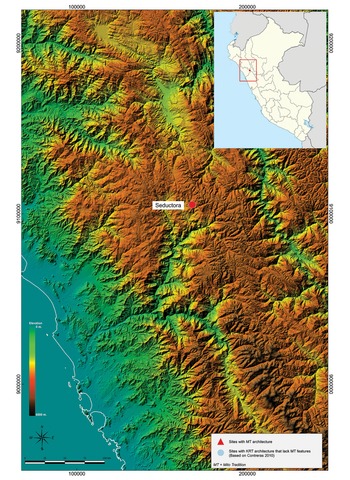
La Seductora is located in the Ucumal area (district of Angasmarca, province of Santiago de Chuco) in the central-northern Andes (Figure 1). The Santiago de Chuco and nearby Huamachuco areas were explored by McCown (Reference McCown1945), Krzanowski (Reference Krzanowski1986), who identified Early Formative local ceramic styles there, Topic and Topic (Reference Topic and Topic1987) and Perez (Reference Perez1998). This work found no evidence of the Late Archaic period, nor were any KRT structures recorded or excavated. Perez identified sites with ceramics of the Early and Middle Formative periods (Huacaloma Temprano phase, 1500–1000 BC) and Late Formative period, with pottery of the Late Huacaloma type (1000–550 BC) related to the northern area of Cajamarca, as well as ‘janabarroid’ ceramics (800–500 BC) linked to the southern site of Chavín de Huántar.
Map of Peru showing the location of La Seductora; KRT = Kotosh religious tradition (figure by J. Pérez Varillas).

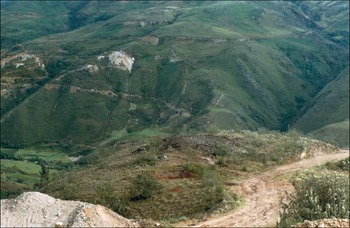
The site of La Seductora lies at 3430m asl, in a region characterised by a humid climate with high rainfall; the average annual temperature is 11°C and the vegetation is typical of tropical montane humid forests. The site occupies a level area, covered in ichu (a grass typical of the Peruvian highlands and commonly used for fodder), surrounded by a cliff and extensive arable land (Figure 2). In 2003, rescue excavations at La Seductora identified a circular structure with an underground ventilation shaft, which we interpret as a KRT building (Structure 01). A second circular structure (02) was built directly adjacent to Structure 01 at a later date.
View of La Seductura, at the edge of a cliff in the Ucumal area (photograph by A. Sanchez-Borjas).

Structures 01 and 02 were exposed in six units excavated as part of a rescue project aimed at exploring, recording and protecting archaeological sites on land owned by the COMARSA mining company. The project also explored the Ucumalí ravine (14.4km west of La Seductora) and the Michiquilca ravine (3.37km south-east of La Seductora), uncovering sites dated by ceramics to the Late Intermediate period (AD 1100–1470).
Our excavations started with a test pit, which was later extended as wall features were revealed. The structures share the same stratigraphy: the top layer consists of an approximately 0.10m-deep, compact, beige cultivated soil with roots and stones of various sizes, containing no cultural remains. The next layer, a compact, reddish organic soil, on average 0.40m thick, covered the structures and floor. No ceramics or other artefacts were found in this layer. In turn, the structures’ floors lay directly on the natural subsoil. The absence of finds from the layer that sealed the structures is not unusual on KRT sites (Onuki Reference Onuki1999, Reference Onuki2014).
A further structure (Structure 03) was recorded at La Seductora, 35m north-east of Structures 01 and 02. This consists of a semi-circular plaza with semi-rectangular rooms attached—a layout typical of the Late Intermediate period.
Architecture
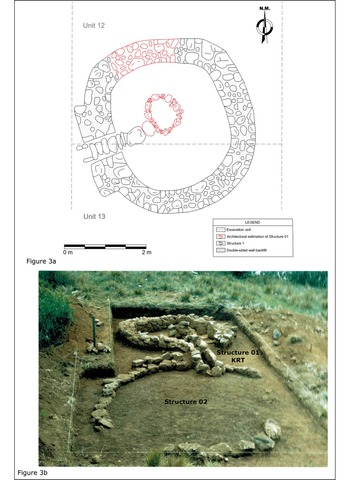
Structure 01 is roughly circular in plan, with an internal diameter of 2.71m and an external diameter of 4.08m, and covering an internal area of 5.8m2 (Figure 3). The walls, 0.50m high and 0.66m wide, are composed of medium-sized, rectangular quarried stones bonded with clay, faced on both sides, but unplastered. The structure was accessed through a narrow, 0.51m-wide entrance on the west-south-west side. The walls around this access point are slightly thicker (0.80m wide) for 0.86m on either side of the entrance.
a) Plan of Structure 01 at La Seductura; b) excavation of Structures 01 and 02; KRT = Kotosh religious tradition (figure by J. Pérez Varillas).

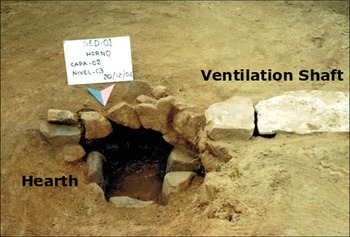
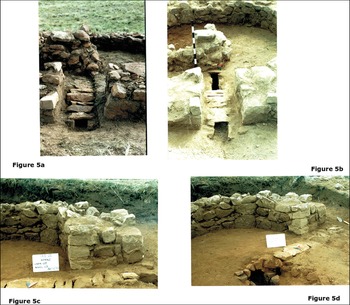
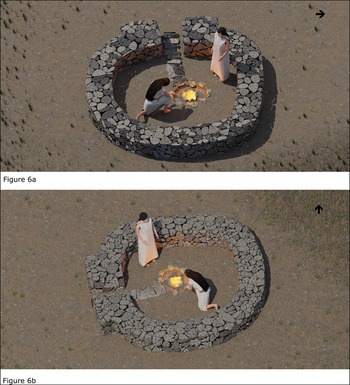
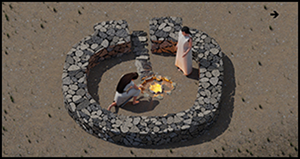
Inside the structure, we found loose, medium-sized rectangular stones, probably representing wall collapse. In the centre, a circular hearth with a diameter of 0.52m showed signs of high heat and even vitrification on its internal surface (Figure 4). Beneath the hearth, a ventilation shaft, 0.42m wide and 1.60m long, was sealed with medium-sized slabs; the shaft leads towards the west, in the direction of the structure's entrance (Figure 5), extending beyond it. This shaft probably served to ventilate the hearth and keep the fire active; traces of carbon were identified on the inside walls of the shaft. The circular structure was large enough to accommodate at least two people in its interior, as shown in our 3D reconstructions (Figure 6).
Hearth and ventilation shaft in Structure 01 at La Seductura (figure by C. Mesía-Montenegro).

a) View, facing east, of the underground ventilation shaft at La Seductura. Note the oven on top of the hearth; b) view, facing east, of the underground ventilation shaft in the process of removing the covering slabs; c) view, facing south, of the ventilation shaft; d) view, facing south-east, of the ventilation shaft (figure by C. Mesía-Montenegro).

a) Reconstruction of Structure 01 at La Seductora, facing west; b) reconstruction of Structure 01, facing north (figure by J. Pérez Varillas).

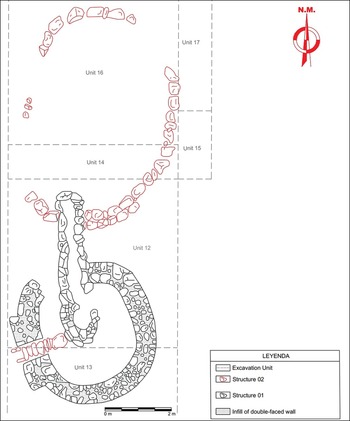
At some point after its initial use as a KRT structure, Structure 01 was remodelled. A cylindrical oven of small- and medium-sized rectangular stones bonded with clay was built on top of the hearth. An oval-shaped court (Structure 02) with a diameter of approximately 6.70m was also built to the north of Structure 01 (Figure 7). This new structure was built of unbonded stones placed directly on the ground surface. Structure 02 is poorly preserved, with many loose stones from the collapsed walls found inside and around the exterior of the structure. No ceramic material was recovered from Structure 02.
Plan of Structure 01 and Structure 02 at La Seductura (figure by J. Pérez Varillas).

At least three episodes of construction can be identified: first, Structure 01 and its hearth and ventilation shaft functioned as a KRT structure. Second, a cylindrical oven was added to the hearth; third, a circular structure (02) was added to the shrine. To connect Structures 01 and 02, part of the northern side of Structure 01 was removed and a narrow, 0.40m-wide passage (or channel?) was built. The passage was too narrow for a person to pass through, and the excavation of its fill revealed nothing that could shed light on its purpose. Structure 02 is thus a secondary addition with an as-yet undetermined function. Given the uniform fill within both structures, they were likely decommissioned and ritually buried at the same time.
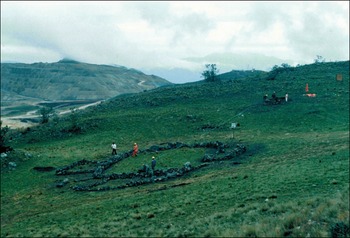
Structure 03, 35m to the north-east, was found to be a small oval plaza measuring 11 × 16m, associated with five small rectangular enclosures. The walls were built of medium- and large-sized stones without mortar—much like those of Structure 02; the wall heights vary from 0.60 to 0.80m (Figure 8). Access to the plaza was via the north-west of the structure. Structure 03 was found to be poorly preserved, having been dismantled in recent times to re-use the stone, leaving only the foundations in place.
View of Structure 03 at La Seductora (photograph by A. Sanchez-Borjas).

Discussion
In the central Andes, monumental architecture pre-dated the production of ceramics by at least one millennium, and large ceremonial centres formed part of the cultural landscape of the coastal valleys, with a strong concentration in the Norte Chico (Shady & Leyva Reference Shady and Leyva2003; Hass & Creamer Reference Hass and Creamer2006; Vega-Centeno Reference Vega-Centeno and Vega-Centeno Sara-Lafosse2017) and the highlands from 2800–1800 BC (Grieder & Bueno Reference Grieder and Bueno1981; Bonnier Reference Bonnier, Bonnier and Bischof1997; Montoya Vera Reference Montoya Vera2007; Grieder et al. Reference Grieder, Bueno, Smith and Malina2012; Bria Reference Bria2017; Munro Reference Munro2018). On the coast, the basic construction units were platforms, mounds and circular plazas (Williams Reference Williams and Mejía Baca1980), while in the highlands, rectangular or circular buildings with central hearths were common (Figure 9). These rectangular buildings were relatively small, but constant renovations and the ritual, deliberate burial of these structures created mounds up to 12m high (Izumi & Sono Reference Izumi and Sono1963).
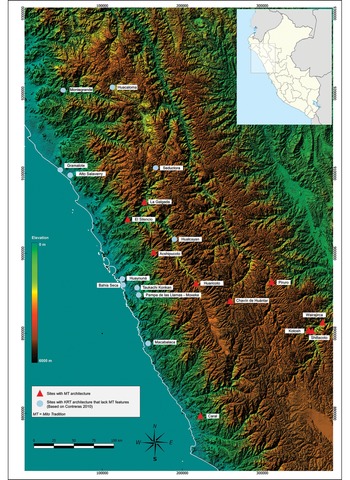
Map showing locations of Kotosh religious tradition (KRT) structures in the central Andes (figure by J. Pérez Varillas).

The KRT is present more consistently on the central coast during the Late Archaic and Early Formative periods, with examples in the Moche, Casma, Huarmey, Pativilca and Supe valleys (Pozorski & Pozorski Reference Pozorski and Pozorski1996; Shady & Leyva Reference Shady and Leyva2003; Piscitelli Reference Piscitelli, Chacon and Mendoza2017; Prieto Reference Prieto2018; Mesía-Montenegro & Sánchez-Borjas Reference Mesía-Montenegro and Sánchez-Borjas2022). KRT variations include split-level floors and freestanding structures with niches. Variations in shape are attested by circular examples (e.g. at Bahía Seca, Huaricoto, Piruro, Caral, Acshipucoto) or rectangular structures (e.g. at Shillacoto, Kotosh, Piruro, Caral, Huaricanga, Macabalaca, Gramalote), both with central hearths. These structures could have comprised high walls and timber roofs (e.g. at La Galgada, Kotosh, Macabalaca) or could have been open and exposed (e.g. at El Silencio). Complex structures even featured moulded friezes and niches (e.g. at Kotosh and probably Chavin). At Acshipucoto (Munro Reference Munro2018) in the higher Nepeña Valley, a circular KRT structure with tall walls, niches, double floor and a central circular hearth, is a unique adaptation of the KRT regional variation in the highlands. In the Norte Chico, KRT structures coexist with large, superimposed platforms and large circular plazas, as at Caral and Huaricanga (Shady & Leyva Reference Shady and Leyva2003; Piscitelli Reference Piscitelli, Chacon and Mendoza2017). Structure 01 at La Seductora, and its circular plan, is similar to the structures found at Huaricoto, Piruro, Bahía Seca and Caral (Burger & Salazar Reference Burger and Salazar1980; Bonnier Reference Bonnier1983; Pozorski & Pozorski Reference Pozorski and Pozorski1996; Shady Reference Shady1997).
At La Seductora, we were unable to excavate in the areas surrounding the structures in order to check for the presence of further buildings, as at Huaricoto and Piruro, where a spread of such structures—thought to have been in contemporaneous use—is attested (Bonnier Reference Bonnier, Bonnier and Bischof1997). Nonetheless, the structures that we located show no superimposition and were built directly on the natural subsoil. We cannot be conclusive about the chronology of the site. The lack of cultural material in the shrine's fill suggests that it dates to the Late Archaic period—the dearth of ceramics is a cultural marker of the Archaic period in the central Andes. We cannot, however, rule out a later date, for example in the Early Formative period. The fill was probably part of a ritual decommissioning practice (Izumi & Terada Reference Izumi and Terada1972; Onuki Reference Onuki2014). Its sterility might be an indicator of sacredness rather than chronology. No datable finds were recovered from the site's surface either. Further excavations may shed light on the site's chronology and the presence or absence of similar structures nearby.
The presence of the KRT in the Santiago de Chuco area is unexpected, given that no other structures of this type are known in the region. To the north, the closest KRT structures are at Huacaloma, 111km from La Seductora, and at Montegrande (127km distant); these structures are rectangular and taller than at La Seductora. La Galgada, 44km to the south, is one of the most complex KRT sites in the highlands; its three ceremonial complexes extend for around 1km along the east bank of the river Tablachaca, one mound being formed by at least five platforms, with KRT structures located on top of the upper platform (Grieder et al. Reference Grieder, Bueno, Smith and Malina2012).
Given that the KRT structures at La Seductora showed no evidence of their presence on the surface, it is unsurprising that similar structures have so far not been found in the highlands of this region. Unlike on the coast, where the size of the Late Archaic ceremonial architecture makes its presence evident, the monumentality of highland KRT sites is slight. This difference in scale has led to the view that centralised socio-political units were manifest on the coast—with large mounds and open spaces, and significant investment of labour to create impressive architecture—in contrast to architecture in the highlands, which was intended to host more intimate ceremonies (Burger Reference Burger1992). The scale of the plazas is also relevant; the larger examples at coastal sites allowed for the gathering of far more people than could be brought together at even the largest KRT structures, let alone smaller ones such as La Seductora.
The difference in scale between La Seductora and La Galgada may be an example of how different KRT sites served different segments of the population. Kotosh and La Galgada may have been regional centres built as ritual spaces for larger groups, while sites such as La Seductora or Bahía Seca in the Casma Valley may have served family groups, as smaller shrines within a larger network of KRT sites. Kotosh and similar sites may have articulated wider communal units, connecting multiple local groups across broader interaction areas, while sites such as La Seductora may have served smaller, social units, such as clans or lineages.
This leads us to the notion of interaction areas, as proposed by Vega-Centeno (Reference Vega-Centeno and Vega-Centeno Sara-Lafosse2017), who hypothesised that seven such interaction areas existed in the Late Archaic period. At least three of these areas are associated with KRT structures: in the Huallaga Valley (Kotosh, Piruro, Shillacoto), the Casma Valley (Bahía Seca, Huanuná) and the Tablachaca Valley (La Galgada, El Silencio, Hualcayán). These interaction areas may have operated on a model of peer polity interaction, although based on differences in size and scale of construction, La Seductora and La Galgada were not direct peers. At La Galgada, there is evidence of prestige goods from the highlands and the coast, such as objects made of anthracite, chrysocolla beads, beaded necklaces and spondylus ornaments; in contrast, none of these objects has been found in La Seductora. Stable isotope analysis of human remains from La Galgada (Washburn et al. Reference Washburn2020) suggests a strong reliance on local crops (C3 plants) during the Late Archaic and Early Formative periods, mixed with limited amounts of terrestrial protein (camelid, deer and guinea pig). This implies that the exchange network probably relied largely on prestige items and intangible elements (such as beliefs) rather than food; the latter was probably not the main exchange commodity and is likely to have accompanied the artefacts that were being exchanged, as indicated by the presence of coastal food products in Acshipucoto (Munro Reference Munro2018).
On the north coast, the Early Formative site of Gramalote, in the lower Moche Valley, shows how a small community of fishers built small religious structures in a context where “daily life activities were embedded in both domestic and communal rituals and ceremonies managed by community members” (Prieto Reference Prieto2018: 200). Structure 10 at Gramalote is quadrangular (8 × 8m), with a central circular hearth—like other KRT structures. It formed part of a larger public architectural compound composed of aggregated rectangular structures and is recognised as part of the KRT (Prieto Reference Prieto2018). Alto Salaverry, located in the same valley, is also notable. This site has a typical Late Archaic circular plaza, associated with a compound of rectangular structures (Pozorski & Pozorski Reference Pozorski and Pozorski1979, Reference Pozorski and Pozorski1990) dated to the transition between the Late Archaic and the Early Formative. One of the structures (Structure B) is rectangular with a central hearth—very much like a KRT structure—painted in yellow and grey. The hearth contained traces of mussels, and no underground ventilation shaft was found. The compound's excavators identified it as a domestic space (Pozorski & Pozorski Reference Pozorski and Pozorski1979, Reference Pozorski and Pozorski1990), but this interpretation may need revisiting in light of the presence of Structure B. Siveroni's (Reference Siveroni2006) suggestion that KRT structures were initially elite residences may also merit further investigation, given the evidence from Structure B at Alto Salaverry.
At the coastal site of Huaca Prieta, a large platform was constructed in the Late Archaic period (Phase IV) on top of terraces built during the Middle Holocene (7000–3000 BC). According to Dillehay (Reference Dillehay2017: 16–17), Huaca Prieta reflects activities that were “essential for the creation of a sense of community among dispersed foragers who were incorporating crops and needing a permanent place to integrate”. The Late Archaic platform could have served as a place of integration, similar to what Burger proposed for KRT structures (Burger & Salazar-Burger Reference Burger, Salazar-Burger, Matos Mendieta, Turpin and Eling1986). But was that the case in the Formative period?
For the Late Formative in the central Andes, Kembel and Rick (Reference Kembel, Rick and Silverman2004) proposed a model in which regional elites came to Chavín to be initiated, become part of its network and acquire the knowledge to gain authority and secure power. We can use this model to propose that groups undertook pilgrimages to attend rituals at larger sites—for example at La Galgada—and then replicated at a smaller scale what they had learnt and experienced on their visits. These pilgrimages may not have been related only to belief but also to the promotion of political relationships amongst leaders or those who aspired to be part of a network that offered advantages to them. In this sense, the ritual buildings at Kotosh (and by extension, the KRT) may represent an earlier, simpler version of what occurred later in Chavín (Hayden Reference Hayden2018). The maintenance of core architectural features across large geographical areas allowed shared cultural practices to be performed in common structures, as was the case along the Pacific north-western coast during the nineteenth century AD, where “societies exhibited the ability to spread over large regions very rapidly, creating a relatively uniform network of ritual and political organisations” (Hayden Reference Hayden2018: 44). This implies that centres shared a “set of religious beliefs which entailed similar kinds of ritual activities and, consequently, required a similar type of ceremonial building” (Burger Reference Burger1992: 46). This nevertheless allows for variation and differences in architectural design that would be expected to reflect variations in ritual performance, while maintaining the essential elements of the ritual. Variations can thus be understood in terms of local or regional identities within a generally shared cultural landscape.
It has been argued that KRT structures were built communally (Burger & Salazar-Burger Reference Burger, Salazar-Burger, Matos Mendieta, Turpin and Eling1986) and that leadership was assumed on a rotational basis, which may have been a strategy to overcome the challenges posed by collective action (Carballo et al. Reference Carballo, Roscoe and Feinman2014). Stanish and colleagues (Reference Stanish, Tantaleán and Knudson2018: 6716) argue that “the development of evolutionary stable social organisations that overcome the collective action problem is a prerequisite for the evolution of social complexity”. Communal building can foster cooperation, long-term relationships, exchange and trade networks, community bonding and ideological reinforcement (Hayden & Villeneuve Reference Hayden, Villeneuve, Price and Feinman2010; Hayden Reference Hayden2018), as well as constructing, testing and putting into practice the norms of cooperative behaviour (Stanish Reference Stanish2017). But who developed the norms of competitive behaviour: those in authority, villagers, specialists, all of these? Persuasion is an important element in this strategy, as the notion of the ‘greater good’ must be legitimised. The cooperation for competition (‘let's cooperate to compete’) model seems to be a plausible evolutionary strategy; it may be a valid scenario in cases such as in the Late Archaic and Formative periods in the central Andes, in which religion was the ‘legitimiser’ used to entice people to cooperate and compete (Rick Reference Rick, Vaughn, Ogburn and Conlee2005; Mesía-Montenegro Reference Mesía-Montenegro2018). Cooperation can be achieved by ritualising the economy (Stanish Reference Stanish2017), but this is insufficient, as economy is only one aspect of managing a polity. Polanyi has proposed the concept of an ‘embedded economy’, where “the vital importance of the economic factor to the existence of society precludes any other result”, that result being “the control of the economic system [… being] of overwhelming consequence to the whole organization of society” (Polanyi Reference Polanyi2001: 60). Adapting Polanyi, we argue that, during the Formative period, most social relationships were embedded in the religious system, in which the vital importance of the religious factor for the existence of society trumps any other factor.
We must consider the role of agency when addressing cooperation and collective action. Elites and those in authority signalled their status through their religious institutions, but religions need to be organised in institutional ways. Elaborating on Granovetter's (Reference Granovetter2017) take on economic institutions, a religious institution involves larger complexes of action and templates for how things should be done, which bestows authoritative knowledge of rituals and traditions, and consequently, power. If religious institutions were “simply ritual associations […] there would be no need for public displays” (Hayden Reference Hayden2018: 25); thus, structures intended for public displays would be an unnecessary expense. It follows that such structures would not only demonstrate power, wealth and canonical knowledge (e.g. at large sites, such as La Galgada), but also allegiance and compliance (at smaller sites, such as La Seductora).
Religion was ubiquitous in administrative, political and economic pursuits; it was embedded in the system, and recognised through symbols, customs, rituals and performances used by those in charge to enhance legitimacy through social cohesion. Religion is a tool for obtaining, legitimising and maintaining authority, and can be replicated among other members of the system and normalised through rituals and cultural values. ‘Embedded religiousness’ would thus be an appropriate concept to describe the nature of social relationships during the Late Archaic and Formative periods.
Conclusions
Excavations at La Seductora revealed a shrine of the Kotosh religious tradition in the northern Peruvian highlands. This small circular structure, and the subsequent modifications and additions to it, were decommissioned and sealed with a clean deposit of soil, following the practice of ‘ritual entombment’ observed at other KRT sites (Onuki Reference Onuki1999, Reference Onuki2014). Given the lack of ceramics and other material in the fills that covered the structures, a date in the Late Archaic (2800–1800 BC) or Early Formative (1800–1200 BC) periods is proposed, but, for now, unverified.
La Seductora may have been part of the Tablachaca area of interaction (named after the valley in which the larger site of La Galgada lies) proposed by Vega-Centeno (Reference Vega-Centeno and Vega-Centeno Sara-Lafosse2017), and may have functioned as a modest, family-orientated shrine. Further research would confirm or invalidate this hypothesis. The interaction area of which La Seductora formed part was shaped by religious practices, with an intense ritualisation attested in the architecture of the period. This is unsurprising, since religion has been identified as the key element that characterises Andean civilisation (Tello Reference Tello1942)—a pervasive and persistent element that shaped the way in which the Andean world was organised.
Acknowledgements
We are grateful to the anonymous reviewers who provided insightful recommendations. We also thank Jenifer Perez Varillas for the drawings and reconstructions.
Funding statement
The excavations and research on which this article is based were funded by the Santa Rosa Mining Company (COMARSA).