Introduction
As dementia progresses, persons with dementia living at home demand greater caregiving, including constant protection and observation, which may lead to a significant burden for the family in the caregiver role (Bakker et al., Reference Bakker2014). The care needs of community-residing persons with dementia are complex and depend on the severity of dementia symptoms, such as cognitive impairments, functional dependencies, and behavioral and psychological symptoms (Rabins et al., Reference Rabins, Lyketsos and Steele2006). An unmet need means a significant problem requiring intervention or assessment, which is currently no assistance or the wrong kind of help, and regarded the problem to be unmet despite any help received (Orrell and Hancock, Reference Orrell and Hancock2004). Persons with dementia living in the community have multiple unmet needs such as inadequate daytime activities, lack of company, failing memory, lack of information, and psychological distress (Miranda-Castillo et al., Reference Miranda-Castillo, Woods and Orrell2013). Subdomains of unmet needs relate positively to caregiver burden, such as health and psychological problems, family and social support, information, religious and spiritual needs, and practical-support needs (Hughes et al., Reference Hughes2014). As the unmet needs of persons with dementia and of family caregivers increase and caregiver burden increases, persons with dementia are more likely to be placed in a care facility (Black et al., Reference Black, Johnston, Rabins, Morrison, Lyketsos and Samus2013). The Camberwell Assessment of Need for the Elderly (CANE; Reynold et al., Reference Reynolds2000; Orrell and Hancock, Reference Orrell and Hancock2004) is a comprehensive assessment of needs of the elderly targeting environmental, physical, psychological, and social needs. Among these unmet needs, physical and psychological needs (e.g. a dementia patient's disturbed behavior, psychotic symptoms, and incontinence) predicted poor caregiver outcomes (Meiland et al., Reference Meiland, Kat, van Tilburg, Jonker and Dröes2005; Hughes et al., Reference Hughes2014). For environmental needs, caregiver burden may remain high unless caregivers also perceive that the support their relative or friend is receiving is adequate (Cleary et al., Reference Cleary, Freeman, Hunt and Walter2006). Persons with dementia who had a low community-involvement network had higher unmet social needs (e.g. company and daytime activities; Miranda-Castillo et al., Reference Miranda-Castillo, Woods, Galboda, Oomman, Olojugba and Orrell2010). These unmet needs related to caregiver burden; meeting patient needs could reduce caregiver burden (Cleary et al., Reference Cleary, Freeman, Hunt and Walter2006).
Many family caregivers do not have professional caregiver skills and expertise, and thus, formal support (e.g. assistance from community-based services, such as visiting nurses and helpers, adult day care) is helpful for persons with dementia in their complex needs for care at home. Since caregivers who lack supporting resources are likely to endure a far greater caregiver burden than those who possess such resources (Han et al., Reference Han2014), sharing caregiving roles through formal support is of great importance to relieve caregivers from the burden of long-term caregiving and to provide respite time (Weber et al., Reference Weber, Pirraglia and Kunik2011).
Most research on caregiving for patients with dementia examines negative aspects of caregiving. Some recent studies, however, have started to report that negative and positive caregiving experiences coexist and that positive caregiving experiences complement and buffer the negative consequences of caregiving (de Labra et al., Reference de Labra2015). In the Lawton et al. (Reference Lawton, Moss, Kleban, Glicksman and Rovine1991) two-factor model, caregiving satisfaction represents subjectively perceived gains from desirable aspects of, or positive affective returns from, caregiving. Family caregivers can perceive even stressful situations as more acceptable if they provide some form of caregiving satisfaction (Lundh, Reference Lundh1999). The majority of caregivers experience some feelings of satisfaction in positive rewards and gratification, such as providing pleasure for the cared-for person; maintaining his/her dignity and self-esteem; feeling appreciation from the cared-for person, family, and friends; improved family relationships; and the development of new skills and abilities (Nolan et al., Reference Nolan, Grant and Keady1998). Thus, understanding the factors contributing to negative and positive caregiving experiences will provide comprehensive insight for family caregiving of persons with dementia.
For its theoretical framework, this study combines the stress process model of Pearlin et al. (Reference Pearlin, Mullan, Semple and Skaff1990), which conceptualizes interactions of multi-dimensional elements related to caring situations, and the two-factor model of Lawton et al. (Reference Lawton, Moss, Kleban, Glicksman and Rovine1991), which presents appraisals of caregiving in two dimensions: caregiving satisfaction and burden. Based on the Pearlin et al. (Reference Pearlin, Mullan, Semple and Skaff1990) model, this study included related variables, such as caregiving context and background, stressors (patient symptoms and unmet needs), mediators (formal support), and caregiving outcomes (caregiving satisfaction and burden). Although the stress process model includes the physical and mental health and well-being of family caregivers as positive and negative caregiving outcomes, most research using this model has focused on negative aspects of caregiving (Crespo and Fernandez-Lansac, Reference Crespo and Fernandez-Lansac2014). This study included both caregiving satisfaction (a positive aspect of caregiving) and caregiving burden (a negative aspect of caregiving).
The cognitive, behavioral, and functional symptoms of patients with dementia are the primary objective stressors in the caregiving process. While a correlation between the symptoms of patients and caregiving satisfaction and burden has been reported (Pinquart and Sorensen, Reference Pinquart and Sörensen2011; de Labra et al., Reference de Labra2015), some studies have reported that there is no direct correlation (Contador et al., Reference Contador, Fernandez-Calvo, Palenzuela, Miguéis and Ramos2012; Hodge and Sun, Reference Hodge and Sun2012). Unmet needs may be associated with greater caregiving burden (Black et al., Reference Black, Johnston, Rabins, Morrison, Lyketsos and Samus2013) and lower caregiving satisfaction (Hwang et al., Reference Hwang2003), but the relationship between caregiving satisfaction and caregiving burden has not been studied previously.
The stress process model emphasizes that caregiving outcomes could differ depending on the extent of resources (e.g. social support) that a caregiver receives (Pearlin et al., Reference Pearlin, Mullan, Semple and Skaff1990). In the previous research, formal support was reported to be a mediator that weakens the effect of stressors and functions as a determinant of caregiving satisfaction (Andrén and Elmståhl, Reference Andrén and Elmståhl2008; Kang, Reference Kang2010; Miranda-Castillo et al., Reference Miranda-Castillo, Woods, Galboda, Oomman, Olojugba and Orrell2010) and burden (Weber et al., Reference Weber, Pirraglia and Kunik2011; Kim and Choi, Reference Kim and Choi2015). Some studies, however, have reported that formal support is not related to caregiving satisfaction or caregiving burden (Parveen and Morrison, Reference Parveen and Morrison2012; Han et al., Reference Han2014).
The evidence is difficult to interpret because existing research presents different results about the relationships among factors, such as patient symptoms and unmet needs, formal support, caregiving satisfaction, and caregiver burden. In addition, most studies of family caregivers’ caregiving experience have not comprehensively examined related factors. As suggested by the stress process model and the two-factor model, however, family caregivers’ caregiving experience is affected by complex and multi-dimensional related factors, which affect caregiving satisfaction or caregiving burden significantly through a direct or indirect path. Therefore, grasping the causal paths between unmet needs and formal support, caregiving satisfaction, and caregiving burden in family caregiving situations with persons with dementia will facilitate the design of interventions focused on these predictors to increase the positive experience of caregiving and thus alleviate the negative consequences of caregiving.
Hypotheses
The hypotheses of this study are as follows:
1. Patient symptoms directly affect unmet needs, formal support, caregiving satisfaction, and caregiving burden and indirectly affect unmet needs through formal support. In addition, patient symptoms indirectly affect caregiving satisfaction and caregiving burden through unmet needs.
2. Unmet needs directly affect caregiving satisfaction and caregiving burden and indirectly affect caregiving burden through caregiving satisfaction.
3. Formal support directly affects unmet needs, caregiving satisfaction, and caregiving burden and indirectly affects caregiving satisfaction and caregiving burden through unmet needs.
4. Caregiving satisfaction directly affects caregiving burden.
Methods
Design
This study is a secondary data analysis of a large cross-sectional survey, the Seoul Dementia Management (SDM) study, which was conducted in Seoul, Korea.
Participants
The study participants included dyads of persons with dementia and their primary family caregivers at home. The SDM study (Lee et al., Reference Lee2014) was conducted for approximately three months from June to August 2014. The sample of the SDM study was drawn randomly from the 656 persons with dementia who were registered in the online database of Seoul, Korea. For the SDM study, all questionnaires were administered via in-person interviews conducted by trained research assistants. The survey addressed issues of treatment, caregiving, burden and costs for dementia care in community settings. From the 360 dyads of community-residing persons with dementia and their families included in the final analysis, 40 dyads were excluded from the final analysis: 23 dyads who were non-family caregivers and 17 dyads for whom missing values in the study variables were 5% or higher.
Measures
Patient symptoms
To examine patient symptoms, the Seoul Dementia Assessment Packet (SDAP; Lee et al., Reference Lee2014) was used. This assessment tool includes 26 items that consisted of four domains: cognitive impairment, behavioral problems, activities of daily living, and instrumental activities of daily living. Each item ranges from 0 to 3. A higher score represents more severe symptoms. The Cronbach's α of the SDAP was previously found to be 0.80 (Lee et al., Reference Lee2014). That of the SDAP in this study was found to be 0.96 overall, ranging from 0.69 to 0.95 in the subdomains.
Unmet needs
The CANE developed by Reynolds et al. (Reference Reynolds2000) and translated into Korean by Lee et al. (Reference Lee2014) was used. The CANE consisted of 24 items belonging to four care domains (environmental, physical, psychological, and social needs). Examples of environmental needs are having a suitable living environment and being able to perform domestic tasks (e.g. accommodation, household activities, food, managing money, benefits, and caring for someone else). Physical needs include diagnosed physical ailments as well as functional problems (e.g. physical illness, drugs, eyesight/hearing impairment, mobility/falls, self-care, and incontinence). Psychological needs include experiencing difficulties with memory, mood, and behavior (e.g. psychological distress, memory problems, alcohol, deliberate self-harm, inadvertent self-harm, and psychotic symptoms). Examples of social needs are experiencing a lack of company or, more precisely, an intimate relationship (e.g. daytime activities, information on condition, and abuse/neglect). Each item is rated as follows: no need, met need, or unmet need. CANE assesses the informal and formal help that the older adult receives and the satisfaction with that help. The number of unmet needs is the total number of areas scored as an unmet need. Reynolds et al. (Reference Reynolds2000) found that Cronbach's α value for this instrument was 0.87, and in our study, the overall Cronbach's α value was found to be 0.84.
Formal support
To examine formal support, we measured the use of the dementia management-registration services in Seoul Metropolitan City. Six domains of formal support were assessed: diagnosis/assessment service (e.g. routine checkup and medical examination), medical/nursing services (e.g. home-visit nursing and referral to medical services), cognitive rehabilitation services (e.g. occupation therapy, art therapy, and validation therapy), family education and support services (e.g. family education programs and family self-help groups), financial services (e.g. support for dementia treatment costs), and social welfare services (e.g. case management services and referral to community welfare services). Each item is scored as 0 (not used) or 1 (used). This variable is constructed as a sum of services used, ranging from 0 to 25.
Caregiving satisfaction
The Carers’ Assessment of Satisfaction Index (CASI)-Short version with 20 items (Nolan et al., Reference Nolan, Grant and Keady1998; Andrén and Elmståhl, Reference Andrén and Elmståhl2005) includes four factors: purpose (e.g. “caring has provided a new purpose in my life that I did not have before”), pleasure (e.g. “I get pleasure from seeing the person I care for happy”), appreciation (e.g. “It's nice to feel appreciated by those family and friends I value”), and reward (e.g. “I feel that if the situation were reversed, the person I care for would do the same for me”). Each item ranges from 0 (not at all) to 2 (very much). Andrén and Elmståhl (Reference Andrén and Elmståhl2005) found that Cronbach's α value for this instrument as a whole was 0.78. In this study, the Cronbach's α value was found to be 0.91 overall.
Caregiving burden
The Korean version of the Zarit Burden Interview (ZBI-K) developed by Zarit et al. (Reference Zarit, Reever and Bach-Peterson1980) and translated by Bae et al. (Reference Bae2006) into Korean was used to measure personal burden and role burden. Each item ranges from 0 (never) to 4 (nearly always). The Cronbach's α of the ZBI-K was previously found to be 0.92 (Bae et al., Reference Bae2006). In this study, the Cronbach's α value was found to be 0.94 overall.
Data analysis
Data were analyzed with structural equation modeling (SEM) using AMOS 22.0. The hypothesized model was based on the stress-process model, the two-factor model, and previous research results included one exogenous latent variable (patient symptoms) and four endogenous latent variables (unmet needs, formal support, caregiving satisfaction, and caregiving burden). Initially, contextual and background factors such as spousal relationship, co-residence, caregiving hours, caregiving duration, and care costs were included as control variables in the study's hypothesized model. However, they were excluded from the final model since we observed that they caused no significant change in the paths between other variables.
To verify normality, we examined the skewness and kurtosis values of the observed variables. We used the maximum-likelihood method to estimate the model. To examine the correlation and multi-collinearity of the observed variables, we analyzed Pearson's correlation coefficient, tolerance, and variance inflation factors. To verify the validity of potential variables in the SEM analysis, we conducted a confirmatory factor analysis. We evaluated the goodness of fit of the models using the χ 2, goodness-of-fit index (GFI), standardized root mean residual (SRMR), root mean square error of approximation (RMSEA), comparative fit index (CFI), normed fit index (NFI), and Tucker Lewis index (TLI). To verify the statistical significance of the direct, indirect, and total effects of the model, we employed the bootstrapping method.
Results
Characteristics of participants
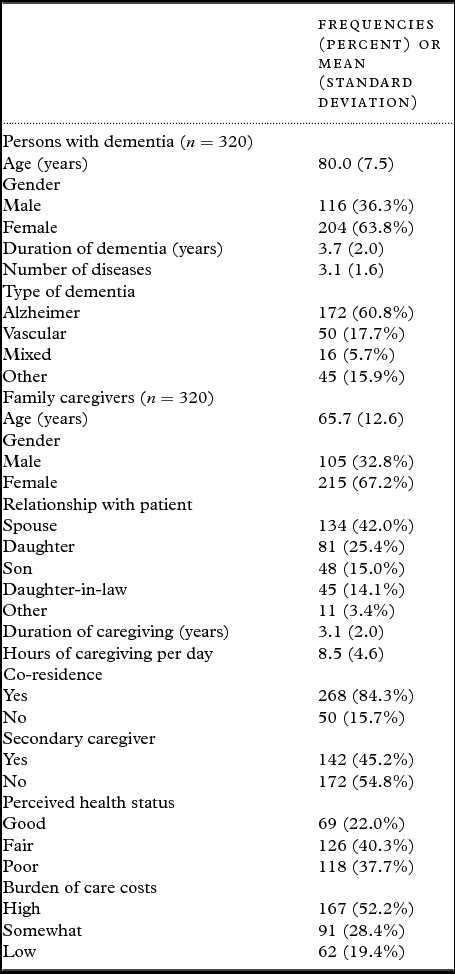
The general characteristics of persons with dementia and their family caregivers are presented in Table 1. The average age of persons with dementia was 79.98. In terms of dementia types, Alzheimer's disease accounted for 60.8%, followed by vascular dementia, which accounted for 17.1%. The average age of family caregivers was 63.74. Spouses accounted for the largest portion (42%), followed by daughters, sons, and daughters-in-law in descending order. The average caregiving duration was 35.3 months. The average number of caregiving hours per day was 8.5 h. Approximately 85% of respondents were living together with patients with dementia, and 45.2% of them had secondary caregivers.
Characteristics of the persons with dementia and their family caregivers

Structural equation modeling
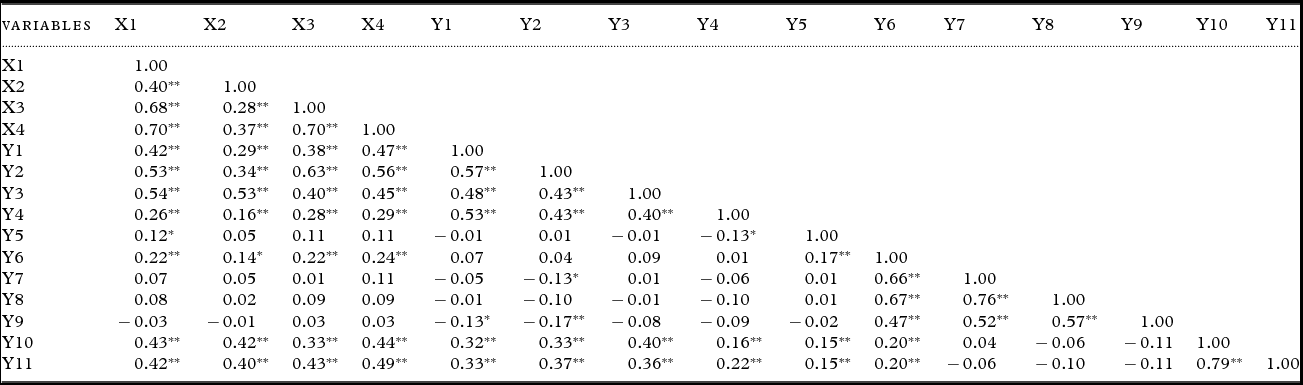
The absolute value of every observed variable was less than 2, the value for skewness was 3.0 or less, and the value for kurtosis was 7.0 or less, which corresponded to the assumption of normality of the structural model data. Table 2 shows the correlation matrix of the measured variables. The coefficient of correlation among all the observed variables was less than 0.8, the tolerance limit was 0.3 or higher, and the variance inflation factor was 3.2 or less, which indicate that there is no problem with multi-collinearity. In the confirmatory factor analysis, the path coefficient of every observed variable was statistically significant, as the absolute value of the factor loading of each observed variable was 0.5. In addition, as the average variance extracted (AVE) indicating the consistency between potential variable and observed variables was 0.5 or higher and the composite construct reliability (CCR) was 0.7 or higher, the convergent validity was verified. The value of the square of the correlation coefficient between patient symptoms and unmet needs was smaller than the value of AVE, which indicates that the correlation between potential variables was low enough to verify the discriminant validity.
Correlations among the measured variables

** p < 0.01; *p < 0.05; X1, Cognitive impairment; X2, Behavioral problems; X3, Activities of daily living; X4, Instrumental activities of daily living. Y1, Environmental needs; Y2, Physical needs; Y3, Psychological needs; Y4, Social needs; Y5, Formal support; Y6, Purpose; Y7, Pleasure; Y8, Appreciation; Y9, Reverse; Y10, Personal burden; and Y11, Role burden.
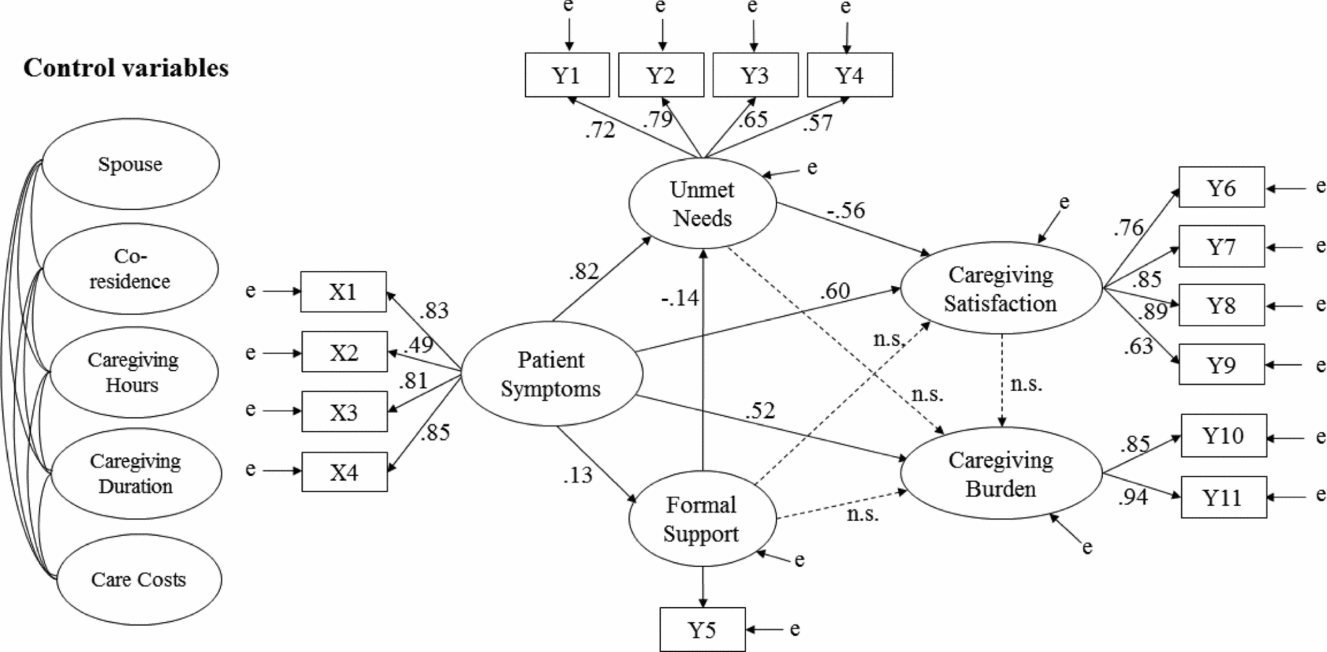
The results of the SEM of the hypothesized model are shown in Figure 1. In the hypothesized model, six of ten hypothetical paths were statistically significant, whereas the rest were not. Patient symptoms significantly related to unmet needs, formal support, caregiving satisfaction, and burden. Unmet needs significantly related to caregiving satisfaction and formal support significantly related to unmet needs. The hypothesized model's goodness of fit was assessed: χ2 (p) = 325.87 (p < 0.001), GFI = 0.88, SRMR = 0.07, RMSEA = 0.10, CFI = 0.90, NFI = 0.87, and TLI = 0.87. The results thus indicate that the goodness of fit did not reach the recommended level. The model was modified by using the covariance between measurement errors of exogenous potential variable and the covariance between measurement errors of endogenous potential variables in reference to the modification indexes. As a result, the final model's GFIs were as follows: χ2 (p) = 256.60 (p < 0.001), GFI = 0.91, SRMR = 0.07, RMSEA = 0.09, CFI = 0.92, NFI = 0.90, and TLI = 0.90. Thus, all indexes reached the recommended level (Table 3).
Path diagram for the hypothesized model. All parameter estimates are standardized and significant unless otherwise stated. Controlling for variable in structural equation modeling requires direct paths (not shown) from control measures to each latent construct in the model. X1, Cognitive impairment; X2, Behavioral problems; X3, Activities of daily living; X4, Instrumental activities of daily living. Y1, Environmental needs; Y2, Physical needs; Y3, Psychological needs; Y4, Social needs; Y5, Formal support; Y6, Purpose; Y7, Pleasure; Y8, Appreciation; Y9, Reverse; Y10, Personal burden; and Y11, Role burden.

Fit indices for the hypothesized model and the modified model

GFI, goodness-of-fit index; SRMR, standardized root mean residual; RMSEA, root mean square error of approximation; CFI, comparative fit index; NFI, normed fit index; TLI, Tucker Lewis index.
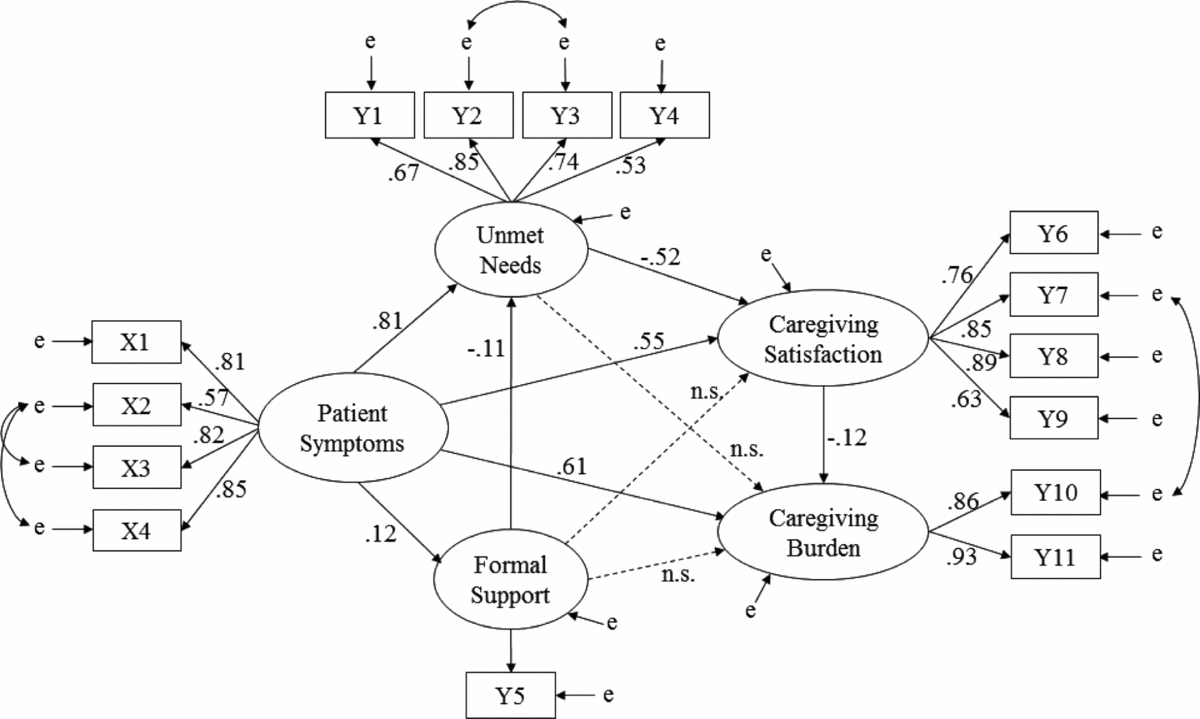
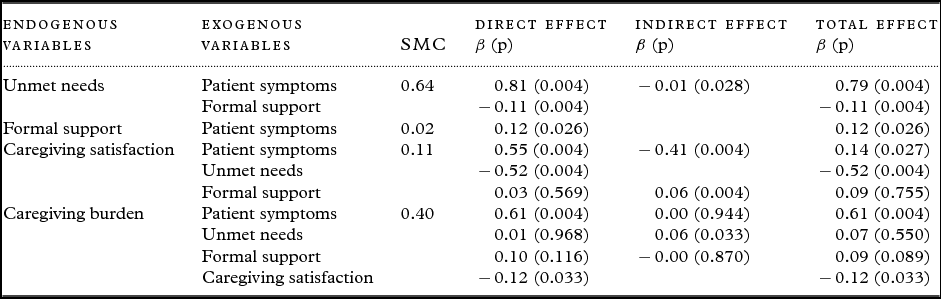
In the final model of this study, seven out of ten hypothetical paths were statistically significant, while the rest were not (Figure 2). Patient symptoms showed a positive association with unmet needs, formal support, caregiving satisfaction, and caregiving burden. Patient symptoms had an indirect effect on unmet needs, with formal support as a mediator, and on caregiving satisfaction, with unmet needs as a mediator. Unmet needs showed a negative relationship with caregiving satisfaction. Caregiving satisfaction had a negative association with caregiving burden, and unmet needs had an indirect effect on caregiving burden, with caregiving satisfaction as a mediator. In contrast, unmet needs were not significant in the path of caregiving burden. Furthermore, formal support had no significant effect on the path of caregiving satisfaction and caregiving burden. The model accounted for 11% of the variance in caregiving satisfaction and 40% of the variance in caregiving burden (Table 4).
Path diagram for the modified model. All parameter estimates are standardized and significant unless otherwise stated. X1, Cognitive impairment; X2, Behavioral problems; X3, Activities of daily living; X4, Instrumental activities of daily living. Y1, Environmental needs; Y2, Physical needs; Y3, Psychological needs; Y4, Social needs; Y5, Formal support; Y6, Purpose; Y7, Pleasure; Y8, Appreciation; Y9, Reverse; Y10, Personal burden; and Y11, Role burden.

Standardized direct, indirect, and total effects for variables in the final model

SMC, squared multiple correlation.
Discussion
This study is the first that verifies the role of unmet needs and formal support in the context of caregiving satisfaction and caregiving burden among family caregivers of patients with dementia living at home in Korea. The SEM shows that unmet needs were an important factor mediating the relationships between patient symptoms and caregiving satisfaction and between formal support and caregiving satisfaction, while formal support was an important factor mediating the relationship between patient symptoms and unmet needs.
The severity of patient symptoms was associated with higher unmet needs. According to Black's study (Reference Black, Johnston, Rabins, Morrison, Lyketsos and Samus2013), people with dementia had significantly more unmet needs than people without dementia. Since the family is the main provider of support for the needs of patients with dementia living at home and since patient symptoms are highly associated with caregiver burden (Park et al., Reference Park, Sung, Kim, Kim and Lee2015), it is not surprising that patients with dementia who have more symptoms also have a significantly higher number of unmet needs.
Patient symptoms were positively associated with caregiving satisfaction as well as caregiving burden. In other words, the severity of patient symptoms predicted higher levels of caregiving satisfaction and caregiving burden. These results are consistent with prior research findings on the relationship between patient symptoms and caregiving satisfaction or burden (Andrén and Elmståhl, Reference Andrén and Elmståhl2005; Park et al., Reference Park, Sung, Kim, Kim and Lee2015). Andrén and Elmståhl (Reference Andrén and Elmståhl2005) found that caregiving satisfaction, expressed as purpose, was influenced by the severity of dementia symptoms, and they interpreted this result as reflecting an increased understanding of the disease process and inter-reflections for the caregiver. In addition, patient symptoms had an indirect effect on caregiving satisfaction through unmet needs. Family caregivers placed particular significance on seeing that the needs of the cared-for person were well addressed and maintaining the cared-for person's dignity (Nolan et al., Reference Nolan, Grant and Keady1998). This finding corresponds to that found in the research of Goetzinger (Reference Goetzinger2008), in which patient symptoms affected family caregivers’ needs for external help and service and in which family caregivers’ well-being was enhanced when patients had greater levels of social support. The findings regarding unmet needs suggest that the extent of unmet needs is critical to improving caregiving outcomes. Improving family caregivers’ caregiving satisfaction, therefore, requires not only regular assessments of patients’ symptoms but also in-depth evaluation of the potentially modifiable unmet needs of patients and families.
Formal support was negatively related to unmet needs and had a mediating effect on the relationship between patient symptoms and unmet needs. This finding corresponds to other studies reporting that the use of formal support buffers the effect of patient symptoms on unmet needs (Miranda-Castillo et al., Reference Miranda-Castillo, Woods, Galboda, Oomman, Olojugba and Orrell2010; Chan, Reference Chan2011). This result probably occurs because formal support is more suitable for patients’ complex needs that cannot be addressed by informal family caregivers. Providing assistance to caregivers can reduce the severity of patients’ symptoms and delay institutionalization. Because this assistance requires the provision of multiple health care and social services, a coordinated system of care guided by need is warranted (Schölzel-Dorenbos et al., Reference Schölzel-Dorenbos, Meeuwsen and Olde Rikkert2010). It is necessary to develop customized interventions and services according to the types and extent of symptoms of patients with dementia to reduce their unmet needs. Although formal support did not affect caregiving satisfaction and caregiving burden directly in this study, it had an indirect effect on caregiving satisfaction with patients’ unmet needs as a mediator. This finding is supported by the research of Miranda-Castillo et al. (Reference Miranda-Castillo, Woods, Galboda, Oomman, Olojugba and Orrell2010), in which social networks had an indirect effect on quality of life through unmet needs. Recent studies on the effects of social support programs have started to focus on positive factors of caregiving experience as well as ways to alleviate negative factors (Andren and Elmståhl, Reference Andrén and Elmståhl2008; Kang, Reference Kang2010). Continuing effort must be made to improve caregiving satisfaction with formal support in consideration of the various unmet needs of patients with dementia.
In this study, caregiving satisfaction appeared to exhibit direct effect on caregiving burden negatively and had a mediating effect on the relationship between patients’ unmet needs and caregiving burden. This finding corresponds to the research of Kajiwara et al. (Reference Kajiwara, Nakatani, Ono and Miyakoshi2015), which reported that when family caregivers of patients with dementia view their caregiving experiences positively, their caregiving burden is lower. This finding indicates that approaches to reducing the caregiving burden may involve helping family caregivers focus on positive aspects of caregiving situations and reconsidering the caregiving situation in a more flexible way (Shim et al., Reference Shim, Barroso, Gilliss and Davis2013).
Contextual and background factors (spousal relationship, co-residence, caregiving hours, caregiving duration, and care costs) relate to latent variables, such as patient symptoms, unmet needs, formal support, caregiving satisfaction, and burden, in previous studies (Andrén and Elmståhl, Reference Andrén and Elmståhl2008; Pinquart and Sörensen, Reference Pinquart and Sörensen2011; Parveen and Morrison, Reference Parveen and Morrison2012; Black et al., Reference Black, Johnston, Rabins, Morrison, Lyketsos and Samus2013; Park et al., Reference Park, Sung, Kim, Kim and Lee2015). These variables were used as control between the latent variables in the model. However, these were excluded because they caused no significant change in the paths between other variables.
This study adds to the research in that it clarifies the effect of unmet needs on caregiving satisfaction, which has not been well explored in existing studies, and confirms that formal support reduces the unmet needs of patients with dementia and thus improves caregiving satisfaction as an important mediator. However, this study has some limitations. Since the participants were community-residing patients with dementia and their family caregivers who were recruited from one urban geographic area, these findings may not be generalizable to family caregivers of patients with dementia who reside in rural areas with insufficient formal support. Because this study used cross-sectional data, the implied causal inferences must be interpreted with caution. Thus, a need persists for longitudinal research to gain a better understanding of family caregivers’ caregiving experience in the illness trajectories of dementia and to retest the fit of our model. Furthermore, the data accrued only for family caregivers, which may restrict its use for people with dementia and health professionals working with dementia. Thus, future research with more a diverse population is needed.
In conclusion, this study verifies the causal paths of unmet needs and formal support in reflecting upon caregiving satisfaction and caregiving burden among family caregivers of patients with dementia living at home. It is necessary for future research to assess patient symptoms and unmet needs based on the findings of this study and to develop customized care plans that consider the needs of patients and their families as well as symptom characteristics. To enhance the quality of life of patients with dementia and their families, multi-dimensional support resources must be utilized to develop preventive and active interventions with supporting programs that reduce unmet needs and caregiving burden and improve family caregivers’ caregiving satisfaction.
Conflict of interest
None.
Description of authors’ roles
M. Park and S. Choi contributed to the conceptualization, data analysis, and preparation of the paper. S.J. Lee., S.H. Kim, and J. Kim designed the study and contributed to data management. Y. Go contributed to manuscript preparation. D.Y. Lee contributed to the conceptualization and design of the study and review of the paper.
Acknowledgments
This study was supported by grants from the Seoul Metropolitan Center for Dementia (SMCD) (2014-12) and the National Research Foundation of Korea (NRF) (NRF-2017R1A2B1011044). The authors thank Dr. Nancy Moore, editor of the Arizona State University College of Nursing and Health Innovation, for reviewing drafts of this manuscript.