INTRODUCTION
In this article, we publish – and discuss the historical implications of – an inscription which has spent more than a century in the museum storerooms of Liverpool (World Museum accession number 20.5.01.58).
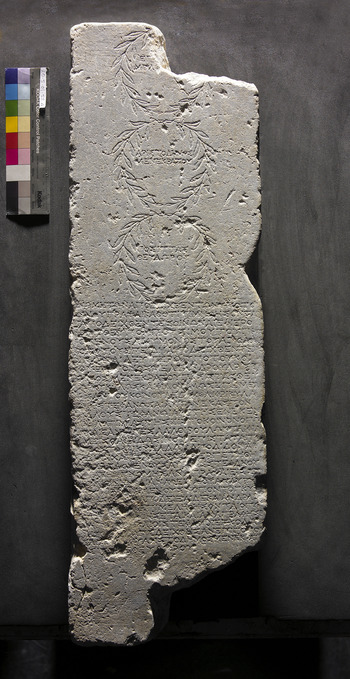
The stone (Fig. 1; for a digitally adjustable version of the image, please see the supplementary material hosted on the CUP website) is a tapering slab of white marble. Two chunks have been cut out from the top and bottom right-hand side, presumably in the process of its remodelling for subsequent reuse (probably as a door-step). The stone otherwise appears to be complete, apart from some wear on both edges (of different types: rough on left-hand side; smooth on right) which has, at points, obscured the initial and final letters. The surface bearing the text is mostly well preserved, with the exception of the bottom-left side of the inscribed area, which is worn, at points making the text hard to decipher. The back of the stele is rough picked. It bore remains of whitewash on both long edges and was blackened (perhaps as a result of bomb damage in the Second World War) when first autopsied in spring 2013, but cleaning and conservation work in early summer 2013 removed both paint and soot.
World Museum accession number 20.5.01.58: the gnome of the Phrikyladai. Courtesy National Museums Liverpool (World Museum). All rights reserved. Digitally adjustable images of the stone are included in the online supplementary material to this article.

The inscription came into the Museum's collections in 1901, as part of a bequest made by Mary Ann MacIver. She was the widow of Charles MacIver, the controller of the Cunard shipping line in Liverpool in the third quarter of the nineteenth century (Hyde Reference Hyde1975, chapters 1 and 2).Footnote 1 The Museum has no further information about the stone's accession or provenance, but it is likely that it came into MacIver's collection from one of his, or his employees’, Mediterranean voyages: we know that this branch of Cunard was heavily involved in Mediterranean routes (including one between Liverpool and Smyrna) in the middle years of the nineteenth century.Footnote 2 Before it was bequeathed to the Museum, it may well have had a place in the family mansion, ‘Calderstones’, in Liverpool (which was sold to the Liverpool Corporation in 1902: Stewart-Brown Reference Stewart-Brown1911, 197).
There is no explicit statement anywhere in the text which informs us about the original place of publication of the stone, but circumstantial evidence (particularly the prosopographical evidence) has led us to conclude that the inscription (and the koinon, of which it is an honorific text) originate from Erythrae. The date, similarly, can be inferred only from indirect evidence: we propose (partly on palaeographic grounds, but more particularly again on the basis of prosopography) a date in the middle years of the third century bc.
WORLD MUSEUM, LIVERPOOL, ACCESSION NUMBER 20.5.01.58
Description
Height: 0.77 m
Width: 0.23 m (top), >0.24 m (bottom)
Thickness: 0.11 m (top), >0.12 m (bottom)
Letter size: 0.05–0.07 mm
Non-stoichedon; mid-third century bc
Text
(In three wreaths)
Ἐπ[ίγονος]
Μελ̣[ιάνδρου]
Ἀριστόδημος
Μενεκράτου
Ποσίττας
Θευδώρου
[Γ]νώμη τῶν ἀποδειχθέντων ὑπὸ το<ῦ?>
[κ]οινοῦ γράψαι καθότι τιμηθήσοντα[ι]
[ο]ἱ̣ ἀποδειχθέντες οἰνῶναι ἐφ' ἱερο-
4 ποιοῦ Θευπόμπου, Σίμου τοῦ Πρ[ω]-
τογένους, Ἀμύμονος τοῦ Ἀπ̣ολλ̣[ω]-
ν̣οδότου· ἐπειδὴ ἀποδειχθέντε[ς]
οἰνῶναι δεύτεροι ὑπὸ τοῦ κοι-
8 νοῦ Ἐ[πίγ]ονος Μελιάνδρου, Ἀριστ[ό]-
[δ]ημος Μενεκράτου, Πο̣σίττας Θευ-
[δ]ώρου κα̣λῶς καὶ φιλοτίμως ἐπεμελ[ή]-
[θη]σαν τοῦ κοινοῦ, δεδ[ό]χθαι Φρικυλά-
12 δαις στεφανῶσαι αὐτῶν ἕκαστον
[θα]λλοῦ στεφάνωι ἀ[ρε]τῆς ἕνεκεν
[κ]αὶ φιλοτιμίας τῆς εἰς τὸ κοινόν. ὅπω[ς]
δ̣ὲ̣ καὶ ἐάν [τι]νες ἄλλοι βούλωνται ̣φι̣[λο]-
16 [τι]μεῖσθαι, εἰδῶσιν ὅτι ἐπίσταται τὸ̣
[κοι]ν̣ὸν τὸ Φρικυλαδῶν ἀποδιδόναι
[ἀξ]ί̣ας χάριτας ὧν ἂ̣[ν εὐ]εργετηθῆ[ι],
[τοὺ]ς̣ δ̣εδομ̣ένους αὐτ[οῖ]ς στεφάνου[ς]
20 [μετ]ὰ τῆς γνώμης ἀναγράψαι εἰς στ[ή]-
[λη]ν̣ λιθίνην̣ κ̣αὶ ἀναθεῖ[να]ι̣ οὗ ἂν αὐτ̣[οῖς?]
[δοκῇ] α̣ἰ̣τ̣[η]σ̣α̣μένους τόπον τὸγ κυ-
[ρω]θ̣η̣σό[μενον]· ἀποδεῖξαι δὲ καὶ ἄνδρας
24 [τρεῖς οἵτινες] ἐπιμεληθήσονται ὅπω[ς]
[ἡ σ]τ̣[ήλη ἀνατεθ]ήσεται καὶ ἀναγραφήσε-
[ται] ἡ̣ γ̣[νώμ]η κ̣α̣ὶ̣ οἱ στέφανοι ἐγκολα-
[φ]θήσο[νται]· ἀπε̣δείχθησαν Ἐπίγο[ν]ος
28 [Με]λιά[νδρ]ου, Ἀριστόδημος Μενεκράτ[ου],
[Πο]σίτ̣τ̣[ας] Θευδ̣ώ̣ρου.
Vacat (c.0.11 m)
EPIGRAPHICAL OBSERVATIONSFootnote 3
General observations
The inscribed surface of the upper part of the stele preserves three wreaths containing the names and patronymics of the honorands; these wreaths bear a close resemblance to those which appeared on an honorific decree from Erythrae for nine strategoi of c.277/275 (I. Erythrai 24); they are also similar to (but less elaborate than) those on the Erythraean copy of a Mytilenean decree for Erythraean judges of the second century bc (I. Erythrai 122).
The subsequent text consists of 29 lines. Fully preserved lines consist typically of 24 (line 7) or 26 (line 12) characters, but there are as many as 31 in the well-preserved penultimate line: the letter spacing is variable. The letter forms resemble those which appear on other honorific decrees of Erythrae, such as the honours for the generals proposed by Polykritos (I. Erythrai 24) and, even more strikingly, the honours for Polykritos himself (I. Erythrai 28) of the first half of the third century bc, which Charles Crowther suggests to us may even be the work of the same letter cutter.
The letter cutter has left the right edge of the text ragged, and there are some indications of attention to syllabic breaks. In the text that we offer, the breaks at the ends of lines 4, 5, 8 and 10 are syllabic; however, the absence of traces of the restored letters at the end of these lines, combined with wear at the beginning of the subsequent lines, means that certainty is hard to attain.Footnote 4
Specific observations
Line 15: the apex of a triangular letter and the outline of an epsilon before the kappa are just visible.
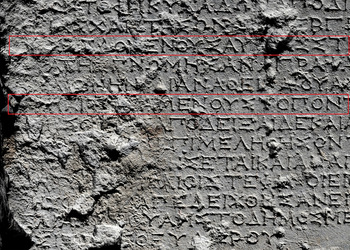
Line 19: [τοὺ]ς̣ δ̣εδομ̣ένους: most of the final sigma of τοὺς̣ is visible; the traces that appear in the third letter space are probably later damage; as for δ̣εδομ̣ένους, we can make out the base of the delta and a mutilated mu. See Fig. 2.
Detail of the lower-left side of the stone. Enhanced image using polynomial texture mapping. The very worn lines 19 and 22 are boxed.

Lines 22–3: τὸγ κυ|[ρω]θ̣η̣σό[μενον]: Crowther, pers. comm., points out some difficulties: ‘there should be room for two letters after ΚY at the end of 22, so a syllabic division at this point would be odd; and there only seems to be space for 3–4 letters between omicron in line 23 and the alpha of ἀποδεῖξαι … could ΗΣ in 23 belong to τῆς?’. See Fig. 2.
Line 25: there are traces in the position of the third letter, which could be those of the stem of a tau.
Line 26: there appears to be an eta directly beneath the previous line's traces of tau, followed by what looks like a gamma with the top bar angled downwards slightly.
TEXTUAL OBSERVATIONS
Lines 1–2: an alternative would be to insert punctuation between [κ]οινοῦ and γράψαι. This would constitute a heading, as γνώμη τοῦ κοινοῦ τῶν περὶ τὸν Διόνυ[σον τεχ]νιτῶν [τῶ]ν ἐν Ἰωνίαι [κ]α[ὶ] Ἑλλησπόντωι καὶ τῶν περὶ τὸν καθηγημόνα Δι[όνυ]σον· ἐπειδὴ … (I. Iasos 152 lines 1–2). In our punctuation of the text, the ‘heading’ extends to the middle of line 6.
Line 2: γράψαι καθότι: this appears to be epigraphically unparalleled. However, ἀναγράψαι καθότι is a well-attested formula in late fourth-century Samian inscriptions (e.g. IG XII 6 1 24 line 29).
Lines 10–11: κα̣λῶς καὶ φιλοτίμως ἐπεμελ[ή|θη]σαν τοῦ κοινοῦ. The closest parallel is IG II2 1203 (deme of Athmone) lines 1–6: ἐπειδὴ οἱ μεράρχαι οἱ ἐπ’ Ἀντικλείους ἄρχοντος καλῶς καὶ φιλοτίμως τῶν θυσιῶν ἐπεμελήθησαν καὶ τῶν κοινῶν, δεδόχθαι τοῖς δημόταις.
Lines 14–18: The punctuation of these lines was proposed to us by Peter Thonemann, and we gratefully accept his suggestions.
Line 18: ὧν ἂ̣[ν εὐ]εργετηθῆ[ι]: A sense paralleled at Isocrates 6.73: οἱ μὲν χάριν ἀποδιδόντες ὧν εὖ πεπόνθασιν (‘those giving back gratitude for those things in which they have been well treated’). We understand that a similar phrase appears in an unpublished Athenian decree of the second century bc now at the Library of Hadrian in Athens: we would like to thank Nikolaos Papazarkadas for drawing this to our attention.
Lines 21–2: οὗ ἂν αὐτ̣[οῖς? | δοκῇ]: cf. IG II3 1290 line 13.
Line 22: α̣ἰ̣τ̣[η]σ̣α̣μένους τόπον: cf. IG XII 4 1055 (Delos, 230–220) lines 25–8: ἀναγράψαι δὲ τὸ ψήφισμα [ε]ἰς στήλην λιθίνην καὶ ἀναθεῖναι παρά τε ἡμῖν εἰς τὸ ἱερὸν | [τ]οῦ Διονύσου καὶ ἐν Δήλωι εἰς τὸ ἱερὸν τοῦ Ἀπόλ[λ]ωνος, τόπον αἰτησαμένους τὸ κοινὸν Δηλίων; McCabe, Teos 34 lines 2–6 (Teos, second century bc): [ἀναγραφῆναι] δὲ καὶ τὸ ψήφισμα τὸ κεκυρωμένον αὐτῶι τῶν τειμῶν· ἀποδειχθῆναι δὲ καὶ ἄνδρας τοὺς αἰτησομένους παρὰ τοῦ δήμου τὸν τόπον.
We now prefer this to [ἐκλεξ]α̣μένους τόπον. Cf. I. ScM III 7 (of 253 bc) lines 29–33: ἀποστεῖλαι δὲ τοὺς στρατα[γοὺς τὸ ἀ]ντίγραφον τοῖς Ἀπολλωνιατᾶν ἄ[ρχουσι] κ̣αὶ παρ<α>καλέσαι αὐτοὺς τὸν ἔπαιν̣[ον ἀναθέ]μεν εἰς τὸ τοῦ Ἀπόλλωνος ἱερὸ[ν τὸν τό]πον ἐπιτάδειον ἐκλεξαμένου̣[ς.
Lines 22–3: τόπον τὸγ κυ|[ρω]θ̣η̣σό[μενον]. We gratefully acknowledge that this was proposed to us by Nikolaos Papazarkadas. Cf. also τὸν γνωσθησόμενον τόπον ὑπὸ τοῦ δήμου· (I. Erythrai 114 line 30, a decree of Erythrai).
Lines 24–6: ὅπω[ς | ἡ σ]τ̣[ήλη ἀνατεθ]ήσεται καὶ ἀναγραφήσε|[ται] ἡ̣ γ̣[νώμ]η: this is the suggestion of Riet van Bremen, which we appreciatively accept. It is preferable to our original suggestion of ἀνατεθ]ήσεται καὶ ἀναγραφήσε|[ται εἰς στήλην] (cf., however, I. Erythrai 35 lines 10–11: ὅπως δὲ καὶ τόδε τὸ ψήφισμα καὶ ὁ στέφανος ἀναγραφήσεται εἰς στήλην καὶ ἀνατεθήσεται ἐν Δελφοῖς ἐν τῶι ἱερῶι). Indeed, the statement in our text that the crowns are to be written up with the gnome (lines 19–20) supports van Bremen's suggestion. Parallels, however, for a gnome being written up on stone are few and far between; see, however, IG XII 5 715 lines 7–9: τὸν δὲ γραμματέα τῶμ πρυτάνεων ἐπιμεληθῆναι, ὅπως [ἡ γνώμη] ἥδε ἀναγραφεῖ εἰς τὸ ἱερὸν τοῦ Ἀπόλλωνος, τὸ δ’ ἀνάλωμα τὸ γενόμε[νον εἰς τὴ]ν ἀναγραφὴν δοῦναι τοὺς ταμίας ἀπὸ τῆς κοινῆς διοικήσεως (for fuller discussion of this matter, see below).
Lines 26–7: ἐγκολα|[φ]θήσο[νται]: this restoration appears to be supported by the existence of a comparable instruction in another Erythraean inscription. I. Erythrai 114 lines 27–8 refers to the act of writing up this decree and the crown on the stele ([το]ὺς [δ]ὲ ἀποδειχθέντας τό τε ψήφισμα τόδε καὶ τὸν στέφανον ἐ[κ]ολάψαντας εἰς στήλην): in that case the verb ἐγκολάπτω refers to the carving of both the decree and the crowns on the stone stele; in ours it refers to the engraving of the crowns alone.
TRANSLATION
‘Ep[igonos]
son of Mel[iandros].
Aristodemos
son of Menekrates.
Posittas
son of Theudoros.
Proposal of those appointed by the koinon – Simos son of Prot[o]genes, Amymon son of Apollonodotos – to draft how those appointed oinonai during the hieropoios-ship of Theupompos will be honoured. Since those appointed second oinonai by the koinon – E[pig]onos son of Meliandros, Arist[od]emos son of Menekrates, Posittas son of Theu[d]oros – took care of/managed/had charge of the koinon well and with philotimia, be it resolved by the Phrikyladai to crown each of them with a crown of foliage for the sake of their virtue and philotimia towards the koinon. So that also if ever anyone else wants to act with philotimia, they might see that the koinon of the Phrikyladai knows how to pay back due gratitude for those things from which it might be benefited, those requesting a place that will have been approved are to write up the crowns given to them [with] the proposal on a stone stele and to set it up wherever [they like]. Appoint also [three men who] will ensure that [the stele] is set up and [the proposal] written up and that the crowns will be engraved; Epigo[n]os son of [Me]lia[ndr]os, Aristodemos son of Menekrat[es], [Po]sitt[as] son of Theudoros were appointed.’
AN OVERVIEW OF THE TEXT
The text announces itself as a gnome ton apodeichthenton; its first six lines consist of a heading which states what this gnome is for. As John Ma points out to us, the natural way of translating gnome would be as ‘proposal’ or ‘motion’: indeed, this is the sense suggested at Aeschines 3.3, where a gnome is to be put to the vote at the assembly, in other Attic decrees (a gnome, when ratified, becomes a psephisma in IG II3 348 lines 21–30), and also in Erythraean inscriptions which mention gnomai of the exetastai (auditors: I. Erythrai 21 line 3; 35 line 2)Footnote 5 but refer to the enactments as psephismata in their publication formulae (I. Erythrai 21 line 18; 35 line 10). However, our document – perhaps uniquely – at line 20 and probably also line 26 contains arrangements for the gnome to be written up on stone, and this suggests that there is no prospect of further enactment or ratification.Footnote 6 Our document's use of the term gnome is, therefore, unorthodox, although the use of it to refer to a ‘decree’ is paralleled on two occasions in decrees from Lampsakos and Alexandria Troias.Footnote 7 We shall return to the question of the status of this gnome below, while noting here that this oddity of phrasing or terminology is far from exceptional in this text.
We return to the prescript in order to introduce the apodeichthentes and the hieropoios. Gnomai of archontes are known from Aphrodisias (MAMA 8.408 line 1) and Iasos (I. Iasos 24.4 and 27.3), but this gnome of the apodeichthentes is unparalleled. These apodeichthentes of lines 1–2 appear to have been chosen by the koinon ‘to draft’Footnote 8 (γράψαι is perhaps to be distinguished from ἀναγράψαι of lines 20 and 25–6) the gnome ‘how those appointed oinonai in the hieropoios-ship of Theupompos will be honoured’. Apodeichthentes was a term used to refer to individuals ‘appointed’ as magistrates or officials; it is well known from Asia Minor and the other parts of the Greek world. The term is attested in third-century Erythrae to refer to those appointed to take responsibility for engraving crowns and setting up a stele (I. Erythrai 114 lines 27–9; SEG XXXVII 934 [= EA 9 (1987), 139 no. 5] lines 5–6; cf. I. Erythrai 115 line 4). They may be contrasted, as they are in decrees of Miletos, with the hairethentes – ‘elected’ – magistrates.Footnote 9 It is worth noting at this point that there appear to be three sets of apodeichthentes in our decree (though two of them consist of the same people): those two appointed by the koinon to draft the decree (lines 2–6); those three appointed as oinonai (lines 6–10); and, finally, the same three who were appointed to set up the decree (lines 27–9).
In lines 3–4, ἐφ' ἱεροποιοῦ Θευπόμπου suggests that the hieropoios is the eponymous magistrate for the year or period of time during which the oinonai held office. Hieropoioi, usefully defined by Davies as ‘secular officials concerned with cult affairs’,Footnote 10 were the eponymous officials in inscriptions from Erythrai.Footnote 11 Even if the institution resembles that of a city-state, however, we cannot rule out the possibility that these hieropoioi may be those of the koinon: they are well known as officers of associations (Poland Reference Poland1909, 390–1). The next two names, of Simos and Amymon, appear with their patronymics preceded by a definite article. The best sense we have been able to make of their names appearing in the genitive is that they are in apposition with τῶν ἀποδειχθέντων of line 1:Footnote 12 Simos and Amymon, therefore, were chosen by the koinon to draft the decree.
The body of the decree (from line 6 onwards) is fairly well preserved, apart from a section on the left-hand side of lines 22 to 26, where we have struggled to make complete sense of the remaining text. Nonetheless, in broad terms, it appears that the decree follows the normal conventions of the honorific genre. Lines 6–11 set out the motivation for the enactment; the motion formulae at 11–14 make it clear that this is an honorific gnome of a koinon called the Phrikyladai to crown each of the oinonai. The statement of intention of lines 14–18 in particular could be widely paralleled in other honorific decrees (Larfeld Reference Larfeld1907, 504–8): the honorands have performed their task well and with philotimia; they are honoured so that all will know that the koinon knows how to repay with gratitude. The text closes with arrangements for publication (lines 20–9), in which the honorands themselves are given the task of setting up the decree.
For the rest of this article we focus upon four areas which seem to us particularly important (and problematic): we will start with names (where we think we can offer some answers), and move on to three areas where there are still uncertainties: the nature of this koinon, the role of the oinonai, and the way (and place) in which this decree is published.
PROSOPOGRAPHY AND ONOMASTICS
Six individuals are named in our text: the three honorands, and three magistrates. Five of the six have patronymics (expressed with the article in the case of the drafters of the decree, without in the case of the honorands). The exception, as already noted, is the eponymous official, the hieropoios Theupompos (line 4), the omission of whose patronymic is consistent with practice elsewhere: in Athens, for example, the patronymic of the eponymous archon is regularly not given – perhaps (as Mogens Hansen has suggested to us) on the grounds that this person would be sufficiently well known so as not to need further identification.Footnote 13
The honorands are, as far as we can tell, otherwise unknown, although (with one exception) their names are relatively common, especially (though not exclusively) in Asia Minor. The names of the first group of magistrates, however, give us a much bigger clue about the origins and date of this text. Theupompos, the hieropoios, cannot be identified with any known individual, but Simos (son of Protogenes) (lines 4–5) and Amymon (son of Apollonodotos) (lines 5–6) are much more useful. A certain Apollonodotos the son of Amymon, perhaps the father or son of our man, is known from I. Erythrai 76, in which he is one of two men appointed (ἀπεδείχθη) to obtain a stele and write up an honorific decree on it (lines 9–10). But more valuable is the fact that both Simos and Amymon are attested as magistrates on the coins of Erythrae (that is, they are named as the officials responsible for minting the coin).Footnote 14 The chronology of this coinage has been exhaustively studied by Kinns, who believes that the coins of Simos and Amymon should be placed in the period 250–240; more significantly, for our purposes, he suggests (on the basis of die-link studies, and on stylistic grounds) that these two performed this role either concurrently or in very close succession (Kinns Reference Kinns1980, vol. 1, 127; vol. 2, 454). This seems too striking a repetition to be random: the Simos and Amymon of the coins must, we think, be the same men as the Simos and Amymon of our inscription. We cannot safely go as far as to suggest that they occupied the same magistracy when they were appointed by the koinon to draft the gnome as they did when they were responsible for Erythraean coinage.Footnote 15 In other words, this coincidence of names does not, we think, necessarily prove anything about the formal relationship between this koinon and the polis, although it does point to a possible overlap in personnel – or perhaps rather in participation – between state and non-state administration. What it does seem safe to conclude, though, is that we can use this numismatic evidence to locate these two men, and therefore our inscription, relatively securely in time and place: it is, we suggest, an Erythraean text, of the middle years of the third century.
Of course, we have already pointed to some formal and stylistic features which are familiar from Erythraean epigraphic practice, but this prosopographical evidence seems to us to settle the questions both of the text's provenance and of its date. The other names in this text, while not definitively Erythraean, are entirely consistent with this theory. The three honorands are not known from anywhere else, although we are tempted to suspect a connection between the second honorand – Aristodemos son of Menekrates – and a Menekrates son of Aristodemos who appears in I. Erythrai 22 line 119, as a donor to the building of city walls in the late fourth century bc. Our Aristodemos could therefore – just about – be the son of the wall builder.
Our knowledge of Hellenistic Erythraean prosopography is, of course, very far from complete (although not negligible either, not least because of the contribution of the numismatic evidence). Any argument about the possible status of the men mentioned in this text, or about their degree of involvement in other aspects of Erythraean public life, must therefore necessarily be rather tentative. Nevertheless, it is probably worth emphasising the point already noted, that the two men appointed to draft this document seem to be political insiders in the Erythraean polis. The office of coin magistrate will probably not have been among the most senior in the city, but it does imply a level of influence, and also – it seems likely – of personal wealth: this is, for example, very visible in the records of the coin magistrates of the fourth-century Boeotian League (which include Epameinondas), and in Hellenistic Eretria.Footnote 16 The honorands, by contrast, are not visible (at least, not to us) in other Erythraean contexts – although if we are correct in seeing a possible connection between our Aristodemos and the Menekrates of the wall-building decree (I. Erythrai 22), this would again suggest that we are dealing (at least in this case) with a member of a family with a track record of euergetic involvement in the life of the polis.
In terms of onomastics, all of the other names on this inscription are attested (in Asia Minor, and elsewhere in Greece), with one exception: Meliandros (the father of the honorand Epigonos) is previously unattested in the Greek world (though the name does – mysteriously – appear in a seventeenth-century work of neo-Latin literature, the Argenis of John Barclay, who explicitly acknowledged that he had used ‘imaginary names, to signify several vices and virtues’!) (Barclay Reference Barclay1623; see Latham Reference Latham2009, 23). The name is clear enough in line 8 of our text (and is securely restored in the first wreath and again in line 28) to offer us a new Greek name.Footnote 17
THE PHRIKYLADAI
There is one more name which we have not yet discussed: who are the Phrikyladai? The production of an inscribed, honorific, decision leads us to envisage an organised group with a structure. However, the inscription gives little away about either the organisation or the purpose of this koinon: there are hoi apodeichthentes, oinonai, and an eponymous hieropoios (though this last may be that of the city), but to say anything more about the scale or nature of this society we are forced to hypothesise.
The associations of the Greek world bore an astonishing range of designations: they were theophoric, occupational, ethnic, or derived from the name of the founder.Footnote 18 The name of our group is tantalisingly obscure. The word ‘Phrikyladai’ is (according to TLG and PHI) unattested anywhere else in extant Greek. It has been suggested to us that a basic segmentation might consist of the root of Φρικ-,Footnote 19 followed by the diminutive -υλ-,Footnote 20 and -αδαι ending to indicate descendants. Yet the name does not appear to have any immediate meaning, and there is probably nothing in the association with the words φρίκη (shiver) or ὕλη (timber); any real or perceived connection of our group with the Aeolian city Larisa Φρικωνίς (Rubinstein Reference Rubinstein, Hansen and Nielsen2004, no. 818), associated with settlers from Mount Phrikion in Lokris, is hard to substantiate.Footnote 21
Another possibility, therefore, is that they are a group whose name is formed on the basis of a real or mythical ktistes: the obvious Attic parallel is the Philaidai, who seem to have made claims about their ancestor Φίλαιος (Herodotus 6.35; Pausanias 1.35.2; Plutarch, Solon, 10).Footnote 22 However, no Phrikylos is known in any mythical account; indeed, as a name it is attested, according to LGPN, only on a Hellenistic roof-tile from Illyria (Ceka Reference Ceka1982, 104 no. 4).
An alternative, then, is that the Phrikyladai got their name from a mortal – perhaps even a living mortal – named Phrikylos. Indeed, as Ilias Arnaoutoglou reminds us, ‘in Rhodes there is a profusion of personal names turned into adjectives to qualify associations’.Footnote 23 A koinon of Euthalidai, for example, is known on an inscription from Rhodes.Footnote 24 Vincent Gabrielsen, who has studied this phenomenon as it appears in Rhodes, sees it as related to the power of the local aristocracy: ‘the aristocratic habit of founding koina can hardly have been unconnected to the customary endeavours of that class, via activation of the mechanisms of patronage, to exploit the human potential which they controlled (foreign as well as native) as an asset in their execution of public responsibilities … the koina stood ready to meet the local aristocracy's insatiable demand for honorific rewards’.Footnote 25 But our understanding of Erythraean society in the third century bc is too limited to allow us to confidently propose such a view of the Phrikyladai.
Closer to the provenance of our decree, koina of the symmoriai (a public subdivision) of Teos appear to take on the patronymic of their founders. One such group was the symmory of Echinos or the Echinadai. Two of their decrees (CIG 3065 [= McCabe, Teos 32] and 3066 [= McCabe, Teos 33]) appear to honour prostatai, who were probably annually appointed officials of their koinon. They were praised, with foliage crowns and announcement, for their expenditure on the sacrifices and hospitality; they were singled out for not drawing on the expenses of the group, and also funded their own honours (CIG 3065 lines 33–5; CIG 3066 lines 30–5).Footnote 26 We do not know, however, whether their eponym Echinos was mythical or mortal, and it is hard to say anything about the social background of the group. But, nevertheless, the Echinadai constitute a group in close geographical proximity to the Phrikyladai, who appear to have possessed similar resources and priorities to them.
There is some evidence of associations at Erythrae. Jones has identified three entities which he identifies as forms of sub-polis group: the phylai, the chiliastyes, and the gene (Jones Reference Jones1987, 303–6); none of the groups ever describes itself as a koinon.Footnote 27 The phylai, though we know next to nothing about their functions, have been identified as territorial groups; the Hellenistic evidence suggests that the chiliastyes and gene were their subdivisions (Jones Reference Jones1987, 304). It is not quite clear how this fits with the late fifth- or early fourth-century inscribed decree of a group known as the Peproioi, which appears to regulate eligibility to the office of the overseers of the marshlands (I. Erythrai 17). Another epigraphically attested association, that of ‘the men who pilot the ferry to Erythrae’, who honoured magistrates charged with the protection of foreigners at some point during the period of Augustus (I. Erythrai 74, from Chios), is equally obscure.
Overall, then, the evidence does not support the existence of comparable associations at Erythrae. But our knowledge of Erythraean politics and civic life in the middle of the third century is very far from complete (Kinns Reference Kinns1980, 113), and it is not perhaps impossible that this additional variety of sub-polis organisation was present, but simply – until now – unattested.
Retreating to less speculative territory, we can safely say at least this: the existence of this inscribed gnome demonstrates that the Phrikyladai formed a koinon, a group of people who presumably come together for some purpose.Footnote 28 As this is the sole testimony for the group, we can make only three assertions about their activity: it involves the acquisition and/or consumption of wine (on which more presently), they have proposed an honorific gnome, and they are making arrangements for it to be written up on a stone stele.
THE OINONAI
As Arnaoutoglou points out, collective identities were fostered among ancient Greek associations through shared religious rituals including sacrifice, dedication and prayer, but also through activities such as feasting, celebrating, and convening (Arnaoutoglou Reference Arnaoutoglou, Nijf and Alston2011, 43; Nijf Reference Nijf1997, 109). We must not, however, forget the importance of liquid consumption. It goes without saying that drinking of wine, its use in libations, its offering as first fruits, and its acquisition were an important aspect of the social and cult activity of ancient Greek communities.Footnote 29 The role of wine in Erythrae is illustrated not only in Athenaios’ reference to Erythraean wine as soft and odourless (Deipnosophistai, 32b) and the application of the epithet pherestaphylos to the city (Deipnosophistai, 112b), but also, far more vividly, on a decree which may well derive from Erythrae, the inscribed regulations for those buying the priesthood of the Kyrbantes, which state that the purchasers are to have the responsibility of mixing wine; their rituals appear to have centred on bathing, drinking and eating.Footnote 30
Who were the honorands, the ‘appointed oinonai’? They surely have something to do with the wine supply, but their precise role is less than clear. LSJ, s.v. οἰνώνης, offers a useful starting point, suggesting ‘wine-merchants’, and referring to Photius’ definition of the term as ‘one who buys up some sort of wine’ (οἰνώνης· οἷον οἶνον συνωνούμενος). But they are probably something other than wine sellers, a Greek term for which, οἰνοπῶλαι, is known from a dedication of Italian vinarii from first-century Delos (ID 1711). Οἰνοπῶλης is, in fact, significantly the more common term for wine seller or merchant, whereas οἰνώνης is barely attested: we can find no other epigraphic attestations of the word, and it appears only very rarely in literary sources with this meaning.Footnote 31 Our suspicion, therefore, is that the term is being used here in some more specific or technical sense; our uncertainty, however, lies in knowing exactly what it denotes in this context.
One answer may lie in the suffix –ωνης. Telonai (tax farmers) and sitonai (grain commissioners) are well attested in Athens and elsewhere in the Greek world; one view, recently expressed by Engen, in his discussion of sitonai, is that they were public officials who held the responsibility to obtain grain for public distribution:Footnote 32 they were purchasers or dealers. Boonai are known from Athens, where they seem to be magistrates responsible for acquiring oxen for sacrifices, probably using public funds (LSJ, s.v. βοώνης).Footnote 33 In the Athenian decree on the little Panathenaia from the 330s they appear alongside the hieropoioi with the responsibility of providing cattle for the sacrifice to Athena (IG II3 447.43–4). In fact, Kretschmer's Rückläufiges Wörterbuch lists some 31 words with the –ωνης suffix (Kretschmer Reference Kretschmer and Locke1944, 265). Some of them are compound words attested only in comedic contexts: the opsones of Aristophanes’ lost Frying-Pan Men (LSJ, s.v. ὀψώνης suggests ‘caterer’: Aristophanes apud Athenaios, Deipnosophistai 171a–b), is blamed for delaying the arrival of dinner; generally, however, these terms refer to purchasers or providers of particular items, such as the elaionai (LSJ, s.v. ἐλαιώνης), who are purchasers of olive oil for the state (SEG XV 108; IG II2 1100). One interpretation, then, is that our oinonai are simply those who provide or purchase wine on behalf of the koinon. It is perhaps attractive to consider the possibility that our honorands are a triumvirate contracted out to acquire, and to distribute promptly, wine for this (perhaps their) koinon. Epigraphical evidence suggests that some associations were reliant on contributions of participants for their supplies: members of the Iobacchoi of Attica were obliged to contribute to monthly dues for wine.Footnote 34 Other organisations may have contracted individuals to provide a secure supply of provisions: the statutes of a club from the second century ad, deriving from central Attica (SEG XXXI 122 = Lupu Reference Lupu2005, no. 5) tell us of the fine inflicted on those contracted to obtain (οἱ ἐργολαβήσαντες) wine and pork if they failed to hand them over.
Why are they ‘second-appointed’ oinonai (οἰνῶναι δεύτεροι: line 7)? Does this mean that they are appointed for a second time? Does it indicate that they were the second-ever appointed cohort of oinonai? Or is it the case that they are a second set of oinonai appointed within one year? We cannot find an exact parallel for this expression,Footnote 35 but there is, in other Erythraean decrees, evidence for the division of years among different office holders. I.Erythrai 29 talks about strategoi who held office ‘for the second four-month period of the year when Apollodoros was hieropoios’ (lines 15–17; cf. I. Erythrai 112 lines 12–14 and I. Erythrai 104, 119).Footnote 36 If this is the right way to interpret this term, it perhaps points to the role of oinones being a particularly important (or exhausting – financially or otherwise) office, which had to be rotated round the group on a regular basis; and that, in turn, might suggest that the provision of wine was not just a constituent part of the activities of this association, but the central purpose of its existence.
If the provision of wine was so important to this group, does this mean that they might resemble the hell-fire clubs of drinkers or banqueters known from classical Athens, the likes of which Murray (Reference Murray and Murray1990) linked with Thucydides’ reports of the drunken mutilation of statues alleged to have taken place on the eve of the sailing of the Sicilian expedition in 415 bc (Thucydides 6.28.1; Parker Reference Parker1996, 333–6)? That is one possibility, but rather than viewing the Phrikyladai as an introspective group of hedonists, we might speculate that the koinon was a group responsible for the supply of wine for cult activity, such as that undertaken by the Kyrbantes. The idea that a wealthy individual, Phrikylos, on purchasing a priesthood which requires him to supply wine, has hired and fired successive groups of oinonai to acquire enough wine for ritual purposes is appealing but cannot be substantiated.
There are, however, plausible alternatives to this view of the oinonai as providers of wine. One alternative view stems from the fact that there are some –onai designations which appear to refer to those who took on responsibilities other than the straightforward provision of a product, such as contractors or lessees. As Csapo has recently observed, theatronai were those who bought or, more exactly, ‘leased a theatre from the state’, probably in return for the right of collecting admission charges (Csapo Reference Csapo and Wilson2007, 89). The halonai are glossed by LSJ as ‘contractors for salt-works’ (I. Priene 67.115); the nomonai are glossed as those officials who lease public pasture (IG VII 3171.43). A second alternative is that such magistrates are farmers or collectors of taxes: Papazarkadas, in his discussion of attestation of hylonai (known neither to LSJ nor to Kretschmer) in a fourth-century tribal decree from the Athenian agora, suggests that they were individuals (or centrally appointed magistrates) who had bid for and purchased the right to collect taxes, presumably in the form of wood (Papazarkadas Reference Papazarkadas, Papazarkadas and Themos2009, 160).
The levying of taxes on the production of wine is known from the mid-third century in the so-called ‘revenue laws’ of Ptolemy II Philadelphos. These documents constitute royal edicts to transfer the one-sixth apomoira (quota) of produce from vineyards and orchards, which until then was owed to native Egyptian cults, to the cult of Arsinoe (Austin Reference Austin2006, no. 296).Footnote 37 The idea that the oinonai themselves collected tax upon wine producers (perhaps in the form of wine) is quite compatible with their being praised for having taken care of the koinon κα̣λῶς καὶ φιλοτίμως: perhaps they advanced a particularly generous sum in the purchase of the tax collection rights from the Phrikyladai? Or maybe they won popularity or raised profile among members of the koinon and its magistrates as they collected the taxes from the cultivators and producers efficiently or promptly?Footnote 38
We have to acknowledge at this point that (if this interpretation of the term is correct) we do not know whether the Phrikyladai were levying the tax on their own behalf, perhaps on the produce of land which belonged to the koinon,Footnote 39 or, alternatively, whether they had purchased the right, from the state or another group, to collect this tax. The latter interpretation, which posits a view of them as an ad hoc organisation, without landholdings of its own, is attractive, given that this is the sole attestation of the body, and also given the implication that the association lacks property of its own (see below). It would mean that the oinonai are praised for having carried out, well and with philotimia, the raison d’ être of the Phrikyladai.
HONORIFIC AND EPIGRAPHICAL HABITS
Our three honorands have been granted honours for having taken care of, or having had charge of, or perhaps having managed, the koinon κα̣λῶς καὶ φιλοτίμως (line 10): the verb ἐπεμελ[ήθη]σαν could refer to a wide range of administrative or euergetic activities. Acting as oinones, then, whatever we envisage this role to be, may have offered the individual an opportunity to make donations of money (cf. Oliver Reference Oliver2007, 222), or wine, or to perform an office (whether it be acquiring or distributing wine, or collecting tax on it) in a way that would have raised their profile among the community or raised their stock with those at the top of the group's hierarchy.
This inscription, while honouring the oinonai, works to the benefit also of the Phrikyladai: while the honorands receive a crown of foliage (lines 12–13), the inscription will act as a message to anyone else who ‘wants to act with philotimia’ – lines 16 and following – so that ‘they might see that the koinon of the Phrikyladai knows how to pay back due gratitude for those things from which it might be benefited’. This brings us to the important question of heightening the honour and ensuring its durability by writing it up on stone, which is addressed in some of the harder-to-read areas of the stone, in particular, lines 19 and 22–3 (see Fig. 2).
In lines 19–20, the infinitive ἀναγράψαι is subordinate to the δεδ[ό]χθαι Φρικυλάδαις of lines 11–12, and brings us back to the substance of the decree: we think that it means that someone or something (the subject, we suggest, is the α̣ἰ̣τ̣[η]σ̣α̣μένους of line 22) is to write up the crowns granted to the honorands ([τοὺ]ς̣ δ̣εδομ̣ένους αὐτ[οῖ]ς στεφάνου[ς]), with the gnome ([μετ]ὰ τῆς γνώμης), on a stone stele and set it up where (seems?) good to them or where they decide (οὗ ἂν αὐτ̣[οῖς? δοκῇ]).
In the heavily restored lines 22 and 23, we find that the people who write up the decree are also required to request a topos, a location, for the stone: α̣ἰ̣τ̣[η]σ̣α̣μένους τόπον. In general, the presence of a request of topos is fairly unproblematic: it is the regular procedure for the erection of any inscription in public or sacred space, and should perhaps be conceptualised as requesting possession of a specific, if very small, plot of land.Footnote 40 The authority for granting this topos typically rests – logically enough – with the organisation which controlled the relevant bit of space: this might be the polis, but might also (especially in the case of requests to place inscriptions in sacred space) be whichever non-polis organisation controlled that area.Footnote 41
The precise situation in our decree, however, is rather less clear, in two (related) respects: we do not (at this point in the decree) know who is responsible for making the request for a topos; and we do not know the identity of the body from which the topos is going to be requested.
Evidence from other inscriptions provides us with two possible scenarios. The first of these is that the requesters are the honorands themselves, and that the target of the request is the honouring body – the koinon. If this is the case, then what is being set out here is a requirement that the honorands should seek permission from the koinon to set up their decree in a space controlled by that organisation (a sanctuary, perhaps, or some sort of clubhouse). This would be similar to the procedure which seems to be envisaged in, for example, an honorific decree of thiasotai from Athens (IG II2 1263), in which the honorand is permitted to set up his anathema anywhere he chooses within the sanctuary – provided that he asks permission of the thiasotai first.Footnote 42
The alternative scenario is that the request is intended to be directed not at the koinon, but at some external organisation (most likely, the polis), and that the request comes not from the honorands but from the koinon (or its designated agents). This is attested in an example which is (at least geographically) closer to our inscription, and which seems to provide a better parallel for the negotiation which is going on in our text: CIG 6818 (=McCabe, Teos 34), perhaps a decree of a symmoria, includes a publication clause which is relatively similar in formulation to that of our text, stating that appointed men are to make a request for a specific place from the demos of the Teians: ἀποδειχθῆναι δὲ καὶ ἄνδρας τοὺς αἰτησομένους παρὰ τοῦ δήμου τὸν τόπον, καὶ ἐὰν δοθῇ, ἐνχαράξοντας τόν τε στέφανον καὶ τὸ ψήφισμα (lines 5–8). Here, it seems reasonable to assume that this organisation (whatever its nature) does not own its own land – or, if even if it does, wants this inscription to enjoy the higher prestige or visibility which might arise from being located in a piece of civic space; they therefore need to petition the demos of the Teians for the grant of a suitable spot. Interestingly, the drafter of the decree seems to envision the possibility that such a request might not be successful (though this could, admittedly, simply be a gesture of politeness): it is only if the topos is granted that the decree will be carved.Footnote 43
Returning to the gnome of the Phrikyladai, if our restorations in lines 22 and following are correct, then it would seem that the author of our text is rather more confident (or less diplomatic) about the likely success of the request: we have suggested restoring, in lines 22–23, a reference to the τόπον … κυρωθησόμενον; that is, the ‘place that will have been approved’ (as a result of the petition: αἰτησαμένους). We should acknowledge, though, that we are not completely confident of our restoration here (we cannot find a precise parallel for the use of κυρόω in exactly this context; see above, ‘Epigraphical observations’).
We are, however, fairly confident that some sort of request for a topos is being made in these lines. And, particularly since (unlike, for example, in the decree of the Attic thiasotai IG II2 1263: see n. 42) the location of the inscription is left unspecified, we are inclined to infer that this association lacks a spatial centre which would provide a regular place for the setting up of a decree. If this line of reasoning is correct (and again we emphasise that it should be treated with some caution), then two things follow. First, this makes our second possible scenario the more likely one: that is, the request for a topos is being made by the koinon (or by its representatives) to an external body. Second, and more generally, this gives us a further clue about the possible size and structure of this organisation. The fact that it seems not to have a topos of its own might well reflect the size of the organisation which, unlike many in the Greek world, lacks a sanctuary, a clubhouse, or other property upon which it could set up a decree. Again, material from Teos provides informative comparanda: three honorary decrees of the symmory of Echinos, which we have already mentioned, specify in their publication clause that the inscription will be set up beside the altar of the symmory (παρὰ τὸν βωμὸν τῆις συμμορίας: McCabe, Teos 34*5 lines 28–9; cf. McCabe, Teos 32 lines 32–3 and 33 line 32). Our koinon, meanwhile, appears to lack even an altar to call its own.
The absence of clarity in this clause's provisions is also worth noting, and, again, might suggest something about the formal status (or lack of it) of this body. The concern with establishing an appropriate place of publication for a decree is paralleled in Erythrae and the Greek world more widely, but the relative generality and succinctness of our decree's provisions can be contrasted with the elaborate detail about the place of publication of decrees into which the Erythraeans sometimes went: in the decree, probably of the second century, for the judge Kallikrates, they spent some 14 lines explaining the selection of the topos, its location, and appointing officials to oversee the work of setting the inscription up there (I. Erythrai 114; cf. SEG XXXVII 927, 934).Footnote 44 Returning to our, less expansive, decree: unless our restorations have gone quite badly off track, it seems that the target of the koinon's request for a topos was never specified. This perhaps makes it most likely that it was the demos of the Erythraeans which was being approached, since this is the body which is most likely to have controlled the significant spaces – civic or religious – in the city (and therefore, as the obvious recipient of the request, is probably least likely to have needed to be specifically named).Footnote 45
If this is correct, then it might be tempting to speculate about the possible implications of this request for our understanding of the relationship between koinon and polis. Such speculation could take two forms, depending on how we choose to interpret the nature of the act of aitesis. One school of thought (represented particularly by Lalonde's work on inscribed diplomatic texts) emphasises the practical side of this procedure: the act of aitesis was a request for a tangible thing (in this case, the right to set up an inscription on a patch of ground), and a necessary precondition for the creation of an inscribed monument; if it has any wider significance, it is only that it indicates that the petitioner is in an inferior position to the body petitioned (because it does not control the place in which it wishes to set up its monuments). An alternative view, most visible in work on the aitesis formula in numismatic contexts, argues instead that the process of aitesis was more symbolic than practical, and might indeed have been deliberately engaged in by subordinate or marginal groups (or individuals) in order to create or cultivate a relationship with a more powerful body, and in order to harness the authority of that body to legitimise (or just add lustre to) their own activities.Footnote 46 However, this view is controversial even in numismatic circles (c f. Weiss Reference Weiss2000), and it is not clear to us that the purely symbolic argument works so well when we are dealing with an inscription. There is, after all, a basic practical problem underpinning this request: the koinon needs a place to put its monument.
Nonetheless, the process of making the request – and the decision to include the request in the inscribed text – might still reveal something about the way in which this koinon had to negotiate its position with the polis: the request acts as a marker of the koinon's position outside the formal structures of the city, while simultaneously serving to demonstrate the connections between the two bodies. Moreover, if we assume that the request for a topos was granted (a fairly safe assumption, given that the inscription exists), then this monument, standing in some public space in the city, would further reinforce the koinon's implied claim to a place in Erythraean civic life.
Finally, the inscription had to be carved, and set up. This is covered in the closing lines of the text (lines 23–9), about whose content we are much more certain: three men are to be chosen who will take care that the stele is set up, the gnome is written up and the crowns are engraved – as we saw earlier, this practice of selecting men to set up an honorific stele is known to have been used in decrees of the Erythraean demos and boule;Footnote 47 the ἄνδρας [τρεῖς] selected for this task are, it turns out, the honorands. These men, the object of ἀποδεῖξαι in line 23, may be anticipated by the accusative α̣ἰ̣τ̣[η]σ̣α̣μένους of line 22: it is, then, revealed here that the honorands, themselves charged with the creation of the physical version of this gnome, are the ones who were to make the request for the place of publication – although it remains unclear whether they are being asked to do so in their role as honorands, or in their role as appointed (inscribing) officials of the koinon (if, indeed, it would even have occurred to the members of this organisation to make this sort of bureaucratic distinction).
Asking an honorand to cover the costs of setting up their own decree is, of course, fairly common practice (though still liable to be seen as a decision which detracts from the level of honour being awarded).Footnote 48 The appointment of honorands to set up their own monuments has parallels from associations in Salamis and Teos.Footnote 49 The combination of both steps – requiring the honorand not only to fund but also to organise the creation of their monument – is less usual, but is attested in an honorific decree already referred to, that of the symmory of Echinos from Teos (McCabe, Teos 33 [= CIG 3066]).Footnote 50 We are left, then, with a feeling that the tight-fisted koinon of the Phrikyladai are reckoning on the generosity of the oinonai once again (or – a slightly more generous interpretation – that the koinon is such a small organisation that these three oinonai were the only men suitably qualified to set up such a decree).
The final lines of the text bring us back to the problem of whether or not it is right to think of this as a decree. As we noted earlier, the term gnome is usually deployed in reference to a proposal at a stage before it has been ratified as a decree. If our restoration of lines 25 and 26 is correct, the stele is to be set up, the gnome is to be written up and the crowns are to be engraved. But it is interesting that, despite the motion formula standard to a proposal of lines 11–12, δεδ[ό]χθαι Φρικυλάδαις, at no stage is the gnome referred to as a dogma (enactment) or psephisma (thing voted) of the koinon.Footnote 51 Is this, perhaps, because the proposal was never formally ratified by a single body? Is it plausible that the Phrikyladai – of whom we never hear any more in Greek history – lacked a formal assembly or decree-making mechanisms but nevertheless recorded this proposal on stone as if they did possess them?Footnote 52 Indeed, as we are told in lines 1–2, this is a gnome of those appointed by the koinon to draft how the oinonai are to be honoured: there is no indication of deliberative or decision-making institution, but it seems to be the case that the koinon has appointed two men – Simos and Amymon, who may have had prior administrative experience or public profile – to draft an honorific proposal.
It is worth noting here that this is not the only oddity of phrasing or terminology in this text: in line 2, for example, we cannot find epigraphic parallels for the phrase γράψαι καθότι; we have also already noted the unparalleled glossing of the oinonai as deuteroi. These recurring oddities in the phraseology of our text lead us both to think that the Phrikyladai were ready to disregard the normative expectations of documentary language, and also to wonder about their status as an organisation. On the other hand, it is clear that their epigraphic practice is at least to some extent informed by that of the polis in which they were located: their use of the term apodeichthentes, the dating by hieropoios, even, in fact, the style of the honorific crowns engraved at the top of the stele, all find close parallels in inscriptions of the Erythraean polis.
CONCLUSION
We can be relatively certain about some aspects of this inscription: its Erythraean origin, its mid-third-century date, the fact that it is an honorific gnome of a koinon, and that the personnel, organisation, honorific practices and even letter cutters of that koinon demonstrate some considerable overlap with those of the polis of the Erythraeans. The decree demonstrates our association's recognition of a euergetic act carried out by a group of oinonai, and their commemoration of it in a way that will demonstrate their ability to reward such behaviour. This inscription can, we suggest, usefully illustrate (maybe even illuminate) some features of sub-polis organisations in this period, and perhaps especially in this part of the world: we have noted, in the course of our discussion, various similarities with Teian material, which might point to some kind of shared ‘koinon culture’ on the western coast of Asia Minor in this period, a culture which cut across city-state boundaries.Footnote 53
But there is still much uncertainty surrounding our interpretation of this document. In particular, our conclusions are rather insecure in two areas, the first of which is the role of the oinonai. Are they rather marginal officials in this organisation (as the perhaps somewhat cheap way in which the act of honouring them is organised might suggest – would the chief officials of an organisation be told to make arrangements for their own decree?), or should we in fact imagine that the oinonai, and the tasks which they performed, were central to the activities of this koinon? The second (and related) area is the nature of this group – its size, purpose, organisation, and relationship with the polis (particularly in view of the apparent overlap in personnel, and perhaps in magistrates – the eponymous hieropoios – between the two groups). It might be relevant to add that Graf has noted, by reference to a study of the epigraphical evidence for the Kyrbantes of Erythrae, that the city appears to have accepted the coexistence of polis cults and private cults (Graf Reference Graf, Reger, Ryan and Winters2010, 308); with respect to the Phrikyladai, it may well have been the case that the Erythraeans acquiesced in a private organisation making use of polis-style institutions. It is tempting, too, to wonder if this text might reveal something about the state of Erythraean civic life in middle of the third century: we have noted that the history of Erythrae in the 250s and 240s is rather obscure, but we would add here that what can be seen through the fog seems quite interesting: the city seems to drift into a state of de facto independence, visible – for example – in the fact that it seems to be conducting an autonomous foreign policy in this period.Footnote 54 And it is in this period that the Phrikyladai produce this sole attestation of their activity.
The fact that this inscription is the only extant evidence for this group is a source of some frustration: we could – obviously – say more about this koinon if we had more evidence for it, or even if we knew who or what it took its name from. However, the uniqueness of this example might also tell us something about the sort of organisation we are dealing with. Of course, we are inevitably dealing with fragments of fragments of evidence – tips of tips of icebergs – but even so, the impression that this group appears almost out of nowhere is perhaps not completely misleading: the world of koina (and other sub-polis groups) in the Hellenistic period seems generally to be a very productive one – in the sense that it seems to be possible for new groups to spring into life with (apparent) ease (and, it probably follows, for many of those groups to fade away again with equal ease). The world of the koina, that is, is vibrant, but also, perhaps, rather unstable – something which might explain some of the oddities which we have pointed to in the framing and promulgation of this text.
Even – perhaps especially – if short-lived, though, these organisations still have to carve out a space for themselves in the existing frameworks of the city-state,Footnote 55 and here too our text can give some hints about how that process might operate. Particularly important, we suggest, is the overlap in officials between the polis and the koinon: it need not be the case (with the possible exception of the hieropoios) that the two bodies are sharing the same officials, but rather that the same people are active (at a relatively high level) in both contexts, both as office holders,Footnote 56 and performing the wider range of euergetic acts which might be counted part of the obligations of a citizen. More speculatively, we have suggested that there might also be a spatial (and commemorative) aspect to the relationship between the two bodies, played out in the decisions which the koinon makes about the placement of its inscription – and, just as important, the way it chooses to advertise those decisions. Here, we acknowledge that our argument is very tentative (primarily because of the state of the text at the relevant point of the inscription), but this is, we suggest, a phenomenon which is visible in other (similar) contexts, and one which should not be omitted from any attempt to pin down the nature of the interaction between polis and non-polis groups in the Hellenistic (or even Greek) world.
ACKNOWLEDGEMENTS
We owe thanks to Tom Harrison, who, while visiting Manchester, happened to mention that the Liverpool World Museum was willing to arrange student visits to its storerooms, where the bulk of their classical collection is held (much of it – but not the inscription under discussion here – derives from the collection formerly held at Ince Blundell Hall). We owe a great debt of gratitude to Gina Muskett, former Curator of Classical Antiquities at the World Museum, Liverpool, not only for giving us access to unpublished material, but also for her kind cooperation in this project at every stage. Nikolaos Papazarkadas gave us a huge amount of help with reading and restoring the text, and we owe a great deal to his epigraphical expertise and intellectual generosity. We owe thanks also to Daryn Lehoux for travelling with us to Liverpool to put into practice his Reflectance Transformation Imaging / Polynomial Texture Mapping techniques in producing digitally enhanced images of the stone. Versions of this text have been presented at seminars in Oxford, Copenhagen, Manchester and Edinburgh; we should like to thank all those who have contributed their thoughts, in particular Riet van Bremen, Jan-Mathieu Carbon, Christy Constantakopoulou, Thomas Corsten, Charles Crowther, Vincent Gabrielsen, Mogens Hansen, David Langslow, John Ma, Robert Parker, Peter Thonemann, and the staff of the Copenhagen Associations Project.
SUPPLEMENTARY MATERIAL
Supplementary material is available online at http://dx.doi.org/10.1017/S0068245415000076.
 : δραχμῶν· τὸ δὲ ἀνάθημα ἀναθεῖναι ἐν τῶι ἱερῶι οὗ ἂν βούληται αἰτήσας τοὺς θιασώτας (lines 20–7). Cf. also ID 1520.