Introduction
Upper Ordovician (lower Katian) rocks from the upper Bobcaygeon−lower Verulam Formation interval in the Lake Simcoe region of Ontario, Canada are well known for their exceptionally preserved echinoderm fauna and for well-exposed hardgrounds that supported a diverse shallow-marine fauna. Numerous taxa in this fauna are known completely, from the arms/brachials to the attachment structure, which is most unusual and why we refer to this fauna as the Brechin Lagerstätte (Cole et al., Reference Cole, Ausich, Wright and Koniecki2018).
Study of upper Bobcaygeon Formation−lower Verulam Formation echinoderms began with the work of Billings (Reference Billings1856, Reference Billings1857a, Reference Billings1858, Reference Billings1859). Further, several studies have addressed the paleoecology of this remarkable echinoderm occurrence (e.g., Brett and Liddell, Reference Brett and Liddell1978; Brett and Brookfield, Reference Brett and Brookfield1984; Brett and Taylor, Reference Brett and Taylor1999; Brett et al., Reference Brett, Deline and McLaughlin2008). However, the last general systematic evaluation of the entire crinoid fauna was by Springer (Reference Springer1911). Since then, the systematics of a few taxa have been studied (e.g., Guensburg, Reference Guensburg1992), but a comprehensive taxonomic evaluation is much needed. This study is part of a larger reevaluation of crinoids from the Brechin Lagerstätte. This contribution considers only the disparid and hybocrinid crinoids (subclass Pentacrinoidea, infraclass Inadunata) and is preceded by that of Cole et al. (Reference Cole, Ausich, Wright and Koniecki2018), which evaluated the dicyclic camerate crinoids (subclass Camerata) of the Brechin Lagerstätte. Future studies in this series will include a re-evaluation of monocyclic camerate crinoids and all other species belonging to the Pentacrinoidea (e.g., eucladids and flexibles, see Wright et al., Reference Wright, Ausich, Cole, Rhenberg and Peter2017).
Katian crinoid faunas are of particular importance to our understanding of crinoid evolutionary history because they represent upper tiering levels of communities at the culmination of the Great Ordovician Biodiversification Event (GOBE; Webby et al., Reference Webby, Paris, Droser and Percival2004; Ausich and Deline, Reference Ausich and Deline2012; Wright and Toom, Reference Wright and Toom2017). These faunas are from the final stages of the early Paleozoic crinoid evolutionary fauna and are among the last faunas that thrived in shallow epicontinental seas prior to the Late Ordovician extinctions that resulted from global climate change and habitat destruction (e.g., Sheehan, Reference Sheehan2001; Brenchley et al., Reference Brenchley, Carden, Hints, Kaljo, Marshall, Martma, Meidla and Nolvak2003; Peters and Ausich, Reference Peters and Ausich2008).
In this paper, we describe all known disparid and hybocrinid crinoids from the Brechin Lagerstätte, including a new species of disparid belonging to the Anomalocrinidae (order Homocrinida). Our descriptions and taxonomic reassessments include the disparids Anomalocrinus astrictus n. sp.; Cremacrinus guttenbergensis Kolata, Reference Kolata1975; Cremacrinus inaequalis Billings, Reference Billings1859; Daedalocrinus bellevillensis Billings, Reference Billings1883; Eustenocrinus springeri Ulrich, Reference Ulrich1925; Iocrinus trentonensis Walcott, Reference Walcott1883; and Isotomocrinus tenuis Billings, Reference Billings1857b; and the hybocrinids Hybocrinus tumidus Billings, Reference Billings1857a and Hybocystites problematicus Wetherby, Reference Wetherby1880. Warn and Strimple (Reference Warn and Strimple1977) recommended that D. kirki Ulrich, Reference Ulrich1925 is a junior synonym of D. bellevillensis. We follow this recommendation. Hybocrinus pristinus Billings, Reference Billings1858 is designated as a junior synonym of H. tumidus. The recommendation by Springer (Reference Springer1911) and the action by Parsley (Reference Parsley1981), that Hybocystites eldonensis (Parks, Reference Parks1908) is a junior synonym of Hybocystites problematicus, are followed. Although probably assignable to Anomalocrinus Meek and Worthen, Reference Meek and Worthen1865 (see also Guensburg, Reference Guensburg1992), the aberrant crinoid Glaucocrinus falconeri Parks and Alcock, Reference Parks and Alcock1912 is designated a nomen dubium; Iocrinus similis (Billings, Reference Billings1857a) is also designated a nomen dubium.
Geologic setting
Stratigraphic nomenclature for the Ordovician of southern Ontario has changed substantially with time, and today it remains unsettled. Further, outcrop versus subsurface nomenclature is typically different. Herein, we primarily follow the outcrop lithostratigraphic nomenclature of Armstrong (Reference Armstrong2000). The new crinoid specimens considered herein are from the Lake Simcoe region and the Bobcaygeon and Verulam formations, which are part of the middle portion of the Lake Simcoe Group (the Lake Simcoe Group is equivalent to the Trenton and Ottawa groups, see Armstrong, Reference Armstrong2000). The middle and upper Bobcaygeon Formation and the lower Verulam Formation are Late Ordovician (Katian) in age (Brookfield and Brett, Reference Brookfield and Brett1988; Holland and Patzkowsky, Reference Holland and Patzkowsky1996; Sproat et al., Reference Sproat, Jin, Zhan and Rudkin2015).
Older literature reports crinoids from the Kirkfield, Hull, and Cobourg units. The Hull Formation of previous workers is now considered equivalent to the upper Bobcaygeon Formation. Similarly, the Kirkfield Formation of previous workers is now considered equivalent to the middle–upper Bobcaygeon Formation. The Cobourg beds of previous workers is now considered equivalent to the lower member of the Lindsay Formation, which is superjacent to the Verulam Formation. For further discussion of the stratigraphic nomenclature, sedimentology, taphonomy, and history of the study of the Brechin Lagerstätte, see Cole et al. (Reference Cole, Ausich, Wright and Koniecki2018).
Materials and methods
Localities
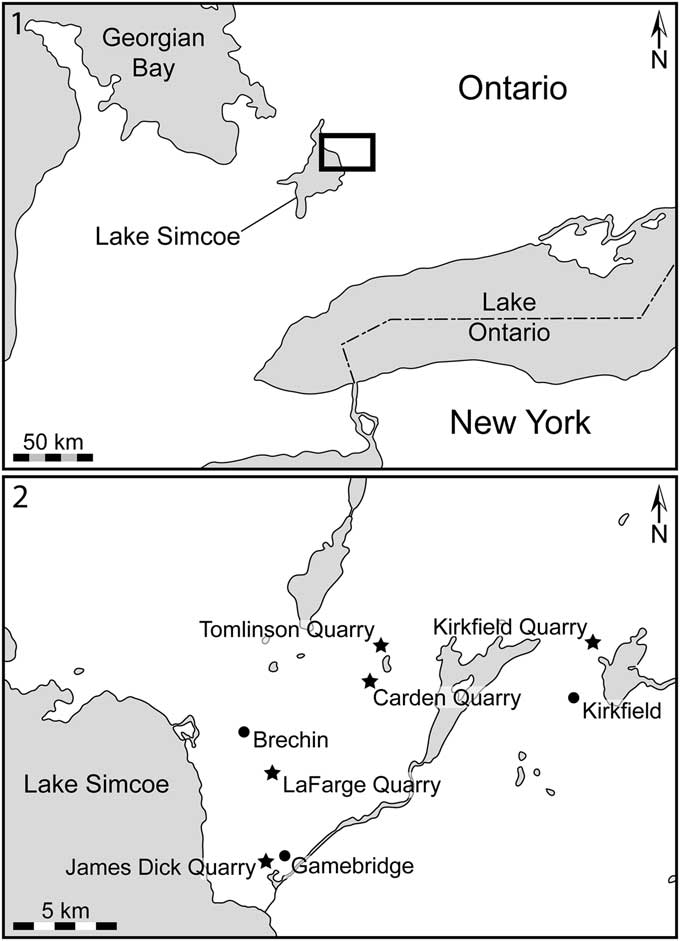
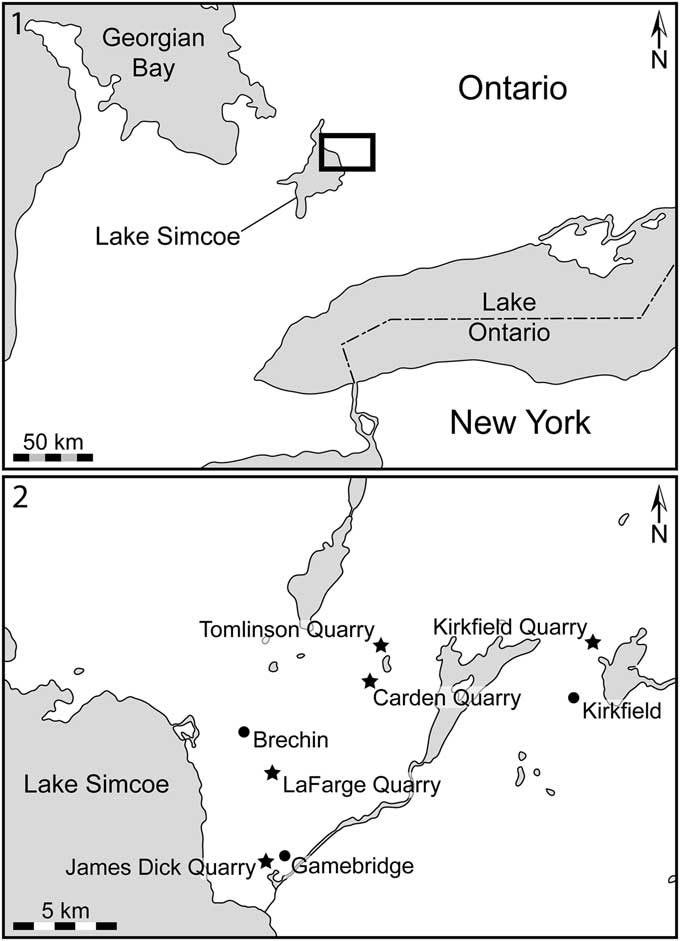
New material reported herein was collected from active quarries. With specimens recovered from blast piles, the upper Bobcaygeon-Verulam Formation boundary interval is commonly the most precise stratigraphic placement possible, because this is the fossiliferous part of the section. More precise stratigraphic data are given where possible. All material is from the vicinity of Brechin, Ontario, Canada. Quarries from which new crinoids from the J.M. Koniecki collection were recovered include the Carden Quarry (44°34'33.5''N, 79°06'09.5''W), located 6 km east of the town of Brechin; the LaFarge Quarry (44°31'55.9''N, 79°09'47.8''W), located 2 km southeast of Brechin; and the Tomlinson Quarry (44°35'45.9''N, 79°05'70.4''W), located 14 km northeast of Brechin. Additional material is from the James Dick Quarry (44°29'93.7''N, 79°09'61.6''W). Material from the Carden and LaFarge quarries was recovered from an unconstrained interval including ~15 m of upper Bobcaygeon and 5 m of lower Verulam (hereafter referred to as the ‘Bobcaygeon-Verulam contact zone’); material from the Tomlinson Quarry is from the upper Bobcaygeon; and material from the James Dick Quarry is from the lower Verulam. Older collections in the Lake Simcoe region are predominately from the upper Bobcaygeon of the classic Kirkfield Quarry (44°35'06.32''N, 78°58'08.16''W), which is now flooded and inaccessible (Fig. 1).
Location map with position of various quarries in the Lake Simcoe region of southern Ontario from which crinoids of the Brechin Lagerstätte are known: (1) southern Ontario with study area in box; (2) relative position of collection sites (stars) within the study area. Modified from Cole et al. (Reference Cole, Ausich, Wright and Koniecki2018).
Repositories and institutional abbreviations
New specimens for this study are deposited in the University of Michigan Museum of Paleontology (UMMP). Depository of other specimens considered here include: BMNH, Burpee Museum of Natural History, Rockford, Illinois, USA; CMC IP, Cincinnati Museum Center Invertebrate Paleontology Collections, Cincinnati, Ohio, USA; GSC, Geological Survey of Canada, Ottawa, Canada; MCZ, Museum of Comparative Zoology, Harvard University, Cambridge, Massachusetts, USA; ROM, Royal Ontario Museum, Toronto, Canada; USNM S, Springer Room, National Museum of Natural History, Washington, DC, USA.
Systematic paleontology
The classification used herein follows the phylogeny-based revision of crinoid higher taxa by Wright et al. (Reference Wright, Ausich, Cole, Rhenberg and Peter2017). Recent phylogenetic analyses find disparids to be sister to the Cladida, with hybocrinids nested within the Cladida and sister to the porocrinids (Ausich et al., Reference Ausich, Kammer, Rhenberg and Wright2015; Wright, Reference Wright2017). At higher taxonomic scales, both disparids and hybocrinids belong to the infraclass Inadunata, which is placed within the newly resurrected subclass Pentacrinoidea (Wright et al., Reference Wright, Ausich, Cole, Rhenberg and Peter2017). Morphological terminology follows Ubaghs (Reference Ubaghs1978) and Ausich et al. (Reference Ausich, Brett, Hess and Simms1999), with modifications from Ausich (Reference Ausich1996, Reference Ausich1998) and Ausich et al. (Reference Ausich, Kammer, Rhenberg and Wright2015). Plate diagrams for the genera treated in this study are given in Supplemental Data. Abbreviations used in designating measurements include: ACH, aboral cup height; ACW, aboral cup width; AH, arm height; ASH, anal sac height; CaH, calyx height; CoH, column height; and CrH, crown height. All measurements are given in mm; an asterisk (*) indicates that a measurement is of a partial or compacted specimen.
Class Crinoidea Miller, Reference Miller1821
Subclass Pentacrinoidea Jaekel, Reference Jaekel1894
Infraclass Inadunata Wachsmuth and Springer, Reference Wachsmuth and Springer1885
Parvclass Disparida Moore and Laudon, Reference Moore and Laudon1943
Order Eustenocrinida Ausich, Reference Ausich1998
Family Eustenocrinidae Ulrich, Reference Ulrich1925
Genus Eustenocrinus Ulrich, Reference Ulrich1925
Type species
Eustenocrinus springeri Ulrich, Reference Ulrich1925, by monotypy.
Occurrence
Ordovician (Katian), Ontario, Canada.
Remarks
In many ways, Eustenocrinus is an iconic Ordovician crinoid. It has an unusual morphology that defines an order-level taxonomic rank with compound radial plates in all five rays, only four functional arms, and the anal sac seated directly on the C radial plate. However, Eustenocrinus is a monospecific genus, and its only species, E. springeri, is relatively poorly documented. Prior to the present study, we were aware of only a single specimen (the holotype) of this taxon. Ulrich (Reference Ulrich1925) illustrated his new taxon with only line drawings: one a plate diagram and the other of a partial crown in lateral view. With the exception of Moore and Lane (Reference Moore and Lane1978a, fig. 347.1c, d), all subsequent authors have illustrated E. springeri with either a reproduction or modification of Ulrich’s original drawings. The exceptions are photographs of two sides of the holotype (USNM S 2148) by Moore and Lane (Reference Moore and Lane1978a).
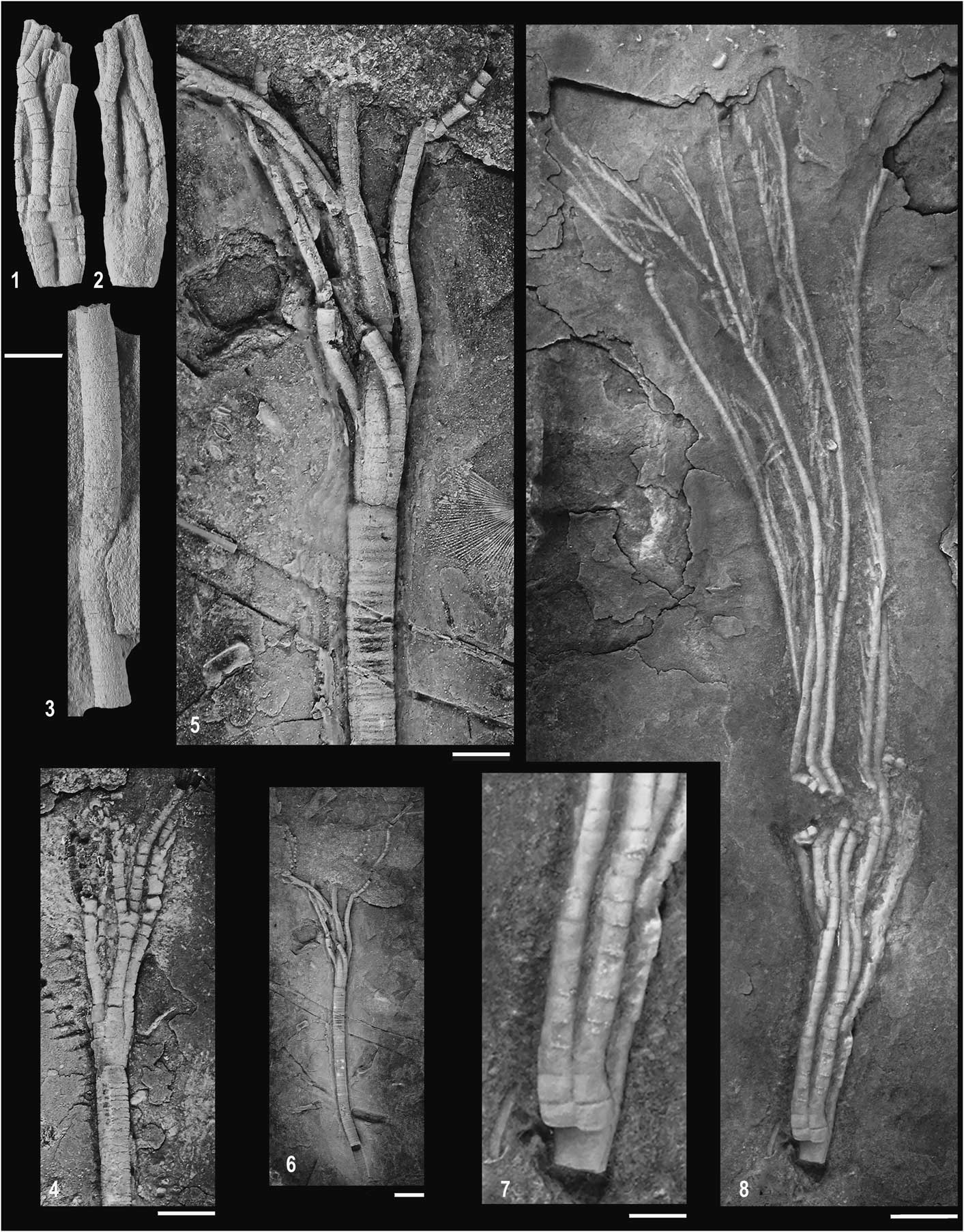
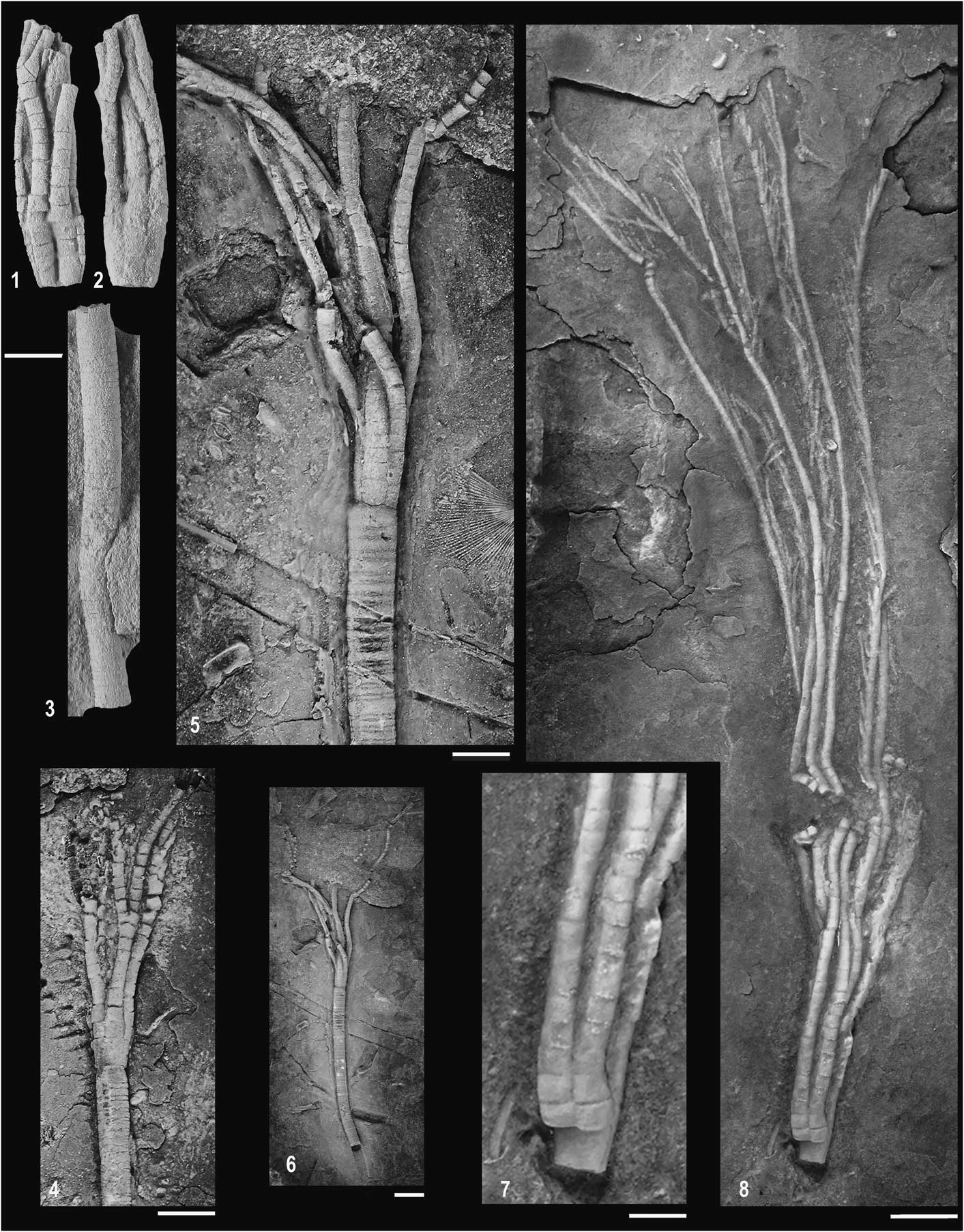
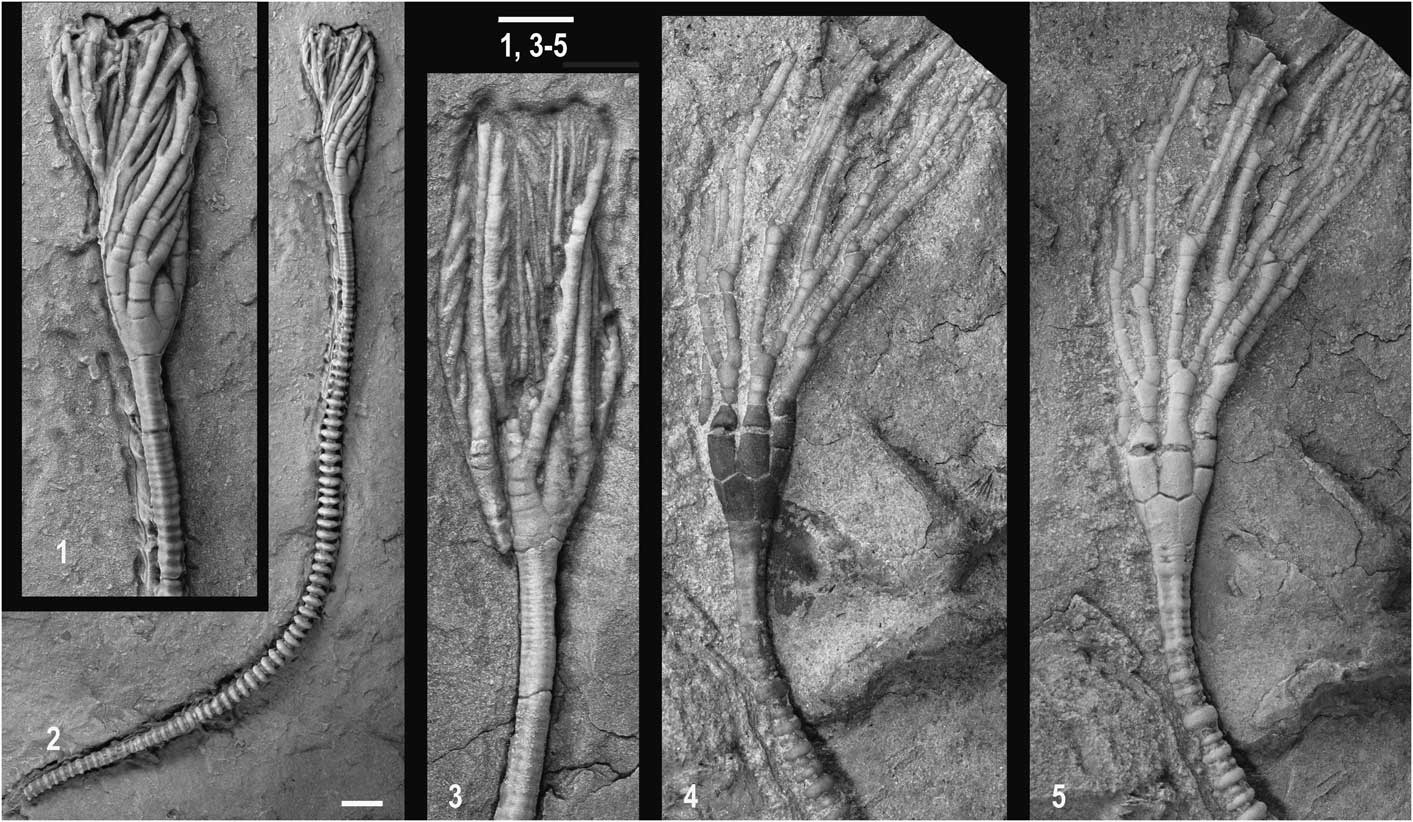
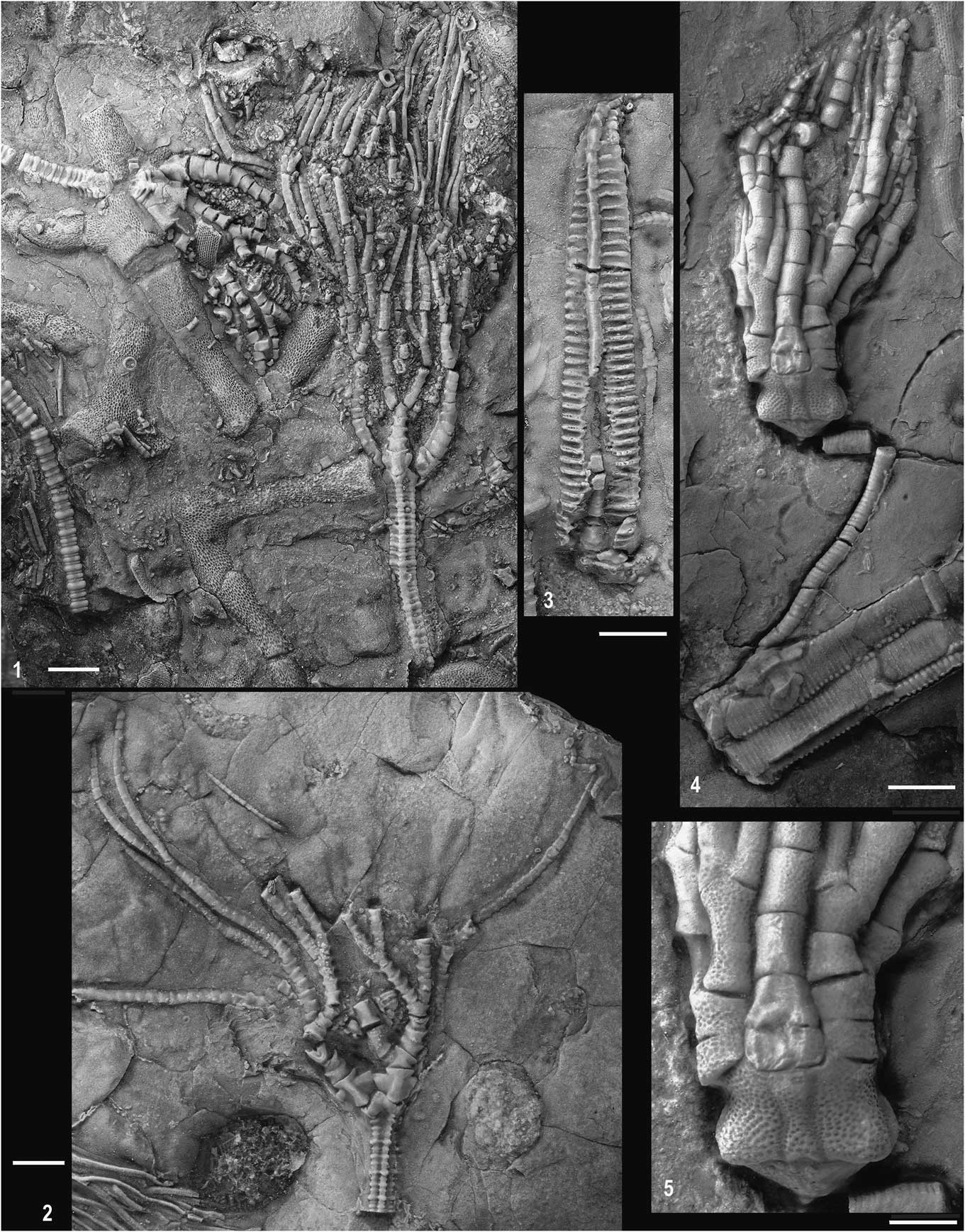
The holotype is a partial crown that has been prepared to be loose from the matrix. The two parts of this specimen include the separated partial aboral cup that includes inferradial plates to the proximal secundibrachials (Fig. 2.1, 2.2). The proximal column is still embedded in the matrix and includes the attached basal circlet (Fig. 2.3). Thus, the three new specimens documented herein from the Brechin fauna add significantly to our understanding of this important Ordovician crinoid. Two specimens (UMMP 74652 and 74653) are partial crowns with some column attached, and the third specimen (UMMP 74654) is a set of complete or nearly complete arms.
Eustenocrinus springeri Ulrich, Reference Ulrich1925: (1–3) holotype, USNM S 2148; (1) AB interray view of partial crown (radial circlet at the bottom to proximal secundibrachials); (2) C ray (note anal sac directly above C superradial plate) view of partial crown (radial circlet at the bottom to proximal secundibrachials); (3) lateral view of partial column with attached basal circlet; (4) UMMP 74653, lateral view of partial crown and column (note indentation at basal circlet-inferradial circlet junction); (5–6) UMMP 74652; (5) enlargement of C ray (note anal sac directly above C superradial plate) lateral view of crown and proximal column; (6) entire preserved specimen; (7–8) nearly complete set of arms assigned to E. springeri, UMMP 74654; (7) enlargement of proximal rays; (8) arms (note long, gracile ramules). Scale bars=2.5 mm (1–3, 5, 7); 5.0 mm (4, 6, 8).
Eustenocrinus springeri Ulrich, Reference Ulrich1925
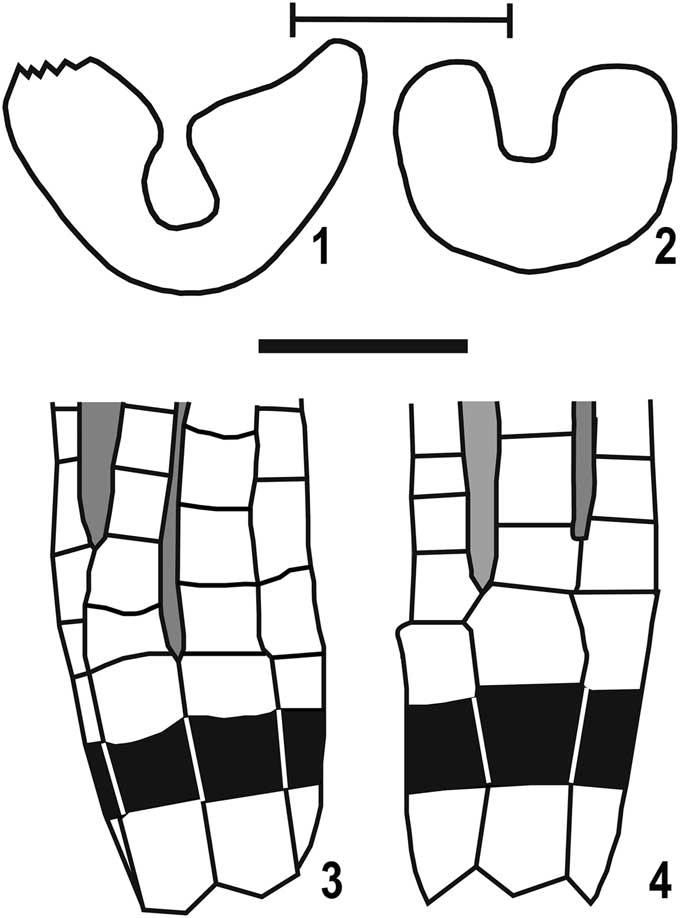
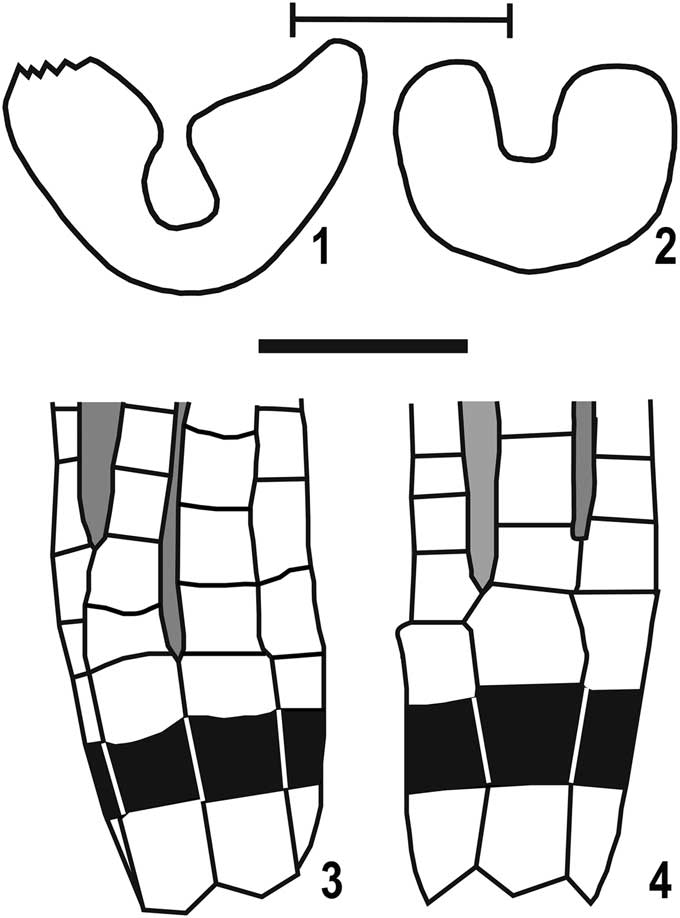
Eustenocrinus springeri Ulrich, Reference Ulrich1925, USNM S 2148, camera lucida drawings: (1, 2) Cross-sectional shapes of ‘appendages’; (1) cross section of a plate from the dominant column of anal sac plates; (2) cross section of brachial on E-ray arm; (3, 4) plate diagrams; (3) AB interray lateral view, compare to Figure 1.1; (4) CD interray lateral view, compare to Figure 1.2. Black filling, superradial plates; horizontal ruling, infraradial plates; gray shading, matrix. Scale bar=1.0 mm.
1925 Eustenocrinus springeri Reference UlrichUlrich in Foerste, p. 99, fig. 14.
1938 Eustenocrinus springeri; Reference BasslerBassler, p. 99.
1943 Eustenocrinus springeri; Reference Bassler and MoodeyBassler and Moodey, p. 474.
1953 Eustenocrinus springeri; Reference UbaghsUbaghs, p. 744, fig. 18a, b.
1964 Eustenocrinus springeri; Reference YakovlevYakovlev, p. 66, fig. 92a.
1973 Eustenocrinus springeri; Reference WebsterWebster, p. 129.
1978 Eustenocrinus springeri; Reference UbaghsUbaghs, p. T122, fig. 93.1, 93.2.
1978a Eustenocrinus springeri; Reference Moore and LaneMoore and Lane, p. T553, fig. 347.1.
1986 Eustenocrinus springeri; Reference WebsterWebster, p. 147.
2013 Eustenocrinus springeri; Reference Webster and WebsterWebster and Webster, p. 1477.
Holotype
USNM S 2148.
Diagnosis
Disparid with compound radials in all five rays; four free arms, one each in A, B, D, and E rays; anal series articulated directly above the C superradial plate.
Occurrence
Eustenocrinus springeri was originally described from the ‘lower Trenton’ at Kirkfield, Ontario, Canada, which is stratigraphically equivalent to the upper Bobcaygeon Formation. New material is from the Bobcaygeon-Verulam contact zone at the Carden Quarry (UMMP 74654) and from an uncertain location but probably the Carden Quarry (UMMP 74652, UMMP 74653) (Ordovician, Katian).
Description
Crown large, cylindrical when in closed, trauma posture (Fig. 2.1). Aboral cup small, subcylindrical, but constricted at basal circlet-inferradial circlet juncture (Fig. 2.5), approximately of same diameter at proximal column (Fig. 2.6); width to height ratio ~1.0–2.0; plates gently convex, sculpture smooth.
Basal circlet ~30% of aboral cup height; basal plates five, pentagonal, slightly wider than high. Radial circlet ~70% of aboral cup height; radial plates five, all compound. Inferradial plates as high as wide; superradials slightly wider than high. Radial facet plenary with first primibrachial sutured into calyx (Fig. 3.3).
Anal X only anal plate in cup, indistinguishable from first primibrachial, sutured immediately above C radial plate, approximately as wide as high (Fig. 3.4). More distal anal plates above anal X similar to brachials.
Arms four, extremely long (Fig. 2.8), branching once isotomously on seventh or eleventh primibrachial (Fig. 2.4, 2.7). First primibrachial completely or partially fixed; nonaxillary primibrachials and more proximal secundibrachials approximately as wide as high, gently convex; more distal brachials can be higher than wide. Ramules typically branching from every third secundibrachial; ramules branching endotomously (as presently known). Ramules very long and narrow; ramulars higher than wide.
Column >40 mm long, circular, heteromorphic (Fig. 2.5), cryptically pentameric. Series of circular, dark calcite structures (infilling of pores) along cryptic pentamere sutures more or less at position of secundinternodals; pore openings of canals penetrating into column. Heights of nodals and internodals irregular; N212 most common columnal arrangement. Lumen pentagonal; details of columnal facets unknown.
Materials
UMMP 74652−74654; USNM S 2148.
Measurements
USMN S 2148: ACH, 2.7; ACW, 2.7; AH, 10.6*; CoH, 18.0*. UMMP 74652: ACH, 3.0; ACW, 2.33; AH, 33.0*; CoH, 36.0*. UMMP 74653: ACH, 3.0*; ACW, 1.5; AH, 10.6*; CoH, 18.0*.
Remarks
With this new material from the Brechin Lagerstätte, this important Ordovician taxon can be more completely characterized, and at least some aspects of its intraspecific variability can be understood. This is especially true for the arms that are extremely high for a crinoid with such a small aboral cup. Also, the unusual morphology of the column can be described. As noted in the description, the column is cryptically pentameric, and aligned with the pentamere sutures is a series of circular structures filled with a dark matrix. One broken portion of the column reveals that this structure is an unbranched canal penetrating from the outside into the column. To fully detail the morphology of these canals, columns would need to be sectioned. However, because of the scarcity of specimens of Eustenocrinus springeri, this was not done.
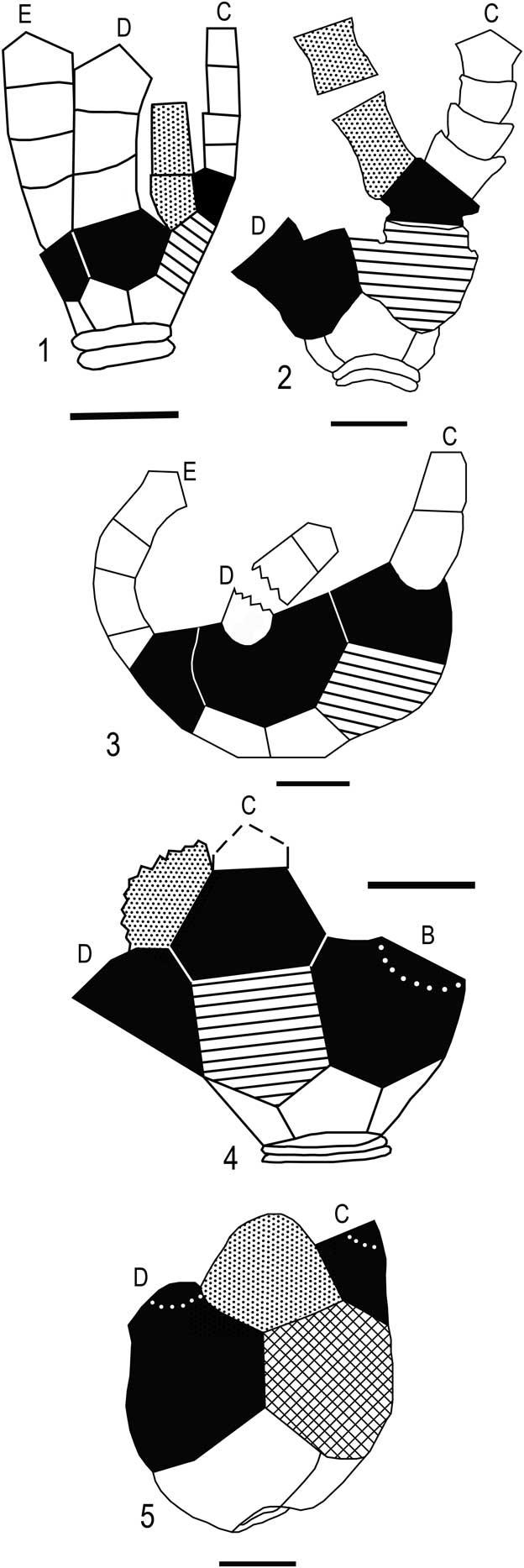
In the traditional (Ulrich, Reference Ulrich1925) interpretation, Eustenocrinus has five compound radial plates, four free arms, and the anal series sutured directly above the C superradial. This represents a unique crinoid morphology, and alternative hypotheses discussed but rejected, herein, include: (1) Eustenocrinus has five arms with a small or absent anal sac; and (2) Eustenocrinus has simple radial plates. The appendage in the C ray is comprised of wider plates than brachials in the arms of other rays, and the cross-sectional shape of these ossicles differs from those of brachials. The groove on the C ray appendage is broader ‘orally’ and narrower and deeper ‘aborally’ than on the brachials of arms (Fig. 3.1, 3.2). Also note that the proximal C-ray plating is interlocked with adjacent rays (Figs. 2.5, 3.4) compared to the plating between rays with arms (Figs. 2.1, 3.3). Thus, it is reasonable to assume that this is a column of plates that supports an anal sac, as originally suggested by Ulrich (Reference Ulrich1925). This feature is also unusual because the proximal anal sac is flush with and enclosed laterally with adjacent arms before being encased distally within the arms (Fig. 2.2).
Eustenocrinus has been traditionally interpreted as having compound radial plates in all five rays, which is now recognized as a diagnostic character for the Eustenocrinidae. In Eustenocrinus, the delineation between the radial circlet and the brachials is not clear. However, in Figure 2.1, the sutures between the inferradials and superradials are well sutured, whereas, the superradial-first primibrachial sutures (as well as many brachial-brachial sutures) are somewhat askew. The material now available is more consistent with this taxon having five compound radial plates rather than five simple radial plates.
Order Homocrinida Ausich, Reference Ausich1998
Family Homocrinidae Kirk, Reference Kirk1914
Genus Daedalocrinus Ulrich, Reference Ulrich1925
Type species
Daedalocrinus kirki Ulrich, Reference Ulrich1925, by monotypy. However, D. kirki is now regarded as a subjective junior synonym of Heterocrinus bellevillensis Billings, Reference Billings1883 (see Warn and Strimple, Reference Warn and Strimple1977).
Occurrence
Ordovician (Katian), Ontario, Canada.
Remarks
In 1925, Ulrich named Daedalocrinus with his new species D. kirki as the type species. He also reassigned Heterocrinus bellevillensis as a species in Daedalocrinus. Ulrich (Reference Ulrich1925) distinguished these two species on the basis of size and robustness of the arms. Daedalocrinus bellevillensis had a large crown and robust arms and ramules, whereas D. kirki had a small crown with less robust arms and ramules. In the literature, both are listed from the Hull Limestone of Ontario.
Warn and Strimple (Reference Warn and Strimple1977) completed the only reassessment of Daedalocrinus species since Ulrich (Reference Ulrich1925), and they regarded D. kirki to be a subjective junior synonym of D. bellevillensis. It is reasonable to view the differences between these nominal species that were highlighted by Ulrich (Reference Ulrich1925) as ontogenetic or as intraspecific differences; thus, herein, we follow the conclusions of Warn and Strimple (Reference Warn and Strimple1977) and regard Daedalocrinus as a monospecific genus.
Daedalocrinus bellevillensis (Billings, Reference Billings1883)
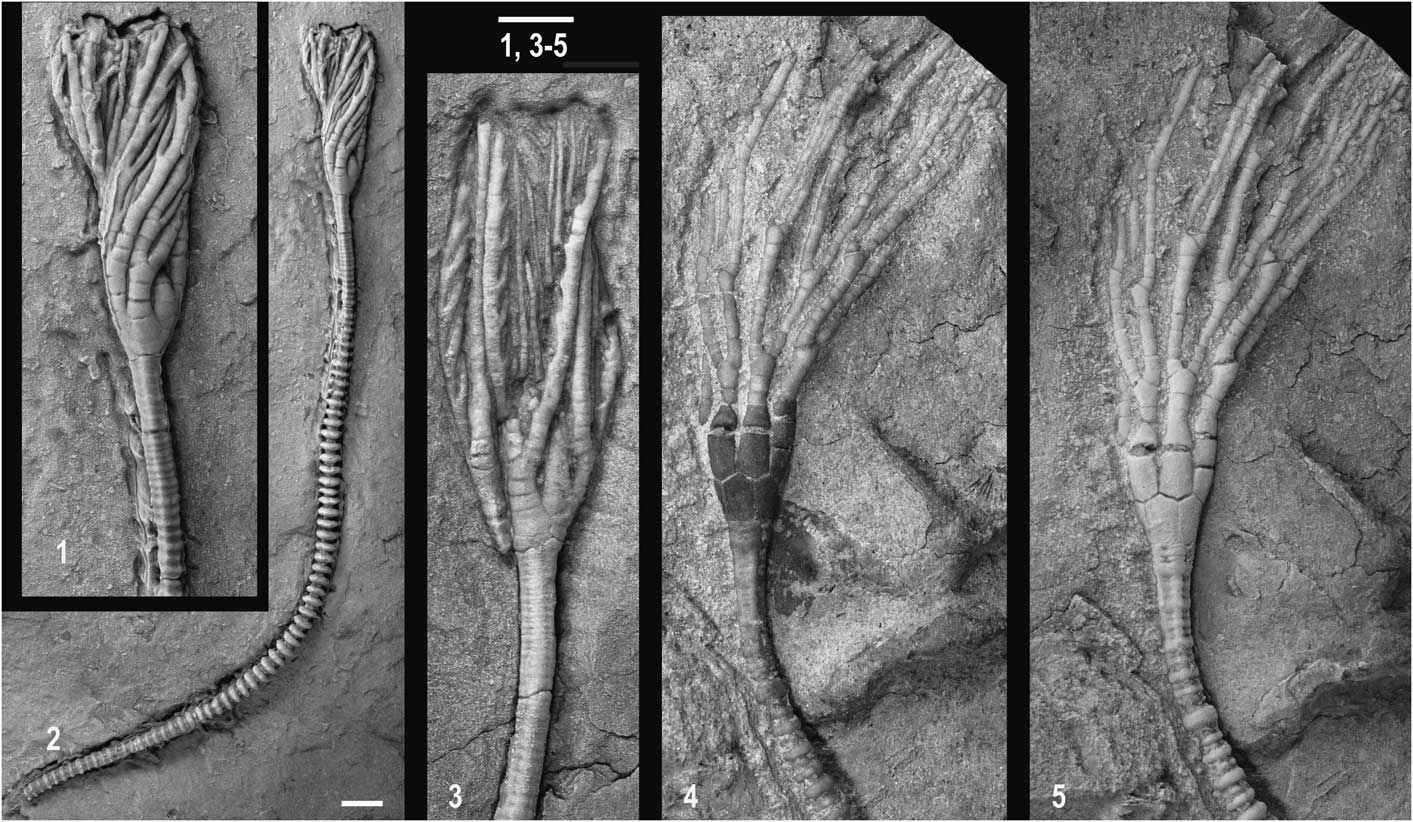
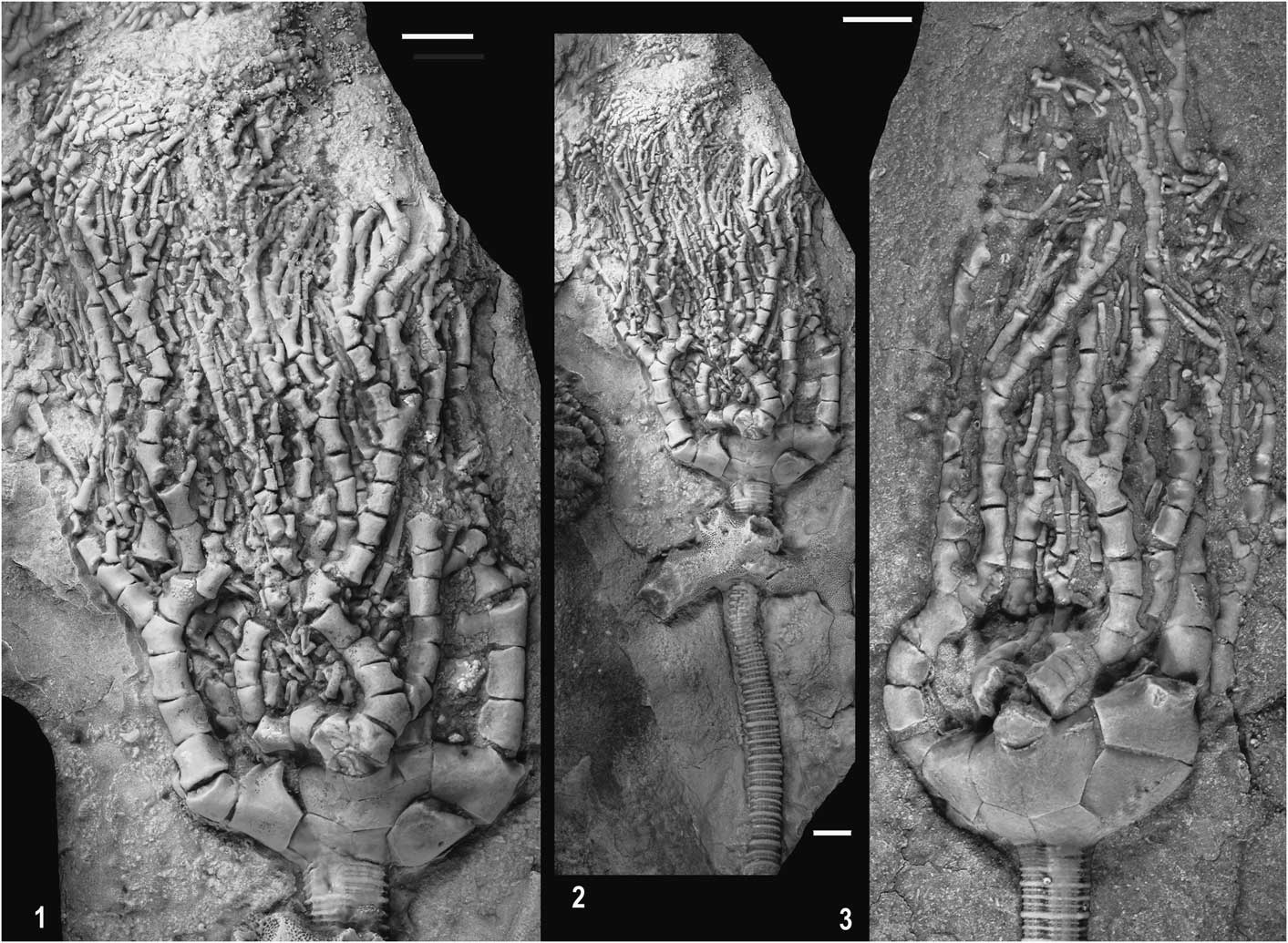
Daedalocrinus and Isotomocrinus: (1–3) Daedalocrinus bellevillensis Billings, Reference Billings1883; (1) D-ray view of crown (enlargement of Figure 4.2; compare to Figure 5.1), UMMP 74656; (2) D-ray view of specimen (note contrasting morphology of proxistele versus mesistele), UMMP 74656; (3) partial crown (note arm branching), UMMP 74655.1; (4, 5) Isotomocrinus tenuis (Billings, Reference Billings1857b) lateral view of partial crown and proximal column (note arm branching), UMMP 74658; (4) specimen uncoated to illustrate the darker coloration on the aboral cup, proximal brachials, and proximal columnals; (5) specimen coated with ammonium chloride prior to photography (note arm branching). Scale bars=5.0 mm.
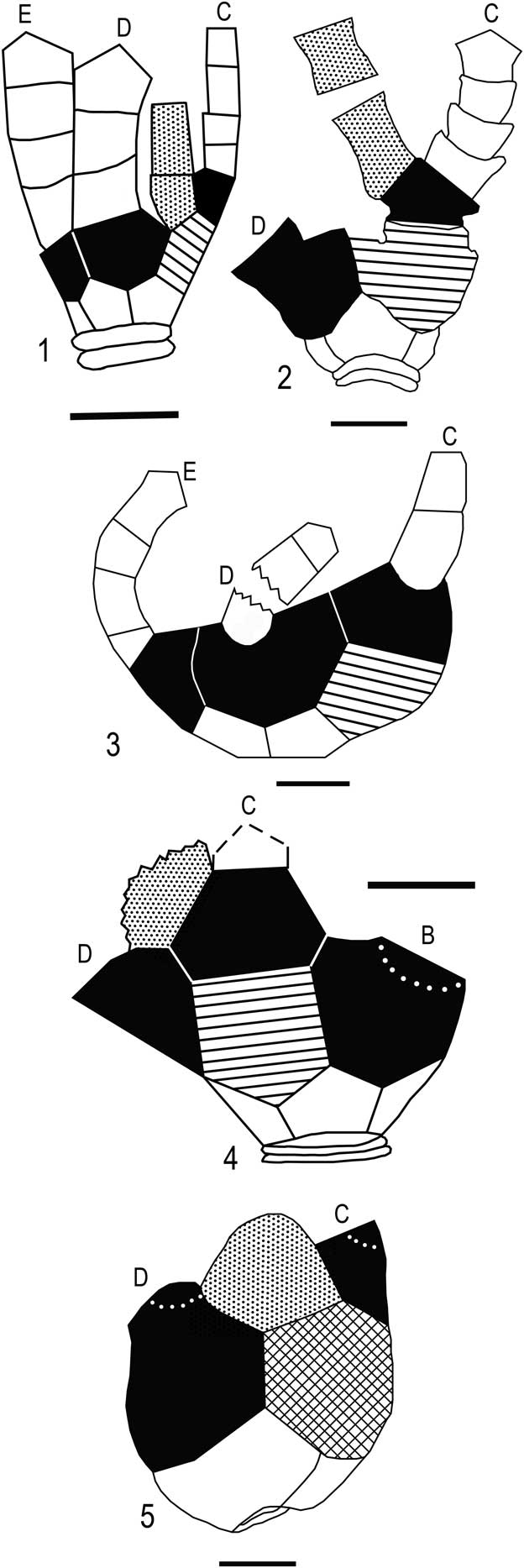
Camera lucida drawings of Brechin crinoids: (1) Daedalocrinus bellevillensis Billings, Reference Billings1883, D-ray lateral view of partial calyx (compare to Figure 4.1), UMMP 74656; (2) Iocrinus trentonensis Walcott, Reference Walcott1883, CD interray view of partial crown (compare to Figure 8.2), UMMP 74668.1; (3) Anomalocrinus astrictus n. sp., D-ray lateral view of partial crown, paratype (compare to Figure 6.3), UMMP 74662; (4) Anomalocrinus astrictus n. sp., C-ray lateral view of partial crown, holotype (compare to Figure 7), UMMP 74661; (5) Hybocrinus tumidus Billings, Reference Billings1857a, CD interray view of aboral cup (compare to Figure 9.2), UMMP 74669. Letters designate Carpenter ray designations; black filling, radial or superradial plate; horizontal ruling, infraradial plate; cross-hatching, radianal plate; stippled, other radial plates. Scale bars=2.5 mm (1, 2); 5.0 (3−5).
1883 Heterocrinus bellevillensis Reference BillingsBillings, p. 49, unnum. pl. and figs.
1889 Heterocrinus bellevillensis; Reference MillerMiller, p. 252.
1891 Heterocrinus bellevillensis; Reference Wachsmuth and SpringerWachsmuth and Springer, p. 392, pl. 10, fig. 8.
1899 Heterocrinus bellevillensis; Reference BatherBather, p. 35, fig. 5.
1900 Heterocrinus bellevillensis; Reference Bather, Gregory and GoodrichBather, p. 146, fig. 58.2.
1886 Stenocrinus bellevillensis; Reference Wachsmuth and SpringerWachsmuth and Springer, p. 132 (p. 208).
1911 Ohiocrinus bellevillensis; Reference SpringerSpringer, p. 26.
1915 Ohiocrinus bellevillensis; Reference BasslerBassler, p. 870.
1915 Stenocrinus bellevillensis; Reference BasslerBassler, p. 870.
1925 Daedalocrinus bellevillensis; Reference UlrichUlrich, p. 83.
1925 Daedalocrinus kirki Reference UlrichUlrich, p. 97, fig. 13.
1938 Daedalocrinus kirki; Reference BasslerBassler, p. 83.
1943 Daedalocrinus bellevillensis; Reference Bassler and MoodeyBassler and Moodey, p. 404.
1943 Daedalocrinus kirki; Reference Bassler and MoodeyBassler and Moodey, p. 404.
1944 Daedalocrinus kirki; Reference Moore and LaudonMoore and Laudon, p. 145, pl. 52, fig. 7.
1973 Daedalocrinus kirki; Reference WebsterWebster, p. 98.
1977 Daedalocrinus bellevillensis; Reference Warn and StrimpleWarn and Strimple, p. 100, pl. 18, fig. 25.
1986 Daedalocrinus bellevillensis; Reference WebsterWebster, p. 119.
2013 Daedalocrinus bellevillensis; Reference Webster and WebsterWebster and Webster, p. 1245.
Holotype
GSC 1439a, b.
Diagnosis
Homocrinid with narrow cone-shaped crown, medium cone-shaped aboral cup, basal concavity absent, basal circlet low, all basal plates symmetrical, radial plates low, superradial plates not much lower than simple radial plates, arms ramulate, arm branching endotomous, proximal columnals low (from Ausich and Copper, Reference Ausich and Copper2010).
Occurrence
The holotypes of both Daedalocrinus bellevillensis and D. kirki are from the ‘lower Trenton’ at Kirkfield, Ontario, Canada, which is stratigraphically in the upper Bobcaygeon Formation. New material from the Brechin Lagerstätte is from the Bobcaygeon-Verulam contact zone at the Carden Quarry (UMMP 74655--UMMP 74657) and the LaFarge Quarry (Ordovician, Katian). This species also occurs in the Curdsville Member of the Lexington Limestone in Garrard County, Kentucky, USA.
Description
Crown relatively small; cone slightly expanding. Aboral cup low cone-shaped (Fig. 4.1); width to height ratio ~0.6; plates gently convex; plate sculpture smooth.
Basal circlet ~45% of aboral cup height; basal plates five, pentagonal, approximately as wide as high. Radial circlet ~55% of aboral cup height.
Radial plates five; A and D radial plates simple; B, C, and E radial plates compound. Simple radial plates 1.5 times wider than high. Interradial and superradial plates of approximately same size; interradial plates ~1.6 times wider than high; superradial plates ~2.0 times wider than high (Fig. 4.1). C inferradial plate pentagonal; C superradial plate pentagonal, sutured on distal left shoulder to first anal plate and to C-ray first primibrachial on right shoulder; former suture narrower than latter. Radial facets plenary; topographical details of radial facet unknown.
First anal tetragonal, above aboral cup, supported beneath by C superradial, as wide as high (Fig. 5.1). More distal anal plates above anal X similar to brachials except dimensions approximately as high as wide.
Arms branching once isotomously on third or fourth primibrachial; nonaxillary primibrachials ~1.5 times wider than high. Proximal portion of most proximal primibrachials can be partially fixed to adjacent plates. Above primaxil, arms ramulating with endotomous branching. Ramules branching from arm on every fourth secundibrachial (Fig. 4.3); nonaxillary secundibrachials approximately as high as wide; axillary secundibrachial higher than wide. Ramules long, robust, unbranched; plates of ramules as much as 1.4 times higher than wide.
Column xenomorphic, pentalobate, pentameric. Proxistele columnals homeomorphic, >5 times wider than high, gradually transitioning into mesistele. Mesistele columnals heteromorphic; one internodal between each nodal; nodals ~3.5 times wider than high; internodals approximately four times wider than high (Fig. 4.2). Nodals approximately twice as wide as internodals; mesistele columnals gradually tapering into dististele but retaining organization with nodals separated by one internodal; compared with maximum nodal width in mesistele, nodals at distal end of nearly complete column are half the width. Lumen pentagonal, ~33% of column width; meres aligned with angles of pentagonal lumen. Other details of column facets unknown.
Materials
Daedalocrinus kirki lectotype, USNM S 2141; CMC IP 54045 (2 specimens) 54047, and 54051; GSC 1439a, b; UMMP 74655.1, 74656, and 74657.
Measurements
UMMP 74655.1: CrH, 28.0*; ACH, 2.8; CoH, 20.0*. UMMP 74656: CrH, 21.5; ACH, 2.6; maximum ACW, 3.5; CoH, 10.2* (although nearly complete). UMMP 74657: CrH, 11.6*; ACH, 2.2; maximum ACW, 4.1; CoH, 6.0*.
Remarks
On several specimens, a portion of the calcite skeleton is preserved with a very dark coloration. This most typically occurs on aboral cup plates, but this coloration can extend onto the proximal column and proximal brachials (e.g., UMMP 74657). Whether this represents secondary mineralization or an expression of preserved organic molecules (O’Malley et al., Reference O’Malley, Ausich and Chin2013) is not known.
Family Cincinnaticrinidae Warn and Strimple, Reference Warn and Strimple1977
Genus Isotomocrinus Ulrich, Reference Ulrich1925
Type species
Isotomocrinus typus Ulrich, Reference Ulrich1925, by monotypy. However, I. typus is has been designated a subjective junior synonym of Heterocrinus tenuis Billings, Reference Billings1857b (see Warn and Strimple, Reference Warn and Strimple1977).
Other species
Isotomocrinus apheles Ausich, Bolton, and Cummings, Reference Ausich, Bolton and Cummings1998 and I. minutus Kolata, Reference Kolata1975.
Occurrence
Ordovician (Darriwilian), Newfoundland, Canada; (Sandbian), Illinois, Iowa, Minnesota, Tennessee, and Wisconsin, USA; and (Katian), New York, USA, and Ontario, Canada.
Remarks
As with Daedalocrinus, Ulrich (Reference Ulrich1925) proposed a new disparid species as the type species of a new genus; however, that species was subsequently regarded as a junior synonym. Ulrich (Reference Ulrich1925) designated Isotomocrinus typus as the type species of Isotomocrinus. Although not recognized as such by Webster and Webster (Reference Webster and Webster2013), Warn and Strimple (Reference Warn and Strimple1977) and Ausich et al. (Reference Ausich, Bolton and Cummings1998) regarded I. typus as a junior subjective synonym of I. tenuis, and that opinion is followed here.
Thus, three species of Isotomocrinus are considered valid: I. apheles, I. minutus, and I. tenuis. These three species are distinguished on the basis of shape of the aboral cup, number of primibrachials, number of secundibrachials, and arm branching.
Isotomocrinus tenuis (Billings, Reference Billings1857b)
1857b Heterocrinus tenuis Reference BillingsBillings, p. 273.
1868 Heterocrinus tenuis; Reference ShumardShumard, p. 377.
1868 Heterocrinus tenuis; Reference BigsbyBigsby, p. 20.
1886 Stenocrinus tenuis; Reference Wachsmuth and SpringerWachsmuth and Springer, p. 132 (p. 208).
1889 Heterocrinus tenuis; Reference MillerMiller, p. 252.
1910 Heterocrinus tenuis; Reference Grabau and ShimerGrabau and Shimer, p. 502.
1915 Heterocrinus tenuis; Reference BasslerBassler, p. 612.
1925 Heterocrinus juvenis Reference FritzFritz, p. 10, pl. 1, figs. 7, 11, 12, figs. 2, 3 (non Hall, Reference Hall1866).
1925 Isotomocrinus typus Reference UlrichUlrich, p. 86, fig. 5.
1938 Isotomocrinus typus; Reference BasslerBassler, p. 119.
1943 Isotomocrinus typus; Reference Bassler and MoodeyBassler and Moodey, p. 525.
1944 Isotomocrinus typus; Reference Moore and LaudonMoore and Laudon, p. 149, pl. 52, fig. 11.
1971 Ectenocrinus n. sp.; Reference Steele and SinclairSteele and Sinclair, p. 3, pl. 16, figs. 10, 11.
1973 Isotomocrinus typus; Reference WebsterWebster, p. 158.
1975 Isotomocrinus tenuis; Reference KolataKolata, p. 26, fig. 8, pl. 4, figs. 9–11.
1977 Isotomocrinus tenuis; Reference Warn and StrimpleWarn and Strimple, p. 62, pl. 8, fig. 15.
1978 Isotomocrinus tenuis; Reference Brower and VeinusBrower and Veinus, p. 456, pl. 16, fig. 4.
1986 Isotomocrinus tenuis; Reference WebsterWebster, p. 180.
1999 Isotomocrinus typus; Reference Brett and TaylorBrett and Taylor, p. 69, fig. 82.
2005 Isotomocrinus tenuis; Reference SloanSloan, p. 153, fig. 4–60.5.
2013 Isotomocrinus tenuis; Reference Webster and WebsterWebster and Webster, p. 1710.
2013 Isotomocrinus typus; Reference Webster and WebsterWebster and Webster, p. 1711.
Holotype
GSC 1438.
Diagnosis
Steep-sided medium cone-shaped aboral cup; 4 or 5 primibrachials,; 4–9 secundibrachials; poor isotomous arm branching.
Occurrence
The original description of Isotomocrinus tenuis was based on material from the ‘Trenton Limestone’ at Ottawa and Montreal, Canada, which are now referred to as the Hull beds. In the Brechin Lagerstätte, this taxon is known from the Bobcaygeon-Verulam contact zone at the Carden Quarry (UMMP 74659) and LaFarge Quarry (UMMP 74658, UMMP 74660) and from the upper Bobcaygeon Formation at the Kirkfield Quarry (Ordovician, Katian). In addition, this taxon has been described from the Buckhorn Member of the Ion Formation in Illinois (Sandbian), the Platteville Group of Illinois (Sandbian), and the Trenton Limestone of New York (Katian), USA.
Description
Crown medium-sized, constricted at level of proximal primibrachials then an expanding cone thereafter. Aboral cup medium cone-shaped, as high as wide; plates gently convex; plate sculpture smooth (Fig. 4.5).
Basal circlet ~50% of aboral cup height; basal plates five, hexagonal, 1.6 times higher than wide. Radial circlet ~50% of aboral cup height; radial plates five; B and D radial plates simple; A, C, and E radial plates compound; simple radial plates pentagonal, 1.5 times higher than wide; inferradial plates tetragonal, as high as wide; superradial plates pentagonal, slightly higher than wide, extending to approximate level of adjacent radial plates; proximal anal plate on upper left shoulder; C-ray arm on upper right shoulder. Radial facets plenary; details of radial facet topography unknown.
Distal corner of first anal plate supported beneath by C superradial and D radial, pentagonal with uneven sides, approximately as wide as high. More distal anal plates above first anal plate similar to brachials, approximately as high as wide.
Arms branching three times with poor isotomy; ramules absent; first primibrachial trapezoidal, proximal width 1.5 times greater than distal width, height approximately same as proximal width; subsequent primibrachial width 1.25 times wider than high. Axillaries larger than nonaxillary plates. Primaxils from fourth to fifth primibrachial; secundaxil from sixth to ninth secundibrachial; tertaxil from ninth to fourteenth tertibrachial. Tertibrachials as high as wide or higher than wide.
Column xenomorphic, pentalobate, pentameric; column index N212. Proxistele with columnals slightly heteromorphic, pentameric or cryptic pentameric; parallel sided; nodals twice as wide as high with ratio higher for internodals; N212 columnal organization present but subtle. Mesistele columnals cryptopentameric or holomeric; nodals approximately two times as wide as high, latus very convex; mesistele first internodals three times wider than high, latus very convex; mesistele tertinternodals 1.6 times as wide as high, straight-sided. Dististele columnals homeomorphic, pentameric. One juvenile specimen with nearly complete column ending in coil; one larger specimen with distal tip abutting against much larger columnal at high angle (thus consistent with but not definitive of distal coil in adult). Aspects of columnal facets unknown.
Materials
CMC IP 36696, 69219, and 74961; UMMP 74658−74660.
Measurements
UMMP 74658: CrH, 30.0*; ACH, 5.4; ACW, 5.4; CoH, 60.0*. UMMP 74659: CrH, 15.0*; ACH, 2.7; ACW, 3.4*; CoH, 60.0*. UMMP 74660: CrH, 17.0*; ACH, 5.9; ACW, 4.6; CoH, 11.0*.
Remarks
As with Daedalocrinus bellevillensis, the calcite skeleton of Isotomocrinus tenuis can be preserved with a very dark coloration (Fig. 4.4). Further, as in D. bellevillensis, this occurs most commonly on the aboral cup plates, but on some specimens, the coloration can extend onto the column or onto the proximal brachials.
Isotomocrinus tenuis is a relatively common species from the Brechin Lagerstätte, including both juveniles and adults. The shape of the aboral cup changes through ontogeny with the cup ~1.25 times higher than wide in subadult specimens and more equidimensional in adults.
Family Anomalocrinidae Wachsmuth and Springer, 1886
Remarks
Anomalocrinus is aptly named. The upper Bobcaygeon-lower Verulam interval in Ontario contains numerous specimens of a species that should be assigned to Anomalocrinus and Glaucocrinus falconeri? Parks and Alcock, Reference Parks and Alcock1912, which also could be assignable to Anomalocrinus. The original understanding for both Anomalocrinus and Glaucocrinus Parks and Alcock, Reference Parks and Alcock1912 was confused by aberrant specimens. In the holotype of A. incurvus Meek and Worthen, Reference Meek and Worthen1865, the position of a D radial plate is occupied by two plates separated by a central, vertical suture. Many specimens of A. incurvus are known now, and the vertical suture is absent on other specimens, making the holotype presumably an aberrant morphology. The holotype of G. falconeri has only three free arms. The C and E radial plates lack an arm (Guensburg, Reference Guensburg1992). As suggested by Guensburg (Reference Guensburg1992), the holotype of G. falconeri is undoubtedly also an aberrant specimen. Guensburg (Reference Guensburg1992) clarified the morphology of G. falconeri, including the presence of only three arms; and otherwise demonstrated that the reconstruction by Parks and Alcock (Reference Parks and Alcock1912) and by Moore and Lane (Reference Moore and Lane1978b) did not represent the morphology of this taxon. Guensburg (Reference Guensburg1992) also demonstrated that the arms are only partially preserved, and the aboral cup is compressed. Guensburg acknowledged that Glaucocrinus could be a junior synonym of Anomalocrinus, but with only the holotype available for study, Guensburg (Reference Guensburg1992, p. 6) concluded “I prefer to retain the status quo for the present; however, Glaucocrinus and Anomalocrinus are clearly closely related taxa.”
Comparison of the holotype of Glaucocrinus falconeri (see Guensburg, Reference Guensburg1992, fig. 2) with the new Anomalocrinus material from the Brechin Lagerstätte supports the suggestion of Guensburg (Reference Guensburg1992) that Glaucocrinus is probably a junior synonym of Anomalocrinus and that the holotype and only known specimen of G. falconeri is an aberrant specimen. However, critical features needed to diagnose the species of Anomalocrinus (shape of the aboral cup, nature of brachials, and arm branching in the C and E rays) are not preserved on the holotype of G. falconeri, precluding comparison with other species of Anomalocrinus. Therefore, both G. falconeri and its monospecific genus Glaucocrinus are unrecognizable because of poor preservation and the fact that the holotype and only specimen is an aberrant individual. Thus, we designate Glaucocrinus and G. falconeri as nomina dubia. With the reassignment of Geraocrinus Ulrich, Reference Ulrich1925 to the Columbicrinidae (see Ausich, Reference Ausich1998), and the designation of Glaucocrinus as a nomen dubium, the Anomalocrinidae is monogeneric.
Genus Anomalocrinus Meek and Worthen, Reference Meek and Worthen1865
Type species
Heterocrinus? (Anomalocrinus) incurvus Meek and Worthen, Reference Meek and Worthen1865, by monotypy.
Other species
?A. antiquus Guensburg, Reference Guensburg1984; A. caponiformis (Lyon, Reference Lyon1869); A. astrictus n. sp.
Occurrence
Ordovician (questionably Sandbian), Tennessee, USA; (Katian), Indiana, Ohio, and Tennessee, USA, and Ontario, Canada.
Remarks
Although beyond the scope of the present investigation, it should be noted that the previously named species of Anomalocrinus are in need of reevaluation. Specimens of Anomalocrinus are relatively large with relatively thin calyx plates; thus, specimens are easily compacted and disarticulated. This could explain the relative paucity of Anomalocrinus crowns preserved relative to, at least locally, the abundance of the distinctive Anomalocrinus holdfasts (Brett et al., Reference Brett, Deline and McLaughlin2008). Although specimens are available in museums, very few crowns of A. incurvus have been illustrated previously. It is probable that the holotype of A. incurvus is, as noted above, an aberrant specimen, and A. caponiformis is only known from a theca. Further, ?A. antiquus is a very small specimen and is known only from the aboral cup and proximalmost arms.
As presently understood, species of Anomalocrinus are diagnosed by the following characters: attitude of the radial circlet, the general character of the arms, character of the C-ray and E-ray primibrachials, shape of brachials, position of the primaxil, position of secundaxil, and arm branching. Anomalocrinus astrictus n. sp. has a more vertically directed radial circlet; brachials higher than wide, C- and E-ray primibrachials much larger than those in other rays; typically first primibrachial axillary in A, B, and D rays; third to fourth primibrachial axillary in C and E rays; the second to fourth secundibrachial is axillary, and as many as six bifurcations in an arm. In contrast, A. incurvus has an outflaring radial circlet; C- and E-ray primibrachials approximately the same size as those in other rays; the first or second primibrachial axillary in A, B, D, and E rays, more primibrachials in C ray; third or sixth secundibrachial axillary; and at least four bifurcations in an arm. ?Anomalocrinus antiquus has an more vertically oriented radial circlet, one partial arm and primibrachials in two other rays preserved, brachials higher than wide, the first primibrachial is axillary, and an axillary in the secundibrachitaxis (if present) higher than the third secundibrachial.
Anomalocrinus astrictus new species
urn:lsid:zoobank.org:act:E2DD9F5A-4DA4-425A-ABCD-FD699373CD44
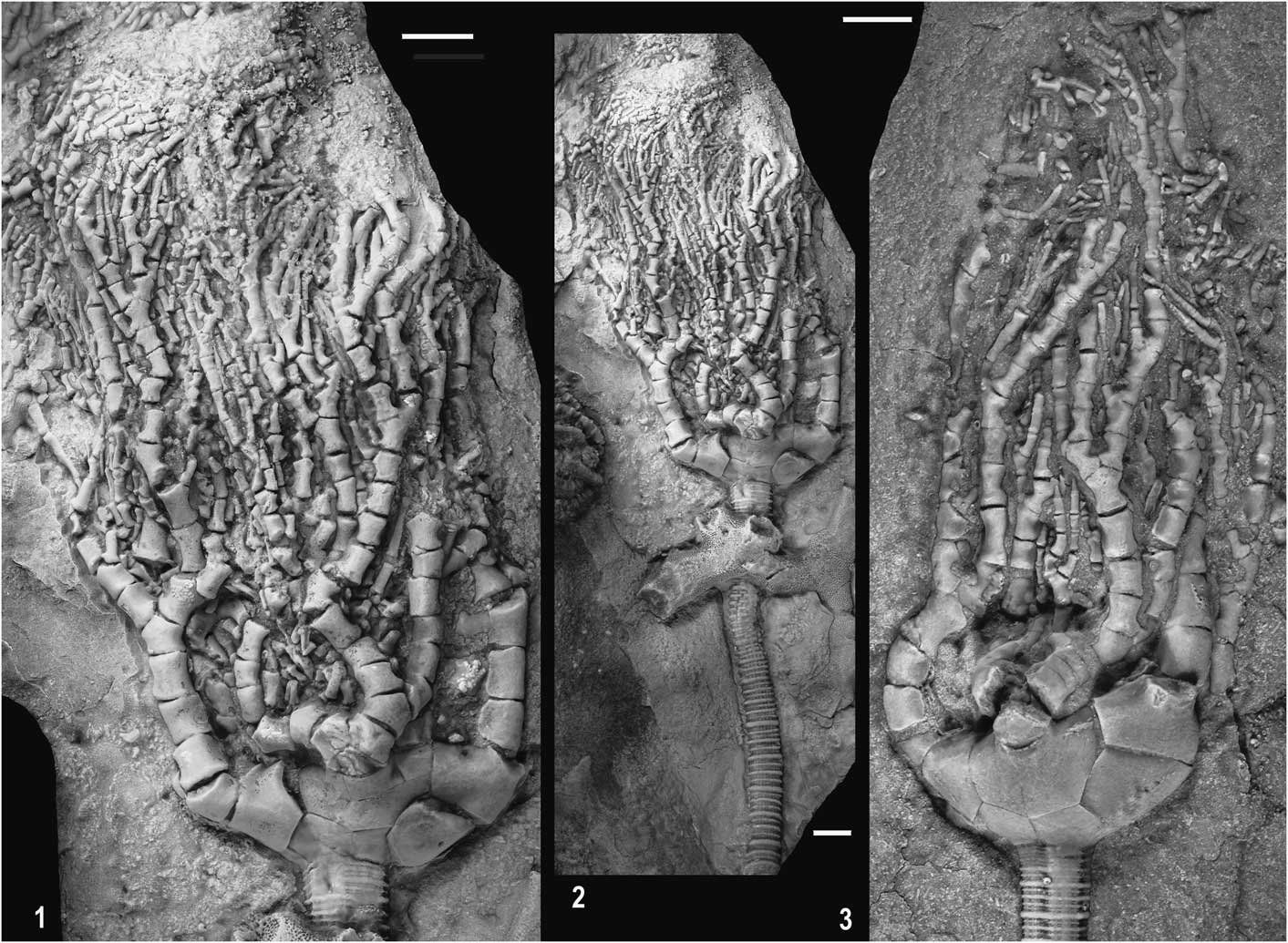
Anomalocrinus astrictus n. sp., paratypes: (1–2) A-ray lateral view of partially disarticulated crown and column, UMMP 74663; (1) note arm branching and brachial morphology, enlargement of Figure 6.2; (2) crown with column; (3) D-ray lateral view of partially disarticulated crown with column, note compound (compare to Figure 5.3), UMMP 74662. Scale bars=5.0 mm.
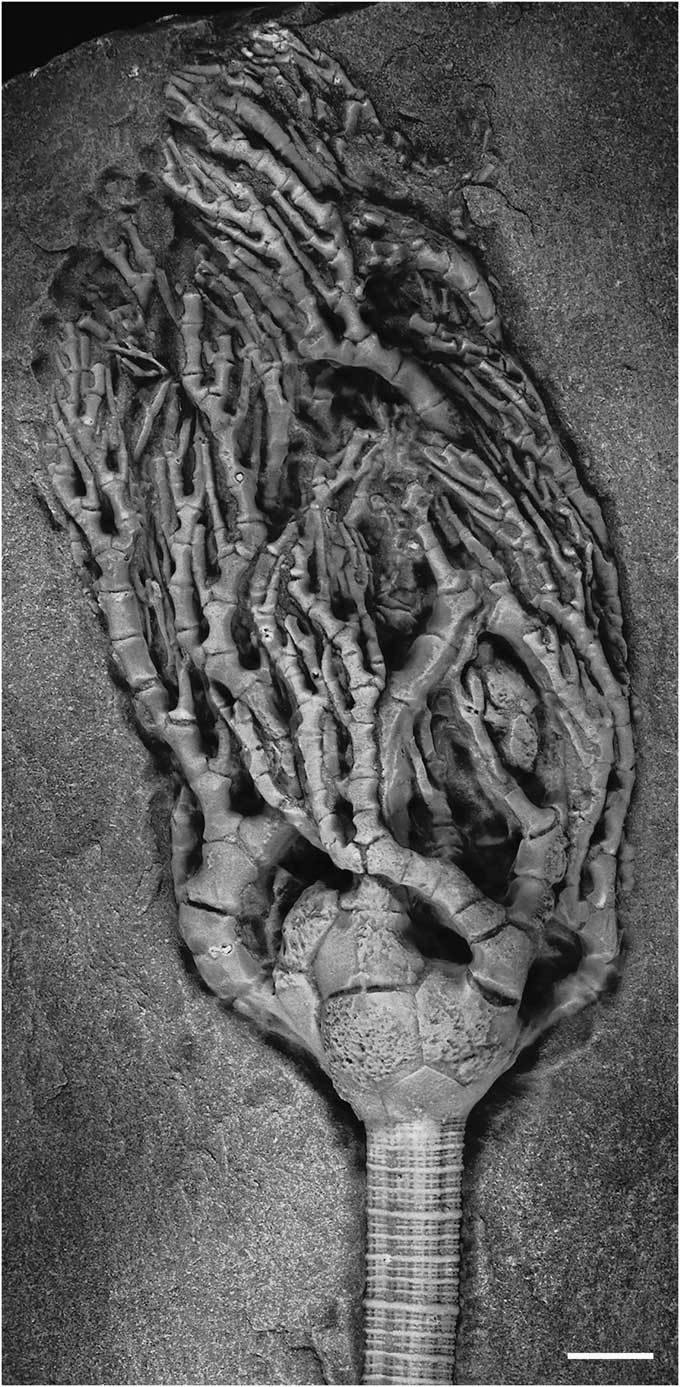
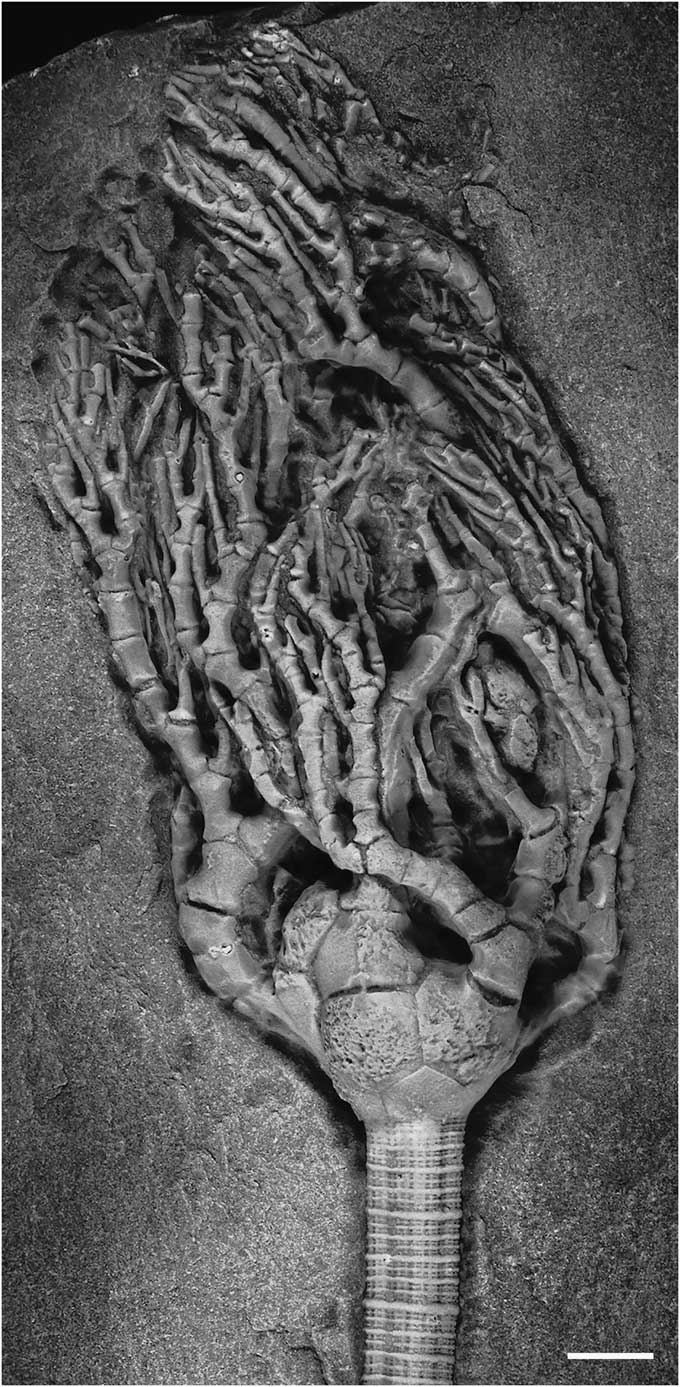
Anomalocrinus astrictus n. sp., holotype, C-ray lateral view of partial crown (note large brachials in the C-ray arm); calyx sculpture is smooth and pitting on calyx plates on this specimen is a preservational artifact (compare to Figure 5.4), UMMP 74661. Scale bar=5.0 mm.
Type specimens
Holotype, UMMP 74661; paratypes, UMMP 74662 and 74663.
Diagnosis
Anomalocrinus with radial circlet more vertically oriented, angustary radial facets (except C ray), brachials higher than wide, the first or the fourth primibrachial axillary (most commonly first), second to fourth secundibrachial axillary, and as many as six bifurcations in an arm.
Occurrence
This new species is known only from the Brechin Lagerstätte in the Bobcaygeon-Verulam contact zone at the Carden Quarry (UMMP 74662) and the LaFarge Quarry (UMMP 74663) (Ordovician; Katian).
Description
Crown medium-sized, subcylindrical. Aboral cup low bowl shaped, ~1.5 times wider than high; plates gently convex, plate sculpture smooth (Fig. 6.1).
Basal circlet ~35% of aboral cup height; basal plates five, pentagonal, ~1.5 times wider than high. Radial circlet more vertically directed, ~65% of aboral cup height; radial plates five, A, B, and D radial plates simple, 2.0 times wider than high; C and E radial plates compound (Figs. 5.3, 6.3, 7); infer- and superradial plates together larger than one simple radial plate; C infer- and superradial plates narrower and more equidimensional than simple radial plates; C inferradial plate pentagonal, as wide as high; C superradial plate octagonal, mostly above the distal extent of other radial plates, tapering distally, maximum width greater than height. A, B, D, and E radial facets angustary to peneplenary, ~60−80% of distal radial plate width; C radial facet plenary (Fig. 5.4), details of facet surface unknown.
First anal plate above aboral cup, sutured beneath to upper shoulders of C superradial and D radial plates (Fig. 7).
Arms branching isotomously as many as six times. Nonaxillary brachials rectilinear uniserial, convex with straight or concave sides; progressively higher-order brachitaxes with more exaggerated concave sides (Fig. 6.1); all axillaries with concave sides (except for some first primibrachials that are axillary, very small, sublenticular, and 1.25 times wider than high). A, B, and D rays typically with first primibrachial axillary; C and E rays with three or four primibrachials that are much larger than those of other rays. Nonaxillary brachials becoming progressively higher than wide from proximal to distal. Beginning in secundibrachitaxis, gracile ramules branching at irregular intervals (ramules from either every successive brachial or separated by nonaxillary brachials). Ramulars up to four times higher than wide, rectilinear uniserial with concave sides.
Column heteromorphic (Fig. 6.2), subcircular to multilobate. Periphery of many internodals with a beaded appearance. Proxistele columnals up to 22 times wider than high; mesistele columnals organized as N3231323, ranging from ~30 to 7.5 times wider than high.
Etymology
The new species name is derived from astrictus (L.) meaning drawn, together, tight, narrow, close; and it refers to the medial constriction of the width of the brachials.
Materials
UMMP 74661−74663.
Measurements
UMMP 74661, holotype: CrH, 61.1*; ACH, 8.8; ACW, 17.6; CoH, 18.0*. UMMP 74662, paratype: CrH, 56.0; ACH, 12.0; ACW, 21.2; CoH, 80.5*. UMMP 74663, paratype: CrH, 58.0*; ACH, 8.0*; ACW, 20*; CoH, 90*.
Remarks
See species comparisons in remarks for genus.
Order Calceocrinida Ausich, Reference Ausich1998
Family Calceocrinidae Meek and Worthen, Reference Meek and Worthen1869
Genus Cremacrinus Ulrich, Reference Ulrich1886
Type species
Cremacrinus punctatus Ulrich, Reference Ulrich1886.
Other species
Cremacrinus arctus Sardeson, Reference Sardeson1928; C. articulosus (Billings, Reference Billings1859); C. billingsianus (Ringueberg, Reference Ringueberg1889); C. crossmani Brower and Strimple, Reference Brower and Strimple1983; C. decatur Springer, Reference Springer1926; C. drummuckensis (Ramsbottom, Reference Ramsbottom1961); C. forrestonensis (Kolata, Reference Kolata1975); C. furcillatus (Billings, Reference Billings1887); C. gerki Brower and Strimple, Reference Brower and Strimple1983; C. guttenbergensis Kolata, Reference Kolata1975; C. inaequalis (Billings, Reference Billings1859); C. kentuckiensis (Miller and Gurley, Reference Miller and Gurley1894); ?C. latus (Brower and Veinus, Reference Brower and Veinus1974); C. lucifer Bolton, Reference Bolton1970; C. ramifer (Brower, Reference Brower1977); C. rugosus (Billings, Reference Billings1887); C. tubuliferus Springer, Reference Springer1926; and C. ulrichi Springer, Reference Springer1926.
Occurrence
Ordovician (Sandbian), Illinois, Iowa, Minnesota, Oklahoma, and Wisconsin, USA; Katian, Illinois, Iowa, Kentucky, Minnesota, Tennessee, and Wisconsin, USA, Ontario, Canada, and Scotland; Silurian (Ludlow and Pridoli), Tennessee, USA.
Remarks
Six species of Cremacrinus have been reported from the Ordovician in Ontario and Quebec: C. articulosus, C. billingsianus, C. furcillatus, C. inaequalis, C. lucifer, and C. rugosus. Wilson (Reference Wilson1946) noted that both C. furcillatus and C. rugosus were known from single specimens that were lost. In addition, many additional species are known from the United States (Webster and Webster, Reference Webster and Webster2013). The presence or absence of three characters can be used to quickly subdivide Cremacrinus into groups: (1) E-ray arm divided or atomous; (2) brachials rectilinear uniserial or cuneate uniserial; and (3) brachial plates wider than high or higher than wide.
As discussed below, two species of Cremacrinus occur in the Brechin fauna, one with the E-ray arm undivided and rectilinear uniserial brachials that are wider than high and the other with E-ray arm undivided and cuneate uniserial brachials that are higher than wide. These are regarded below as C. inaequalis and C. guttenbergensis Kolata, Reference Kolata1975, respectively.
Cremacrinus guttenbergensis Kolata, Reference Kolata1975
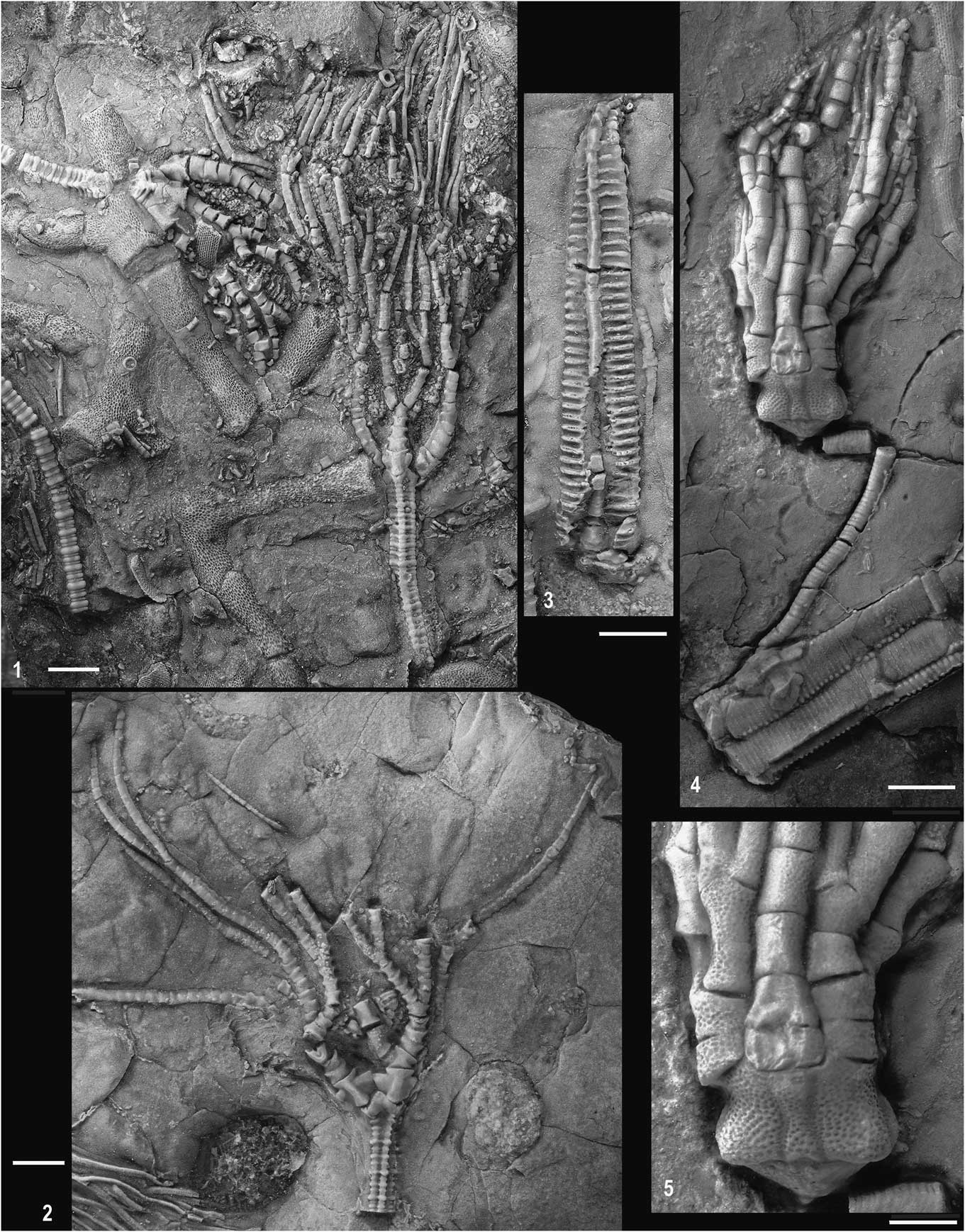
Iocrinus trentonensis Walcott, Reference Walcott1883 and Cremacrinus guttenbergensis Kolata, Reference Kolata1975: (1–3) Iocrinus trentonensis; (1) two partial specimens (note arm branching on the larger specimen and aboral cup shape on the smaller specimen), UMMP 74667.1–74667.2; (2) CD interray view of partial crown illustrating the compound radial plate in the C ray (compare to Figure 5.2), UMMP 74668.1; (3) isolated anal sac with the typical Iocrinus anal sac morphology, UMMP 74668.2; (4–5) E-ray view of a nearly compete specimen of Cremacrinus guttenbergensis, UMMP 74664; (4) note complete (if partially disarticulated) column and encrusting holdfast, first few brachials of E ray damaged prior to collection; (5) enlargement of aboral cup, note pitted plate sculpture. Scale bars=2.5 mm (5); 5 mm (remaining).
1975 Cremacrinus guttenbergensis Reference KolataKolata, p. 23, fig. 6, pl. 3, figs. 10, 14.
1982 Cremacrinus guttenbergensis; Reference BrowerBrower, p. 92.
1983 Cremacrinus guttenbergensis; Reference Brower and StrimpleBrower and Strimple, p. 1277, figs. 10a–c, 11a–c.
1986 Cremacrinus guttenbergensis; Reference WebsterWebster, p. 105.
1988 Cremacrinus guttenbergensis; Reference BrowerBrower, p. 919.
1988 Cremacrinus guttenbergensis; Reference WebsterWebster, p. 60.
1993 Cremacrinus guttenbergensis; Reference WebsterWebster, p. 41.
2013 Cremacrinus guttenbergensis; Reference Webster and WebsterWebster and Webster, p. 1121.
Holotype
BMNH PK-45.
Diagnosis
Cremacrinus with coarsely pitted aboral cup sculpture; aboral cup wider than high; aboral cup plates not swollen; axil arms two; axillaries not swollen; arms robust; brachials cuneate or rectilinear uniserial and higher than wide; B arm smaller than A and D arms; E-ray arm unbranched.
Occurrence
This taxon was founded on specimens from the Guttenberg Formation (Galena Group) in Illinois and Wisconsin (Katian), USA. Subsequently it has been recovered from the Mortimer and Sherwood members of the Dunleith Formation (Sandbian) of Illinois, Iowa, and Minnesota, and the Trenton Formation in New York (Katian), USA. In the Brechin Lagerstätte, this species of Cremacrinus is known from the Bobcaygeon-Verulam contact zone at the Carden Quarry (UMMP 74664, UMMP 74665.1) and from the upper Bobcaygeon Formation at the Kirkfield Quarry and Tomlinson Quarry (Ordovician, Katian).
Description
Crown without perfect bilateral symmetry, probably pendant on column. Aboral cup small, adorally-aborally compressed; plate sculpture coarsely pitted; sutures impressed (Fig. 8.5).
Basal plates four, all in column concavity, all part of distal margin of basal circlet. Radial circlet almost twice as wide as high, wider proximally, tapering distally (Fig. 8.5); trapezoidal and slightly indented along line between proximal edge of A and D radial facets; ligament pit divided. A and D radial plates occupying majority of radial circlet. E-ray inferradial and superradial with narrow sutural contact; E superradial trapezoidal; E inferradial trapezoidal, occupying ~20% of radial-basal articulation; E superradial occupying ~55% of the distal aboral cup margin. Distal facet of A and D radials supporting a lateral arm. Other aspects of radial and anal plates unknown, including verification that B arm is present.
Four arms presumably present. Arms slender with aborally convex brachials; brachials rectilinear uniserial or cuneate uniserial, higher than wide, yielding arms with zig-zag appearance. Main axil with nonaxillary brachials; divisions isotomous. E-ray arm unbranched; E-ray brachials higher than wide, rectilinear uniserial (Fig. 8.4). Main axils weakly developed; two axillaries present, each separated by one nonaxillary brachial. Lateral arms apparently with normal bilateral heterotomy. Primaxil arm bifurcating at least through epsilon axillary with two (proximally) or four (distally) nonaxillary brachials before each bifurcation; three divisions preserved on betaaxil arm with three and five nonaxillary brachials before each bifurcation; beta ramules not visible. Other details of arms unknown.
Column homeomorphic; proxistele with very thin columnals with wavy or straight sutures. Beneath aboral cup proxistele columnals approximately six times wider than high and wedge shaped. Mesistele and dististele columnals three times wider than high. Holdfast an irregular, subovate mass of stereom cemented to crinoid pluricolumnal. Holdfast classified as simple, discoidal, cemented type (Fig. 8.4).
Materials
CMC IP 366334 (3 specimens); UMMP 74664 and 74665.1.
Measurements
UMMP 74664: CrH, 30.0*; ACH, 5.0; proximal, ACW, 7.0; CoH, 24.0. UMMP 74665.1: CrH, 30.0; ACH, 4.5; proximal ACW, 5.1; CoH, 19.5*.
Remarks
See remarks under genus.
Cremacrinus inaequalis (Billings, Reference Billings1859)
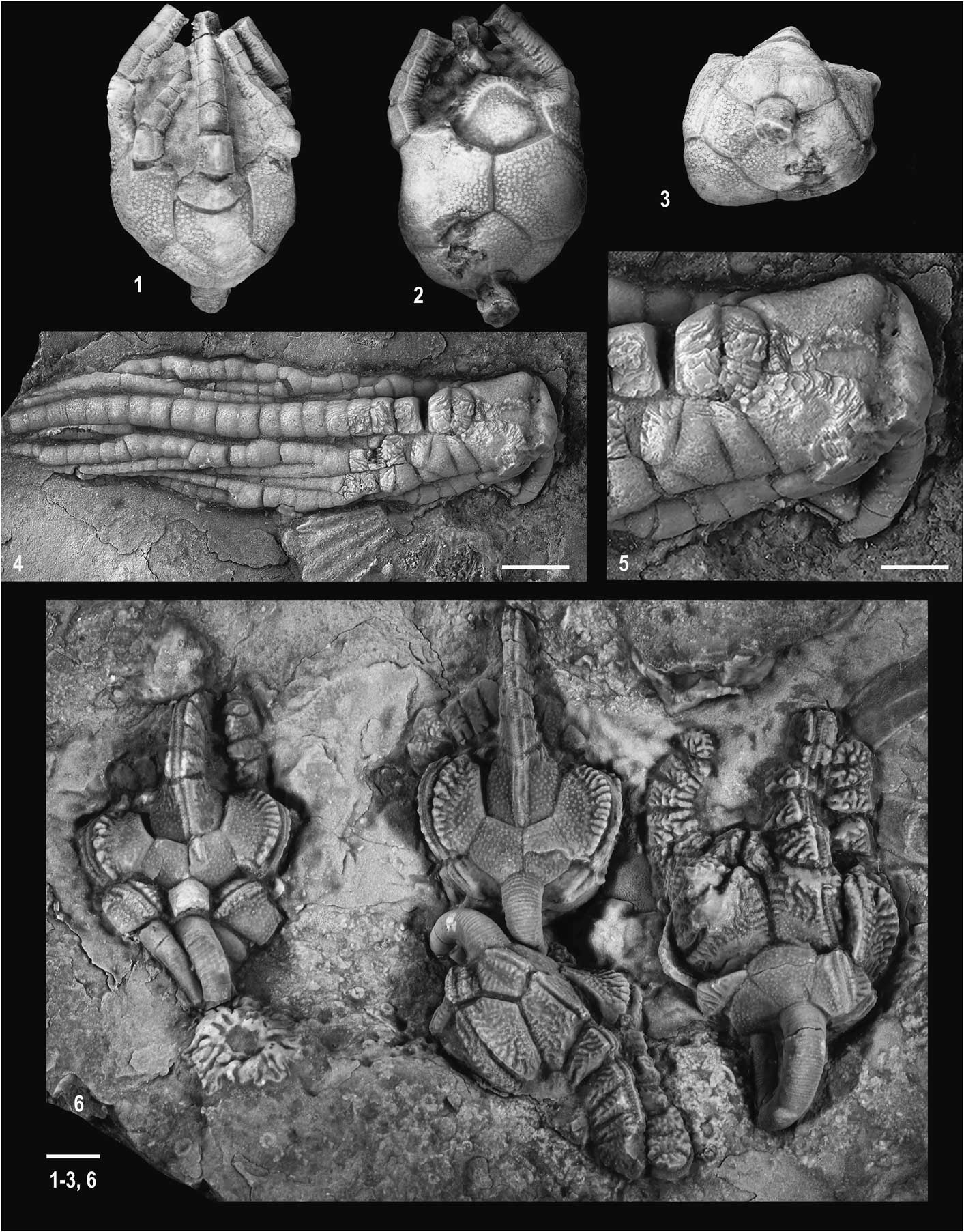
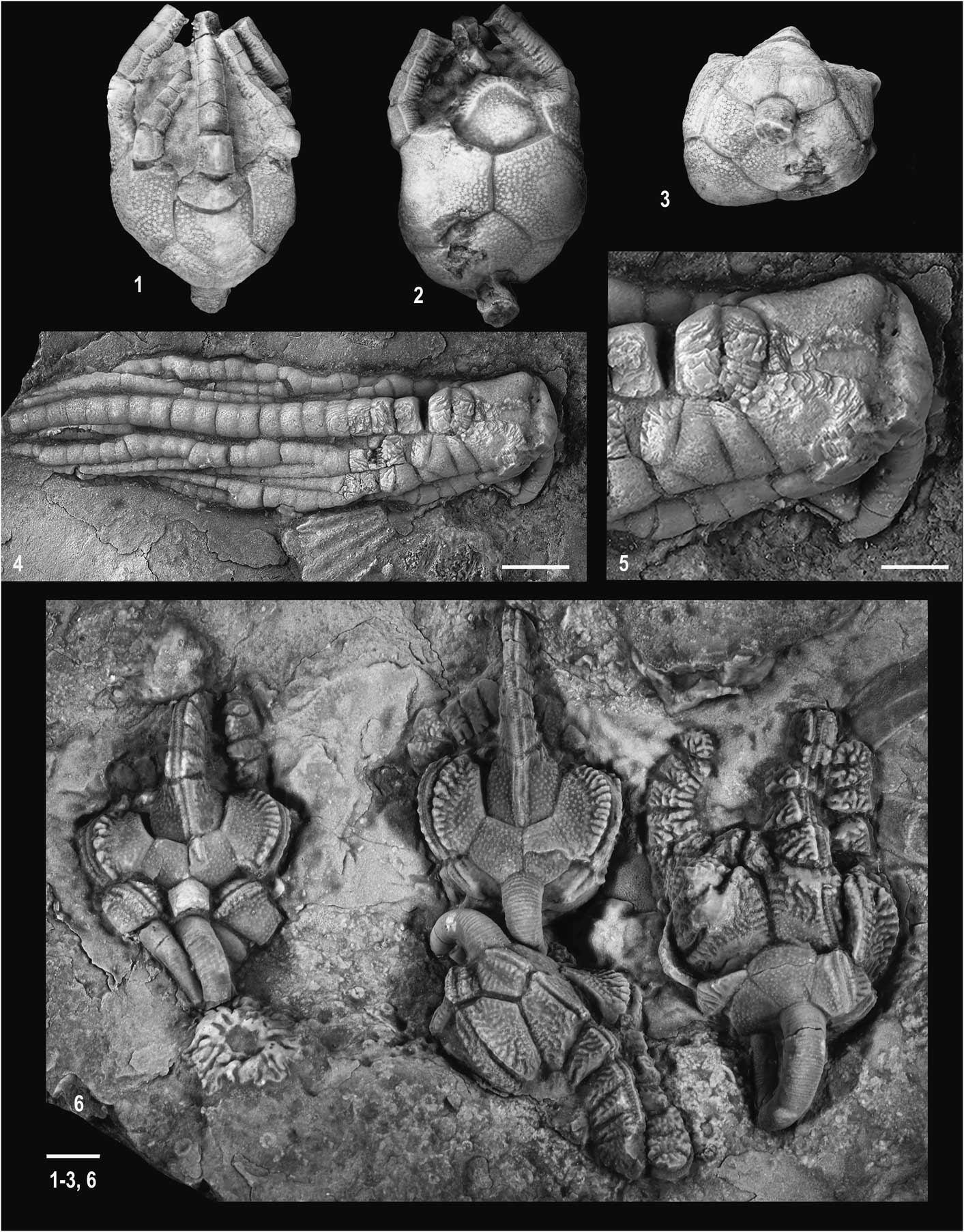
Hybocrinidae and Calceocrinidae: (1–3) Hybocrinus tumidus Billings, Reference Billings1857a, UMMP 74669; (1) A-ray view of partial crown (note robust, uniserial brachials of atomous arms; note radial plate is broken with an arcuate fracture); (2) CD interray view of partial crown (note the prominent ridges along the convex distal surface of the first anal plate and the prominent grooves on the sides of brachials; compare to Figure 5.5); (3) basal view of calyx; (4, 5) slightly askew E-ray view of crown and column of Cremacrinus inaequalis Billings, Reference Billings1859 (note damage on some calyx and proximal brachials prior to collection), UMMP 74666; (4) entire crown; (5) enlargement of aboral cup (note short length of column tucked beneath the aboral cup); (6) four partially compressed adult individuals of Hybocystites problematicus Wetherby, Reference Wetherby1880 (note prominent sculpture on plates, prominent ridges on brachials and along recumbent ambulacra, and proximal extensions of recumbent ambulacra), UMMP 74670.1–74670.4. Scale bars 2.5 mm (5); 5.0 mm (remaining).
1859 Heterocrinus inaequalis Reference BillingsBillings, p. 51, pl. 4, fig. 7a.
1868 Heterocrinus inaequalis; Reference ShumardShumard, p. 377.
1868 Heterocrinus inaequalis; Reference BigsbyBigsby, p. 20.
1886 Cremacrinus inaequalis; Reference UlrichUlrich, p. 113.
1889 Calceocrinus inaequalis; Reference MillerMiller, p. 230.
1889 Castocrinus inaequalis; Reference RinguebergRingueberg, p. 395, pl. 10, fig. 5.
1915 Cremacrinus inaequalis; Reference BasslerBassler, p. 289.
1943 Cremacrinus inaequalis; Reference Bassler and MoodeyBassler and Moodey, p. 376.
1946 Cremacrinus inaequalis; Reference WilsonWilson, p. 35, pl. 5, fig. 4.
1962 Cremacrinus inaequalis; Reference MooreMoore, p. 21.
1973 Cremacrinus inaequalis; Reference WebsterWebster, p. 86.
1982 Cremacrinus inaequalis; Reference BrowerBrower, p. 93.
1988 Cremacrinus inaequalis; Reference WebsterWebster, p. 60.
Holotype
GSC 1444.
Diagnosis
Cremacrinus with smooth aboral cup sculpture; aboral cup wider than high; aboral cup plates not swollen; axil arms two; axillaries not swollen; arms slender; brachials rectilinear uniserial, wider than high; E-ray arm unbranched.
Occurrence
Cremacrinus inaequalis was originally described from the Cobourg beds (now Lindsay Formation) at Ottawa, Canada (Ordovician, Katian), and has also been reported from the Sandbian-Katian Prosser Limestone of Minnesota and Wisconsin, USA. In the Brechin Lagerstätte, it is known from the Bobcaygeon-Verulam contact zone at the Carden Quarry (UMMP 74665) and from the upper Bobcaygeon Formation at the Kirkfield Quarry (Ordovician, Katian).
Description
Crown without perfect bilateral symmetry, pendant on column. Aboral cup medium-sized, adorally-aborally compressed; plate sculpture smooth; sutures impressed (Fig. 9.4).
Basal plates four, all in column concavity, all part of distal margin of basal circlet. Radial circlet wider than high, wider proximally, tapering distally (Fig. 9.5); condition of ligament pit unknown. A and D radial plates occupying majority of radial circlet. E-ray inferradial and superradial with wide sutural contact; E superradial trapezoidal; E inferradial pseudo-rectangular, occupying ~25% of radial-basal articulation; E superradial occupying ~50% of distal aboral cup margin (Fig. 9.5). Distal facet of A, B, and D radials support a lateral arm. Other aspects of radial and anal plates unknown.
Four arms presumably present. Arms moderately robust with aborally convex brachials; brachials rectilinear uniserial, wider than high. Main axil with nonaxillary brachials; first division isotomous; second division heterotomous. E-ray arm unbranched; E-ray brachials wider than high (Fig. 9.4). Main axils weakly developed; two axillaries present, each separated by one nonaxillary brachial. Lateral arms apparently with normal bilateral heterotomy. Primaxil arm bifurcating at least through epsilon axillary with two to five nonaxillary brachials before each bifurcation; two divisions preserved on betaaxil arm with three and six (proximal/distal) nonaxillary brachials before each bifurcation; beta ramules not visible. B arm with one nonaxillary before first bifurcation and four before second bifurcation; further aspects of B arm covered. Other details of arms unknown.
Column apparently homeomorphic, although columnals very thin near aboral cup. Beneath aboral cup columnals approximately six times wider than high and wedge shaped.
Materials
CMC IP 54773; UMMP 74666.
Measurements
UMMP 74666: CrH, 40.0*; ACH, 6.8; proximal ACW, 8.7; CoH, 7.4*.
Remarks
See remarks under genus.
Order Myelodactylida Ausich, Reference Ausich1998
Family Iocrinidae Moore and Laudon, Reference Moore and Laudon1943
Genus Iocrinus Hall, Reference Hall1866
Type species
Heterocrinus (Iocrinus) polyxo Hall, Reference Hall1866=H. subcrassus Meek and Worthen, Reference Meek and Worthen1865.
Other species
Iocrinus africanus Zamora, Rahman, and Ausich, Reference Zamora, Rahman and Ausich2015; I. crassus (Meek and Worthen, Reference Meek and Worthen1865); I. llandegleyi Botting, Reference Botting2003; I. pauli Donovan and Gale, Reference Donovan and Gale1989; I. subcrassus torontoensis Fritz, Reference Fritz1925 (herein regarded as a synonym of I. subcrassus); and I. trentonensis Walcott, Reference Walcott1883.
Occurrence
Ordovician (latest Dapingian to early Darriwilian), Oman; (Darriwilian) England, Morocco, and Wales; (Katian) Illinois, Indiana, Iowa, Kentucky, New York, and Ohio, USA, and Ontario, Canada.
Remarks
Four species (plus one subspecies) of Iocrinus have been described from Katian strata of eastern North America. These include the type species, I. subcrassus, from the Greater Cincinnati region, New York, USA and Ontario, Canada; I. crassus from the Maquoketa Formation of Illinois, USA; and I. trentonensis from the Spillway Member of the Rust Formation in New York, USA. In addition, I. subcrassus torontoensis has been named.
As discussed by Wilson (Reference Wilson1946), Kelly (Reference Kelly1978), and Brower (Reference Brower2008), Iocrinus similis is known only known the holotype (GSC 1428), which is a damaged specimen lacking key features of the aboral cup. Further, the specimen is most likely a teratological specimen with an extra plate inserted between the C-ray infer- and superradial plates (Kelly, Reference Kelly1978). Thus, we designate, herein, I. similis as a nomen dubium.
Fritz (Reference Fritz1925, p. 13) named Iocrinus subcrassus torontoensis (holotype ROM 245) based on two specimens in which the C-ray arm has five primibrachials rather than three. As noted by Brower (Reference Brower2008, p. 59), the number of primibrachials of I. subcrassus ranges from three to five with a mean of 4.13. Therefore, because the diagnostic characteristic of I. subcrassus torontoensis falls within the recognized range of this feature for I. subcrassus populations, designation of a subspecies is deemed unwarranted, and I. subcrassus torontoensis is designated, herein, a junior synonym of I. subcrassus.
In summary, three valid Katian species are now recognized from eastern North America. These three species can be differentiated as follows: Iocrinus subcrassus is medium-sized; proximal aboral cup width to aboral cup height 1.17; distal aboral cup width to aboral cup height 2.12 (means from Brower, Reference Brower2008); first primibrachial approximately two times wider than high; 5−13 tertibrachials (mean 7.99, from Brower, Reference Brower2008); typically four (range three to eight) in-line bifurcations within a ray; brachials with distal flanges only proximally. Iocrinus crassus is large; proximal aboral cup width to aboral cup height 0.9; distal aboral cup width to aboral cup height 1.8 (means from Brower, Reference Brower2008); first primibrachial approximately two times wider than high; four to eight tertibrachials; as many as seven in-line bifurcations within a ray; brachials without distal flanges. Iocrinus trentonensis is small; proximal aboral cup width to aboral cup height 0.697; distal aboral cup width to aboral cup height 1.79 (means from Brower, Reference Brower2008); first primibrachial ~1.4−2 times wider than high; 5−13 tertibrachials (mean 7.99, from Brower, Reference Brower2008); three to five in-line bifurcations within a ray; brachials with distal flanges throughout arms.
Iocrinus trentonensis Walcott, Reference Walcott1883
Figures Reference Ausich and Copper5.2, Reference Ausich, Brett, Hess and Simms8.1–Reference Ausich, Brett, Hess and Simms8.3
1883 Iocrinus trentonensis Reference WalcottWalcott, 1883, p. 4, pl. 17, figs. 7, 8.
1884 Iocrinus trentonensis; Reference WalcottWalcott, p. 210, pls. 17, 18.
1889 Iocrinus trentonensis; Reference MillerMiller, p. 257.
1915 Iocrinus trentonensis; Reference BasslerBassler, p. 668.
1943 Iocrinus trentonensis; Reference Bassler and MoodeyBassler and Moodey, p. 525.
1999 Iocrinus trentonensis; Reference Brett and TaylorBrett and Taylor, p. 65, fig. 74.
2007 Iocrinus trentonensis; Reference BrowerBrower, p. 1285, fig. 2.10–2.12.
2008 Iocrinus trentonensis; Reference BrowerBrower, p. 59, figs. 2−5.
2011 Iocrinus trentonensis; Reference BrowerBrower, p. 270, fig. 2.1–2.2.
2013 Iocrinus trentonensis; Reference Webster and WebsterWebster and Webster, p. 1707.
Type specimens
Lectotype, MCZ 106417; paralectotype, MCZ 113426 (see Brower, Reference Brower2008).
Diagnosis
Relatively small species with aboral cup distal width to height ratio much more than twice that of aboral cup proximal width versus height; basal plate height ~50% of radial plate height; radial plate height and width approximately equal; transverse ribbing between adjacent aboral cup plates; first primibrachial width versus height 1.5 or less; four to six primibrachials; six to nine secundibrachials; six to fifteen tertibrachials; three to five in-line bifurcations per ray; brachials with distal flanges through most of arm height; anal sac robust.
Occurrence
Iocrinus trentonensis was originally described from the Trenton Limestone of New York, USA. It is now recognized from the Spillway Member, Rust Limestone (Katian) in New York and the Brechin Lagerstätte from the Bobcaygeon-Verulam contact zone at the Carden Quarry (UMMP 74667.1) and from the lower Verulam Formation at the James Dick Quarry (UMMP 74668) (Ordovician, Katian).
Description
Crown medium-sized, expanding cone-shaped. Aboral cup flat cone-shaped; height to width ratio ~4.0; plates sharply convex; plate sculpture smooth (Fig. Reference Ausich, Brett, Hess and Simms8.2).
Basal circlet ~33% of aboral cup height; basal plates five, hexagonal, 3.0 times higher than wide; basal-basal plate sutures depressed. Radial circlet ~67% of aboral cup height; radial plates five; A, B, D, and E radial plates simple. Simple radial plates ranging from as wide as high to 1.4 times wider than high, very convex with broad ridge connecting adjacent radial plates, deeply concave at radial-radial-basal plate triple junction. C radial plate compound; C inferradial pentagonal, 1.5 times wider than high, same sculpture as simple radial plates; C superradial plate above aboral cup, subpentagonal, 1.7 times wider than high, constricted medially a short distance above proximal suture; anal X supported on left with slightly shorter suture than C-ray arm to right (Figs. 5.2, Reference Ausich, Brett, Hess and Simms8.2). Radial facets peneplenary, occupying 75% of distal width of radial facet; facet topography unknown.
First anal plate above aboral cup, supported beneath by only C superradial, hexagonal, slightly contorted, ~1.2 times higher than wide. Second anal plate quadrangular, approximately as high as wide. Based on anal sac plates preserved within crown and isolated, intact anal sac preserved adjacent to Iocrinus crowns; anal sac large, cylindrical, comprised of two columns of robust plates as high as wide (one in CD-interray orientation, one in A-ray orientation); two columns connected laterally by concave, very wide plates with plicated, depressed sutures; sutures covered by small plates (Fig. Reference Ausich, Brett, Hess and Simms8.3).
Arms branching four or five times isotomously (Fig. Reference Ausich, Brett, Hess and Simms8.1); nonramulate; first primibrachial quadrangular, ~1.5 times wider than high; fourth primibrachial axillary in all rays. Secundibrachials and higher quadrangular, as high as wide; fifth to seventh secundibrachial axillary.
Column pentalobate, heteromorphic, holomeric; largest columnals four times wider than high; latus convex (Fig. Reference Ausich, Brett, Hess and Simms8.1). Lumen circular, ~15% of columnal width; columnal facets unknown.
Materials
UMMP 74667.1, 74667.2, 74668.1, and 74668.2.
Measurements
UMMP 74667.1: CrH, 48.0; ACH, 3.1; distal ACW, 6.8; CoH 42.8*. UMMP 74668.1: ACH, 4.7; distal ACW, 7.4; CoH, 26.0*. UMMP 74668.2: CrH, 49.2.; ACH, 5.0; distal ACW, 7.7; CoH 50.0.
Remarks
As noted above, Iocrinus trentonensis can be readily differentiated from the other two North American species of Iocrinus. Iocrinus trentonensis is closest to I. subcrassus and might be a paedomorphic derivative of I. subcrassus, with smaller size, fewer brachial plates within brachitaxes, wider radial plates, a wider aboral cup, and flanges throughout the height of the arms. Of the two species, I. subcrassus is the most widespread geographically of the two species, although both occur in Katian strata of Ontario, Canada. Only I. trentonensis is known from the Brechin fauna.
Although this taxon is recognized by relatively small specimens, Iocrinus trentonensis is regarded as an adult based on the morphology of the brachial plates, which are wider than high rather than higher than wide.
Parvclass Cladida Moore and Laudon, Reference Moore and Laudon1943
Superorder Porocrinoidea Wright, Reference Wright2017
Order Hybocrinida Jaekel, Reference Jaekel1918
Family Hybocrinidae Zittel, Reference Zittel1879
Genus Hybocrinus Billings, Reference Billings1857a
Type species
Hybocrinus conicus Billings, Reference Billings1857a, by subsequent designation.
Other species
Hybocrinus bilateralis Guensburg, Reference Guensburg1984; H. crinerensis Strimple and Watkins, Reference Strimple and Watkins1949; H. nitidus Sinclair, Reference Sinclair1945; H. perperamnominatus Brower and Veinus, Reference Brower and Veinus1974; H. pristinus Billings, Reference Billings1858; H. punctatocristatus Brower and Veinus, Reference Brower and Veinus1974; H. punctatus (Miller and Gurley, Reference Miller and Gurley1895); and H. tumidus Billings, Reference Billings1857a.
Occurrence
Ordovician (Sandbian), Illinois, Iowa, Kentucky, Oklahoma, Minnesota, Tennessee, Virginia, and Wisconsin, USA; (Katian), Ontario, Canada.
Remarks
Billings (Reference Billings1857a) assigned two new species (Hybocrinus conicus and H. tumidus) from the Upper Ordovician to his new genus Hybocrinus; in 1858, he described a third species, H. pristinus (see Billings, 1958). These are the three species of Hybocrinus known from Ontario, Canada. As noted below, only H. tumidus is recognized from the Brechin fauna, and H. pristinus is considered a junior synonym of H. tumidus.
Species characters in Hybocrinus are: overall calyx symmetry about the oral-aboral axis, calyx outline in oral view, calyx plate sculpture, summit attitude, basal plate size, anal X shape, nature of the distal margin of the first anal plate, presence or absence of a stout A-ray arm, and position of column facet.
Hybocrinus tumidus Billings, 1857
1857a Hybocrinus tumidus Reference BillingsBillings, p. 275.
1858 Hybocrinus pristinus Reference BillingsBillings, Reference Billings1858, p. 25, figs. 4, 5.
1859 Hybocrinus pristinus; Reference BillingsBillings, p. 23, pl. 1, fig. 2a.
1859 Hybocrinus tumidus; Reference BillingsBillings, p. 28, pl. 2, fig. 1a–e.
1867 Hybocrinus pristinus; Reference GrewingkGrewingk, p. 103.
1867 Hybocrinus tumidus; Reference GrewingkGrewingk, p. 103.
1868 Hybocrinus pristinus; Reference ShumardShumard, p. 378.
1868 Hybocrinus tumidus; Reference ShumardShumard, p. 378.
1868 Hybocrinus pristinus; Reference BigsbyBigsby, p. 20.
1868 Hybocrinus tumidus; Reference BigsbyBigsby, p. 20.
1880 Hybocrinus tumidus; Reference WetherbyWetherby, p. 152, pl. 5, fig. 2a–c.
1882 Hybocrinus tumidus; Reference CarpenterCarpenter, p. 298, fig. A, pl. 11, figs. 3–5.
1889 Hybocrinus pristinus; Reference MillerMiller, p. 255.
1889 Hybocrinus tumidus; Reference MillerMiller, p. 255.
1910 Hybocrinus pristinus; Reference Grabau and ShimerGrabau and Shimer, p. 501.
1910 Hybocrinus tumidus; Reference Grabau and ShimerGrabau and Shimer, p. 501, fig. 1812.
1915 Hybocrinus pristinus; Reference BasslerBassler, p. 654.
1915 Hybocrinus tumidus; Reference BasslerBassler, p. 654.
1943 Hybocrinus pristinus; Reference Bassler and MoodeyBassler and Moodey, p. 515.
1943 Hybocrinus tumidus; Reference Bassler and MoodeyBassler and Moodey, p. 515.
1944 Hybocrinus tumidus; Reference Moore and LaudonMoore and Laudon, p. 151, pl. 53, fig. 3.
1946 Hybocrinus tumidus; Reference WilsonWilson, p. 31.
1973 Hybocrinus tumidus; Reference WebsterWebster, p. 151.
1975 Hybocrinus tumidus; Reference StrimpleStrimple, p. 51, fig. 1.
1981 Hybocrinus tumidus; Reference ParsleyParsley, p. 3, pl. 1, figs. 6, 9.
1986 Hybocrinus tumidus; Reference WebsterWebster, p. 174.
1988 Hybocrinus tumidus; Reference WebsterWebster, p. 96.
2013 Hybocrinus tumidus; Reference Webster and WebsterWebster and Webster, p. 1666.
2013 Hybocrinus pristinus; Reference Webster and WebsterWebster and Webster, p. 1665.
Type specimens
Wilson (Reference Wilson1946) recognized cotypes (GSC 1419b and 1419c) from Ottawa, Canada in the Trenton Limestone.
Diagnosis
Calyx asymmetrical about oral-aboral axis; calyx with subpentagonal outline in oral view; calyx plate sculpture coarsely granulose; summit surface tilted; basal plates unequal in size; anal X nearly equidimensional or wider than high; distal margin of first anal plate with deep grooves; A-ray arm stout; position of column facet asymmetrical.
Occurrence
Hybocrinus tumidus was originally described from the Cobourg beds (now Lindsay Formation) at Ottawa, Canada, and H. pristinus was originally described from the Aylmer Formation (Sandbian) of Quebec, Canada. In addition, this taxon was reported from the Hull (now Bobcaygeon Formation) and Sherman Falls members, Ottawa (now Verulam) Formation, Ontario (Katian), Canada; and the Curdsville Member, Hermitage Formation, Kentucky (Katian), USA. Since then, it has been recognized from the Curdsville Limestone Member of the Lexington Limestone in Mercer County, Kentucky, USA. In the Brechin Lagerstätte H. tumidus is known from the Bobcaygeon-Verulam contact zone at the Carden Quarry (UMMP 74669) and LaFarge Quarry and from the upper Bobcaygeon at the Kirkfield Quarry (Ordovician, Katian).
Description
Crown medium-sized. Aboral cup medium bowl- to medium globe-shaped; maximum width to maximum height ratio ~1.0; plates gently to markedly convex; sculpture with irregular-shaped, small nodes arranged in rows parallel to plate boundaries, combined with fine pitting (Fig. 9.3); in narrow margin along plate boundaries, fine ridges perpendicular to plate boundaries that abut similar ridges on opposing plates.
Basal circlet ~25% of aboral cup height, varying in different rays. Basal plates five, hexagonal, very differently sized (Fig. 9.3), typically as high as wide. Radial circlet ~75% of aboral cup height; radial plates five, A, B, D, and E radial plates simple; C radial plate compound. Radial plates of very different sizes and shapes, symmetrical or asymmetrical about the oral-aboral axis. C inferradial hexagonal, slightly wider than high; superradial above to right; first anal plate above to left. Radial facets angustary, horseshoe-shaped, declivate; A, B, and E radial facets symmetrically positioned on radial plate; C and D radial facets asymmetrically positioned on radial plate. Details of radial facet topography unknown.
Radianal (Fig. 9.2) supported equally beneath by C and D inferradials, supporting above C radial plate to right and anal X to left. Anal X partially in aboral cup; distal margin arcuate, strongly crenulate (Figs. 5.5, 9.2). Oral surface plating unknown; surface tilted relative to oral-aboral axis.
Arms atomous; primibrachials rectilinear uniserial (Fig. 9.1), as high as wide, distinctly convex, deep; lateral sides of brachials strongly crenulate (Fig. 9.2).
Proximal columnals very thin, homeomorphic; wavy sutures between columnals; other aspects of column not known. Lumen strongly pentalobate, ~50% of columnal width; columnal facets unknown.
Materials
CMC IP 22560, 36433, and 55395; UMMP 74669, 74687.1, and 74687.2.
Measurements
UMMP 74669: CrH, 30.5*; maximum ACH, 18.2; maximum ACW, 17.3; ArH, 16.2*; CoH, 3.1*.
Remarks
In describing his new species Hybocrinus pristinus, Billings (Reference Billings1858, p. 24) noted: “This species so closely resembles H. tumidus of the Trenton Limestone, that I have had much doubt as to the propriety of separating it therefrom. The only differences that I can perceive are, that it is always smaller that the Trenton form, the plates more coarsely granulated under a lens, and not so convex in their centres [sic]. In a well-preserved specimen of H. tumidus the column exhibits from eight to ten joints in the length of one line, where as in H. pristinus there are only five. Under these circumstances I have thought it best to distinguish that Chazy specimens by a separate name for the present.” This distinction recognized by Billings is readily explained by ontogenetic variation, and we consider H. pristinus to be a junior synonym of H. tumidus. Therefore, the Katian crinoid faunas have only two species of Hybocrinus, H. conicus and H. tumidus. These two Katian species are distinguished because H. tumidus has a summit surface that is tilted, basal plates unequal in size, the distal margin of the first anal plate with deep grooves, and an asymmetrical position of the column facet. In contrast, H. conicus has a summit surface that is not tilted, basal plates approximately equal in size, the distal margin of the first anal plate lacking deep grooves, and a symmetrical position of the column facet.
Family Hybocystitidae Jaekel, Reference Jaekel1918
Genus Hybocystites Wetherby, Reference Wetherby1880
Type species
Hybocystites problematicus Wetherby, Reference Wetherby1880, by monotypy.
Occurrence
Ordovician (Katian), New York, USA and Ontario, Canada.
Remarks
As noted below, Hybocystites is now considered monospecific with the recommendation herein that H. problematicus and H. eldonensis are conspecific.
Hybocystites problematicus Wetherby, Reference Wetherby1880
1880 Hybocystites problematicus Reference WetherbyWetherby, p. 7, pl. 5, fig. 1a–c.
1882 Hybocystites problematicus; Reference CarpenterCarpenter, p. 307, pl. 11, figs. 6–24.
1889 Hybocystites problematicus; Reference MillerMiller, p. 256, fig. 342.
1900 Hybocystis problematicus; Reference Bather, Gregory and GoodrichBather in Lankester, p. 95, fig. 1.
1908 Hybocystites problematicus; Reference ParksParks, p. 232, pl. 2, figs. 1–3, 5.
1908 Hybocystis eldonensis Reference ParksParks, p. 234, pl. 2, fig. 4.
1911 Hybocystis eldonensis; Reference SpringerSpringer, p. 13, pl. 2, figs. 1–10.
1915 Hybocystites eldonensis; Reference BasslerBassler, p. 654.
1915 Hybocystites problematicus; Reference BasslerBassler, p. 655.
1938 Hybocystites problematicus; Reference BasslerBassler, p. 115.
1943 Hybocystites eldonensis; Reference Bassler and MoodeyBassler and Moodey, p. 515.
1943 Hybocystis problematicus; Reference Bassler and MoodeyBassler and Moodey, p. 516.
1943 Hybocystis eldonensis; Reference Bassler and MoodeyBassler and Moodey, p. 515.
1943 Hybocystites eldonensis; Reference Moore and LaudonMoore and Laudon, p. 130, pl. 1, fig. 8.
1944 Hybocystites eldonensis; Reference Moore and LaudonMoore and Laudon, p. 151, pl. 53, fig. 1.
1948 Hybocystis eldonensis; Reference CuénotCuénot, p. 55, fig. 69.
1948 Hybocystites problematicus; Reference RegnellRegnell, p. 9, fig. 3B.
1953 Hybocystites eldonensis; Reference UbaghsUbaghs, p. 749, figs. 143, 144.
1953 Hybocystites problematicus; Reference UbaghsUbaghs, p. 749, fig. 80c.
1973 Hybocystites eldonensis; Reference WebsterWebster, p. 152.
1973 Hybocystites problematicus; Reference WebsterWebster, p. 152.
1975 Hybocystites problematicus; Reference StrimpleStrimple, p. 51, fig. 1.
1978 Hybocystites eldonensis; Reference Brett and LiddellBrett and Liddell, p. 338, figs. 5.8, 7–9.
1978 Hybocystites problematicus; Reference Sprinkle and MooreSprinkle and Moore, p. T572, fig. 365.1a, b.
1978 Hybocystites eldonensis; Reference UbaghsUbaghs, p. T138, figs. 109.5–109.6, 151.4, 174.11.
1978 Hybocystites eldonensis; Reference Sprinkle and MooreSprinkle and Moore, p. T574, fig. 365.1c–j.
1981 Hybocystites problematicus; Reference ParsleyParsley, p. 4, pl. 1, figs. 7, 8, 10.
1981 Hybocystites problematicus; Reference ArendtArendt, p. 164, fig. 29b.
1981 Hybocystites eldonensis; Reference ArendtArendt, p. 164, fig. 29e–zh.
1985 Hybocystites eldonensis; Reference RozhnovRozhnov, p. 5, fig. 1d.
1985 Hybocystis eldonensis; Reference SmithSmith, p. 170, pl. 7.4.22.
1986 Hybocystites eldonensis; Reference RozhnovRozhnov, p. 1, fig. 1e.
1986 Hybocystites problematicus; Reference WebsterWebster, p. 174.
1986 Hybocystites eldonensis; Reference WebsterWebster, p. 174.
1988 Hybocystites problematicus; Reference WebsterWebster, p. 96.
1988 Hybocystites eldonensis; Reference WebsterWebster, p. 96.
1993 Hybocystites eldonensis; Reference WebsterWebster, p. 70.
1999 Hybocystites eldonensis; Reference Brett and TaylorBrett and Taylor, p. 69, fig. 79.
2002 Hybocystites eldonensis; Reference RozhnovRozhnov, p. 584, fig. 44e.
Holotype
The holotype of Hybocystites problematicus has not been located with certainty; the holotype of H. eldonensis is ROM 23779.
Occurrence
Wetherby’s original specimens of Hybocystites problematicus were reportedly from the upper Trenton (Katian) in Mercer County, Kentucky, USA, and H. eldonensis was originally reported from Kirkfield, Ontario, Canada. This taxon is now known from the Curdsville Member of the Hermitage Formation (Katian) in Anderson, Garrard, Hermitage, and Jessamine counties in Kentucky; the Hull Member of the Ottawa (now Bobcaygeon) Formation and the Bobcaygeon Formation at Kirkfield, Ontario. New material is from the Bobcaygeon-Verulam contact zone at the Carden Quarry (UMMP 74670) (Ordovician, Katian).
Description
Crown medium-sized. Aboral cup medium globe-shaped (Fig. 9.6); maximum width to maximum height ratio ~1.0; all plates with coarse sculpture as noted below.
Basal circlet ~33% of aboral cup height. Basal plates five, pentagonal, equal in size, as high as wide; coarsely nodose plate sculpture that can be irregular or roughly arranged in rows parallel to plate boundaries. Radial circlet ~67% of aboral cup height; radial plates five, A, B, D, and E radial plates simple, of approximately same size and shape; symmetrical about oral-aboral axis; C radial plate compound. A, C, and D radial plates supporting a free arm; B and E radial plates lacking a free arm, but each with recumbent ambulacrum. Sculpture of A, C, and D radial plates only coarse irregular nodes of similar size across plates (Fig. 9.6). Sculpture of B and E radial plates with coarse nodes marginally; large nodes toward plate center merging into coarse ridges that abut and are arranged perpendicular to recumbent ambulacra. C inferradial hexagonal, approximately as high as wide; superradial above to right; first anal plate above to left. Radial facets angustary, horseshoe-shaped, declivate; details of radial facet topography unknown.
Posterior interray and tegmen plating unknown on present material; surface presumably perpendicular to oral-aboral axis.
Atomous free arms three (A, C, and D rays). Primibrachials rectilinear uniserial, as high as wide, >3.0 times deeper than wide proximally, as deep as wide distally; lateral sides of brachials with coarse irregular nodes and ridges that define a groove admedially along side of each brachial (Fig. 9.6). On rays with free arms (A, C, and D), ambulacra extending distally along adoral side of arm, over distal tip of arm, proximally along aboral side of arm, onto radial plate surface, and typically onto surface of basal plate. In some instances, ambulacrum extending onto proximal surface. On rays without free arms, ambulacra typically extending proximally onto basal plates and can extend onto column (Fig. 9.6). Biserial cover plates covering ambulacra.
Proximal columnals very thin, heteromorphic, holomeric, convex latus; proximal columnals very low, becoming higher distally. Lumen morphology and columnal facet morphology unknown.
Materials
As noted above, the original Wetherby (Reference Wetherby1880) specimens have not been located, but existing collections include those from Springer (Reference Springer1911): USNM S 2051 and 2051; from Sprinkle (Reference Sprinkle1973): USNM S 5732−5734; and from Parsley (Reference Parsley1981): USNM 245187 and 245189. New specimens include UMMP 74670.1–74670.5 and 74687.3.
Measurements
UMMP 74670.1: CrH, 28.0*; CaW, 18.5*; CoH, 10.0*. UMMP 74670.2: CrH, 25.3; CaH, 13.2; CaW, 17.0*; CoH, 8.0*. UMMP 74670.3: CaW, 18.6; CoH, 10.0*. Brechin UMMP 74670.4: CrH, 27.6*; CaH, 16.2; CaW, 20.1*; CoH, 13.0*. UMMP 74670.5: CrH, 28.6;* CaH, 21.0; CaW, 20.7; CoH, 12.5*.
Remarks
Two species of Hybocystites are recognized, H. problematicus (originally described from Kentucky, USA) and H. eldonensis (originally described from Ontario, Canada). The type specimen of H. eldonensis was “only about seven millimeters in vertical extent” (Parks, Reference Parks1908, p. 234), and it was differentiated from the type species by having the two recumbent ambulacra confined to the radial plates, and an ambulacral furrow that does not extend proximally to radial plates in arm-bearing rays. The Parks species also has much more subdued aboral plate sculpture than H. problematicus. Springer (Reference Springer1911) made a convincing argument that the differences between H. problematicus and H. eldonensis can be explained as ontogenetic changes. Further, in both Kentucky and Kirkfield, Ontario, single clusters of Hybocystites specimens contained both H. problematicus and H. eldonensis forms. Springer suggested that these two taxa are conspecific. He stated, “In view of the fact that Dr. Parks was the first to investigate and describe the Canadian forms, I prefer to place the foregoing facts at his disposal and leave the decision of the question to him, hoping that he will publish his conclusion; but the weight of evidence seems to me to favour the latter view” (Springer, Reference Springer1911, p. 21, 22). Parks did not address this question in subsequent publications. Also, note that both the H. problematicus and H. eldonensis forms co-exist in the Brechin material.
Parsley (Reference Parsley1981) followed Springer’s conclusions and designated Hybocystites eldonensis as a junior synonym of H. problematicus. Synonymy of these two species has not always been followed (e.g., Webster and Webster, Reference Webster and Webster2013), but we agree with Springer (Reference Springer1911) and Parsley (Reference Parsley1981) that the ‘weight of evidence’ supports the position that these two species are conspecific.
Acknowledgments
We thank the following for assistance with curated specimens: K. Hollis, National Museum of Natural History (NMNH), Smithsonian Institution, and B. Hunda, CMC. S. Rozhnov, G.D. Sevastopulo, and C. Sumrall improved an earlier version of this manuscript. SRC was supported by a Presidential Fellowship from Ohio State University and a Springer Fellowship from the NMNH. DFW was supported by a James R. Welch Scholarship from the Association of Applied Paleontological Sciences and a Peter Buck Fellowship from the NMNH. This research was also partially supported by the National Science Foundation (DEB 1036416).
Accessibility of supplemental data
Data available from the Dryad Digital Repository: https://doi:10.5061/dryad.dm67f.