Introduction
Ex situ germplasm conservation systems (genebanks) exist to maintain crop diversity and facilitate utilization for breeding and research (Plucknett et al., Reference Plucknett, Smith, Williams and Anishetty1987; Hammer, Reference Hammer1993; Walters, Reference Walters, Guerrant, Havens and Maunder2004). Globally more than seven million accessions are conserved; however, far from all are unique, as there has been extensive duplication among collection holders (Van Hintum and Visser, Reference Van Hintum and Visser1995; Van Hintum and Boukema, Reference Van Hintum, Boukema, Lebeda and Krístková1999; Germeier et al., Reference Germeier, Frese and Bücken2003; Van Treuren et al., Reference Van Treuren, Engels, Hoekstra and van Hintum2009). Unwanted duplication is costly, but as long as each genebank acts on its own and fails to coordinate with other genebanks, the problem persists. The issue has been addressed (Fowler, Reference Fowler2007; FAO, 2010), and at European level with a strategic framework of an integrated genebank system (AEGIS) (Engels and Maggioni, Reference Engels, Maggioni, Maxted, Dulloo, Ford-Lloyd, Frese, Iriondo and Pinheiro de Carvalho2012). The framework contains a roadmap on how to reduce unwanted duplications as well as to ensure quality standards and long-term commitment to conservation from the participating genebanks. The Brassica Working Group of the European Cooperative Programme for Plant Genetic Resources has given priority to AEGIS. This means that there is an ongoing process in which potential duplicates are actively sought for (ECPGR, 2008), with the aim to include only unique accessions in the European Collection defined by AEGIS. In Europe, there are 35 Brassica collections located in 24 countries (Branca et al., Reference Branca, Bas, Artemyeva, De Haro and Maggioni2013); online tools have been developed to search for potential duplicate accessions (Menting and Bas, Reference Menting and Bas2016). Our study includes two collections: the collection held at the N. I. Vavilov Institute of Plant Genetic Resources in St. Petersburg (VIR) and the collection held at the Nordic Genetic Resource Center (NGB). The genus Brassica includes several important vegetables, such as cabbage (B. oleracea L. var capitata), turnip (Brassica rapa L. var. rapa) and swede [Brassica napus (L.) Rchb. var. napobrassica]. More than 15.000 accessions of B. oleracea are reported by the Global Gateway to Genetic Resources (GENESYS, 2017). Out of these, around 800 cabbage accessions are maintained at VIR and 190 at NGB. In addition both genebanks have significant collections of turnip and swede.
Van Hintum and Knüpffer (Reference Van Hintum and Knüpffer1995) distinguish between genetically identical accessions and common duplicates, where common duplicates derive from the same initial population. One approach has been to identify common duplicates by comparing passport data. The NGB collection was established in 1979 and accessions were acquired from universities, research stations and enterprises in the Nordic countries; however, the accessions could have been stored for years before entering the genebank. The VIR collection contains accessions from the 1920s onwards and records indicate that Nicolai Vavilov had contact with the Botanical Garden in Copenhagen and with breeders in Weibullsholm and in Svalöf, Sweden, during the inter-war period (Loskutov, Reference Loskutov1999). Subsequent accessions have been acquired from enterprises or research institutions. While a natural and immediate assumption might be that accessions that have the same name are common duplicates, here we demonstrate that this is not always the case and argue that characterization should be included in any duplicate assessment process.
Material and methods
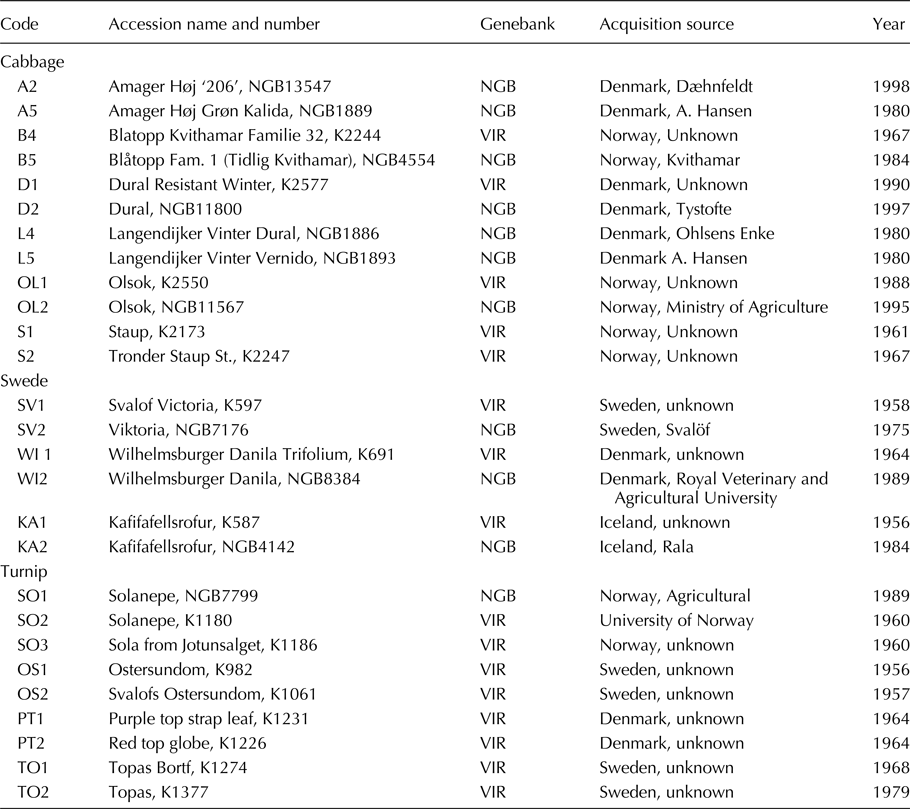
As they represent outcrossing plants, highly susceptible to crosspollination and genetic drift during regeneration, Brassica vegetables were selected. Selection criteria were: (1) same or similar names, (2) different (or unknown) donors or not duplicated from the other genebank, respectively, and (3) seed available for distribution. In total, 60 pairs/triplets were identified. We randomly selected 13 of these (Table 1). The following data were recorded: ‘accession name’, ‘donor name’, ‘donor number’ and ‘acquisition year’. In most cases, the accession names provided a cultivar name, often combined with the name of a seed enterprise or a second name (most likely a selection identity). The names were compared to archives of known cultivars (Börjesson, Reference Börjesson2015; SESTO, 2017). The accessions were grouped into potential duplication pairs/triplets based on ‘accession name’.
Overview of the accessions that was included in the study

Field assessment and characterization
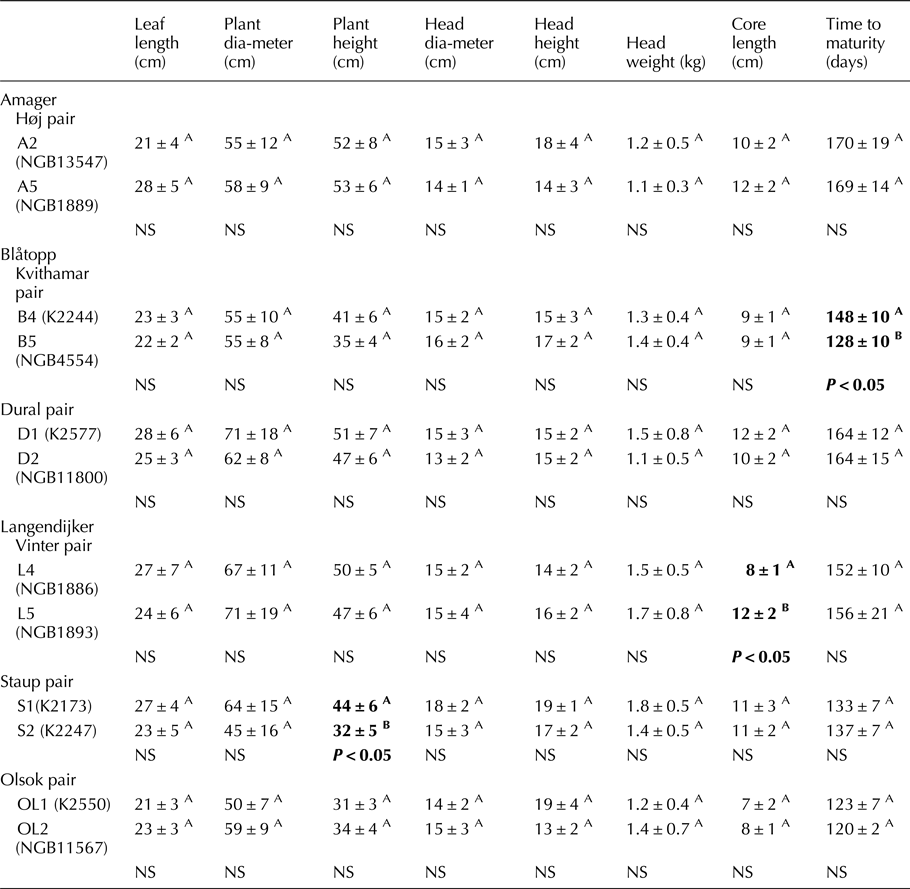
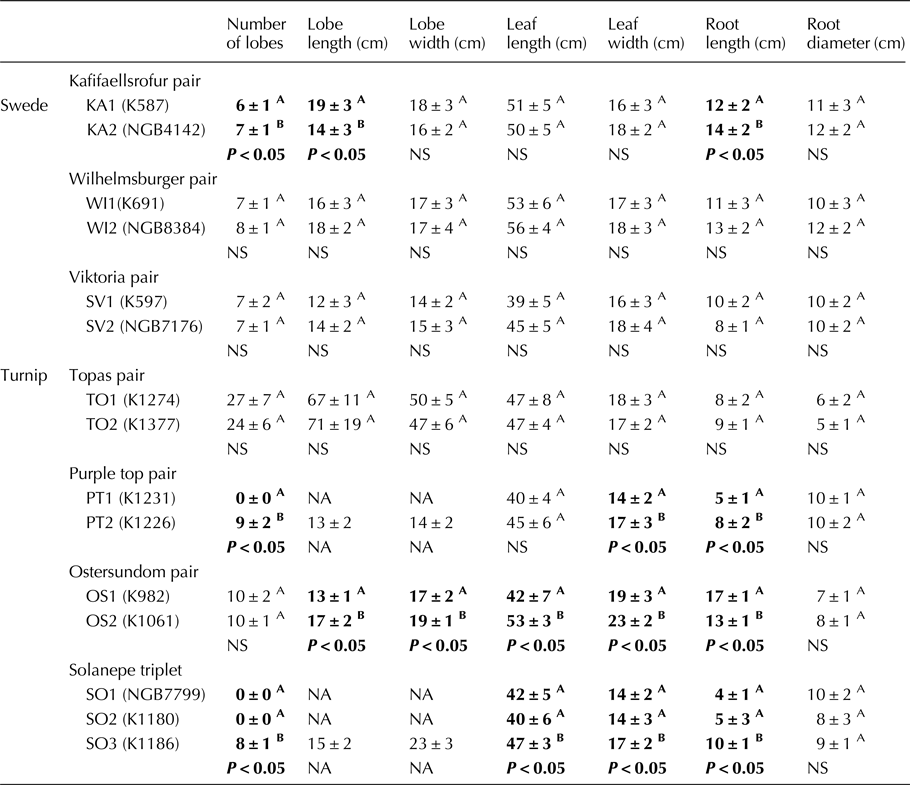
The accessions were planted with a spacing of 50 cm between plants; 27 plants in total divided into three randomized blocks were used per accession of turnip and swede, and 12 plants were used for cabbage. The growing location was Alnarp, Skandia, Sweden (55°N, 13°E), on a loamy clay soil fertilized with about 100 kg/ha PROMAGNA 11-5-18™ (Yara, Norway) at planting and 30 kg/ha YaraMila 22-0-12™ (Yara, Norway) 1 month after planting. Irrigation, biological pest control measures and fungicides were applied to safeguard plant development. Various parameters of each single plant were measured, applying SI units as given in Table 2 (cabbage) and Table 3 (swede and turnip). In addition, leaf colour, head shape and head density were scored for cabbage plants according to categories supplied by UPOV (2004). For swede, leaf type, root skin colour and root shape were scored (UPOV, 2009), as were leaf type, root skin colour, flesh colour and root shape for turnip (UPOV, 2001).
Mean value with standard deviation of the numeric descriptors in cabbage (Brassica oleracea var. capitate) accessions

Significant differences in bold.
Petiole length, width and thickness, leaf lamina width and core width not included.
Mean value with standard deviation of the numeric descriptors in turnip and swede accessions

Significant differences in bold.
Statistical analysis
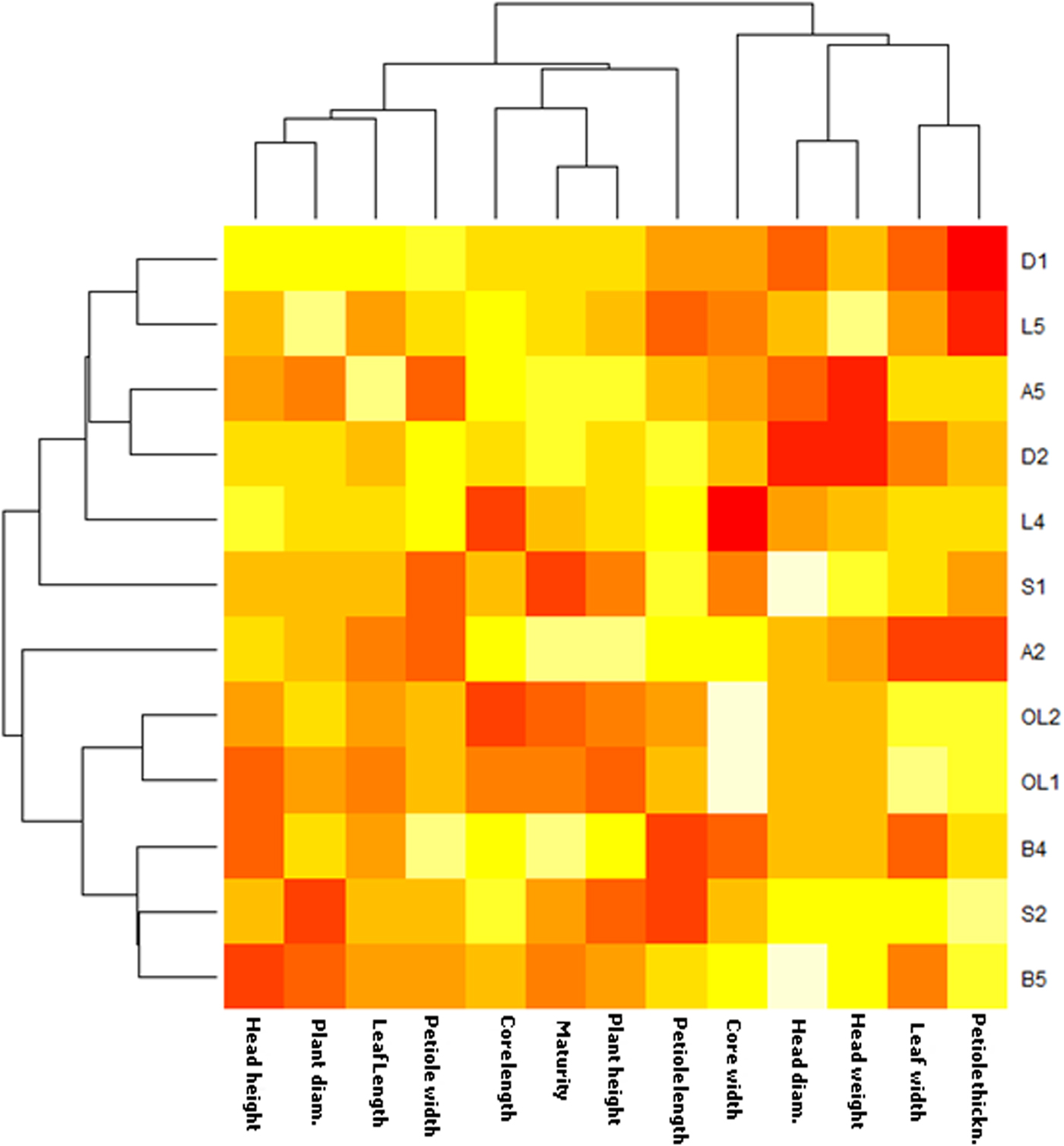
Data was processed following the guidelines defined by Jonge and van der Loo (Reference Jonge and van der Loo2013) and fed into R software (R Core Team, 2014). Boxplots were used to survey the distribution of continuous numeric descriptors. Tukey multiple comparison of means with a 95% family-wise confidence level was used to examine differences among pairs/triplets (Crawley, Reference Crawley2009). The UPOV descriptors (categorical data) were examined by chi-squared statistics. Initially, a chi-square hypothesis test was made for each descriptor, including all data, to verify the relevance of the given descriptor. In cabbage, leaf type and leaf hairs showed no variation and were not included in the further analysis. Similarly, leaf anthocyanin and root flesh anthocyanin coloration in turnip and leaf type in swede were not included in further analysis as no variation was found. Thereafter, a comparison of accessions within a pair/triplet was done. A cluster analysis was conducted for the significant numeric descriptors only. The R function heatmap was used to demonstrate dendrograms for both accessions and variables in the same picture; dissimilarities are expressed as different colours. This is a two-way cluster analysis.
Results
In general, some variability was observed within accessions showing that accessions were not uniform. As expected, some clustering of accessions within pairs/triplets was detected (Figs. 1 and 2). Each figure contains two dendrograms, one for accessions and one for descriptors, shown on either side of the graph. The plotted grinds illustrate the extent of dissimilarity between each combination. Identical colour indicates the same response. In cabbage, the two Staup accessions (S1 and S2) were in different clusters, as were the two Amager accessions (A2 and A5) (Fig. 1). The different descriptors fell into two main clusters, where for example head height and plant diameter were close.
Two-way cluster diagrams (heatmap) of cabbage (see text for explanation).

Two-way cluster diagrams (heatmap) of turnip and swede (see text for explanation).
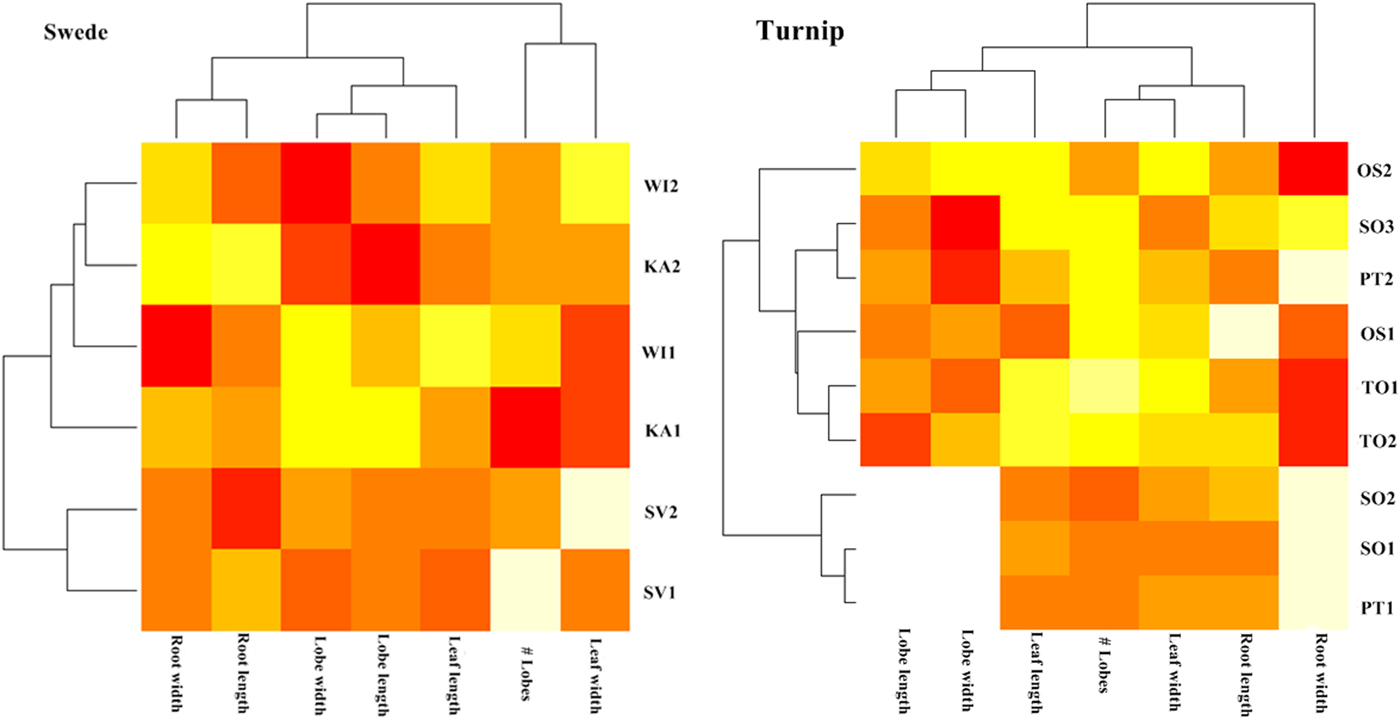
In swede, the Kafifafellsrofur pair (KA1 and KA2) fell into two different clusters (Fig. 2). In turnip, one of the three Sola turnip accessions (S3) was not grouped with S1 and S2. Here, one of the Purple top accessions (PT1) was in the same cluster as the two Sola accessions.
The ANOVA tests showed that all numeric descriptors were relevant for examination with Tukey multiple comparison of means. In cabbage, and based on the numeric descriptors, no clear distinction could be made for three out of six cabbage pairs (Table 2). Significant differences were detected in one character within the Staup pair, the Langendijker Vinter pair and the Blåtopp Kvithamar pairs, respectively. Based on the qualitative, categorical descriptors only minor differences were detected among accessions for the cabbage pairs.
In turnip, three out of four pairs/triplets demonstrated significant differences in two or more numeric descriptors (Table 3). Only the Topas pair (TO1 and TO2) showed no differences in any of these characters. For the qualitative, categorical descriptors, all SO3 plants showed a lobed leaf type, while SO1 and SO2 plants both had an entire leaf type. Furthermore, all PT2 plants were lobed, while PT1 plants had entire leaves. In swede, the Kafifafellsrofur pair (K1 and K2) showed clear differences in number of lobes and lobe length but no major differences in the qualitative, categorical descriptors.
Across the three Brassica vegetable species, around half of the pair/triplets showed clear differences in one or more descriptors, while the other half showed no differences and could thus be regarded as duplicates.
Discussion
To maintain a high number of accessions is costly, especially for outcrossing species such as Brassica vegetables. From a management point of view, any reduction in the number of accessions should be welcomed. Our study clearly highlights the need to include characterization in the duplicate assessment process. In cabbage, plant height, core length and time to maturity were the most useful characters to distinguish between the cabbage pairs. Root length and leaf width were most useful characters for turnip and swede, but leaf type, number of lobes, and lobe length were also useful. In cabbage, we can summarize that the Olsok pair and the Dural pair are true duplicates. In swede, the Wilhelmsburger pair and the Viktoria pair should be regarded as true duplicates and in turnip, the Topas pair. Across species, around half of the pairs/triplets did not fully match. In most of these, one or two traits that did not match. However, in the Ostersunddom turnip pair, the Sola turnip triplet, and the Kafifaellsrofur swede pair, there were more characters that differ. The overall result is in line with Axel Diederichsen's observations (Reference Diederichsen2009) on oat (Avena sativa) accessions in the Canadian genebank. Indeed, having the same name does not necessarily mean that the holdings are duplicates. Numerous causes may account for the differences. Genetic drift caused by random forces, and genetic shift, caused by selection due to errors or improper regeneration protocols, have been showed to cause changes in material conserved ex situ (Soleri and Smith, Reference Soleri and Smith1995; Gomez et al., Reference Gomez, Blair, Frankow-Lindberg and Gullberg2005; Negri and Tiranti, Reference Negri and Tiranti2010). This risk is particularly relevant in small populations during regeneration (Ellstrand and Elam, Reference Ellstrand and Elam1993; Solberg et al., Reference Solberg, Yndgaard and Palmè2017). Van Hintum et al. (Reference Van Hintum, van Treuren, van de Wiel, Visser and Vosman2007) showed that genetic changes under standard genebank regeneration were of a magnitude comparable to the differences among white cabbage accessions with the same or similar names. Van Hintum's team studied genetic diversity applying AFLP markers and questioned conservation of a large number of similar accessions if accessions are in any case changed by regeneration. Van Treuren et al. (Reference Van Treuren, Engels, Hoekstra and van Hintum2009) proposed a strategy to structure genebank collections to avoid under- and over-representation of accessions within each of its different components, building on the concept of core collection, to facilitate a relevant collection for users. In cases with extensive overlap in diversity, duplicates could be removed or bulked (Van Hintum et al., Reference Van Hintum, Sackville Hamilton, Engels, van Treuren, Engels, Rao, Brown and Jackson2002; Cruz et al., Reference Cruz, Nason, Luhman, Marek, Shoemaker, Brummer and Gardner2006). In our case, most putative duplicate accessions are maintained by different genebanks and bulking is not an option, but only one of three similar accessions might be selected to become part of the European Collection. Our study demonstrated that relying on passport data exclusively is fraught with pitfalls. A common challenge is passport data quality; how accessions are named and how information is organized in genebanks. Here, the past century's cultivar naming practice proved to be a challenge. For any given cultivar, a number of strains could be present, as seed companies or research stations frequently made different selections, but retained the original cultivar name or added a second or third name, for example in the case of the cabbage cultivar ‘Blåtopp Kvithamar’. Names given in this period often indicated a ‘strain’ or selection within a cultivar type. Furthermore, in many cases a third name was involved. In the Blåtopp Kvithamar case, time to maturity was the only trait that varied between B4 (Blåtopp Kvithamar Familie 32) and B5 (Blåtopp Fam. 1 Tidlig Kvithamar), where the latter accession was 20 d earlier than the other. This was indicated in the selection name, where the Norwegian ‘Tidlig Kvithamar’ translates as ‘Early Kvithamar’. The two accessions are definitively not duplicates but morphologically closely related. Another example is the Ostersunddom pair. The accessions differ in the majority of the descriptors. Both accessions are maintained in the VIR genebank, and both were received from Sweden in the late 1950s. We have no good explanations why the two accessions are so different, we could only speculate. In the Nordic countries, national variety lists were established in the 1950s (NPVB, 1952) and the UPOV convention came into force in 1969 (NPVB, 1960; Jördens and Button, Reference Jördens and Button2011). Some strains or selections were no longer able to fulfil the DUS-criteria (distinct, uniform and stable) of UPOV, which may be one reason why many cultivars were removed from the variety lists between 1970 and 1980 (Solberg and Breian, Reference Solberg and Breian2015). Nevertheless, major agro-botanical variation, as detected in this study, demonstrates the value of agro-botanical characterization. Indeed, accessions with the same or similar names do not necessarily represent the same material. AEGIS has suggested a road-map for duplicate assessment of accessions at a European level. We would stress that elimination of accessions should only take place in situations where solid data are available.
Acknowledgements
The project was funded by the Nordic Council of Ministers and was conducted within the framework of the vegetable working group at the Nordic Genetic Resource Center. There are no interests of conflicts. This article is dedicated to Sergey M. Alexanian, former vice director for foreign relations, who passed away in 2014.