Introduction
The role of non-Indigenous researchers in Australian Aboriginal and Torres Strait Islander research spaces has become an area of increasing critical scholarly examination. In particular, contemporary scholarship has focused on the concern for Aboriginal and Torres Strait Islander control in research projects involving them as a means of speaking back to constructed knowledge of Indigeneity in discourses (Nakata, Reference Nakata1997, Reference Nakata2003, Reference Nakata2006, Reference Nakata2007a, Reference Nakata and Nakata2007b; Minniecon et al., Reference Minniecon, Franks and Heffernan2007; Gower, Reference Gower2012; Shay, Reference Shay2017; Hogarth, Reference Hogarth2018). This raises questions however about the ‘purity of research outcomes [being] enhanced if the indigenous is researched [only] by the indigenous’ (Foley, Reference Foley2003, p. 46). In an attempt to address such concerns, Minniecon et al. (Reference Minniecon, Franks and Heffernan2007) states that while:
Indigenous control over research allows for questions to be framed differently; priorities to be ranked differently; problems to be defined differently; and people to participate on different terms (p. 25) … [the] non-Indigenous researcher[s] can come to the research relationship with a practice guided by an understanding of the need to find new, culturally appropriate research ‘spaces’ … [where] the focus changes from empathetic understanding to the flexible engagement in an interface that attempts to challenge dominant discourses (Minniecon et al., Reference Minniecon, Franks and Heffernan2007, p. 28).
Zubzycki et al. (Reference Zubzycki, Shipp and Jones2017) argue, however, that in order for non-Indigenous peoples to understand inherently how their own positioning and social histories may influence development of culturally responsive research processes, they ought to be cognisant of the time required to ‘engage in different knowledge systems and trust building processes’ (p. 1324). For Nakata (Reference Nakata2006), concerns for Aboriginal and Torres Strait Islander control in non-Indigenous led research projects involving them are central to:
A whole range of issues … whose knowledge, which parts of knowledge systems, whose language, who is in charge of them, what can be written about them, who owns the intellectual property, for what purposes can they be taught, who decides, and what survives in the translation (p. 271).
These statements couched within power/knowledge relations raise questions for non-Indigenous researchers working and researching with Aboriginal peoples and Torres Strait Islanders. What roles do the non-Indigenous researcher, Aboriginal and Torres Strait Islander participants take where both privileged and non-privileged subjects are engaged and examined? How may knowledge be co-constructed and shared in ways that move beyond race-based constructs permeating binary dichotomies? How does intercultural research take into consideration the entirety of elements contributing to a complex situation? How may intercultural research be presented so that communication methods of the oldest living culture on earth is honoured and embraced with the 21st century of digital technology?
Such questions bring forth discourses of privilege that circulate in and around the Australian academy. Foley et al. (Reference Foley, Golding and Brown2008) argue, for example, that Eurocentric research practices position the researcher as an expert who professes knowledge and the participant/research subject as the data-presenting object. Researchers drawing on Eurocentric theoretical perspectives and methodological constructs then position their research within imperialistic/colonialist codes where ethical processes and methods of knowledge transfer are couched securely within notions of Eurocentrism (Smith, Reference Smith1999). Historically, this has led to ‘inappropriate and invasive research methodologies [that] often ignore the rights of Indigenous Australians’ (Gower, Reference Gower2012, p. 2). To step beyond such practices, Sefa Dei's (Reference Sefa Dei1999) argues that the privileged non-Indigenous researcher has:
An obligation to speak about these issues [minoritising, deprivileging, oppression] because we are all in the same boat. We live in an interdependent world. We need to deal with the sense of complacency that since things are working for me, everything is fine … We cannot continue to read our world in terms of those who have and those who have not (np).
Instead of adding to a ‘unitary system of knowledge’ (Smith, Reference Smith1999, p. 45), non-Indigenous researchers ought to be concerned with conceiving a ‘cultural archive [that] contains multiple traditions of knowledge and ways of knowing’ (Smith, Reference Smith1999, p. 45). Given this, we build upon Lawrence-Lightfoot's (Reference Lawrence-Lightfoot1986, Reference Lawrence-Lightfoot2005) formative studies to develop the cross-cultural oral narrative portraiture method (C-CONPM) in the Aboriginal/Torres Strait Islander/non-Indigenous research space. In the remainder of this paper, we speak about the possibilities of C-CONPM honouring Aboriginal/Torres Strait Islander oral histories processes, rejecting Eurocentric research practices of appropriation and harm and continuing dialogue for interculturally valuable research methodologies.
Portraiture genealogy
The concept of portraiture originated with Lawrence-Lightfoot (Reference Lawrence-Lightfoot1986) as a narrative method to capture the complexity, dynamics and subtleties of the human experience. The purpose of portraiture is to create narratives that provide contextual stories of participants' experiences by bridging the gap between scientific and interpretive paradigms (Lawrence-Lightfoot, Reference Lawrence-Lightfoot2005). The methodological legitimacy of narrative portraiture lies in the shifting nature of research away from ‘a single disciplinary lens of inquiry’ (Lawrence-Lightfoot, Reference Lawrence-Lightfoot2005, p. 8), to a focus on context and voice. The relationships between researchers and participants in this method are central to ensure ‘more participatory, collaborative, symmetric, and dialectic research’ (Lawrence-Lightfoot, Reference Lawrence-Lightfoot2005, p. 9) that produces ‘multiple opportunities for voice in privileged settings without further marginalising groups or individuals’ (Chapman, Reference Chapman2005, p. 27).
Lawrence-Lightfoot (Reference Lawrence-Lightfoot2005) argues that the act of crafting narrative portraits ‘is a discerning, deliberative processes and a highly creative one’ (p. 10) that requires a deep sense of perspective and reflexivity. This is because:
There is a crucial dynamic between documenting and creating the narrative, between receiving and shaping, reflecting and imposing, mirroring and improvising … a string of paradoxes. The effort to reach coherence must both flow organically from the data and from the interpretive witness of the portraitist (p. 10).
The key tenants upon which researchers drawing on portraiture to present narratives are via notions of context and voice. Context is the reference point at which audiences may start to develop situational understanding of participants' stories within a time and place, with voice being the chronological presence of dialogue between researcher and participant (Hill, Reference Hill2005). In this manner, portraiture becomes an interactive process where meanings, context and experience intersect (Bloom and Erlandson, Reference Bloom and Erlandson2003).
While Lawrence-Lightfoot's (Reference Lawrence-Lightfoot1986, Reference Lawrence-Lightfoot2005) studies focus primarily on artistic expression, Smyth and McInerney (Reference Smyth and McInerney2011) build upon the method to develop a guiding text that explains how portraits may be crafted from audio-recorded interview transcripts. They propose three avenues by which this occurs; from interviews, from field notes including observations, and from documents collected as data in a research project. They argue that narrative portraiture is a particularly pertinent methodology because it asserts a:
Counterhegemonic view [where] researchers have a moral and ethical responsibility beyond the “thin” imposed views of university ethics committees – to work with and advance the lives of those who are institutionally and systematically the most excluded and silenced (p. 17).
The originality and legitimacy of Lawrence-Lightfoot's (Reference Lawrence-Lightfoot1986, Reference Lawrence-Lightfoot2005) formative studies have been taken up by a range of other scholars, particularly those concerned with exploring power/knowledge relations where one group of people are privileged and others marginalised. Golding (Reference Golding, Falk, Golding and Balatti2000) drew upon the narrative portraiture method to present the importance of wellbeing and social capital inherent to Koorie Elders as the surrounding urban environment increasingly becomes Westernised. Chapman (Reference Chapman2005) employed the portraiture method through the lens of critical race theory to demonstrate the complex relational dynamics operating within a racially diverse and contextually layered urban classroom in the United States. Hill (Reference Hill2005) used portraiture to develop poems that captures the experiences and practices of three Black women teacher educators. Each of these scholars' studies point to the power of the portraiture method as the humanistic impulse of storytelling that has the potential to influence public discourse by blending analytic rigour with community building (Featherstone, Reference Featherstone1989). Featherstone (Reference Featherstone1989) describes it as ‘a people's scholarship [in which] scientific facts are gathered in the field to give voice to a people's experience’ (p. 375).
The use of portraiture method as a stand-alone approach however is not advocated by any scholars who draw upon it. Lawrence-Lightfoot (Reference Lawrence-Lightfoot2005) even argues the need for multi-disciplinary research in spaces where researcher and participant are entangled relationally in interpersonal, social and ethical histories. Similarly, Smyth and McInerney (Reference Smyth and McInerney2013) argue for advancing the sterile and detached research practices espoused by university committees to ‘reveal more socially just and democratic alternatives’ (p. 16). Methodologically, studies presenting interviews as narratives view research subjects as active participants who researchers work with and for to offer insights into exclusionary processes. By ‘listening [and responding] to the voices of those who are traditionally most muted [and] treating them in a more robust and respectful way’ (Smyth and McInerney, Reference Smyth and McInerney2013, p. 4), agents of change orientated towards interrogating power/knowledge relations of exclusionary processes emerge.
Making a case for cross-cultural oral narrative portraiture method (C-CONPM)
One of the most complex considerations non-Indigenous researchers' knowledgeable about Australia's socio-political–historical relations between European arrivals, Aboriginal peoples and Torres Strait Islanders is how their stories may be conveyed in ways that are respectful and culturally appropriate (Gower, Reference Gower2012). Nakata's (Reference Nakata1997) discussion of life worlds as the interface of two cultures serves as a useful model for theorising the non-Indigenous researcher position within an Aboriginal and Torres Strait Islander research space. Nakata (Reference Nakata1997) says that ‘there is an Islander [Indigenous] position and there is a non-Islander [Indigenous] position. But, there is another dimension where the trajectories of two different histories come together to produce conditions that circumscribe’ (p. 14) how we make sense and enact our lives. In this manner, the fallacy of the excluded middle is rejected. Rather than continuing to portray ‘the marginalisation and sterilization’ (Chapman, Reference Chapman2005, p. 28) of Aboriginal peoples and Torres Strait Islanders' experiences from the privileged non-Indigenous position, Nakata (Reference Nakata2007a) theorises that non-Indigenous researchers ought to afford agency to Indigenous peoples' as participants to actualise stories, experiences, histories and cultures, in culturally responsive ways.
Rather than simply doing no harm—the foundation upon which many research projects are approved ethically—researchers ought to do moral research that ‘takes a stand with/for those most adversely affected by unfair practices and discriminatory polices’ (Smyth and McInerney, Reference Smyth and McInerney2013, p. 15). In Australia's cross-cultural research space, we have seen this made possible through research prioritising theorisation of the Aboriginal and/or Torres Strait Islander position, such as Indigenous Standpoint Theory (Foley, Reference Foley2003; Nakata, Reference Nakata and Nakata2007b; Kinefuchi and Orbie, Reference Kinefuchi and Orbie2008; Nakata et al., Reference Nakata, Nakata, Keech and Bolt2012; Hogarth, Reference Hogarth2017), Indigenous Critical Discourse Analysis (Hogarth, Reference Hogarth2017), Indigenist Research Principles (Rigney, Reference Rigney1999) and Indigenous Women's Standpoint Theory (Moreton-Robinson, Reference Moreton-Robinson2013) to name a few. While touted as Indigenous research methodologies (IRMs) reserved for Indigenous researchers primarily, one of the authors (Weuffen, Reference Weuffen2017) have put forward the argument previously that as a non-Indigenous researchers draw upon IRMs as a lens of inquiry, in conjunction with other non-Indigenous methodologies, the construction of narratives that step beyond binary dichotomies becomes imaginable. This is supported by Hogarth (Reference Hogarth2017) who argues:
Drawing on both Indigenous and Western methodologies, theorising and articulating Indigenous and non-Indigenous theories further develops understanding of how research itself can be used proactively to speak back to the deficit discourses [and] challenge the societal norms (p. 32).
We argue that employment of a grey methodology—one that encompasses Indigenous and non-Indigenous methodologies—assists non-Indigenous researchers to develop a reflexive cautionary praxis where culturally appropriate methods of creating narratives avoid marginalising the voices and complexity of participant experiences (Chapman, Reference Chapman2005).
Yet, application of a grey methodology raises questions in relation to how non-Indigenous researchers new to working in the space, and with Aboriginal and Torres Strait Islander communities, may step beyond the coding conditions of their own positionality in research; a position infused with social, historical, cultural and relational experiences. Perhaps as an avenue to understanding their positioning better, novice non-Indigenous researchers would benefit more from working with race-based methodologies initially such as whiteness theory, critical race theory and decoloniality to name a few. This is because race-based methodologies guide researchers to critique the theoretical and practical Western order of things. An interesting conundrum of these race-based methodologies however, is that while the intention is to disrupt privileged research processes, those same privileged research processes are employed to conduct the interrogation.
Researchers' reflective engagement of their own positionality, and ways in which participants are involved in research projects, is an important step to avoiding repetition of harmful research practices, particularly ones that create division. Critique of divisional practices in cross-cultural research spaces is important because the adversarial position is a:
Simplistic division that situates ‘us’ in relation to ‘them’. That is, the cultural paradigm is but another way to articulate the same division … the bind that is the power in knowledge, that serves to reify old relations and that conditions future possibilities (Nakata, Reference Nakata1997, p. 310).
As this occurs, the notion of othering permeates dominant ideologies in the Australian research/education space, identifying who we (and not they, or others) are as a society, our practices, and our knowledge systems, as a way of maintaining privilege (Foucault, Reference Foucault1970; Smith, Reference Smith1999; Nakata, Reference Nakata2003).
Portraiture in the form of narratives then provides a platform from which non-Indigenous researchers may attempt to deviate away from their privileged researcher positions—invariably couched within colonial/imperialist discourses—in discussions of data. One way in which we argue this may be possible is to avoid massaging interviews so they align prescriptively with Eurocentric research practices. Because the researcher holds ‘responsibility to demonstrate the complexities of people lives and the contexts influencing’ (Chapman, Reference Chapman2005, p. 48) their experiences, stepping beyond assumed norms of data (re) presentation is important because:
Most cross-cultural research is guided by a set of ethical considerations that are irrelevant, unrealistic, and/or possibly inappropriate and insufficient to address the complexity of such encounters. We are better researchers when we push ourselves to confront those aspects of our work that cause us discomfort (Andrews, Reference Andrews and Clandinin2007, p. 498).
Challenging binary dichotomies in Eurocentric research discourses illuminates ways in which Aboriginal peoples and Torres Strait Islanders have been ‘suspended and dislocated from their own historical context for academic scholars [to] transform people into objects to study’ (Nakata, Reference Nakata1997, p. 237). There exists precedence in the use of narratives to convey the interrelated connectedness in the Bringing them Home: The Stolen Children Report (Australian Human Rights Commission, 1997). As Smyth and McInerney (Reference Smyth and McInerney2013) discuss, this report highlights ‘just how powerful this form of representation can be … because of the prominence given to voices and stories’ (p. 5). Furthermore, Ulalka Tur et al. (Reference Ulalka Tur, Blanch and Wilson2010) contend that foregrounding voice within Indigenous narrative portraiture ‘confronts the silence to incorporate the multiple voices that make one who we are’ (p. 64).
Privileging Aboriginal and Torres Strait Islander voices and emphasising the richness of their experiences in what is arguably otherwise Eurocentric research projects, manifests within C-CONPM by drawing on the notion of storytelling, or, to use the cultural term, yarning (see e.g. Dean, Reference Dean2010; Geia et al., Reference Geia, Hayes and Kim2013). The presentation of stories, as they are spoken in real time and real language, articulates and justifies the cultural appropriateness and post-structuralist uniqueness of C-CONPM. It creates an opportunity for wider readership due to the nature of the research being presented in a manner that is ‘understandable, not exclusive and esoteric’ (Lawrence-Lightfoot, Reference Lawrence-Lightfoot2005, p. 9). The use of C-CONPM challenges the homogenisation of ‘rich indigenous knowledges so [they can] fit a western view [and] recognises the value of indigenous knowledge and its connections to other forms of knowledge’ (Benham, Reference Benham and Clandinin2007, p. 513), which ‘advances and highlights the sustaining features of cultures and communities that are rarely promoted’ (Chapman, Reference Chapman2005, p. 31). It creates a space that ‘gives voice to those who rarely get the chance to enter into public conversation’ (Lawrence-Lightfoot, Reference Lawrence-Lightfoot1986, p. 26).
Rather than being seen as good practice, we argue that presenting Aboriginal and Torres Strait Islander stories as oral narrative portraits facilitates making sense of, and challenging, hegemonic research practices in Australia. The need for advocatory research practices is explored by Smyth and McInerney (Reference Smyth and McInerney2013) as a response to:
The highly politicised research climate … to restore the political balance unashamedly with and for people and groups in society whose interests, voices, and perspectives are silenced, excluded, marginalised, expunged or totally denied (p. 2).
One way in which such politicisation manifests is by examining the constraints of a PhD thesis. Any thesis presenting content outside the written word is considered primarily an exegesis and/or a creative-based research piece. While a few pictures or tables may be considered normative practice to illuminate particular arguments, the use of C-CONPM in Weuffen's thesis (Reference Weuffen2017) was considered initially as unnecessary and/or a ‘nice thing to do’; their integration was considered not essential. We make the case that C-CONPM is not a feel-good endeavour, rather it is a culturally responsive and appropriate practice more suitable than race-based theories in affording ‘priority to language formation in its socio-historical context’ (Nakata, Reference Nakata1997, p. 97) to reflect the manner in which stories have been transmitted in Aboriginal and Torres Strait Islander communities for over 40,000 years (Dean, Reference Dean2010; Geia et al., Reference Geia, Hayes and Kim2013).
For many Aboriginal and Torres Strait Islander participants where trust and relationships between them and the researcher are built, the interview process is not a stoic professional interaction solely; it is one of yarning. Yarning as a process of interacting and telling stories:
Illuminate[s] knowledge in such way[s] that it connects us to the roots of who we are as individuals and as a community. For indigenous [sic] people, narratives are evocative accounts of sovereignty and loss, as well as identity and home. They are detailed and contextual, recognising the importance of community and place (Benham, Reference Benham and Clandinin2007, p. 512).
Being aware and sensitive to the historical power/knowledge relations between non-Indigenous peoples, Aboriginal peoples and Torres Strait Islanders through a grey methodology lens ensures caution to not ‘overlook or oversimplify’ (Nakata, Reference Nakata1997, p. 29) the intricacies of stories. Rather than ignoring the historical race-based social and research practices that continue to reinforce deficit discourses, or creating false optimistic accounts, C-CONPM creates a powerfully paradoxal dialogue where ‘the beautiful/ugly experiences that are so much a part of the texture of human development and social relationship’ (Lawrence-Lightfoot, Reference Lawrence-Lightfoot2005, p. 9) are laid out in their humanistic rawness. This rawness opens space for connections of experiences between audience and participant, and conversations to advance/reject discussions of the fallacy of the excluded middle in Australian cross-cultural research practices.
Crafting oral narrative portraits
Creating cross-cultural oral narrative portraits begins with the interview. As Smyth and McInerney (Reference Smyth and McInerney2013) say, ‘portraits [as they are] developed from semi-structured individual interviews and conversations, rejects flat, stereotypical explanations [and rather focuses] on the capacity of to convey the emotions, depth of feelings and intellectual reasonings’ (p. 6) of participants' stories. To capture the richness and complexity of the socially and culturally bound stories, ‘the context becomes the reference point to place people and action in time and space and a resource for understanding what they say and do’ (Hill, Reference Hill2005, p. 96). In taking up the concept of portraiture, the researcher takes care to ‘honour the voices of participants, not ride over them … smashing up what they say into fragments’ (Smyth and McInerney, Reference Smyth and McInerney2013, p. 4). In this manner, C-CONPM (re)constructs an interview so that the audience is able to experience the ‘timbre, resonance, cadence and tone of [the] voices, their messages and their meaning’ (Lawrence-Lightfoot and Davis, Reference Lawrence-Lightfoot and Davis2002, p. 99). As they are developed, English's (Reference English2000) concern for a central tendency that overrides the truthfulness of the narrative are addressed. Rather than setting the audience up to feel a certain way, the autobiographical presence encapsulated by oral narrative portraits allows the audience to hear the personal histories, experiences, connections to family and community, and cultural practices as they were shared in interviews (Lawrence-Lightfoot and Davis, Reference Lawrence-Lightfoot and Davis2002).
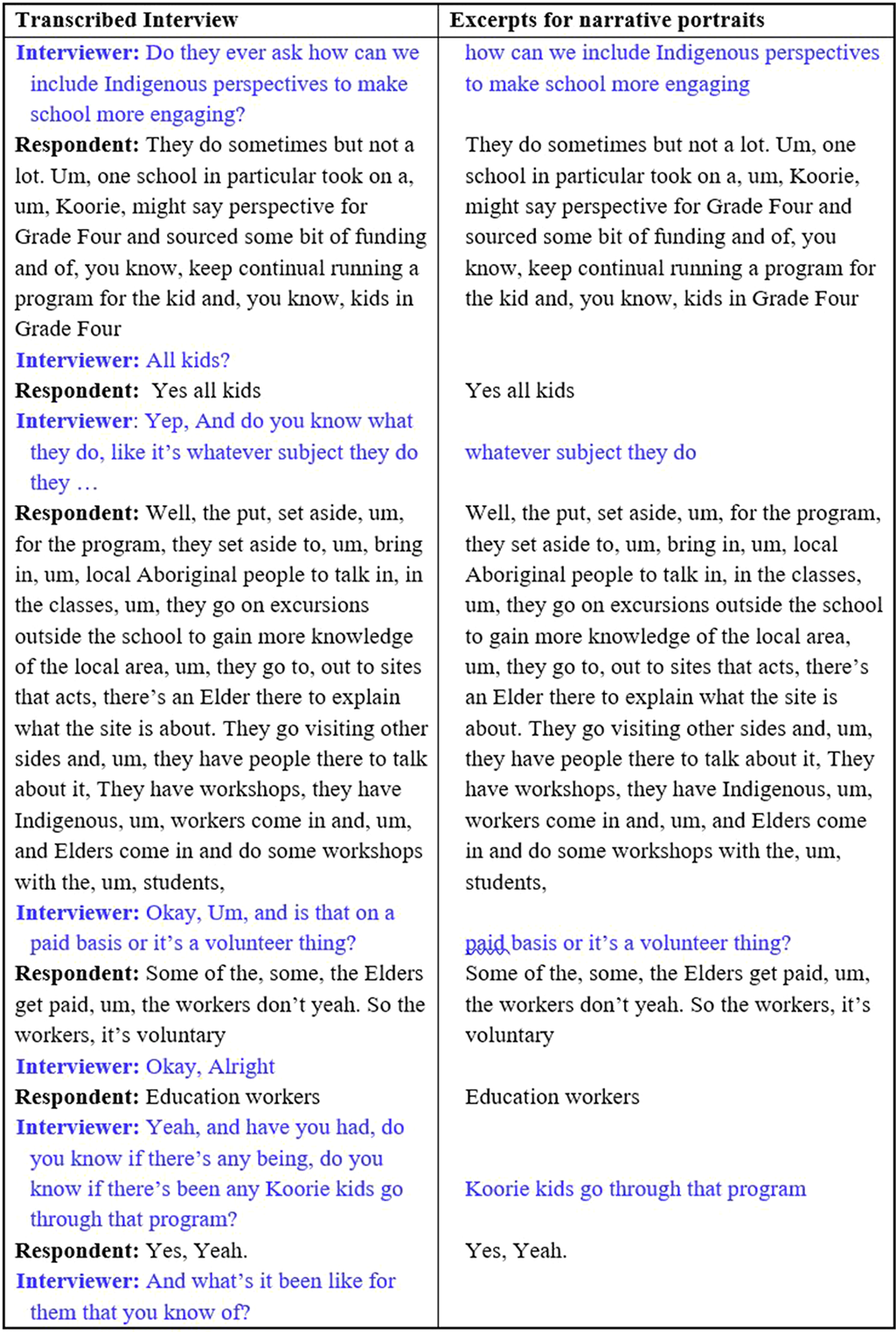
To craft narrative portraits from interviews, we assumed a preservationist position where dedication to ‘presenting the original speech in such a way as to reproduce the sounds as they appear on the tape as accurately as possible’ (Smyth and McInerney, Reference Smyth and McInerney2013, p. 11) is of primary interest. This included working with ‘the respondent's hesitancies and non-standard grammatical constructions’ (Weiss, Reference Weiss1994, p. 192, cited in Smyth and McInerney, Reference Smyth and McInerney2013, p. 11). The first stage of C-CONPM is to create a document in Microsoft Word and create a table, split into two columns and two rows. The top row contains a title that reflects content in each column. The second row contains the raw transcript from the semi-structured interviews in the left-hand column, and the first stage of C-CONPM development in the right-hand column.
In the first-stage, Lankshear and Knobel's (Reference Lankshear and Knobel2004) categorical content analysis is extended upon to systematically organise voices within the text. Colour-coding is applied to identify clearly, and at a glance, the researcher's voice in questioning (blue) and the participant's voice as responses (black). The use of colour-coding as Pappaluca (Reference Pappaluca2018) explains is a visual indicator to identify ‘whose voice is being privileged over others within the text [which] allows the reader to ‘see’ who is talking clearly’ (p. 96). During this stage of C-CONPM, responses from the Koorie participant are copy and pasted directly from the left-hand column to the right-hand column, minus the proper noun signifier. To assist making sense as a stand-alone text, questions posed by the researcher are reviewed to identify appropriate statements that provide contextualisation of responses from Koorie participants, which are then copy and pasted into the right-hand column. The first-stage process of C-CONPM is represented visually in figure 1.
First-stage of oral narrative portraiture development: extracting statements from interview transcripts.

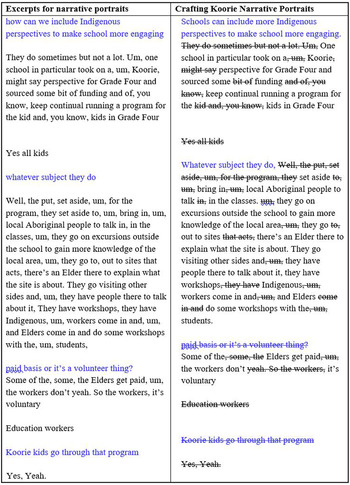
The second-stage of C-CONPM requires another blank document to be created using Microsoft Word, with one table, split into two columns and two rows. The top row contains a title that reflects content in each column, with the second row containing reflective textual content. The first column contains precise excerpts for narrative portraits developed during the first-stage of the method, copy and pasted from the first document. During this stage, the right-hand column is used to make editorial amendments to excerpts to create conventional paragraphs for sense making (Zeegers, Reference Zeegers2013). Discussions held throughout interviews not aligning with the key research questions, or interrupting the narrative flow, are removed. The second-stage process of C-CONPM is represented visually in figure 2.
Second-stage of oral narrative portraiture development: crafting Koorie narratives.

The third-stage process of C-CONPM requires the creation of another blank document in Microsoft Word, where content from the right-hand column of the second-stage process is copy and pasted. While listening to the raw audio recording of the interview, the researcher applies further editorial amendments to the narrative portrait, namely the insertion of grammar and square brackets, all-the-while ‘remain[ing] faithful to the words and meaning of the original transcript, but accept[ing] the need for editing [for] a more coherent and readable text’ (Smyth and McInerney, 2011, p. 11). Because ‘interview talk is by nature, interpretation work [that is reflexive, theoretical, contextual and textual] concerning the topic in question’ (Talja, Reference Talja1999, p. 6), to guide against the ‘distorting effects of personal bias’ (Lather, Reference Lather1986, p. 86), the final narrative portrait as a clean document is sent back to the participant for review. The process known as member-checking has been argued to enhance rigour in qualitative research (Guba and Lincoln, Reference Guba, Lincoln, Denzin and Lincoln1994), yet Birt et al. (Reference Birt, Scott, Cavers, Campbell and Walter2016) argues the process ‘raises ethical questions about the protection of participants during the research process, [in particular], whose voice is being bought to the fore’ (p. 1805).
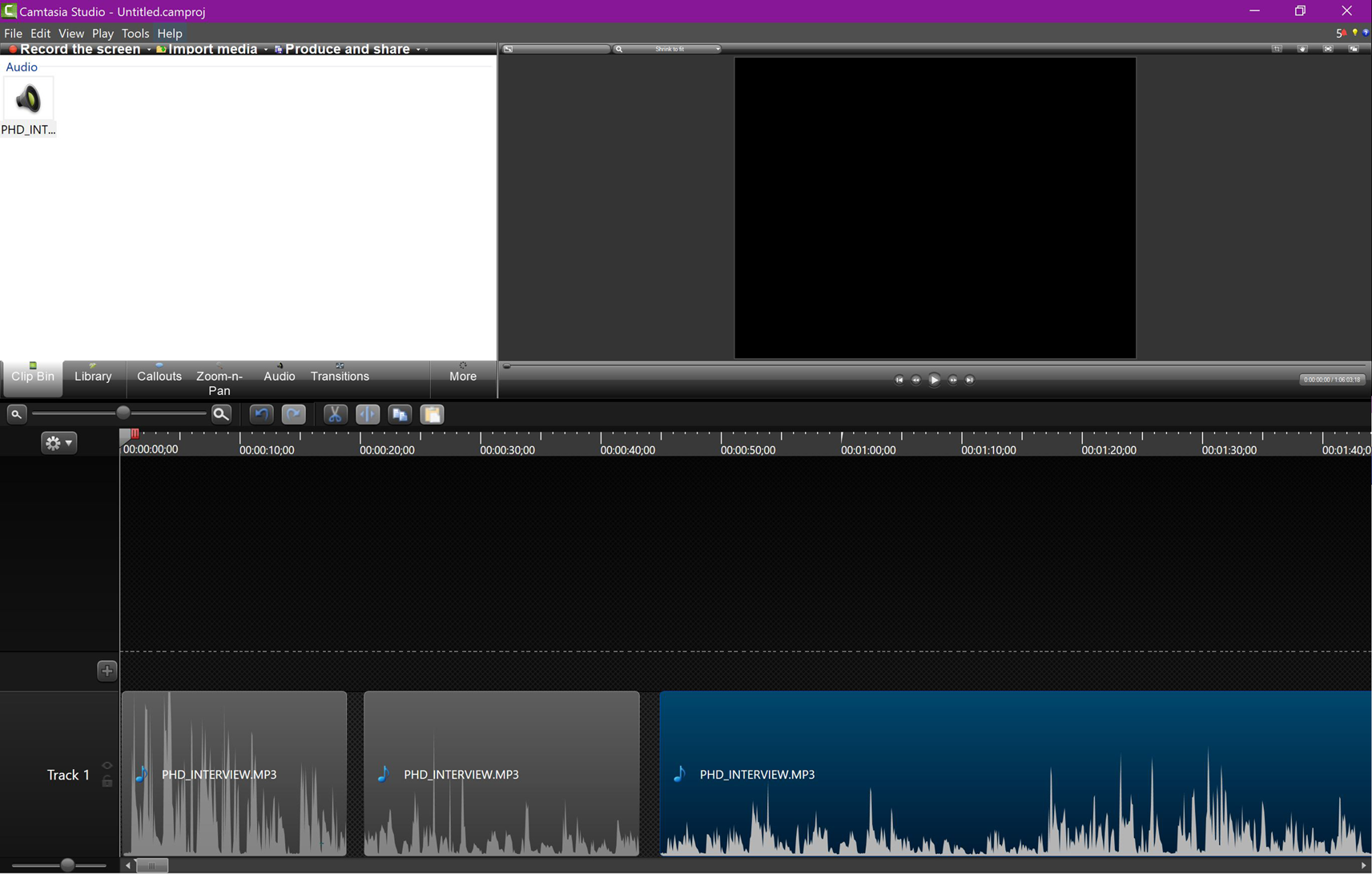
The fourth-stage and final-stage of C-CONPM is to develop an audio file that is a direct reflection of the portrait. Using Camtasia® (https://www.techsmith.com/video-editor.html) software, we uploaded the entire interview recording. With the final narrative portrait on hand, we cut out sections of the recording that contained either the interviewer's voice, or excerpts spoken by the participant not used in the final narrative portrait. We then proceeded to make a seamless audio file of the narrative portrait; a detailed explanation of the process is beyond the scope of this paper. The fourth-stage process of C-CONPM is represented visually in figure 3.
Fourth-stage of oral narrative portraiture development: creating the audio file.

Provided below is an excerpt of one oral narrative portrait developed for a PhD thesis (Weuffen, Reference Weuffen2017). For contextualisation, this portrait discusses the participant's experiences of the Australian education system, in particular, ways in which Aboriginal culture and support for Aboriginal students is understood in the Australian social landscape.
Note: Due to the purpose of C-CONPM, the audio file should be listened to simultaneously while reading the narrative.
A Koorie Engagement Support Officer (KESO) supports kindergartens and schools – primary and secondary – around enrolment of Koorie students in their schools, liaising with schools to make sure they've got school uniforms, books, advising parents how to around how to get money for uniforms and books for school. [KESO] liaise with the department [Department of Education and Training] and the different workers in there [such as] nurses, student welfare, early years prevention and networking with different organisations.
The teachers come for advice, sometimes the teachers ring up and invite us, the KESOs, out to [their] schools to talk to us around what's appropriate, what's not appropriate with Koorie kids and Aboriginal areas [of the curriculum]. The schools taken on a responsibility and they've got to make sure that there's someone there that the parent and child can go to that has got some knowledge about Koorie families. So they gotta be there for them and be equipped to answer any questions or support those Koorie kids.
One school in particular took on a Koorie perspective for Grade Four and have sourced some funding for it, to keep continually running that program for the kids [students] in Grade Four. [This school] sets aside time to bring in local Aboriginal people to talk in the classes, they go on excursion outside the school, to gain more knowledge of the local area, they go out to sites where there's an Elder there to explain what the site is about. They go visiting other sites and have they people there to talk about it, they have workshops that have Indigenous workers come in, and Elders, to do workshops with the students. Some of the Elders get paid but the workers don't, it's voluntary. It's an experience having their grandfather who's an Elder come along and explain his knowledge of the area, do a smoking ceremony before they leave. They feel empowered at the end of their program where they have a concert and they get into groups of emu, kangaroos and they perform those at the concert to the whole school. Students really enjoyed the program and their younger siblings are keen to get to Grade Four to do the program. They work in the class and they work with parents to make costumes and things like survival bags where the kids collect items on the way on their journey. [In the bag] they could have something to eat in it while they're walking, they can pick up some information, leaves, or something along the way. Being on Wadawurrung Country, they learn about the significance of the area they're going on excursion to.
It's about consulting with Aboriginal people, finding out as much information on the area, who the Aboriginal people were here, how many were here, where were the significant sites that they frequent, gain lots of information on the area, and that gives you more knowledge of understanding Aboriginal people.
If you're talking about Koorie, if it's in a class you gotta be aware that some students might be Torres Strait Islander so it's probably preferred to use Aboriginal and Torres Strait Islander. You can use mobs, clans, tribes, but if there's aversion around the [word] tribe, they used to call them tribes back then, but tribes might have been wiped out and then it comes down to what clan you're associated with, and then it comes down to the mob which was your family. Mobs are your family connection and it could be a big family connection. Clans are clans where everybody sorta comes into there, and a tribe bigger like a community. [When schools or teachers contact us it's around] is this appropriate, [or] can we use this. [For example, they might say] ‘We've got this resource from, for example, Queensland’, and we would say ‘well it's no, you need to look into the local area; we have a rich history and knowledge of the local area’. Sometimes it does [become tedious], but if you've got the finger on the pulse to know where to find it, [it's easy]. Being Aboriginal people, we have the knowledge and information to share, and if we don't, we source it.
If you don't build a relationship you're not going to get anywhere.
[Sometimes we might get] teaching saying ‘well I don't have an Aboriginal child in my class’, and that's when you say ‘oh?, yes you do, this is their name’, [then the teacher says], ‘but] they don't look Aboriginal’. Well you just say ‘well they are, even though [they have] blond hair, blue eyes’. You just say ‘come along to our cultural awareness information sessions’.
We had a Koorie education policy, but now [all] we've got is a Koorie education strategy [which is departmentally constructed], consulted with the Aboriginal education association (VAEAI), Koorie workforce, communities. It gives us a direction in our work with those strategies, but there is a strategy and we're still waiting; it was soft launched and we're still waiting to see if the new government is going to use that strategy. I believe there was some hoo-haa about it, so we've been told to just hold off [and] don't get it out there at the moment. Look, we've had strategies, we've had policies, but they send them out to schools [and] where do they end up?, on a bookshelf, not even looked at. And then you say, [during] a PD ‘have you got this book?’, [they say] ‘No, I haven't see that one’, [we say] ‘Well perhaps you better go back to your school and have a look on the shelf somewhere’.
I haven't had any consultation [from school about the curriculum]. When the national curriculum was [being developed] they were looking at it, they had lots of consultation with Aboriginal communities right across Australia and they had lots in Melbourne. They [curriculum developers] had to have consolation with Aboriginal communities because I remember going to a couple in Melbourne. There was an Aboriginal person that was on the committees that were working on it [the curriculum], because I was in a group and we were asking the questions back to these people that were on the committee working on the curriculum, say for example history, but because there was only one rep, it [questions] had to taken back to that committee to consult more.
Critiquing C-CONPM
In adopting what is, arguably, a standardised approach to crafting narrative portraiture, it could be disputed, that the researcher's voice can never be fully extracted from the narratives, since it is that voice which enables the stories to exist in the space. As Clandinin's (Reference Clandinin2007) notes, ‘stories, as they are collected, are co-constructed by [the] researcher and research participant, but … in interpreting and representing they become the stories of the researcher constructed for the research audience’ (p. 458). To this, English (Reference English2000) argues that the ‘inclusivity claimed by portraiture undermines itself. Inclusivity and omniscience are only possible to present [as] a singular, grand, encompassing truth’ (p. 23).
It could also be reasoned that because the creation of narratives are so tightly bound within the research process, the researcher's voice/presence seeps through to potentially distort subject meanings, due to their position and the manner in which portraiture as art evolves (Lawrence-Lightfoot, Reference Lawrence-Lightfoot1986, Reference Lawrence-Lightfoot2005). However, Smyth and McInerney (Reference Smyth and McInerney2013) contend that while ‘it is ultimately the researcher's perspective, experiences, and ideological beliefs that influence the construction of the portrait’ (p. 10), the rawness of crafted narrative portraits:
Helps to recreate the immediacy and spontaneity of the actual encounter [to a point where] humanity shines through, and we [the audience] are paired with the niceties of carefully measured words and detached judgements (p. 7).
In the case of cross-cultural research, non-Indigenous researchers engaging Aboriginal and Torres Strait Islander participants may face possible objection to the use of C-CONPM. Namely, this may be via the argument that any co-creation and interpretation of stories told by Aboriginal peoples and Torres Strait Islanders can only be infused with views and interests held by the researcher's privileged position within Eurocentric research practices. Foley et al. (Reference Foley, Golding and Brown2008) asserts that because of this, there is the potential for the individual researchers' presuppositions to create and distort inferences and therefore alter and dilute the authenticity of Indigenous peoples' stories for the purposes of the research project.
As we will speak about in a forthcoming paper, the intention of C-CONPM is not to deconstruct the interview, extract themes and write to the commonalities and discontinuities uncovered between participant experiences of a phenomenon. Neither is the process a superficial application of methodology employed to sit within normative qualitative research practices. This is because:
The inclusion of mere snippets or fragments from lengthy transcripts can rob a report of important contextual information and separate out details of participant's lives that add to the complexity and authenticity of the story (Smyth and McInerney, Reference Smyth and McInerney2013, p. 4).
We maintain that construction of C-CONPM through a grey methodology lens, and emerging from trusting and respectful relationships between the researcher and interviewee, is a concerted and politically imbued attempt to dim the non-Indigenous researcher voice/presence in an Aboriginal and/or Torres Strait Islander story. In saying this, we consider C-CONPM a method more suited to experienced researchers already committed to engaging ethical research that respects, validates, and foregrounds Indigenous voices; researchers who understand, and undertake concerted efforts to build meaningful, respectful, and productive relationships with Aboriginal and Torres Strait Islander communities (Wilson, Reference Wilson2008; Geia et al., Reference Geia, Hayes and Kim2013).
While we argue that any research has the potential to manipulate data, the purpose of C-CONPM is to enable critical examination and flexible engagement of intercultural ways in which non-Indigenous researchers may work with, rather than research on Aboriginal peoples and Torres Strait Islanders, their cultures, their ideologies, and IRMs. As De Lissovoy et al. (Reference De Lissovoy, Campos, Alarcon, Malott, Porfilio and Kress2013) may argue, the aims, process and outcomes of C-CONPM have the potential to ‘extend our thinking by acknowledging and challenging the power dynamics [that] explicitly decentre the authoritative voice of the researcher’ (p. 35). In other words, presenting Aboriginal and Torres Strait Islander stories as oral narratives is an example of the actualised engagement of ‘decolonial knowledge-making, that reasserts and draws in concepts and meanings from Indigenous knowledge and systems of thought and experiences’ (Nakata et al., Reference Nakata, Nakata, Keech and Bolt2012, p. 124).
The question of how non-Indigenous researchers may best present stories told by Aboriginal peoples and Torres Strait Islanders, while also complying with Eurocentric research practices, raises power/knowledge relations issues that interweave and circulate throughout cross-cultural research. We acknowledge the everyday tensions existing between non-Indigenous researchers, Aboriginal, and Torres Strait Islander participants in the cross-cultural/racial research space, yet seek to imagine possibilities that exist beyond culturally/racially bound constructs. We question, how may cross-cultural stories be presented in ways consistent with the researcher's Eurocentric position, while also resisting them by taking up IRMs consistent with the Aboriginal and Torres Strait Islander participant positioning? (Rigney, Reference Rigney1999; Smith, Reference Smith1999; Wilson, Reference Wilson2008; Singh and Major, Reference Singh and Major2017). This crisis of representation, as Richardson (Reference Richardson1997) argues ‘challenges the grounds of [one's] own and other's authority, and raises ethical questions about [one's] own practices’ (p. 298).
While non-Indigenous research projects may not engage IRMs as formative guiding frameworks, we make the case that drawing on Aboriginal and Torres Strait Islander concepts of storytelling intentionally as a means of developing oral narrative portraits, moves them towards a more intercultural space. The give and take of cultural knowledge, or reciprocity, in such intercultural spaces, enables ‘a mutual recognition of meaning and power … between researcher and researched and between data and theory’ (Lather, Reference Lather1986, p. 263). In taking up such practices, the researchers:
Recognises that reality is more than negotiated accounts – that we are both shaped by and shapers of our world. [Yet, they are] challenged [to consider] how to maximise the researcher's mediation between people's self-understandings and transformative social action without becoming impositional (Lather, Reference Lather1986, p. 269).
This has been an important consideration in C-CONPM because as Nadasdy (Reference Nadasdy2004) argues, only when non-Indigenous researchers ‘take into account [Indigenous] peoples’ approaches to interpersonal interactions with agents and processes of the state’ (p. 28) are cross-cultural research approaches positioned to disrupt and challenge privileged discourses of Eurocentric research processes.
Given this, we acknowledge that there is a deep engagement of power/knowledge relationships in any attempt to extract the privileged voice from a text. The very reality and persistent preoccupation that the researcher's voice can never be completely extracted from the crafted narrative only continues to ‘keep the spotlight firmly on power relations so as to expose the forces of hegemony and injustice’ (Crotty, Reference Crotty1998, p. 157). While there exists undercurrents of privilege where the position of non-Indigenous researcher to Aboriginal and Torres Strait Islander participant is concerned, this only remains true while particular research practices are privileged over others. The possibility for such power/knowledge relations to be disrupted lies in the interrogation and possibilities for enhancing Australian research practices.
Examining the possibilities
We acknowledge that the C-CONPM discussed in this paper is not immune from critique from the research community, because ‘the issue of communicating across cultural boundaries is a major challenge to the very foundation of our dominant theoretical frameworks’ (Apfelbaum, Reference Apfelbaum2001, p. 32). In advocating for this approach, we argue that Aboriginal and Torres Strait Islander stories presented as oral narratives, honours and foregrounds ‘the diversity of older traditions and historical experiences’ (Nakata, Reference Nakata2006, p. 272) as they manifest in knowledge transfer/storytelling/yarning today. Shay (Reference Shay2017) argues that there is a growing need for ‘theoretical frameworks that re-present multiple Indigenous knowledges and experiences’ (p. 57). While the suite of IRMs offer lenses for (re)presentation of multiple knowledge and experiences, overwhelmingly they are couched within discourses of Indigeneity. We argue that C-CONPM may be seen as a more culturally accessible tool that non-Indigenous researchers may engage to step beyond Eurocentric research paradigms. Had Weuffen (Reference Weuffen2017) decided to conduct a discursive analysis of interviews held with Koorie participants in the same manner as teacher participants for example, the stories and voices of Koorie peoples would have been lost within the grand-narrative of researcher interpretation; picked apart, coded and decontextualised. Their stories and voices would once again have been subject to the Eurocentric ‘scientific discourse that construct[s] knowledge about [them]’ (Shay, Reference Shay2017, p. 57).
We argue that a major objective in cross-cultural/racial research should be for the privileged researcher to acknowledge and work with and through other knowledge systems as a means of disrupting hegemonic research agendas. We feel strongly that the non-Indigenous researcher has a responsibility to:
Acknowledge that [they] are telling a narrative of a community embedded in place and space … [they] must become more skilled at both pivoting between and building bridges across native and non-native discourse systems … this journey must start by honouring the sacredness of the process of telling (Benham, Reference Benham and Clandinin2007, p. 529).
Through employment of C-CONPM ‘the facades that protect us from the implications of social injustice’ (Bloom & Erlandson, Reference Bloom and Erlandson2003, p. 892) are exposed, thus offering researchers (and by extension, the academic research community) opportunities to be empowered to challenge constructed privileged research processes. In doing so, ‘the value of multiplicitous realities, where the role of the researcher, whether indigenous or non-indigenous, is as kumu (teacher)’ (Benham, Reference Benham and Clandinin2007, p. 519) becomes actualised. Rather than perpetuating Eurocentric practices of privilege, we put forward the case that bringing together Eurocentric and IRMs enables the creation of more culturally nuanced and responsive research practices. These practices, while constrained by the western order of things and privileged way of doing research—at least at the moment—offer up a view of the possible advancements awaiting post-structural research practices.
Supplementary material
The supplementary material for this article can be found at https://doi.org/10.1017/jie.2019.12.
Acknowledgements
We acknowledge the Traditional Custodians of the lands and waters upon which this work was undertaken, the Wadawurrung Peoples. We also acknowledge the Wotjobuluk peoples as the Traditional Custodians of the Wimmera Region of Victoria. We are grateful and respectful for the invaluable learning and teaching offered by Elders both past and present of these communities.
Sara Weuffen is an education researcher lecturing from the Centre for Learning Innovation and Professional Practice at Federation University, Australia. Her PhD research focuses on examining ways in which Aboriginal and Torres Strait Islander perspectives are integrated into studies of the Australian Curriculum: History in Victorian Secondary Schools.
Aunty Marjorie Pickford is a proud Wotjobuluk Woman and Native Title/Traditional Owner in the Wimmera Region of Victoria, Australia. She is a long-standing community/board member, and current Chair of Board, of the Ballarat Aboriginal Co-operative, and previous Chair of the Women's Resource Information and Support Centre (WRISC). Currently, she works as Koorie Engagement Support Office (KESO) for the Department of Education and Training.