Introduction
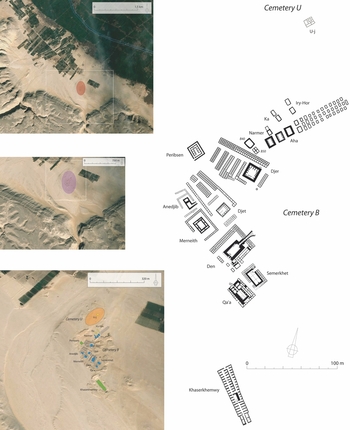
‘Cemetery B’ is located at the southern end of the Abydos necropolis in Egypt, two kilometres from the temples of Seti I and Ramesses II (Figure 1). Bounded to the west by the wadi Umm-el-Qaab (the ‘Processional Valley’), to the north by the alluvial plain of the Nile and to the south and east by the foothills of the Western Desert, this landscape has evidence of human activity from the Predynastic and the Protodynastic Periods (Figure 2). Aside from the sacred precinct of Osiris, it comprises almost exclusively funerary monuments, from the Naqada IB-C/IIA and IID1-D2/IIIA-B phases (‘Cemetery U’, 3700–3050 BC) to the New Kingdom (1550–1069 BC).
Location map and plan of ‘Cemetery B’ (after Dreyer et al. Reference Dreyer, Engel, Hartung, Hikade, Köhler and Pumpenmaeier1996; source: Google Earth 2011).

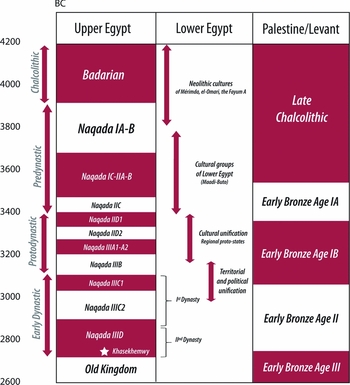
Chronological framework of the study (after Midant-Reynes Reference Midant-Reynes2003).

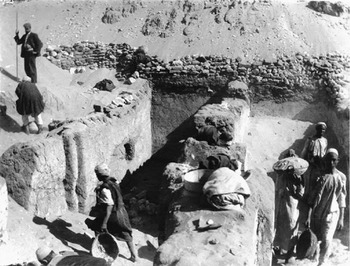
The Early Dynastic royal necropolis (‘Cemetery B’) was investigated by archaeologists in the late nineteenth and early twentieth centuries (notably by Émile Amélineau from 1896–Reference Amélineau1898, Flinders Petrie between 1899 and 1901, Édouard Naville in 1912 and Thomas Peet in 1913: Amélineau Reference Amélineau1896, 1896–Reference Amélineau1897, Reference Amélineau1898, Reference Amélineau1899, Reference Amélineau1901, Reference Amélineau1902, Reference Amélineau1904; Petrie Reference Petrie1900, Reference Petrie1901; Naville Reference Naville1913; Peet Reference Peet1914; see Figure 3). More recently, since the end of the 1970s, Werner Kaiser and Günter Dreyer of the German Institute conducted excavations in this area (Kaiser & Grossman Reference Kaiser and Grossman1979; Kaiser & Dreyer Reference Kaiser and Dreyer1982; Dreyer Reference Dreyer1990, Reference Dreyer1992, Reference Dreyer1993, Reference Dreyer1998; Dreyer et al. Reference Dreyer, Engel, Hartung, Hikade, Köhler and Pumpenmaeier1996, Reference Dreyer, Hartung, Hikade, Köhler, Muller and Pumpenmaeier1998, Reference Dreyer, von den Driesch, Engel, Hartmann, Hartung, Hikade, Muller and Peters2000, Reference Dreyer, Hartmann, Hartung, Hikade, Köpp, Lacher, Muller, Nerlich and Zink2003, Reference Dreyer, Effland, Effland, Engel, Hartmann, Hartung, Lacher, Muller and Pokorny2006). Their findings completed the earliest excavations and sensibly modified the historical and chronological framework established by the earlier scholars.
Flinders Petrie (top left) supervising the excavation of Khasekhemwy's tomb at Abydos (Petrie Reference Petrie1901, pl. LVII.3 © Egyptian Exploration Society, London 2011).

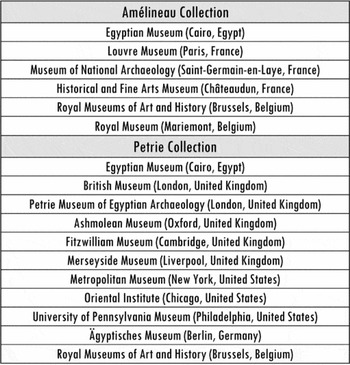
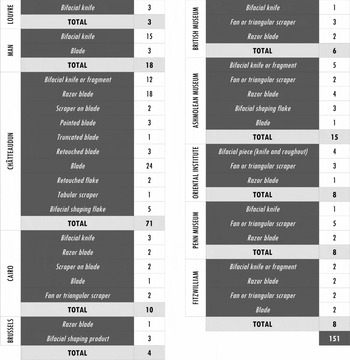
Despite the depredations that have occurred since Antiquity, the tombs of the First Dynasty kings, and two kings of the Second Dynasty (Peribsen and Khasekhemwy), have yielded a large number of grave goods. These consist primarily of pottery and stone dishes, as well as more exceptional metal and ivory objects. The assemblage is currently divided between a number of museums in Egypt, Europe and the USA, but these artefacts remain largely unpublished (Figure 4). Amélineau and Petrie provided only a summary description of their excavations despite the relatively large amount of information they unearthed. And they did not always record the location of the finds. Nonetheless, research into the publications and site archives, cross-referenced with technological data recorded during analysis of the archaeological material, allows us, broadly, to reconstruct the original arrangement of the funerary artefacts.
Dispersion of the Amélineau and Petrie collections across various museums in Europe and America.

The data from the exceptional lithic assemblage of King Khasekhemwy (c. 2700 BC) presented an opportunity to analyse standardisation and variability in the deposition of grave goods. This assemblage consists of over 800 artefacts, and is thus larger than those recovered from other royal tombs at Abydos. The typological and technological analysis presented here is based on a new review of the documentation and an examination of those objects still preserved in museum collections. It allows an understanding of both their utilitarian and symbolic functions through a detailed reconstruction of their social trajectory. Analysis was undertaken of the nature, chronology and arrangement of the lithics alongside investigations of their ideological and cultural significance to identify changes in the selection and frequency of artefact deposition (Bonnardin et al. Reference Bonnardin, Hamon, Lauwers and Quilliec2009). The results of this analysis form the basis for further socio-economic interpretations.
Structure and organisation of the funerary grave goods of Khasekhemwy
Khasekhemwy's tomb, located in the southern part of the Umm-el-Qaab necropolis, breaks away from the traditional architecture of the previous periods (see online supplementary material S1), with structures clustered rather than isolated as they had been in previous reigns. The tomb comprises 58 storage chambers and corridors organised around a stone-lined main chamber or central tomb. These compartments vary principally in the nature of their grave goods. The objects discovered in the different rooms reflect the standard ambitions in ostentatious funerary projects in Protodynastic Egypt. This standardisation is in keeping with the well-known process of accumulating prestigious objects (some of foreign origin e.g. Early Bronze I Palestinian jars found in the Royal funerary complexes of the First Dynasty; Amélineau 1899–1901). In this context, the king's grave goods comprised storage vessels and decorated ceramics, and dishes made of limestone, porphyry and alabaster, as well as copper tools, bronze and gold objects, marble ‘offering tables’, small wooden and ivory objects, fragments of faience tiles, basketry and sealings. These items were carefully organised throughout the various spaces according to an ideological plan and, probably, a ritual procedure that is yet to be understood. It is clear that within this assemblage, the lithic industries played a special role.
Previous publications
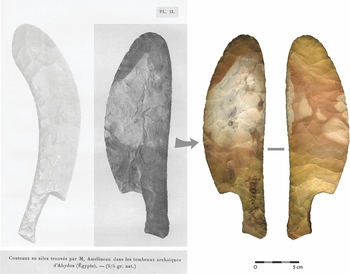
In comparison to other excavations of the period, the site records of Umm-el-Qaab appear relatively complete (see online supplementary material S2). The context of the funerary objects discovered in 1896 by Amélineau can be partially restored from the room-by-room inventory of the grave goods. Despite a degree of uncertainty due to disturbances in the tomb prior to excavation, this documentation allows an approximate reconstruction of the layout of some of the grave goods (Figure 5).
Bifacial knife E25265 from the Louvre (Amélineau Reference Amélineau1904: 717; © 2010 DAE Musée du Louvre/Raphaël Angevin).

It is important to note that such reconstruction is not always possible for the material excavated by Petrie, who rarely recorded the composition of assemblages. This refutes traditional claims made in Egyptian archaeology that suggest that the work of the ‘amateur’ Amélineau was inferior to that of the more ‘professional’ Petrie (Etienne Reference Etienne2007; Spencer Reference Spencer and Teeter2011).
In addition to his systematic finds recording, Amélineau paid particular attention, at least during the first stage of the excavation, to the flint material. He entrusted its study to Louis Capitan, a pioneer of French prehistoric anthropology, at the beginning of the twentieth century. From 1901–1902 Capitan examined two assemblages. The first, a collection of 138 arrowheads (of 324), came from the tomb of Narmer (B18) or one of king Aha's ‘satellite’ tombs. The second was from the funerary complex of King Khasekhemwy (Capitan Reference Capitan1904, Reference Capitan1905). Capitan states that
700 to 800 blades, some 50 knives, came from the tomb that Amélineau called the ‘tomb of Set and Horus’, and that others call the tomb of Khasekhemwy. The majority were found in the upper level of the rubble, but part came from the lower level of the fill within the chambers of the tomb. But the greatest number of these flints were found on the floor of two funerary chambers that M. Amélineau called for that reason the ‘flint chambers’ (Capitan Reference Capitan1904: 89).
The publications of Jacques De Morgan (Reference Morgan1896–1897) and the later catalogues of the Egyptian Museum in Cairo (Quibell Reference Quibell1905; Currelly Reference Currelly1913) and the Salle d’Archéologie Comparée of the Musée d’Archéologie Nationale at Saint-Germain-en-Laye (Collective 1982) complete these records (Angevin Reference Angevin2014a). Similarly, the inventories of the British Museum, the Ashmolean Museum, the Oriental Institute Museum, the Penn Museum of Philadelphia and the Louvre provide a contemporary but incomplete assessment of Amélineau's and Petrie's collections after the sharing of objects from the archaeological excavations (following the Khedival decree on Antiquities 1891) and their dispersal to the various European museums between 1904 and 1921.
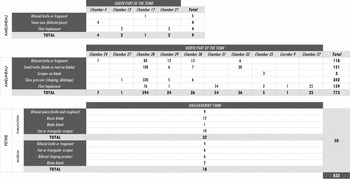
Archaeological collections cross-referenced with site archives and other museum records indicate that the lithic grave goods of Khasekhemwy amounted to 832 artefacts (Figure 6). Of these, 782 originated from various rooms within the funerary complex discovered by Amélineau. To them must be added several dozen objects recovered from the clearing of the tomb without secure contexts, as well as 50 items collected by Petrie. Further, an indeterminate number of items were found in the filling of the grave during the excavations by the German Institute at the end of the twentieth century (Hikade Reference Hikade1997, Reference Hikade2003).
Inventory of the lithic artefacts from Khasekhemwy's tomb (Petrie Reference Petrie1900–1901; Amélineau Reference Amélineau1902).

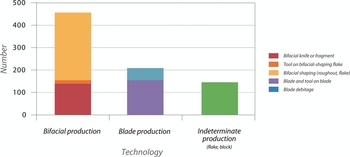
From their material, Amélineau and Capitan were able to collect or recreate “fifty knives [. . .] through fragments broken in the major grave disturbance of the VIth century AD” (Capitan Reference Capitan1904: 90). To these bifacial finished products (relatively typical of Early Dynastic funerary contexts) must be added numerous blade blanks, some left unworked but most retouched, as well as scrapers (of single- or double-edged ‘razor blade’ type) and different forms of circular or triangular scrapers on flakes. Perhaps most surprising are the numerous flint fragments and ‘technical items’ (debitage fragments, nucleus and so on), “functional more than votive objects” (Capitan Reference Capitan1904: 89), which complete the typological corpus and give this assemblage a unique character (Figure 7).
Technological categories of lithics (Petrie Reference Petrie1900–1901; Amélineau Reference Amélineau1902).

Technological analysis
Only a limited number of the original lithics were available for study. The Amélineau assemblage was divided and sold in public auctions in 1904. Only a tenth reached French public collections; these primarily consist of exceptional objects and reworked tools. In the same way, the few objects collected by Petrie were allocated to the various contributing institutions in England and the USA.
My technological assessment of Khasekhemwy's funerary assemblage was based on the study of the lithic material in five collections (see online supplementary material S3). Including some of Petrie's assemblage, these series comprise 117 artefacts that can positively be assigned to this tomb (Figure 8). Given the small sample size, my analysis also included other objects from the same tomb referenced in the databases of the British Museum, the Fitzwilliam Museum, the Royal Museums of Brussels, the Oriental Institute of Chicago and the Penn Museum (34 objects), as well as artefacts used for demonstration by Capitan in his Études des silex d’Abydos (Reference Capitan1904, Reference Capitan1905), and several drawings and photographs taken from publications on the necropolis that might prove significant from a technical point of view.
Typological classification of the lithic assemblage.

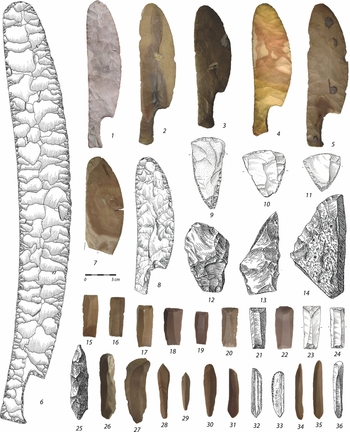
Typological corpus and technical components of the flint assemblage; elaborate items: 1–8 bifacial knife or fragment; 15–24 razor blade; 28–29 pointed blade; 30 scraper on regular blade; 31–32 truncated blade; 33 retouched blade. Technical items: 9–11 bifacial shaping, ‘triangular scraper’ on bifacial-shaping flake; 12 bifacial shaping, unmodified bifacial-shaping flake; 13 bifacial shaping, knife roughout; 14 bifacial shaping, fragment of a flint plaquet with partially removed cortex; 25 blade debitage, ‘crested blade’; 26 blade debitage, scraper on ‘crested blade’; 27 blade debitage, semi-cortical blade; 34–36 blade debitage, unmodified blade. From Capitan Reference Capitan1904 and Hikade Reference Hikade1997; drawings L. Capitan (12–14, 21, 25, 32–33, 36), T. Hikade (6) and British Museum Digital collections (8–11, 23–24); © Raphaël Angevin: Musée d’archéologie Nationale (1), Egyptian Museum in Cairo (2), Musée de Châteaudun (3, 5, 7, 15–20, 22, 26–31, 34–35), Louvre (4).
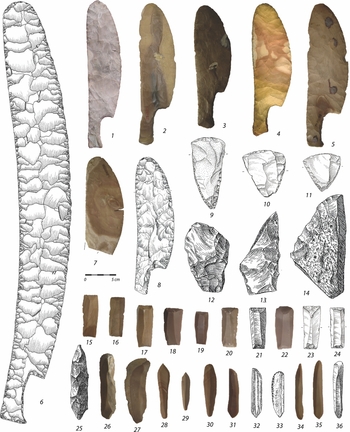
The corpus comprises 46 bifacial knives or fragments of bifacial knives (Figure 9:1–8), 32 ‘razor blades’ (Figure 9–15–24), 17 scrapers on flakes (‘fan’ or triangular scrapers; Figure 9.9–11), three pointed blades (Figure 9.28–29), four scrapers on the distal (Figure 9.26) or proximal (Figure 9.30) part of a blade, two blades retouched on one or two lateral edges (e.g. Figure 9.33), two retouched flakes, a truncated blade (Figure 9.31) and a ‘tabular scraper’ on a cortex removal flake. Also found among the collections of Amélineau and Petrie were 31 unmodified blade blanks (Figure 9.34–35) and 11 bifacial-shaping products.
The assemblage gathered for the present study does not therefore appear to be representative of the original material collected from the royal tomb by the excavators: indeed, Amélineau mentioned “flints [comprising] knives, scrapers, axes and a very large number of small flakes” (Amélineau Reference Amélineau1896: 198). This refers to the archaeological material from chamber 28, one of the famous ‘flint chambers’, not all of which can now be traced. Thus, details of the chaînes opératoires addressed below are primarily based on descriptions by Amélineau and Capitan.
Evidence for the production of knives dominated the assemblage and was represented by numerous flakes and shaping waste (whole, broken or flaked) that appeared to be mixed with by-products of blade knapping. Forty-six complete knives or fragments of knives, 11 bifacial shaped flakes and 18 tabular or triangular ‘scrapers’ on cortical and bifacial-shaping blanks (British Museum, Ashmolean Museum and Egyptian Museum) corresponding to different technological stages confirm Capitan's initial observations:
On examining the hundreds of flakes and flint debris that M. Amélineau had carefully collected [I] was thus easily able to identify an extensive series of pieces marking in the clearest possible manner the various stages in the production of the knives (Capitan Reference Capitan1904: 92).
A relatively high number of artefacts appear to originate from the process of shaping and working a nodule. These are most often flints from the sedimentary formations of the Nile Valley. This process, clearly illustrated by a ‘tabular scraper’ from Châteaudun, aimed to remove the cortex and significantly reduce the size of the nodule (Figure 9.9 & 9.14).
These are above all wide flakes, very thin, of irregular shape and with cortex on one of their faces. Without any doubt, they are flakes of reduction. Many fragments [. . .] of varying sizes, still covered by cortex on each side represent the raw material from which these flakes had been struck (Capitan Reference Capitan1904: 92).
The resulting flakes generally exhibit an abraded butt with strike marks (large scarred bulbs). This reveals that the preferred method here was percussion with a relatively soft hard hammer, such as limestone. According to Capitan, “The knapping has removed all the flint cortex by means of large and very flat flakes” (Capitan 1904: 93; Figure 9–10–12). Another technique may be assumed at the end of this phase: a cortical removal flake from Cairo Museum (JE34980) perfectly illustrates the recourse to an organic hammer, probably of wood (e.g. low diffuse bulb of percussion, presence of an outer ‘lip’ below the striking platform).
These knives appear to have been made by a single unvarying method: “They first shaped one face almost completely, then moved on to the other” (Capitan Reference Capitan1904: 93). The resulting type of roughout is illustrated by one object photographed in Petrie's publication (Reference Petrie1902: pl. XV). Two slightly earlier preforms from ‘Cemetery M’ in Abu Rawash also confirm the use of this method (First Dynasty; Angevin Reference Angevin2014b).
The following technical sequence was detailed by Capitan. In this phase, the preparation of butts appears more refined and the working of the surfaces better controlled. The few items that are technologically significant exhibit reworking of the edges: “[retouching] very thin edges [to] control the shape of the piece” (Capitan Reference Capitan1904: 93; Figure 9.13). The flakes (flat in profile) associated with this stage of the preparation are generally very thin and the striking platforms are subject to heavy abrasion, some even being facetted to either side of the percussion point. This technique reflects tangential percussion with a soft organic hammer, before shaping the ‘sharp edge’ and ‘back’ of the tool was resumed, with semi-abrupt or denticulated retouch, sometimes by pressure. During this sequence, there is currently no evidence of deliberate heat treating in the manufacture of artefacts. Most of the time, the finishing work was limited to the making of the tang.
Archaeological analysis
The substantial lithic material recovered from chamber 28 reveals the shaping process of large bifacial knives, from the roughout to the final retouch. To a lesser extent, it also highlights the process of blade production (Figure 9.25–27). Although this assemblage presents an undeniable technological coherence, we must now turn our attention to its archaeological integrity.
From an architectural point of view, the tomb of Khasekhemwy reflects numerous construction phases over approximately 50 years during his reign and that of his successor, Djoser (c. 2700–2650 BC). The architectural study conducted by Dreyer and his team between 1999 and 2003 established four major stages of construction in this complex. The initial building phase appears to have involved the creation of a centrally focused tomb, organised around a central funerary chamber and attached workshops; a layout that is morphologically similar to the tomb of Peribsen (Dreyer et al. Reference Dreyer, von den Driesch, Engel, Hartmann, Hartung, Hikade, Muller and Peters2000, Reference Dreyer, Hartmann, Hartung, Hikade, Köpp, Lacher, Muller, Nerlich and Zink2003: 108).
This first building was quickly supplemented by an extension to the north (phase 2) that includes chamber 28; this was followed by an additional two contemporary extensions to the north and south (phase 3). These gave the tomb its definitive compact appearance and were part of the same architectural project as the storeroom containing the grave goods (Dreyer et al. Reference Dreyer, Hartmann, Hartung, Hikade, Köpp, Lacher, Muller, Nerlich and Zink2003: 110). The final phase was the addition of a southern antechamber with four alcoves and an access corridor, as well as the reconstruction of the main funerary chamber in cut stone. Amélineau (Reference Amélineau1902: 122–26) had mistakenly interpreted these architectural modifications as New Kingdom restorations in the southern part of the tomb.
An in-depth study of the history of the Umm-el-Qaab necropolis revealed the major impact that religious activities have had on the development of this area (Effland et al. Reference Effland, Budka and Effland2010). It is known that during the Middle and the New Kingdoms, several hundred objects, and particularly flint tools, were taken from the tombs and deposited outside them (Müller in Dreyer et al. Reference Dreyer, von den Driesch, Engel, Hartmann, Hartung, Hikade, Muller and Peters2000, Reference Dreyer, Hartmann, Hartung, Hikade, Köpp, Lacher, Muller, Nerlich and Zink2003; Hikade Reference Hikade2003). This was principally due to the refurbishment and extension of the sacred precinct of Osiris. The relocation of these objects can be seen as a continuation of the Old Kingdom practice of ritual deposition in which numerous Pre- and Protodynastic objects had been collected together for use in later funerary activities from as early as the third millennium (O’Connor Reference O’Connor2011). The process involved the ritual reorganisation and reassignment of certain earlier royal tombs, as well as the development of the sanctuary and the integration of the necropolis of the wadi Umm el-Qaab into the sacred landscape of Abydos (cf. the tomb of Djer/Osiris in Dreyer et al. Reference Dreyer, von den Driesch, Engel, Hartmann, Hartung, Hikade, Muller and Peters2000).
Akin to many other royal burials, the tomb of Khasekhemwy was subject to theft and damage (Lacher in Dreyer et al. Reference Dreyer, Hartmann, Hartung, Hikade, Köpp, Lacher, Muller, Nerlich and Zink2003: 112–14; Martin Reference Martin2011). This complex history and a partly disturbed stratigraphy force us to exercise extreme caution when handling data from early excavations. Interference in the Abydos tombs occurred repeatedly until the Coptic period: the latest dateable intrusion and destruction at the tomb of Khasekhemwy appears to have taken place between the fifth and sixth centuries AD, following the cessation of worship at the site and the abandonment of the sanctuary of Osiris (Amélineau Reference Amélineau1902: 122–27; Dreyer et al. Reference Dreyer, Hartmann, Hartung, Hikade, Köpp, Lacher, Muller, Nerlich and Zink2003: 111).
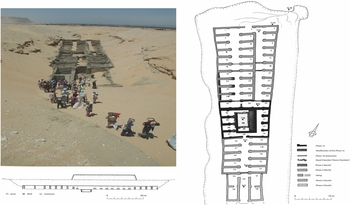
The tomb may have been spared much disturbance by the collapse of the wooden ceiling and the superstructure mound or tumulus originally covering the funerary chamber (Figure 10). This collapse sealed all of the funerary material in an arrangement close to its original layout at the end of the Second Dynasty or beginning of the Old Kingdom. Amélineau pointed out that “All the walls of this chamber had undergone thrust deformation and had collapsed on objects, breaking them” (Amélineau Reference Amélineau1902: 86). Indeed, he continued by stating that
Chamber 28 was [one] of [those] that had retained its assemblage: never had a chamber been so productive, but at the same time, unfortunately, never had a chamber been more extensively looted [most likely due to the collapse of the tomb and subsequent lootings]. It was, as invariably the case, in a state of almost total ruin and that is why the assemblage was found here [. . .] The floor of the chamber was covered [. . .] with flint fragments, so much so that it was completely impossible to record their locations (Amélineau Reference Amélineau1902: 160).
Tomb of Khasekhemwy: phases of construction, remains of the superstructure and cross-section (Dreyer et al. Reference Dreyer, Hartmann, Hartung, Hikade, Köpp, Lacher, Muller, Nerlich and Zink2003 © Deutsches Archäologiches Institut im Kairo 1999).

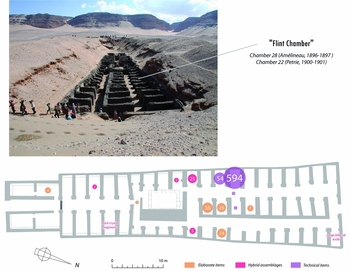
Chamber 28 is therefore distinguished from other chambers where flints are present in lower numbers, with the exception of the neighbouring chambers 29, 30, 31, 33 and 37, where flints were also found in large quantities, probably through dispersal of the material originally in chamber 28 after the collapse of the tomb. Elsewhere, only a few flints were found, and these are mostly finished objects (Figure 11). This is particularly the case among objects found in the anterior part of the funerary complex, located around the royal chamber where we can note “a complete change in the nature of the objects that are found” (Amélineau Reference Amélineau1896: 199). Within this sector, and to a lesser extent in the eastern storage chambers, the Early Dynastic royal elites appeared to have favoured the deposition of a restricted number of ‘exceptional’ items such as the largest bifacial knife ever recovered from the site, found in 1995 by Dreyer to the north-east corner of the tomb (Hikade Reference Hikade1997). These items were deposited with other categories of ‘prestigious’ grave goods (alabaster vases, copper tools, carnelian beads, ivory objects, stone vessels, decorated ceramics and so on) together with food offerings.
Tomb of Khasekhemwy: top) photographed from the north-west; below) interpretation of the composition and distribution of lithic grave goods (Petrie Reference Petrie1901: LXIII © Deutsches Archäologiches Institut im Kairo 1999).

By contrast, the discovery of several hundred tools and debitage within the small space of chamber 28 suggests structured deposition. This can be interpreted either as active flint production in a workshop dependent on royal power or that the king's lithic grave goods were made on site, perhaps during the burial ritual. Either way, these remains bear witness to the particular symbolic meaning given to these Protodynastic objects, a point observed by Amélineau (Reference Amélineau1902: 161).
Discussion
The large bifacial knives from the tomb of Khasekhemwy and their debitage follow a tradition that can be seen evolving in the Nile Valley throughout the fourth millennium BC. The development of greater technical skill is evident as early as the Naqada IB/C-IIB period (3750–3450 BC) within a plethora of models developed for agricultural use. Indeed, the large bifacial sickle-blades and the ‘forked-lances’ clearly fit within the Neolithic and Badarian technical tradition of Upper Egypt and bear witness to the longevity of certain local traditions linked to bifacial shaping (Brunton & Caton-Thompson Reference Brunton and Caton-Thompson1928; Angevin Reference Angevin2014b). Despite their skilful craftsmanship, these valuable objects still belong to a ‘domestic mode of production’ (Sahlins Reference Sahlins1972; Godelier Reference Godelier1984).
From the middle of the fourth millennium BC, several components of the funeral assemblage appear to reveal craft specialisation (Roux & Pelegrin Reference Roux and Pelegrin1989). Within lithic industries this can be seen through the standardisation of flaking methods, the diversification of tools, a rationalisation of knapping activities and a reorganisation of exchange and redistribution flows. The large ripple-flake knives dating to Naqada IIC/D (3450–3300 BC) indicate the development of carefully elaborated chaînes opératoires. Indeed, these complex items are manufactured through operative schemes that, in organisation and execution, appear firmly standardised (Midant-Reynes & Tixier Reference Midant-Reynes and Tixier1981; Kelterborn Reference Kelterborn1984; Midant-Reynes Reference Midant-Reynes1987).
How objects from these workshops were used is a fundamental question as it reveals aspects of their social lives (Appadurai Reference Appadurai1986). In the absence of use-wear analyses we must rely on the physical examination of these artefacts. This shows us that they were taken out of their functional cycle very early to be ‘marginalised’ within their social trajectories and ‘standardised’ within the context of ritual deposition. This observation is corroborated by the study of specific items (such as the Gebel el-Arak knife at the Louvre and the Brooklyn Museum knife), which highlight their use in elite circles through the quality and high level of technical investment they reflect, the precious raw material used for the manufacturing of their handles (hippopotamus ivory) and their complex iconography (Bénédite Reference Bénédite1916; Angevin Reference Angevin2014a).
It appears that few craftsmen were specialised in the production of non-functional objects destined as funerary goods for the Predynastic elites and to reinforce their prestige. The large Gerzean blades mark the beginning of a centralised economy, and particularly the emergence of specialised craft workshops that concentrated productive activity.
This craft specialisation was nevertheless only one element in the development of these grave goods and does not sufficiently explain the changes that occurred in the following period. From an economic point of view, there was a radical shift between Naqada IID and Naqada IIIA/B (3300–3100 BC). This change saw the emergence of new solutions: the increased demand for status goods by the elites of Upper and Lower Egypt caused an exponential development in inter-regional exchange networks. It also reverberated through the double process of accumulation and ostentation that affected the main Predynastic necropolises (in particular Naqada: Petrie & Quibell Reference Petrie and Quibell1896).
Sometimes, however, these assemblages best inform us through what is missing. In some tombs at Hierakonpolis and Adaima (Naqada II-IIIA), the presence of ‘fake’ bifacial items made of clay demonstrates the symbolic weight given to these objects closely integrated in a production system that was carefully organised from a spatial and social point of view (Quibell & Petrie Reference Quibell and Petrie1900; Crubézy et al. Reference Crubézy, Janin and Midant-Reynes2002). In such a context, the restricted availability of authentic goods forced certain individuals to obtain ersatz or substitutes as a means of expressing their dignity, although the latter was possibly not really accepted by society.
At the same time, some cemeteries saw unprecedented development of their funerary assemblages with particular focus on two major manufacturing methods, bifacial shaping and blade knapping. A decisive change is evident at the Umm-el-Qaab necropolis at the turn of the fourth and third millennia BC. Here more than anywhere else, chipped-stone industries saw increased demand: the qualitative and quantitative growth of high-value products is evident in funerary assemblages through a rapid evolution of the toolkits and therefore through more in-depth skills. Echoing trends of a few centuries earlier, the assemblages demonstrate a radical subversion of technical and ideological choices, as well as the enhanced social significance and value of the flint implements.
These changes are expressed through the deposition of flint-working products and debris as offerings. This act questions the authority controlling craft production: from the first two dynasties, the royal rulers did not just remain at the centre of the vast dynamic of accumulation and redistribution of goods; they also needed to control the associated networks to ensure their wealth and sustain their legitimacy (Midant-Reynes Reference Midant-Reynes2003).
In this movement, the accumulation processes through which elites increased or maintained their wealth and authority led to the establishment of coercive economic structures that primarily affected trade and redistribution networks. This suggests that certain goods, including bifacially worked flint blades, were seen as ‘remarkable’ and therefore kept apart, their symbolic value exceeding their functional or economic value. In periods of ideological unity, such as the Early Dynastic Period, the special status and strategic importance of these artefacts required the development of regulations closely tied to administrative power. The uniqueness of these objects was supported by a powerful consensus and their distribution was strictly controlled through an organised system of concentration and redistribution that excluded substitutes or fakes.
Finally, the fact that the debris from bifacial shaping was found only in the superstructure of a royal tomb indicates that this part of the chipped-stone industry, devoted to the production of the large bifacial knives, was under royal control. This essentially reveals a state monopoly. It is expressed in the reduction sequence of the debitage in chamber 28, but also more surprisingly in the elite tomb Op1/1 at Helwan (Lower Egypt), which contained several thousand waste products and debris (Hikade Reference Hikade1999, Reference Hikade and Köhler2005). The deposition of several hundred roughouts and shaping flakes arising from the manufacture of large bifacial knives in c. 2700 BC at Umm el-Qaab appears therefore to have been intimately linked to economic control and most likely reflects exclusive royal prerogatives. Indeed, for probably the very first time, these assemblages directly highlight the close relationship between specialised production, workshops and emerging royal power.
In this way, the circulation of certain exceptional objects engraved with the name of the sovereign (e.g. the large knife from tomb 71 of Minshat Ezzat with the serekh of King Den; Angevin Reference Angevin2014b) illustrates the development of new concepts of loyalty founded not only on personal relationships but also on a well-established authority, which appears to have had unquestioned legitimacy. Power became the only means of indicating the prestige of the elites, and was conveyed through carefully coded symbolic objects where the rarity of donation reinforced the legitimacy of the donor's power.
Conclusion
Over time, the utilitarian character of lithic implements diminished as their symbolic value increased in Egypt. This transition was gradual and reflected the actions of elites who seized power and instituted a centralised economy in the Naqada period. These changes were evident throughout the Protodynastic and Early Dynastic Periods in a shift in the exchange economy, leading to royal exclusivity. By the end of this process, prestige goods were no longer exchanged through trading transactions but were certainly the subject of donation (whether funerary or religious).
The artisans who produced these prestige goods hence became the producers of ideologies. Master flint-knappers could undertake their activities within specialised workshops, progressively integrated into the royal domain. This process introduced a new protagonist between the individual invested with prestige and the community that gave it legitimacy: the artisan became one of the primary agents in creating the acceptance of power.
Flint only lost its prestige centuries later, retaining its “original privileged status, down to the Ptolemaic period, in the bas-reliefs of tombs and temples, the hand of gods or of the demons of the Otherworld” (Midant-Reynes Reference Midant-Reynes1998: 47). It became the ultimate sacrificial tool and was used to make knives dedicated to mummification. Still employed in both agricultural and ritual practices, the use of flint decreased but did not disappear with the emergence of iron metallurgy during the transition from the Middle to the New Kingdom (e.g. the bas-relief of a ‘flint workshop’ in tomb 15 in Beni Hassan; Griffith Reference Griffith1896). Within this context, the specificity of the Egyptian trajectory is illustrated by the importance given to tradition and the symbolic capital regularly attributed to this material (Midant-Reynes Reference Midant-Reynes1981; Graves-Brown Reference Graves-Brown2010).
In Egypt the survival of flint therefore appears to address both a technical and cultural requirement: “If the abundance and the quality of the raw material made it a highly valued resource, the conservatism that appears as a characteristic feature of this civilisation made it also highly respected” (Midant-Reynes Reference Midant-Reynes1981: 42). The features addressed here invite us to interpret the development of flint through a ‘conformist’ prism that ensured the longevity of this technical tradition throughout several millennia.
Acknowledgements
Thanks to Wafa Habib, Guillemette Andreu-Lanoë, Geneviève Pierrat-Bonnefois, Christine Lorre, Sophie Bruniau, Helen McDonald, Jean Walker, Dirk Huyge and M. Liam McNamara for providing access to the collections mentioned in the text. Thanks also to Yann Tristant and the anonymous reviewers of this article for their relevant comments. All translated quotes are the editor's translation.
Supplementary material
To view supplementary material for this article, please visit http://dx.doi.org/10.15184/aqy.2015.50