Introduction
The vulnerability of people with mental illness to poverty and social exclusion is an international phenomenon. People with mental illness are often excluded from employment, education and social services, and are at risk of unstable housing and limited or no social supports (ABS, 2006; Bassett et al., Reference Bassett, Lloyd and King2003; Folsom and Jeste, Reference Folsom and Jeste2002). This article argues that if certain support is available, supported housing models can assist people with high levels of psychiatric disability to participate meaningfully in the community.Footnote 1
Findings from a longitudinal evaluation of the Housing and Accommodation Support Initiative Stage One (HASI) are used to demonstrate how an individualised supported housing programme can contribute to increasing the social and community participation of people with mental illness. The article reviews the history of mental health services and their capacity to increase community participation; it examines the HASI model, evaluation methodology and the social and community participation results; discusses how HASI has contributed to improved participation; and concludes with implications for future programmes.
Deinstitutionalisation has enabled a shift from segregated, institutional care to community-based living for many people with mental illness. However, living in the community has not necessarily meant people with mental illness are able to participate meaningfully in it. The post-desegregation period involved the development of a range of local, community-based, coordinated services that provided treatment at home and focused on both symptoms and disabilities (Thornicroft and Tansella, Reference Thornicroft and Tansella2003). In many countries, supported housing has been a means to achieving these aims.
The type of supported housing people usually receive is largely determined by clinical wellbeing. Consequently, as mental health declines or improves, people are often required to move into the appropriate housing (Hanrahan et al., Reference Hanrahan, Luchins, Savage and Goldman2001; Tsemberis, Reference Tsemberis1999). This transitional model of housing support has been found to improve mental health and decrease hospitalisations (Rog, Reference Rog2004), but it can have very limited effectiveness in improving community participation (Carling, Reference Carling1990).
In the early 1990s, mental health services gradually shifted from the transitional model of supported housing to individualised supported housing options, which attempt to stabilise housing (Ridgway and Zipple, Reference Ridgway and Zipple1990). In the UK, for example, Supporting People has provided individualised supported housing services for people with mental health problems since 2003. It assists people to maintain their tenancies, develop living skills, improve social and family networks, and provides advocacy, information and referrals (UK Department of Health, 2003; UK Office of the Deputy Prime Minister, 2005).
In Australia, many programmes continue to follow a transitional model of supported housing (Freeman et al., Reference Freeman, Hunt, Evenhuis, Smith and Malone2003; NSW Health, 2002).Footnote 2 Psychosocial housing support is provided in a number of states in collaboration with clinical support, but in only two exceptions are individualised supported housing programmes offered that provide stable housing, accommodation support and clinical case management (Meehan et al., Reference Meehan, O'Rourke, Morrison and Drake2004; NSW Health, 2002).
Rog (Reference Rog2004) found that stable, individualised housing support programmes improve mental health and decrease hospitalisations. An evaluation of a Supporting People pilot programme similarly found reductions in hospitalisations and improvements in wellbeing (UK Department for Communities and Local Government, 2006).
It is important for programmes that support people with mental illness to move beyond housing, living skills and clinical support, and address social and community participation. Attaining these social goals assists with overcoming stigma, discrimination and loneliness; improving participation rates in the workforce and education systems; and, importantly, addressing social exclusion (Davidson et al., Reference Davidson, O'Connell, Tondora, Styron and Kangas2006; Sane Australia, 2005; Social Exclusion Unit, 2004). Furthermore, from a policy perspective, governments recognise the importance of social, economic and community participation in creating inclusive societies and in addressing significant social problems, such as homelessness, unemployment and poor mental health (Australian Social Inclusion Board, 2008; Social Exclusion Unit, 2004).
Meaningful participation in the community is also a key component of the recovery and social exclusion paradigms in mental health literature (Davidson et al., Reference Davidson, O'Connell, Tondora, Styron and Kangas2006; Dumont et al., Reference Dumont, Ridgway, Onken, Dornan and Ralph2006; Huxley and Thornicroft, Reference Huxley and Thornicroft2003; Strong, Reference Strong1998). As Davidson and colleagues (Reference Davidson, O'Connell, Tondora, Styron and Kangas2006) argue:
Recovery in serious mental illness calls for the provision of accommodations and supports that enable people with psychiatric disabilities to lead safe, dignified and full lives in the community.
The recovery literature, however, recognises that additional empirical evidence is needed of the types of interventions that can help people with severe mental health problems achieve meaningful participation (Davidson et al., Reference Davidson, O'Connell, Tondora, Styron and Kangas2006; Dickerson, Reference Dickerson2006). Although Huxley and Thornicroft (Reference Huxley and Thornicroft2003) identified key social domains for mental health clinicians to address when working with clients, they did not demonstrate how this might be operationalised. Finally, evaluations of housing support programmes have also not revealed how individualised supported housing models work to facilitate increased social and community participation (Meehan et al., Reference Meehan, O'Rourke, Morrison and Drake2004; Rog, Reference Rog2004; UK Department for Communities and Local Government, 2006). This article assesses whether and how supported housing models can assist people with high levels of psychiatric disability to participate meaningfully in the community.
Housing and Accommodation Support Initiative
HASI is a partnership between the New South Wales Government Departments of Health and Housing and non-government organisations (NGOs) in Australia. As a coordinated approach, the Department of Housing provides clients with permanent social housing,Footnote 3 Area Mental Health Service (AMHS) case managers provide active mental health case management and NGOs offer long-term accommodation and community support to enable independent living and access to community services.
HASI Stage One was established over 2002/2003 and supports more than 100 people with complex mental health problems living in nine locations around NSW.Footnote 4 HASI Stage One clients are typically men (67.3 per cent) born in Australia, with a primary diagnosis of schizophrenia (74.3 per cent) and a secondary diagnosis (64.3 per cent). They have histories of long-term hospitalisation, unstable tenancies, minimal living skills, low levels of occupational, social and psychological functioning, limited social networks and some have spent time in prison (Muir et al., Reference Muir, Fisher, Dadich and Abelló2008).
Due to their high levels of psychiatric disability, HASI Stage One clients receive approximately four to five hours of NGO support per day. This support assists clients to maintain their tenancy, develop living skills and participate in the community. NGOs support clients to access a range of community services (in the areas of domesticity, leisure, community, finance, education and work) by working with clients on goal-setting and planning, providing encouragement, organising, transporting and/or accompanying clients to and from services and activities. Three different NGOs were involved in the HASI Stage One programme. Each of these NGOs facilitated client social and community participation by using existing disability groups within the community, by organising group activities for HASI clients, by having one-on-one outings with clients and/or by facilitating links between clients and mainstream activities. Due to the high levels of psychiatric disability, HASI Stage One clients are not expected to recover completely from their mental disorders and are expected to require some level of continual support. The level of support, however, may change over time. HASI Stage One costs approximately AUS $58,000 per person per year and the NSW government continues to fund the HASI programme.Footnote 5
Methodology
The Social Policy Research Centre was commissioned to evaluate HASI to determine whether the initiative engaged clients with high levels of psychiatric disability and whether these clients experienced improvements in their mental health, tenancy situations and community participation. The HASI model, the effectiveness of stakeholder partnerships and governance structures and operational issues were also evaluated.
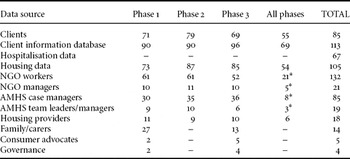
HASI Stage One was evaluated over a two-year period with three data collection stages in each of the nine locations. This included 633 interviews and surveys with: clients; AMHS, NGO and housing provider personnel; family members; and consumer advocates and people involved in the governance of the programme (see Table 1). The processes and outcomes of HASI were evaluated and a cost-effectiveness analysis completed (Muir et al., Reference Muir, Fisher, Dadich, Abelló and Bleasdale2007b).
Data sources

Note: *Substantial staffing movement within AMHS and NGOs (related to changing responsibilities and staff retention) resulted in low number of longitudinal participants.
Client outcomes were assessed from semi-structured interviews, surveys, a client information database and hospital admission and clinical assessment records. All clients supported by HASI at the time of the first stage of the evaluation (n = 92) were invited to participate in the evaluation. Seventy-one HASI clients (77 per cent) agreed to be interviewed and to complete a survey. In addition, information on 90 of the 92 clients was received via a client information database (completed by NGO personnel; see Table 1). Longitudinal interview and survey data (across all three stages) were collected on 55 clients, and longitudinal client information was received for 69 clients. NSW Health hospital and assessment data could only be obtained with clients’ consent, when their demographic data could be matched to NSW Health's administrative datasets and when records were complete (n = 67). Finally, NSW Housing provided tenancy information on 105 HASI clients for whom they provided housing during the evaluation period.
The evaluation included a number of standardised psychometric tools, including the Global Assessment of Functioning (GAF), Kessler-10, Living Skills Profile and Health of the Nation Outcome Scale. The surveys were also designed to include questions and instruments that could be compared to secondary data sources, such as the Personal Wellbeing Index, demographic information, generalised trust and health questions. Surveys and the client information database were also designed to collect quantifiable information on client demographics, health service use, living skills, social and community participation and education and employment.
Client social and community participation changes reported in this article are based on client interview and survey data, the client information dataset and interviews with NGO and AMHS personnel. Meaningful participation was defined as taking part in activities (social or economic) in which people felt like they belonged, had an opportunity to increase their confidence, social and/or other skills and where reintegration and community engagement could occur. This was determined through interviews with clients and their NGO and AMHS support workers.
The evaluation was complicated by a range of factors, including staff turnover of NGO and AMHS personnel and high levels of positive and negative symptomatology experienced by some clients diagnosed with schizophrenia. To address these challenges, methods were adapted appropriately and data were triangulated from multiple sources.Footnote 6
Results
Housing and mental health
Similar to the findings of other evaluations of individualised supported housing models, HASI helped stabilise housing, improve mental health and decrease the number and duration of hospitalisations. At the end of the evaluation, 85 per cent of clients remained in secure, affordable and stable housing. Almost all clients accessed professional mental health support,Footnote 7 and, for the 67 clients with available hospitalisation data prior to and since joining HASI, the time spent in psychiatric hospital units and emergency departments decreased by 81 per cent.Footnote 8 While many clients have ongoing co-morbid physical health problems, HASI facilitated the recognition, identification and appropriate treatment of these problems. With decreased hospitalisation, a stable and affordable home in which to live, improved mental and physical health, and a commitment of support from NGOs, HASI clients had the opportunity to improve their social and community participation.
Social and community participation
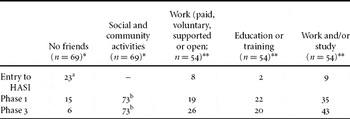
Social and community participation results are based on HASI clients who remained in the programme (n = 69) and engaged in all three phases of the study (n = 55) throughout the evaluation (see Table 2). The limitation of this is that it is not possible to understand the educational or employment outcomes for HASI clients who did not participate in the evaluation, or the friendship and social and community activity outcomes for HASI clients who exited the programme.Footnote 9 However, the longitudinal sample reflected the broader population of clients in HASI in regard to their demographics, mental health diagnoses and levels of psychiatric disability. Thus, they provide insight into the impact that a programme like HASI can have on the social and economic participation of people with high levels of psychiatric disability if they remain in the programme for at least two years.
Longitudinal indicators of community and social participation among HASI participants (per cent)

Notes: *Based on longitudinal data from the Client information database completed by NGO workers. Change in friends between entry and Phase 3 is statistically significant (p<0.05).
**Based on longitudinal surveys with HASI clients who participated in the evaluation from the outset of the programme to Phase 3 and who responded to these questions. Findings were validated by interviews with NGO and/or AMHS personnel. Changes between entry and Phase 3 are statistically significant (p<0.05).
a69.6% were known to have friends; it was unknown if 7.2% had friends when they entered the programme.
b24% not participating; 3% don't know.
HASI clients started the programme with limited social networks (23 per cent had no friends) and almost all were excluded from employment (8 per cent were in supported employment) and education (2 per cent were studying or training). Although there were no quantitative baseline data for participation in social and community activities on entry to HASI, the large amount of time spent in hospital, the high levels of psychiatric disability and findings from the qualitative interviews suggest that the majority of HASI clients had no or very low levels of social and community participation.
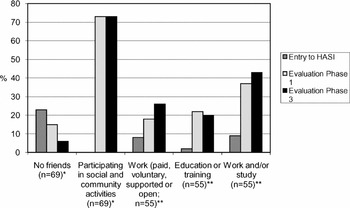
By the third data collection stage, 94 per cent of people had established friendships (p < 0.05), at least 73 per cent were participating in social and community activities and 43 per cent were working in paid or voluntary roles and/or studying at community colleges, vocational education facilities or university (p < 0.05; see Table 2 and Figure 1).Footnote 10 Client reports of accessing community services and resources and participation in leisure activities were also high. Eighty-three per cent reported accessing at least one of the following community-based services at least once a week: work and financial services (employment agencies, government income support and financial management); domestic services (cleaning, meal services and garden maintenance); educational services (libraries, community colleges, vocational education and universities); and social and community services (disability day programmes, support groups, churches, gymnasiums, sporting organisations, leisure centres, cafes, art groups and community events).
Longitudinal indicators of community and social participation among HASI participants (per cent)

Of the people working, 50 per cent were in unsupported, paid positions, 33 per cent were in supported employment and the remaining 22 per cent volunteered. Clients were studying in a range of educational facilities, including technical and further education colleges (57 per cent), community colleges or education centres (29 per cent) and universities (14 per cent).
The participation results did not significantly differ by age, gender or diagnosis. There was some deviation, however, in regard to the clients’ assessed levels of occupational, social and psychological functioning and their participation. These functioning levels were measured using GAF scores rated by NGO workers. The GAF is a validated, useful clinical measure of functional change, which is scored between 0–100 on a continuum from very high levels of psychiatric disability to good mental health (Söderberg et al., Reference Söderberg and Tungström2005). Clients who were not employed or studying had lower average GAF scores at Wave 1 and Wave 3 of the evaluation, compared to clients who were (35.5 compared to 48.5 at Wave 1, and 53.9 compared to 60.9 at Wave 3).Footnote 11
Individual case studies and reports from AMHS personnel reaffirm the success of HASI in facilitating social and community participation: ‘[As a result of HASI] we've got people with social skills, happiness, friends, a quality of life’ (AMHS manager). The parents of a HASI client were ‘amazed’ at the improvement in their son's social skills. He previously did not communicate with other people, but since taking part in recreational activities with his HASI NGO he has started to talk to neighbours.
Another participant who rarely left his house prior to HASI due to severe paranoia, started to re-engage in the community by attending NGO activities. This led to his independent participation in leisure activities and the subsequent commencement of casual work. He explained the change in his life:
My life [before HASI] consisted of barricading myself inside my house, all the windows locked, the blinds drawn . . . For several years I only came out once a fortnight at pay day to get smokes and food. With the support I've got now I live a fulfilling life and I enjoy it . . . and realise that there is a world out there and I should be a part of it. (HASI participant)
Recreation activities were important for assisting this man and other clients to improve their quality of life and provide a pathway to work and education. Prior to the programme, another client's social skills and confidence were so poor that he constantly wore dark glasses, kept his head down and rarely communicated. By the second stage of data collection, he attended NGO-organised activities two or three times a week, and his confidence and social skills had improved. By the third stage of data collection, he was involved in a work experience course. Once HASI clients could commence employment, it provided them with a sense of worth, meaning and future direction:
I'm happy with the job I've got here . . . I haven't really felt this good in my life, I could say. I didn't just like sittin’ around all day. Things are starting to fall together . . . I can see progress in the long [term].
Explanations for how HASI improved social and community participation outcomes
The results showed HASI Stage One improved social and community participation. This section discusses the processes that led to that achievement. It postulates why the structure and operationalising of the HASI model improved outcomes. These explanations are primarily based on the researchers’ independent observations and comparisons across the HASI sites, but they are also drawn from the triangulation of all data sources, particularly the perceptions of NGO, AMHS and housing provider workers and managers.
The housing and mental health components provided the foundation for social and community participation to occur. Housing not only provided stability of housing, but also community. The regular monitoring and maintenance of clients’ mental health assisted in decreasing the level of impairment and symptomatology experienced by clients, which gave them the opportunity and capacity to re-focus on other aspects of their lives, such as social and community participation. Critical to facilitating improved social and community participation was the role of the NGOs.Footnote 12
The NGOs were able to facilitate improved participation because of the intensity of support provided, the person-centred approach to support and the range of strategies NGOs were able to draw on for people with varying capacities and needs. NGO workers were funded to provide four to five hours of support per day – this included intense case management and long-term opportunities to assist clients with severe psychiatric disabilities to improve slowly. Case planning was conducted on an individual level and was driven by each client's mental health, cognitive ability, needs and interests. This enabled clients to set goals they were interested in, to break these goals up into realistic steps and to have the close support of the NGO in achieving these steps and to monitor, revise and refocus plans when required. Individual case planning and support also assisted clients to increase their social and community participation through specific aspects of their lives. For example, some clients required assistance with social and family problems, help to identify and address exploitative relationships, encouragement and support to build healthy relationships and/or counselling to increase their self-esteem and sense of worth.
Social and recreational activities were a key focus for NGOs because of benefits such as skill development and working towards increased independence, and towards pathways to work or education. This is an area that AMHSs with rehabilitation programmes have traditionally overlooked. They ‘focus on getting ready to work, volunteering [and] stress management’. They do not provide ‘social contact, which is quite often what [clients] need’ (AMHS manager). Similarly, another AMHS manager explained:
Every professional in the . . . [community mental health team] that is involved in psychosocial rehab tends to have a fairly serious bias – daily living skills, treatment compliance, service plans.
NGOs were in a good position to provide recreational support because of the different power relationship between them and the client, compared to the health system.
As HASI clients have histories of very high levels of psychiatric disability, starting with recreational activities was important for the redevelopment of social skills. As an AMHS manager explained: ‘you have a population of people without socialisation, recreation skills . . . clients have to learn those skills.’
NGOs supported HASI clients to take part in social and recreational activities in their communities through four strategies: by linking clients in with local, existing disability-based groups, by providing one-on-one support between clients and key workers, by organising group activities for all HASI clients and by linking clients into mainstream activities. HASI clients with access to all four options had multiple opportunities for meaningful community participation.
Using disability support programmes to facilitate participation enabled NGOs to draw on existing community resources. Clients could benefit from professionals offering skills training in particular areas, such as cooking. Disability-specific groups were also beneficial for clients who felt comfortable in these groups, especially those who also had cognitive disabilities. Few HASI clients, however, liked this option because of the forced association with a generic ‘disability’ group. The manager of one NGO explained:
A lot of them don't want to link into . . . [disability programmes] because mainly people with intellectual disabilities attend those programmes, not people with mental illness. So they don't feel comfortable in the groups.
Disability support programmes can also be limiting because they are often held in segregated locations and rarely ‘provide pathways to integration with the local community’ (Sane Australia, 2005).
One-on-one social outings between an NGO worker and client were a well-regarded part of NGO support. They helped clients to understand how their needs and preferences might be accommodated by the NGO. They also offered clients opportunities to be exposed to different activities with the personalised support of an NGO worker. The level of support provided during these one-on-one activities could be changed as the client increased their independence. One HASI client discussed how personalised support increased her participation in the community:
I used to try and force myself to do things on my own and I'd be shaking like a leaf and I'd probably end up schitzing [sic] out before I got home . . . Once a fortnight I make an effort to go into town and meet my key worker. We go out and have lunch in town and we might wander through the shops . . . Once I wouldn't have even ventured out to do that.
This woman's life changed from not being able to go out independently, to attending activities such as sporting events with friends.
NGO-organised group activities were a powerful mechanism for facilitating participation. These offered clients an alternative to disability-based programmes in the community. They enabled clients to develop rapport and build trust with support workers and fellow clients, provided a group therapy approach and assisted some clients in developing the social skills, confidence and knowledge to participate independently or commence education or employment. An NGO manager recognised the role the service played in providing a bridge between social isolation and community integration:
You can't just say, ‘Off you go into the community.’ We find that we actually have to do it first, run it ourselves . . . It has been more beneficial than when we have just gone, ‘Here you go, off you go’, and most clients won't actually do it. They really don't feel that they are part of that community, so they don't feel like they can join in.
The NGO-organised activities also provided workers with insight into clients’ social skills and a forum for HASI clients to learn ‘appropriate behaviour’ in a social context.
Besides lacking social skills and confidence, people with high levels of psychiatric disability may not be aware of local community amenities. NGO activities helped clients overcome this barrier by organising and subsidising (if necessary) community-based activities. This ranged from accompanying a group of interested people to a community event or festival, to going ten-pin bowling or fishing. By attending group activities, some clients developed friendships. With histories of few social networks, these friendships played an important role in some clients’ lives. Some have moved from group swimming, fishing and barbeques to doing these activities autonomously or with another participant, independent of the NGO.
Good practice by NGOs occurred when support from community participation was facilitated through NGO-organised activities, community-based disability groups and mainstream activities. This provided choice, enabled individual needs to be met and did not segregate people into a single forced community, such as a mental health or disability group. An AMHS manager outlined the importance of facilitating participation through varied options:
The . . . [social activities HASI clients] are doing are in the community setting. A lot of them do community access by themselves and they do it together as a group. I think that's really important for them to feel that, ‘Today, I'm in this group, everyone is the same as me’ . . . Community access is great and it's the ultimate goal, but I'm sure hanging around with other people with mental health problems is great because you just fit in. It's about giving people options, a mix.
The mechanism used to facilitate participation – disability, NGO or mainstream-based – could impact on the meaningfulness of activities. Activities were meaningful when they fitted with client interests and needs, when clients felt like they belonged, when there were opportunities to increase confidence, social and other skills and where reintegration and community engagement could occur. The evaluation found that the purpose and opportunity the activity afforded – such as skill development, socialisation, interaction in the broader community and/or working towards goal achievement – was more important for meaningful participation than the activity per se. For example, a group picnic with fellow HASI clients could be more meaningful and beneficial than attending a class for people with disability at a local college. This is because the former was held in a public community space, it involved familiar others and clients had the opportunity to develop social skills and learn appropriate behaviours.
Challenges for HASI
Clients, case managers, consumer advocates and most key workers were supportive of NGO-organised community activities where they occurred and were eager for their introduction where they did not. NGOs, however, faced some challenges in facilitating social and community participation. These related to attitudinal and practical limitations.
From an attitudinal perspective, one NGO did not introduce organised group-based activities until after preliminary evaluation results verified their benefit. This NGO misconstrued the value of offering these activities, believing that they were merely ‘for entertaining people’ and that this was not their responsibility. Furthermore, NGOs required innovative and motivated workers to identify and organise affordable activities and community events and motivate clients.
The practical issues presented greater barriers. NGOs were required to commit resources – including personnel and transport – to facilitate community participation through the various strategies. This had implications for both organisational planning and budgets. Access to community facilities also assisted NGOs to facilitate participation. NGOs in rural locations had limited access to resources, relative to their regional and metropolitan counterparts. This had both social and psychological effects on the workers: ‘There is a limited range of those sorts of resources. It tends to change a worker's perception about what they can do to make something happen.’ A case manager in another rural area lamented, ‘We just don't have the services to pass these guys onto.’
Minimal public transport and people's capacity to use it also hindered participation. Some clients ‘aren't able to just get on a bus’ and others do not recognise value in the financial costs of public transport or social outings: ‘Trying to encourage them to do something in the private sector it comes back to fares and costs, even though they get paid [with government benefits], they don't see those types of things as important, they're thinking about cigarettes and food’ (NGO worker).
NGOs also faced challenges in balancing the frequency of group-organised activities with one-on-one support and mainstream activities. Clients were most satisfied when these activities occurred at least weekly. NGOs that were most successful with clients were cognisant of varying the types of support to reduce client dependence and ensure that participation remained meaningful.
The other challenges noted above were also overcome in other areas. All communities had parks where gatherings could occur at minimal cost to clients. Transportation was initially provided, and activities with no costs (such as walking groups) or minimal costs (for example, tennis club or barbecues where clients provided their own food) were organised. NGOs also had techniques to assist people to budget for activities. This was part of the broader role NGOs played in improving clients’ financial literacy, and it assisted clients to get more out of their small incomes, including social and cultural activities.
Although, overall, NGOs were successful in increasing community participation, feelings of loneliness persisted and some clients did not participate in any activities. Approximately half of all clients reported ongoing loneliness throughout the evaluation. This included clients who actively participated in community activities. It demonstrates the important need continually to address loneliness among people with mental health problems and that time is needed to facilitate mainstream participation. Furthermore, some clients were restricted by their mental illness symptomatology to participate in any social or community activities.
Programme implications
This article has demonstrated that HASI Stage One facilitated meaningful social and community participation of people with mental illness. It has also described how individualised supported housing programmes can increase the community participation of people with high levels of psychiatric disability who were previously excluded from their communities, the workforce and education. The findings have important implications for future policies and programmes aiming to facilitate recovery and community participation of people with psychiatric disability.
The social and community participation outcomes were contingent on: having clinical mental health and housing support as a foundation;Footnote 13 ensuring that disability support workers were available for approximately four or five hours per day per person; structuring support for social and community participation around individual, person-centred planning and incremental, realistic goals; and for most people having an initial focus on recreational activities.
A range of strategies can be successful in increasing client participation in social and community activities. One-on-one support and NGO-organised group activities can be particularly beneficial to increase confidence, social skills, social/community connections and independence. They may also ease pathways to work and education. To successfully facilitate access to a range of community activities, programmes require some funding to subsidise some activities and transportation.
It is important for policy-makers to recognise that the purpose and opportunities activities afford – such as skill development, socialisation, interaction in the community and working towards goal achievement – can be more important than the activity per se. That is, traditional ‘skills-based’ programmes may not be the most appropriate initial supports. Although HASI demonstrated how recreational participation facilitates education and employment activities, it is important for future programmes to note that these transitions can take considerable time. Incremental steps should be based on healthy risks to ensure people's confidence grows, their skills are enhanced and facilitative support is maintained.
Conclusion
Understanding whether and how individualised housing support programmes improve community participation is important to address social exclusion, loneliness, stigma and discrimination, and poor economic participation among people with high levels of psychiatric disability. The HASI Stage One evaluation found that the NGOs’ role in facilitating social and community participation could be instrumental to increasing meaningful activity among programme clients. This support was possible because of permanent social housing and active mental health case management. The research findings can inform policy that attempts to address the social needs of people with high levels of psychiatric disability through a community-based, integrated approach to support services.
Acknowledgements
This research is based on the Social Policy Research Centre's evaluation of the Mental Health Housing and Accommodation Support Initiative, which was commissioned by NSW Health. The authors would like to acknowledge the role of Dr Alan Morris and Michael Bleasdale in the evaluation.