Introduction
It is estimated that 26 million people worldwide are experiencing life with heart failure (HF) (Ponikowski et al., Reference Ponikowski, Anker and AlHabib2014) and statistics suggest that this number will continue to rise (Heart and Stroke Foundation, 2015). Recent developments in cardiac care have contributed to this increase with new HF treatments, leading to an extension of the advanced stages (Cubbon et al., Reference Cubbon, Gale and Kearney2011). Advanced HF is commonly defined in the literature as those who meet classification III or IV of the New York Heart Association or stage D as classified by the American College of Cardiology and American Heart Association (American Heart Association, 2012). Symptoms during this period include fatigue, edema, pain, shortness of breath, and mental health challenges such as anxiety and depression (Adler et al., Reference Adler, Goldfinger and Kalman2009). Although it is not always clear when a patient enters the advanced stages of HF, key criteria have been identified that indicate a person may be in the advanced period including a noted increase in the frequency of hospitalizations and an inability to relieve symptoms despite appropriate treatments (Glogowska et al., Reference Glogowska, Simmonds and McLachlan2016; Hupcey et al., Reference Hupcey, Kitko and Alonso2016). When a patient enters the advanced period of HF, he or she requires assistance in promotion of health and daily symptom management, a role often performed by the family caregiver (Kitko et al., Reference Kitko, Hupcey and Pinto2015). In addition, as the healthcare system shifts client care from the hospital to the community setting (Public Health Agency of Canada, 2013), there will be an increased need for family members to take on the role of caregiver; however, this shift in service delivery will be unsustainable if we do not provide support for people undertaking this important role.
In the literature, the voice of the caregiver is often overshadowed by a focus on the needs of the patient. Given the important role that caregivers play in the case of advanced HF, research is needed to understand caregivers’ experience. Caregivers of persons living with advanced HF have a challenging role and the literature suggests that the needs of these caregivers are not being met considering the high reports of caregiver burnout and emotional difficulties (Doherty et al., Reference Doherty, Fitzsimons and McIlfatrick2016). To develop interventions that effectively meet the needs of caregivers of those with advanced HF, we need to first gain an enhanced understanding of their specific experience. There have been previous meta-syntheses on the topic of caregiving for persons with HF (e.g., Grant, & Graven, Reference Grant and Graven2018; Kang et al., Reference Kang, Li and Nolan2011; Molloy et al., Reference Molloy, Johnston and Witham2005); although valuable in their findings, these reviews do not specifically address the advanced stages of the illness where care needs are significant. One previous review did limit focus to caregivers of persons with advanced HF; however, discussion was focused solely on caregiver needs rather than the entire experience of caregiving which is the focus of this review (Doherty et al., Reference Doherty, Fitzsimons and McIlfatrick2016). To the best of our knowledge, this is the first review that has focused on understanding the experience of caregiving for individuals with advanced HF, including the end-of-life period through to bereavement. The following will be a discussion of the extent of the knowledge currently available in the literature regarding caregivers of those with advanced HF, including the gaps that require further exploration and preliminary practice recommendations based on findings.
Methods
A rigorous review method was used to synthesize the state of the knowledge related to the experience of caregivers for those with advanced HF from both qualitative and quantitative studies. The structure of this mixed review was based on the integrative review framework presented by Whittemore and Knafl (Reference Whittemore and Knafl2005). This framework outlines key areas to address during the research process including (1) problem identification, (2) literature search, (3) data evaluation, (4) data analysis, and (5) presentation. Results generated from an integrative review provide a wider scope of the identified problem area as well as serve to generate new knowledge on the topic (Torraco, Reference Torraco2005; Whittemore & Knafl, Reference Whittemore and Knafl2005). This kind of new knowledge generated by an integrative review is important because existing services are not meeting the needs of caregivers of persons with advanced HF.
Search strategy
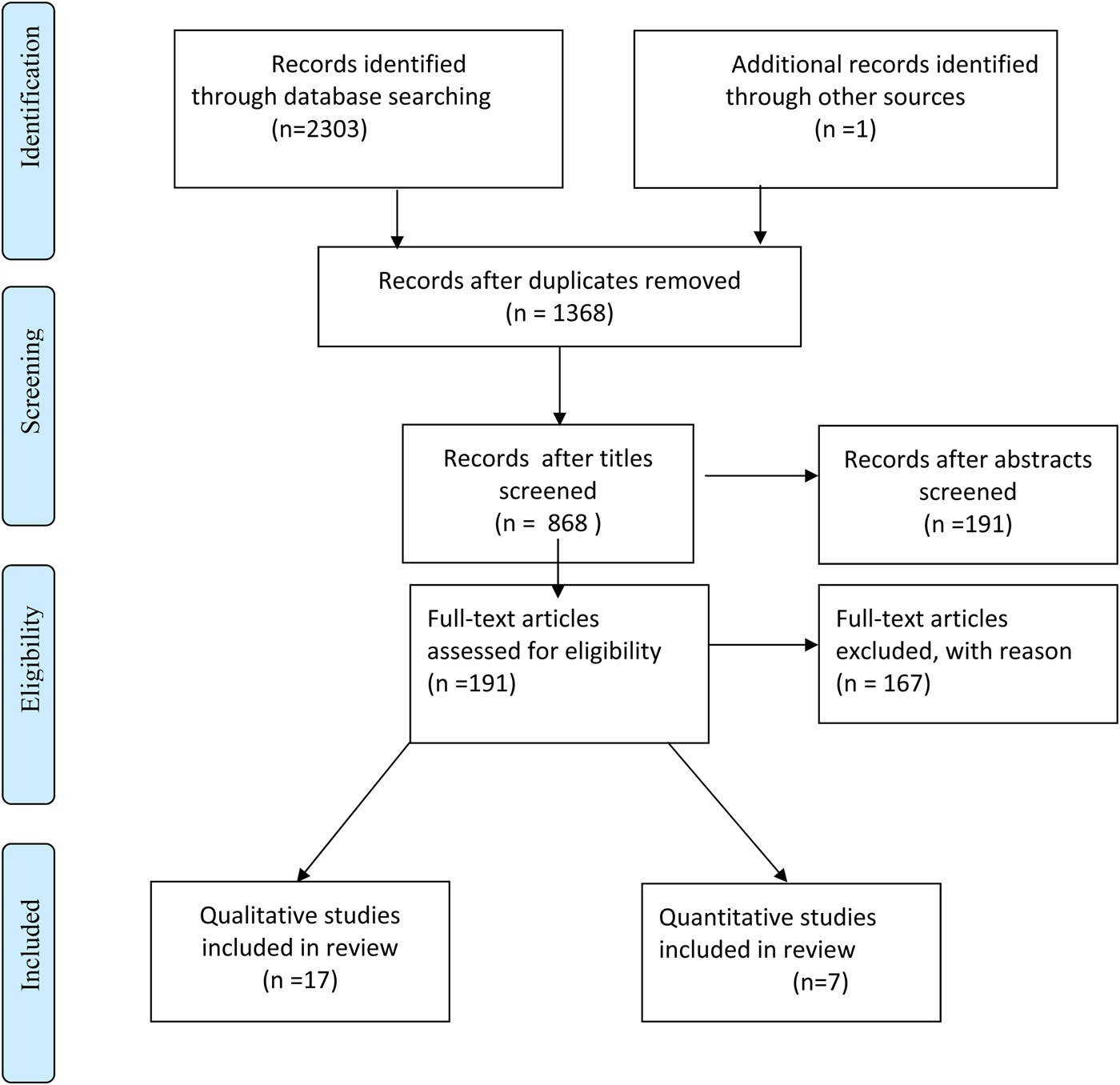
The search was conducted in June 2016 and updated in May 2018 (Figure 1). Databases for the search included CINAHL, Medline, EMBASE and PubMed. Search terms were combined using BOOLEAN operators AND/OR. The search strategy included the MESH terms “caregiver” AND “heart failure,” both exploded to encompass all subject headings within the term. Key words used were “heart failure” OR “advanced heart failure” OR “cardiac failure” OR “heart decompensation” OR “right sided heart failure” OR “right-sided heart failure” OR “left sided heart failure” OR “left-sided heart failure” OR “myocardial failure” OR “congestive heart failure” AND “caregiv*” OR “family caregiv*” OR “informal caregiv*” OR “spouse” OR “neighbor” OR “friend” OR “carer” OR “daughter” OR “son.” The search strategy was developed with assistance of an experienced health science librarian.
Prisma flow diagram

Inclusion and exclusion criteria
To meet the aims of the review, inclusion criteria were: (1) family caregivers older than age 18 and including spouse, adult child, friend, and/or neighbor; (2) study indicates patient is palliative, end-of-life, and/or in the advanced stages of HF, class III or IV according of the New York Heart Association (NYHA) and/or stage D; (3) primary research in peer-reviewed journal or unpublished peer-reviewed research such as dissertations and theses; (4) article is in English; and (5) article differentiates between the results of the caregiver and the care receiver. Exclusion criteria were: care recipient has a left ventricular assist device (LVAD) and in the case of mixed population, the results of advanced HF were not reported separately from other population groups. Articles were also not excluded based on date/year of publication. Quality of quantitative articles was assessed using the Quality Assessment Tool for Quantitative Studies, a tool that meets standards for both reliability and validity (National Collaborating Center for Methods and Tools, 2008) and was specifically developed to analyze quality of quantitative articles in the public health sphere. Qualitative articles were assessed using the Critical Appraisal Skills Programme. Studies were not excluded based on quality, but were taken into account during data analysis.
Data analysis
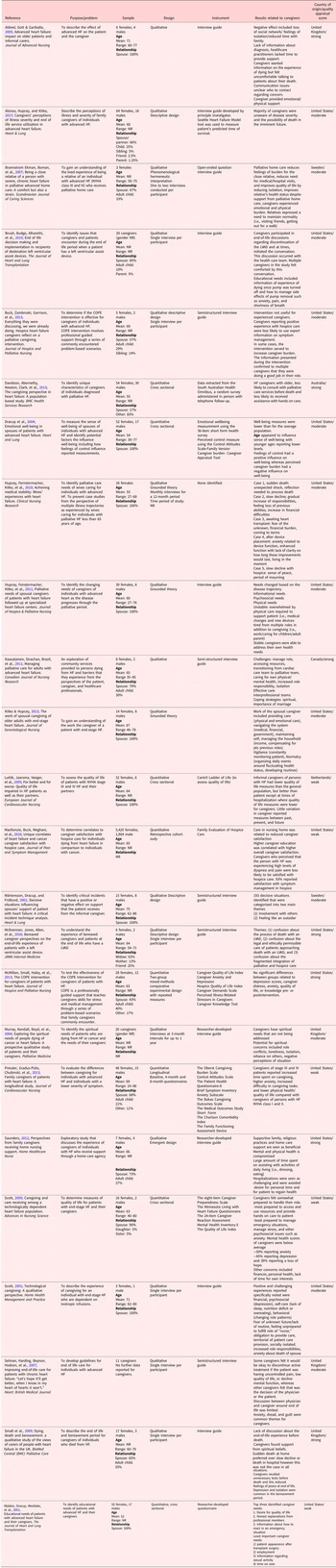
Data extraction was conducted using the process outlined by Pinch (Reference Pinch1995), which involved (1) extracting data from each article related to caregivers and creating a summary of each article based on preset categories and (2) analyzing summaries to develop a tentative outline based on common themes (Table 1 provides the completed data extraction table). The constant comparative method of coding developed by Glaser (Reference Glaser1965) was used to analyze the data in this study. The first step in this method involved reviewing pertinent data within the studies and assigning meaning to each part of the text through use of codes. As each individual piece of text was coded, it was compared with text within the same category. The purpose of this method is to begin generating comparisons within and between categories to aid in the development of a theoretical explanation of results. The second step involved analyzing each code and group them according to themes.
Characteristics of articles

COPE, Creativity, Optimism, Planning, and Expert information; HF, heart failure; LVAD, left ventricular assist device; NYHA, New York Heart Association; NR, not reported.
Results
A total of 24 articles met our inclusion criteria in this integrative review. This included 17 (71%) qualitative and 7 (29%) quantitative research studies. Qualitative research articles used semistructured interviews as their form of data collection. Quantitative research used a mixture of researcher developed questionnaires and established instruments to collect data. The date of publication for the sample ranged between 2000 and 2017, with the majority of research originating from the United States (63%) followed by United Kingdom (17%), Sweden (8%), Netherlands (4%), Canada (4%), and Australia (4%). During the data analysis process, six major themes emerged. Each theme will be discussed in the following section.
Undertaking a journey in a state of flux
A state of flux can be defined as living a life of uncertainty, coupled with not knowing what each day will bring. The stories shared by caregivers reflected a sense of uncertainty regarding the future, “the unpredictability of symptom onset meant that planning activities was impossible” (Aldred et al., Reference Aldred, Gott and Gariballa2005, p. 119). Although caregivers reported a desire for routine in an attempt to establish a sense of normality (Braannstrom et al., Reference Braannstrom, Ekman and Boman2007; Brush et al., Reference Brush, Budge and Alharethi2010; Kitko & Hupcey, Reference Kitko and Hupcey2013; Saunders, Reference Saunders2012; Scott, Reference Scott2001), there was also a recognition that a normal state did not exist (Aldred et al., Reference Aldred, Gott and Gariballa2005; Kitko & Hupcey, Reference Kitko and Hupcey2013; Luttik et al., Reference Luttik, Jaarsma and Veeger2005; Scott, Reference Scott2001). Loss of the ability to predict future events resulted in general feelings of discontent (Dracup et al., Reference Dracup, Evangelista and Doering2004). The constant state of flux resulted in situations in which caregivers declined invitations to events outside of the home, allowing them to be isolated from a larger social network (Aldred et al., Reference Aldred, Gott and Gariballa2005). The state of flux is further revealed through continuous changes to patient care plans and related financial obligations.
Characteristics of this state of flux included frequent changes to medication regimens, introduction of new treatments, and the ongoing need to relearn care strategies (Hupcey et al., Reference Hupcey, Fenstermacher and Kitko2011; Scott, Reference Scott2001); for example, one caregiver reported relief in knowing that when the patient started wheezing, he was heading toward a health crisis, alerting the caregiver that they should seek professional support (Kitko & Hupcey, Reference Kitko and Hupcey2013). As the patient neared end of life, he or she no longer exhibited these signs, decreasing the caregiver's ability to predict future health needs. Experienced caregivers recognized that to be successful in their role, they needed to develop skills that allowed them to adapt to new situations when they arise (Scott, Reference Scott2001). The unpredictable nature of a diagnosis of advanced HF contributed to financial challenges for caregivers (Hupcey et al., Reference Hupcey, Fenstermacher and Kitko2010, Reference Hupcey, Fenstermacher and Kitko2011; Kitko & Hupcey, Reference Kitko and Hupcey2013; Scott, Reference Scott2000). This occurred at a time when it was typical for additional costs to be incurred such as travel to and from hospital, accommodation, meals, payment for medical treatments, and new medication costs (Hupcey et al., Reference Hupcey, Fenstermacher and Kitko2010, Reference Hupcey, Fenstermacher and Kitko2011; Kitko & Hupcey, Reference Kitko and Hupcey2013; Scott, Reference Scott2001).
Gaining strength
The theme of gaining strength encompasses the personal growth that the caregiver attributes to the experience of caregiving. Despite reports of feeling overwhelmed by the caregiving role and concerning themselves with “What if I did something wrong?” several participants reported an increased sense of satisfaction from these additional responsibilities (Scott, Reference Scott2001, p. 230). Caregivers credited these positive effects of caregiving to the development of new skills and the strengthening of the relationship between caregiver and patient.
Developing new skills
This subtheme includes the development of both cognitive and physical skills. As a result of undertaking the caregiving role, caregivers gained skills in providing physical care (Aldred et al., Reference Aldred, Gott and Gariballa2005; Braannstrom et al., Reference Braannstrom, Ekman and Boman2007; Kitko & Hupcey, Reference Kitko and Hupcey2013; Saunders, Reference Saunders2012). These skills included wound care, patient assessment for symptom deterioration, titration of medication doses based on pertinent clinical data, and administering intravenous medications in the home environment (Hupcey et al., Reference Hupcey, Fenstermacher and Kitko2011; Scott, Reference Scott2001). These skills were often equated with the job of a nurse and, although they initially proved to be anxiety provoking, once mastered, these tasks contributed to an increase in caregiver self-esteem (Hupcey et al., Reference Hupcey, Fenstermacher and Kitko2011; Scott, Reference Scott2001). Skills gained as caregiver could be transferrable to other areas of life; for example, one caregiver reported using her skills learned as a caregiver to improve her own health status (Buck et al., Reference Buck, Zambroski and Garrison2013). Another caregiver reported an increase in her ability to problem solve as a result of the experience of caregiving (Scott, Reference Scott2001).
Growing together
The subtheme of growing together entailed both negative and positive aspects. It is evident in the literature that caregivers commonly reported experiencing a sense of frustration and resentment when interacting with the care recipient, specifically when they did not attempt to reciprocate care when they had the ability (Hupcey et al., Reference Hupcey, Fenstermacher and Kitko2011) or when conversation between the patient and the caregiver was limited (Mårtensson et al., Reference Mårtensson, Dracup and Fridlund2001). In some cases, caregivers undertook their role from a sense of obligation to the care recipient rather than a desire to provide care (Scott, Reference Scott2001). Despite these challenges, positive outcomes resulted from the caregiving experience such as the additional time spent with the patient allowed for the development of a deeper relationship (Braannstrom et al., Reference Braannstrom, Ekman and Boman2007; Scott, Reference Scott2001). In addition, the psychological support that caregivers provided allowed both the caregiver and patient an opportunity in which time was spent focusing on the positive aspects of life (Aldred et al., Reference Aldred, Gott and Gariballa2005; Braannstrom et al., Reference Braannstrom, Ekman and Boman2007; Kitko & Hupcey, Reference Kitko and Hupcey2013; Scott, Reference Scott2000). When faced with the inevitability that end of life for the patient may be nearing, the caregiver began to view each additional day with the patient as a gift (Scott, Reference Scott2001).
Forgetting oneself along the way
The experience of caregiving for persons with advanced HF involved an intense focus on the patient. Caregivers described the experience as “constantly watching thinking something is going to happen with their [the patient's] heart” (Braannstrom et al., Reference Braannstrom, Ekman and Boman2007, p. 4), which led to caregivers neglecting their own needs in favor of meeting the needs of the patient (Kaasalainen et al., Reference Kaasalainen, Strachan and Brazil2011; Walden et al., Reference Walden, Dracup and Westlake2001). Two subthemes emerged from the data: (1) neglect of personal health and (2) making sacrifices.
Neglect of personal health
Caregivers of those with advanced HF experience a higher degree of burden to physical and mental health when compared with caregivers of persons with HF who experience low to moderate symptoms (NYHA class I or II) (Pressler et al., Reference Pressler, Gradus-Pizlo and Chubinski2013). As additional responsibilities common to end of life were added to the role of the caregivers, it became increasingly difficult for them to address their own personal health needs (Hupcey et al., Reference Hupcey, Fenstermacher and Kitko2011; Saunders, Reference Saunders2012; Scott, Reference Scott2000, Reference Scott2001). The limited emphasis on self-care were in relation to improper diet, poor sleep habits, and failure to make medical appointments for their own health issues (Braannstrom et al., Reference Braannstrom, Ekman and Boman2007; Kitko & Hupcey, Reference Kitko and Hupcey2013; Scott, Reference Scott2001).
Caregivers identified that to maintain mental health it was important to participate in activities unrelated to the patient such as watching television, praying, physical activity, or socializing (Aldred et al., Reference Aldred, Gott and Gariballa2005; Braannstrom et al., Reference Braannstrom, Ekman and Boman2007; Kaasalainen et al., Reference Kaasalainen, Strachan and Brazil2011; Kitko & Hupcey, Reference Kitko and Hupcey2013; Murray et al., Reference Murray, Kendall and Boyd2004; Scott, Reference Scott2001); however, caregivers often neglected to take this advice and would only participate in activities outside of the home when the patient's symptoms had been effectively managed (Hupcey et al., Reference Hupcey, Fenstermacher and Kitko2011; Kitko & Hupcey, Reference Kitko and Hupcey2013). Further, these activities would frequently center on meeting needs of the patient such as obtaining medications (Braannstrom et al., Reference Braannstrom, Ekman and Boman2007).
Making sacrifices
The experience of caregiving for those with advanced HF involved making sacrifices which can be defined as discontinuing something you enjoy to allow for participation in another thing of value. For example, caregivers reported being unable to travel because it was not recommended for the patient (Aldred et al., Reference Aldred, Gott and Gariballa2005; Scott, Reference Scott2001). This resulted in a large percentage of time being spent in the home setting, which contributed to a sense of isolation from their surrounding community (Aldred et al., Reference Aldred, Gott and Gariballa2005; McMillan et al., Reference McMillan, Small and Haley2013; Saunders, Reference Saunders2012). Because of the time requirements needed to provide care for a person with advanced HF, many caregivers felt they needed to give up hobbies that they had once enjoyed (Aldred et al., Reference Aldred, Gott and Gariballa2005).
Seeking out sources of support
The advanced period of HF is chaotic and, as such, caregivers are required to seek out additional sources of support; however, proclamations such as “I have to support, I have to take care of everything” (Kaasalainen et al., Reference Kaasalainen, Strachan and Brazil2011, p. 48) show that caregivers felt alone in their experience. When discussed, identified sources of support included other family members, friends, and professional members of the healthcare team. Caregivers admitted to being hesitant in requesting assistance because they felt others were too busy to provide support and/or they did not want to be seen as a burden (Buck et al., Reference Buck, Zambroski and Garrison2013; Hupcey et al., Reference Hupcey, Fenstermacher and Kitko2011; Murray et al., Reference Murray, Kendall and Boyd2004; Scott, Reference Scott2001). Support from a palliative care team was seen as an asset (Braannstrom et al., Reference Braannstrom, Ekman and Boman2007; Hupcey et al., Reference Hupcey, Fenstermacher and Kitko2010; MacKenzie et al., Reference MacKenzie, Buck and Meghani2016); however, persons affected by advanced HF were not consistently referred to these sources of support (Alonso et al., Reference Alonso, Hupcey and Kitko2017; Davidson et al., Reference Davidson, Abernethy and Newton2013; Kaasalainen et al., Reference Kaasalainen, Strachan and Brazil2011).
The quality of support the caregiver received during the advanced period through to end of life appeared to have a strong influence on whether the experience of caregiving was seen as positive or negative (Buck et al., Reference Buck, Zambroski and Garrison2013; Mårtensson et al., Reference Mårtensson, Dracup and Fridlund2001). Interventions viewed as supportive included arranging for assistance with physical care, encouraging contact for personal needs rather than solely focusing on the patient, and allowing time for discussion about the caregiving experience using positive language (Mårtensson et al., Reference Mårtensson, Dracup and Fridlund2001; Murray et al., Reference Murray, Kendall and Boyd2004). Caregivers also felt supported when they were given straightforward information about the patient's needs and current health status (Hupcey et al., Reference Hupcey, Fenstermacher and Kitko2011; Walden et al., Reference Walden, Dracup and Westlake2001). A negative experience of caregiving was reported when professionals providing support appeared rushed, when outside support did not provide information to the caregiver, or when communication was lacking between supportive services (Aldred et al., Reference Aldred, Gott and Gariballa2005; Braannstrom et al., Reference Braannstrom, Ekman and Boman2007; Kitko & Hupcey, Reference Kitko and Hupcey2013; Mårtensson et al., Reference Mårtensson, Dracup and Fridlund2001; McIlvennan et al., Reference McIlvennan, Jones and Allen2016; Saunders, Reference Saunders2012).
Preparing for end of life
Preparation for end of life includes any task that would assist caregivers in the transition from active treatment to acceptance of the possibility of death of the patient. A prime concern of caregivers at end of life was a desire “to receive information about action steps to take in an emergency” (Walden et al., Reference Walden, Dracup and Westlake2001, p.767), illustrating a need to feel equipped for future challenges, although varying degrees of preparedness related to the possibility of death were demonstrated. Areas of preparation reported by caregivers were mainly focused in three areas: (1) mental preparedness, (2) educational concerns, and (3) making difficult decisions.
Mental preparedness
Lack of or delayed discussion about the topic of end of life created a barrier for caregivers to become mentally prepared for the possibility of death of the patient. Caregivers reported knowing that death in the near future was plausible (Aldred et al., Reference Aldred, Gott and Gariballa2005; Alonso et al., Reference Alonso, Hupcey and Kitko2017; Murray et al., Reference Murray, Kendall and Boyd2004; Scott, Reference Scott2001) but, healthcare providers had not brought the topic up with them and caregivers felt uncomfortable initiating the conversation (Aldred et al., Reference Aldred, Gott and Gariballa2005; Alonso et al., Reference Alonso, Hupcey and Kitko2017; Braannstrom et al., Reference Braannstrom, Ekman and Boman2007; Murray et al., Reference Murray, Kendall and Boyd2004; Small et al., Reference Small, Barnes and Gott2009). Caregivers reported relief when a healthcare professional would broach the subject of end of life because it allowed them to begin to develop a plan for the future (Brush et al., Reference Brush, Budge and Alharethi2010). Reasons cited for avoidance of the topic of death included a wish to maintain a sense of optimism for the patient, feeling uncomfortable about the topic, and/or a lack of knowledge about how to address the matter (Aldred et al., Reference Aldred, Gott and Gariballa2005; Small et al., Reference Small, Barnes and Gott2009). Once the patient had died, caregivers reported that they had not been mentally prepared for this experience (Alonso et al., Reference Alonso, Hupcey and Kitko2017; Davidson et al., Reference Davidson, Abernethy and Newton2013; Hupcey et al., Reference Hupcey, Fenstermacher and Kitko2010). Caregivers that received support through palliative care or had access to hospice services were more likely to report being mentally prepared for death or the possibility of death in the future (Hupcey et al., Reference Hupcey, Fenstermacher and Kitko2010).
Educational concerns
If caregivers were able to acknowledge that HF was a life-limiting illness, they attempted to prepare themselves for end of life by acquiring knowledge. Educational requests included a description of their role when presented with an emergency situation such as when the care recipient's heart stops beating (Braannstrom et al., Reference Braannstrom, Ekman and Boman2007; Mårtensson et al., Reference Mårtensson, Dracup and Fridlund2001; McIlvennan et al., Reference McIlvennan, Jones and Allen2016; Selman et al., Reference Selman, Harding and Beynon2007). Caregivers also reported an eagerness to visualize the end-of-life experience, questioning if pain or anxiety for the patient would be involved (Brush et al., Reference Brush, Budge and Alharethi2010; McIlvennan et al., Reference McIlvennan, Jones and Allen2016). These questions commonly remained unanswered, creating a sense of frustration and confusion for caregivers (Aldred et al., Reference Aldred, Gott and Gariballa2005; McIlvennan et al., Reference McIlvennan, Jones and Allen2016; Small et al., Reference Small, Barnes and Gott2009). Caregivers who had already experienced a person dying from HF reported multiple end-of-life scenarios including sudden death, gradual worsening of symptoms, or rapid improvement followed by an unexpected death (Brush et al., Reference Brush, Budge and Alharethi2010; Hupcey et al., Reference Hupcey, Fenstermacher and Kitko2010; Small et al., Reference Small, Barnes and Gott2009). As such, it is difficult to predict which disease trajectory with which the caregiver will be presented.
Making difficult decisions
Because those with advanced HF showed a significant deterioration in health status, caregivers found themselves assisting patients’ in making choices that would influence the end-of-life experience. A common decision required of caregivers concerned whether to access palliative resources such as home care or hospice (Alonso et al., Reference Alonso, Hupcey and Kitko2017; Braannstrom et al., Reference Braannstrom, Ekman and Boman2007; Hupcey et al., Reference Hupcey, Fenstermacher and Kitko2011). Other decisions were related to patient hospitalizations, such as the decision whether to bring the patient to the hospital for symptom relief versus staying at home to manage care (Aldred et al., Reference Aldred, Gott and Gariballa2005), to decline tests and procedures at end of life that the family deemed unnecessary (Aldred et al., Reference Aldred, Gott and Gariballa2005; Small et al., Reference Small, Barnes and Gott2009), or to discontinue current life-prolonging treatments including medications and deactivation of an LVAD (Brush et al., Reference Brush, Budge and Alharethi2010; McIlvennan et al., Reference McIlvennan, Jones and Allen2016). Caregivers reported that decisions at end of life were based on what would provide the best quality of life for the patient and would result in the lowest degree of pain and anxiety (Selman et al., Reference Selman, Harding and Beynon2007).
Finding closure
The experience of caregiving does not end once the patient dies. As one participant would describe the experience after death, it is “like falling into a deep pit” (Small et al., Reference Small, Barnes and Gott2009, p. 5). The theme of finding closure illustrates the experience of the caregiver during the bereavement period. Findings during this period were conflicted with some caregivers reporting an increase in socialization, whereas others reporting that they remained isolated (Small et al., Reference Small, Barnes and Gott2009). All caregivers discussed some level of grief following the death of the person with HF (Davidson et al., Reference Davidson, Abernethy and Newton2013; Small et al., Reference Small, Barnes and Gott2009), with a high percentage reporting that they were able to eventually resolve their grief (Davidson et al., Reference Davidson, Abernethy and Newton2013). Professional support during the bereavement period was seen as beneficial but support services were not commonly accessed by the caregiver (Davidson et al., Reference Davidson, Abernethy and Newton2013; Small et al., Reference Small, Barnes and Gott2009). Discussion related to the bereavement period was limited to two articles indicating a need for further research in this area.
Discussion
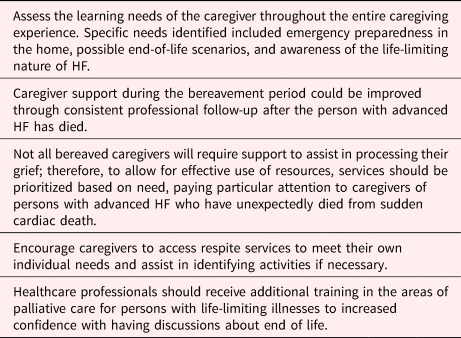
Finding interventions that support the needs of caregivers of persons with advanced HF needs to be a priority. Within this review, only one intervention was tested with caregivers of persons with advanced HF (Table 1) and this intervention was shown to be ineffective (Buck et al., Reference Buck, Zambroski and Garrison2013; McMillan et al., Reference McMillan, Small and Haley2013). Current guidelines in HF care have identified that incorporating the caregiver into the plan of care is essential (Howlett et al., Reference Howlett, Chan and Ezekowitz2016); however, it does not elaborate on including specific interventions, leaving practitioners with little research evidence to guide their practice in working with caregivers. A review of caregiver interventions for persons with a life-limiting illness identified 12 interventions that have been shown to be effective in improving the caregiver's ability to manage their caregiving role (Candy et al., Reference Candy, Jones and Drake2011) with 11 of these interventions being developed specifically for caregivers of persons with cancer. Because of unique differences between each diagnosis, it is not advisable to generalize results from one disease population to another and expect the same outcomes (Molloy et al., Reference Molloy, Johnston and Witham2005). Results generated from this integrative review provide a wider scope of the identified problem area that serves to generate new knowledge on the topic (Torraco, Reference Torraco2005; Whittemore & Knafl, Reference Whittemore and Knafl2005) and can inform development of caregiver interventions. See Table 2 for recommendations for practice based on this research.
Recommendation for practice based on research findings

HF, heart failure.
Barriers in the accessibility of palliative services was also identified in this review as an issue for caregivers of persons with advanced HF. Patients with chronic obstructive pulmonary disease, a disease with a disease trajectory comparable to HF, encountered limitations with accessing palliative services (Curtis, Reference Curtis2008). Reasons cited for this included a lack of adequate communication about the life-limiting nature of the diagnosis and an inability to predict when end of life will occur, which are identical to the challenges that caregivers of individuals with advanced HF experience. It may be beneficial for key players from both chronic obstructive pulmonary disease and HF to work together to develop a strategy to improve patient services at end of life. In general, there are a multitude of reasons that a caregiver may not have adequate access to support services which are unique to the caregiver (Adelman et al., Reference Adelman, Tmanova and Delgado2014); therefore, interventions to increase access to support services need to be individualized to the caregiver.
Within this review, caregivers who had experienced the death of the patient commonly expressed that the event had been unanticipated and were therefore not prepared for end of life (Hupcey et al., Reference Hupcey, Fenstermacher and Kitko2010; McIlvennan et al., Reference McIlvennan, Jones and Allen2016; Small et al., Reference Small, Barnes and Gott2009). An unexpected death has been shown to increase the caregiver's risk for ineffective coping during bereavement (Shah et al., Reference Shah, Carey and Harris2013). Increased referrals to palliative or hospice services for patients living with advanced HF, preferably at the beginning of the disease trajectory, could assist in preparing families for the end-of-life period (Howlett et al., Reference Howlett, Morrin and Fortin2010), increasing the likelihood that caregivers will effectively cope with feelings of grief in bereavement. Emotional distress that results from ineffective coping during bereavement can increase the caregiver's risk of mortality (Stroebe et al., Reference Stroebe, Schut and Stroebe2007). Although it may not be feasible to provide bereavement services to every person who has taken on the role of caregiver for those with advanced HF, by investigating what aspects of the situation place people at an increased risk for prolonged grief and ineffective coping, services can be targeted and those at risk should be offered additional supports when necessary (Ghesquiere et al., Reference Ghesquiere, Haidar and Shear2011).
Within this review, only two articles (Davidson et al., Reference Davidson, Abernethy and Newton2013; Small et al., Reference Small, Barnes and Gott2009) focused on the caregiving experience following the death of the person with advanced HF. It is not uncommon for this phase of the caregiving journey to be neglected in the literature (Ume & Evans, Reference Ume and Evans2011). In clinical practice, healthcare professionals, such as nurses, providing palliative care state busy schedules do not allow for time to provide support to caregivers in the bereavement period (Johnson, Reference Johnson2015). Not all bereaved caregivers will require support to assist in processing their grief (Faull & Taplin, Reference Faull, Taplin, Faull, de Caestecker and Nicholson2012), and therefore to allow for effective use of resources, services should be prioritized based on need, paying particular attention to caregivers of persons with advanced HF who have unexpectedly died from sudden cardiac death.
Based on the current understanding of the experience of caregiving for persons with advanced HF, it could be argued that this group of caregivers are at an increased risk for complicated grief and failure to cope post death. One reason for this increased risk is related to the frequent reports from caregivers of the lack of effective communication between health care professionals and patients at end of life (Aldred et al., Reference Aldred, Gott and Gariballa2005; Braannstrom et al., Reference Braannstrom, Ekman and Boman2007; Hupcey et al., Reference Hupcey, Fenstermacher and Kitko2011; Kaasalainen et al., Reference Kaasalainen, Strachan and Brazil2011; Kitko & Hupcey, Reference Kitko and Hupcey2013; McIlvennan et al., Reference McIlvennan, Jones and Allen2016). Research has shown that ineffective communication with healthcare professionals before the death of the patient limits the caregiver's ability to effectively manage feelings of loss in bereavement (DiGiacomo et al., Reference DiGiacomo, Lewis and Nolan2013). Caregivers have a desire for open and honest discussions about death (Thorne et al., Reference Thorne, Con and McGuinness2004). It is also recommended that caregivers are aware that HF is a life-limiting disease and that they receive information on possible end-of-life scenarios.
Limitations of the review
The majority of caregiver participants (86.3%) indicated they were a spouse of the person with advanced HF. The large percentage of spouses within the sample limits the generalizability of the current state of the advanced HF caregiver literature as research has demonstrated that spouses report unique caregiving experiences (Penning & Wu, Reference Penning and Wu2016). When compared with adult children (Pinquart & Sorensen, Reference Pinquart and Sorensen2006), siblings, parents, and friends (Penning & Wu, Reference Penning and Wu2016), spouse caregivers report a lower quality of life, increased incidence of depression, and/or financial strain. Therefore, these measures may be overestimated in the results of this review. Same sex couples have also been shown to have individualized needs based on their distinct experiences such as a perceived feeling of discrimination within the healthcare setting (Czaja et al., Reference Czaja, Sabbag and Lee2016); however, only one same-sex couple was included in the studies analyzed for this review. In other bodies of caregiver literature, such as research related to caregivers of persons with dementia, an effort has been made to analyze each caregiver relationship in isolation (Day et al., Reference Day, Anderson and Davis2014; Lee et al., Reference Lee, Sohn and Lee2016; Tan & Schneider, Reference Tan and Schneider2009). This approach to research development should be replicated in future research related to caregivers of persons with HF as each relationship offers a unique insight into the caregiving experience.
The male perspective is limited within the literature in this review with males constituting 26% of the caregiver sample. The caregiving experience varies between the male and female population (Hammond-Collins et al., Reference Hammond-Collins, Peacock and Forbes2014). Cultural background has been shown to influence the experience of caregiving. Cho, Ory, and Stevens (Reference Cho, Ory and Stevens2016) found that when compared with Hispanic and African American caregivers, Caucasian caregivers reported fewer positive aspects of caregiving. The majority of caregivers within this review were Caucasian, which could have influenced the reported experiences.
Implications for research
From a research perspective, the current understanding of the caregiving experience for persons with advanced HF needs to be expanded. An enhanced understanding could be achieved by addressing current gaps in the literature that have been identified within this review. As discussed previously, this can include conducting research using participants from different cultural groups, comparing experience by gender, and exploring different relationship structures (such as same-sex marriages). Future research should also avoid solely focusing on the negative aspects of the caregiving experience. Priorities for future research include exploring the experience of bereavement and the development of effective caregiver interventions
Conclusion
The intent of this integrative review was to create a thematic framework for the current state of literature related to informal caregiving of persons with advanced HF from the perspective of the caregiver. To our knowledge, this is the first integrative review that sought to bring together available quantitative and qualitative research specific to the advanced period of caregiving, including end of life and bereavement, for caregivers of persons with HF. Analysis of the included studies identified six key themes: (1) undertaking a journey in a state of flux, (2) gaining strength, (3) forgetting oneself along the way, (4) seeking out sources of support, (5) preparing for end of life, and (6) finding closure.
The understanding of caregiving for people with advanced HF remains incomplete, with multiple gaps identified in the literature. Although it will take time to develop a stronger research base, healthcare professionals working in direct contact with patients with advanced HF can improve the experience of caregiving immediately by implementing small, simple changes into their practice (e.g., taking the time to talk with the caregiver, asking for their feedback, and ensuring that the caregiver is involved in the care planning process). Caregivers play an invaluable role in the care of those with HF and they should be seen as a key member of the health care team.