Social media has cemented itself as a ubiquitous and useful communication tool in the public sphere. Public health agencies have a responsibility for communication to the public on a number of issues, including emergencies. Use of social media for this purpose is not routine, and public health agencies are still assessing how social media can best be adopted to contribute in practice.Reference Davies, Dhaliwal and Brankley1, Reference Rubin, Bouri, Jolani and Minton2 The reach and timeliness of social media contribute to its appeal for public health emergencies, and applications have included outbreak detection, information sharing, and managing rumors.Reference Merchant, Elmer and Lurie3 It is not uncommon for public health agencies to have social media accounts that can be followed by the public; for example, during the May 2017 floods in Ottawa/Gatineau, public health used Twitter (@ottawahealth) to share messaging around well-water testing, preparedness activities, and mental health support. Social media provide an opportunity to enhance communication on population health issues relevant to emergencies.
While the potential contribution of social media to public health practice is acknowledged, there is limited evidence evaluating its current use.Reference Khan, Fazli and Henry4 In our review of the public health emergency preparedness literature, we noted a knowledge gap in the use of novel technologies for communication.Reference Khan, Fazli and Henry4 For social media, the specific nature of how that technology influences communication between public health agencies and the public has not been explored in the Canadian context. Given the important role for public health in communicating to the public during emergencies, research is needed to understand its applications in emergency management and general public health practice. In this study, we explored social media use among local public health agencies in Ontario, Canada, in relation to managing a spectrum of emerging public health incidents (EPHIs). EPHIs are defined as all-hazards events with the potential to overwhelm routine local capacities; they are unpredictable and have a sudden onset.Reference Nelson, Lurie and Wasserman5–Reference Khan, Sanford and Sider7 Our objectives were to (1) investigate how social media are currently used for communication between local public health and the public, and (2) explore barriers and practice-relevant gaps experienced by local public health professionals in using social media for communication. By understanding this, we aim to inform strategies for how social media may be leveraged in the management of EPHIs.
METHODS
This study was conducted at the local public health level in Ontario, Canada. Differences in population density and socioeconomic characteristics across Ontario were defined by Statistics Canada Peer Groups according to urban, urban-rural, and rural health regions.8 At the time of this study, public health programs and services were delivered by 36 local public health agencies across the province.
An exploratory, qualitative design was chosen given the limited evidence on this topic.Reference Khan, Fazli and Henry4 We used an interdisciplinary, participatory method to identify challenges, while promoting knowledge-sharing. Using this approach, 2 focus groups were conducted with the structured interview matrix (SIM) technique. The SIM incorporates varied experiences using social media across disciplines within a public health agency and accommodates 8–40 participants.Reference O’Sullivan, Amaratunga and Phillips9–Reference Tracey, O’Sullivan and Lane11 Reporting is found in the Consolidated Criteria for Reporting Qualitative Research checklist (Supplemental file 1).
A purposive sample of public health professionals was recruited from public health agencies with the aim of achieving diverse and complementary perspectives based on geography and role. Representation from urban, urban-rural, and rural health regions was sought in anticipation of differences in participant experience with social media.8 Public health professionals (management and staff) with active roles in surveillance and/or epidemiology, outbreak and incident management, emergency preparedness, and communications were invited to participate. The purposive sample was augmented by a snowball recruitment method within professional networks, and recruitment was initiated by e-mail.Reference Morgan and Given12 Ethics approval was obtained from Public Health Ontario’s Ethics Review Board and the University of Ottawa.
Focus groups were held in 1 urban and 1 urban-rural region in February and March 2016. Each focus group was approximately 2.5 hours in length and was scheduled during work hours at a site separate from the participants’ workplaces. Focus groups were facilitated by a doctoral-trained qualitative researcher (TO) who was not previously known to participants. Each focus group was attended by the facilitator, the principal investigator, and 2 research team members, in addition to the research participants. The facilitator interacted directly with participants for data collection. The facilitator’s expertise was in related fields of disaster risk reduction and resilience but not directly in this topic.
The SIM is a 3-step data collection process centered around 4 questions, which were developed from the study objectives and piloted.Reference O’Sullivan, Corneil and Kuziemsky10 The final questions are presented in Table 1. Field notes and audio-recordings were collected. Participant checking occurs in the third part of the SIM focus group, as participants confirm the data during the plenary.
Structured Interview Matrix Focus Group Questions

Audio-recordings were transcribed and checked for accuracy. Field notes from 1-on-1 interviews were used to develop the coding grid, which was tested on a sample of the data and refined until team consensus was reached. The final coding grid is provided as Supplemental file 2. Transcribed audio-recordings from small and large group deliberations were coded using NVivo 10TM software. Transcripts from small and large group deliberations were coded by 2 research team members iteratively until agreement was reached on application of the grid to the data. Subsequently, 1 team member coded the remaining transcripts. Qualitative content analysis was conducted using an inductive approach for theme identification. Coding reports were analyzed for emergent themes, which were revised until consensus was reached, ensuring that the final themes were grounded in the data. Three authors (YK, ST, TO) led the analysis and regularly consulted with the remaining authors (EG, IJ) to ensure rigor in the interpretation of the data.Reference Miles, Huberman and Saldana13
RESULTS
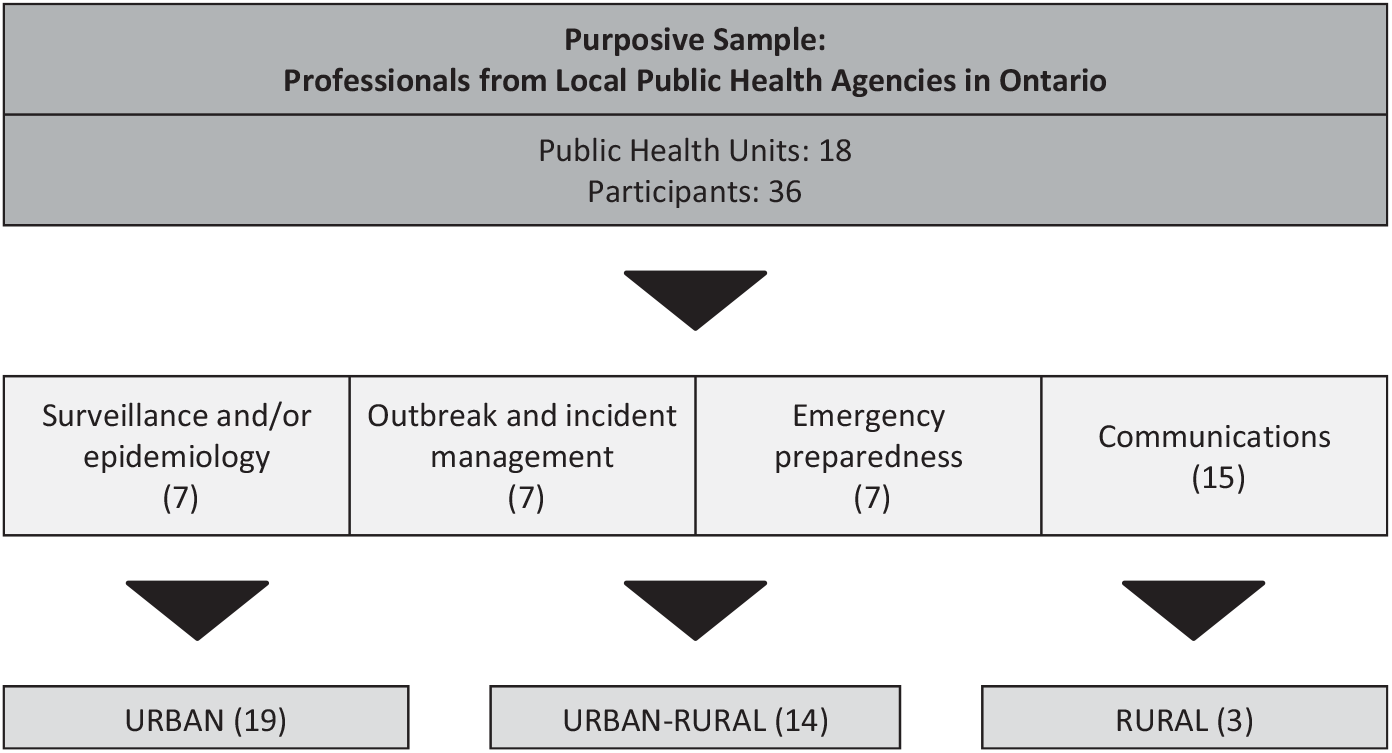
A total of 95 individuals were invited to participate in a regional focus group. We over-sampled given travel required and time commitment during working hours. The number of participants who accepted the invitation was 40. Four participants were unable to attend due to weather or illness. A total of 36 professionals from public health agencies participated in this study across 2 focus groups. Twelve participants attended the focus group held in an urban-rural region, and 24 participants attended the focus group held in an urban region. Figure 1 provides a breakdown of participants by geography and role.
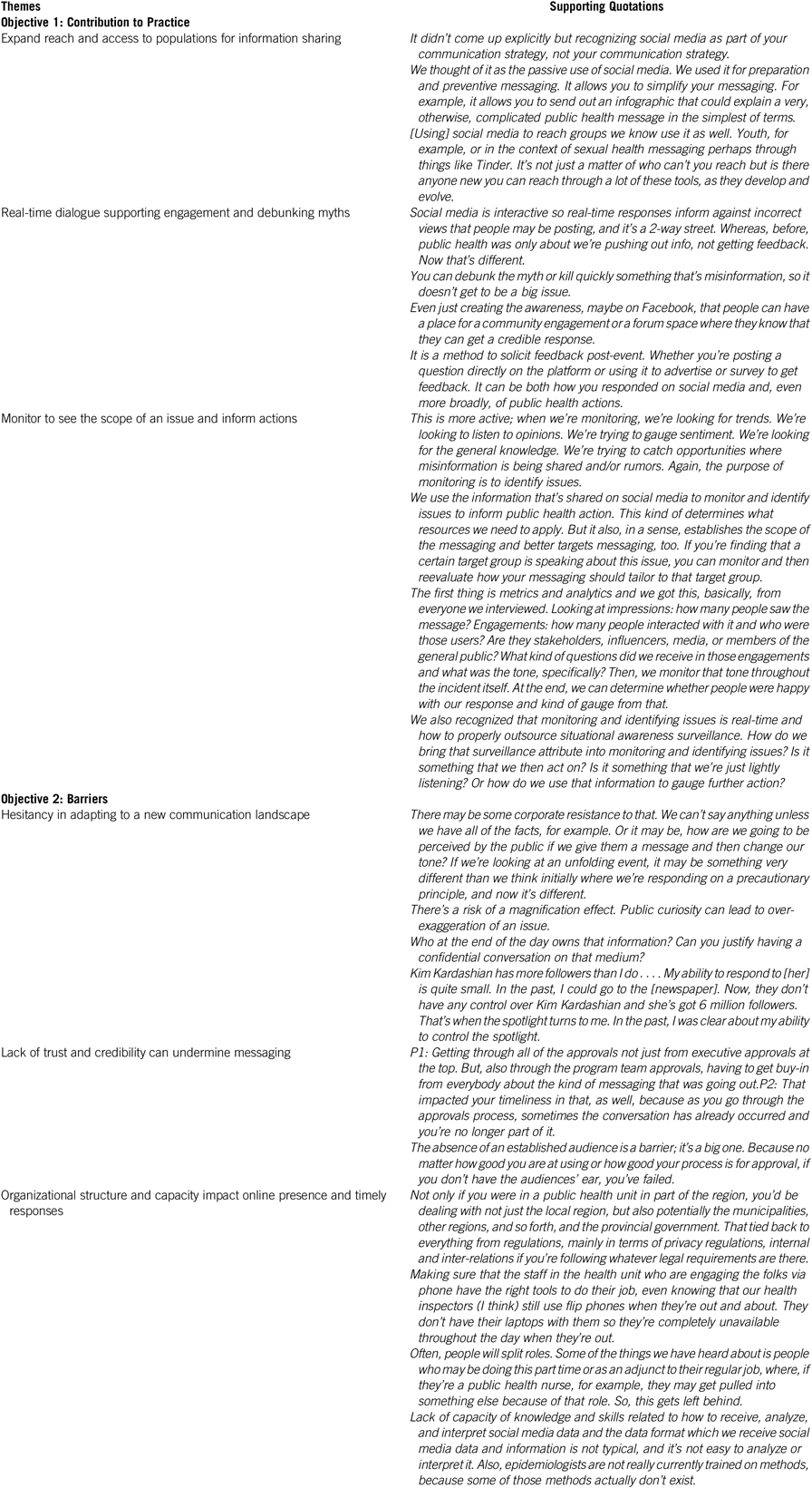
Six themes were identified from the data analysis and are organized below according to our research objectives. Supporting quotations for each theme are presented in Table 2. Emergent strategies to enable social media use are reviewed in the final section of the results.
Demographics of Public Health Professional Participants in Structured Interview Matrix Focus Groups by Expertise and Geography.

Supporting Quotations by Emergent Theme

Contribution to Practice (Objective 1)
Theme 1: Expand Reach and Access to Populations for Information Sharing
The predominant use of social media was to disseminate information and reach the population. Social media is a tool in the toolbox, used to fulfill part of the overall public health agency communication strategy. It is important to choose the appropriate tool to reach the target audience. Information sharing was recognized as a passive form of communication where public health agencies push out messages to the public to create awareness or change behavior. This 1-way sharing is a default use of social media to disseminate information quickly to a wide audience. Examples of information sharing are awareness and prevention messages, early warning messages, advisories, and updates.
Social media can expand the reach of messages and access to populations. These may include new audiences who are hard-to-reach, such as youth, some indigenous peoples, temporary residents, and LGBTQ2+ communities. Breadth or scope of reach was also discussed in terms of targeting particular groups or reaching as many individuals as possible. This theme captures social media use that is predominantly 1-way and used to disseminate key EPHI information and updates to an audience.
Theme 2: Real-time Dialogue Supporting Engagement and Debunking Myths
Social media moves beyond passive communication to enable 2-way dialogue between agencies and the public. Prior to social media, agencies functioned by unidirectionally pushing information out to the public with little interaction.
Online and offline conversations are ongoing and public health agencies have the opportunity to participate, otherwise the conversation will go on and they will be left behind. Social media can support engagement in conversations and can be used to clarify misinformation and manage rumors. With public health agencies having a presence on social media, they are able to create a credible space for the public to ask questions and get a reliable response, including guidance to appropriate resources. Convenience is another important attribute of social media facilitating a customer service approach.
Finally, the ability to ask for feedback over social media is a useful way to help evaluate public health actions. The real-time bi-directional aspect of social media is identified as a unique contribution to public health communication practice, and this, in turn, could support engagement activities before, during, and after an EPHI.
Theme 3: Monitor to See the Scope of an Issue and Inform Actions
Monitoring is an important contribution of social media to identify unrecognized issues and inform public health actions for EPHIs. Monitoring is a form of listening to or observing the conversation for the purposes of detecting an incident, promoting situational awareness, understanding public perceptions, and correcting rumors and misinformation. This information can be used to determine how to prepare and respond with appropriate resources and improve timeliness of the response.
It is recognized that there is potential to assess the content on social media to understand public perceptions and identify gaps in the response, contributing to improvement for the next response. Social media can contribute to measurement of reach by monitoring click-throughs, followers, and shares. Monitoring via social media can help with early identification of an incident and situational awareness to support adaptive response; however, social media are not yet being used in this capacity. Considerable discussion in focus groups related to data volume and usefulness is described by 1 participant – there are “more data than we’ve ever dreamed of having and none of it is what we want.”
Barriers (Objective 2)
Theme 4: Hesitancy in Adapting to a New Communication Landscape
Communication is continuously evolving and social media require public health agencies to adapt communication strategies to be part of what is now a conversation. However, several barriers can limit engagement in the conversation, including fear, over-exaggeration, and privacy and confidentiality concerns. Fear can be a barrier to the adoption of social media within public health agencies, due to perceptions of loss of control, the potential for mistakes, and concerns for how it will work within public health (ie, a period of trial-and-error). Exaggeration and bias can lead to response with more resources than necessary when there may not have been a true incident in the first place. Privacy and confidentiality present challenges for having a conversation over social media without revealing health information. The shift – from controlling the message to competing for the message to be heard – has changed the way public health communicates with the public.
Theme 5: Lack of Trust and Credibility Can Undermine Messaging
Trust is a critical component of preparedness for an EPHI both internally and externally facing. Within public health agencies, trust relates to leadership putting trust in the staff or departments to post accurate information on social media. An associated challenge is the onerous approvals process for messages that can impact timeliness and risk the conversation going on without public health. In regard to externally facing communication, trust predominantly relates to public trust and the reliability and credibility of the information shared by the agency. Establishing trust with the public is part of preparedness so that, when an incident occurs, trust is established and the public may be more likely to “listen” to the message.
Trust was also recognized for its importance in correcting misinformation: “The ultimate goal is to become people’s primary source of information.” Overall, a lack of trust within the organization limits organizational ability to successfully engage with social media; if the public does not trust or perceive public health to be a credible source of information, they may not act on the messages being sent by public health during an EPHI.
Theme 6: Organizational Structure and Capacity Impact Online Presence and Timely Responses
Organizational structure and capacity was described as a barrier to adopting and managing social media. By structure and capacity, we refer to the role of health agencies, physical resources, human resources, and the skills, expertise, and experience with social media. Lack of clarity regarding whose role it is to respond, given the variation in structure of public health units within the region, was identified as a challenge. For example, some health agencies are within the municipality, and the resources for communication (ie, social media) are housed under this structure.
Lack of equipment and technology limits the ability of public health professionals to actively engage with social media. For example, 1 participant explained how their public health inspectors have flip phones, which limit their ability to go on social media. Smart technology would enable these inspectors to use social media to identify or respond to an incident.
The need for adequate human resources dedicated to managing social media platforms on a continuous basis (ie, 24/7) was underscored as a challenge in public health, particularly for smaller health agencies. The organizational commitment of time and funding is needed for investment in social media. Training, expertise, and skills support effective social media use. This includes skills to analyze and interpret data collected from social media for monitoring purposes. One participant emphasized that methods to analyze this information have not yet been developed.
Strategies
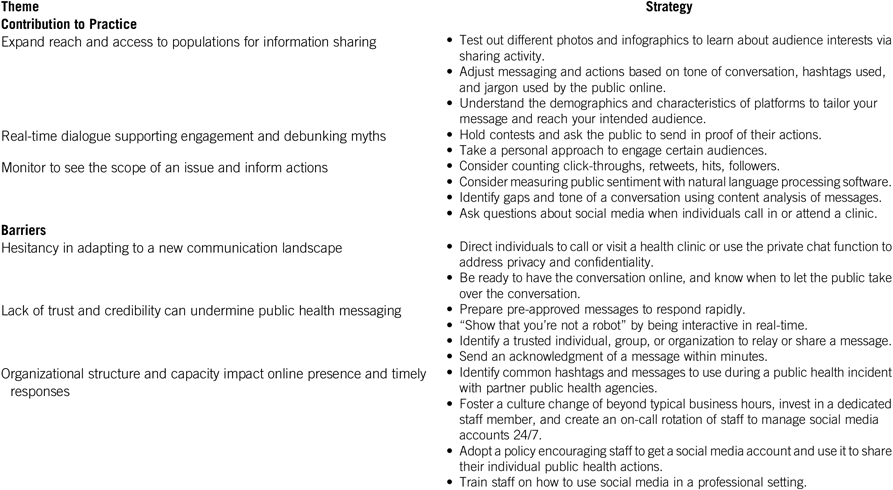
The SIM technique as a participatory method enabled co-learning as participants had an active role in collecting information, discussing, and reporting back.Reference O’Sullivan, Corneil and Kuziemsky10 As a result, strategies emerged during the discussions to address barriers and improve the use of social media for public health agencies. General communication strategies included consistency and relevancy of messaging, and providing accredited and appropriate information. Strategies specific to social media use in local public health agencies were relevant to the management of EPHIs. This list is displayed in Table 3 and corresponds with the objectives and emergent themes.
Strategies Identified by Participants for Incorporating Social Media in Public Health Practice

DISCUSSION
This exploratory study aimed to understand the opportunities and challenges for public health agencies when using social media in Ontario, with relevance to the EPHI context. Two focus groups, with a total of 36 public health professionals from 18 local public health agencies in Ontario, Canada, provided insight into the contribution of social media to current local public health practice. The 6 themes capture perceptions of how social media can contribute to local public health practice in Ontario, as well as barriers to its use. The first 3 themes indicate that social media are being used to expand the reach of public health messages, to engage in dialogue and debunk myths, and to inform the scope of an issue. The remaining themes represented barriers, including hesitancy to adapt, lack of trust and credibility, and organizational structures and capacity implications. Additionally, strategies were proposed by participants through their discussions for practical approaches to incorporating social media in practice. This study confirms that, in the Canadian context, public health agencies were less familiar with leveraging social media for communication for emergency management-specific uses, although the contributions, barriers, and strategies are highly relevant to EPHIs. The participatory nature of the SIM and the interdisciplinarity of the participants, including communications professionals, supported the development of practical ideas for incorporating social media at the local public health agency level. The added value from a diverse group was evident in the networking, knowledge-sharing, and solution-oriented discussions that participants engaged in, characteristic of the SIM method.Reference O’Sullivan, Corneil and Kuziemsky10, Reference Tracey, O’Sullivan and Lane11 The practice and policy-relevant findings represent an important contribution to applied public health research.
This study highlights unique contributions of social media to public health activities and communication. Social media have broadened the communication landscape as they offer new platforms to disseminate information while also enabling all members of the public to engage in the discourse on public health actions.Reference Fung, Fu and Ying14 Although there was a range in the understanding of social media, several general characteristics were widely discussed with useful implications for practice. The real-time capability of social media was an overarching concept that was embedded in the themes. Previous studies have highlighted the usefulness of real-time capability for tracking anti-vaccine sentiment during an influenza pandemic and facilitating investigations of public concern for infectious disease outbreaks to inform communication strategies and targeted messages.Reference Seeman, Ing and Rizo15, Reference Signorini, Segre and Polgreen16 The timeliness inherent in social media is therefore a window for public health agencies to listen and understand public discourse and evolving public health-related concerns. This characteristic is a key attribute and important reason to consider this communication medium in an emergency. In addition, social media can contribute to practice through the opportunity for public health agencies to engage with the public virtually.
Community engagement is an important activity for public health agencies, and social media offer platforms that can facilitate this in a timely and responsive fashion.Reference Davies, Dhaliwal and Brankley1, Reference Gurman and Ellenberger17, Reference Heldman, Schindelar and Weaver18 Social media technology can therefore be seen as a tool in the toolbox both for messaging outwardly, but also for achieving community engagement through 2-way dialogue and building trust with their community.
Another important characteristic of social media is the permeability of geographic boundaries and the competition for being heard that relates to a lack of virtual boundaries in information-sharing. In this study, competition was seen among public health agencies as well as from celebrities and other individuals or organizations who have a substantial social media following. For example, 1 participant described having to compete with the Disney Twitter account during a measles outbreak, and Disney had more followers and was commenting on public health response. When celebrities have a greater reach through social media, there is potential for them to negatively affect public health messages by disseminating incorrect information, impacting the public’s health-related knowledge and behavior.Reference Caulfield and Fahy19–Reference Kata22 This characteristic highlights the need for public health agencies to engage on social media and be active participants in the conversation.
A limitation of this study is that it is based on 2 focus group sites (urban and urban-rural) and the 36 participants were recruited from the surrounding areas. Thus, the findings may not be transferable to public health agencies in different jurisdictions. However, the participant mix of communications and public health practitioners is common to many public health agencies, and the findings related to contributions, barriers, and strategies relate to typical public health domains of practice in Canada and other countries. Future study could benefit from examining social media use for public health in more remote communities where technology access varies. An additional limitation is that participants represent public health professionals and the study did not include perspectives of the general public on social media use by public health agencies. Consultation with the general public on agency activities using social media would further augment the knowledge base on this topic.
In our study, social media were seen as a tool contributing to the reach of public health messaging. This study aligns with previous research about the potential for social media to expand reach and to access new populations that are traditionally considered hard to reach.Reference Rubin, Bouri, Jolani and Minton2, Reference Gurman and Ellenberger17 In 2011, the Centers for Disease Control and Prevention rolled out a social media campaign, which capitalized on the zombie apocalypse trend occurring in popular culture.23 Using humor, this campaign intended to enhance awareness of personal preparedness activities among the American population. Findings from an evaluation in 2015 by Fraustino and MaReference Fraustino and Ma24 showed that the zombie campaign enhanced awareness but had negative effects on intentions to take disaster preparedness actions. Another study looking at reach explains how using links in tweets reduces convenience for the audience to access information, and their findings show that global organizations using Twitter after the Haitian earthquake are shifting away from this strategy.Reference Gurman and Ellenberger17 These findings illustrate the importance of evaluating social media strategies to determine their effectiveness, which could facilitate developing a comprehensive communication strategy. It is also important for future evaluative research to consider an equity lens exploring which populations are not reached and/or are excluded by social media.
Social media use by public health agencies across Ontario is highly variable. Despite this, participants demonstrated a readiness to learn and innovate as they shared practical strategies collaboratively during the focus groups. The barriers identified in this study are consistent with the literature and are related to factors relevant to social media implementation in public health agency practice, in general, as well as the EPHI context.Reference Davies, Dhaliwal and Brankley1, Reference Rubin, Bouri, Jolani and Minton2 To address barriers to the use of social media that relate to the organizational level, organizational change theories may be useful to strategically implement social media into the public health agency norm. Reference Kotter and Schlesinger25, Reference Kurt and Cartwright26 An examination of assets as well as barriers could capitalize on existing strengths and promote capacity-building to support social media use.Reference Tracey, O’Sullivan and Lane11
CONCLUSION
This study identifies and provides strategies to address barriers and practice gaps related to public health agencies’ use of social media during emergencies. This represents an important contribution to the applied public health literature on this topic and provides promise as a tool to enhance community and stakeholder engagement during public health emergencies.
Acknowledgments
The authors wish to thank and acknowledge all participants, as well as Thomas Appleyard, Tina Badiani, Paul Belanger, Aaron Furfaro, Kieran Moore, and Sarah Nayani for their contributions to the study’s implementation and analysis. This study was funded by the Public Health Ontario Project Initiation Fund.
Author Contributions
All authors contributed to the study conception and design. YK, ST, and TO contributed to data collection and the initial data analysis. All authors contributed to the final analysis and reported findings. All authors critically revised the manuscript for important intellectual content and approved the final manuscript.
Supplementary material
To view supplementary material for this article, please visit https://doi.org/10.1017/dmp.2018.147.