
The unique structural and electronic properties of graphene combined with catalytic properties and chemical selectivity of metal nanoparticles led to a considerable interest in application of graphene decorated with small metal clusters in catalysis[ Reference Georgakilas, Otyepka, Bourlinos, Chandra, Kim, Kemp, Hobza, Zboril and Kim 1 , Reference Green, Isseroff, Lin, Wang and Rafailovich 2 ] and gas sensing.[ Reference Cho, Yoon, Hahm, Kim, Kim, Kahng, Park, Lee, Park, Kwon, Kim, Song, Jeong, Nam and Ko 3 – Reference Ding, Tang and Star 5 ] The catalytic and gas sensing properties of the metal nanoparticles decorating graphene depends on their surface properties and morphology,[ Reference Georgakilas, Otyepka, Bourlinos, Chandra, Kim, Kemp, Hobza, Zboril and Kim 1 ] which, in turn, are strongly influenced by the details of the interactions between metal nanoparticles and graphene.
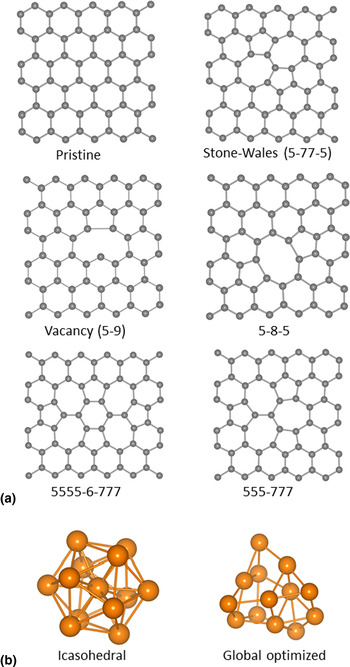
As synthesized graphene is usually not perfect and contains defects that serve as nucleation sites for metal nanoparticles.[ Reference Wu and Ho 6 , Reference Fampiou and Ramasubramaniam 7 ] Common defects include monovacancies[ Reference Padmanabhan and Nanda 8 ] with one carbon atom missing and divacancies with two carbon atoms missing. More complex reconstruction type defects, where one of the C–C bonds is rotated by 90°, are also frequently observed.[ Reference Zhang, Dabbs, Liu, Aksay, Car and Selloni 9 ] Such bond rotation in pristine graphene results in the so-called Stone Wales (SW) or 5-77-5 defect, where the numbers 5 and 7 indicate the presence of pentagon and heptagon rings in graphene as opposed to the regular hexagonal rings [Fig. 1(a)]. Divacancies can adopt one of the 5-8-5, 555-777 or 5555-6-7777 configurations [Fig. 1(a)]. In higher order defects like tetravacancies, numerous configurations are possible due to structural reconstruction.[ Reference Robertson, Lee, He, Yoon, Kirkland and Warner 10 ] Point defects also play an important role in bandgap engineering of graphene and other 2D materials like silicene and germanene.[ Reference Kaloni, Singh and Schwingenschlögl 11 – Reference Singh, Kaloni and Schwingenschlögl 13 ] Simulations suggest that SW defect has the lowest formation energy, defined in Eq. (1), followed by divacancies and the monovacancy. Among divacancies, 555-777 is the most stable followed by 5555-6-7777 and 5-8-5 configurations (Table S1 in SI).
Structure of graphene and isolated d Pt13 clusters. (a) Pristine and defective graphene configurations used for this study. (b) Icosahedral Pt13 with bulk fcc structure and the known[ Reference Piotrowski, Piquini and Da Silva 14 ] lowest energy structure of isolated Pt13 nanoparticles.

Here we investigate how local environment of defects in graphene influences the morphology of Pt clusters. Previous studies of the optimal morphologies of Pt dimers, trimers, tetramers, and 13 atom Pt clusters bound to pristine and defective graphene were limited to either local energy minimization calculations of several initial structures using density functional theory (DFT),[ Reference Fampiou and Ramasubramaniam 7 ] which significantly limited the configurational space probed, or employed molecular dynamics simulations with empirical potentials. Previous attempts to find the optimal structures for isolated nanoparticles of various chemical species concluded that empirical potentials were not able to reliably identify the low energy structures for small nanoparticles.[ Reference Piotrowski, Piquini and Da Silva 14 ] This motivated us to find the lowest energy morphologies of Pt nanoparticles using first principles density functional methods coupled with Basin Hopping[ Reference Wales and Doye 15 ] global optimization technique, the approach that was successfully used in the past for global optimization of the structure of isolated nanoparticles[ Reference Piotrowski, Piquini and Da Silva 14 , Reference Fernando, Weerawardene, Karimova and Aikens 16 – Reference Medasani and Vasiliev 18 ] [Fig. 1(b)]. Using 13-atom Pt cluster, which has the lowest non-trivial number of closed atomic shells, as a representative nanoparticle, we attempted to identify the globally optimized structure and the mode of Pt nanoparticles binding to pristine graphene and to defect sites. As a starting structure for global optimization, we used the globally optimized structure of gaseous Pt13 shown in Fig. 1(b), which has the formation energy that is 3.42 eV (3.53 eV in Ref. Reference Piotrowski, Piquini and Da Silva14) lower than that of icosahedral Pt13 configuration.
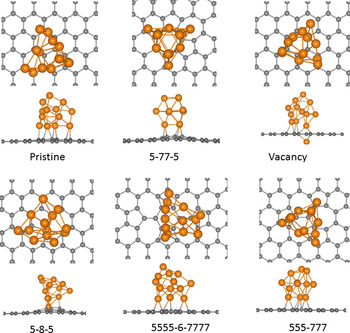
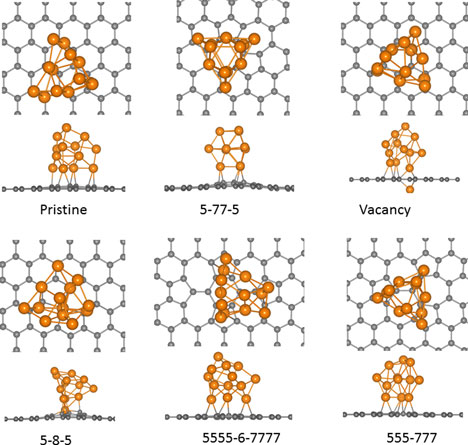
The local minima and the global minimum energy configurations of the Pt13 nanoparticles decorating pristine and defective graphene are obtained using Basin Hopping method and DFT for evaluating energy landscape. The globally optimized structures indicate that Pt13 adopts low-symmetry configurations to adsorb onto graphene (Fig. 2, see also Fig. S1 in SI) similar to most energetically favorable configurations found in the gas phase [Fig. 1(b)], which is indicative of weak interactions between Pt cluster and pristine graphene. In contrast, Pt13 decorating Stone-Wales (5-77-5) and 555-777 divacancies have most energetically favorable configurations significantly different from those in the gas phase. Deformation of the substrate is observed for 5-77-5 and 5-8-5 defects indicating stronger interactions between C atoms and Pt13 cluster.
Lowest energy structures of Pt13 nanoparticles decorating pristine and defect graphene obtained from basin hopping and density functional theory. Grey and gold spheres represent C and Pt atoms, respectively.

Global optimization calculations revealed a new lowest energy configuration of Pt13 cluster decorating a monovacancy, which is 350 meV lower in energy than that reported previously[ Reference Fampiou and Ramasubramaniam 7 ] (Fig. 2). In this configuration Pt13 cluster transects the vacancy with one Pt atom, while retaining the integrity of the cluster. Specifically, the distance between this Pt atom below graphene surface to the nearest Pt atom above the surface is 2.91 Å, which is comparable with the bulk Pt–Pt distance of 2.77 Å. This indicates that the nanoparticle transects the void to maximize its interaction with graphene sheet without inducing graphene deformation. This effect is not observed for any other defects studied although the void space is larger for the 5-8-5 defect. Instead, graphene deformation takes place upon the adsorption of Pt13 on this defect site.
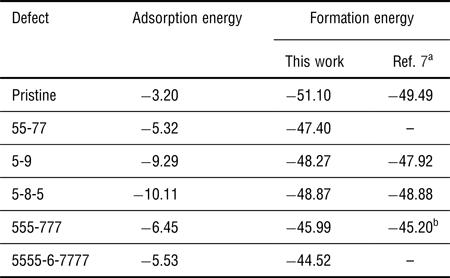
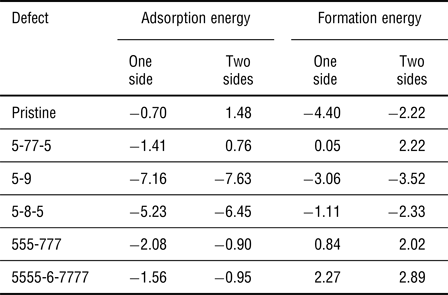
To quantify the strength of interactions between optimized Pt13 clusters and graphene the adsorption energies of the Pt13 decorating the defective or pristine graphene sheet were calculated. The calculated adsorption energies indicate a strong preference for Pt nanoparticles to adsorb to graphene at monovacancy (5-9) and 5-8-5 defects (Table I).
Energetics of Pt13 nanoparticle interactions with graphene in eV.

a Formation energies for the graphene + Pt13 structures reported in Ref. Reference Fampiou and Ramasubramaniam7 are recomputed with DFT parameters consistent with this work.
b Value taken directly from Ref. Reference Fampiou and Ramasubramaniam7.
The energetics for Pt cluster nucleation through classical monomer addition mechanism on graphene surface was analyzed through calculation of cluster formation energy, with respect to isolated Pt atoms (Table I). The formation energy reflects the strength and the number of Pt cluster bonds with C atoms in graphene and the level of strain in the cluster and substrate (see Methods section). In particular, interactions between Pt13 and pristine graphene are weak as evidenced by the smallest adsorption energy, which results in the weakest strain and in Pt13 structure close to that in the gas phase. The combination of these factors results in the lowest formation energy on pristine graphene followed by that on 5-8-5 and 5-9 defects (Table I), reflecting the increase in the strength of cluster/graphene interactions and in associated strains. We note that previous DFT work predicted that the energetic cost for deforming graphene around the 5-9 vacancy site is only 50 meV.[ Reference Padmanabhan and Nanda 8 ] Such deformation relieves strain around the vacancy. However, higher electron localization of defect levels in a non-deformed configuration ensures its energetic preference.[ Reference Padmanabhan and Nanda 8 ] Our simulations show significant broadening of defect states in graphene due to interactions with Pt cluster, which may reduce the energetic penalty for graphene deformation (see Fig. S2 in SI).
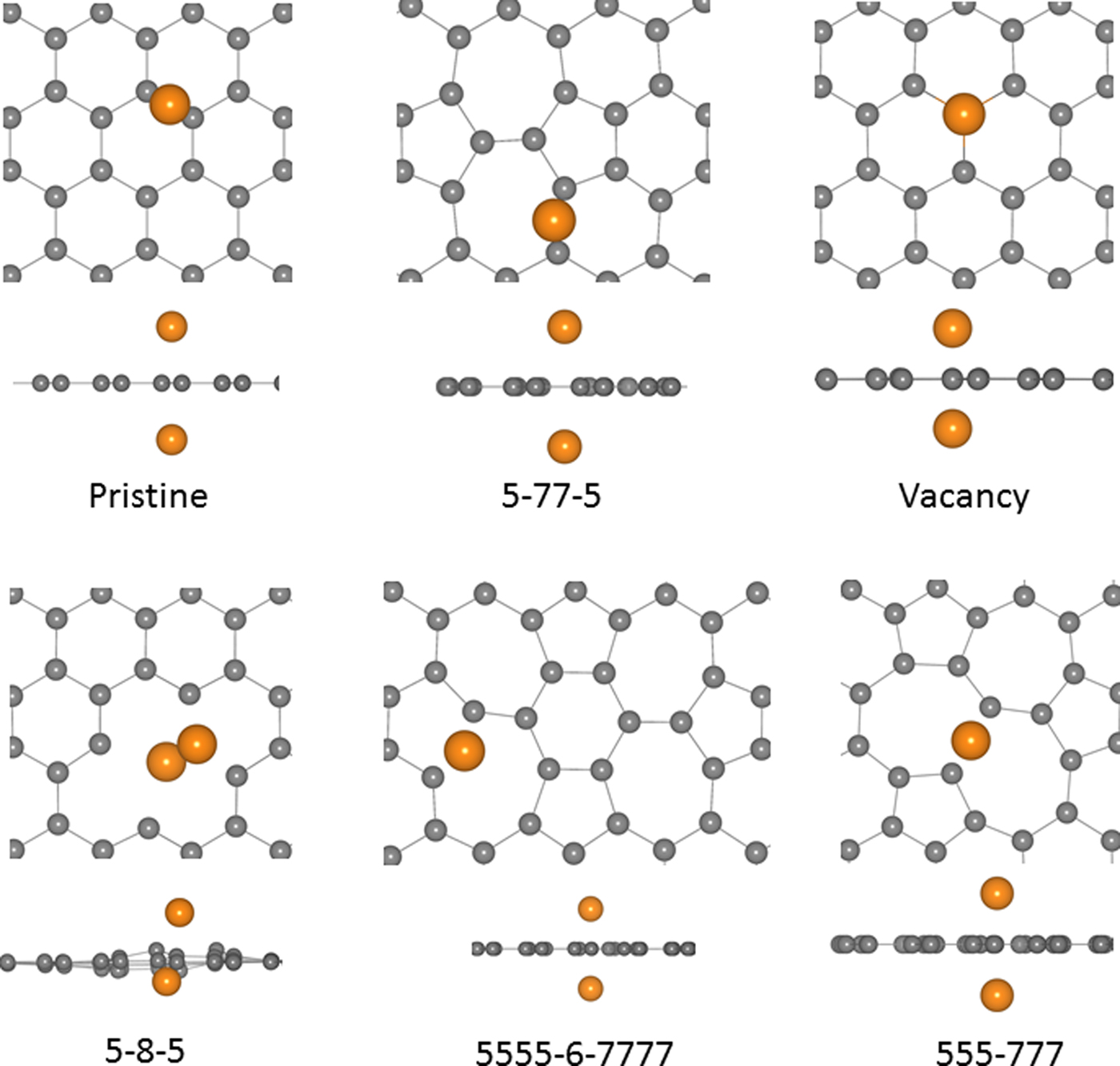
To further investigate the mechanism for two-side decoration of graphene defects by Pt, we studied Pt dimer, the smallest Pt structure that can bind to graphene from both sides. Simulations revealed that for pristine graphene and all defects considered except 5-8-5, the most energetically favorable configuration corresponds to Pt dimer normal to graphene surface (Fig. 3). Calculations of Pt dimer adsorption energies indicate a clear preference for Pt dimers to cross graphene sheet at 5-9 and 5-8-5 vacancy sites (Table II). The distance between the two Pt atoms in these dimers is 2.83 and 2.78 Å for 5-9 and 5-8-5 defects, respectively, and is close to the bulk Pt–Pt distance of 2.77 Å. Among the Pt dimer decorated configurations, monovacancy has the lowest formation energy followed by 5-8-5 defect (Table II). In contrast, adsorption of Pt dimers above pristine graphene, SW, 555-777, and 5555-6-7777 defects is energetically more favorable.
The lowest energy configurations of Pt dimers decorating pristine and defective graphene from both sides.

Energetics of Pt dimer adsorption on graphene in eV.

To get an insight into the mechanism of formation of Pt13 cluster transecting 5-9 monovacancy Pt diffusion through the vacancy site was studied. The diffusion barrier energy of a single Pt atom migrating through 5-9 and 5-8-5 defect was calculated using climbing image nudged elastic band method.[ Reference Henkelman, Uberuaga and Jónsson 19 ] The barrier energies suggest that Pt diffuses rapidly through 5-8-5 with low barrier energy of 0.22 eV, facilitating the formation dimer crossing the defect. However, the barrier for Pt migration through the 5-8-5 defect is comparable with the diffusion barrier of metal atoms on deformed graphene, 0.2 eV,[ Reference Koh and Manzhos 20 ] and at the later stages of Pt cluster growth, the energetic gain for binding above the defect facilitates overcoming this barrier ultimately resulting in above the defect binding mode for Pt13 cluster. In contrast, the barrier for Pt atom diffusion through 5-9 defect is high and equal to 3.2 eV. Such high energetic cost for Pt diffusion coupled with the energetic preference of dimer configuration crossing the defect stabilizes cluster formation in defect configuration transecting 5-9 vacancy.
In summary, global optimization calculations indicate that Pt nanoparticles can bind to monovacancy in graphene with the cluster transecting the vacancy while retaining bulk-like Pt–Pt distances. High energy barrier for Pt diffusion through monovacancy stabilizes the cluster at the vacancy site. All other types of common defect sites support Pt cluster adsorption on one side of graphene sheet and are expected to have higher mobility than clusters bound to monovacancies. These results point to a distribution of stability of Pt clusters on graphene surface depending on defect types, which have important implications in catalysis and materials synthesis.
Methods
Structural optimization of various defect morphologies in graphene (Fig. 1) was performed using DFT. The defect formation energy,
 $E_{\rm d}^{\rm f}, $
was calculated as:
 $$E_{\rm d}^{\rm f} = E_{\rm d}^{{\rm tot}} - \left( {\displaystyle{{N - \eta} \over N}} \right)E_{{\rm bulk}}^{{\rm tot}}, $$
where
 $E_{\rm d}^{{\rm tot}} $
is the total energy of the defect supercell with N − η atoms (η = 1 for monovacancy and 2 for divacancy),
 $E_{{\rm bulk}}^{{\rm tot}} $
is the total energy of the bulk supercell with N atoms.
The DFT calculations were performed with both Plane Wave and Gaussian Plane Wave methods using VASP[ Reference Kresse and Hafner 21 ] and CP2K[ Reference Hutter, Iannuzzi, Schiffmann and VandeVondele 22 ] codes, respectively (see SI for more details). The morphologies of Pt13 nanoparticles decorating relaxed defective graphene were globally optimized using a revised Basin Hopping[ Reference Wales and Doye 15 ] algorithm, implemented in ASE[ Reference Bahn and Jacobsen 23 ] and TSASE[ Reference Terrel, Chill, Xiao, Duncan, Stauffer, Bandy and Henkelman 24 ] packages. Basin Hopping approach projects the potential energy landscape onto a step function based on the local minima and maxima (see SI for details). The potential energies and local minima were computed with CP2K using quasi Newton algorithm for local relaxation.
Adsorption energies of Pt cluster to pristine or defective graphene were calculated as:
 $$E_{{\rm ads}} = E_{{\rm g + Pt}}^{{\rm tot}} - E_{\rm g}^{{\rm tot}} - E_{{\rm Pt}}^{{\rm tot}}, $$
where
 $E_{\rm g}^{{\rm tot}} $
is the total energy of graphene,
 $E_{{\rm Pt}}^{{\rm tot}} $
is the total energy of globally optimized isolated Pt nanoparticle, and
 $E_{{\rm g + Pt}}^{{\rm tot}} $
is the total energy of the Pt nanoparticle decorated graphene.
Pt cluster formation energy on graphene is defined as:
 $$E_{\rm f} = E_{{\rm C}_m + {\rm Pt}_n} ^{{\rm tot}} - mE_{\rm C}^{{\rm tot}} - nE_{{\rm Pt}}^{{\rm tot}}, $$
where
 $E_{{\rm C}_m + {\rm Pt}_n} ^{{\rm tot}} $
is the total energy of the graphene sheet with m C atoms decorated with n atom Pt nanoparticle,
 $E_{\rm C}^{{\rm tot}} $
is the energy of a single C atom in pristine graphene sheet, and
 $E_{{\rm Pt}}^{{\rm tot}} $
is the energy of the isolated Pt atom.
The figures in this paper are generated using VESTA[ Reference Momma and Izumi 25 ].
Supplementary material
The supplementary material for this article can be found at https://doi.org/10.1557/mrc.2017.112
Acknowledgment
This research was supported by the U.S. Department of Energy, Office of Science, Basic Energy Sciences, Division of Materials Sciences and Engineering, under Award KC020105-FWP12152. Simulations were performed using PNNL Institutional Computing Resources. Pacific Northwest National Laboratory (PNNL) is operated by Battelle for the Department of Energy under contract No. DE-AC05-76RLO1830. The authors thank Mauricio Piotrowski and Juarez da Silva for providing the lowest energy gaseous Pt13 structure and Iona Fampiou and Ashwin Ramasubramaniam for providing the annealed structures of Pt13 decorating pristine and defective graphene with monovacancy and 5-8-5 defects.
Conflict of Interest
The authors declare no competing financial interests.