Introduction
Whilst most of us have adapted to the new norms of social distancing and handwashing, as a result of the coronavirus disease 2019 (Covid-19) pandemic, survivors of Covid-19 with persistent loss of smell or olfactory dysfunction are now having to battle a new norm of being ‘scentless’. Many may not be aware that a scentless life may be a consequence of surviving Covid-19. Albeit reported to afflict only a small number of patients, persistent olfactory dysfunction can severely impair quality of life (QoL), and it poses a life-threatening situation to the patient and their family members.
From the initial anecdotal report on the association between new-onset olfactory dysfunction and Covid-19 in early March 2020, olfactory dysfunction has been regarded as a key manifestation of Covid-19. Myriad studies and research on olfactory dysfunction in Covid-19 have emerged over the past year, with a prevalence of 47.85 per cent.Reference Saniasiaya, Islam and Abdullah1 Nearly 15–20 per cent of the afflicted population have reported persistent olfactory dysfunction.Reference Klein, Asseo, Karni, Benjamini, Nir-Paz and Muszkat2 Yet, this is starkly different from the findings of a six-month psychophysical olfactory assessment study, in which 60 per cent of the cohort were found to have persistent olfactory dysfunction, whilst only 18 per cent of this group self-reported on altered smell.Reference Boscolo-Rizzo, Menegaldo, Fabbris, Spinato, Borsetto and Vaira3 Parallel to that, the prevalence of, as well as recovery from, olfactory dysfunction in Covid-19 patients may be underreported, as most study findings are based on self-reports.Reference Otte, Klussmann and Luers4
Whilst great attention is being paid to curbing the ongoing pandemic, with vaccination programmes being carried out globally, the fate of Covid-19 survivors with olfactory dysfunction remains a conundrum. Many may not be aware of the crippling effect of olfactory dysfunction amongst Covid-19 survivors. Recently published studies have focused on the prevalence and outcome of olfactory dysfunction amongst Covid-19 patients. Yet, the question is how olfactory dysfunction affects the QoL of these patients, as the road to recovery remains an enigma. This systematic review aimed to cover the current literature available on the impact of olfactory dysfunction on QoL in Covid-19 patients.
Methods
We conducted a systematic review of the literature, in accordance with the Preferred Reporting Items for Systematic Reviews and Meta-Analyses (‘PRISMA’) guidelines, to identify studies that investigated the impact of olfactory dysfunction on QoL in Covid-19 patients. This systematic review used a population, intervention, comparison and outcome framework, to identify studies: involving patients with persistent Covid-19-related olfactory dysfunction (population), through either subjective or objective assessment (intervention), whereby the impact of QoL specific to olfactory dysfunction is assessed (outcome).
The review was specifically designed to: (1) clarify the QoL of Covid-19 patients with persistent olfactory dysfunction; (2) identify gaps in the literature; and (3) help guide the direction of future research.
Data sources
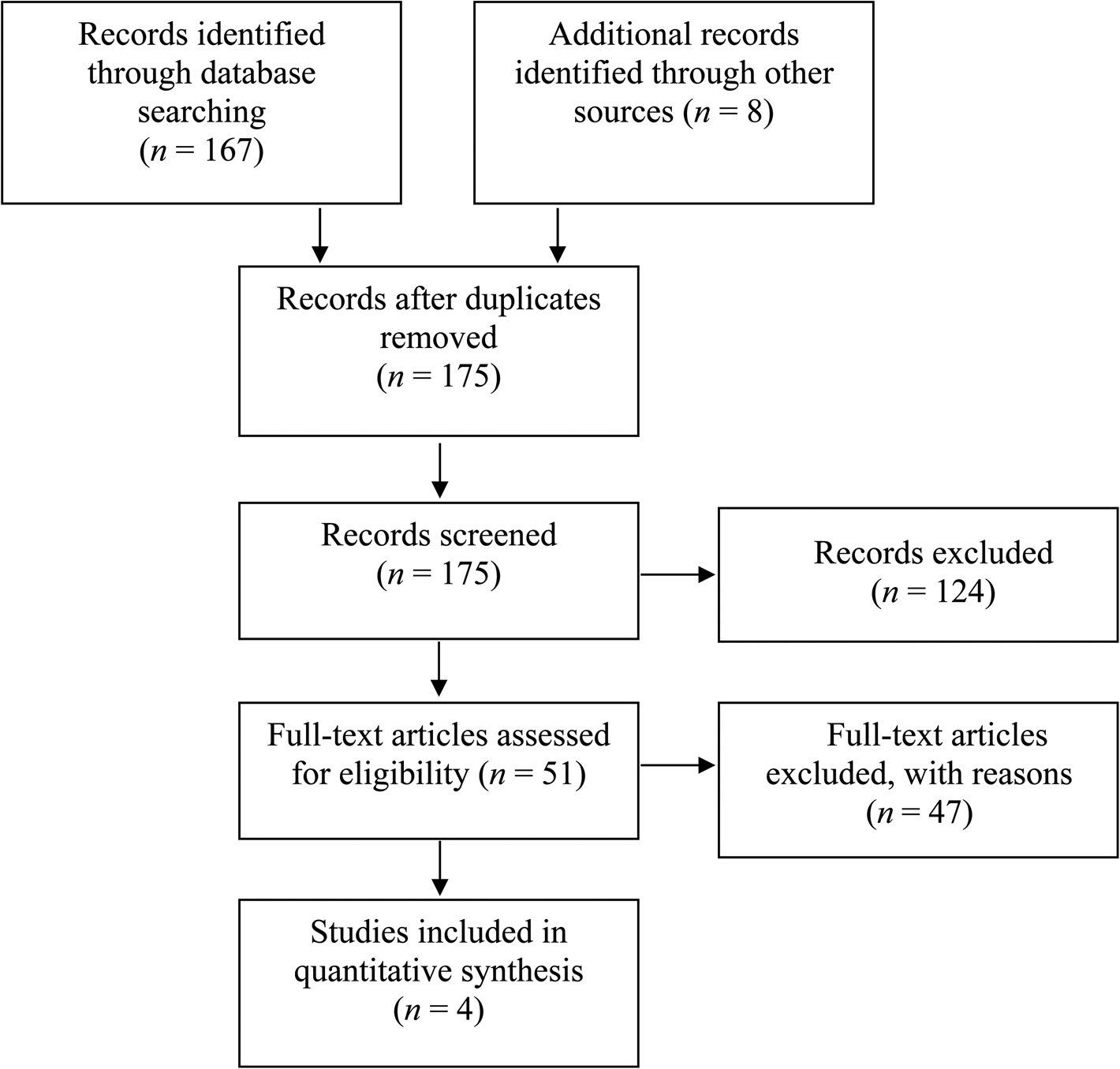
PubMed, Embase and Scopus databases were searched to identify studies published from 1 November 2019 to 30 April 2021. The following key terms were searched: ‘olfactory dysfunction’, ‘loss of smell’, ‘quality of life’, ‘Covid-19’, ‘Covid19’ and ‘SARS-CoV-2’. Complete details of the search strategy are shown in Figure 1. In order to ensure a robust search procedure, references of the included studies were also searched. Duplicate studies were excluded using EndNote™ X10 reference management software.
Flow diagram of Preferred Reporting Items for Systematic Reviews and Meta-Analyses (‘PRISMA’) for the systematic literature search.

The search was conducted over a period of one month (May 2021), in accordance with Preferred Reporting Items for Systematic Reviews and Meta-Analyses guidelinesReference Moher, Liberati, Tetzlaff and Altman5 and the Cochrane Handbook for Systematic Reviews of InterventionsReference Higgins6 when appropriate.
After being scrutinised by the panel members, four original clinical research articles were selected based on our objective and selection criteria. The selected articles were appraised using the Quality Assessment Tool for Case Series studies from the National Heart, Lung and Blood Institute guideline.7
Study selection
Articles of interest were screened, based on the title and abstract, to identify eligible studies. This was followed by independent reading of the full text by two authors (JS and NP). Any disagreements regarding the inclusion of articles were discussed and resolved by consensus.
Data extraction and quality assessment
Data extraction was performed independently by two authors (JS and NP). We extracted the following information from each eligible study and entered it into a predefined Excel® spreadsheet: first author's last name; study design; country of the participants; total number of patients; age; gender; duration of olfactory dysfunction; type of olfactory dysfunction; olfactory dysfunction assessment tool; QoL assessment tool; and QoL outcome.
Outcome measures
The primary outcome was defined as QoL deficit resulting from olfactory dysfunction. Secondary outcomes were other related outcomes resulting from persistent olfactory dysfunction. Studies that did not report on QoL outcomes were excluded.
Ethical considerations
The study was performed in accordance with ethical standards.
Results
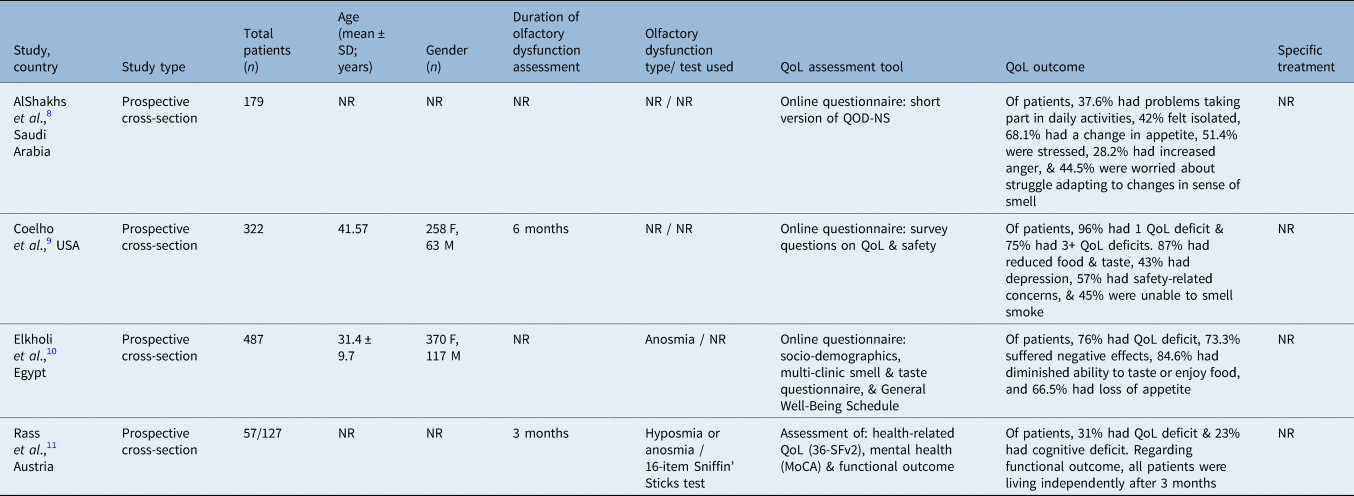
A total of four studies, initially published online during the study period, that fulfilled the selection criteria were included in the review.Reference AlShakhs, Almomen, AlYaeesh, AlOmairin, AlMutairi and Alammar8–Reference Rass, Beer, Schiefecker, Kofler, Lindner and Mahlknecht11 All four studies were considered to have a level of evidence of 3 (prospective, observational, cross-section studies). Altogether, there were 1045 patients. Gender predominance and mean age were not determined, as these variables were not mentioned in two studies.Reference AlShakhs, Almomen, AlYaeesh, AlOmairin, AlMutairi and Alammar8,Reference Rass, Beer, Schiefecker, Kofler, Lindner and Mahlknecht11 The studies included in this review are summarised in Table 1. A meta-analysis was considered inappropriate in our study because of the heterogeneity issue. Hence, meaningful interpretation of the outcomes in the studies needed expert discussion and clinical judgment by us.
Summary of QoL findings for Covid-19 patients with persistent olfactory dysfunction

QoL = quality of life; Covid-19 = coronavirus disease 2019; SD = standard deviation; NR = not reported; QOD-NS = Questionnaire of Olfactory Disorders – Negative Statements; F = female; M = male; SF-36v2 = 36-item Short Form Health Survey, version 2; MoCA = Montreal Cognitive Assessment
We found that in three studies, QoL assessment was obtained through an online platform. Various questionnaires were used to assess the QoL, including the short version of the Questionnaire of Olfactory Disorders – Negative Statements,Reference AlShakhs, Almomen, AlYaeesh, AlOmairin, AlMutairi and Alammar8 the Multi-Clinic Smell and Taste Questionnaire,Reference Elkholi, Abdelwahab and Abdelhafeez10 the General Well-Being Schedule Reference Elkholi, Abdelwahab and Abdelhafeez10 and the 36-item Short Form Health Survey.Reference Rass, Beer, Schiefecker, Kofler, Lindner and Mahlknecht11 In one study, standard questions were used during clinical evaluations at the Virginia Commonwealth University of Smell and Taste Center.Reference Elkholi, Abdelwahab and Abdelhafeez10
The QoL domains investigated included overall QoL,Reference AlShakhs, Almomen, AlYaeesh, AlOmairin, AlMutairi and Alammar8–Reference Rass, Beer, Schiefecker, Kofler, Lindner and Mahlknecht11 mental health,Reference AlShakhs, Almomen, AlYaeesh, AlOmairin, AlMutairi and Alammar8,Reference Coelho, Reiter, Budd, Shin, Kons and Costanzo9 taste dysfunction,Reference Coelho, Reiter, Budd, Shin, Kons and Costanzo9,Reference Elkholi, Abdelwahab and Abdelhafeez10 cognitive function,Reference Rass, Beer, Schiefecker, Kofler, Lindner and Mahlknecht11 functional outcomeReference Rass, Beer, Schiefecker, Kofler, Lindner and Mahlknecht11 and safety issues.Reference Coelho, Reiter, Budd, Shin, Kons and Costanzo9 Overall, the QoL deficit affected 67.7 per cent of the included population. Olfactory dysfunction was assessed objectively in one study using the 16-item Sniffin’ Sticks odour identification test.Reference Rass, Beer, Schiefecker, Kofler, Lindner and Mahlknecht11 Eighty-six per cent of the subjects tested had a reduced ability to taste food.Reference Coelho, Reiter, Budd, Shin, Kons and Costanzo9,Reference Elkholi, Abdelwahab and Abdelhafeez10 Loss of appetite was reported in two studies, affecting 67.3 per cent of subjects.Reference AlShakhs, Almomen, AlYaeesh, AlOmairin, AlMutairi and Alammar8,Reference Elkholi, Abdelwahab and Abdelhafeez10
Mental health status was described in two studies.Reference AlShakhs, Almomen, AlYaeesh, AlOmairin, AlMutairi and Alammar8,Reference Coelho, Reiter, Budd, Shin, Kons and Costanzo9 AlShakhs et al. revealed that 42 per cent of Covid-19 patients with olfactory dysfunction mentioned feeling isolated,Reference AlShakhs, Almomen, AlYaeesh, AlOmairin, AlMutairi and Alammar8 whereas depression was reported to be present in 43 per cent by Coelho et al.Reference Coelho, Reiter, Budd, Shin, Kons and Costanzo9 AlShakhs et al. revealed stress in 51.4 per cent of their cohort.Reference AlShakhs, Almomen, AlYaeesh, AlOmairin, AlMutairi and Alammar8 Safety-related concerns were reported in one study, and affected 57 per cent of patients.Reference Coelho, Reiter, Budd, Shin, Kons and Costanzo9 None of the studies described any methods of olfactory dysfunction treatment. The quality assessment of the results of the selected articles is summarised in Table 2.
Quality assessment of all four study reports

NR = not reported
Discussion
Persistent olfactory dysfunction has a detrimental effect on the population, resulting in a major impact on a person's social skills, relationship, wellbeing and QoL. Our review revealed four studies reporting on the impact of QoL in Covid-19 patients with olfactory dysfunction,Reference AlShakhs, Almomen, AlYaeesh, AlOmairin, AlMutairi and Alammar8–Reference Rass, Beer, Schiefecker, Kofler, Lindner and Mahlknecht11 involving various QoL domains, including overall QoL, and mental, physical, social functioning and safety domains. Results from this review echo findings from previous studies on the QoL impact of various conditions causing olfactory dysfunction.Reference Rochet, El-Hage, Richa, Kazour and Atanasova12
Food, taste and appetite
Olfactory dysfunction has been reported to gravely impair the QoL of the affected individual because of numerous day-to-day activity limitations. The most noticeable change is the decrease in flavour perception from impaired retronasal olfaction, which leads to reduced food pleasure, found in approximately 69 per cent of individuals, based on a study by Nordin et al.Reference Nordin, Blomqvist, Olsson, Stjärne and Ehnhage13 The ramifications from diminished food enjoyment result in a grievous situation, as food is a significant part of one's life.
Previous studies have revealed that permanent olfactory dysfunction reduces appetite in almost 56 per cent of patients, although nearly 20 per cent of patients consume more food.Reference Ferris and Duffy14 In the same vein, these patients have demonstrated difficulties with cooking and preparing food, as well as detecting rotten food. In our review, reduced ability to taste food was present in 86 per cent of cases.Reference Coelho, Reiter, Budd, Shin, Kons and Costanzo9,Reference Elkholi, Abdelwahab and Abdelhafeez10 Loss of appetite was reported in two studies, affecting 67.3 per cent of cases.Reference AlShakhs, Almomen, AlYaeesh, AlOmairin, AlMutairi and Alammar8,Reference Elkholi, Abdelwahab and Abdelhafeez10
Safety issues
Odours serve as the first warning signal, alerting one to various harmful conditions such as smoke or fire, spoiled food, or hygiene-related issues. Patients with olfactory dysfunction may not be aware of life-threatening situations associated with the inability to detect harmful odorants such as fire, gas leaks and smoke, which has been demonstrated to afflict 61 per cent of such patients, as described by Nordin et al.Reference Nordin, Blomqvist, Olsson, Stjärne and Ehnhage13 Safety-related concern was reported in one study in our review, involving 57 per cent of their cohort. Croy et al. revealed that patients with olfactory dysfunction are involved in more household accidents as compared with normosmic individuals.Reference Croy, Negoias, Novakova, Landis and Hummel15 Patients with olfactory dysfunction tend to be more insecure and constantly worry about safety issues.Reference Croy, Nordin and Hummel16
Personal hygiene
Individuals with olfactory dysfunction are affected by hygiene-related concerns, as they are unable to detect their own body odour. This leads to further insecurity, and could result in isolation and damage to self-esteem. None of the patients included in this review reported on hygiene impairment.
Occupation issues
Intact olfactory function is crucial in many olfaction-reliant occupational groups, notably chefs, gas fitters, firefighters, perfumers, sommeliers, coffee- and tea-tasters, grocers, chemical industry workers, and domestic helpers.Reference Werner and Nies17 Loss of smell is also regarded as a criterion for the discharge of US military and reservists, as well as coastguard employees.Reference Doty18 These groups of affected individuals are among millions who may have to find a new source of income and relocate, as olfaction is a central part of their job. None of the included studies mentioned job-related concerns associated with olfactory dysfunction. This may be attributed to the fact that the outcome of olfactory dysfunction in Covid-19 remains elusive.
Mental health
Olfactory dysfunction has been traditionally linked to depression.Reference Kohli, Soler, Nguyen, Muus and Schlosser19 Interestingly, olfactory function has been regarded as a marker for depression.Reference Rochet, El-Hage, Richa, Kazour and Atanasova12 AlShakhs et al.Reference AlShakhs, Almomen, AlYaeesh, AlOmairin, AlMutairi and Alammar8 found that 42 per cent of Covid-19 patients with olfactory dysfunction felt isolated, and a study by Coelho et al.Reference Coelho, Reiter, Budd, Shin, Kons and Costanzo9 revealed that depression affected 43 per cent of such patients. Although the link between olfactory dysfunction and depression remains unexplained, an overlap between the brain areas implicated in both depression and the olfactory process has been postulated, notably the orbitofrontal cortex, anterior and posterior cingulate cortices, insula, amygdala, hippocampus and thalamus.Reference Naudin and Atanasova20 In the same vein, odours are known to have a profound effect on the emotions, mood and behaviour, which could explain depression amongst these patients.Reference Seo, Roidl, Müller and Negoias21
What is next for ‘scentless’ survivors?
It is salutary to note that although spontaneous recovery from olfactory dysfunction has been linked to post-infectious olfactory dysfunction, we are yet to unravel the outcome of olfactory dysfunction post-Covid-19. Currently, olfactory dysfunction following Covid-19 is possibly underreported in the available data, as most studies are based on self-reports rather than a more objective assessment. The implications of long-standing olfactory dysfunction in terms of the economic burden have been reported in previous studies.
To date, no validated medication exists specifically to treat post-infectious olfactory dysfunction, although numerous trials involving systemic and topical steroids, vitamin B, caroverine, acupuncture and alpha-lipoic acid have been attempted, with varying results.Reference Damm, Pikart, Reimann, Burkert, Goktas and Haxel22 None of the included studies proposed a treatment regimen.
Olfactory retraining therapy has gained popularity recently because of the rising numbers of patients afflicted with olfactory dysfunction post-Covid-19. This non-invasive intervention, directed at the rehabilitation of olfactory dysfunction, has demonstrated promising outcomes in relation to olfactory dysfunction from various causes.Reference Oleszkiewicz, Hanf, Whitcroft, Haehner and Hummel23,Reference Choi, Jeong, Noh, Park, Cho and Kim24 As well as being easy to administer, olfactory retraining therapy has been reported to decrease depressive episodes amongst patients.Reference Birte-Antina, Ilona, Antje and Thomas25 The concept behind olfactory retraining therapy is based on daily repeated exposure to selected odorants. Four odours are traditionally incorporated, based on the odour prism proposed by Henning, of rose, eucalyptus, lemon and clove,Reference Hummel, Rissom, Reden, Hahner, Weidenbecher and Huttenbrink26 which correspond to one from each category: fruity, flowery, resinous and spicy.Reference Whitcroft and Hummel27 Olfactory retraining therapy is believed to strengthen the olfactory nerve through repeated exercise. The only drawback of olfactory retraining therapy is the need to repeat the training exercise for months, which may be tiresome to most patients. Nonetheless, favourable results have been demonstrated amongst Covid-19 patients with olfactory dysfunction, whereby early olfactory retraining therapy corresponds to a better olfactory outcome.Reference Yan, Gao, Sun, Guo, Yao and Liu28
• New-onset olfactory dysfunction is a known manifestation of coronavirus disease 2019, with a prevalence of nearly 50 per cent worldwide
• Objective assessment of olfactory dysfunction revealed that olfactory dysfunction prevalence has been underestimated
• Nearly 15–20 per cent of the afflicted population has persistent olfactory dysfunction
• Persistent olfactory dysfunction has detrimental effects on quality of life (well-being, safety, taste, mental health, cognitive impairment, social functioning)
• Early implementation of coping and safety strategies is advised
Several coping strategies directed to managing olfactory dysfunction from various causes have been carried out successfully over the past decade. These include safety measures such as installing gas or smoke detectors.Reference Croy, Nordin and Hummel16 Olfactory dysfunction patients tend to rely on family members to test food or check perfume usage. Family members and close friends need to play an important role in supporting these Covid-19 survivors, as they may be vulnerable and fearful of having permanent smell loss. Dysregulated appetite can be addressed by scheduled eating hours.Reference Croy, Nordin and Hummel16 Strict adherence to manufacturing dates on food and drink is required to avoid food poisoning. Additionally, there are numerous social support groups that can play an important role in targeting emotional adaptation.Reference Nordin, Blomqvist, Olsson, Stjärne and Ehnhage13 Currently, the ongoing pandemic has witnessed charity-based support groups such as Fifth Sense and AbSent coming forward to help afflicted patients. Online patient support groups enable patients newly affected with olfactory dysfunction to share their struggle with others who have managed olfactory dysfunction from other causes. Finally, the patients themselves need to come to terms with and gain emotional acceptance of the deficit to allow adaptive adjustment to the disease.
Conclusion
A QoL deficit is found in 67.7 per cent of Covid-19 patients with olfactory dysfunction. Yet, the numbers may be even higher, as olfactory dysfunction has been underreported following a lack of proper assessment. Research involving Covid-19 survivors with persistent olfactory dysfunction needs to be carried out hand-in-hand with curbing the pandemic, as persistent olfactory dysfunction will lead to a global health burden in addition to detrimental socio-economic effects.
Acknowledgement
We would like to acknowledge all involved.
Competing interests
None declared