Introduction
Macao, a former colony of Portugal, is located in the western side of the Pearl River estuary, adjoining the Zhuhai Special Economic Zone and facing the South China Sea. It is much smaller than its ‘big brother’ Hong Kong, having a total land area of 29.5 sq km and a population of around 540,000, of which 94.3% are ethnic Chinese (DSEC, 2011).
Although both Chinese and Portuguese remain the official languages in Macao after its return to China, Chinese is clearly predominant in most forms of social interaction. At the same time, Portuguese's influence on the community has been further weakened by the presence of another lingua franca in Macao: English is now fast becoming much more highly valued than Portuguese among Macao residents (Young, Reference Young2009; Zhang, Reference Zhang2010). Although it does not enjoy de jure recognition, English is widely used in domains such as government, education, media, commerce and tourism in Macao (Moody, Reference Moody2008; Young, Reference Young2009). After examining the use of English in the Macao government, Moody (Reference Moody2008: 6) concluded that ‘English maintains a de facto status as an additional working language of the Macau government.’ In addition to this, in the fields of commerce and tourism, with the casino concessions opened to foreign investments in 2002 and recognition of the ‘Historic Centre of Macao’ in 2005, more and more international visitors are now coming to Macao; consequently, the use of English for inter-ethnic communication has become more prominent. In the domain of education, English is ‘taught as a subject from kindergarten to senior secondary school’ (Young, Reference Young2009: 418), and it is also used as the medium of instruction in some schools as well. In terms of tertiary education, the University of Macau (the most comprehensive public university in Macao) also promotes the use of English in academic settings, implementing the policy of using English as its main medium of instruction.
While it is clear that English is gaining importance in public and institutional life in several key domains in Macao, very little is known about how and to what extent Macao residents actually use English in their daily lives, or about how they perceive themselves as users of English. The present paper, being part of an on-going study of language use in Macao, aims to cast light on this question by studying speakers' English use in various settings, with a focus on Mainland Chinese university students.
Design of the study
Method
Questionnaire is the main method used in this study. The advantages of using this method lie in the fact that it can be distributed to a large number of people in a short time and the results obtained from it can provide the researcher with an overall picture of the views of the sample as a group. The questionnaire discussed in this study was composed of three sections. The first section was designed to collect background information about Mainland students in Macao, and covered questions about their gender, age, family background and length of stay in Macao. The second section tried to elicit Mainland students' self-reported English proficiency levels in the four ‘macro-skill’ areas of listening, speaking, reading and writing. The last section asked respondents to assess the extent to which they typically use English in different settings in Macao.
The questionnaire was distributed at the University of Macau. The author mainly distributed it at the university library and the students' dormitory. Altogether 53 copies of the questionnaire were collected. The questionnaire data were analysed using SPSS (version 10). Analysis of the data involved calculating overall frequencies and means for the items in the questionnaire.
Informal follow-up interviews were also conducted with selected participants in the questionnaire research. The Findings section of this article includes excerpts from the interview data for illustrative purposes.
Participants
As mentioned above, this study focused on university students from Mainland China. Recent years have seen an increasingly large number of Mainland Chinese students crossing the border to pursue their tertiary and postgraduate studies in Macao (Li, Reference Li2006). One of the factors that motivate them to do so is that they see Macao as an international city where they may have more exposure to English. In particular, they believe that they can improve their English proficiency by attending an English-medium university.
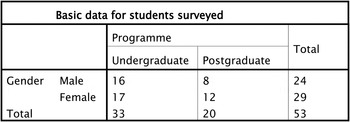
Among the 53 participants surveyed, there were 29 female students and 24 male students; 33 were undergraduate students and 20 were postgraduates. Figure 1 summarises the number of students based on gender and programme level.
Basic data for students surveyed

These fifty-three students were from five different disciplines at the University of Macau. Twenty-two students were from the Faculty of Business and Administration. Thirteen students were from the Faculty of Social Sciences and Humanities. Nine students were from the Faculty of Science and Technology. Six students were from the Faculty of Law. The remaining three were from the Institute of Chinese Medical Sciences. This sample included all the Faculties or Institutes at the University of Macau except the Faculty of Education.
The background information elicited from the questionnaire also shows that 19 students had been in Macao for less than one year prior to the study; 10 students had been resident in Macao for one year; 5 students had been resident for two years; and 20 had been in Macao for three years or more.
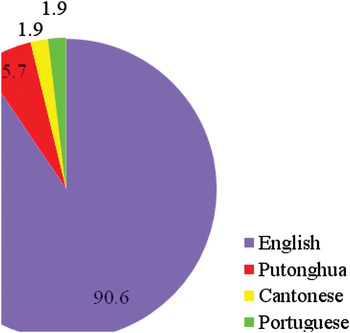
In terms of the medium of instruction, it was found that more than 90% of the students surveyed were enrolled into the programmes that were taught in English. Few students reported that they were taught in Cantonese, Putonghua, or Portuguese. Figure 2 illustrates the percentages of Mainland students taught by different languages.
The percentages of Mainland students taught by different languages

Findings
In this section, I will report on the findings of the questionnaire with regard to Mainland students' perceptions of their English proficiency levels and their patterns of English use in different settings. We will begin by looking at their perceived English proficiency levels.
English proficiency
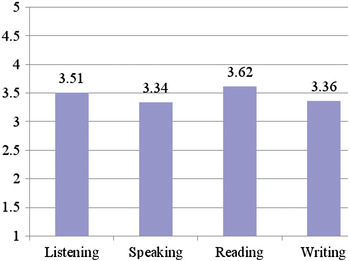
Mainland students were asked to rate their ability in four English skills, i.e., listening, speaking, reading and writing, on a 5-point Likert scale anchored by the descriptors ‘not at all’ (1) to ‘very good’ (5). The results, as illustrated in Figure 3, indicate that Mainland students expressed greatest confidence in their ability in English reading (mean = 3.62) and listening (mean = 3.51), both of which lay in the category of ‘good’. Their self-reported abilities in English speaking and writing, in contrast, tended to be evaluated only as ‘average’.
Mainland students' perceived English proficiency

English use in Macao
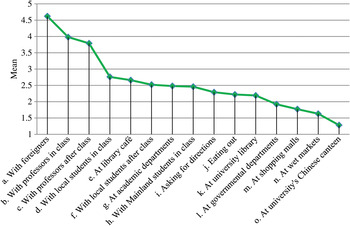
We now turn to the question of how and where Mainland students use English in various settings in Macao. An overview of the findings of the questionnaire is presented in Figure 4, which illustrates the means of Mainland students' English use in 15 settings that they might experience when they were living and studying in Macao. The ‘setting’ analysis conducted here is very similar to ‘domain analysis’ as proposed by Fishman (Reference Fishman1965). By asking Mainland students to choose an English use frequency level for each setting (listed on the x axis in the figure), we can get a general sense of how Mainland students use English, with whom, and when.
Mainland students' English use in different settings in Macao

The list of settings came from the researcher's own observations of the possible situations often encountered by Mainland students in their daily lives. In some cases, Mainland students may interact with different people (either other Mainland students, or locals, or foreigners) in the same or different settings, so it is assumed that their choice of language for communication also varies. For each setting, students were asked to indicate how frequently they use English on a 5-scale level of frequency. When inputting the results of this section, the researcher labelled the 5-scale level of frequency with numbers ranging from 1 to 5, with 1 standing for ‘never’ and 5 for ‘always’. The English use frequency was calculated separately, and the means obtained from these settings were added up so that the mean for the use of English in each setting could be counted.
Overall, it seems that Mainland students' English use frequency can be divided into five main categories. The first category consists exclusively of setting a, the only situation in which the Mainland students ‘always’ used English, with foreigners. The second category includes settings b and c, where Mainland students ‘often’ used English with professors both in and out of class. The third category includes settings d, e and f, during which Mainland students ‘sometimes’ used English. Settings g, h, i, j, k, l, m and n belong to the fourth category, in which Mainland students ‘seldom’ used English. The last category is a setting in which Mainland students ‘never’ used English, that is, at the University's Chinese canteen.
The fact that Mainland students always talked with foreigners in English is entirely unsurprising, and simply confirms that English is used in Macao (as it is elsewhere around the world) as a lingua franca in inter-ethnic communication. It is also in line with expectations to find that settings b and c are places where English was often used. It is reasonable to suppose that Mainland students tend to interact with professors in English both in and out of class because English is the main medium of instruction in class, and interacting with professors in English accords with this language policy. However, this practice may also reflect the fact that, outside class, in addition to professors who are foreigners, there are also a large number of professors from Hong Kong and Macao who are not Putonghua speakers. Thus speaking in English with them may be a better choice for many Mainland students.
Mainland students sometimes used English in settings d, e and f. Settings d and f are situations when Mainland students talked with local students in and out of class. Given that local students' mother tongue is Cantonese and Mainland students' mother tongue is Putonghua, they need to choose to speak the same language for communication. In most cases, local students will accommodate Mainland students by the use of Putonghua, but they may occasionally speak in English to each other if some ideas cannot be well expressed in Putonghua.
Setting e is the library café, which is located in the University of Macau library, and is run by a famous bakery in Macao. When buying food there, Mainland students sometimes speak English because some of the cashiers there are from Southeast Asia and cannot speak Putonghua. If Mainland students do not speak Cantonese, they have to use English to communicate with them. Thus we see that the use of English in the café is relatively more frequent than in many other settings.
In settings g to n, Mainland students seldom seem to speak English. Except for setting h, the other 7 settings all relate to Mainland students' direct interactions with local people in Macao. In these settings, based on my observations and my informants' reflections, Putonghua is always used when interacting with local people, although those local people are primarily Cantonese speakers. In addition, when we compare Mainland students' use of English with local students (settings d and f) and Mainland students' use of English among themselves in class, it can be noticed that they used more English with local students than with Mainland students. That is echoed with some Mainland students' responses on the use of English in class. One informant told me that even though the class was conducted in English, once they were asked to have a group discussion, they would choose to speak Putonghua to each other because all the group members were from the Mainland, but once the professor approached them to listen in to their discussion, they would switch to English. This informant also explained that talking to other Mainland students in English made them feel uneasy.
The last category is setting o, where English was never used. Setting o is the main Chinese-style canteen at the University of Macau, where the waiters and waitresses are all Cantonese speakers. Mainland students visit this canteen on most days, and use Putonghua when interacting with the waiters.
Discussion and conclusion
In this article I have presented the results of a survey of Mainland university students' attitudes towards their English proficiency and their perceptions of when and where they use English in Macao. In terms of their English proficiency in four skills, the data show that their self-reported proficiency in listening and reading was good and proficiency in speaking and writing was average. Studying as they do at an English-medium university, Mainland students need to attend lectures in English, read English textbooks, do presentations in English and write assignments in English. But it should be pointed out that their exposure to English is unbalanced, which may be reflected in their relatively lower proficiency in speaking and writing. Whatever the underlying reasons for this, it is clear from the questionnaire data that Mainland students have limited opportunities to speak English in their daily lives, both inside and outside the classroom. For example, some students think that professors in most cases dominate the class, and they are not able to speak a lot in English in class. Conversely, when professors do ask students to have group discussions, Mainland students seem to want to form groups with other Mainland students rather than with local and/or foreign students, so that they can speak in Putonghua instead of in English.
Mainland students' English use in Macao varies greatly in different settings. Besides speaking English with foreigners in Macao, their use of English is more restricted to the interaction with professors in and out of class. This may be because speaking English with professors complies with the language policy of the University. Sometimes Mainland students use English to talk with local students. This kind of use may be because, given that Mainland students do not share a common code with local students but their educational background, especially English proficiency, is similar, on some occasions speaking English with local students is an acceptable practice. However, in all the other settings, it seems that Mainland students' English use is limited to ‘seldom’ or ‘never’, which seems to indicate that English is not widely used in the daily settings that Mainland students encounter in Macao.
Above all, the findings of this small study of Mainland Chinese students' use of English in Macao contribute in interesting ways to broader questions in applied linguistics about the relationship between language and identity. As we have seen, Mainland students use English more frequently with Macao local students than they do among each other, whereas local students tend to accommodate to Mainland students by speaking Putonghua. However, it is also common to see that either Mainland students or local students choose to use English to express any of their ideas that cannot be well communicated in Putonghua. In contrast, Mainland students seldom speak English with other Mainland students even when they are supposed to have a group discussion in English in class. In this sense, Mainland students' use of English seems to help them project a difference of identity between them and local students. Second, when Mainland students' English use in other daily settings (e.g., g–o) in Macao is taken into account, we can see that Macao is still a typical Chinese community where Chinese (Cantonese or Putonghua) is used.
Mainland students who come to Macao to pursue their tertiary studies hope to improve their English proficiency by studying in an English-medium university, but it turns out that their chances of practising and developing their English skills are actually very limited. However, the research reported in this article has also identified ways in which universities in Macao may be able to offer more opportunities for Mainland students and local students alike to practise their English on and off campus. For instance, professors could encourage students to talk more in English in class, during group discussions, and in social interactions outside of the classroom. Finally, it is also clear from this article that if Mainland students are to improve their English skills, they will need to make more of an effort to step outside their ‘comfort zone’ and interact more frequently with local and international students and teachers through the medium of English.
 KUN ZHANG is a PhD candidate in the Centre for Applied English Studies at the University of Hong Kong, where he is working on his doctoral dissertation about Mainland Chinese students' language choice and identity construction in Hong Kong and Macao. His research interests include sociolinguistics, multilingualism and discourse analysis. Email: zhangkunbnu@gmail.com