Introduction
Dementia is very common in later life. Indeed, 36 million people worldwide were estimated to have dementia in 2010, with this number nearly doubling every 20 years to 66 million by 2030 and to 115 million by 2050 (Alzheimer's Disease International, 2013). Since dementia cannot be cured, the clinical course of the illness and the effectiveness of interventions are increasingly evaluated by QOL (Crespo et al., Reference Crespo, de Quirós, Gómez and Hornillos2012). However, measures of QOL in PWD continue to be debated.
QOL has been defined by the World Health Organization as the perception of one's health, considering one's culture, values, goals, and expectations (The WHOQOL Group, 1995). This definition assumes that individuals have the intellectual capacity to make complex subjective judgments about their lives. However, in cases of persons with more advanced dementia, self-reported QOL may be unreliable due to patients’ deterioration in language, comprehension, and level of awareness (Albert et al., Reference Albert1996; Ready et al., Reference Ready, Ott and Grace2006); thus, proxy reports from caregivers can provide important and meaningful information to assess PWD QOL (Buckley et al., Reference Buckley2012).
Despite the necessity of proxy QOL measures for PWDs, studies have repeatedly found that when both PWDs and caregivers/proxies rate PWD QOL, proxy-rated PWD QOL levels are significantly lower than the PWD self-rating (Hoe et al., Reference Hoe, Katona, Orrell and Livingston2007; Arlt et al., Reference Arlt, Hornung, Eichenlaub, Jahn, Bullinger and Petersen2008). These lower proxy QOL ratings have been predicted by proxy depression (Schiffczyk et al., Reference Schiffczyk, Romero, Jonas, Lahmeyer, Muller and Riepe2010) and greater perception of caregiver burden (Logsdon et al., Reference Logsdon, Gibbons, McCurry and Teri2002; Huang et al., Reference Huang, Yeh, Tang, Chiu and Weng2009). Larger discrepancies between proxy- and PWD-rated QOL were shown with greater PWD cognitive impairment (Albert et al., Reference Albert1996; Buckley et al., Reference Buckley2012). Furthermore, agreement between PWD- and proxy-rated QOL was shown to be influenced by the kinship between caregivers and PWDs (Conde-Sala et al., Reference Conde-Sala, Garre-Olmo, Turró-Garriga, Vilalta-Franch and López-Pousa2010), and the quality of the PWD-proxy relationship (Huang et al., Reference Huang, Yeh, Tang, Chiu and Weng2009).
The factors related to the discrepancy in self- and proxy-rated PWD QOL have been widely studied, but most studies have examined only community-dwelling PWDs and their family caregivers (Huang et al., Reference Huang, Yeh, Tang, Chiu and Weng2009; Bosboom et al., Reference Bosboom, Alfonso, Eaton and Almeida2012; Bruvik et al., Reference Bruvik, Ulstein, Ranhoff and Engedal2012) or only PWDs living in long-term care as well as their family caregivers and professional staff (Crespo et al., Reference Crespo, de Quirós, Gómez and Hornillos2012; Moyle et al., Reference Moyle, Murfield, Griffiths and Venturato2012). Till date, few studies have paid attention to the impact of residence on PWD- and caregiver-rated PWD QOL. In addition, these studies came to paradoxical conclusions about the effect of residence on PWD QOL. A naturalistic study of PWD-caregiver dyads in England found that both PWD- and caregiver-rated QOL were significantly higher for PWDs living at home (n = 144) than for those living in 24-hour residential care (n = 47) (Hoe et al., Reference Hoe, Katona, Orrell and Livingston2007). However, this study did not have comparable sample sizes for different residences. Moreover, a study across 8 European countries found that both proxy- and PWD-rated QOL did not differ significantly between PWDs living at home (n = 1,123) and PWDs receiving institutional care (n = 791) (Beerens et al., Reference Beerens2014). However, QOL scores varied greatly between residential settings among European countries (Beerens et al., Reference Beerens2014). Finally, the cultural impact of nursing home placement should be taken into consideration, particularly in Asian countries that tend to emphasize familism and filial piety. Therefore, the impact of PWD residence on PWD- and caregiver-rated QOL still needs to be explored. Regardless of whether a PWD lives in the community or a long-term care setting, family caregivers usually provide direct or indirect care for PWDs and frequently act as advocates or monitor the quality of care for their relatives with dementia. Thus, understanding how caregiver characteristics impact proxy-rated QOL may indicate modifiable targets for interventions. In this regard, our study has an advantage over most previous studies on this topic in that our sample of PWDs comes from both the community and nursing homes.
Proxy-rated PWD QOL has the disadvantage of filtering an inherently subjective measure through the perceptive lens of someone who may not share the same values. Nonetheless, this limitation is unavoidable when assessing and addressing QOL in persons with advanced dementia. Therefore, understanding the source of differences in PWD- and proxy-rated QOL will guide health professionals in determining how to properly assess the impact of dementia and evaluate the efficacy of intervention programs. This study was designed to determine the factors related to PWD- and caregiver-rated QOL in PWDs as well as factors related to the discrepancy in these ratings.
Methods
Study design
This study used a cross-sectional design.
Sample
PWD-caregiver dyads were recruited by convenience (referred) from the memory disorder clinic of a medical center and from four dementia special care units of nursing homes in northern Taiwan. PWDs were included if they met these criteria: diagnosed with “probable” or “possible” dementia (i.e. mild cognitive impairment) according to ICD-9 or DSM-IV criteria by a neurologist or psychiatrist, scoring ≥ 4 points on the Mini-Mental State Examination, Taiwan version (MMSE-T) (Shyu and Yip, Reference Shyu and Yip2001), and capable of giving answers on the QOL-AD questionnaire interview (Logsdon et al., Reference Logsdon, Gibbons, McCurry and Teri2002). Family caregivers were included if they visited the PWD at least once a month when the PWD lived in a nursing home or lived with the PWD or spent most of their time with the PWD when the PWD lived in the community. Both PWDs and caregivers had to speak Chinese or Taiwanese.
The sample size was estimated by G*Power3 (Faul et al., Reference Faul, Erdfelder, Lang and Buchner2007). Setting the α level at 0.05, power at 0.80, medium effect size (0.20) and 14 predictors, we estimated a sample size of 105 dyads was needed. To account for attrition, we recruited 120 PWD-family caregiver dyads (60 from the community and 60 from nursing homes). Of these 120 dyads, three PWDs and eight caregivers refused to participate, and one PWD could not respond to the QOL-AD questionnaire. Another three family caregivers omitted > 3 responses to the QOL-AD and were not included in the analyses (Logsdon et al., Reference Logsdon, Gibbons, McCurry and Teri2002). Therefore, the final sample comprised 106 PWD-family caregiver dyads (58 community-dwelling and 48 nursing-home dyads).
Procedures
The Chang Gung Hospital Institutional Review Board approved this research (IRB: 99–1004B). Both PWDs and family caregivers received oral and written information about the study and gave written consent to participate. For cognitively impaired individuals who lacked consent capacity, proxy consent was obtained from their family caregiver.
Participants were enrolled from October 2010 to May 2012. Data were collected by four interviewers who were educated and trained in a one-day course on performing cognitive testing and using the assessment scales. Interviewers’ inter-rater reliability for the QOL-AD measure was 0.94–0.96.
Measures
Quality of life
The main outcome, PWDs’ QOL was measured by the 13-item QOL-AD scale, which is designed to be self-rated by PWDs and proxy-rated by their caregiver (Logsdon et al., Reference Logsdon, Gibbons, McCurry and Teri2002). The QOL-AD covers the domains of physical health, energy, mood, living situation, memory, family, marriage, friends, chores, fun, money, self, and life as a whole. Responses to items range from 1 (poor) to 4 (excellent), with total scores ranging from 13 to 52. Higher scores indicate better QOL. The QOL-AD internal consistency reliabilities (Cronbach's α coefficients) for PWDs and caregivers in the US were 0.88–0.89 (Logsdon et al., Reference Logsdon, Gibbons, McCurry and Teri2002); for both community-dwelling PWDs and caregivers in northern Taiwan Cronbach's α was 0.83 (Huang et al., Reference Huang, Yeh, Tang, Chiu and Weng2009). In our study, the QOL-AD Cronbach's α was 0.90 for PWDs and 0.85 for caregivers. Discrepancies in PWD- and caregiver-rated QOL-AD scores were calculated by subtracting the latter from the former. To ensure independence in PWDs’ and caregivers’ responses, PWDs’ QOL-AD ratings were obtained by trained interviewers, and caregiver proxy ratings were obtained separately by a different interviewer or by caregivers themselves.
Cognition
PWDs’ cognitive function was measured by the MMSE-T (Shyu and Yip, Reference Shyu and Yip2001). Total scores range from 0–30, with higher scores indicating higher cognitive function. The MMSE-T was shown by confirmatory factor analysis to have acceptable psychometrics (the explained variance ranged from 50.1% to 86.9%) (Shyu and Yip, Reference Shyu and Yip2001).
Dementia severity
Severity of dementia was measured by the Clinical Dementia Rating (CDR), which assesses dementia severity in six domains: memory, orientation, judgment and problem-solving, community affairs, home and hobbies, and personal care. Scores are combined to obtain a composite score ranging from 0 (no cognitive impairment) to 3 (severe stage dementia) (Morris, Reference Morris1997).
Depression (pwds)
PWDs’ depression was measured by family caregiver report on the 19-item Cornell Scale for Depression in Dementia (CSDD; Alexopoulos et al., Reference Alexopoulos, Abrams, Young and Shamoian1988). Responses to the CSDD are scored from 0 (absent) to 2 (severe) or “symptom not possible to evaluate,” with total scores ranging from 0 to 38. Higher scores indicate greater depressive level. The scale's internal consistency reliability (Cronbach's α) for PWDs in the US was 0.84 (Alexopoulos et al., Reference Alexopoulos, Abrams, Young and Shamoian1988); for the Chinese version CSDD, Cronbach's α among PWDs in southern Taiwan was 0.84 (Lin and Wang, Reference Lin and Wang2008). In our study, Cronbach's α was 0.84.
Comorbidities
PWDs’ comorbidities were measured by the number of chronic medical problems, such as cardiovascular disease/hypertension, endocrine disease (diabetes or thyroid disease), central nervous system disease (stroke or Parkinson's disease), pulmonary disease (asthma), cancer, rheumatic disease (arthritis), gastrointestinal disease (peptic ulcer), renal/urological disease (benign prostatic hyperplasia), and sensory problems (visual impairment).
Quality of dyadic relationship
PWDs were asked to evaluate that the quality of the relationship with their caregiver. Responses to the single item range from 1 (very bad relationship) to 5 (very good relationship) (Huang et al., Reference Huang, Yeh, Tang, Chiu and Weng2009). In our study, the 2-week test-retest reliability was 0.93.
Depressive symptoms (caregivers)
Caregivers’ depressive symptoms were identified using the 15-item Geriatric Depression Scale (GDS), with reported 92% sensitivity and 89% specificity (GDS; Sheikh and Yesavage, Reference Sheikh and Yesavage1986). The GDS has been shown to have comparable validity in younger and older US patients (Weintraub et al., Reference Weintraub, Saboe and Stern2007). Each item is scored as 0 (symptom not present) or 1 (symptom present), with total scores ranging from 0 to 15. Higher scores indicate more severe depressive status. The internal reliability (Cronbach's α) of the GDS for elderly Chinese in Hong Kong was 0.90 (Lee et al., Reference Lee1993). In our study, Cronbach's α was 0.77.
Mutuality of dyadic relationship
Caregivers’ perceived quality of caregiver–PWD relationship was measured by the 15-item Mutuality Scale (Archbold et al., Reference Archbold, Stewart, Greenlick and Harvath1990), which covers four domains: love and affection, shared pleasurable activities, shared values, and reciprocity. Each item is rated from 0 (almost none) to 4 (very much), with total scores ranging from 0 to 60. Higher scores indicate better mutuality. The scale's internal consistency reliability (Cronbach's α) in US caregivers of PWDs was 0.91 (Archbold et al., Reference Archbold, Stewart, Greenlick and Harvath1990); Cronbach's α for the Taiwanese version Mutuality Scale among caregivers of PWDs in northern Taiwan was 0.94 (Shyu et al., Reference Shyu, Yang, Huang, Kuo, Chen and Hsu2010). In our study, Cronbach's α was 0.95.
Sociodemographic data
PWDs’ demographic data included gender, age, education, and residence. Caregivers’ demographics included gender, age, education, and relationship to the PWD.
Statistical methods
All study variables were analyzed using predictive analytics software, version 18.0 (IBM SPSS Statistics). P values < 0.05 were considered statistically significant. Differences between residence groups in terms of frequency distributions and means were examined for significance by χ 2 test and independent t-test, respectively. The agreement between QOL-AD item and total scores for PWDs versus caregivers was assessed by intraclass correlation coefficients (ICCs). ICC values > 0.75 indicate excellent agreement, between 0.40 and 0.75 indicate fair to good agreement, and < 0.40 indicate poor agreement (Fleiss, Reference Fleiss1986). Correlates of PWD ratings, caregiver proxy ratings, and discrepancy between PWD and proxy ratings were identified by a series of multiple linear regression analyses. Multicollinearity was tested using the variance inflation factor, and the fit of each final model was assessed by plotting the error term against the dependent variable.
Results
PWD and caregiver characteristics
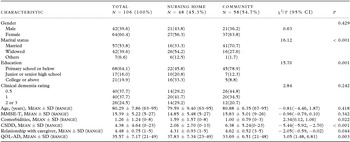
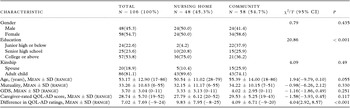
Among the 106 PWD-caregiver dyads, the majority of PWDs was female (60.4%), with a mean age of 80.3 years (range 63–95), and about half of them (54.7%) were living in the community. Their dementia diagnoses, with sample frequencies, were Alzheimer's disease (40.6%), vascular dementia (37.7%), mixed dementia (13.5%), other dementias (4.7%), and mild cognitive impairment (3.8%). Bivariate analyses showed some differences by PWDs’ residence. More PWDs in the nursing-home group than in the community group had at least a college education; PWDs living in nursing homes had lower CSDD scores, poorer relationships with their caregivers, more comorbidities, and higher QOL-AD scores than PWDs in the community group. For more characteristics and comparisons of PWDs, see Table 1. The majority of caregivers were also female (54.7%), with a mean age of 53.2 years (range 17–86). Bivariate analyses also showed some differences between caregivers’ characteristics by PWDs’ residence. More PWDs in the nursing-home group had at least a college education and the difference in QOL-AD ratings was greater for the nursing-home group than the community group (Table 2).
Characteristics of persons with dementia by residence

MMSE = Mini-Mental State Examination, Taiwan version; CSDD = Cornell Scale for Depression in Dementia; QOL-AD = Quality of Life - Alzheimer's Disease; CI = confidence interval.
Characteristics of caregivers by residence of persons with dementia

GDS = Geriatric Depression Scale; QOL-AD = Quality of Life - Alzheimer's Disease; CI = confidence interval.
Agreement between self-rated and proxy-rated PWD QOL
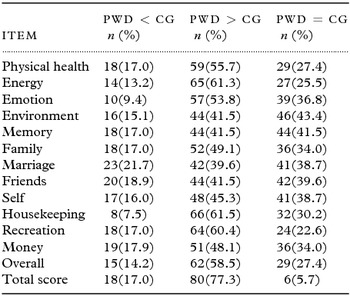
Almost all QOL-AD items rated by PWDs were higher than those rated by caregivers, except the item on environment (Table 3). Nearly 80% of PWD self-rated total QOL-AD scores were higher than those rated by caregivers.
Percentage agreement between PWDs and caregivers on QOL-AD items

PWD = person with dementia; CG = caregiver; QOL-AD = Quality of Life – Alzheimer's Disease.
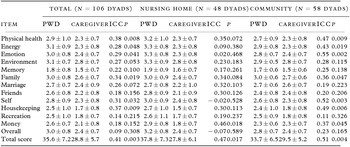
The results of ICC coefficients for agreement between PWD- and caregiver-rated QOL-AD are displayed in Table 4. For the whole sample, only the total QOL-AD score had an ICC coefficient (mean measure) over 0.4; no single item had a score > 0.4, indicating poor agreement. For PWDs living in the community, ICC coefficients were > 0.4 for QOL-AD items on physical health, energy, emotion, self, housekeeping, and the total score. However, for PWDs living in nursing homes, the only ICC coefficient > 0.4 was for the item on money and the total score.
PWD-caregiver agreement on the QOL-AD items by residence

Predictors of PWD-rated, caregiver-rated, and discrepancy in PWD QOL scores
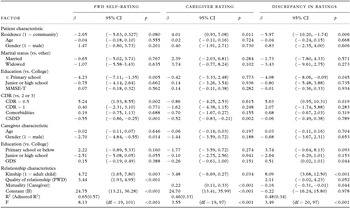
PWD self-rated, caregiver proxy-rated, and inconsistencies between PWD- and caregiver-rated QOL-AD scores were analyzed in three multiple regression models (Table 5). Model 1 revealed that higher self-rated QOL-AD scores were predicted by PWD education at or above college level (β = −4.23, 95% CI = −7.11 to −1.35, P = 0.005), CDR score of 0.5 (β = 5.24, 95% CI = 1.93–8.55, P = 0.002), lower Cornell depression scores (β = −0.55, 95% CI = −0.64 to −0.03, P = 0.001), female caregiver, adult child caregiver, and higher quality of relationship with the caregiver (β = 3.44, 95% CI = 1.93–4.95, P < 0.001). Although simple regression showed that MMSE scores (β = 0.42, 95% CI = 0.16–0.67, P = 0.002) significantly predicted PWDs’ self-rated QOL-AD scores, this effect was not significant in multivariate regression.
Predictors of PWD self-rated, proxy-rated, and discrepancy in ratings of PWD QOL

MMSE = Mini-Mental State Examination, Taiwan version; CDR = Clinical Dementia Rating Scale; CSDD = Cornell Scale for Depression in Dementia; GDS = Geriatric Depression Scale; CI = confidence interval; df = degrees of freedom.
Model 2 revealed that higher caregiver proxy-rated QOL-AD scores were predicted by PWDs living in the community (β = 4.01, 95% CI = 0.93–7.08, P = 0.011), lower Cornell depression scores (β = −0.52, 95% CI = −0.83 to −0.21, P = 0.002), and caregivers’ higher mutuality with PWD (β = 0.22, 95% CI = 0.11–0.33, P <0.001).
Model 3 revealed that fewer differences between self- and proxy-rated QOL-AD scores were predicted by PWDs living in the community (β = −5.97, 95% CI = −10.20 to −1.74, P = 0.006), PWDs’ lower educational level (β = −4.08, 95% CI = −8.06 to −0.09, P = 0.045), and caregivers’ higher mutuality with PWD (β = −0.16, 95% CI = −0.31 to −0.01, P = 0.044). Greater differences in QOL-AD ratings were predicted by PWDs lower CDR (mild dementia) (β = 5.63, 95% CI = 0.95–10.31, P = 0.019), higher caregiver GDS scores (β = 0.51, 95% CI = 0.02–1.01, P = 0.022), and adult child caregiver (β = 8.09, 95% CI = 3.68–12.50, P < 0.001).
Discussion
Agreement in QOL ratings and PWD residence
Our findings reveal that overall agreement and number of moderate-agreement items between PWD- and caregiver-rated QOL-AD for community-dwelling PWDs were significantly higher than for the nursing-home group. For PWDs living in the community, ICC coefficients for agreement in QOL-AD items on physical health, energy, emotion, self, and housekeeping were > 0.4. These findings are consistent with those on other community-dwelling samples (Logsdon et al., 1999, Huang et al., Reference Huang, Yeh, Tang, Chiu and Weng2009). Most of these items rated observable aspects of PWD QOL, suggesting that they could be more accurately assessed by caregivers who live with or frequently visit PWDs. However, for PWDs living in nursing homes, only one item (money) had an ICC coefficient > 0.4. This result might have been due to caregivers and/or PWDs having to pay nursing-home fees; caregivers needed to closely evaluate PWDs’ financial condition or discuss money issues with them.
We also found that PWDs’ and caregivers’ ratings of QOL-AD varied inversely by PWDs’ residence. Caregivers whose relative with dementia lived in the community (at home) rated QOL-AD higher than caregivers whose relative lived in a nursing home. However, PWDs who lived at home rated their QOL lower than PWDs who lived in nursing homes.
Our finding that PWDs living in nursing homes rated their QOL higher than that of PWDs living at home in the community was contrary to our expectations and a previous report (Hoe et al., Reference Hoe, Katona, Orrell and Livingston2007). This phenomenon might have been due to sample bias; our nursing-home sample of PWDs was recruited only from dementia special care units rather than general or mixed type units. Living in such special care units in nursing homes has been positively associated with PWDs’ QOL (Albert, Reference Albert2004; Abrahamson et al., Reference Abrahamson, Lewis, Perkins, Clark, Nazir and Arling2013). Although community-dwelling PWDs can live with a loving family, their self-rated QOL might be decreased by their inability to perform meaningful or interactive activities and lack of programmed activities with the family or in the community. Another possible reason for the higher QOL of PWDs living in nursing homes is their depressive status (CSDD scores) was lower than that of PWDs living at home. Depressive symptoms have been strongly related to QOL (Bruvik et al., Reference Bruvik, Ulstein, Ranhoff and Engedal2012; Conde-Sala et al., Reference Conde-Sala2014). The lower CSDD scores of PWDs living in nursing homes might have resulted from nursing home professional caregivers who appropriately recognized and dealt with PWDs’ depressive symptoms (Beerens et al., Reference Beerens2014).
Our finding that caregivers of PWDs living at home rated QOL-AD higher than caregivers of PWDs living in nursing homes is similar to those of earlier studies (Hoe et al., Reference Hoe, Katona, Orrell and Livingston2007; Bruvik et al., Reference Bruvik, Ulstein, Ranhoff and Engedal2012; Crespo et al., Reference Crespo, de Quirós, Gómez and Hornillos2012). The association between low proxy-rated QOL and PWDs living in nursing homes may be related to PWDs in institutions having higher levels of dependency and exhibiting more behavioral problems (Hoe et al., Reference Hoe, Katona, Orrell and Livingston2007; Crespo et al., Reference Crespo, de Quirós, Gómez and Hornillos2012). Furthermore, caregiver-rated QOL-AD may vary with culture or local healthcare delivery systems (Beerens et al., Reference Beerens2014). Caregiver-rated QOL-AD may have been higher for PWDs living in the community because people generally prefer to live in their own homes, especially in Taiwan where filial piety is a central cultural value, and they believe that supporting and caring for their disabled parents or relatives at home is a worthwhile endeavor. Indeed, institutionalization of the elderly has always been viewed in Taiwan as conflicting with traditional values or as the last alternative (Hsu et al., Reference Hsu, Lew-Ting and Wu2001). Thus, PWDs are often cared for at home as long as possible and are usually placed in a nursing home only when they have a severe impairment that exceeds family care resources.
QOL rating and depressive status for both PWDs and caregivers
PWDs’ self-rated QOL was significantly, negatively related to their depressive symptoms, as previously reported (Sands et al., 2004; Bruvik et al., Reference Bruvik, Ulstein, Ranhoff and Engedal2012; Conde-Sala et al., Reference Conde-Sala2014). Therefore, reducing PWDs’ depressive symptoms may maximize their QOL. This result suggests that healthcare professionals who work in both nursing homes and the community should increase their knowledge and skills in detecting and alleviating depressive symptoms in persons with dementia.
Similar to PWDs’ rating of QOL-AD, caregivers’ proxy rating of PWD QOL was negatively related to PWDs’ depressive symptoms. This finding is supported by the CSDD scale assessing PWDs’ mood-related signs, behavioral disturbances, physical signs, and cyclic functions, which caregivers can easily observe, facilitating their accurate assessment of PWDs’ symptoms to judge their QOL. Similar results were found in other studies (Arlt et al., Reference Arlt, Hornung, Eichenlaub, Jahn, Bullinger and Petersen2008; Black et al., Reference Black, Johnston, Morrison, Rabins, Lyketsos and Samus2012; Bruvik et al., Reference Bruvik, Ulstein, Ranhoff and Engedal2012).
We also found that caregivers’ depressive status (higher GDS scores) was associated with a higher discrepancy between self- and proxy-rated QOL-AD, consistent with previous reports (Logsdon et al., Reference Logsdon, Gibbons, McCurry and Teri2002; Arlt et al., Reference Arlt, Hornung, Eichenlaub, Jahn, Bullinger and Petersen2008; Black et al., Reference Black, Johnston, Morrison, Rabins, Lyketsos and Samus2012). This result might be due to caregivers projecting their own psychological status on proxy-rated QOL, emphasizing the importance of assessing caregivers’ mental health status when using caregiver proxy-rated QOL for PWDs.
QOL rating and quality of dyadic relationship
PWDs’ QOL rating was influenced by their perceptions of the quality of the relationship with their caregivers. This finding is in line with a previous report that the factors influencing PWDs’ positive QOL were related to their relationships with family and others (Moyle et al., Reference Moyle, Murfield, Griffiths and Venturato2012). Thus, PWD perceptions of their QOL may benefit from strategies to maintain a high quality caregiver-care recipient relationship.
Our results show that caregivers who perceived higher mutuality rated PWD's QOL higher. This result is supported by reports that positive mutuality produces positive caregiving circumstances and outcomes (Archbold et al., Reference Archbold, Stewart, Greenlick and Harvath1990; Ball et al., Reference Ball2010). We also found that mutuality was significantly, negatively related to the discrepancy between PWD- and caregiver-rated PWD QOL, as previously reported (Huang et al., Reference Huang, Yeh, Tang, Chiu and Weng2009). This result may be explained by caregivers in a high-mutuality dyadic relationship being more understanding and their thoughts thus being closer to those of PWDs. These findings suggest that if a proxy-reported QOL is necessary, the selected proxy should have high mutuality with the PWD, thus minimizing proxy bias in rating QOL.
QOL rating and kinship
We also found that spouse proxy-rated QOL for PWDs agreed more with PWD-rated QOL than adult child-proxy-rated QOL, consistent with previous findings (Conde-Sala et al., Reference Conde-Sala, Garre-Olmo, Turró-Garriga, Vilalta-Franch and López-Pousa2010). Spouse caregivers would consider caregiving tasks as part of their marital commitment and would be closer to the PWD, both physically and emotionally. In addition, spouse caregivers’ age, physical function, and mental function are usually similar to those of PWDs. Thus, their standard might be different from that of offspring. In contrast, adult child caregivers would experience notable generational differences with respect to the PWD, more conflicts between caregiving and other responsibilities, and might feel more physically and emotionally distant (Conde-Sala et al., Reference Conde-Sala, Garre-Olmo, Turró-Garriga, Vilalta-Franch and López-Pousa2010).
QOL ratings, cognitive function, and dementia severity
Our findings show that PWD-rated QOL was inversely related to dementia severity, consistent with previous results (Huang et al., Reference Huang, Yeh, Tang, Chiu and Weng2009; Conde-Sala et al., Reference Conde-Sala2014). Although both MMSE scores and CDR significantly positively predicted PWDs’ self-rated QOL-AD scores in simple regression, MMSE scores did not contribute significantly to explaining PWDs’ self-reported QOL in the final multivariate linear regression analysis. A plausible explanation is that CDR is a broader measure of dementia severity than MMSE. CDR not only measures cognition, but also includes self-care ability and other social-functional dimensions. Thus, CDR may be a more sensitive predictor of PWD-rated QOL.
We found that CDR was also a predictor of the difference between proxy- and self-rated QOL for PWDs. Similarly, CDR predicted differences in PWD and proxy ratings, with less difference evident in PWDs with higher CDR (more severe dementia) (Buckley et al., Reference Buckley2012). The discrepancy between self- and proxy-rated QOL might be due to PWDs evaluating QOL according to their overall dementia severity, while their caregivers may use different standards to judge PWDs’ QOL.
In our sample, PWDs who completely responded to the QOL-AD scale had a mean MMSE score of 15.4, indicating moderate cognitive impairment, even though one-third of these PWDs had MMSE scores < 11. This result, taken with previous results (Hoe et al., Reference Hoe, Katona, Orrell and Livingston2007; Huang et al., Reference Huang, Yeh, Tang, Chiu and Weng2009; Crespo et al., Reference Crespo, de Quirós, Gómez and Hornillos2012) supports direct assessment of PWD QOL by self-report. Therefore, PWDs with the ability to report their QOL should be the first source of information on their QOL when evaluating treatment efficacy or impact of disease.
Discrepancy between self- and caregiver-rated QOL for PWDs
The agreement between self-reported and proxy-rated PWD QOL was only moderate. Family caregivers’ proxy-rated QOL was significantly worse than PWDs’ self-report, consistent with previous findings (Huang et al., Reference Huang, Yeh, Tang, Chiu and Weng2009; Black et al., Reference Black, Johnston, Morrison, Rabins, Lyketsos and Samus2012; Bruvik et al., Reference Bruvik, Ulstein, Ranhoff and Engedal2012). The possible explanations for this phenomenon are illustrated further below.
The first explanation for this difference is an adaptation mechanism. This mechanism, described as the disability paradox, reflects an adaptive coping strategy in which PWDs who experience memory loss and functional impairment may shift to accommodate these changes and develop compensatory mechanisms to preserve positive feelings or a stable self-concept (Huang et al., Reference Huang, Yeh, Tang, Chiu and Weng2009; Bruvik et al., Reference Bruvik, Ulstein, Ranhoff and Engedal2012; Conde-Sala et al., Reference Conde-Sala2014). The discrepancy between PWD- and caregiver-rated QOL might result from PWDs gradually adjusting their goals and expectations with their decreasing abilities, while caregivers judge PWDs’ QOL by normal standards (Vogel et al., Reference Vogel, Mortensen, Hasselbalch, Andersen and Waldemar2006).
The second explanation for this difference is anosognosia or PWDs’ inability to recognize their dementia. This loss of insight and low awareness of declining memory function seem to affect QOL in a positive way, even in early-stage dementia (Trigg et al., Reference Trigg, Watts, Jones and Tod2011). The third explanation for this difference is social stigma (Behuniak, Reference Behuniak2011). Many caregivers think that “dementia is worse than death” (Huang et al., Reference Huang, Yeh, Tang, Chiu and Weng2009); thus, they project their negative feelings about dementia onto their rating of PWDs’ QOL regardless of PWDs’ actual QOL. The final explanation for this difference is dissimilar viewpoints. Caregivers might have directly judged PWDs’ QOL based on their own perceptions instead of indirectly judging how PWDs might rate their own QOL (Moyle et al., Reference Moyle, Murfield, Griffiths and Venturato2012). Since PWDs’ and caregivers’ perceptions of PWD QOL might be influenced by a different set of factors, some researchers claim that self- and proxy-rated QOL-AD scores should be considered complementary, rather than using proxy-rated QOL to replicate or substitute for self-reported QOL (Hoe et al., Reference Hoe, Katona, Orrell and Livingston2007; Bosboom et al., Reference Bosboom, Alfonso, Eaton and Almeida2012).
Limitations
The limitations of this study are worth noting. First, our cross-sectional design prevents ascertaining the direction of causation. Second, although participants were drawn from community and nursing-home settings, they were a convenience sample. The community-based participants were recruited from only one medical center memory clinic and nursing-home participants were recruited from dementia special care units. Because the sample was not selected randomly, generalizability of the results may be limited. Third, we did not examine several variables impacting QOL ratings, such as PWDs’ insight or anosognosia (Ready et al., Reference Ready, Ott and Grace2006; Trigg et al., Reference Trigg, Watts, Jones and Tod2011; Conde-Sala et al., Reference Conde-Sala2014), activities of daily living (Logsdon et al., Reference Logsdon, Gibbons, McCurry and Teri2002; Bruvik et al., Reference Bruvik, Ulstein, Ranhoff and Engedal2012; Giebel et al., Reference Giebel2014), problem behaviors (Hoe et al., Reference Hoe, Katona, Orrell and Livingston2007; Backley et al., Reference Black, Johnston, Morrison, Rabins, Lyketsos and Samus2012), both PWDs’ and caregivers’ perceptions of nursing home placement, and caregiver distress or burden related to caregiving (Huang et al., Reference Huang, Yeh, Tang, Chiu and Weng2009). Thus, these measures should be included in future studies on dementia QOL.
Conclusion
Our study contributes to the literature on dementia QOL by showing that the well-established discrepancy in self- and proxy-rated PWD QOL was significantly lower for PWDs living in the community than for those living in nursing homes. For PWDs, the factors positively related to their perceived QOL were higher educational level, fewer depressive symptoms, lower CDR, and higher quality of relationship with caregivers. For caregivers, more positive perception of PWD QOL was significantly related to fewer PWD depressive symptoms and higher mutuality with the PWD. The sources of discrepancy in self- and proxy-rated PWD QOL were PWDs’ residence, higher educational level, and lower CDR, as well as greater caregiver depression, being an adult child caregiver, and lower caregiver mutuality with the PWD. Depressive symptoms were negatively related to both self- and proxy-rated PWD QOL; higher caregiver depression also increased the discrepancy in self- and proxy-rated PWD QOL. To improve consistency in self- and proxy-rated PWD QOL, healthcare professionals should increase their knowledge and skills in detecting and alleviating depressive symptoms of PWDs and their caregivers. Healthcare providers should also carefully deliberate before using a proxy report instead of PWD-reported QOL. If combined caregiver-PWD reports are needed, the quality of the PWD-caregiver relationship must be carefully assessed and PWDs’ self-report should be properly weighted.
Conflict of interest declaration
The authors declare no conflict of interest.
Description of authors’ roles
H. Huang developed the study concept, analyzed the data, and wrote the paper; L. Weng, Y. Tsai, and Y. Chiu developed the study concept and assisted in critical revisions of the paper; K. Chen, C. Huang, J. S. Tang, and W. Wang provided access to the data and assisted in critical revisions of the paper.
Acknowledgments
This research was supported by National Science Council (100-2314-B-182-028) and Chang Gung Memorial Hospital Research Programs grants (CMRPD1A0141-3). We would like to thank all the persons with dementia and their family caregivers who took part in the study. We also thank all health care professionals working in nursing homes or memory clinics for referring participants for this study.