


Introduction
Farmers in the US approach the 3-year transition from conventional to organic production using different strategies that have variable effects on the biological control of insect and weed pests. Some of the adjustments to farming necessary during this transition period are in the tools that are used for organic versus conventional crop production. Examples of these tools include improving soil fertility through incorporating organic matter into the soil versus applying inorganic fertilizers, using biologically and culturally based pest management options versus synthetic chemicals, and planting polycultures versus monocultures. The degree to which these different tactics are implemented profitably is characteristic of the management intensity of the system.
The types and intensities of cropping practices have important implications for soil fauna. Ground-dwelling granivore and insectivore communities, represented in part by ground beetles (Coleoptera: Carabidae), often are reflective of certain management systems and practicesReference Thiele1–Reference Hance and Holland3. Certain species of ground beetles are strongly associated with organic or conventional farming systemsReference Döring and Kromp4. Within these systems, specific farming practices such as weed and ground cover managementReference Anderson5,Reference Tooley, Brust and Holland6, insecticide applicationReference Brust, Stinner and McCartney7,Reference Holland and Luff8, cultivation timing and frequencyReference Brust, Stinner and McCartney7,Reference Baguette and Hance9,Reference Cromar, Murphy and Swanton10, soil amendments such as manure or mulchReference Tooley, Brust and Holland6,Reference Purvis and Curry11,Reference Reichert and Bishop12, and crop selectionReference Booij, Desender, Dufrene, Moreau, Luff and Maelfeit13,Reference Ellsbury, Powell, Forcella, Woodson, Clay and Riedell14 all influence the communities of ground beetles and other beneficial arthropods. Thus, different cropping systems and farming practices are inherently different in their compatibility with biological control of pests, or the use of beneficial insects (and other organisms) as agents of pest management.
Although it is commonly understood that beneficial insects are impacted by farm management, the effects of specific farm management practices on their function as biological control agents is less understood. Nevertheless, instances of management practices that influence biological control have been reported. Brust et al.Reference Brust, Stinner and McCartney7,Reference Brust, Stinner and McCartney15 associated deep cultivation with decreases in predation rates of the black cutworm, Agrotis ipsilon (Hufnagel) (Lepidoptera: Noctuidae), and found that predator abundance was negatively correlated with plant damage by A. ipsilon. Reichert and BishopReference Reichert and Bishop12 showed that mulching garden plots increased spider densities and decreased insect pest populations. Investigating biological control agents of weed seed banks, Cromar et al.Reference Cromar, Murphy and Swanton10 observed that tillage affected seed removal rates by granivorous insects. Also, crop type and cropping density affects the levels of seed consumption by arthropodsReference Honěk, Martinkova and Jarošík16.
Researchers at the Illinois Natural History Survey and University of Illinois initiated a field study in 2003 to compare the influence of organic transition schemes on weed populations, soil organic matter and fertility, soil invertebrates, and the relationship between soil fertility, plant health and insect/disease pressure. An advisory panel of Illinois organic producers assisted in the development of the study, which compares three dominant approaches to the transition process that vary in the class of crops planted, level of soil disturbance and amendments, number of inputs for pest management, and economic returns. The three systems selected take into account a farmer's history and income requirements during the transition process. The three transition systems represented in our experiment were: (1) high-intensity transition systems, which use costly inputs such as organically approved insecticides, hand-labor or weeding along with frequent tillage, and require high returns such as those from vegetable crops; (2) intermediate-intensity transition systems, such as cash-grain systems, which use fewer costly inputs and involve less soil disturbance while still generating some income; and (3) low-intensity transition systems that include few to no added inputs or pest management activities to produce a forage crop or fallow but provide minimal economic returns during the transition period. The systems were identified based on several informal phone conversations and listening sessions with organic producers in Illinois and at a workshop held at the Illinois Natural History Survey to identify key research needs of organic producers. The advisory panel reviewed the selection of treatments and agreed that they were representative of predominant pathways by which organic producers approach the transition process in our region.
Systems approaches are specifically designed to increase the relevancy of a research program, and while this approach does not identify specific mechanisms that are mitigating the level of beneficial arthropods and biological control in the different treatments, it does give us a ‘real-world’ picture of how some predominant methods for transitioning to organic production affect this important form of pest management. Here, we document how these different strategies for handling the transition to organic production influence the abundance and activity of ground-dwelling arthropod communities and the predation of insects and weed seed banks during the first 2 years of the transition process.
Materials and Methods
Field site and management
Research was conducted on the Cruse Farm of the University of Illinois in Champaign, IL (N 40.08, W 88.24) in 2003–2004. The transition to organic production was initiated in 2003 on a site that had been under conventional corn and soybean production through the 2002 growing season. Only certified organic seed (unless otherwise noted) and materials approved for the production of certified organic crops were used in managing the field site. In fall 2002, winter rye (Secale cereale L., ‘FS Hi Rye 500’, untreated non-organic seed, Growmark, Bloomington, IL, USA) was seeded (101 kg ha−1) to use as a green manure and to reduce soil erosion. The rye was mown and incorporated into the soil by disking in spring 2003. Twelve experimental plots (30 m×12 m) were established, and the three management-intensity treatments were randomly assigned to the plots in a randomized complete block design (RCBD) with four blocks. Plots were separated by alleyways (≥1.5 m wide) that were seeded with a mixture of meadow fescue (Festuca pratensis Ruds. ‘Bartura’) and smooth bromegrass (Bromus inermis L.) (untreated non-organic seed, Albert Lea Seed House, Albert Lea, MN, USA) and regularly mown.
High-intensity treatment: vegetable system
2003: Tomatoes
Six raised beds that ran the length of each plot were created with a bed-shaper (BP400 Superbedder, Kennco Manufacturing, Inc., Ruskin, FL, USA). These beds were trapezoidal in cross-section, with the bottom dimension 0.91 m, 0.76 m at the top and 0.20 m tall. The beds were covered with embossed black plastic (Enviromulch™, Sonoco Products Company, Hartsville, SC, USA). Tomatoes (Lycopersicon esculentum Miller ‘La Rossa’, grown from seed from Johnny's Selected Seed, Winslow, ME, USA) were hand transplanted into the raised beds between 30 May and 2 June. There were 1.8 m between rows and 0.46 m between plants within rows (approximately 400 plants per plot). To suppress weeds, wheat straw (not certified organic) was spread between the raised beds to a depth of 15 cm; adventive wheat populations originating from seeds in the straw persisted between raised beds throughout the season. Weeds (including volunteer wheat) were removed by hand or mowing before they could shed seeds. Plots in this treatment were not cultivated for weed control after tomatoes were planted, and no pesticides or fertilizers were applied. Tomatoes were harvested by hand between 28 August and 2 October (the date of the first killing frost), and many ripe tomatoes were left in the field. After removal of the plastic, the beds were leveled and the plant residues incorporated.
2004: Cabbage and Broccoli
In spring, plots were disked and Austrian winter peas (Pisum sativum L.; Seeds of Change, El Guique, NM, USA) inoculated with Rhizobium leguminosarum (Frank) were drilled into the plots at 190 kg ha−1 as a green manure. These peas were mown and incorporated into the soil using an Imants (Reusel, The Netherlands) spading machine with power harrow. Cabbage (Brassica oleraceae L. ‘Tendersweet’) and broccoli (B. oleraceae L. ‘Gypsy’) (untreated non-organic seed, Johnny's Selected Seeds, Winslow, ME, USA) were transplanted on 16 July in alternating rows. Ten rows of crucifers were planted in each plot, with plant spacing of 0.91 m between and 0.4 m within rows. Spinosad (an insecticidal byproduct of Saccharopolyspora spinosa; Entrust® WP80, Greenfire Inc., Chico, CA, USA) was applied twice to suppress cruciferous Lepidoptera, based on periodic plant sampling and treatment guidelines adapted from Weinzierl and CloydReference Weinzierl, Cloyd and Bissonnette17. The first application (69 g ai ha−1) was made on 13 August using a two-row tractor-mounted boom with three hollow-cone nozzles per row. A second application (95 g ai ha−1) was made on 11 September using a hand-pressurized backpack sprayer equipped with a hollow-cone nozzle. For both applications, Crocker's Fish Oil (Crocker's Fish Inc., Quincy, WA, USA) (2.6 ml liter−1 water) was used as a sticker-spreader, to ensure good insecticide coverage on the plants. Weeds were controlled with a single row cultivator on 23 July and by hand between 2 and 9 September. Cabbage and broccoli were harvested for yield and quality assessment between 14 and 29 September.
Intermediate-intensity treatment: cash grain system
2003: Soybeans
On 2 June, the plots assigned to this treatment were planted with soybeans (Glycine max (L.) Merr. ‘Vinton’, Ridgeline Farm, Cerro Gordo, IL, USA). Soybeans were planted in 16 rows that were separated by 0.76 m, and the seeding rate was 420,000 seeds ha−1. No pesticide applications were made. To manage weeds, the soybeans were cultivated with a single row cultivator on 18 June and 15 July. Soybeans were harvested on 9 October, when beans had dried on the plant to approximately 12% moisture, as determined with a Farmex® MT# moisture meter (Farmex Electronics, Streetsboro, OH, USA). Winter wheat (Triticum aestivum L., Gleason Grains, Bridport, VT, USA) was drilled (134 kg ha−1) on 21 October.
2004: Wheat
Weeds and insects were not managed in the winter wheat. Wheat was harvested on 28 June. Straw was raked, baled and removed in early July. Wheat stubble and weeds were mown on 12 August. Otherwise, the plots were left fallow until 9 September, when hairy vetch (Vicia villosa Roth, Albert Lea Seed House, Albert Lea, MN, USA) was drilled into the wheat stubble at 48 kg ha−1 as a green manure cover crop.
Low-intensity treatment: pasture system
2003 & 2004: Hay/Pasture
On 2 June, the plots assigned to the low-intensity treatment were planted with a hay and pasture mix (22 kg ha−1, Hay/Pasture Mix 1, untreated non-organic seed, Albert Lea Seed House, Albert Lea, MN, USA). This mixture contained the following forages (percentage of mixture): alfalfa (Medicago sativa L. var. ‘Big Sky’; 29.5%), red clover (Trifolium pratense L. var. ‘Arlington’; 19.9%), timothy (Phleum pratense L. var. ‘Climax’; 19.9%), orchard grass (Dactylis glomerata L. var. ‘Potomac’; 19.5%) and Alsike clover (Trifolium hybridum L.; 9.9%). To prevent the establishment of perennial weeds, these plots were mown to 15 cm on 15 July and 1 August, 2003. In 2004, the plots were mown on 30 April, 27 May, 22 June and 12 August.
Arthropod activity
Pitfall-trap collections were made to determine possible effects of management-intensity treatments on the activity of ground-dwelling arthropods. A linear transect consisting of four pitfall trapsReference Spence and Niemelä18 placed every 6.1 m was established down the center of each plot. The traps were filled with 100 ml of ethylene glycol as an insect preservative and were placed in the field for sampling periods of 5–8 days during several intervals over the 2003–2004 seasons. Sampling periods were always separated by at least 7 days. One sample was collected beginning 16 April, 2003, while cereal rye was present across the entire field, to establish that there were no pretreatment differences. In 2003, trapping periods were conducted beginning on 5 June, 19 June, 3 July, 22 July, 4 August and 9 September. In 2004, trapping periods were conducted beginning on 24 April, 4 May, 19 May, 2 June, 7 July, 24 July, 5 August, 25 August and 15 September.
Arthropods collected in the pitfall samples were sorted into categorical taxa: Carabidae (insectivores, granivores), Staphylinidae (insectivores), Gryllidae (insectivores, granivores, only in 2004), Coccinellidae (insectivores), Araneae (insectivores) and Phalangiidae (insectivores). Specimens of Carabidae, Gryllidae and Coccinellidae were identified to species, and other insectivores were identified to morphospecies within a taxon (order or family). In general, the groups of arthropods highlighted here have a reputation as being beneficial; other species or groups may also be beneficial but are less well understood and so were not included in this study. Insectivore and granivore community data were analyzed separately. All four traps from a plot were consolidated into a single sample. Then the number of specimens per trap per day was calculated and compared among the three treatments using repeated measures ANOVA19 (n=4 plots for each sample period). Significantly different means were separated using the LSD test19. The numbers of catches were not compared between years because of seasonal differences in the trapping frequency and duration.
Densities of beneficial arthropods
This experiment was conducted to determine the effect of management intensities on the actual densities of beneficial arthropods. Quadrat samples were used to determine differences in the actual densities of predators and granivores in the different management systems.
Two sample periods on 19–20 August 2004 were selected to represent day- and night-time densities of beneficial arthropods: from 9:00–14:00 and from 22:00–2:30 CST, respectively. Three random samples were collected in each plot in three of the blocks during each designated sample period. Specimens from the three random samples were then consolidated into a single sample for each plot (nine observations each during day and night). For each sample, a metal quadrat frame (0.25 m2; 0.5 m×0.5 m, 0.13 m tall) was randomly placed within a plot and pressed several centimeters into the ground. Vegetation was removed from within the quadrat and stored in a plastic bag until processing. Cabbage/broccoli plants within the quadrat were examined in the field and any beneficial arthropods on them were removed. All arthropods that occurred within the quadrat were removed with forceps or an aspirator and were stored until processing. Flashlights were used during the night sample to help locate arthropods. Vegetation samples were kept cool (approximately 10°C) until they could be placed into Berlese funnels (process described in Methven et al.Reference Methven, Jeffords, Weinzierl and McGiffen20). Once the samples were completely dry, the vegetation was removed from the Berleses and examined to confirm that no arthropods remained in the vegetation.
The arthropods collected from the vegetation, soil, and detritus in the quadrat samples were identified to morphospecies and categorized as ‘insectivorous’, ‘granivorous’, ‘both’ or ‘other’. Those classified as ‘others’ were discarded from the analyses. Comparisons of insectivore abundance among the management treatments and between the day and night periods were made with repeated-measures ANOVA. A similar analysis was used to compare granivore abundances. The mean numbers of specimens per plot within day and night samples were separated among treatments using Tukey HSD tests19.
Predation estimates
An index of predation on lepidopteran larvae (i.e. caterpillars) was generated for the different management intensities. Brust et al.Reference Brust, Stinner and McCartney15 determined that ground-dwelling insectivores do not distinguish between lepidopteran species as long as they are of consistent size, and so wax moth (Galleria mellonella L. [Lepidopera: Pyralidae]) larvae were used as a surrogate prey. Observations of predation on restrained G. mellonella larvae were made on 22 September, 2004. Three ∼3.5 h observation periods were selected: approximately 9:00–12:30 (morning), 13:00–16:30 (afternoon), and 22:30–2:00 (23 September) (night). For each time period, five observation sites were established at random locations within each plot; the same locations were used for all three periods. At each observation site, two late-instar G. mellonella (mean±SEM weight was 0.23±0.0064 g) were restrained to a 30×15×2-mm3 piece of modeling clay (Polyform Products Co., Inc. Elk Grove Village, IL, USA) using insect pins (size 3) inserted through the posterior segment of their abdomens (as described by Frank and ShrewsburyReference Frank and Shrewsbury21). In preliminary tests, larvae restrained in this manner survived for more than 24 h in the laboratory. To exclude vertebrate predators, each observation site was enclosed within an open-topped, cylindrical wire cage (8 cm tall and 7 cm in diameter, mesh size 1.2 cm) that was pressed 1–2 cm into the soil. A piece of vegetation was loosely placed over the prey to keep them from desiccating during the day. At the end of each observation period, the larvae were removed from the field and examined for signs of predation. Also, any insectivores that were found within the caged location at the end of the period were identified by sight and were released within the vicinity of the cage. The proportion of the ten prey larvae consumed per plot and the number of predation events in each plot by each insectivore species were recorded. The percentages of prey consumed in each management-intensity treatment and during each sample period were compared using repeated-measures ANOVA. Means were separated among management treatments and within treatments over the 17-h period using LSD comparisons.
Granivory estimates
Weekly seed removal rates were used as an index of biological control of weed seed banks. Weeds encountered at our site (J.B. Masiunas, unpublished data) were lambsquarter (Chenopodium album L.), velvetleaf (Abutilon theophrasti Medic.), redroot pigweed (Amaranthus retroflexus L.), ivyleaf morning glory (Ipomoea hederacea [L.] Jacq.), crabgrass (Digitaria sanguinalis [L.] Scop.), giant ragweed (Ambrosia trifida L.) and giant foxtail (Setaria faberi Herrmann). Seeds of these species were ordered from commercial sources (Valley Seed Service, Fresno, CA, USA or V & J Seed Farms, Woodstock, IL, USA), and their identities were verified by germinating them in the greenhouse and identifying the plant by morphology. Seeds of each species were affixed to the bottom halves of Petri dishes (15 cm diameter, 1 cm deep) with double-sided Scotch® tape (3M, St Paul, MN, USA). Each dish contained all of the species; seed numbers were 50 for C. album, Ab. theophrasti, Ama. retroflexus, D. sanguinalis, and S. faberi and 25 for the comparatively larger seeds of I. hederacea and Amb. trifida. Seed densities were comparable to or higher than respective seed populations commonly encountered in Midwestern agricultural fieldsReference Forcella, Wilson, Renner, Dekker, Harvey, Alm, Buhler and Cardina22,Reference Cardina, Norquay, Stinner and McCartney23. In agricultural systems, seed removal rates tend to be density dependent at concentrations equal to or higher than field populationsReference Cardina, Norquay, Stinner and McCartney23,Reference Brust and House24. Three seed-containing dishes were placed in each of the plots at randomly selected sites. The dishes were buried so that their upper lips were flush with the soil surface, and surrounding soil and plant material were placed in and on the dish to mimic the surrounding vegetation and crop residue. An uncovered wire cage (1.4 cm×1.4 cm mesh size, 15 cm diameter and 14.5 cm tall) was placed around each dish to exclude vertebrate granivores. To control for ancillary seed loss not attributable to granivory, we created dishes that contained black plastic beads and placed one dish in each plot. Large beads (approximately 4.2 mm diameter, 80 mg each; n=25) and small beads (approximately 2.2 mm diameter, 10.5 mg; n=50) were intended to generally represent the large and small weed seed species, respectively.
Seed removal rates were examined for three consecutive 7-day periods beginning on 6 September. Precipitation levels during the three 1-week intervals were recorded by the Illinois State Water Survey (http://www.sws.uiuc.edu/warm/data/) at a monitoring site 0.16 km to the north of the research plots. The seed removal sites remained fixed throughout the 3-week period. At the end of each week, the dishes with all of their contents were brought back into the laboratory and frozen at −10°C until processing. The contents of each dish were sifted through, and the number of each seed species or bead was recorded. Seeds which had their seed coat cracked were counted as removed. The numbers of seeds and beads missing were recorded for each plot over each 1-week period. The weekly removal rates were compared among treatments and sample weeks by repeated-measures ANOVA. Significantly different means among treatments and sample weeks were separated using LSD tests.
The number of each seed species consumed per plot was generated; data were pooled across management treatments and sample weeks (n=9 dishes in each plot over 3 weeks). ANOVA was used to reveal any significant preferences for certain weed species. A Tukey HSD test was applied to separate significantly different means among the treatments. Each species was categorized as a grass or broadleaf species; ANOVA was used to determine preferences for broadleaves or grasses. The weight of ten seeds of each species was measured on 15 replicate groups using an electronic balance, and a general linear model was used to determine whether there was a relationship between seed biomass and average removal rate per week (removal rates were pooled over sample periods and treatments)19.
Sample methods and biological control indices
Pitfall and quadrat samples were correlated with the indices of insectivory and granivory to determine which sampling method was more representative of biological control by ground-dwelling arthropods during the latter part of the growing season. Quadrat samples to assess the densities of beneficial arthropods were collected on 20 August, 2004. The mean numbers of insectivores captured (per trap per plot per day) from traps that were in the field from 5 to 10 August represented the pitfall sample method. These sample dates were intended to give an indication of the relative populations of beneficial species during the latter part of the growing season. Granivory estimates spanned from 6 to 27 September, and insectivory rates were investigated on 22 September. A mean predation rate of wax moth larvae was derived from the morning, afternoon and night sample periods for each plot. Granivory was measured as the number of seeds removed per plot over the 3-week sample interval. Separate linear regressions were established for each of the insectivory and granivory indices and the two sample methods19.
Results
Arthropod activity
A total of 3177 adult insectivores and granivores were collected in pitfall traps in 2003, and 2478 specimens were trapped in 2004 (Table 1). Management intensity significantly affected the total number of insectivores captured over the season in 2003 (F 2, 9=7.98, P=0.01), but there were no significant differences in predator activity among the treatments in 2004 (F2, 9=2.37, P=0.15) (Fig. 1). In 2003, 69% of specimens collected in pitfall traps were the insectivorous species Poecilus chalcites (Say). This species was still the most commonly collected species in 2004, but comprised only 26% of specimens (Table 1).
Mean (±SEM) insectivore activity in the different organic transition systems, as measured by pitfall samples (n=4). Columns with different letters are significantly different from one another (α=0.05, LSD test).

Adult arthropod natural enemies captured in pitfall traps.

1 Tooley and BrustReference Tooley, Brust and Holland6 and LindrothReference Lindroth39 suggest that this entire genus is granivorous to some degree.
2 Tooley and BrustReference Tooley, Brust and Holland6 declare that this entire genus is granivorous to some degree.
3 Tooley and BrustReference Tooley, Brust and Holland6 suggest that the entire genus is granivorous, but this is questionable. Brust and HouseReference Brust and House24 did see Chlaenius sp. and Lebia sp. visit seed trays in the field. However, AllenReference Allen, Erwin, Ball, Whitehead and Halpern34 and LarochelleReference Larochelle33 do not list any seeds in the diet of Chlaenius and Lebia spp. It may be that these species are granivorous, but more data are needed on the matter.
4 No specific references to seed-feeding could be found for this species, although their close relationship with seed-feeding congeners makes it likely that they will feed on seeds to some degree.
5 This is a close relative of G. pennsylvanicus, separable only based on seasonal phenology. Given its morphological similarity, we presume that this species is granivorous.
Collections totaled 3177 adult beneficial (granivore and insectivore) arthropods in 2003 and 2478 in 2004.
Pitfall-trap data revealed an increase in the activity of granivorous species from 2003 to 2004, but management intensity did not influence granivorous communities. Granivorous ground beetles increased from 12.62% of total specimens (13 species) in 2003 to 36.67% of specimens (20 species) in 2004 (Table 1). Treatment did not affect the activity of the total granivores in 2003 (crickets weren't sampled in 2003) (F 2, 9=1.65, P=0.25) or in 2004 (including crickets) (F 2, 9=1.87, P=0.21).
Densities of beneficial arthropods
A total of 465 predators, most of which were spiders, were collected from the quadrat samples (Table 2). Management intensity had significant effects on the number of predators observed per plot (F 2, 6=10.71, P=0.01) (Fig. 2), and sample period affected the number of insectivores encountered (F 1, 6=7.82, P=0.03; treatment×sample period: F 2, 6=4.77, P=0.06). Fewer predators were captured at night than during the day (Fig. 2). Averaging the mean day and night density estimates per m2 extrapolated into approximately 45,000 (high), 100,000 (intermediate) and 733,000 (low) insectivores per hectare.
Mean (±SEM) densities of insectivorous arthropods collected from quadrat samples (n=3 plots for each sample period/treatment combination). Bars within a sample period with different letters are significantly different (Tukey HSD test, α=0.05).

Abundance of individual predator taxa in quadrat samples.

Data were pooled over treatment and sample periods, a total of 63 samples (0.25 m2 each).
The 33 granivorous arthropods collected in the quadrat samples fell into four general taxa: Carabidae (n=11; 5 spp.), Gryllus pennsylvanicus (n=9), Miridae (n=9) and Elateridae (n=4). No granivores were found in the quadrat samples from the high-intensity plots. The density of granivores was significantly affected by management intensity (F 2, 6=14.12, P=0.005), but sample period did not affect the number of granivores (F 1, 6=5.45, P=0.06; treatment×sample period: F 2, 6=10.10, P=0.01). The low-intensity treatment had the highest densities of granivores (mean±SEMs were 0, 1.14±0.40 and 5.14±1.24 granivores per m2 in the high-, intermediate- and low-intensity treatments, respectively).
Predation in the field
The proportion of G. mellonella larvae consumed was significantly influenced by time of day and management intensity (treatment: F 2, 9=6.97, P=0.015; sample period: F 2, 18=9.72, P=0.001; treatment×sample period: F 4, 18=3.95, P=0.018) (Table 3). A sharp increase in insectivory in the high-intensity plots during the night sample was responsible for the significant interaction observed here (Table 3).
Predation rates of caterpillars (% of G. mellonella larvae consumed±SEM) in the three organic transition systems (n=4 plots for each sample period/treatment combination).
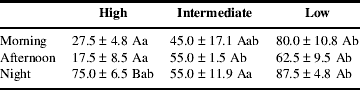
Values within a column followed by different capital letters are significantly different within the treatment; values within a row followed by different lower-case letters are significantly different in predation among management systems for a particular sample period (LSD test, α=0.05).
A total of nine insectivorous morphospecies/taxa were found consuming G. mellonella. Larvae of Chauleognathus sp. (Coleoptera: Cantharidae) accounted for 70% of predation events (Table 4). Most predation occurred during the night; 71% of all events were observed at night, versus 16 and 13% during the morning and afternoon, respectively. Insectivory was most commonly observed in the low-intensity management system (55% of events, versus 22 and 14% in the high and intermediate systems, respectively).
Predator taxa observed consuming caterpillars (G. melonella larvae) in the field.

Observations were made at 12:30, 16:30 and 2:00 over a single date.
Granivory estimates
We recovered 97, 97 and 94% of the large beads and 99, 99 and 95% of the small beads that were placed in the high-, intermediate- and low-intensity treatments, respectively. Seeds (C. album, Ama. retroflexus, D. sanguinalis and S. faberi) were occasionally placed unintentionally into the bead dishes when dishes were filled with soil/residue from the field, but the average number of these ancillary seeds was never more than 2.33 per dish per plot.
The total number of seeds consumed differed significantly among treatments and sample periods (treatments: F 2, 9=7.72, P=0.01; sample week: F 2, 18=70.13, P<0.0001, treatment×week: F 4, 18=1.69, P=0.19). Mean weekly seed removal rates were 63.86±10.21, 49.92±7.03, 36.39±7.31, in the low-, high- and intermediate-intensity treatments. Seed removal was significantly higher during the middle week (13 September) than the other two (F 2, 33=56.66, P<0.0001). Rainfall occurred only during the second sample week (5.25 cm).
Granivores showed a preference for certain species of weed seeds. Significantly different numbers of seeds were consumed for each species (Fig. 3) (F 6, 77=15.39, P<0.001). On average, more grass seeds of each species were removed than for broadleaf species (F 1, 82=32.88, P<0.0001). There was also a slight trend for preference of lighter seeds over heavier seeds, although this relationship was not significant (F 1, 5=4.78, P=0.082).
Mean±SEM preference for weed seed species by granivorous arthropods. The average number of seeds (SEM) consumed per plot over 3 weeks (n=12). Seed species were crabgrass (C), foxtail (F), velvetleaf (V), lambsquarter (L), redroot pigweed (P), giant ragweed (R) and ivyleaf morning glory (M). Bars with different letters are significantly different (α=0.05, Tukey HSD).

Sample methods and biological control indices
Insectivory rates were significantly correlated with the quadrat sample estimates (R 2=0.52, F 1, 10=11.46, P=0.007) (Fig. 4) but not with pitfall samples (R 2=0.02, F 1, 10=0.21, P=0.66). The total number of seeds removed per plot was not well correlated with granivore numbers in the quadrat samples (R 2=0.12, F 1, 10=1.33, P=0.28) or in the pitfall samples (R 2=0.07, F 1, 10=0.71, P=0.42).
Predation rate on caterpillars (G. melonella larvae) versus insectivore abundance. Insectivore abundance (per m2) was determined using quadrat samples. Predation on G. mellonella larvae was monitored for 10 h over three periods of a single date.

Discussion
Farm management intensity has important implications for the activity and abundance of beneficial arthropods. Pitfall and quadrat samples revealed contradictory information about the communities of biological control agents. Actual abundance of beneficial arthropods was a better indicator of biological control potential than activity estimates. In general, predators of insects and weeds were favored in the low-intensity transition system, and the beneficial arthropod communities behaved differently in the different management treatments.
Pitfall sampling revealed a shift in the activity of arthropod communities as the transition process proceeded. The number of predator species captured in pitfall traps increased from 2003 to 2004 (Table 1). But the activity of insectivores in the low-intensity treatment dropped considerably from 2003 to 2004, while activity remained consistent in the high and intermediate intensity treatments (Fig. 1). Actual densities of insectivores (as measured in the quadrat samples) in the low-intensity treatment far exceeded those found in the other treatments, and diversity was also much greater (Fig. 2).
Clearly, the quadrat and pitfall sampling methods captured different components of the biological control community. We hypothesize that the differences between these sample methods can be explained in part by the relative stability in the different treatments over time. Pitfall samples estimate the activity of a community and do not give a reliable measurement of actual densities or community constituencyReference Spence and Niemelä18,Reference Desender and Maelfait25. The activity of ground-dwelling arthropods can be impacted by a number of factorsReference Spence and Niemelä18,Reference Adis26. The capture rate by pitfall traps appears to be reduced in stable habitats because the movement of arthropods is impeded relative to that in open habitats characteristic of conventional agricultureReference Greenslade27,Reference Niemelä, Halme and Haila28. In 2004, many more predators were found in quadrat samples in the low-intensity treatment relative to the other treatments, but the activity of these predators was not reflective of this trend in abundance (compare Figs. 1 and 2). The low-intensity treatment was planted with a diversity of forage crops in 2003 and had not been cultivated during the 2-year experiment. These factors led to a complex and stable habitat that supported a large number of niches for a higher diversity and abundance of predators to exploit but reduced the ability of these predators to move long distances quickly, hence the low pitfall capture rate in this treatment. In contrast, the similarity in pitfall captures within the high- and intermediate-intensity treatments may simply reflect the year-to-year constancy in the ability of arthropods to move in these treatments. The general increase in the number of species from 2003 to 2004 (Table 1) may be an acclimation of the biological control agents to the treatment regimen. For instance, smaller plots, increased plant diversity, and reduced levels of chemical inputs are factors known to positively affect the diversity of predator communities (reviewed by KrompReference Kromp2). We observed all of these habitat characteristics in our experimental plots over the 2-year period.
In this study, predator abundance rather than activity estimates was a better indicator of our insectivory index (i.e. biological control of insects). Similar to our results, Brust et al.Reference Brust, Stinner and McCartney15 found quadrat samples to be well correlated with predation rates in cornfields. Not surprisingly, not all of the predators observed in the density samples (Table 2) were major consumers of late-instar G. melonella larvae (Table 4). Spiders were the most abundant predators, but many of these were smaller species (such as Lyniphiidae) that are not active or large enough to kill and eat large, mobile preyReference Clark, Luna, Stone and Youngman29. In spite of the fact that the entire predator community does not attack large prey, the number of G. melonella larvae consumed over the day was strongly correlated with the abundance of insectivores present in the plot (Fig. 4).
The management treatments led to varying insectivory rates and daily predation patterns, suggesting that natural enemy communities behaved differently in the assorted cropping systems. The highest levels of insectivory occurred in the low-intensity system, and these levels were consistent over the entire day (Table 3). In contrast, predation occurred predominantly at night in the high-intensity treatment (Table 3), even though predator densities did not differ substantially over the day in this treatment (Fig. 2). This suggests that either different biological control agents reside in more intensively managed fields, or that key predators of lepidopteran larvae behave differently in these systems. In cornfields, Brust et al.Reference Brust, Stinner and McCartney15 found daily insectivory patterns similar to those observed in our highly managed system, suggesting that there may be a characteristic predator community associated with ephemeral cropping systems. Certainly, a strong precedence of habitat or crop selection by specific species of insectivores has been well establishedReference Cromar, Murphy and Swanton10,Reference Ellsbury, Powell, Forcella, Woodson, Clay and Riedell14,Reference Honěk, Martinkova and Jarošík16,Reference Cárcamo and Spence30. A next step in our research program will be to determine whether the cropping system selected during the transition process and the accompanying biological control agents have long-term effects on biological control after the transition process has ended.
Granivory by arthropods was influenced by farm management intensity, and granivores showed preferences for certain weed species. The low-intensity treatment had higher seed removal rates than the others, which may be related to the reasons discussed for the higher levels of insect predation in this treatment. Seed preference appeared to be greatest for grass species (Fig. 3) and was independent of seed size. For instance, more Ag. abutilon seeds were removed than C. album or Ama. retroflexus seeds, despite the preferred seeds being ten times the weight of the less preferred species. This suggests that plant seeds may be differentially prone to granivory based on their morphological (i.e. seed coat thickness) or physiological (i.e. internal chemistry) characteristics or ‘defenses’Reference Janzen31.
Granivory peaked during the second week of the observation period, the only week to experience rainfall. This may be a demonstration in the field of granivores preferring seeds that had imbibed moisture compared to dry seeds. We hypothesize that soil moisture resulting from rainfall is important in regulating granivory rates. No rain fell during the first and third weeks of the observation period, but more than 5 cm fell during the second week; seed consumption was 4-fold higher during this period compared to the adjacent weeks. In the laboratory, we observed that Harpalus pensylvanicus and Anisodactylus sanctaecrucis, two abundant granivorous species in our plots (Table 1), preferred moistened seeds over dry ones (J.G. Lundgren, unpublished data). This may be in part due to the relative ease with which the seed coat of wet seeds can be penetrated. Preference for imbibed seeds has been observed in other granivorous insects as wellReference Cardina, Norquay, Stinner and McCartney23,Reference Pausch and Pausch32. Rainfall should be a consideration of future field studies involving granivory rates.
Acknowledgements
We thank Guillermo Arce, Gabriella Carrasco, Alison Huber, Claudia Kunioshi, Juan Carlos Laso, Janeth Moncada, John Murdoch and Anthony Razzak for assistance with data collection, field plot maintenance and greenhouse production of plants. Organic transitions project colleagues John Masiunas, Michelle Wander, Darin Eastburn, Deborah Cavanaugh-Grant, and Dan Anderson along with advisory board members Allen Williams, Jon Cherniss, Henry Brockman, David Campbell, Alan DeYoung, David Cleverdon, Marvin Manges and John Peterson contributed to the design of the field experiment. Mike Ellsbury and Matt O'Neal provided helpful comments on earlier drafts of this manuscript. This research was funded in part by Organic Transitions grant award ORG 2003-51106-02086 through USDA-CSREES, Hatch project 65-342 (Pest management for transitioning to organic vegetable production systems) to CEE, and by the Illinois Natural History Survey.


