In 2012, Rick Santorum went from being a relatively unknown political figure to a legitimate presidential contender. Santorum, who is Catholic, openly courted fundamentalist Christian voters with his strongly expressed religious views and socially conservative policy positions. While this approach helped endear him to many on the so-called Religious Right, it also turned off, and in some cases offended, many moderate voters. The reaction to Santorum demonstrates how polarizing religion has become in America (Putnam and Campbell Reference Putnam and Campbell2010).
While a large segment of the population laments the lack of religious guidance in America, many others have little tolerance for religious influence in politics (Lambert Reference Lambert2008). A recent Pew (2012) poll, for example, revealed that 38% of Americans are tired of politicians talking about religion. What this poll likely means is that many Americans are tired of so much conservative religious talk by Republicans. Citizens, media pundits, and scholars alike frequently conflate being a Christian fundamentalist with being a Republican (Bolce and de Maio Reference Bolce and De Maio1999), yet many Democratic politicians and Democratic voters are also religious.
Religious disagreements are a fixture of modern political discourse (McTague and Layman Reference McTague, Layman, Smidt, Kellstedt and Guth2009; Stark and Finke Reference Stark and Finke2000). The “culture wars” narrative (Hunter Reference Hunter1991) posits that insurmountable divisions exist between those with “orthodox” or “conservative” Christian beliefs and those with “liberal” or “progressive” religious viewpoints (Layman and Carmines Reference Layman and Carmines1997; Lambert Reference Lambert2008; Putnam and Campbell Reference Putnam and Campbell2010). While in the past affiliation served as the major religious cleavage, religious divisions are now largely fueled by the type of religiosity groups hold (Wuthnow Reference Wuthnow1998). Central to these disagreements are different perspectives about cultural issues such as abortion, homosexuality, and prayer in public schools (Hunter Reference Hunter1991). Santorum's success with religious conservatives highlights that voters may react more to the intensity of politicians’ religious convictions, rather than their affiliation (Braman and Sinno Reference Braman and Sinno2009).
Other scholars have argued that the cultural wars narrative is overstated, as the “vast middle” of the country is best characterized as moderate rather than orthodox or progressive (DiMaggio, Evans, and Bryson Reference DiMaggio, Evans and Bryson1996; Guth et al. Reference Guth, Kellstedt, Smidt and Green2006). Because over 90% of Americans identify as religious, it is not surprising that both Democratic and Republican politicians frequently weave religious language into their political speeches (Domke and Coe Reference Domke and Coe2008). Unlike Santorum, however, most politicians try to play it safe by using subtler and more general religious cues (Lambert Reference Lambert2008). Domke and Coe (Reference Domke and Coe2008) claim that both Republicans and Democrats stand to gain politically by correctly applying religious cues.
While there is little doubt that politicians can benefit from attracting religious voters (Wald and Calhoun-Brown Reference Wald and Calhoun-Brown2011), many Americans hold negative stereotypes about those who are religious (Pieper Reference Pieper2011). When politicians use religious cues, therefore, they run the risk of activating negative associations in voters’ minds. Because voters often rely on social identity cues to help make quick assumptions and evaluations of politicians, religious cues may play a large role in influencing voter behavior (McDermott Reference McDermott2009).
More work is needed in order to directly test the degree to which general religious cues can either attract or repel potential voters. We therefore seek to contribute to the understanding of religion's role in American politics by performing an experimental study to assess the effects of general religious cues utilizing a national adult sample. Using a fictitious Congressional candidate's homepage, we manipulate the use of either subtle or overt religious cues while divorcing the religious language from specific policy positions. In addition, we consider how religious cues interact with a citizen's religiosity, as an individual's response to religious cues should be influenced by his or her own religious beliefs and behaviors.
Informational Shortcuts and Religious Cues
Religious language can play an important role in influencing political behavior because citizens tend to rely on social identity cues to infer politically relevant information. Indeed, people are “cognitive misers” who often rely on accessible shortcuts to make judgments about people (Popkin Reference Popkin1991). This is especially true for low-information elections, such as Congressional races, where voters often have limited exposure to the candidates they have to choose from (McDermott Reference McDermott1998). To compensate for this lack of information, voters often rely on identity cues when making voting decisions (McDermott Reference McDermott2007; Valentino Reference Valentino1999; Weaver Reference Weaver2012). By using stereotypes about social groups, voters can make rapid assumptions about the character traits and policy positions a candidate is likely to possess (McDermott Reference McDermott2009).
A politician's religious affiliation has traditionally provided citizens with a cue from which to make inferences about a politician's beliefs and values. A growing body of literature has used experimental manipulations to test the effects of a politician's religious affiliation on voter stereotypes and evaluations (Campbell, Green, and Layman Reference Campbell, Green and Layman2011). This includes examining the effects of religious identity when a politician is evangelical Christian (McDermott Reference McDermott2009), Catholic (McDermott Reference McDermott2007), Jewish (Bernisky and Mendelberg Reference Bernisky and Mendelberg2005), and Muslim (Braman and Sinno Reference Braman and Sinno2009). These studies have generally found that religious affiliation activates stereotypes and affects evaluations. For example, Jews are typically stereotyped as liberal (Bernisky and Mendelberg Reference Bernisky and Mendelberg2005), while evangelicals are seen as conservative, but also trustworthy (McDermott Reference McDermott2009).
While these studies are crucial in untangling the effects of religious cues, political candidates are also increasingly likely to downplay their religious affiliation (Lambert Reference Lambert2008; McDermott Reference McDermott2009). Politicians instead tend to rely on generic religious labels and use general Christian terms in their speeches, such as “God,” “Christ,” “faith,” and “heaven” (Domke and Coe Reference Domke and Coe2008). It may not be the specific type of religious affiliation, but the degree to which politicians' display their religious commitments that matters most (McDermott Reference McDermott2007). For example, Braman and Sinno (Reference Braman and Sinno2009) found that evaluations of Christian and Muslim political candidates were more influenced by the level of the candidates' religiousness than their religious affiliation. It is therefore important to examine how the effects of religious cues differ as they become more overt.
On one end of the spectrum, religious cues can be delivered without most citizens even noticing them. For example, Republican politicians often employ covert religious cues that do not directly reference God or religious faith (Calfano and Djupe Reference Calfano and Djupe2009). These cues rely on references to biblical passages that can be detected by evangelical Protestants, but are unlikely to be noticed by less religious voters. The authors show that use of “the code” results in greater support among evangelicals, while the support levels of non-evangelicals are unaffected by these cues. By signaling to white evangelical voters that they share the same social group, Republican politicians can gain support among an intended audience without alienating moderate voters (Calfano and Djupe Reference Calfano and Djupe2009).
Testing the God Strategy
Understanding how covert religious cues affect voting behavior helps us better comprehend an important aspect of how Republican politicians strategically use religion to their advantage. Less is known about the generalist cues used by both Republican and Democratic candidates. Unlike covert religious cues, generalist religious cues are typically intended to be noticed. Domke and Coe (Reference Domke and Coe2008) argue that the political fates of both Republicans and Democrats rely to a large degree on the effective use of religious cues. Indeed, there is ample evidence that religious appeals have also become a prominent fixture for Democratic presidential candidates, with Bill Clinton (Domke and Coe Reference Domke and Coe2008), Barack Obama (Sheets, Domke, and Greenwald Reference Sheets, Domke and Greenwald2011), Al Gore (Albertson Reference Albertson2011) and John Kerry (Guth et al. Reference Guth, Kellstedt, Smidt and Green2006) all using religious language in their political campaigns. Domke and Coe (Reference Domke and Coe2008, 7) refer to the “calculated, deliberate, and partisan use of faith” as the “God Strategy” (7) and claim the most important lesson in contemporary United States politics is that both Republican and Democratic politicians “had better be able to talk the religious talk” (6).
Central to the God Strategy is the distinction between “invocations of God” and “invocations of faith” (Domke and Coe Reference Domke and Coe2008). “Invocations of God” include overt reference to God and Christianity, leaving little doubt about a politician's religious beliefs. “Invocations of faith” are subtle cues that do not explicitly mention God, but are “nonetheless laden with spiritual, particularly Christian, significance” (Domke and Coe Reference Domke and Coe2008, 39). Invocations of faith include words such as “angel,” “faith,” “miracle,” “mission,” “pray,” “sacred,” and “worship.” Overt religious cues are likely to be noticed by the vast majority of potential voters. Subtle religious cues, on the other hand, will still be noticed by a large percentage of voters, but are less likely to catch the attention of those who are not particularly religious (Domke and Coe Reference Domke and Coe2008).
Americans that do hold religious views are likely to identify positively with subtle invocations of faith. For one thing, citizens are unlikely to view subtle cues as an indicator that a politician's religious viewpoints will affect his or her political performance. Additionally, because a large majority of Americans are integrated into a Judeo-Christian worldview from early in life (Albertson Reference Albertson2011), we should expect that general, but subtle, religious cues appeal to a majority of Americans. Domke and Coe (Reference Domke and Coe2008) claim that politicians benefit most from exhibiting faith through the use of subtle religious cues, we therefore hypothesize:
H1: The use of subtle religious cues will lead to citizens (a) feeling more favorably about a political candidate and (b) being more likely to vote for the candidate.
While religion can be a boon to political success, politicians also must employ religious language carefully. It is not just the presence of religious cues that matters, but whether they indicate the extremity of a politician's position (Braman and Sinno Reference Braman and Sinno2009). When religious messages become more extreme they may risk alienating less religious voters (Domke and Coe Reference Domke and Coe2008; Wald and Calhoun-Brown Reference Wald and Calhoun-Brown2011). While Americans are generally supportive of a religious worldview, a large percentage of voters prefer that religion and politics be kept separate (Lambert Reference Lambert2008). As religious cues become more overt, they are more likely to turn off potential voters. We therefore predict:
H2: The use of overt religious cues will lead to citizens (a) feeling less favorably about a political candidate and (b) being less likely to vote for the candidate.
Another important effect of social identity cues is that they can prime particular aspects of an individual's social identity. Once a social identity becomes salient, it can then influence the way citizens process and react to politicians' messages. For example, Calfano and Djupe (Reference Calfano and Djupe2009) explain how the use of covert evangelical codes allows evangelical citizens to recognize a politician as a member of their in-group. Similarly, Weber and Thornton (Reference Weber and Thornton2012) show that religious cues activate religious traditionalism among religious citizens. Religious cues may also activate the partisan identity of a citizen (Campbell, Green, and Layman 2009). Meaning, social identity cues matter because citizens use them to make inferences about whether a politician is likely to represent their interests. The impact of religious cues, therefore, is likely to depend on the religiosity of a potential voter (Albertson Reference Albertson2011). We expect that the more religious a citizen is, the more effective religious cues will be in garnering support. Thus, we predict:
H3: The impact of subtle religious cues will be contingent on the religiosity of a citizen, with subtle cues leading to higher levels of (a) favorability and (b) willingness to vote among those who are more religious.
H4: The impact of overt religious cues will be contingent on the religiosity of a citizen, with overt cues leading to higher levels of (a) favorability and (b) willingness to vote among those who are more religious.
As mentioned above, as religious cues become more overt, citizens are likely to perceive the candidate as being more ardently religious. Because most politicians weave subtle, general religious cues into their political discourse (Domke and Coe Reference Domke and Coe2008), most voters are less likely to notice them. As religious cues become more extreme, however, the effects of those cues are likely to become more pronounced. As a result, we expect that overt religious cues will be more polarizing than subtle cues, with those who are highly religious finding more cause to support the politician, while those who are less religious more likely to be turned off. Thus, we hypothesize:
H5: The impact of overt religious cues will be more dependent on the religiosity of a citizen than subtle religious cues.
Religious cues do not always exist in isolation, however. They can often interact with other social identity cues, such as party affiliation (Campbell, Green, and Layman Reference Campbell, Green and Layman2011). For example, when a Republican politician uses religious cues, citizens should be more likely to use those cues to make inferences about the politician's position on social issues and character traits. Conversely, Democrats are more frequently associated with religious liberals, and their use of subtle religious cues will not necessarily indicate a conservative ideology. Instead, religious liberals are expected to be concerned about social welfare, and hold liberal stances on issues such as gay marriage and abortion (Layman and Carmines Reference Layman and Carmines1997; Lambert Reference Lambert2008).
It may be, therefore, that a politician's use of religious cues will interact with their partisan affiliation. Specifically, we wonder if subtle religious cues will be more effective when a politician's partisan affiliation matches that of a potential voter. Conversely, when a politician's partisan affiliation contrasts with a citizen's party, perhaps religious cues will be used to infer more negative information. We therefore ask:
RQ1: Is the use of subtle religious cues more likely to lead to citizens (a) feeling more favorably about a political candidate and (b) being more likely to vote for the candidate when a citizen shares the same party affiliation as the political candidate?
Any potential interaction between religious cues and partisan affiliation may be contingent on the extremity of the cues, however. Perhaps as religious cues become more overt they overshadow the partisan cues. We therefore ask:
RQ2: Is the use of overt religious cues more likely to lead to citizens (a) feeling more favorably about a political candidate and (b) being more likely to vote for the candidate when a citizen shares the same party affiliation as the political candidate?
Finally, we wonder if any observed relationship between religious cues and a party affiliation match is contingent upon the level of religiosity of an individual. We therefore ask:
RQ3: Is the relationship between religious cues and whether a citizen shares the same party affiliation as the political candidate contingent upon a citizen's level of religiosity?
METHOD
Participants
Participants were recruited through Amazon's Mechanical Turk (mTurk). mTurk has recently received attention as an affordable source of participants for experimental research. Although mTurk samples fall short of an ideal national probability sample, they tend to be more diverse and more attentive than the typical undergraduate sample used in experiments (Bernisky, Huber, and Lenz Reference Bernisky, Huber and Lenz2012; Buhrmester, Kwang, and Gosling Reference Buhrmester, Kwang and Gosling2011; Mason and Suri Reference Mason and Suri2011; Paolacci, Changler, and Ipeirotis Reference Paolacci, Changler and Ipeirotis2010). A total of 585 participants completed the approximately 15-minute experiment. In order to ensure participants were sufficiently attentive to the survey, we removed any participants that took less than 5 minutes or more than an hour to complete the survey, leaving us with a total of 520 participants. Respondents were distributed across 48 states and we found no evidence of geographic clustering.Footnote 1 Ages ranged from 19 to 84 (M = 31, SE = 12.56). The sample was 56.8% male; 75.1% white, 6.8% black, 8.5% Asian, and 6.4% Hispanic. Religious affiliation was 13.9% Mainline Protestant, 7.5% evangelical Christian, 14% Roman Catholic, 16.8% agnostic, 19.5% atheist. Party identification was 38.6% Democrat, 20% Republican, and 31.2% independent. Notably, the percentage of non-religious participants was higher than the general population. Nonetheless, the sample was indeed more diverse than is typically found in an undergraduate sample and we were able to recruit sizeable representations from most demographic groups.
Experimental Procedure
This study employed a 3 × 2 between-subject factorial design (candidate's religious cues: overt vs. subtle vs. baseline) × (candidate's party affiliation: Republican vs. Democrat). Data were collected using a web-based experiment in the spring of 2012. After providing informed consent, participants completed questionnaire items that included a limited number of religiosity measures. These measures were embedded within larger batteries of distracter questions in order to avoid priming participants to the nature of our manipulations.Footnote 2 Participants were then randomly assigned to one of six conditions, after which they were asked a series of questions measuring their responses to the stimulus. Upon completion, participants were debriefed and thanked for their time.
Stimulus Material
Participants were randomly assigned to view one of six versions of a fictitious congressional candidate's homepage (see the online appendix for details). Respondents were exposed to the “About” page and told that all links had been deactivated. Aside from the changes to religious language and the politician's party affiliation, the profiles were identical. The fictitious politician, “Alan Cole,” was presented as either a moderate Democratic or a moderate Republican who had a history of “working across the aisle.” The layout of the website was designed to mimic what is typically found on a congressional candidate's homepage. The page provided details about Cole's approach to governing; his professional background and family life; his stances on education, national security, and the economy; and career highlights. Each issue included one position that reflected a typical Democratic stance and one that represented a typical Republican stance, with care being taken to ensure these positions were not contradictory.
The overt religious condition contained direct references to God and religion. The subtle religious condition alluded to religious beliefs without explicit references. The baseline condition focused on highlighting the role of rationality and human intelligence. Religious language was never directly connected to specific policy positions. For example, in the overt condition a sentence states: “He believes we need to take a fresh approach to Washington, but remains optimistic due to his faith in God” (italics added). In the subtle condition Cole “remains optimistic due to his faith,” while in the baseline condition he “remains optimistic due to his faith in human intelligence.” Similar language signifying Cole's religiosity was inserted judiciously throughout the text.
Measures
Full coding information is available in the online appendix, though the following is a summary of the included measures.
General Religious Belief: Respondents were asked their agreement with the following statements; “I believe there is a Heaven,” “I believe there is a God.” Participants recorded their responses on a seven-point scales (strongly disagree — strongly agree).
Fundamentalist Christian Belief: Fundamentalist belief measures were taken from the Christian Fundamentalist Belief Scale (Gibson and Francis Reference Gibson, Francis, Francis and Campbell1996). Respondents were asked their agreement with the following statements: “I believe Jesus was born of a virgin,” and “I believe Jesus walked on water.” Participants recorded their responses on a seven-point scale (strongly disagree – strongly agree).
Public Religious Practice: Public religious practice was measured using an item from the World Values Survey, which asked participants how frequently in the past 12 months they had “attended religious services (apart from weddings, funerals, and christenings).”
Private Religious Practice: Private religious practice was measured using items from the World Values Survey, which asked participants how frequently in the past 12 months they had “prayed to God outside of religious services,” and “read the Bible outside of religious services.” Participants recorded their responses on a seven-point scale (never – very frequently).
Religiosity: Due to a very high correlation between these seven measures a religiosity index was created (Cronbach's α = 0.949, M = 1.85, SD = 0.799).
Favorability: The post-test questionnaire measured favorability toward the candidate using a 100-point feeling thermometer, with 0 representing a “cold” or unfavorable feeling, 50 representing a neutral feeling and 100 representing a “warm” or favorable feeling (M = 62.2, SD = 21.09).
Willingness to vote: A second measure asked participants whether they would be willing to vote for Cole if he were to run for Congress in their district. Responses were measured using a 100-point scale, with 0 being very unlikely, 50 being unsure, and 100 being very likely (M = 58.96, SD = 25.86).
Pilot Test & Randomization and Manipulation Checks
Prior to conducting the experiment through mTurk, we conducted a pilot test using only the Democratic conditions. The pilot test was performed with a national sample obtained through Survey Sampling International (N = 153). The results of the pilot test allowed us to be confident in proceeding with our design and measures. Small refinements were made to the design and Republican conditions were added prior to fielding with mTurk.
After conducting the experiment through mTurk, we first checked the distribution of participants across experimental conditions. Distribution based on participant religiosity suggests random assignment was successful.Footnote 3 Additionally, we performed F tests to make sure there were no significant differences in distribution on demographic variables and there were none.Footnote 4 We also checked to see if there were any substantial differences between average time spent reading the stimulusFootnote 5 or attrition rates between experimental conditions.Footnote 6 We found these patterns to be consistent across all experimental conditions. Next we checked whether participants were sufficiently attentive to the manipulation. Results of the Chi-square test show that there was a significant relationship between experimental condition and voter perception of religious cues, χ2 (4) = 5.55, p = 0.000.Footnote 7
RESULTS
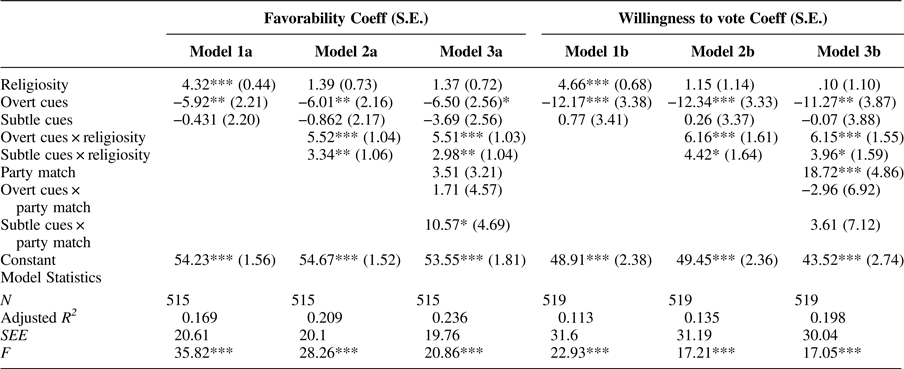
Table 1 presents the ordinary least squares regression results of candidate favorability rating and willingness to vote for the candidate, both of which were mean centered for analysis. Models 1a and 1b show the effects of respondent religiosity, and overt and subtle religious cues compared to the baseline condition. Models 2a and 2b add variables for the interactions between the two cue conditions and religiosity. Models 3a and 3b include variables for party match (mismatch is the reference group), and the interactions between party match and the cue conditions. A fourth set of models (not included in the table) adds three way interactions between party match, the cue conditions, and religiosity.Footnote 8
The interactive effects of religious cue, participant religiosity and candidate/participant political party match on favorability and willingness to vote

***p < 0.001, **p < 0.01, *p < 0.05 (two-tailed tests).
H1a predicted that subtle religious cues would lead to citizens feeling more favorably about a political candidate, while H2a predicted overt cues would dampen favorability. We did not find any evidence that subtle cues affected favorability, thus we failed to support H1a. The significant and negative sign for “overt cues,” however, shows that the use of overt cues resulted in reduced favorability, thus H2a was supported.
Model 2a shows a significant, positive interaction effect between religiosity and both cue conditions, such that increasing levels of religiosity counteract the negative effects of religious cues. We therefore found support for H3a and H4a .
In order to test whether the effect of religiosity is significantly stronger when the candidate uses overt cues compared to subtle cues, we ran a model in which we changed the reference group from the baseline cue group to the subtle cue group. In this model, the overt cue and religiosity interaction was positive and significant, β = 2.532, t(515) = 2.409, p = 0.016. This suggests that religiosity plays a greater role in evaluations of favorability when overt cues are used compared to when subtle cues are used, lending support to H5.
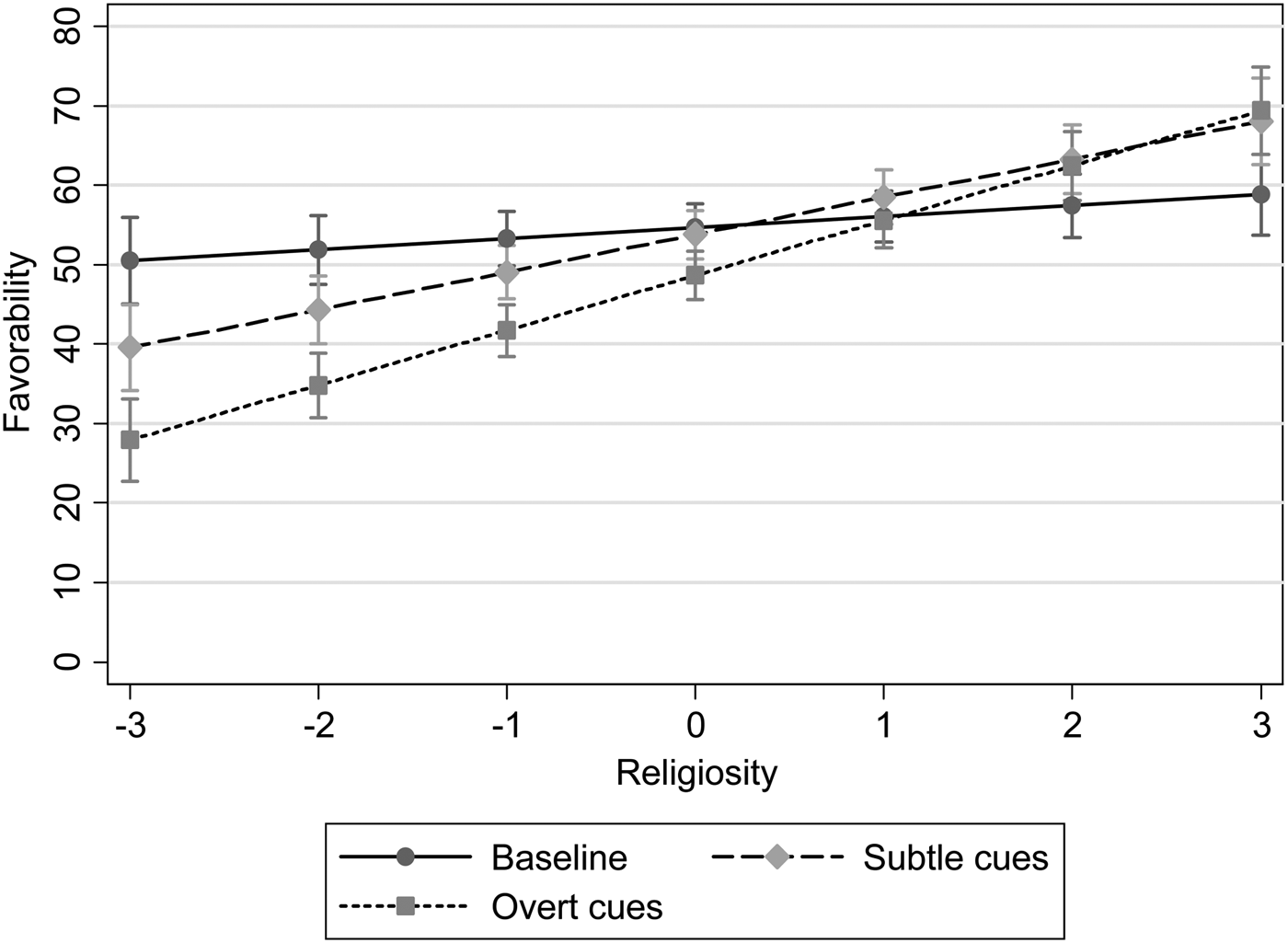
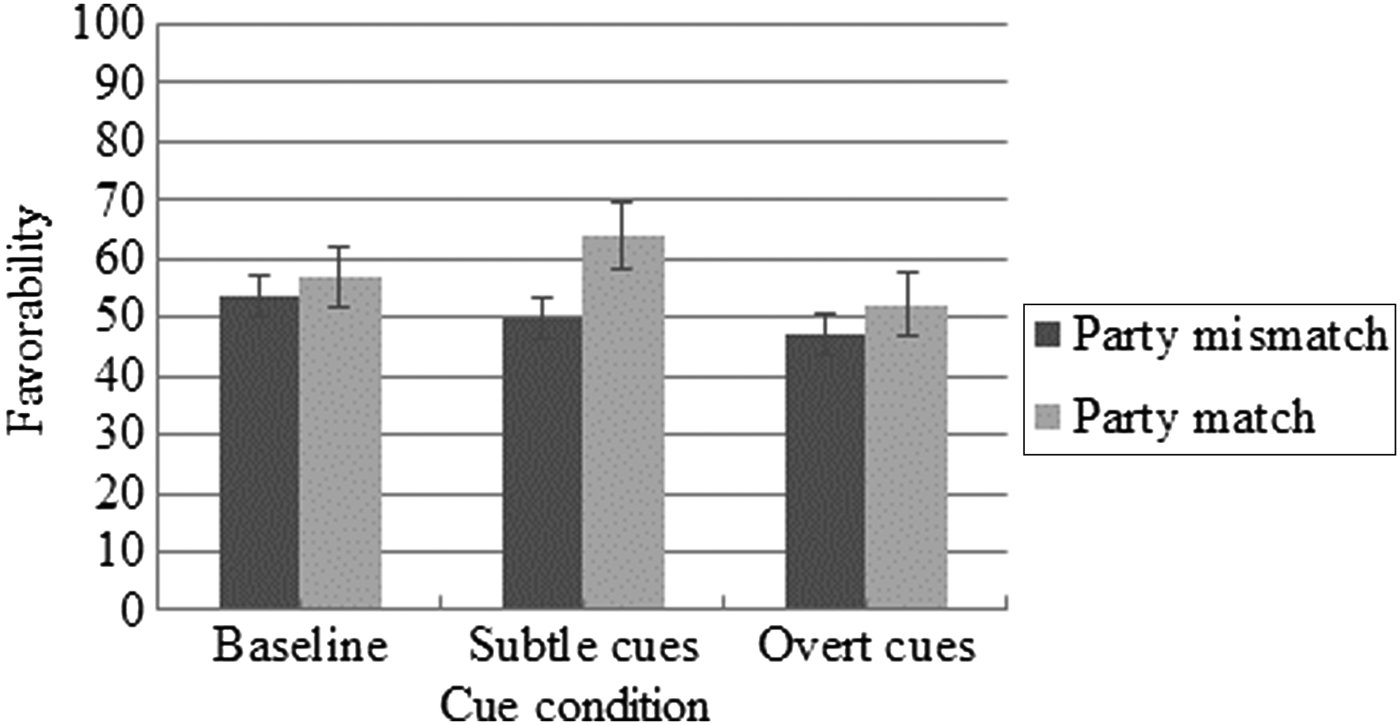
While we find in model 3a that party match significantly interacted with subtle religious cue use to bolster favorability, but we did not find evidence that it did so in the case of overt cues. Additionally, in our fourth model, we failed to find a significant three-way interaction between religious cue condition, party congruence, and citizen religiosity; Overt cues: β = −0.84, t(515) = −0.38, p = 0.71; Subtle cues: β = 0.33, t(515) = 0.15, p = 0.36. Thus, in regard to RQ1a, RQ2a, and RQ3, we find that party match only affected candidate favorability in the subtle cues condition (Figs. 1 and 2).
Predicted values with 95% CIs for the effects of candidate religious cue use and citizen religiosity on candidate favorability. Note: The “religiosity” variable is mean centered. Full favorability scale ranges from 0 to 100.

Effect of religious cue use and candidate/citizen political party congruence on favorability.

H1b predicted that subtle religious cues would increase citizens’ willingness to vote for a candidate, while H2b predicted overt cues would lead to less willingness to vote. The significant and negative sign for “overt cues” indicates that those who saw overt cues were less willing to vote for the candidate than those who saw no religious cues. We did not see any evidence that subtle religious cues affected willingness to vote. We therefore found support for H2b, but not H1b.
Model 2b shows that cue use interacts with religiosity, such that when either subtle or overt cues are used, the reported willingness to vote for the candidate increased as respondents' level of religiosity increased. We therefore found support for H3b and H4b.
We changed the reference group from the baseline cue group to the subtle cue group in order to test whether the effect of religiosity on willingness to vote for the candidate is stronger when the candidate uses overt cues compared to subtle cues. We found no evidence to support this, as the overt cue and religiosity interaction was not significant, β = 2.191, t(519) = 1.379, p = 0.169. We therefore failed to support H5.
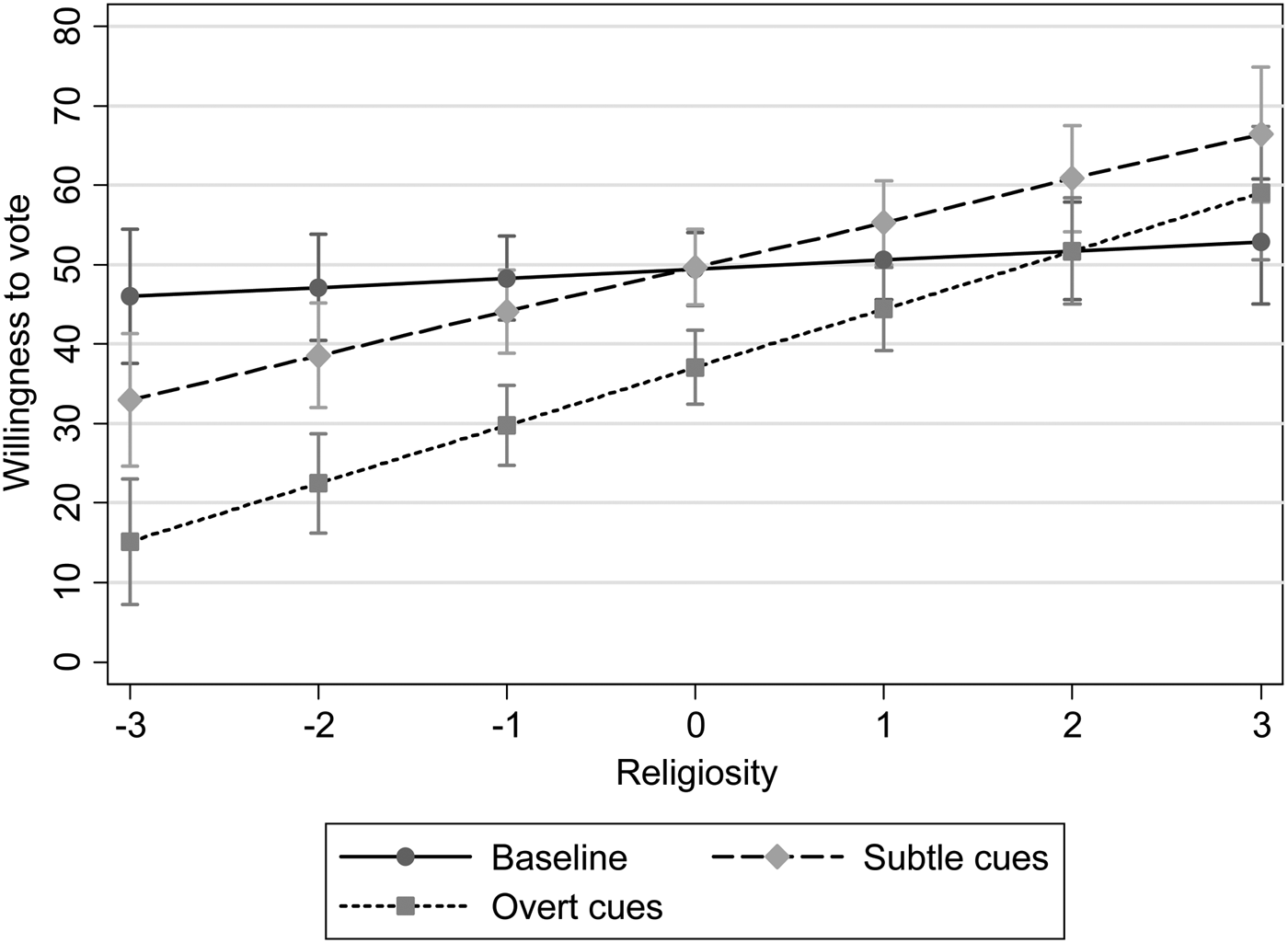
In model 3b, the interactions between party congruence and subtle and overt cues were not significant. Additionally, the three-way interactions between religious cue condition, party congruence, and citizen religiosity, which were tested in a fourth model, were not significant; Overt cues: β = −4.49, t(519) = −1.35, p = 0.179; Subtle cues: β = −0.40, t(519) = −0.12, p = 0.91. Thus, in regard to RQ1b, RQ2b, and RQ3, we found no evidence that the effects of religious cues and citizen religiosity on willingness to vote are impacted by party congruence (Fig. 3).
Predicted values with 95% CIs for the effects of candidate religious cue use and citizen religiosity on willingness to vote for the candidate. Note: The “religiosity” variable is mean centered. Full willingness-to-vote scale ranges from 0 to 100.

DISCUSSION
Even though the vast majority of Americans hold religious beliefs, religion has proven to be a contentious political topic. The debate surrounding religion is often connected to its political influence, where large portions of the American public wish it had a greater presence and others wish it had no presence. Even as large segments remain divided over religion, religion remains a prominent fixture in both Republican and Democratic political speeches. While there is little doubt that Republicans have been able to gain votes by directly appealing to evangelical and fundamentalists Christians, much less is known about how general religious cues influence political outcomes. Domke and Coe (Reference Domke and Coe2008) claim that religious cues can be a boon to both Republican and Democratic candidates, but there is also a large risk of alienating less religious voters. This study sought to contribute to the understanding of how general religious cues influence political evaluations by utilizing an experimental design. Our results provide important information about general religious cues that further our understanding of how religion influences political outcomes.
First, the main effects tests show a significant negative effect for overt cues, but no significant effect of subtle cues. This corroborates one important claim of Domke and Coe (Reference Domke and Coe2008) that when religious cues become too strong, they risk alienating a large portion of the American public. The lack of a significant positive effect of subtle religious cues, however, may not be generalizable to the American public because our sample had an atypically high number of non-religious participants. Nevertheless, the results do highlight the potential for clear displays of religious commitment, even when unconnected to specific policy positions, to hurt a politician's chances of getting elected.
More importantly, our study demonstrates how the effectiveness of religious cues interacts with citizen religiosity. We find that for candidates who use either subtle or overt cues, as religiosity goes up, so too does willingness to vote and favorability toward a candidate. Looking at Figure 1 and Figure 3, it is clear that the use of subtle cues only really starts to benefit a politician when his or her audience has high levels of religiosity. It is also worth noting that we found citizen religiosity had a greater effect on favorability when the candidate used overt rather than subtle cues. This suggests that the more explicit a candidate is with his or her religious commitments, the more polarizing they become. Overt religious cues provide a clearer indication than subtle cues that a candidate holds strong religious beliefs, thus making religiosity more important when a citizen evaluates that politician.
We did not, however, find that citizen religiosity had a significant effect on willingness to vote when comparing overt to subtle cues. This highlights a potentially important distinction between the effects of overt cues on favorability compared to willingness to vote. While on the whole overt cues appear to be less effective than subtle cues, the gap in favorability goes away among highly religious voters. The same trend does not occur for willingness to vote, however, as the highly religious are still more likely to vote for a candidate that uses subtle religious cues. It may be that while some highly religious citizens are likely to feel favorably about a candidate who openly expresses their religious faith, overt cues also raise concerns about a candidate's electoral prospects. If a highly religious citizen is worried that mainstream American society will not support an overtly religious candidate, they may be less willing to vote for a candidate they fear will lose.
We also found some evidence that the effect of general religious cues can depend on the political affiliation of the citizen and the politician. Specifically, we find that the effect of subtle religious cues on candidate favorability is dependent on whether a citizen shares the same party as the politician. Notably, overt religious cues were not contingent on party match. It may be that when a politician uses general, subtle cues, party match can play an important role in whether those cues lead to favorable citizen evaluations. Conversely, overt religious cues may override partisanship. Taken together, these results illustrate that religious cues can have important implications for political outcomes, but the type of effects they have can also depend on other factors.
Our study does have some notable limitations. In particular, as is often the case with experimental methods, our study lacked a degree of ecological validity. Specifically, the overt religious cues may have been blunter than what is typically seen on political websites, even for those who openly express their religious views. That being said, we believe the manipulation still illustrates the type of patterns we would expect to see when politicians move from subtle to overt cues.
Along these lines, there are also some clear limitations to our sample. The sample was heavily skewed toward non-believers, as the proportion of participants who identified as either agnostic or atheist is far above the national average. Additionally, there was an atypically high correlation between religious belief and religious behavior. While we do not advocate treating religiosity as a uniform construct, the high correlation between our measures of belief and behavior made it impractical to treat these as distinct measures. Thus, we were not able to fully explore how different forms of religious belief, belonging, and behavior may moderate the influence of religious cues. We cannot, therefore, claim to have captured the complexity of the interaction between citizen religiosity and religious cues. Nevertheless, this experimental examination of general religious cues and religiosity provides an important foundation that furthers our understanding of the broad patterns with which religious discourse can affect voter evaluation and behavior. Despite the limitations of our sample, we still have reason to believe the results demonstrate important trends that would also be seen in a more representative population.
FUTURE RESEARCH
Our study contributes to a growing body of literature that has considered how religious cues can affect political evaluations. While media pundits and scholars alike often narrowly paint religion as something that only Republicans use strategically, in reality the relationship between religion and politics is much more complex. This study highlights the importance of more thoroughly considering how politicians use generalist religious cues and how those cues interact with individual predispositions. Much more work is needed to fully understand how religious cues are used and to what effect.
One area that needs more careful consideration is how religious cues interact with other social identity cues. Calfano and Djupe (Reference Calfano and Djupe2011) demonstrate how covert religious cues stop being advantageous when females deliver them because citizens tend to more critically evaluate messages from females. It would be helpful to expand on Calfano and Djupe's findings by evaluating what happens when female politicians employ generalist religious cues. Campbell, Green, and Layman (2009) highlight the importance of examining the interaction with partisan affiliation. Our study corroborates the importance of considering party, but also demonstrates that there are circumstances in which religious cues may transcend party. Other work could examine demographic factors (i.e., which state a politician is running in).
Additionally, more work should consider how other message related factors may interact with religious cues. For example, recent work (Djupe and Calfano Reference Djupe and Calfano2009; Djupe and Gwiasda Reference Djupe and Gwiasda2010) has shown how “process cues” or elaboration on the decision-making process a politician uses can impact the effectiveness of a message. That is, the rationale a politician provides for making a decision (e.g., an evangelical Christian claiming to have reached a decision after praying about it) can change how citizens interpret a politician's issue position. Other potential message factors to consider may include patriotic statements, issue specific positions and/or ideological extremity. Perhaps most interestingly, future research may examine the effect of religious cues when a political message references and/or attacks a political opponent.
Finally, other citizen demographic factors should be considered. Of particular interest are social identity variables, such as gender, race, geographic location, and age. Braman and Sinno (Reference Braman and Sinno2009) demonstrate that factors such as political sophistication may also play an important role. These, along with other political attitudes and opinions, are worth examining further.
CONCLUSION
This study contributes to our understanding of the relationship between religion and politics by using an experiment to examine how general religious cues affect the political evaluations of American citizens. Given the trend away from religious affiliation and towards more general religious identity (McDermott Reference McDermott2009), it is important to perform more research isolating the effects of general religious cues. The results of our study provide several important findings about the effect of general religious cues on voter evaluations that warrant further investigation. Specifically, we find some evidence for the following claims: (1) While religious language remains a salient feature in political discourse, for many politicians the potential gains of using religious cues may be outweighed by the risk. (2) Employing overt religious cues poses a greater risk for a politician than using subtle cues. (3) The effectiveness of religious cues depends on a citizen's level of religiosity. Specifically, when candidates use either subtle or overt religious cues, as citizen religiosity goes up, so too does willingness to vote and favorability towards a candidate. (4) Highly religious citizens are likely to feel favorably about a candidate who uses overt cues, but they may be less willing to vote for such a candidate compared to one who uses more subtle religious cues. (5) When a politician uses subtle cues they are more effective when a potential voter shares that candidate's party. Conversely, overt religious cues do not appear to be dependent on a politician's party affiliation, perhaps because they override partisanship. Taken together, these results illustrate that general religious cues can have important implications for political outcomes, but the type of effects they have can depend on several factors.
APPENDIX
DEPENDENT VARIABLES
Favorability
We'd like to get your feelings towards Alan Cole by having you rate him on a 100-point feeling thermometer. Ratings between 51 degrees and 100 degrees mean you feel favorably towards Alan. Ratings between 0 degrees and 49 degrees mean you do not feel favorably towards Alan. A rating of 50 means you do not feel particularly favorable or unfavorable about Alan. How favorably do you feel about Alan?
Voting Intention
Alan Cole will be running for a seat in the House of Representatives in a Wisconsin district in 2012. Thinking about what you have just read about Alan, how likely do you think you would be to vote for him if you lived in his district? Please rate your likelihood of voting for Alan using the following 100 point scale, where 0 represents no chance you would vote for him, 50 represents an even chance, and 100 represents a certain vote.
INDEPENDENT VARIABLES
Party Identity
Which of the following best describes your party identification?
(1) Democrat, (2) Republican, (3) Green, (4) Libertarian, (5) Tea Party, (6) Independent
Religious Practice
Here's a list of activities some people do and others do not. For each activity listed below, indicate how frequently during the past 12 months you have engaged in this activity. How frequently in the past 12 months have you...
-
– Attended religious services (apart from weddings, funerals, and christenings)? (1: Never – 7: Very Frequently)
-
– Prayed to God outside of religious services? (1: Never – 7: Very Frequently)
-
– Read the Bible outside of religious services? (1: Never – 7: Very Frequently)
Religious Beliefs
Here's a list of some different beliefs and attitudes some people have and others do not. Please tell us to what extent you agree with the following statements.
-
– I believe there is a Heaven. (1: Strongly Agree – 7: Strongly Disagree)
-
– I believe there is a God. (1: Strongly Agree – 7: Strongly Disagree)
-
– I believe Jesus walked on water. (1: Strongly Agree – 7: Strongly Disagree)
-
– I believe that Jesus was born of a virgin. (1: Strongly Agree – 7: Strongly Disagree)
OTHER POST TEST VARIABLES
Religious Affiliation
What is your religious affiliation?
(1) Mainline Protestant, (2) Evangelical Protestant, (3) Black Protestant (4) Roman Catholic, (5) Jewish, (6) Agnostic, (7) Atheist, (8) Other
Manipulation checks
What political party is Alan Cole affiliated with?
(1) Democrat, (2) Republican, (3) Green Party, (4) Tea Part, (5) Independent, (6) Unclear
Thinking about Alan's profile, did he… (Check the best answer)
(1) Make specific references to God and the “Almighty.”
(2) Did not explicitly mention God, but used religious terms such as “faith” and “blessed.”
(3) Did not mention God, but focused on “human rationality” and “intelligence.”
DUMMY VARIABLES
Party Match
The measure equals 1 if the participant is Democrat and they were exposed to a manipulation condition in which the politician was Democrat or if the participant is Republican and they were exposed to a manipulation condition in which the politician was Republican, it was scored as 0 otherwise.
Evangelical
The measure equals 1 if the participant indicated they identified as evangelical Protestant, it was scored as 0 otherwise.
Experimental Condition: Baseline Cues × Democrat

Experimental Condition: Baseline Cues × Republican

Experimental Condition: Subtle Cues × Democrat

Experimental Condition: Subtle Cues × Republican

Experimental Condition: Overt Cues × Democrat

Experimental Condition: Overt Cues × Republican