Introduction
Mental disorders pose tremendous burden on national economies largely because many of those with mental illness are not treated despite the availability of effective treatments. Treatment gap represents ‘the difference between the true prevalence of a disorder and the treated proportion of individuals affected by the disorder’. Alternatively, treatment gap may be defined as the percentage of individuals who require care but do not receive treatment (Kohn et al. Reference Kohn, Saxena, Levav and Saraceno2004). Mental disorders when untreated could in time become more severe and treatment refractory (Post & Weiss, Reference Post and Weiss1998); single disorders often progress to complex comorbid disorders that are more difficult to treat (Kessler & Price, Reference Kessler and Price1993); and studies have found this to be associated with adverse outcomes like school failure, teenage child-bearing, unstable employment, marital violence, and instability (Kessler et al. Reference Kessler, Foster, Saunders and Stang1995, Reference Kessler, Berglund, Foster, Saunders, Stang and Walters1997a, Reference Kessler, Walters and Forthofer1998a; Forthofer et al. Reference Forthofer, Kessler, Story and Gotlib1996).
The phenomena of wide treatment gaps is worldwide: in a World Health Organization compilation of 37 community-based psychiatric epidemiological studies around the world, the treatment gap for schizophrenia was 32%, depression 56%, dysthymia 56%, bipolar disorder 50%, generalized anxiety disorder (GAD) 58%, obsessive compulsive disorder (OCD) 60%, and alcohol abuse and dependence 78% (Kohn et al. Reference Kohn, Saxena, Levav and Saraceno2004; WHO, 2005). There is a fairly wide variation in treatment gaps among different countries. Generally, the treatment gap is wider in developing than in developed countries with the proportion of those receiving help corresponding with the countries' overall spending on health care in particular mental health care (Saxena et al. Reference Saxena, Sharan and Saraceno2003). However, even in the world's biggest economy, this under treatment is still considerable: 31% of the US population is affected by mental illness every year and 67% of them are not treated (Kessler et al. Reference Kessler, Demler, Frank, Olfonso, Pincus, Walters, Wang, Wells and Zaslavsky2005). In Europe where mental illness affects 27% of people yearly and 74% of them receive no treatment (Alonso et al. Reference Alonso, Codony, Kovess, Angermeyer, Katz, Haro, De Girolamo, de Graaf, Demyttenaere, Vilagut, Almansa, Lepine and Brugha2007). This gap seems even more glaring when in comparison only 8% of people in Europe with diabetes mellitus received no care (Alonso et al. Reference Alonso, Codony, Kovess, Angermeyer, Katz, Haro, De Girolamo, de Graaf, Demyttenaere, Vilagut, Almansa, Lepine and Brugha2007; Thornicroft, Reference Thornicroft2007).
Singapore's first National Mental Health Blueprint was implemented in 2007 with the aims of improving the services and mental health of its population – and as suggested by Kessler et al. (Reference Kessler, Frank, Edlund, Katz, Lin and Leaf1997b), in any country's effort to redesign their mental health care systems and allocate resources, two tasks are important (Kessler et al. Reference Kessler, Frank, Edlund, Katz, Lin and Leaf1997b; Bijl et al. Reference Bijl, de Graaf, Hiripi, Kessler, Kohn, Offord, Ustun, Vicente, Vollebergn, Walters and Wittchen2003). The first is the documentation of the pattern of service utilization, and the extent and nature of unmet needs for treatment, and the second, is a cross-national comparison of these factors as such comparisons ‘can help to uncover optimum financing, national policies, and delivery systems for mental health care’.
This paper reports on the treatment gap of adults with mental disorders in the Singapore resident population, and also presents the projected cumulative lifetime probability of treatment contact and associated factors for each of these disorders.
Methods
Singapore is a city-state country off the southern tip of the Malay Peninsula. In 2009, the population of Singapore was just under 5 million of which 3.7 million were Singapore residents. Of its residents, 74.2% are of Chinese descent, 13.4% are Malays, and 9.2% are of Indian descent (Singapore Department of Statistics, 2009). The Singapore Mental Health Study was a cross-sectional, population-based, epidemiological study (Subramaniam et al. in press). The face-to-face interviews were conducted over a 1-year period from December 2009 to December 2010 and the subsequent response rate was 75.9%. The sample of 6616 Singapore citizens and permanent residents who participated in the study represented adult resident population aged 18 years and older. All the respondents were administered the World Mental Health Composite International Diagnostic Interview (WMH-CIDI) (Kessler & Ustun, Reference Kessler and Ustun2004) which generates diagnoses – according to the definitions and criteria of both the 10th Edition of the International Classification of Diseases (ICD-10) and the Diagnostic and Statistical Manual, Fourth Edition, of the American Psychiatric Association (DSM-IV) (American Psychiatric Association, 2000). Diagnostic modules for lifetime and 12-month prevalence of affective disorders, including major depressive disorder (MDD), dysthmia and bipolar disorder; anxiety disorders, including GAD and OCD; alcohol abuse disorders i.e. alcohol abuse and alcohol dependence were included in the survey. All participants meeting criteria for at least one definite DSM-IV disorder (of the seven we assessed with the CIDI) were combined into the category of ‘common mental disorders’.
In each WMH-CIDI diagnostic module, respondents were asked a series of questions regarding treatment. To establish if they had ever sought treatment, they were asked whether they had ever in their life ‘talked to a medical doctor or other professional’ about the disorder. The term ‘other professional’ is defined by WMH-CIDI as a wide range of professionals including psychologists, counselors, spiritual advisors, herbalists, acupuncturists, and any other healing professionals. The ‘treatment gap’ was defined as ‘the absolute difference between the true prevalence of a disorder and the treated proportion of individuals affected by the disorder’ (Kohn et al. Reference Kohn, Saxena, Levav and Saraceno2004). Respondents who reported that they ever talked to any professional about the disorder were then asked how old they were the first time they did so. Responses to this question were used to calculate age of first treatment contact in this study.
Age of onset, cohort, gender, and ethnicity were used to predict lifetime treatment contact for each disorder. Age of onset was categorized into three groups as early (25th percentiles), early-average (50th percentiles), and late-average (75th percentiles). Cohort as defined by age at interview was categorized as 18–34, 35–49, 50–64, and 65+ years. These procedures had been used widely in the World Health Organization's World Mental Health Survey Initiative studies (Kessler et al. Reference Kessler, Olfson and Berglund1998b; Wang et al. Reference Wang, Berglund, Olfson, Pincus, Wells and Kessler2005, Reference Wang, Angermeyer, Borges, Bruffaerts, Chiu, Girolamo, Fayyad, Fureje, Haro, Huang, Kessler, Kovess, Levinson, Nakane, Brown, Ormel, Villa, Gixiola, Alonso, Lee, Heeringa, Pennelle, Chatterji and Ustun2007; Borges et al. Reference Borges, Wang, Medina-Mora, Lura and Chiu2007).
Data analyses
Statistical analyses were carried out using the Statistical Analysis Software (SAS) System version 9.2 (SAS Institute Inc, 2011). To ensure that the survey findings were representative of the Singapore population, the data were weighted to adjust for over-sampling and post-stratified by age and ethnicity distributions between the survey sample and the Singapore resident population in 2007. Descriptive analyses were performed to establish the proportion of treatment gap, treatment contact in first year of onset, as well as describe the sociodemographic profile of the study population. Projections of cumulative lifetime probability of treatment contact of each disorder from year of onset were estimated using the life-table method (Elandt & Johnson, Reference Elandt-Johnson and Johnson1980; Lee, Reference Lee1992). The delay in treatment contact was defined as the median number of years from onset of the disorder to first treatment contact among those who eventually made treatment contact. Predictors of lifetime treatment contact for individual mental disorders were examined using discrete-time survival analyses. Odds ratios were obtained by exponentiating survival coefficients. Standard errors (s.e.) were estimated using the Taylor series linearization method. Multivariate significance tests in the discrete-time survival analyses were evaluated using χ2 tests based on design corrected coefficient variance–covariance matrices. Statistical significance was evaluated at the <0.05 level using two-sided tests.
Results
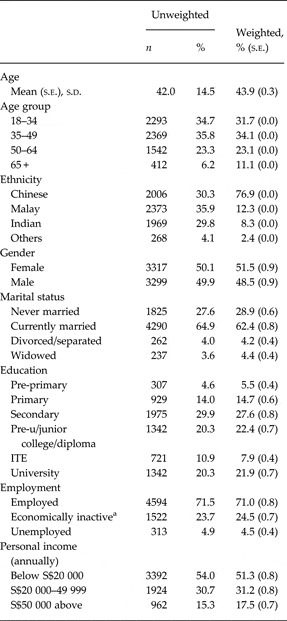
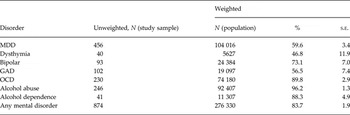
The sociodemographic characteristics of the 6616 respondents are shown in Table 1. The weighted percentage of those who met criteria for DSM-IV lifetime mental disorders but had not sought any treatment at the point of the survey (treatment gap) is shown in Table 2. Alcohol abuse had the highest proportion with treatment gap (96.2%); this was followed by OCD (89.8%) and alcohol dependence (88.3%). For other specific disorders the treatment gap was: MDD, 59.6%; dysthymia, 46.8%; bipolar, 73.1%; and GAD, 56.5%.
Sociodemographic characteristics of the study sample of the Singapore Mental Health Survey

aIncludes homemaker, retiree, and students.
Weighted percentage of lifetime treatment gap for mental disorders in the SMHS

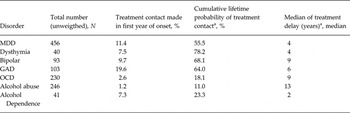
The proportion of those with a mental disorder who sought some help in the year of onset of the disorder is shown in Table 3, which also presents the projection of cumulative lifetime probability of treatment contact and median delay among cases that subsequently made treatment contact. Based on this projection, more than half of those with MDD (55.5%), bipolar disorder (78.2%), and GAD (64.0%) would eventually make treatment contact in their lifetime. The lowest proportion of treatment contact was observed among those with OCD (18.1%). The proportion of cases that made treatment contact in the year of onset of disorder ranged from a low of 1.2% (alcohol abuse) to a high of 19.6% (GAD). The longest median delay of treatment contact was among those with alcohol abuse (13 years), followed by OCD and bipolar disorder (9 years), GAD (6 years), MDD and dysthymia (4 years), and alcohol dependence (2 years).
Proportion of treatment contact in the year of disorder onset, projection of treatment contact, and median delay among cases that subsequently made treatment contact

aProjected using actuarial method implemented in SAS.
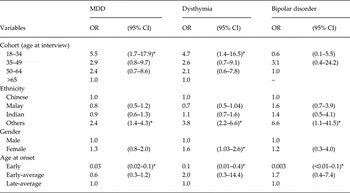
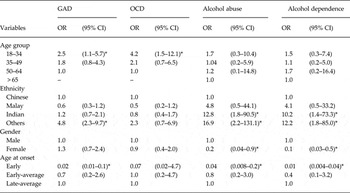
Tables 4 and 5 show the results of sociodemographic predictors of ever making treatment contact for each lifetime disorder using the multivariate discrete-time survival analyses. Compared with the older cohort, the younger one had higher odds of making treatment contact for MDD, dysthymia, GAD, and OCD. There were significant ethnic differences in the probability of making treatment contact. We observed significantly higher odds of treatment contact among ‘Others’ ethnic group as compared to Chinese for all lifetime disorders except OCD. However, the ‘Others’ group was extremely heterogeneous in their ethnic composition which precludes any further meaningful analyses. Indians had higher odds of treatment contacts for alcohol abuse and dependence as compared to Chinese.
Sociodemographic predictors of lifetime treatment contact for mood disorders

−: Inadequate sample size to estimate coefficient.
*p value ≤ 0.05.
Sociodemographic predictors of lifetime treatment contact forspecific anxiety and alcohol related disorders

– : Inadequate sample size to estimate coefficient.
*p value < 0.05.
Women had higher odds of treatment contact than men among those with dysthymia but it was significantly lower among those with alcohol abuse and dependence. Age of onset was significantly associated with treatment contact. Those who had an earlier age of onset were less likely to have treatment contact than those with late age of onset for all lifetime disorders except OCD.
Discussion
The most striking finding of our study is the considerable treatment gap. The treatment gaps as established by our study are higher for all disorders except GAD than those compiled by WHO (Kohn et al. Reference Kohn, Saxena, Levav and Saraceno2004; WHO, 2005). It is important to acknowledge that although our outcomes were treatment gap and delay in initial treatment contact; these represent a number of steps in the help-seeking process such as becoming aware of the disorder, perceiving the need for treatment, and finally accessing care. Barriers at any of these points would affect these outcomes. Even among those who eventually sought help, a second major factor of unmet need is the pervasive and long delay before treatment contact was made. Our finding here is consistent with the few studies that have examined initial treatment seeking and found that many people with mental disorders sought help only after delaying for years after the onset of the disorders (Kessler et al. Reference Kessler, Olfson and Berglund1998b; Olfson et al. Reference Olfson, Kessler, Berglund and Lin1998; Christiana et al. Reference Christiana, Gilman, Guardino, Kessler, Mickelson, Morselli and Olfson2000; Wang et al. Reference Wang, Berglund, Olfson and Kessler2004).
How a person perceives the nature and cause of symptoms – an important determinant of help seeking – may be influenced by culture. As suggested by some (Ying et al. Reference Ying, Lee, Tsai, Yeh and Huang2000; Parker et al. Reference Parker, Gladstone and Chee2001a), Asians tend to focus on physical (somatic) features of a disease than on emotional or psychological ones, which might contribute to their relative lack of seeking help from mental health providers. Researchers have attributed the tendency of somatization among Chinese as a culturally sanctioned ‘idiom of distress’, which allow the expression of negative emotions and solicit attention, care, and sympathy without jeopardizing social ties (Kleinman, Reference Kleinman1982) – thereby warding off the stigmatization associated with mental illness, and the ‘loss of face’' for the family (Kleinman, Reference Kleinman1986; Parker et al. Reference Parker, Cheah and Roy2001b; Keyes & Ryff, Reference Keyes and Ryff2003). A local study, which assessed public attitude toward mental illness, found that 48.7% of the respondents reported they ‘would not want anyone to know if they are suffering from a mental illness’ (Chong et al. Reference Chong, Verma, Vaingankar, Chan, Wong and Heng2007) and this could also mean that they are less likely to seek help.
We also found substantial differences in the treatment gap among the different disorders. Dysthymia, MDD, and GAD in our population had relatively smaller treatment gaps; of all the mental disorders, depression has arguably the least stigma and is often the selected target of frequent public educational campaigns and initiatives, which could have enabled help seeking. The widest treatment gap was for alcohol abuse. People with alcohol-related problem in most cases are unlikely to perceive a need for treatment – this could be engendered by society's tolerance toward excessive use of alcohol (Bijl & Ravelli, Reference Bijl and Ravelli2000) – and perceiving it a social ill rather than a mental illness that needs treatment. The person either actively resists treatment or seeks treatment only when the condition has become very severe. Other studies have similarly found low rates of treatment among those with alcohol disorders (Hasin et al. Reference Hasin, Stinson, Ogburn and Grant2007), reasons for this include stigmatization (Crisp et al. Reference Crisp, Gelder, Rix, Meltzer and Rowlands2000), declining medical attention for alcohol problems (Hasin et al. Reference Hasin, Grant, Dufour and Endicott1990; Friedman et al. Reference Friedman, McCullough, Chin and Saitz2000), uncertainty that screening is warranted, and low expectations of positive treatment outcomes (Kaner et al. Reference Kaner, Heather, McAvoy, Lock and Gilvarry1999; Saitz et al. Reference Saitz, Svikis, D'Onofrio, Kraemer and Perl2006).
Some sociodemographic factors are apparently important in influencing help seeking for some of these disorders. Our study found that significantly more females have treatment contact for dysthymia. This was also reported in a study conducted by the World Mental Health Initiative where female gender was found to be significantly associated with treatment contact for mood disorders (Wang et al. Reference Wang, Angermeyer, Borges, Bruffaerts, Chiu, Girolamo, Fayyad, Fureje, Haro, Huang, Kessler, Kovess, Levinson, Nakane, Brown, Ormel, Villa, Gixiola, Alonso, Lee, Heeringa, Pennelle, Chatterji and Ustun2007). It has been suggested that women hold a less negative view of mental illness and are more capable of expressing non-specific feelings of distress as a mental health issue (Kessler et al. Reference Kessler, Brown and Broman1981). However, in the case of alcohol use disorders, females had significantly lower treatment contacts as compared to males which could be due to social reasons. Although there is stigma attached to alcohol use disorders for both men and women, societal and cultural norms and expectations may make it even more difficult for a woman to admit to the problem (Lex, Reference Lex1991; Finkelstein, Reference Finkelstein1994). Fears of losing a partner or the custody of children are other important social barriers that may prevent women from seeking help (Lex, Reference Lex1991) for alcohol-related problems.
Consistent with other research (Wang et al. Reference Wang, Berglund, Olfson and Kessler2004, Reference Wang, Angermeyer, Borges, Bruffaerts, Chiu, Girolamo, Fayyad, Fureje, Haro, Huang, Kessler, Kovess, Levinson, Nakane, Brown, Ormel, Villa, Gixiola, Alonso, Lee, Heeringa, Pennelle, Chatterji and Ustun2007) age of onset was significantly associated with treatment contact. Those with an earlier age of onset were less likely to have treatment contact than those with late age of onset for almost all lifetime disorders. One explanation may be that minors need the help of parents or other adults to seek treatment, and help seeking is largely driven by parental attitudes and perceptions (Verhulst & Koot, Reference Verhulst and Koot1992; Angold et al. Reference Angold, Messer, Stangl, Farmer, Costello and Burns1998). The strongest predictor of treatment initiation for a child is the presence of parental perceived burden rather than the severity of the child's behavior as rated by clinicians or observers (Angold et al. Reference Angold, Messer, Stangl, Farmer, Costello and Burns1998). In addition, early onset mental disorders may be associated with normalization of symptoms that results in a very low need for treatment later in life.
Our study also found that persons from more recent cohorts had higher odds of making treatment contact that was significantly higher for all disorders except for bipolar and alcohol use disorders. Other studies have similarly found that the age of cohort is significantly related to lifetime treatment contact (Wang et al. Reference Wang, Berglund, Olfson, Pincus, Wells and Kessler2005; Bruffaerts et al. Reference Bruffaerts, Bonnewyn and Demyttenaere2007). This suggests that help seeking behavior for most mental disorders has improved over time. It may be that younger people are more knowledgeable about mental illnesses, the need for treatment and the ways of accessing help as compared to the older people. This could also have resulted from the various programs – implemented in the last few years in Singapore – that have both increased public awareness of mental illnesses and collaboration with community sectors on early recognition and treatment (Chong & Bird, Reference Chong, Bird, Saxena and Garrison2004).
However, our findings should be viewed in the context of some limitations: (i) respondents have to recall lifetime events and therefore there is the possibility of recall bias with those who did not seek treatment being more likely either to forget or to normalize symptoms leading to an underestimation of lifetime prevalence and subsequent treatment contact (Wang et al. Reference Wang, Berglund, Olfson, Pincus, Wells and Kessler2005); (ii) some respondents may not feel comfortable answering sensitive questions which may have led to under-reporting; (iii) it was not possible to ascertain whether the treatment gap was due to ignorance of their condition or lack of knowledge of available services/treatment; (iv) we could not verify whether the treatment was actually sought as well as the appropriateness and adequacy of these treatments; and lastly (v) people outside the sampling frame (residents of nursing homes, prisoners, and patients in hospitals) were excluded from the survey.
A raft of initiatives and interventions would be needed to alleviate the burdens and the adverse consequences of untreated mental disorders. In view of the considerable delay and failure in treatment seeking after the first onset of mental disorders, an obvious strategy is to establish a system for early detection and treatment and this should include training teachers and parents to recognize early manifestation of mental illnesses. Further research, especially qualitative research must be undertaken to tease out the barriers resulting in treatment gap. Broad-based and regular public education and other initiatives to destigmatize mental disorders (perhaps even legislation to prevent discrimination) would be needed that also takes cultural influences into consideration.
Acknowledgment
The study was supported by funding from the Singapore Millennium Foundation and the Ministry of Health, Singapore.
Declaration of Interest
None.
Conflict of Interest
None.