Since the market reforms of the late 1970s, China's economy and social structure have been transformed. While understandably much attention has been given to industrialization and urbanization,Footnote 1 the rural transition has also been profound. Rural enterprises have become integrated into global economic networks, which have, in turn, transformed domestic socio-economic landscapes and natural environments.Footnote 2 An increasingly urbanized and affluent Chinese middle class is raising concerns about food quality and supply, including issues with milk powder contaminated with melamine, and recycled oil and toxic chemical usage in the food production system.Footnote 3 Although current studies into food supply and quality provide different explanations for the causality of food problems,Footnote 4 there has so far been limited inquiry into the role of the local state. This is a serious omission, first, because the local state performs a key role in providing support for farmers (for example, agricultural extension services), and second, because the county-level administrative division is central to developing novel instruments to manage supply chain relationships (for example, food production standards). It is important to know more about the key players involved in standard making and delivery at the county level. We also need to understand how and why the local state engages in standard-setting activities. This study uses a case study of the county of Lin'an 临安县 and its bamboo shoot production industry to investigate how the local state implements “hazard-free,” “green” and “forest food” production standards. The growing importance of standards in public policy is an under-researched area, especially in reference to China.Footnote 5
A detailed analysis of standards in rural China is important for three reasons. First, it provides a lens through which to examine the dynamics of the relationship between the local state and market and how those dynamics are changing over time.Footnote 6 From the perspective of the local state in Lin'an, the imperative is to increase its territorial reach so as to expand the domestic and international markets for Lin'an's bamboo shoots. Growth in the reach of the local state is, however, constantly threatened by internal and external pressures. A key internal tension arises from the increased intensification of bamboo farming, which has the potential to further exacerbate soil degradation, while an increasingly important external tension is consumer demand for higher quality food, which may be expressed in multiple ways such as calls for better food safety or a desire for artisanal production. Second, the paper highlights the role of the county-level administrative division in economic development and policy delivery. For Lin'an, food standards are a form of technical knowledge to serve the local government as it seeks to extend its spatial control over bamboo shoot production. Standards act as a spatial fix (for example, to control fertilizer usage) to safeguard the quality of the material through the supply chain, from the rural bamboo grower to the urban consumer's plate. The implementation of standards also shows a policy commitment to protect the rural environment and promote food quality.Footnote 7 Third, we show the extent to which standards matter in maintaining a competitive advantage for bamboo shoot growers in Lin'an, and thus why state and producer interests are so entangled. Standards are both a means and an end to secure a competitive edge. Bamboo shoot standards become a territorial strategy for the state to manage nature since they can be used to establish growing practices and to publicly demonstrate how a resource can be utilized. Through such an analysis, we can show how international environmental neo-liberalismFootnote 8 interacts with Chinese governmentality.Footnote 9 One consequence is that bamboo standards could be conceived of as a means of putting a “green cloak” over bamboo farmers and the local government.
We use the term “green cloak” rather than the more market-oriented “green wash” because we wish to refer to a specific governance logic of state territorial control over the production of nature. By engaging with non-state actors, including experts, academics and producers, to apparently apply “greening” efforts, the local state is able to develop a new set of production standards to legitimize an apparently “green” productivist model. In this productivist model, Lin'an state uses bamboo shoot cultivation to meet the environmentally oriented directives of the National Forest Protection Programme.Footnote 10 Since the 1980s, the bamboo shoot cultivation area in Lin'an has increased rapidly: bamboo forest coverage grew by 92 per cent between 1985 and 2009 (from 2,900 to 55,777 hectares). As a result of its efforts to increase bamboo growth – and thereby “greening” the landscape – Lin'an county is recognized throughout the country as China's “national bamboo homeland” (Zhongguo zhuzi zhi xiang 中国竹子之乡).Footnote 11 When we lift the “green cloak” through detailed local analysis, however, the interest in standardization by farmers and the local state becomes more instrumental. There remains a deep-seated tension between exploitative ways of using resources and environmental limits, and these tensions are not fully recognized at the local level. This results in short-term economic gains mattering more than conservation for the local state and producers and, in turn, the exploitation of natural resources to the detriment of the environment.
This paper is divided into five further sections. In the next section, we analyse the relationships between the local state and food production standards. Then, in the third section, we briefly explain our approach to data collection and the reasoning behind our selection of bamboo as a material and Lin'an as a county for research. The two sections after that report on our empirical material to show how Lin'an county applies “hazard-free,” “green food” and “forest food” production standards. Finally, we reflect on the interactions between different levels of government and the formation and implementation of food production standards. We conclude that food production standards provide a valuable way to understand the dynamics of the local government and an important insight into multi-scalar activities.
Food Production Standards and the Local State
Commentators have pointed out that standards are an often little noticed but nevertheless remarkable feature of contemporary life.Footnote 12 Creating a standard provides an important window through which to examine the authority of states or private actors to influence the quality and credibility of production and/or services.Footnote 13 Standards help to regulate individual and collective behaviour.Footnote 14 Moreover, as a voluntary policy instrument, standards require a legitimacy to be effective. By analysing food standards, we are able to gain an insight into the evolving relationship between state and society, and state and businesses in rural China. For example, some observers have illustrated how the nexus of power-culture embedded in Western food standards has become a new form of domination to demand notions of “goodness” and safety in imported food.Footnote 15 Within the context of Chinese public policy, there is a growing interest in food standards, principally arising from a series of high profile food scares.Footnote 16 The work of Kathleen Buckingham and her colleagues on bamboo standards has been particularly instructive, as they have documented the ways in which national and international standards matter for biodiversity.Footnote 17 Commentators on forest certification also point to how the Chinese state tactically engages with non-state actors (academics, forestry experts and producers) and third-party certification bodies (the Forest Stewardship Council) to co-produce the knowledge needed to develop standards.Footnote 18 This co-produced knowledge enables China's food products to align themselves with global requirements while maintaining China's “state-centric” governance system.Footnote 19
Although current debates on food production standards and forest certification provide insights into how the Chinese state collaborates with non-state actors in order to meet international requirements and maintain state-centric governance, most attention has been on activity on a national level. Researchers have paid less attention to the ways in which standards may matter at a local level and the role that the local state plays in mobilizing farmers to meet standards.Footnote 20 It is important here to problematize the role of the local state:Footnote 21 why might a local state develop its own standards? How does the promotion of standards help us to understand the changing role of the local state?
To begin to answer these questions, we seek to bring together the social, economic and political structures that enable bamboo shoot-related stakeholders to interact in order to implement standardization policies and programmes. Christopher Coggins further suggests that scholars pay attention to the interactions between the political economy of the bamboo forest and environmental degradation, as these will affect the lives of rural people and biodiversity.Footnote 22 Networks among state officials, processors, forestry experts, technicians, research institutions and private agricultural companies, as well as with bamboo shoot farmers who perform collaborative roles, define farming norms and negotiate standards for bamboo shoot production. In the empirical material that follows, we detail how these arrangements work in practice for bamboo shoot growers in Lin'an. County government plays a crucial role in increasing farmers’ incentives and productivity through regulation and supporting policies.Footnote 23 To deliver governmental policies on food standards, agricultural extension systems (for example, agro-forestry experts) and farmers’ cooperatives are important information providers that can diffuse knowledge and ideas of food and environmental quality.Footnote 24 Even if such knowledge is not deemed appropriate by bamboo growers for their day-to-day activities, the tendency to comply with rules, regulations and standards prevails, or as Carolyn Cartier has described it, there is the “expectation of [a] uniform acceptance of authority.”Footnote 25
The persistence of state authoritarianism, party-state governance and pro-growth pragmatism are central to interpreting current food systems in China.Footnote 26 For our perspective, it is important to understand how the local state makes plans, coordinates with different state and non-state actors, and utilizes the rights for fiscal autonomy to make profits from food production enterprises.Footnote 27 There are two major ways to conceptualize the role of the local state in economic development. One perspective is promoted by Marc Blecher and Vivienne Shue who employ the concept of a developmental state to analyse how a local state (i.e. county-level government) plays direct and indirect roles to “plan, finance, and implement developmental projects.”Footnote 28 The developmental state thesis argues that a strong central state creates favourable conditions for processes of economic restructuring in newly industrializing countries (NICs) such as Japan, South Korea, and Singapore. The role of the local state is to support the activities of companies as best as it can, including identifying those companies or sectors which are most likely to be successful. The developmental state model is helpful in explaining why the Lin'an county government would be so supportive of the bamboo shoot industry: it is economically and culturally significant.Footnote 29 The model may also provide a tentative answer as to why a local state should be involved in delivering on national standards as well as promoting its own standards. This is because the Lin'an bamboo industry is already highly competitive, and standards could help to protect its domestic markets from lower quality competitors and assist it to gain access to international markets. A potential weakness in the argument is that there is little evidence to show that local producers and processors – the entrepreneurs who are to be supported – made any requests for standards to support or enhance their competitive position.
A second perspective is that of the “entrepreneurial state,” proposed by Jean Oi and Andrew Walder.Footnote 30 Both Oi and Walder see the local state as acting like an entrepreneur. For instance, local government leaders perform the role of a board of directors in a company to make profits from township village enterprises (TVEs), and sell land to maximize extra revenue for local government expenses and retain tax earnings.Footnote 31 For Oi, “local government coordinates economic enterprises in its territories as if it were a diversified business corporation.”Footnote 32 In contrast to the developmental state model, which locates entrepreneurialism in the local business community, here it is to be equally found in local government because officials will wish to expand revenue-generating activities, and especially the “extraction of profits from enterprises.”Footnote 33 To promote successful enterprises, local governments can exercise control over factory management, offer privileged access to resources (for example, raw materials), provide investment and credit, and make available bureaucratic services (for example, prizes).Footnote 34 The latter would also include certification and provide an important insight into why the “entrepreneurial state” would be interested in promoting standardization: by entangling state and nominally private interests, bureaucrats would be using a state-supported instrument to endorse and give their firms a competitive advantage. In this model, the local state will innovate to provide support mechanisms to enable firms to flourish. Oi's work also distinguishes between entrepreneurially economically successful rural areas, such as Lin'an, and those that fall behind. Rather problematic, though, is how the model of the entrepreneurial state can bring together a sectoral perspective – in this case, bamboo – with a scalar perspective to suggest a geography of the local state that can offer an understanding of how nationally and locally formulated standards compete with or complement one another in specific places, such as Lin'an. What do national standards mean to producers, processors and bureaucrats at the local level? And how might locally developed standards be scaled up from the county level to the provincial level?
Part of the reason why both the developmental state and entrepreneurial state models fail to sufficiently incorporate the potential significance of a novel policy instrument, such as a standard, is that they overemphasize state-driven transformation processes, which results in an unduly static understanding of state–market relations.Footnote 35 Instead, Cartier explores how state power is shaped and reshaped in a dynamic way, where the local state employs territorial strategies (for example, direct investment and rearrangement of its administrative organization) to extend its governing capacity and authoritarian power.Footnote 36 By adopting a more dynamic understanding of how a local state extends its control and rule on bamboo shoot standards through localized production networks, we can analyse how a county-level state expands its direct and indirect rules through standardization processes. Here, we can explore interactions with other rural areas. For instance, standards can be caught up in competition between rural areas, as local states seek to promote their bamboo shoot industries. Rural areas may also be engaged in exploitative relations with one another. For example, bamboo growers in the neighbouring county of Anji 安吉 import bamboo supplies from elsewhere. These are then processed to maximize the value added from the cachet of the Anji name.Footnote 37 We can also examine interactions with urban areas, because bamboo shoots are a material for urban consumers. Standards provide one way of bringing together through a supply chain (from producer to consumer) knowledge and expectations of a product. Moreover, by exploring how standards operate in practice we can see how the national state intrudes into a rural area, and also how a local state can seek to project itself beyond its rural area. For example, the county-level standard developed in Lin'an has a symbolism that spreads well beyond the community. At a time when the changing of administrative boundaries is commonplace, to extend or defend a rural economic space can be of paramount importance to local Party actors.Footnote 38
Research Focus and Methods
Bamboo has enormous cultural significance in China. It is one of the four most admired plants in the country.Footnote 39 Economically, bamboo is one of the fastest expanding forest-land crops in China – there are approximately 7 million hectares of bamboo forest – and the industry is estimated to be worth about US$5.4bn a year.Footnote 40 In many respects, bamboo has the features of a classic sustainable material: it is natural, grows rapidly and can do so with limited or no inputs, can substitute for more environmentally damaging materials (such as plastics, fibres or wood), and produces limited waste.
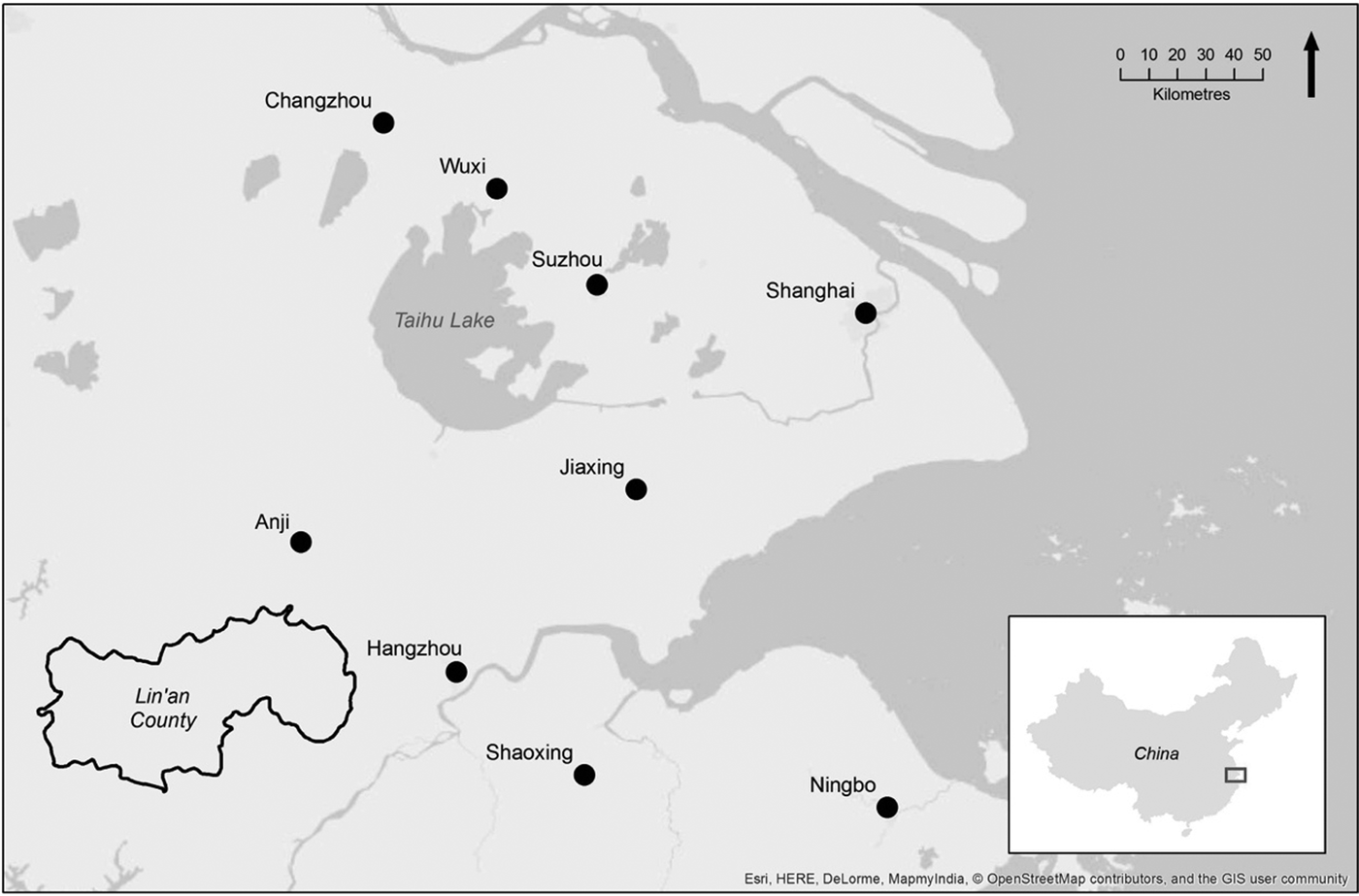
The traditional markets for bamboo products are handicrafts, chopsticks and bamboo shoots (food). Emergent markets, with the greatest added value, include furniture and flooring.Footnote 41 There is not only domestic demand for bamboo products but also significant export markets. This study focuses on bamboo shoots as a food, because standards in this area most clearly bring together producers, processors and consumers. As shown below, there are international, national and locally developed standards that apply to bamboo shoots. Lin'an county in Zhejiang province (see Figure 1) was selected as the geographical focus for research on the standardization of bamboo shoots owing to three major factors.Footnote 42 First, it is well known for its bamboo knowledge and has a long history of bamboo shoot production that dates back to the 15th century. Lin'an county is the biggest bamboo shoot production hub in China. Second, the local state uses bamboo shoot production as a means of providing ecological services (for example, managing soil erosion by encouraging bamboo planting, see below) and socio-economic functions (for example, by stabilizing farmers’ livelihoods), which provides a lens to evaluate the steering approaches and policy implementation of production standards. Third, the bamboo shoot production industry is a crucial part of the mountain economy. In Lin'an county, around 50 per cent of farmers’ incomes derive from bamboo shoots. While more than 60 types of bamboo are grown within Lin'an county, there are three major types of bamboo shoots: Moso Phyllostachys (Ph.) Edulis (maozhu sun 毛竹笋); Phyllostachys (Ph.) Praecox (leizhu sun 雷竹笋); and Phyllostachys (Ph.) Nuda (shezhu sun 石竹笋). The selection and specialization of these three types of bamboo shoots stem from decisions made during the 1980s by the Lin'an Forestry Bureau. It wished to encourage farmers to grow bamboo shoots based on different slope gradients. For instance, on slopes with gradients of less than 20 degrees, farmers were encouraged to grow Ph. Praecox bamboo shoots; where the slope gradient was greater than 20 degrees, farmers were encouraged to grow Ph. Nuda bamboo shoots.Footnote 43 In Lin'an, similar to its neighbouring county of Anji, the increasing specialization in bamboo has meant an increase in the area of bamboo forestland, with a consequent loss of needle leaf and broadleaf forests.Footnote 44 The tendency to promote the monoculture of bamboo has important implications for biodiversity.Footnote 45
Map Showing the Location of Lin'an County
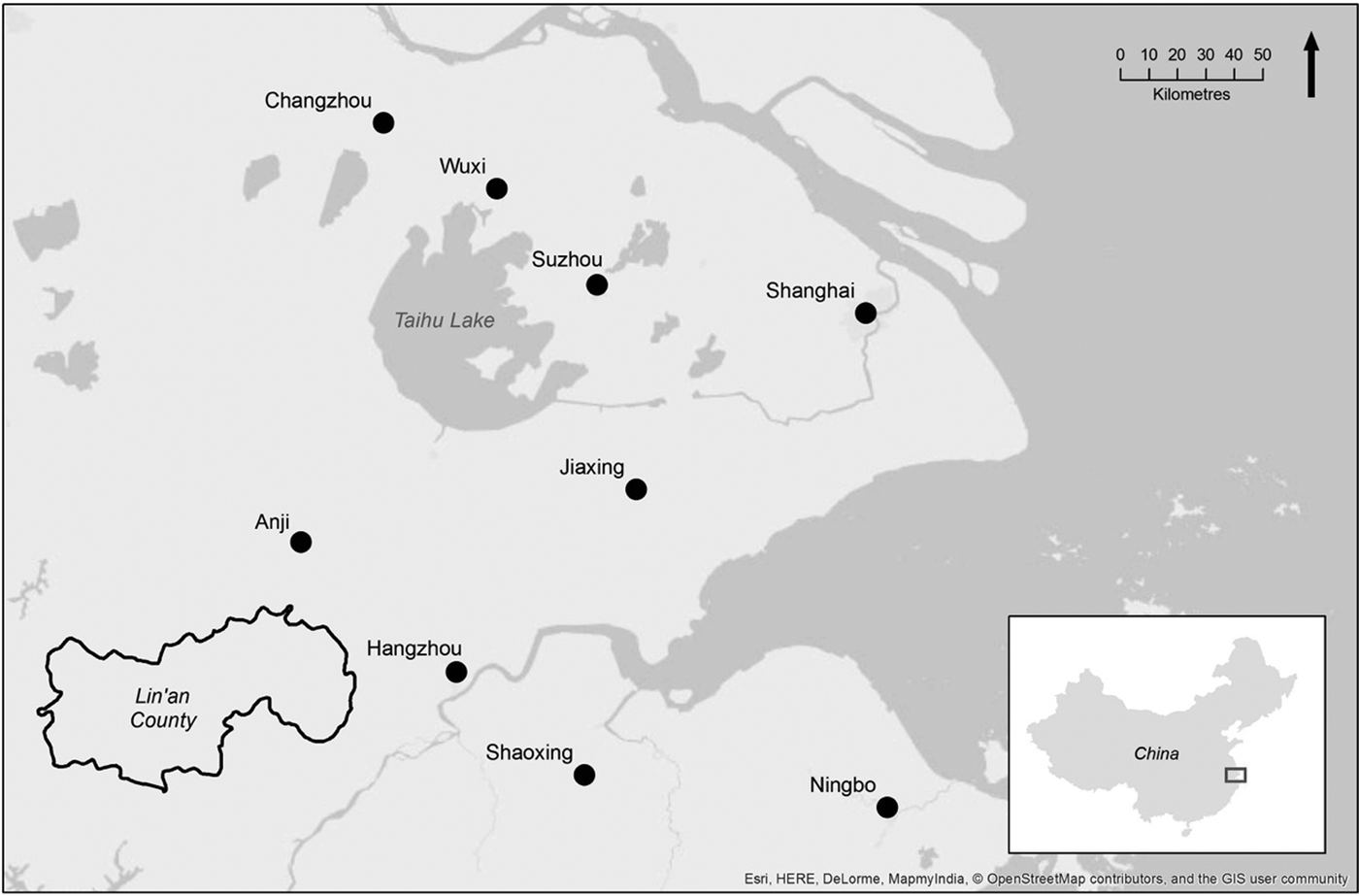
Owing to their different seasonalities, these three major shoot types provide fresh shoots for the wholesale market for a longer time period and also appeal to different users. Moso and Ph. Praecox shoots are sold on the fresh shoot market or are processed and canned. Ph. Nuda shoots, on the other hand, are used for dried bamboo shoot products. In 2006, the bamboo shoot industry in Lin'an produced 35,000 tonnes of bamboo shoots and generated an economic value of around 160 million yuan.Footnote 46 There are around 5,000 traders involved in bamboo shoot transportation and marketing. They bring the fresh shoots to wholesalers in Changzhou 常州, Shanghai, Nanjing, Jiaxing 嘉兴, Shaoxing 绍兴, Ningbo 宁波, Suzhou 苏州 and Wuxi 无锡.Footnote 47
The empirical base for the analysis in this article has been collected and built up over a period of time using a range of secondary (archival materials) and primary data collected through interviews and field visits to Lin'an. Empirical research was conducted in 2011 and 2012. During this time, in-depth interviews were undertaken with forestry bureau officials, farmers’ cooperative representatives, processors, bamboo shoot farmers, forestry technicians and Zhejiang Agricultural and Forestry University researchers. In-depth interviews were conducted across national, provincial and county levels of forestry officials to understand how standards are delivered and implemented from central to county level. Archival materials in relation to bamboo shoot production standards were obtained from the State Forestry Administration, the International Network for Bamboo and Rattan (INBAR) in Beijing, and Lin'an Forestry Bureau.
International and Chinese Standards for Bamboo Shoot Processing
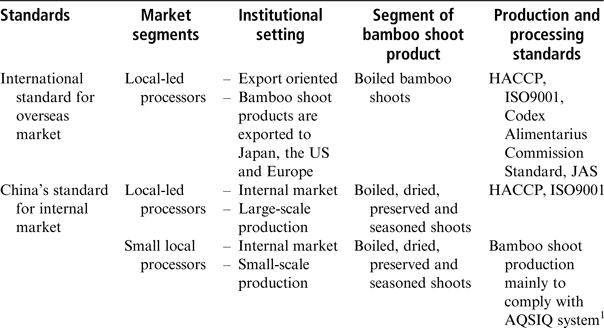
China became a member of the World Trade Organization (WTO) in 2001. As with those countries in the West that have been caught up in the neo-liberal political economy, the demands of the international market have driven China's Ministry of Agriculture also to institutionalize and monitor the processing standards of food products.Footnote 48 According to Guihong Wang, export-oriented processors must fulfil food production standards in order to be in compliance with international food safety laws.Footnote 49 In Lin'an, the Product Quality Monitoring Group in the Lin'an Bamboo Shoot Processing Association monitor two major standards for bamboo shoot processing: (1) an international standard for local-led processors which meets overseas market requirements, and (2) China's standard for local-led processors and small local processors (see Table 1).
Scales and Production Standards in Lin'an County
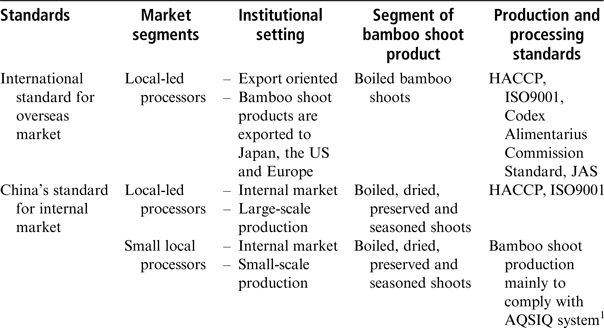
Notes:
1AQSIQ is the General Administration for Quality Supervision, Inspection and Quarantine in China. This organization is a ministerial-level body under the State Council and is in charge of import–export food safety, certification and standardization.
International standards for local-led processors
The JAS,Footnote 50 ISO,Footnote 51 HACCPFootnote 52 and CODEX AlimentariusFootnote 53 (food safety) standards are crucial for export-oriented processors to follow (see Table 1). In Lin'an, over ten bamboo shoot processing firms have obtained HACCP certification and ISO9001 certification.Footnote 54 The HACCP, as it applies in Lin'an, is a systematic preventative approach to regulate and control chemical usage and biological and physical hazards in the production and processing of fresh bamboo shoots.Footnote 55 The JAS standard requires bamboo shoot processors to comply with standards pertaining to production, processing procedures, import clearance, inspection certificates, containers and packaging.Footnote 56 Both Japanese and overseas accreditors can certify bamboo shoot processors with the JAS.Footnote 57 In order to help local-led processors meet international standards, the Lin'an Forestry Bureau and the Lin'an Bamboo Shoots Processing Association provide them with links to “hazard-free” bamboo shoot producers.
When describing the effectiveness with which the local state regulates processors to ensure that they comply with both international and national production and processing standards, the chair of the Bamboo Shoot Processing Association distinguished between markets and farmers:
Mostly, the local-led processing firms can fulfil both national and international standards because their products have to sell to international markets and they have a stricter food quality control and assurance system. For instance, the Japanese food quality standard is very strict; if the Japanese customer found a hair in any bamboo shoot product, the whole container load has to go back to China. For the internal market, monitoring is a problem: we cannot ensure that those small processors comply with hygiene and chemical usage standards because most of the small processors are household based.Footnote 58
There is a hierarchy of regulatory practice. Those at the top are producing for and selling to international markets. These firms are supported in their efforts to comply with standards. Beneath them are those firms who can produce for a national market and meet national standards. Beneath these firms are smaller companies who target domestic consumers, fall outside of the standards and are beyond both the regulatory and supportive arrangements of the local state. As long as the small, unregulated processing firms stay out of the public gaze, they do not tarnish Lin'an's reputation for quality, which depends on the high-profile exporting companies. The county's reputation for quality is also – and even more significantly – dependent upon its bamboo shoot growers, and it is their interaction with standards that we now examine.
Bamboo Shoot Production Standards
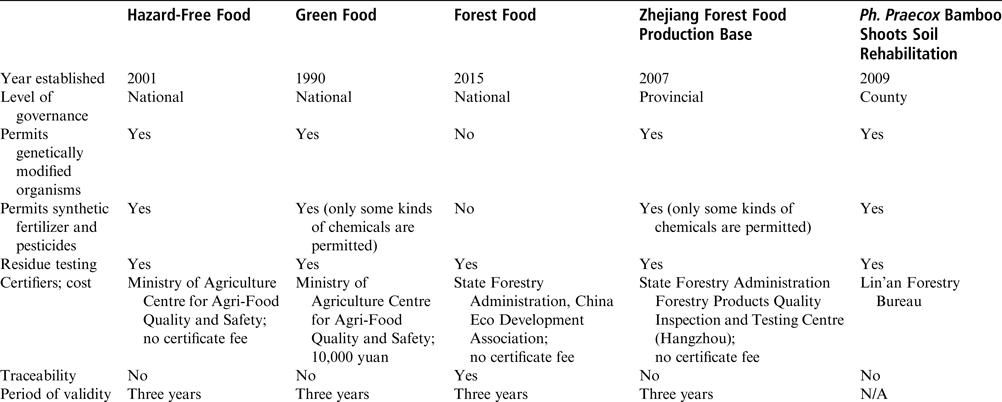
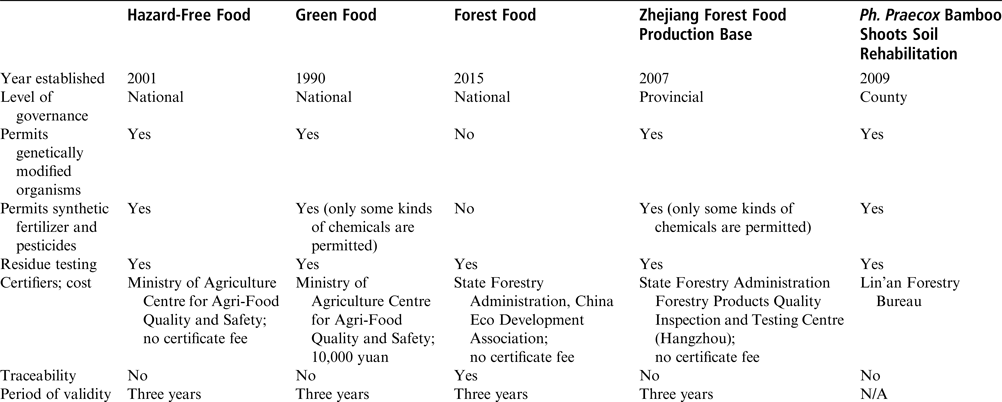
In 2009, a Standing Committee of the National People's Congress enacted the People's Republic of China's Food Safety Law. To help implement the law, further regulations and standards have been developed at sub-national level. For bamboo shoot growers in Lin'an, three are particularly important: the Hazard-Free Production Standard (Wugonghai shipin shengchan biaozhun 无公害食品生产标准, HFPS), the Green Food Production Standard (Lüse shipin shengchan biaozhun 绿色食品生产标准, GFPS), and the Zhejiang Province Forest Food Production Base Standard (Zhejiang sheng senlin shipin shengchan biaozhun 浙江省森林食品生产标准, ZFFPBS) (see Table 2). The standards are set and evaluated in a complex manner, with responsibilities falling to different government departments. The HFPS and GFPS are the responsibility of the Zhejiang Agricultural Department, and the ZFFPBS is issued by the State Forestry Administration Forestry Products Quality Inspection and Testing Centre (Hangzhou). The competition between departments is typical of that found in Chinese bureaucracy.Footnote 59
National-, Provincial- and County-level Food Standards for Bamboo Shoot Growers
Source:
Adapted from Scott et al. Reference Scott, Si, Schumilas and Chen2014, 161; Specification of Forest Food Certification 2015, 1–20; State Forestry Administration 2010, 1–20.
The HFPS requires that farmers meet the following criteria: (1) chemical fertilizers should be maintained at safe levels; (2) the surrounding areas of the agro-forestry production lands should fulfil hazard-free standards; and (3) the production procedures, processing, packaging, storage and transport should reach hazard-free agricultural product standards. The standard does not seem particularly difficult to fulfil because, according to a Lin'an Forestry Department (aligned to the provincial government) technician, “most of our farmers fulfil the hazard-free standards.”Footnote 60 The Green Food Standard makes more stringent demands on the use of toxic chemical fertilizers and the quantity of chemical residue in agricultural products.
The local state is making considerable efforts to promote the Green Food Standard to distinguish Lin'an products in a competitive market place, but this is difficult where fertilizers are embedded in local farming practice.Footnote 61 As the same forestry department technician explained: “we are working hard to help farmers realize the practices of green food production standards. It takes time and financial resources to propel the green food standards because the requirements are hard to meet with the current knowledge and financial resources of farmers.”Footnote 62
The Forest Food Production Base Standard (FFPBS) is popular in Zhejiang. To differentiate its standard from those of the provincial agricultural department (i.e. Hazard-Free and Green Good standards), the Zhejiang Provincial Forestry Department set up its own forest food product base standard (the ZFFPBS). This pays more attention to forest biodiversity, forest coverage, forest structure, soil condition, air quality and water quality. By demonstrating the legitimacy of the ZFFPBS to its users, Zhejiang has “promoted” a provincial standard to a national level. The national-level Forest Food Standard, like that for Zhejiang, stresses “forest sustainability.” However, the national-level standard is more rigorous in that it promotes “product branding,” emphasizes “organic” or “natural” production without the use of artificial pesticides and fertilizers, and provides for traceability throughout the supply chain, from place of production to the plate. Such a stringent form of production is beyond the means of Lin'an bamboo shoot growers, which is why the province is so keen to legitimize its own standard.
Lin'an county, like the Zhejiang Provincial Forestry Department, has also proved to be innovative. Led by Lin'an forestry experts and technicians, who have considerable expertise in bamboo cultivation and processing, standards were developed based on the Ministry of Agriculture's Hazard-Free Production and Zhejiang's Non-Environmental Pollution Bamboo Shoot (DB33/333/1-2001). In 2009, the Lin'an Forestry Bureau issued the Ph. Praecox Bamboo Shoots Soil Rehabilitation Standard (DB3301/T199-2011) (see Table 2). This production standard regulates the terminology for forestry management and pest and disease controls for bamboo. The purpose of the standard is to encourage soil rehabilitation of degraded soil. However, county-level standards are relatively loose and the certification, traceability and period of validity of bamboo shoot products are ambiguous. As we show below, the standards do little to challenge the increasing intensification of production and the environmental degradation that results. As Michael Bloomfield has noted, measures like standards tend to be popular because “they do not tackle tough issues.”Footnote 63
From provincial to local level: implementing bamboo shoot production standards in Lin'an
Fresh bamboo shoots are a local specialty, and one that is increasingly being exploited. For example, farmers and processors make reference to the geographical origin of their bamboo shoots at the source of Lake Tai 太湖 and Mount Tianmu 天目山 in Lin'an (see the example of the Kao Yuen Bamboo Shoot Cooperative below). Farmers use these references to conjure up powerful cultural images for urban consumers of a typical Chinese mountainous climate with clean water. Moreover, the bamboo shoot farmers are associated with traditional artisan methods of cultivation, harvesting and processing skills that date back to the Ming Dynasty. A high-quality dried bamboo shoot should be brown and slightly green in colour with a soft texture, uniform in size and without odour or mould. All these specific geographical and socio-cultural contexts combine to construct an image of “authentic, healthy, traditional” bamboo shoot products from Lin'an.Footnote 64
However, images of high quality products based upon traditional bamboo-growing methods and harvesting techniques jar with the reality of intensive farming and threaten to undermine the distinctiveness of the Lin'an industry. Environmental degradation and potential risks to food quality now go hand-in-hand,
… owing to the application of massive amounts of chemical fertilizers, which increase the accumulation of potassium and phosphate in the soil. Forest degradation [is a risk] because the phosphate content level is above the safety level. By increasing the scale of bamboo cultivation … pest and disease problems [increase]. To tackle this problem, farmers apply more and more pesticides, even some prohibited pesticides (for example, carborfuran), which induces a food safety problem.Footnote 65
Recognizing the threat to a key economic activity, Lin'an state actively intervened to promote more environmentally friendly bamboo shoot growing practices. Four major measures were implemented. First, the use and marketing of carbofuran in Lin'an county was prohibited in 2000. Second, soil samples were collected from 60 bamboo shoot cultivation areas to evaluate the level of sulphur, potassium and phosphates in the soil. Calculations were then done to ascertain the appropriate proportions of fertilizer ingredients. Fertilizer use and application is an important part of bamboo growing, discussed further below. Third, county-level hazard-free production standards for bamboo shoot cultivation were drafted based on those devised at the provincial and national levels. Lin'an Forestry Bureau worked with the Bamboo Shoot Production and Processing Association, bamboo shoot producers, processors, private technological extension firms, and research institutions (for example, Zhejiang Agricultural and Forestry University) to co-produce the standards for bamboo shoot production. Fourth, training workshops, exhibitions, booklets, and television programmes were produced to help bamboo shoot farmers learn about hazard-free production standards.Footnote 66 Below, we explore how the local state works with its cooperatives to promote compliance with standards in order to maintain the competitive advantage of Lin'an's bamboo shoot growers.
The local state and farmers’ cooperatives
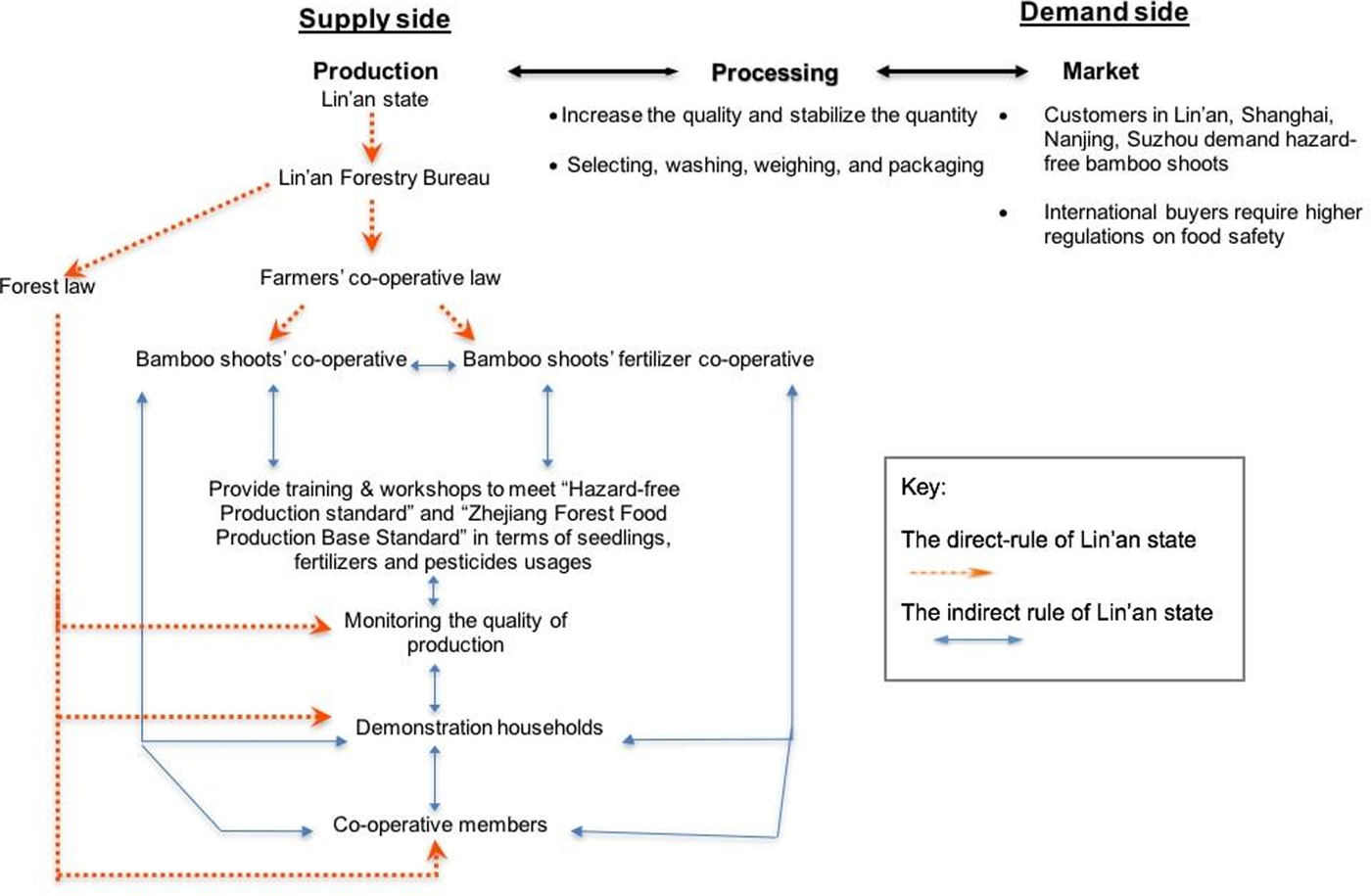
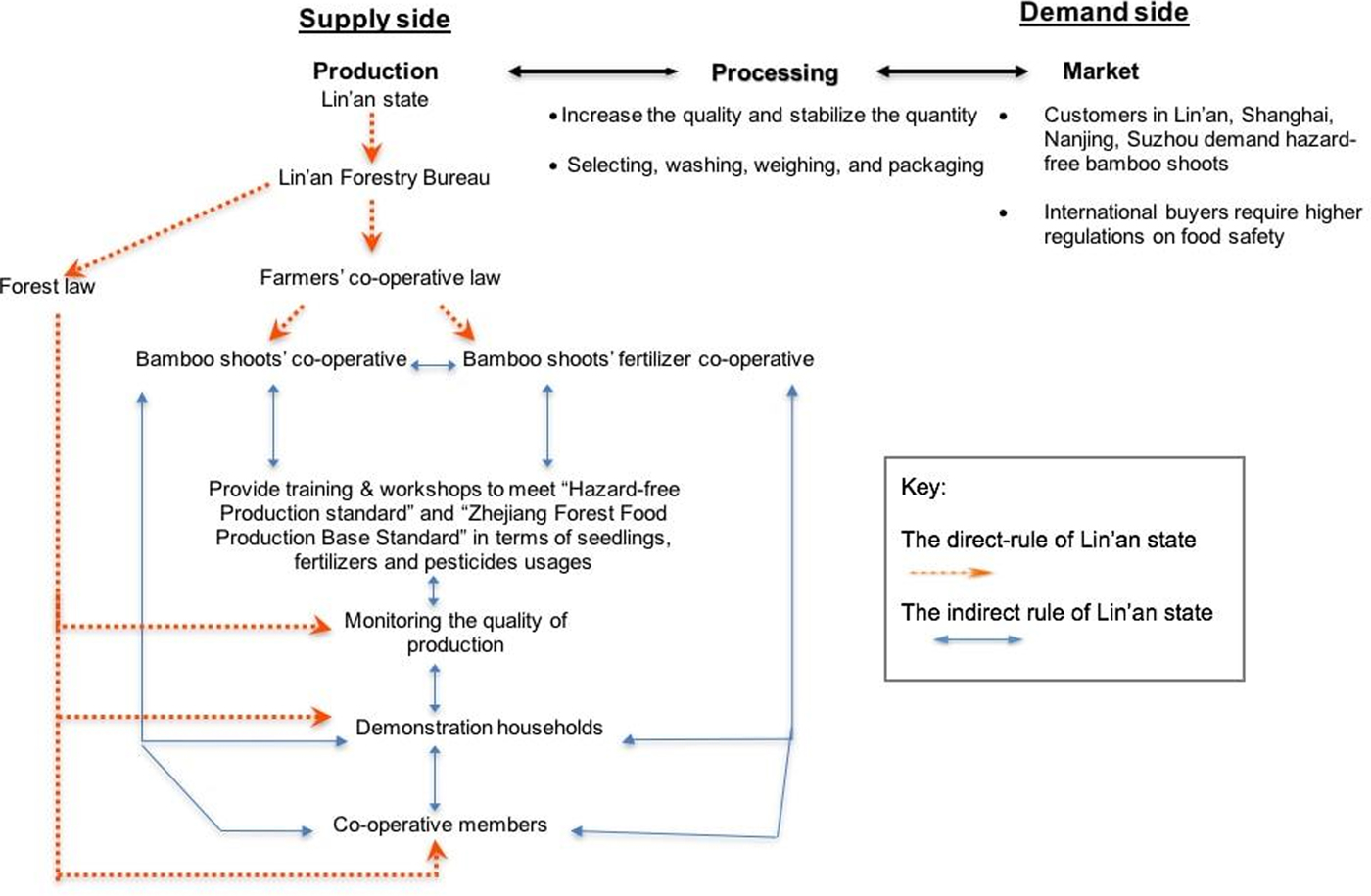
Lin'an state applies its direct and indirect rules on promoting hazard-free production standards through collaboration with farmers’ cooperatives and demonstration households. For direct rules, both Lin'an state and the Forestry Bureau have the authority to control the production of bamboo shoots and the activities of farmers’ cooperatives through the Forest Law and Farmers’ Cooperative Law.Footnote 67 Additionally, the Forestry Bureau provides technology extension services and monitors the production quality of bamboo shoots from individual farmers and cooperatives. To do so, Lin'an Forestry Bureau has established 50 testing points throughout the county to monitor the quality, heavy metal content, and chemical residue of bamboo shoots to ensure that they meet the Hazard-Free Production Standard. The county government and Forestry Bureau also need and use the cooperatives to increase the state's influence over individual farmers’ practices.
Through partnerships with fertilizer cooperatives, Lin'an Forestry Bureau can, on the one hand, trace the origin of fertilizers and, on the other hand, extend its indirect rule over farmers’ fertilizer usage and cultivation procedures by encouraging cooperative members to achieve food production standards. The cooperatives maintain good relationships with farmers through various niche services such as soil testing and fertilizer matching, and increasing the market network for bamboo shoots. Informal governance structures such as trust, negotiation and verbal agreements are common within a cooperative's networks. Farmers’ cooperatives also sign bamboo shoot production contracts with individual farmers that protect prices, and provide production training and workshops for farmers to maintain Hazard-Free and Zhejiang Forest Food Production Base Standards (see Figure 2). To further understand farmers’ cooperatives, the Yi Wei Fertilizer Cooperative (Yi Wei huafei hezuoshe 益微化肥合作社) and Kao Yuen Bamboo Shoot Cooperative (Gaoyuan zhusun hezuoshe 高源竹笋合作社) will be discussed in the following section.
The Local State, Farmers’ Co-operatives and Food Production Standards
Yi Wei Fertilizer Cooperative
The Yi Wei Fertilizer Cooperative was established in 2012 and processes fertilizers for bamboo shoot producers. Members who buy the cooperative's fertilizers obtain standardized-quality fertilizer and training in its application. The cooperative is small, with only 100 members. According to a director of the cooperative, it has three major functions: (1) soil testing and soil condition consultancy services, (2) the manufacturing and wholesaling of tailor-made non-toxic fertilizers, and (3) facilitating the Forestry Bureau's technological extension services to promote fertilizer which meets the Hazard-Free and Zhejiang Forest Food Production Base Standards. The director explained:
Our cooperative conducts research on the optimum composition of chemical and organic substances in fertilizer to restore degraded soil and meet the Hazard-Free Production Standard … We collaborated with the Zhejiang Agricultural and Forestry University, Lin'an Forestry Bureau and the Agricultural Bureau's soil testing stations to learn from their techniques to test the soil and learn their knowledge to blend the appropriate proportion of chemical and organic substances.Footnote 68
According to the same director, farmers' repeated use of a fertilizer is based upon their experience; however, many farmers have little or no knowledge about the fertilizers that they use. According to the director:
Some fertilizers are counterfeit and even toxic. The source of the fertilizers is difficult to trace. However, if farmers purchase fertilizers from our cooperative, at least they know where it comes from … We will let farmers try our products and let them see the improvement in their plantations. Once farmers see the bamboo become greener and healthier, they will come back to buy it.Footnote 69
For the cooperative, it is not only establishing a relationship of trust with farmers that matters; building close relationships with the Forestry Bureau also helps to promote its fertilizers to Lin'an farmers:
I have been working in fertilizer manufacture and networking with Lin'an forestry officials for more than five years. Now, I have earned the trust of the bureau because my fertilizers increase farmers’ productivity and ameliorate the toxicity of the soil. Therefore, I can accompany the bureau's technicians to promote my fertilizers and develop business opportunities.Footnote 70
The relationship between cooperative and state is portrayed as one of mutual benefit: the fertilizer cooperative needs the government's endorsement and recommendations to promote its products on the market, and in turn, the fertilizer cooperative helps Lin'an state to make its farmers competitive.
Kao Yuen Bamboo Shoot Cooperative
The Kao Yuen Bamboo Shoot Cooperative was founded in 2009. It is a medium-sized cooperative, with around 1,300 bamboo shoot farmer members from across Lin'an county. Its members are responsible for about 7,500 hectares of bamboo land. The Kao Yuen Cooperative also directly manages 225 hectares of land. The cooperative mainly buys bamboo shoots from its members, which it then sells on their behalf under the brand name Taihu yuantou 太湖源头, named after its location at the source of the Taihu River (see above). The cooperative has guided its members to adopt Hazard-Free and Zhejiang Forest Food Production Standards from seedling propagation and fertilizer use through to production processes. It does this by providing information on growing techniques.
In addition, the cooperative ensures the quality of its members’ bamboo shoots in three other ways. First, it collaborates with the Yi Wei Fertilizer Cooperative by recommending to its members that they use the approved Yi Wei Cooperative fertilizers. In return, the fertilizer cooperative provides free soil testing services for the Kao Yuen Bamboo Shoot Cooperative's members. Second, written contracts are used to maintain the Hazard-Free and Zhejiang Forest Food Production Standards. According to one director:
Our bamboo shoot products have the brand name “Taihu yuantou” and farmers sign a contract with the cooperative because we have standardization in production procedures, fertilizers and pesticide usages. Therefore, the size, weight, width and quality of our bamboo shoot products are standardized.Footnote 71
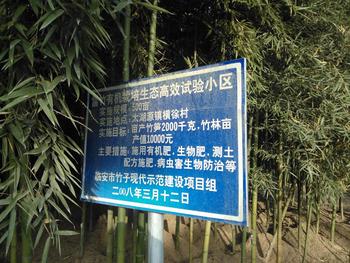
Third, by establishing links with demonstration households, the cooperative diffuses the knowledge and practices of production standards. For example, the cooperative will put a sign up outside a demonstration household farm that reads “Ph. Praecox Shoot Plantation” to signify that those plots of land are meeting hazard-free production standards with the cooperative's guidance. Also on the sign will be the name of the demonstration household, the types and descriptions of soil restoration, and the technology adopted (see Figure 3). Farmers interested in achieving hazard-free production standards can contact the demonstration households or the cooperative to receive a free consultation. According to one demonstration householder:
More than 100 farmers consulted me about my cultivation techniques, farming schedules, and the types of fertilizers I use. There are around 30 farmers closely tied to me. Whenever they have problems, they come to my house to have a chat with me.Footnote 72
Sign Showing the Adoption of Hazard-Free and Zhejiang Forest Food Production Base Standards

The cooperative not only encourages its own demonstration household farms to display its Hazard-Free Production Standard but also uses the networks of the demonstration households to promote its brands and attract interested farmers to join the Bamboo Shoot Cooperative. Like the Yi Wei Cooperative, the Kao Yuen Cooperative is working at the interface between the state and farmers. As the local state seeks to safeguard the economic interests of its farmers, it is increasingly turning towards the use of standards. Standards become a way of differentiating Lin'an products from their competitors. The protection of producers depends upon the local state being able to reassure urban consumers of the quality of products, and the cooperatives play a prominent role in ensuring that the requirements of standards are met.
Conclusions
Standards, like other neo-liberal practices such as auditing and certification,Footnote 73 are becoming increasingly important policy instruments and a means to provide reassurance on quality where trading takes place.Footnote 74 To gain a better insight into what standards mean for Chinese local environmental governance, it is important to make two points here. First, even when they have a stated ecological purpose, standards may not produce improvements in the quality of the bamboo growing environment, and second, in the Chinese context, the operation of standards is intertwined with the practices of the local state, a markedly different state of affairs from that which may be found elsewhere.Footnote 75 These two points are elaborated below.
Intensification of production can accelerate soil degradation and impair the carrying capacity of the land. For the local state, the increasing tensions between the promotion of economic growth and the avoidance of harmful exploitation of natural resources raise an increasingly pronounced conflict. We share the views of Linda Calvin et al. and George Lin that both the local state and producers look for short-term economic gains instead of addressing the deep-seated contradiction between resource exploitation and environmental limits.Footnote 76 Therefore, standardization is merely a short-term fix to ameliorate environmental degradation. Even if environmental degradation is accelerated, the local state's politico-economic territory is remade. To describe this phenomenon, we use the term “green cloak” since it suggests a specific governance logic of state territorial control over the production of nature. The local state engages with non-state actors to achieve superficial environmental efforts (for example, standards) to throw a “green cloak” over a continuing productivist model. A “green-cloak” requires state officials, academics, auditing bodies and experts to co-produce knowledge, such as showing quantitative changes to land surfaces and the number of green infrastructure projects, along with a set of rules to legitimize these green-looking development models.
Our case study also reveals how the nature of the Chinese local state means that it is inextricably intertwined with both the organization and operation of standards, thus making it significantly different from what is expected, although perhaps not realized, in liberal democracies.Footnote 77 This is because standards and the production of nature form part of the “territorial strategies” of the local state.Footnote 78 The local state expands its territory and maintains its privileged governance through being able to exercise power over multi-layered “space.” The local state is not limited to the physical space in which it can seek to exert control over raw material supplies; it also seeks control over the economic space, where it can enhance the competitiveness of the processors through the supply chain, as well as the political space in which it hopes to obtain the attention of the central state to boost its profile and economic opportunities. To be able to achieve this outcome, our research has shown how standardization engages with the local state, farmers’ cooperatives, forestry experts, bamboo shoot processors and extension services to co-produce the knowledge necessary to realize these economic and political ambitions.
At the local level, where so much policy delivery takes place, administrative competition may mean that there is more attention given to securing the “legitimacy” of a standard rather than to how that standard might help with the delivery of public policy. As shown in Table 2, national, provincial and county governments are involved in standard setting. One reading of the Table is that national-level standards are delivered in a relatively straightforward manner by sub-national government. In practice, it is a more complex and dynamic situation, with upscaling and downscaling and territorial competition taking place. An upscaling of standards can help the local state to secure administrative resources, inward investment and sympathetic policies.Footnote 79 At a provincial level, the upscaling of the Zhejiang Forest Food Standard into a national forest food standard involves the transfer of power, creates the potential for economic benefits, and the opportunity for promotion among government officials. At the same time, the upscaling and downscaling of standards is taking place in a context of interdepartmental politics (for example, between the agriculture and forestry departments), and this is resulting in a proliferation of standards.
By examining a local state, we are able to show how it engages with key actors including farmers’ cooperatives, demonstration households and agricultural extension services to co-produce the knowledge needed to develop standards as well as knowledge about the standards themselves. In our analysis of how standards are used in practice, we can see how they come to control bamboo shoot quality – a productive norm – and so become a governing tool for the local state to extend its direct and indirect rule over bamboo shoot producers. For direct rules, Lin'an state has the authority to control the production of bamboo shoots and the activities of farmers’ cooperatives through the Forest Law and the Farmer's Cooperative Law. This is the traditional modus operandi of the Chinese state. In its indirect rule, the county government and forestry bureau work with cooperatives, research institutions, and demonstration households to increase the state's influence over individual farmers’ growing practices, and it is here that standards matter. By utilizing direct and indirect rules, the local state can use control and cooperation in its links with farmers.
At present, compliance with standards is confined to a minority of bamboo shoot growers in Lin'an – that is, those who are best able to provide premium products. The local state in Lin'an aims to disperse standardized bamboo shoot cultivation to a larger number of its farmers by demonstrating the economic value of adopting standards in growing. The highly networked nature of the Lin'an bamboo-growing community means that much learning is taking place via the cooperatives. The cooperatives become an agency to extend the arm of the local state to ensure the legitimacy of the standards it promotes and to raise the market recognition of Lin'an bamboo shoots. This should increase consumers’ confidence in Lin'an products, which will, of course, also benefit the bamboo shoot processors. As the local state generates additional economic value from bamboo shoot production and processing, it will also enlarge its economic territory. One challenge for the local state will be that as standards become normalized, then the local state may become less interested in promoting standards and become more of an auditor along the supply chain to ensure compliance with standards.Footnote 80 It remains to be seen how such neo-liberal tendencies can be managed within the Chinese model of governance and points to the ongoing importance of the study of standards as a window into the dynamic nature of the relationships between the state and other actors.
Acknowledgement
This project was generously funded by the Cardiff University President's Research Scholarship Fund between 2011 and 2014. We wish to thank Yu Li, Jin Wei, Zhu Zhao Hua, Wang On Guo, He Jun Chao, Xu Xiu Ying, Zhejiang Agricultural and Forestry University, Lin'an Modern Technology Company and the Lin'an Forestry Bureau for assistance with data collection in Lin'an, China. We also thank three anonymous reviewers for providing insightful comments on an earlier draft of this paper.
Biographical notes
Kin Wing (Ray) Chan is a postdoctoral research associate at the School of Geography, University of Exeter. He researches environmental governance, animal health, food politics and the emergence of antibiotic resistance (AMR) in China and the United Kingdom. He is currently working on a four-year research project that examines how diagnostic innovations reduce the utilization of antibiotics in livestock farming in the United Kingdom.
Andrew Flynn is a reader in environmental policy and planning in the School of Geography and Planning at Cardiff University. He has a background in policy analysis and environmental geography. His principal research interests have been in the making and delivery of policy on sustainable development, the implementation of policy and its evaluation in the United Kingdom and China.