INTRODUCTION
The recent escalation of violent Islamist activity in Kenya and Nigeria, in addition to ongoing unrest in the Sahel, has focused international attention on Islamist violence in sub-Saharan Africa. In spite of this type of violence being frequently characterised as a global threat, Islamist violence emerges in particular countries and sub-national locations: not all African countries with large Muslim populations experience violence, and fewer still experience Islamist violence specifically. What conditions facilitate its emergence? What factors contribute to the adoption of violent Islamist ideologies in some countries, but not others? This research argues that explanations for political violence which focus on political marginalisation and grievances can be used to explain violent Islamist activity in a range of contexts. This finding is in contrast to approaches which emphasise the uniqueness of Islamist violence, ideology and goals.
Violent conflict is common across many African states (Raleigh et al. Reference Raleigh, Linke, Hegre and Karlsen2010), and research has demonstrated a clear relationship between the practices of governance such as repression (Regan & Norton Reference Regan and Norton2005) or exclusion from central power (Deiwiks et al. Reference Deiwiks, Cederman and Gleditsch2012) and the level, location and variations in violence across sub-national territories in Africa (Raleigh Reference Raleigh2014). In addition to experiencing high rates of violence, many African states experience multiple forms of violence (Raleigh Reference Raleigh2014): understanding the relationship between these discrete forms of violence and the politics and practices of governance within which they occur is of critical importance. In this context, Sub-Saharan Africa has witnessed an increase in the levels of violent Islamist activity in recent years, as well as its emergence in spaces from which it was previously absent (Dowd Reference Dowd2013).
Contrary to theories and explanations of Islamist violence which attribute its emergence and intensity to religious ideology or the diffusion of violence from neighbouring states, this article contends that Islamist violence can be attributed to similar factors explaining other forms of conflict, namely the local political and economic conditions in which it emerges. I propose that Islamist violence emerges in sub-national contexts shaped by governance practices of political and economic marginalisation, and with a history of non-Islamist violence. Timing and escalation are explained by the expansion of the state's politically exclusionary practices, wherein nascent or local Islamist militants capitalise on, and reconfigure, grievances. Islamist violence is not different in context or mechanism to other forms of violent conflict, but differs in its mode of organisation. This argument has been tested in large-n cross-national comparison (Dowd Reference Dowd2015) and in specific studies of individual country cases (Agbiboa Reference Agbiboa2013). I go further in this paper by isolating the specific conditions in which Islamist violence emerges, the unique histories of violence which facilitate it, and the variation in policy responses across sub-national spaces in three conflict-affected countries. This argument is advanced by pairing survey data from Afrobarometer with qualitative findings and political violence data from the Armed Conflict Location & Event Dataset (Raleigh et al. Reference Raleigh, Linke, Hegre and Karlsen2010) in case studies of Kenya, Mali and Nigeria.
In contrast to frameworks which assert the importance of cultural or ideational aspects of Islamist violence, the findings highlight the applicability of wider theories of political violence centring on political and economic marginalisation as drivers of Islamist violence in diverse contexts. Further, this article expands and applies grievance-based explanations to Islamist violence through an analysis of the perceptions of populations of group power and influence as motivating factors in collective mobilisation, and the distribution of grievances across group cleavages as opportunity-generating conditions for collective action. In addition, by situating violent Islamist activity within the context of political practices of governance and domestic legacies of violence, rather than as a sudden aberration in the histories and politics of each country, I draw attention to and focus on the endogenous practices of local conflict and instability. Finally, applying these theories at the sub-national level facilitates comparisons between different sub-national areas within the same countries differentially affected by Islamist violence, and similarities across diverse countries in which this phenomenon is present.
This paper proceeds as follows: Section 1 provides an overview of prominent theories of Islamist violence; Section 2 details an alternative theory of Islamist violence based on grievances; Section 3 reviews the transformation of existing violence in sub-national territories; key triggering events are covered in Section 4; and Section 5 concludes with a discussion of findings and implications for future research.
ISLAMIST VIOLENCE IN KENYA, MALI AND NIGERIA
For the purposes of this paper, the term ‘Islamist’ refers to groups which proactively promote or enforce Islamic ideologies, laws, policies or customs in the state and/or society (Denoeux Reference Denoeux2002: 61; Esposito Reference Esposito2003: 151). Islamism encompasses a wide range of political, social and religious activity across diverse disciplines and traditions within Islam (ICG 2005). Violent Islamist groups are distinguished from other Islamist groups by the use of violence in pursuit of their goals (Dowd Reference Dowd2015). In spite of encompassing a diverse range of actors, the theoretical conceptualisation of violent Islamist groups often assumes a relatively homogeneous, global phenomenon of violent Islamism is emerging in a wide variety of contexts – from the Middle East to Africa and beyond – and proceeds to collectivise these various manifestations, rather than approaching the conditions in which it emerges as a starting point for interrogation (Dowd & Raleigh Reference Dowd and Raleigh2013).
Several features of Kenya, Mali and Nigeria make them useful cases for analysis of this phenomenon, while highlighting a more widely transferable theory: first, they are drawn from both East and West Africa, two regions in which clusters of countries are affected by Islamist violence, including Niger, Sudan and Somalia. Second, they represent diverse religious demographies: according to Afrobarometer survey data, Muslims make up about 14% of the population in Kenya, while Nigeria's population is more evenly split between Muslims (approximately 40% of the population) and Christians; and over 90% of Mali's population identifies as Muslim (Afrobarometer Reference Kenya and Nigeria2008).
Third, all three countries have experienced Islamist violence in a relatively limited part of their territories. Each country has seen sporadic violence in capital cities, and Islamist violence has been concentrated in the counties of Kenya's former North-Eastern and Coast provinces; in Mali's northern regions of Kidal, Timbuktu and Gao; and in Nigeria's northern states of Borno, Kano and Yobe. These sub-national areas have witnessed over 70% of the Islamist violence events which occurred in each country (source: ACLED). Finally, the level of Islamist violence in recent years has intensified in all three countries, compared with historical levels of activity. These demographic, geographic and temporal patterns provide an opportunity to test theories of Islamist violence, taking into account the variation across and within each country in an attempt to understand the contexts in which Islamist violence emerges.
EXISTING EXPLANATIONS AND THEIR EVIDENCE
The phenomenon of Islamist violence in Sub-Saharan Africa has conventionally been explained by two distinct theories: those which focus on the underlying, but relatively static, religious demography of countries; and those which focus on the more dynamic processes of physical diffusion of violence from neighbouring areas. An alternative perspective applied in this paper suggests that violence emanates from practices of governance, exclusion and marginalisation by the state. Demographic and diffusion explanations for Islamist violence that locate it in static contexts share an approach which overlooks the domestic political arena in which Islamist violence occurs. In doing so, these explanations neglect the local political practices in areas experiencing Islamist violence, and how these can provide a basis for mobilisation.
Religious violence
More so than other forms of religiously mobilised violence, Islamist violence has been subject to claims that it is irrational and incomprehensible (Celso Reference Celso2014: 230). Claims that violence is an inherent cultural facet of Islam (Huntington Reference Huntington1993), or that Islamist violence is a function of a global ‘clash of civilizations’ (Huntington Reference Huntington1993; Lewis Reference Lewis2003: 36), and that religiously framed violence is unique, remain pervasive, if nowadays more implicit, features of the discussion of Islamist violence (Cavanaugh Reference Cavanaugh2004; de Soysa & Nordås Reference de Soysa and Nordås2007; Gunning & Jackson Reference Gunning and Jackson2011). In general terms, the perceived role of ideational factors such as ‘jihad’ in Islam has been cited as a contributing factor in ‘Islam's disproportionate role in religious civil wars’ (Toft Reference Toft2007: 110). Other scholars place greater emphasis on the concept of martyrdom, attributing the motivation to engage in political violence to the expectation of other-worldly rewards (Jeurgensmeyer Reference Jeurgensmeyer2003). According to these approaches, religion provides not only a basis of mobilisation, or a justification for the use of force, but also the very motivation to engage in violence itself.
Empirical tests of these theories have revealed their limitations. Studies have found no evidence of increased conflict between ‘civilizations’ in the context of inter-state conflict (Chiozza Reference Chiozza2002). There is also no evidence of a relationship between Muslim population size and political violence levels in Africa (Dowd Reference Dowd2015). Meanwhile, the effect of Islamist group ideology on violence intensity disappears when other organisational characteristics, such as alliances, are controlled for (Piazza Reference Piazza2009).
In the context of Kenya, Nigeria and Mali specifically, religiously focused theories shed little light on why violent Islamist activity is higher in some Muslim-populated areas than in others. If cultural facets inherent to Islam drive violence, it should be found across a range of countries with large Muslim majorities or substantial minorities. But it is absent in many such spaces, including much of Mali, where the population is approximately 90% Muslim and dispersed throughout the state, yet Islamist violence is concentrated in the far north of the country. Areas of similar demographic characteristics in Nigeria (e.g. Zamfara, Kebbi and Jigwawa) witness no recorded Islamist violence or only isolated events far below the national average. Moreover, if Islamist violence is a function of the ‘confrontation’ between Islam and Christianity (Lewis Reference Lewis2003: 36), it should be found more in highly religiously diverse areas, such as Osun and Oyo states in Nigeria, where 33% and 49% of the population identify as Muslim respectively (Afrobarometer Reference Kenya and Nigeria2008). Clearly, large Muslim populations are not a sufficient condition for the rise of Islamist violence, even in otherwise conflict-affected countries.
As a consequence of the privileging of religious ideology and demography in explanations of Islamist violence, these approaches largely fail to interrogate the conditions in which proponents of violence gain traction among communities by assuming violent discourse, adherence, mobilisation and politicisation develop in political, economic and social vacuums. This paper does not seek to dismiss the potential power of specific cultural or religious symbols and rhetoric as tools for framing collective action in terms of particular narratives and histories. It argues instead, that while particular narratives may be effective in framing violence, and specific demographies may contribute to favourable conditions for mobilisation, this mobilisation is made possible through the necessary mechanism of political and economic experiences of marginality and exclusion. By analysing the political and social conditions in which violence emerges, claims that Islamist activity is driven predominantly by irrational doctrinal or demographic factors can be countered with evidence of similarities in the ‘place influences’ (O'Loughlin Reference O'Loughlin2010) in which such groups emerge.
Physical diffusion
Diffusion is a second common explanation for the emergence of Islamist violence in countries across Sub-Saharan Africa. Kenya's border with Somalia, Mali's border with Algeria, and Nigeria's border with Cameroon and Niger are suggested cross-border ‘conduits’ of violence, material and militants across the continent.
Islamist violence across Africa is presented as the result of porous and ineffective security services, rather than domestic, ‘concerted indigenous support for transnational Islamic extremism’ (Haynes Reference Haynes2005: 1337). The Kenyan parliamentary report on the Westgate attack in September 2013 reinforced this view when it concluded that ‘nationwide systemic failure’ on the part of the Immigration Services Department and Department of Refugee Affairs was a contributing factor in the attack (Kenya National Assembly 2013). Meanwhile, the subsequently launched counter-terrorism ‘Operation Usalama Watch’ – involving dragnet arrests in predominantly Somali areas of Nairobi – has concentrated on the relocation and deportation of Somali populations in Kenya as a security measure (Amnesty International 2014).
In Mali, also, the role of the transnational movement of militants has received considerable attention. The return of Tuareg militants from Libya after the fall of the Gaddafi regime and the movement of Algerian militants into the north of the country have both been proposed as explanations for the outbreak of Islamist violence in the country in the past three years. The physical movement of militants from nearby conflict zones is less often cited as an explanation for Islamist violence in Nigeria, because there is far less dispute over the national agenda and origins of the militant group Jama'atu Ahlis Sunna Lidda'awati Wal-Jihad (commonly, and hereafter, ‘Boko Haram’), although some researchers have identified Nigeria's ‘porous borders’ as a driver of Islamist violence in the country (Onuoha Reference Onuoha2012).
However, the physical diffusion of militants can at best serve as a proximate trigger, but not explanatory cause, of Islamist violence. Ultimately, an explanation relying on the physical diffusion of militants into countries, bringing with them the threat of violence, overlooks the conditions which make diffusion attractive in the first place; or which give radical groups traction among local communities once they are among them. Undoubtedly, militants from Somalia have crossed the border into north-eastern Kenya, and Islamist groups in Nigeria have used the border with Cameroon to evade capture, just as it is the case that militants from neighbouring Algeria and the wider Sahelian region were active in northern Mali for years prior to the most recent outbreak of violence. These movements notwithstanding, diffusion-focused explanations neglect two critical dimensions.
The first is that it does not interrogate why militants diffuse into particular spaces, not all, and that the common features of these spaces are the political, social and economic factors which might characterise those spaces to which militants relocate. Somalia shares a border with three neighbouring states, only one of which (Kenya) has seen notable levels of Islamist violence. Al Shabaab has had only limited success in militarising communities in diverse regions within the same country, with negligible activity in north-eastern Puntland or north-western Somaliland (Amble & Meleagrou-Hitchens Reference Amble and Meleagrou-Hitchens2014). Similarly, a concentration of Algerian militants in northern Mali should be considered in light of the conditions which make activity in that space more feasible than in nearby Mauritania or Niger. In other words, the translocation of international militants is itself a part of the puzzle of Islamist violence; it does not in itself offer an answer.
Second, an explanation relying on the diffusion of militants cannot explain the appeal violent Islamist groups have among local communities. In Kenya, a focus on the diffusion of Somali militants into the country obscures the growing record of militancy among Swahili-speaking, Kenyan nationals in the country's coastal region with limited direct connection to Somali groups. Recent research has documented membership of Al Shabaab among a wide range of ethnic groups beyond Somali nationals, or ethnically Somali Kenyans, including members from Kikuyu, Luo and Mijikenda groups (Botha Reference Botha2014). In Nigeria, in spite of reports of a growing number of foreign fighters among Boko Haram's ranks (Chimton Reference Chimton2015), the leadership and the vast majority of the membership are undisputedly Nigerian, drawn from among the Kanuri ethnic group in the north-east of the country (Baca Reference Baca2015), and benefiting from considerable local support in the early days of their activity. In Mali, Ansar Dine were primarily constituted of Malian militants (Flood Reference Flood2012), with clear connections to Malian leadership of previous insurgencies (Walther & Christopoulos Reference Walther and Christopoulos2015). The same is true of the Movement for Oneness and Jihad in West Africa (ICT Database 2012).
The significant role of national militants in these domestic groups presents a challenge to the claim that the activity of trans-national militants alone can explain the rise of Islamist violence.
Muslim marginalisation
An alternative explanation for violent conflict focuses on the way in which discrimination by the state and the subsequent production of economic and political marginalisation provides a basis on which grievances can be fomented and populations can be motivated to support and engage in violent opposition (Gurr Reference Gurr1970). The extensive theoretical and case study literature on this relationship proposes, in general terms, a process whereby persistent inequality leads to grievances among the population and fuels demands for political change. By this logic, ‘Denied such reforms, and possibly even encountering state-led repression, the aggrieved will see little choice but to rebel’ (Buhaug et al. Reference Buhaug, Cederman and Gleditsch2014: 420).
Early studies of inequality and conflict primarily focused on levels of absolute poverty, or ‘objective grievances’ (Collier & Hoeffler Reference Collier and Hoeffler2004: 565). These largely failed to find an empirical relationship between deprivation and violent conflict (Fearon & Laitin Reference Fearon and Laitin2003; Collier & Hoeffler Reference Collier and Hoeffler2004). However, these studies relied on cross-national comparisons of individual measures of poverty, with limited analysis of the sub-national distribution of inequalities across space and populations. Other scholars have argued that approaches mechanistically linking grievances to violent political action can fail to specify the conditions in which one is translated into the other (Hafez Reference Hafez2003). This is of particular importance in contexts such as developing countries in which large portions of the population may live in absolute poverty, and yet do not engage in armed violence.
Two recent theoretical developments have sought to address these shortcomings. The first is a shift in focus from individual to group-level grievances and ‘horizontal inequalities’ defined by cultural cleavages (Stewart Reference Stewart2002). The claim that grievances are ‘ubiquitous’ (Wiktorowicz Reference Wiktorowicz2002), or that they are ‘too common to distinguish between the cases where civil war breaks out’ (Fearon & Laitin Reference Fearon and Laitin2003: 76) can obscure important differences in the nature and distribution of grievances. Deprivation may be widespread, but the extent and depth of grievances may also differ significantly across geographic locations (Buhaug et al. Reference Buhaug, Gleditsch, Holtermann, Østby and Tollefsen2011) and demographic groups (Stewart Reference Stewart2002); and, consequently, so might their explanatory power as drivers of violent conflict.
Grievances concentrated among particular social groups (such as religious populations) can provide both a motive for collective violence and an opportunity to engage in it (see Collier & Hoeffler Reference Collier and Hoeffler2004 on this distinction). Motivation is established when discrimination reinforces perceptions that marginalisation is based on personal identity characteristics; while opportunity arises for a collective response to perceived injustices among cohorts with strong social capital (Basedau et al. Reference Basedau, Pfeiffer and Vüllers2014). The relationship between group discrimination and violent conflict includes studies in which variations in group welfare have been linked to the onset of civil war (Østby et al. Reference Østby, Nordas and Rød2009); inequalities in political power across groups have been linked to conflict (Cederman et al. Reference Cederman, Weidmann and Gleditsch2011; Stewart Reference Stewart2011); regionally concentrated inequality has increased the likelihood of conflict (Buhaug et al. Reference Buhaug, Gleditsch, Holtermann, Østby and Tollefsen2011); and the failure of governments to provide public services to populations has been linked to violence (Berman et al. Reference Berman, Shapiro and Felter2011).
Other research has found that grievances over religious discrimination are related to the onset of both interreligious and theological conflicts, but not wider armed conflict (Basedau et al. Reference Basedau, Pfeiffer and Vüllers2014), highlighting the importance of grievances as both a motivating and opportunity-generating basis for collective action. However, in limiting the unit of analysis to national-level measures, and in measuring grievances as a binary variable indicating whether discrimination occurs, the research cannot directly explain why violence emerges in some sub-national locations and not others, nor take account of the intensity of grievances at the sub-national level. Akbaba & Taydas (Reference Akbaba and Taydas2011) also find that religious discrimination is a strong predictor of violent dissent, although their study focuses exclusively on religious discrimination among ethnoreligious minorities: this would variously exclude Nigerian Muslims (who do not constitute a minority by the authors’ threshold) and Kenyan Muslims (who do not experience state restrictions on religious practices).
Group-level grievances are central to understanding the emergence of Islamist violence because the process of feeling aggrieved through a collective, group structure is a function of how the state has politicised identity groups and exercised exclusive practices of governance. The conditions in which one identity category (such as religion) becomes a basis for mobilisation over another (such as ethnicity) depend on two features: first, whether inequalities occur most strongly along ethnic or religious lines; and second, the number and relative size of the demographic groups affected, which shapes opportunities for mobilization (Stewart Reference Stewart2009). Drawing on this literature, Islamist violence should be higher in areas with both a significant Muslim population, in order to overcome collective action problems associated with mobilisation; and where grievances are high among the Muslim population in particular.
The second development in the study of grievances has been a shift away from focusing exclusively on poverty and deprivation, to acknowledging the multi-faceted ways in which marginalisation may be experienced. Stewart (Reference Stewart2011) points out that economic and social inequalities can often be addressed through inclusive political institutions, and thereby attenuate drivers of violent conflict. Instead, research is increasingly including analyses of political inequalities, putting the strategically exclusive and inclusive nature of state governance at the centre of analyses of inequality (Stewart Reference Stewart2011; Raleigh Reference Raleigh2014).
Collective grievances contribute to a wider social context in which militants can evade capture among a supportive population, and in which populations refuse to cooperate or share information on militant activity with security forces (Condra & Shapiro Reference Condra and Shapiro2011), even if the vast majority of the population never actively participate in militant activity. Similarly, widespread economic deprivation creates a larger pool for recruitment of individual militants who are motivated by economic incentives such as payment, and the promise of status usually denied lower economic groups. Group-level inequalities in both economic and political aspects are contributing, though not sufficient, conditions for Islamist militancy in Kenya, Mali and Nigeria. If grievances are a necessary condition for political violence, the areas in which Islamist violence occurs should have higher-than-average levels of political and economic grievances among Muslim populations.
Testing these theories
The theory is tested through information from surveys of public opinion in Kenya, Mali and Nigeria in 2008 (Afrobarometer, R4).Footnote 1 The survey round is chosen because it pre-dates the period of rapid escalation in Islamist violence in all three countries. In all three country cases, the year 2009 witnessed a sharp escalation in Islamist violence: for example, Kenya had witnessed an average of 0·2 recorded violent Islamist events per year in the period 1997–2008, increasing to 7 in the year 2009. Mali saw a four-fold increase in recorded Islamist violence in 2009 compared with the 1997–2008 average; and Nigeria witnessed a 17-fold increase. Exploring survey data from before this period provides an opportunity to unpack conditions prior to this escalation, and isolate the specific conditions which lead to Islamist violence. In other words, drawing on perception data which precede the onset of any significant Islamist violence ensures that Islamist violence is not in itself a cause of these perceptions, but rather a consequence of those conditions. This design follows other research which has analysed survey data for patterns in religiosity and political participation (Beatty Riedl Reference Beatty Riedl2012), and analyses which have paired conflict data with survey information (Dyrstad et al. Reference Dyrstad, Buhaug, Ringdal, Simkus and Listhaug2011; Collier & Vicente Reference Collier and Vicente2013), including the specific pairing of Afrobarometer data with disaggregated data on conflict locations and levels (Linke Reference Linke2013).
Survey data are particularly well-suited to addressing the question of the relationship between grievances and conflict, because objective grievance, even at group level, may not necessarily translate into collective awareness of disadvantage (Basedau et al. Reference Basedau, Pfeiffer and Vüllers2014). Collective awareness is what distinguishes measures of objective marginalisation (such as poverty) and the general failure to observe a relationship between these conditions and violent conflict (Buhaug et al. Reference Buhaug, Cederman and Gleditsch2014). It is the subjective perception of marginalisation on which violent groups can draw to mobilise, recruit members, and help evade detection. The survey data explicitly concern the perceptions of respondents of their status in society relative to others: this captures more directly the grounds on which collective grievance is translated into collective action.
Respondents were asked how their economic conditions and political influence compare with other groups in the country; how often respondents feel the government treats their group unfairly; and how often people are treated unequally under the law.Footnote 2 The perception of inequality and powerlessness can be a strong motivator for disaffection with the state: if violence is related to political grievances, rates of violence should be higher in areas with higher-than-average rates of respondents reporting that their economic conditions are ‘Much worse’, and political influence is ‘Much less’, than other groups in the country; and higher-than-average responses that the government ‘Always’ treats them unfairly, or that people are ‘Always’ treated unequally under the law.Footnote 3
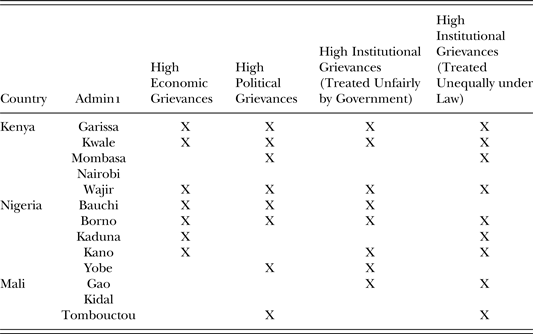
From a review of the data, Islamist violence is indeed concentrated in areas in which Muslim populations report higher-than-average grievances. In Kenya and Nigeria, at least three of the five areas in which Islamist violence was highest had higher-than-average rates of Muslim economic grievances. In Kenya, four of the five counties surveyed with the highest levels of Islamist violence have higher-than-average grievances relating to political influence and frequent unequal treatment (the exception being Nairobi). While in Nigeria, three of the five states with the highest rates of Islamist violence had higher-than-average political grievances; and four of these report higher-than-average rates of ‘Always’ being treated unfairly by the government.
In Mali, the results were less consistent: Tombouctou and Gao both registered higher-than-average grievances in relation to political and/or institutional marginalisation, although Kidal remains an outlier. Kidal is an outlier in several of the survey responses, with low numbers or no respondents reporting their economic conditions or political influence are ‘Much worse’ or ‘Much less’ than other groups, or that they are ‘Always’ treated unfairly by the government or unequally under the law. However, these responses should be viewed in light of the strong role secessionism plays in the region: specifically, a much higher share of the population in Kidal (over 80%, compared with an average of 8% elsewhere in the country) strongly disagree with statements such as ‘The courts have the right to make decisions that people always have to abide by’ (Q44A) and ‘The police always have the right to make people obey the law’ (Q44B). This suggests that while the level of grievances expressed are low, respondents in Kidal show a stronger tendency to reject the authority of the central state altogether. Responses are summarised in Table I.
Grievances among Muslim populations by category and administrative unit, Kenya, Mali and Nigeria

Source: Afrobarometer (Reference Kenya and Nigeria2008).
In religiously diverse contexts, the perception of unequal treatment under the law is also more pronounced among Muslims than Christians in areas in which Islamist violence subsequently occurs. In Kenya's Kwale, Mombasa and Nairobi, the proportion of Muslims who responded that people are ‘Always’ treated unequally under the law was one-and-a-half to four times higher in absolute terms than Christians (no Christians responded with this answer in Garissa and Wajir, while 18% and 21% of Muslims did respectively). In Kilifi, by contrast, which has witnessed very little recorded Islamist violence, but which is home to a sizeable Muslim population, Christian and Muslim respondents reported equal rates of grievances in response to questions concerning unfair treatment. Likewise in Nigeria, where Muslims and Christians both responded to the same question (in Borno and Kaduna), absolute proportions of Muslim responses were higher than Christian counterparts. When an interaction term takes into account the actual size of the Muslim and Christian populations respectively, the results hold: where both Muslim and Christian respondents answered the same questions, Muslim responses that people are ‘Always’ treated unequally under the law were on average 2·3 times larger than the rate of Christian respondents. By contrast, in the religiously diverse Nasarawa State, which has witnessed high levels of communal violence, but limited Islamist violence, reported Christian perceptions of unfair treatment were higher than Muslim counterparts.Footnote 4
These perceptions of marginalisation are also confirmed in each of the three case studies through qualitative accounts of the mobilising power of perceived marginalisation among Muslim communities. In Kenya, Al Shabaab has drawn on the perception of oppression and marginalisation among Kenyan Muslims. In May 2014, following an attack by Al Shabaab militants on Kenyan security forces close to the Somali border, a senior Al Shabaab member, Sheikh Faud Mohamed Khalaf declared: ‘We are training Muslim boys from Kenya who had been oppressed there, and we return them back there’ (quoted in Mubarak Reference Mubarak2014).
The extent to which histories of marginalisation are experienced on a religious, rather than regional or ethnic basis, helps account for the mobilisation of collective action on religious grounds. While there is extensive documentation of ethnic profiling in security service campaigns and the denial of citizenship rights such as national identity cards on an ethno-regional basis (KHRC 2009) in Kenya, interviews conducted with Muslim religious leaders and Muslim youth activists in Kenya revealed a widespread belief that discrimination is based on religious, rather than other, identity bases.
One interviewee maintained he was subject to additional vetting in his application for an identity card because he was a Muslim, emphasising that this discrimination ‘cuts across ethnicities’, since he was from Western Kenya, and therefore ethnic or ethno-regional profiling of Kenyan Somalis could not account for this perceived discrimination (A 2015 int.). Another interviewee reported similar experiences by Muslim applicants for identity cards, adding: ‘Governments must be very sensitive of how they engage their citizens. People should not feel “This is happening to me because I'm a Muslim.” Let it be cutting across, documented and in the law’ (B 2015 int.). This perception of religiously based discrimination may also reflect an innovative response to collective action problems, where discrimination on the basis of smaller, less mobilisation-compatible bases, such as marginalised ethnicities, corresponds to the collectivisation of those grievances under a larger, more collective, cross-cutting identity (Dowd Reference Dowd2015).
In Mali, militant Islamist leaders wrote in internal documents concerning military strategy about the importance of presenting the movement's ‘general logo’ as one of ‘defending Muslims from those who want to victimize them’, while supporting the local Azawad militant movement in pursuit of ‘its just cause and achieving its legitimate goals’ (Droukdel Reference Droukdeln.d.). In Nigeria, there is also evidence that Boko Haram drew on local dissatisfaction with the Nigerian government to elicit support among the population: ‘People are supporting them [Boko Haram] because the government is cheating them’, a Kano imam reported in 2012 (Nossiter Reference Nossiter2012).
In terms of the explicit role of economic incentives, in a survey of Kenyans affiliated with Al Shabaab, economic reasons were the second most-cited reason for joining the group (after ‘Religion’) (Botha Reference Botha2014: 22). Economic incentives also appear to have played a role in recruitment in Mali, where support for economic activity is one way by which violent Islamist groups supplanted the role of a largely absent state. Al Qa'eda in the Islamic Maghreb (AQIM) forged business partnerships with local elites (Cline Reference Cline2013) and engaged in service provision, functioning in some ways ‘as an Islamic charity’ (Bøas & Torheim Reference Bøas and Torheim2013: 1287). Reinforcing these actions, analysts have noted how relationships founded in trade and security arrangements were cemented through the marriages of Islamist militants to local women (Goïta Reference Goïta2011; Cline Reference Cline2013), ‘not into powerful families, but into poor local lineages, deliberately taking the side of the poor’ (Bøas & Torheim Reference Bøas and Torheim2013: 1287). Interviews in north-eastern Nigeria in 2013 also found that unemployment and poverty were the second most important reason youth join Boko Haram (following ‘ignorance of religious teaching opposed to violence’) rendering youth ‘highly vulnerable to manipulation by extremist ideologues’ (Onuoha Reference Onuoha2014: 5–6).
Combined, these results point to two conclusions: first, grievances regarding economic and political exclusion are typically higher than average in areas subsequently affected by Islamist violence, providing both a motivation and an opportunity for collective opposition. Second, in the relatively few cases where religious diversity allows us to compare perceptions among different religious groups, it is on religious grounds that this marginalisation is perceived to take place, providing a partial explanation for the mode of violence observed in these areas. In other words, where discrimination is experienced as religiously determined, that identity in turn provides the basis for collective mobilisation. In effect, the state's politicisation of particular identity categories through the marginalisation of religious groups in turn predicts the identity which will serve as the basis for mobilisation of opposition.
HISTORIES OF VIOLENCE AND TRIGGERING EXCLUSION
The findings above highlight the deeply entrenched perceptions of marginalisation among communities in areas in which Islamist violence occurs, and the ways in which militants draw on these grievances to mobilise support and recruits. However, economic and political marginalisation are widespread not only in the case studies under review, but globally, and while these conditions are contributing factors to violent mobilisation, they are not sufficient conditions for its emergence: two additional conditions explain the contexts of violence, and the escalation of that conflict subsequently.
Histories of violence
The history of violent opposition and conflict is central to the transformation of grievances into collective violence in the areas under consideration. Notably, all areas which subsequently experienced high levels of Islamist violence are also areas in which high rates of non-Islamist political violence previously occurred, although earlier forms were mobilised under different mantles. This legacy provides an opportunity for Islamist militants to capitalise on pre-existing forms of violence and reconfigure it under a different strategy. Of the areas subsequently affected by high rates of Islamist violence, four in Kenya (Garissa, Mombasa, Nairobi and Wajir), and three in Nigeria (Borno, Kaduna and Kano) had higher-than-average levels of violent events and/or violence-related fatalities per capita than other sub-national units in the preceding 1997–2008 period. In Mali, only Kidal registers higher-than-average rates across the country, but this is affected by the extremely high rates of violence per capita recorded there (over 10 violent events and 36 reported fatalities per 100,000 in the preceding period, compared with an average of under 1 and 5 respectively elsewhere in the country). If Kidal is excluded from the analysis, both Gao and Tombouctou record higher-than-average rates of violent events and/or fatalities.
These legacies of violence have been capitalised upon by Islamist militants in different ways. In Kenya, two distinct areas are affected by Islamist violence: the counties of Garissa and Wajir, near the border with Somalia; and the areas around Mombasa and Kwale in the former Coastal province. Both regions share historical claims, dating to the colonial period and its immediate aftermath, of autonomy and the right to secession (Willis & Gona Reference Willis and Gona2013), and a broadly defined sense of ‘being Muslims and “low-country” citizens in a state that is dominated by non-Muslim “up-country” Kenyans’ (Bradbury & Kleinman Reference Bradbury and Kleinman2010: 22). In the north-east, the so-called “Shifta wars” of the 1960s resulted in the imposition of administration through draconian emergency legislation, which effectively cut off the Northern Frontier District (present-day Garissa, Wajir and Mandera) from the rest of the country. Legislation restricted access to the region, and was accompanied by sporadic but devastating bouts of violence by state forces against civilian populations with the aim of sedentarising groups, and screening ethnic Somalis (Bradbury & Kleinman Reference Bradbury and Kleinman2010). In coastal Kenya, by contrast, the basis of much of the political contest in the Coastal region has not been the absence of the state, but attempts by central elites to capitalise on the resources and wealth of coastal areas. This is reflected in the centrality of land disputes and contestation over the settlement of non-indigenous populations on large swathes of coastal land (Boone Reference Boone2012), while concomitantly sustaining the under-development of the region through the neglect of basic services, infrastructure and economic opportunities (Kivuva Reference Kivuva2012).
Al Shabaab operatives have harnessed these experiences of violence at the hands of the state to mobilise opposition. The group has actively drawn on pre-existing cleavages of conflict and contestation in Kenya. Al Shabaab violently intervened in the issue of land ownership in Kenya's Coast when it carried out an attack on Mpeketoni, home to Christian land owners considered non-indigenous to the region, and a symbol of politicised ethnicity in Kenya. Likewise, the group sought to provoke further violence through a wave of attacks targeting clan elders seeking to broker peace between warring factions in Mandera and Wajir (Bosire Reference Bosire2014). In these ways, it is clear that not only has Islamist violence occurred in sites of previous violence, but the very language and targeting of Islamist violence cannot be divorced from domestic politics and historical violence in the state.
A similar pattern is evident in Mali, which has a long history of recurring cycles of violence in its northern region. These cycles of violence have sought greater autonomy for the population of the northern region – particularly among the Tuareg ethnic group, who dominated leadership of previous uprisings. Successive efforts were undertaken to decentralise power followed by recurring conflicts, although the implementation of these reforms fell far short of their expected effect of increasing vertical accountability, and may have instead increased opportunities for corruption and capture at the local level (Wing Reference Wing2013). Having established themselves as key providers of security and public goods in the region, violent Islamist groups forged strategic relationships with key local elites with a history of mobilising and leading violence against the state. Among these leaders was Iyad ag Ghali, the leader of the domestic Malian Islamist group, Ansar Dine, whose role in subsequent conflict reflects the interconnectedness of these discrete forms of conflict (Lind & Dowd Reference Lind and Dowd2015; Walther & Christopoulos Reference Walther and Christopoulos2015).
Critically, an overarching Islamist identity did not entirely supplant previous forms of violence: Ansar Dine was primarily constituted of ethnically Tuareg militants, which were themselves subject to considerable factionalism and ‘vertical fragmentation’ along lineage and caste lines; while the Movement for Oneness and Jihad in West Africa (MUJAO) drew on racial and ethnic tensions to recruit among Fulani and other groups (de Sardan Reference de Sardan2013: 28, 35). Effectively, while an overarching Islamist mantle may have given the impression of relative homogeneity in these complex social contexts, the histories of violence and conflicting rivalries among communities in the area were critical to the ability of diverse groups to mobilise support and recruitment.
The states in Nigeria which have subsequently experienced Islamist violence also have a long history of violent conflict, including the Maitatsine riots which took place in states across the north in the 1980s (Adesoji Reference Adesoji2011). In Yobe and Borno states, political elites have also relied on militia forces to intimidate opponents, among them ‘ECOMOG’ militias, named after the Nigerian forces in Sierra Leone and Liberia (Reno Reference Reno2002: 847). Interviews with diaspora civil society activists from Borno state revealed a perception that political elites in power at state level at the time of Boko Haram's emergence played an important role in the establishment and arming of non-state groups, through their concerted support for ECOMOG militias, pre-empting clashes in 2009 (C 2014 int.). The states have also experienced sporadic outbursts of inter-communal conflict and communal militia violence against civilians marks the timeline of each of the five states from 1997–2008. Inter-communal violence has primarily occurred along religious lines, either between Christian and Muslim populations, or along sectarian lines among Muslim populations. A significant minority of these events are recorded as concerning ethnic tensions, pointing to underlying cleavages. As in Mali, there is evidence to suggest that ethnic dynamics and competition shaped recruitment and establishment of rival Islamist militias: Boko Haram has been described as dominated by members of the Kanuri ethnic group (Agbiboa Reference Agbiboa2013; Zenn Reference Zenn2013). Interviews with captured members of the group indicate that the organisation's leader, Abubakar Shekau, favoured ethnically Kanuri members. By contrast, Ansaru membership is reported to be drawn more directly from the Fulani ethnic group (Zenn Reference Zenn2013; Baca Reference Baca2015). The interaction between ethnic cleavages along which lines conflict had already occurred, and mobilisation under a collective mantle suggests the salience and efficacy of Islamist militant organisations in harnessing and reformulating legacies of violence.
This history of pre-existing violence is significant for several reasons. Theoretically, it highlights the importance of conceptualising Islamist violence not as a sudden disruption to politics and stability in otherwise peaceful states, but as an extension of the practices of politics endogenous to these states themselves. Effectively, each of these regions has experienced high levels of political violence: this means that violent confrontation is part of the toolkit of political opposition in these states, and is an established means by which groups seek to address issues of governance, distribution and power. Furthermore, the organisation, recruitment and targeting of violence along familiar ethnic, regional and political cleavages in all three countries, points to the centrality of previous conflict in the mobilising strategies of violent Islamists in all three contexts.
Key triggering events
There is also evidence that triggering events are linked to the onset and escalation of violence in each case study. Triggering events are not conditions for violence in themselves, but interact with grievances and a history of conflict to explain the timing and escalation of conflict in each case. State actions can help explain why violence moved from being a nascent, but relatively marginal, aspect of Islamist movements in these case studies in the pre-2009 period, to a widespread phenomenon thereafter. In each case, a critical triggering event demarcated a movement from the existing exercise of political marginalisation, to even greater levels of exclusion by the state. In such contexts, the combination of grievances, pre-existing forms of violent confrontation, and limited opportunities to affect change through non-violent channels can mean, in the eyes of militants, that ‘rebellion [becomes] a legitimate strategy for countering repressive state policies’ (Hafez Reference Hafez2003: 103).
Kenya has experienced sporadic outbreaks of Islamist violence in recent decades, but a major intensification of this violence took place after the launch of Operation Linda Nchi, in which Kenya sent military forces into Somalia. In the decade preceding the October 2011 incursion, violent Islamist events occurred in Kenya at a rate of 0·19 per month; and at a rate of 0·75 per month in the twelve months immediately preceding the incursion. Since October 2011, violent Islamist events have occurred in Kenya at a rate of approximately 5·2 per month, with a concomitant escalation in the rates of fatalities associated with this violence.
The campaign has had two related effects on Islamist violence within Kenya. The first is in the mobilising effect it has had on portions of the Kenyan Muslim population who felt solidarity with Muslims in Somalia (even among those who were not of Somali ethnicity within Kenya). In May 2014, the Al Shabaab Emir, Ahmed Godane, called on Muslims in Kenya to rise up against the state, and warned the Kenyan government that it had made an historic mistake by attacking Al Shabaab in Somalia, warning that the government should not do ‘a second stupid thing’ by further targeting Muslims in Somalia, because ‘The Westgate Operation is not far off from you’ (quoted in Mubarak Reference Mubarak2014). Drawing on the same logic, an alleged Kenyan former Al Shabaab fighter explained his motivation for joining Al Shabaab, thusly ‘Kenyan soldiers, Ugandan soldiers, they're killing people in Somalia … It's said in the Koran if you fight jihad, you'll go to heaven. For me it's not a jihad, it's like a retaliation’ (Lowen Reference Lowen2014).
The second way in which it has impacted grievances and mobilisation among Islamist militants is that it has also been accompanied by an intensification of repressive tactics used against Muslim and ethnically Somali populations within Kenya. This occurred first under the auspices of attempts to relocate Somali refugees resident in Nairobi to the Dadaab refugee camp in the north-east of the country in 2012 (BBC News 18.12.2012), the announcement of plans to repatriate Somali refugees resident in Kenya (BBC News 11.11.2013), and then by the expansion of security sweeps and ethnically profiled arrests under Operation Usalama Watch in 2014 (Amnesty International 2014; Botha Reference Botha2014). While these campaigns have primarily (though not exclusively) targeted ethnically Somali Kenyans, Muslim populations in Coastal Kenya have also witnessed an intensification of repressive responses by the state to increased Islamist violence in Kenya, including raids, arrests and abuse in custody of Muslim suspects (MUHURI 2013). The assassination of several Muslim clerics (MUHURI 2013), which many believe to have been perpetrated by the paramilitary Anti-Terrorism Police Unit, has further escalated tensions and been directly linked to subsequent rioting and unrest in Mombasa. Survey results from Al Shabaab members in Kenya appear to confirm the centrality of perceptions of violent government and collective punishment of Muslims as motivating factors for joining the organisation: 65% referred to the government's counter-terrorism strategy, while others pointed to the assassination of Muslim leaders and extra-judicial killings of Muslims (Botha Reference Botha2014: 20).
Escalation in Nigeria also surrounds a critical event: the April 2011 general elections. Although the group emerged prior to this period, and engaged in clashes with security forces in 2009, the frequency of the group's activity intensified in the run-up to and following the general elections. Between January 2009 and November 2010 (six months prior to the elections), Boko Haram activity averaged around 1·6 events per month; this increased to an average of 10 events per month in the six month periods surrounding the elections; and just under 30 events per month from December 2011 onwards (source: ACLED).
The election was significant for a number of reasons, chief among them was the declaration by incumbent President Goodluck Jonathan that he would run as a candidate, with Jonathan's victory effectively ending the informal system of rotation of presidency between southern Christians and northern Muslims. The effect of this development was to create an opportunity for elite sponsors to use the nascent Islamist militant organisation as a militia to push for greater northern political inclusion and representation (Africa Confidential 2012). During the electoral period itself, at least some of the group's violence was explicitly focused on the election process: Boko Haram engaged in deliberate acts of violence against campaign events, rallies, polling stations and electoral offices (Thurston Reference Thurston2011). There are persistent allegations that Boko Haram is funded by disgruntled politicians seeking to shift the balance of power in favour of northern elites (IRIN 2011), further reinforcing the central role of the elections and contests for power in the evolution of the group. In the subsequent years, the campaign of violence by Boko Haram has expanded far beyond serving as a militia which initially primarily targeted security forces in the north (Dowd Reference Dowd2013) and has become increasingly associated with violence against civilians. However, a critical juncture in the escalation of the group's activity can be identified in the period surrounding the election of 2011.
In Mali, the trigger for the 2012 coup, which subsequently created the opportunity for the large-scale campaign of violence by Islamists, was withdrawal of national military forces from parts of the north following a wave of violence there, speaking to both the limited capacity of the state's forces, and the region-specific challenges it faced in the north. The strategic choices made by Islamist militants to integrate themselves into particularly marginalised communities in northern Mali highlights the ways in which the recurring cycle of ethno-regional rebellions was interrupted by a transformation of this conflict into one mobilised around Islamist ideology and goals. Having established themselves as key providers of security and public goods in the region, Islamist groups then forged strategic relationships with key local elites with a history of mobilising and leading violence against the state.
Together, these cases point to a third necessary condition for the emergence of widespread Islamist violence. Building on the prevalence of grievances among Muslim populations, and legacies of violent conflict in all three regions, the expansion of exclusionary practices which are seen to further entrench marginalisation, and further limit peaceful modes of affecting change, were key to the dramatic escalation of Islamist violence subsequently witnessed in all three cases.
SUB-NATIONAL VARIATION
The accounts above reveal that marginalisation of Muslim communities; histories of violence; and key triggering events have played pivotal roles in the emergence and escalation of Islamist violence in Kenya, Mali and Nigeria. Examining sub-national variation in these factors also helps explain the absence or lower levels of violence within and across the same countries.
The absence of grievances can in part explain the absence of Islamist violence in areas with otherwise similar demographic characteristics. For example, parts of North-West Nigeria, such as Sokoto and Zamfara, which have experienced relatively limited Islamist violence, also reported relatively limited grievances, nor are there consistently high rates of grievances in regions of Mali such as Ségou and Mopti. The same is true in parts of Kenya in which there are sizeable Muslim populations, such as Machakos and Siaya.
The historical experience of conflict also shapes the geography of subsequent violence. The northern Nigerian states of Jigawa and Kebbi, the Malian regions of Kayes and Koulikouro, and the Kenyan county of Kilifi, all have comparably high levels of reported grievances among Muslim populations. However, with very low rates of historical violence in each of these locations, the opportunities for violent Islamists to mobilise support are more limited, reflected in the extremely limited scope of Islamist violence.
A small number of sub-national units appear to have both a high level of grievances and a history of previous violence, but do not currently witness high levels of Islamist violence. The most prominent of these cases is Marsabit County, Kenya, where both grievances and historical violence are high. Significantly, however, these areas are invariably high-violence, although they have yet to experience high rates of Islamist violence. This exception suggests there is an alternative privileging of identity, likely around contests over power locally. If the theory outlined in this paper holds, Marsabit may be vulnerable to the reconfiguration of existing conflict into Islamist violence in the near future.
CONCLUSIONS
This article highlighted key similarities and common features across otherwise diverse religious, ethnic, political and geographic contexts in which Islamist violence has occurred. The analysis indicates that Islamist violence occurs in areas with the following three characteristics: high levels of economic, political and institutional grievances among Muslim populations; a history of pre-existing violent conflict in other forms in the area; and the expansion or intensification of this marginalisation through key triggering events in each country.
These findings underscore a new approach to Islamist violence based on local experiences and perceptions of governance, inclusion and marginalisation. In contrast to narratives emphasising the unique nature of Islamist violence, evidence indicates that tenets within Islam cannot explain the sub-national variation in locations and levels of Islamist violence: in other words, even within the same countries, members of the same religious groups may experience marginalisation differently, and may be susceptible to the transformation of existing conflict, in ways which predict the locations and intensity of violence in these sub-national spaces.
The analysis highlights the limitations of relying on conventional theories of Islamist violence, including theories of religious violence, and the diffusion of militants, as convincing explanations for its emergence. Neither theory can explain the specific locations in which Islamist violence emergences, nor does either integrate considerations of the political, economic and institutional relations of these sub-national spaces to interrogate why communities in these areas might mobilise under this mantle. In spite of a tendency to emphasise the uniqueness of Islamist violence, this form of conflict can be understood by applying and expanding grievance-based theories of violence.
While marginalisation may be a necessary condition for the emergence of Islamist violence, it is not sufficient, and the history and legacy of both state relations, and the collective mobilisation of opposition groups in sub-national spaces are central factors in explaining the mechanism connecting these two conditions. Specifically, the history of violence in subsequently Islamist-affected areas points to the value of conceptualising Islamist violence not as a global phenomenon which disrupts otherwise peaceful political processes and relations, but as a function of those relations themselves. The ways in which states marginalise and privilege different areas and identity groups in turn becomes the basis on which opposition is mobilised: where religion serves as a condition for exclusion, marginalisation and unfair treatment, it can in turn be manipulated by conflict entrepreneurs to serve as a principle around opposition is organised.
Effectively, exclusionary and marginalising state engagement with religious communities creates opportunities for the exploitation of the grievances it produces. This understanding has implications beyond theorising the emergence of violence, but also in the responses to it: where state actions have further reinforced and entrenched the exclusion and marginalisation of Muslim populations through religious and ethno-religious profiling, this is likely to only underscore the perceived legitimacy of these identity groups as grounds for collective action.