Introduction
Several studies suggest that pre-adult and adult onset major depressive disorder (MDD) are two distinct forms of MDD in terms of pathophysiology and phenomenology (see review by Kaufman et al. Reference Kaufman, Martin, King and Charney2001). Diagnostic criteria according to the Diagnostic and Statistical Manual of Mental Disorders – Text Revision (DSM-IV-TR) for MDD are independent of the age at onset of the first major depressive episode (MDE) (APA, 2000). This contrasts with dysthymic disorder, for which the DSM-IV-TR makes a distinction in age at onset before or after 21 years of age (early onset and late onset, respectively).
In previous studies, demographic characteristics of pre-adult versus adult onset MDD were female gender, being unmarried (Benazzi, Reference Benazzi2000; Zisook et al. Reference Zisook, Rush, Albala, Alpert, Balasubramani, Fava, Husain, Sackeim, Trivedi and Wisniewski2004, Reference Zisook, Lesser, Stewart, Wisniewski, Balasubramani, Fava, Gilmer, Dresselhaus, Thase, Nierenberg, Trivedi and Rush2007a), impaired social and occupational functioning (Zisook et al. Reference Zisook, Lesser, Stewart, Wisniewski, Balasubramani, Fava, Gilmer, Dresselhaus, Thase, Nierenberg, Trivedi and Rush2007a) and lower education (Parker et al. Reference Parker, Roy, Hadzi-Pavlovic, Mitchell and Wilhelm2003). The course of the depressive disorder also differed significantly in some studies, with pre-adult onset MDD being associated with more depressive episodes (Klein, Reference Klein1999; Benazzi, Reference Benazzi2000; Ramklint & Ekselius, Reference Ramklint and Ekselius2003; Zisook et al. Reference Zisook, Rush, Albala, Alpert, Balasubramani, Fava, Husain, Sackeim, Trivedi and Wisniewski2004, Reference Zisook, Lesser, Stewart, Wisniewski, Balasubramani, Fava, Gilmer, Dresselhaus, Thase, Nierenberg, Trivedi and Rush2007a) and more chronicity (Klein, Reference Klein1999; Benazzi, Reference Benazzi2000; Parker et al. Reference Parker, Roy, Hadzi-Pavlovic, Mitchell and Wilhelm2003; Zisook et al. Reference Zisook, Rush, Albala, Alpert, Balasubramani, Fava, Husain, Sackeim, Trivedi and Wisniewski2004, Reference Zisook, Lesser, Stewart, Wisniewski, Balasubramani, Fava, Gilmer, Dresselhaus, Thase, Nierenberg, Trivedi and Rush2007a, Reference Zisook, Rush, Lesser, Wisniewski, Trivedi, Husain, Balasubramani, Alpert and Favab; Coryell et al. Reference Coryell, Solomon, Leon, Fiedorowicz, Schettler, Judd and Keller2009). In addition, pre-adult MDD patients showed more suicidality (Benazzi, Reference Benazzi2000; Zisook et al. Reference Zisook, Rush, Albala, Alpert, Balasubramani, Fava, Husain, Sackeim, Trivedi and Wisniewski2004, Reference Zisook, Lesser, Stewart, Wisniewski, Balasubramani, Fava, Gilmer, Dresselhaus, Thase, Nierenberg, Trivedi and Rush2007a, Reference Zisook, Rush, Lesser, Wisniewski, Trivedi, Husain, Balasubramani, Alpert and Favab; Thompson, Reference Thompson2008), a higher amount of medical co-morbidity (Zisook et al. Reference Zisook, Lesser, Stewart, Wisniewski, Balasubramani, Fava, Gilmer, Dresselhaus, Thase, Nierenberg, Trivedi and Rush2007a), more familiality of depression (Klein, Reference Klein1999; Parker et al. Reference Parker, Roy, Hadzi-Pavlovic, Mitchell and Wilhelm2003; Kendler et al. Reference Kendler, Gatz, Gardner and Pedersen2005; Zisook et al. Reference Zisook, Rush, Lesser, Wisniewski, Trivedi, Husain, Balasubramani, Alpert and Fava2007b) and more alcohol and drug abuse (Klein, Reference Klein1999; Parker et al. Reference Parker, Roy, Hadzi-Pavlovic, Mitchell and Wilhelm2003; Zisook et al. Reference Zisook, Rush, Lesser, Wisniewski, Trivedi, Husain, Balasubramani, Alpert and Fava2007b). Early childhood risk factors such as motor skill deficits, perinatal insults and caretaker instability, criminality and psychopathology in the families of origin were associated with pre-adult onset MDD in a birth cohort that had been followed from childhood up to age 26 years (Jaffee et al. Reference Jaffee, Moffitt, Caspi, Fombonne, Poulton and Martin2002). Taken together, these data suggest that pre-adult onset MDD points towards a more severe form of illness.
Previous investigations have been undertaken in various study populations, using varying study designs. Prospective findings from a New Zealand birth cohort suggested that both heritable and childhood psychosocial factors contributed to a pre-adult onset of depression (Jaffee et al. Reference Jaffee, Moffitt, Caspi, Fombonne, Poulton and Martin2002). These findings were consistent with results from family studies, which suggested that pre-adult onset MDD might be more strongly associated with genetic factors and early childhood psychosocial risk factors (Kovacs et al. Reference Kovacs, Devlin, Pollock, Richards and Mukerji1997; Neuman et al. Reference Neuman, Geller, Rice and Todd1997; Klein et al. Reference Klein, Lewinsohn, Seeley and Rohde2001). Several studies reported a different course of illness of pre-adult onset and adult onset MDD. Adolescent MDD has been associated with elevated rates of subsequent MDEs in early adulthood in prospective case–control studies (Harrington et al. Reference Harrington, Fudge, Rutter, Pickles and Hill1990; Weissman et al. Reference Weissman, Wolk, Goldstein, Moreau, Adams, Greenwald, Klier, Ryan, Dahl and Wickramaratne1999). Yet, most studies used cross-sectional designs in selected populations. In three analyses in the Sequenced Treatment Alternatives to Relieve Depression (STAR*D) Study population (Zisook et al. Reference Zisook, Rush, Albala, Alpert, Balasubramani, Fava, Husain, Sackeim, Trivedi and Wisniewski2004, Reference Zisook, Lesser, Stewart, Wisniewski, Balasubramani, Fava, Gilmer, Dresselhaus, Thase, Nierenberg, Trivedi and Rush2007a, Reference Zisook, Rush, Lesser, Wisniewski, Trivedi, Husain, Balasubramani, Alpert and Favab), using data from over 4000 selected MDD patients, the most prominent findings in pre-adult onset MDD patients were more psychiatric co-morbidity and more suicidality. These findings were largely consistent with the findings in a large US community sample of 9282 people (Thompson, Reference Thompson2008).
It is well established that clinical treatment samples may be prone to selection bias, whereas population-based samples may not reflect a treatment-seeking population either (Zimmerman et al. Reference Zimmerman, Mattia and Posternak2002). Since data on naturalistic patients are generally considered to represent ‘real-life patients’ more closely than selected populations, naturalistic data on differences between pre-adult onset versus adult onset MDD would be of great value. Therefore, the aim of the present study was to evaluate differences in demographic correlates, co-morbidity, symptomatology and general health status between pre-adult and adult onset MDD in a large naturalistic out-patient sample from psychiatric specialty care. We used the Leiden Routine Outcome Monitoring Study baseline sample (de Beurs et al. Reference de Beurs, den Hollander-Gijsman, van Rood, van der Wee, Giltay, van Noorden, van der Lem, van Fenema and Zitman2010; van Noorden et al. Reference van Noorden, Giltay, den Hollander-Gijsman, der Wee, van Veen and Zitman2010). We hypothesized that pre-adult onset MDD would be characterized by markers of greater severity as compared with adult onset MDD. Pre-adult onset of MDD was defined as first MDE before the age of 18 years.
Methods
Study design
The Leiden Routine Outcome Monitoring Study baseline cohort sample comprised 3798 adult out-patients who were referred for treatment of a mood, anxiety or somatoform (MAS) disorder to the Dutch Regional Mental Health Provider, Rivierduinen (RD) or the psychiatric out-patient department of the Leiden University Medical Center (LUMC) in the Western part of the Netherlands, between January 2004 and December 2006 (de Beurs et al. Reference de Beurs, den Hollander-Gijsman, van Rood, van der Wee, Giltay, van Noorden, van der Lem, van Fenema and Zitman2010; van Noorden et al. Reference van Noorden, Giltay, den Hollander-Gijsman, der Wee, van Veen and Zitman2010). At baseline, subjects were assessed as part of the routine outcome monitoring (ROM) procedure. In ROM, all patients referred to RD or LUMC for treatment of a MAS disorder are routinely assessed, at baseline and at fixed intervals during treatment, with an extensive battery of psychometric instruments administered by specially trained research nurses. ROM is a method for the systematic collection of data on the diagnostic status and severity of complaints to assess the effectiveness of treatments in everyday clinical practice. The only exclusion criteria for ROM are insufficient mastery of the Dutch language and inability to perform the assessment procedure due to severity of symptoms. In practice, >80% of the patients referred to the LUMC or RD for treatment of a MAS disorder are enrolled in ROM. During the first session, psychopathology was assessed with the Dutch translation of the MINI International Neuropsychiatric Interview Plus 5.0.0.-R, structured diagnostic interview (MINI-Plus) developed to assess the presence of Axis I disorders according to the DSM-IV-TR diagnostic criteria (Sheehan et al. Reference Sheehan, Lecrubier, Sheehan, Amorim, Janavs, Weiller, Hergueta, Baker and Dunbar1998; van Vliet & de Beurs, Reference van Vliet and de Beurs2007). The MINI-Plus has been validated with the Composite International Diagnostic Interview (WHO, 1990) diagnoses and has good psychometric properties (Lecrubier et al. Reference Lecrubier, Sheehan, Weiller, Amorim, Bonora, Sheehan, Janavs and Dunbar1997). Patient data were stored anonymously in the Psychiatric Academic Registration Leiden database and were accessible for research purposes only. This procedure has been approved by the Medical Ethical Committee of the LUMC. For the present study, only the baseline ROM data were used.
Study population
In the present analyses, all patients with a current DSM-IV-TR MDD diagnosis according to the MINI-Plus (age range 20–65 years) were included. We used only baseline ROM assessments, administered at intake. No distinction was made between MDD as principal or co-morbid diagnosis. Concomitant current DSM-IV-TR disorders were also recorded. The presence of DSM-IV-TR melancholical features of depression was systematically assessed with the MINI-Plus, whenever the DSM-IV-TR criteria for MDD were fulfilled. Patients with a bipolar disorder or lifetime psychotic illness were excluded, but a diagnosis of psychotic depression was allowed. Only patients with complete data on all variables of interest were included in the initial analyses. Altogether, 1552 (40.9%) of 3798 patients fulfilled the DSM-IV-TR criteria of MDD, current episode on the MINI-Plus and were aged 20–65 years. Of these 1552 MDD patients, 1105 (71.2%) had complete data on all variables of interest and were included in the present analyses. The excluded 447 patients differed statistically significant in age (mean age=40.6 v. 39.3 for included patients, respectively; t=2.06, p=0.04), age at onset (mean age=31.4 v. 28.3 for included patients, respectively; t=4.21, p<0.001), Montgomery–Asberg Depression Rating Scale (MADRS) score (mean score 24.2 v. 25.5 for included patients, respectively; t=−2.54, p=0.02), but not in gender, total Brief Symptom Inventory (BSI) score, current suicidal thoughts or history of suicide attempts.
Age of onset
Age of onset of MDD was defined as the age at which the first MDE initiated, regardless of whether treatment was sought. In the MINI-Plus, when a current MDD was diagnosed, the age at onset of the first episode was assessed by the question: ‘How old were you when you first experienced these symptoms of depression, for at least 2 weeks?’ In our study, we defined pre-adult onset of MDD as an onset of MDD before age 18 years, in accordance with the existing literature on this subject. Various cut-off points to distinguish between pre-adult and adult onset MDD have been used in previous studies. Cut-off ages varied from 17 (Jaffee et al. Reference Jaffee, Moffitt, Caspi, Fombonne, Poulton and Martin2002), 18 (Fava et al. Reference Fava, Alpert, Borus, Nierenberg, Pava and Rosenbaum1996; Alpert et al. Reference Alpert, Fava, Uebelacker, Nierenberg, Pava, Worthington and Rosenbaum1999; Benazzi, Reference Benazzi2000; Zisook et al. Reference Zisook, Rush, Albala, Alpert, Balasubramani, Fava, Husain, Sackeim, Trivedi and Wisniewski2004, Reference Zisook, Lesser, Stewart, Wisniewski, Balasubramani, Fava, Gilmer, Dresselhaus, Thase, Nierenberg, Trivedi and Rush2007a, Reference Zisook, Rush, Lesser, Wisniewski, Trivedi, Husain, Balasubramani, Alpert and Favab), 21 (Klein, Reference Klein1999), 25 (Parker et al. Reference Parker, Roy, Hadzi-Pavlovic, Mitchell and Wilhelm2003) and 26 (Ramklint & Ekselius, Reference Ramklint and Ekselius2003) to 30 (Thompson, Reference Thompson2008) years and despite the lack of widely accepted consensus most authors use a cut-off age of 18 years. In sensitivity analyses we re-analysed our data with a cut-off age of 25 years (see Statistical analyses).
Other variables
Demographic variables were obtained using a self-report questionnaire that assessed ethnic background, marital status, housing situation, educational status and employment status. A Dutch ethnic background was assumed when the patient and both parents were born in The Netherlands.
Depression severity was assessed with MADRS (Montgomery, Reference Montgomery1979), a 10-item observer-rated scale that measures symptoms of depression on a 7-point Likert-scale. The MADRS has a good internal consistency and reliability (Montgomery, Reference Montgomery1979). In addition to the continuous measure, three categories were distinguished: a MADRS score of <20 for mild depression; 20–35 for moderate depression; ⩾35 for severe depression (Snaith, Reference Snaith1986; Muller, Reference Muller2003). Post hoc, we analysed MADRS item 10, which assesses suicidal thoughts. We dichotomized in symptom absent if the score was 0 or 1 and symptom present if the score was ⩾2. The Brief Anxiety Scale (BAS), an observer-rated scale that measures symptoms of anxiety, was used to assess severity of anxiety (Tyrer et al. Reference Tyrer, Owen and Cicchetti1984). General psychopathological symptoms were scored on the BSI. The BSI is a short version of the Symptom Check List, a self-report instrument that measures psychopathological symptoms in several domains, e.g. somatic symptoms, depressive symptoms, anxiety symptoms and hostility on a 5-point Likert-scale (Derogatis & Melisaratos, Reference Derogatis and Melisaratos1983; de Beurs & Zitman, Reference de Beurs and Zitman2006). The BSI has shown good internal consistency, reliability and validity (Derogatis, Reference Derogatis1977). In addition to the BSI total score, we studied presence of specific symptoms on the depressive and anxiety subscales of the BSI. A score of 0 or 1 on each individual item was defined as the absence of a symptom, whereas a score of 2, 3 or 4 was defined as the presence of a symptom. A history of suicide attempts and current suicidal thoughts was assessed with the MINI-Plus. In section C of the MINI-Plus, the following questions were asked respectively: ‘Did you ever in your life try to commit suicide?’ and ‘During the past month, did you ever think about suicide?’
Co-morbid DSM-IV-TR disorders, e.g. anxiety disorders, somatoform disorders and alcohol- or drug-related disorders were also assessed with the MINI-Plus. Generic health status was assessed with the Dutch version of the Short-Form-36 health survey (SF-36), a 36-item self-report questionnaire that measures health status in eight domains: physical functioning; role limitations due to physical health; bodily pain; general health perceptions; vitality; social functioning; role limitations due to emotional problems; mental health (Ware & Sherbourne, Reference Ware and Sherbourne1992; Aaronson et al. Reference Aaronson, Muller, Cohen, Essink-Bot, Fekkes, Sanderman, Sprangers, te Velde and Verrips1998).
Statistical analyses
All group comparisons were made between pre-adult onset (age <18 years) and adult onset (age ⩾18 years) MDD groups. For continuous data, t tests for independent samples were used, while categorical data were analysed with χ2 tests. In all previous cross-sectional studies, the pre-adult onset MDD patients were younger than adult onset MDD patients at the time of assessment. Despite the fact that many studies adjusted for age, residual confounding by age at interview is possible as several demographic factors are highly associated with age (e.g. marital status, duration of disease and co-morbidity). Therefore, we stratified the study population into two age strata (20–40 and 40–65 years of age at interview). If both age strata would yield similar associations and odds ratios (OR), the confounding effects by age are likely to be small. Stratification based on the age of 40 years was chosen because this age is generally considered to be the beginning of middle age and it was close to the median age of the sample (i.e. 38 years). Also, it was assumed that the associations between the clinical characteristics and age at onset would vary by gender. Therefore, we also made adjustments for gender and current age by including these characteristics in a logistic regression model with forced entry (adjusted analysis). To account for the potential curvilinear confounding effects of age, a quadratic term (age-squared) was added to the model. In the logistic regression model, we analysed the univariate findings with a p<0.1 in the two age strata and the combined group. Sensitivity analyses were performed, in which patients with an age at interview of 20–25 years were excluded from the analyses to rule out the possibility that any differences in outcome could be explained by the very short disease duration. Sensitivity analyses were subsequently performed on the complete sample of 1552 MDD patients while using multiple imputations of missing data. Finally, sensitivity analyses were performed, in which a cut-off age of 25 instead of 18 years was used to distinguish between pre-adult onset and adult onset MDD. The statistical significance was set at p<0.05. When appropriate, Bonferroni correction for multiple testing was applied. Statistical analysis was carried out using the SPSS version 17.0 for Windows (SPSS Inc., USA).
Results
Sociodemographic characteristics
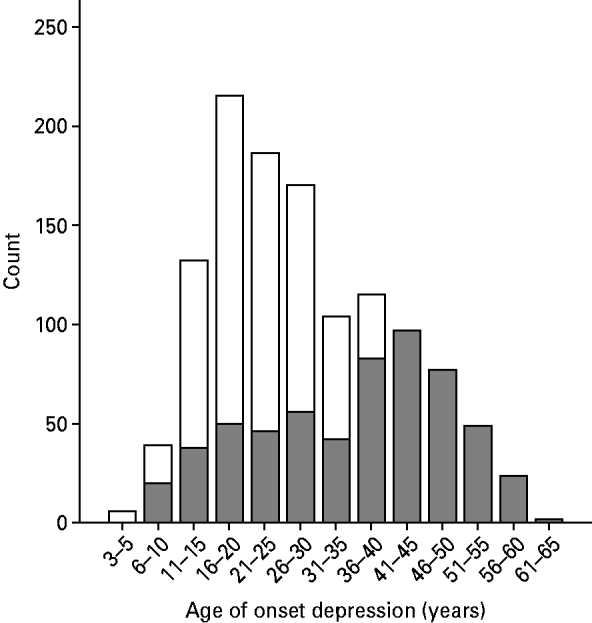
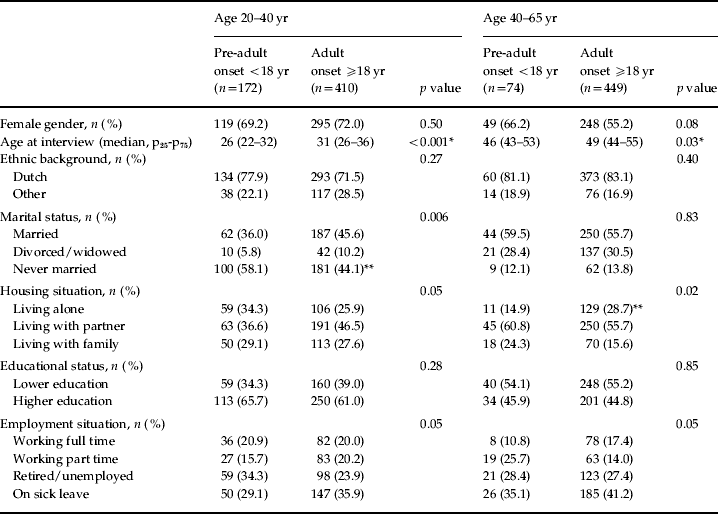
The sample consisted of 711 women and 394 men (35.7%). The mean age of the subjects was 39.2 (s.d.=11.6) years (range 20–65). Fig. 1 illustrates the distributions of age at onset of MDD and age at interview of the 1105 patients. In Table 1, the sociodemographic characteristics of the study population are presented. In total, 246 patients (22.3%) had an early onset form of MDD. These patients were younger than adult onset patients at the time of interview in both strata [in the 20–40 years group, median age=25 v. 31 years, respectively (p<0.001); in the 40–65 years group, median age=46 v. 49 years (p=0.03)]. No difference in ethnic background was found between pre-adult and adult onset groups.
Distribution of age at onset of depression in 1105 outpatients with current major depressive disorder. Age at interview: □, <40 years;  , ⩾40 years.

Sociodemographic characteristics according to age at onset in 1105 out-patients aged between 20 and 65 years with major depressive disorder

* Mann–Whitney non-parametric test.
** Indicates significant difference post hoc with χ2 test after Bonferroni correction.
Univariate analyses
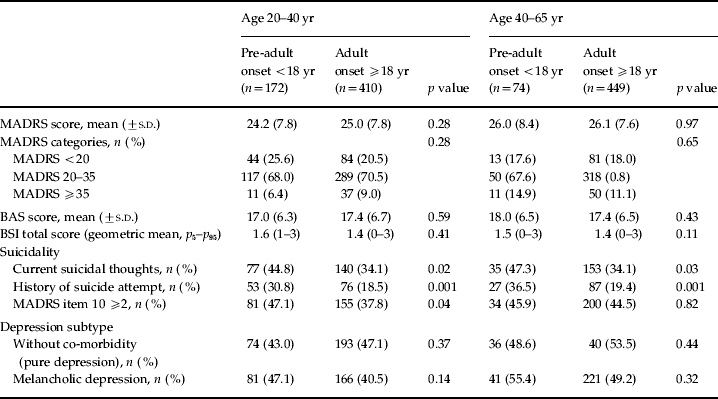
Table 2 shows the relationship between age at onset and rating scale scores and subtype of depression. The main difference was that patients with pre-adult onset MDD had a history of suicide attempts significantly more often (in the 20–40 years group, 30.8% v. 18.5%, p<0.001; in the 40–65 years group, 36.5% v. 19.4%, p<0.001). No differences between the groups were found in MADRS continuous scores or in MADRS categories. Only in the 20–40 years group, pre-adult onset patients more often had a positive score on the MADRS suicidality item (47.1% v. 37.8%, p=0.04). No significant differences were found between the early and adult onset groups on the BSI or BAS scores, or in the presence of subtypes of depression.
Rating scale scores and subtype of depression according to age at onset in 1105 out-patients aged between 20 and 65 years with major depressive disorder

MADRS, Montgomery–Åsberg Depression Rating Scale; BAS, Brief Anxiety Scale; BSI, Brief Symptom Inventory.
Furthermore, we analysed the differences between pre-adult onset and adult onset groups on the symptom level by focusing on the anxiety and depression subscales of the BSI. Significant differences in univariate analyses were found for the following two items only: ‘thoughts of ending your life’ and ‘feeling hopeless about the future’. Consistent with ‘suicidal thoughts’ on the MINI-Plus, these affirmative answers from the depression subscale were more prevalent in patients with pre-adult onset than adult onset MDD (data not shown).
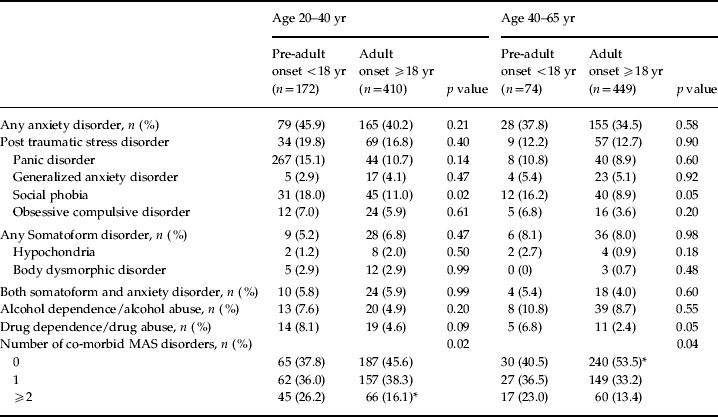
Table 3 summarizes the presence of co-morbid DSM-IV-TR disorders according to age at onset in each group, in univariate analyses. Pre-adult onset individuals had increased rates of co-morbid social phobia, but no differences were found in the rates of other DSM-IV-TR anxiety disorders.
Current co-morbidity according to age at onset in 1105 out-patients with major depressive disorder

MAS, Mood, anxiety or somatoform.
* Indicates significant difference post hoc with χ2 test after Bonferroni correction.
Patients with a pre-adult onset MDD were more likely to be dependent on drugs or to abuse drugs and had a higher number of co-morbid MAS disorders.
No differences were found for any of the SF-36 subscale scores between pre-adult onset and adult onset MDD patients (data not shown).
Multivariate and sensitivity analyses
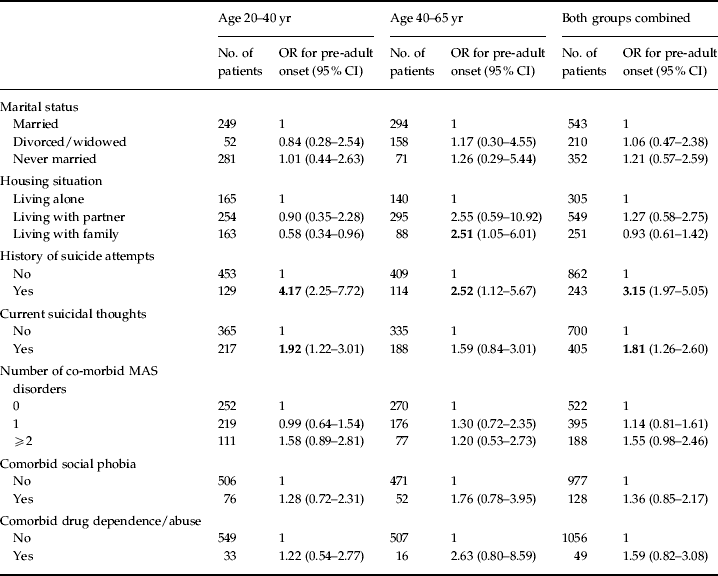
The results of the multivariate analyses are presented in Table 4. After adjusting for age at interview and gender, in both strata pre-adult onset MDD patients significantly more often had a history of suicide attempts compared with adult onset MDD patients [OR in 20–40 years group 4.17, 95% confidence intervals (CI) 2.25–7.72; OR in 40–65 years group 2.52, 95% CI 1.12–5.67]. Furthermore, pre-adult patients in the 20–40 years group and in the combined groups more often had current suicidal thoughts. In the 40–65 years group, a non-significant trend was found. In the combined groups, the OR for having a history of suicide attempts in pre-adult onset MDD patients was 3.15 (95% CI 1.97–5.05) and the OR for having current suicidal thoughts was 1.81 (95% CI 1.26–2.60). Results of sensitivity analyses as described in Method section were as follows. In a first sensitivity analysis when excluding all patients between 20 and 25 years, the OR for a history of suicide attempts and current suicidal thoughts remained largely unchanged (2.75 and 1.66, respectively, for the combined group). In our second sensitivity analysis, we aimed to impute missing data and to analyse the complete sample of 1552 MDD patients in the multivariate model. However, no variables used in the multivariate model were missing, so the analysis could be performed in 1552 patients without imputation. OR for a history of suicide attempts and current suicidal thoughts were 2.71 and 1.52 respectively, for the combined group. In the third sensitivity analysis, we used a cut-off age of 25 instead of 18 years to distinguish between pre-adult and adult onset MDD. In this analysis, OR were again largely comparable with the original analysis (2.78 and 1.94, respectively for the combined group).
Odds ratios (OR) for outcomes according to pre-adult age at onset of MDD in 1105 out-patients aged between 20 and 65 years with MDD

CI, Confidence intervals; MAS, mood, anxiety or somatoform.
Reference=adult onset major depressive disorder (MDD).
Data adjusted for age at interview and gender with forced entry in logistic regression models.
Values shown in bold denote statistical significant difference at p<0.05.
Discussion
In our naturalistic patient sample, we found that patients with pre-adult onset MDD, defined as an onset before age 18 years, more often had a history of suicide attempts and current suicidal thoughts compared with patients with adult onset MDD. We found no differences in severity of depression measured with the MADRS nor differences in the presence of co-morbid anxiety disorders or differences in self-reported generic health status.
The main finding of more previous suicide attempts and current suicidal thoughts, after adjusting for age at interview and gender in multivariate models in patients with pre-adult onset MDD, is in accordance with the results of several studies in different populations and settings. In three studies of Zisook and colleagues (Zisook et al. Reference Zisook, Rush, Albala, Alpert, Balasubramani, Fava, Husain, Sackeim, Trivedi and Wisniewski2004, Reference Zisook, Lesser, Stewart, Wisniewski, Balasubramani, Fava, Gilmer, Dresselhaus, Thase, Nierenberg, Trivedi and Rush2007a, Reference Zisook, Rush, Lesser, Wisniewski, Trivedi, Husain, Balasubramani, Alpert and Favab), the STAR*D population was used to investigate factors that differentiate early and later onset MDD. The most prominent finding of the first two studies in 1500 and 2541 patients, respectively, was a higher rate of suicidality and more previous suicide attempts in the pre-adult onset MDD group (Zisook et al. Reference Zisook, Rush, Albala, Alpert, Balasubramani, Fava, Husain, Sackeim, Trivedi and Wisniewski2004, Reference Zisook, Rush, Lesser, Wisniewski, Trivedi, Husain, Balasubramani, Alpert and Fava2007b). In the third study on the combined sample, the study population was divided into five age-at-onset groups. Earlier onset was again associated with more suicidality in multivariate analyses, adjusted for age at interview, duration of illness and gender (Zisook et al. Reference Zisook, Lesser, Stewart, Wisniewski, Balasubramani, Fava, Gilmer, Dresselhaus, Thase, Nierenberg, Trivedi and Rush2007a). Most other findings of the first study, such as more anxiety disorders in the pre-adult onset group and greater depressive symptom severity, could not be replicated in the second and third study. Our results are also in line with those of the National Comorbidity Survey, a large representative US population study in 9289 respondents, where a higher degree of suicidal intent was associated with early onset MDD (Thompson, Reference Thompson2008).
In our study, there were no significant differences in a number of clinical characteristics, such as symptom severity or co-morbid anxiety disorders, which were found previously in several clinical trial samples to differ between pre-adult and adult onset MDD (Benazzi, Reference Benazzi2000; Zisook et al. Reference Zisook, Rush, Albala, Alpert, Balasubramani, Fava, Husain, Sackeim, Trivedi and Wisniewski2004, Reference Zisook, Lesser, Stewart, Wisniewski, Balasubramani, Fava, Gilmer, Dresselhaus, Thase, Nierenberg, Trivedi and Rush2007a, Reference Zisook, Rush, Lesser, Wisniewski, Trivedi, Husain, Balasubramani, Alpert and Favab). For example, after adjusting for age at interview and gender, pre-adult onset was found to be associated with more social and simple phobias and more alcohol abuse or dependence in a sample of 381 adult MDD patients, who were recruited for out-patient clinical trials (Alpert et al. Reference Alpert, Fava, Uebelacker, Nierenberg, Pava, Worthington and Rosenbaum1999). In a study of 269 MDD out-patients, partly consecutive referrals and partly recruited patients, patients with a MDD onset before age 25 years showed more irritability, anxiety and more alcohol and drug use in multivariate models adjusting for age at interview (Parker et al. Reference Parker, Roy, Hadzi-Pavlovic, Mitchell and Wilhelm2003). The fact that earlier cross-sectional studies identified other clinical differences between pre-adult onset and adult onset MDD patients might be explained by the differences in study design and populations. These clinical studies often used selected groups of patients that had been recruited for clinical treatment trials. It is known that clinical treatment studies, particularly randomized controlled trials (RCTs), use stringent criteria for patient selection, which may reduce the generalizability to routine clinical practice. For example, patients with suicidality, co-morbidity or unsuccessful previous treatments are often excluded from RCTs (Zimmerman et al. Reference Zimmerman, Mattia and Posternak2002, Reference Zimmerman, Chelminski and Posternak2005; Zetin & Hoepner, Reference Zetin and Hoepner2007). If suicidal patients are excluded, finding an association between suicidality and age at onset would be impossible (e.g. Alpert et al. Reference Alpert, Fava, Uebelacker, Nierenberg, Pava, Worthington and Rosenbaum1999; Klein, Reference Klein1999). On the other hand, one would expect to validate previous findings from more selected populations in a replication study with a naturalistic design. Since the results of studies carried out in naturalistic patient samples are more applicable to ‘real-life’ patients, the probability of finding ‘true effects’ is higher in these studies. Indeed, the finding of more suicidality in pre-adult onset MDD was the main finding of the three STAR*D trials, with a design that aimed to have maximum generalizability of patients in both specialty and primary care.
Another remarkable difference between previous cross-sectional studies and our study is the proportion of MDD patients who reported a pre-adult onset of MDD. The percentage (22%) of MDD patients who reported a pre-adult onset MDD in our study is lower than the 35–40% found in other studies (Fava et al. Reference Fava, Alpert, Borus, Nierenberg, Pava and Rosenbaum1996; Alpert et al. Reference Alpert, Fava, Uebelacker, Nierenberg, Pava, Worthington and Rosenbaum1999; Zisook et al. Reference Zisook, Lesser, Stewart, Wisniewski, Balasubramani, Fava, Gilmer, Dresselhaus, Thase, Nierenberg, Trivedi and Rush2007a) also using a cut-off age of 18 years. Since both our study and these earlier studies obtained the age at onset retrospectively, this cannot explain the observed differences. Hence, the differences are probably the result of differences in study design and study samples.
We found no differences between the groups in rates of patients with melancholic depression. The overall rate of 46.1% (509 from 1105 patients, see Table 2) is in line with previous prevalence estimates of melancholic depression in psychiatric specialty care out-patients, which vary from 16% to 67% (Mallinckrodt et al. Reference Mallinckrodt, Watkin, Liu, Wohlreich and Raskin2005), depending on the definitions being used.
The finding that patients with a pre-adult onset MDD are more likely to have attempted suicide and to have current suicidal thoughts could have several explanations. First, the increased occurrence of suicidality in pre-adult onset MDD could point towards a different variant of MDD, with a different genetic and familial load or other childhood experiences. Indeed, previous studies on suicidality in depression found that genetic factors and familial loading were risk factors for suicide attempts in depression, as were early traumatic experiences (Malone et al. Reference Malone, Haas, Sweeney and Mann1995). Unfortunately, no information about familial status or early trauma was ascertained in ROM in the study period. Second, MDD with an onset before age 18 years could reflect a more severe variant of MDD. Suicidality and suicide attempts generally occur in severely depressed patients and hence can be interpreted as a marker of severity of psychopathology (Forman et al. Reference Forman, Berk, Henriques, Brown and Beck2004). However, this explanation is not supported by the results of our study as we did not find differences between the pre-adult and late-adult onset MDD patient on global measures of severity, e.g. MADRS scores or BSI total scores. A third explanation for the increased suicidality could be found in the time passed since the onset of MDD as patients with pre-adult onset of MDD generally have been depressed longer or more often. Because we adjusted for current age and stratified in two age groups, we did not adjust for the highly correlated disease duration variable. Furthermore, in a sensitivity analysis, in which we excluded all patients aged 20–25 years, the OR remained largely unchanged. Hence, we believe that our data do not support the explanation of increased suicidality being the result of the longer disease duration or in patients with pre-adult onset MDD. A final explanation could be that the increased suicidality is a chance finding. However, the use of stratification with the consistent findings within each stratum, as well as the consistency with previous similar findings (Zisook et al. Reference Zisook, Rush, Albala, Alpert, Balasubramani, Fava, Husain, Sackeim, Trivedi and Wisniewski2004, Reference Zisook, Lesser, Stewart, Wisniewski, Balasubramani, Fava, Gilmer, Dresselhaus, Thase, Nierenberg, Trivedi and Rush2007a, Reference Zisook, Rush, Lesser, Wisniewski, Trivedi, Husain, Balasubramani, Alpert and Favab; Thompson, Reference Thompson2008), reduces the probability that this was a chance finding.
Strengths and limitations
Our study has several strengths. First, to our knowledge, few previous studies have investigated the differences between pre-adult MDD and adult MDD in a naturalistic sample of secondary and tertiary care MDD out-patients. Altogether, >80% of the patients referred for treatment of a MAS disorder between 2004 and 2007 in RD or the LUMC were included in the ROM database. The external validity of these findings from real-life patients is likely higher than findings in samples from RCTs. Second, the reliability of the results was enhanced by replication of the findings in the two age group samples, ruling out the confounding of age. Most previous studies adjusted for current age (Parker et al. Reference Parker, Roy, Hadzi-Pavlovic, Mitchell and Wilhelm2003; Ramklint & Ekselius, Reference Ramklint and Ekselius2003) or age and duration of illness (e.g. Zisook et al. Reference Zisook, Rush, Albala, Alpert, Balasubramani, Fava, Husain, Sackeim, Trivedi and Wisniewski2004, Reference Zisook, Rush, Lesser, Wisniewski, Trivedi, Husain, Balasubramani, Alpert and Fava2007b), which may still leave room for residual confounding. Third, in addition to using a cut-off age of 18 years, such as in most previous studies, we performed a sensitivity analysis, in which we used a cut-off age of 25 years to distinguish between pre-adult and adult onset MDD. This analysis yielded largely comparable results.
A limitation of our study is the fact that the initial onset of MDD was assessed retrospectively, by using self-report estimates, which limits the reliability. This was also the case in many previous studies. This method is more prone to measurement error and bias than assessment through medical records, e.g. a current depressive state can cause recall bias regarding the exact age at onset of the first depressive episode. In addition, the retrospective assessments did not allow for more subtle distinctions, such as between the onset of the first symptoms and the onset of the full syndrome. However, as other studies also assessed age at onset retrospectively, this limitation is not restricted to our study. Other possible limitations include the fact that not all patients were included in the ROM database (e.g. due to language problems) and the fact that excluded patients with missing variables had a different mean age, age at onset and MADRS score than included patients. Furthermore, no data regarding familial status, somatic co-morbidity, Axis II disorders and information about (pharmacological) treatment were ascertained. Finally, by using the MINI-Plus diagnostic interview we were not able to make a distinction between principal and co-morbid diagnoses.
Conclusions
Overall, our findings in a large naturalistic cohort of out-patients with MDD confirm earlier studies that found pre-adult onset MDD associated with more suicidality. Our study stresses the importance of taking the age at onset of MDD into account in clinical decision making and suicide risk assessment.
Acknowledgements
The authors thank M. J. van Noorden, Ph.D. for reading the manuscript.
Declaration of Interest
None