Introduction
On November 13, 1976, the East German songwriter and poet Wolf Biermann gave what has arguably become his most iconic performance at the sports arena in Cologne for an audience of over 6,000 West Germans. After an eleven-year ban on his public concerts in the German Democratic Republic (GDR), the East German Socialist Unity Party (SED) granted him permission in September of the same year to resume performing and travel to the West. However, upon attempting to return to Berlin several days after the concert, he found that the government had revoked his citizenship ostensibly sentencing him to exile due to his critical performance. Among the dozens of songs that Biermann performed over the four-hour programme was “Ballade vom Kameramann” (“Ballade of the Camerman”), which tells of the assassination of a photojournalist at the hands of Chilean military forces during a failed coup attempt (tanquetazo), just several months before General Augusto Pinochet overthrew the government of democratically elected socialist president Salvador Allende and installed a deadly seventeen-year military dictatorship (1973–1990). Although initially composed to promote solidarity with the nearly 200,000 Chilean exiles that either fled or were forcibly expatriated under the dictatorship, Biermann’s description of a face-off between the cameraman and the soldiers increasingly came to stand in for his own antagonistic relationship with the SED.
Several months later, the East German singing club, Oktoberklub released the album Politkirmes (AMIGA – 1978), which featured the song “Chile resistencia” (“Chile Resistance”) written by the Chilean composer Sergio Ortega and made popular by the Chilean ensemble Inti-Illimani (Oktoberklub 1978). Oktoberklub was founded in 1966 by a group of East German students and became one of the principal cultural forces of the Freie Deutsche Jugend (Free German Youth – FDJ), which was the official youth and student arm of the SED. Their performances, which were oriented around public and community participation through collective singing, frequently drew on the political songs from workers’ and leftist movements around the world. Although appearing here as a one-off track, the music of Chilean musicians affiliated with the nueva canción (new song) movement were regularly programmed and recorded by Oktoberklub and other artists affiliated with the broader Singebewegung (singing movement) across the GDR. Due to the strong political content of Chilean nueva canción and its affiliation with the election and presidency of Salvador Allende (1970–1973) and his Unidad Popular (Popular Unity – UP) coalition, it was seen as a powerful tool to arouse political engagement among East German youth.
The deployment of these two songs reflects two ostensibly contradictory interpretations vis-à-vis the official cultural policies of the East German government. These are just two of several dozen instances where Chilean political and musical content entered into the East German folk scene, and despite binary framings between those in support of the SED and those that resisted, a deeper consideration of covers and themes offers a much more complex picture of the internal diversity within the movement.
Due to shifting political motivations and relationships with the government among East German artists, and a sustained identification of a perceived political power in these songs from Chile, nueva canción offered a continued resource for Germans wishing to express a range of political aspirations. I want to suggest here that Chilean themes promoted a form of political participation to young artists in the GDR that may have been broadly inaccessible under the tight regulations and authoritarianism of the SED government. Before discussing several examples of the various ways this music informed recordings in both the Singebewegung and Liedermacher (Song Maker) traditions, I will briefly discuss some background on the place of folk song in East Germany and the development of folk movements in the 1960s. I will then discuss the presence of Chilean artists in the GDR and question some of the more general understanding about the role of nueva canción in exile. To develop the idea of this music offering a kind of resource to promote political praxis, I draw on Jaime Trnka’s (Reference Trnka2015) concept of “aesthetic solidarity” between German authors and Latin America. This concept produces a productive intervention and complicates any possible notion of folkloric singularity in the GDR demonstrating how two very diverse music traditions and practices interacted and offered new political possibilities.
Folk Music in the GDR
The role of folk music and its relationship to German folk traditions over the course of the GDR’s history was fragmented and changed in unexpected ways over time. After the end of the Second World War, there were broader anxieties about the role of folklore due to its instrumentalisation during the era of National Socialism. Britta Sweers (Reference Sweers and Randall2005) has charted the legacies and progressive attachment between folk culture and nationalism under Nazi cultural leadership. She notes that after 1933, the work of German folklorists such as Fritz Jöde and Walther Hensel led to “the term ‘folk’ [as] understood to include all classes, and folk song was brought to an anti-individualistic extreme through its interpretation as music for the masses” after which “folk song’s purportedly inherent nationalism was taken to another extreme by restricting the notion of ‘everyone’ or the ‘masses’ only to those who met the Nazi criteria of Germanness” (ibid.:71–72). Aspects of this massification of folk singing would linger over into the period of division albeit under a distinctly different communal or identificatory rubric. In the GDR, the de-individualising tendencies of collective singing would be turned specifically against the legacies of German nationalism in favour of a collective identity oriented around anti-fascist ideology.
Because many folksongs without any ostensible nationalist or racist texts were co-opted under the Nazi regime, scholars and artists interested in revitalising German songs in the GDR undertook processes of reframing the idea of folklore itself as well as looking to alternative sources. In the 1950s, a number of East German musicologists and folk song collectors located a progressive folk identity distinct from “‘das Volk’ of [the] romantic folklore as propagated by the Nazis” (Robb Reference Robb2010:297) in the song repertoire of the 1848 German Revolution, which was led by workers and the middle class. These songs became instrumental in reflecting values of nation-building and socialist unity within the East German government, particularly during the “Aufbau” period from 1949–1961. However, after the construction of the Berlin Wall in 1961 and the increasingly repressive measures taken to restrict artistic criticism beginning around the 1965 Eleventh Plenum of the Central Committee of the SED, these revolutionary songs began to be repurposed towards critical ends. As David Robb has demonstrated, the songs of the revolution accrued a broader meaning over time as they “were in essence historical texts relating to what the GDR considered its own revolutionary heritage” while also offering other artists a means to develop subversive commentary on life in the GDR (Reference Robb2010:302).
This sense of plurality—and in some respects, overt contradiction—between narratives of an East German folk identity at the level of the state and the musical activities of folk artists in the 1960s and 1970s was inscribed onto the repertoire and scene. Many of the songs that were collected and promoted as exemplars of anti-fascism bore complex associations due to the way they were singularised in official discourse. Composers engaging with these song texts could therefore offer a more plural understanding of an officially described “victory” over National Socialism and challenge East German historiography (Sprigge Reference Sprigge, Gregor and Irvine2019). Artists in the East German folk revival in the mid-1970s also identified Irish folk songs as potential sources of inspiration and resources to leverage veiled criticism through encounters with Irish artists at the yearly Festival of Political Songs, which was one of the largest events in the GDR. Felix Morgenstern characterises East German folk artists’ use of Irish themes and songs as “ambiguous” and deployed within a climate where artists worked both within and against the state to develop their critical commentary (Reference Morgenstern2018:122–123). In other words, narratives of political and aesthetic singularity subject to the rigid binarism of a free and open West and a repressive East do not capture the complexities of East German life and performance.
Song texts and their corresponding histories might serve two distinct functions in the GDR depending on the forum in which they were performed and received. Similarly, most GDR folk musicians performed identities marked by political tensions, simultaneously wishing to support the idea of a socialist state while also critiquing the climate of surveillance and restriction. In this way, viewing artists in the political and folk song movements as either “pro” or “against” the GDR ignores a much more complicated dynamic in which musicians sought to develop strategies for greater participation. As members of the diverse Chilean community entered into the early years of the East German folk scene, their music and cultural identity became imbricated in an equally complex web of political signification.
Chilean Nueva Canción in the East German Folk Scene
After the military coup in Chile, the GDR would ultimately receive just under 3,000 Chilean political exiles including a number of musicians affiliated with the nueva canción movement. Nueva canción was part of a larger musical movement that began to spread across the Spanish-speaking Americas and Brazil in the 1950s. The term was first used in 1967 in Cuba at the Encuentro de la Canción Protesta (Meeting of Protest Song) and became a kind of blanket descriptor for various expressions of politically engaged and folklore-inspired artists (Fairley Reference Fairley1984:107). These international festivals were held in many countries throughout the 1960s and 1970s and were key sites of exchange and diffusion for the movement (González Reference González2017). In Chile, the first Festival de la Nueva Canción Chilena (Festival of Chilean New Song) was held in July 1969 in Santiago following the theme, “Chilean Folk and Popular Song” (ibid.:15).
The origins of the movement in Chile are typically located in the folksong collecting of artists like Violeta Parra, Margot Loyola, Victor Jara, and Rolando Alarcón. These artists were all affiliated with the cantautor (singer-songwriter) tradition, which typically features a solo singer on guitar. The songs of the early cantautores in the nueva canción movement continue to circulate with a large degree of currency in contemporary political movements in Chile, particularly the songs of Victor Jara and Violeta Parra. Additionally, nueva canción has been sustained to this day through the innovative approaches to folklore, most prominently developed by groups like Inti-Illimani and Quilapayún, both of whom were in exile during the dictatorship. Although these groups have displayed a range of artistic development between the late-1960s and the present, their music is often characterised by complex polyphonic vocal ornamentation and the foregrounding of Indigenous instruments such as the charango (small Andean guitar traditionally made from armadillo shell), zampoña (Andean panflute), and quena (Andean end-blown flute).
Though typically characterised as a political song movement merging popular, Indigenous, and folk music traditions, Chilean nueva canción also had deep roots in the conservatory and música docta (learned music). González, Ohlsen, and Rolle note that “a central element in understanding the phenomenon of Nueva Canción [sic] is the relationship that was established between popular musicians and the conservatory whether for the opportunity of mutual learning or for the ideological links that united them” (Reference González, Ohlsen and Rolle2009:375). While unmistakably foregrounding political issues at home, these works were also informed by wider movements for social justice and human rights around the world and had truly cosmopolitan roots and aspirations (ibid.; see also Rios Reference Rios2008). However, performances by Chilean artists in exile in the GDR and in other European countries were consumed largely in connection with their role in the presidency of Salvador Allende and as a point of index for popular democratic participation. Because of this, the more complicated historical developments of the movement were not always recognised by East German artists either covering or drawing on Chilean themes in their own political music.
However, this form of political singularisation may have been precisely what allowed artists in the GDR to interpret this music towards different aims. East German artists demonstrating both antagonistic and sympathetic relations with the SED equally arrived at the struggles of the Chilean musical community in exile to demonstrate solidarity with their cause, but this artistic engagement with the issue of solidarity increasingly reflected the subject positions and values of the artists articulating them. In part due to the almost mythical power of figures like Violeta Parra and Victor Jara, the latter of whom was brutally murdered at the hands of Chilean military forces after the coup, discussions around the circulation of nueva canción in exile have tended to provoke a more singularising narrative about its meaning and role. The politicisation of this group, as a product of their status as exiles, has tended to foreground narratives around massive solidarity movements against the dictatorship and anti-fascist causes (McSherry Reference McSherry2016). Similarly, individual experiences and interactions around musical exchange in this context have been subsumed under the dynamics of performance and how they contribute to the revolutionary character of these artists (Fairley Reference Fairley1989). These discussions are crucial as they assess the ways this musical movement supported global calls for human rights and fostered connections across the Chilean community around the world. However, they also tend to reduce the plurality of the Chilean musical activity in exile and how artists received and participated with it differently in a variety of contexts (García Reference García2013:167–168).
Javier Rodríguez Aedo (Reference Rodríguez Aedo2016) argues that groups like Quilapayún, who toured in Eastern and Western Europe as early as 1968 and were in exile in Paris during the years of the dictatorship, had an instrumental effect, not only in disseminating nueva canción as a cultural and political tool, but also in inspiring European musicians affiliated with progressive movements to rethink their relationships to their own folkloric traditions. In the GDR, songs were translated and performed in German, allowing them both to circulate among a wider group of listeners, but also to change and evolve their meaning and presentation in different contexts (Richter-Ibáñez Reference Richter-Ibáñez2020). Solidarity, therefore, became a point of more meaningful political participation and engagement with this community, although this participation may have identified a more singular or mythologised Chilean political subject.
The two East German musical “camps” that were engaged and affected most clearly by the presence of Chilean musicians and the efforts of the solidarity movement were the Singebewegung (singing movement) and the Liedermacher (song makers). These communities have come to be framed around similar dynamics that reflect broader conceptions of binarism and division during the Cold War. On the one hand was the Singebewegung, which came into existence partly as a product of more general folk “revival” movements around the world in the mid-twentieth century. The Canadian folk musician and banjo player Perry Friedman arrived in the GDR in 1959 and organised the first singing clubs with student members of the FDJ in the early 1960s. These groups were inspired by the Hootenanny Clubs of Pete Seeger and Woody Gutherie from the 1940s and became a model for the first East German hootenannies in the 1960s. Robbie Lieberman describing the character of early hootenannies notes, “people were expected to lend their voices to the sound and spirit being created. The emphasis on audience participation in the form of mass singing made as important a political statement as the content of the songs” (Reference Lieberman1995:116–117). This model of political activation through collective singing was profoundly attractive to younger party leaders in the FDJ. The most prominent group within the Singebewegung was the song collective, Oktoberklub who promoted a state-sanctioned form of political engagement through song. They also organised the yearly Festival of Political Songs and, by the end of the 1960s, hundreds of singing clubs existed in universities, community centres, and other social spaces around the GDR.
On the other hand were the Liedermacher*innen, who were a group of singer-songwriters that came to prominence in both East and West Germany in the 1960s that accompanied their political and elaborate lyrics on guitar and primarily wrote chansons and ballads. Rossen Djagalov (Reference Djagalov, Gorsuch and Koenker2013) uses the term “guitar poetry” to refer to a broadly manifested, albeit nationally compartmentalised musical movement in which one might describe Victor Jara as the Bob Dylan of Chile or Wolf Biermann as the Phil Ochs of Germany. Although Djagalov argues that the geopolitical and cultural boundaries during the Cold War prevented any meaningful exchange between the various national camps of guitar poets, the deployment of Chilean themes in the Liedermacher movement appears to be one powerful point of contact.
The Liedermacher movement emerged in the GDR in the early 1970s and, as Lutz Kirchenwitz has noted, came about as “a process of political polarisation and aesthetic differentiation that…expressed itself in a crisis of the Singebewegung and toward a song scene with different directions” (Reference Kirchenwitz1993:83). Wolf Biermann remains today one of the most high-profile East German Liedermacher and because he and several other artists, including Bettina Wegner, Gerulf Pannach, and Christian Kunnert, ended up in the SED purges of dissident artists to the West, their music has come to index a form of resistance and critique of the GDR. However, the nature of this resistance was more rooted in a critique of the authoritarian control of the SED and the lack of participation afforded to the general population. It was not, as it might be more casually understood in the West, a critique of the possibility of a socialist utopic state. Artists such as Biermann, though critical of SED authoritarianism, held deep support and faith in the GDR. After learning that he would not be permitted back in 1976, Biermann later reflected that instead of dismantling the state, he wanted to contribute to and improve it by “unabashedly [singing] and [voicing] his solidary criticism of [it]” (Spröer Reference Spröer2019). In his 1990 autobiographical work he further states that before his expatriation:
The illusions were still not broken and so I could live. I believed until the end, even after being forbidden to work for twelve years, that the GDR, in spite of everything, was a historical chance. (cited in Kirchenwitz Reference Kirchenwitz1993:26)
Conversely, many artists initially involved in groups like Oktoberklub and other East German singing clubs around the East German state, though initially engaged by the propagandistic practices of the Singebewegung, began to fracture off and explore different political possibilities through their songs. Artists like Reinhold Andert who was a former member of Oktoberklub, though at one point more closely aligned with the “official” cultural policies of the state, came out as a critic in the years leading up to the fall of the Wall and was himself banned from public performance in the 1970s. There were also several artists that enjoyed careers in the GDR who continually toyed with the line between dissidence and acceptable presentation, such as the duo Karls Enkel (Robb Reference Robb and Cheesman2013) and the Liedermacher Gerhard Schöne (Richter-Ibáñez Reference Richter-Ibáñez2020).
In all these musical communities, Chilean themes, covers, and stories were a notably common presence. Although primarily influenced by the broader solidarity movement against the Pinochet dictatorship, these songs took on a unique character with respect to their circulation and association with groups representing different political goals in East German society. Chilean music emerged with the most traction in East German song culture in the early 1970s, at a point when many musicians were beginning to have a much more individualistic relationship with their art, its political connotations, and the state (Kirchenwitz Reference Kirchenwitz1993:84). This initial form of “aesthetic solidarity” with the manifold dimensions of the revolutionary appeal of Chile became increasingly complicated over the course of the 1970s as it was used to articulate a much more acute subject position for many performers. As described by one East German artist who was a young woman in the early-1970s:
As students we learned of the Chilean revolution through music and poetry…I made many Chilean friends and I am still in contact with most of them today…With their stories [and songs], their different political views opened up a world for me, different perspectives. It was the beginning of changing my point of view, my first steps towards opposition. (interview, 17 March 2021)
Through these songs, artists explored the lived tensions and porosity of a system that had come to be so neatly framed in a kind of “us” and “them” binarism. Instead, the influence of Chilean artists in the GDR supported access to a set of political and geographic imaginaries. Although it is unlikely that artists were deliberately seeking out these influences as a means to work through and process alternative possibilities in their political and artistic lives, this music provided a system of cosmopolitan interventions into their own experience.
Solidarity, Participation, and Revolutionary Imaginaries
In her analysis of Latin American themes in East and West German literature during the Cold War, Jamie Trnka (Reference Trnka2015) develops the term “aesthetic solidarity” to describe the manifold ways the region came into a broader German literary consciousness. She argues that:
Latin America’s perceived position between the absolute Otherness of Africa and a normative Europe, and its more recent status as victim of neoimperialism and agent of revolutionary resistance, are key to understanding German preoccupations with Latin American as a site of oppositional agency and political authenticity in the age of the three worlds. (ibid.: Introduction)
Perhaps more than any other nation, Chile, as a concept, site, people, and music, entered into East German political and cultural life as an index for a revolutionary identity. However, and as Trnka notes, the arrival of this identity was complicated on many fronts in mid-twentieth century German literature with regards to Germany’s colonial past, the Holocaust, and claims in both the East and the West to their own revolutionary heritage. While aesthetic solidarity in one sense describes East German artists’ fascination with the perceived revolutionary identity of these songs, it also acknowledges what Trnka refers to as the “limit” surrounding this form of exchange (ibid.: Chapter 6). The very nature of ideas about revolutionary identity and its performance engagement by East Germans is shaped by political, economic, and geographic histories and its valuation cannot be extracted from this continually shifting and unstable socio-political framework.
Trnka offers the word Verdichtung (literally: “compression” or “condensation”) as a strategy for acknowledging the limitation of aesthetic solidarity while also providing serious acknowledgement of the dynamic cultural products that emerge through this process. Here the term refers to “the increasing density of cross-border relationships over time and the aesthetic strategy of casting those relationships in poetic terms” (ibid.: Introduction). Verdichtung attempts to account for some of the ways that cultural and political circumstances around transnational and international influence and exchange are constantly adjusting, providing the framework for new cultural forms that can generate innovative forms of experiencing the world (ibid.: Chapter 6). Through this process, Latin America “generat[ed] complex and often contradictory subjects in and of literature, widening the range of possible revolutionary positions available to German subjects” (ibid.: Introduction).
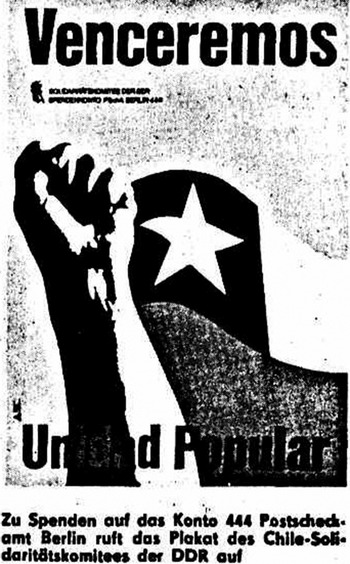
Chilean themes in the Singebewegung and among the Liedermacher*innen, reflect these frameworks of aesthetic solidarity and Verdichtung in that they offered a kind of point of contact that fostered a form of imagined participation in a dynamic and shifting political sphere.Footnote 2 In the case of nueva canción, the translation of its revolutionary aesthetics to meet the needs of young East German artists was oftentimes messy, plural, and fragmented, and the usefulness of the term derives precisely from the way it mediates musical exchange between various sets of circumstances. For Chilean musicians in exile in both Eastern and Western Europe, song was principally deployed as a component of the broader international solidarity movement with the Chilean people and, in general, this was the way it was received by audience members around the world. In the case of the GDR, many citizens sent regular donations to the “Chile Account” (Figure 1), which was managed by the Chile Anti-Fascist Committee (CHAF) and certain proceeds from performances would go to support various causes at home. However, these themes broadened to index a wider variety of movements driven by progressive causes. In the words of organisers of the Tenth World Festival of Youth and Students in the summer of 1973: “Many of these songs began their journey around the world [in East Berlin]. One of the most well-known: Venceremos!”Footnote 3 (cited in Rodríguez Aedo Reference Rodríguez Aedo2017:11).
An advertisement in Neues Deutschland, 5 October 1973, with information on donating to the Chilean Solidarity Account.

These songs never split off from their original context, but they continued to offer new spaces for participation and engagement throughout the East German musical community. Elke Bitterhof was one of the founders of the group Oktoberklub and was instrumental in both the development of the Singebewegung and the organisation of the Festival of Political Songs:
In the 1970s, numerous “singing clubs” emerged modelled on Oktoberklub. Almost every university or school had such a club and sang folk songs, workers’ songs, and also international folklore. Chilean music found its way into this repertoire very quickly. (interview, 12 January Reference Bitterhof2021)
We were happy about the UP election victory, but we didn’t compare it to an “election victory” in our country. It was the result of democratic elections. The Chileans could rejoice. In the GDR, the elections were theoretically democratic, but in reality, everyone knew how they would turn out, because there were no opposing candidates and, if necessary, they were rigged. …For us, Chile was particularly present in these years through its songs, a country with a lot of beauty, the sea, and the Andes, but in these years above all a country of pain due to the thousands of dead and kidnapped. There were also musicians who lived here after 1973 who told of how their friends and relatives were arrested and never came back. …What impressed us was the sociability of the Chileans, their rhythmic songs, the uncomplicated nature of everyday interactions. In the short time between the victory of the UP and the coup, Chile was for us a symbol of possibility if the people are united, and Sergio Ortega’s song: “El pueblo unido jamas sera vencido” [“The People United Will Never Be Defeated”] was in our collective thinking. (interview, 15 January 2021)
Bitterhof here describes the development of political and geographic imaginaries that aided in a form of aesthetic solidarity and were also framed by Trnka’s concept of Verdichtung. Additionally, imagining Chilean politics through song also afforded a form of imagined participation in the elections and government of Allende’s UP coalition. While recognising the limitations of democratic participation at home, she describes connecting collective singing with a sense of possibility and practice.
This form of music-making presents somewhat of a contrast to Turino’s idea of “participatory performance,” which refers to “a special type of artistic practice in which there are no artist-audience distinctions, only participants and potential participants performing different roles” (Reference Turino2008:26). Whereas he grounds a participatory frame in the intersection of the sonic and bodily relation one feels to the music and the others in the group (ibid.:28–29), this form of imagined participation through processes described by aesthetic solidarity and Verdichtung extends a participatory dynamic to musical activities not strictly rooted in collective performance. This is because the connections here between sound, political activity, and imaginaries through Chilean nueva canción were also available to participants outside of direct music-making activities.
Considering the Chilean tradition of the peña, or coffee house-style events where artists and performers came to discuss politics and engage with political songs, although there may be a clear line between performer and audience, the proscription of space is less defined as people are brought in to engage with the political content of songs. As Ariel Mamani describes, these events became “a project that prioritised the word in the song form and that intended to form the peña as a privileged space for listening, reflection, and artistic and political discussion, a goal quite far from the more traditional and commercial musical events” (Reference Mamani2013:129). In this way, even though audience members were engaged in a frame not strictly inclusive of the bodily and the sonic as in Turino’s model, they were engaged discursively as political participants in the production of this space. In recordings of the Liedermacher Wolf Biermann’s famous 1976 concert in Cologne, people continually call out from the audience and he responds with laughter and music in a form of political dialogue. Additionally, he frequently pauses in the middle of a song, to address the audience directly. He even laments that they cannot freely speak with one another in such a large hall and that he will not bother with the “exaggerated perfectionism” of recordings; a resistance to the strictures of the performative frame.
Both the Singebewegung and the Liedermacher traditions, therefore engaged in participatory dimensions of sonic expression, albeit using different techniques. The musicologists Marko Kölbl and Fritz Trümpi attempt to broaden participatory musical activity and demonstrate the ways it can both encourage and restrict democratic participation. They suggest that “highlighting the sphere of consumption and distribution of music as a participatory act, and thus as a specific form of artistic practice, adds important perspectives on music and democracy” (Reference Kölbl, Trümpi, Kölbl and Trümpi2021:11). While an analysis and critique of the GDR political organisation, and whether it afforded space for democratic political participation is beyond the scope of this essay, we can assess the various forms of engagement that political song in the GDR provided, particularly to younger citizens. Through voicing and singing the imagined and imperfect dimensions of aesthetic solidarity with Chile, these two ostensibly divergent and contradictory song movements offered a multifarious and individualised form of participatory political praxis.
Chilean Themes and Covers in the Singebewegung
The particular “revolutionary” identity that was ascribed to artists affiliated with Salvador Allende’s UP coalition parallels what Javier Rodríguez Aedo (Reference Rodríguez Aedo2018) describes as the “aesthetic singularisation” of the music of Violeta Parra’s early recordings on the Le Chant du Monde label in France. Here however, we see a singularisation of political identity, where even songs with a less clear political content indexed collective political participation. Many of the most popular Chilean songs in Europe in the 1970s might be described as political anthems such as Sergio Ortega’s “Venceremos” (“We Shall Overcome”), “El pueblo unido jamas será vencido” (“A People United Will Never Be Defeated”), and also “No nos moverán” (“We Shall Not Be Moved”), which was made popular in the GDR in its Spanish-language version by the group Tiemponuevo.
However, the emphasis on collective singing as a means of constructing a unified political identity instead likely stimulated a much more diverse and individualised experience of musical and political participation. Shana Redmond describes the circulation of anthems as projects of “political accumulation,” where songs accrue new meanings, functions, and relations with their singing publics as they circulate through new performances (Reference Redmond2014:7). She argues:
Like any effort at representation, these anthems are flawed and embody contradiction; there are exclusions embedded within their composition—whether textual or musical—that limit their effectiveness and reach. They are not universally held or appreciated—at best, they speak to and for most of the people most of the time (more likely, they managed speech for some). In this respect, they are not unlike any other national anthem in that their communities are selectively imagined and exclusive. (ibid.:6)
The imperfections and plurality of Chilean anthemic texts in the context of East German hootenannies offered participants a chance to imagine and engage with alternative forms of political life. The administration of Allende was profoundly attractive to many young East Germans due to his advancement through democratic elections and the perceived role of musical participation in his campaign (see Rolle Reference Rolle2020). The group participation in these songs therefore allowed many young members of the FDJ to bring their own political circumstances and aspirations of greater democratic engagement to singing clubs.
Although the Singebewegung and the song clubs scattered about Germany continued to operate throughout the 1970s, there was a growing awareness that the movement’s proximity to the SED government was alienating a significant contingent of younger GDR citizens. As Hartmut König, one of the founding members of Oktoberklub, noted after the third Festival of Political Songs:
At a time when the Singing Movement was rightly struggling to find more complicated solutions to the presentation of more complicated facts, I somewhat misjudged the division of labour between the resounding agitprop song and the politically controversial chanson or the ballade. A division of labour that is still misunderstood in some places. Personally, I have…never lost my interest in the Agitproplied and will continue to work with it. (cited in Mierau Reference Mierau1973:172)
In this increasingly diversifying environment of musical tastes and expressions, the Liedermacher and the Singebewegung might therefore function as a referendum upon one another. From the point of view of the FDJ-allied members of Oktoberklub, collective singing was still a crucial strategy for encouraging wilful youth participation in party politics. Chile, both before and after the coup, represented a point of ideological unification and coordination, as both Allende’s UP coalition and the global solidarity movement against Pinochet, were widely supported among the GDR population.
Borrowing songs and themes in and around Chilean politics would have been seen as a resource to arouse domestic engagement precisely by displacing concerns abroad. In fact, when compared with the more metaphorical song texts of the Liedermacher tradition, Chilean-inspired texts in the Singebewegung were much clearer and more direct with regards to names, places, and other characteristics that GDR citizens might know from the news and television such as König’s song “Chile tanzt”:
The text of this song manages to connect a geographically situated injustice in Chile with the desires of young people in the GDR. König and other artists heard musicians in Chile calling out to the world to denounce the conditions of workers in their country. Works like “Chile tanzt” responded with a form of optimism and inclusivity that people could literally shake the earth and reshape political and spatial conditions through their participation as audience members.
The collective dancing causing the imagined shaking of the Nixon White House described in the text and the physical manifestation of the international impact of a labour revolution against the mining industry reflects both the limits and potential of aesthetic solidary. Allende is cast as a revolutionary hero within the lived political sphere of Chilean workers thereby bringing the activities of government into dialogue with the more quotidian activities of this community. Similarly, the heat of the asphalt and the path causing the owners to dance in Chile also reflect wider tensions around the world in the early-1970s; the workers dancing is both a response and a challenge to global hegemony and fascism. While the song therefore idealizes a form of Latin American revolutionary heroism, it is also framed by Trnka’s Verdichtung as an imperfect and dynamic sense of global revolutionary participation. This imagined and geographically situated activity in Chile translated in a similarly imperfect and open sense of possibility to allow East German audience members to feel politically integrated and engaged in a way not frequently experienced in their daily lives.
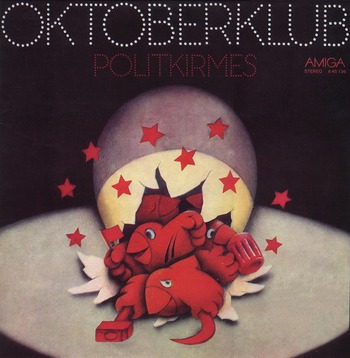
Another product of the waning popularity of groups such as Oktoberklub and the Singebewegung in the 1970s was number of covers made popular by some of the more prominent groups in the nueva canción movement like Inti-Illimani and Quilapayún. These tunes provided a more dynamic and likely “exotic” point of mass-singing coordination than many of those composed by members of the FDJ. Former Oktoberklub member Reinhold Andert, describes that many in the Singebewegung “[were] above all astounded by their [Chileans] high professionalism” (pers. comm., 12 September Reference Andert2021) and these covers by German artists reflect intense efforts to master the complex polyphonic singing characteristics of nueva canción. A great deal of energy was given to developing German translations of these tracks in order to create the widest engagement and participation among audience members and club participants such as a rendition of Luis Advis’ “Das neue Leben beginnt” (“A New Life Begins”—originally “Comienza la vida nueva” in Spanish) on the 1973 album Aha, and Sergio Ortega’s “Chile resistencia” (“Chile Resists”) on the 1978 album Politkirmes (see Figure 2).Footnote 4 Chilean covers and themes were one component of a much larger international literature performed in singing clubs, but due to the intense interest and sense of possibility that Chilean artists provided to East German youths, the ongoing presence of this literature in the GDR singing tradition and at the Festival of Political Songs may be seen as a continued effort to animate the Singebewegung and cultivate greater space for political participation.
Oktoberklub – Politkirmes (AMIGA – 1978).

The attractiveness of participatory dynamics in a foreign political system that nueva canción initially provided as it came on to the East German scene never abated. These performances shared practical dimensions with Turino’s (Reference Turino2008) framing of participatory music, but these dynamics further invited a form of participation in a system of alternate political imaginaries. While song clubs continued to draw on Chilean themes and covers up through the early 1980s to stimulate engagement in domestic issues, these songs may have also served to underscore a level of disaffection and disillusionment among audience members and performers alike. Many felt an increasing sense of disengagement from their own politics and their political and social experiences, and the openness and possibility of these songs never succeeded in closing the gap between the lack of openness and possibility of daily life in the GDR.
Liedermacher*innen and the Influence of Chilean Solidarity
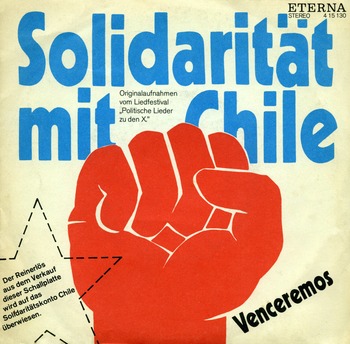
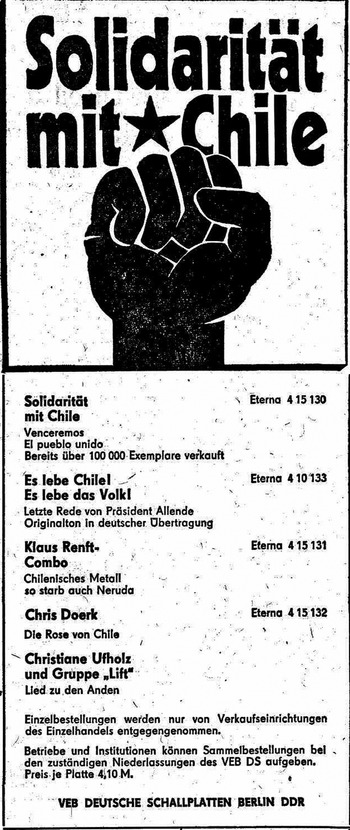
The 1973 coup precipitated a flurry of recording activity in the effort to promote solidarity with the anti-fascist cause in Chile. A number of 7” discs were pressed under the state-run label, Amiga, and proceeds from these recordings were funnelled to the CHAF committee (see Figures 3 and 4). Chilean-inspired songs were produced equally by artists that were more in step with the “official” cultural activities of the FDJ and by those that were or came to be more openly labelled as dissidents.
Recording from the Tenth World Festival of Youth and Students with proceeds going to the Chilean Solidarity Account (Eterna – 1973).

An advertisement in Neue Zeit, 21 October 1973, with information on purchasing Chilean-inspired albums.

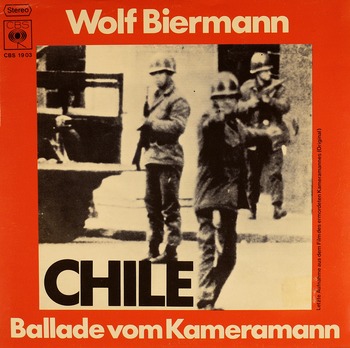
One of the more interesting recordings was Wolf Biermann’s 7” disc, which was known as the “Chile Single” (Figure 5). Standing in stark contrast to the more direct lyrics of the Agitprop songs of the Singebewegung, Biermann’s A-side single, “Ballade vom Kameramann” (“Ballade of the Cameraman”) is a multi-sectional song, rich with poetry and changes in tempo, rhythm, and character (Biermann Reference Biermann1976). The song tells of a Swedish-Argentine photojournalist, Leonardo Heinrichsen, who was murdered by Chilean military forces during the failed coup attempt on June 29, 1973. The album artwork on the single is the last still on his camera film before his death.
Wolf Bierman – Chile (CBS – 1973).

Rather than documenting the experience narratively, the orientation of the song shifts between descriptions of violence in the streets of Santiago and the artist’s own political reaction against it in Berlin. The cameraman here operates as a surrogate for Biermann’s own values of militant action against fascism. At the end of the song Heinrichsen is placed in a standoff with the soldier: gun against camera. When a bullet fails to emerge from the camera, leaving the journalist dead, Biermann announces the continued need for guns and guitars as the struggle persists:
Although this ballade can and ought to be viewed primarily in the wider climate of international solidarity against the Pinochet dictatorship, Biermann is also positioning himself in the place of the cameraman, using an artistic medium to face down the weapons and oppression of the state. His 1976 album Es gibt ein Leben vor dem Tod (There is Life Before Death), featured not only “Kameramann,” but a number of other direct and indirect references to Chile as a narrative strategy to invite militant action against fascism (Shreve Reference Shreve1980:224–227). After his forced expatriation to the West just a few months after the disc’s release, the cameraman metaphor took on a new valence for Biermann’s colleagues and friends such as the duo of Gerulf Pannach and Christian Kunert who performed the song as a means of support for the exiled artist and recorded it live in Sweden after their own expatriation in 1977. In this way, the processes of aesthetic solidarity and Verdichtung continued to amplify and change through various interpretations. The cameraman metaphor, though initially viewed as a form of revolutionary identification with the people of Chile, became a way to identify with Biermann. Through this process, experiences of persecution and exile between Chile and the GDR became highly individualised and subjective offering strategies for artists to imagine acts of political engagement and resistance through musical activity.
In a somewhat similar manner of metaphorical and narrative displacement, the Liedermacherin Bettina Wegner recorded her track “Hör zu, Soldat” (“Listen, Soldier”) on her 1978 album Sind so kleine Hände (They Are Such Small Hands). This track is a freely adapted cover of Payo Grondona’s song “Soldado, escucha” but in Wegner’s adaptation, the song takes on a new meaning. Whereas the 1973 version of the song by Tiemponuevo has a lighter character in triple metre, Wegner’s version is almost a dirge, minimally accompanied and with a chilling vocal quality (Wegner Reference Wegner1978). The lyrics launch a litany of criticisms against a particular Chilean soldier, calling him despicable, disgraceful, and shameful to his mother. The song not only depicts anger towards the soldier but also a sense of betrayal. Victoria Hardwick (Reference Hardwick1996) has argued that in the GDR, where the spontaneous expression of personal emotions was discouraged and close, honest relationships were often clouded by suspicion, love songs and songs about relationships played a critical role in critiquing the state. Wegner’s feeling of immediate betrayal by this soldier is also a product of a deeper unmet desire to have a relationship with East German politics. Although ostensibly functioning as a point of solidarity with the Chilean people, her arrival at this theme was also complicated by her own subject position and provided space for her to lament a form of political heartbreak.
By the time she recorded the song, Wegner had had over a decade of tension with the SED government. She was imprisoned for sixteen months in 1968 after distributing pamphlets in support of the “Prague Spring” and protesting the Warsaw Pact invasion in August of the same year. She was censored and banned from performance for most of the 1970s leading her to develop a huge following of East German dissidents in the underground concert scene. In 1980 she was given a travel permit to the West with the hope that she would remain out of the country. Ultimately, in 1983, she was forced to “auto-expatriate” (Wensierski Reference Wensierski2015).
Considering this history of tension and antagonism between Wegner and the East German state, we can further read her adaptation of “Hör zu, Soldat” as a critique of state militarisation in Chile, but also more generally in the GDR. Drawing on a perception of a kind of applied revolutionary practice, we see yet another instance of “aesthetic solidarity” between GDR artists and Chile. Although the character of the Chilean soldier is identified in the first line as a point of critical intervention, as we move through the song there is no further reference to national identity. In this way, Wegner draws on the Chilean soldier as an object around which she can arouse a broader critique of the military and police state that marked her and so many other young Germans’ experiences.
Conclusion
Leonardo Rodríguez arrived in the GDR in exile as a young boy with his family and was a member of the singing collective Basta. He has largely fond memories of growing up behind the Berlin Wall and the East German people and continues to live in Berlin today:
The spirit of solidarity of the GDR population…always remained very high. With Vietnam: things went up, and they went down. Palestine: one day yes, tomorrow no. But with Chile it was something that I felt was much deeper [era latente] and that there was always a high spirit of solidarity…Corvalán, Allende, Pinochet—terms that that population, not just in the cities, but also in the small villages knew—it was something of the heart. I felt until the last day, that for the Germans of the GDR, the theme [of Chile] was a theme of the heart. (interview, 7 January Reference Rodríguez2022)
This perspective is valuable as it demonstrates how the Chilean community in exile and their music resonated in all aspects of East German life. While Rodríguez does not argue about the specific impact of this community in different cultural spheres, his reflection here suggests that Chile was deeply imbricated in the activities of GDR citizens. This connection fluctuated across the unique circumstances of different singers in the Singebewegung and Liedermacher movements and fostered profound forms of real and imagined engagement.
Despite a wide range of diversity between and within these two movements, the concepts of “aesthetic solidarity” and Verdichtung can help to understand how the musical and political identity of the Chilean community in exile impacted artistic expression and possibility in the GDR. In the case of the Singebewegung, the campaigns for solidarity with the people of Chile both before and after the coup, were also implemented to coordinate the political activities and identities of young FDJ members at hootenannies. The homogenising or unifying tendencies of collective singing, however, may have been less successful in the case of nueva canción as Chile represented such a powerful index of democratic participation that individuals may have been able to exercise a form of individualised political praxis through singing. Conversely, while Liedermacher*innen frequently drew on Chilean themes as metaphors for their individualised experiences or critiques of the East German government, practices of intense listening and consideration with these song texts brought listeners into a participatory frame oriented around their subjective position. In both cases Chile represents a revolutionary ideal characterised and imagined through aesthetic engagement. However, this ideal was messy, plural, and dynamic as it sounded against the needs of different communities and individuals. Though often framed as political instruments of the East German Government (Maurin Reference Maurin2005), considerations of the role of nueva canción in these two distinct song movements open serious discussion around the Chilean community in exile in the GDR as not merely beneficiaries of the state, but as active contributors, and, in some cases, disruptors to it. East German artists experienced tension, supervision, and suppression, just as all members of GDR society. Through this process, Chilean themes provided new resources to reflect and critique, through new creative, political, and revolutionary possibilities.
Acknowledgements
A version of this article was originally presented at the 2021 meeting of the Society for Ethnomusicology (SEM). I am grateful for the feedback I received during this presentation and also for the generous feedback from three anonymous reviewers. This article was written, in part, with support from a grant from the German Academic Exchange Service (DAAD).