
The current system of decision-making in land use law is not transparent and is open to bias and personal corruption. This gives rise to the possibility of unequal treatment under the law, especially given the judicial reluctance to interfere in reviewing the decision-making process. The solution is an auction mechanism to overcome these problems, under which the local government would award land use rights to the highest bidder, where offers will be examined in light of their contribution to the society’s best interest. Such a mechanism would have possible benefits in terms of transparency and insurance against favoritism or arbitrariness. This is especially the case where the value of the resource is relative and contingent upon spatial, speculative and dynamic variables.
The auction mechanism employs a simple metric (i.e., revealed private value of the competing claims) by which the local government can give a transparent, non-arbitrary, observable, and verifiable response. This mechanism treats each and every person’s choices with equal concern and respect. In this sense, it is procedurally fair. When we compare potential bidders under such an auction, we find that as long as the background of opportunities is fair—i.e., inequality in agents’ situation is a result of their own choices—choosing a better positioned contender in a bid is justifiable. This conclusion implies a normative consideration in favor of employing the auction tool, if it is conducted between potential bargainers that enjoy equality in background conditions and when means for offsetting brute bad luck are utilized.
I. Introduction
Legal systems acknowledge that persons, being equal moral agents, are entitled to equal treatment by administrative authorities, zoning or planning commissions included, and consider the concept of equal protection a fundamental constitutional principle. Scholars have further argued that distributional concerns should shape land use law and related areas of property law, such as compensation for expropriation and regulatory injuries to private property.Footnote 1 However, properties are different from one another, and land use law is essentially about making distinctions.Footnote 2 The justice-oriented distributer might find it difficult to know what the appropriated distribution criterion should be.Footnote 3 Given the fact that courts tend to endorse the notion that land use decisions (and distinctions) involve substantial discretion and are thus subject to minor, rational basis review,Footnote 4 rarely have courts recognized a claim of discriminatory treatment that was not grounded on personal suspected characteristics of the claimant. Clearly, there is no ground for a discrimination claim where, for instance, two developers apply for a special permission (spot-zoning) to develop a shopping centre on their respective properties, and the city council allows only one shopping centre in that area.Footnote 5 The question of how to justly allocate land use rights in such cases is the focus of this paper.
Distributional concerns are especially present and intriguing in the context of piecemeal changes (spot-zonings) that result from negotiations between local governments and land developers. In such negotiations, which are often used nowadays, the local government agrees to amend its existing land use regulations to the requirements of the specific owner, and approves a development project proposed by the owner in exchange for in-cash or in-kind contributions for public goals.Footnote 6 In Canadian terms, the local government may agree to pass a zoning bylaw authorizing increases in the height and density of development otherwise permitted by the bylaw in exchange for the provision of facilities, services or other matters by the developer.Footnote 7 A recent study indicates that between 2007 and 2011, the City of Toronto entered into 157 such agreements, securing a total of $136 million in-cash contributions as well as in-kind benefits of a similar total value.Footnote 8
This practice of allocating a greater share of land use rights,Footnote 9 e.g., in terms of permitting incompatible uses or allowing higher levels of density than currently prescribed, may raise problems if the payment (monetary or in-kind) is agreed to by the local government and the landowner raises distributional concerns.Footnote 10 For example, not everyone would agree, or could agree, to a deal proposed by local government officials that requires a developer to make a substantial monetary payment for public uses as a condition for approving her application. Potential developers differ from one another in their bargaining resources, and that might affect the outcomes of the bargaining.Footnote 11 A local government might decide with whom to negotiate based on purposive discrimination or, maybe no less troubling, on arbitrary considerations.Footnote 12 Our purpose is to explore these distributional concerns from a luck-egalitarian perspective.Footnote 13
This paper argues that the current system of decision making in land use law is not transparent and is open to bias or personal corruption. This gives rise to the possibility of unequal treatment under the law, especially given the judicial reluctance to interfere in reviewing the decision making process. The just solution is an auction mechanism to overcome these problems, under which the local government would be bound to award land use rights to the highest bidder, where offers will be examined in light of their contribution to the society’s best interest. Such a mechanism has possible benefits in terms of transparency and insurance against favouritism or arbitrariness. That is especially the case when the value of the resource is relative and contingent upon spatial, speculative, and dynamic variables.
The auction mechanism proposes the use of a simple metric (i.e., revealed private value of the competing claims) by which the local government can give a transparent, non-arbitrary, observable, and verifiable response. This mechanism, so we will argue, treats each and every person’s choices with equal concern and respect. In this sense, it is procedurally fair. When we compare potential bidders under such an auction, we find that as long as the background of opportunities is fair—i.e., inequality in agents’ situation is a result of their own choices—choosing a better positioned contender in a bid is justifiable, and there is no discrimination against the worse positioned contender. This conclusion implies a normative consideration in favor of employing the auction tool, if it is conducted between potential bargainers that enjoy equality in background conditions and when means for offsetting brute bad lack are utilized.
The article is organized as follows. Part II provides some contextual background regarding land use law allocations, and the place distributional concerns have taken within this domain. This Part stresses the importance and complexity of the distributional concerns in such allocations. Part III argues for the virtue of implementing an auction mechanism for making allocation decisions, and reflects on this proposal from a Luck-egalitarian approach. Part IV analyzes several paradigmatic cases to test the distributional outcomes of an auction scheme. Part V briefly discusses potential normative implications of the proposed model.
II. Land Use Allocations
A. Land Use Law Rationales
Although the practice of implementing land use laws and regulations is a worldwide phenomenon,Footnote 14 the justifications for it “remain ambiguous.”Footnote 15 We can identify two central types of justifications for land use law. The first is externality-based, and rests upon the idea that there are market failures where land use spillovers are not internalized by those who create them. A regulatory system is required in order to avert market failures. Ronald Coase pointed at the reciprocal nature of actions, and therefore that the important question is not how we should restrain those who generate “externalities,” but rather how to avoid the more serious harm that results either from the activity or from its prevention.Footnote 16 Under this understanding, land use laws are justified in as much as they are targeted to this end.
The second type of justification is public policy-based, which entails social engineering and the production of desired spatial or social ends. This rationale rests upon a broader normative outlook concerning the function of law in modern society. This rationale, which can also be referred to as the public interest rationale, is open-textured. It paves the way for local governments and the public to design different types of land use systems: such as a system that adopts efficiency as the one and only public policy orientation, in which there would in fact be no difference between the dictates of both rationales; or a land use system that adopts urban justice as its leading orientation, in which strict efficiency considerations are not awarded priority.
These rationales are not the only ones that underlie land use law; they are, however, the most compelling and convincing rationales, as they provide a coherent approach to land use law in the most general and comprehensive way.Footnote 17 Pointing at these justifications for land use law does not eliminate the possibility that the practice of planning, rather than the mandatory demand for planning to precede land uses, has intrinsic value. Thinking before acting, which is the main purpose of planning practices, can provides knowledge and opinion of various kinds as well as understanding of the meaning and expected outcomes of a certain act.Footnote 18
As a consequence of the broad-scoped rationales for land use laws, and with reference to the lack of constitutional status for property rights, Canadian courts have refused to develop a strong constitutional doctrine of compensation for injuries to land caused by zoning restrictions. The courts have also rejected the availability of distributive claims for aggrieved owners.Footnote 19 For instance, in one case, the city of Vancouver adopted a development plan that effectively froze the development of a certain parcel of land owned by a railway company, and then restricted the use of the land to noneconomic uses. The Supreme Court of Canada disagreed with the railway company’s claim that the city’s conduct amounted to an effective taking of the property in question, noting that the development plan did not remove all reasonable uses of the property and that the regulatory body had not acquired an interest in the property.Footnote 20 The decision stands as an example of the Supreme Court’s continuing refusal to intervene in the relationships between private property owners and public authorities, leaving it to legislatures and to the democratic process.Footnote 21
B. Allocative Modes of Land Use Rights
The question of just distribution in land use allocations is manifested in each of three allocative scenarios of land use rights.Footnote 22 The first scenario involves the initial allocation of land use rights that takes place with the implementation of the first zoning scheme or comprehensive plan. The distributional concern which arises here is the extent to which the shift from a no-restrictions mode to a restrictions mode creates distributional issues. The second scenario involves changes or updates to zoning schemes that are the result of a governmental policy change or a planning commission decision to change the prevailing restrictions, usually for a large area and not per parcel. These changes might create value for a certain owner, while devaluing the holdings of other property owners, or they could either uniformly value or devalue all the properties to which the scheme applies. Finally, the third allocative scenario concerns piecemeal changes to zoning schemes that follow a request from a property owner. These changes might create value for the applying owner and add or decrease value to other properties, and they might affect the possibilities for future development for others. In this common and typical scenario,Footnote 23 which we will also refer to as concrete adjustments, the approval of the owner’s request by the planning commission might be conditioned upon her fulfillment of development charges or exactions requirements or her consenting to provide certain public contributions that have been negotiated with her by the local government. The public contributions are usually perceived as means to overcome the negative effects which the development project would have on its surrounding, though arguably there are no strict boundaries to what can be agreed upon between the developer and the local government—as long as the developer truly agrees and the contributions generated are utilized for public purposes.Footnote 24
With regard to the first and second scenarios, the differences between them in terms of the distributional issue are rather minor. Both of them involve a decision to implement an original scheme (or an amendment to it) that has positive value for some and negative value for others. One question which arises in this context is whether drawing the line between zoning categories or permitted uses is fair. The courts evaluate such claims by focusing on whether there was a rational and reasonable basis for the decision. If there is such a basis, then it is not a matter of equals being treated differently.
Clearly, a personalized (intentional) basis for a land use allocation, which rests upon the characteristics of a certain type of property owners, would not be a generally convincing rationale nor would it be considered reasonable. But, what if the allocation is to an entire neighborhood that just so happens to be inhabited mostly by whites, and there is no allocation to other non-white neighborhoods? Or, what if an allocation has distributive effects, such as for instance when bans on maximal units per parcel place an exclusionary burden on those who cannot afford anything but multi-family housing?Footnote 25 It seems that given the suspicious outcomes the threshold for establishing that these allocations are justified should be higher, and that it requires something different than the standard response that the court is not a superzoning commission. Another question is what would be the case when a land use rights allocation is only to members of a distinct minority, and whether this could be justified as affirmative action. Yet other questions concern the ability or desirability of using land use allocations for securing re-distributive justice considerations. These are important questions which will not be directly addressed here.
One reason for excluding general redistributive concerns from the current discussion is that their presence in land use allocations is not unique to the allocation of land use rights as such. On the contrary, referring to redistributional aspects of one good—land use rights—might be wrong as there is no reason to isolate the allocation of this particular valuable from other goods (that the state governs their allocation or not). Concrete adjustments, however, accentuate distributive concerns. It is the concrete adjustment cases that questions of fairness are often associated with and debated.
C. Characteristics of Land Use Rights as Goods
Before approaching how land use rights should be allocated, a few words about the character of this good are required.
A land use right is intrinsically correlated with the location of the property to which it is allocated. The economic, social, and cultural value of a certain allocation cannot be a-contextual; it will always have reference to the locational characteristics of the property. Given that no two properties are identical, for the very least because of their different geographical locations, then no two land use allocations are identical. For example, the same right (or privilege) to build a twenty-floor high-rise for residential use, if applied to different areas of a city, would create different benefits (and burdens) for the landowner, her neighbors, and the community, regardless of the owner’s acts or subjective perceptions. To illustrate, in one part of the city, a high-rise constructed according to that allocation would be occupied by low-income residents. This might lead to a “white-flight” of nearby residents and the gradual deterioration of the surrounding neighborhood.Footnote 26 However, the same allocation in another part of a city could attract a high-income population. This might lead to a gradual rise of nearby property prices and eventually to the “gentrification” of the area.Footnote 27
We cannot anticipate the effect of the allocation, in advance, on all cases or on a large proportion of them.Footnote 28 With this type of allocations there is something independent of the owner’s subjective will or capabilities; something that is related to the spatial feature of the good, which makes its value a function of a variety of context-place determinants. One of the reasons for that is that an allocation of land use rights does not imply the right-holder’s duty to act upon that allocation, to actually execute it and develop what was permitted, immediately or ever.Footnote 29 Even though owners might have a moral duty to realize their rights in a way that considers the needs of others, right holders also have a right to violate their own duty and not execute a land use allocation.Footnote 30 This, however, does not exclude the possibility that postponing the execution of an entitlement will affect its value. Assume, for example, that there is an update to the zoning or planning scheme that is in force, according to which the zoning commission will allow anyone who asks for it to add up to three storeys to their building, to a maximum of 6 storeys, as long as the total number of residential units in the area does not exceed a certain number X. This constraint is rationally justified in terms of the overall capacity and saturation potential and quality of life standards. The outcome of this limitation is that not everyone will be able to build additional storeys, but rather only a certain portion of the owners will be able to do so. One could decide at a certain point in time not to add the permitted storeys, or to add only one or two of them now, and that would affect the residual number of overall “available” units. Ultimately, some buildings might “leave” the market if they are transferred to other uses, or they may be demolished. Eventually, my ability to execute or to value the scheme’s amendment and the land use allocation depends not only on my decisions but also on others’ decisions, in a way that evolves over time. There is thus an additional element of timing that determines the value of an allocation, which means that foreseeing its future effects is no more than mere speculation.
Besides the fact that an allocation of land use right is sensitive to spatial consideration, an additional characteristic of land use rights is their speculative value. Land speculators often invest in properties given their evaluations about the future value of the properties. Sometimes, speculators strategically buy properties to keep them off the market until they can maximize profits on resale.Footnote 31 The questions regarding what type of property one wants to purchase, when, where and for what price, is determined by speculators upon calculating the risks for future demographic and social and other changes.Footnote 32
When aiming for a just distribution of land use rights, the characteristics which we discussed—spatially-related value, speculative value, value which is sensitive to other people’s actions, etc.—create an immanent difficulty with the metric under which the fair distribution of outcomes will be tested. In order to bridge over this difficulty of comparing the added value a certain allocation confers on different properties, we suggest that concrete adjustments to land use restrictions as applied to a property will take place only after an auction was set between potential interested owners. Such a bidding scheme could enable all interested persons to set a tag price and enable them to properly regard the specific characteristics of land use rights. Would such a bidding be considered as a just means for distribution? This is where we head next.
III. An Auction as a Basis for Allocation of Resources
A. Auction and Just Distribution in the Context of Land Use Law
In order to address just distribution concerns regarding allocations of land use rights, we propose that an allocation of land use rights in concrete adjustment cases requires the local government to employ an auction mechanism before determining which property would gain the allocation and on what conditions. The general idea is that when the local government receives an application for allocation of land use rights (which are not already secured by the existing land use regulation as it applies to the property), it would publish a notice to the public, inviting other property owners from the area to apply for that allocation or for a similar one, dependent on whether only one or more such allocations can be granted. The boundaries of the relevant “area” should be determined according to planning, social, or other relevant considerations. In this auction-like procedure, the competing developers would be required to announce not only their desired allocations, but also the price—in terms of in-kind or in-cash public contributions—that they are willing to pay.
After a general notice is made to the public about the government’s intention to conduct a bid for an additional allocation of rights, the developer who made the initial proposal and any other interested party could have the option of discreetly interacting with the local government’s officials within a constrained period of time. All proposals would need to be submitted by a certain date and then revealed to the public. Our solution is not absolutely impractical. Formal planning procedures provide us with the opportunity (and the obligation) to let the public know about the government’s intent to enact by-laws. The planning commission would have to consider the proposals submitted within the framework of the formal procedure for planning (hearing, public consideration, etc.). In addition, the usual regulations that apply to governmental bidding should apply for this bidding as well, with respect to all relevant issues, such the option for renegotiation, judicial review, etc. If the winning bidder differs from the developer who initially made the proposal, the winner should be given time (secured appropriately) to submit a detailed plan for approval. The local government should also have the power to initiate bidding in a certain designated area, if it wishes to develop that area. This very brief account should suffice, assuming that it is enough to enable us to further craft a land use system that in fact endorses such a bidding mechanism.
It could be objected that the auction mechanism is a market-based solution. If this is true, then the question which arises is what exactly is land use regulation doing here? If we need land use laws to correct a market failure, why resort to market forces so as to resolve the problem? In different words, why do we need any land use restriction in the first place? As noted earlier, land use laws are required because transaction costs prevent efficient bargaining over land use. It is only when the local government is presented as the qualified representative of the public interest, that market oriented considerations of all relevant factors are receiving their proper place. The following words aims to explain that in some detail.
Under the Coase theorem,Footnote 33 in a world of zero transaction costs the initial allocation of rights—between the private owner and the community—is immaterial, as long as potential Pareto improvements are available. Therefore, according to this view, if people and communities could negotiate the use of every right (or stick, in the “bundle of sticks” metaphor),Footnote 34 the result would be efficiency.Footnote 35 Contrarily, if zoning restrictions cannot be bought and sold, then the Coaseian conditions do not hold and inefficiency is inevitable.Footnote 36 It is inevitable, because it is hard to imagine that the initial allocation will be optimal, given information limitations, the dynamic of land uses, political biases in the regulation process, distributional effects, etc. The legal system cannot really delimitate rights in a way that brings about greater value of production than any other alternative allocation, mimicking the result that would be achieved had transaction costs been an immaterial factor, even if that is its stated purpose. If development rights are a means to advance efficiency, their transferability is necessary. So holds William Fischel: “[a]ny existing zoning restriction may be sold by the community,” provided that minimal legislation is designed to ensure the prevention of fraud by officials or developers and the equal treatment of landowners in the same zoning district.Footnote 37 If substantial gains are achieved through trading zoning prohibitions with the affected landowner, then clinging to minimization of externalities as the only justification for zoning leads to social waste.Footnote 38
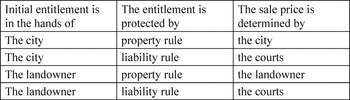
The questions to consider are who should be given the initial entitlement and how this entitlement should be protected. As discussed above, whether rights are in the hands of a property owner or in the hands of the government is a matter of calculation where the greatest value will be generated, while the option of future transactions (if their gains are higher than the transaction costs associated with them) remains regardless of the initial entitlement (albeit with some reservations). We can think of four alternatives to the allocation of rights. Land use rights can rest in the hands of the city (the local government) and become the landowner’s property if one buys them in exchange for a sale price as determined by the city (if the entitlement is protected under a property rule) or by collective valuation such as offered by courts (if the entitlement is protected under a liability rule).Footnote 39 Contrarily, land use rights can rest in the hands of the landowner and become the city’s property if it buys them in exchange for a sale price as determined by the landowner (under a property rule) or by collective valuation such as offered by courts (under a liability rule). The concerns which should lead us towards the optimal entitlement mode, in terms of the one which leads to the greatest value of production, are first and foremost efficiency considerations as well as distributional ones, given a world in which transaction costs do exist. Within the framework of these concerns, we need to pay regard to transaction costs, which when high usually justify deference to liability rules,Footnote 40 to institutional (assessment) costs in case of liability rules,Footnote 41 including the possibility of courts erring in evaluation and the administration costs associated with the need to set the terms of transactions,Footnote 42 to the fact that wealth maximization might depend on the ability to develop a certain geographical area under some guidelines which might result in holdout or freeloader problems, and to other considerations.
Optional Models for Allocating Land Use Rights

What we need in order to craft the best entitlement framework in those terms is the relevant empirical data about transaction and related costs,Footnote 43 which might be dependent upon local characteristics (such as statistics about corruption, strategic behavior, socioeconomic characteristics of the relevant landowners and their homogeneity, etc.), or a set of assumptions upon which to develop a theoretical economic model. We will offer neither.Footnote 44 We can intuitively acknowledge, however, that requiring the city to interact with each owner over the sale price, especially so if set by the owner under a property protection, is not a recipe for a functioning low transaction costs society. This is also why in almost every legal system (if not all of them) landowners are not considered the owners of unallocated development rights.
When assigning rights to an administrative body, such as in this case, holding entitlements (in the form of the ability of landowners to develop their properties) under a property rule or liability rule is almost the same or at least much less divergent than the theory implies. For in both cases, there must be a legal standard which determines what is right and wrong for the government to do. For instance, let us suppose that development rights are considered to be in the hands of the city, under a liability rule. What would be the court’s criterion for evaluating the sale price? Ostensibly, they need to identify the fair market value of the entitlement. Now, let us further suppose that development rights are considered to be in the hands of the city, under a property rule. This means that the city determines the sale price. But the city is not a private entity or a real estate tycoon, with the right to exercise its freedom and autonomy in determining the sale price. The city must activate its entitlement as required by the law. How can the city justify its withholding a development benefit from a landowner? The answer must be that public-oriented concerns (particularly of efficiency) support the stand the city takes. The city holds the entitlement for the benefit of the city’s residents and users, in accordance with what the law (the same one as above) prescribes for it. If that is true then the “subjective” value of the entitlement is not measured by the same means for both parties—the city and a private owner. Therefore if the city has the power to set the price for the sale of the entitlement, it must do so in accordance with the substantive limitations and expectations which would apply had the court been required to set the price.
In both cases—entitlements to the city under either a property or liability protection, though maybe to a greater extent under a liability protection—the court needs to know when and how it can justifiably believe that the city’s stated purposes are real and not merely strategic. For instance, if the city states that it is reluctant to allow a landowner to add another storey to a building unless a certain payment is made, the court is required to know whether objecting to the asked-for permission is based on relevant grounds (efficient, public-oriented considerations) and whether (if we are under a liability protection) the asking price addresses, proportionally, the relevant concerns, or is in fact an exploitation of the city’s position vis-à-vis the landowner.
Intuitively, for the distribution of goods to which no one has a claim-right or a justifiable demand, an auction seems to go well with fair distribution. Auctioning land use rights fits the idea that land use rights are a public good, owned by the community as a set of community or collective property rightsFootnote 45 that rest in the hands of the political apparatus,Footnote 46 as a qualified representative of community members.Footnote 47 If everyone is entitled to compete for a specific allocation, then we have an insurance-like control against favoritism or arbitrary allocations. An auction also fits common perceptions about good governance: it supports public officials’ decision-making by providing alternatives through a transparent process. Finally, auctions are means for extracting more from bidders, in a way that benefits the public’s interest.
We assume here that no offer would be accepted if it harms the public’s interest. Therefore, for instance, if a developer proposes to pay two million dollars but to harm the wellbeing of her neighbors, while another developer proposes to pay one million dollars for the approval of a project that would not harm the neighbors, then the local government cannot vote for the former proposal. A public good problem should not be created if the local government would serve, as described above, as the entitlement holder on behalf of its citizenry, taking into account all the relevant considerations. Take, for example, the case of a developer who wishes to build a factory next to a lake. To build the factory requires a change to the zoning laws of the land that the developer already owns. The value to this developer is high; let us say $100. Assume there are 1,000 objectors (people who value the lake for other reasons, such as fishermen, boaters, etc.), each of whom incur a small loss of $1 if the factory is built. From a social perspective, the factory is clearly socially bad. For this reason, the government should not go for an auction for this allocation and thus despite the presence of coordination costs, the developer would not be able to build the factory. The local government is the one to calculate whether the project, “after the money”, after the public contributions suggested by the developer, would overcome the preferences of the objectors. For our purposes, we are not intrigued by these problems as we assume, recall, that either of the projects which are on the table is socially good (based on the local government’s calculations and estimations about exactly that).
On this ground, we can also reject an alternative objection to the argument in favor of auction, which suggests that the developer is aware of the cost of coordination and simply bids $2 in the auction. In such a case, not only do we have a socially bad allocation, but the public contribution is minimal and comes nowhere close to covering the marginal external cost. Such cases are by no means justified or approved through the auction mechanism. It is not that with the auction in place the local government may simply auction off everything, bypassing the very reasons for government regulation in the first place. To the contrary. The auction mechanism proposed here provides a nuanced improvement to the formal variation of land use laws. It should be installed only in those places where the local government has reasons to believe that an allocation would create a positive value to the society. The fact that the local government has to initiate a public procedure paves the way for greater awareness on behalf of the public, which could be translated for a mechanism to reveal not only potential developers’ preferences but those of the public as well.
Against the pro auction intuitions there are two types of distributional claims that might arise. First, persons paying for land use rights might claim unequal treatment in case others were granted similar land use rights without payment (“I will pay only if you will pay as well”); second, persons without the ability to pay for land use rights might argue that their shares would have been greater had they had the resources to pay for them. All of the cases which we will be examining shortly discuss these two types of claims, and they involve one player against one other player.
The personalized-type claims we suggest paying attention to are focused on differences between individual developers and not on differences between properties. These give rise to the following objection. Land use rights are property-related rights. The character of land use rights is their attachment to a particular property, not to a particular owner. A change of owners, for instance, does not (or should not) give rise to a change in the share of land use rights. The auction mechanism treats the differences between properties by giving their managers, their owners,Footnote 48 the opportunity to set their prices for the land use right given the value that right would have for a particular property. The auction does not eliminate the financial and other differences among property owners, which are potential competitors in a concrete bid. Yet, again, it should not. The fact that property owners might perceive themselves as unequally treated—that they paid “more” than others for the “same” right, or that they could not pay as much as others—is unjustified from an equal treatment perspective which targets developers’ comparative standing vis-à-vis their properties.
One could have ended the discussion here, concluding that an auction is the only requirement for equal treatment. However, we want to convince those who resist the idea that property relations bear distinct in rem characteristics, that even on the personalized level the claims for equality are refuted. Taking this step will support future applications of the auction mechanism for distribution of other resources or rights that are not as attached to real properties as land use rights are. The idea of an auction as a means to treat persons equally is not original, of course. Ronald Dworkin’s well-known thought experiment utilizes an auction as well, to consider the equal distribution of all goods or entitlement.Footnote 49 We can draw from Dworkin’s comprehensive analysis some interesting conclusions for our concrete suggestion of auctions for allocation of land use rights. We apply Dworkin’s conditions for auctions as an equalizing mechanism for the allocation of a specific good or entitlement. We believe that this method does not contradict the notion for an auction for all goods, because especially with regard to non-primary goods such as land use rights, there is no justification to bundle their distribution with the distribution of all other resources.Footnote 50
Following a short description of the Dworkinian auction, we will analyze the moral statutes of the personalized-type distributional claims through several illustrative cases.
B. Dworkin’s Auction
Ronald Dworkin defines equality as equal concern and respect for each and every person. Equal treatment means equal concern and respect for persons’ authentic choices. This account of equality of resources (EOR) treats persons as equal moral agents, each deserving of equal respect and concern for their choices and preferences. EOR holds persons responsible for their choices, such that each must consider the consequences of their actions with care, for they have implications for the ability of other equally moral agents to make their own choices and act upon them. Not taking people’s decisions seriously would mean that persons could claim compensation for unequal success regardless of their own choices and decisions. Dworkin stresses two disturbing consequences for such a course of action. First, it could create an unequal distributive burden on others who have been more responsible with their choices, but who will have to shoulder the burden of compensation regardless of their own responsible behavior. Second, compensation ex post is tantamount to proclaiming the choices that persons previously made as not morally binding. It would mean that responsibility for choices is stripped of its moral role.Footnote 51
The notion of equality of resources begins with a hypothetical auction, in which all citizens receive an equal amount of bidding chips. They go on to bid for resources, which they value (idiosyncratically), thereby creating differential prices of goods according to how others, collectively, value these goods (the “opportunity costs” for others). The conclusion of the auction is an “envy test”: no one wants to trade their bundle of resources for that of another, because they could have had that bundle had they chose to restructure their bid.Footnote 52
Clearly, the result of the auction is uneven resource distribution, in the sense that not everybody has an identical bundle of resources to start their lives with. Rather, each has a unique bundle of resources they deem equal in value. Nevertheless, it is the only distribution that ensures equal concern and respect. Any other metric for distribution, such as equality of welfare or wellbeing, demands that the government make value judgments about what is important in life and impose these judgments collectively. It inevitably treats those with other views disrespectfully, discounting their choices and preferences as unworthy.
Suppose the government decides that the metric for equal wellbeing is the rate of success in life goals. In this case, when one does not succeed in her life goals, the government should compensate her, either by giving her extra resources or by interfering with the obstacles that stood in her way to success. But we can see that this metric does two things that are inimical to equal concern and respect: first, it implies that the views of persons who do not value wellbeing in terms of success are discounted as unworthy. Second, it implies that all instances of failure entail compensation, regardless of the agent’s choices and actions. Again, this is an instance of unequal respect for those who have been conscious of the responsibility for their choices and actions. By equalizing resources or welfare ex post, we would be neutralizing the effects of the conscious choices and actions that persons have taken, treating them as irrelevant to their lives and emptying the value of authentic choice.
It is important to note that Dworkin’s equality of resources is not laissez-faire. It does not leave persons to fend for themselves after the initial auction has ended. Rather, Dworkin builds into the auction model a protective mechanism against unlucky events—an insurance scheme. Within this scheme, persons bid for insurance against all kinds of idiosyncratically perceived bad luck, so that they can use the insurance money in the event of accidents or misfortunes and help themselves get back on track.Footnote 53 Dworkin makes a distinction between brute luck, which is the result of arbitrary accidents, catastrophes or certain circumstances (such as contracting a disease or lacking a marketable talent), and bad option luck, which is a result of calculated risks or gambles (losing money in financial investments, choosing a profession which turns out to be unprofitable, etc.).
The insurance market ensures equal concern and respect in the following way: it allows persons to tailor their insurance according to their idiosyncratic risk aversion, thus fully respecting their choices and preferences. Second, it holds persons responsible for their choices, because one cannot complain if one’s plans have failed—that person has insurance to fall back on. For example, if one chooses to pursue an unprofitable occupation but is worried about not being able to support oneself, then one can insure against unemployment at a premium one perceives as appropriate to needs and according to one’s risk aversion. Aggregated across society, these insurance schemes translate into unemployment compensation, medical compensation, etc.
Instances of brute luck, including genetic luck, which are not the result of conscious choices, can also be insured against: “because the decision to buy or reject catastrophe insurance is [itself] a calculated gamble”.Footnote 54 If someone is less talented than others, for instance, it would be morally wrong for society to deal that person fewer resources (less opportunity to achieve financial success, all else being equal). Buying insurance against lack of marketable talent would solve that problem, by aggregating the premiums of persons who turn out to be successful into an income tax and redistributing it to the less fortunate.Footnote 55
This approach therefore fits neatly with the requirement from an allocative principle that is sensitive to relational, dynamic and speculative characteristics. Just as the value of relative and speculative goods is determined according to how others value it, the opportunity costs, including the insurance premiums, reflect precisely the dynamic feature of the good. Moreover, recall that the requirement from the particular good under investigation—the distribution of development rights—is that it equalizes treatment and not outcomes. EOR does precisely that—it focuses on equal treatment and not on equal outcomes.
The hypothetical auction (including the hypothetical insurance) assumes an ideal world, where the auction can go on undisturbed and there is political commitment to ensuring equal resources distribution. In this ideal world, since equality is secured, freedom cannot be interfered with and a defensible distribution may exist.Footnote 56 However, the “real real” world rarely exhibits the equality that exists in the ideal world.Footnote 57 Dworkin introduces therefore a bridging principle that takes us from the hypothetical world of the desert island to the “real real” world—the principle of victimization. This principle sets out to identify those instances where liberty is compromised due to a certain constraint in comparison to the liberty one would have in a defensible distribution. In a defensible distribution there should be no constraints on freedom of choice, because everyone starts with a resource bundle which is equal to all other bundles in value. In real life, because equality of resources does not obtain, the principle of victimization can tell us whether certain constraints on liberty are justified, i.e., as long as they are designed as elements in an overall scheme to improve equality. The principle of victimization holds that in the “real real” world, loss of liberty is legitimate (only) when the (legal) constraint on doing something is meant to improve overall equality. If a constraint in real life on private medicine is a part of an overall scheme to supply better medicine (through improvement of equality of resources), then no one should be victimized, because compared to the defensible distribution there is no loss of liberty to acquire a certain standard of healthcare.Footnote 58
To illustrate, in a defensible distribution, queue jumping in healthcare services would not be available. Therefore, there is nothing wrong with prohibiting queue jumping that is bought through private medicine in a “real real” situation. Short of abolishing private medicine altogether, certain steps such as prohibiting queue jumping are perfectly compatible with equal treatment of persons in the “real real” world. Dworkin uses this example to show that the principle of victimization sets the criteria for evaluating whether overall governmental programs, in which certain constraints might figure, may nevertheless serve the purpose of striving towards a defensible egalitarian distribution.Footnote 59
The first normative conclusion that surfaces under a luck egalitarian perspective is that an auction is fully congruent with granting such indivisible goods as development rights. Turning now to analysing the equality demands that potential competing developers might be making, we present four illustrative cases which emphasize different aspects of distributional concerns in land use allocations and apply to each of them the theoretical approaches we have discussed above.
IV. With-in Bidders’ Distributional Concerns
With-in bidders’ substantive unjust distributional claims are legally unavailable. A bidder in an auction can argue that another bidder had a better chance to win, for instance if one was given an extension to make an offer or got inside information about the process. However, bidders cannot argue that they are more deserving of the resource at stake than the auction’s winner because they are in greater need if needs-based considerations were not part of the auction’s formation. In that case, the disappointed bidder might have the power to frame a legal case against the auction’s formation or the auction’s formatters but not against the winner. More generally, property owners are usually immune from claims made by those without property regarding the equal distribution of resources.Footnote 60 However, claims for inequality are worthy of considering even if the institution that decides on these matters is not the judiciary. We therefore suggest considering the following examples, which illustrate the worlds of within-in bidders’ claims for unjust distribution.
We propose that before any decision to allocate land use or development rights as asked in a concrete application for a zoning bylaw amendment, the local government would conduct a bid procedure. The local government will be required to announce its intentions to open negotiations with the developer who made the initial development proposal, and will need to invite competing application from any other developer who owns a lot in the nearby area. After such an announcement the following bids might occur.
In all our cases, against a “big shot” developer stands either a relatively same-size developer or a smaller developer. The proposed development advanced by the “big shot” developer either exhausts development capacity (in the sense of saturation potential, quality of life standards, or other planning considerations) or it does not. In two of the cases, the one who might raise an unequal treatment claim is the developer who will not be able to develop, and in the other pair of cases the one who might raise an unequal treatment claim is the winning developer who will be able to develop, but would be subject to conditions that will not apply to others in the future. In Case 1 we have two developers who are both big shots. Whoever wins the development bid will have to pay a substantial public contribution. There is only this opportunity to develop without exhausting the potential capacity. Similarly, in Case 2, the situation is such that one development project exhausts all of the development capacity; however, the competing parties are a “big shot” developer and a smaller developer. The latter wants to bid for the allocation, but cannot provide the public contributions asked for by the local government which the big shot developer has no problem agreeing to. In Case 3 there are two “big shot” developers. One of them wishes to develop her land in a way that would not exhaust all foreseen future allocations of this type in the nearby area while the other wishes to develop her land but at a later point in time. The former developer is then asked to pay while the latter developer will not be asked to do so in the future (due to changes in policy or public needs). Finally, Case 4 resembles Case 3 but in this case the future unconditional allocation is for a smaller size developer.
An important note is in order. Even though we have described these examples as illustrative, we were unable to think of any other relevant example that presents problems of the third allocative scenario (concrete adjustments), besides the case of two “small” developers. If none of them can offer more than the other, then a lottery or any other fair allocation method such as “first in time first in right” might work to equalize between them. We also should emphasize that although these examples assume only two actors, we could easily multiply the number of actors without changing the essence of the potential situations or their implications. Naturally we assume that there is no pre-knowledge about financial capabilities (the “size”) of the competing developers or even about the future development capacity with respect to a concrete proposed development. But if all of the possible worlds that will be explored below are adequate in terms of equal allocation, then such concrete knowledge is not necessary.
For the purposes of our discussion, we put aside some practical considerations by presupposing a world without material transaction costs (including bargaining costs) and a world of transparent government where officials act on professional, not personal, grounds. For this reason, we are not troubled with a case in which two developers receive different treatment—one is given the chance to gain the allocation for a payment of one million dollars, the other for only half a million dollars—because (and only because) the latter is personally related to the local government. However, even in the real, far from ideal, and different from the imagined “real real” world, adopting our open bidding mechanism as a pre-condition for local governments’ authority to facilitate bargains should bring better results with respect to distributional concerns.
We will now apply to each of the four cases the theoretical approaches we have discussed above (defensible distribution, and distribution in the “real real” world).
A. Case 1: Two “Big Shot” Developers; Exhaustion of Development Capacity
In this case there are two property owners, both of whom are “big shot” developers. One of them, developer X, wishes to develop her land in a way that would exhaust all foreseen future allocations of this type (by foreseen future we mean 5-10 years ahead) in the nearby area. For instance, the proposed development is for a shopping center in an area where it is clear that additional shopping center would have no viability and would not be permitted due to rational planning considerations. The other property owner, “developer B”, has no interest in advancing such a development at this time, because of her current financial obligations or for any other reason, though she thinks that she would want to execute such a development if it were still possible, within a few years. Would granting the development rights to developer X constitute an unequal treatment by the local government? Alternatively, developer B is economically able and willing to develop now but only if it will not be conditioned on a requirement to supply public contributions. Would granting the development rights to developer X, who is willing and able to contribute a million dollars (or equivalent services) give rise to an unequal treatment claim on behalf of developer B?
Defensible distribution. In the first variation of this case, the developers differ in only one respect: they hold different preferences regarding when to apply for a development grant. Developer X prefers to develop now, while developer B prefers to develop in a few years’ time. Therefore, we contend that they are in fact equal in the relevant respects: both enjoy similar economic circumstances; both can bid for the resources. The fact that developer B had no interest in developing now reflects her own choices, and that gives no rise for an inequality claim. She has had her opportunity but deliberately chose not to exercise it. In the second variation presented in this case, developer B is willing and able to develop now, but only if no public contribution is required. The fact that she currently has less liquid resources reflects bad option luck, which does not justify ex post compensation (such as granting her tradable development rights for a future use elsewhere, or waiving the public contribution now in the sense of running an unconditional lottery between all bidders).
Real real world. Both developers are equal in the relevant respects, i.e., their differences are a result of differential option luck that is entirely due to their own preferences regarding investment and risk taking. Therefore, developer B is in no way victimized by the decision to grant the development rights to developer X now and thereby exhausting these rights for the foreseeable future. In both variations there are no grounds for claiming unequal treatment.
B. Case 2: A “Big Shot” Developer and a Smaller Developer; Exhaustion of Development Capacity
In this case there are two property owners, one of whom is a “big shot” developer (“developer X”), while the other is a developer with more limited resources than X (“developer C”). Developer X wishes to develop her land in a way that would exhaust all foreseen future allocations of this type in the nearby area. Developer C also wants that allocation, and applies for the bid as well. However, developer C is unable to provide the public contributions asked for by the government which developer X has no problem agreeing to.Footnote 61 Would granting the development approval to developer X constitute unequal treatment by the local government?
Defensible distribution. In the hypothetical world, developer C would not be able to claim that she has been treated unequally. In a defensible distribution, developer C would be free, just like anyone else, to employ her resources according to her preferences and choices. Save for instances of brute luck, the fact that developer C has less dispensable capital now means that she chose to invest her resources in other venues. Therefore, in a defensible distribution the fact that developer C now has fewer dispensable resources to compete over the opportunity for development of the property cannot serve as proof that her liberty is compromised.
The real real world. Nevertheless, in the real real world, the circumstances that determine both developers’ current affairs might lead to a different conclusion regarding the fairness of the outcome (to grant development rights to X). In the real real world, we assume that if the developers differ substantially, their differences might be a result of the conditions of the real real world—which, recall, is fraught with inequalities and injustice, and where not only are there technical problems with applying the hypothetical auction (equality of resources), but political will is lacking as well.
Therefore, inequality of resources, when it cannot be traced fully to the agents’ own choices, makes the agents unequal in a relevant sense, because it denotes unfair treatment based on arbitrary morality. Agents do not start out with equal resources, but rather receive their share according to things like luck, talent, motivation, family background, and cultural background, all of which are morally arbitrary (no one chooses to be born to a poor family).
Nevertheless, before rendering final judgment that granting the development rights to developer X is unfair and unjust, we need to distinguish between two background circumstances in which the development grant might be embedded. In both cases, we assume that the local government is cognizant of the inequalities and actively looking for ways to reduce them. In the first case, the city intends to construct the bid such that developer C will have equal chances of success, off-setting C’s bad luck which cannot be traced to her own faulty decisions. This means that the public contribution would be waived, and a lottery would be utilized to determine the identity of the winning developer. The reasons for the waiver are a concern for the inequalities that X and C start out against and a desire to alleviate some of the inequality by allowing C equal chances of success in the bid. If, consequently, C wins the lottery, X cannot complain that she has been treated unfairly, in the sense that utilizing a lottery and not a bid neutralized her advantage, because her situation was unfairly better to begin with. Running a lottery and not an auction reflects a genuine concern for alleviating the unfair inequalities that C has had to endure. In this case, however, the public interest is harmed because a contribution that could have been derived from developer X with her consent is withdrawn even if she wins the lottery.
In an alternative, preferable case, the local government implements some overall plan to alleviate inequalities. These measures are not directly connected to land use rights, but nevertheless their aim is to equalize the situations of parties such as X and C, in order to compensate the disadvantaged party for its morally undeserved bad luck. One such measure could be a trust fund for small developers, to help them overcome their disadvantaged position in the economic competition. If such measures are in place, the auction option can be pursued, including the requirement to pay the public contribution by whomever proposes the better offer. In this case, if X is granted the development rights, C cannot complain that she has been victimized, because of the implementation of complementary measures that are intended to support C in different spheres. Nevertheless, if C is granted the development rights, X’s claim that she has been victimized would depend on the degree of support that the complementary measures actually do achieve. If the complementary measures are such that they move C’s circumstances beyond X’s, then X can legitimately claim that now she has been victimized.
It is important to note that there are two sorts of local government interests at stake here. The narrow interest is to receive X’s contribution immediately. Certainly this is more hassle-free than setting up a comprehensive support system for small developers, etc. Nevertheless, the wider interest any local government should have is to achieve equality across the board, and a support system could do just that. Even though local governments are preoccupied with immediate, pressing problems, long-term considerations should also have their place, particularly with respect to planning issues. The fact that not adopting equalizing measures (such as small developers fund) would deprive local governments of the ability to extract public contributions in some cases (which cannot be anticipated in advance), might create an incentive to adopt such measures.
C. Case 3: Two “Big Shot” Developers; Development Capacity not Exhausted
In this case, there are two property owners, both of them “big shot” developers. One of them, developer X, wishes to develop her land in a way that would not exhaust all foreseen future allocations of this type in the nearby area. For instance, the proposed development is for a shopping center in an area where it is not clear that an additional shopping center would have no viability and not be permitted. The other property owner, “developer D”, has no interest in advancing such a project now, in her current financial position or simply because she so desires, though she thinks that she would ask for it, if it were still possible, within a few years. Would granting developer X development rights subject to a bargaining process—in which the parties agree that developer X will contribute a million dollars as a condition for approving the application—and then granting a similar allocation to developer D a few years later, but this time unconditionally (without making her provide the public contribution),Footnote 62 constitute unequal treatment by the local government?
The rationale for handling the claims in this case resembles the rationale of case 1. In both cases the agents are equal in the relevant respects. Their economic circumstances are similar, in the sense that they can both compete in principle. Their differences result from past or current choices taken against similar circumstances, and hence merit no preferential treatment.
Defensible distribution. In a defensible distribution, if X gets the development rights now subject to paying the public contribution and D gets a development grant in the future unconditionally, the outcomes reflect the agents’ choices against a background of aggregate opportunity costs. To illustrate: the reason for constructing the auction now so that it includes a public contribution rests on the benefits that the development will capture from public amenities, and which the general public wants to be compensated for. The negotiation therefore reflects the current desire of X to develop against the reasonable price that the city is willing to accept for granting the right to develop. In a few years’ time circumstances may change, so that these benefits are no longer present, or, alternatively, the preferences of the public may change so that people would value an additional shopping center more than they valued the first one, and are willing to allow it at a lower price (by waiving the demand for a public contribution) than they accepted for the first. Therefore, if D gets the development rights in the future unconditionally, it will merely reflect the changes in the aggregate opportunity costs. Developer X will not have been treated unfairly.
The real real world. As in case 1, since both developers are equal in the relevant respects, i.e., their differences are a result of differential option luck that is entirely due to their own preferences regarding investment and risk taking. Therefore, developer X is in no way victimized by a future decision to grant similar development rights to developer D without having to pay a public contribution.
D. Case 4: A “Big Shot” Developer and A Smaller Developer; Development Capacity not Exhausted
In this final case there are two property owners, one of whom is a “big shot” developer (“developer X”), while the other is a developer with more limited resources than X (“developer E”). Developer X wishes to develop her land in a way that would not exhaust all foreseen future allocations of this type in the nearby area. Developer E also wants that allocation, and applies to the auction as well. However, developer E is unable to provide the public contributions asked for by the government which developer X has no problem agreeing to. Would granting the development rights subject to a bargaining process between the local government and developer X—in which the parties agree that developer X will contribute a million dollars as a condition for approving the application—and then granting a similar allocation to developer E, at the same time or even a few years later, but this time unconditionally, constitute unequal treatment by the local government?
Defensible distribution. In a defensible distribution, granting the future development rights to developer E who would not be subject to any public contribution is perfectly fair. Making E pay the same public contribution that X is paying now reflects unequal treatment, and would be equivalent to awarding ex post compensation to developer X. This is because it would be a distortion of the opportunity costs of the entire body of metropolitan citizens, which, in the future, will have reflected a change of preferences and a greater demand for the development together with a willingness to accept the externalities that accompany it.
The real real world. In this case, the fact that developer E will win a future allocation unconditionally (no public contribution) makes her equal to X in the relevant respect—equal potential in winning a development allocation. The fact that the developers are not equally situated financially does not seem to reduce E’s prospects of winning the future auction if the aggregate opportunity costs in the future reflect a greater demand for the development (manifested by waiving the public contribution). And again, as in case 3, the fact that in the future the demand for the development will be such that aggregately the local government will be willing to forgo the public contribution does not mean that conditioning X to pay a public contribution now victimizes X in any way.
E. Concluding Remark
In summary, we have shown that under equality of resources, in a defensible distribution in all of the cases equality claims should be rejected. That is on the condition that the differences between the developers are due to prudent choices and (in cases 3 and 4) the future waiver of requirement to make a contribution to the public is in response to changes in overall preferences. In the “real real” world account, where a smaller developer bids against a bigger developer and loses due to her inability to provide equivalent public contributions, complementary measures must be utilized to reduce inequality.
V. Potential Normative Implications and Conclusion
The current state of affairs with regard to piecemeal changes that pertain to land use rights is that there is no law. Local governments’ authority to condition project’s approval upon the developers’ willingness to commit to certain public contributions is either statutorily unclear (in the US) or insufficiently detailed (in Canada). This situation gives rise to vocal opposition to such bargains that is sometimes dressed in inequality clothing. Courts’ inability to assess the desirability in terms of public interest of approving proposed development projects and the existent of procedural limitations such as of standing, make it virtually impossible to seriously evaluate such claims.
At the heart of our analysis lies the proposal that in cases of piecemeal changes to land use allocations, an auction must be present prior to the local government’s decision whether to accept the development proposal and at what price. Adopting this proposal would not require that much: planning procedures already require a public notice and hearing, before the city council makes its decision. Conducting a bidding prior to determining whether to accept an application for a piecemeal change would require the local government and city planners in particular to consider alternatives to a requested permission to amend the zoning scheme. The local government and the public could have the chance to appreciate different visions for a certain area, and to assess the commensurability of certain developments given the developers differing suggestions about the development and the public contributions they will be willing to make. A bidding process would force greater transparency on the part of local governments and a greater opportunity for the public to review their representatives’ decision-making.
The discussion of the illustrative cases has pointed out the conditions for viewing bidding as a fair treatment under equality of resources, an approach that is the most relevant in this context. We have argued that bargaining does not necessarily imply inequality if an auction is offered. We have suggested that distributional concerns can—and arguably, should—be taken seriously without needing to refer to substantive planning considerations. Having the ability to discuss the issue of equal treatment without needing to assess the desirability of the development project, as such, facilitates judicial review while reassuring local governments’ substantive discretion. There is still a need to work on the details of how to implement an auction mechanism and how to create the means to compensate for brute luck. The overall picture we have aimed to portray is that distributional concerns, even if taken seriously, do not eliminate the normativity of the bargained for piecemeal changes if an auction procedure is in effect.
In order for allocations to be equal where bidders are non-homogenous, compensating measures against brute bad luck should be imbedded. However, a person’s claim that no such measures were taken by the local government would not entitle that person to win the auction in which another person had forwarded a better offer. The doctrinal resistance to intervene in the substantive planning or discretionary matters raised in concrete land use cases, which have led to the dead letter status of equality claims in land use law, should not be abandoned. The role of the courts is to enforce the local government’s duties to possess the means to minimize inequality—such as auction, transparency, and compensation measures. Failing to fulfill these demands might put at risk the moral legitimacy of land use allocations, even if these do not amount to a private claim for a specific allocation. Judicial persistence on adopting such means to mitigate inequality would not only benefit society’s overall equality but would also fortify political awareness and public debate concerning the city’s development.
William Fischel, a prominent law and economics land use scholar, wrote many years ago that “equal treatment of landowners would mean that each would be entitled to the same terms of the sale, not that each would be able to obtain rezoning for the same price. Conditions may change over time, requiring different sale prices for the same rezoning”.Footnote 63 Our investigation of the issue of equality in land use allocations has brought us to a similar conclusion: the fact that not all would be entitled to a land use allocation for the same price (or at all) does not contradict equality, as long as all relevant actors can participate. The most important thing, from the point of view of equality, is that all landowners will have the same opportunity to present their bidding prices and that off-setting measures will be available to compensate for brute bad luck.
In analyzing the illustrative cases we have assumed a perfect realistic world (a “real real” world), in the sense that a bid is indeed a bid: the decision-making process is transparent, not biased or personally corrupted in any way. When such conditions are obtained we can see that, under the frames of luck egalitarianism, if inequality in agents’ resource holdings is a result of their own prudent choices then bargainers are justified in choosing a better positioned contender, and there is no discrimination against the lesser positioned contender. By no means are we blind to the fact that a perfect administrative world of that kind is nonexistent. Minding the problem of second best,Footnote 64 we suggest that crafting a procedure that reflects the essence of such a perfect system and enforcing it in the real world is morally preferable to and ultimately easier than accepting the unequal current situation where personal or political preferences of public officials are concealed behind discretionary development decisions that are not subject to judicial review.