Introduction
Body mass index (BMI) is derived from a person’s weight and height and is accepted by the World Health Organization (WHO) as an indirect indicator of the nutritional status of a population. An underweight woman (BMI≤18.5 kg/m2) is more likely to sustain a hip fracture (Gnudi et al., Reference Gnudi, Sitta and Lisi2009; Morin et al., Reference Morin, Tsang and Leslie2009). Delivery of low-birth-weight babies and a higher perinatal mortality rate have also been found to be associated with mothers with a low BMI (Hosegood & Campbell, Reference Hosegood and Campbell2003). On the other hand, obese individuals (BMI≥30 kg/m2) have a higher risk of developing coronary heart disease, type 2 diabetes mellitus, hypertension, stroke and various types of cancers compared with normal weight individuals (18.5<BMI<25 kg/m2) (Lamon-Fava et al., Reference Lamon-Fava, Wilson and Schaefer1996; Wilson et al., Reference Wilson, D’Agostino, Sullivan, Parise and Kannel2002).
In many developing nations, women are supposed to provide for all members of their extended family. A married woman in Bangladesh is responsible for the well-being of her children and husband, and sometimes the parents or siblings of her husband as well. The health status of women therefore affects the general health and social environment of the entire population. Due to the unique role of women, it is important to investigate the relationship between the BMI of married non-pregnant women of reproductive age and socio-demographic factors. This has been done for some countries (Tavani et al., Reference Tavani, Negri and La Vecchia1994; Brener et al., Reference Brener, Eaton, Lowry and McManus2004; Ali & Lindstrom, Reference Ali and Lindström2006; Morin et al., Reference Morin, Tsang and Leslie2009; Okoh, Reference Okoh2013; Hou et al., Reference Hou, Quan, Qian, Yang, Xu and Cao2014; Sundararajan et al., Reference Sundararajan, Campbell, Choi and Sarma2014). In Bangladesh, the relationship between BMI and mortality has been investigated by Hosegood and Campbell (Reference Hosegood and Campbell2003) and Pierce et al. (Reference Pierce, Kalra, Argos, Parvez, Chen and Islam2010). Other researchers have studied the relationship between BMI and socioeconomic and socio-demographic factors among women in selected sections of the Bangladeshi population (Pryer et al., Reference Pryer, Rogers and Rahman2003; Shafique et al., Reference Shafique, Akhter, Stallkamp, de Pee, Panagides and Bloem2007; Khan & Kraemer, Reference Khan and Kraemer2009; Hossain et al., Reference Hossain, Kamruzzaman, Islam, Islam and Alam2012; Mohsena et al., Reference Mohsena, Goto and Mascie-Taylor2015).
A traditional (single-level) statistical model is not appropriate for the analysis of hierarchy data (Khan & Shaw, Reference Khan and Shaw2011). The present study used a hierarchy dataset collected by the 2011 Bangladesh Demographic and Health Survey (BDHS-2011) (NIPORT, 2013). The aim of the study was to investigate the influence of socioeconomic and socio-demographic factors on the BMI of married Bangladeshi non-pregnant women of reproductive age after removing the cluster effect based on the dataset collected by the BDHS-2011.
Methods
The cross-sectional data were extracted from the BDHS-2011. This is part of the worldwide Demographic and Health Surveys programme designed to collect data on fertility, family planning and maternal and child health in various regions of the world. The BDHS-2011 was conducted under the authority of the National Institute of Population Research and Training (NIPORT, 2013) of the Ministry of Health and Family Welfare, Bangladesh. The survey was implemented by Mitra and Associates, a Bangladeshi research firm located in Dhaka
The BDHS-2011 was designed to collect health and demographic information for Bangladesh as a whole, covering all seven administrative divisions of the country. From 8th July 2011 to 27th December 2011, 17,842 ever-married Bangladeshi women with a mean age of 30.78±9.27 years (ranging from 12 to 49 years) were interviewed. Two-stage stratified cluster sampling was used to select households from different enumeration areas (EAs), as defined by the Bangladesh Bureau of Statistics (BBS-2011). In the first stage of sampling, 600 EAs were selected with probability proportional to the EA size, with 207 clusters in urban areas and 393 in rural areas. In the second stage, an average of 30 households were systematically selected per EA (NIPORT, 2013). A total of 18,000 residential households were selected. Surveys were conducted by sixteen interviewing teams; each team consisted of a supervisor, a field editor, five female interviewers, two male interviewers and one logistics staff member. A total of 173 fieldworkers were recruited based on their educational level, prior experience with surveys, maturity and willingness to spend up to 6 months on the project. Data quality was ensured through four quality-control teams; each team comprised one male and one female staff member. Further information about the survey design, sampling technique, survey instruments, measuring system and quality control can be found elsewhere (NIPORT, 2013).
Outcome variable
The outcome variable was BMI, defined and calculated as the ratio of weight in kilograms to height in metres squared. In the BDHS-2011, body weight was measured using a weighing scale and height using an anthropometer (NIPORT, 2013).
Independent variables
The following independent variables were selected from the BDHS-2011 dataset: age, number of family members, wealth index (poor=1, middle=2, rich=3), number of ever-born children, age at first birth, age at first marriage, type of residence (urban=2, rural=1), education level (none=0, primary=1, secondary=2, higher=3), husband’s education level (none=0, primary=1, secondary=2, higher=3), have television at home (yes=1, no=0), religion (Muslim=2, non-Muslim=1), currently breast-feeding (yes=1, no=0), living with husband (yes=1, no=0) and current work status (yes=1, no=0). The BDHS-2011 collected these variables from Bangladeshi ever-married women using a standard pre- and post-tested questionnaire (NIPORT, 2013).
The dataset was checked for outliers using informal statistical techniques (Dunn & Clark, Reference Dunn and Clark1974). Pregnant women were excluded from the study. After removing outliers, cases with incomplete data and women who were currently pregnant the dataset was reduced to 14,022 non-pregnant married women.
Statistical analysis
The independent sample t-test and ANOVA were used for comparison of mean BMI values between two and more than two groups, respectively. Pearson’s correlation coefficient was used to find the degree of relationship between two continuous variables. Since the data used in the present study were collected from two-stage clustered samples, the dependence among observations came from several levels of the hierarchy. Hence, there was a cluster effect of the dataset. A multilevel regression model was appropriate for analysing the dataset. Before applying this, the usefulness of a multilevel model for the data needed to be checked. The Intra-class Correlation Coefficient (ICC) was used to check the validity of the multilevel model:
 $${\rm ICC}\,{\rm =}\,{{\sigma _{u} ^{2} } \over {\sigma _{u} ^{2} {\plus}\sigma _{e} ^{2} }}$$
The ICC measures the degree of correlation among observations within a cluster. It only separates the variances of the dependent variable into two parts; that is, the variance of clusters (
 $$\sigma _{u}^{2} $$
), and the variance of observations at Level 1 (
 $$\sigma _{e}^{2} $$
). The value of ICC ranges from 0 to 1. If ICC is 0, there is no cluster effect, and if ICC is greater than 0, a multilevel regression model is appropriate for the analysis (Park & Lake, Reference Park and Lake2005). A multilevel linear regression model is a powerful statistical tool to remove the cluster effect for finding the relationship between dependent (continuous) and independent variables at different levels of hierarchy data.
The dependent variable was BMI. The two levels of multiple linear regression model are:
 $${\rm Level\,I}\!:\,Y_{{ij}} \,=\beta _{0j} \,{\plus}\,\beta _{1} X_{{1ij}} \,{\plus}\,\beta _{2} X_{{2ij}} \,{\plus}...{\plus}\beta _{k} X_{{kij}} \,{\plus}e_{{_{{ij}} }} ;\,(i=1,\,2,...,\,n)$$
 $${\rm Level\,II}\!:\,\beta _{{{\rm 0}j}} \,=\,\beta _{0} \,{\plus}\,\mu _{{0_{j} }} ,\,\mu _{{0_{j} }} \,\,\sim\,\,N(0,\,\sigma _{u} ^{2} ),\,e_{{ij}} \,\sim\,(0,\,\sigma _{e} ^{2} )$$
where β
0 and β
1, β
2, …β
k
are fixed regression coefficients; u
0j
and e
ij
and are multilevel residuals;
 $$\sigma _{u}^{2} $$
and
 $$\sigma _{e}^{2} $$
are random parameters to be estimated along with the (fixed) regression coefficients. Since the considered model was multilevel multiple regression, the multicollinearity problem among independent variables needed to be checked. This is an important assumption that the explanatory variables are independent of each other. However, in some applications of regression, the explanatory variables are related to each other. In this study, the relationship between the predictor variables was examined using a Variance Inflation Factor (VIF). The VIF for independent variables X
j
is:
 $${\rm VIF}_{j} \,={{\,1} \mathord{\left/ {\vphantom {{\,1} {\left( {1{\minus}R_{j}^{2} } \right)}}} \right. \kern-\nulldelimiterspace} {\left( {1{\minus}R_{j}^{2} } \right)}};\,j=1,2,...,k;$$
where k is the number of predictor variables and
 $R_{j} ^{2} $
is the square of the multiple correlation coefficient of the j
th variable with the remaining (k−1) variables, where: (1) if 0<VIF<5, there is no evidence of a multicollinearity problem; (2) if 5≤VIF≤10, there is a moderate multicollinearity problem; and (3) if VIF>10, there is a serious multicollinearity problem of variables (Chatterjee & Hadi, Reference Chatterjee and Hadi2006).
Statistical significance was accepted at p<0.05. Statistical analyses were carried out using STATA (version 11) and SPSS software (version IBM 19).
Results
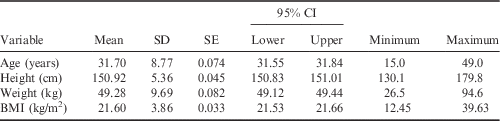
A total of 14,022 married, currently non-pregnant Bangladeshi women were analysed. The age of subjects varied from 15 to 49 years with a mean of 31.70±8.77 years (95% CI: 31.55–31.84). The average BMI of the women was 21.60±3.86 kg/m2 (95% CI: 21.53–21.66), ranging from 12.45 to 39.63 kg/m2 (Table 1). More than half of the women were normal weight (59.1%) and 14.9% were overweight. A marked percentage of women were underweight (22.8%), while only 3.2% were obese (Table 2).
Descriptive statistics for age, height, weight and BMI of married Bangladeshi women aged 15–49 years (N=14,022)

Frequency distribution of BMI categories of married Bangladeshi non-pregnant women

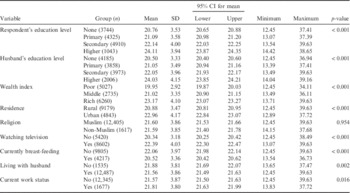
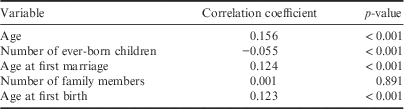
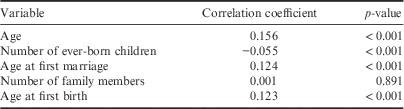
The ANOVA analysis showed that the mean BMI of the sample women was significantly associated with their education level, husband’s education level and wealth index (p<0.001). The t-test demonstrated a higher BMI for women from urban areas, with a television at home (p<0.001), currently not breast-feeding (p<0.001), living separately from their husband (p<0.001) and working outside the home (p<0.05) compared with their counterparts (Table 3). Pearson’s correlation coefficient demonstrated a positive relationship between BMI and age (p<0.001), age at first marriage (p<0.001) and age at first childbirth (p<0.001). A negative relationship was found between BMI and number of ever-born children/parity (p<0.001) (Table 4).
Descriptive statistics for BMI of married Bangladeshi women by socio-demographic factors

Pearson correlation coefficient between BMI and some demographic variables
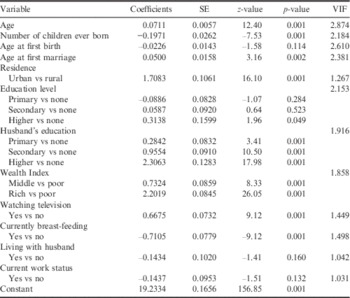
Effects of socioeconomic and demographic factors on BMI using multilevel linear regression

A socio-demographic factor would be considered as a predictor for BMI in the multilevel multiple linear regression model if there was a statistically significant difference between various categories (t-test and ANOVA) or if there was a significant relationship (Pearson’s correlation coefficient) with the variables.
An ICC of 0.062 was obtained, indicating that the selected multilevel model was appropriate for the present study. The VIF showed that there was no evidence of multicollinearity problems among the independent variables. Based on these analyses, the coefficients of the multilevel linear regression analysis exhibited a significant positive relationship between BMI and age (p<0.001) and age at first marriage (p<0.001). A negative association was observed between BMI and parity (p<0.001). Women from urban areas (p<0.001) and from better economic backgrounds (p<0.001) had a significantly higher BMI than their counterparts. Women with a higher level of education had significantly higher BMI than those who were not educated (p<0.05). In addition, women whose husbands were educated (primary, secondary and higher) had a significantly higher BMI (p<0.001) than those with uneducated husbands. It was also found that women who had the opportunity to watch television at home had a significantly higher BMI (p<0.001) than those who did not. Women who were not currently breast-feeding had a significantly higher BMI (p<0.001) than those who were currently breast-feeding.
Other variables, such as age at first birth, living with husband and current work status, showed no significant association with BMI.
Discussion
This study found the mean BMI of married Bangladeshi women to be 21.60 kg/m2. More than half (59.1%) of the women were of normal weight, 22.8% were underweight, 14.9% were overweight, with only 3.2% being considered obese. The results are consistent with a previous study that reported 15.7% and 3.9% of Bangladeshi women from urban areas were overweight and obese, respectively (Khan & Kraemer, Reference Khan and Kraemer2009). A similar result was reported in a large population study in India, where 56.9% of married women were reported to be of normal weight, 31.2% were underweight, 9.4% were overweight and 2.6% were obese (Bharati et al., Reference Bharati, Pal, Bhattacharya and Bharati2007). An earlier study reported that 54% of women living in the slum area of Dhaka were underweight (Pryer et al., Reference Pryer, Rogers and Rahman2003), but this only represented a small section of the population, and they were surveyed more than a decade ago. A more recent national survey based on BDHS-2007 (Hossain et al., Reference Hossain, Kamruzzaman, Islam, Islam and Alam2012) reported that 57.7% of women were of normal weight, 28.66% were underweight, 11.45% were overweight and only 2.16% were obese. The reducing trend in the percentage of underweight and increasing trend in the percentages of overweight/obese among Bangladeshi women between Hossain et al.’s 2012 study and the current one would indicate general improvement in the nutritional status of the female population in the country.
This study showed that the BMI of married Bangladeshi women was higher with higher levels of education for women and their husbands, better wealth index, increasing age and higher age at first marriage. More than 35% of the women were living under poor economic conditions, and 32% were illiterate. Education allows women to understand the importance of good nutrition and to be aware of the consequences of malnutrition. Poor and uneducated women do not have information on healthy lifestyles and knowledge on minimal nutritional requirements (NIPORT, 2009). Most of the women were living in rural areas. The percentage of underweight women was higher in rural areas compared with urban regions, while the reverse was observed for the percentage of obese women. It has been reported that more than 61% of women in the rural areas of Bangladesh do not receive basic health care, and 80% of them deliver their babies at home without any trained medical staff (NIPORT, 2013). Also, the present study found that higher BMI was more common among women who had a television set at home, were not breast-feeding and were living in urban areas. Television provides a channel for women to receive information. Breast-feeding mothers have higher nutritional requirements, and if these requirements are not met, they can develop a low BMI.
This study also showed that age and age at first marriage were associated with a higher BMI. A study based on the Nutritional Surveillance Project (NSP), conducted between 2000 to 2004 (Shafique et al., Reference Shafique, Akhter, Stallkamp, de Pee, Panagides and Bloem2007), reported that age, level of education, wealth index, type of residence and place of residence were important factors affecting the BMI of non-pregnant women with children below 5 years of age. Another study on Bangladeshi women based on the BDHS-2004 (Khan & Kraemer, Reference Khan and Kraemer2009) reported that age, education level, region of residence, marital status and type of occupation affect their BMI. The study on women in the slum area of Dhaka also reported that BMI was associated with age, smoking status and level of education (Pryer et al., Reference Pryer, Rogers and Rahman2003). Young women may not have adequate knowledge about health and nutrition, and this is especially true for those who married during their adolescence. With more children, these women would be burdened with the responsibility of providing for all their family members – a strong tradition in rural areas in this part of the world. Some of them may eventually neglect their own health. With increasing age, they acquire more knowledge about healthy lifestyles and the importance of nutrition from their family and friends, and learn how to take better care of themselves.
No significant difference in BMI was detected between Muslim and non-Muslim women despite the obvious differences in dietary habits between the two groups. Most of the non-Muslims in Bangladesh are either Buddhists or Hindus.
The study has its limitations. It was based on secondary data from a national health survey, and information on some potentially relevant factors such as smoking habits, weight goals, weight-loss methods, body-shape perceptions, eating attitudes and behaviours, self-concept and physical activity (Cilliers et al., Reference Cilliers, Senekal and Kunneke2006), level of energy intake (Ortega et al., Reference Ortega, Requejo, Quintas, Redondo, Lopez-Sobaler and Andres1997; Herrera et al., Reference Herrera, Rebato, Arechabaleta, Lagrange, Salces and Susanne2003; Najat et al., Reference Najat, Alice, Abbass and Rizk2008) and age at menarche (Hossain et al., Reference Hossain, Islam, Aik, Zaman and Lestrel2010) was not available. The authorities should consider adding these variables to future surveys considering their potential association with the health of the general population.
In conclusion, based on multilevel linear regression analysis on married Bangladeshi women from various geographical regions of the country, it was found that BMI was associated with age, age at first marriage, total children ever born, type of residence, level of education, level of husband’s education, wealth index, having television at home and breast-feeding.
Acknowledgments
The authors would like to thank the Bangladesh Demographic and Health Survey (BDHS) and National Institute of Population Research and Training (NIPORT-2013) for providing access to the nationally representative data collected in 2011. ICF International (Calverton, MD, USA) provided technical assistance for the project as part of its international Demographic and Health Surveys programme (MEASURE DHS). Financial support was provided by the United States Agency for International Development (USAID). All authors declare that there were no conflicts of interests in relation to this study.