Introduction
In August 1943, Will Haenlein, employee at the cultural department of the Mainz city administration, received a phone call from Dr Heinz Merten, a museum curator based at the Hessisches Landesmuseum Darmstadt. Merten called Haenlein to tell him that the Darmstadt museum was currently holding “a large number of works of art from Jewish property”Footnote 1 and that the administration holding them intended to hand them over to the city of Mainz. The administration in charge of the works of art stored at Darmstadt was not the Landesmuseum itself but, rather, the Oberfinanzpräsident Footnote 2 (OFP) of the State of Hesse in Darmstadt. In the 1930s, the Reich’s finance administration had played an expanding role in the expropriation of Jewish citizens and the exploitation of their property by collecting special taxes like the Reich flight tax or the Jewish property tax.
When the systematic deportations began in 1941, the Eleventh Decree to the Reich Citizenship Law ruled that Jews were automatically denaturalized when crossing the border of the German Reich, be it through emigration or deportation. The property of the denaturalized Jews was then automatically seized by the Reich’s finance administration.Footnote 3 Detailed orders specified how the different categories of property – not only buildings, apartments, and bank accounts but also moveable objects such as household items, sewing machines, books, and even food – should be put to use. Within this exploitation logic, works of art were treated separately from other kinds of moveable objects: when their value exceeded 50 Reichsmark, they were appraised by art experts who had to decide whether a work had “museum value” and should therefore be turned over to public institutions or whether it did not, in which case it could be sold by art dealers and auction houses.Footnote 4 For the OFP Hesse in Darmstadt, it was Heinz Merten from the Darmstadt regional museum who conducted the appraisals. The works of art that he offered to the city of Mainz in the summer of 1943 were those he had deemed “museum worthy” while appraising the pieces belonging to Jewish owners who had been deported from the cities of Mainz and Darmstadt during the mass transportations to Piaski, Theresienstadt, and Treblinka in 1942.
At the time, Merten addressed his proposal to the city of Mainz as the city museums – the Gemäldegalerie (paintings gallery) and the Altertumsmuseum (museum of antiquities), two formally separate, but administratively intertwined, institutions – had no official museum director. Since 1942, it was therefore Will Haenlein from the cultural department of the city administration who oversaw all museum affairs, including the new acquisitions. After an inspection of the artworks stored at Darmstadt in August 1943, he and Merten concluded that around 60 paintings, a hundred works on paper, and a few pieces of furniture and decorative art would be turned over to the Gemäldegalerie Mainz.Footnote 5
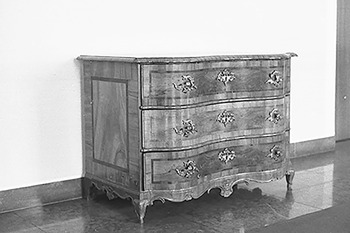
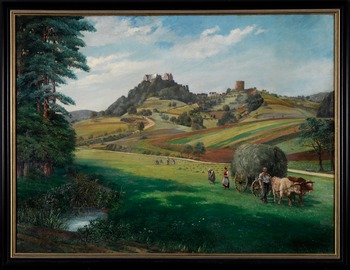
The ensemble of the transferred paintings, prints, drawings, and pieces of furniture is quite heterogenic (Figures 1–2). The paintings alone consist of an assortment of seventeenth-century Dutch works by mostly second-rate anonymous painters, nineteenth-century genre paintings, anonymous family portraits, and early twentieth-century still life or landscape paintings by local artists, largely unknown today. The works on paper can be divided into two main thematic collections: one consists mainly of prints and etchings depicting historical views from the city of Mainz. The other comprises prints from various early twentieth-century graphic artists, among them well-known members of the Berlin Secession like Lovis Corinth, Käthe Kollwitz, and Emil Orlik as well as rather unknown Jewish artists like Erich Wolfsfeld. The furniture, on the other hand, ranges from Dutch and Rhenanian baroque wardrobes and dressers to nineteenth-century baroque-style chairs and armchairs. The heterogeneity of the object types shows that the ensemble is not a collection but, rather, has been put together as a result of confiscations from several households that varied in size and style. In fact, both the variety of the object types and their overall quality illustrate that the objects originally came from the interiors of (upper)-middle-class, bourgeois Jewish families who, while being wealthy enough to decorate their homes with original works of art, were not necessarily renowned art collectors.
Baroque drawer, nut and fir wood, Landesmuseum Mainz, Inventory no. KH 0/4008. Credit: © Generaldirektion Kulturelles Erbe Rheinland-Pfalz, Direktion Landesmuseum Mainz.

Conrad Sutter, Ansicht vom Lindenfels, oil on canvas, Landesmuseum Mainz, Inventory no. 1220. Credit: © Generaldirektion Kulturelles Erbe Rheinland-Pfalz, Direktion Landesmuseum Mainz (Ursula Rudischer).

The term “living room art” was first coined as an informal description of the bulk of the objects during a conversation with a colleague. The use of the term “living room” in fact might seem misleading, as in upper-middle-class houses and apartments of the late nineteenth and early twentieth centuries, the representative or leisurely functions of what we would consider as a living room today often were fulfilled by several different rooms: while the salon (parlor) or Herrenzimmer (study) were usually used as reception rooms for guests, the living room in the stricter sense was a private room to which only family members had access.Footnote 6 The contemporary construct “living room art” therefore operates with today’s connotations that no longer reflect the social practices of the German Empire or even the Weimar Republic. It is, however, precisely the present-day connotations of the term that make it so compelling: “living room art” seems to depreciatively imply that this type of art had only a minor artistic value and may have been acquired for merely decorative purposes. This implication raises a set of questions of its own since it sheds light on a social group and its practices of art possession that has largely been overlooked so far: bourgeois families that, while being wealthy and well integrated in the economic and cultural elite of their home city, have never developed ties to the art world in the stricter sense and, when acquiring works of art, never did so with an intention to systematically build up art collections. What function did the works of art fulfill in this type of social environment? How did art possession, or, in a more general sense, material culture, relate to the ways in which its owners expressed and represented their social and economic status? And how were those ways of self-representation and their sense of belonging to a certain class affected by Nazi persecution and its particular practices of art confiscation?
The notion of material culture appears particularly helpful here in its aim of bringing things and objects to the center of analysis. According to the “material turn,” objects can be considered as representations of ideas, values, norms, and practices of a certain given time and, as such, should be analyzed as sources of information that have the same relevance as textual or visual sources. Even more crucially, material culture studies question the aesthetics and social function of objects, their potential to create identity and preserve memory, as well as historical practices of appropriation and use of objects.Footnote 7 In terms of methodology, the study of material culture requires an object-related approach that starts with, but is not limited to, the study of an object itself – for example, its material, its form, and its function. Since the examination of these aspects is often not self-explanatory enough to grasp the entirety of an objects’ potential meaning – how and by whom it was typically used, what value it had, and how its uses, values, and appropriations may have changed over time – a profound understanding of the object often requires its study through additional types of sources, be it written textual sources such as inventory lists, auction catalogues, or testaments or visual documentation such as images and photographs.Footnote 8
The methodology of material culture studies is similar to that of provenance research in museums and the art market: in order to retrace the provenance of an object, one usually starts with an examination of the object itself. What type of object is it and what material is it made of? To which period can it be dated? Can it be attributed to a known artist? Does it bear any marks that hint at its ownership history – are there, for instance, any stickers, inscriptions, or customs stamps that may document its passage through the art market or across state borders? Or are there maybe indications that could refer to a confiscation? Since those marks are usually not self-evident but demand a certain amount of reference knowledge to interpret them, provenance research additionally requires extensive research through written documents: auction catalogues and auction sale records, art dealer records as well as documents from the customs and finance administration and the restitution claim files from the postwar period.
Typically, these types of written documents are consulted for the reconstruction of a particular ownership history, but they can also be revelatory for more general research questions. Art dealer records, and customs forms, for instance, reveal the circulation of cultural items and the mechanisms of the art market. The records of the customs offices and finance administration that handled the seizing of “nationally relevant” works of art from the liftvans (shipping containers) of emigrating Jews show how German bureaucracy was involved in art looting as well as containing information on the types of works of art that were considered “nationally relevant” during the Third Reich and, thus, can further our knowledge on Nazi art politics.Footnote 9 Sale records from the auctions of “non-Aryan households” in the early 1940s show what middle-class households of this time had consisted of; similarly, restitution claim files offer postwar descriptions of the material possessions that had been taken away from Jewish owners. Since both types of sources offer intimate insights into the material culture that once had surrounded Jewish families, they can be used for studies that go way beyond the search for a particular object. The historian Leora Auslander, for instance, analyzes German auction sales records and French restitution claim files for a comparative history of Jewish taste. Through a close reading of items listed in the respective records, she reconstructs Jewish everyday habitat, choices of furniture and porcelain types, what they reveal about cultural consumerism and identity, and whether or not they can be considered as an expression of a specific “Jewish” taste in the private sphere of their home.Footnote 10
While provenance research heavily relies on restitution claim files for a reconstruction of persecution circumstances and ownership histories, the ways in which inventory lists and household descriptions can relate to the material culture and private life of particular persons are usually not extensively explored. This may be due to the often intimate nature of restitution and compensation files: while retracing the specific persecution situation of a family, they also refer to the family’s history in more general terms, evoke personal relationships between family members, and can contain sensitive data on the financial situation or the physical health of Holocaust survivors. For this reason, the archival access to a part of the restitution and compensation files is still restricted today, and while full access to the documents is in general provided upon request, their sensitive nature and the intimacy of the family histories uncovered has to be kept in mind when studying them. In addition, Auslander has identified a second moral dimension that has to be considered when working with this type of sources: the question of whether it is legitimate to use information generated in the interests of mass destruction for a purpose other than analyzing persecution. She argues that it is, given that she analyzes stories of life rather than death and that “the obligation to struggle to understand the death of European Jews in the 1940s should not force us to forget their lives.”Footnote 11
In provenance research, the use of restitution files usually aims at analyzing persecution in order to check whether persecution circumstances have impacted the ownership history of an object and led to a change in ownership that otherwise would not have occurred. Auslander’s approach to restitution files as sources for grasping Jewish material life and analyzing its relevance for questions of social belonging, taste, and identity can nonetheless give new impulses to the study of provenance, ownership histories, and collecting. Up to date, the main focal points framing provenance research remain focused on studies of the art market and art dealer networks,Footnote 12 the acquisition strategies of museums,Footnote 13 or the biographies of particularly notable dealers and collectors.Footnote 14 The consequences of Nazi art politics and anti-Semitic persecution, however, were not only limited to the art world of museums, dealers, and renowned collectors but also heavily affected the private sphere of the Jewish middle class. The “living room art” that came into the collections of the Landesmuseum Mainz through the OFP Hesse in Darmstadt in 1943, in fact, represents only the tip of an iceberg. The paintings, porcelains, and pieces of furniture that were judged “museum worthy” are only a small part of a much larger amount of household items that went through the confiscation and exploitation mechanisms of the Reich’s finance administration. Most of those items were subsequently sold into private hands, where they are much more difficult to trace than the ones that ended up in museum collections.Footnote 15 Both the “living room art” that entered museums and the household items that did not are closely linked to the everyday life dimensions of Nazi persecution since they unveil how this persecution contributed to a reduction and eventual complete dispersal of private Jewish homes. They represent a material side of the Holocaust that cannot be disconnected from what happened to their owners. Their retracing can thus shed light on the mechanisms of plundering, the cultural dimension of the genocide, and the extent to which German society profited from it.
The retracing of “living room art,” however, does not necessarily have to be limited to the study of persecution. By reconstructing its initial environment – for example, the material culture of the Jewish middle class – we can also gain new insights into the history of Jewish bourgeoisie or the history of Jewish everyday life in general. The emergence of a German Jewish bourgeoisie in the nineteenth century and its development in the early twentieth century have been explored by several scholars, often in a biographical approach focusing on one particular family and also through the lens of the history of everyday life.Footnote 16 From the perspective of the analysis of Jewish bourgeoisie, art-collecting practices are usually considered to be part of a bourgeois habitus that was closely related to the ideal of Bildung to which the Jewish bourgeoisie aspired.Footnote 17 Through the analysis of material culture – or, more concretely, “living room art” – we can gain deeper insights into those practices and how they related to ideals of culture and education or expressed their owners’ sense of social belonging and identity.
In this article, I would like to think of the term “living room art” as a category of analysis that brings together questions of art possession and its expropriation, provenance, and the study of material culture. Through a close reading of restitution files, I want to analyze the descriptions of the material culture of the German Jewish middle class and its relationship to questions of social belonging and self-representation. By doing so, I also suggest the study of material culture as a possible analytical framework for questions of provenance research – one that is not so much based on art dealer networks, museums, and the art world in general but, rather, on the more everyday-life and private dimension of middle-class consumerism and collecting practices.
The source material: Characteristics of restitution claim files
Paradoxically, it was the very Nazi persecution measures and the resulting restitution legislation enforced in Western Germany through the Allied restitution laws in 1947 and the Federal Restitution Law (Bundesrückerstattungsgesetz [BRüG]) in 1957 that produced the sources that allow the deepest insights into the material life of Jewish families in the 1930s and 1940s.Footnote 18 While the original documents produced by the perpetrating administration itself – for example, the income declarations for the Reich’s finance administration, the customs declarations for émigrés, and the sales records from auctions of “Non-Aryan” households – are often incomplete due to war-time losses, the restitution claims filed under the Allied restitution laws and the subsequent BRüG legislation in many cases provide a comprehensive documentation that allows for a detailed reconstruction of individual biographies and persecution circumstances – in those cases where the family members or relatives of the family survived.
Under both pieces of legislation, the first step for the claimants to undertake consisted of declaring the kinds of material losses the persecuted person in question had endured. In Bavaria and Hesse, claims were declared by filling out a form and submitting it to a central registry, which then forwarded them to the local or regional bureau (Wiedergutmachungsamt) in charge, whereas in Rhineland-Palatinate – where all three Mainz cases discussed in this article were filed – the claim took the form of a lawsuit against the current holder of the property or against Germany as the legal successor of the German Reich. In addition to declaring and describing the losses, claimants also had to deliver proof of the persecution measures and the confiscations. In those cases where claimants declared the loss of liftvans that were confiscated shortly before or during emigration, they were required to describe the scope and content of the liftvans and, if possible, submit customs forms or the original documentation from the moving company specifying the number and description of the packed objects. Similarly, when a financial compensation for the loss of furniture or household items was requested, claimants were asked to specify the size of the apartment as well as, if possible, the amount and estimated value of its furnishing.
As a consequence, restitution case files often contain inventory lists or descriptions of the former households. The amount of detail provided in each restitution file, of course, varies. In some cases, the inventory lists only indicate the number of rooms an apartment consisted of, but no description of how they were furnished. In other cases, the claimants delivered detailed enumerations of pieces of furniture, silverware, porcelain, and could even name the titles of the books their family had owned. In addition, family members, friends, or neighbors who were requested to testify could hand in descriptions of the household or the persecution its owners had to endure – for example, the destruction or pillaging that had occurred during the pogroms of November 1938, the handing in of jewelry or silver, or the forced sale of household items before people moved into a smaller apartment.
Whereas restitution cases filed for immobile assets could end in the physical turnover of the asset to its original owners, a physical restitution of lost furniture or household items was rarely possible. In general, the claimants could only retrace the circumstances of the loss but were unable to determine the whereabouts of the objects by the time their restitution was requested. The testimonies delivered in the restitution process – both inventory lists and household descriptions – consequently served as a basis not so much for researching the objects in question but, rather, for estimating their monetary value and subsequently determining the financial compensation to be paid to the claimants.Footnote 19
The majority of the restitution procedures under BRüG were finished by the end of the 1960s, and most of the files were turned over to the regional archives during the late 1990s.Footnote 20 After Germany signed the Washington Principles and issued the Joined Declaration, the files became more and more relevant for provenance researchers for two reasons: first, the forms, testimonies, and additional materials submitted by the claimants allow the reconstruction of a person’s biography and the evaluation of the persecution circumstances under which a work of art might have been sold or otherwise surrendered.Footnote 21 Second, since the Joint Declaration stipulates that no double-compensation shall take place, the files also have to be consulted in order to check whether claimants already have received any prior compensation payments under Allied or BRüG legislation which would have to be taken into account in case of a restitution negotiation.Footnote 22 As of today, access to most restitution files is still restricted due to data protection laws, but some regional archives have responded to the increase in research enquiries by classifying the files in a way that makes the specific information they contain more accessible.Footnote 23
In the following paragraphs, I will analyze how the intersection of art possession, social belonging, and representation can be grasped through the restitution files. However, since the testimonies and inventories of households were retrospective reconstructions of households that in general no longer existed, one has to take into account that the representations of the households were in general based on the claimant’s memory and only sometimes could be drawn from written or photographic documentation and, thus, could be emotionally biased and incomplete. In order to counterbalance this bias, the case studies additionally use primary sources such as Gestapo minutes or private letters written during the time of the persecution as well as biographical accounts, published memories, and local studies of the Jewish history in Mainz.
Jewish assimilated bourgeoisie and the impact of Nazi persecution on their material life – three examples from Mainz
The following case studies are based on the provenance research conducted on the works of art that were transferred to the Gemäldegalerie Mainz by the OFP Hessen in Darmstadt in 1943. While all three family histories have already been published in local studies of Mainz Jewish history, only one of them actually turned out to be related to works of art currently held at the Landesmuseum.
Eduard Epstein, born in 1867 in Frankenthal, was a businessman who was married to Emma Epstein (née Hirsch) and father to four sons. The large family apartment was located right above the salesrooms of his firm “Warenhaus L. Epstein.” In the 1920s, Eduard Epstein started to specialize in selling furniture and renamed his business “Möbelhaus L. Epstein”; he was joined in his business by two of his sons, Max and Alfred.Footnote 24 In an account of his childhood memories, Alfred describes his parents’ household as being part of the wealthy Mainz bourgeoisie and remembers how, in a typical manner for assimilated Jewish families of the German Empire, they celebrated Christmas with a Christmas tree and presents for the children.Footnote 25
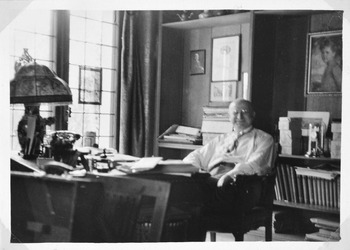
Felix Ganz, on the other hand, grew up in an assimilated Jewish family but ultimately decided to convert to Protestantism with his wife Gertrud and his three children (Figure 3).Footnote 26 Born in 1869, he was the owner of the Mainz-based carpet firm “Ludwig Ganz AG.” The family lived in an apartment above the salerooms on Schillerplatz until 1920 and then moved into a mansion on Michelsberg. In Mainz, Felix Ganz was known not only as a merchant but also for his important role in the cultural life of the city: he supported the Mainz Antiquities Society as well as the Römisch-Germanisches Zentralmuseum and was the owner of a collection of Asian art that he had acquired during his business trips to the Middle East and North Africa.Footnote 27
Felix Ganz in his study at Michelsberg, undated. Credit: Family Archives; © Ganz Family, courtesy of Adam Ganz.

Siegmund Levi, the descendent of a Mainz family of lawyers, was also well known as a connoisseur and collector of art. He was born in 1864, married Emma Oppenheimer, who died in 1917, and had two sons. The family resided in a house on Uferstraße 57, the promenade directly facing the Rhine. His law firm was located on the prestigious Kaiserstraße until 1932, after which Siegmund relocated the office to his private house.Footnote 28
When the National Socialists took over power in 1933, Eduard Epstein, Felix Ganz, and Siegmund Levi were all, regardless of their religious beliefs, considered as Jewish. The persecution they had to endure not only affected their social status but also their private lifestyles and the extent to which they could dispose of their property. While the occupational bans and economic “Aryanization” was aimed, first and foremost, at the removal of Jews from the public sphere,Footnote 29 these measures also had consequences for their private lives since the loss of workplaces and income often resulted in the need to move into smaller apartments and therefore to sell assets or to the decision to leave Germany altogether. The carpet firm of Felix Ganz, for instance, was “Aryanized” as early as 1934–35. While his adult children left Germany and went to England and Switzerland, he stayed in Mainz, and, having lost his first wife in 1936, remarried in 1939.Footnote 30 Eduard Epstein was forced to sublet his business to an “Aryan” tenant in 1935 and eventually to sell his house in 1938.Footnote 31 His sons Alfred and Erwin, who both had been Social Democrats, had already fled to France in 1933; his third surviving son Kurt emigrated to the Netherlands.Footnote 32 Siegmund Levi’s law firm suffered from a continuous decrease in clientele, which, by late 1937, forced him to sell his house and to move into an apartment in Frankfurt am Main. At the same time, he surrendered his approbation as a lawyer, only months before the Reich imposed a general occupational ban on all remaining Jewish lawyers.Footnote 33
Starting in 1938, the impact of Nazi persecution on Jewish private life became more immediate: in April 1938, the Decree on Property Registration required Jews to declare not only their income but also all estates, houses, and moveable assets that they possessed to the local finance administration. In the aftermath of the pogroms in November 1938, these declarations served as a basis for the calculation of the Jewish Property Tax, which forced Jews to turn over 20 percent of their property to the state. Since, by this time, the majority of the Jewish population was no longer allowed to work, paying the tax in many cases meant that family assets like pianos, pieces of furniture, or works of art had to be sold. In February 1939, the Reich’s government additionally ordered the surrender of precious metals and jewelry.Footnote 34 The daughter of Felix Ganz later remembered bringing the family silver to a pawnbroker in Mainz in a suitcase.Footnote 35 Siegmund Levi had to surrender his coin collection and so much household silver that it took two separate car trips to deliver everything.Footnote 36 Starting in 1939, Jews also could no longer freely dispose of their bank accounts since they had been sequestrated by the local finance administration. Only small sums for covering the most basic monthly expenses were allotted to the account holders.
The pressure to sell assets was heightened by the Law on Rental Contracts and the tendency of the Gestapo to force Jewish families to move into smaller apartments in so-called “Jew houses.”Footnote 37 Felix Ganz and his second wife Erna (née Benfey) were evicted from the villa at Michelsberg in the spring of 1941; during the subsequent 18 months, they had to move to different apartments three times due to the constant efforts of the Mainz Gestapo to reduce the number of houses and apartments occupied by Jewish families.Footnote 38 Changes in accommodation were accompanied by a constant flux of orders and decrees regarding the surrendering of minks and fur coats, typewriters, bicycles, and radios. The minutes that Michel Oppenheim, a Jew from Mainz who had been forcibly appointed to serve as a liaison officer between the Jewish community and the local Gestapo, had kept of his daily meetings with Gestapo officers, however, prove particularly revealing in this sense.Footnote 39 They contain references to the eviction of the Ganz couple from their house at Michelsberg, succinctly mention that furniture belonging to the Ganz family was sent off to Würzburg and then returned to Mainz to be sold through the auction house Dapper, and also refer to the moment when Felix Ganz eventually had to surrender his gramophone and record collection.Footnote 40 The Ganz family was certainly not the only one concerned by those measures. In fact, since the Gestapo had to consent to each single furniture sale, the meeting minutes contain a lot of small references to those types of transactions. They usually do not contain detailed information about the types of objects sold. Despite this, the minutes represent a chilling account of the gradual diminution of Jewish material life between 1941 and 1942 and ultimately culminate in documenting the preparation of the two mass deportations from Mainz that took place in March and September 1942 and a third one from Darmstadt in February 1943.
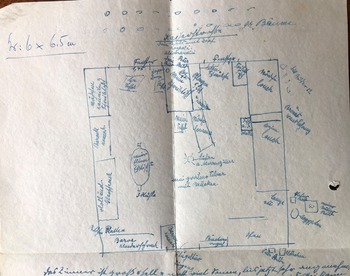
What the Gestapo orders meant for the actual living conditions and material situation of individual families becomes clear in a letter that Felix Ganz wrote to his daughter in June 1942 and which his heirs presented to the Mainz district court during the restitution process in the early 1960s. At the time, Felix Ganz wrote this letter, he and his wife had just moved apartments for the third time and now were living in one room at Kaiserstraße 32, where they shared the kitchen and the bathroom with Felix Ganz’s mother-in-law Marie Benfey. In his letter, Ganz describes briefly how he and his wife had settled into the new place, and he illustrates his description with a sketched layout of the room indicating how they had arranged their remaining furniture (Figure 4). The sketch shows that the Ganz couple had managed to subdivide the room into several distinct spaces, each fulfilling a separate function of private living. While the right part of the room with the sofa beds was reserved for sleeping and resting, the window section and the left part of the room containing the spouses’ writing desks, two baroque dressers, the former dining room table and several chairs, armchairs, and a chaise longue served as a combined study, living room, and dining room. In the restitution process, the witness Michel Oppenheim testified: “Das Zimmer war sehr groß und war mit Möbeln dermassen vollgestopft, dass es aussah wie in einem Möbellager. … Es standen auch mehrere Kisten umher, in die der Erblasser, wie er mir berichtet hat, seine Kunstsammlung verpackt hatte. … Auch auf dem Flur waren zahlreiche Möbelstücke und vor allem die Kisten aufgestellt, so dass man kaum dort durchgehen konnte.”Footnote 41 Little inscriptions on the sketch illustrate that the couple even had suspended their chandelier, hung the family portraits on the walls, and unpacked at least one Persian lamp and mounted it in a corner of the room.Footnote 42 Clearly, the couple had made every effort to surround themselves with the things they were most attached to and which still communicated the socio-economic status that had forcibly been taken away from them.
Letter from Felix Ganz to his daughter Annemarie, 16 June 1942. Credit: Family Archives, © Ganz Family, courtesy of Adam Ganz.

The same efforts become apparent in Oppenheim’s private letters on Siegmund Levi’s final living arrangements in a Jewish retirement home in Frankfurt: “Sigmund’s neue Wohnung ist sehr schön geworden. Anstelle seines großen Zimmers hat er jetzt 2 kleinere Räume, die gut einzurichten waren. Was das Wichtigste ist: An den Wänden ist soviel Platz gewesen, dass er zu den Bildern, die bisher schon aufgehängt waren, noch 3 weitere und zwar grosse hängen konnte.”Footnote 43 By this time, the pieces of his art collection had become the last valuable things that Siegmund Levi still clung to; they not only offered aesthetic pleasure but also materially supported his memories of the time prior to the Nazi persecution. Eduard and Emma Epstein, Felix and Erna Ganz, and Siegmund Levi were all deported from Mainz and Frankfurt to Theresienstadt in August and September 1942. Eduard Epstein and Siegmund Levi perished there in 1943. Felix and Erna Ganz were murdered in Auschwitz in 1944. Only Emma Epstein survived the detention.Footnote 44
Inventory lists as transcripts of material culture
In all three cases, heirs filed restitution claims at the Mainz district court under the BRüG legislation in 1958. The inventory lists and testimonies they provided give us intimate insight into the material culture that once had surrounded their parents’ lives. After the death of his mother Emma Epstein in 1955, Alfred Epstein was the only surviving member of the Epstein family. In 1933, he had fled to France, made a living as a shoemaker in Paris until 1939, then joined the Légion étrangère to avoid internment as a German citizen and survived World War II while being stationed in Algeria.Footnote 45 In the 1950s, he returned to Mainz where he and his wife contributed to the postwar reconstruction of the Jewish community and filed for restitution and compensation on behalf of his parents. In the first letter in which Alfred Epstein’s lawyer initially claimed restitution at the Mainz district court, he provided a succinct list of the household items the Epsteins had been forced to surrender.Footnote 46 Epstein himself subsequently handed in a testimony in which he described the contents of the parental apartment and recalled that it had been remodeled in 1925.Footnote 47 In addition, he compiled a detailed room-by-room tabular inventory list containing not only furniture prices but also meticulous descriptions of how each room was furnished, which factory had produced the different pieces of furniture, and which paintings, carpets, or porcelain objects decorated them. His description of the dining room, for instance, reads as follows:
Speisezimmer: Büffet, Kredenz, 2 Vitrinen, Auszugtisch, 8 hohe Ledersessel – Möbelfabrik ROHRER, Stuttgart, Stuttgarter Möbelausstellung, 1924/25, 2.500 – 1 Marmorsäule, Teppich, Gardinen, Übergardinen, 2 Gemälde, Parkettboden, Decke und Wände mit Holzverkleidung … – Das schwereichene Zimmer stammte aus der Stuttgarter Möbelfabrik ROHNER [sic] A.G., die nur allerfeinste Möbel herstellte und wurde 1924 od. 1925 auf der Stuttgarter Möbelausstellung gekauft. … Ein prachtvolle [sic] Stilleben, sowie zwei wertvolle Landschaftsbilder im Speisezimmer wurden auf Bildausstellungen in Wiesbaden und Darmstadt gekauft. Eines der Bilder war unterzeichnet “Schütz” od. Schürz; ein anderes Bild stellte das Mannheimer Schloss und Park dar, doch entsinne ich mich nichtmehr [sic] des Mahlers [sic].Footnote 48
The number of details that Alfred Epstein remembered about the provenance of each piece might seem surprising at first but is much less so when taking into account that his parents had owned a furniture store. When remodeling their apartment in 1925, they therefore might have very consciously decided to buy particularly representative and valuable furniture, especially for the dining room in which they entertained guests or relatives and which was therefore one of the more public spaces of the apartment. The choice underlined both the Epstein’s wealth and bourgeois lifestyle while, at the same time, communicating their professional expertise and, thus, ultimately, their professional identity as furniture dealers.
Epstein’s inventory lists are not limited to furniture descriptions but, at various points, also mention that the family owned paintings. Two or three of them were displayed in the dining room, and some of the original paintings hung in the study and the reception room.Footnote 49 All three rooms belonged to the more semi-public sphere of the apartment where guests were received. But only the paintings from the dining room – one still life and two landscapes – were actually described in detail. None of these descriptions would allow for the identification of a particular work of art, and neither would the mention of graphic portfolios in the description of the study. Nevertheless, the mere mention of the presence of paintings and etchings reflects the idea that the Epstein couple was interested in art and could afford to possess some pieces. Similarly, the presence of a piano in the salon indicates that music was a part of their family life. In short, the Epstein’s material possessions clearly show that they were part of the economically wealthy and intellectual upper middle class and expressed their economic status, professional identity, and cultural interests through the things they owned.
The Epstein’s lifestyle was, in fact, quite typical for their generation’s urban upper middle class. As Marion Kaplan and colleagues point out, a representative living room, oil paintings, and pianos were staples of bourgeois households of the German Empire as well as of the Weimar Republic.Footnote 50 This also becomes apparent when comparing the Epstein restitution files to those pertaining to Felix Ganz and Siegmund Levi. When the heirs of Felix Ganz filed for restitution, they submitted three different inventory lists to the Mainz district court. The first one describes the Asian art collection and features Chinese screens, ink paintings, and Japanese sculptures as well as Persian wood paneling and fireplace tiles that likely had been integrated into the fireplace and wall structures of at least one of the rooms in the villa. The second inventory list enumerates the furniture, among them several baroque wardrobes, dressers, desks, and chairs. Both lists also feature smaller items, such as a library, a radio, a gramophone, and a musical record collection. While the latter items were featured on the art collection inventory, the library was not, and neither were the only four “Western”-style paintings mentioned on the lists: books and family portraits apparently were perceived to be part of the regular household furnishings. The third inventory list includes a large amount of silver cutlery, usually in sets of 12–24 pieces of each type of spoon, fork, or knife and thus reflects the initial size of the household and the number of persons it could serve.Footnote 51 The claim was additionally supported by testimonies from witnesses who described the furniture and household assets as valuable and above average, especially the Asian art collection.Footnote 52
In comparison to the Epstein family case, the inventory lists and descriptions in the Felix Ganz case are less explicit about his professional identity. Nevertheless, they are indicative of economic wealth, private interests, and personal taste. They allude to an interest in music, reveal a preference for antique baroque furniture, and show that, as a result of his frequent travels to the Middle East and Asia, Felix Ganz had developed a certain connoisseurship in Asian art that influenced the interior design of his home. Ganz might not have figured among the more renowned bourgeois art collectors of the late nineteenth and early twentieth centuries, but he certainly did consider himself to be an art collector.
The same observation can be made with regard to Siegmund Levi. In his restitution claim, his son Ricardo Levi, who had emigrated to Argentina, delivered a room-by-room description of the house and emphasized both the size of the building and the exquisiteness of its furnishings. According to Levi, the furniture had been made by the Mainz-based factory Bembé specifically for the Levi household when the family moved into the house in 1900.Footnote 53 In comparison to the details given about the furniture, Ricardo Levi’s description of his father’s art collection is more succinct – he only mentions that it consisted of etchings, paintings, and books. The testimonies of Siegmund Levi’s friends Michel Oppenheim and Herbert Strauß elaborated that the collection’s main focal point had indeed been etchings. Reportedly, some of them had been by Dürer, Rembrandt, as well as smaller French and German eighteenth-century masters. In addition, the collection consisted of oil paintings, a wooden sculpture of St Martin, porcelain, a large coin collection, and a cabinet full of small books and portfolios related to the city of Mainz.Footnote 54 Levi was not as specialized on one single area of expertise as Felix Ganz was but, instead, displayed a more eclectic – and, ultimately, very bourgeois – interest in different categories of objects. His social status in the Jewish upper middle class in Mainz was thus not only communicated through the location of his house near the Rhine promenade and its furnishing by a prestigious Mainz-based firm, but his bourgeois sense of identity was also enhanced and displayed through his broad taste in collecting.
The material culture that surrounded Eduard Epstein, Felix Ganz, and Siegmund Levi clearly identifies them as belonging to the Mainz bourgeoisie and allows one to make assumptions on their aesthetics, taste, and consumer practices. While Leora Auslander has stated that the economically comfortable Berlin Jewry of the 1920–40s was attracted to cosmopolitism, eclecticism, and, to a certain extent, modernism,Footnote 55 the insights given by the Mainz case studies reveal an interior aesthetic that was established roughly between 1900 and 1925 and seems to evoke the historicist traditions of the late German Empire. Tellingly, though, the Epstein and Levi inventories describe furniture not in terms of a specific style but, rather, by naming the Mainz-based factories that produced it. While this means that their style presumably could have ranged from late historicism to art nouveau or art deco inspired, it more importantly shows that buying from local firms was a determining factor in their consumerist choices. The Felix Ganz inventories, by contrast, do reveal an eclectic mix of historicist and cosmopolitan tendencies. Eclecticism was also expressed in the art collection assembled by both Felix Ganz and Siegmund Levi. Most strikingly, the Mainz examples resemble the Berlin case in that the inventories are marked by the complete absence of Jewish ritual objects.Footnote 56 The assimilation of Jewish bourgeoisie was thus not only expressed by the description of a bourgeois lifestyle but also by the omission of any references to religion.
Reconstructing what was destroyed: Inventory lists as recollections of the past
The specific quality of the inventory lists and household descriptions in restitution files lies in the fact that, in contrast to auction protocols from a household dissolution, they usually were not drafted while the household still existed or was being dissolved. In most cases, they constitute retrospective documents, written down up to 20 years after the claimants had last set foot in the physical spaces they describe. They therefore are not contemporary and do not reflect the factual material situation of a space at a given time but, rather, mirror how claimants reimagined and virtually reconstructed it. The reconstructive character of the inventory lists is mirrored by the way they are usually structured. While even the most succinct kind of list generally enumerates the number of rooms an apartment had, the more detailed ones are strikingly similar to one another in that they almost always follow a room-by-room structure that reveals how the claimants, when consciously remembering the apartment, undertook a virtual room-by-room tour of it.Footnote 57 Alfred Epstein, for instance, started his description in the most private part of the apartment – the master bedroom – before moving on toward the more public spheres of the dining room and salon. This proceeding not only reflects different levels of privacy within the apartment but also seems to mirror the layout of the rooms.Footnote 58
The room-by-room structure is also reflected in Ricardo Levi’s description of his father’s house. In order to support his own memories, he additionally handed in photographs of the interior (which are, unfortunately, no longer part of the file), referred to the house’s architect who could provide additional information on the size and layout of the building, and assumed that the furniture manufacturer Bembé might still be able to look up the original price of the furniture in their books.Footnote 59 The Ganz inventory lists, on the other hand, are not structured according to the layout of the former Ganz apartment but instead show how material sources could support the virtual reconstruction of a former interior. As already mentioned, the files contain a total of three different lists: one for his furniture, one for his silver, and one for his collection of Asian art. The furniture inventory does not reflect the entirety of the former Ganz estate at Michelsberg but, rather, a reduced state of the household with only the kitchen equipment, the living room, a study, and some pieces from the master bedroom.
A comparison of the single entries with the pieces of furniture Felix Ganz had inscribed in his sketched layout of his last room at Kaiserstraße 32 reveals that the inventory list is largely congruent with what Felix Ganz had described in 1942. Clearly, the Ganz heirs had used their father’s letter and his room description as a basis for setting up the furniture inventory, but they had been unable to document how the villa at Michelsberg originally had been equipped and what had happened to the pieces that Felix Ganz had not been able to take along when he had to move out. In the end, the Mainz district court acknowledged this by explicitly ruling that the compensation paid to the claimants for the confiscated furniture was limited to the furniture from Felix Ganz’s “last room.”Footnote 60
As postwar reconstructions, inventory lists were subject to personal memories and the availability of material sources that might support them. However, they were also biased by the ways in which claimants perceived their own family: whenever claimants insisted that their family members had been wealthy or that their furniture had an above-average quality and value, they did so because this was how they subjectively estimated the family’s pre-1933 socio-economic situation. The implicit statements about social belonging and representation that can be inferred from the restitution files are therefore retrospective attributions and subject to the bias of memory. They do not objectively mirror the social status a family had before the persecutions began but show how the claimants remember it.
The ways in which Alfred Epstein remembered the paintings in his parents’ apartment is particularly telling: he did not remember all of them and was only able to describe the ones in the representative environment of the dining room. His descriptions are also contradictory. Whereas the tabular enumeration of items from the dining room in the inventory list mentions “2 paintings,” his detailed description of the same room mentions three paintings – one still life and two landscapes – one signed by “Schütz or Schürz” and another representing the Mannheim castle.Footnote 61 Also, his explicit mention of the “picture exhibitions in Wiesbaden and Darmstadt,” where the paintings had been acquired, hints at the fact that the paintings did have a certain artistic value but, more importantly, also underscores the fact that the Epstein couple adhered to the social practice of attending exhibitions and buying art there.Footnote 62
While Epstein would no longer exactly remember the individual works of art hanging in his parental apartment, he was at the same time able to precisely recall the provenance of the apartment’s furniture. Clearly, his memory was shaped by the way he perceived his family: since his parents had worked with furniture, they had been experts in the different factories and styles, and their own private apartment had been a place where they would have showcased it. Alfred Epstein, in turn, not only shared this specific expertise, but, by describing in detail the value and provenance of each furniture item, also retrospectively acknowledged his parents’ expertise and their professional identity. The paintings, however, while enhancing the bourgeois character of the apartment and emphasizing the social status of its inhabitants, were not as central to the family’s identity, and Epstein did not explicitly describe his parents as art collectors. By mentioning the fact that they did possess works of art, he stressed that they had been wealthy and cultured in order to make sure that the Mainz district court would correctly acknowledge the value of the household items when calculating the financial compensation.
The case is different for the Ganz family. Not only did the Ganz heirs provide a separate inventory list for the collection of Asian art, but they also filed for two distinct kinds of compensation, one explicitly aiming at the art collection and the other aiming at the furniture. The clear distinction underlines the importance of the art collection and thus reveals that Felix Ganz, indeed, must have identified as an art collector for whom his works of art had been far more than decorative elements or status symbols. While the pieces of Asian art had certainly influenced parts of the interior design of the villa at Michelsberg, they also referred to his professional biography, especially his business travels to the Middle East during which he had presumably acquired his collection. In addition, they reflect the expertise he had gained through his travels as well as through the study of specialized literature and exchanges with Sinologists from German universities.Footnote 63
The way in which Siegmund Levi’s son and friends retrospectively describe his living circumstances similarly reveals the extent of his cultural interests. Ricardo Levi mentioned that when his father moved from Mainz to Frankfurt, he only took along his etchings, paintings, and books, thereby implicitly stressing the importance that those objects must have had for him.Footnote 64 Michel Oppenheim testified that their friendship had been based upon a shared interest in works of art: thanks to their frequent meetings and discussions about art up until shortly before Levi’s deportation, Oppenheim was able to recall which objects the collection had consisted of and indirectly underlined that Levi had been as much of an art expert as Oppenheim himself.Footnote 65
All three cases show that the restitution claims and the requests of adequate financial compensations for lost household items and art collections were never about material compensation alone. By describing the former position of their families within the Mainz bourgeoisie, their material culture, and their social integration, the heirs of each of our individuals aimed not only to reconnect with their own past but also indirectly to request an acknowledgement of the former position of their family as well as of the fact that their families had been systematically marginalized, persecuted, and eventually physically annihilated.Footnote 66
Conclusion
Through the mirror of restitution files, we can uncover descriptions of bourgeois material culture and “living room art.” Inventory lists filed in restitution claims unveil not only that the members of the middle class collected cultural items but also how they perceived themselves and their collecting practices and how this related to their sense of social belonging and identity. Even though most middle-class families collected on a much smaller scale than the well-known art collectors of their time, these small-scale bourgeois practices of collecting were no less eclectic or specialized than their large-scale counterparts. Inventory lists reference not only paintings – though, in general, paintings are mentioned without specifying much of their subject matter or the painters – but also portfolios of etchings and drawings, stamp or coin collections, fine china, oriental carpets and tapestries, and pieces of Asian art. Interestingly, these pieces were not always explicitly labeled as “art collection” in the restitution files, and instead of assembling separate inventory lists exclusively for the works of art, claimants frequently named the works of art alongside the furniture and the smaller household items. While many bourgeois families did collect works of art, not all of them explicitly perceived the objects as a collection or themselves as collectors. Rather, cultural objects were simply considered to be part of the average wealthy, bourgeois household. As such, they served to represent and express the social class of their owners, but they were not necessarily collected for their inherent artistic value. Nevertheless, the possession of those objects enhanced the sense of identity and of belonging to a certain social class.
By highlighting the types of art owners and collectors who are comparatively less renowned than collectors of museum-worthy items and who only rarely acted as patrons or established close relationships to art dealers or museums, the analysis of restitution files opens up new perspectives on the practices of bourgeois private collecting and taste. At the same time, the inventory lists and testimonies of middle-class private households allow readers to grasp traces of “living room” works of art that were always meant to be displayed in the private sphere. Due to the process of exploitation of Jewish property by the Gestapo and the finance administration in the early 1940s, these types of works of art sometimes eventually ended up in museum collections but, far more often, were sold into private hands.
By reading the restitution files, provenance researchers can overcome some of the blind spots caused by a focus on museum collections. Since they reconstruct a posteriori the original state of households and apartments from the time before their dispersal, they list “museum-worthy” objects alongside those items that were considered “non-museum worthy” during the process of confiscation and thus offer a more complete representation of the material and socio-economic context in which a single work of art originally had been placed. Moreover, the cultural historical reading of restitution files can help further the meaning of cultural items in a private, everyday-life environment and thus contribute to the telling of more multifaceted object biographies. The close link between these object biographies and the biographies of their owners additionally can open new, intimate perspectives into the study of Jewish bourgeoisie and its everyday life in the early twentieth century. It should however be kept in mind for which purposes the restitution files were produced and that the object biographies and inventory lists refer to lives and material spaces that have been systematically exterminated.