

1. Introduction
The alternation between the ergative and the antipassive in Inuktitut, shown in (1), has generated considerable discussion in the literature.Footnote 1
-
(1) Baffin Inuktitut (Spreng Reference Spreng2005: 2)
-
a. anguti-up arnaq-ø kunik-taa ergative
man-erg woman-abs kiss-ind.subj3sg.obj3sg
‘The man kissed the woman.’
-
b. anguti-ø arna-mik kunik-si-vuq antipassive
man-abs woman-ins.sg kiss-ant-ind.subj3s
‘The man is kissing a woman.’
-
Leaving their morphosyntactic differences aside for now (see section 3.2), some theoretical linguists claim that the patientFootnote 2 is interpreted as definite in the ergative but indefinite in the antipassive (e.g., Sadock Reference Sadock1980, Fortescue Reference Fortescue1984); while others claim that the grammatical aspect is interpreted as perfective in the ergative but imperfective in the antipassive (Spreng Reference Spreng2012), as the examples above suggest. However, other examples in the literature contradict those hypotheses and other proposals have been advanced (e.g., Kalmár Reference Kalmár1979, Bittner Reference Bittner1987, Manga Reference Manga1996, Hallman Reference Hallman2008, Clarke Reference Clarke2009). For example, Kalmár (Reference Kalmár1979: 95) argues that the patient in the ergative is actually a given argument (i.e., an argument that had already been mentioned in the discourse and is consequently definite) while the patient in the antipassive is a new argument (i.e., an argument that had not been introduced yet in the discourse and could be indefinite or definite). Yet these proposals do not account for all the data as we always find counterexamples.
I propose to look at the problem from a different angle by presenting a quantitative study of sociolinguistic variation, which has never been done for this language. The ergative-antipassive alternation does not look like a typical linguistic variable, as the two constructions in (1) seem to have not only different forms but also different semantic interpretations. However, the disagreement about the interpretation(s) of those constructions suggests that there might be multiple linguistic factors implicated and operating simultaneously. A variationist approach will help us determine and weigh these linguistic factors, and better understand the constraints on the grammar. In addition, this could establish a new method for similar problems in syntactic theory. Thus, my first research question is: What are all the linguistic factors significantly involved in this alternation?
Using a sociolinguistic variationist approach to analyze alternations between morphosyntactic constructions has been questioned (since those constructions normally have different semantic interpretations), but it has been argued that there are contexts in which their semantic differences can be neutralized and where such constructions overlap (Sankoff Reference Sankoff and Newmeyer1988). This is particularly obvious in language change contexts (e.g., Poplack and Turpin Reference Poplack and Turpin1999), since a morphosyntactic construction could not logically replace another without being used in a similar context at some point in time. As a matter of fact, recent studies show that there are ongoing changes with the ergative and antipassive in many Eastern Inuktitut dialects. For example, Johns (Reference Johns and Faarlund2001, Reference Johns, Johns, Massam and Ndayiragije2006) reports that in Labrador Inuttitut, the patient in the antipassive can be a proper noun (i.e., an inherently definite patient), which in the more conservative Western dialects is possible only in the ergative. In South Baffin Inuktitut, Spreng (Reference Spreng2005) claims that the antipassive rather than the ergative is obligatory with some verbs in certain contexts (see section 3.3.5). Finally, in Nunavik Inuktitut, Carrier (Reference Carrier2012) observes that the frequency of the antipassive overwhelmingly surpasses that of the ergative and also that the ergative case marker is no longer used. These observations bring us to the second research question: What are the contexts in which the two constructions overlap and what is the source of the dialectal differences in their use?
The data analyzed here was collected in 2014 in Resolute Bay, Nunavut. This Inuit community presents an ideal situation for investigating the two research questions formulated above: the community was created in the 1950s when the Canadian government relocated Inuit families from two distant regions that were home to two different Inuktitut dialects. As a result, the first generation of speakers all born and raised in Resolute Bay arguably speak a new dialect of Inuktitut formed from the mixture of the other two. The data collected for this study could also be especially valuable, as the younger generation in this community seems to be using English over Inuktitut more and more, which makes this new dialect at risk of increased endangerment. (See also Dorais and Sammons Reference Dorais and Sammons2002, who report similar behaviors in two other Inuit communities in Nunavut).
Trudgill (Reference Trudgill2004) claims that new-dialect formation undergoes three stages, corresponding to the first three generations of speakers. Also, whenever linguistic forms from different dialects are in conflict, Trudgill argues that the ones most frequent in the input would be kept. This study does not examine the speech of the first adult migrants (only that of their children and grandchildren), but can still offer valuable insights to test Trudgill's claims. His theory will be summarized in section 5, where we will also answer the third and final research question: How well does Trudgill's theory on new-dialect formation account for the present scenario?
In the next section, the historical background of the High Arctic relocation is portrayed. In section 3, the methods used to collect, code and analyze the data are explained. In section 4, the results from the distributional and multivariate analyses are presented. Finally, the three research questions posed above are answered in section 5. I will argue that definiteness of the patient is indeed one of the linguistic factors involved in the ergative-antipassive alternation, but that topicality and grammatical person of the agent also play a role. Furthermore, we will see that the bulk of the variation between the two constructions happens when both the agent and the patient are definite, and that dialectal differences (at least for the dialects considered in this paper) seem to be based on the percentage of third person and given patients that are found in one of the two constructions. I will argue that those dialectal differences have to do with an ongoing change in the grammar regarding how the language expresses referential arguments. Finally, we will see that the present new-dialect formation scenario is consistent with Trudgill's theory.
2. The High Arctic Relocation
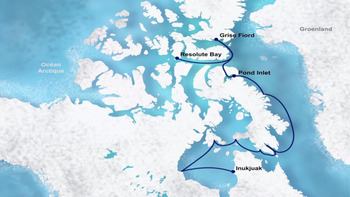
All the information presented in section 2 comes from The High Arctic Relocation: a report on the 1953–55 relocation produced by the Royal Commission on Aboriginal Peoples (Dussault and Erasmus Reference Dussault and Erasmus1994). The High Arctic Relocation took place in 1953 and 1955, and involved the movement of Inuit families from Inukjuak, in Nunavik, and Pond Inlet, on Baffin Island, to uninhabited areas in the High Arctic, now called Resolute Bay and Grise Fiord (see Figure 1 below). Specifically, in 1953, three families from Nunavik and one family from North Baffin were relocated to Resolute Bay, while four families from Nunavik and two families from North Baffin were moved to Grise Fiord. In 1955, another three families from Nunavik and two families from North Baffin resettled in Resolute Bay, whereas only one other family from Nunavik went to Grise Fiord. The official records do not show the number of members that those families contained. In any case, at the end of 1955, about two-thirds of the population of both Resolute Bay and Grise Fiord were from Nunavik, while the other third were from North Baffin.
The High Arctic relocation

The reasons for the relocation are controversial. Most relocates claim that they were lied to when the federal government sought their consent to be relocated and that the conditions they were subjected to in the High Arctic were worse than those they were used to prior to the relocation. The government acknowledges some failings in the project but insists that the relocation was not imposed on the relocatees and that the general goal was to improve their lives. The resolution of this matter goes beyond the scope of this article; interested readers are referred to the report cited above. For the most part, the Commission blames the federal government for the defects in the relocation scheme and recognizes the wrongs and the hardship that the relocatees have suffered.
For the purposes of this article, it is essential to know that Inuit from Nunavik and Inuit from North Baffin do not speak the same Inuktitut dialect. Although the two dialects are mutually intelligible, at first the relocatees had difficulties understanding those from the other group. Dorais (Reference Dorais2003) lists a few phonological, morphological and lexical differences between these two varieties. However, I am not aware that any distinction between these two dialects concerning the two morphosyntactic constructions in (1) has ever been reported, or that any study has ever been conducted on the dialect(s) spoken in Resolute Bay or Grise Fiord. Dorais (Reference Dorais2003: 93) states that the younger generation in those communities uses a mixed dialect, whose phonology is closer to Nunavik but whose vocabulary resembles the dialect of North Baffin; however, Dorais does not provide any examples or statistics to support his claim.
The fact that the majority of the relocatees were from Nunavik might lead one to think that the Inuktitut dialect spoken now in Resolute Bay or Grise Fiord by younger speakers must include more features of the dialect from Nunavik than of the one from North Baffin. However, this may not be the case. First, to my knowledge, no Inuit from Nunavik have moved to Resolute Bay or Grise Fiord since 1955, while Inuit from North Baffin (which is much closer to these communities than Nunavik is) have kept coming to these communities for work or personal reasons. In addition, some relocatees originally from Nunavik and their children moved back to Inukjuak in 1989, as this option was offered to them by the federal government. Second, the North Baffin dialect might have had a higher status. Unlike the relocatees from Nunavik, who were not told the reasons behind the relocation, the relocatees from North Baffin were asked to assist the other group by showing them how to survive in the High Arctic. They were also told that the Inuit from Nunavik had been on welfare or other relief programs for some time and needed to be rehabilitated to a more ‘traditional Inuit life style’. The two groups were treated differently as local officials repeatedly praised the Inuit from North Baffin for being more self-sufficient hunters and for complaining less about the hardship of the relocation. Thus, despite the smaller number of relocatees originally from North Baffin, there are factors that might have enhanced the vitality of their dialect up to the present day.
3. Methodology
I now turn to the collection and coding of the data. I apply variationist methods to the documentation of this endangered variety in order to understand the constraints on the grammar.
3.1 Participants
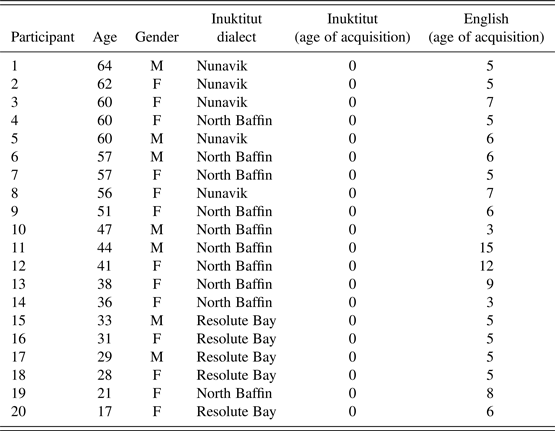
The data analyzed here was collected in Resolute Bay, one of the two communities to which Inuit families were moved during the High Arctic Relocation. In 2014, I interviewed and recorded 20 Inuktitut speakers originally from this community. This number is relatively high considering that 243 people live there (Government of Nunavut 2013) and that many among them are not Inuit, are not originally from Resolute Bay or were too young to participate. The sampling of participants was not performed randomly. All participants were required to be native speakers of Inuktitut, to have lived in Resolute Bay since childhood (i.e., before 12 years old) and to have lived there until at least reaching the age of majority (i.e., 18 years old). Moreover, the participants were sought out based on various criteria, in order to obtain a good representation of the community, as shown in Table 1.
Participant profiles

Data was obtained from male and female speakers, aged from 17 to 64 years. Recall that the first inhabitants of Resolute Bay spoke either the Nunavik or the North Baffin dialect. To account for the specific Inuktitut dialect spoken by each of the participants, they were categorized according to the origin of their parents (assuming that the dialect spoken by each of them originates mainly from the one spoken by their parents). Thus, the participants whose parents were relocated from Nunavik are categorized as Nunavik speakers. The participants whose parents were relocated from North Baffin or whose parents moved voluntarily from that area after the relocation are categorized as North Baffin speakers. Finally, the participants whose parents grew up in Resolute Bay are categorized as Resolute Bay speakers (i.e., the grandchildren of the relocatees). Obviously, there is a natural relation between the age of participants and the Inuktitut dialect that they are assigned to. Nunavik speakers are aged between 56 and 64 years, North Baffin speakers are almost all aged between 36 and 60 (except participant #19) and Resolute Bay speakers are aged between 17 and 33. This overlap will be taken into consideration during the analysis of the data. Also, note that Table 1 shows the participant's self-reported age of acquisition of both Inuktitut and English.
3.2 The data (variable context and exclusion)
The participants were asked to perform different linguistic tasks in Inuktitut. Due to time and financial constraints, only the personal stories were transcribed and translated, and are analyzed here. Each of them lasts between five and 15 minutes, and all were transcribed and translated by two native speakers of Inuktitut, one from Resolute Bay and the other from the South Baffin area. For the transcriptions, they were asked to use the Roman alphabet and to transcribe as the words were pronounced. Transcription was done using ELANFootnote 3 (Max Planck Institute for Psycholinguistics), producing transcription and translation files time-aligned to the recorded speech at the sentential level. Each sentence was segmented individually and coded by the author as one of the two constructions analyzed in this paper (i.e., the ergative and the antipassive) or neither (these last were then disregarded as not relevant to the present study).
We will now analyze examples from the corpus to demonstrate how these constructions were identified during the coding. As shown in the examples in (2), henceforth each clause in the examples will be placed in square brackets and marked as ergative (erg), antipassive (ant) or other.
-
(2)
-
a. [ataata-mma pigia-rasu-lauq-sima-janga niuvirvi-kuluk-ø] ERG
father- poss1sg.erg start-try-pst-prf-ind.subj3sg.obj3sg shop-little- abs
‘My father was trying to start the little shop’ 16C (5:58)
-
b. [hamlet-kut-ø pinasuarti-limaa-ngit-ø
hamlet-collective-abs worker-all- poss3pl - abs
nua-tsi-lluti-guuq kiinaujar-nik] ANT
collect- ant-ia.subj3pl -apparently money- ins.pl
‘All the employees of the hamlet pooled together (some) money’ 4C (1:47)
-
The examples in (2) differ in various ways. First, the agent is marked with ergative case in the ergative construction (e.g., ataata-maa ‘my father’) but with absolutive case in the antipassive construction (e.g., hamletkut-ø pinasuartilimaangit-ø ‘all the employees of the hamlet’). Second, the patient is case-marked with the absolutive in the ergative (e.g., niuvirvikuluk-ø ‘little shop’) but with the instrumental in the antipassive (e.g., kiinaujar-nik ‘money’). Third, the verbal inflection encodes the person and number of both the agent and the patient in the ergative (e.g., -janga ‘ind.subj3sg.obj3sg’) but only those of the agent in the antipassive (e.g., -llutik ‘ia.subj3pl’). Finally, some verbs in the antipassive require the antipassive morpheme -si-/-tsi-, as in (1b) and (2b), while others do not, as in (3) and (4).
Inuktitut is a pro-drop language, in which both the agent and the patient can be omitted. Thus, there are cases where only the characteristics of the verbal complex tell us which construction we have. This does not cause any problem for the identification of an ergative since the verb (uniquely to this construction) encodes both the agent and the patient.Footnote 4 As for the identification of an antipassive, some verbs do not require the antipassive morpheme -si-/-tsi-, which makes them resemble intransitive verbs. In those cases, there are two possible scenarios in which an antipassive can be found, as in (3).
-
(3) [ila-mini qimai-guma-gatik] ANT
part(ner)- refl.ins abandon-want-nar.subj3pl
[kisiani polisi-ø takunia-qatta-tu-viniu-mat] ANT
however police-abs go.see-repeatedly-act.part-pst-prf.subj3sg
‘Theyi didn't want to leave their relative, but the police went to see themi separately’ 1C (3:04)
The verbs qimai- ‘abandon’ and takunia- ‘go.see’ are not followed by the antipassive morpheme -si-/-tsi- but the two sentences are still coded as antipassive. In the first one, the patient ilamini ‘their relative’ is present and case-marked with the instrumental; therefore the sentence is clearly an antipassive. In the second one, the patient is omitted but refers back to the one in the previous sentence. Sentences like these were coded as antipassive, as long as the omitted patient corefers to an argument mentioned previously in the discourse. To my knowledge such examples have never been discussed in any traditional grammar or other work on the language. This will be further discussed in section 5. An omitted patient in an antipassive is traditionally assumed to receive a generic interpretation, as in (4).
-
(4) [ilaa-ngit-ø kappia-naq-pallau-tlutik] OTHER
part(ner)-poss3pl-abs fear-cause.to-continually-pa.subj3pl
[ilaa-ngit-ø aanniq-sui-ju-qatta-lauq-sima-tilluti-lu] ANT
part(ner)-poss3pl-abs hurt-no.longer-often-repeatedly-pst-prf-nra.subj3pl-and
‘Some were scary, some used to hurt (other people)’ 10C (4:31)
The omitted patient is interpreted as ‘other people’. Only the antipassive can have an omitted patient referring to an argument with a generic interpretation. Consequently, antipassives with such patients were excluded from the analysis. In total, the corpus contains 2912 sentences, in which 819 ergatives and antipassives were found and coded according to the different linguistic and social factors, to which we turn in sections 3.3 and 3.4.
3.3 Linguistic factors
I considered the linguistic factors proposed in the literature and said to have an effect on the two morphosyntactic constructions. However, since very little has been said in the literature about the properties of the agent, all the linguistic factors normally linked to the patient were also coded for the agent. The abbreviations for all the variants below are given in footnote 1 along with the interlinear glosses.
3.3.1 Agent/patient definiteness
The definiteness of the patient is the linguistic factor believed to have the biggest effect on the ergative-antipassive alternation: the patient tends to be definite in the ergative but indefinite in the antipassive (e.g., Sadock Reference Sadock1980, Fortescue Reference Fortescue1984). However, as mentioned earlier, many examples in the literature show that this generalization does not hold systematically. Some have tried to replace the notion of definiteness by another theoretical notion (see Bittner Reference Bittner1987 for scope, Manga Reference Manga1996 for specificity). It is beyond the scope of this paper to evaluate whether those proposals are more appropriate. One serious problem for coding a notion like definiteness in Inuktitut is that the language does not employ articles (as English does) to mark definiteness on nouns. Thus, the coding was based on semantic criteria. Following Lyons (Reference Lyons1999), definiteness is more broadly defined here by two basic principles, identifiability and inclusiveness.Footnote 5 In a nutshell, identifiability is the idea that definite arguments can be identified by the hearer(s) in a given context, while inclusiveness specifies that definite arguments make reference to the totality of objects that are part of a ‘shared set’ in a given context. In other words, definite arguments were categorized here as identifiable members of a class in a given context (e.g., the policeman) or to the class itself (e.g., the police), and were distinguished from indefinite arguments, which refer to unidentifiable members of a class in a given context (e.g., a policeman). Consider the sentences in (5).
-
(5)
-
a. [natsi-ø i asiu-juq] OTHER [asuila taavani
seal-abs lose-ind.subj3sg then over.there
nanu-u-vuq niri-juq] OTHER
polar.bear-be-ind.subj3sg eat-ind.subj3sg
[[natsi-mik] i DEF tigu-si-tsuni] ANT
seal-ins.sg take-ant-pa.subj3sg
‘The seali is gone. Then over there a polar bear is eating. It took the seali’5C (6:10)
-
b. [[kinaujar-ni-guuq] INDF nua-tsi-lauq-tillugit…] ANT
money-ins.pl-apparently collect-ant-pst-nra.subj3pl
‘Apparently when they pooled some money…’ 4C (2:32)
-
Although both patients in the antipassives in (5) are marked with the instrumental case, natsi-mik ‘the seal’ in (5a) is interpreted as definite as it refers back to the same seal mentioned in the first sentence (therefore identifiable) while kinaujar-ni-guuq ‘some money’ in (5b) is interpreted as indefinite because it does not refer to an entity identifiable in the context of the sentence (i.e., a sum of money mentioned previously).
3.3.2 Agent/patient coreferentiality
Kalmár (Reference Kalmár1979: 95) claims that the patient in the ergative is a given argument (i.e., one that has already been mentioned in the discourse); while the patient in the antipassive is normally a new argument (i.e., new to the discourse). Similarly, Hallman (Reference Hallman2008) proposes that arguments case-marked with the absolutive or the ergative have to refer back to an argument previously mentioned in the discourse (if the context makes it possible), otherwise they introduce a new argument. Arguments in the instrumental, on the other hand, systematically introduce a new argument. Thus, according to Hallman, the agent and the patient in the ergative construction (which are case-marked respectively with the ergative and the absolutive) and the agent in the antipassive (case-marked with the absolutive) should be predominantly given arguments, while the patient in the antipassive (case-marked with the instrumental) is always a new argument. However, these patterns are not categorical and there are counterexamples in natural speech. All agents and patients in the data are coded for whether they are a given or new argument in the discourse, to measure the significance of coreferentiality in the two variants. For example, consider the sentences in (6) and, more specifically, the antipassive clause. Note that since arguments in Inuktitut do not need to be overt (as discussed in section 3.1) the coding of the agent and the patient for coreferentiality is represented in the translation of the sentence.
-
(6) [upak-pait] ERG
go.over-ind.subj3sg.obj3pl
[asuila unaar-minit tigu-si-gami ] ANT
then harpoon-refl.ins take-ant-prf.subj3sg
‘He caught up with them. Then, [he]GV took [his harpoon] NEW’ 6C (3:41)
The agent of the antipassive, ‘he’,Footnote 6 refers back to the agent of the ergative while the patient unaarminit ‘his harpoon’ is newly introduced. The agent is thus coded as given and the patient as new.
3.3.3 Continuity
From another perspective, Dorais (Reference Dorais1988: 29) proposes that the absolutive argument in each of these constructions represents the topic of the sentence, that is, the agent in the antipassive and the patient in the ergative. Similarly, Berge (Reference Berge2011: 273–274) claims that one key difference between the ergative and the antipassive is that the patient is a topic in the first (since it is case-marked with the absolutive) but a non-topic in the second (since it is case-marked with the instrumental). If the absolutive argument is the topic of the sentence, we could expect this argument to have the tendency to be appear again in the following sentence and to again be case-marked with the absolutive (assuming that a topic is discussed across numerous sentences). To check for this, each token was coded for whether the agent or the patient appears in the following sentence and is case-marked with the absolutive. Consider the sentences in (7), paying attention to the ergative in each example.
-
(7)
-
a. [kisiani taku-laur-sima-jara ataata-ga-ø] ERG + TP
only see-past-perf-ind.subj1sg.obj3sg father-poss1sg-abs
[qunga-gasuar-tuq]OTHER
smile-try-ind.subj3sg
‘Only I saw my dad. He was trying to smile’ 2C (5:44)
-
b. [qaujima-liq-tlugu katatjar-niq-ø] ERG + TA
know-prog-ga.obj3sg throat.singing-nom-abs
[amma miqsu-runnaq-tlunga]OTHER
and sew-can-pa.subj1sg
‘I know now how to throat-sing, and also I can sew’ 20C2 (0:21)
-
The ergative construction in (7a) is coded as having a patient topic since the patient ataataga ‘my father’ is present again in the following intransitive construction and case-marked with the absolutive. (The argument is actually not overt in the second sentence but it would be morphologically marked with the absolutive if it were.) As for the ergative construction in (7b), it is coded as having an agent topic because it is the agent ‘I’, not the patient katatjarniq ‘throat-singing’, that is present in the following intransitive construction and case-marked with the absolutive. (Once again the argument is not overt here, but it would receive the absolutive case if it were.) Finally, note that sentences for which neither the agent nor the patient is present in the following sentence are coded simply as neither.
3.3.4 Aspect
Spreng (Reference Spreng2012) claims that the antipassive has an imperfective viewpoint whereas the ergative has a perfective viewpoint. The majority of Inuit consultants I have had the chance to work with also normally have a feeling that the ergative expresses more of a sense of completeness than the antipassive. However, it is relatively easy to find counterexamples, such as the ergative in (8), which has an imperfective interpretation.
-
(8) South Baffin (Clarke Reference Clarke2009: 301)
[Aapu-ø nigi-jara] ERG + IPFV
apple-abs eat-ind.subj1sg.obj3sg
‘I'm eating an apple (not *I ate an apple)’
In fact, it is difficult to know exactly how the aspectual interpretation is built up in each construction. Others believe that the aspectual interpretation is actually based on other elements, like lexical aspect (Clarke Reference Clarke2009), the type of grammatical mood encoded in the verbal inflection, which is not discussed here (Schneider Reference Schneider1979, Dorais Reference Dorais2003) or different forms of the antipassive morpheme (Bittner Reference Bittner1987). In addition to those proposals, there is a set of aspectual markers that can be used with any type of construction to mark the aspectual interpretation. In any case, all ergatives and antipassives were coded according to their final aspectual interpretation, as expressed in their English translation, to see if their aspectual reading is a significant factor in the alternation. Consider the examples in (9).
-
(9) [ila-ngit-ø unga-gi-gattigu] ERG + IPFV
part(ner)-poss3pl-abs miss-tr-prf.subj1pl.obj3pl
[taku-guma-li-gattigu]ERG + IPFV
see-want- prog -prf.subj1pl.obj3pl
‘Because we miss them, because we want to see them’ 1C (12:13)
Both ergatives in (9) receive an imperfective interpretation. However, only the verb in the second ergative is morphologically marked with an aspectual morpheme, that is, the progressive morpheme –li(r). Why does the first ergative have an imperfective interpretation even if it is not morphologically marked for it? The answer is not very important to this study, as the only concern is whether the aspectual interpretation of the sentence is a significant factor in the choice between the two variants.
3.3.5 Agent/patient grammatical person
Johns (Reference Johns, Johns, Massam and Ndayiragije2006) observes that in Labrador Inuttitut the agent and the patient in the ergative cannot be respectively third and first/second person in certain contexts, as in (10).
-
(10) Labrador Inuttitut (Johns Reference Johns, Johns, Massam and Ndayiragije2006: 7–8)
-
a. *[taku-jaanga] ERG+3+1
see-ind.subj3sg.obj1sg
(Intended: ‘He/she sees me’)
-
b. *[taku-jaatit] ERG+3+2
see-ind.subj3sg.obj2sg
(Intended: ‘He/she sees you’)
-
Similarly, Spreng (Reference Spreng2005) claims that in South Baffin Inuktitut, the agent cannot be third person in the ergative with punctual verbs. Since the data analyzed in this study is taken from personal stories, there are few second person arguments (except in quotations). Thus, first and second persons are coded together as participant person.
3.4 Social factors
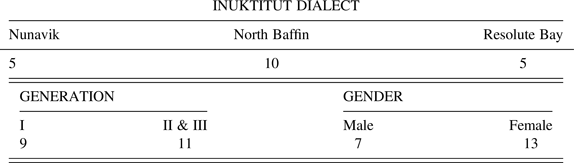
In addition to the linguistic factors, each of the 20 participants is coded for three social factors, namely Inuktitut dialect, Generation and Gender.
Social factors

The first factor codes speakers according to the Inuktitut dialect they speak (i.e., the one learned from their parents). The five Nunavik speakers correspond to the children of the relocated families from Nunavik, and the ten North Baffin speakers correspond to the children of the relocated families from North Baffin or of the families from the same region who came willingly after the relocation. Lastly, the five Resolute Bay speakers are the grandchildren of the relocated families and arguably speak a new dialect. As for the generational factor, the nine Generation I speakers represent the first generation of speakers who grew up in Resolute Bay (i.e., the children of the relocated families from Nunavik or North Baffin), whereas the eleven Generation II & III speakers are part of the following generation of speakers (i.e., the children of the families from North Baffin who moved later to Resolute Bay, and the grandchildren of the relocated families). The reason why Generation II and Generation III were combined is to test Trudgill's theory on new-dialect formation (Reference Trudgill2004), which proposes that the dialect of the first generation of children should show a lot of variability while the dialect of the following generations should be more stable. This will be discussed in more detail in section 5. Finally, seven speakers are male and 13 are female.
3.5 Methods of analysis
In the next section, the distributional and multivariate analysis of the variable data is presented. In the multivariate analysis, the linguistic factors discussed in section 3.3 are examined with mixed-effects logistic regressions using Rbrul (Johnson Reference Johnson2015), a linguistic program built in R (R Development Core Team 2008 ). The multiple regressions are performed first with a binominal step-down/step-up levelled analysis, in which the antipassive is the application value against the ergative, to know the significant factor groups, and then with a one-level analysis to obtain the factor weights of all predictors. The participants are entered as random effects. Any factors that present a percentage input above 95% or under 5% are considered (near-) categorical and the tokens related to those factors are excluded from the multivariate analysis.
4. Results and analysis
I first present the distributional analysis, followed in section 4.2 by the multivariate analysis.
4.1 Distributional analysis
The distributional analysis displays the overall frequencies of the variants across the three social factor groups discussed in section 3.4. However, tokens with an indefinite patient and/or indefinite agent were excluded. Consider Tables 3 and 4.
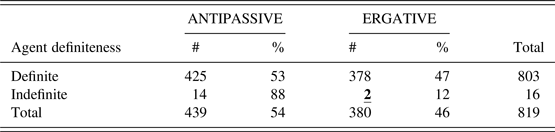
Cross-tabulation between type of construction and agent definiteness

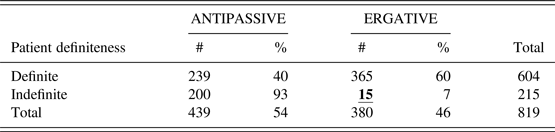
Cross-tabulation between type of construction and patient definiteness

Table 3 shows that only two ergatives have an indefinite agent, while Table 4 shows that only 7% of indefinite patients are found in the ergative construction. Thus, the vast majority of ergative clauses have both a definite agent (378/380 = 99.5%) and a definite patient (365/380 = 95.9%). With respect to the second research question, even if indefinite agents and patients are not found categorically in one variant, as predicted by some hypotheses (see section 1), the majority appear in the antipassive. The bulk of the variation or at least the context in which the two constructions overlap is when both the agent and the patient are definite, since we can predict that the antipassive will be used the vast majority of the time if either the agent or the patient is indefinite. Thus, given the input rates, 224 tokens with an indefinite agent and/or an indefinite patient were excluded. Consider now the distribution of the variants across the three social factor groups.
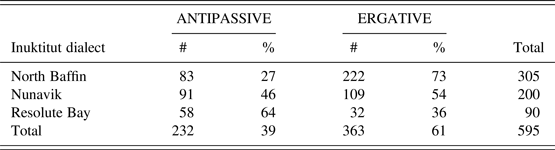
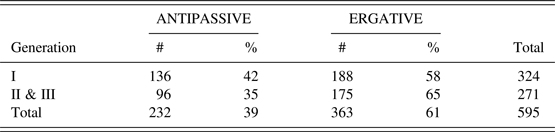
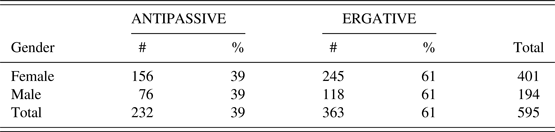
In Table 5, we see that Nunavik speakers use the antipassive more frequently than North Baffin speakers, but that Resolute Bay speakers use it even more frequently than Nunavik speakers. Conversely, we see the opposite tendency with the ergative. It is interesting to see that the results for Resolute Bay speakers is not an average of the two putative input varieties, but is closer to the more numerous group of speakers during the relocation (i.e., the Nunavik speakers). In Table 6, we can observe that Generation I speakers use the antipassive more frequently than Generation II & III speakers. In Table 7, male and female speakers show the same frequencies for both variants.
Distribution of the variants by Inuktitut dialect

Distribution of the variants by generation

Distribution of the variants by gender

A binominal step-up/step-down levelled logistic regression analysis (with the antipassive as the application value) was performed to check if these social factors were statistically significant. Only Inuktitut dialect came out as significant.Footnote 7 Because of this, separate multivariate analyses were conducted for each group of speakers by Inuktitut dialect to see whether those groups also show different grammatical patterns with the two variants. The Generation factor was not kept in the multivariate analysis since there is an unavoidable collinearity between this social factor and Inuktitut dialect, as all Nunavik speakers are also Generation I speakers and all Resolute Bay speakers are Generation II & III speakers.
4.2 Multivariate analysis
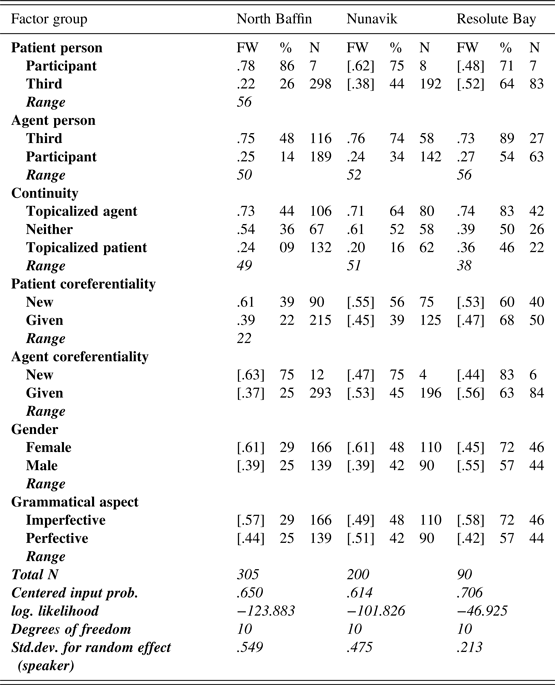
The multivariate analysisFootnote 8 presented in Table 8 examines the linguistic factors predicted to constrain the variants for each group of speakers by Inuktitut dialect. The antipassive is the application value against the ergative. The results of the multivariate analysis for each group will be interpreted from the factor groups that were found significant or not, the rank of the significant factor groups, and also the rank of the factors within each one of those significant factor groups (as suggested in Poplack and Tagliamonte (Reference Poplack and Tagliamonte2001: 92). Finally, the square brackets show factor weights of the groups that were not found to be significant for a particular analysis.
Factors constraining the antipassive in three Inuktitut dialects (analyzed separately)

Only Continuity and Agent person are significant and have the same direction of effect across the three groups of speakers. Continuity shows that an agent topic favours the antipassive while a patient topic favours the ergative. In other words, the absolutive argument in each construction seems to be the topic of the sentence since it has the tendency to appear again and receive the absolutive case in the following sentence. As for Agent person, we see that a third person agent favours the antipassive while a participant agent favours the ergative across all groups. If we also consider Patient person for North Baffin speakers, for whom a participant person patient also favours the antipassive and a third person patient the ergative, there might be a grammatical person hierarchy involved with this group of speakers (i.e., 3 < 1,2 in the antipassive but 1,2 > 3 in the ergative). In addition, Patient coreferentiality is also significant for North Baffin speakers, for whom a new patient favours the antipassive while a given patient favours the ergative.
As for Nunavik and Resolute Bay speakers, neither Patient person nor Patient coreferentiality is found to be significant. Nevertheless, notice that the percentages of third person patients and given patients in the antipassive steadily rise as we compare North Baffin speakers to Nunavik speakers, and then Nunavik speakers to Resolute Bay speakers (i.e., 26% → 44% → 64% for third person patients, and 22% → 39% → 68% for given patients). This is a crucial piece of information which, I propose, explains why the antipassive is increasingly used (and the ergative progressively less) in the same patterns by those groups of speakers, as we saw in Table 5. This will be discussed further in the next section.
5. Discussion
In the introduction, three research questions were formulated; I discuss each one in turn.
1. What are all the linguistic factors that are significantly involved in this alternation?
In the distributional analysis, we saw that the vast majority of indefinite patients are found in the antipassive and that most ergative constructions have not only a definite patient but also a definite agent (see Tables 3 and 4). It thus goes without saying that the definiteness of the patient is indeed an important linguistic factor in the alternation, partly supporting previous theoretical research. However, it is essential to keep in mind that these results were not categorical and that a large number of definite patients were still found in the antipassive, indicating that other linguistic factors must be involved.
The distributional analysis also showed that the frequencies of the variants vary greatly depending on the dialect spoken (see Table 5), and the multivariate analysis confirmed that the groups of speakers not only show different frequencies but also different grammatical patterns (see Table 8). Nevertheless the three groups, who each speak a different dialect, share similar linguistic constraints. For instance, an agent topic favours the antipassive, whereas a patient topic favours the ergative for all of them. Also, a third-person agent favours the antipassive, while a participant agent favours the ergative across the three groups. Those constraining linguistic factors illustrate the distinct contexts of the variants. The antipassive tends to be used when the agent is the topic and/or third person (and when the patient is indefinite or receives a generic interpretation), while the ergative is normally used when the patient is the topic and/or when the agent is first or second person.
One the on hand, Dorais (Reference Dorais1988) would have predicted that the topic in the antipassive is the agent while the topic in the ergative is the patient (since they are the absolutive arguments in their respective constructions). On the other hand, to my knowledge it has not been argued that the agent might constrain the alternation between the two constructions in such a way. However, recent observations in some Eastern Canadian dialects go along with what we see here. Recall that Johns (Reference Johns, Johns, Massam and Ndayiragije2006) reports that in Labrador Inuttitut the agent and the patient in the ergative cannot be respectively third person and first/second person in a certain verbal mood; similarly, Spreng (Reference Spreng2005) claims that in South Baffin Inuktitut the agent in the ergative cannot be third person with certain verbs (see section 3.3.5). Those observations agree with the results of the current study since a third person agent in the ergative is disfavoured across all groups, and a first or second person patient in the ergative is disfavoured at least by North Baffin speakers. Unfortunately, I do not have a good answer at the moment as to why the antipassive and the ergative are constrained in this way by the grammatical person of the agent and/or that of the patient, or even if the contexts in which Johns and Spreng attest that the ergative is constrained in those other dialects could be relevant here too in the same manner. More theoretical work needs to be done on this question.
2. What are the contexts in which the two constructions overlap and what is the source of dialectal differences in their use?
As we saw in section 4.1, the bulk of the variation between the ergative and the antipassive is when both the agent and the patient are definite. In the previous section, we showed that topicality and the grammatical person of the agent also play a role in the alternation. However, we observed some dialectal differences too. While a third-person and/or given patient disfavours the antipassive for North Baffin speakers, patient person and patient coreferentiality were not found to be significant for Nunavik and Resolute Bay speakers. On the other hand, we saw at the end of section 4.2 that usage rates of a third-person or given patient in the antipassive rise steadily as we compared North Baffin speakers to Nunavik speakers and then Nunavik speakers to Resolute Bay speakers, in the same way as the antipassive is used progressively more across these three groups (see Table 5).
I believe that this correlation exposes a crucial characteristic about the dialect differences regarding the ergative and the antipassive (as has been reported in different Eastern Canadian dialects), and consequently about the phenomenon of fading ergativity observed in some of them. There are two grammatical points about the language that are important here. First, given arguments can be omitted when the context allows it. Second, there is no third-person pronoun in Inuktitut, only first and second person (uvanga ‘me’ and ivvit ‘you’). Thus, when a given and third-person patient is omitted in an ergative construction, its grammatical features still appear on the verb, as in (11).
-
(11) [takkua-ø pinasuaq-ti-limaa-ngit-ø tamaanga-aq-sima-mmata] OTHER
dem3pl-abs work-who.does-all-poss3pl-abs here-towards-prf-prf.subj3pl
[quja-gi-llugit] ERG
thank-tr-ia.obj3pl
‘[All their employees]i are from here. I thank [them]i’ 4C (4:13)
In (11), the omitted patient translated as ‘them’ in the ergative refers to the single argument of the preceding intransitive, takkua pinasuaqtilimaangit ‘all their employees’. Although that patient is omitted here, its grammatical features are encoded in the verbal inflection -llugit ‘pa.obj3pl’, and it is relatively easy to recover which argument it refers to. On the other hand, the grammatical features of the patient are never encoded in the verbal inflection in an antipassive (see section 4.2). Thus, two scenarios were observed in the data when the patient in the antipassive is both given and third person: either the argument is repeated, as in (12a),Footnote 9 or the patient is omitted even if its grammatical features are not encoded in the verbal inflection, as in (12b).Footnote 10
-
(12)
-
a. [unaar-mik tigu-si-lluni]ANT [qukiuti-qa-ngi-nami]OTHER
harpoon-inst.sg take-ant-ia.subj3sg gun-have-neg-prf.subj3sg
[unaar-mik tigu-si-gami] ANT
harpoon-ins.sg take-ant-perf.subj3sg
‘He grabbed [the harpoon]i because he didn't have a rifle. When he grabbed [the harpoon]i, …’ 11C (0:58)
-
b. [tuqu-nga-lik-suni-lu tagga]OTHER
die-prf-prog-pa.subj3sg-and then
[takuna-liq-tugut] ANT
look.for.long.time-prog-ind.subj1pl
‘And now that [the caribou]i is dead, we are looking at [it]i’ 5C (9:47)
-
In (12a), the patient unaarmik ‘the harpoon’ in the second antipassive refers back to the same patient unaarmik ‘the harpoon’ in the first antipassive. In (12b), the omitted patient translated as ‘it’ in the antipassive refers back to the single argument ‘caribou’ of the previous intransitive (although that argument is also not overt), even if its grammatical features are not encoded in the verbal inflection –tugut ‘ind.subj1pl’.
Building on Fortescue (Reference Fortescue1995), Johns (to appear) argues that the verbal inflection in the ergative is clitic-like, and that the ergative should be expected in examples like (11) or (12), when the patient is given and could be omitted. I agree that it is probably the ergative that is used more frequently in conservative dialects in such cases; but I also believe that examples such as (12a–b), where the antipassive is used over the ergative even if the patient is given and could be omitted, are becoming more and more frequent in some Eastern dialects. In fact, I have never seen, in any traditional grammar or published work on Inuktitut, examples such as the one in (12b), where an omitted patient in an antipassive refers back to an argument of a previous sentence. Traditionally, an omitted patient in an antipassive is expected to receive a generic interpretation (see example (4)). Besides, both Kalmár (Reference Kalmár1979) and Hallman (Reference Hallman2008) claim that the patient in the antipassive is always a new argument. Therefore, it seems that the possibility of the patient in the antipassive being first given, as in (12a) and subsequently given and omitted, as in (12b) is evidence of new grammatical patterns in the language and could be one of the main reasons for fading ergativity in some dialects.
Thus, North Baffin speakers, for whom third person and/or given patients disfavour the antipassive, would be presenting more conservative linguistic behaviour with the two variants. Conversely, the increase of given and third person patients in the antipassive with Nunavik and Resolute Bay speakers would be an indication of fading ergativity. As for what could have triggered such a change, that could have to do with the changing nature of the verbal inflection in the ergative (i.e., whether it is clitic-like or agreement-like), which could consequently impact how given and/or omitted arguments are expressed in the language. However, investigating this question lies outside the scope of this article.
3. How well does Trudgill's theory on new-dialect formation account for the present scenario?
Trudgill (Reference Trudgill2004) proposes that new-dialect formation has three stages. At the first stage, adult migrants who do not all speak the same dialect come into contact. This stage is characterized by rudimentary levelling, where the migrants try to accommodate the others speaking a different dialect by choosing certain variants towards an interdialect. Stage two is associated with the first generation of children, who show a lot of variability among themselves and again some levelling. Stage three arises with the subsequent generations of speakers, for whom the new dialect is more stable. Importantly, recall that Trudgill also argues that the most frequent forms in the input will always survive and consequently that social factors do not play an important role in new-dialect formation (see Schneider Reference Schneider2003 for an opposing view).
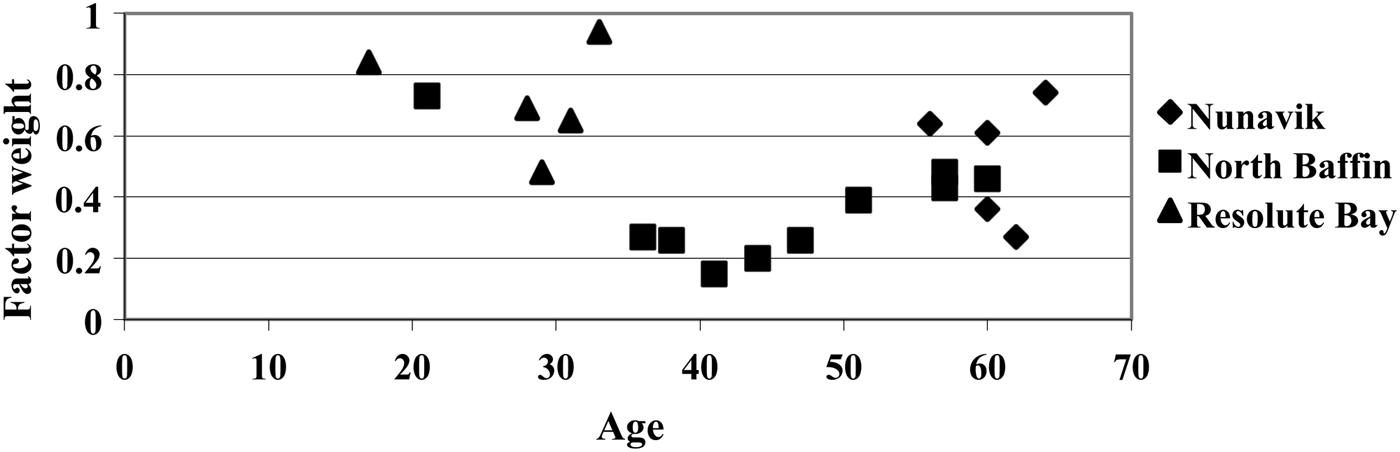
In this study, we have not examined data from the first adult migrants to Resolute Bay. We looked at the speech of the first generation of children and the subsequent generations, respectively Generation I and Generation II & III speakers (see section 3.4). As a factor, Generation was not found to be significant for the multivariate analysis (see section 4.1). Nonetheless, there is quite a lot of overlap between age and the dialect spoken by the participants. For example, all Nunavik speakers belong to the first generation of children, while all Resolute Bay speakers are part of the following generation. The situation is a little more complicated for North Baffin speakers, as the four older ones are children of the first adult migrants (as is the case for Nunavik Speakers) and the six younger ones are children of adult migrants who are originally from North Baffin but who came to Resolute Bay years after the relocation (see section 3.1). These details are important because when we considered the factor weights of each speaker separately, as shown in Figure 2 for the antipassive (note that the graph would be turned upside down for the ergative), we see more clearly the new-dialect stages of the present scenario.
Factor weight of each individual by age and parent's origin for the antipassive

Surprisingly, we see a U-shape distribution. However, I believe that the graph is very informative. First, as predicted by Trudgill, the first generation of children (i.e., all Nunavik speakers and the four North Baffin speakers who are over 50 years old) show a lot of variation, ranging from not favouring the variant much to favouring it greatly. Then, we observe that the older the North Baffin speakers are, the more they behave like Nunavik speakers; but the younger they are, the more they are like Resolute Bay speakers. Recall that the six younger North Baffin speakers have parents who were not relocated to Resolute Bay and consequently did not interact with adult migrants from Nunavik as much as the parents of the four older North Baffin speakers. Therefore, not only the younger North Baffin speakers, but also their parents, have had less opportunity to interact with Nunavik speakers (because they are younger than those speakers). Thus, we can argue that the U-shape distribution in Figure 2 is due to levelling, or in other words to the profile of speakers each one of them had the most chance to interact with. Also, we can argue that the middle-aged North Baffin speakers likely represent the most prototypical North Baffin speakers, or in other words, North Baffin speakers who would have been the least influenced by other dialect(s).
As for Resolute Bay speakers, they all greatly favour the antipassive, which was also a characteristic of Nunavik speakers as a group (see section 4.2). This reveals two things. First, fading ergativity was probably an ongoing language change transmitted from Nunavik speakers to Resolute Bay speakers. Second, this characteristic of the grammar of Nunavik speakers won over the more conservative linguistic behaviours of North Baffin speakers, arguably because adult migrants from Nunavik were more numerous than those from North Baffin during the relocation (see section 4.2). It is thus fair to say that the input received by Resolute Bay speakers from Nunavik speakers was greater than that from North Baffin speakers, and that this must have played a significant role regarding which of the contrasting grammatical patterns would be kept. Thus, everything we see here seems to confirm Trudgill's theory of new-dialect formation.
6. Conclusion
Using a sociolinguistic variationist approach to analyze the ergative-antipassive alternation in Inuktitut quickly revealed the shortcomings of the previous theoretical proposals. On one hand, the data shows that definiteness of the patient is indeed an important linguistic factor to explain the alternation, as the patient in the ergative is almost categorically definite. However, the antipassive still receives a fair share of definite patients, which indicates that there are other factors involved. In addition, not only is the patient almost categorically definite in the ergative but so is the agent, which implies that the bulk of the variation between the two constructions is when both of these arguments are definite. On the other hand, we also see dialectal differences and ongoing changes in some dialects regarding this alternation, which shows that the linguistic factors implicated are sometimes different from one dialect to another. Thus, it is interesting that the method used here turned out to be very useful even with an atypical linguistic variable.
It was found that the agent is the topic of the sentence in the antipassive, while the patient plays this role in an ergative clause. Further, the analysis uncovers a linguistic factor that had not been proposed before regarding this alternation, namely the grammatical person of agent, according to which a third-person agent favours the antipassive while a first- or second-person agent favours the ergative. And if it is true that North Baffin speakers present more conservative linguistic behaviour (as assumed in this paper), we could predict that in conservative dialects the antipassive would also be favoured by a first-or second-person patient whereas the ergative would be favoured by a third-person patient. Therefore, the two constructions in those dialects would also be constrained by a grammatical person hierarchy between the agent and the patient.
To sum up, I analysed a case of new-dialect formation in Inuktitut, due to the High Arctic Relocation. First of all, a close look at each individual speaker in the study helped (at least partly) to validate Trudgill's (Reference Trudgill2004) theory of new-dialect formation, in that the first generation of children do show a lot of variation in their speech regarding the ergative-antipassive alternation, but the speech of the second generation of children appeared to be more stable. In addition, the grammatical patterns that were maintained by the second generation of children are those that were arguably more numerous in the input, as Trudgill would also have predicted. The consequence of that was the transmission of an ongoing language change in relation to the ergative-antipassive alternation, where the ergative progressively loses ground to the antipassive. The explanation proposed here for this change, which appears to be affecting other Eastern Canadian dialects as well, is that it originates from new grammatical patterns having to do with how given and/or omitted arguments are expressed in the language, which in turn affect the use of the ergative and the antipassive.