The women and politics literature has dedicated significant attention to outlining the institutional and cultural factors that explain women's numeric representation in legislatures (Kenworthy and Malami Reference Kenworthy and Malami1999; Reynolds Reference Reynolds1999). Comparatively less attention, however, has been devoted to understanding women's access to positions of power within national assemblies. Though understudied, the status of women in parliaments merits serious consideration. This issue became especially salient in British politics following the 2010 general election, in which women secured 22% of the seats in the House of Commons. After the election, the UK Parliament implemented reforms aimed at improving the procedures and relevance of the legislature. Among these changes was the introduction of elections for select committee members and chairs, with the intention of strengthening these committees by freeing membership selection from the control of the party whips. Under the new system, shortly after entering office women members of Parliament (MPs) had to compete once again, this time for committee positions.
How did these female representatives fare in comparison to their male colleagues under the new rules governing the selection of committee members and chairs? Winning election to a select committee—and especially committee chair—demands the support of fellow parliamentarians. Assessing the extent to which female MPs were able to compete successfully for these positions thus offers new information concerning the gendered ethos of the House of Commons. The elections further present a unique opportunity for examining competing expectations concerning how the mode of selection for positions of power within assemblies can advance or hinder the position of female legislators.
After introducing the select committee system, I draw on existing research on gender and committee assignments to posit three hypotheses concerning women candidates and select committee election outcomes. The gender-bias hypothesis suggests that women will be disadvantaged because of implicit or explicit discrimination by male parliamentarians. The gender-advantage hypothesis, in contrast, argues that the mode of selection—combined with the environment in the House of Commons—may have allowed women to be especially successful. Finally, the gender-neutral-outcomes hypothesis posits that no sex effect will be observed.
In order to test the competing theories, the article draws on two unique data sets on select committee members and chairs. The results from the statistical models offer support for two of the three theoretical claims. In neither committee membership nor the elections for chairs is there evidence of a bias against female parliamentarians. Instead, the composition of committee membership indicates gender-neutral outcomes, while the results for select committee chairs show an advantage for female candidates. Taken together, these gendered analyses of election outcomes provide new insights into both the study of women in British politics and the broader literature on gender and the allocation of power within national assemblies.
THE SELECT COMMITTEE SYSTEM
The Westminster model of democracy is a strongly executive-dominated system (Lijphart Reference Lijphart1999) in which parliamentarians are party politicians and the aims of the Cabinet dominate the legislative agenda. Within the House of Commons, select committees provide the principal mechanism through which the legislature can hold the executive accountable (Brazier and Fox Reference Brazier and Fox2011). The majority of select committees, each comprised of between 11 and 15 back bench MPs, are responsible for shadowing a department within the government. There are currently 19 committees—such as the Defence, Education, and Foreign Affairs select committees—tasked with overseeing the expenditure, administration, and policy of a government department and its related bodies and agencies. In addition to these departmental select committees, there are also several nondepartmental committees. Some of them—including the Procedure and Backbench Business Committees—deal with matters related to the internal administration of Parliament. Others, like the European Scrutiny and Environmental Audit Committees, cross departmental boundaries and may examine any or all government departments, depending on the issue under consideration.
In relation to the formal powers of many other parliamentary committee systems, those of the select committees are comparatively weak (Hindmoor, Larkin, and Kennon Reference Hindmoor, Larkin and Kennon2009; Mattson and Strøm Reference Mattson, Strøm and Döring1995). They do not, for example, review legislation prior to adoption. Despite their limitations, select committees became more important after reforms in 1979,Footnote 1 and have further risen in prominence since the late 1980s (Hindmoor, Larkin, and Kennon Reference Hindmoor, Larkin and Kennon2009; Kubala Reference Kubala2011; Norton Reference Norton, Longley and Davidson1998; Russell Reference Russell2011). Their increased stature can be attributed in part to the committee members' ability to determine their own subjects for inquiry. Back bench MPs can choose to monitor the government's behavior and/or conduct agenda-setting investigations on issues that are receiving limited government attention (Russell and Benton Reference Russell and Benton2011). The committees then generate reports to the House, which generally include recommendations directed to the relevant government department. The department is, in turn, obligated to respond to these recommendations within two months.
Research indicates that select committees have been increasingly successful in shaping policy. Between 1997 and 2010, approximately 40% of committee recommendations were accepted and implemented by the government. Beyond this direct influence, ministers and senior officials have also indicated that when drafting proposals, they consider the select committee's potential response, which in turn shapes the policymaking process (Russell and Benton Reference Russell and Benton2011).
Although select committees do not provide parliamentarians with the ability to draft legislation, they can confer some benefits to MPs. Committee membership allows legislators to specialize in policy fields related to personal or constituency interests. Participation on a committee can provide a venue for pursuing these interests and offers additional credibility when issues with ministers or within party policy committees are raised (Jogerst Reference Jogerst1993). Members may also view committee service as a means toward political advancement (Beloff and Peele Reference Beloff and Peele1985). Even in the early years of the modern select committee system—in which these bodies were arguably less important than they are today—two-thirds of committee members viewed the position as a stepping-stone in legislators' parliamentary careers (Jogerst Reference Jogerst1993).
While select committee membership can help MPs advance to the government payroll, acting as a select committee chair offers an alternative career path to the traditional pursuit of a Cabinet position. Though chairing a select committee is not as prestigious as serving as a minister, in recent years this post has grown in importance. Despite being assigned few formal powers, the chair plays a key role in leading the committee's work and setting the agenda. As such, he or she is widely acknowledged as the most influential member, and the one attracting the most media attention (Norton Reference Norton, Longley and Davidson1998). In addition to these intangible benefits, departmental select committee chairs, following a recent reform, now also receive an extra salary of around £15,000.Footnote 2 This additional remuneration is a recognition of the extra work that is required of these members. It also represents a concerted effort to reinforce the notion that serving as a select committee chair offers a legitimate alternative to pursuing a ministerial position (Flinders Reference Flinders2007).
Party whips determine the proportion of committee members drawn from each party and the partisan allocation of select committee chairs. By convention, the membership of select committees is roughly equal to the party balance in the House of Commons. Given the overall composition of the House, the governing Conservative and Liberal Democrat coalition today holds a bare majority of seats on each committee. The Labour Party is allocated almost all remaining positions.Footnote 3 A similar system is used to divide committee chairs. Of the elected select committees, 12 chairs were designated as Conservative posts, two were reserved for the Liberal Democrats, and the remaining 11 were allocated to the Labour Party.Footnote 4
Although the procedure for distributing positions among the parties remains unchanged, the method for filling those positions has been radically transformed. Historically, party whips—via the Committee of Selection—determined committee membership. Each committee then elected a chair from among its members at its first meeting. As the whips could block the nominations of potentially troublesome MPs, this system increased the power of the parties with respect to the committees. In June 2010, as part of a larger effort to “make the Commons matter more,”Footnote 5 25 committee chairs were elected via secret ballot by 590 members of the House. Following the chair elections, members for these committee were then chosen by elections held within their own parties.Footnote 6 Whereas in previous Parliaments committee members and chairs were accountable to the whips, under the new system committee members are answerable to their party colleagues, and committee chairs now represent, and are accountable to, the whole House (Russell Reference Russell2011). The degree to which female MPs were helped or hindered by this democratizing reform has yet to be considered. To answer this question, I draw on the literature on women in committees to generate and test competing expectations concerning gender and select committee election outcomes.
GENDER AND COMMITTEE MEMBERSHIP
Committees are increasingly important in modern parliamentary politics, as they have become the “main focal points” of many elected assemblies. Significant attention has been dedicated to understanding how variation in their tenure, membership, and functions influences parliamentary outcomes (Longley and Davidson Reference Longley and Davidson1998; Mattson and Strøm Reference Mattson, Strøm and Döring1995). Just as the research on legislatures has recognized the importance of committees, the gender and politics literature has identified systematic differences between male and female legislators' committee experiences.
Not only do men and women behave differently during committee hearings (Kathlene Reference Kathlene1994; Rosenthal Reference Rosenthal1997, Reference Rosenthal1998), the committees to which they are assigned also vary (Heath, Schwindt-Bayer, and Taylor-Robinson Reference Heath, Schwindt-Bayer and Taylor-Robinson2005; Thomas Reference Thomas1994; Towns Reference Towns2003). Even as their presence in legislatures increases, women often remain concentrated on “less powerful” committees or on those addressing traditionally “feminine” issue areas. In Australia, for example, women have been much more likely to chair the reference and community affairs committees (Sawer Reference Sawer2000). Similarly, in both the Swedish Riksdag and the Norwegian Storting, women have been consistently overrepresented in culture, education, health, and social affairs committees and underrepresented in the defense, finance, and industry committees (Towns Reference Towns2003).
Although gender differences in committee membership have been well documented across a number of institutions, the extent to which these differences indicate a bias against female representatives remains unclear. In some instances, membership appears to reflect the divergent preferences of men and women legislators. In both U.S. state governments and Danish local councils, for example, studies indicate that variation in committee assignments emerges from representatives' priorities, rather than from biases against female members (Bækgaard and Kjaer Reference Bækgaard and Kjaer2011; Thomas Reference Thomas1994). More generally, within the U.S. House of Representatives, women's presence among committee members (Friedman Reference Friedman1996) and chairs (Darcy Reference Darcy1996) is proportionate to their numbers in the legislature. Since the mid-1960s, these women have fared better as a group than both their female predecessors and male colleagues (Gertzog Reference Gertzog1995).
On Scottish and Welsh parliamentary committees, which are also very important to the legislative process, women are similarly well represented. In Scotland, after changes to the committee system in January 2001, women held 39% of seats on committees and six of the 17 convenorships. In Wales, women comprised 41% of committee members and 40% of committee convenors (Brown et al. Reference Brown, Donaghy, Mackay and Meehan2002). Finally, research on the Swedish Riksdag illustrates that while in the 1980s women were less likely to receive their preferred assignment than were their male colleagues, this gender disparity subsequently diminished (Wängnerud Reference Wängnerud2009). In fact, Diaz (Reference Mateo Diaz2005) argues that senior female legislators are actually more satisfied with their committee assignments than are their male colleagues.
In contrast to cases in which women largely receive their preferred committee assignments, there are also examples in which an anti-female sentiment emerges. Research on Latin American legislatures, for instance, demonstrates that male elites limit women's access to committees. In her study of the Mexican Chamber of Deputies, Rodríguez (Reference Rodríguez2003) argues that women are relegated to chairing committees that are perceived as being of minor importance. Using data from six assemblies, Heath, Schwindt-Bayer, and Taylor-Robinson (Reference Heath, Schwindt-Bayer and Taylor-Robinson2005) similarly illustrate that as women's presence in office increases, female legislators tend to be isolated on social and women's issues committees.
Even within advanced industrialized democracies, the question of bias has not been wholly resolved. While women's presence in the Australian Parliament significantly increased after the 1996 general election, the number of women acting as chairs or deputy chairs of parliamentary committees decreased by half (Sawer Reference Sawer2000). In both the United States (Frisch and Kelly Reference Frisch and Kelly2003) and Sweden (Diaz Reference Mateo Diaz2005), women have been shown to be disadvantaged during their first term in office. Likewise, in Belgium women MPs are more likely to be assigned to a committee that they did not request (Diaz Reference Mateo Diaz2005).
THEORETICAL MOTIVATION AND HYPOTHESES
The existing research demonstrates how women's access to committees remains disputed, often even within a single political environment. Although this work provides important insights into the gendered nature of committee assignments, it focuses primarily on cases in which membership is determined by party elites. Because committee membership in the House of Commons is now decided via elections, the motivations of male and female backbenchers (rather than party leaders) are of primary importance. The consequences of this mode of selection for women's representation within legislatures is assessed in the following section, which outlines three alternative expectations concerning gendered variation in election outcomes.
The Gender-Bias Hypothesis
Allowing parliamentarians to determine committee membership may disadvantage female MPs. Legislatures are frequently described as masculine environments (Diamond Reference Diamond1977; Thomas Reference Thomas1994), and gender biases have been shown to exist in the personnel, policy, and cultures of political institutions (Lovenduski Reference Lovenduski2005). In particular, women representatives are often isolated by—and even encounter outright hostility from—their male colleagues. Female legislators, for example, have been pressured to adhere to “less important” women's domain issues when sponsoring legislation (Schwindt-Bayer Reference Schwindt-Bayer2006). Men have also been shown to be verbally aggressive and controlling of both committee hearings (Kathlene Reference Kathlene1994; Rosenthal Reference Rosenthal1998) and parliamentary debates (Grey Reference Grey2002), especially as the proportion of women in the legislature increases. This marginalization and hostility can act to doubly disadvantage women. Not only do female MPs encounter sexism from male colleagues, but their minority status may also encourage competition, rather than coalition building among them (Galligan, Clavero, and Calloni Reference Galligan, Clavero and Calloni2007).
Considering the biases faced by female legislators, any environment in which they are dependent upon their male colleagues for support may inhibit women's access to power. Since historically British politics has been highly masculinized, this may be especially true in the UK Parliament. Lovenduski (Reference Lovenduski2005) argues that though there are some indications of change, there is “considerable evidence of persistent institutional sexism in the political parties and in the House of Commons” (p. 47).
The Labour Party women elected in 1997, for example, were subjected to relentless scrutiny, including criticism from both the Conservative opposition (Childs Reference Childs2004a) and fellow Labour MPs (Lovenduski Reference Lovenduski2005; Lovenduski and Norris Reference Lovenduski and Norris2003). Several of these women, in turn, identified Parliament as an “old boys' club” (Childs Reference Childs2004b, 184). The select committee chairs, in particular, have been dominated by men. Of the 25 committees that now have elected chairs, women chaired only two (Transport and Communities & Local Government) during the previous Parliament. The experiences of women MPs—both in the UK and elsewhere—demonstrate that they are often confronted with both overt discrimination and subtle marginalization. The literature on gender bias thus suggests the first hypothesis about sex and select committee elections:
H1. Gender Bias:
Due to implicit or explicit bias against female MPs, women were disadvantaged in select committee elections.
If the gender-bias hypothesis holds, then even when controlling for intervening factors that may lead women to be perceived as less qualified for office, female MPs should be less likely to serve on select committees and less likely to win the elections for chairs.
Though female representatives from across the ideological spectrum are often subject to discrimination, the presence of an anti-female sentiment varies across parties. In particular, the correlation between left parties and women's descriptive representation in parliaments has been well documented (Duverger Reference Duverger1954; Kenworthy and Malami Reference Kenworthy and Malami1999; Reynolds Reference Reynolds1999). Within legislatures, left-wing parties tend to be more open to the promotion of women to prominent political positions, whereas right-wing parties typically seek to preserve traditional gender roles (Lovenduski and Norris Reference Lovenduski and Norris1993). Right-party governments are, for example, less likely to appoint female Cabinet ministers (Reynolds Reference Reynolds1999), and less willing to assign women to portfolios in nonfeminine issue areas (Studlar and Moncrief Reference Studlar and Moncrief1999).
The relationship between left-party ideology and women's descriptive representation holds true in the British case. Among the three major organizations, the Labour Party has been at the forefront of advancing women's presence in office. In 1989, the party adopted quotas for women in internal organizations and in 1993 introduced a positive discrimination policy ensuring the selection of a female candidate in half of the party's winnable seats. Though it lost more than 90 seats in the 2010 election, the Labour Party still elected more women MPs than the other major parties combined. Women now represent 31% of the Parliamentary Labour Party. Moreover, in determining the rules for selecting the shadow cabinet, the parliamentary caucus voted for a positive discrimination policy, ensuring that six of the 19 elected members would be women. In the election, eight female MPs were chosen to sit on the Labour front bench, exceeding the party's predetermined quota. Combined with the two women MPs and one peer who already had a place in the shadow cabinet, women hold 11 of these positions in total.
While women are well represented within the Labour Party, both the Conservative and Liberal Democratic Parties continue to lag behind. The Conservative Party did make a concerted effort to nominate more female candidates before the 2010 general election, but the effects were limited. The party selected women for only 24% of positions and elected women to only 16% of Conservative held seats. The Conservative's coalition partner, the Liberal Democrats, have also failed to promote women's presence in office. In the 2010 election, the party actually nominated and elected fewer women than in 2005, leaving women holding only 12% of the party's seats.
Women are also poorly represented in positions of power within the coalition government. Although the percentage of ministerial positions held by Conservative women is comparable to their presence in the Conservative parliamentary party, there were no women on the coalition negotiating team of either party. The government has subsequently introduced several policies that can be viewed as unfavorable for women, including the elimination of the Health in Pregnancy Grant, an attempt to grant anonymity to accused rapists, and deep public sector cuts that disproportionately affect women.
This variation in women's representation indicates that potential biases against women may not be constant across parties. Rather, because of the Labour Party's tradition of promoting women's presence both in elected office and among party leaders, its female MPs may encounter less discrimination from their copartisans than do women in the other major parties. These intraparty dynamics suggest an additional gender-bias hypothesis:
H1a. Party-Varying Gender-Bias:
As compared to both their male copartisans and female Labour Party colleagues, women in the Conservative and/or Liberal Democrat Parties were disadvantaged in select committee elections.
If the party-varying–gender-bias hypothesis holds, then Conservative and/or Liberal Democrat female MPs should be less likely to serve on select committees than their male copartisans. Labour women, on the other hand, should be as likely to be elected to select committees as their male counterparts. Additionally, as members from across all parties vote for the committee chairs, all women MPs (including female Labour Party nominees) should be less likely to win these elections.
The Female-Advantage Hypothesis
If British parties' parliamentary delegations are biased against women, then the result of the recently enacted reforms should be fewer committee positions won by female MPs than by their male colleagues. Alternatively, women may be advantaged under the new system. Existing research indicates that when party leaders control committee assignments, female representatives tend to serve on committees focused on women's and social issues. When a floor vote determines assignments, on the other hand, women are more likely to sit on economics and foreign affairs committees (Heath, Schwindt-Bayer, and Taylor-Robinson Reference Heath, Schwindt-Bayer and Taylor-Robinson2005). These results indicate that gender bias in committee assignments is less likely to emerge in systems where members must negotiate with one another and win support from their colleagues.
While the decentralization of power alone may benefit women MPs, the circumstances surrounding these particular select committee elections could provide a unique advantage to female representatives. Following the 2010 general election, both the process for allocating committee assignments and many members of the selectorate were new to the House of Commons. The election generated the largest turnover of MPs in recent years, resulting in 227 newly elected representatives (35% of total membership). The timing of the elections, moreover, provided parliamentarians with a limited period in which to organize their campaigns. Elections for select committee chairs occurred in early June, and committee members were elected later that month.
The large number of new MPs, combined with the unfamiliarity of parliamentarians with the system, resulted in the selection of many candidates with only limited information to distinguish one from another. In choosing committee members, MPs often had to decide between newly elected parliamentarians for a large number of positions. For committee chairs, MPs had to choose not only between members of their own party —whom they may not have known well—but also candidates from other parties. In low-information environments, sex can serve as the metric to distinguish between contenders (Cutler Reference Cutler2002; Sanbonmatsu Reference Sanbonmatsu2002). While the gender-bias hypothesis posits that this may harm female nominees, gendered voting could also provide an advantage to women. If female parliamentarians are cognizant of their shared gender identity, then women MPs may be more likely to vote for one another.
Previous research indicates that women in the House of Commons may share a gender consciousness. Lovenduski and Norris (Reference Lovenduski and Norris2003), for example, show that female MPs are more likely than their male counterparts to support affirmative action and liberal gender-equality values. Similarly, Childs (Reference Childs2004b) finds that the majority of the new Labour women elected in 1997 identified as feminists. Beyond the House of Commons, female legislators in other assemblies describe a feeling of camaraderie once their numbers are sufficiently large (Grey Reference Grey2002). These findings lend support to the assumption that at least some MPs are conscious of gender issues and could be mobilized around their shared sex. In combination with the existing research illustrating that women benefit from the decentralization of power, this work suggests an alternative to the gender-bias hypotheses:
H2. Gender Advantage:
Women were advantaged in select committee elections.
If the gender-advantage hypothesis holds, then even when controlling for intervening factors that may lead women to be perceived as more qualified for committee service, female MPs should have greater committee membership and be more likely to win elections for chairperson than their male counterparts. These results should be particularly visible for elections for select committee chairs—in which MPs vote for candidates from outside their own party—because sex provides a signal by which to distinguish between seemingly similar competitors.
The Gender-Neutral-Outcomes Hypothesis
In addition to the gender-bias and gender-advantage hypotheses, a third alternative is that no gendered effect will emerge. The apparent noninfluence of gender has two possible explanations. The first is that the sex of the candidate is simply not relevant to the election of committee members and chairs. Legislators select candidates on the basis of attributes unrelated to gender, thereby rendering the male/female distinction inconsequential. Alternatively, a noneffect may result from the combination of a male bias against women MPs and women's support for other female candidates. In this case, the two gendered effects may negate each other. The net effect would be neither a bias in favor nor one against female candidates. Unfortunately, without observing the votes cast by MPs for select committee members and chairs, these two alternatives are observationally equivalent. Taken together, they result in a single third hypothesis:
H3. Gender-Neutral Outcomes:
There is no clear distinction between male and female MPs in the outcome of select committee elections.
If the gender-neutral hypothesis holds, then after controlling for experience, men and women MPs should be equally likely to serve as committee members and chairs.
DATA AND METHODS
In order to test the three competing hypotheses, the quantitative analysis uses two original data sets to examine sex differences in election results. With data compiled from select committee minutes and parliamentarians' biographies, the first analysis employs binomial logistic regression to model the relationship between select committee membership and sex. Drawing on information about the MPs nominated for committee chair positions, the second analysis uses conditional logistic regression to model election outcomes based on candidate characteristics. The results illustrate that while candidate sex does not directly influence select committee membership, it is salient in the election of select committee chairs.
Testing for Gender Differences in Select Committee Membership
Using data compiled from select committee minutesFootnote 7 and the biographies of 470 back bench MPs elected in 2010,Footnote 8 the first analysis uses binomial logistic regression to model the relationship between select committee membership and sex. The outcome (or dependent) variable, committee membership, is a dichotomous measure that distinguishes between the 260 back bench MPs who are currently serving on an elected select committee from the 210 who are not.Footnote 9 The three hypotheses posit that women MPs are more (gender advantage), less (gender bias), or as likely (gender neutral) to serve on select committees than their male colleagues. At the same time, the gender-bias hypothesis posits that differences may emerge across the major parties. Given that select committee membership is determined by intraparty elections, in order to account for the gender dynamics within parties, the main predictor (or independent variable) is an interaction effect measuring the combined influence of sex and partisanship. This allows for comparisons of committee membership between female Labour MPs and male Labour MPs, conservative women MPs, and so on. Finally, in order to account for the potentially intervening variable of seniority, the model includes a binary measure of incumbency that controls for prior experience in the House of Commons by distinguishing new intake from previously elected MPs.
Testing for Gender Differences in the Election of Select Committee Chairs
Building on the logistic regression of sex and select committee membership, the election of committee chairs offers a second opportunity to test the competing hypotheses. Beyond providing ancillary data, however, there are two additional motivations for analyzing these elections. First, because the House publishes information on all of the nominees for chairs—not simply the winners—the analysis can directly compare the success of male and female candidates for each of the contested positions. Second, a comparison of the results from the committee membership and committee chair models allows for an analysis of the differences between intra- and interparty elections.
Like select committee membership, 25 committees were to have chairs chosen via direct elections. Of these positions, eight were uncontested,Footnote 10 leaving 51 MPs running for the remaining 17 committees. Among the contested committees, the median number of competitors was four. Eight committees drew two competitors, while the most competitive position—chair of the Public Accounts Committee—drew six Labour Party candidates. Nine women were nominated for select committee chairs, among whom eight competed in contested races. The Labour women vied for five committees, with one head-to-head race between two female candidates for the Work and Pensions Committee. In total, they won four positions—including the highly contested Public Accounts Committee. Conservative women were nominated to chair the Environment, Food, & Rural Affairs and Health select committees, winning the former and losing the later.Footnote 11 Despite the comparatively small number of Conservative female candidates, when taken together women hold six of the 25 elected select committee chairs and won five of the 17 contested positions.
Combining data on the election resultsFootnote 12 with information drawn from members' biographies, the second analysis tests for a gendered effect in the election of contested select committee chairs. The outcome variable denotes whether the parliamentarian won the select committee election. The primary explanatory variable is the candidate's sex, which captures whether female MPs are more or less likely than their male copartisans to win these elections after controlling for potentially intervening factors.
As male and female candidates may have different backgrounds that shape whether they are perceived as “qualified” for the position, this analysis also accounts for a candidate's previous experience. In respect to incumbency, for example, there was only one female nominee who had served as select committee chair in the previous Parliament. The model therefore includes a binary measure that controls for candidates who served as chair or subchair of any select committee immediately prior to the 2010 general election.
Beyond incumbency, a dichotomous measure of committee experience controls for any previous service on the committee (or a closely related select committee) for which the candidate was running. The measure of related experience aims to account for relevant backgrounds outside of the select committee system. The most common form of related experience was service as a shadow minister for the associated department, though activities such as participation on a related commission were also included. As a final measure of experience, the number of years in office variable captures the length of time that legislators have had to gain intracameral experience and cultivate relationships with other MPs. Taken together, these variables account for many of the intervening factors that might explain differences in male and female candidates' capacity to win select committee chair elections.
The election of select committee chairs is modeled using the conditional logistic regression approach developed by McFadden (Reference McFadden and Zarembka1974). The conditional logit models decision making across multiple choice sets. It is particularly appropriate for these data because it accounts for differing characteristics of alternatives (candidates) within these choice sets (elections for each select committee chair).
In total, there are 17 choice sets, with the “decision” being the MP elected by the House of Commons. Within each choice set, the model accounts for individual-level characteristics of the candidates. This allows us to determine whether these attributes—including sex, experience, and tenure in office—influence election outcomes. In essence, the model generates candidate-level effects by comparing attributes of the winning MP to those of each of the other parliamentarians standing for the same select committee chair.Footnote 13 Formally, a candidate in each choice set is elected randomly with probabilities given by:
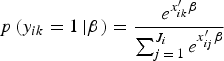
where i indexes choice sets and k = 1, . . ., Ji indexes the candidates in choice set i. Due to the small number of observations, the data cannot support the large-sample approximations employed by frequentist statistics. Bayesian methods, in contrast, treat the number of observations as fixed for any given estimation problem, and Bayes' Theorem provides the exact posterior distribution of the parameters conditional on the observed data. Bayesian methods of estimation and inference therefore do not depend on asymptotic assumptions, and are thus much more appropriate for this second analysis.Footnote 14 The results of both the binomial and conditional logistic regression models are presented in the following section.
RESULTS AND DISCUSSION
The gender-bias, gender-advantage, and gender-neutral outcomes hypotheses each generate distinct empirical implications that are tested using data on both committee membership and the election for committee chairs. The results from these models suggest that empowering MPs does not necessarily disadvantage women and that cross-partisan elections may even provide a unique gender advantage.
Results from the Model of Committee Membership
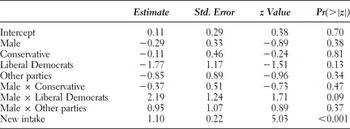
The coefficient estimates and standard errors from the binomial logistic regression are displayed in Table 1. Two key results emerge from the model of committee membership: the absence of a gender effect and the importance of career trajectory. The regression results illustrate that when controlling for experience, there are no statistically significant differencesFootnote 15 in select committee membership between Labour women and either men or women in any other party group. Log odds ratios are used to compare the male and female MPs in each of the three additional party groups. After accounting for experience, these comparisons indicate that there are no significant differences in select committee membership between male and female MPs.Footnote 16 For each party, the 95% confidence intervals contain zero.Footnote 17 Just as there are no differences between men and women within parties, the log odds ratios indicate that the differences between women across parties are also nonsignificant.Footnote 18
Binomial logistic regression model of select committee membership
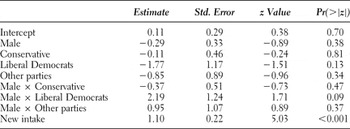
Notes: The outcome variable is a dichotomous indicator of elected select committee membership. The baseline category for the interaction term measuring sex and partisanship is Labour women. The baseline category for experience is incumbent MPs. N = 470 (number serving on elected committee = 260; number not serving on elected committee = 210).
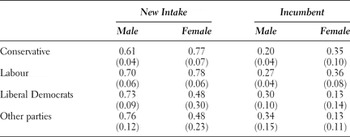
While parliamentarians' sex is not associated with committee service, the measure of previous experience is correlated with select committee membership. Although 55% of back bench MPs (260 of 470 members) serve on an elected select committee, 68% of the new intake (154 of 228 members) were elected to one of these committees. The regression results further indicate that newly elected MPs are more likely than incumbents to serve on select committees. As Table 2 illustrates, the predicted probabilities are lowest among incumbent women in the Liberal Democrats and other small parties, with only a 0.13 probability of membership. Even for the major parties, the predicted probabilities for Labour and Conservative women are only 0.35 and 0.36, respectively. Male and female incumbents from all other parties also have predicted probabilities of committee service below 0.35. The predicted values for the new intake, in contrast, are significantly higher. They range from 0.48 for women newly elected to the Liberal Democrats and other small parties to as high as 0.77 and 0.78 for the new female Conservative and Labour MPs.
Predicted probabilities of select committee service
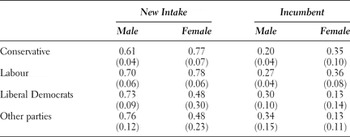
Notes: The outcome variable is a dichotomous indicator of elected select committee membership. The table presents predicted probabilities from a binomial logistic regression model with standard errors for the predicted values in parentheses.
The difference between previously and newly elected MPs may be especially large due to the circumstances in which these elections occurred. With the transition in power from a Labour to a Conservative–Liberal Democratic coalition government, many of the incumbent representatives—who in previous Parliaments may have pursued select committee seats—are now serving in lower-ranking government positions. Thus, these incumbents are ineligible for select committee service.
In 2010, moreover, there were many inexperienced legislators looking to build their reputations in their parties and among their fellow MPs. The new intake may be more likely to perceive election to a select committee as career advancement. The more established and experienced back bench MPs, on the other hand, may be more likely to be ambivalent about committee service and less likely to put themselves forward for membership. When they did compete, incumbent parliamentarians may also have campaigned less aggressively than their recently elected colleagues.
The extent to which this interest gap will manifest in future elections is largely dependent on the performance of these more independent select committees. If they are viewed as effective, and service is associated with career advancement, then the gap between new and incumbent MPs may narrow. On the other hand, if they are perceived as largely ineffective, the MPs who pursued these positions in 2010 may eschew them in the future. This would once again leave spaces for recently elected representatives.
While the results indicate that the new intake seems to have been more interested in select committee membership, there was no parliamentary record on which to assess the qualifications of these recently elected MPs. Arguably, if sex is a meaningful determinant of election outcomes, it should be most visible within this group (who can less easily mitigate gendered effects through previous experience and networking). As both the motivations and the qualifications of the new intake are uninfluenced by previous parliamentary experience, an assessment of the combined influence of sex and partisanship on select committee membership among them is particularly informative. Although the predicted probability of committee membership is larger for female members of both the Conservative and Labour new intake than for their male counterparts, the difference is nonsignificant. Similarly, while the predicted probabilities are larger for male than female MPs for the remaining parties, these differences are also nonsignificant.Footnote 19 These results demonstrate that gendered effects do not emerge, even in the most likely case. Neither the gender-advantage (H2) nor the gender-bias (H1 and H1a) hypotheses are supported by the data.
Results from the Model of Elections for Committee Chair
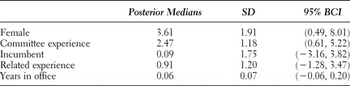
Table 3 presents the posterior median values and 95% Bayesian credible intervals for the conditional logistic regression predicting the election of select committee chairs. From this model, two key results emerge. First, experience—especially previous service on the committee—is correlated with winning the election. Second, even when controlling for candidates' backgrounds, women are more likely to win their elections than are their male counterparts. These results lend support to the hypothesis that interparty elections advantage female candidates.
Bayesian conditional logistic regression model of select committee chair elections
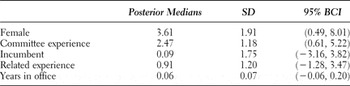
Notes: The outcome variable is a dichotomous indicator denoting whether the candidate won the select committee chair election. The 95% BCI presents the Bayesian Credible Intervals. The results are generated from 17 candidate choice sets and 51 total observations.
Of the variables controlling for candidate quality, there is a positive and statically significant relationship between winning election and having previously served on the committee.Footnote 20 In an election between two candidates, for example, the individual with committee experience enjoys a 0.92 probability of winning the chair, holding all other variables constant.Footnote 21 The probability of a candidate with related experience winning election is somewhat smaller, with median value 0.71. Although the 95% credible interval would not be deemed “significant” in the standard regression framework,Footnote 22 the posterior clearly shows that MPs with related experience are favored over those without it.Footnote 23
In contrast, the probability of an incumbent winning over a nonincumbent in a two-person race is 0.53, with a 95% CI of (0.04, 0.98). Similarly, a candidate with an additional year of experience has a probability of winning of 0.51, with a 95% CI of (0.49, 0.55). These probabilities are so close to 50% that, when holding all other variables constant, the choice between an incumbent and nonincumbent (or between two parliamentarians differentiated by only an additional year of experience) can be thought of as a toss-up between the two candidates.Footnote 24
Although candidate quality influences the choice of select committee chair, candidate sex is the best predictor of election results. Holding all other variables constant, in a two-person election between a male and female candidate, the woman MP enjoys a 0.98 probability of winning the chair.Footnote 25 Generating predicted values by comparing an inexperienced female candidate to more experienced men further illustrates this effect. The median probability of a woman with no experience winning a two-person race against a male candidate with related experience is 0.94. The spread, however, is very large and the 95% credible interval ranges from 0.27 to 1. This indicates that while the inexperienced female candidate does not have an outright advantage—as the credible interval includes 50%—the posterior continues to show that the woman is favored over the man.
The gender effect decreases when a woman with no experience runs against a man who has previously served on a committee (or a closely related select committee). In this case, the median predicted probability of the woman winning is 0.76, with a 95% credible interval ranging from 0.15 to 0.99. The gender effect, however, is not fully mitigated until a woman with no experience stands against a male candidate with both committee and related prior experience. In this case, the median predicted probability of the woman winning is 0.56, with a 95% credible interval of 0.04 to 0.98. In this final scenario, the predicted probability indicates that the choice between the experienced male and inexperienced female candidates is like a coin toss when all other variables are held constant. The median value and spread indicate that women's advantage is mitigated only when the male candidate is markedly more experienced than his female opponent.
Candidate sex was not relevant in determining the makeup of select committee membership, but it was an important factor in the election of select committee chairs. Thus, the results provide support for two of the hypotheses. The selection of committee members by intraparty elections led to gender-neutral outcomes across the party groups. Female MPs are neither overtly advantaged nor disadvantaged in gaining select committee membership. In contrast, the outcome of the interparty elections for committee chairs lends support to the gender-advantage hypothesis. Even when controlling for candidate quality, female parliamentarians were still more likely to win election than their male counterparts.
What accounts for the discrepancy in the significance of sex across these related elections? There are two key differences between the vote for committee members and chairs: timing and the composition of the selectorate. Committee membership was decided by an intraparty vote, meaning that candidates had to gain support strictly from their copartisans. Additionally, these elections occurred more than one month after the general election. MPs likely have greater knowledge of, and have had more time to share experiences with, members of their own party than those of opposing parties. Any potential sex effects may consequently be overwhelmed by more particularized information about the candidate.
Committee chairs, in contrast, were selected via interparty elections. Within weeks of the State Opening of Parliament, members were forced to choose among candidates from outside of their own party for a subset of positions. For these elections, MPs had to devise a metric for choosing among candidates with whom they were less familiar. The rules governing voting thus create the opportunity for candidate sex to serve as an information shortcut in determining vote choice. While male MPs do not appear to have discriminated against their female colleagues—at least not in numbers large enough to skew the results—female MPs may have favored other women when selecting committee chairs from among the opposition candidates.
CONCLUSION
The analysis of select committee election outcomes offers new insights for —and generates additional questions concerning—the study of women in British politics. Although the House of Commons is a highly masculinized environment, there is no evidence that female candidates were marginalized in elections for select committee positions and chairs, which is counter to both the general and party-specific–gender-bias hypotheses. In fact, the interparty selection of chairs seems to have provided an advantage to women. Given both the discrimination that has been reported by female MPs and the governing parties' poor track records concerning women's descriptive representation, this is an unexpected finding that merits significant attention. While the results do not imply that women are treated as equals by their male copartisans in every context, they are clearly encouraging for those concerned with the position of women in the House of Commons.
While the results of the 2010 select committee elections are consistent with the gender-neutral and gender-advantage hypotheses, the extent to which these dynamics will persist in subsequent elections cannot yet be known. The newness of both the voting procedures and the selectorate may have created a unique opportunity for a female gender advantage. In the future, legislators may not need to rely on sex as a signal for choosing between candidates, thereby leading to gender-neutral outcomes. Alternatively, the next election may witness a backlash from male MPs who feel marginalized by a perceived advantage for female candidates. Then again, buoyed by their success in these elections, women may engage in greater (and more explicit) gender-based organizing. While future research should examine sex and select committee elections over time, for now we can conclude that female MPs successfully navigated the period following the adoption of the Wright Committee reforms.
Beyond the future of select committee elections, the extent to which these findings are indicative of women's greater access to other positions of power also remains to be seen. While select committees are growing in importance, serving as a committee chair remains less prestigious than holding a Cabinet portfolio. When the Conservative Party formed its coalition government in 2010, there were very few incumbent female Conservative MPs. Some of these women were granted positions in the government, and others are now serving as select committee chairs. Now there are many more women on the Conservative back benches who, during Cabinet reshuffles or following the next election, can be appointed to the Conservative front-bench team. Though Conservative women have done well in select committee elections, the extent to which these women can leverage this success in order to gain positions in the government is unknown. Committee service could be a gateway to power or a consolation prize for female MPs.
Just as the findings generate new insights and questions concerning women in the House of Commons, they also offer additional implications concerning sex-based organizing in political institutions. Existing research indicates that women are more likely to serve on traditionally masculine or high-prestige committees when membership is determined in part by a floor vote. Currently, most positions of power within national assemblies—including committee assignments and cabinet positions—are allocated by party elites. The results from the UK indicate that the position of women within legislatures may be strengthened when access to power comes not from elites but from alliances forged with fellow parliamentarians. Under the new system, for example, women were successful in gaining select committee membership. Moreover, in comparison to the previous Parliament, they are also much better represented among committee chairs. For those interested in promoting women's descriptive representation within assemblies, changing the mode of selection for these positions may create new opportunities for female MPs.
Finally, while there is a large literature examining mass political behavior and sociodemographic characteristics as information shortcuts that help to determine vote choice, similar arguments have yet to be made in work on legislators' behavior. This article indicates that sex-based alliances may promote (or inhibit) women's position within political organizations and that sex may be particularly salient in low-information environments. Across other institutions, women and politics scholars should be attentive to moments in which there are large numbers of new legislators or important rule changes. It is within these environments that gender may be especially important.