Introduction
In Taiwan, on 18 March 2014, protestors climbed over the fence and broke into the Legislative Yuan building, which led to the unprecedented occupation of the Legislative Yuan for 23 days (from 18 March to 10 April 2014) and was named as the Sunflower Movement. It became the biggest political protest in the past 30 years of Taiwan history. Due to an increased awakening of civic consciousness and the changing attitude toward civil disobedience, Taiwanese citizens are simultaneously engaging in, and skeptical of, civic participation in recent years. On the one hand, civic consciousness refers to individual cognition of civic rights and obligations. According to cognitive-developmental theory, engaging in social activities can provide opportunities for participants to construct their civic consciousness through working and discussing with their peers. The social activities, including political participation and community service, appear to promote people's civic consciousness during adolescence, such as understanding of the individual's relationship with the state or society; cognition of citizenship, civic rights, and civic virtues; and internalization and identification of social behavioral norms and basic values (Scales et al., Reference Scales, Blyth, Berkas and Kielsmeier2000).
On the other hand, civil disobedience goes against the moral requirement that citizens comply with democratic institutions, because civil disobedience pertains to the individual's refusal to obey laws and is a way of forcing the government to do or to change something (Smith, Reference Smith2013). Specifically, civil disobedience often involves violations of laws, and is viewed as unacceptable in a democracy, because civil disobedience may lead to the destruction of the spirit of the rule of law. A democracy always promotes the formation of civic consciousness, because a high level of civic consciousness can increase citizen participation in political and public affairs. Basically, people with strong feelings of civic consciousness seek legal and institutional channels to participate in the political process to help shape public policy and legislation. This scenario is based on the premise of political effectiveness. Once the government does not function in line with public expectations and even loses public trust, some may resort to non-institutional approaches to change the government and advocate that citizens have the right to disobey and fight against the government, which leads to the formation of civil disobedience.
While civic consciousness has been rooted in Taiwan, civil disobedience is a new concept that is just beginning to attract public attention. So far, few studies have examined the impact of civic consciousness and civil disobedience on the political attitudes and behavior of individuals. In this study, we attempt to examine the effects of civic consciousness and civil disobedience on individual attitudes toward, and participation in, contentious politics that means ‘episodic, public, collective interaction among makers of claims and their objects when: (a) at least one government is a claimant, an object of claims, or a party to the claims, and (b) the claims would, if realized, affect the interests of at least one of the claimants or objects of claims’ (Tarrow, Reference Tarrow2013). Simply speaking, contentious politics refer to collective political struggle and include political activities such as social movements, riots, strikes, civil wars, and revolutions. This study expects to provide new insights into the connections between civic consciousness, civil disobedience, and individual support for, and participation in, the contentious political activity in Taiwan. The reminder of this study is organized as follows. In Section 2, we discuss the structure of political participation and outline the theoretical relationships between political participation, civic consciousness, and civil disobedience; in Section 3, we describe the data, measurement of variables, and model specification; in Section 4, we report the empirical findings on how civic consciousness and civil disobedience influence individual attitudes toward, and participation in, contentious politics; and, in the final section, we conclude by summarizing the key findings and discussing the implications of this study.
Political participation: conventional and unconventional engagement
‘Politics is too serious a matter to be left to politicians’. – Charles de Gaulle
There is a general consensus among scholars of political behavior that, despite institutional and socio-economic changes that would be expected to increase the levels of voting, voter turnout in advanced democracies has – at best – stagnated since the 1950s (Blais, Reference Blais, LeDuc, Niemi and Norris2010; Blais et al., Reference Blais, Gidengil and Nevitte2004; Dalton, Reference Dalton2008; Franklin, Reference Franklin2004; Lewis-Beck et al., Reference Lewis-Beck, Jacoby, Norpoth and Weisburg2008; McDonald, Reference McDonald and Leighley2010; Norris, Reference Norris2002; Wattenberg, Reference Wattenberg2012). This consensus, coupled with evidence of weakening political parties and lower levels of political campaign-related activities (Dalton and Wattenberg, Reference Dalton and Wattenberg2000; Van Biezen et al., Reference Van Biezen, Mair and Poguntke2012; Whiteley, Reference Whiteley2011) indicates that traditional electoral-oriented actions have not been a source of political rejuvenation in both old and new democracies. In the Taiwanese context, after the lifting of martial law, protests and demonstrations have become acceptable forms of political participation. Simply seeing the rapid escalation in the number of protests in the late 1980s, one could find that a changing attitude toward protest activities had emerged.Footnote 1 In other words, more and more Taiwanese citizens have participated in protests and social movements over the recent years.
Two major theoretical perspectives, the ‘elite competition’ and ‘participatory citizenship’ theories, have guided much of the research on voter turnout and other forms of political participation in mature democracies (for useful summaries, see Held, Reference Held1996; Dalton, Reference Dalton2002). The elite competition theory is associated with the ‘responsible government’ school of thought (e.g., Almond and Verba, Reference Almond and Verba1963) and argues that modern governments should be, or necessarily are, dominated by political elites. Citizen participation in such political systems is episodic and circumscribed. According to the elite competition theory, limited citizen involvement is an adequate and appropriate method for ensuring that a democracy will have a stable and effective government to respond to public needs.
In contrast to the elite competition theory, the participatory citizenship theory contends that a defining characteristic of democracy should be ‘untidy’ governance attendant upon widespread public involvement in governmental processes. ‘Strong’ democracy requires extensive – not minimal – citizen involvement (e.g., Barber, Reference Barber1984; Pateman, Reference Pateman1970; Macpherson, Reference Macpherson1977; Clarke et al., Reference Clarke, Sanders, Stewart and Whiteley2004). Participatory democracy theorists argue that expansive citizen involvement in various kinds of political activities enhances the effectiveness, openness, and responsiveness of government, while bolstering citizens’ political interest, political knowledge, feelings of efficacy, and political trust (e.g., Pateman, Reference Pateman1970; Macpherson, Reference Macpherson1977). Widespread participation is an integral component of a ‘virtuous circle’ of responsive governance and informed citizenship (Norris, Reference Norris, Robinson and Landman2009).
The two democratic theories delineate a sharp contrast regarding the desirable and possible scope of citizen involvement. Despite these consequential differences between the two theories, there are still important areas of agreement between them. Perhaps most fundamentally, both theories conceptualize ‘political participation as a voluntary activity done by an individual acting alone or with others’ (Clarke et al., Reference Clarke, Sanders, Stewart and Whiteley2004: 219). Specifically, the two major theoretical arguments suggest that such participation involves activities by citizens aimed at influencing the action of government by expressing attitudes, beliefs, and opinions about the ends and means of public policy.
To further understand the relationships between political attitudes and various types of participation, starting in the 1970s, scholars have initiated systematic investigations of citizen involvement in a diverse range of non-electoral political activities. The canonical cross-national comparative study of this genre is Barnes et al. (Reference Barnes, Kaase and Allerback1979). A frequent demarcation point for these inquiries is the distinction between types (or ‘modes’) of political participation that are ‘conventional’ or ‘unconventional’ (Verba and Nie, Reference Verba and Nie1972; Barnes et al., Reference Barnes, Kaase and Allerback1979; Dalton, Reference Dalton2002; Clarke et al., Reference Clarke, Sanders, Stewart and Whiteley2004, Reference Clarke, Sanders, Stewart and Whiteley2009). In addition to election-centered activities such as voting and campaign work, conventional activities encompass various kinds of community involvement in inter-election periods. As Verba and Nie (Reference Verba and Nie1972) state, community involvement includes citizens trying to solve local problems via contacting public officials and working with friends and neighbors in policy-advocacy and problem-solving roles. These activities can be seen as ‘elite supportive’ because they are peaceful and implicitly recognize the legitimacy of existing governmental structures and processes. In contrast, ‘unconventional’ participation may range from ‘mild’ forms, such as signing a petition or joining a boycott of goods and services, to ‘strong’ ones, such as marches, demonstrations, and protests that involve violence against people and the government.
Beyond election: the multidimensional structure of political participation
Prior empirical research on public political participation has delineated the nature and incidences of various types of activities in democracies. The key finding is that citizen political participation in democracies, regardless of age, is multidimensional. In the United States context, Verba and Nie (Reference Verba and Nie1972) identify four basic types of participation: voting, campaign activity, contacting, and cooperative activity. The empirical utility of this typology has been demonstrated in subsequent studies (e.g., Verba et al., Reference Verba, Schlozman and Brady1995; Brady, Reference Brady, Robinson, Shaver and Wrightsman1999). In Canada, Kornberg and Clarke (Reference Kornberg and Clarke1992, Reference Kornberg and Clarke1994) use confirmatory factor analysis (CFA) to identify four main types of political participation: verbal persuasion, campaign activity, non-confrontational protest, and confrontational protest. Scholars working in Britain have reported similar findings. For example, Stewart and Clarke (Reference Stewart and Clarke1992) use CFA to identify three participation dimensions – electoral conventional, mild unconventional, and strong unconventional – in the British survey data gathered as part of the Political Action Study. In later work, Parry et al. (1992) reexamine the structure of political participation in England and claimed that political participation in Britain has six dimensions: voting, party campaigning, collective action, contacting, direct action, and political violence.
The strength of understanding the structure of political participation suggested by previous studies is the explicit focus on manifest political participation in a more narrow sense – i.e., activities intended to influence actual political outcomes by forcing political elites to take actions (see Brady, Reference Brady, Robinson, Shaver and Wrightsman1999). At the same time, understanding the structure of political participation could cover a lot more than just participation in elections. More importantly, the full picture of political participation is based on previous studies demonstrating empirically that different forms of participation seem to be related. That is, citizens involved in one mode or dimension of political behavior tend to engage in other forms of political behavior within the same dimension, but do not necessarily participate in political activities in other dimensions. For example, citizens involved in illegal demonstrations also tend to get involved in legal demonstrations, but it does not necessarily mean that they will take part in conventional party activity (see Clarke et al., Reference Clarke, Sanders, Stewart and Whiteley2004).
In light of the aforementioned research, we know that understanding of the structure of political participation could help us to more clearly depict the civil society in a country. Yet, to our knowledge, existing studies of mass political behavior in new Asian democracies have focused heavily, albeit not exclusively, on electoral behavior, especially on the determinants of voting in periodic national elections (e.g., Dalton et al., Reference Dalton, Shin and Jou2007; Ho et al., Reference Ho, Clarke, Chen and Lu-Chung Weng2013). In the Taiwanese context, despite not mainly focusing on the structure of political participation, previous studies on non-electoral political participation have found that Taiwanese citizens have gradually changed their attitudes toward engagement in unconventional participation activities. These studies center on categorization of non-electoral participation and on who participates in these activities. For instance, Chu (Reference Chu and Chung-Chi1989) classifies non-electoral participation by the Taiwanese into four different categories, namely economic, political, environmental, and labor issues. Furthermore, Fan (Reference Fan and Alagappa2004) investigates social movement activists in the 1990s in Taiwan, finding that social movement activists tended to come from privileged backgrounds, were well educated, and had higher socio-economic status. However, existing studies on political participation in Taiwan are quite insufficient for our understanding of the relationships between political attitudes and unconventional participation. Therefore, this study expects to reveal the impact of two important political attitudes – civic consciousness and civil disobedience – on individual participation in contentious political activities in Taiwan.
Why do people participate in contentious political activities?
There has been a considerable body of research on the determinants of different forms of political participation in the west. Previous studies have revealed that various factors exert significant influence on the political engagement of individuals, such as partisan attachment, gender, age, and other social demographic factors. However, we would like to argue that our understanding of political participation, particularly contentious participation, suggested by existing studies is not optimal. While we can learn about why such contentious events happen in some places and at certain times, but not in other places or at other times, or about who and which groups are more likely to participate in such activities by examining the effects of certain factors on participation, we still do not understand the endogenous motivations pulling individuals into the fray. Specifically, we want to know what motivates an ordinary citizen to join in.
In addition to the factors discussed in previous studies, there are also many endogenous psychological factors that have been found to affect civic and political participation. The idea of finding the endogenous psychological motivations is based on the simple observation that citizens actually do a lot of things in their daily life that may not be directly or unequivocally classified as ‘political participation’, but at the same time could be of great significance for future political participation. If we are interested in why citizens would participate in contentious politics, we must not overlook such motivation for engagement. People of all ages and from all walks of life engage socially in a number of ways, formally outside of the political domain, but nevertheless in ways that may have political consequences.
As a result, in this current study, our focus is on the two potential endogenous motivations, namely civic consciousness and civil disobedience. We contend that these two psychological factors either independently influence or cumulatively comprise what we have termed ‘contentious participation’ in this study. Here, we provide a brief review of the theoretical arguments related to these two motivations that have been discussed to date.
The rising civic consciousness
As explained previously, past research has shown that decline in the norms of civic duty leads to decline in voting in a variety of democracies (Blais et al., Reference Blais, Gidengil and Nevitte2004; Blais and Rubenson, Reference Blais and Rubenson2013; Bowler and Donovan, Reference Bowler and Donovan2013). Scholars who interpret recent participation trends as indicative of civic and political renewal have not disputed these findings, and Dalton's (Reference Dalton2008: 89–92) interpretation of data on turnout in the United States is that voter participation has indeed declined somewhat since the 1950s. Dalton, who represents the transformational school of thought, however, argues that the decline in turnout rates, due to the decline in a sense of duty, tells ‘only half of the story’ of how generational norm change has influenced patterns of political participation (Dalton, Reference Dalton2008: 83). The other half of the story according to Dalton is that a rise in civic consciousness is yielding a new style of political engagement that uniquely emphasizes political engagement beyond the electoral arena. Therefore, scholars of these new kinds of engaged citizenship norms and behaviors have generally praised their emergence as a sign of democratic renewal (Bennett, Reference Bennett2012; Norris, Reference Norris1999, Reference Norris2011; Schudson, Reference Schudson1998, Reference Schudson2000).
The upsurging of civic consciousness in society may reflect cognitive-developmental theory (Kohlberg, Reference Kohlberg1987), which emphasizes the strengthening of cognitive ability and reasoning as an essential developmental key. Cognitive-developmental theory regards peer interaction with a community as an important factor conducive to moral development and civic consciousness. Accordingly, people gain the most cognitive development by discussing freely and rationally with their peers. Thus, young people's involvement in discussion with peers, rather than learning from superiors, is a viable means. The underlying principle is in the efficacy of constructing moral values by experiencing conflict and disequilibrium in contact with reasoning at a slightly higher moral stage (Snarey and Pavkov, Reference Snarey and Pavkov1991).
Therefore, discussing openly with peers who have diverse views but are not at an absolutely higher moral stage provides the impetus for moral development. In the social media era, cognitive-development theory denies authority figures, and sees social networking as effective for promoting young people's moral development. Young people have opportunities to interact and discuss with their peers via new communication techniques. In this regard, according to cognitive-developmental theory, they can develop their civic consciousness through peer interaction quicker than older generations. More importantly, the rising civic consciousness often consists of comprehensive moral norms that are wildly accepted by the general public, and it thus reflects the current public opinion more accurately. Since civic conscious people tend to feel obligated to care about and participate in political affairs, we expect that people with higher levels of civic consciousness are more likely to hold a favorable opinion of, and engage in, contentious politics.
Why civil disobedience matters
Compared to the measurement of civic consciousness, it is harder to conduct empirical analysis of the second psychological factor – the changing attitude toward civil disobedience. In his renowned work, A Theory of Justice, John Rawls defines civil disobedience as ‘a public, non-violent and conscientious breach of law undertaken with the aim of bringing about a change in laws or government policies’ (John Rawls, Reference Rawls1971). For Rawls, civil disobedience could only be done openly in public, and only ever with advance notice to legal authorities. According to Rawls, such openness is the mean of disobedients’ civility and willingness to deal fairly with authorities in a democratic society. Another mark of their civility is their non-violence. Rawls states that any violent acts likely to injure are incompatible with civil disobedience as a mode of expressing opinions, because the violent acts would damage the quality of the act. Finally, Rawls’ definition also emphasizes disobedients’ willingness to accept the legal consequences of their actions, including punishment that may occur.
Among the three key components of Rawls’ definition, the concept of the non-violent act has received the most attention. Opponents of Rawls’ view have challenged the centrality of non-violence for civil disobedience from different perspectives. First, it is hard to specify the notion of violence. In other words, how should we know at what stage an action could be viewed as a violent act (see Morreall, Reference Morreall and Bedau1991)? Second, sometimes a non-violent act could cause more harm to others than violent one (Raz, Reference Raz2009). For instance, a legal strike by nurses may have more severe consequences than high school students throwing eggs at government buildings. Third, an acceptable level of violence may not necessarily obscure the communicative quality of a disobedient's action, as Rawls and Peter Singer suggest it does (Singer, Reference Singer1973). On the contrary, using limited violent actions to achieve a specific objective might heighten the communicative quality of the act via drawing greater attention to the dissenter's cause and by emphasizing seriousness and frustration (Brownlee, Reference Brownlee2012).
In the Taiwanese context, the attitude toward civil disobedience is critical to individual participation in political activities due to its history of political development. Looking back at Taiwan's history, at the time when the Tangwai (i.e., outside-the-party) was beginning to openly challenge the Kuomintang (KMT) in 1980s, the majority of protests and demonstrations were described as violent acts by the KMT. Similar to other new Asian democracies, such as South Korea, the Philippines, and Indonesia, Taiwan had been under authoritarian rule with heavy political control and then became a democracy. Prior to early 1990s, the dominant party, the KMT, controlled the social and political conditions in Taiwan by keeping Taiwanese citizens under the control of martial law for the longest period of any country in the world. After decades of successful control of public opinion, the end of martial law saw a sudden rise in all kinds of contentious movements fighting for political rights in Taiwan. Yet, Taiwanese citizens as a whole tend to be less unfavorable toward these contentious movements. Why?
According to cognitive-developmental theory, due to changing public sentiment across the generations toward protest, one would expect that the generations that had experienced the pre-democratization era would develop their cognition toward political participation with a more cautious attitude than the younger generations. Ho and his colleagues (Reference Ho, Lu-Chung Weng and Clarke2015) demonstrate that older generations and younger generations indeed have significant differences in how they participate in politics. They confirm that there exists a generational difference in political participation in Taiwan, and the older cohorts have more cautious attitudes toward politics. However, few previous studies on contentious participation in Taiwan have examined the effects of individual feelings regarding civil disobedience on attitudes towards, and participation in, contentious political activity, and it is precisely this gap that this study aims to fill. Since the feeling of civil disobedience implies a tendency to oppose the government using either violent or non-violent means, we expect that people with higher levels of civil disobedience are more likely to hold a favorable opinion of, and engage in, contentious politics.
To sum up, previous studies have provided various possible assumptions in which each of the hypothesized factors may have an impact on citizens’ participation in unconventional engagement. The balance of influence between the different factors varies from one societal setting to another, depending on the particular constellation of macro and social factors that is present. For this reason, different factors may be the primary drivers of political and civic participation for different demographic groups in different countries. In this regard, while taking Taiwan's political context into consideration, we contend that the two psychological factors – civic consciousness and civil disobedience – are the two crucial indicators of individual attitudes toward and participation in contentious politics, which have long been overlooked. Specifically, we test the following two hypotheses:
Hypothesis 1: Civic consciousness is positively associated with individual support for and participation in contentious politics.
Hypothesis 2: Civil disobedience is positively associated with individual support for and participation in contentious politics.
Data, measurement of variables and model specification
We test our hypotheses using data from the project of ‘Civic Consciousness and Civil Disobedience’ which is co-hosted by Fu-Kien Chang and Chia-hung Tsai. The Election Study Center at National Chengchi University was responsible for the data collection and distribution. The data were collected from 2 March through 7 March 2015 via a telephone survey, which included Taiwanese citizens aged 20 and above as the population and had a sample size of 1,301 respondents. The respondents were interviewed mainly in either Taiwanese or Mandarin. However, due to missing values, the effective number of observations is reduced to 860 in this study. Furthermore, the data are weighted by gender, age, education, and residence area in order to assure the representativeness of the sample. Therefore, we employ weights to generate estimates that are nationally representative. Next, we explain the operationalization of variables for empirical testing.
Our main concerns are individual attitudes toward and participation in contentious political activity. Accordingly, we focus on two dependent variables, namely support for the Sunflower Movement and contentious participation, and respectively operationalize them as follows.Footnote 2 First, the respondents were asked to indicate the extent to which they support the Sunflower Movement and their responses to this survey item were collapsed into four ordinal categories from ‘strong non-support’ to ‘strong support’. Accordingly, we recode the responses to range from 1 to 4. Second, the respondents were asked whether they had participated in rallies, marches, and strikes over the past two years. Therefore, we treat this variable as a dichotomous variable, coded 1 for those who had taken part in such contentious political activities, and 0 otherwise.
With regard to our key explanatory variables, the survey asked the respondents to indicate the extent to which they agree or disagree with five statements reflecting various beliefs about civic consciousness. We first code the individual responses to each question, ranging from 1 to 4, with the higher values signifying higher levels of civic consciousness. Then we take the average of the respondents’ answers to all five survey items, and, accordingly, the values of civic consciousness can theoretically range from 1 to 4, and the higher values indicate higher levels of civic consciousness.Footnote 3 The survey measured civil disobedience by asking the respondents to reveal the extent to which they agree or disagree with the statement that if there are serious problems with some laws, people can publicly take action to oppose them. We code each individual response, ranging from 1 to 4, with the higher values indicating higher levels of civil disobedience.Footnote 4
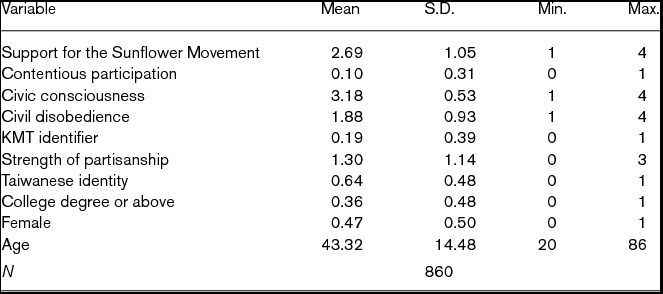
To avoid misestimating the relationships between civic consciousness, civil disobedience, and individual support for and participate in contentious politics, we control for some potential explanatory variables in the model, such as identification with the ruling party, strength of partisanship, Taiwanese identity, and demographic factors (i.e., education, gender, and age). First of all, people who support the incumbent or the ruling party have greater trust and confidence in political institutions and are thus are less likely to attend political activities against the government. Given that both the Sunflower Movement and the temporal scope coved by our variable of contentious participation refer to activities taking place under the KMT administration, we expect that those who identify with the KMT ought to be less likely to support the Sunflower Movement and take part in contentious political activities compared to adherents of opposition parties. Therefore, we create a dummy variable, KMT identifier, and code it as 1 for the respondents with KMT identification and 0 otherwise.Footnote 5 Second, previous studies have demonstrated that party identification affects the likelihood of individual participation in contentious politics (Corrigall-Brown, Reference Corrigall-Brown2011; Finkel and Opp, Reference Finkel and Karl-Dieter1991). Thus, we create a continuous variable to measure the respondent's intensity of party identification coded to range from 0 to 3, 0 being an independent and 3 being a strong partisan. Third, Taiwanese identity has been an important issue in Taiwan and past research has documented that Taiwanese identity has critical influence on Taiwanese people's political attitudes and behavior (Bedford and Hwang, Reference Bedford and Kwang-Kuo2006; Shyu, Reference Shyu2001; Wang and Liu, Reference Wang and Liu2004). Hence, Taiwanese identity is expected to play a role in individual attitudes toward and participation in contentious politics in Taiwan. We code the respondents who self-identity themselves as Taiwanese as 1, namely Taiwanese identify, and 0 for those who consider themselves as both Taiwanese and Chinese, that is, dual identity.Footnote 6 Finally, to control for the influence of demographic factors, we generate one dummy variable, college degree and above, with 1 for the respondents who are in the corresponding categories and 0 otherwise, whereas we treat gender as a dummy variable coded as 1 if the respondents are female and 0 for males, and age is measured by the number of years since birth. Table 1 reports the descriptive statistics for all variables (see the Appendix for detailed questionnaire wording).Footnote 7
Descriptive statistics of variables

With regard to model specification, given the nature of our two dependent variables – either ordinal or dichotomous – we estimate the ordered logistic regression model for support for the Sunflower Movement, whereas we employ the binary logistic regression model for contentious participation. The general form of our models can be presented using the following equation:
 $$\begin{eqnarray*}
&&Dependent\ variable = {\beta _0} + {\beta _1}\left( {Civic\ consciousness} \right) + {\beta _2}\left( {Civil\ disobedience} \right)\\
&&\quad +\, {\beta _3}\left( {KMT\ identifier} \right) + {\beta _4}\left( {Strength\ of\ partisanship} \right)\\
&&\quad + \, {\beta _5}\left( {Taiwanese\ identity} \right) + {\beta _6}\left( {College\ degree\ or\ above} \right)\\
&&\quad +\, {\beta _7}\left( {Female} \right) + {\beta _8}\left( {Age} \right)
\end{eqnarray*}$$
Empirical findings
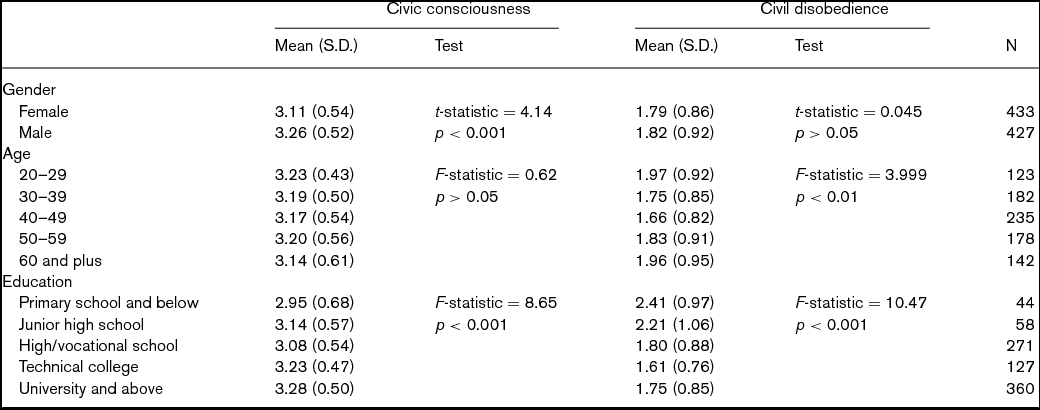
Before testing our hypotheses, we first examine whether there exist significant differences in civic consciousness and civil disobedience among different demographic groups. In particular, we compare the mean differences of civic consciousness and civil disobedience by focusing on gender, age, and education. First of all, men have higher levels of civic consciousness than women, as shown in the top row of Table 2. Moreover, the gender difference in civic consciousness is statistically significant at the 0.001 level according to the two-sample t-test. Although men seem to have slightly higher levels of civil disobedience than women, the result from the two-sample t-test indicates no significant difference in civil disobedience between men and women. Therefore, we conclude that men are more civic-conscious than women, but there is no gender difference in civil disobedience in Taiwan. Second, the middle row of Table 2 shows that there are slight differences in civic consciousness across age groups. However, the result from analysis of variance (ANOVA) points out that the differences do not achieve statistical significance. By contrast, the ANOVA result reports significant differences in civil disobedience among age groups.Footnote 8 Specifically, people between the ages of 20 and 29 and those aged 60 and over hold higher levels of civil disobedience compared to the other age groups. Consequently, we conclude that young and old people have a strong sense of civil disobedience in Taiwan. While some argue that the Sunflower Movement in March 2014 has contributed to the development of civic consciousness and civil disobedience among young people, our findings suggest that the Sunflower Movement might be conducive to the rising young people's civil disobedience, but it is not the case for civic consciousness. On the other hand, it is not clear why old people in Taiwan have higher levels of civil disobedience and further studies are needed to assess civil disobedience among old people. Lastly, people with different educational levels exhibit significantly different levels of civic consciousness and civil disobedience. The ANOVA results show that both differences in civic consciousness and civil disobedience across educational levels are statistically significant at the 0.001 level. In particular, people with higher levels of education tend to have higher levels of civic consciousness, but they are prone to have lower levels of civil disobedience. As a result, education seems to be a key determinant of individual civic consciousness and civil disobedience in Taiwan. To sum up, we indeed find some evidence that people with different demographic characteristics display different levels of civic consciousness and civil disobedience in Taiwan.Footnote 9 Next, we address our main concern over whether civic consciousness and civil disobedience influence individual support for and participation in contentious politics in Taiwan.
Mean comparison of civic consciousness and civil disobedience by demographics

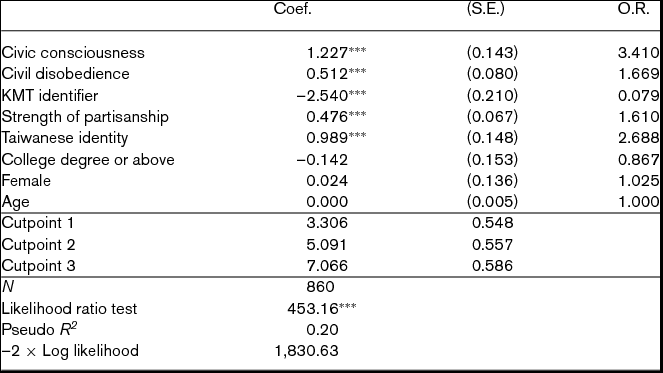
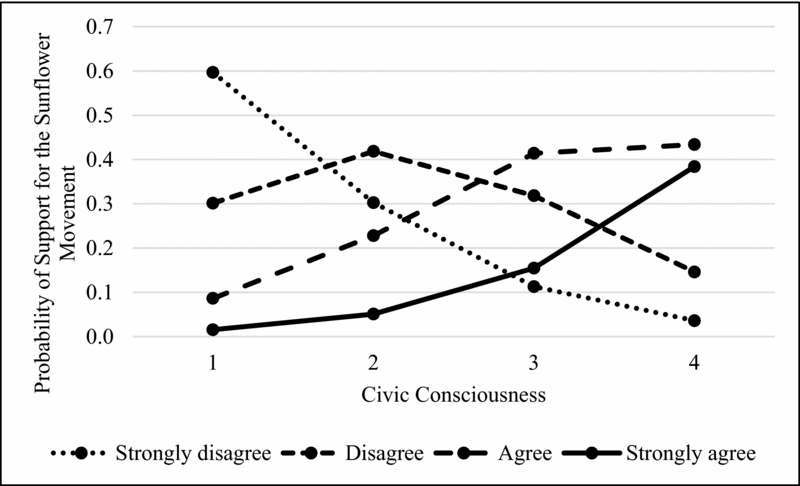
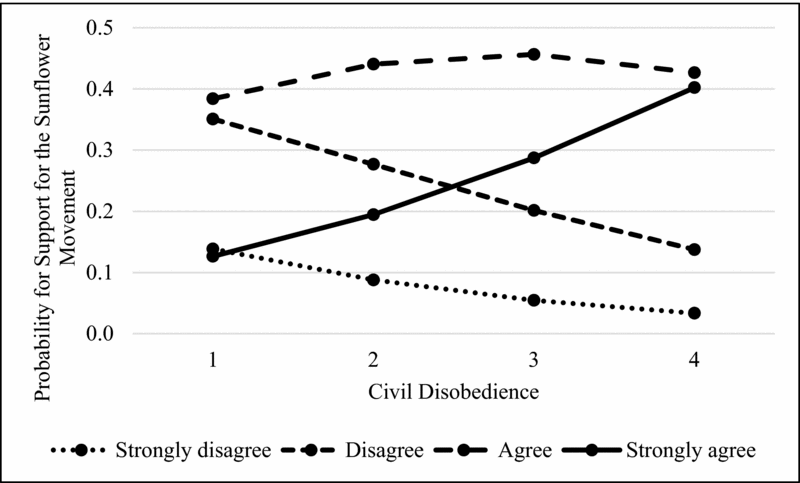
Table 3 presents the results for the impacts of civic consciousness and civil disobedience on individual support for the Sunflower Movement. It is evident that both higher levels of civic consciousness and civil disobedience are significantly associated with higher levels of support for the Sunflower Movement, which is consistent with our hypotheses. Specifically, for a one unit increase in civic consciousness, the odds of strong support for the Sunflower Movement versus the other three categories are 3.410 times greater, given the other variables are held constant in the model. On the other hand, for a one unit increase in civil disobedience, the odds of strong support for the Sunflower movement versus the other three categories are 1.669 times greater, given the other variables are held constant. To explain the results more clearly, people with the highest level of civic consciousness have a 38% probability to strongly support the Sunflower Movement, whereas they only have a 4% probability to strongly oppose the Sunflower Movement. By contrast, the probability of people with the lowest level of civic consciousness to strongly support the Sunflower Movement is only 2%, but they have a 60% probability to strongly oppose the Sunflower Movement (see Figure 1).Footnote 10 On the other hand, people with the highest level of civil disobedience have a 40% probability to exhibit strong support for the Sunflower Movement, and they have a mere 3% probability to express strong opposition to the Sunflower Movement. By contrast, people with the lowest level of civil disobedience have a 13% probability to display strong support for the Sunflower Movement (see Figure 2).Footnote 11 Besides, we also find that KMT identification, strength of partisanship, and Taiwanese identity are significantly associated with individual support for the Sunflower Movement. That is, people who identify with the ruling KMT are less likely to support the Sunflower Movement, but those with strong party identification are more likely to support the Sunflower Movement. Moreover, people with Taiwanese identity are more likely to favor the Sunflower movement than those with dual identity (i.e., both Chinese and Taiwanese).Footnote 12 To sum up, our findings imply that people who hold strong civic consciousness and civil disobedience are more likely to mentally support contentious political activities in Taiwan.
Ordered logit analysis of support for the sunflower movement

Notes: 1. O.R. is odds ratio.
2. ***: p < 0.01.
3. Two-tailed test.
Predicted probability of support for contentious politics as civic consciousness varies

Predicted probability of support for contentious politics as civil disobedience varies

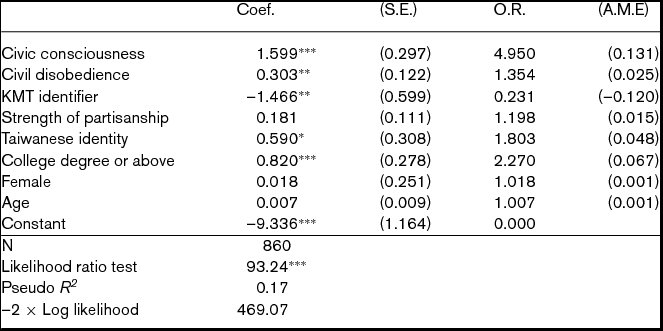
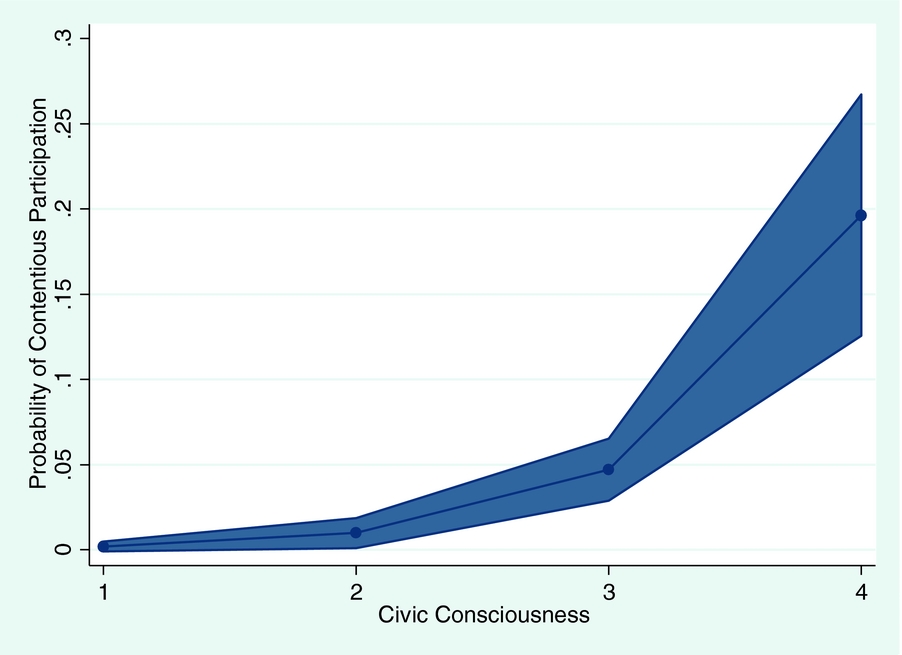
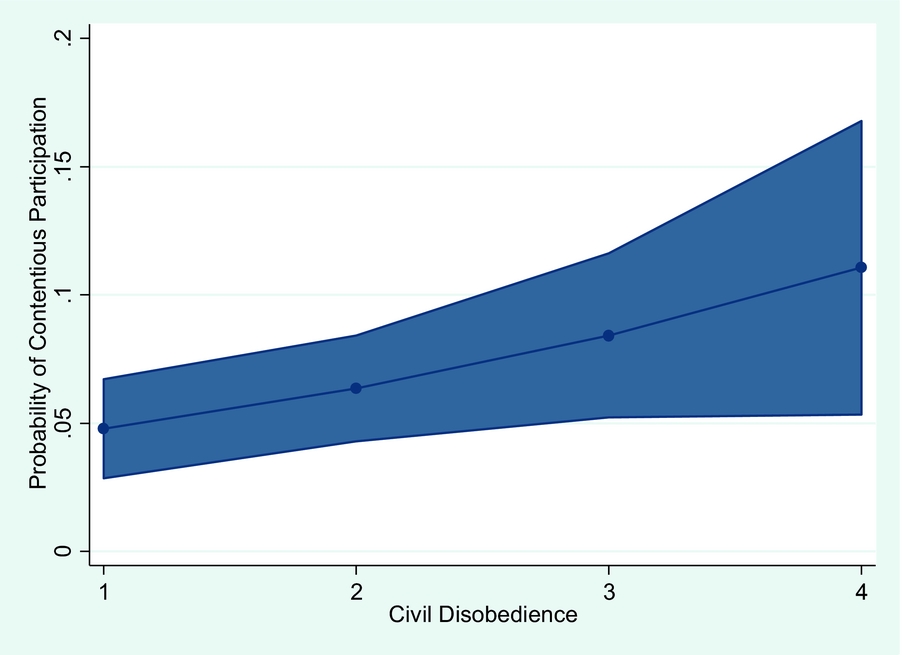
Then we turn our attention to the impacts of civic consciousness and civil disobedience on individual participation in contentious politics. As shown in Table 4, both civic consciousness and civil disobedience exert significant positive effects on contentious participation. Specifically, on average, a one unit increase in civic consciousness leads to an increase in contentious participation by 13.1%, whereas a one unit increase in civil disobedience increases individual participation in contentious political activity by 2.5%. The findings suggest that although both civic consciousness and civil disobedience are significantly associated with contentious participation in Taiwan, civic consciousness appears to play a more important role than civil disobedience in individual engagement in contentious political activities. Figures 3 and 4 respectively show the predicted probabilities of contentious participation varied by consciousness and civil disobedience.Footnote 13 Except for the positive impacts of civic consciousness and civil disobedience on contentious participation, it is known that people with the highest level of civic consciousness have a 20% probability to participate in contentious politics; by contrast, those with the highest level of civil disobedience only have a 11% probability to engage in contentious political activity. It is clear that the substantial effect of civic consciousness on contentious participation is greater than that of civil disobedience. In addition, KMT identification, Taiwanese identity and education also have significant positive effects on contentious participation. In particular, people who identify with the ruling KMT are less likely to participate in political contentious activity against the government, where those who self-identify as Taiwanese are more likely to take part in political contentious activity than those who identify themselves as both Chinese and Taiwanese. Besides, people with a college degree and above are more likely to engage in contentious politics than their counterparts.Footnote 14 On the whole, we conclude that civic consciousness and civil disobedience are two pivotal determinants of individual participation in contentious politics in Taiwan.Footnote 15
Binary logit analysis of contentious participation

Notes: 1. O.R. is odds ratio; A.M.E. is average marginal effect in terms of probability change.
2. ***: p < 0.01; **: p < 0.05; *: p < 0.10.
3. Two-tailed test.
Predicted probability of contentious participation as civic consciousness varies

Predicted probability of contentious participation as civil disobedience varies

To sum up, the above findings provide strong evidence that both civic consciousness and civil disobedience are key determinants of individuals’ support for and participation in contentious politics in Taiwan. Civic consciousness has been linked to institutional forms of political participation and a democracy always encourages the development of civic consciousness among its citizens because civic consciousness is conducive to citizen participation in public affairs. However, our results indicate that civic consciousness can also increase citizen participation in contentious political activities against the government. Therefore, it seems that for civic conscious people, both institutional and non-institutional forms of political engagement can be used to express their opinions and concerns about public affairs. On the other hand, it might not be surprising to find that the elevated levels of civil disobedience will lead people to participate in contentious political activities. People with higher levels of civil disobedience often exhibit distrust in the government and thus they would not think that they are able to achieve their ends through institutional means. Therefore, they have no choice but to resort to contentious political activities to change the government policies.
Conclusion
In a democracy, the incidence of contentious politics is a warning signal for public dissatisfaction with the functioning of democracy. Once the public are unable to use legal or institutional means to achieve their ends, they will be forced to resort to disruptive, even violent, techniques to express their needs, or to change government policy. In Taiwan, we have seen the occurrence of many social movements and protest activities over the past years.Footnote 16 Two large-scale socio-political movements – the White Shirt Movement and Sunflower Movement – have made significant contributions to the prevalence of civic consciousness and civil disobedience in Taiwan.Footnote 17 While the concept of civic consciousness has existed for a while in Taiwanese society, civil disobedience is a new idea advocated during the period of the Sunflower Movement. This study is the first to assess the consequences of civic consciousness and civil disobedience in Taiwan, especially focusing on individual support for and participation in contentious politics. We provide preliminary evidence that both civic consciousness and civil disobedience significantly increase individual support for and participation in contentious politics. The findings imply that as the ideas of civic consciousness and civil disobedience prevail in a democracy, the public will be more likely to choose to take part in contentious political activities to express their opinions instead of institutional and legal approaches, such as voting, when the government fails to timely respond to public needs.Footnote 18 Nevertheless, while Taiwanese people's average level of civic consciousness is high (i.e., mean = 3.18 and the maximum value is 4), we currently need not worry that the idea of civil disobedience is widely accepted in Taiwan given that only about 21% of Taiwanese people agree that the public can publicly take action to oppose the laws. That is, the majority of Taiwanese people still abide by the spirit of democracy, that is, rule of law. As a result, we are confident that democracy will continue to work in Taiwan.
On the other hand, while scholars have used the same measuring tools to gauge civic consciousness in Taiwan, some might suspect that the single item is not an effective measure of civil disobedience. It is always difficult to develop the measuring tools to measure a new concept, but it is also always beneficial to attempt to capture a new idea such appQuestionas civil disobedience even though the initial measurement is not perfect. The measurement of civil disobedience is beyond the scope of this study and we encourage students of public opinion and political behavior to develop more precise and reliable, even comparable cross-national, survey items to measure the concept of civil disobedience that has attracted scholarly attention in new democracies. Besides, this study simply focuses on Taiwan, and it is worth studying whether the findings from Taiwan can be generalized to other countries if data are available.
About the authors
Ching-Hsing Wang is a postdoctoral fellow in the Hobby School of Public Affairs at the University of Houston. His research interests include research methods, political behavior, political psychology, public opinion, and Asian politics. He has published articles in such scholarly journals as Electoral Studies, International Political Science Review, Issues and Studies, Party Politics, Social Science Quarterly, Taiwanese Political Science Review, The Social Science Journal.
Dennis Lu-Chung Weng is an assistant professor of political science at State University of New York at Cortland. His research interests are comparative politics, political behavior, quantitative methods, and Asian politics. He has published articles in such scholarly journals as Electoral Studies, Asian Journal of Political Science, Asian Journal of Comparative Politics, and Taiwan Journal of Southeast Asian Studies.
Appendix: Question wording
Support for the Sunflower Movement. Overall, do you support or not support the Sunflower Movement last March?
Contentious participation. Did you participate in rallies, marches, and strikes (in the past two years)?
Ineffectiveness of representative democracy. Some people say: ‘The legislature in Taiwan cannot reflect the public's opinion’. Do you agree or disagree with this statement?
Support for public policy referendum. Some people think that public policy should be decided by the referendum so as to reflect true public opinion. Others think that public policy requires professionals, so it should be decided by the representatives. Which of the two statements do you agree with more?
Civic consciousness
1. Some people say: ‘For public affairs, everyone should contribute money or take the initiative to participate’. Do you agree or disagree with this statement?
2. Some people say: ‘political affairs are only given to politicians to handle’. Do you agree or disagree with this statement?
3. Some people say: ‘when politicians’ opinions are different from ours, we should publicly express opposition’. Do you agree or disagree with this statement?
4. Some people say: ‘Just do our own business and do not get involved in political affairs’. Do you agree or disagree with this statement?
5. Some people say: ‘For public affairs, we should take the initiative to express our opinions’. Do you agree or disagree with this statement?
Civil disobedience. Some people say: ‘If our conscience believes that some laws are seriously problematic, we can publicly take action against them’. Do you agree or disagree with this statement?
Strength of partisanship
1. Among the main political parties in our country, including the KMT, DPP, NP, PFP, and TSU, do you think of yourself as leaning toward any particular party?
2. Do you feel yourself leaning a little more to one of the political parties than the others?
Taiwanese identity. In Taiwan, some people think they are Taiwanese. There are also some people who think that they are Chinese. Do you consider yourself as Taiwanese, Chinese, or both?
Education/ gender/ age. Respondent's educational level, gender, and year of birth.