Introduction
Background
Mass-gathering health (MGH) is a relatively new field of research. A mass gathering (MG) is a situation or event in which crowds gather, and where there is the potential for a delayed response to emergencies because of limited or delayed access or other features of the environment and location.Reference Arbon 1 The science underpinning this body of knowledge is developing rapidly, but there is still a lack of theory maturity and adequate conceptual analysis to inform the understanding of MGs.Reference Arbon, Cusack and Verdonk 2 In December of 2013, the Flinders University World Health Organization (WHO; Geneva, Switzerland) Collaborating Center for High Risk/Visibility Events hosted a scientific meeting in Adelaide, South Australia, bringing together international researchers in the MGH field. The team included members from: Flinders University and the University of Canberra, in Australia; the University of British Columbia (BC) and the Justice Institute of BC, in Canada; as well as Public Health England (London, England, United Kingdom) and the WHO.
The MGH Collaborating Team, formed during this meeting, discussed populations of interest to MGH researchers and clinicians in order to support a common understanding about the human health effects of MGs. These discussions formed part of a larger, international consensus project aimed at developing a MGH minimum data set and accompanying data dictionary. Such a data set will support description, measurement, comparison, evaluation, and reporting on parameters of interest, permitting international collaboration that to date has been impossible. Collecting data on a cohesive set of common variables during MGs will help researchers, policy makers, event operations personnel, and clinicians understand the health effects of MGs, both on those attending or participating in events and on the host communities.Reference Tam, Barbeschi, Shapovalova, Briand, Memish and Kieny 3 - Reference Turris and Lund 6
In keeping with this goal, defining MG events and the subsequent populations is required to obtain consistent totals, numerators, and denominators in reporting fields. Consistent data collection will permit meta-analysis and pooling of data sources internationally, and will create a foundation for risk assessment, as well as illness and injury prediction modeling. Ultimately, more rigorous data collection will support methodology for evaluating health promotion, harm reduction, and clinical response interventions at MGs.Reference Ranse and Hutton 4 , Reference Abubakar, Gautret and Brumnette 7 The development of a population model is the focus of this report, and it addresses a gap in the current body of knowledge with regard to MGs and understanding the full scope of their health effects.
A variety of factors may affect the composition of, and dictate the characteristics of, the population at any specific event. Because there will always be an interaction between event type and the people who attend or participate in the event, a population and an event model are both required. Accordingly, this manuscript is the first of two reports. This first report analyzes the variables of interest regarding the various populations of people involved in MGs and proposes population models for MGH. The second report addresses the characterization of events that may be reported internationally, ultimately presenting an event model for MGH.
Conceptualizing a MGH Research System
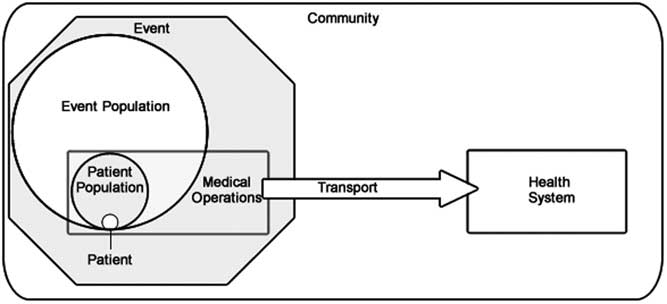
Mass-gathering health populations of interest are part of larger systems. Research in the MGH field has tended to focus on “macro” elements separately, including: type of event, event population, patient population, medical operations, and to a lesser extent, community setting and local health infrastructure. Figure 1 depicts the macro elements as a whole, in relation to each other. In this report, the authors initially present three population-related variables drawn from this model then examine how selected characteristics and relationships between these variables may influence their definition and use in MGH research.
Mass Gathering Health Research System.

Process/Methods
The development of the population model was undertaken using a 2-pronged approach. The first stage involved a review and critique of existing definitions and descriptions of MGs in published literature. The team attempted to describe the populations involved in, or affected by, MGs of various sizes and forms. Mass gatherings from small, medium, and large local events, through to international mega-events and compound events, were considered in turn. When it became apparent that published definitions lack sufficient depth to support researchers and clinicians in defining, describing, and explaining MGH effects, the need to build on existing work became evident and the second stage of the process, formulating a population model, was undertaken.
Taking existing definitions as a starting point, the team employed a consensus approach to delineate the population groups affected, or potentially affected, by MGs, thus formulating the model described below. Through face-to-face group meetings and structured breakout sessions in Adelaide, and subsequent asynchronous collaboration as well as virtual meetings, a conceptual model was developed in an iterative fashion and presented graphically, capturing both academically- and operationally-relevant divisions in MG populations.
Findings and Interpretation
The results of the iterative process are presented below in four sections. First, a proposed MGH Population Model is presented as applied in local contexts. Second, global considerations are explored in more detail. Third, analyses of selected characteristics (or facets) of MG events and populations are described over a time axis. Finally, an analysis of some initial applications, and related metrics arising from the model, is given.
Elements of a Local Population Model for MGH
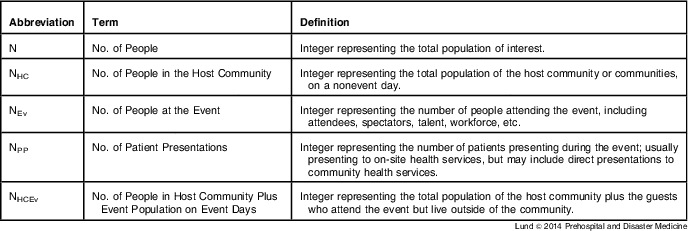
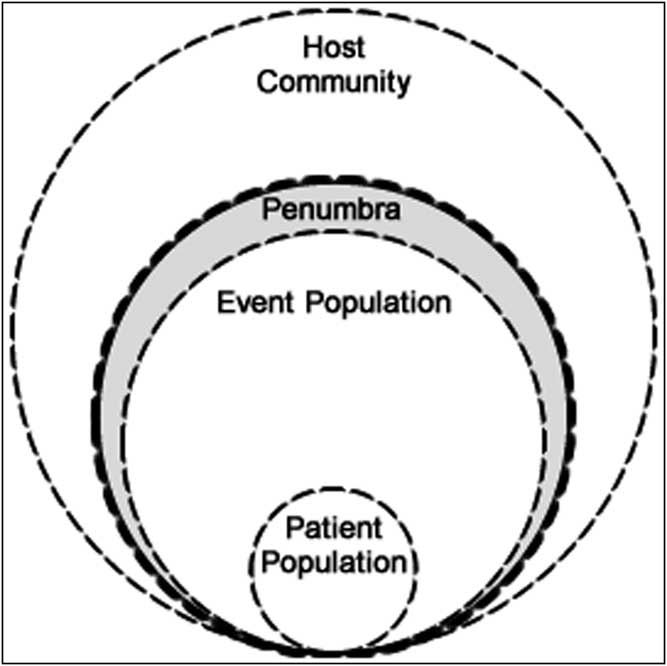
The starting point for developing a basic population model consists of three “nested” variables: (1) the number of people in the host community (NHC); (2) the number of people attending the event (NEV); and (3) the number of patients who present to medical care (NPP; Table 1). Figure 2 presents a basic, graphic representation of the relationships between these terms and variables.
Abbreviation and Definition of Terms for the Mass-gathering Health Population Model

Populations of Interest at a Mass Gathering Event

These three variables form an important part of MGH research. Though each appears self-evident, there are a number of factors that researchers should consider in defining and analyzing the variables that they will use in specific MG studies. Each population in Figure 2 exists in relation to the others. Specifically, researchers should attend to the nesting of the populations, the boundaries between the populations, and the shifting nature of those boundaries. The circles in Figure 2 are “nested” to emphasize that the total population of the community during a MG event. This event contains a set of sub-populations (ie, those attending the event), and sub-sub-populations (ie, those attending who present with a health-related issue). The boundaries in the figure are represented as hatched lines, indicating porosity, fluctuation, and expandability. During MGs, populations are in flux and “boundaries shift;” people may move in and out of the community before, during, and after the event, which will affect the denominator in most population descriptions.
The population of the host community at baseline (ie, nonevent time), or NHC, is represented by a proportionately large circle. However, NHC will often increase during event dates. In cases where this increase is significant, an additional variable, NHCEv, may be useful to indicate the value of the host community's base population plus the guests who attend the event but live outside of the community. Depending on the size of the host community and the scope of the event, the total size of the community on an event day may increase fractionally, or may double, triple, or increase even further the size of the total population during an event. In the latter case, the NEv may in fact be greater than the NHC. For example, there is a popular music festival in Western Canada that takes place in a local town with a population of roughly 1,200 people. During the 2008 festival, the more than 40,000 attendees taxed local infrastructure to the extent that the festival was cancelled the following year. 8
The population attending the event, NEv, is represented by the middle circle, and includes participants, attendees, spectators, staff, volunteers, and others. Note that the event population will commonly be composed of a combination of members from the host community as well as visitors from outside of the host community who are drawn to the area by the event. Therefore, some population of NHC may migrate into NEv.
Another sub-population is represented in Figure 2 by the penumbra, or fringe. This concept acknowledges the population not directly involved in the event, but attracted to, or affected by, the event due to proximity (ie, just outside of the event boundaries). These may include crowds that gather outside of event boundaries (ie, nonticket holders, fans, and protesters), or members of the host community whose baseline health services are affected by event-related service interruptions. Although not easy to measure, this population requires consideration in event planning, particularly with regard to security measures and the possible need to deploy members of the on-site medical team beyond the borders of a given event.
Patient presentations, or NPP, are represented by the innermost circle. This captures members of the event population who present for a health encounter, whether related to health promotion, illness prevention, self-treatment, infectious disease, illness, or injury. In some cases, patients may come from the fringe or the host community. Clarity will be required with regard to how these encounters are counted and reported. Patients may present to on-site care teams, to health resources outside of the event in the host community, or may delay seeking care until they can access health services in their home community.
Global/Complex MGH Population Models
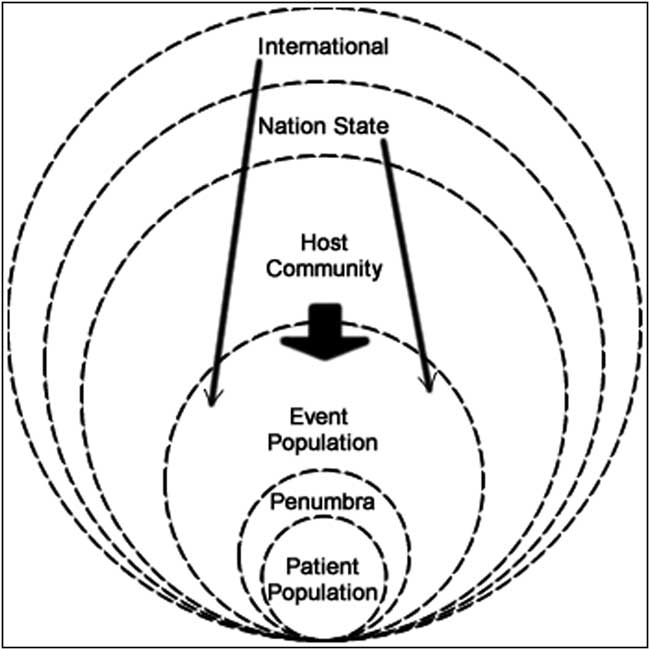
The WHO perspective on MGH requires a broad view of MG populations, including consideration of the international and global contexts. For example, at what point do events acquire international significance? How might risks related to the transmission of infectious diseases, hazards related to the environment and geography of an event, or security risks inherent in an event such as the Olympic Games be captured in population models? An expanded population model would therefore be of value (Figure 3).
Nested Geographic Communities

The addition of the two outer rings is intended to remind the viewer of multiple perspectives on larger, internationally-relevant MGs. Depending on where one's responsibility lies, different considerations may be relevant. For example:
-
• from a health/medical operations perspective, the primary focus may be on health infrastructure, of the event and in the host community, to ensure the safety of all event participants;
-
• from a host community/health authority perspective, the impact of the event population and the ability to maintain a baseline health-service capacity for the surrounding community may be of highest relevance;
-
• from the perspective of the nation-state, considerations like transportation, security, and border control may be the most important; and
-
• from an international perspective, global-health and infectious-disease vectors may be primary considerations, as well as health security, including obligations under the International Health Regulations.
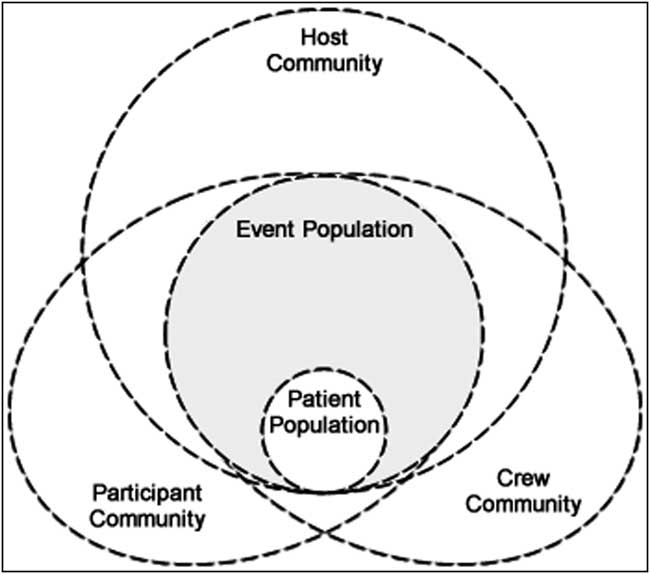
The graphic representation of the basic Population Model (Figure 2) implies that the event population is drawn from the local host community. However, MG events can involve regional, national, and even international participants and attendees. In the global context, the host community population from which the event population is drawn must be carefully described, and may even have to be considered as multiple communities representing the different groups from which attendees are drawn. For example, the event population in a large marathon may include predominantly local spectators, but call upon event staff from national organizations and include significant participation from national and international athletes. Alternatively, from a functional perspective, the event population (NEV) may form from the intersection of the host community, participant community, and crew community (Figure 4).
Overlapping Functional Communities

Mass-gathering researchers and medical services providers commonly report NEV and NPP to assess risk, anticipate patient presentations, and predict resource needs. Increasingly, impact on the host community (NHC) is reported in the literature as an important variable in planning. 9 - Reference Heiby, Barnhardt, Berry, Welcher and Brady 15 Researchers must be aware, however, that even simple population models can be influenced by a number of characteristics and relationships between these variables. Thus, researchers must clearly identify their choice and definitions of population variables and articulate the rationale for these decisions.
Factors to Consider in Modeling MGH Populations Over Time
As previously discussed, populations are not static over time. Operationally, there are relevant times, or phases, when populations are predictably in flux, including: pre-event, during event, and post event. As argued by Zielioski and Pawlak, an important aspect of understanding risk vis a vis events depends on analyzing population movement and the contact between population groups (eg, exposure of host population to the guest population and exposure of guests to hosts).Reference Zielioski and Pawlak 16 The authors of the current report propose that the population needs to be modeled for each separate phase of an event in order to capture the fluctuations of the model as the events unfold (Table 2).
Domains and Discussion of Event Phase in Mass-gathering Health Population Modeling

Population Metrics for MGH Research
The population model described above, and the variables included in the model, can be used to study a number of aspects of MG events. The following discussion explores issues that MG researchers should consider in using the population variables within their calculations.
Determining the Patient Presentation Rate (PPR)
The PPR, expressed as the rate of patient presentations per 1,000 attendees, is a calculation central to MGH research.Reference Arbon, Bridgewater and Smith 17 The PPR is generally expressed by the formula: PPR = NPP/NEV x 1,000. Two values are necessary to determine the PPR: (1) the number of patients (NPP); and (2) the number of attendees at the event (NE V ). This conceives the PPR of an event as a holistic value useful in determining the overall risk for an event and in planning medical coverage.
The PPR is a useful calculation for both researchers and clinicians, however, in the current form, the concept fails to capture peaks or surges in patient flow. This is of particular importance for clinicians providing medical care during an event. For example, during a marathon, the absolute number of patient encounters may not be high, but if the majority of patients present over a 90-minute period, this will affect staffing requirements for the event. Therefore, the authors propose that, in addition to calculating the PPR as an aggregated value for an entire event (or series of events), calculating the PPR/hour may also be useful. This will require that medical teams have the ability to document the time of arrival and discharge for individual patients.
Determining the Population of Patient Presentations (NPP)
Much of the MG medicine literature presents case reports and analysis of medical services at MGs and, thus, the number of patient presentations (NPP) are usually expressed in terms of the number of patients who present to the medical facilities at an event. However, delineating the patient population may be complicated by factors such as whether or not to include encounters related to “self-treatment” (eg, receiving a band aid or female hygiene products) or “dispensary” requests (eg, acetaminophen), and whether/how to “count” patients with event-related complaints who seek medical treatment off site (eg, patients who present at local emergency departments, walk-in clinics, and pharmacies).
In addition, researchers must consider the effects of temporality and geography on populations attending and supporting MGs. For example, researchers looking at MGs from a public health perspective may study patient populations for a longer period of time (eg, days and weeks after the events), as is the case in infectious-disease outbreaks. In the case of infectious disease, due to international travel, the population of interest may extend far beyond the population of the host community, crossing international boundaries. Researchers are encouraged to indicate clearly how these considerations are either incorporated into their study or why they were excluded. Excluding some patient presentations will underestimate the total health burden of a MG.
Determining the Event Population (NEV)
Defining the event population (NEv) is integral to determining PPR. This value may also be used in classifying the size or potential risks of an MG event. In its simplest terms, the event population consists of the attendees to a MG event. Depending on the type of event, the event population may consist of spectators (most MG events), participants (athletic and/or cultural events), and/or crew (broadly conceived as those volunteers, contractors, media, and workers who are involved in staging and supporting the event). Researchers should ensure that their definitions of the NEV address the inclusion or exclusion of these groups.
Determining consistent numbers for NEv is challenging. For example, at a music festival, the media may report ticket sales as a proxy for event attendees, which fails to include those who are provided complimentary access by promoters. Gate numbers may be reported as a proxy for the total population, however, at events with “in-and-out” privileges, or variable attractions through the day, the actual number of persons on site may vary (ie, maximum number during headliner attraction, but fewer earlier in day).
Defining the Host Community (NHC)
The host community is most commonly thought of in relation to the geographic or municipal jurisdiction in which the MG event is held. The variable NHC captures the size of the host community, or in the case of a multi-jurisdictional event, such as a marathon, host communities.
Understanding and defining the size of the host community is most valuable in evaluating the risks and resources associated with hosting a particular event. If an event will temporarily quadruple the number of people in a given community, this will create a burden for local infrastructure in relation to health services, policing, firefighting, traffic management, and other services. Challenges arise in accurately determining the size of the host community. The availability of current population statistics may vary. Determining the boundaries of the host community may require that a range be used (eg, for an event held in an urban setting, should the population include the entire city or just population in the section of the city through which the event will pass). Specifically reporting both numbers, or providing a detailed range, would promote consistency and allow researchers to compare patient populations and PPRs across events.
Limitations
The population model presented in this report results from discussions by the international collaborative group. This report aims to elicit further discussion and developmental input from other experts working in the MGH field. The models have not yet been tested prospectively in a real-world setting.
Conclusions
The objective of the team assembled in Australia in 2013 was to initiate a consensus process to develop an internationally-accepted minimum dataset for use in MGH research. The present lack of agreement on the definitions and classification of MGs makes this work challenging. This report proposes a population model with definitions and conceptual categories underlying MGH research and operational health planning for MGs. Clarity in definitions and descriptions of host community, event, and patient populations in the context of MGs will permit consistent description and reporting in the international literature. Importantly, it will also permit a better understanding of injury and illness presentations and clarify the health service impacts on the various populations of interest. Operational planning for emergency response, health promotion, injury and illness prevention, and surveillance will be measurable against more precisely-defined populations.
Research in Context
Literature Review
The writing team consisted of an international-collaborative group with substantial experience with clinical, research, and policy development in the context of MGs. Review of the literature and addressing gaps in theory building identified in published reviews of the literature prompted the consensus process.
Interpretation
This manuscript puts forward theory-building concepts and models that may stimulate further discussion and consensus building amongst MG researchers in the international community.
Acknowledgements
The authors would like to acknowledge: Dr. Greg Anderson, PhD, Dean, Office of Applied Research, Justice Institute of British Columbia, New Westminster, BC, Canada; Dr. Katherine Arbuthnott, WHO and Public Health England; and Dr. Mark Salter, Public Health England.
Authors’ Contributions
Paul Arbon participated in the discussions of the population model at the Flinders University meeting and on team conference calls discussing the model and the publication; he also commented on the various drafts of the document. Ron Bowles contributed significantly to the theoretical model, and, in conjunction with the principle author, expanded the paper into two parts in order to clarify the population of events vs the populations of people affected by MGs. Dr. Bowles also contributed the formatted figures to the submitted version of the manuscript. Alison Hutton contributed to the initial draft of this paper; she was also part of the panel that gave feedback to the initial diagram concepts for this paper. Adam Lund was the principle author on this paper; Dr. Lund created the initial drafts and the diagram concepts and overviewed the team process in bringing the paper to completion, including final submission of all document elements to the journal. Jamie Ranse contributed to the development of the population model at the Flinders University meeting and on team conference calls; he also contributed to the initial draft of this paper. Malinda Steenkamp participated in discussions of the population model at the Flinders University meeting and on team conference calls discussing the model and the publication; she commented on the various drafts of the document. Sheila Turris cowrote this paper with the principle author; she was also a member of the panel that created the original drafts of the figures and tables.