Drinking water as the trigger factor for the new supply system
If the major hydraulic infrastructures of the ancient Roman cities mainly provided water for fountains and thermae, those of the European cities, from about the year 1000, had a very different purpose. The Rec Comtal channel, which was built near Barcelona in the middle of the eleventh century to supply the city with water from the Besòs River, is a case in point. It was originally designed to drive the count of Barcelona's watermills. With the passing of time, however, it was also used to irrigate the fields where part of the city's food supply was produced, and many industrial establishments arose along its banks. It may thus be said to have been a purely productive facility. People obtained water for drinking and other domestic uses from wells tapping groundwater sources. It was only in the fourteenth century that the foundations were laid for a drinking water supply system based on qanat-like filtration galleriesFootnote 1 with distribution through a system of ducts and fountains, although well water continued to be used intensively for many different purposes.
Due to population growth within the city walls and the fact that the latrine pits in the courtyards of the houses usually stood near the wells, the cleanliness of the water supply steadily declined, as may clearly be seen from documents dating from the late eighteenth century. Nevertheless, this lack of cleanliness was no obstacle to the intensive use of groundwater. Indeed, the expansion of cotton mills in the eighteenth century and the introduction of new industries based on steam engines in the nineteenth century were based mainly on well water, and this dependence endured until the advent of the deindustrialization process in the 1970s. Consequently, even though Barcelona's ‘water transition’ forms part of a set of processes commonly called the ‘Industrial Revolution’, the driving force behind the changes was not the industrial imperative but rather that of the domestic sphere.Footnote 2
As previously stated, the first drinking water supply system in Barcelona dated from the Middle Ages, having been built to supply the city's public fountains in the mid-fourteenth century.Footnote 3 This medieval system collected filtration gallery water on the slopes of the Collserola mountains about four kilometres from the city. The system was gradually expanded, with an increase in the number of filtration galleries to a total of seven by the end of the eighteenth century. From these filtration galleries, water flowed by gravity through channels and converged at a castellum aquae or water tank called Caseta de Jesús, standing 700 metres from the city wall at a height of 23 metres above sea level. From that point on, the water supply to the city was pressurized, since it was distributed by means of secondary ‘delivery tanks’ placed on top of pillars to the various public drinking fountains, to some medical, political and religious institutions, and to a few wealthy homes.Footnote 4
The system's upkeep, for which the fountain master (mestre de les fonts) was responsible, was quite costly. Likewise, supply shortages often arose due to droughts, the collapse of filtration galleries, breakage of pipes, lime deposits or transport losses. Petitions filed by notable citizens to obtain municipal domestic drinking water were dependent on the applicant's personal merits and were only granted in exceptional cases, under usufruct and as a gratuitous distinction, even if the beneficiary paid the high cost of running the pipes to his home. Only in 1791, in response to the steady increase in such petitions, did these concessions begin to be granted for a fee of 100 doblons per ploma (2.2 m3/day) to defray the cost of upkeep and enlargement of filtration galleries and piping.Footnote 5 Thus ceasing to be a privilege, the water supply came to depend solely on the applicant's financial means.
Despite the growth of public needs and private demand, however, Barcelona's water supply system was greatly limited both by municipal budgets and the assignment of water to the Crown Property. Finally, in 1824, Barcelona City Council obtained a concession of 2,200 plomes (4,840 m3/day) from the king. Part of this water (1,700 plomes) was devoted to the city's public fountains, whereas the other 500 plomes (1,100 m3/day) could be sold to private persons with a view to raising funds to build the duct that was to cross a distance of over 10 kilometres from the Montcada filtration gallery. Indeed, the new aqueduct was financed through the direct sale of plomes costing 150 duros each. This hefty price, however, covered but a small part of the overall cost. An average of 400 to 500 duros had to be added to the cost of the works required to carry water to each house.Footnote 6 Sales got off to a good start, but in 1836 only 370.5 plomes had been sold from among the 500 granted.Footnote 7 This was a very modest amount of water compared to what was supplied to public fountains, which were the main means of providing people with drinking water. Nevertheless, these sales entailed a substantial increase in private water consumption, making it necessary to carry out an extensive renewal of the whole distribution system, with the building of new ducts and new secondary delivery tanks.Footnote 8
The data provided in 1859 by Ildefons Cerdà (1815–76) show that, of the 1,435 plomes (3,057 m3/day) reaching the city, 1,400 plomes (3,080 m3/day) came from the Montcada filtration gallery.Footnote 9 This means that, of the 146 plomes from the various traditional filtration galleries of the Collserola mountains, 115 plomes were supplied to Barcelona's neighbouring municipalities, such as Sant Gervasi and Gràcia, which had grown considerably in that period, or else they were used to sprinkle the elegant new avenue called Passeig de Gràcia. These were all places that, due to their height, could not be supplied by the new aqueduct.
All the data from 1859 show that, even though the water supply network had grown and the part devoted to domestic use had increased, technically speaking the facility was not very different from the system that had existed in Barcelona during ancient Roman times.
The Eixample district: from a public water supply to private undertakings
The system supplying water to Barcelona's Eixample or expansion district, which began to be built in 1859 according to a project by Ildefons Cerdà (1815–76), was the trigger factor for the ‘water transition’.Footnote 10 The goal was to provide a sufficient supply of water and above all to deal with the fundamental technical issue: the necessary elevation of the water storage source to serve the projected new urban development. The height of the Caseta de Jesús delivery tank, which established the supply height for the distribution of the Montcada water, was considerably lower than the most select areas of the Eixample district.
The consumption forecasts differed substantially. In December 1857, the fountain master Josep Fontserè (1829–97) considered that 14 litres per person per day would suffice, which was less than the amount supplied by the Collserola and Montcada filtration galleries (17 litres per person per day).Footnote 11 Cerdà, for his part, considered this amount to be totally insufficient. He argued that ‘the foremost hygienists’ stated that the minimum required for drinking and other domestic uses was an average of 40.33 litres/day for each inhabitant. He added that Madrid was carrying out works to bring in water from a distance of 70 kilometres to provide 942 litres per person per day.Footnote 12 Valencia, which had depended on well water until only a few years earlier, already had 100 litres of drinking water per person per day thanks to the completion of a project by the engineer Calixto Santacruz. Paris, which had 120 litres per person per day, was carrying out a set of very costly works. New York and Glasgow had over 90 litres per person per day, and London over 68. According to Cerdà's calculations, Barcelona had the meagre amount of 28.63 litres per person per day, making up for this shortage with well water.Footnote 13
The essential point, however, was the Montcada water's elevation. In 1859, the fountain master had proposed the installation of a steam pump on the Caseta de Jesús ‘to lift 2,500 m3 of water from the Montcada filtration gallery to a height of 23 metres every 24 hours’,Footnote 14 but this project was never carried out, and the first expansion of the Eixample district was based primarily on well water. The passivity of local authorities favoured the appearance of private enterprises devoted to supplying the Eixample with water. Indeed, the first effective supply measures in the Eixample district stemmed from real estate interests, leading the company called Sociedad de Crédito y Fomento de Barcelona to build the Torre de les Aigües, or Water Tower, in the Eixample's first expansion area, according to a project from 1867. This facility drew water from a well, raising it by means of a steam engine. Likewise, a company called Compañía de Aguas de Barcelona was organized in Liège in 1867. This company, with Belgian and French capital, purchased an enterprise in serious financial difficulties that had started to collect and channel groundwater from the Dosrius municipality, located 30 kilometres from Barcelona. By 1873, it had a network in operation that served 262 customers in Gràcia, 38 in Sant Gervasi and 129 in Barcelona, who were supplied by a tank standing at a height of 93 metres above sea level.Footnote 15
In 1870, Barcelona City Council appeared to be taking the initiative. Information was gathered in order to draw up a general plan for the renewal of the municipal network. It was proposed that water ducting projects should compete to increase the supplied flow, and in 1879 three catchment pits with steam engines went into operation near Montcada. Legal impediments and claims, however, and an archaic distribution network with leaks and very little pressure, minimized the effect of the new wells. A general pipe plan for ducting the municipality's water, which was signed in April 1880, envisaged a large tank in the upper part of the Eixample district, equipped with a steam engine for raising the water that arrived along a branch of the Montcada aqueduct.Footnote 16 This system was to provide the network with a pressure that made its complete renewal necessary. The old ceramic pipes had to be substituted with new ones and the old secondary delivery tanks had to be replaced with trickle-feed cocks but, since this project was never carried out, the old system was maintained for a long time afterwards.Footnote 17 The most surprising thing, however, is that between 1874 and 1881 the city council preferred to build the elevation system and cistern for the ornamental waterfall in Ciutadella Park, which was merely an urban embellishment, instead of modernizing Barcelona's water supply network. In this way, the city council tacitly left the door open to the proliferation of private enterprises, which came to face tough competition and growing shortages of capital. Although the Compañía de Aguas de Barcelona was the most solid among these firms, it also ran into difficulties due to the volume of investments called for by the competition. For this reason, it reached an agreement with the Société Lyonnaise des Eaux in 1881 to obtain the necessary financial resources, founding the Sociedad General de Aguas de Barcelona (SGAB). Thereafter, the various companies in the market gradually fell under the influence of this new and stronger enterprise.Footnote 18 The SGAB went about strengthening and increasing its customer base and extended the installed network. The most ambitious companies were the last to enter the sphere of the Sociedad General de Aguas de Barcelona, but in 1888 the Compañía General Anónima de Aguas de Barcelona declared itself bankrupt and was acquired in 1895 by the SGAB, which went on to sign a private contract for the purchase of the Empresa de Aguas del Alto Vallés in 1896. Also in that year, the SGAB acquired the effective control of the Empresa Concesionaria de Aguas Subterráneas del Río Llobregat, its foremost competitor. Although this company had stood out for its fast pace of growth and had followed an effective strategy by collecting the groundwater of the Llobregat River, which turned out to be a wise decision, it had been treading a precarious financial path.Footnote 19 Since Aguas de Montcada, which was owned by the municipality and was the only other company left in the field, was in no way a threat, the SGAB came to exert a de facto domination of all the private enterprises and established its own strategy without regard to the competition. The overall set of catchments rose from 15,000 cubic metres in 1890 to 81,000 in 1910, and the elevation system was completed in 1905, culminating in the Tibidabo Water Tower, which stood 541 metres above sea level and assured the supply of water to every point of Barcelona, whatever its height might be.
The sanitation problem and the necessary increase in water consumption
Another key issue in addition to the water supply was the construction of the sanitation network. With the expansion of the population in the eighteenth and early nineteenth centuries, the height of the old houses and the number of their inhabitants had grown, without any improvement to their latrine pits. The kitchens of the apartments usually had a window looking out onto the courtyard right over the well, which was accessed by means of a pulley. The latrine pits were also usually located in the courtyard, allowing the removal of excreta from the toilets on all the floors and the ventilation of these facilities. Consequently, cesspits stood dangerously near the clean-water wells and pollution from filtrations was almost inevitable. The nuisance caused by latrines and cesspits affected domestic as well as public space. In the private sphere, they were a focus of infection and foul smells that could fill the courtyard, the stairway and the interior of the houses. The extraction of the latrine pits also affected the public space. From the standpoint of foul odours, the fetid emanations produced by the emptying of these pits and the transport of excreta, in carts along the streets, were not only quite unpleasant but also a highly worrying source of contagion. To empty the pits, permission was required from the city's head of public works and the hours for the performance of this task were strictly limited to before six o'clock in the morning in the summer and before seven o'clock in the morning in the winter.
As in other European cities, many solutions were proposed for assuring the success of the operation. The hygienist physician Pere Felip Monlau (1808–71) explained the advantages of mobile latrines.Footnote 20 Ildefons Cerdà placed his trust in technical advances beyond the traditional method based on ‘pails and pumps emptied into barrels on carts’ and made a review of the innovations that had been proposed.Footnote 21 Many of them must have appeared ideal for avoiding miasmatic contagion, but they had no perceptible effect in Barcelona, or were not considered appropriate, as all other cities had abandoned these innovative proposals by the close of the century.
Ildefons Cerdà found the sewer network to be in a deplorable condition. In 1859, the municipal services made a complete inspection of all the cobbled pavements and sewers in Barcelona's streets. Although 90 per cent of the streets had sewers, only 57 per cent of these were in good condition. In the working-class district of La Barceloneta, standing at a negligible height above sea level, 81 per cent of the streets lacked sewers.Footnote 22 Despite criticisms and studies aimed at improvement, the renewal of the sewer system was not included in the project approved for the Eixample district. Ildefons Cerdà never considered emptying faecal waters directly into the sewer system either. Excreta were looked upon as necessary agricultural fertilizer and, moreover, the Great Stink of London in 1858 had shown the drawbacks of emptying faecal water into the sewer network, so for sanitary, financial and technical reasons it did not appear to be advisable to apply this method. Indeed, neither did the major transformations taking place in Paris at that time under the direction of Baron Haussmann and the engineer Belgrand, with an unprecedented investment in infrastructures, adopt the continuous cycle or tout-à-l'égout model that had been applied in London.
Accordingly, the first houses built in the Eixample continued to situate a clean-water well and a latrine pit in the same courtyard, as may be seen in the drawings of the building permits. In the 1870s and early 1880s, which were marked by a vigorous expansion of the city and the Eixample in particular, sanitation patterns did not change substantially. With the passage of time, the aggravation of hygiene problems and the experience of other cities led to a reconsideration of the situation, and in August 1884 a special commission was formed. Presided over by the mayor and with five regular members, plus two civil engineers, two industrial engineers, two architects and a physician, the purpose of this commission was to find a suitable solution to the sanitation problem. Its studies appeared in a Preliminary Opinion published in 1886, which presented a broad range of international experiences, offering a highly documented digest of this transitional period all over Europe.Footnote 23 To begin with, it proposed a continuous circulation solution which had been initially tested in London and had eventually been adopted by many other cities of different dimensions and circumstances, ranging from smaller English towns to major European cities such as Brussels, Berlin, Vienna, Danzig, Hamburg and Frankfurt. The Preliminary Opinion also mentioned many other cities where different systems had been adopted, such as mobile pits in Manchester, Rochdale, Nice, Heidelberg, Nuremberg, Augsburg, Grätz, Bremen and Groningen, or fixed pits in Sheffield, Lyon, Reggio, Padua, Como, Imola, Brescia, Pisa and Lucca. Many cities had implemented a pneumatic cleaning system for fixed pits, such as Dresden, Stuttgart, Mainz, Strasbourg, Karlsruhe and Hannover. In Amsterdam, Leiden and Dordrecht, the Liernur process had been undergoing tests since 1878.Footnote 24 Most of these systems had proved inefficient or very costly, so the Preliminary Opinion advocated complete continuous circulation as the best solution.
It also stated that it was advisable jointly to design the new sewer systems of the principal municipalities of the Plain of Barcelona, pointing out that many problems were likely to arise if the aggregation of these towns to Barcelona city was not settled first. Likewise, within the walled precinct of Barcelona's Old Town, the construction of the new sewer system was inseparably linked to the performance of the Interior Reform based on Àngel Baixeras’ contemporaneous project. Lastly, the new sanitation system required a much greater supply of water for both public and private services. It was not a coincidence that in 1891 the green light was given to a project for the elevation of the Montcada water to supply an aqueduct at greater heights, assuring a municipal supply that would meet the growing sewer requirements. This concern was also clearly reflected in the ordinances, which were approved in that year, envisaging continuous circulation while only authorizing fixed pits (which were to be completely impermeable) in houses and streets without sewers. Drain couplings were to be equipped with hydraulic sealing siphons to cut off all connection between sewers and the interior of the buildings. The ordinances also regulated toilets, which were to be equipped with a siphon or flush system. There was likewise a notable increase in the planned water supply, which ‘will be prudently based on an average of 250 litres per day, for each independent inhabitable room in a house’. This was less than what the Preliminary Opinion considered optimum (between 200 and 500 litres per person per day), but it was much more than the 14 litres per person per day that Fontserè had considered sufficient in 1857, and even more than what was proposed by Ildefons Cerdà (40 litres per person per day). Continuous circulation called for a high level of water consumption.
The sanitation project, which was confined to the narrower limits of the municipality of Barcelona itself before the aggregation of the neighbouring towns in 1897, was given to the engineer Pere Garcia Fària (1858–1927), a member of the commission that had drafted the Preliminary Opinion.Footnote 25 This project, approved in 1891, represented a major technical updating but it was never implemented, like Baixeras’ Interior Reform project. The renewal of the sewer system only began in 1902 and only then on an urgent basis, after the aggregation of municipalities to the city of Barcelona in 1897. On 10 March, the architect in charge of the city council's roads and ducts department, Jaume Gustà Bondia (1853–1932), was appointed to head an office entrusted exclusively with the sewer project.Footnote 26 The project's progress between 1902 and 1914 is well documented in Barcelona's Statistical Yearbooks. As opposed to what was proposed in Garcia Fària's plan, Gustà Bondia's project preserved the main sewers in the layout of the Eixample and the Old Town, confining itself to the renewal and expansion of the necessary parts. The system drained directly into the sea, obviating agricultural uses or purification.
Failure of municipal initiatives and consolidation of the SGAB's monopoly
As mentioned above, at the end of the nineteenth century the municipal company Aguas de Montcada planned to build the High Aqueduct, which was to raise the Montcada water to a height of 147 metres from the Trinitat stations to the Vallcarca area. This would allow the company to provide good service at an appropriate pressure for the most highly urbanized part of the Plain of Barcelona and to compete with the biggest company, the SGAB, by reducing the price of water. Indeed, this was the only way to stimulate the consumption that the new sanitation system required. Although the project was started in 1891, problems arose constantly and work progressed at a slow pace. The duct's layout led to a series of lawsuits, vaults collapsed on several occasions and the project proved costly. It also gave rise to a number of scandals and criticisms involving municipal inefficiency and corruption. Despite difficulties, however, the High Aqueduct was almost completed by 1910 although it would not come into operation without a significant increase in the water supply. To this end, in 1896 a competition took place for proposals on collecting and channelling water to Barcelona. None of the proposals submitted went beyond the project phase, and in 1899 the deadline for the submission of new proposals was extended. In 1903, it was finally decided to duct water from the Ter River, at a distance of 139 kilometres from Barcelona, but a series of circumstances foiled this project. A new competition was announced in 1910 and ended with serious suspicions of corruption and a political conflict that reached the parliament. A new commission was then formed which issued a well-founded opinion, showing that the problem resided not so much in a supply shortage as in the resistance to an increase in consumption patterns. It may be noted that the cost of the water supply was usually borne by the tenement house owners, who avoided metering contracts in favour of trickle-feed agreements assuring a minimum flow for the inhabitants of the houses while preventing increased consumption. In May 1911, yet another competition was announced, but the proposals were not convincing in this case either, and the commission was in no hurry to purchase new flows.Footnote 27
During the same period, Barcelona City Council considered the acquisition of the SGAB on different occasions. Several European cities were opting for municipalization and Barcelona City Council, which was working on a treasury contract with Banco Hispano Colonial, appeared to have sufficient leeway and the will to carry out a comprehensive restructuring in order to convince the SGAB of the need to hold discussions,Footnote 28 although the difficulties in reaching an agreement and party confrontations made this very complicated. Early in August 1914, the possibilities of municipalization seemed few, but two circumstances combined to change radically that state of affairs. On the one hand, the start of World War I obliged the SGAB, a French company, to abandon all negotiations, and on the other hand, in September a severe typhoid epidemic broke out that left the city council in a critical condition.Footnote 29
At first, the general public largely blamed the SGAB for the epidemic, although it was finally proven that the municipal water from Montcada had been infected by filtrations. Barcelona City Council was slow to react and did not cut off the service until 21 November. The sources of the Montcada water, which was the most highly esteemed in the city, had to be sealed off or sterilized, and the SGAB had to set up some provisional sources to replace them. As a result, between 1914 and 1920 the distribution system of the Montcada was completely renewed. It was decided to use a pumping station and a tank that had been built for the first elevation of the High Aqueduct, which had never gone into operation. The new facility did without the old network of clay ducts and asphalted sheet metal pipes and the obsolete system of distributors, using reinforced cement ducts placed in the gallery of the old aqueduct. Although the new facility was based on a modern network of cast iron pipes with sufficient pressure to supply all floors of houses, it served the same consumption points and the hasty modernization process was not accompanied by an increased water supply, so the renewal of the municipal supply did not threaten the SGAB's progressive expansion.Footnote 30
However, the economic situation in post-war France and the laws enacted on the repatriation of capital allowed a local bank group to acquire the SGAB in June 1920. Under these new circumstances, municipalization was reconsidered but once again it all ended in failure. Despite the complexity of the period, the 1920s marked the full consolidation of the SGAB. In December 1929, in reply to a statement issued by Barcelona City Council that insisted on the need to endow the city with abundant and appropriately potable water and to ensure that housing tenants did not have to pay high prices for it, the SGAB stated that it had been supplying an average daily flow of 150,000 cubic metres which, added to the water from other companies, made a total of 200,000 cubic metres, equal to a consumption of 200 litres per inhabitant per day. In addition, the SGAB repeated the proposal made in 1926, undertaking to provide a supplementary flow of up to 100,000 cubic metres a day, which would bring the total to be consumed to 300 litres per person per day. In this way, the city council could be sure that the volume of available water was sufficient at the close of the 1920s.Footnote 31
Water's slow entry into the domestic sphere
As mentioned at the beginning of this article, Barcelona's real transition to a modern water system began with the increase in domestic consumption. Water was late in entering the domestic sphere in the city in comparison to the situation in Great Britain and the United States. The local conditions were more similar to those of France, where the cultural dimension of the process has received special attention.Footnote 32 This crucial change will now be addressed, which began among the well-to-do classes around 1900 and the early years of the century, although it did not become widespread until the 1960s.
The rediscovery of bathing in the nineteenth century was mainly for therapeutic purposes, and baths were usually taken in public bath-houses. According to the Guía general de Barcelona (General Guide to Barcelona) by Saurí and Matas dating from 1849, ‘For some years now these establishments have been increasing in number due to people's special fondness for bathing as a way of obtaining many health benefits. In all these establishments, great care is taken to provide good service to customers, offering cleanliness, comfort and elegance, particularly in the summer season when they are used the most.’ In some cases, bath tubs were taken ‘to the homes of both patients and persons who particularly enjoy taking baths for recreation, both at night and by day: a store of bath tubs of all kinds is available for general baths, sit-baths, foot-baths and even arm-baths – which may be taken in full comfort while lying in bed’. There were also ‘many tinsmiths who, for a daily fee, provide portable bath tubs, and people who rent them have them filled with precisely the type of water that patients require to cure their ills’.Footnote 33
The possession of one's own bath tub was rare until the end of the nineteenth century: water reached few homes and when it did, it was not abundant and had to be used sparingly. The most common practice was to wash oneself with a sponge, basins and pails. The catalogues of the department store Grandes Almacenes El Siglo, dating from around 1900, indicate a great variety of portable utensils for sale: wash basins, pitchers and cabinet-work bidets in the furniture department, and metal utensils, which were the most numerous and economical, in the cooking utensils section, including bath tubs, pails, pitchers, showers and portable bidets.
The sale of fixed sanitary appliances for connection to the water network in those years allows a comparison of prices and a verification of the fact that they were only accessible to small segments of the population in the most affluent classes. For example, portable wash basins cost between 4 and 10 pesetas at Grandes Almacenes El Siglo while, in the catalogue of the department store Casa Verdaguer, a complete fixed wash stand cost over 100 pesetas. A tube-type pail, depending on its diameter, cost 12 to 16 pesetas. Portable bath tubs cost about 50 pesetas and could also be rented. Fixed wash stands cost between 200 and 300 pesetas, but some cost more than 600 pesetas. The comfortable use of a bath tub called for new gas heaters, which cost between 70 and 330 pesetas. At El Siglo, there were portable bath heaters for 15 pesetas. The price of a toilet was also considerable: about 100 pesetas. If the installation expenses and the greater water consumption that these facilities entailed are added to these prices, it is obvious that all these objects were still very exclusive.
All told, although the new water distribution system, the new sanitation system and the spread of new hygienic practices transformed everyday life in the space of a few short years, at first they affected only a very small proportion of the population. Likewise, despite the large sustained growth in consumption and in the number of the SGAB's customers, the pertinent figures are quite moderate in relation to the population's growth.
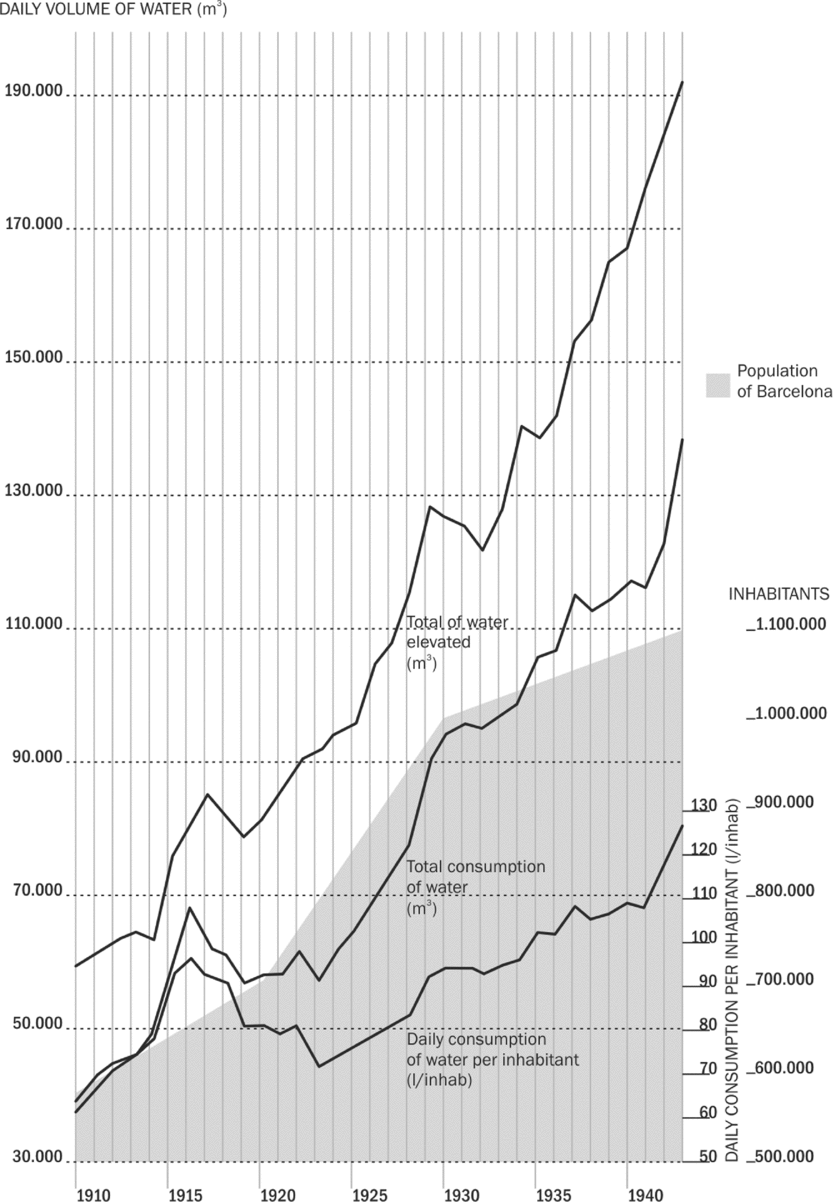
If the water distribution curve registered by the SGAB between 1910 and 1945 (Figure 1) is examined, a sustained increase of consumption may be observed, with an anomalous peak between 1914 and 1920 due to the substitution of the Montcada water supply following the typhoid epidemic of 1914.Footnote 34 Later, the rise in consumption grew more moderate, coinciding with the big wave of immigration in the period between the wars, with a rise in population from 600,000 inhabitants in 1914 to over 1,000,000 in 1930, so the increase in water consumption remained clearly below that of the population. Consequently, while the more favoured strata of society improved their facilities and grew accustomed to the new level of consumption, an ever larger part of the population was left out. Since most of the technical networks belonged to private companies, well-to-do consumers were favoured in order to assure returns on the big investments, and only the most centrally located and most affluent areas were served. For this reason, technical networks tended to enhance the gaps between the city's various districts in a period that was characterized by a large increase in social segregation and in the segregation of urban space.Footnote 35
Study of the water demand's probable increase in the company network up to the year 2000 and the plan for meeting itSource: L. Soucheiron Bataller, Estudio del incremento probable de la demanda de agua en la red de la sociedad hasta el año 2000 y plan para afrontarlo, typewritten, 1945 (Fundación AGBAR Fonds, file cabinet 2).

However, neither the working-class sectors nor the districts inhabited by the working classes were uniform in structure. The most depressed sectors of Barcelona's Old Town received the majority of immigrants and became more populous, proletarian and degraded. Living conditions there were dreadful, as is shown by many documents compiled in the 1930s, especially in the area then known as ‘Barrio Chino’. Dr Lluís Claramunt, the director of the Municipal Institute of Hygiene, considered unhealthiness to be inherent in the structure of the houses there:
the rooms are not isolated by hydraulic seals from the sewers or the tanks of excreta and wastewater. Indeed, in many houses the toilet is located in the kitchen, while in others it opens on to the kitchen, without one or the other being connected in any way to the exterior, which causes them to always be dark and smelly while making cleanliness purely illusory, especially in the Barrio Chino, because the water – in the houses where it is installed – is usually insufficient for the family's needs and the location of the waste tanks – which are poorly covered and dirty – is incorrect. In houses where water is not installed, people either obtain it from wells dug in a putrid subsoil or they have to fetch it at a public fountain, so they save water in all possible ways. These deficiencies in the quality and quantity of water translate into a lack of cleanliness of the skin, clothing and food, assuring the continuity of serious illnesses and especially enteritis, which runs rampant in almost all the houses in that district and in many streets of District 5.Footnote 36
Generally speaking, the attempts to improve facilities and to increase consumption for health reasons ran up against the resistance of tenement house owners, because it was not easy to pass on the cost of improvements to poor working-class people. The economic straits of the times also prevented the spread of water meters, as opposed to what was provided in the Municipal Health Regulations approved by Royal Decree in 1925. Despite the modest increase in water meters, trickle-feed contracts persisted and, since they covered entire tenement houses where the water was included in the rent, these contracts served to limit consumption severely. Consequently, in poorer sectors of the population, traditional consumption patterns and old private facilities were long maintained. Some urban areas were clearly excluded from the new services, above all in the peripheral working-class districts that arose in the 1920s and 1930s, where there was a very low level of urban development and very limited access to technical networks.
The difficulties faced by broad sectors of the population in gaining access to the new service were clearly visible in their enduring reliance on public fountains, wash-houses and bath-houses. In the period immediately following the Spanish Civil War, it is significant that the SGAB – after recovering ownership of the company, which had been collectivized during the war – financed the foundation of Baños Populares S.A. (popular baths company), as a philanthropic initiative, opening its third bathing establishment by 1943.Footnote 37
From post-war restrictions to widespread water consumption
The consumption of water per inhabitant doubled between 1910 and 1943 (Figure 1).Footnote 38 In the period immediately subsequent to the Spanish Civil War, this increase showed signs of enduring. However, the disastrous autarchic economic policy of the Franco regime, the rapid rise in immigration and the so-called ‘prolonged drought’ between 1945 and 1953 put the water supply system to the test. Between 1945 and 1948, the SGAB denied on several occasions in the press that there were any water restrictions and attributed the supply problems to electric power outages. Even so, in March 1949 it admitted that despite all its efforts it had been unable to avoid the restrictions, announcing immediate measures aimed at solving the supply problems. Later, beginning in May 1953, it imposed supply restrictions again during 30 per cent of the service hours.Footnote 39 Even under such a carefully controlled regime as Franco's, this long water supply crisis and the unpopular restriction periods led to political reactions. An editorial in La Vanguardia of 29 May 1953 criticized the private management of the water supply.Footnote 40 The press ran news on the authorities’ responses to a problem that affected everyday life so directly in such a difficult period. In this critical atmosphere, measures were taken to deal with the problem of the city's water supply, which until then had depended exclusively on the collection of groundwater from filtration galleries and wells. The rapid growth of the city and its metropolitan area made it necessary to assure the supply through the catchment of surface water. This measure was a project promoted by the SGAB, proposing the collection of surface water from the Llobregat River as the first step towards the integral utilization of this river's resources. The second measure, proposed by the Hydrographic Confederation of the Eastern Pyrenees (which had been advocated from the start by Barcelona City Council), was the transfer of the Ter River's water. This initiative was launched by decree in April 1950, ordering the Hydrographic Confederation of the Eastern Pyrenees to carry out a study of the system required to assure Barcelona of a water supply of 150 to 250 litres a day per inhabitant, and proposing that water should be collected from the Sau reservoir, which was then under construction in the Ter River basin. These two options had different promoters and initially appeared to stand at odds with one another, but it was finally understood that rather than being mutually exclusive strategies they were in fact complementary.Footnote 41
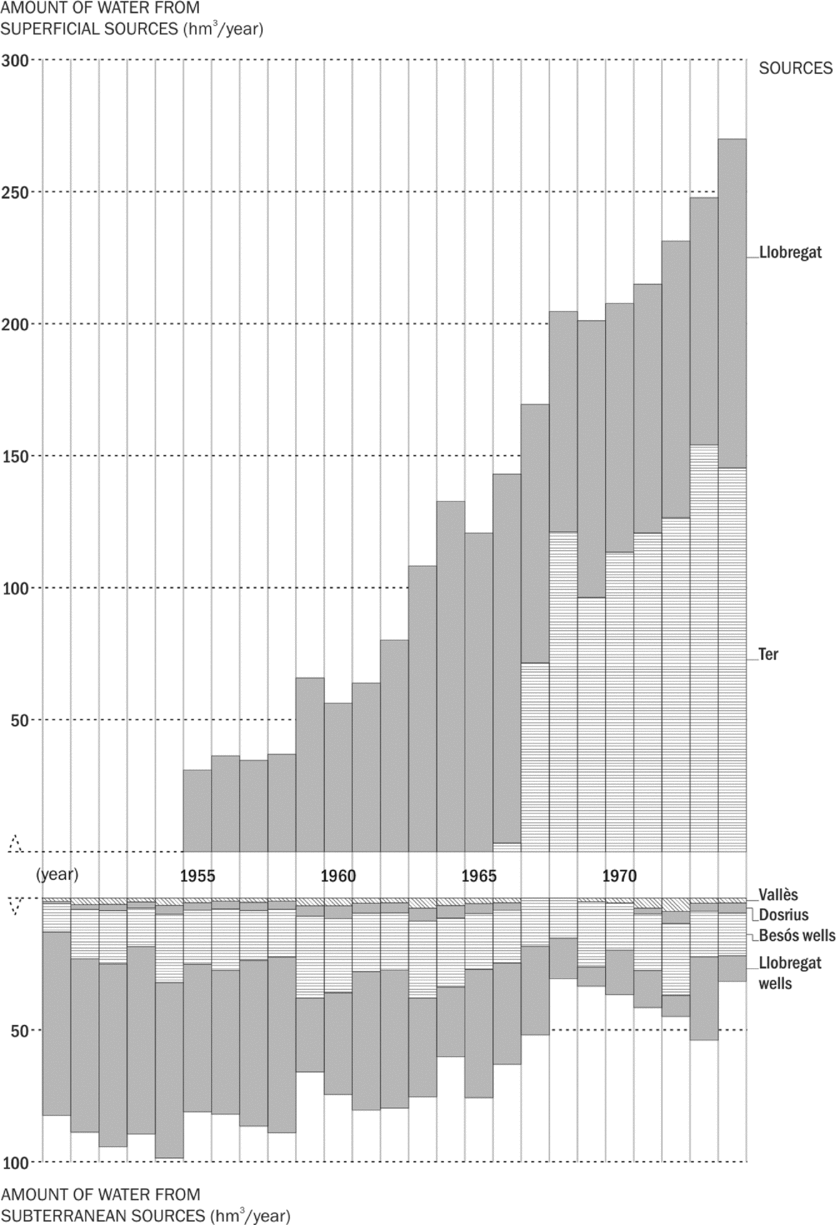
A quick look at the graph on the provenance of Barcelona's water supply in the period 1950–74 shows the great effect of the surface water collections from the Llobregat and Ter Rivers on the increase of Barcelona's water supply, since they progressively replaced the groundwater flows (Figure 2).Footnote 42 Between 1955 and 1965, the catchment of water from the Llobregat River solved Barcelona's immediate needs. The water from the Ter River arrived in 1966 in a token amount but in 1967 this supply became substantial, exceeding that of the Llobregat River. From this moment on, there was a widespread entry of water in sufficient amounts into all aspects of the domestic sphere and the new practices that had begun to appear 80 years earlier reached most social strata. The disappearance of the last public bath-houses and wash-houses in the 1970s marked the end of the transition.
Graph of the provenance of Barcelona's water supply, 1950–74 Source: Prepared by the authors from historical data of the SGAB and Aguas del Besós, 1975 (Fundación AGBAR).
Conclusion
The modernization process in general and the modernization of the water supply systems in particular were subject to a diversity of factors, following different paths in different places. The case of Barcelona presents some interesting elements to consider since it represents the lengthy process of transition to a modern water system in a big southern European city. Indeed, it sheds light on significant differences with respect to many cities in northern Europe and on the importance of some highly diverse contextual factors. Despite the fact that Barcelona was the first and most dynamic industrial centre in the Iberian Peninsula, it should be noted that the impetus for the transition did not stem from the industrial demand but rather from the domestic consumption derived from the city's new expansion within the framework of the Eixample project approved in 1859.Footnote 43
Although the supply of drinking water for public fountains had been a municipal prerogative since the fourteenth century, the city government showed itself to be incapable of meeting the new demand and did not solve the problem of the elevation required to assure an efficient water supply to the new Eixample district then under construction. As in most of the Spanish cities, in contrast to Madrid where the national government's investment was decisive, Barcelona's scant municipal budgets favoured the proliferation of private initiatives, and it was private enterprise that supplied water to the tall buildings in the Eixample district. The SGAB, which was founded with Belgian and French capital in 1867, was one of the most solid financial and technological companies in this field, achieving a de facto monopoly towards the close of the nineteenth century in the wake of a rapid corporate restructuring process.
During this period, urban growth ensured the necessity of dealing with the issue of sanitation in continental Europe, which adopted the continuous circulation system that needed a substantial rise in water consumption through an increase of supply and the lowering of rates.Footnote 44 In most European countries and the United States, the municipalization of public services was advocated and established during this period. Nevertheless, this trend had little effect on Spanish cities, which had always been limited by their scant financial capacity and by their narrow scope of action.Footnote 45 Barcelona City Council tried to update and expand the municipal water supply and in the early twentieth century it sought to municipalize the SGAB, but both these initiatives were complete failures.
The updating of the sanitation system in the opening decades of the twentieth century coincided with the spread of new hygienic practices in the domestic sphere. The impact of the water supply system was limited at first by its high cost to small privileged segments of society. Indeed, despite the overall growth of consumption in the first half of the twentieth century, the system spread very slowly to the different social strata in a period of strong demographic growth, intense immigration and crisis – a period marked by the Spanish Civil War between the years 1936 and 1939. The exclusion of large segments of society and complete urban districts, precarious facilities, extremely limited consumption patterns and the dependence on public fountains and wash-houses were characteristic of these times. The depression that followed the Civil War was especially harsh, entailing severe water supply problems. Indeed, the imposed restrictions produced a great malaise that called for a vigorous political response. Two measures were taken in parallel. The SGAB undertook the catchment of surface water from the Llobregat River in 1955, while the Spanish Ministry of Public Works, supported by Barcelona City Council, promoted the catchment of the surface water from the Ter River, which was farther away but of better quality, reaching Barcelona in 1967.Footnote 46 The disappearance of the last public bath-houses and wash-houses in the 1970s marked the end of this long cycle of transition and the start of a new period, which is still in place today. Paradoxically, it is a cycle characterized by a decrease in consumption that is ‘mainly driven by lesser water intensity of the local economy, a halt in population growth and the emergence of a new sustainable water culture in Catalan society’.Footnote 47