Soon after he was consecrated bishop in 963, Æthelwold of Winchester (909–84) began to promulgate a series of new rules for worship and religious life in the monasteries of England. In one passage that is well known to theatre historians, Æthelwold insisted on the following performance of the Easter morning liturgy.
While the third lesson is being read aloud, four of the brothers should dress themselves. One of them, wearing an alb, should come in as though intent on other business and go stealthily to the place of the sepulchre, and there he should sit quietly…. The three remaining brothers … should make their way slowly and haltingly, coming before the place of the sepulchre as if they are seeking something. For these things are done in imitation of the angel seated on the tomb and of the women coming with perfumes to anoint the body of Jesus. When, therefore, the one sitting there sees the three drawing near, who are still wandering about as though seeking something, he should begin to sing sweetly, in a moderate voice: “Whom do you seek?”Footnote 1
Together with a similar text included in a companion liturgical book, this description of the Quem quæritis trope is supposedly the earliest instance of medieval drama—which hitherto (we have been told) had barely existed and, when it did, took the form of ceremonies even more static, staid, boring, and colorless than the one outlined here.Footnote 2
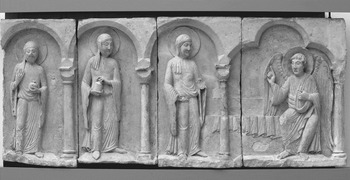
I argue the opposite. Æthelwold's effort to regulate the decorous and pious conduct of performers is likely to be a reaction against more lively treatments of a familiar episode—so familiar that he didn't bother to script it fully.Footnote 3 It is not the beginning of a performance practice; it is an attempt to put an end to one. Like most legislation, Æthelwold’s “Concordance of Rules” responded to perceived abuses, and like most legislation, it was not successful in eradicating them. Quite the contrary: the few anecdotal accounts of liturgical drama in performance that have come down to us suggest that it could so excite actors and audiences that lives were threatened—as when a boy, striving to get a better view of a Resurrection play performed in an English churchyard, fell out of a tree,Footnote 4 or when “an extremely well-produced play of the prophets” enthusiastically mounted before the semiconverted inhabitants of Riga presented so realistic a battle scene that spectators fled in terror.Footnote 5 As John Blair, a historian of Anglo-Saxon England, has put it: “To generalize from the highly colored and polemical texts inspired by Saint Æthelwold, the sternest and most uncompromising of the reformers, distorts the picture” of what actually happened, and kept on happening.Footnote 6 The annual “Visit to the Sepulchre” enacted in churches large and small throughout Europe was a solemnity, but that doesn't mean it was solemn. A relief sculpture from the diocese of Cologne depicts the arrival of the Marys at the tomb as it would have depicted an enactment of this scene, and it suggests that performers would have registered (and elicited) a variety of responses, not all of which would have won the approval of a reforming bishop (Fig. 1). For in most churches, including this one, the Marys were played by men whose execution of their roles might not always have conformed to Æthelwold's hushed, emasculated model.Footnote 7
The Visitatio sepulchri as represented in a limestone relief from the diocese of Cologne, ca. 1130–40. In older photographs, damage to the face of the figure on the far left appeared to suggest that this Mary was bearded. While this cannot be proven, this scene certainly references the embodied performance of a sacred event, featuring bodies that may not have appeared graceful or feminine to contemporary viewers. Photo courtesy of the Rheinisches Landesmuseum, Bonn.

But Æthelwold did succeed in reaching one audience apt to take his rules seriously: modern scholars of medieval drama. To quote Blair again, “A lasting consequence of reform polemic has been to make the Anglo-Saxon Church seem more uniform, hierarchical, and centralized than it ever really was.”Footnote 8 Duped by such powerful polemic and by the self-proclaimed authority of certain manuscript witnesses, most narratives of theatre history assume that only carefully scripted, pious performances were allowed to occur during the Middle Ages. Supposedly, the medieval theatrical archive consists entirely of records like this and medieval theatricality did not exist prior to the making of such records or reach much beyond them.Footnote 9 Even many of those scholars now engaged in meticulous archival research have consistently resisted calls to account for the fact that medieval texts—of all kinds—were created, kept, and used for purposes that do not necessarily match those scholars’ expectations (and desires), purposes that are further obscured by these texts’ extraction from their material and performative contexts.Footnote 10 “Unless we thoroughly scrutinize these fundamental and far-reaching issues relating to the evidence we use and the tools and methods of its accumulation and identification, we risk producing a puerile, superficial, and ultimately useless scholarship,” said one contributor to a state-of-the art summary of theatre history in 1989.Footnote 11 Yet the “quest for dramatic evidence” has largely remained just that: a quest for what dramatically announces itself as ancillary to drama, or a quest for “what we would call plays” that are conceived explicitly as scripts for performance and that function as such scripts are supposed to do.Footnote 12 “When is a text a play?” asked one scholar of medieval English drama. Answer: “When the writer says it is”Footnote 13—a response that makes no distinction among the actual writer (the scribe), the patron or community for whom s/he worked, the playwright or performer whose entertainment was being subjected to a textual working over, or the copyist(s) or compositors who may have “patched” a play together from a number of disparate elements. Well into the seventeenth century, as Tiffany Stern has shown, “each separate document that made up a play has its own story, its own attachment to other documents, its own rate of loss and survival,” so that some still “have not been seen for what they are” and some have only just been revealed to have existed at all. She also calls attention to the fact that not all the written and unwritten elements that might once have come together in a first performance of a play would continue to inform subsequent performances, thus invalidating any generalizations about performance that proceed from published playscripts.Footnote 14 Andrew Gurr puts it this way: “I would say that almost no play texts survive from Shakespearean time in a form that represents with much precision what was actually staged.”Footnote 15
As I will demonstrate here, the very precision of some medieval texts should in fact make us skeptical about their relationship to “what was actually staged.” At the same time, the close scrutiny of those texts might help us to access unwritten evidence that such texts were designed to curtail. Nor is this type of analysis applicable only to medieval texts. Studies inflected by performance theory and cultural anthropology offer numerous parallels.Footnote 16 Indeed, the “premodern” performance of my title could justifiably be expanded to “not modern,” meaning equally postmodern, non-Western, or indigenous: it refers to any place or time ungoverned by the narrow expectations of a self-proclaimed modernity, when “the ancient relationship between doing and script was inverted,” in the words of Richard Schechner.Footnote 17 Current debates about the constitution of “the archive” are directly relevant here, since performance studies embrace not only “what's in books, photographs, the archaeological record, historical remains, etc.” but “what people do in the activity of their doing it.”Footnote 18
Take, for example, the challenge at the heart of any attempt to locate, recover, represent, and interpret the contributions of African Americans to the history of literature. As Sandra L. Richards notes, often what is most “ ‘authentic’ ” about these contributions is not “literary,” either because a given contribution is not textualized or because it falls short in someone's subjective judgment: it will not, therefore, be taken seriously. Richards's solution is to “write the absent potential into criticism” by “offer[ing] informed accounts of the latent intertexts likely to be produced in performance.”Footnote 19 She models this through two short case studies. The first considers Zora Neale Hurston's Color Struck (1925), a play that was neither fully scripted nor ever staged—yet it provides vital evidence for contemporary theatrical practices and expectations while illuminating the play's historical, social, and cultural milieu. By contrast, August Wilson's Ma Rainey's Black Bottom (1982) appears “quite ‘present’ on the page” and has therefore been regarded as a bona fide literary artifact, exhibiting little of the “theatrical shorthand” Hurston used.Footnote 20 But when one “must account for bodies in space” and in actual performance, one is struck by “the textual incompleteness that drama shamelessly displays,” even (or especially) when it seems so fully realized.Footnote 21 Thus Richards argues that the scantiness of Ma's scripted role—when compared to its enormous significance within the world of the play—demands performative action that is actually downplayed in Wilson's literary text and yet should inform our reading of it. The same applies to the texts that medievalists have labeled plays, as well as to many other texts that have not been recognized as having been shaped or created by performance.
The Quem quæritis embedded in the Regularis Concordia is not a neutral artifact; it did not make itself. It was made by a monastic scribe working for Bishop Æthelwold, a historical actor who had an agenda that was made explicit in the packaging of that rulebook and that can be corroborated through careful attention to historical context. Texts, Jody Enders has boldly reminded us, are products of human agency and therefore compel us to discover what actions they were intended to describe, provoke, or constrain.Footnote 22 Given that notions of “performativity” invite a “willingness to credit a performative dimension in all ritual, ceremonial, [and] scripted behaviors,”Footnote 23 we can begin by noting that what is being performed in this script, first and foremost, is Æthelwold's power to call it into being and to promulgate it in this format, within a didactic and quasi-juridical document. The question that must inform the way we look at this and all other accounts of premodern performance is therefore an essential one. What is the relationship between what was written down and what was really going on? And in answer to it, we need to read the evidence in a different way, one that pays full attention to the processes by which any artifact came into being. Rather than seeing this as the fons et origo of medieval drama, we will be getting closer to the truth if we recognize that this representation of the Quem quæritis liturgy resulted from an attempt to control, to censor, to proscribe existing practices, modalities, and behaviors. Premodern scripts are much more likely to function in this way than they are to offer careful prescriptions of what was supposed to occur or faithful transcriptions of what did.Footnote 24 So we need to scrutinize not just the records of performance in order to gain information about theatre's history, but also the probable modes and methods of record making and record keeping. And we need to revise our understanding of what people meant to do or did based on this reassessment. We may also need to revise, radically, the history of theatre, in which the Middle Ages has hitherto played a very marginal role.
• • •
Most ancient and medieval documents were produced for different reasons and functioned in very different ways than documents do today. This was particularly so in the crucial centuries after the turn of the millennium, which witnessed what Michael Clanchy has called a shift “from memory to written record”Footnote 25—a shift in many ways analogous to what was perceived as revolutionary in Greece during the fifth century b.c. Indeed, it is helpful to draw on the findings of classicists and biblical scholars who have been grappling, since the publication of Albert B. Lord's The Singer of Tales, with the impact of literacy on ancient oral societies.Footnote 26 For example, Gregory Nagy's study of the redaction of the Homeric canon (which he has compared to the transcribing and anthologizing of medieval troubadour lyrics) distinguishes among three different types of text and their relationship to performance practice: the transcript that records a past performance and possibly aids in its future reconstruction (the majority of all premodern texts); the script that precedes performance but still leaves room for improvisation (a few premodern texts and some modern texts); and the scripture that precludes or proscribes performance (some premodern texts and the majority of all modern texts).Footnote 27 These categories are equally applicable to the complex relationship between writing and speaking—or acting—that prevailed in Europe until at least the sixteenth century and that continues to prevail in some places today. Yet ingrained habits make it difficult for us to think in this way. As Eric Havelock observed with reference to the relatively well-documented culture of Athens, “Greek drama has been written about from differing critical standpoints … but all presupposing that here is an art form which is autonomous, called into existence solely by the creative energies of its authors,” who must (it was thought) have been responsible for its inscription. These impressions are misleading, as he goes on to show: performance in general, and drama in particular, came to be seen as a set of practices to be conveyed primarily in writing after the heyday of Athenian theatre had passed. Only then did drama become a species of “literature” best appreciated as such.Footnote 28 The scripts on which we rely for our knowledge of performance practices—whether in classical Athens or medieval Europe—are consequently far removed from the conditions of performance. And they become further removed when they are carefully “corrected,” annotated, and otherwise brought to heel by later generations more reliant on literacy. On the one hand, we can point to the librarians and editors of Alexandria in the second century b.c.e., on the other to the bibliophiles and philologists of modern Europe. In both cases, we see the process whereby texts become tamers.Footnote 29
Performance, then, has been perennially forced to subordinate itself to more permanent media if it is to survive. And according to Aristotle's Poetics, itself the powerful product of an age when literacy began to trump orality, those aspects of performance that are most important and most ephemeral—the lilt of a voice, the eloquent gesture, the comic turn—are actually required to remain silent. Recounting the history of dramatic endeavor, the philosopher noted that “tragedy's phases of development, and those responsible for them, have been remembered; but comedy's early history was forgotten because no serious interest was taken in it.”Footnote 30 This “lost” history of comedy can be construed as a metaphor for the occlusion of the oral (or the visual, or other sensory stimuli) by the written, because what matters most about comedy has always been largely dependent on improvisation, the seizure of a fleeting moment. Humor is notoriously resistant to academic abstraction, which may explain why Aristotle's promised treatment of comedy was either never written or doesn't survive. And tellingly, he goes on to advise the prospective tragedian against the recording of anything but carefully scripted speech; although ironically, as one scholar recently observed, “assumptions of orality” constantly “dictate [Aristotle's] own written practice.”Footnote 31 For example, Aristotle declares that “while spectacle is emotionally potent, it falls quite outside the art [of tragedy] and is not integral to poetry”: it therefore should not be an aspect of performance scripted by the playwright but should be left to costumers and their ilk. He even goes so far as to claim that “tragedy's capacity is independent of performance and actors” altogether, and can be enjoyed more fully if privately enacted in the reader's mind than if (imperfectly, humanly) staged.Footnote 32 These views are reminiscent of Æthelwold's rules for proper liturgical conduct as well as of the process by which the plays of Shakespeare came to be classed as muted texts, the vehicles by which most people since the eighteenth century have been exposed to them.
We cannot know whether Aristotle's prejudices against certain performance practices—and, by extension, the preservation and transmission of this information—were universally shared in his own time, but it is chilling to think of their probable effects on the Alexandrian scholars who were responsible for selecting and preserving the canon of Greek drama. These scholars appear to have limited that canon ruthlessly to plays that met very stringent requirements, so that the examples of “bad” tragedies cited by Aristotle are known to us from those damning citations alone.Footnote 33 In the modern era, just as damagingly, neo-Aristotelian notions of literary genre—indeed, the very notion of what the medievalist Paul Zumthor insisted on calling “literature” (in quotation marks)—have imposed impossible limitations on premodern texts, wrenching them from their social, cultural, and manuscript contexts while at the same time denying their performative possibilities.Footnote 34 The written word thus becomes “delusory,” as Gurr puts it, threatening to drain entertainments of the very qualities that makes them entertaining.Footnote 35
Yet Hamlet's amateurish advice to the professional players at Elsinore to “let those that play your clowns speak no more than is set down for them” (Hamlet, act 3, scene 2) represents an attempt at authorial control that will (as Shakespeare himself knew from experience) inevitably prove futile, since those actors were supposed to “diverge from the text.”Footnote 36 Scripts are always subject to improvisational enlargement or, conversely, to abbreviation or excision at the hands of actors or playhouse managers. Gurr has argued, for example, that all the Choruses of Henry V were cut from the original production.Footnote 37 If so, this lends a new irony to Shakespeare's choric image of himself in the play's epilogue, where the efforts of the historian-playwright are contrasted with those of historical and dramatic actors:
Thus far, with rough and all-unable pen,
Our bending author hath pursu'd the story
In little room confining mighty men,
Mangling by starts the full course of their glory. (Henry V, act 5, scene 2)
In the theatre, both the playwright and the characters he creates are at the mercy of performers. But on the page, it is the performer's turn to be silenced.Footnote 38
Clearly, then, the relationship between what happens in performance and what happens when performance is captured in writing is not the problem of medievalists alone. But I submit that the evidence of the Middle Ages sheds light on this problem in a particularly important way, one that is useful to scholars of other eras and other dramatic traditions. This is especially true of the evidence produced in the era between (roughly) 1000 and 1300, when writing was just beginning to become a dominant technology for conveying information hitherto entrusted to oral communication and when the vernacular was beginning to challenge the hegemony of Latin. How might a direct engagement with the manuscripts from this era provide us with more information about how records of performance are made and why? What might they reveal about methods of scripting and silencing? And how might this evidence contribute to the methodologies and narratives of theatre history?
Although one might imagine that the surviving texts of medieval plays are artifacts very close to the moment of performance, they are even more likely than ancient and early modern playtexts to be proscriptive documents bearing little resemblance to actual praxis or descriptions of actual praxis made at a time when the livelihood of a given tradition was threatened. Moreover, they do not always take on forms familiar to modern eyes; that is, they do not look like plays.Footnote 39 Indeed, the vast majority of medieval performances—dramatic, musical, ritual, political, public—were never recorded at all. This is overwhelmingly the case when we consider the activities of entertainment professionals, who had a vested interest in keeping their material unscripted and flexible and who have left very few traces of that material in writing. Professional entertainers had to be ready to perform anywhere, at any time, for any audience. They prepared routines and gags, sketches and bits, tricks and acts, but they did not, for the most part, memorize texts. Their very livelihood depended on spontaneity; the scripted passing of the hat in the mid-fifteenth-century morality Mankind provides a belated glimpse of standard practices encased in parchment, a witness to what had worked in the unscripted past and might continue to work in the scripted future.Footnote 40 Most of the actors who performed such plays would not have used or made such texts, instead learning their craft by watching and listening as they traveled and worked singly or in couples, sometimes in larger groups.
Moreover, all professional performers in this era—whether monks, minstrels, kings, or public officials—relied only occasionally on the practice of writing. This explains why the earliest manuscripts of nearly all extant medieval plays (including sung Latin dramas), long postdate the performance traditions to which they sketchily refer.Footnote 41 Careful scripting or notation was the exception, not the rule. Scrutiny of the relationship between medieval texts and medieval performances should therefore begin with the premise that the text is the vestigial remains of enactments that were either being disciplined by the imposition of an official template or translated into a new medium. In other words, the advent of a text may indicate the invention of a literary genre, but it does not mark the origins of a performative one.Footnote 42 Indeed, there is often an inverse relationship between the clarity of a text and the immediacy of a living tradition—to the extent that the very scripts that have been frequently dismissed as dramatically impoverished, cryptic, or “unperformable” may actually be those closest to the moment of performance. They presuppose that performers are already familiar with the material or can expand on a bare minimum of information. The absence of stage directions or even character designations is not, then, an indication that medieval plays were wooden and lifeless or “not intended” for performance; the very opposite is true.
In what follows, I outline some of the distinguishing characteristics common to those manuscripts that have been deemed to preserve the texts of plays. But I want to stress, again, that these characteristics are shared by other records of medieval performance, which include the documentation of songs, sermons, stories, oaths, and legal testimony— a multitude of sources that replicate speech acts or attempt to take the place of those speech acts.
• • •
I. Even performance practices that were, at one time, recorded in writing are not apt to have survived. Manuscripts unprotected by the binding of a codex or by the covering of leather cases or wooden chests are extremely fragile. Those few medieval texts that were intended as aids to performance were designed to be portable and were therefore more regularly exposed to the elements, circulating in single sheets, booklets, or scrolls of parchment. The extraordinarily popular Latin comedy Pamphilus, which survives in an astonishing number of copies (some 170), actually gave us the term “pamphlet” because of the format in which it traveled. Given that the survival rate of such pamphlets is very low, one is invited to imagine that many, many more copies were once in circulation but did not outlive hard usage. Three of the seven surviving copies of the Latin comedy Babio, to take another example, seem to have seen long service in the schoolroom of Lincoln Cathedral and are so frail and tattered as a result that they were later bound together into a single codex for safekeeping—a codex to which even the most recent editor of the comedy was denied full access.Footnote 43 And the very same qualities that made these booklets or scrolls portable in the Middle Ages make them vulnerable to theft today. The oldest known actor's roll, once in the British Library, has been missing since 1971; the next oldest, long preserved in Switzerland, has also vanished.Footnote 44
In the early age of print, when the quantity of scripted plays available for our perusal certainly increases geometrically, we still have only a fraction of the plays that were replicated using this new medium. Moreover, many scripts were not printed at all: hence the plays by Shakespeare and his contemporaries that are known to have been composed but do not survive. Furthermore, the fact that hardly any of the other documents supporting the production of early modern plays have been preserved—the many thousands of plats, promptbooks, and actors’ rolls used in the theatres of London between 1576 and 1642, for example—is further proof that theatrical texts do not fare well in the hands of actors or the hands of time.Footnote 45 An unusually quantifiable sample of evidence from late-medieval France confirms this: of the fifty-two plays listed in the catalog of a bookseller in Tours at the end of the fifteenth century, only twenty have survived to this day; another twenty-one are not mentioned anywhere else, and the remaining eleven have been lost, although they are mentioned in various other sources. One can therefore estimate the survival rate of all late-medieval plays, including those in print, at 40 percent. But the percentage is much lower if we look at the manuscript record alone: nine of the twenty extant plays mentioned in the catalog survive only in printed copies. This means that a mere eleven of the fifty-two named plays have survived in singular manuscripts, suggesting that fewer than 20 percent of all late-medieval plays have come down to us.Footnote 46
What's more, these figures account only for plays from the very last century of the Middle Ages, when performance was more often supported by texts. In the earlier period, both the scripting and the transcription of medieval entertainments were rare practices; contemporary identification of discrete texts as “plays” was rarer still. How many of the plays performed in Europe, even in highly literate communities such as monasteries and cathedral schools, were supported by texts or helpfully identified as ludus, ordo, play, jeu, Spiel, or auto in extant manuscript books? We are told that Geoffrey de Gorron, abbot of St. Albans (fl. 1119–46), made his monastic profession after the vestments borrowed from that abbey for his play about Saint Katherine were burned in the fire that ravaged his rooms the night after the performance. Was that play written down somewhere, and was the text of it also destroyed? No mention is made of that in the abbey's chronicle—and if the play did exist in writing, in what language? (Latin? Anglo-Norman? Anglo-Saxon?) How did the boys who acted it learn their parts? Was it usual for “this sort of play, which we commonly called ‘a miracle,’” to take on a textual form, or was this a devised performance?Footnote 47 Would any group of students need a script to perform a story familiar to them from other sources? The chronicler takes it for granted that his audience will know the answers to these questions; the silence of the record on these points is the silence that envelops us, not the record's maker.
The mere fact that the overwhelming majority of all designated medieval plays exist only in single copies suggests that all are hovering on the edge of extinction. The Jeu de saint Nicolas of Jehan Bodel, composed in or just after 1191, would not exist at all were it not for the mysterious impulse that led to its inclusion in a manuscript dedicated to the work of Jehan's compatriot, Adam de la Halle, which was copied nearly a century later. And were it not for this remarkable codex, paid for by a patron whose identity cannot be established with certainty, Adam's Jeu de la feuillée would be known to us only in two abbreviated versions of the opening scene, preserved in two different miscellanies.Footnote 48 Furthermore, when the Jeu de saint Nicolas was transcribed after its author's death, a prologue was added to make it look more conventional.Footnote 49 Ascribed to a character called the Preacher, this prologue is clearly distrustful of the play qua performance piece and attempts to control its future reception by providing a misleading synopsis of the plot and assuring that everything will be performed “according to the script” (selonc lescrit, v. 61) while at the same time denigrating the spoken word in which the play will be voiced: “What's told here could be better said / Were we to find the saint's life read.”Footnote 50 The actor playing the Preacher thus embodies the very paradox presented in his prologue, which is poised between a culture in which performance itself is authoritative and one in which performances must be backed by a written bond. Like the Prologue of Shakespeare's Troilus and Cressida, he is “A prologue arm'd, but not in confidence / Of author's pen or actor's voice, but suited / In like conditions as our argument” (vv. 23–25), by which he means (as Stern has shown) a printed playbill reliably summarizing the plot.Footnote 51
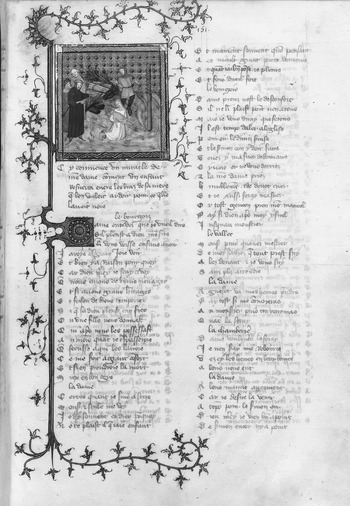
The very technologies that enable the recording of some performance practices are thus instrumental in eradicating or altering others. And because medieval performers were aware of this, they may have been increasingly reluctant to commit their performances to writing. The unscripted improvisations of the commedia dell'arte were a reaction against attempts at censorship, which means that we have no texts, and no expectation of texts, for these plays.Footnote 52 Most of the late-medieval plays of England and the civic passion plays of the Continent were transcribed in order to ensure that actors adhered to approved and orthodox scripts. These efforts to limit the power and purview of some entertainments have thus resulted in the making of the texts on which we rely for our study of the performances that such texts suppressed. The Miracles de Nostre Dame par personnages, a group of forty plays comprising a sizable portion of the fourteenth century's extant dramatic archive, are preserved in a deluxe presentation manuscript copied between 1382 and 1389, the very years when a series of royal edicts banned the confraternal assemblies for which these plays had been devised for nearly fifty years (Fig. 2). The texts that provided the exemplars, however, the oldest of which might have dated from 1339, no longer survive, whereas the plays themselves were dead letters by the time they were copied, since continuing royal strictures made their performance impossible.Footnote 53 In 1567, when the Creed pageant performed annually at York was beginning to raise anxieties about its religious orthodoxy under the new Protestant regime, the lord mayor and his council sought the advice of an expert before they ventured to include it in the repertoire. They were right to do so, as Matthew Hutton, dean of the York Minster cathedral, affirmed: “For thoghe it was plausible XL yeares agoe, & wold now also of the ignorant sort be well liked; yet now in this happie time of the Gospell, I knowe the learned will mislike it: and how the State will beare with it, I knowe not.” The script of this pageant, not surprisingly, is missing from the official register and is consequently unknown today.Footnote 54
“Here begins a miracle of Our Lady: how a child was revived in the arms of its mother”—one of forty plays preserved in a deluxe manuscript made between 1382 and 1389, after a royal edict prohibited their performance. The original texts do not survive. Paris, BnF, fr. 819, fol. 151. Photo courtesy of the Bibliothèque nationale de France, Paris.

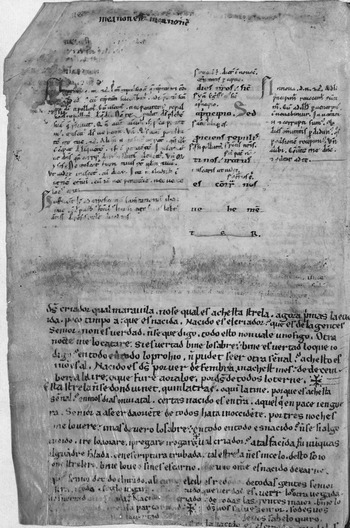
II. Many of the dramatic documents that do survive preserve only certain kinds of information, usually intended for those who are already familiar with the living tradition of performance. Footnote 55 Perhaps the best example of this is the Castilian Auto de los reyes magos from Toledo (Fig. 3). This is an Epiphany play, so the basic plot would have been familiar to most Christians. But it was an Epiphany play with a contemporary political message, using the journey and enlightenment of the Magi kings as a metaphor for the recent achievements of the “Reconquista.” Moreover, it was couched in the same local vernacular that would become a significant instrument of cultural and political authority in the course of the thirteenth century. It was jotted down, then—on parts of two scrappy, spare leaves in an older manuscript—because it was topical and was attempting to accomplish something new.Footnote 56 However, it was apparently assumed that future performers would need only the most minimal instruction; that is, they would need only to learn the words that were sung. So the words are all we have. There are no musical notations and no rubrics or didascaliæ of any kind: no character designations, no stage directions. The shift from one character's lines to another's is simply marked with a cross, while other markings indicate stage business or the processions central to Epiphany plays.
The Auto de los reyes magos is one of the oldest extant texts in the Castilian vernacular, and was inexpertly copied in the second decade of the thirteenth century onto two spare pages at the end of an older codex: Toledo, Biblioteca del Cabildo, Cax-6, 8, fols. 67v–68r. This image shows the first of these two pages. Note the crosses that indicate verses to be sung by different performers and the starred marking three lines from the bottom, which probably signals a change of scene by processional movement around the church. Photo courtesy of the Biblioteca Nacional de España, Madrid.

In general, scripts produced for performers “in the know” could afford to be sparsely presented, even careless. The dramas in the so-called Fleury Playbook, for example, prepared for a monastic community (possibly that of Saint-Benoît-sur-Loire), were copied in a slapdash, sloppy fashion. They are not differentiated from one another (a modern hand has gone through the manuscript and labeled them), and the lines of chant are frequently interrupted or obscured by didascaliæ. Either the task of copying these plays was not important enough to merit the attention of a good scribe or it was considered to be a perfunctory effort expended on plays that everyone in the community already knew.Footnote 57 Similarly, the so-called Sponsus of Saint-Martial in Limoges trusts that performers will understand what to do with the text. For one thing, it assumes that the monastic users of the manuscript will know where the sequence begins and ends. The “title” usually bestowed upon the play is actually the rubric designating the first chanted lines to be sung by the character of the Bridegroom; in fact, the performance probably began with a version of the venerable Quem quæritis trope, which is copied just above it on the page and is labeled “This is about the women” (‘Oc est de mulieribus). Similarly, the performance may have continued with the subsequent ordo prophetarum, which is not presented in the manuscript as a separate entity. In any case, it is clear that these confusing elements would not have been confusing to the performers for whom this text was made. Casual mistakes in the copying of rubrics suggest, further, that such information was secondary in importance to the music, since the conventions of staging were well known.Footnote 58
Most secular performers also did not rely on such niceties as character designations. The manuscripts of the thirteenth-century Courtois d'Arras, like those of all medieval fabliaux, assume that performers—working singly or in groups—would know how to apportion lines to different characters. The manuscript of the contemporary dialogue Le Garçon et l'aveugle, which may have been copied by one such performer, assumes the same. It makes distinctions only between spoken lines and songs; the character designations in the margins were added and changed by later readers, editors, and/or performers over the course of two or more centuries.Footnote 59 And even in the early modern theatre, as noted above, professionals were expected to extract the information they needed from the lines themselves.Footnote 60
III. Plays and other performance pieces are seldom identified explicitly as such. Most medieval texts assume that readers know what it is they have in front of them, often because the reader was also the scribe or the patron who had commissioned the copy for his or her own use. Those rare texts provided with obvious beginnings and endings (incipits and explicits) are apt to lose these features if the text is cut up or rebound or if the rubricator has been prevented from supplying them—as in the late thirteenth-century miscellany preserving one copy of Courtois, part of the Jeu de la feuillée, and Rutebeuf's Le Miracle de Théophile, which leaves spaces for rubricated incipits that were not, for the most part, added until the fifteenth century.Footnote 61 As I noted above, the Fleury plays carry no intitulation, although some begin with lengthy instructions on how to set the scene: “In order to represent the conversion of the blessed apostle Paul …” (Ad repraesentandum conversionem beati Pauli apostoli … ) or “In order to represent how Saint Nicholas freed the son of Getron from the hands of Marmorinus, king of the Agareni …” (Ad repraesentandum quomodo Sanctus Nicholaus Getronis filium, de manu Marmorini, regis Agarenorum, liberavit … ).Footnote 62 The so-called Ludus de Antichristo (Play about the Antichrist) from Tegernesee is not given that title in the manuscript. Neither does Suscitio Lazari (The raising of Lazarus) by Hilarius call itself a play, although it does stipulate that “these characters are necessary” for its performance: “the character of Lazarus, his two sisters, four Jews, Jesus Christ, and the twelve apostles, or six at least.”Footnote 63 (This inclusion of a roster of dramatis personae is highly unusual.) Examples could be multiplied. More noteworthy are those unusual plays that do self-identify, the most obvious example being the well-known Danielis ludus (Play of Daniel) from the cathedral of Beauvais, which calls attention to itself in performance and on the page.

Were it to be recopied by a careless scribe, losing its elaborate rubrics and the scaffolding of its music, future readers would still be able to tell what this text was, where it was composed and performed, and by whom. Most medieval plays do not provide such data, nor should we expect it of them. Rather, we should ask why the cathedral scholars of Beauvais chose to be so specific. Were they merely boastful? Or were they mindful of the difficulties inherent in conveying such information to posterity? Whatever their motives, the care taken in the preservation of this musical drama and its apparatus has facilitated performances down to our own day.
IV. Plays or other records of performance are rarely presented as different from other kinds of text and can take on the “protective coloring” of those texts. The casual appearance of the Auto de los reyes magos or the difficulty (for modern scholars) of determining where the so-called Sponsus begins and ends are cases in point. More fundamentally, it is important to note that oft-cited distinctions between liturgical drama and liturgy per se are not maintained by the books containing these elements. Even the Danielis ludus, so carefully delineated, is presented in its sole manuscript as part of the Office for the Feast of the Circumcision, which provided the occasion for its performance.Footnote 65 The Ludus de Antichristo is virtually indistinguishable from the Latin lyrics with which it is juxtaposed, save for the narrative prose stage directions (which have been underlined by a later hand). Not one of the four copies of the Courtois d'Arras is provided with character designations or stage directions, and not one is called a “play.” In fact, it is explicitly described as lai in one manuscript and is otherwise identical, in form and in function, to the hundreds of fabliaux and verse tales alongside which it was conveyed and with which it probably shared space in performance. The two copies of the Anglo-Norman Seinte Resureccion dress the play in two entirely different guises. In one case, it is laid out and rubricated like a scholarly treatise; in another, it has been stripped of its distinguishing features in order to conform to the layout of a very different manuscript.
In fact, the likelihood that a fancy dramatic apparatus would be the first thing abandoned by a copyist lacking time, skill, or resources explains why Le Miracle de Théophile, Courtois, most fabliaux, and nearly all Latin comedies contain narrative material in verse: it was a type of insurance policy, preserving basic information for readers within the fabric of the piece.Footnote 66 This is probably the reason why the Seinte Resureccion, like the Danielis ludus, carries its title and most instructions for its performance (actual or imagined) in the verse itself.
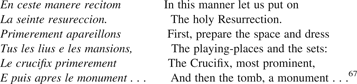
The famous Ordo representacionis Adæ (known as the Jeu d'Adam, Play of Adam) is also a textual chameleon, changing its layout over the course of several folios as its scribe experimented with different ways of handling spoken vernacular dialogue within the context of what was, in other respects, a sung Latin drama.Footnote 68
V. Records of performance are likely to lose—or acquire—distinguishing features in the copying process, rendering them more or less visible. This is the flip side of the characteristic just discussed. Did the Norwich manuscript of the Seinte Resureccion acquire a dramatic apparatus or did the Canterbury copy lose one? And if the copy laid out “as a play” had not survived, would the other copy have been identified by subsequent scholars “as a play”? Not that there is one way of transcribing or inscribing a play: that is the point. As noted above, an analysis of the scribal strategies at work in the so-called Jeu d'Adam show that this text acquired a dramatic-looking layout as the scribe experimented with different ways to convey what was going on. It is possible that a pared-down text, like that of the Auto de los reyes magos, could actually represent only one of many attempts to record that drama in writing, some of which might have been more specific but do not survive. Needless to say, the number of liturgical manuscripts that contain no music to underscore what was usually sung—the vast majority—are proof enough that some scribes, and most performers, did not rely on notation for these aspects of the performance.
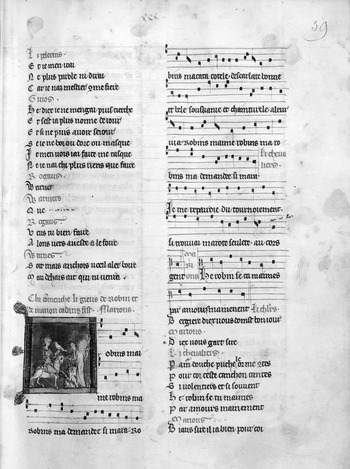
Some manuscripts, of course, were meant to have music or rubrics but were never supplied with them. The abbreviated sketch adapted from Adam de la Halle's Jeu de la feuillée is missing its rubrics in the Paris manuscript (blank spaces show where they should have been), while in the contemporary Vatican codex the names of the characters have been changed to suit different performers and audiences. Adam's Jeu de Robin et de Marion, which survives in three deluxe manuscripts, is lacking music in one whereas in another it has acquired a lavish set of illuminated miniatures; in the third, part of the anthology that concludes with the Jeu de saint Nicolas, it has acquired a dramatic prologue, the Jeu du pelerin (Play of the Pilgrim), and an additional scene (Fig. 4). Many scripts also acquired marginalia or rubrics over time. A number of Latin comedies bear the annotations and clarifications of generations of reader-performers, and so does the single manuscript of Le Garçon et l'aveugle (The Boy and the Blind Man). Even the archetypical Regularis Concordia was provided, in one copy, with an interlinear Anglo-Saxon gloss of Æthelwold's Latin directives.Footnote 69
The opening of Adam de la Halle's Jeu de Robin et de Marion, with the end of the prologue appended to it, the Jeu du pelerin. Because Adam was a precocious composer of polyphonic music, this memorial manuscript anthology of his “complete works” (compiled after his death, ca. 1285) was entrusted to a team of highly skilled scribes capable of handling such specialized material. Their expertise has contributed to the theatrical visibility and legibility of all the pieces gathered in this codex, which also includes the sole extant copy of Jehan Bodel's Jeu de saint Nicolas (ca. 1191). Paris, BnF fr. 25566, fol. 39r. Photo courtesy of the Bibliothèque nationale de France, Paris.

VI. Some performance scenarios were more readily adaptable than others, and this is reflected in the number and format of surviving texts. This observation follows on the last. The Jeu de la feuillée is virtually incomprehensible to an audience outside Arras, ca. 1276. Moreover, it would take over two hours to perform and has at least sixteen speaking parts (not counting interjections from a [planted] audience member), only eight of which can be doubled; so it requires at least twelve actors, a number that could be furnished only by the large community of jongleurs living in Arras. But its opening scene, which features a pretentious poet exchanging witticisms with a couple of buddies, could be played for a much larger array of audiences—and we know that it was played that way because it survives in two separate, abbreviated versions (there may have been others) and because the fifteenth-century scribe who added the missing incipit to one of these thirteenth-century manuscripts was still able to identify it easily two centuries later (suggesting that it was still in repertory).Footnote 70Courtois was, as I have noted, extremely adaptable and was, judging by the number of manuscripts into which it was copied, at least four times more popular than most other medieval plays, with the exception of Rutebeuf's Théophile (extant in two copies) and the more significant exception of the many Latin comedies that exist in multiples ranging from 170 (Pamphilus) to 65 (Geta) and so on down to those preserved in single manuscripts (Aulularia, Baucis et Traso, De mercatore). Generations of scholarly prejudice against the performance qualities of these comedies has led to their dismissal from the medieval dramatic canon, yet they need to be studied as central to the entertainment experiences of the era's large Latin-speaking public.Footnote 71 In much the same way, Le Garçon et l'aveugle was adapted to various degrees over the course of at least two centuries, up to the time when the appetite for farces may have lent it a renewed relevance.
On the opposite end of the spectrum are plays that defy adaptation, ones that were highly localized and specific to a particular set of historical conditions or required the resources of a particular community: the Jeu de la feuillée, the Ordo virtutum of Hildegard of Bingen, and especially the Ludus de Antichristo. Composed and presumably performed by the monks of Tegernsee Abbey around the year 1160, this play promotes the political and military policies of Emperor Frederick II Barbarossa (r. 1152–90), exhibiting a perspective that would hardly have met with approval outside of Frederick's Holy Roman Empire, even if the elaborate staging could be replicated in another venue. However, it may have been performed or read on other occasions at Tegernsee itself, since the surviving manuscript was copied a generation later, probably between 1178 and 1180, certainly by 1186.Footnote 72 Alternatively, this text may have served as a tribute to the aging emperor: it is noteworthy that the historian Otto of Freising's Gesta Frederici forms part of the same codex.
VII. The technical demands of describing certain special effects (or the unusual expertise of copyists) can help promote the theatrical appearance or intelligibility of certain texts. Once more, the so-called Sponsus provides an early example, since the particular form of musical notation employed at the abbey of Saint-Martial necessitated that the text of this play be entrusted to a skilled copyist—who was not, however, the scribe responsible for the errors made in rubrication. Two hundred years later, the anthology of Adam de la Halle's work would also benefit from the special requirements of musical innovation. Since Adam was a pioneer in the composition of polyphony, any manuscript containing his motets would have to be entrusted to one of the few scribes in Europe then skilled in the transcription of the new mensural notation that made the transmission of multivoiced songs possible. Such scribes were to be found only in Paris and Arras, and their services would not come cheap; nor would it make sense to combine meticulous musical layout with a perfunctory presentation of Adam's monophonic songs, versified debate poems, lyrics, and plays.Footnote 73 The result is that no expense was spared in the making of the extraordinary memorial collection of his work, in which the Jeu de saint Nicolas of Jehan Bodel was also transcribed. Likewise, the musical requirements of the Danielis ludus certainly contributed something to its manuscript presentation, but it is arguably the fullness of the stage directions that account for its unusual legibility and its utility for future performers. In many other liturgical and dramatic texts, as I have explained, such directions are absent, indicating a parallel oral tradition that supplemented the written text when it was adapted for performance or suggesting that the play survives only as a textual fossil. It is almost certain, for instance, that the Ludus de Antichristo would have been sung, but no music is included in the manuscript. Perhaps the original singers improvised.
In the manuscript of Danielis ludus, the didascaliæ concern themselves with types of performed action that are not specified in the lyrics but are necessary to the plot, such as the moment in Balthasar's court when “a right hand will appear in full view of the king, writing on the wall: Mane, Thechel, Phares,” or Daniel's rescue from the lions’ den with the assistance of Habbakuk and the angel, or the punishment of the king's evil counselors who, “thrown into the pit, will immediately be eaten by the lions.”Footnote 74 However, the rubrics do not tell us how these effects are to be achieved. By contrast, the contemporary Jeu d'Adam is extremely forthright about matters of staging. Not only does it describe how all the characters should be dressed and how Adam and Eve's “nakedness” is to be represented (among myriad other details), it also describes the setting, the movement of the characters through the playing space, and the behavior and gestures of the characters. It also makes note of the props needed for performance—down to the clay pot that should be hidden from view in Abel's clothing and “which Cain will strike and break, as though he will kill Abel.”Footnote 75 It is also notable for its detailed instructions as to the speaking of the verse.
And let this Adam be well instructed as to when he ought to make his responses, so that he doesn't respond either too quickly or too slowly. Nor does this apply only to him, but let all the characters [personæ] be instructed similarly, so that they should speak correctly and make gestures appropriate to the things about which they are speaking. And in their observance of the verse [rhythmis], let them neither add nor subtract a syllable, but pronounce them all confidently, and say those things that ought to be said in the right order.Footnote 76
This may indicate that it was unusual for a liturgical ordo to be spoken rather than sung, but it also indicates that the author of these didascalia was attempting to control not only what was said and done in performance but how. Possibly this was because the ordo was designed for performance by amateur laymen, who may have required a great deal more direction than entertainment professionals (clerics, jongleurs).
In any case, this degree of practical detail should not be construed as the norm. The near-contemporary Ludus de Antichristo also stages a series of battles, ceremonies, and diplomatic missions that obviously called for pomp and pageantry, but all of that staging is left to the imagination of the monastic performers, who would have been able to draw upon personal experience and developing heraldic conventions for the costuming of the various kings and popes. It also calls for certain very important special effects, among them a series of false miracles that must be executed in such a way as to make their deceit apparent to the audience. Hence, the didascalia calls for a coffin to be brought in containing “someone pretending to have been killed in battle.” But just how the actor who is playing dead is supposed to signal that he is merely playing at playing dead is not explained.Footnote 77 By the same token, the Christmas play from Benediktbeuern, which forms part of the celebrated Carmina Burana codex, does not explain how the actor playing Herod “should be gnawed to bits by worms.”Footnote 78
It is possible, indeed, that these instructions were not intended to be carried out by performers but were instead substitutes for performance, aids for mental reenactment by the reader. Whatever the case, it is striking that the most detailed instructions in this particular play are reserved for the actor playing the pivotal role of Archisynagogus (Head of the Synagogue) who disputes—successfully—with Saint Augustine and the Old Testament prophets, skillfully countering their credulous arguments for the Virgin Birth with references to cutting-edge Aristotelian philosophy. In my view, it is precisely because Archisynagogus's arguments are so superior to those of his patristic opponent that he is directed to undercut his own authority by playing the fool in a manner that was supposed to appear stereotypically “Jewish”: bellowing with derision and indignation, pushing his companions around, wagging his head and stamping his foot, “and imitating the behavior of a Jew in all ways.” But later on, when Archisynagogus no longer poses a threat to the doctrine that is central to the play's plot, his behavior changes markedly; as Herod's chief advisor, he is instructed to speak to the visiting Magi “with great wisdom and eloquence.”Footnote 79
In a similar fashion, the scripts in the so-called Fleury Playbook occasionally specify the emotions to be displayed by certain characters when such emotions are central to the action, as when Saul (Paul) must persecute the followers of Christ “as if enraged” (quasi iratus), so that this behavior will contrast strikingly with his conversion on the road to Damascus, when he must act “as if now believing” (quasi iam credens).Footnote 80 Hildegard of Bingen's Ordo virtutum (Service of the virtues) goes further.Footnote 81 Not only do the lyrics of this play call for specific and often violent action (“Fly!” “Run!” “Bind him!”) but the carefully inserted rubrics delineate the protagonist's emotional journey from “Happy Soul” (Felix Anima) to “Unhappy Soul” (Infelix Anima) and, at length, to “penitent” Soul (penitens). That is because these different emotional states are necessary manifestations of Anima's journey toward salvation. Indeed, a careful analysis of the manuscript shows that the playwright and her scribe were working hard to ensure that the changes in Anima's spiritual condition would not be construed as the attributes of different characters called “Felix Anima” and “Infelix Anima.” Hence, the rubrics direct that the Virtues should address themselves “to that same Anima” (Virtutes ad Animam illam) and describe “the shouting of the Devil to that same Anima” (Strepitus Diaboli ad Animam illam). Even after Anima's dramatic identity would seem to have been adequately established, she is always distinctly labeled as “the same Soul.” However, the fact that some of these designations were supplied after the initial copying campaign, on second thought and occasionally at the expense of the lyrics’ clarity, emphasizes the mechanical difficulties of the composer's and copyist's tasks, while underscoring that the affective enactment of Anima's altered demeanor is crucial to the message of the play.Footnote 82
VIII. The specificity of instructions for performance included in certain texts may represent attempts to codify existing practices, establish an official template for performers outside a community, or limit future innovations. Hildegard's Ordo virtutum may have received its inaugural performance on the first of May in 1151, when her new convent at Rupertsberg was solemnly consecrated by the archbishop of Mainz and attendant prelates from the region. It is conceivable that these dignitaries were simultaneously pressed into service as the introductory chorus of prophets and patriarchs, while the religious of the convent played the Virtues and Hildegard's long-suffering amanuensis, Volmar, took on the somewhat thankless role of the Devil. Perhaps the aristocratic congregation stood in for the Souls “set in bodies” (in carne positarum), from among whom the individual Soul, Anima, emerged as protagonist. Whatever the case, the script of the Ordo was preserved in a selected edition of Hildegard's works now known as the Riesencodex, and strong arguments have been put forward that the manuscript as a whole was copied over two decades later under Hildegard's supervision, most probably between 1177 and 1180 (the year of her death).Footnote 83 If so, it is the first medieval play to exist in anything like an autograph copy and certainly one of the few premodern scripts over which anyone directly associated with a live performance can be said to have exercised so much control.Footnote 84
• • •
The extant script of Hildegard's Ordo virtutum was intended either to foster future performances that would be governed by a definitive text and/or to supply a definitive text that took the place of performance for the clerics of the papal curia, who would consider (and ultimately reject) her community's bid for their founder's canonization. In both cases, it suggests an interesting correlation between artistic innovation and the availability of sophisticated scribal skills. Margot Fassler has called Hildegard “the most prolific composer of monophonic chants known to us, not only from the twelfth century but from the entire Middle Ages.” While it would be too facile to observe that this is, in part, because she had access to an extremely competent scribe, we must recognize that the very novelty of her works, especially the novelty of their music, posed a potential threat to these works’ survival. Hildegard appears to have composed orally, and her nuns may have learned their parts aurally.Footnote 85 The Riesencodex is thus charged with the task of conveying something of her genius to a new audience dependent on a textual record or desiring a definitive memorial of a singular life's work. It is comparable, in some respects, to the manuscript of the Danielis ludus, produced a generation or two later at Beauvais, or to the Regularis Concordia promulgated by Æthelwold. It is even more closely analogous to the mysterious manuscript preserving the oeuvre of Adam de la Halle. That book, too, was carefully designed to establish a textual canon, a record of Adam's artistic endeavors and a testimonial of his relationships with his patron(s), the people of Arras, and his predecessor, Jehan Bodel. But unlike the codices copied under Hildegard's eye and at her direction, its circumstances of production are unknown.Footnote 86
One thing can be said with certainty: such manuscripts as these were the exception. We are closer to the dynamics of performance when we encounter indeterminate scripts such as Courtois d'Arras, works in progress such as Le Garçon et l'aveugle, or adapted dialogues such as the two versions of the scene borrowed from the Jeu de la feuillée. Perhaps we are closer still when we must exercise our imaginations to the fullest, working our thoughts to flesh out the bare bones of the most basic “Type I” Visitatio sepulchri, that allegedly “unevolved” and ubiquitous staple of the ecclesiastical repertoire. As a scholar and editor of early biblical manuscripts has observed, “the vastly complex indeterminacies involved in the generation and transmission of texts, and in the very nature of textuality, encourage us to be open to the presentation (and interpretation) of texts in accordance with quite various logics.”Footnote 87 According to the medievalist Roger Dagenais, this means apprehending the “fundamental … indeterminacy of text” and recognizing that “the very act of reading a scriptum involved constant choices,”Footnote 88 to say nothing of the choices involved in performance. These views of the evidence encourage us to react creatively when there are few texts to be had and few obvious references to the performative possibilities that lie beyond the text—the moment of performance to which the text was a response or for which it was only a starting point. No play is complete until it is played. No text, whether script or transcript, can stand in for lived experience. As one witness to a splendid set of Burgundian spectacles remarked in 1496, “It is not at all within the capacities of any man living on this earth to know how to describe in writing something that has been accomplished in reality.”Footnote 89
Recognizing this, we are in a better position to reassess the records of premodern performance practice and to rethink our approach to the premodern theatrical archive. While very recent trends have encouraged “a more diverse and inclusive history of theatre and performance practices,” as Susan Bennett reminds us, one can “demonstrate the remarkable tenacity of certain principles” that have been impervious to “critical excavations of how archives work.”Footnote 90 Bennett's own concern is the resistance of these narratives to feminist methodologies, resulting in the continued marginalization of women's contributions to theatre's history, and I have already observed that the same can be said of African American, indigenous, and non-Western practitioners. What I have stressed here is that the premodern (or “not modern”) performance practices of the West have also been exempt from this critical revisionism, resulting in the continued promulgation of misleading narratives predicated on the existence of certain kinds of texts. It is time to look at the evidence of theatre's “dark age” in this new light and to reassess the role of the Middle Ages in our narratives of the past.