The pervasive politicization of every aspect of society is a defining feature of the People’s Republic of China (PRC). The politicization is evident in the monopoly of the ruling Chinese Communist Party (CCP), which penetrates Chinese society at different levels. At the macro institutional level, the CCP has established a one-party political system, akin to all Leninist regimes, to ensure the Party’s absolute power.Footnote 1 The CCP has consistently promoted communist ideological propaganda as the guiding principle for party-state policy when justifying political actions and campaigns. Despite shifts in leadership strategies over time, ideology remains one of the most important “soft power” tools of governance in China and is formally enshrined in the country’s constitution. At the meso-level, the Party maintains control over organizations by establishing Party structures within them and appointing Party members to their leadership positions. The CCP Propaganda Department (CCPPD), which is the core organ of the Party’s propaganda system, oversees propaganda efforts across various media outlets, including newspapers, magazines, radio and television stations, and extends its influence over other cultural industries, such as music, film, drama, museums and theatres.Footnote 2 The Party also exerts political control at the micro-level over individuals’ lives. For example, during the Mao era, individuals were classified according to their class origin and given a label which influenced their life chances. In the reform era, Chinese society remains politicized. For instance, students have to attend ideological education courses before they can graduate, CCTV news is broadcast daily on all television channels at 7:00 p.m., and internet users must avoid politically sensitive words when posting on personal social media accounts.
The level of politicization in China is not static and has continually changed over the past seven decades in response to the prevailing development priorities. During periods when the emphasis leans towards socialist revolution and construction, political control tends to intensify; when the focus shifts to economic development, it tends to diminish.Footnote 3 In the early era, the CCP’s main task was to legitimize its absolute authority. It did so using ideology and manipulative tactics, such as propaganda and indoctrination, to maintain control over society during the Mao years.Footnote 4 Under Deng Xiaoping 邓小平, political control relaxed as the CCP shifted its focus from the Maoist “politics in command” doctrine to Deng’s “economics in command” approach.Footnote 5 However, in 1989, the Party was faced with a governance crisis when divergent views regarding state–society relations emerged. Some scholars argue that the CCP’s control over society had gradually diminished by the late 1980s and that it had even lost control of its grassroots Party members.Footnote 6 Others contend that the Party has preserved its tight grip on society, highlighting the enduring nature of the Party’s governance structure and its effective use of ideological propaganda and coercive measures.Footnote 7 From Jiang Zemin’s 江泽民 post-crisis emphasis on “political discipline” to Xi Jinping’s 习近平 era of “the Party controls everything,” it is evident that the CCP is continually striving to maintain political control over society. The Party’s ongoing strategy adjustments to balance the dual objectives of economic development and political control have been instrumental in ensuring its longevity, distinguishing it from other communist regimes that collapsed at the end of the 20th century.
Given the pervasive influence of politics across all aspects of Chinese society, the level of politicization serves as the starting point for almost all areas of China studies. Existing research has outlined the general trends of politicization in China, spanning from Mao’s revolutionary epoch to Deng’s reform era and onwards to the post-Deng period of developmentalism. However, until now there has been no comprehensive perspective to depict the changes over the past 75 years. In our research, we constructed an index of China’s politicization that reveals the changing trends of the political regime, identifying four stages of politicization in the CCP’s ruling history from 1949 to 2023. We also provide an example of the practical application of the politicization index through an analysis of CCP membership attainment.
Politicization: The Essence of the Party-state China
We use the concept of politicization to explain mechanisms of pervasive social control. In its literal sense, politicization refers to the process of rendering an issue political. While it is commonly used in political research, the concept is often left undefined, implicitly shaping analyses rather than being explicitly articulated. In our research, we define China’s regime politicization as the social-political control exerted for regime stability through political ideology and campaigns.
The concept of politicization can be broadly understood through two key theoretical perspectives. One perspective, rooted in Carl Schmitt’s work, emphasizes the distinction between friend and foe as the essence of the political. Schmitt argues that social contrasts – whether religious, cultural, economic or moral – become politicized when they are sufficiently pronounced to create clear divisions and mobilize individuals into opposing groups.Footnote 8 This process of drawing friend–foe distinctions across different societal spheres captures the core of politicization, highlighting its role in structuring oppositional identities and driving political conflict. Building on Schmitt’s framework, Johannes Gerschewski defines over-politicization as the ideological exaggeration of differences, turning them into absolutes through a heightened process of friend–foe distinctions.Footnote 9 This form of politicization is strategically employed to mobilize ordinary citizens.Footnote 10
The other perspective, grounded in Jürgen Habermas’s theory of the public sphere, views politicization as the transformation of private issues into public concerns.Footnote 11 For Habermas, the public sphere is a platform where private matters are debated, negotiated and elevated into the political domain. Through this process, social issues – such as economic inequality or cultural norms – are reframed as collective challenges, requiring political engagement and institutional responses.Footnote 12 This dimension of politicization reflects its capacity to reconfigure previously apolitical domains into arenas of public contestation. Scholars follow this theory to define politicization as the process by which issues, practices or patterns of behaviour that were previously considered private or apolitical are brought into the realm of public, political discourse and decision-making.Footnote 13
China serves as a clear extension of these two theories of politicization. Within its party-state system, China’s politicization transcends political discourse to infiltrate economic, social and cultural spheres, becoming a defining feature of the state’s governance approach. While politicization is evident in other regimes, such as the European Union, it does not play a central role in governance.Footnote 14 In China, however, Party and state systems are fully intertwined, allowing Party organizations to exercise arbitrary power across all sectors and effectively subjecting citizens to the party-state apparatus.Footnote 15 Even when marketization was prioritized after 1978, the regime remained deeply politicized, sustained by the Party’s core leadership and its foundation in communist ideology.Footnote 16
Politicization in China can be most effectively captured through two central mechanisms: the Party’s policy discourse as a soft-power mechanism and political campaigns as a hard-power mechanism.Footnote 17 Schmitt’s theory of the friend–foe distinction and Habermas’s concept of the public sphere provide the theoretical foundation for understanding how these two mechanisms structure China’s political landscape, where ideological discourse and political campaigns intertwine to define the boundaries of political engagement.
China’s politicization may appear all-encompassing, but its core characteristics lie in ideology and campaigns. Economic and social issues are never purely technocratic; they are always formulated, justified and implemented within the Party’s ideological framework. For example, market-oriented reforms are embedded within the narrative of “socialism with Chinese characteristics,” and their implementation is fundamentally shaped by the logic of campaign-style governance. Therefore, ideology and campaigns are the key dimensions through which we quantify politicization.
Ideology and Campaigns: The Power of Social Control
Ideology: the CCP’s soft power of control
Ideology refers to a set of thinking patterns, including beliefs, ideals and principles, that are widely shared within a society.Footnote 18 In China’s communist regime, ideology is usually associated with control. The CCP maintains its political legitimacy and control through various means of ideological propagation,Footnote 19 including extensive ideological education in schools, universities and government institutions, where Marxist-Leninism theories and the CCP’s interpretation of socialism are emphasized.Footnote 20 Additionally, state-controlled media, such as newspapers, television and radio, are utilized to ensure the dominance of the Party’s narratives in public discourse. Propaganda departments at different government levels oversee and regulate ideological content across various media platforms, censoring sensitive or critical material and promoting narratives that align with the Party’s agenda.Footnote 21 The CCP also leverages the internet and social media platforms to disseminate its ideology while closely monitoring and censoring online discussions to suppress dissent.Footnote 22
Ideology serves as a crucial tool for the CCP to establish and maintain its rule by securing the consent of both Party members and the masses. To ensure that Party members accept communist ideology, the CCP engages in intensive ideological indoctrination, creating a highly cohesive governing group. This practice can be traced back to before the Party came to power. During a period of brutal underground struggle, disloyal members posed a significant threat to the Party’s organization. Therefore, the CCP emphasizes communist ideology as a means of inspiring Party members’loyalty by engendering in them aspirations for an ideal future society.Footnote 23 In the ruling process, ideological conformity serves as the criterion for the top Party leaders to assess the loyalty of Party cadres. Once the leaders establish their ideology, they mobilize the Party apparatus to propagate this ideology and cultivate the loyalty of Party members. For the general populace, ideology is crafted to gain the support and consent of the masses, serving as a key source of ruling legitimacy. According to David Beetham’s model, ideology can mobilize popular consent by defining the standards of performance for the ruling body, particularly by aligning with the common interests of society and outlining how goals are achieved.Footnote 24 The CCP is one such example of this principle. Its success in overthrowing the previous elite ruling party, the Nationalist Party, depended largely on the “mass line,” which aimed to mobilize the broadest mass support to carry out revolution. Therefore, gaining mass recognition of the communist ideology – specifically, the pursuit of the common good for society as a whole through proletarian struggle – is a key source of legitimacy for the CCP regime. Herbert Franz Schurmann argues that individuals can cultivate a commitment to the organization by internalizing the pure ideology of the organization and by acquiring practical ideology that guides their actions in ways that are beneficial to the organization.Footnote 25 Sujian Guo regards ideology as a means of justifying the Leninist regime for the truthful, moral supremacy represented by the legitimacy of the Party as the sole ruler.Footnote 26 Kerry Brown contends that the CCP’s ideology occupies a distinct social role by providing unity, legitimacy and a comprehensive social belief system.Footnote 27
The political campaigns of the late Maoist era failed and inflicted great damage on society, and as a result, the CCP’s legitimacy reached a nadir. Some scholars suggest that official communist ideology faces an existential crisis, as people no longer believe in it. They contend that the focus on economic performance in the context of reform renders ideology meaningless.Footnote 28 However, the reality is quite the opposite. Each of the post-Mao leaders has promoted their own particular ideology, with varying degrees of politicization, to exercise social control. These include Deng’s “socialism with Chinese characteristics” (Zhongguo tese shehui zhuyi 中国特色社会主义), Jiang’s “Three represents” (sange daibiao 三个代表), Hu Jintao’s 胡锦涛 “scientific outlook on development” (kexue fazhan guan 科学发展观) and Xi’s “four comprehensives”(sige yishi 四个意识). Consequently, ideological education has continued to occupy a central place in the work of the Party, particularly in the aftermath of the 1989 Tiananmen Square protests and subsequent crackdown. Anne-Marie Brady describes ideology as “one of the key means for guaranteeing the CCP’s ongoing legitimacy and hold on power.”Footnote 29 This raises a critical question: why does ideology continue to play a significant role in the CCP’s rule, despite a general decline in belief in it? The answer lies in one of the fundamental functions of ideology – achieving hegemony through a particular discourse system.
The notion of ideology as hegemony is rooted in Gramsci’s political thought, which posits that social power arises from mechanisms of consent and coercion.Footnote 30 While coercion demonstrates the state’s power through violence, hegemony operates through persuasion, by gaining individual acceptance of a society’s values and fostering voluntary submission to that society’s power. The dominant group needs to maintain sufficient ideological unity to secure the consent of the ruled groups in order to consolidate power.Footnote 31 In other words, Gramsci viewed ideology as both an expression and a reflection of social power relations and an important tool for the ruling class to maintain hegemony. Based on Gramsci’s concept of hegemony, Ernesto Laclau and Chantal Mouffe propose a post-Marxist discourse model that focuses on how discourse functions within social power. This model argues that ideology is not a monolithic system through which the ruling class conquers all masses; rather, hegemony is constantly contested and maintained through discursive practices.Footnote 32 Both theories provide a logical basis for the use of communist ideology as a soft control force to consolidate power under Chinese communist rule. Joseph Schull considered ideology as a system of discourse in which individuals only need to respect ideology, rather than to “believe” in it, so that individuals with different beliefs can adhere to the same ideology.Footnote 33 Building on Schull’s point, Jinghan Zeng further distinguishes between formal and informal ideologies. The formal ideology, including extended communist ideologies such as the “Three represents” and “scientific outlook on development,” is designed to legitimize the communist regime within the Party itself. The informal ideology, which encompasses populist discourses like nationalism and virtues, aims to justify the one-party dictatorship to society.Footnote 34 When ideology achieves hegemony through an official discourse system, it is a matter of “practising” rather than “believing” in it.Footnote 35 The powerful propaganda system of the CCP ensures that the masses use the official discourse correctly, thereby implementing soft control over the entire society by making the masses “sing in unison.” This study aligns with the perspective that despite the shifts in its role across periods, ideology has consistently functioned as a crucial “soft” power in the CCP’s politicized nature of control.
Campaigns: the CCP’s coercive control tactics
Political campaigns serve as a coercive means through which the CCP exercises its control over both the Party and society.Footnote 36 Unlike electoral campaigns in democratic systems, Chinese campaigns (yundong 运动) are “government-sponsored efforts to storm and eventually overwhelm strong but vulnerable barriers to the progress of socialism through intensive mass mobilization of active commitment.”Footnote 37 Mass campaigns became a defining feature of the CCP during the Yan’an period, when the “rectification” campaign marked the beginning of the CCP’s long-term adherence to the mass line as a fundamental governing principle.Footnote 38 Through this campaign, the CCP established a solid mass foundation, achieving significant revolutionary success. After the CCP seized national power in 1949, the Party continued to practise the mass line theory. As its embodiment, mass campaigns, which were characterized by their coerciveness and extensive reach, became the principal feature of policy implementation and social management under Mao. Prominent campaigns during this era, such as land reform, collectivization, the “anti-rightist” campaign, the Great Leap Forward, “socialist education” campaign and Cultural Revolution, were tasked with revolutionizing society. This revolutionary zeal was the lifelong pursuit of the first-generation CCP leaders, and Mao’s Cultural Revolution epitomized this approach, reaching an unparalleled scale and permeating every aspect of social life. Although the campaigns achieved significant governance successes in Mao’s era, they are also criticized for causing many unintended and severe consequences.Footnote 39
Deng announced the end of the campaign era in 1978, ushering in a new period that was eagerly anticipated by those who had endured the painful lessons of the mass campaigns. He emphasized the necessity of mobilizing the masses – but not for political campaigns.Footnote 40 Minxin Pei noted a significant erosion in the CCP’s capacity for mass mobilization under Deng, a trend that, he argued, would continue with the deepening of economic reforms. The transformation of China’s economic system had disrupted the Party’s traditional organizational structures, weakening its ability to mobilize the masses through previously tightly controlled networks.Footnote 41 Thus, political campaigns would likely recede from the historical stage.
However, this was not to be the case. As predicted by Gordon Bennett in 1976, campaigns would continue to flourish under Mao’s successors.Footnote 42 Scholars have subsequently validated this prediction.Footnote 43 One perspective posits that the CCP has not rejected the method of campaigns but has merely avoided using the term “campaign,” replacing it instead with “actions.”Footnote 44 In fact, Mao’s legacy of mass mobilization campaigns for social control and governance has not disappeared. The CCP continues to manage social affairs using a series of campaign-style governance methods, which include setting task objectives, establishing teams to direct and coordinate work, and propagandizing the effort through slogans and wall posters.Footnote 45 Chinese scholars have used the term “campaign-style governance” to describe the role of post-Mao campaigns in the CCP’s management and control of society. Xueguang Zhou contends that campaign-style governance is a cornerstone of China’s administrative logic as revealed in the persistent pattern of top-down resource mobilizations throughout the history of the PRC.Footnote 46 Shizheng Feng suggests that post-1949 campaign-style governance is a legacy of the pre-1949 revolutionary campaigns, resulting in “state campaigns” characterized by an inherent top-down structure, a radical approach and Party dictatorship.Footnote 47
Nonetheless, campaigns in the post-Mao era differ in terms of their scope and impact compared to their Maoist counterparts.Footnote 48 While the Maoist campaigns affected the majority of the people and had a profound impact on all aspects of their lives, the campaigns in the reform era primarily impact only a subset of Party members rather than the broader society, and “even then many party members do not have to take them seriously.”Footnote 49 Elizabeth Perry describes this change as a shift from Maoist mass campaigns to post-Mao “managed campaigns.” The latter inherits the revolutionary spirit, mass mobilization and political propaganda methods of the former but primarily targets grassroots officials.Footnote 50
Therefore, our research design for constructing an index of regime politicization through a content analysis of the People’s Daily from 1949 to 2023 will encompass two key elements: ideology and campaigns. Before presenting our research design, we will elaborate on our theoretical position regarding the trajectory of China’s regime politicization.
The Trajectory of China’s Regime Politicization
Scholarly opinions regarding the trajectory of China’s regime politicization are divided. Supporters of the “two-stage” perspective divide China’s political regime into two phases, the Maoist period and the post-Mao period, which are separated by the significant transition of Deng’s reform policy in 1978.Footnote 51 Proponents of the “three-stage” politicization theory are inspired by Dorothy Solinger’s three-line framework, which categorizes the Party’s visions as bureaucratic, radical or reformist.Footnote 52 Building on this, Barry Sautman conceptualizes China’s politicization trajectory in three stages: the politicized stage of the early Maoist era, which corresponds to the bureaucratic vision; the hyper-politicized stage during the Cultural Revolution, associated with radical vision; and the depoliticized stage in the post-Mao reform period.Footnote 53 Recent studies suggest that Xi’s re-politicization policies since 2013 significantly deviate from the reformist periods under Deng and his successors, Jiang and Hu, before 2012. Under Xi, there has been a revival of Maoist ideologies and a reinvigoration of political campaigns.Footnote 54
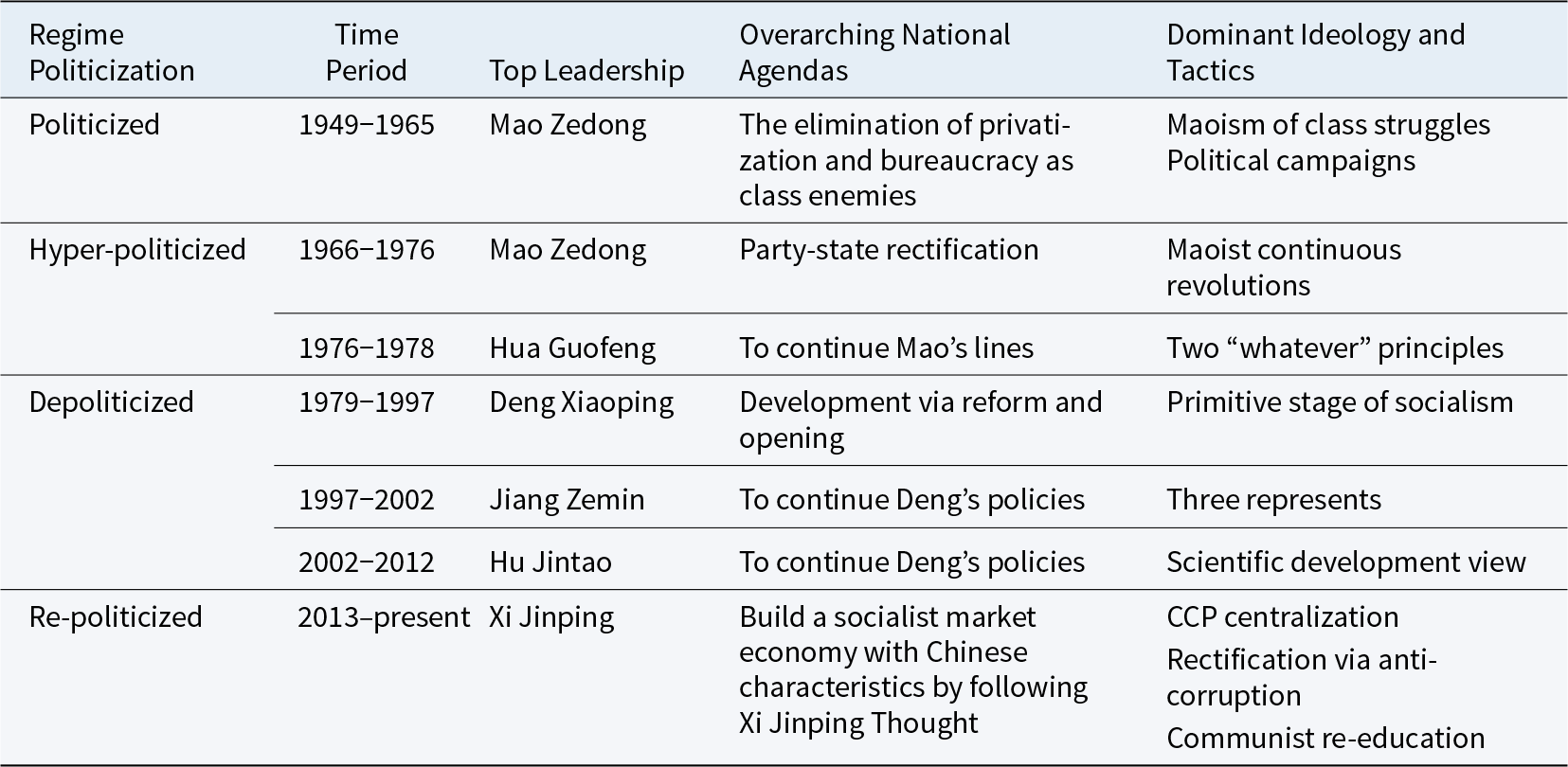
Based on these theories, we propose a four-period politicization model to cover the whole 75-year history of the PRC, from 1949 to 2023, and have compiled quantitative data to measure the changing degrees of politicization across these periods: (1) the politicized period of 1949–1965; (2) the hyper-politicized period of 1966–1978; (3) the depoliticized period of 1979–2012; and (4) the re-politicized period of 2013–present. The significant features of each period are presented in Table 1.
China’s Regime Politicization: A Conceptual Model

Source: Authors.
We hypothesize that trends in ideology and campaigns evolve differently across the four periods. For example, large-scale political campaigns declined after 1978 as Deng moved away from mass mobilization, yet the CCP continued to maintain its legitimacy through sustained ideological education and propaganda. This means that while the overall politicization process is dynamic, its two core components fluctuate in distinct ways over time.
Constructing China’s Politicization Dictionary
Corpus source
The People’s Daily is an ideal source for examining trends in China’s politicization through content analysis. As the official mouthpiece of the CCP, it enjoys widespread circulation and maintains significant influence. The corpus comprises 2,041,926 articles published in the People’s Daily, spanning from from 1 January 1949 to 31 December 2023.
As the Central Committee’s newspaper, the People’s Daily serves as a direct channel for disseminating CCP policies and guiding public opinion. Founded in 1948, the paper has consistently promoted the Party’s line, theories, principles and policies, as well as the centre’s key decisions and plans.Footnote 55 Its editorial positions are appointed by the Central Propaganda Department, ensuring its strict adherence to the Party line.Footnote 56 Given its authoritative status and mission to propagate ideology and campaigns while influencing public behaviour, the People’s Daily offers a crucial lens through which to understand China’s politicization.Footnote 57
Additionally, the newspaper commands the widest readership in China, making it the most influential outlet for politicization. At its peak in 1979, its circulation reached six million copies.Footnote 58 Even today, despite the rise of commercial media, it maintains a circulation of three million copies and is recognized by UNESCO as one of the world’s top ten newspapers in terms of circulation.Footnote 59 This extensive reach, combined with its political authority, enables it to shape public perception of key political issues, further amplifying its role in driving politicization.
Despite recent trends in media commercialization and digitalization, the People’s Daily remains the best window onto China’s politicization sphere. This can be attributed to its enduring status as the CCP’s Central Committee newspaper, its continued public influence and its adaptation to new platforms. According to Xi, “People’s Daily is the CCP Central Committee’s newspaper, which connects the Party with the people. We must … fully exert its guiding, flag-bearing, and leading roles in public opinion.”Footnote 60 The People’s Daily has also expanded into digital platforms such as Weibo – China’s largest social media platform for public discourse – to maintain its relevance while preserving its authority.Footnote 61 Clearly, if any newspaper reflects China’s politicization dynamics, it is the People’s Daily.
Annotation of the politicization dictionary
We followed a three-step process when constructing the politicization dictionary.Footnote 62 First, we performed token segmentation using the jieba module in Python, which is widely recognized as one of the most effective tools for Chinese text segmentation.Footnote 63 A token is a basic unit of text in natural language, typically comprising a word or punctuation.Footnote 64 In our research, a token refers to the raw segmented units, including words, phrases and symbols, taken from the People’s Daily corpus. To enhance accuracy, we incorporated a customized user dictionary into jieba, for which we compiled politicized terms drawn from two authoritative CCP historical materials.Footnote 65 This segmentation process resulted in a total of 2,599,519 tokens, which serve as the basis for annotation.
Second, we conducted manual coding to identify politicization-related terms. While machine-based methods offer convenience, they lack the precision and nuances required to capture the complexities of political concepts.Footnote 66 To ensure reliability, two independent coders identified the segmented tokens, achieving a high level of consistence (Cohen’s Kappa = 0.951). This process resulted in a final vocabulary of 203 terms, with 93 associated with “ideology” and 112 reflecting “campaigns,” as defined in our framework.Footnote 67 Here, a term specifically refers to a token identified as relevant to politicization and thus included in the politicization dictionary.
We then assigned a weight to each term to reflect its degree of politicization by encoding three dimensions of the term:Footnote 68
(1) Intensity. Ideology-related terms were categorized as either “General Ideology” (weight = 1) or “Specific Ideology” (weight = 2), depending on whether they represented broad ideological principles or were tied to specific political campaigns. Terms in the latter group were assigned greater weight due to their more immediate political salience. Campaign-related terms were categorized according to the degree of control involved: “Soft Control Campaigns” (weight = 1) feature mild, incentive-based or educational mobilization, while “Strong Control Campaigns” (weight = 2) involve coercive strategies with more significant political and social consequences.
(2) Scope. Each term was assigned to either “Party-state Apparatus” (weight = 1) or “Broader Society” (weight = 2), depending on the breadth of impact.
(3) Duration. To capture historical shifts in political salience, we assigned a weight of 1 to the years during which a political term was actively promoted, and a weight of 0 otherwise.
The final weight assigned to each term for each year was calculated by multiplying the weights across the three dimensions. For example, the term “Revolutionary Committee” repeatedly appeared during the Cultural Revolution period (1966–1976). In our coding scheme, the term is classified as a “Strong Control Campaign” under the intensity dimension (weight = 2) and as influencing “Broader Society” (weight = 2) under the scope dimension. For the duration dimension, the term was relevant in the 1966–1976 period (weight = 1), but not in other years (weight = 0). Therefore, the term “Revolutionary Committee” receives a score of 4 (2 × 2 × 1) for each year from 1966 to 1976 and a score of 0 (2 × 2 × 0) for all other years.
In this way, we derived an annual politicization score for each term in our politicization dictionary over the 75-year period from 1949 to 2023.
Index of China’s Regime Politicization
Index construction
We calculated China’s annual politicization index using the weights of terms from the politicization dictionary. The index was constructed using four distinct scores: a token-based ideology score, article-based ideology score, token-based campaign score and article-based campaign score. These scores are derived from two distinct dimensions. The first categorizes politicization into “ideology” and “campaign,” based on the politicization vocabulary. The second dimension distinguishes between a token-based algorithm, which measures politicization through the frequency of terms, and an article-based algorithm, which measures it through the proportion of politicized articles. We provide a detailed explanation of the algorithms below.
The token-based (TB) algorithm utilizes the principles of the term-frequency procedure to calculate the percentage of politicization terms for a given year. Each term is assigned a politicization weight, as outlined in the politicization dictionary. The formula used to compute the token-based score in year  $t$ is as follows:
 \begin{equation*}TB\left( t \right) = \frac{{\mathop \sum \nolimits_{i = 1}^w W\left( {i,t} \right)N\left( {i,t} \right)}}{{\mathop \sum \nolimits_{j = 1}^{{n_t}} N\left( {j,t} \right)}}\end{equation*}
where  $i$ refers to the politicized terms, and
 $j$ represents all segmented tokens (excluding stop words).
 $w$ is the number of distinct political terms, while
 ${n_t}$ represents the distinct number of segmented tokens in the year
 $t$.
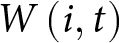 ${\text{ }}W\left( {i,t} \right)$ refers to term
 $i$’s weight in year
 $t$,
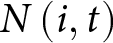 $N\left( {i,t} \right)$ and
 $N\left( {j,t} \right)$ refer to the occurrences of the term
 $i$ and token
 $j$ in year
 $t$, respectively.
The article-based (AB) algorithm analyses the proportion of politicized articles. An article is classified as politicized if it contains at least one term from the politicization dictionary, and the weight of the article is determined by the maximum weight of terms within the text. The article-based score in year  $t$ is given by:
 \begin{equation*}AB\left( t \right) = \frac{{\mathop \sum \nolimits_{i = 1}^{{n_t}} A\left( {i,t} \right)}}{{{n_t}}}\end{equation*}
where  ${n_t}$ is the total number of articles in year
 $t$, and
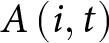 $A\left( {i,t} \right)$ is the politicized weight of the article
 $i$ in year
 $t$.Footnote 69
By using this approach, we mitigate the issue of redundant calculations that arise when multiple politicized terms represent the same event.
The final annual politicization index is derived from the annual mean of the four scores. These scores are first normalized to a 0–100 scale. Appendix A in the supplementary material shows the detailed computation process and parameters used in normalization for each original score.
China’s regime politicization change: 1949–2023
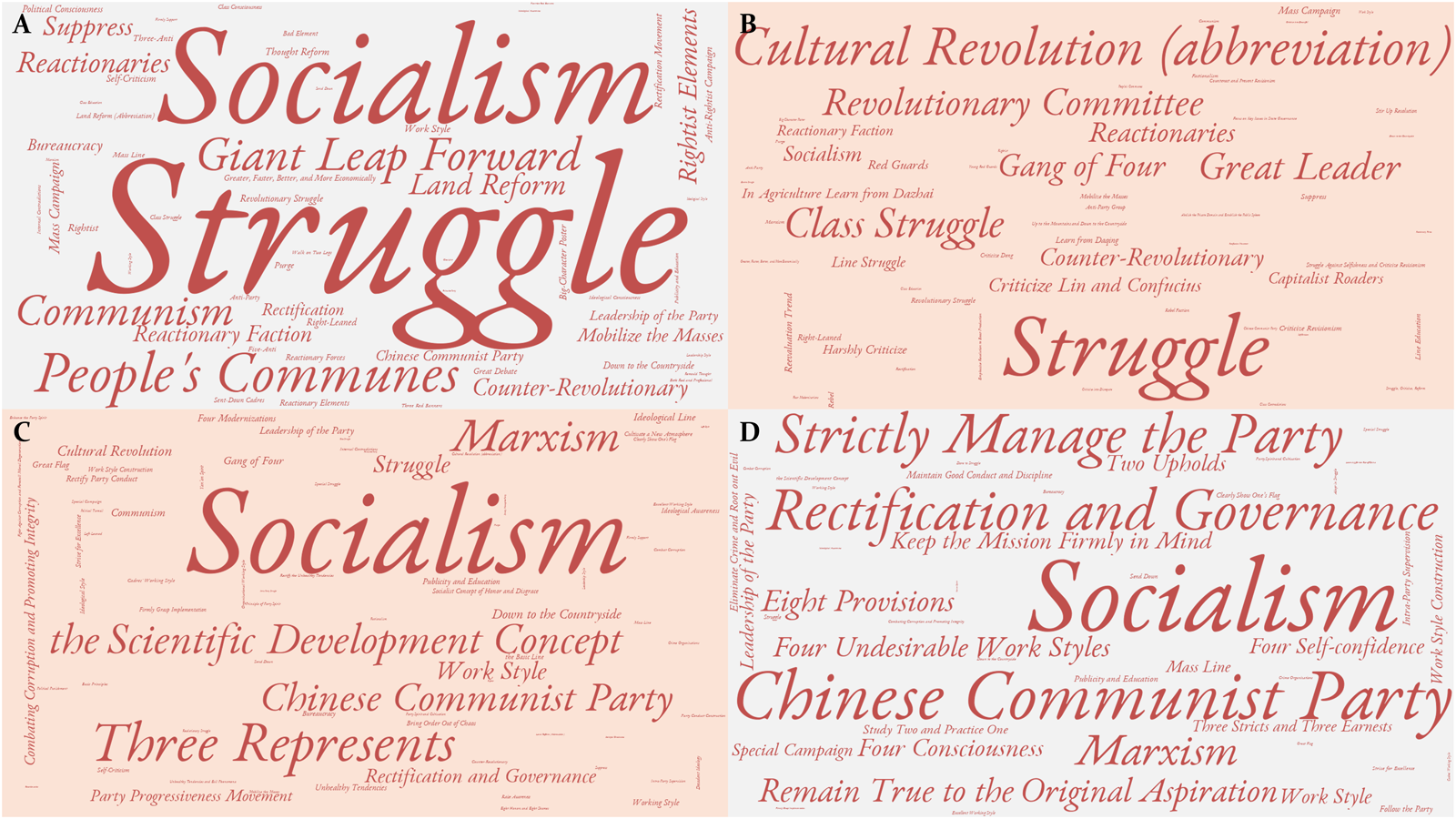
Figure 1 visualizes the occurrence of politicization terms in the People’s Daily across the four historical periods in period-specific word cloud plots.Footnote 70 The figure highlights three key conclusions. First, there is a transition from campaign to ideology, reflected by the fading emphasis on “struggle” during Mao’s era and its replacement with ideological focus in the subsequent years. Second, “socialism” consistently emerges as a central term across all periods. Third, campaigns related to Party discipline become increasingly prominent during Xi’s era.
Politicization Word Cloud for the Four Periods

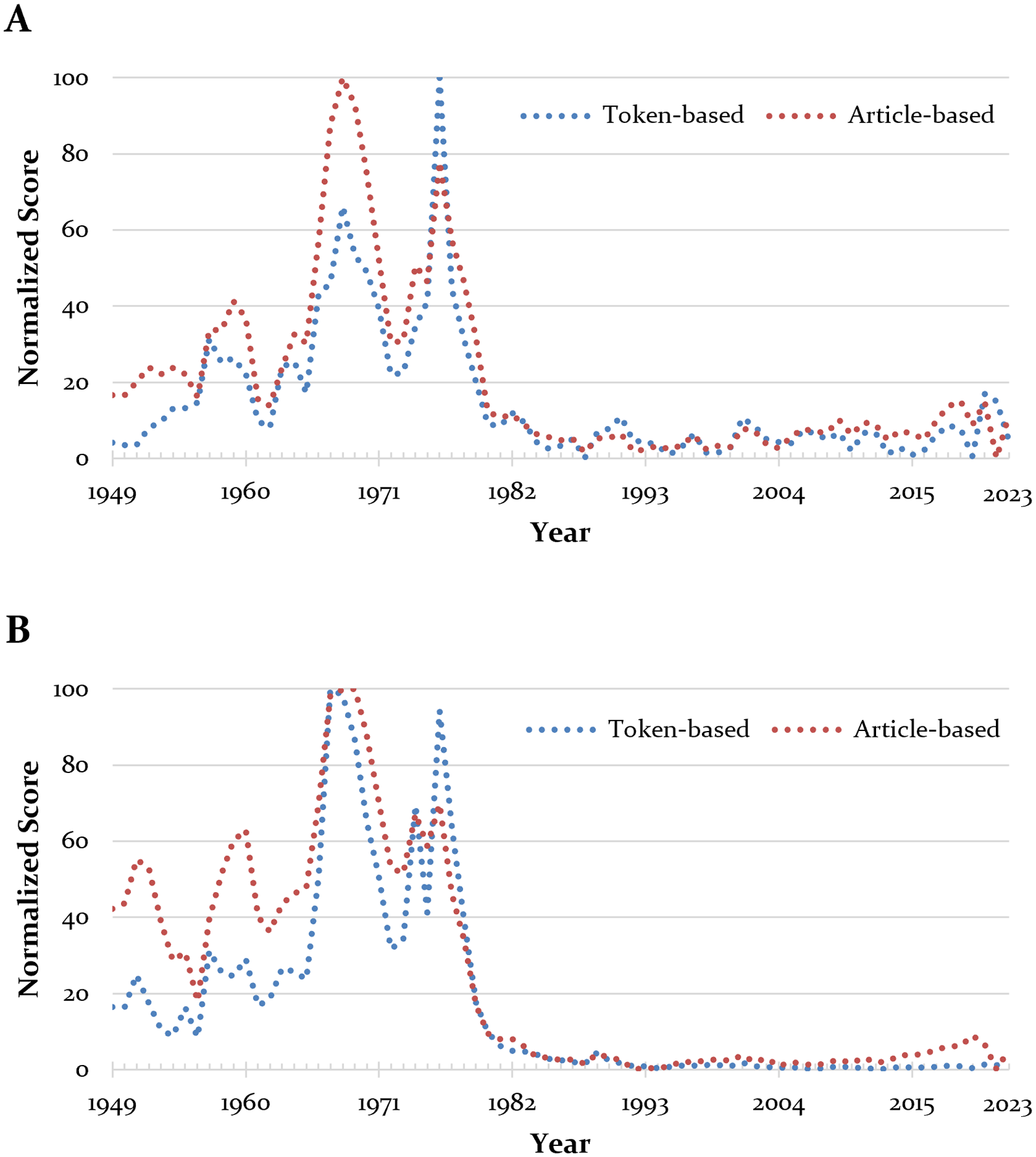
Figure 2 illustrates the trends in politicization levels in two panels. Panel A displays the trends for ideology scores, and Panel B shows the trends for campaign scores, with both panels featuring token-based and article-based measurements. The overall patterns align with the periodization in Table 1, reflecting the phases of politicized, hyper-politicized, depoliticized and modest re-politicization in the later period. Minor fluctuations correspond to key political events, such as the 2001 ideology index rise coinciding with the introduction of the “Three represents.” In the post-Mao era, ideology remains high and is comparable to the early PRC years in token-based measures, while campaign drops to its lowest, with only a slight resurgence in the re-politicized period, supporting our theoretical expectation of ideology’s sustained centrality.
Normalized Annual Token-based and Article-based Scores, 1949–2023

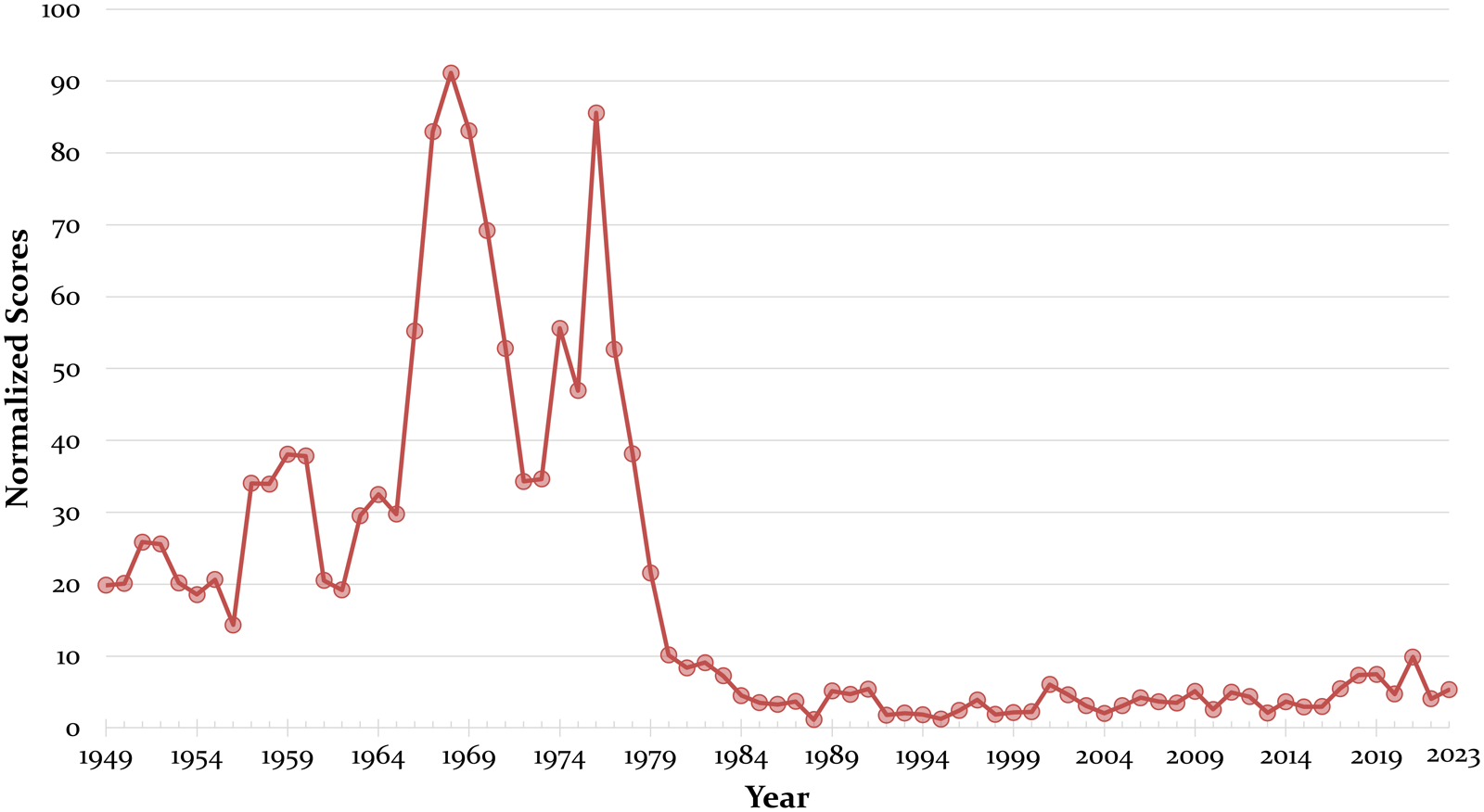
Figure 3 shows the trend for the composite politicization index, which validates our theory of four distinct periods with different levels of politicization. The politicization index remains relatively high, fluctuating between 10 and 40 throughout Mao’s early regime, which spans from 1949 to 1965. The line jumps sharply in 1966 with the onset of the catastrophic Cultural Revolution, symbolizing the beginning of the hyper-politicized regime. Following Mao’s passing in 1976, there is a dramatic drop. Since 1979, however, the trend has generally stabilized, with slight increases observed in 1989 and 2001 corresponding to the Tiananmen Square incident and the prominence of the “Three represents” proposed by Jiang Zemin from the end of 2001. The line shows a slightly upward trend after Xi took power in 2013, marking a re-politicized era, with the score fluctuating around 10. However, these scores remain much lower than those seen in the first politicized period from 1949 to 1965.
Annual Politicization Index, 1949–2023

We also used factor analysis to establish the index, and the pattern is solid, as demonstrated in Figure B.3. in the supplementary material. We opted for the averaging method because it facilitates simple updates to the index for subsequent years, allowing for the direct calculation of each score. Conversely, factor analysis necessitates the incorporation of initial values from all years and generates new values after factorization. This would result in changes to previous year values with each update, rendering its results unsuitable for use as the politicization index.
Modelling Regime Politicization in CCP Membership
Politicization serves as a crucial lens for understanding Chinese society and is a key indicator to consider in the stratified study of this context.Footnote 71 Taking Party membership as an example, we illustrate how the politicization index can be applied in empirical research. Specifically, our analysis focuses on how politicization impacts traditional stratification variables – the “red” factor of political loyalty and the “expertise” factor of merit credentials – which, in turn, influence the likelihood of joining the Party.
Data and method
We constructed an event history dataset from 1949 to 2018 to measure the trend in Party membership during this period.Footnote 72 We harmonized four major surveys that contain life-history information relevant to the key measures of Party membership attainment, education and occupation: the “Life History and Social Change in Contemporary China” (LHSCCC) from 1996; two waves of the “Chinese General Social Survey” (CGSS) from 2003 and 2008; four waves of the “China Labor-force Dynamic Survey” (CLDS) from 2012, 2014, 2016 and 2018; and five waves of the “China Family Panel Studies” (CFPS) from 2010, 2012, 2014, 2016 and 2018. We carefully harmonized the pooled data, ensuring that each survey had a common structure of life history variables for the key measures. Our analytical sample consists of 34,815 cases and 628,749 person-years.
We built upon the traditional models of CCP membership attainment using key factors such as “red,” represented by parental CCP membership and administrative status, and “expertise,” represented by individual occupation and education, as well as parental professional status. We applied discrete-time event history analysis, incorporating the politicization index to examine how politicization influences the likelihood of joining the CCP and the mechanisms behind it. The modelling was performed by StataBE 18.
CCP membership, 1949–2018
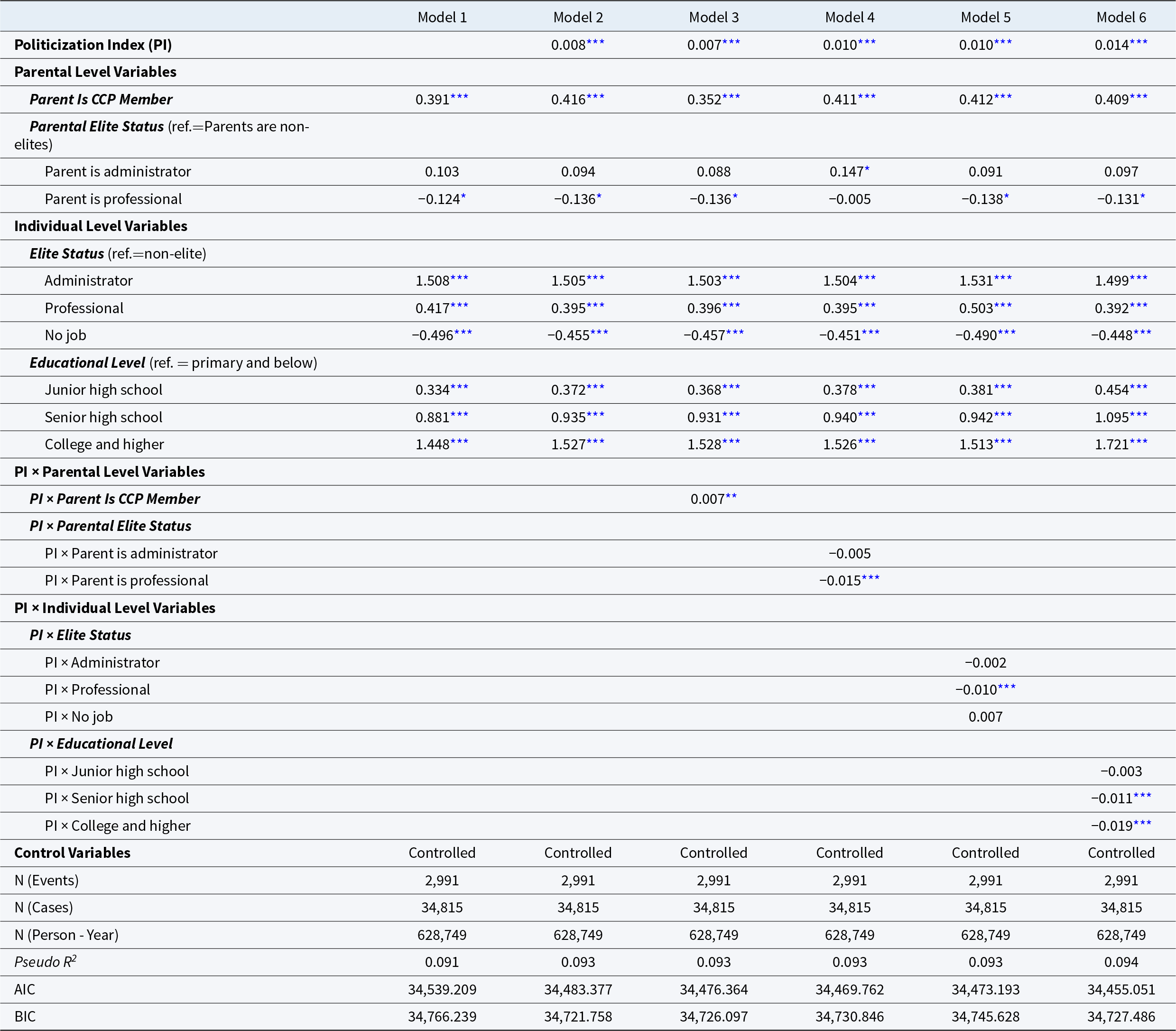
Table 2 displays the results of models predicting CCP membership attainment. By comparing Model 2 with Model 1, we find that the politicalization index significantly increases the likelihood of gaining Party membership. Moreover, the inclusion of the politicalization index enhances the explanatory power of the model, providing empirical evidence of the index’s importance in the Party membership attainment model. This illustrates how the regime’s mobilization strategies align both in propaganda and in practice.
Discrete-time Event History Analysis of CCP Membership Attainment

Source: Authors.
* Notes: Level of significance: *p < .05; **p < .01; ***p < .001.
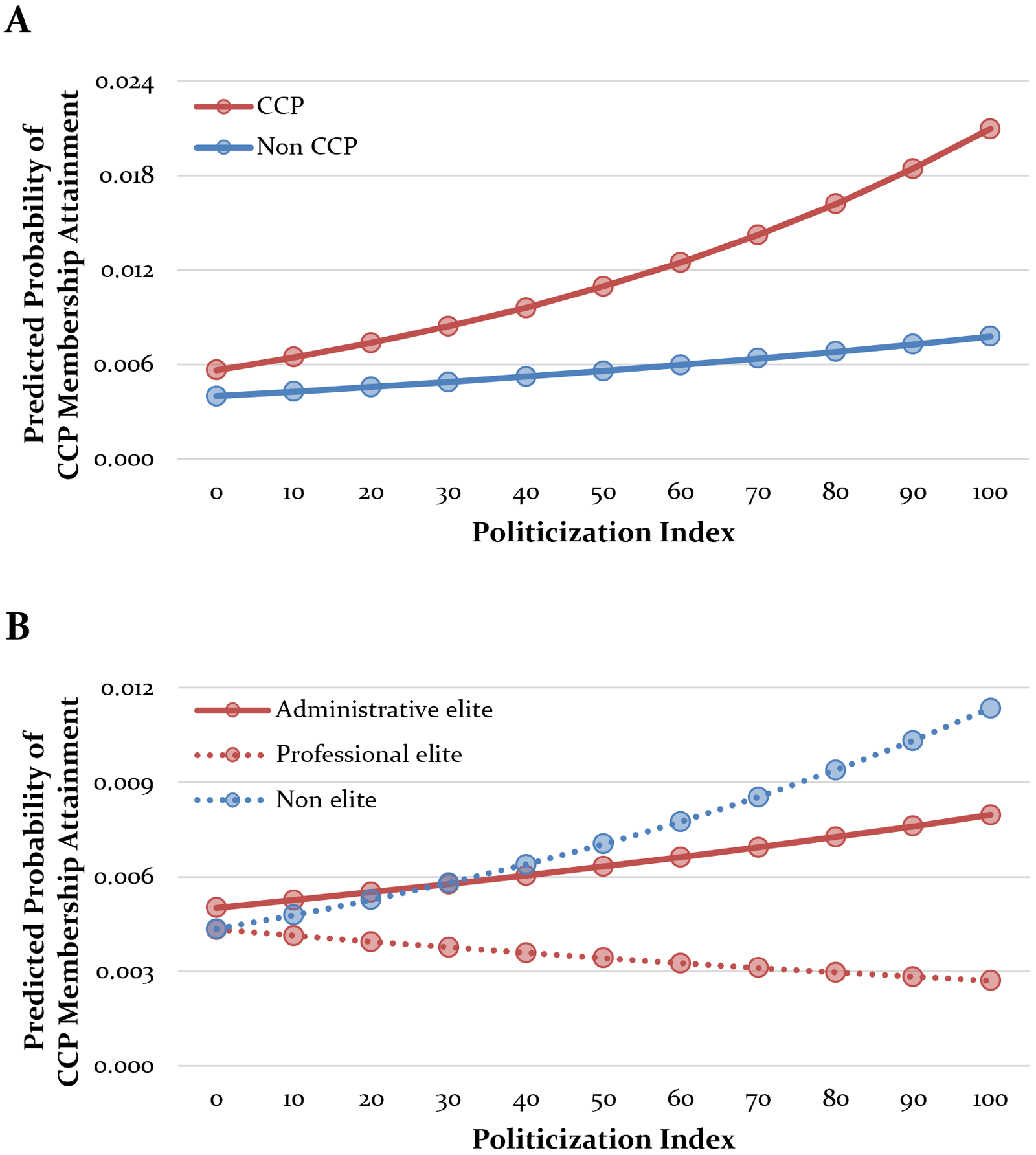
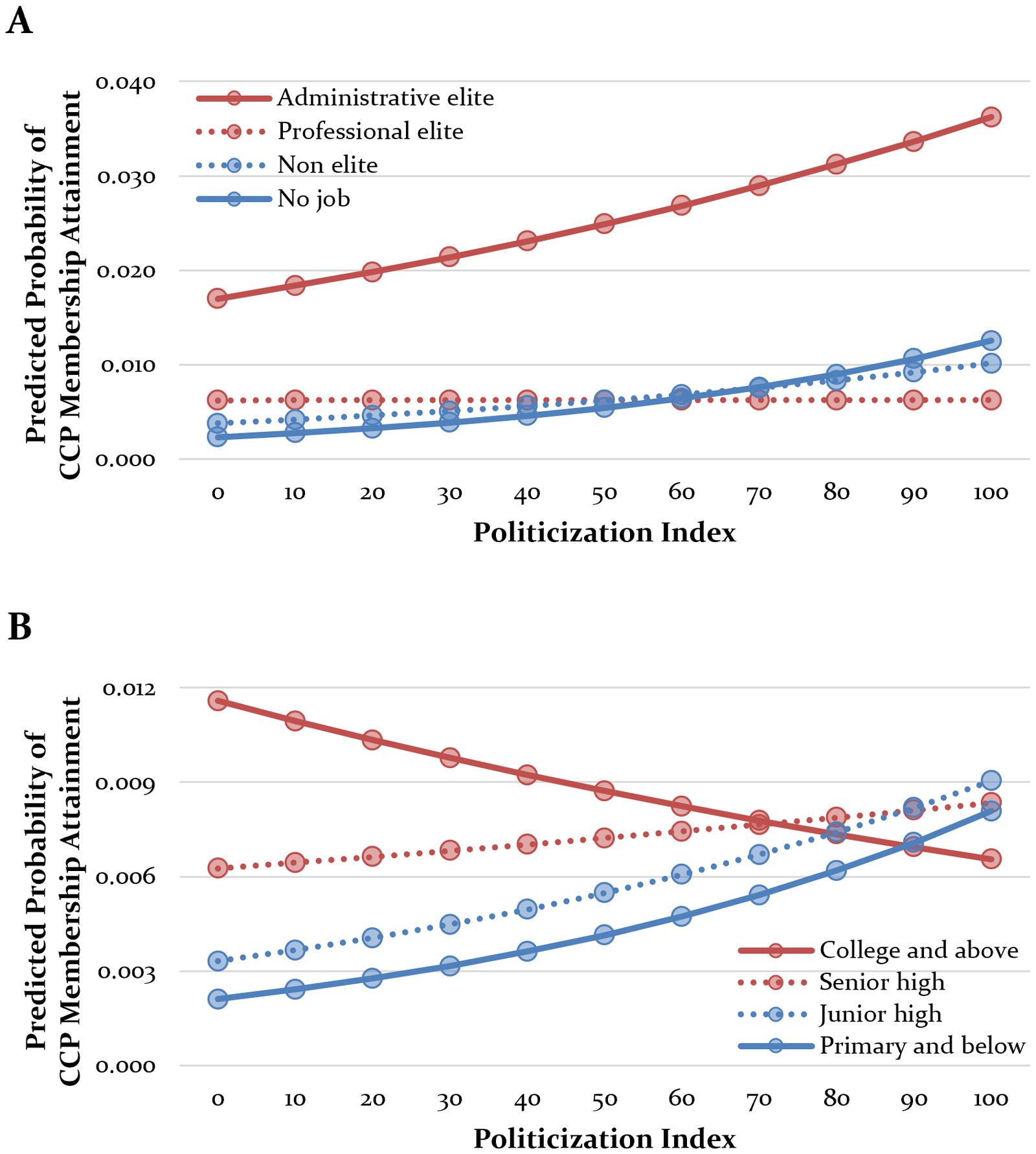
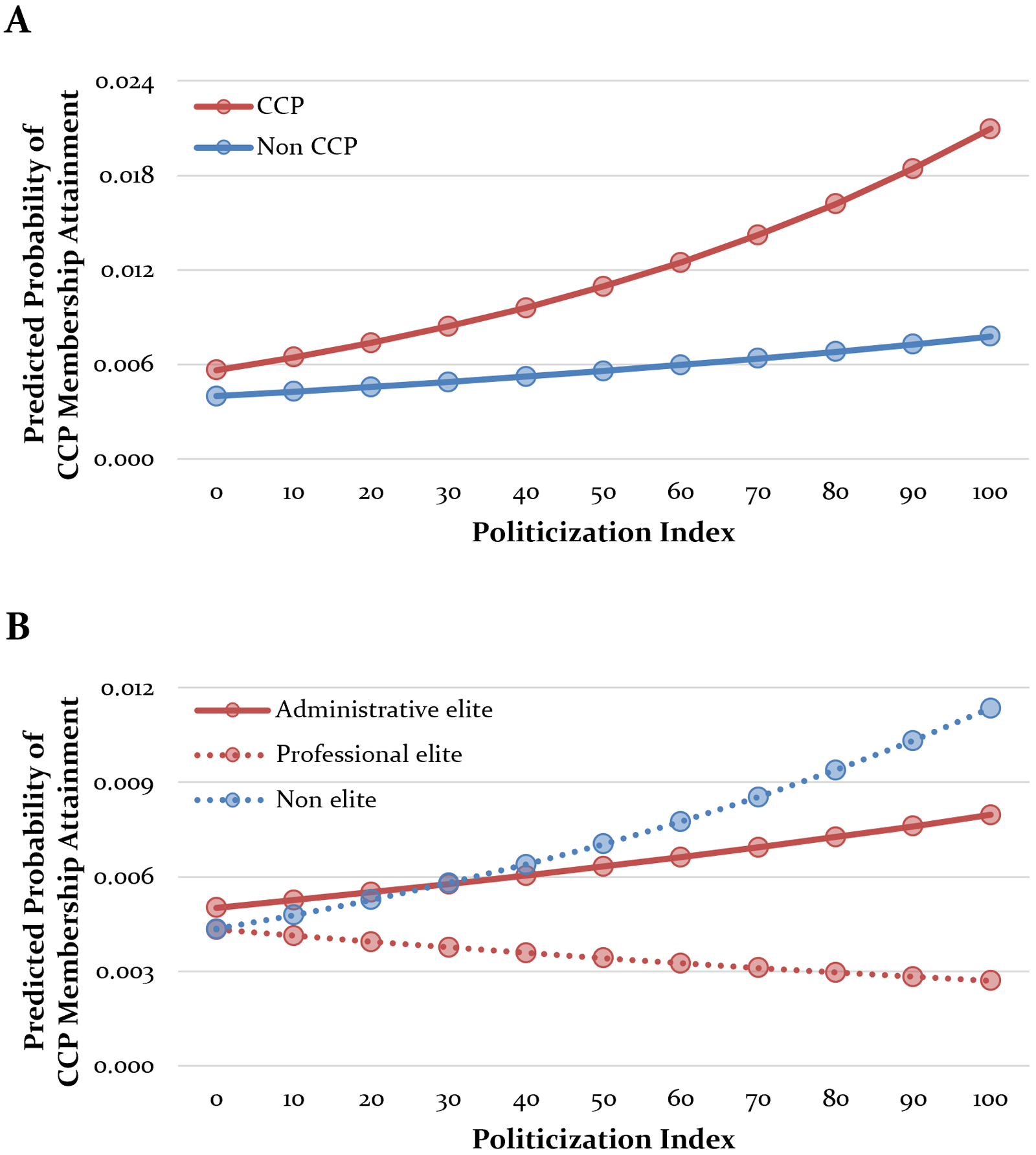
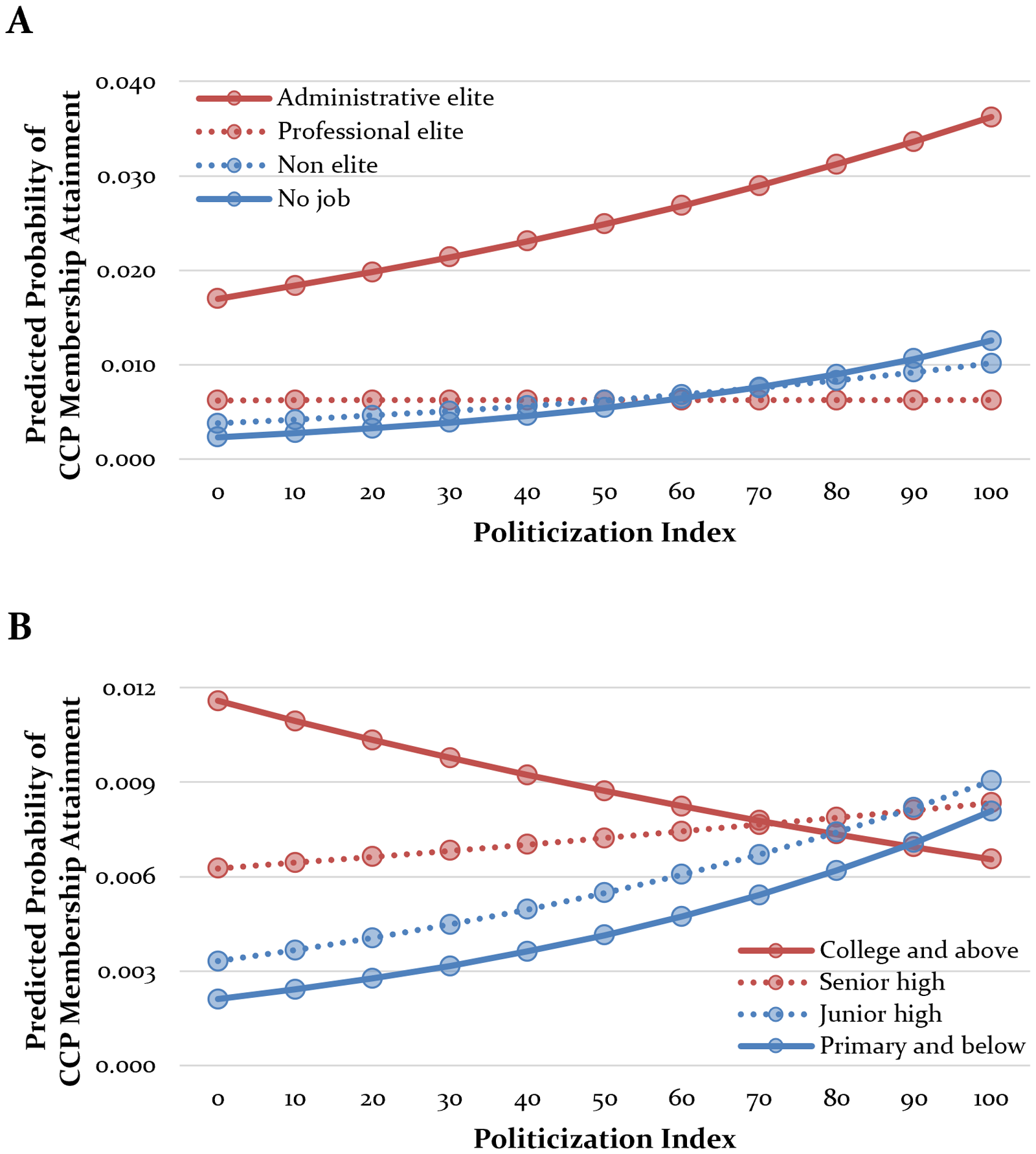
Models 3 to 6 illustrate the impact of the politicalization index on CCP membership. We examined the interaction between the politicalization index and the four variables representing “red” and “expertise,” demonstrating how the level of politicization moderates the effects of family background and personal characteristics. In Model 3, a positive interaction coefficient indicates a heightened advantage of parental CCP membership in a more politicized social environment. In Model 4, the politicalization index has no effect on individuals with political elite parents, but it significantly reduces the disadvantage for those with technical elite parents. Models 5 and 6 indicate that as the political polarization increases, the advantages of professional status and educational background for joining the Party diminish.
Figures 4 and 5 illustrate the marginal effects of key variables on the probability of gaining CCP membership as the degree of politicization increases, with Figure 4 focusing on family background variables – that is, parental Party membership and occupational status – and Figure 5 examining personal qualifications. It is evident that as the degree of social politicization increases, the influence of “red” gradually amplifies and the significance of “expertise” simultaneously declines in the process of obtaining Party membership.
Predicted Probability of CCP Membership Attainment by Politicization Index
Predicted Probability of CCP Membership Attainment by Politicization Index
Conclusion and Discussion
China’s political trajectory over the past seven decades has been intricately shaped by periods of varying degrees of politicization, reflected in ideological dissemination and political campaigns orchestrated by the CCP. This study introduces a robust politicization index that measures these dynamics using a comprehensive dataset derived from over two million articles published in the People’s Daily from 1949 to 2023. Through the index, we analyse the dual dimensions of ideology and campaigns as pivotal elements of CCP governance and societal control.
Our conceptual model identifies four distinct periods: the politicized period of Mao’s early era from 1949 to 1965, characterized by a focus on class struggle; the hyper-politicized period from 1966 to 1978, marked by the traumatic Cultural Revolution and the continuation of Mao’s ideology under Hua Guofeng 华国锋; the depoliticized period from 1979 to 2012, during Deng’s reform era, which prioritized economic development; and the re-politicized period under the current leader Xi Jinping, considered as a revival of Maoism since 2013. Empirical evidence supports our theoretical model. We establish four scores along with a compound factor to depict changes in China’s politicization. The robust results align with our theoretical framework of four different politicization regimes.
Our politicization index serves as a bridge between politicization theory and empirical research. Future studies on China can utilize this index as a macro-level variable in trend analyses, such as the uplift in CCP membership, job success and even marriage and divorce rates.
Our empirical demonstration of politicization in Chinese society represents a bold endeavour. We acknowledge that the development of this index is still in its early stages and there is ample room for improvement. For instance, many scholars argue that the nomenklatura system within the CCP is crucial for understanding societal control, yet we did not build it into our index. This omission stems from the system’s historical continuity under CCP rule, with government structures consistently operating under CCP oversight. Furthermore, our current index relies on the frequency of politicized terms in texts from a politicization dictionary. Future advancements could employ large language models in the annotation of the politicization dictionary This approach promises a more refined understanding and a more efficient measurement of politicization dynamics in China in many other aspects (beyond our ideology–campaign framework).
While recognizing the need for further refinement, our intention is to open up avenues for broader exploration. By doing so, we aim to provide a new perspective and toolset for future researchers and policymakers, facilitating deeper insights into the complexities of political and social change in China.
Supplementary material
The supplementary material can be obtained from the corresponding author.
Acknowledgements
We are very grateful to Xiaoguang Li, Yinghui Li, Sonja Opper and two anonymous reviewers for their helpful comments, as well as the doctoral students who participated in the online workshop series organized by Professor Yanjie Bian during the pandemic (2020–2023) during which drafts of this paper were discussed.
Conflicts of interest
None.
Yixue ZHANG is a doctoral candidate in sociology at the Institute for Empirical Social Science Research, Xi’an Jiaotong University (XJTU), China. Her research focuses on political sociology, particularly the quantification of China’s macro political institutions, and health sociology, examining how social networks shape the health behaviour of adolescents, especially their physical activity.
Lingfeng HE is a doctoral candidate in sociology at the Institute for Empirical Social Science Research, Xi’an Jiaotong University (XJTU), China. His research focuses on the application of computational methods to social sciences, with particular emphasis on the construction of sociological indicators featuring high spatial and temporal resolution.
Yanjie BIAN is distinguished professor of humanities and social science and the director of the Institute for Social Science Research, Xi’an Jiaotong University (XJTU), China. He is professor emeritus of sociology at the University of Minnesota and also formerly taught at the Hong Kong University of Science and Technology. He has published extensively in the areas of economic sociology, social inequality, social networks and contemporary Chinese society. He is currently developing the sociology of guanxi and theory of Chinese-style modernization, with additional efforts to conduct empirical research on ethnic relations in China.