1. Introduction
The term ‘ethnicity’ derives from the Greek word ethnos, and exists in modern French as ethnie, with the associated adjective ethnique. The adjective appears in modern English as ‘ethnic’, with a suffix added to give ‘ethnicity’.Footnote 1 However, the Greek origin of the term and its subsequent evolution as a notion, though sometimes expressed in different terms, are often ignored in its contemporary use. Instead, ethnicity is sometimes claimed to be quite a ‘new’ term. For example, in the introduction to an edited volume published in 1975, the editors (Glazer and Moynihan), referring to ethnicity, claimed that it was a new term appearing roughly in the middle of the twentieth century.Footnote 2 Likewise, in the Theories of Ethnicity, Thompson claims that the almost universal acknowledgement of ethnicity as a social category is a recent phenomenon, and its historical genesis is quite easily traced.Footnote 3 He finds ethnicity largely absent in academic discourses in the 1950s and 1960s. In the context of the US, he argues, three concurrent events of the 1960s – the Civil Rights Movement, the Vietnamese War, and a period of impressive economic prosperity – combined in a way that shook the optimism and naïveté of American society apropos the malleability of ethnicity.Footnote 4 As a consequence, concern with ethnic and racial issues enthusiastically re-emerged at that time to the extent that in 1977, ‘one commentator even noted that ethnicity is the social sciences’ newest growth industry’.Footnote 5
The claims to novelty, however, ignore the antiquity of the notion of ‘ethnicity’ as well as its political implications. Far from being ‘new’, this notion has been playing a long-standing political role. With reference to this role of ethnicity, this paper examines how the liberal treatment of ethnicity as backward ‘otherness’ informs international law of minority protection in the post-Cold War context. The peculiarity of the post-Cold War moment of international law in relation to ethnicity remains in the fact that on the one hand, the collapse of the Soviet empire is celebrated as the landslide of liberalism (expressed in its core values of individual liberty and equal rights for all individuals), the end of history and also liberal-democratic ‘progress’ and peace; on the other hand, eruption of violent ethnic conflicts even in Europe brought the issue of ethnicity to the forefront.
In the following sections, this paper will try to grasp the ambivalence this post-Cold War confrontation of liberal ‘progress’ and ethnic ‘primitiveness’ has engendered in relation to minority protection in three different ways. First, I argue that in the international law of minority protection, the definition of the minority as the ‘other’ is informed by the notion of ethnicity, in that almost all the UN and European instruments invariably define the minority as a group, members of which collectively share primordial characteristics distinct from that of the majority or the rest of the population. But in contrast, the liberal individualist response to minority ‘protection’ is characterized by the endeavour to remove ethnicity from the concept of ‘minority’. And finally, it is again the notion of ethnic ‘otherness’ that rationalizes a differentiated minority protection mechanism for the East and the West within post-Cold War Europe.
To substantiate this argument, at first, I provide an account in section 2 of how the notion of ethnic ‘otherness’ travelled through time. This is followed by a discussion in section 3 on the relevance of ethnicity in the liberal tradition to set an analytical framework through which I then explore three different roles of ethnicity in the liberal understanding of minority protection in the post-Cold War context.
2. Ethnicity as backward ‘otherness’: an etymological exposition
In ancient Greek, while genos was generally used by Greeks of Greeks themselves in a restricted kinship sense, ethnos was the term for the ‘others’.Footnote 6 Tonkin, McDonald, and Chapman trace similar uses of ethnos in other Greek classics: Aeschylus uses ethnos to describe the Furies (Eumenides 366), and also the Persians (Persai 43, 56; also Herodotus 1.101); Sophocles uses it for wild animals (Philoctetes 1147; Antigone 344); Pindar employs the term to describe groups of like people, but ‘again people whose location or conduct put them in some way outside the sphere of Greek social normality’, e.g., the husband-killing women of Lemnos (Pythian Odes 4.448); Aristotle uses it for foreign or barbarous nations, as opposed to ‘Hellenes’ (Politics, 1324.b.10); Romans, writing in Greek under the empire, use the term to describe a province, or the provinces in general – areas that were not Rome (Appian Bella Civilia 2.13; Herodianus 1.2.1; Dion Chrysostom 4.3.11).Footnote 7 Tonkin, McDonald, and Chapman thus assert that
[a]spects of naturality, of non-legitimate social organisation, of disorganisation, and of animality, are strong in ethnos. . . . It is characteristic of this area of vocabulary, perhaps in all languages, that any term for ‘people’ in a general sense, has the potential for being taken up into a duality of ‘us’ and ‘them’, and from early use this has been the fate of ethnos.Footnote 8
In later uses, in New Testament Greek, ethnos appears as a religious indicator to refer to non-Christian and non-Jewish. At this stage, the derived adjective ethnikos is very nearly synonymous with barbaros – those who spoke unintelligible languages, and wanted for civilization, who were beyond the bounds of meaning, order and decency.Footnote 9 Because throughout the Middle Ages it was Church Latin that dominated literacy in Europe, the term gentile – a grouping for religious ‘otherness’ – succeeded ethnos.Footnote 10 In public Roman law, jus gentium represented a body of rules for Romans in maintaining relations with foreigners, while jus civile governed interactions between citizens. The term ‘law of nations’, the synonym for the present-day phrase ‘international law’, is the literal translation of the Latin term jus gentium into English.Footnote 11 Although jus gentium used to deal with individuals, as opposed to nation-states, which are the subjects of the law of nations,Footnote 12 the phenomenon of managing the ‘other’ is quite evident in both cases.
The term ‘ethnic’ has long been used in English in its Greek New Testament sense as an unusual intellectual synonym for ‘gentile’, denoting ‘pagan’ or ‘non-Christian’, and it retained this sense until well into the nineteenth century.Footnote 13 But from about the mid-nineteenth century, scholarship has made of ethnos a word meaning something such as ‘group of people of shared characteristics’.Footnote 14 The notion of ‘otherness’ in ethnos then shifted to the image of the ‘self’, expressed through the dominant political vocabulary of the nineteenth century – ‘nation’. As the etymology of the term demonstrates, the nation used to refer to shared biological characteristics. Deriving from the past participle of the verb nasci, meaning ‘to be born’, the Latin noun nationem connotes ‘breed’ or ‘race’.Footnote 15
The relevance of the biological features in the understanding of a nation would gain impetus with the emergence of social Darwinism in the latter part of the nineteenth century. However, prior to the emergence of the ‘scientific’ justification for racial superiority of a nation, what dominated the quest for finding the self-image in the nineteenth century was ‘culture’. This quest appears, in Gellner's account, largely as the Romantic response to the Enlightenment. While the Enlightenment was premised on an ‘individualistic, universalistic and egalitarian’ ethic as opposed to the ‘oppression, dogmatization, superstition and inequality of the agrarian age’, Romanticism praised a sense of specificity in feeling and culture.Footnote 16 In this sense, a nation is, then, the product of the process of creating the culturally specific ‘self’ in relation to the ‘other’.
The Romantic response to the Enlightenment had its root in the German tradition. To the Germans, the authentic Kultur of the German people was to be preferred to the French notion of rational, scientific and universal civilization – the Enlightenment.Footnote 17 The eighteenth-century German philosopher Herder is a key proponent of this emergent Romantic nationalism who, despite acknowledging that all mankind shared the same basic attributes, claims that nations have modified their characters according to their specific cultural conditions.Footnote 18 For him, the nation is like an enlarged family, and the most natural state is one which is composed of a specific people with a unique national character.Footnote 19 It is therefore opposed to the verdict of nature, he argues, to expand the nation beyond its natural limits and thereby cause the indiscriminate mingling of various nations and human types.Footnote 20 A nation, in Herderian sense, is thus a unique and specific ethnic connotation.
Like Herder, the German political theorist Fichte also inclined to the uniqueness of the German Kultur despite his strong faith in the universal solidarity enshrined in the French Revolution. This shift from liberal universalism to the locality of culture was caused by increasing French expansionism under the pretext of liberalism at the dawn of the nineteenth century.Footnote 21 Works of his late life clearly reveal this shift from liberalism to Romanticism. In his celebrated work Address to the German Nation (1808), less than a decade before he died, he portrays the German nation as an authentic entity with all its peculiar natural characteristics. The original and truly natural frontiers of all states, he asserts, are undoubtedly their inner cultural frontiers.Footnote 22 The cultural features, he continues, are so peculiar to that particular nation that any nation of a different origin and language that would try to appropriate and absorb such a people could do this only by confusing itself as well as profoundly disturbing the uniform progress of its own education.Footnote 23 Within this Romantic framework, no doubt, Fichte found the idea of universalism quite problematic; to take his words, ‘despicable’ and ‘irrational’.Footnote 24 His vision of the world is thus constituted of culturally specific nations.
Compared to Herder and Fichte, the nineteenth-century scholars of the German Historical School, such as Leopold Ranke, took a more conservative stance. For Ranke, the greatness of a nation lies not in the extent of its possessions or the power of its troops or the amount of its wealth or its share in the general civilization, but in the moral strength of the nation and its sense of nationality – the two most important things but for which a state cannot exist.Footnote 25 In the face of the ever-increasing influence of the French philosophy of rationality and materialism, Ranke thus advocates for a counter spiritual force – nationalism – to contain that influence: ‘The dominion which another nation threatens to gain over us can only be combated by developing our own sense of nationality.’Footnote 26 And while explaining this nationalist spirit, he actually refers to ‘the real, existing one’ – not merely an invented, illusionary nationality – which is expressed in the state.Footnote 27 It implies, therefore, that the authentic root of the German nation-state needs to be traced; nothing could be a better tool to this end than the idea of ‘race’.Footnote 28 Thus, the romantic image of a nation having its foundation in ethnicity was destined to exclude the remaining ‘other’ in the process of constructing the ‘self’.
However, this nineteenth-century notion of ethnicity expressed as ‘otherness’ remains relevant in its current use to identify the ‘outsiders’ – in most cases, minorities – within the nation. The present dictionary meanings of the term ‘ethnicity’ exemplify this phenomenon. The Oxford Dictionary provides two meanings of the term ‘ethnic’, both of which are also mentioned in the Chambers Dictionary: one is something ‘connected with or belonging to a nation, race or tribe that shares a cultural tradition’, and in this sense, ‘ethnicity’ is defined as ‘[t]he fact of belonging to a particular race’.Footnote 29 Though interrelated, each of these three categories – nation, race, and tribe – represents three different connotations. Tonkin, McDonald, and Chapman hold the view that the early Greek use of ethnos might be compared to modern English ‘tribe’ – ‘a term still used by many educated people to describe all political units that are not of the familiar nation and nation-State kind’. They highlight the animality in this term by referring to the phrase ‘the tribesmen swarming like ants over the rocks’ in an account of some British imperial campaigns.Footnote 30
The ‘otherness’ in ‘ethnic’ is exhibited more precisely in another Oxford meaning of the term: ‘Typical of a country or culture that is very different from modern Western culture and therefore interesting for people in Western countries’, e.g., ethnic dress, food, and so on. In other words, ethnic is exotic, non-European. This way of defining the ‘other’ through Western imaginations is perhaps best explained by Said. Although the process can be traced in antiquity, for him this never stopped; ‘the European, whose sensibility tours the Orient, is a watcher, never involved, always detached, always ready for new example . . .,’ and ‘[t]he Orient is watched’.Footnote 31 Drawing upon the fact of the creation of the ‘Orient’ through sweeping generalizations by the West, Said concludes that the construction of identity involves establishing opposites and ‘others,’ and this ‘otherness’ is interpreted and reinterpreted in a historical process in relation to difference from the ‘self’.Footnote 32 In this sense, ethnicity simultaneously defines both the ‘self’ and the ‘other’.
To a great extent, Said's proposition is premised upon Foucault's historical, philosophical, and epistemological analyses that set his methodological framework by connecting with the utilization of discourses of those who wield power in society, and through which the social order receives its classification. In The Order of Things, referring to the now-famous classification of animals in a ‘certain Chinese encyclopedia’, Foucault asserts that while most people would regard this classification of animals to be ludicrous, this presents us an opportunity to recognize the limitations of our own classification system, by which we would not think of this alternative.Footnote 33 In his words, ‘the thing that, by means of the fable, is demonstrated as the exotic charm of another system of thought, is the limitation of our own, the stark impossibility of thinking that’.Footnote 34 While the people in power merely presume that their own presently accepted classification scheme presents an objective reality, they actually exclude numerous alternative classification schemes.Footnote 35 A particular classification scheme is thus a cultural code of interpretation, what Foucault usually calls a ‘discursive formation’ – a set of deep rules for ordering that is embedded in our own cultural language.
Against this backdrop of ethnicity expressed as primitive ‘otherness’, in the following section I first explore the meaning of ethnicity in the liberal tradition and then the ways in which this tradition of dealing with ethnicity informs the ‘protection’ of minorities in the post-Cold War context.
3. Ethnicity in the liberal understanding of minority protection
3.1. The liberal tradition of dealing with ethnicity
The post-Revolution philosophy of the Enlightenment and liberalism relied heavily on individualism and international solidarity to contain the sense of national loyalty. The German philosopher Immanuel Kant had the most prominent stance in locating the individual within the universal realm, which is the essence of the Enlightenment idea. For Kant, a state is a union of an aggregate of men. The act by which they constitute a state is the original contract, through which all individual members sacrifice their freedom that exists in the state of nature in order to receive civil rights in return.Footnote 36 Thus, in so far as the laws reflect the wills of the individuals, the form of the state will be the one that the principle of right requires.
For Kant, human beings not only make up a nation, they also belong to an international community, of which all the nations are members.Footnote 37 Thus, with the analogy that the way individuals have to sacrifice their lawless state of nature to join the republic, he proposes that states must for the same reason relinquish some of their freedoms available in a savage natural condition for the sake of the universal good.Footnote 38 And the vision of the rights that states ultimately enjoy among themselves is ‘cosmopolitan’, insofar as they contribute to the union of all nations for the purpose of certain universal laws to regulate the intercourse they may have with one another.Footnote 39
Kant's cosmopolitanism is an effort to transcend the natural geographic confinements of ethnicity and nations – a move towards progress in the form of universalism. He finds such geographic demarcation of nations obvious, given that nature has confined nations within an area of definite limits through the spherical shape of the planet they inhabit. But on the other hand, his cosmopolitanism conceives the specific geographic demarcation as an act of possessing a part within a determinate whole in which everyone has an original right to share, and in this sense, ‘all nations are originally members of a community of the land’.Footnote 40 This is a cosmopolitan community formed not by legal rights of possession or ownership, but by the mutual activities of commerce.Footnote 41 In the political sphere, Kant projects such a union of nations in the form of a confederation of nations that would maintain peaceful international order.Footnote 42
Kant's proposition received criticism from Herder, as we have already noted, who advocated Romantic ideas of ethno-cultural specificity and held the view that the rights of cultural nations should supersede the natural rights of all. Within the liberal stream, Hegel adopted a different approach to oppose Kant's proposition. Like Herder, Hegel held the view that the individual exists within a general consciousness, i.e., the national consciousness. The individual is brought up with the atmosphere of this consciousness – the substance that underlies the spirit of the nation that informs all the aims and interests of the nation as well as determines the nation's rights, customs, and religion.Footnote 43 But, for Hegel, the spirit of the nation, which is particular in essence, is identical with the universal spirit that is revealed through the human consciousness, corresponding to the divine, hence absolute, spirit. The spirit of the nation, Hegel continues, is therefore the universal spirit in particular form, but the latter is dependent on the former for its actual being or existence. Although the particular spirit of a particular nation may perish, it disappears as a ‘particular moment’ of the development of the world spirit, which is absolute, hence omnipresent.Footnote 44 What is implied, therefore, is an evolutionary process to reach the absolute universal spirit, wherein particular national spirits fuse to supplement each other; some disappear in the process but an advanced new spirit also appears. In the words of Hegel:
Each new individual national spirit represents a new stage in the conquering march of the world spirit as it wins its way to consciousness and freedom. The death of a national spirit is a transition to new life, but not as in nature, where the death of one individual gives life to another individual of the same kind. On the contrary, the world spirit progresses from lower determinations to higher principles and concepts of its own nature, to more fully developed expressions of its idea.Footnote 45
This universal spirit that takes a particular national form for coming into actual existence as the consciousness within a state is the nation's culture; this is the form to which everything within the state is assimilated.Footnote 46 Given that the state embodied a particular spirit, and the law is the objectivity of the spirit as well as the will in its true expression, Hegel concludes, when the subjective will of men subordinates itself to laws, ‘the objective and the subjective will are then reconciled, forming a single, undivided whole’.Footnote 47 As Wild summarizes, Hegel's totalitarian thinking sees the dangers of an uncontrolled, individual freedom and aims to gain an all-inclusive, panoramic view of all things, including the ‘other’, in a neutral, impersonal light – the Geist (spirit).Footnote 48 Unlike Herder and Fichte, Hegel thus reconciles liberalism with the Romantic ethnic appeals by locating national spirits within the framework of the state and its laws.
In contrast, Levinas, with his phenomenological approach to Hegel's totalitarian thinking, suggests another way that takes into account the ‘other’ and his criticism. Instead of taking the panoramic sense of vision as its model for understanding, this refers to language where there is always room for the diversity of dialogue, and for further growth through the communicative dynamics between the self and the other.
This other-regarding way of thought rejects traditional assumption that reason has no plural, and asks why we should not recognize what our lived experience shows us, that reason has many centres, and approaches the truth in many different ways. Instead of building great systems in which the singular diversities of things and persons are passed over and diluted, this way of thinking prefers to start with the careful analysis of the peculiar features of each being in its otherness, and only then to clarify its relationship with the ‘other’ in the light of its peculiar and distinctive features.Footnote 49
Yet, in the liberal nation, ethnicity remains at the sidelines, and the liberal discourse on whether the ethnic ‘other’ – often ‘minorities’ – should be assimilated or allowed to maintain cultural distinctiveness is informed by an instrumental understanding of ethnicity. For example, although Mill held the view that for the efficient working of a representative government it is imperative that the boundaries of government coincide with those of nationalities, he does not see the solution in the creation of German-style ethnic nations by excluding the ‘other’; instead, he advocated the assimilation of the lower and backward portion of the human race into that of the higher for the betterment of the backward as well as of the entire human race.Footnote 50 Thus, according to Mill, a greater interest of the Breton and the Basque of French Navarre, or the Welshmen and the Scottish Highlander, lies in their assimilation into the highly civilized and cultivated French and British nations, respectively.Footnote 51
While Mill prescribes the merger and absorption of one nation in another to secure the homogeneity that is crucial for representative governance, Acton, in contrast, is of the view that ‘[t]he combination of different nations in one state is a necessary condition of civilized life’.Footnote 52 For Acton, this diversity not only results from liberty, but also maintains liberty by creating a barrier against the intrusion of the government beyond the political sphere, supplying the greatest variety of intellectual resource, providing perpetual incentives to progress, among other things.Footnote 53 Multiculturalism helps the liberal evolutionary process too: ‘Inferior races are raised by living in political union with races intellectually superior.’Footnote 54 Unlike the German ideology of the nation, Acton insists that diversity persists under the same state, for as an instrument of civilization it will indicate greater advancement and progress than national unity.Footnote 55 Nevertheless, he refutes the validity of any claim of political allegiance on individuals by the nations within the state; instead, it is only the nationality formed by the state to which individuals owe political duties and thereby devolve corresponding political rights.Footnote 56 In his words:
The difference between nationality and the state is exhibited in the nature of patriotic attachment. Our connection with the race is merely natural or physical, whilst our duties to the political nation are ethical. One is a community of affections and instincts infinitely important and powerful in savage life, but pertaining more to the animal than to the civilized man; the other is an authority governing by laws, imposing obligations, and giving a moral sanction and character to the natural relations of society.Footnote 57
Thus, Acton's proposed diversity is more about a strategic choice to facilitate stability within a multinational state, which is formed in a historical process. The pragmatic tone is expressed in the distinctiveness of the approach that he claims: it aims not at an arbitrary change, but at careful respect for the existing conditions of political life; it obeys the laws and results of history, not the aspirations of an ideal future.Footnote 58
Thus, in both the liberal approaches to a different ethnic group within the state, ethnicity must either submerge in the state-imposed national identity or silently remain at the periphery for other instrumental purposes such as sociopolitical stability. In neither case is ethnicity important on its own merit – a feature that stands in sharp contrast with the salience of ethnicity in ethnic nationalism. What is common between Mill and Acton is their vision of a nation-state that heads toward a progressive, scientific world civilization – a universal spirit that consistently reflects back on the character of the state. This is such a high level of cultural progression that all other nations should be guided in this direction.
The assimilationist urge of liberal nationalism, along with its conservative, exclusionist counterpart, had recourse to another significant concept of the late nineteenth century: social Darwinism. Both monogenic and polygenic streams of social Darwinism, having the binding force of ‘science’, offered the logic of assimilation of different social groups within one political unit or their strict segregation on the basis of race.Footnote 59 While the polygenists argued for the exclusion of the derogated ‘other’ to preserve racial purity, the liberal, monogenic framework actually went beyond being a mere parallel of natural evolutionary processes to rationalize assimilation.Footnote 60 As Dickens persuasively presents, while describing social evolution the social Darwinist scholarship indicated ‘progress occurring through evolution, direction to social change and teleology, an end which is built into social change itself’.Footnote 61 Given that this monogenic understanding of evolution was informed by the Enlightenment philosophies, unsurprisingly all these concepts of progress, direction, and teleology in fact related to the realization of a civilized society in the Western European sense. Thus, ‘progress’ is exemplified by modernization; a modern society is a fully developed one that relies on modern political, educational, and legal systems as well as includes a value system supportive of economic growth in contrast to the ‘traditional’ societies that largely depend on clan-based or autocratic systems of government as well as pre-Newtonian science and technology.Footnote 62 The same is true for the concepts of ‘direction’ and ‘end’.Footnote 63
It is, therefore, the vision of a ‘culture’ through which ‘progress’ would be maintained and, thereby, the ‘end’ would be realized. Given that the ‘high culture’ that would lead to the liberal ‘progress’ is the selected cultural traits in the social evolutionary process, everything else is arguably destined to submit to this high culture. This explains the logic of assimilation of the low cultural groups, such as ethnic minorities, into the liberal, universal high culture.
The nineteenth-century concept of world civilization was translated into the theory of modernization in the early twentieth century and then into the notion of globalization in the era that followed.Footnote 64 Nevertheless, in both cases, culture – in ethnic, hence backward, terms, i.e., the low culture – remained labelled as a barrier to progression; culture was invoked to explain apparently irrational behaviour and self-destructive strategies directed towards the attributes of advanced societies such as development and democracy.Footnote 65 Nevertheless, ethnicity continued to inform the liberal understanding of the minority and minority protection in complex ways. In the following three subsections, I discuss three such ways in which the notion of ethnic ‘backwardness’ as well as ‘otherness’ interacted with the liberal individualist approach to minority protection in the post-Cold War context.
3.2. The liberal understanding of the minority as the backward ethnic ‘other’
Although any study on the minority essentially refers to the complexities involved in defining the term, ethnicity remains the core of a perception of the minority. For example, the UN Sub-Commission on Prevention of Discrimination and Protection of Minorities formulated in 1950 guidelines for a definition of the minority, one of which conceives of the minority as those non-dominant groups in a given population that ‘possess and wish to preserve stable ethnic, religious or linguistic traditions or characteristics markedly different from those of the rest of the population’.Footnote 66 The minority was defined accordingly in 1954.Footnote 67 Thus, the concept of ‘otherness’ in the Sub-Commission's understanding of the minority is translated into the subordinate position of the minority in a given society compared to the majority, while, by wishing to preserve its distinctive characters as the insignia of its identity, the minority simultaneously appears as a symbol of the nineteenth century's conservative tradition of defining the ‘self’ in ethnic terms, which makes it different from the liberal understanding of the ‘self’ as a non-ethnic notion. In other words, this process of defining a minority can be seen as an ambiguous pronouncement: in one direction it speaks of the ‘otherness’ of the minority understood in terms of its ethnic differentiation from the majority, the converse of its ‘otherness’ being to affirm the ethnic homogeneity of the majority. In another direction it may speak to the liberal tradition by emphasizing the contrast between those who are committed to speak the language of ethnicity in their self-identification, and the majority who have dispensed with such a condition.
A similar approach was adopted by the special rapporteurs on minorities in their seminal works. The Capotorti Report of 1979 defined the minority, in the context of Article 27 of the International Covenant on Civil and Political Rights (ICCPR), as ‘a group which is numerically inferior to the rest of the population of a State and in a non-dominant position, whose members possess ethnic, religious or linguistic characteristics which differ from those of the rest of the population and who, if only implicitly, maintain a sense of solidarity, directed towards preserving their culture, traditions, religion or language’.Footnote 68 Special Rapporteur Deschenes, in a text transmitted to the Human Rights Commission in 1985, defines the minority in a like manner.Footnote 69 The mention of ‘a sense of solidarity’ in these definitions demands particular attention. It is this sense of solidarity and collective will that makes a minority, as a group, different from a group of individuals formed for everyday purposes in rational terms. Here remains the fundamental contrast between the liberal and conservative attitudes towards the way in which identity of the ‘self’ is perceived. Besides, in both definitions, the minority is depicted as a group identified by primordial characteristics which are not only distinct from the rest of the population (or majority), but also meant to be preserved as distinct. The minority defined in this way is assigned a specific position in the ‘self’ and ‘other’ discourse. The phenomenon of ‘otherness’ in the concept of minority was also emphasized by the state parties while commenting on the provisional interpretation of the term ‘minority’ provided by Special Rapporteur Capotorti.Footnote 70
This trend is unmistakably reflected in the post-Cold War international and European instruments. The text of the Declaration on Persons Belonging to Minorities (1992) and the document issued by the Commission on Security and Cooperation in Europe (CSCE) Meeting of Experts on National Minorities (1991) both perceive minorities as bearers of ‘ethnic, cultural, linguistic and religious identity’.Footnote 71 Although the Steering Committee on Human Rights to the Council of Europe could not agree on a definition of the minority, the Committee in the end formulated a list of criteria to identify ‘persons belonging to national minorities’; holding primordial features, the distinctiveness of these features from the rest of the population, and the wish to preserve collectively this distinctive collective identity remain at the core of this list.Footnote 72 The Parliamentary Assembly of the Council of Europe (COE) defines the ‘national minority’ as a group of persons in a state who, among others, display distinctive ethnic, cultural, religious, or linguistic characteristics and are motivated by a concern to preserve together that which constitutes their common identity, including their culture, their traditions, their religion, or their language.Footnote 73 Although there is no general definition of a ‘national minority’ at the level of the Organization for Security and Cooperation in Europe (OSCE), Henrard claims that ‘there is a silent, practical consensus in the OSCE that the concept ‘‘minority’’ concerns ‘‘a non-dominant group which constitutes a numerical minority within a state’’ and also that it would refer to ‘‘non-dominant, distinct, numerical minorities within a state’’’.Footnote 74 Thus, in the mandate for the High Commissioner on National Minorities it is suggested that a ‘national minority’ would typically fulfil two conditions: ‘First of all, a minority is a group with linguistic, ethnic, or cultural characteristics, which distinguish it from the majority. Secondly, a minority is a group which usually not only seeks to maintain its identity but also tries to give stronger expression to that identity.’Footnote 75
Taken together, what is common in all these definitions and understandings of the term ‘minority’ is the image of a group in a subordinate position, which has at its core certain ethnic features that the members of the group not only share but also intend to preserve as insignia of their identity. This very desire of preserving these features makes minorities the symbols of the conservative passion. In this sense, the minority is not only the ‘other’ of the majority within a given polity because of its distinctive ethnic features, but also the ‘other’ of liberal universalism due to its tendency to portray its self-image in ethnic terms. Therefore, instead of being understood as an isolated object with certain distinctive features, the minority needs to be perceived in relational terms – it is in this uneven relationship with the majority (in the realm of power and in terms of demographic composition) and liberalism (at the ideological level) that the ‘minority’ is consistently defined and understood as ‘distinct’ as well as primitive. The hierarchy of this relationship is, furthermore, informed by another aspect of inferiority attached to the definition of the minority: as Schermerhorn puts it lucidly, an image of ‘minority’ essentially captures a condition of inferiority in relation to both demography and power.Footnote 76
Thus, ethnic ‘otherness’ lies at the core of an understanding of the minority as expressed in a series of definitions adopted over a number of decades. However, ethnicity has a paradoxically different role to play in the notion of the ‘protection’ of minorities, to which we turn now.
3.3. International ‘protection’ of minorities through individualism
International law in the aftermath of the Second World War was indeed set to reaffirm faith in and to promote progressive universal norms such as fundamental human rights, the dignity and worth of individuals, and equal rights, among others. However, progression equated to Western liberal values, and universalism simply meant the imposition of these values on a global scale. The ethnic notion of the minority stands in sharp contrast with progressive liberal values. Besides, as the conventional wisdom concerning interwar minority protection dictated, minorities were conceived as a constant threat to the modern state system. Thus, the new regime desired, as we shall see, to remove ‘ethnicity’ from the concept of the minority and fill the vacuum with the Western-style liberal individualism.
The liberal disavowal of the protection of minorities in the conservative sense was explicit from the outset of the post-Second World War world order. The issue of the protection of the constitutive features of minorities as well as their sense of solidarity (hereinafter, minority protection) was carefully avoided during the San Francisco Conference, though few references to minorities were actually made.Footnote 77 In the Charter of the United Nations, discrimination on the basis of sex, race, language, religion, and birthplace has been explicitly prohibited in a number of places,Footnote 78 and for the framers of the Charter, reliance on ‘non-discrimination’ was the appropriate way of addressing the issue of minority rights.Footnote 79 Although the Sub-Commission on Prevention of Discrimination and the Protection of Minorities was created as a compensatory measure, its work towards protection of minorities made little progress due to constant prioritization of the prevention of discrimination.Footnote 80 In the Universal Declaration of Human Rights too, the principle of non-discrimination prevailed without any reference to minorities. The dominant argument remained that the individual human rights would, in themselves, provide the necessary protection to minorities through the principle of non-discrimination. US Representative Eleanor Roosevelt explicitly declared that there should be no minority provision in the Declaration, and asserted that ‘the best solution of the problem of minorities was to encourage respect for human rights’.Footnote 81
Similarly, Article 27 of the ICCPR addressed the issue of minority within the individualist framework of the Covenant. The individualism in this article is substantiated when read with Article 5(1) of the Covenant, which stipulates that nothing in the Covenant will be interpreted in a way that would jeopardize the individual rights and freedoms guaranteed in other provisions of the Covenant. It is also reinforced in the Optional Protocol to the ICCPR, which recognizes the competence of the Human Rights Committee to receive and consider communications from individual victims alone.Footnote 82 The issue of protection of minorities appeared in a number of other international human rights instruments, and, necessarily, non-discrimination was the guiding principle to approach the issue.Footnote 83
From a liberal standpoint, this is nothing short of desired, in that within the liberal individualist framework, it is not even considered necessary to ‘protect’ any culture per se.Footnote 84 The protection of minorities in a liberal sense can at best be perceived as the protection of minorities from the very constitutive elements of their identity – ethnicity. Given that ethnicity, expressed in the conservative tradition of the perception of self-image, not only turns the minority into the victim of oppression by the majority, but also undermines the individual rights of the minority group members, the liberal way of minority protection would thus logically mean the suppression of ethnicity through the individualist principles of equality and non-discrimination. In other words, the liberal version of minority protection appears as an emancipatory project: the liberal not only constructs minorities as a symbol of conservative traditions, but also protects them from the curse of ethnicity – the very constitutive element of minorities. The conservative notion of minority protection, meaning the promotion of ethnic features and solidarity, is therefore incompatible with liberalism. Such a liberal regime of minority protection, from the perspectives of ethnic minorities, readily permits the subordination of minorities to the majority culture under the veil of principles of non-discrimination, equality, and so on.Footnote 85
Ethnicity in the international protection of minorities

Yet, in the real world, the continued existence of minorities keeps the underlying ethnic phenomenon alive, and thereby poses a constant challenge to this liberal imaginary. The liberal way of dealing with this pragmatic challenge reveals the hesitancy at and reconciliatory approach to the idea of actively promoting ethnic identities. The pressing need to restore ethnicity in ‘minority protection’ emerged at the end of the Cold War with the eruption of a series of ethnic conflicts, which no longer could be wished away. Eruption of violent ethnic conflicts provided a fresh impetus for minority protection in international law. Most of the literature on minority rights covering this period refers to a causal relationship between violent ethnic conflicts and the resurgence of the claim for group rights for minorities. Some related the absence of minority group rights directly to the eruption of ethnic conflicts.Footnote 86 It is also quite plausible to suggest that even if there were extensive provisions protecting ethnic minorities, those might themselves have been condemned for keeping the spirit of ethnicity alive. Nevertheless, in the aftermath of the Cold War, the protection of minorities in ethnic terms once again gained attention as a viable pragmatic response to ethnic tension. Thus, while in the preceding regime ethnicity was conceived as a political void and, in this connection, minority protection was understood in purely liberal-individualist terms, in the post-Cold War phase, ethnicity came to push the agenda of minority protection towards the conservative line, and thereby made the liberal hesitancy at minority rights more visible and the need for a reconciliatory approach to these competing traditions more compelling.
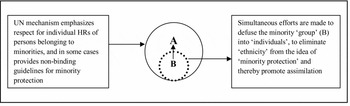
The UN Declaration on the Rights of Persons Belonging to National or Ethnic, Religious and Linguistic Minorities (1992) is the iconic document in this context, accommodating the post-Cold War consciousness about the ethnic dimension of minority protection.Footnote 87 Although designed to address the rights of individuals, the Declaration formulates state responsibilities towards minority groups. Unlike Article 27, the Declaration makes it clear that these rights often require action, including protective measures and encouragement of conditions for the promotion of their identity,Footnote 88 and specifies active measures by the state.Footnote 89 In his oft-cited commentary on Article 4 of the Declaration, Asbjorn Eide holds the view that these measures may require economic resources from the state; thus, in the same way as the state provides funding for the development of the culture and language of the majority, it shall provide resources for similar activities of the minority.Footnote 90 Such a positive attitude towards minorities certainly underscores the group dimension of minority protection.
However, the process was not as straightforward as it might appear. It was not an easy task to break with the dominant liberal-individualist approach to minority protection; a consistent balance had to be made. Thus, in the first place, the Declaration advocated rights for individuals in line with Article 27, and not for any group. Eide confirms this in his commentary: ‘The rights of persons belonging to minorities are individual rights, even if they in most cases can only be enjoyed in community with others.’Footnote 91 Therefore, the right to self-determination, which is a collective right of peoples, is outside the purview of the Declaration; the issue of autonomy shares the same fate. Moreover, as Henrard claims, the Declaration has little or no concrete content in relation to the right to enjoy one's own culture, the right to profess and practise one's own religion, or the right to participate in the religious life of the state.Footnote 92 Thus, in the final evaluation, Henrard depicts the provisions of the Declaration as some mere open ‘guidelines’ for states who are positive about minority protection.Footnote 93
Thus, this account of the liberal notion of minority protection demonstrates a rigorous effort to manage the conservative passion of ethnicity in relation to minority protection. Instead of being static, the response to ethnicity had to go through makeshift arrangements to reconcile norms with pragmatic needs from time to time. While the efforts to eliminate ethnicity from the idea of minority protection marked the dawn of a new universal regime of human rights drawn upon the liberal-individualist philosophy in the aftermath of the Second World War, de facto existence of minorities in the ethnic form and ensuing pragmatic needs gradually insisted on accommodating minorities along the line of the conservative tradition. The latter gained momentum in the face of ethnic violence that followed the end of the Cold War.
However, the overall individualist tone of the existing regime of rights, the celebrated universal norm that has been advocated to the ‘other’ world as a policy prescription for ethnic peace, remained an obstacle to the effective accommodation of minorities. What appears as a result is the rhetoric of the protection of minority groups without the actual creation of any legal norm to this effect that would undercut liberalism itself. Ethnicity, thus, remains in the UN mechanism of minority protection as a symbol of constant tension between the liberal and conservative traditions: it is there at the core of the liberal understanding of the ‘minority’ as a conservative connotation, but simultaneously avoided in the case of minority protection.
3.4. The European context: the minority as a problem of the ‘ethnic’ East
The collapse of the Soviet empire, along with the ensuing end of the Cold War, gave birth to a hope so high that Fukuyama even called it the ‘end of history’ as he saw the progression of human history as a struggle between ideologies coming to an end with the world settling on liberal democracy.Footnote 94 However, eruption of violent ethnic conflicts even in Europe brought the issue of ethnicity – a primitive notion in liberal understanding – to the forefront. During that troubled time of ethno-nationalist upheaval, Europe inclined towards more accommodative policies vis-à-vis national minorities. For example, since 1989 the CSCE/OSCE included statements of national minority rights in all texts setting human rights standards, such as the Copenhagen Document,Footnote 95 among other official documents that formed the basis of the organization's activities.Footnote 96 Recommendation 1201 of the Council of Europe Parliamentary Assembly (1993) even went further by stipulating that ‘the persons belonging to a national minority shall have the right to have at their disposal appropriate local or autonomous authorities or to have a special status’.Footnote 97
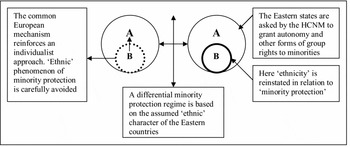
Yet, the European system of minority protection shared with the UN system the liberal hesitancy at the idea of creating uniformly applicable legal norms. Some Western countries not only opposed the idea of granting self-government rights to national minorities, but also showed reluctance to bring their own minority protection system under a supranational monitoring mechanism.Footnote 98 But at the same time, the liberal West found it necessary to devise a more accommodative and effective minority protection regime for the Eastern countries to respond efficiently to the potential violent ethnic conflicts in these countries despite the fact that the political structures of a number of Western democracies were and still are challenged by secessionist claims. Thus, a justification had to be made for differential treatments of minorities in two parts of Europe within a single European system of minority protection; it was done along a line which demarcated the conservative ‘ethnic’ East from the liberal ‘post-ethnic’ West very much in similarity with the minority protection regime under the League.
However, Kymlicka argues that under the new system the West relied on two different and contradictory tracks – a universal justice-based track and a security-based track. In the universal justice-based minority rights track, he argues, the liberal West systematically endeavoured to lower the standard of minority protection applicable to the whole of Europe, while in the security-based track only United Nations Economic Commission for Europe (ECE) states were put under special minority protection obligations on the grounds that minorities in these countries pose a security threat to Europe.Footnote 99 Indeed, a critical examination of the Framework Convention for the Protection of National Minorities (1994), which was meant to translate the political commitments of the OSCE into legal obligations, reveals that it consists of vague programme declarations, including several escape clauses, and grants member states a wide range of discretion.Footnote 100 Compared to the earlier OSCE Declarations or COE Recommendation 1201, the Convention is also weaker, in that it makes no reference to the right to autonomy or any other form of power-sharing for minorities, nor does it mention anything about official language status, or mother-tongue universities, or consociational measures.Footnote 101 Regarding the Framework Convention's approach to group rights, the Explanatory Report categorically states that the Convention does not imply the recognition of collective rights; instead, the emphasis is placed on the ‘protection of persons belonging to national minorities’ in conformity with the approach adopted by other international instruments in this regard.Footnote 102 As the Report mentions, the parties recognized that protection of a national minority could be achieved through the protection of the rights of individuals belonging to such a minority.Footnote 103
However, this is only one aspect of the relationship between ethnicity and minority protection in this context. Another aspect of this relationship demonstrates how the politics of minority protection in Europe simultaneously referred to the salience of ethnicity in the political organization of nation-states in Eastern and Central Europe as a reflection of the conservative tradition of this region. It is to be noted here that in a number of Western democracies too minorities are a ‘problem’, and they threaten political stability as well as national and international security in forms of secessionist claims and violence, though the degree of violence is much lower than what the East has experienced in the recent past. Nevertheless, the West has devised a separate mechanism, i.e. the office of the High Commissioner on National Minorities (HCNM) created in 1992 within the OSCE, to pressure the Eastern European countries to protect their minorities by ‘securitizing’ the minority issue.
The mandate of the HCNM crafted at the 1992 OSCE meeting held in Helsinki made it clear that the position of the HCNM was not created to implement international norms concerning minorities; instead, this position was entrusted with the foremost responsibility of conflict prevention.Footnote 104 Although the HCNM quite successfully used ‘minority protection’ as a norm to prevent ethnic conflicts in Eastern Europe, the mechanism itself is premised on the perception that minorities in these countries alone are the security threats to European stability, whereas the minority issues in the West can be effectively addressed through existing national legislation, democratic institutions, and international as well as European instruments with an individualist approach to rights. Therefore, the HCNM has not so far initiated an investigation into, or offered recommendations regarding, any Western country's minority rights record.Footnote 105 Under this differential system, the security mandate of the HCNM allows him to recommend forms of minority rights beyond those required by the Framework Convention, such as territorial autonomy, or official language status, or consociational veto rights. Although these recommendations are not legally binding, Kymlicka notes, the EU has repeatedly emphasized that these countries ‘seeking accession to the EU are expected to follow the HCNM's advice.’Footnote 106
However, Kymlicka's argument that the pragmatic need for additional protection of minorities in the ECE states, which the West refused to grant to their minorities, engendered a differential treatment, and that ‘securitizing’ the concept of ‘minority’ offered justification for this differentiation, ignores a very significant aspect of the dichotomy. His acknowledgement in one place that even the very understanding of the term ‘security’ is informed by the East–West dichotomy – in the West ‘security’ is narrowly interpreted to mean absence of war between states, whereas in the East it expanded in various directions to justify intervention in countries where there is little or no prospect of inter-state warFootnote 107 – in fact contradicts the argument that a differential treatment is dictated by value-free pragmatic needs, a mere state of affairs. Instead, it is quite evident from the structure of the specific minority protection mechanism for the East that the West attributes a different notion to minorities in these countries, which it carefully avoids in the discourse on the protection of its own minorities. And this is the conservative notion of ethnicity and its significance in the political organization of the nation-state that inform the liberal West's concept of ‘minority protection’ in relation to the Eastern European countries.
This role of ‘ethnicity’ in this context is a historical phenomenon that can be traced in the minority protection mechanism under the League. Despite the existence of a significant minority ‘problem’ in Great Britain, Italy, France, Denmark, and the defeated Germany at that time, and the initial efforts to bind all member-states of the League with minority protection obligations, the interwar international law of minority rights invariably brought only the non-Western countries under the minority protection obligations by signing a series of bilateral minority rights treaties. Not only the concept of minority, but also the very character of Eastern Europe was then conceived in ‘ethnic’ terms. Thus, in the Greco-Bulgarian Communities Case, the Permanent Court held the view that the ‘sentiment of solidarity’ and the importance of collective identity – in other words, the ethnic phenomenon – were the attributes of ‘Eastern Countries’.Footnote 108 Such incorporation of ethnicity, attributed to the conservative Eastern culture, justified the exemption of the Western countries from international scrutiny of their treatment of minorities.
This interwar perception of non-Western Europe reappeared in the post-Cold War context. The outbreak of ethnic violence with the collapse of Yugoslavia was closely linked to the salience of ethnicity in the conservative tradition of perceiving the self-image of the people in this region. In the liberal understanding, if ethnic primitiveness leads to irrationality and ensuing violence, the ethnic characteristics of the people in this region thus necessarily offer a fertile field for violent confrontations. Maria Todorova demonstrates, in line with Said's deconstructivist approach to the West's imagination of the Orient, how ‘as in the case of Orient, the Balkans have served as a repository of negative characteristics against which a positive and self-congratulatory image of the “European” and the “West” has been constructed’.Footnote 109 Bakic-Hayden argues that this ‘Balkanism’, to use Todorova's term, has been internalized by the Balkan states themselves, who then attempt to get rid of the ‘Balkan’ label by claiming themselves ‘European’ and simultaneously designating their neighbours’ nations ‘Balkans’.Footnote 110 This pattern reinforces not only the interwar ethnic dichotomy of the liberal, civilized West and the conservative, primitive East within Europe, but also the process of ‘othering’ on the ground of ethnic violence. Sumantra Bose notes that the stereotyping of the Balkans as primitive, and hence a source of conflict, has drawn many ‘adventure-seekers, missionary zealots on civilizing field expeditions, and careerists from contemporary dull and boring post-industrial Western societies’ to ‘exotic and tortured’ post-conflict Bosnia.Footnote 111
Ethnicity in the post-Cold War European context of minority protection

It is, therefore, no surprise that the European Community made the recognition of the new states (that came into being as independent states due to the dissolution of Yugoslavia) subject to the guarantee of minority rights in these states. The Declaration on the Guidelines on the Recognition of New States in Eastern Europe and in the Soviet Union declares that the EC and its member states have adopted a common position on the process of recognition of these new states, which requires ‘guarantees for the rights of ethnic and national groups and minorities in accordance with the commitments subscribed to in the framework of the CSCE.’Footnote 112 Similarly, the Declaration on Yugoslavia categorically mentions that the EC and its member states agree to recognize the independence of all the Yugoslav Republics provided that they accept, inter alia, ‘the provisions laid down in the draft Convention – especially those in Chapter II on human rights and rights of national or ethnic groups – under consideration by the Conference on Yugoslavia’.Footnote 113
With reference to these Declarations, the Arbitration Commission of the Conference on Yugoslavia (hereinafter, the Badinter Commission) decided that in the cases of SloveniaFootnote 114 and MacedoniaFootnote 115 all criteria were fulfilled and that in the cases of CroatiaFootnote 116 and Bosnia and HerzegovinaFootnote 117 additional activities were necessary (respectively, provision for an appropriate status of minorities and a referendum). Regarding Serbia and Montenegro, the Commission held that they have constituted a new state – the Federal Republic of Yugoslavia, and therefore, ‘its recognition by the Member States of the European Community would be subject to its compliance with the conditions laid down by general international law for such an act and the joint statement and Guidelines of [16 December 1991]’, which stipulated the protection of minorities in a conservative sense.Footnote 118
Reinforcing this dichotomy of liberal and conservative traditions apropos ethnicity, the OSCE/HCNM advances for the minorities in the non-Western European countries a number of group rights of varying strength, which range from mild forms of non-territorial cultural rights to confederation to associated statehood. Now, the concept of ‘minority’ is an ethnic phenomenon that necessarily has a conservative group dimension. At the same time, this ethnic character of minorities is attributed to the Eastern culture alone given their conservative tradition of perceiving self-image along ethnic lines, in contrast with liberal Western values. While the West is more inclined to the liberal democratic norms that sanctify individual freedom, the East arguably keeps emphasizing ethnic solidarity. And, once the East is conceived of as ‘ethnic’, minorities within it would require effective protection from exclusionist state-sponsored measures. In other words, the liberal construction of the East in conservative ethnic terms once again justifies that special minority protection obligations should be imposed on ECE states to suppress the threat to minorities – both of which are defined as conservative phenomena.
Therefore, it is this very nature of the Eastern states that defines the pragmatic needs expressed now as a ‘security issue’. The emphasis on this ethnic character helps the liberal West to distance itself from the East and also to avoid additional minority protection obligations. This ethnic dimension explains Kymlicka's observation that the concept of security is understood by the HCNM in two different ways in relation to the West and the non-West. Here the ethnic notion of ‘otherness’ silently informs an understanding of ‘security’ in the same way it explained ‘civilization’ and ‘backwardness’ in various epochs of international law.
Thus, in the security mandate of the HCNM, in the first place, ethnicity is reinstated in the discourse of ‘minority protection’, understood as the protection of minorities as groups with distinct characteristics, and second, the conservative tradition of the Eastern countries as to ethnicity, which in itself is arguably a historical phenomenon and distinct from the West's culturally advanced liberal approach, defines the pragmatic needs for ensuring ‘security’, which then justifies a differential system of minority protection for the East and the West within Europe.
4. Conclusion
This narrative of the international protection of minorities in the post-Cold War context demonstrates how ‘ethnicity’ plays a dominant role in the contemporary liberal understanding of minority protection within an environment of uneasiness and mistrust. Although ethnicity has always been playing a crucial role in the international law of minority protection, the significance of the post-Cold War era remains in the fact that now ethnicity re-emerges in the most complex manner to coexist with the liberal-individualist notion of human rights. While the efforts to eliminate ethnicity from the minority marked the dawn of a new universal regime of human rights in the aftermath of the Second World War, the existence of minorities as an ethnic phenomenon and ensuing pragmatic needs in the face of the post-Cold War ethnic violence gradually brought ethnicity to the surface of the current discourse on minority protection. Thus, instead of being the era of mere enforcement of the norms of international human rights law that allegedly developed during the Cold War, this era appears as the moment of reconciliation between ‘progressive’ human rights and ethnic ‘primitiveness’.