The use of a fit-tested N95 or FFP2 half-face respirator is recommended to protect against transmission of airborne pathogens,Reference Gomersall, Tai and Loo 1 , Reference Gomersall, Loo, Joynt and Taylor 2 but poor compliance with correct mask usage due to discomfort and the need for repeated fit-testing are problematic. The National Academies Institute of Medicine have recommended research to obviate the need for fit testing.Reference Fries and Shaffer 3
We previously studied a compact, reusable, high-efficiency particulate air (HEPA) filtering mask that can be cut to size (Totobobo, Dream Lab One Pte Ltd, Singapore). Its performance was suboptimal but not significantly worse than N95 respirators used without regular fit testing.Reference Au, Gomersall, Leung and Li 4 The new generation of mask incorporates changes that should result in a better seal. This mask is heat moldable and incorporates larger HEPA filters that reduce resistance to flow through the filters, which should decrease entrainment of unfiltered air around the mask.
METHODS
We conducted a pragmatic a prospective, unblinded, crossover study of the filtration factor of next-generation Totobobo masks compared to previously fit-tested N95 respirators (models 1860, 1860s, or 1862; 3M Health Care, St Paul, MN). Secondary end points were the proportion of subjects achieving a filtration factor ≥100 and subjective comfort. Approval was obtained from The Chinese University of Hong Kong New Territories East Cluster Clinical Research Ethics Committee, and informed consent was obtained from each participant.
In total, 22 healthy volunteers who had previously passed a fit test with a model 1860, 1860s, or 1862 N95 respirator tested the Totobobo mask and their previously identified fit-tested respirators in a computer-generated random order. Prior to testing the N95 respirators, subjects adjusted their respirators and performed a user seal test.
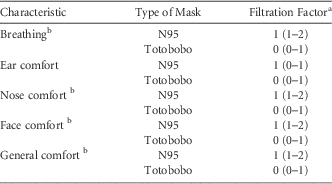
For each participant, a Totobobo mask was molded to fit the volunteer’s face after it was immersed in hot water and warmed with a hair dryer. The inventor visually assessed the fit by examining whether a water mark formed a continuous line, indicating a circumferential seal against the participant’s face. If necessary, specially designed rubber bands supplied by the manufacturer were added to improve the fit. The inventor was only involved in fitting and took no part in the measurement of filtration fraction, data analysis, or data interpretation. Volunteers underwent a standard, previously described, mask-fitting protocol to measure the filtration fraction.Reference Au, Gomersall, Leung and Li 4 This procedure involved calculating a filtration fraction from particle concentrations in air samples taken from inside and just outside the masks while performing different movements. All subjects were asked to complete a questionnaire (Table 1) on mask comfort immediately after the protocol was performed.
Tolerability Questionnaire

a 0, not affected; 1, mildly affected; 2, moderately affected; 3, severely affected.
b P=.001 (N95 vs Totobobo).
Filtration factors and questionnaire responses were analyzed using the Mann-Whitney U test. The proportion of subjects achieving a filtration factor ≥100 were analyzed using a χ2 test. P<0.05 was considered significant. The sample size was calculated to achieve a power of 80% based on an effect size of a probability of 0.24 that the filtration factor using one mask was less than the filtration factor using the other mask, with an α value of 0.05 (2-tailed).Reference Campbell, Julious and Altman 5
RESULTS
The median age of study participants was 42 years (interquartile range [IQR], 37.25–49.5); 86% were female. The median time since the participant’s last N95 fit-test was 4 years (IQR, 1–9.75). The median filtration factor was 77.5 (IQR, 49.75–135) for N95 masks and 84.5 (35.5–160.5) for Totobobo masks (P=.981). The filtration factor was ≥100 in 9 of 22 participants with N95 respirators and in 10 of 22 participants with Totobobo masks. Years since fit testing and N95 filtration factor were negatively correlated (Spearman’s ρ, −0.684; P=.01). The results of the tolerability questionnaire are given in Table 1.
DISCUSSION
The performance of the Totobobo mask adjusted to fit the subject’s face but not fit tested was similar to the performance of previously fit-tested N95 respirators, although both performance levels were suboptimal. This result suggests that Totobobo masks should not be used to replace N95 respirators if regular fit testing is possible but that these masks do show some promise when regular fit testing is not possible.
Fit testing is recommended annually or whenever there are visible changes in physical condition that could affect respirator fit (eg, facial scarring, dental changes, or cosmetic surgery), or an obvious change in body weight. 6 , Reference Zhuang, Bergman and Brochu 7 This recommendation imposes considerable logistic and financial burdens and is controversial.Reference Zhuang, Bergman and Brochu 7 In some situations, such as ours, in which it is not possible for all relevant healthcare workers to use a N95 respirator that has recently been fit tested, there are currently no established alternatives. Even multiple surgical masks do not achieve filtration factors of >13.7.Reference Derrick and Gomersall 8 Furthermore, it may be difficult to source appropriate respirators in an epidemic situation. Although the new generation of Totobobo masks has theoretical advantages, performance may not be superior to the old generation. Using the old generation, 16 of 22 subjects had a filtration factor ≥100.Reference Au, Gomersall, Leung and Li 4
Totobobo masks were more comfortable (according to most measures) than N95 respirators, which may lead to greater compliance in clinical practice, offsetting the lower filtration factor.
Our study has a few weaknesses. First, Totobobo masks were fitted by an expert, and the performance may be worse in real life. Second, filtration testing by the PortaCount machine is only a surrogate test; however, exposing subjects to real infectious agents would not be ethical. Third, we studied an exclusively Chinese group of predominantly female subjects. Facial characteristics may vary between racial groups, and our results may not be replicated in other groups.Reference Zhuang, Coffey and Ann 9 Finally, the study was unblinded; however, it was mainly based on objective parameters.
In conclusion, the new Totobobo masks may be useful when regular fit testing is not possible or when a limited range of masks can be stocked, but further testing is necessary.
ACKNOWLEDGMENTS
Free Totobobo masks were supplied by the manufacturer. The inventor of the mask assisted with shaping masks to fit participants’ faces. The manufacturer and inventor had no part in gathering or preparing data, data analysis, or the preparation or writing of the manuscript.
Financial support: No financial support was provided relevant to this article.
Potential conflicts of interest: All authors report no conflicts of interest relevant to this article.