INTRODUCTION
Cobalt (Co), an essential trace element, has long been recognized to have several important functions in ruminants. One such function includes the vital role Co plays in rumen microbial synthesis of vitamin B12 (McDowell Reference McDowell2000). Ruminant microorganisms are only capable of synthesizing vitamin B12 when adequate Co is present in the diet. Therefore, dietary Co is the limiting factor for ruminal microorganism syntheses of cobalamin, known as vitamin B12 (Sutton & Elliot Reference Sutton and Elliot1972). Vitamin B12 serves as a growth factor for many ruminal microorganisms (Tanner & Wolfe Reference Tanner and Wolfe1988) and is an essential co-factor for gluconeogenesis in the host animal. Gluconeogenesis is the process by which the liver, and to a lesser extent the kidney, converts fermentation by-products or glucogenic amino acids to glucose through a series of enzymatic reactions which require vitamin B12 as a co-factor (Seal et al. Reference Seal, Parker and Avery1992; Brockman Reference Brockman, Forbes and France1993). Tiffany et al. (Reference Tiffany, Spears, Xi and Horton2003) reported increased concentrations of ruminal vitamin B12 and propionate concentrations when Co was supplemented to steers fed a high-energy, Co-deficient diet. Along with its structural role in vitamin B12 synthesis, several studies have also suggested that Co may improve fibre digestion in the rumen by acting as a divalent cation (Lopez-Guisa & Satter Reference Lopez-Guisa and Satter1992).
The effectiveness of supplemental Co is dependent on the biological availability of Co not only to ruminal microorganisms, but ultimately the host ruminant. Thus, the source of Co fed may be important to both vitamin B12 production and the various roles Co is responsible for in the ruminant animal. Ammerman et al. (Reference Ammerman, Henry and Loggins1982) found Co oxide to be of lesser biological value when compared with Co carbonate (CC) or Co sulphate. However, limited information is known about organic Co sources and what, if any, benefits apply to supplementing organic source of Co to ruminant diets. Therefore, the objective of the present study was to determine the effect of supplementing an organic Co source on in situ fibre fermentation and serum vitamin B12 concentrations.
MATERIALS & METHODS
Animal management and measurements
The Fort Keogh Livestock and Range Research Laboratory Institutional Animal Care and Use Committee approved all animal handling and experimental procedures used in the present study.
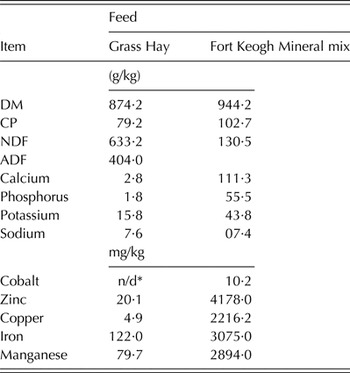
Twenty crossbred ruminally cannulated cows (577 ± 13 kg) were stratified by age (5 ± 0·4 years old) and prior lactation history (three cows did not raise a calf). Cows were assigned to one of two forms of Co supplementation: (1) 12·5 mg Co supplied as 27·2 mg of CC (n = 11 cows) (2) 12·5 mg Co supplied as 50 mg of Co glucoheptonate (CGH, n = 8 cows; Zinpro Corp., Eden Prairie, MN, USA). On the first day of treatment supplementation, one cow in the CGH treatment group was given a CC bolus, thus was moved to the CC treatment group, increasing this group to 11 cows. One cow in the CGH treatment group was found to be a true outlier, thus was removed from the study decreasing this group to eight cows. Diets met or exceed the dietary requirements for Co of 10 mg/kg (NRC 2000). Cobalt concentrations were below assay detection limits for the grass hay provided in the diet and verified by two independent commercial laboratory analyses. To alleviate weaning stress, calves were weaned 14 days prior to starting the trial, at which time cows were relocated from the native range to a common dry lot pen and fed a chopped grass hay diet, free choice (Table 1). Seven days prior to the start of the trial, cows were assigned randomly to an individual pen (6 × 10 m2) with ad libitum access to water. Water analysis revealed undetectable concentrations of Co and no other known antagonistic factors were detected. Throughout the trial all cows were fed a basal diet of chopped grass hay at a rate of 0·02% of body weight and 57 g of Fort Keogh Range Mineral top-dressed into each bunk once daily (07·00 h; Table 1). Cows were managed in individual pens for 62 days, which included an acclimation (AC), treatment (TR) and residual (RE) period. During the AC period (days 0–17), all cows were fed only the basal diet with no supplemental Co. On days 18–44 (TR period) cows received one of the two Co treatments daily, 2 h after feeding (09·00 h). Cobalt supplement was administered directly into the rumen via the rumen cannula in a gelatin capsule (Torpac, Inc. Fairfield, NJ, USA). From days 45 to 62 (RE period), cows received no Co supplementation to determine any carry-over effects from the previous TR period.
Chemical composition of hay and top dressed Fort Keogh Range Mineral fed throughout the 62-day experiment

DM, dry matter; CP, crude protein; NDF, neutral detergent fibre; ADF, acid detergent fibre.
* n/d: below detectable assay limits (confirmed by two independent commercial laboratories).
To estimate diet digestibility, in situ neutral detergent fibre (NDF) disappearance (ISNDFD) and in situ organic matter (OM) disappearance (ISOMD) were measured. Grass hay samples (same source as basal diet) were collected from stockpiled hay and ground to pass through a 2 mm screen (Model 4 Wiley mill, Arthur H. Thomas Co, Philadelphia, PA, USA). Dacron bags (10 × 20 cm2: 50 µm porosity: Ankom Technology Corp., Fairport, NY, USA) were filled individually with 5 g of ground grass hay and sealed. During the last 4 days of each period (AC d 14, TR d 41 and RE d 58) a 96 h in situ was initiated. At each incubation time (96, 48 and 24 h), five filled Dacron bags along with a sealed blank bag were placed in a 35 × 45 cm2 polyester mesh bag (Household Essentials, Hazelwood, MO, USA) anchored with ~1 m of string and a rubber stopper. The bags were then placed into the rumen in the vicinity of the mat and liquid interface and all removed at end of the 96 h interval. The empty bag was used as a correction factor for ruminal contamination entering the bags. The empty bag residue weight was subtracted from each sample bag at the same incubation time. Upon removal from the rumen, all the bags were subjected to an initial rinse by submerging them in a bucket filled with cold tap water to arrest microbial fermentation. Five filled bags and one empty bag were not inserted into the rumen, but were subjected to the cold water rinse (Wiley et al. Reference Wiley, Petersen, Clark, Ansotegui and Lodman1991) and designated 0 h bags. All bags were transported to the lab and rinsed individually under cold tap water until the effluent was clear, after which bags were frozen (–20 °C), lyophilized and weighed. Residue remaining in the bag was analysed for dry matter (DM), OM and NDF using the methods of Van Soest et al. (Reference Van Soest, Robertson and Lewis1991). Disappearance of NDF was determined with a batch processor (ANKOM 200 fibre analyser, ANKOM Technology, Fairport, NY, USA).
On days 17, 44 and 61 of the corresponding AC, TR and RE periods, blood samples were collected via coccygeal venipuncture (Corvac, Sherwood Medical, St Louis, MO, USA) at 4 and 6 h after feeding. Blood samples were centrifuged at 1500 g for 30 min; serum was decanted and stored at –20 °C until the analysis. Cobalamin was assayed by Ronald Kincaid's laboratory (Department of Animal Sciences, Washington State University, Pullman, WA, USA) using a Dualcount Solid Phase Vitamin B12/Folic Acid procedure (Siemens Healthcare Diagnostics, Los Angeles, CA, USA. Cat # KDSP1, interassay CV 4·2% and intraassay CV 3·3%) and expressed as pg/ml.
Particulate-associated carboxymethylcellulase (CMCase) activity was measured on residue from in situ bags incubated at 96, 48, 24 and 0 h for all three periods of cellulolytic activity in response to differing sources of Co supplementation. A single dacron bag/cow/incubation period was pulled randomly after lyophilization for the CMCase analysis. Approximately 0·4 g of residue was weighed into a 50 ml centrifuge tube, after which 8 ml of 10 mm sodium phosphate buffer (pH 6·8) containing 20 µg/ml of lysozyme (Sigma Aldrich, St. Louis, MO, USA) was added. Following an addition of 1 ml of carbon tetrachloride, the mixture was vortexed and incubated in a 37 °C water bath for 3 h. The tubes were then centrifuged at 29 000 g at 4 °C for 15 min and supernatant was decanted and frozen (–20 °C) prior to analysis. The CMCase assay has been previously adapted to utilize a 96-well micro plate system (Xiao et al. Reference Xiao, Storms and Tsang2004, Reference Xiao, Storms and Tsang2005). Thirty micro litres of the sample supernatant, in duplicate, was pipetted into a 96-well polymerase chain reaction (PCR) plate and an addition of 30 µl of 2% (w/v) sodium carboxymethylcellulose (Sigma Aldrich, St. Louis, MO, USA) containing 0·1 mg/ml of thirmersol was added to each well. The 96-well plate was incubated utilizing a thermocycler, programmed to heat to 50 °C for 30 min followed by cooling and holding at 20 °C. Following incubation, 60 µl of 3,5-dinitrosalicylic acid reagent (Miller et al. Reference Miller, Blum, Glennon and Burton1960) was added to each well. To develop colour, the plate was incubated again in the thermocycler programmed to heat to 95 °C for 5 min followed by cooling to 4 °C for 1 min and holding at 20 °C (King et al. Reference King, Donnelly, Bergstrom, Walker and Gibson2009). Following colour development, a 100 µl aliquot from each duplicated sample was transferred to the wells of a flat-bottom 96-well (Costar, Corning INC, Corning, NY, USA). Absorbance was measured on a plate reader (Synergy HT, Bio TEK Instruments INC, Winooski, VT, USA) at 540 nm. D-glucose was used as the standard, and CMCase activity was expressed as μm glucose released/g OM/min. Activity of CMCase was corrected by subtracting the background glucose activity from every sample (Bhatti & Firkins Reference Bhatti and Firkins1995).
Statistical analysis
Data were analysed using Proc Mixed procedures of SAS (Version 9.3, SAS Institute Inc., Cary, NC, USA). The experiment was a completely randomized design with three periods (AC, TR and RE). The restricted maximum-likelihood method was used for estimating the variance components and degree of freedom was adjusted using the Kenward–Roger option. The model included the fixed effects of treatment and period (TR and RE) and their interaction. Data were analysed by hour. The covariance structure used was variance components. The Repeated statement included period with the subject being cow. Corresponding measurements obtained in the acclimation period were used as covariates in the treatment and residual period. Significance was set at P ⩽ 0·05, while trends were considered between P = 0·05 and 0·10.
RESULTS
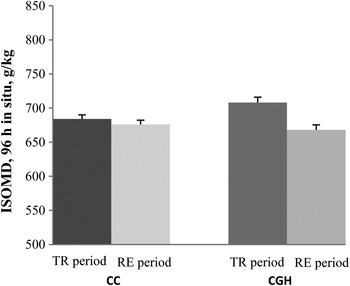
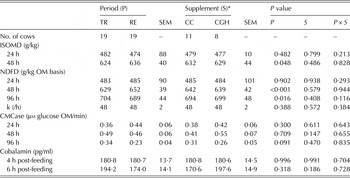
An interaction for ISOMD (P = 0·027) at 96 h was detected between source of Co and period (TR and RE, respectively). Cows receiving CGH exhibited a greater percentage of ISOMD when incubated at 96 h in the rumen, during the TR compared with the RE (TR; 684 and 708 ± 8 g/kg and RE period 676 and 668 ± 8 g/kg for CC and CGH, respectively; Fig. 1). Cobalt source did not affect ISOMD (Table 2) at shorter incubation times (24 and 48 h, respectively). However, ISOMD was increased when Co was supplemented at 48 h of incubation (P = 0·048). Disappearance of in situ NDF (OM basis) was less during the TR compared with the RE at 48 h (P < 0·001); however, by 96 h, the TR had greater disappearance (P = 0·016). No differences were found between sources of Co for ISNDFD. No differences were detected for the fibre fermentation rate.
In situ organic matter disappearance (ISOMD) at 96 h of low-quality grass hay from cows during a treatment (TR) period with Co supplementation and a residual period (RE) when no supplement was offered. During the TR period cows were supplemented daily with one of two treatments to provide 12·5 mg Co; 27·2 mg of Co carbonate (CC) or 50 mg of Co glucoheptonate (CGH, Zinpro Corp., Eden Prairie, MN, USA). The magnitude of ISOMD at 96 h decreased further for cattle previously supplemented with CGH compared with cattle previously supplements CC (P = 0·027).

In situ organic matter disappearance (ISOMD), in situ neutral detergent fibre (NDF) disappearance (ISNDFD), rate (k) of fibre fermentation and particle-associated carboxymethylcellulase (CMCase), specific activity of low-quality grass hay extrusa and serum cobalamin concentrations in cows during a treatment period (TR) with cobalt supplementation and a residual period (RE) with no supplement

* Cows were supplemented daily with one of two treatments; 27·2 mg cobalt carbonate (CC) or 50 mg cobalt glucoheptonate (CGH) to provide 12·5 mg cobalt.
Carboxymethylcellulase activity was measured to assess the effect supplemental Co or treatment period had on microbial cellulolytic activity. A trend was found between the two periods at 96 h of in situ incubation, with the TR tending to have greater CMCase activity (P = 0·091; Table 2).
Serum cobalamin concentration was assayed as an indication of the effectiveness of Co source on serum vitamin B12 concentrations. Neither sampling time (4 and 6 h after feeding) nor Co source affected serum cobalamin.
DISCUSSION
Although several studies have documented the importance of Co supplementation in high concentrate diets fed to young growing cattle (Schwarz et al. Reference Schwarz, Kirchgessner and Stangl2000; Stangl et al. Reference Stangl, Schwarz, Müller and Kirchgessner2000; Tiffany & Spears Reference Tiffany and Spears2005), much is yet to be learned about Co requirements for ruminants consuming high-fibre diets or if Co source differentially affects ruminal microbial function. Hussein et al. (Reference Hussein, Fahey, Wolf and Berger1994) reported no effects on in vitro fermentation when Co was supplemented at rates 0, 5 and 10 mg of Co/kg of substrate DM after 24 and 48 h incubation periods. Lopez-Guisa & Satter (Reference Lopez-Guisa and Satter1992) supplemented both Co and Cu at concentrations greater than National Research Council (NRC) recommendations and reported that the greater dietary content of these trace minerals aided in digestion of low-quality forage diets. However, since both minerals were supplemented together it is confounding and the direct impact of Co or Cu alone cannot be determined. Lopez-Guisa & Satter (Reference Lopez-Guisa and Satter1992), have attributed the enhanced digestion to the increased affinity between the fibre particles to the microbes. Often the microbial cell wall is negatively charged; therefore attachment to a similarly charged fibre particle is difficult. As a divalent cation, Co functions as a link between negatively charged microbes and similarly charged fibre particles (Somers Reference Somers1973; Lopez-Guisa & Satter Reference Lopez-Guisa and Satter1992; Hussein et al. Reference Hussein, Fahey, Wolf and Berger1994).
Most trace minerals have been linked to increased efficiency of absorption, availability and metabolism when organic forms are supplemented (Nockels et al. Reference Nockels, DeBonis and Torrent1993; Kegley & Spears Reference Kegley and Spears1994; Du et al. Reference Du, Hemken, Jackson and Trammell1996). In the present study, organic Co improved ISOMD at 96 h during the TR compared with the RE. When CGH was not fed, ISOMD at 96 h was 4·0% less compared with the TR phase, whereas CC-supplemented cattle varied only by 0·8% between the periods when they were and were not supplemented.
Greater ISNDFD was detected when CGH and CC forms of Co were supplemented after 96 h of in situ incubation; thus, the extent of NDF digestion was enhanced regardless of Co form. Few studies have investigated the effectiveness of Co to influence digestibility after 48 h. The current results suggest that when Co is limited, rumen digestion of poor quality forages may be incomplete. This could be especially important for cattle consuming high roughage diets or grazing late-season dormant vegetation, as diets are often resistant to digestion and are characterized by a slower rate of passage. This finding is further supported by changes in CMCase activity, where a trend for greater CMCase activity with Co supplementation occurred when compared with no supplementation after 96 h of fermentation. Thus, enzymatic activity derived from the microbial population was greater in later hours of fermentation when cows were supplemented with Co. The complexity of these processes is enhanced by the fact that ISNDFD was increased during the RE period for the 48 h incubation interval in CC compared with CGH supplemented cows (Table 2). The reasons for this cannot be fully elucidated in the present study.
Similar serum concentrations of cobalamin were detected between experimental periods and Co sources, thus it may have been more informative to have collected liver biopsy samples, where excess Co is thought to be stored (Smith Reference Smith and Mertz1987). While it has been well documented that sheep and cows fed Co-deficient diets have lesser serum and plasma vitamin B12 concentrations (Somers & Gawthorne Reference Somers and Gawthorne1969; Kennedy et al. Reference Kennedy, Young, McCaughey, Kennedy and Blanchflower1991; Stangl et al. Reference Stangl, Schwarz and Kirchgessner1999), little is known about specific serum or plasma concentrations needed for optimal production. It is also unclear how the dietary Co requirements for the microbial population as well as the host animal differ, if at all. This is due to the complexity of Co/vitamin B12 metabolism and subsequent absorption. Tiffany et al. (Reference Tiffany, Spears, Xi and Horton2003) showed a linear increase of plasma vitamin B12 as Co supplementation increased from 0 to 1·0 mg/kg of DM; however, Co source (carbonate and propionate) did not affect plasma vitamin B12. With supplementation targeting the high concentrations of Co in the present study, it was not surprising that no differences were found in the serum cobalamin concentrations.
CONCLUSION
The current research indicates an increased extent of fibre digestion. Very few studies have observed increases in fibre disappearance after 48 h with supplementation of trace minerals; thus, Co may be a valuable resource for maximizing forage fermentation. Although there was an increase in OM disappearance at 48 h during the residual period this finding cannot be attributed to Co supplementation and the interaction detected at 96 h suggests extent of fibre disappearance to be enhanced in cows supplemented with CGH and cows supplemented with CC having improved in situ OM disappearance.
The authors acknowledge the Zinpro Corporation, Eden Prairie, MN 55344 for partial funding of this project. Authors also gratefully acknowledge S. Reil, M. Woods, D. Armstrong, R. J. Hubbard, S. Kageyama, J. Kiel, M. Landers, D. Logan, T. Mott and B. Eik for their technical assistance. USDA-ARS is an equal opportunity/affirmative action employer and all agency services are available without discrimination. Mention of a proprietary product does not constitute a guarantee or warranty of the product by USDA or the authors and does not imply its approval to the exclusion of other products that may be also suitable.