I. INTRODUCTION
The development of metallic alloys and their applications have been focused on traditional alloys based on one principal element or two major elements. The performance improvements or enhancements are mostly attributed to the addition of alloying elements in low concentrations, multiple phases with complex microstructures, or some nanosized features, interfaces, grain boundaries, nanoparticles, etc. Recently, much research attention has been drawn to concentrated solid-solution alloys (CSAs). Reference Gludovatz, Hohenwarter, Catoor, Chang, George and Ritchie1–Reference Tsai15 These CSAs possess exceptional performance, including tailorable physical and electronic properties, Reference Zhang, Stocks, Jin, Lu, Bei, Sales, Wang, Beland, Stoller, Samolyuk, Caro, Caro and Weber2,Reference Jin, Sales, Stocks, Samolyuk, Daene, Weber, Zhang and Bei5,Reference Zhang, Zuo, Cheng and Liaw7,Reference Tsai15 high-temperature thermal stability and hardness, Reference Senkov, Wilks, Miracle, Chuang and Liaw8–Reference Wu, Bei, Pharr and George10,Reference Tsai and Yeh14 enhanced mechanical strength, Reference Gludovatz, Hohenwarter, Catoor, Chang, George and Ritchie1,Reference Lu, Jin, Béland, Zhang, Yang, Qiao, Zhang, Bei, Christen, Stoller and Wang6 improved irradiation resistance, Reference Zhang, Stocks, Jin, Lu, Bei, Sales, Wang, Beland, Stoller, Samolyuk, Caro, Caro and Weber2,Reference Lu, Jin, Béland, Zhang, Yang, Qiao, Zhang, Bei, Christen, Stoller and Wang6 and excellent corrosion and wear resistance, Reference Tsai and Yeh14 some of which outperform traditional alloys.
Despite the recent success in alloy synthesis, Reference Santodonato, Zhang, Feygenson, Parish, Gao, Weber, Neuefeind, Tang and Liaw3,Reference Senkov, Miller, Miracle and Woodward4,Reference Zhang, Zuo, Cheng and Liaw7,Reference Senkov, Wilks, Miracle, Chuang and Liaw8,Reference Ye, Ma, Liu, Li, Zhong, Liu and Wu11–Reference Tsai15 the scientific understanding of strongly disordered CSAs, especially the intrinsic properties and defect physics at the level of electrons and atoms, lags far behind the technical exploration. Single-phase concentrated solid-solution alloys (SP-CSAs) hold distinctive links between tunable scattering processes and energy dissipation, as well as unique correlations between modified energy landscapes and various defect dynamic processes. SP-CSAs are, therefore, ideal model systems to fill the knowledge gaps between electronic- and atomic-level interactions, energy transfer processes, and radiation resistance performance. In this work, recent progress in some face-centered cubic (fcc) SP-CSAs, including pure Ni to quinary alloys, that bridge these knowledge gaps is discussed.
II. ADVANCED ALLOYS: SINGLE-PHASE CONCENTRATED SOLID-SOLUTION ALLOYS
A. Intrinsic complexity
Single-phase concentrated solid solution alloys are random solid solutions on simple underlying fcc, body-centered cubic (bcc), or hexagonal close-packed (hcp) crystal structures with two to five (or more) multiple principal elements. SP-CSAs with five or more components at equiatomic ratios are also called high-entropy alloys. Reference Yeh, Chen, Lin, Gan, Chin, Shun, Tsau and Chang16 SP-CSAs stand in sharp contrast to traditional alloy systems, of which numerous nickel- and iron-based alloys are classic examples.
Random arrangement of multiple elemental species in a regular fcc, bcc, or hcp lattice results in atomic level chemical disorder and site-to-site local lattice distortions. In these solid solution alloys, each atom has a different local environment (difference in the arrangement of surrounding atoms—1st, 2nd, … near neighbors). Adapting to such elemental variation results in intrinsic distortion of the atomic position so that no atom actually resides on a perfect crystalline lattice site. While, on average, the underlying fcc or bcc lattice structure is well defined, and the distortion can be viewed as displacement fluctuations or lattice distortion. Reference Zhang, Stocks, Jin, Lu, Bei, Sales, Wang, Beland, Stoller, Samolyuk, Caro, Caro and Weber2 In dilute alloys, some impurities or low concentration dopants are observed as pinning sites for dislocation movements. In a similar concept, randomly arranging various elemental species in SP-CSAs is the most effective way to create the maximum density of pinning sites per unit volume, where all atoms may serve as pinning sites—distorted atomic structure. Atomic-level alternation of multiple elemental species in SP-CSAs can also lead to extreme disorder at the electron level—disordered electronic structure. Such atomic and electronic level complexity in SP-CSAs is controlled by compositional variation that can be tuned by changing the number, type, and concentration of these constituent elements.
Compositional complexity in SP-CSAs has a significant impact on intrinsic properties. Reference Jin, Sales, Stocks, Samolyuk, Daene, Weber, Zhang and Bei5,Reference Tsai15 To investigate compositional effects and to study intrinsic properties, high-quality single crystals of Ni and alloys are used that are known to form single-phase solid solution alloys on an underlying fcc lattice. Reference Wu, Bei, Pharr and George10,Reference Wu, Bei, Otto, Pharr and George17 To avoid confusion, the SP-CSAs with equiatomic composition will be denoted only by the corresponding element symbols, such as NiCo, NiFe, NiPd, NiFeCo, NiCoCr, NiCoFeCr, NiCoCrFeMn, and NiCoCrFePd. For the alloys with nonequiatomic composition, concentration will be noted, such as Ni0.8Fe0.2 and Ni0.8Cr0.2. For these alloys, electronic structure calculations show that the constituent elements Reference Zhang, Stocks, Jin, Lu, Bei, Sales, Wang, Beland, Stoller, Samolyuk, Caro, Caro and Weber2,Reference Jin, Sales, Stocks, Samolyuk, Daene, Weber, Zhang and Bei5,Reference Kudrnovský, Drchal and Bruno18 couple ferromagnetically (Fe, Co), antiferromagnetically (Cr, Mn), or nonmagnetically (or weakly) (Pd) with Ni. As a result, this set of fcc crystals is ideal to investigate the influence of chemical disorder (distortion of the electronic, magnetic, and lattice structures due to randomly arranged elemental species) on energy dissipation and defect evolution while avoiding possible structural effects from different metallic crystalline structures, such as fcc, bcc, or hcp.
B. Disorder-induced electronic and magnetic complexity
Random site occupancy by different elements in SP-CSAs leads to a lack of translational symmetry. As a result, Bloch states are no longer eigenstates of the system and the electronic band structure is expected to smear out in reciprocal (k) space. To quantify the effects of compositional disorder on the electronic structure, Reference Zhang, Stocks, Jin, Lu, Bei, Sales, Wang, Beland, Stoller, Samolyuk, Caro, Caro and Weber2,Reference Jin, Sales, Stocks, Samolyuk, Daene, Weber, Zhang and Bei5 electron mean free paths (MFP), Reference Jin, Sales, Stocks, Samolyuk, Daene, Weber, Zhang and Bei5,Reference Troparevsky, Morris, Daene, Wang, Lupini and Stocks19 short-range order (SRO), Reference Tamm, Aabloo, Klintenberg, Stocks and Caro20 and magnetic moments, Reference Jin, Sales, Stocks, Samolyuk, Daene, Weber, Zhang and Bei5,Reference Troparevsky, Morris, Daene, Wang, Lupini and Stocks19,Reference Tamm, Aabloo, Klintenberg, Stocks and Caro20 modeling work has been performed on alloy systems with increasing chemical disorder.
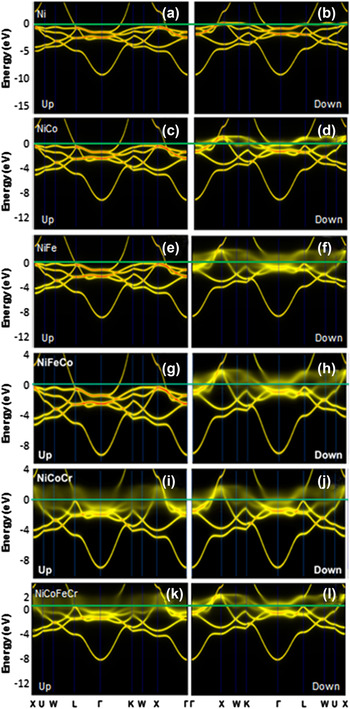
Ab initio Korringa–Kohn–Rostoker Coherent–Potential–Approximation (KKR-CPA) calculations of the electronic structure of SP-CSAs are used to describe the ground state electronic and magnetic structure, and to reveal the effects of chemical disorder on the underlying electronic structure. Reference Zhang, Stocks, Jin, Lu, Bei, Sales, Wang, Beland, Stoller, Samolyuk, Caro, Caro and Weber2,Reference Jin, Sales, Stocks, Samolyuk, Daene, Weber, Zhang and Bei5,Reference Faulkner and Stocks21,Reference Troparevsky, Morris, Kent, Lupini and Stocks22 Representative spin-resolved Bloch spectral functions (BSF) are shown in Fig. 1. The BSF reflect the d-band spin splitting that results from local magnetic moments on each of the alloying species. In these figures the Fermi energy is indicated by a solid line.
Calculated disorder broadening of electronic energy band or Bloch spectral density function along high symmetry directions. The plots from top to bottom are for Ni, NiCo, NiFe, NiFeCo, NiCoCr, and NiCoFeCr; left side are majority (spin up) and right side are minority (spindown), respectively. Adapted from Refs. Reference Zhang, Stocks, Jin, Lu, Bei, Sales, Wang, Beland, Stoller, Samolyuk, Caro, Caro and Weber2 and Reference Jin, Sales, Stocks, Samolyuk, Daene, Weber, Zhang and Bei5.

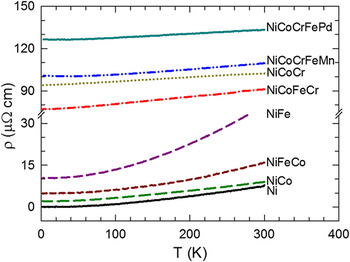
While elemental nickel has a well-defined electronic band structure, the band structures of the alloys are smeared out to very different extents in both energy and k-space. Interestingly, the BSF can be divided into two alloy subgroups containing elements that (i) couple ferromagnetically (Ni, Fe, Co) as shown in Figs. 1(a)–1(h), and (ii) couple both ferromagnetically (Ni, Fe, Co) and antiferromagnetically (Cr) shown in Figs. 1(i)–1(l). For the ferromagnetic coupling, only the spin-down channel [minority, Figs. 1(d), 1(f), and 1(h)] exhibits strong disorder broadening of the BSF that is a substantial fraction of a Brillouin zone dimension. For the antiferromagnetic coupling, both spin-channels are substantially smeared [Figs. 1(i)–1(l)]. In other words, for ferromagnetically coupled alloys of NiCo, NiFe, and NiFeCo, the disorder is limited to minority states; whereas for alloys NiCoCr and NiCoFeCr where Cr couples antiferromagnetically to Ni, Fe, and Co, both minority and majority states are affected by the different magnetic interactions among the alloying species, giving rise to the much larger overall smearing, specifically at the Fermi energy. The broadening of the BSF in k-space at the Fermi energy is closely related to the inverse of the electron MFP and therefore the residual resistivity. Reference Butler and Stocks23,Reference Butler and Stocks24 In particular, a small degree of k-space smearing at the Fermi energy (i.e., a sharp peak in the BSF) implies a long electron MFP, while a BSF that is uniformly smeared throughout the Brillouin zone corresponds to electron MFP that is on the order of a single interatomic spacing. Consequently, the MFP in the ferromagnetically coupled alloys is generally short for the minority-spin electrons [Figs. 1(d), 1(f), and 1(h)] but long for the majority-spin electrons [Figs. 1(c), 1(e), and 1(g)]. For example in NiFeCo, the bands that cross the Fermi energy along the k-directions Γ–X, Γ–K, Γ–L have widths of the order of a 100th of the Brillouin zone dimension, implying a very long MFP and corresponding low resistivity (a few μΩ cm). In the minority-spin channel, even the most sharply defined bands have widths that are of the order of a few tenths of the Brillouin zone dimension, implying shorter MFPs and higher resistivity (tens of μΩ cm). As a result, for these alloys the long MFP majority-spin electrons can act as a short circuit giving rise to a low overall residual resistivity (resistivity at T = 0 K). On the other hand, for NiCoCr and NiCoFeCr that contain elements coupled both ferromagnetically and antiformagnetically, there is a large disorder broadening (and correspondingly short MFP) in both spin channels implying an overall high residual resistivity. A significant reduction of electrical and thermal conductivity is, therefore, expected for the alloys with mixed ferro/antiferromagnetic interactions. The significant difference in the electrical and thermal conductivity of SP-CSAs that is expected through consideration of the Fermi energy BSF of the different alloys is consistent with the experimental results shown in Fig. 2. Reference Zhang, Stocks, Jin, Lu, Bei, Sales, Wang, Beland, Stoller, Samolyuk, Caro, Caro and Weber2,Reference Jin, Sales, Stocks, Samolyuk, Daene, Weber, Zhang and Bei5
The measured electrical resistivity of Ni and SP-CSA. Adapted from Ref. Reference Jin, Sales, Stocks, Samolyuk, Daene, Weber, Zhang and Bei5.

C. Predicted disorder effects on lattice thermal conductivity
Energy transfer from radiation-damage events in SP-CSAs is determined by thermal conductivity contributed from both electrons and phonons. With increasing chemical complexity in SP-CSAs, an electron mean free path, which is proportional to inverse value of electronic bandwidth (Fig. 1), is reduced. As a result, the heat conduction by electrons becomes inefficient, and the lattice contribution to total thermal conductivity starts to be significant. Reference Zhang, Stocks, Jin, Lu, Bei, Sales, Wang, Beland, Stoller, Samolyuk, Caro, Caro and Weber2 Mass, size, and force constant are the three parameters that characterize defects and disorder in the lattice Hamiltonian, which defines phonon thermal conductivity. Calculations using Lennard–Jones (L–J) models Reference Gludovatz, Hohenwarter, Catoor, Chang, George and Ritchie1 and the Green-Kubo formalism to obtain the lattice thermal conductivity, show that coupling between the disorder sources, in particular mass and size, in a disordered alloy is not negligible. Reference Hoover25
The reduction of lattice thermal conductivity has been explored by varying the elemental species (differing in mass, atomic radii, and cohesive energy) and concentration in quasibinary, quasiternary, and quaternary alloys. Reference Caro, Béland, Samolyuk, Stoller and Caro26 For binary systems, minimum lattice thermal conductivity is predicted for an alloy with components of a small heavy atom and a large but light atom. The calculations for lattice thermal conductivity Reference Zhang, Stocks, Jin, Lu, Bei, Sales, Wang, Beland, Stoller, Samolyuk, Caro, Caro and Weber2,Reference Hoover27,Reference Bonny, Nicolas and Dmitry28 suggest that the lattice conductivity in equiatomic NiFe and NiCo is about half of the value corresponding to a linear interpolation of conductivity between the two pure elements. Moreover, the phonon thermal conductivity of 2-, 3-, and 4-component L–J alloys has shown that greater number of constituent elements does not necessarily result in more phonon scattering and further decreases the conductivity. Reference Caro, Béland, Samolyuk, Stoller and Caro26 Experimental validations of microscopic phonon processes are highly desirable to achieve fundamental insights into phonon-mediated thermal transport in the SP-CSAs. The results Reference Tamm, Aabloo, Klintenberg, Stocks and Caro20,Reference Caro, Béland, Samolyuk, Stoller and Caro26 suggest that minimized phonon MFP can be tailored via compositional complexity that modifies the scattering mechanisms and controls energy transport in the phonon subsystem. Certain combinations of size, mass, and cohesive energy may design alloys with tunable thermal conductivity.
D. Chemical short-range order
Monte Carlo methods combined with density functional theory (DFT) calculations have been used to study atomic displacements, SRO, electronic density of states (DOS), and magnetic moments in several SP-CSAs. Reference Tamm, Aabloo, Klintenberg, Stocks and Caro20
The ab initio DFT calculations are based on supercell models of the disordered state, in which atoms are distributed randomly on the sites on N × N × N repeat of a fcc lattice. For both NiCoCr ternary and NiCrCoFe quaternary alloys, these supercell models find that the atomic displacements are small, and configurationally averaged magnetic moments are in close agreement with those obtained using KKR-CPA.
Additional Monte–Carlo calculations of SRO reveal a negative or positive SRO parameter between Ni–Cr or Cr–Cr pairs, respectively, in a NiCoCr ternary alloy. The SRO variation leads to a decrease in the number of Cr–Cr pairs and an increase in Ni–Cr and Cr–Co pairs with respect to a random distribution in an equiatomic alloy. For the quaternary alloy (NiCoFeCr), negative SRO parameters for Ni–Cr and Ni–Fe pairs and positive for Cr–Cr and Fe–Fe pairs are predicted. As a result, a decrease in the number of Cr–Cr, Fe–Fe, Ni–Ni and Co–Co pairs and a moderate increase in Ni-Cr, Ni–Fe, Cr–Co, and Co–Fe pairs are predicted. The predicted SRO, which needs experimental validation from scattering measurements, may affect point-defect energetics and electron–phonon coupling, as well as lead to possible segregation under radiation. Reference Allen, Cole, Gan, Was, Dropek and Kenik29
E. Experimentally-determined electrical resistivity and total thermal conductivity
Thermal conductivity is important to understand energy dissipation of local heating generated from damage events in a radiation environment. In pure metals and dilute alloys, heat flow is dominated by the thermal conductivity of the electronic subsystem. The measured electrical resistivity is shown in Fig. 2 as a function of temperature up to 300 K. Reference Jin, Sales, Stocks, Samolyuk, Daene, Weber, Zhang and Bei5 Electrical resistivity is an intrinsic electrical transport property that at zero temperature (residual resistivity) reflects the extent of intrinsic disorder scattering, arising from the random occupation of different constituent elements on lattice sites. At finite temperatures, electrical resistivity includes an additional contribution from electron–phonon scattering where thermal lattice vibrations may be significant. It is evident that the resistivity has lower values for crystals without the antiferromagnetic element Cr (Ni, NiCo, NiFe, and NiFeCo) than for those alloys containing Cr (NiCoFeCr, NiCoCr, NiCoCrFeMn, and NiCoCrFePd), and this is attributed to the broadening of the electronic band structure described in Fig. 1. In the alloys composed of all ferromagnetic elements (Ni, Co, and Fe), the band structure is broadened mainly for spin-down electrons [Figs. 1(d), 1(f), and 1(h)]. In the alloys with a mix of ferromagnetic and antiferromagnetic elements, the band structure is broadened for both spin-up and spin-down electrons [Figs. 1(i)–1(l)]. The results show that increasing chemical (magnetic) disorder strongly enhances the scattering of electrons, and thus increases the electrical resistivity. Reference Zhang, Stocks, Jin, Lu, Bei, Sales, Wang, Beland, Stoller, Samolyuk, Caro, Caro and Weber2,Reference Jin, Sales, Stocks, Samolyuk, Daene, Weber, Zhang and Bei5
The thermal conductivity, including contributions from both electrons and phonons, is measured for Ni, NiCo, NiFe, and NiCoFeCr, and the values at room temperature are 88.0, 69.9, 28.0, and 12.8 W/m K, respectively. Reference Zhang, Stocks, Jin, Lu, Bei, Sales, Wang, Beland, Stoller, Samolyuk, Caro, Caro and Weber2 These results reveal that electrical resistivity and thermal conductivity in SP-CSAs can be tailored by modifying the chemical complexity.
III. EFFECTS OF CHEMICAL DISORDER ON ENERGY TRANSFER AND DISSIPATION
Heat conduction in metals and traditional alloys depends on how far free electrons can travel before they are scattered and change direction, which is closely related to the electrical resistivity. With increasing effects of disorder in the electronic structure and distortion in crystalline lattice of complex SP-CSAs, heat conduction via electrons and phonons is reduced. Contrary to traditional alloys with low impurity concentration but multiple phases, controlling energy dissipation at the level of electrons and atoms in SP-CSA systems with extreme compositional disorder is an unexplored territory. Understanding electron–electron and electron–phonon (e–ph) scattering in disordered systems is a challenging topic.
For atomic velocities lower than a threshold velocity, atomic motion can be described using a phonon formalism, where the electron–ion interaction is simplified to e–ph interactions. The e–ph interactions in SP-CSAs can be calculated using a rigid muffin-tin approximation to linear response theory. Reference Caro, Correa, Tamm, Samolyuk and Stocks30,Reference Samolyuk, Béland, Stocks and Stoller31 In the case of Ni, it is demonstrated that e–ph interactions described using state-of-the-art time-dependent density functional theory (TD-DFT) is in good agreement with the prediction from the linear response theory. Reference Caro, Correa, Tamm, Samolyuk and Stocks30 The e–ph coupling in concentrated binary alloys (NiCr, NiFe, NiCo, and NiPd) has been calculated using electronic structure from KKR-CPA. Reference Samolyuk, Béland, Stocks and Stoller31 These alloys have a Stoner-type origin magnetism that the magnetic ordering results in a decrease of electronic DOS at the Fermi level. The decrease in DOS in turn reduces the e–ph coupling. The calculated e–ph coupling values for all discussed alloys are approximately 50% smaller in a magnetic state than those for the same alloy in a nonmagnetic state. It was found that, as the temperature increases, the calculated coupling initially increases, and then decreases after passing the Curie temperature. The rate of decrease is controlled by the shape of the DOS near the Fermi energy.
Energy transfer from high-energy charged particles is fundamental to the understanding and predictability of defect evolution from extreme electronic excitations. Swift heavy ions (SHIs) deposit highly localized electronic energy that leads to intensive electron–electron interactions. In the SP-CSAs, the significant reduction in thermal conductivity may result in a prolonged thermal spike and increase in electronic/lattice temperature along the ion path. This can also interact with pre-existing structural defects, affect defect dynamics and microstructural modification.
At high incident energies, the treatment of energy dissipation requires inclusion of electron excitation processes beyond standard ground state DFT methods. As the first step in tackling the radiation energy deposited and dissipated in multicomponent alloys, TD-DFT methods and Ehrenfest dynamics have been utilized recently to calculate electronic excitations produced by a moving Ni ion and to describe electron-phonon interactions in a Ni crystal. Reference Caro, Correa, Tamm, Samolyuk and Stocks30 These calculations focus on nonadiabatic aspects of the initial stages of radiation damage when energy is deposited by energetic particles and dissipated by electronic and ionic transport processes. These calculations predict electronic energy loss and damage production with ion velocities ranging from 1 to 10 a.u., corresponding to an ion energy up to 150 MeV. Ions with energies of one MeV per nucleon or higher are termed as SHIs, and radiation effects are mainly attributed to extreme excitation and ionization. Ionization for a Ni projectile traveling inside a Ni target is investigated using the plane wave pseudopotential code QBOX. Reference Correa, Kohanoff, Artacho, Sanchez-Portal and Caro32,Reference Schleife, Draeger, Kanai and Correa33
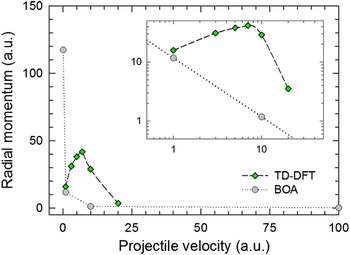
The results suggest that radial and longitudinal interatomic forces are modified by the projectile perturbation. Charged nuclei near the projectile path repel each other by positive outward radial force. As the projectile leaves the monitored atom behind, a negative inward radial force develops for a short time. When the electrons are excited, the radial momentum transferred to the target atoms is more than an order of magnitude larger than in the adiabatic approximation (see Fig. 3). This difference, which comes from the interplay between energy deposition and dissipation in both the electronic and atomic subsystems, constitutes an important contribution to the description of the early stages of a radiation damage event. Furthermore, the calculated electron–ion interaction, Reference Caro, Correa, Tamm, Samolyuk and Stocks30 as a particular case of an electronic stopping process, provides a solution to the empiricism present today in molecular dynamics (MD) simulations of nonadiabatic processes during energetic ion–solid interactions by describing the host electronic density as a function of ion velocity. This approach to electron–ion interaction as an electronic stopping process may provide the basis for a unified framework to perform classical MD of ion–solid interactions with ab initio type nonadiabatic terms in a wide range of energies. Reference Caro, Correa, Tamm, Samolyuk and Stocks30
Comparison of the momentum transfer calculated from TD-DFT and the adiabatic approximation from Born–Oppenheimer approximation (BOA) for Ni ion in Ni target. The inset is the comparison shown in logarithmic scale.

IV. EFFECTS OF CHEMICAL DISORDER ON DEFECT EVOLUTION
Intense radiation in nuclear fission and fusion energy power systems transfers energy to electrons and atoms in the material, and produces defects and extended damage clusters that may ultimately compromise the material's strength and lifetime. Structural alloy development in radiation environments demands in-depth knowledge on the correlation among intrinsic properties, energy dissipation, and defect evolution.
Chemical disorder induced by compositional changes leads to slower heat conduction in disordered SP-CSAs, and also results in complex energy landscapes for defect formation and migration. Defect dynamics occurring under irradiation is expected to be different from processes in traditional alloys. Recent progress Reference Zhang, Stocks, Jin, Lu, Bei, Sales, Wang, Beland, Stoller, Samolyuk, Caro, Caro and Weber2,Reference Lu, Jin, Béland, Zhang, Yang, Qiao, Zhang, Bei, Christen, Stoller and Wang6,Reference Zhao, Stocks and Zhang34–Reference Ullah, Aidhy, Zhang and Weber42 includes demonstrating that alloy complexity has a profound impact on defect dynamics with a focus on ballistic defect formation and kinetic evolution of defect structures, as well as how the complexity alters radiation-induced microstructural evolution.
A. Defect formation from single ion events
Cascade events often produce many interstitials and vacancies. While the formation and migration energies have been studied in pure Ni, the effects of compositional disorder are unknown. Defect studies in SP-CSAs have been focused on characterization of the mechanisms that control defect formation under irradiation, to determine what characteristics of atomic displacement cascades are responsible for the formation of defect clusters during cascades.
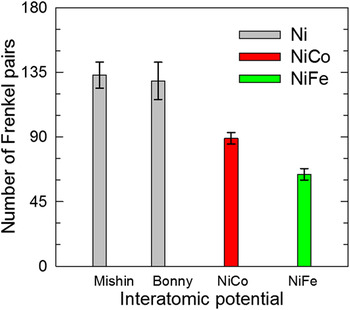
Point defects in Ni, NiCo, NiFe, Ni0.8Fe0.2, and Ni0.8Cr0.2 are investigated using ab initio calculations based on DFT, Reference Zhao, Stocks and Zhang34 ab initio molecular dynamics (AIMD), Reference Liu, Yuan, Jin, Zhang and Weber37 and atomistic simulations with empirical potentials. Reference Béland, Samolyuk and Stoller38–Reference Ullah, Aidhy, Zhang and Weber42 The DFT calculations Reference Zhao, Stocks and Zhang34 show that the formation energies of Ni and Fe vacancies in NiFe are higher than in pure Ni, while the formation energies of interstitials are lower for NiFe. AIMD Reference Liu, Yuan, Jin, Zhang and Weber37 and MD simulations Reference Béland, Samolyuk and Stoller38–Reference Ullah, Aidhy, Zhang and Weber42 are used to investigate primary damage formation in displacement cascades in Ni, and some binary alloys. The AIMD study Reference Liu, Yuan, Jin, Zhang and Weber37 of low-energy recoil events indicates that, in contrast to the replacement sequences in pure Ni, the antisite defect sequences in NiCo may be more effective to produce defects and transporting energy outside of the cascade core. MD simulations Reference Béland, Samolyuk and Stoller38–Reference Aidhy, Lu, Jin, Bei, Zhang, Wang and Weber41 at 300 K based on interatomic potentials of Mishin Reference Purja Pun, Yamakov and Mishin43 and Bonny Reference Bonny, Nicolas and Dmitry28,Reference Bonny, Pasianot and Malerba44 reveals significant differences between pure Ni and alloys of NiCo and NiFe (Fig. 4). The stable defect production is higher in Ni than in NiCo and NiFe. The alloying elements modify the short-range interatomic interactions and affect the number of defects generated. Moreover, the decrease in thermal conductivity and increase in the lifetime of the thermally enhanced recombination stage favor self-annihilation of defects in the first few ps after the collision cascade reaches its atomic displacement peak. Furthermore, the formation of large extended defects is suppressed in alloys, probably because they are not as energetically favorable as in Ni.
Number of Frenkel pairs resulting from cascade simulations of 40 keV recoils in Ni, NiCo, and NiFe. The statistical uncertainty is marked accordingly. Adapted from Ref. Reference Beland, Lu, Osetsky, Samolyuk, Caro, Wang and Stoller40.

B. Post-cascade defect evolution: defect migration and clustering
Complex energy landscapes will affect defect migration. The DFT calculations Reference Zhao, Stocks and Zhang34 show that the distribution of migration energies for vacancies and interstitials starts to overlap with increasing disorder from Ni0.8Fe0.2 to NiFe, suggesting an unexpected equal mobility in a solid solution phase. The diffusion barrier of interstitials in Ni0.8Cr0.2 is found to be smaller than that in NiFe and Ni0.8Fe0.2, an indication of faster migration of interstitials in Ni0.8Cr0.2. The calculations Reference Zhao, Stocks and Zhang34 indicate that defect energetics are highly dependent on composition.
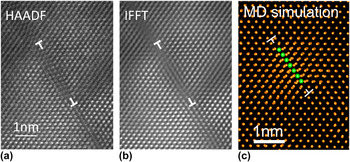
To understand how irradiation-induced defects evolve, MD simulations are carried out to reveal mechanisms of defect migration, as well as interstitial and vacancy clustering. The evolution of high concentrations of point defects is investigated within MD simulations in fcc Ni, NiFe, and Ni0.8Cr0.2. Reference Aidhy, Lu, Jin, Bei, Zhang, Wang and Weber39 Interstitials are observed to cluster into dislocation loops; whereas vacancies form stacking fault tetrahedra (SFT). The clusters were similar to those observed using cross-sectional transmission electron microscopy (TEM) (Fig. 5). The MD results show that interstitial migration in the alloys is significantly slower than in Ni. As a result, larger and fewer clusters are formed in Ni than in the alloys, similar to the results from 5 keV overlapping cascades. Reference Ullah, Aidhy, Zhang and Weber42 In addition, there are more single interstitials present in the alloys. A comparison between point defect evolution in NiFe and Ni is shown in Fig. 6, revealing more small clusters and single interstitials in NiFe. Similar results are observed in Ni0.8Cr0.2. Reference Ullah, Aidhy, Zhang and Weber42
Irradiation-induced interstitial dislocation loops on {111} planes in pure Ni from (a) a high-resolution high angle annular dark field (HAADF) image, (b) the corresponding inverse fast Fourier transform (IFFT) image (Ref. Reference Aidhy, Lu, Jin, Bei, Zhang, Wang and Weber39), and (c) from MD simulation.

Defect clusters in (a) Ni and (b) NiFe, and comparison of the clusters size in (c). NiFe has large number of small clusters compared to Ni (vacancies are shown in blue, and Ni and Fe interstitials in green and pink, respectively). Adapted from Ref. Reference Aidhy, Lu, Jin, Bei, Zhang, Wang and Weber39.

The formation of SFT by the aggregation of individual vacancies is also observed in the MD simulations. Reference Aidhy, Lu, Jin, Bei, Zhang, Wang and Weber41 Previously there were two mechanisms assumed responsible for the formation of SFT: the dissociation of perfect dislocations on the boundary of a triangular vacancy loop Reference Silcox and Hirsch45 and direct formation in displacement cascades. Reference Osetsky and Bacon46 There has been speculation Reference de Jong and Koehler47 that SFT formation could occur due to agglomeration of vacancies. Recent MD simulations Reference Aidhy, Lu, Jin, Bei, Zhang, Wang and Weber41 demonstrate the possibility of SFT growth by vacancy aggregation at high vacancy concentrations and indicate that a tetrahedral vacancy cluster may act as a nucleation site for the formation of a stacking fault tetrahedron.
Lower barriers to migration of small vacancy clusters than isolated vacancies have been reported in the literature. Reference Johnson48–Reference Martínez and Uberuaga53 In many fcc metals, such as Cu, Ag, Au, Al, Ni, and Pt, Reference Schüle, Scholz and Panzarasa49 the divacancy migration energy values are reported to be lower than the migration energy of single vacancies. In fcc Ni, the lower barrier energy for cluster diffusion, compared to single vacancies, is explained by a bond-breaking mechanism proposed by Johnson, Reference Johnson48 where a two-body central force was used to describe the interaction between the nearest-neighbor atoms. The results indicate that the migration energies of small vacancy clusters, while increasing slowly with cluster size, are less than the single-vacancy migration energy due to fewer bonds to break when small clusters migrate. Johnson has also concluded that the easiest migrating vacancy cluster is the divacancy. In fcc Cu, Reference Martínez and Uberuaga53 the authors have shown that the diffusivity of defective SFT or vacancy clusters is much higher than perfect SFT. The mechanisms responsible for the high mobility result from temporary disruption of their configuration through activated thermal events, such as irradiation. During the deformation and reorganization of the clusters, interstitial defects come into play by decreasing the barrier for the movement. The defect properties, therefore, can be counter-intuitive with vacancy clusters exhibiting higher mobility than isolated vacancies. In Ni and SP-CSAs, although individual vacancies have a high migration barrier, the barrier for small vacancy clusters is lower and may allow diffusion and grouping of small clusters to form large SFT. Reference Aidhy, Lu, Jin, Bei, Zhang, Wang and Weber41
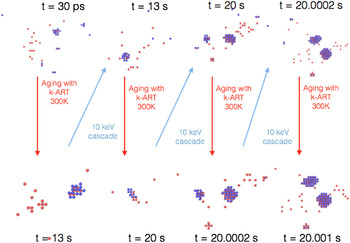
Aging of cascade-induced defects has been simulated using on-the-fly kinetic Monte Carlo. More precisely, the kinetic activation relaxation technique (k-ART), Reference Béland, Brommer, El-Mellouhi, Joly and Mousseau54,Reference Mousseau, Béland, Rommer, El-Mellouhi, Joly, N'Tsouaglo, Restrepo and Trochet55 an off-lattice, self-learning, fully atomistic simulation code that is capable of aging systems containing hundreds of thousands of atoms on timescales of seconds or more, is used to study the time-evolution of defects in between cascade events at room temperature. In the past, this method has been shown to accurately predict the evolution of radiation damage in Fe, Reference Brommer, Beland, Joly and Mousseau56–Reference Béland, Osetsky, Stoller and Xu58 and FeCr. Reference Béland, Osetsky, Stoller and Xu58,Reference Béland, Osetsky, Stoller and Xu59 An example of intercascade aging and defect accumulation in Ni is illustrated in Fig. 7. The study of Ni and Ni-alloys confirmed that small vacancy clusters, including tetrahedral-shaped clusters, are highly mobile in Ni and NiFe, and that defect mobility, especially interstitials, is sluggish in the alloy. The diffusion of these small vacancy clusters explains the observation that SFT are found much deeper than the ion range. Reference Lu, Jin, Béland, Zhang, Yang, Qiao, Zhang, Bei, Christen, Stoller and Wang6 The differences in defect mobility also explain why, under the same irradiation condition, defects are found deeper in Ni than in NiFe. Reference Granberg, Nordlundl, Ullah, Jin, Lu, Bei, Wang, Djurabekova, Weber and Zhang60 Moreover, the sluggish diffusion in NiFe reduces intercascade self-annealing in comparison to Ni.
The aging of 10 keV cascade debris in Ni generated by MD as simulated using the k-ART. Vacancies are illustrated in red and interstitials in blue. Defect aggregation, annihilation, and reconfiguration are observed.

C. Effects of chemical disorder on irradiation response
It is essential to understand how chemical complexity impacts defect production and damage accumulation under ion irradiation over a long period, and how it may ultimately be modified and controlled to promote radiation resistance and increase lifetime in specific applications. To address these challenges, integrated experimental and modeling work has been carried out to identify and understand the mechanisms controlling long-term post-cascade defect evolution, including microstructural changes.
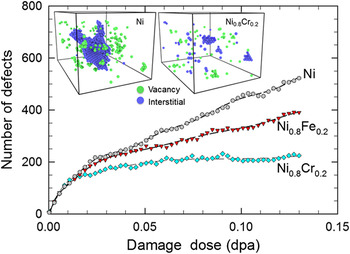
Damage accumulation in Ni0.8Fe0.2 and Ni0.8Cr0.2 under overlapping cascades, compared with Ni, is predicted by MD simulations Reference Ullah, Aidhy, Zhang and Weber42 based on the Bonny potentials Reference Bonny, Nicolas and Dmitry28,Reference Bonny, Pasianot and Malerba44 to assess possible enhanced radiation-resistance performance (Fig. 8). The results show that the total number of point defects produced in Ni0.8Cr0.2 and Ni0.8Fe0.2 is approximately 2.5 and 1.4 times lower than in Ni, respectively, due to efficient recombination in the compositionally disordered alloys. Although the formation of a large interstitial cluster is observed in Ni (top left inset in Fig. 8) and is attributed to the high mobility of Ni interstitials, only isolated point defects and small clusters are produced in Ni0.8Cr0.2 (top right inset in Fig. 8). The difference in defect production between the alloys and Ni is governed by the diffusion of point defects during overlapping cascades.
Accumulation of point defects in Ni and the two binaries of Ni, Ni0.8Fe0.2 and Ni0.8Cr0.2 as a function of damage dose under cumulative recoil events (5 keV). The lines are curve fit to guide the eye. Insets represent defect cluster formation after 400 recoils (∼0.13 dpa) in Ni (left) and Ni0.8Cr0.2 (right). Vacancies are shown in green and interstitials in blue. Adapted from Ref. Reference Ullah, Aidhy, Zhang and Weber42.

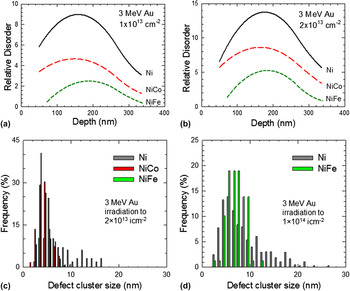
The irradiation response of pure Ni and two model binary alloys (NiCo and NiFe) are experimentally examined using the ion channeling technique after 3 MeV Au ion irradiation. Reference Zhang, Stocks, Jin, Lu, Bei, Sales, Wang, Beland, Stoller, Samolyuk, Caro, Caro and Weber2,Reference Jin, Bei and Zhang35,Reference Granberg, Nordlundl, Ullah, Jin, Lu, Bei, Wang, Djurabekova, Weber and Zhang60,Reference Zhang, Crespillo, Xue, Jin, Chen, Fontana, Graham and Weber61 The irradiation-induced disorder profile under relatively low-dose irradiation is shown in Fig. 9. With increasing ion fluence, from 1 × 10¹³ to 2 × 1013 cm−2 [with peak dose at ∼0.057 and 0.114 displacements per atom (dpa)], an increase in backscattering yield is observed in all three crystals [Figs. 9(a) and 9(b)]. Lower damage levels are observed in the two binaries where NiFe is more irradiation-resistant than NiCo. This observation is consistent with the MD results Reference Béland, Samolyuk and Stoller38,Reference Aidhy, Lu, Jin, Bei, Zhang, Wang and Weber39,Reference Ullah, Aidhy, Zhang and Weber42 showing significant reduction in stable defect production in the alloys (Fig. 4). After irradiation to 2 × 10¹³ and 1 × 10¹⁴ ions/cm2 (with peak dose at ∼0.114 and 0.57 dpa), defect clusters in Ni have a wider size distribution with large clusters, whereas the cluster size in NiCo and NiFe is more confined. The larger clusters observed in pure Ni validate the MD predictions Reference Aidhy, Lu, Jin, Bei, Zhang, Wang and Weber39,Reference Ullah, Aidhy, Zhang and Weber42 that interstitial migration is significantly slower in the alloys than in Ni, leading to the formation of larger clusters in Ni. Comparing the relative size distribution shown in Figs. 9(c) and 9(d), the cluster size increases with ion fluence, which is attributed to the accumulation of defects with prolonged irradiation.
Irradiation performance of Ni and equiatomic alloys of NiCo and NiFe under 3 MeV Au ion bombardments. (a) and (b) represent disorder profiles in the three crystals upon irradiation to 1 × 10¹³ and 2 × 10¹³ Au cm−2, respectively, (c) and (d) are the size distribution of defect clusters in the samples irradiated to 2 × 10¹³ and 1 × 10¹⁴ Au cm−2 determined from TEM observation. Adapted from Refs. Reference Zhang, Stocks, Jin, Lu, Bei, Sales, Wang, Beland, Stoller, Samolyuk, Caro, Caro and Weber2, Reference Jin, Bei and Zhang35, and Reference Granberg, Nordlundl, Ullah, Jin, Lu, Bei, Wang, Djurabekova, Weber and Zhang60.

X-ray diffuse scattering (XRDS) near Bragg reflections provides greater sensitivity to small defect clusters than TEM, and it provides separate size distributions for vacancy clusters (loops and SFTs) and interstitial loops. Using XRDS measurements, Reference Olsen, Jin, Lu, Beland, Wang, Bei, Specht and Larson36 separate size distributions have been determined for vacancy and interstitial clusters in Ni ion irradiated pure Ni and NiCo. Excellent agreement is observed between defect cluster densities determined from TEM and XRDS for sizes greater than ∼4 nm. However, XRDS identifies higher densities of small SFT <2 nm that is close to or lower than the TEM resolution limit. The XRDS results show that cluster sizes are smaller in NiCo than in Ni, suggesting that chemical disorder in the alloy inhibits defect mobility and cluster aggregation, which is in agreement with the MD simulation, as discussed above. Reference Béland, Samolyuk and Stoller38–Reference Ullah, Aidhy, Zhang and Weber42
Under high-fluence irradiations (above ∼1 dpa), Reference Lu, Jin, Béland, Zhang, Yang, Qiao, Zhang, Bei, Christen, Stoller and Wang6,Reference Jin, Bei and Zhang35 ion damage ranges are found to far exceed the theoretically predicted depths. Under the same irradiation conditions, the observed differences in damage ranges indicate altered migration mobility of defect clusters in these alloys. The TEM study Reference Lu, Jin, Béland, Zhang, Yang, Qiao, Zhang, Bei, Christen, Stoller and Wang6 clearly shows that defects migrate much faster in Ni than in NiCo and NiFe. Pure Ni is observed to have a wider damage range than that for the alloys, indicating that defects have higher mobility in pure Ni, consistent with the modeling prediction. Reference Béland, Samolyuk and Stoller38–Reference Ullah, Aidhy, Zhang and Weber42 High defect diffusivities and prolonged irradiation periods both contribute to this long-range effect. Mechanical stress created by implanted species may also play an important role in driving the defects to a deeper depth or to the surface. In addition, the production and migration of defects in more confined vicinities in the alloys than that in pure nickel may contribute to an enhanced defect recombination rate, leading to a higher radiation tolerance of the material.
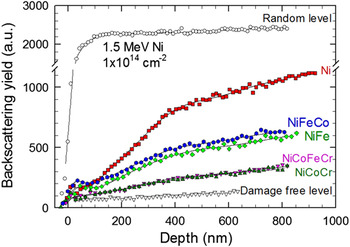
While compositional changes in binary alloys have been shown to have an enormous impact on defect dynamics, the influence of extreme compositional disorder on defect production and radiation response has been demonstrated in a more complex NiCoFeCr alloy in a previous study. Reference Zhang, Stocks, Jin, Lu, Bei, Sales, Wang, Beland, Stoller, Samolyuk, Caro, Caro and Weber2 To further validate the hypothesis that alloy complexity has a significant impact on radiation response, high-quality crystals of Ni, NiFe, NiFeCo, NiCoCr, and NiCoFeCr are used here to make comparisons. After Ni ion irradiation (1.5 MeV, 1 × 1014 cm−2) at room temperature to a peak dose of ∼0.13 dpa, the ion channeling measurements Reference Zhang, Crespillo, Xue, Jin, Chen, Fontana, Graham and Weber61 are utilized to characterize the relative damage (Fig. 10). The results in Fig. 10 show improved radiation resistance (i.e., lower backscattering yield) for NiFe and NiFeCo, compared to Ni. An even greater suppression of accumulated damage is observed in NiCoCr and NiCoFeCr. The evidence is the relative backscattering yield, which is significantly lower in NiCoCr and NiCoFeCr than that in NiFe and NiFeCo; it is even further below that for Ni (indicated by the difference between the backscattering yield from the corresponding samples and the indicated damage free level). Greater damage resistance is observed in NiCoCr than in NiFeCo, suggesting intrinsic properties of elemental species and local environments are key factors for controlling defect evolution.
Ion channeling backscattering spectra showing different irradiation response in Ni and Ni-containing SP-CSAs. The solid lines are data fit to guide the eye. The irradiation was performed using 1.5 MeV nickel to a fluence of 1 × 1014 cm−2 at room temperature.

V. SUMMARY
Well-characterized microstructural changes in various traditional alloys reported over the last half century are the consequence of complex interactions. While material properties have steadily progressed to show that specific alloy compositions have higher radiation resistance than their pure metal counterparts, the underlying defect mechanisms remain unexplored at the level of electrons and atoms. Utilizing experimental techniques of ion irradiation, ion beam analysis, TEM and XRDS, in combination with broad theoretical approaches of DFT, AIMD, and MD simulations, the effects of intrinsic chemical disorder on energy dissipation and defect evolution are investigated. Significant differences in electron and phonon scattering processes, energy transport and defect behavior are observed by comparing pure Ni with a set of concentrated solid solution alloys, including both equal concentration (NiFe, NiCo, NiPd, NiFeCo, NiCoCr, NiCoFeCr, NiCoFeCrMn, and NiCoFeCrPd) and nonequal concentration (Ni0.8Cr0.2 and Ni0.8Fe0.2). Recent work reveals the effects of chemical disorder on the electronic structure, electrical resistivity, thermal conductivity, and defect energetics and dynamics of these SP-CSAs alloys.
The extreme chemical disorder in SP-CSAs has an enormous impact on energy dissipation. The KKR-CPA results demonstrate a significant smearing of the d-band electrons attributed to the chemical disorder. The disordered electronic structure results in a substantial reduction of the electron mean free path, which is supported by the experimental values of the electrical resistivity measured from 5 K to room temperature. Orders-of-magnitude reductions in MFP, from nearly infinite in pure Ni to the order of the interatomic spacing in complex SP-CSAs, greatly reduce the electronic subsystem's effectiveness in energy dissipation. The measured values show that the predicted reduction in total thermal conductivity at room temperature is also significant. The phonon contribution to thermal conductivity decreases from pure Ni to binary alloys, and alloy complexity can be tailored to modify the scattering mechanisms (mass, size, and force constant) that control energy transport in the phonon subsystem.
The extreme chemical disorder in SP-CSAs also has an enormous impact on defect evolution under ion irradiation. Random arrangements of multiple element species may be the most effective way to create the maximum density of pinning sites. Increasing alloy complexity in SP-CSAs has been confirmed as an effective way to suppress damage accumulation. In addition to the lower damage level observed from the ion channeling measurements, TEM results have clearly shown that higher-densities of smaller clusters exist in binary alloys, but much larger clusters are formed in pure Ni, which is consistent with MD predictions. The current work suggests that defect migration barriers and extended defect formation energies are modified in the alloys relative to pure Ni, resulting in the formation of larger clusters in pure Ni and smaller clusters in the alloys.
VI. PERSPECTIVE
Many related experimental and modeling studies have been recently carried out in a number of model fcc concentrated solid-solution alloys, with the number of constituent elements varying from 2 to 5. Unique links from intrinsic material properties to both energy dissipation and various dynamic processes are becoming clear. The systematic variation in the number and concentration of components, as well as the chemical elements, makes this a valuable tactic to de-convolute the effects at electronic and atomic levels. The focus on model fcc alloys eliminates possible confusion or entangled complications from variations of crystal structures, multiphases, or nano-scale features. This review brings together recent understanding from a large number of theoretical and experimental studies on these model alloys. The aim of this review is to draw attention to how the chemical complexity can result in distinctive intrinsic material properties, and how such fundamental properties can affect energy dissipation and defect evolution in these advanced alloys. These properties include the distortion of the electronic band structure due to the intrinsic chemical disorder, reduction of thermal and electrical conductivities due to predominantly ferromagnetic and antiferromagnetic coupling, and increased radiation tolerance due to modified formation energies and migration barriers of defects and defect clusters. This review reinforces the message that has become apparent over the past two years that the intrinsic disorder of these alloys has a strong effect on energy dissipation and defect evolution.
This recent progress suggests a novel concept of how intrinsic chemical disorder can affect energy dissipation and defect dynamics at their early stages (low-dose irradiation cases). This has made it possible to build a much-needed knowledge base that may enable reductions in damage accumulation at a later stage (high-dose irradiation cases). Understanding the influence of chemical disorder on energy dissipation and defect evolution will allow major advancements in alloy development by altering defect dynamics through the substantial modification of energy dissipation pathways and energy landscapes.
ACKNOWLEDGMENTS
This work was supported as part of the Energy Dissipation to Defect Evolution (EDDE), an Energy Frontier Research Center funded by the U.S. Department of Energy, Office of Science, Basic Energy Sciences. Ion beam work was performed at the University of Tennessee–Oak Ridge National Laboratory Ion Beam Materials Laboratory (IBML) located at the campus of the University of Tennessee, Knoxville. This simulation used resources of the National Energy Research Scientific Computing Center, supported by the Office of Science, US Department of Energy, under Contract No. DEAC02–05CH11231. LKB acknowledgs additional support from a fellowship awarded by the Fonds Québéecois de recherche Nature et Technologies. This manuscript has been authored by UT-Battelle, LLC under Contract No. DE-AC05-00OR22725 with the U.S. Department of Energy. The United States Government retains and the publisher, by accepting the article for publication, acknowledges that the United States Government retains a nonexclusive, paid-up, irrevocable, world-wide license to publish or reproduce the published form of this manuscript, or allow others to do so, for United States Government purposes. The Department of Energy will provide public access to these results of federally sponsored research in accordance with the DOE Public Access Plan (http://energy.gov/downloads/doe-public-access-plan).