Introduction
The following review is a result of discussions that occurred during an “Expert Round Table Meeting: Management of Behavioral Problems in Alzheimer's Disease” held in Hong Kong on 27 February, 2008. The meeting was convened by Serge Gauthier and Jeffrey Cummings to evaluate the current gaps in our knowledge concerning the management of behavioral and psychological symptoms associated with dementia. Also participating in the meeting were Clive Ballard, Henry Brodaty, George Grossberg, Constantine Lyketsos, and Philippe Robert. The meeting was sponsored by Forest Laboratories Inc, H. Lundbeck A/S, and Merz Pharma, and immediately preceded the Hong Kong/Springfield Symposium on Advances in Alzheimer's Disease Treatment. Since these initial discussions, the literature has been further studied and the first article by this group has been published, on the specific topic of the management of agitation and aggression in Alzheimer's disease (AD) (Ballard et al., Reference Ballard2009a).
The current review reflects a group consensus on neuropsychiatric symptoms (NPS), with emphasis on a clinical approach to the individual behavioral symptoms, using the best available information. Issues surrounding the measurement of NPS are identified and suggestions on how to resolve them are proposed. The purpose of the review is to look at the “bigger picture” rather than individual studies. Therefore, we have not cited every study that has been conducted on NPS but rather have aimed to maintain a balance in the evaluation among the many approaches currently available. Our discussions were aimed at the sub-acute and long-term management of NPS; management of acute psychiatric inpatient care was not discussed. Although both the recommendations and comments made and the literature cited in the body of this review are aimed primarily at AD, they may also be useful in the consideration of non-AD dementias. In this review, the term “NPS” is synonymous with “behavioral and psychological symptoms of dementia” (BPSD), and “psychotropic drugs” include antipsychotics, antidepressants and anticonvulsants, but not cholinesterase inhibitors and memantine.
Behavior in the context of Alzheimer's disease
AD is a complex progressive degenerative brain disorder that has effects on multiple cerebral systems, giving rise to diverse clinical phenomena. As the disease progresses, more and more brain regions are affected, and intellectual impairment advances. Cognitive deterioration, as well as progressive impairment in activities of daily living, leads to an increase in patient dependency. NPS associated with AD tend to follow a trajectory of increasing severity over time – a feature they have in common with cognitive and functional decline. However, greater variability is observed in the pattern of behavioral changes and in their evolution than is characteristic of the decline in cognition and function. Furthermore, there is inconsistent correlation between NPS and cognitive decline as measured using the Mini-mental State Examination (MMSE) (Craig et al., Reference Craig, Mirakhur, Hart, McIlroy and Passmore2005), or the cognition portion of the Alzheimer's Disease Assessment Scale (ADAS-Cog) (Cummings et al., Reference Cummings, Schneider, Tariot, Kershaw and Yuan2004a). Some individual NPS are more closely correlated with cognitive decline than others. Onyike et al. (Reference Onyike2007), when examining prevalence and associations of apathy in older adults, found that apathy was evident in 3.1% of those with mild cognitive impairment and in 17.3% of those with dementia (Onyike et al., Reference Onyike2007). This association persisted when controlling for comorbid depression. The authors concluded that both the frequency and severity of apathy is positively correlated with the severity of cognitive impairment (Onyike et al., Reference Onyike2007). A direct correlation of apathy with severity was also reported in nursing home residents (Wu et al., Reference Wu, Low, Xia and Brodaty2009). Irritability was also found to correlate with cognitive decline (Craig et al., Reference Craig, Mirakhur, Hart, McIlroy and Passmore2005).
NPS are present in all stages of AD, such that almost all patients with AD will manifest such symptoms, including personality alterations, psychoses, mood changes, agitation, apathy and aberrant motor behavior, at some point during the course of the disease (Gauthier et al., Reference Gauthier2002a). NPS are as clinically relevant as cognitive and functional impairment; importantly, they contribute to patient and caregiver distress (Banerjee et al., Reference Banerjee2006), and may precipitate institutionalization (Lesser and Hughes, Reference Lesser and Hughes2006). As many as 80–97% of patients with AD are affected by at least one NPS at some point in their illness (Jost and Grossberg, Reference Jost and Grossberg1996; Lyketsos et al., Reference Lyketsos, Lopez, Jones, Fitzpatrick, Breitner and DeKosky2002; Steinberg et al., Reference Steinberg2008). Some of these symptoms, depression in particular, may be present even before the cognitive decline becomes evident (Jost and Grossberg, Reference Jost and Grossberg1996), and in the dementia prodromes, such as mild cognitive impairment (MCI) and cognitive impairment no dementia (CIND) (Lyketsos et al., Reference Lyketsos, Lopez, Jones, Fitzpatrick, Breitner and DeKosky2002). Indeed, the association of apathy and depressive symptoms with mild cognitive impairment has been shown to increase the likelihood of progression to dementia of the Alzheimer type (Teng et al., Reference Teng, Lu and Cummings2007; Robert et al., Reference Robert2008a).
Prevalence of NPS in AD
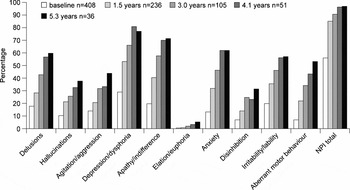
NPS comprise a variety of features that evolve over time. Figure 1 shows the evolution of behavioral changes, in terms of Neuropsychiatric Inventory (NPI) symptoms, as found in the Cache County Study (five-year period prevalence; Steinberg et al., Reference Steinberg2008). Latent class and factor analytic studies suggest the existence of several overlapping behavioral syndromes or factors (Frisoni et al., Reference Frisoni1999; Lyketsos et al., Reference Lyketsos2001; Moran et al., Reference Moran, Walsh, Lynch, Coen, Coakley and Lawlor2004). Frisoni et al. (Reference Frisoni1999) grouped these into three syndromes: “psychotic” (agitation, hallucinations, delusions, irritability), “mood” (anxiety, depression), and “frontal” (disinhibition, euphoria). Lyketsos et al. (Reference Lyketsos2001) identified three groupings: “no neuropsychiatric symptoms”, “affective” and “psychotic” symptoms.
Five-year prevalence of NPI symptoms (NPI >0) in the Cache County Study (Steinberg et al., Reference Steinberg2008).

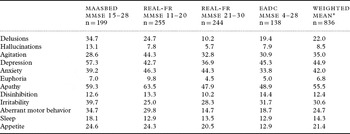
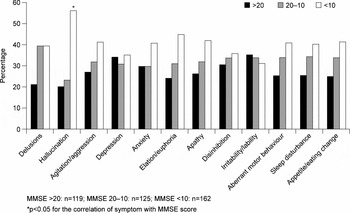
The most frequently occurring of the NPS are apathy, depression, and anxiety (Robert et al., Reference Robert2005; Steinberg et al., Reference Steinberg2008; Table 1). Apathy can be present in all stages of the disease, but increases in prevalence with severity of disease (Figure 2). Apathy appears to be an independent syndrome, whereas agitation may occur in combination with many different symptoms. Senanarong et al. (Reference Senanarong2004) found significant correlations between agitation and all other NPI subscale scores, with the strongest correlations existing with irritability, disinhibition, delusions, and aberrant motor activity (p < 0.001 in all cases) (Senanarong et al., Reference Senanarong2004). Aberrant motor behavior (wandering, pacing, rummaging, purposeless hyperactivity) is observable in more than one-quarter of patients with dementia (Aalten et al., Reference Aalten2007), and falls into the behavioral category of “hyperactivity”, which also comprises agitation, disinhibition and irritability (Aalten et al., Reference Aalten2007).
Frequency (percent) of NPS in community care samples evaluated with the NPI in three European studies

NPS = neuropsychiatric symptoms; NPI = Neuropsychiatric Inventory; MAASBED = Maastricht Study of Behavior in Dementia; REAL = Réseaux Alzheimer Français; EADC = European Alzheimer Disease Consortium; MMSE = Mini-mental State Examination.
*Overall mean taking into account the relative contribution of the size (n) of each study.
Source: Robert et al. (Reference Robert2005).
NPI symptoms in AD, by MMSE groupings (mild, moderate, severe) (Craig et al., Reference Craig, Mirakhur, Hart, McIlroy and Passmore2005).

Agitation and aggression are among the most troublesome of the NPS for caregivers and, along with depression and psychosis, are leading predictors of institutionalization (Yaffe et al., Reference Yaffe2002; Gauthier et al., Reference Gauthier, Loft and Cummings2008; Gaugler et al., Reference Gaugler, Yu, Krichbaum and Wyman2009) Within care facilities, 40–60% of AD patients have aggression and agitation (Margallo-Lana et al., Reference Margallo-Lana2001; Ballard and Howard, Reference Ballard and Howard2006).
Irritability is common and can be troublesome to the caregiver; it occurs with a prevalence of ~40% of patients with mild and moderate AD, increasing to ~50% of patients in the more severe stages of the disease (Cummings and Back, Reference Cummings and Back1998; Robert et al., Reference Robert2002).
Psychotic disorders (delusions and hallucinations) can affect 27–45% of AD patients (Leroi et al., Reference Leroi, Voulgari, Breitner and Lyketsos2003; Jost and Grossberg, Reference Jost and Grossberg1996), and has been associated with accelerated cognitive decline, earlier institutionalization, and caregiver burnout (Drevets and Rubin Reference Drevets and Rubin1989; Yaffe et al., Reference Yaffe2002; Lesser and Hughes, Reference Lesser and Hughes2006). Delusions most often present in the form of beliefs of theft and infidelity, and hallucinations (most often visual) are usually visions of people from the past, or of intruders. Prospective studies show that hallucinations often resolve over a few months, but delusions and agitation are more persistent (Ballard and Howard, Reference Ballard and Howard2006).
The prevalence of depression in AD patients, as estimated in both population and clinical studies, is between 20% (Lyketsos et al., Reference Lyketsos, Steinberg, Tschanz, Norton, Steffens and Breitner2000; Reference Lyketsos2003) and 50% (Lyketsos and Olin, Reference Lyketsos and Olin2002). Regular screening for depression in AD is recommended: preliminary studies suggest that antidepressant treatment instigated on the basis of screening for the condition improves outcomes for patients (in terms of depression symptom scores) (Cohen et al., Reference Cohen, Hyland and Kimhy2003), and may decrease the strain on the caregiver.
Sleep problems, which are estimated to occur in 25–54% of AD patients (Chen et al., Reference Chen, Borson and Scanlan2000; Hart et al., Reference Hart2003; Moran et al., Reference Moran, Lynch, Walsh, Coen, Coakley and Lawlor2005), can impact greatly on the quality of sleep of caregivers. It is well established that sleep disturbance, and the accompanying caregiver stress, are very common precipitants of institutionalization in dementia (Vitiello and Borson, Reference Vitiello and Borson2001). Although the management of sleep problems is not specifically discussed in this review, interested readers can study the report published by Deschenes and McCurry (Reference Deschenes and McCurry2009) on this topic. Aggressiveness has been shown to be a significant predictor of sleep disturbance (p = 0.009) (Moran et al., Reference Moran, Lynch, Walsh, Coen, Coakley and Lawlor2005).
Other behavioral symptoms include personality changes, where a person's premorbid personality may be accentuated, attenuated or, in some cases, may be the complete opposite of the premorbid character (Archer et al., Reference Archer2007; Talassi et al., Reference Talassi, Cipriani, Bianchetti and Trabucchi2007). Alterations in sexual behavior may also occur (Devanand et al., Reference Devanand1992; Alagiakrishnan et al., Reference Alagiakrishnan2005).
Significance of NPS in AD
There is a growing interest in NPS since these symptoms are present from the early stages of the disease, constitute a marker of disease progression, and strongly determine the patient's daily function and the clinician's management choices, e.g. the use of psychotropic medication. An even more salient reason is that NPS are a major contributor to suffering and quality of life for both patients and caregivers (Banerjee et al., Reference Banerjee2006), leading to caregiver burnout and institutionalization of patients with AD (Lesser and Hughes, Reference Lesser and Hughes2006; Gaugler et al., Reference Gaugler, Davey, Pearlin and Zarit2000). Caregiver distress is significantly correlated with behavior, as reflected by the Neuropsychiatric Inventory Caregiver Distress Scale (total NPI-D score), and is unrelated to the patients’ place of residence (Craig et al., Reference Craig, Mirakhur, Hart, McIlroy and Passmore2005).
Factors contributing to NPS
A complex interaction of biological, psychosocial/psychological, and environmental factors contributes to the development and presence of NPS in AD.
Biological factors
From a biological perspective, progression in brain pathology is associated with the emergence of NPS over the course of AD, although there have been relatively few studies directly correlating behavior and pathologic changes.
Psychosis has been associated with an increase in neocortical neurofibrillary tangles (Farber et al., Reference Farber2000), and agitation in AD has been associated with a greater burden of neurofibrillary tangles in the orbitofrontal cortex (Tekin et al., Reference Tekin2001). Apathy in AD is related to decreased perfusion and metabolic activity, as well as increased neurofibrillary tangle burden, in the anterior cingulate region (Migneco et al., Reference Migneco2001; Marshall et al., Reference Marshall, Fairbanks, Tekin, Vinters and Cummings2006). These associations reinforce findings from several studies demonstrating an association between apathy in AD and deficits in medial frontal integrity (e.g. Apostolova et al., Reference Apostolova2007; Marshall et al., Reference Marshall, Monserratt, Harwood, Mandelkern, Cummings and Sultzer2007). AD with depression is associated with more plaques and tangles than are found in patients not exhibiting mood changes earlier in life (Rapp et al., Reference Rapp2006). Furthermore, depression in AD is correlated with frontal and prefrontal hypometabolism (Hirono et al., Reference Hirono1998; Holthoff et al., Reference Holthoff2005), and concomitant cerebrovascular disease (Treiber et al., Reference Treiber2008). Decreased activity of the suprachiasmatic nucleus (circadian pacemaker or body clock) may be responsible for the circadian breakdown in the sleep–wake cycle, leading to the sleep problems commonly seen in AD (Wu et al., Reference Wu2006). Additionally, genetic factors may account for some of the neuropsychiatric heterogeneity associated with AD. Some studies have found relationships between the apolipoprotein E-ε4 genotype and delusions and agitation (van der Flier et al., Reference van der Flier2007); others have been unable to demonstrate genetic associations (Craig et al., Reference Craig, Hart, Carson, McIlroy and Passmore2004), or an association between psychosis in AD and a personal or family history of psychosis (Kotrla et al., Reference Kotrla, Chacko, Harper and Doody1995; Craig et al., Reference Craig, Hart, Carson, McIlroy and Passmore2004). There is some evidence that risk of depression in AD is significantly increased in the presence of a positive family history of depression, particularly if a first-degree relative is affected (Pearlson et al., Reference Pearlson, Ross, Lohr, Rovner, Chase and Folstein1990; Strauss and Ogrocki, Reference Strauss and Ogrocki1996; Lyketsos et al., Reference Lyketsos, Tune, Pearlson and Steele1996); however, this finding has not been consistently replicated (Butt and Strauss, Reference Butt and Strauss2001), and in one particular study this positive association was true only in female patients with AD (Lyketsos et al., Reference Lyketsos, Tune, Pearlson and Steele1996).
Additionally, AD is accompanied by changes in several neurotransmitter systems in the brain. The two most studied systems involve glutamate and acetylcholine. Glutamate receptors are involved in the central neuronal mechanisms responsible for the cognitive processes of memory and learning. In AD, glutamate release and uptake are dysfunctional and this may contribute to the cognitive and behavioral changes observed in AD (Müller et al., Reference Müller, Mutschler and Riederer1995). Acetylcholine is another important neurotransmitter in the CNS. In AD, levels of acetylcholine are substantially reduced, as are the levels of choline acetyltransferase (ChAT) and acetylcholinesterase (AChE) – the two enzymes which regulate acetylcholine function (Perry et al., Reference Perry, Perry, Blessed and Tomlinson1977; Francis et al., Reference Francis, Palmer, Snape and Wilcock1999; Rinne et al., Reference Rinne2003). Increases in muscarinic cholinergic M2 receptors have been identified in patients with psychosis (Lai et al., Reference Lai2001).
Reductions in activity also occur in the noradrenergic (noradrenaline) (Gsell et al., Reference Gsell, Jungkunz and Riederer2004), dopaminergic, and serotoninergic systems in AD, possibly contributing to the mood changes, e.g. depression (serotonin and noradrenaline) (Raskind and Peskind, Reference Raskind and Peskind1994); movement disorders, e.g. restlessness and wandering (dopamine) (Gsell et al., Reference Gsell, Jungkunz and Riederer2004); and behavioral changes, e.g. aggression (serotonin) (Zarros et al., Reference Zarros, Kalopita and Tsakiris2005), seen in AD. It has been proposed that 5-HT2A receptor polymorphisms are associated with risk of psychosis and aggression. In particular, the 5-HT2A receptor 102T/C polymorphism was found to be positively associated with agitation/aggression (p = 0.002) and delusions (p = 0.045) in AD patients (Assal et al., Reference Assal, Alarcón, Solomon, Masterman, Geschwind and Cummings2004). Further, an association between 5-HT6 receptor/ChAT ratio in frontal and temporal cortex and aggression in AD has been reported (Garcia-Alloza et al., 2007).
Psychosocial/psychological factors
NPS may be an expression of unmet psychological needs, such as those associated with thirst, hunger, pain, distress, feelings of abandonment, or fear of endangerment. Several psycho-social models have been proposed to explain these behaviors. The Unmet Needs Model proposes that people with dementia are unable to articulate their needs and therefore react to adverse situations with behaviors that may be disturbing to others (Algase et al., Reference Algase1996; Cohen-Mansfield, Reference Cohen-Mansfield2000). For example, an impaired ability of AD patients to self-soothe may manifest in a display of disturbing behavior in order to feel safe and secure in a strange environment. Verbal disturbances, such as yelling (“screamer behavior”), or cursing, should be considered either as an attempt to communicate these unmet needs, as a sign of discomfort/pain due to an underlying medical condition, or as a sign of depression (Ramadan et al., Reference Ramadan, Naughton and Bassanelli2000; Barton et al., Reference Barton, Findlay and Blake2005).
The Progressively Lowered Stress Threshold Model posits that dementia causes a progressively lowered threshold for stress or stimuli and that, when these thresholds are passed, adverse behaviors may become manifest (Hall and Buckwalter, Reference Hall and Buckwalter1987). For example, catastrophic reactions – acute expressions of overwhelming anxiety and frustration – are often triggered in AD patients by adverse experiences such as frustration with getting dressed, or with paying bills, etc. These responses are often brief and self limited, and can be avoided by assigning manageable tasks for the AD patient.
The Learning Theory hypothesizes that environmental triggers, and feedback from others, can influence behavior (Miesen and Jones, Reference Miesen and Jones1997). This has led to the A-B-C approach, whereby Antecedents to the behavior are recorded, as well as details of the Behavior (duration, time, description), and Consequences (Cohen-Mansfield, Reference Cohen-Mansfield2001). For example, an individual may receive much attention from nursing staff whilst they are screaming, but be ignored when quiet, inadvertently reinforcing screamer behavior rather than quiet behavior.
Environmental factors
Environmental factors implicated in triggering NPS are excessive noise/stimulation, lack of daily structure/routine, inadequate lighting, confusing surroundings, excessive demands, the distressing behavior of others, and loneliness/boredom. Symptoms of NPS may be alleviated through avoidance or minimization of these environmental factors (Lyketsos et al., Reference Lyketsos2006).
Measurement of NPS
In clinical practice and in clinical research, the Neuropsychiatric Inventory (NPI) is the instrument most commonly used to assess behavioral changes (Cummings et al., Reference Cummings, Mega, Gray, Rosemberg-Thompson and Gornbein1994; Reference Cummings, Mackell and Kaufer2008). Also, the Behavioural Pathology in Alzheimer's disease (BEHAVE-AD) Rating Scale (Reisberg et al., Reference Reisberg, Borenstein, Salob, Ferris and Franssen1987) assesses a wide range of behavioral disturbances in dementia, the Cohen-Mansfield Agitation Inventory (CMAI) (Cohen-Mansfield, Reference Cohen-Mansfield1986) is frequently employed to evaluate agitation, and the Cornell Scale for Depression in Dementia (CSDD) (Alexopoulos et al., Reference Alexopoulos, Abrams, Young and Shamoian1988) assesses depressive symptoms.
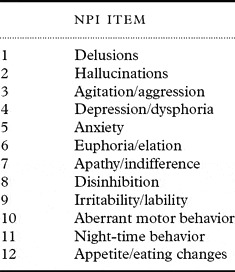
The current NPI evaluates 12 behavioral domains (Table 2) commonly encountered in various types of dementia (Cummings et al., Reference Cummings, Schneider, Tariot and Graham2006b). The NPI requires the frequency and severity of behaviors to be scored by the caregiver based on a scripted interview with the caregiver or other knowledgeable surrogate reporter, referring to behaviors occurring in the preceding four weeks. In addition, the distress that caregivers experience in response to each symptom can be scored on the NPI caregiver distress subscale (NPI-D). Individual symptom (domain) scores are calculated by multiplying the frequency of each symptom by its severity, and the NPI total score is calculated as the sum of the symptom/domain scores. Concurrent validity with other instruments, as well as inter-rater and test–retest reliability, have been established for the NPI total score and domains (Cummings et al., Reference Cummings, Mega, Gray, Rosemberg-Thompson and Gornbein1994). Convergent validity of the NPI has been shown in autopsy investigations, genetic studies, cross-cultural assessments, and neuroimaging studies (Cummings, Reference Cummings2003). A recent observational study in Europe has reported considerable variability (large standard deviation) in NPI total scores (Reynish et al., Reference Reynish2007), and significant differences between European countries have been reported for scores of the NPI item apathy (Robert et al., Reference Robert, Reynish, Cantet and Vellas2008b), reflecting differences in cultural manifestations of behavior, clinical populations, or rater training and strategies.
Behavioral domains assessed by the NPI (Cummings et al., Reference Cummings, Schneider, Tariot and Graham2006b)

NPI = Neuropsychiatric Inventory
The NPI has been the assessment tool of choice in many clinical trials to date, but limitations to the methodology should be noted. In some cases, the total NPI score may not reflect a change in behavior, despite a reduction in individual domain scores, as the domain effect is not sufficient to impact significantly on the total NPI score. In this case, no drug–placebo difference on the total score will be observed. Conversely, small effects on multiple domains may be enough to produce a significant change in the total score in the absence of robust changes in any specific domain. Here, the total NPI score will show treatment–placebo differences, but no individual domain will emerge as responsible for the difference in the total score. The NPI total score reflects a sum of diverse behaviors, and can be regarded only as a rough guide to the overall magnitude of the behavioral disturbances of the patient. Furthermore, the total NPI score is not a description of a clinically recognizable entity and, as with NPS or BPSD, the total NPI score is more a communication device than a diagnosis. Individual NPI symptom domains are more diagnostically informative and therapeutically relevant than the total NPI score, as some agents may show effectiveness on one, or a few, neuropsychiatric syndromes (e.g. delusions and hallucinations). Therefore, evaluating the effect of a treatment intervention on each individual or cluster of NPI symptoms is more likely to give an accurate representation of its efficacy in treating multiple neuropsychiatric syndromes. Support for the value of single-item analysis has been demonstrated in studies of donepezil (Gauthier et al., Reference Gauthier2002a; Feldman et al., Reference Feldman2005), galantamine (Cummings et al., Reference Cummings, Schneider, Tariot, Kershaw and Yuan2004a), rivastigmine (Cummings et al., Reference Cummings, Koumaras, Chen and Mirski2005), and memantine (Gauthier et al., Reference Gauthier, Wirth and Möbius2005; Reference Gauthier, Loft and Cummings2008; Cummings et al., Reference Cummings, McRae and Zhang2006a).
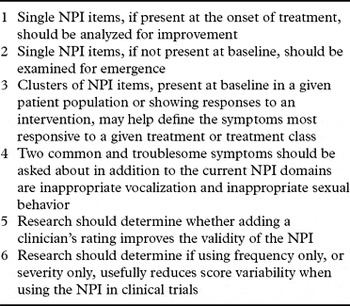
Single NPI items can be used to assess the change in, or emergence of, symptoms in one behavioral domain by scoring the severity (how severe) and frequency (how often) of each symptom – this method reflects clinical reality and has been validated in several studies (e.g. Gauthier et al., Reference Gauthier2002a; Reference Gauthier, Wirth and Möbius2005; Cummings et al., Reference Cummings, Schneider, Tariot, Kershaw and Yuan2004a; Reference Cummings, Koumaras, Chen and Mirski2005). The frequency and severity of behaviors are important dimensions of behavioral assessment and might be useful in clinical practice, as they are easily understood by the person rating the symptoms. For example, with regard to the majority of the symptom domains, reducing the score from “present every day” to “present only once or several times in the week” is a meaningful result, both for the patient and the caregiver. Likewise, reducing the severity of a symptom from marked to mild also has face validity. The latter (severity only) approach is used in the brief NPI-Questionnaire (see below) (Kaufer et al., Reference Kaufer2000). Using only the frequency parameter may also reduce measurement variability (Robert et al., Reference Robert, Reynish, Cantet and Vellas2008b). Limitations of scoring based only on caregiver input have led to the proposal of allowing clinicians’ input to NPI scoring. This, and a number of recommendations by our group in relation to the analysis of NPI scores, are listed in Table 3.
Recommendations for the analysis of NPI scores

NPI = Neuropsychiatric Inventory
Recommendation 5 has been built into an NPI-clinician rating (NPI-C), being developed at Johns Hopkins, which is undergoing validation in the U.S.A. and international sites (de Medeiros et al., Reference de Medeiros2009). This is a unique attempt to take caregiver, patient, and clinician points of view into account in a measure that provides sufficient depth and versatility to rate NPS across the range of dementia syndromes, i.e. from its prodromes to its latest stages.
It is possible that, within assessment of the NPI, the frequency parameter may be less variable than that of severity. To determine if this is true, a recalculation of NPI total scores in existing databases from randomized clinical trials should be conducted using only the frequency parameter. The effect of this maneuver on assessment of treatment across multiple clinical trials will be necessary.
The value of cluster analysis – identification of clusters of behavioral symptoms or ‘NPS sub-syndromes’ – has been demonstrated in studies of donepezil in AD (Gauthier et al., Reference Gauthier, Wirth and Möbius2005; Cummings et al., Reference Cummings, McRae and Zhang2006a), one rivastigmine study in dementia with Lewy bodies (McKeith et al., Reference McKeith2000), and in population-based observational studies, such as that performed by the European Alzheimer's Disease Consortium (EADC). The study conducted by the EADC analyzed the cross-sectional data of 2,354 patients with AD from 12 centers, and demonstrated the presence of four consistent NPS sub-syndromes: hyperactivity, psychosis, affective, and apathy (Aalten et al., Reference Aalten2007). Using these four sub-syndromes to characterize neuropsychiatric symptoms, more than 65% of the patients presented at least one of the syndromes; apathy was the most frequent, followed by hyperactivity, affective, and psychosis (Aalten et al., Reference Aalten2007).
We recommend augmenting the NPI in any specific study with scales that are more specific for the NPS sub-syndromes of interest, e.g. hyperactivity, psychosis, agitation, affective, and apathy. Such scales include the CMAI (Cohen-Mansfield, Reference Cohen-Mansfield1986) for agitation; CSDD (Alexopoulos et al., Reference Alexopoulos, Abrams, Young and Shamoian1988), Montgomery-Åsberg Depression Rating Scale (MADRS) (Montgomery and Åsberg, Reference Montgomery and Åsberg1979), or the Geriatric Depression Scale for mood syndromes (Yesavage et al., Reference Yesavage1982–1983), the Geriatric Anxiety Scale (Pachana et al., Reference Pachana, Byrne, Siddle, Koloski, Harley and Arnold2007) for anxiety, and the Apathy Inventory (Robert et al., Reference Robert2002), or the Apathy Evaluation Scale (AES) (Marin et al., Reference Marin, Biedrzycki and Firinciogullari1991) for apathy.
Measurement of NPS at the pre-dementia stage of the disease
Behavioral changes are not only important at a symptomatic level but also should be considered as an additional outcome measure in clinical trials of disease-modifying therapies. Maximal benefit of disease-modifying therapies will be obtained if treatment is initiated in the early stages of the disease before dementia clearly manifests, and behavioral measures can assist in measuring the benefit of the intervention.
There are two types of prevention studies: primary and secondary. Primary prevention studies in AD target the neuropathologic changes before any symptoms occur. The aim, in the case of behavioral outcomes, would be to monitor the appearance of behavioral symptoms using an instrument such as the NPI. “Emergence analysis” can be used to demonstrate reductions in the emergence of new behavioral symptoms when comparing active treatment with placebo. Secondary prevention studies focus on limiting the progression of mild clinical manifestations. Mood and motivational changes are common in patients with mild cognitive impairment and predict a higher rate of progression to dementia of the Alzheimer type (Teng et al., Reference Teng, Lu and Cummings2007; Robert et al., Reference Robert2008a). Once present, improvement in these symptoms can be used as an outcome in trials of this type.
Management options for NPS in AD
NPS are common in AD, causing excess disability for patients, and distress to caregivers. Despite the importance of these behavioral problems, there are no consensus treatment approaches. Current management of behavioral disturbances involves non-pharmacological interventions, as well as pharmacological interventions including antipsychotic drugs, antidepressants, anxiolytics, hypnotics, anticonvulsants, cholinesterase inhibitors (ChEIs), and memantine. The following sections describe the various options that are available for the treatment of NPS in AD.
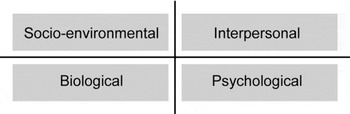
NPS are driven by biological, psychological, psychosocial and environmental factors, and there is no single treatment that works for all patients or in all situations. Before embarking on the management of NPS, it is useful to construct an etiological map; the bio-psycho-social model (Figure 3) provides a useful framework for considering therapeutic interventions in AD. The first step should be to determine the cause of the behavior (i.e. why is a patient behaving in this way), and to attempt to correct reversible factors, before resorting to pharmacological intervention.
The bio-psycho-social framework for behavioral changes in dementia.

Non-pharmacological management approaches
Evidence for psychosocial/psychological management
A review of 162 studies concerned with psychological management approaches to NPS concluded that psycho-education for caregivers was effective, with benefits lasting for months, especially when delivered individually (Livingston et al., Reference Livingston, Johnston, Katona, Paton and Lyketsos2005). Similar benefits were observed when behavior management techniques centering on individual patient or caregiver behaviors were employed. Music therapy and sensory stimulation were useful during the treatment period, but the effects did not persist. One study reported that group training of caregivers in the management of NPS compared to individual caregiver education significantly reduced caregivers’ distress with the behaviors (p = 0.005), and showed a trend for reduction in care recipients’ levels of behavior disturbance (Gonyea et al., Reference Gonyea, O'Connor and Boyle2006). Education and staff training programs are also effective in the nursing home environment reducing NPS (Deudon et al., Reference Deudon2009).
Examples of psychological therapies include relaxation training, which has been shown to reduce NPS (Welden and Yesavage, Reference Welden and Yesavage1982), Learning Theory approaches, and massage therapy. Several authors have emphasized the importance of individualizing treatment approaches according to the needs of the patient (Bird et al., Reference Bird, Alexopoulos and Adamowicz1995; Cohen-Mansfield, Reference Cohen-Mansfield2001). Simulated presence therapy (use of audio or video tapes of family members) has been shown to modify behaviors in small open-label studies (for a review, see Livingston et al., Reference Livingston, Johnston, Katona, Paton and Lyketsos2005). The use of contingent reinforcement has been shown to reduce disruptive vocalization (Doyle et al., Reference Doyle, Zapparoni, O'Connor and Runci1997), and patients participating in reminiscence groups have manifested reductions in problem behaviors (Baines et al., Reference Baines, Saxby and Ehlert1987) and depression (Goldwasser et al., Reference Goldwasser, Auerbach and Harkins1987).
Evidence for interpersonal management
The presence of NPS may be an expression of unmet needs such as pain, hunger, thirst, sex, distress, or fear of endangerment. It is the inability of patients to comprehend these needs, or to make these needs known to caregivers, that may result in a display of disturbing behavior. Intervention comes in the form of interpersonal therapies, which rely on the interaction between the person with dementia and others.
Caregivers can be trained to deliver behavioral therapies to AD patients. Regimes involving pleasurable events or caregiver problem-solving techniques were shown to reduce both the rate and severity of depression in AD patients over control (Teri et al., Reference Teri, Logsdon, Uomoto and McCurry1997). Improvements were maintained for six months and were accompanied by decreased caregiver depressive symptoms (Teri et al., Reference Teri, Logsdon, Uomoto and McCurry1997).
A separate study demonstrated that behavior training sessions by family caregivers resulted in equivalent benefits for the symptoms of agitation achieved following treatment with haloperidol, trazodone, or placebo (Teri et al., Reference Teri2000). However, adverse effects were more common with the drug treatments. Several studies have shown that a multidisciplinary team approach, with individually planned care and clinical supervision, can reduce vocal behaviors and improve nurse–patient cooperation (Draper et al., 2000; Edberg and Hallberg, Reference Edberg and Hallberg1996). Additionally, methods of nursing care have been shown to influence of NPS. Dementia Care Mapping (DCM) and Person Centered Care (PCC) are widely used as ways of preventing and reducing behavioral disturbances. A recent randomized controlled trial showed that DCM and PCC reduced levels of agitation compared to usual care (UC), but that PCC was substantially more cost-effective (Chenoweth et al., Reference Chenoweth2009). Another technique – supervised individualized planned care with nurses – has been demonstrated to have benefits for mood and general behavior of patients (Edberg et al., Reference Edberg, Norberg and Hallberg1999).
Evidence for environmental management
Environmental vulnerability – for example, over/understimulation, overcrowding, inconsistent routine, provocation by others (Day et al., Reference Day, Carreon and Stump2000) – can decrease the threshold for stress (Hall and Buckwalter, Reference Hall and Buckwalter1987), leading to disturbing behavior. The sundowning phenomenon (i.e. greater confusion and more NPS in the late afternoon or early evening) is commonly reported; in one study, nursing home evening staff documented a greater incidence of hallucinations, psychosis, activity disturbance, and diurnal disturbance among residents than their daytime colleagues (Brodaty et al., Reference Brodaty2001). Sundowning may result from decreased and modified environmental stimulation. When NPS appear to be triggered by environmental factors, intervention may be as simple as modifying the person's environment to reflect less institutionalized and more home-like surroundings, allowing personalized space, securing the grounds, and optimizing the mix of residents. Sundowning may respond to simplification of late afternoon and evening routines, and allowing time for relaxation and adjustment. Agitation and aggression have been shown to decrease where nature sounds and large bright pictures have been placed in bathrooms (Whall et al., Reference Whall, Black, Groh, Yankou, Kupferschmid and Foster1997). Furthermore, patients who have been allowed to listen to their preferred music have shown a reduction in agitation (Gerdner, Reference Gerdner2000) and bathtime aggression (Clark et al., Reference Clark, Lipe and Bilbrey1998), whilst those exposed to individualized “white noise” experienced a reduction in verbal agitation (Burgio et al., Reference Burgio, Scilley, Hardin, Hsu and Yancey1996). In addition to an enhanced environment, aromatherapy – lavender oil sprayed into the air (Holmes et al., Reference Holmes, Hopkins, Hensford, MacLaughlin, Wilkinson and Rosenvinge2002), delivered via aroma diffusers placed on each side of the pillow (Lin et al., Reference Lin, Chan, Ng and Lam2007), or Melissa essential oil massaged into the skin (Ballard et al., Reference Ballard, O'Brien, Reichelt and Perry2002) – have shown beneficial effects on behavior in patients with severe dementia and agitation. Bright light therapy to aid sleep and reduce mood and behavioral disturbances, and animal-assisted therapy to reduce agitation and/or aggression have been proposed, but supporting studies are of limited quality (Forbes et al., Reference Forbes, Morgan, Bangma, Peacock and Adamson2004), or conclusions are restricted by small sample sizes and short study durations (Filan and Llewellyn-Jones, Reference Filan and Llewellyn-Jones2006).
Pharmacological management approaches
Antipsychotics
Effect on behavior. The most difficult to manage NPS in dementia are agitation (aggressive and non-aggressive) and psychosis (delusions and hallucinations). Hallucinations may resolve over a few months, but delusions and agitation are more persistent.
Antipsychotics are often used as the first-line pharmacological approach to treat agitation and psychosis in people with dementia. As regards agitation generally, two placebo-controlled trials of antipsychotics in AD over a period of six months or longer have been conducted (Ballard et al., Reference Ballard2005; Schneider et al., Reference Schneider2006b). One study compared six months of treatment with quetiapine, rivastigmine, and placebo in 93 AD patients with significant agitation, and showed no evidence of benefit in symptoms of agitation (Ballard et al., Reference Ballard2005). However, the dose of quetiapine used (50 mg twice daily between Week 12 and Week 26) was lower than many authorities would consider optimal. The second study (CATIE-AD, Comparative Atypical Trial for Intervention Effectiveness in Alzheimer's Disease study) compared nine months of treatment with risperidone, olanzapine, and quetiapine, against placebo in AD patients with clinically significant aggression or agitation (Schneider et al., Reference Schneider2006b). The results showed no significant improvement on the Clinical Global Impression of Change (CGI-C) for any agent, in comparison to placebo, at Week 12. Time to drug discontinuation was the primary outcome of the study, integrating efficacy, safety and tolerability into a global measure of effectiveness; physicians tended to stop placebo and quetiapine for lack of efficacy and to stop olanzapine and risperidone for emergence of side effects (Schneider et al., Reference Schneider2006b). These results are consistent with three placebo-controlled withdrawal studies which have demonstrated that there is no worsening of behavior when longstanding antipsychotics are withdrawn (Bridges-Parlet et al., Reference Bridges-Parlet, Knopman and Steffes1997; Cohen-Mansfield et al., Reference Cohen-Mansfield1999; Ballard et al., Reference Ballard2004). The CATIE-AD study demonstrated that physicians change antipsychotics rapidly after initiation and tend not to titrate to optimal doses.
The efficacy of short-term antipsychotic treatment (lasting between 3 and 18 weeks) in AD patients has been investigated in eight randomized placebo-controlled trials with typical antipsychotics (Schneider et al., Reference Schneider, Pollock and Lyness1990; Lonergan et al., Reference Lonergan, Luxenberg, Colford and Birks2002; Ballard and Howard, Reference Ballard and Howard2006) and 18 placebo-controlled trials with atypical antipsychotics (Ballard and Howard, Reference Ballard and Howard2006; Schneider et al., Reference Schneider, Dagerman and Insel2006a; Reference Schneider2006b; Jeste et al., Reference Jeste2008). The best evidence base is for risperidone, where there are five published trials indicating a modest but significant improvement in aggression compared to placebo, with a larger effect size at 2 mg/day. However, evidence is limited regarding the benefit of risperidone for other symptoms of agitation (Ballard and Howard, Reference Ballard and Howard2006), and for longer-term benefits (see subsequent section).
The evidence base pertaining to the treatment of psychosis in AD is less substantial. The majority of previous studies have focused specifically on agitation symptoms or a cumulative NPS score, with less emphasis on psychosis. A recent meta-analysis evaluated seven trials reporting psychosis as an outcome, using the BEHAVE-AD subscore (Ballard and Howard, Reference Ballard and Howard2006). Three trials involving risperidone indicated a modest, but significant, improvement compared to placebo at 1 mg/day that was not seen at other doses. Another trial supported these data, with risperidone effectively reducing psychosis and improving global functioning in elderly patients with moderate-to-severe psychosis of AD and mixed dementia (Brodaty et al., Reference Brodaty2005). Pooled data from two trials involving olanzapine showed a non-significant trend towards benefit (Ballard and Howard, Reference Ballard and Howard2006). However, only two placebo-controlled trials have specifically focused upon AD patients with clinically significant psychosis at trial entry. In comparison with placebo, one study suggested that risperidone did not confer a significant benefit in AD patients with mild to severe psychosis (Mintzer et al., Reference Mintzer2006), whilst the other reported that a group treated with 10 mg/day of aripiprazole showed a significant benefit of approximately 1.5 points on the NPI psychosis sub-scale (Mintzer et al., Reference Mintzer2007).
The recent double-blind, placebo-controlled study in dementia patients continuing or stopping antipsychotics (DART-AD) investigated, as a secondary endpoint, whether or not discontinuing antipsychotics was associated with an exacerbation of neuropsychiatric symptoms (Ballard et al., Reference Ballard2008). The results showed that patients continuing on antipsychotic treatment experienced a significant deterioration in verbal fluency (p = 0.002), and also showed a non-significant decline in language functions, but there was no significant worsening of neuropsychiatric symptoms with treatment withdrawal (Ballard et al., Reference Ballard2008).
Despite the results from these studies, there are still substantial gaps in the knowledge surrounding the use of antipsychotics in AD patients. In particular, the short-term efficacy of antipsychotics for the treatment of clinically significant psychosis in AD is unclear, and there are very few trials that examine longer-term treatment of aggression or address the issue of whether ongoing antipsychotic treatment confers any benefit for patients with more severe aggression. The lack of long-term treatment studies focusing on the pharmacological management of neuropsychiatric symptoms in AD is a major challenge to evidence-based management.
Safety and tolerability. Widely reported side effects of antipsychotics include extrapyramidal symptoms, sedation, tardive dyskinesia, gait disturbances, and falls, with many agents also producing anticholinergic side effects, such as delirium (Tune et al., Reference Tune, Steele and Cooper1991). Prolongation of the QT interval has been reported as a significant problem with several antipsychotics, in particular droperidol and thioridazine (Reilly et al., Reference Reilly, Ayis, Ferrier, Jones and Thomas2000). A meta-analysis also identified an increase in febrile illness compared to placebo-treated patients, and found that peripheral edema was increased amongst people treated with risperidone (Ballard and Howard, Reference Ballard and Howard2006). Some atypical antipsychotics, in particular olanzapine, clozapine, and quetiapine, are associated with metabolic abnormalities, including insulin resistance and type II diabetes, and hyperlipidemia (Sernyak et al., Reference Sernyak, Leslie, Alarcon, Losonczy and Rosenheck2002).
Cerebrovascular events. Serious concerns have arisen in the past few years regarding analyses suggesting an increase in cerebrovascular events in AD patients treated with antipsychotics. In 2004, the EMEA issued a warning against the use of atypical antipsychotics (risperidone and olanzapine) in elderly patients with dementia due to the risk of stroke (EMEA, 2004). Combining data from placebo-controlled trials, risperidone was associated with a three-fold increased risk of serious cerebrovascular adverse events compared to placebo (Ballard and Howard, Reference Ballard and Howard2006; MHRA, 2004). A similar increase in the incidence of cerebrovascular adverse events was noted in placebo-controlled trials of olanzapine in elderly patients with dementia (olanzapine 1.3% vs placebo 0.4%) (Wooltorton, Reference Wooltorton2004). By contrast, a large retrospective study (using healthcare databases) of older people in Canada did not identify an excess of strokes in patients treated with atypical antipsychotics over those treated with typical antipsychotics (Gill et al., Reference Gill2005), but the absence of diagnostic data prohibited a specific evaluation for patients with dementia. The balance of evidence supports the conclusion that there is an increased risk of cerebrovascular adverse events in patients with dementia treated with risperidone or olanzapine. However, it is unclear whether this is a class effect or an effect specific to a limited subset of drugs. One study of aripiprazole reported cerebrovascular adverse events in four patients on a dose of 10 mg/day, compared with no events in placebo-treated patients (Mintzer et al., Reference Mintzer2007). In the absence of clear clinical trial data, there needs to be a high level of caution regarding the likelihood of an increased risk of adverse cerebrovascular events.
Similarly, there is limited evidence regarding the potential impact of typical antipsychotics on stroke risk. The results of a large retrospective Canadian study indicated a similar stroke incidence in people with dementia who were prescribed typical or atypical antipsychotics (Herrmann et al., Reference Herrmann, Mamdani and Lanctôt2004). However, the absence of an “untreated” comparison group in this study makes the results difficult to interpret.
Mortality. In 2005, the FDA published a warning to highlight a significant increase in mortality risk (OR: 1.6–1.7) for elderly patients with dementia treated with atypical antipsychotics compared to placebo-treated patients in randomized controlled trials (FDA, 2005), forcing a change to the Summary of Product Characteristics (SPC) of atypical antipsychotics. This analysis was based on data from 17 placebo-controlled trials with atypical agents. However, as individual trial data were not provided, it is unclear whether or not the risk differs among the individual drugs. A review of 15 of the 17 trials confirmed a significant increase in mortality (OR: 1.54; 95% CI: 1.06–2.23; p = 0.02), and found no difference among atypical agents (Schneider et al., Reference Schneider, Dagerman and Insel2005). In 2008, the Committee for Medicinal Products for Human Use (CHMP) assessment report on conventional antipsychotics (EMEA, 2008) raised a concern regarding physicians switching patients from atypical to typical antipsychotics for NPS management, in response to the FDA warning. These medication changes were taking place based on a lack of evidence that typical agents were associated with a comparable mortality risk, rather than on evidence that they were not associated with this risk (EMEA, 2008). Subsequent to such concerns, from 2005 onward, further observational studies have been conducted to determine the degree of mortality risk associated with typical antipsychotics (EMEA, 2008). Increased mortality associated with typical antipsychotics has been demonstrated in some studies (e.g. Wang et al., Reference Wang2005), although with some heterogeneity. A retrospective review of Australian veterans and war widows aged 65 years and older, who were dispensed an antipsychotic drug, reported considerable heterogeneity in risk of death from antipsychotics. The greatest risk was found for haloperidol, even when controlling for its use in terminal-state agitation (Hollis et al., Reference Hollis, Grayson, Forrester, Brodaty, Touyz and Cumming2007).
Studies have shown that the differences among antipsychotics were not restricted to clear group differences between typical and atypical agents. For example, when compared to olanzapine, haloperidol was clearly associated with a significantly increased mortality risk (relative risk [RR] = 2.26, 95% CI 2.08–2.47; p≤0.001), whilst there was a more modest, but also significant, increased, mortality risk for risperidone (RR = 1.23, 95% CI 1.07–1.40; p = 0.003) (Hollis et al., Reference Hollis, Grayson, Forrester, Brodaty, Touyz and Cumming2007). Furthermore, combined therapies – defined as people taking more than one study drug – were associated with an increase in mortality risk when compared to olanzapine only (RR = 1.45, 95% CI: 1.10–1.98) (Hollis et al., Reference Hollis, Grayson, Forrester, Brodaty, Touyz and Cumming2007).
A placebo-controlled study of aripiprazole reported three deaths in the placebo-treated group and eight deaths on aripiprazole 10 mg/day, with an odds ratio of 2.7 (Mintzer et al., Reference Mintzer2007). As highlighted by Schneider et al. (Reference Schneider, Dagerman and Insel2005), the absolute number of excess deaths over 10–12 weeks in antipsychotic-treated AD patients is small (Schneider et al., Reference Schneider, Dagerman and Insel2005). A key question is whether or not this excess risk persists or changes with longer-term therapy. The recent extension of the DART-AD study, reporting follow-up for up to 54 months for individual participants, reported a similar overall relative risk to the reports by Schneider et al. (Reference Schneider, Dagerman and Insel2005) and the FDA (2005), but indicated that the absolute risk increased dramatically with longer-term treatment. For example, after 36 months of exposure, 59% of people randomized to placebo were still alive whereas only 30% of people randomized to continue an antipsychotic were still alive (Ballard et al., Reference Ballard2009b). The cause of the increased risk of death is unknown. Hypothetically, treatment may lead to somnolence, and the consequent reductions in activity levels may precipitate a cascade of events, including increased vulnerability to chest infections and increased use of diuretics, which combine to confer an increased mortality risk (Ballard and Howard, Reference Ballard and Howard2006).
Overall, antipsychotics clearly confer significant treatment benefit for the short-term (up to 12 weeks) treatment of aggression in people with AD, although the benefits must be weighed against the not insubstantial risk of serious adverse events. The evidence base is less robust for longer-term therapy, and for the treatment of psychosis, but the longer-term use of antipsychotics in people with AD is probably inadvisable, other than in exceptional clinical circumstances. Clinical trials to identify other safe and effective pharmacological and non-pharmacological treatments for neuropsychiatric symptoms in AD are an urgent clinical research priority.
Electroconvulsive therapy
Although not subject to randomized controlled trials (Stek et al., Reference Stek, van der Wurff, Hoogendijk and Beekman2003), the use of electroconvulsive therapy (ECT) for depression, agitation and psychosis in dementia has been documented, largely in the form of case series and case reports. ECT in dementia tends to be reserved for life-threatening or pharmacologically-unresponsive conditions, such as severe depression or suicidality (e.g. Zink et al., Reference Zink, Sartorius, Lederbogen and Henn2002), extreme agitation and aggression (e.g. Grant and Mohan, Reference Grant and Mohan2001; Sutor and Rasmussen, Reference Sutor and Rasmussen2008), or psychosis associated with refusal of food and medications (e.g. Katagai et al., Reference Katagai, Yasui-Furukori, Kikuchi and Kaneko2007). In published case reports of these particular examples, ECT was found to be a safe and effective alternative treatment. Support for the use of ECT in the elderly (with or without cognitive impairment) is almost always accompanied by warnings regarding side effects, including increased pulse and blood pressure – thereby increasing myocardial oxygen demand – and the potential for cardiac events (Kelly and Zisselman, Reference Kelly and Zisselman2000), as well as significant but transient delirium or other impairments in cognition and memory (Price and McAllister, Reference Price and McAllister1989; Kelly and Zisselman, Reference Kelly and Zisselman2000).
Rao and Lyketsos (Reference Rao and Lyketsos2000) reviewed medical charts of 31 patients diagnosed with “dementia with depression” who had been treated with ECT, 13% of whom were patients with AD. Following a mean of nine ECT treatments (range 1–23), patients experienced a significant decline in their MADRS scores of 12.28 points (p < 0.01), and 40% of patients had MADRS scores <10 (normal). Almost half the patients experienced transient delirium following a treatment; however, by discharge there was a small but significant improvement in MMSE score of 1.62 points (p < 0.02). The authors concluded that ECT is effective against depression in dementia, but that several treatments might be necessary to yield significant clinical improvement (Rao and Lyketsos, Reference Rao and Lyketsos2000).
Randomized controlled trials are needed to assess the safety and efficacy of ECT in dementia-associated depression if a sound evidence base is to be generated on which to develop clinical guidance (Stek et al., Reference Stek, van der Wurff, Hoogendijk and Beekman2003).
Antidepressants and anticonvulsants
Effects on behavior. Antidepressants and anticonvulsants have been used to treat the NPS of dementia for almost three decades. Despite this, the literature remains limited, so that few clear inferences can be drawn. The main problem is that potential treatments have been directed towards poorly defined targets. Generally, antidepressants have targeted primarily depression, defined syndromally (e.g. major depressive episode) or using rating scales. More recently, the use of antidepressants has been directed towards agitation, or broadly defined NPS. By contrast, the primary target of anticonvulsants has been agitation, mostly in institutionalized patients. The effect of antidepressants or anticonvulsants in treating psychosis is not documented systematically in the literature, although there is evidence of potential efficacy if the psychosis is associated with depression or agitation (Ballard and Howard, Reference Ballard and Howard2006). The safety profile of both these classes of medications in this setting is not fully known, although there is some reassurance that they do not carry the mortality risk of antipsychotics. A large retrospective cohort study identified the following relative risk (RR) values for 12-month mortality compared to typical antipsychotics: for selective serotonin reuptake inhibitors (SSRIs) RR = 0.49 (95% CI 0.39–0.62), for tricyclic antidepressants RR = 0.40 (95% CI 0.25–0.62), and for anticonvulsants RR = 0.79 (95% CI 0.51–1.24) (Kales et al., Reference Kales2007).
Data from randomized controlled trials gleaned from the literature can be grouped into three areas: trials of antidepressants targeting depression (mood), involving placebo or active comparator controls; trials of antidepressants targeting agitation or NPS, involving placebo or active comparator controls; and trials of anticonvulsants (carbamazepine, sodium valproate, or divalproex sodium) involving placebo targeting agitation.
Effects on mood. The results of the placebo-controlled studies targeting depression in dementia, on balance, suggest efficacy, especially for the SSRIs – citalopram and sertraline (Nyth et al., Reference Nyth1992; Lyketsos et al., Reference Lyketsos2003) – although efficacy over placebo was also observed for the non-SSRIs – clomipramine (Petracca et al., Reference Petracca, Tesón, Chemerinski, Leiguarda and Starkstein1996) and moclobemide (Roth et al., Reference Roth, Mountjoy and Amrein1996). The only two trials failing to show efficacy involved one of sertraline in severe AD, where the assessment of depression is very difficult (Magai et al., Reference Magai, Kennedy, Cohen and Gomberg2000), and one of imipramine that used the Hamilton Depression Rating Scale (HAM-D) as the only rating of outcome (Reifler et al., Reference Reifler1989). The latter result is of interest, since a recent study suggested that dementia-specific depression rating scales, such as the one developed at Cornell (CSDD), are more sensitive to the treatment effects of antidepressants in depressed AD patients than the HAM-D (Mayer et al., Reference Mayer2006).
The Depression in Alzheimer's Disease Study-2 (DIADS-2) (Martin et al., Reference Martin2006), proposed by the consensus panel assembled by the U.S. National Institute on Mental Health (NIMH) (Olin et al., Reference Olin2002), was, in part, designed to clarify the safety and efficacy of the antidepressant sertraline at 100 mg/day for depression in AD. Furthermore, DIADS-2 was also designed to evaluate nosologically the depressive target syndrome that is most likely to respond to antidepressants (Martin et al., Reference Martin2006).
Comparator trials of antidepressants without placebo have involved a variety of antidepressants. The findings have consistently suggested comparable efficacy for SSRI and non-SSRI antidepressants – in trials of fluoxetine versus amitryptiline (Taragano et al., Reference Taragano, Lyketsos, Mangone, Allegri and Comesaña-Diaz1997); paroxetine versus imipramine (Katona et al., Reference Katona, Hunter and Bray1998); and citalopram versus mianserin (Karlsson et al., Reference Karlsson2000). In general, SSRIs (fluoxetine, paroxetine, and citalopram) appear to be better tolerated than the non-SSRIs (amitryptiline and imipramine) (Taragano et al., Reference Taragano, Lyketsos, Mangone, Allegri and Comesaña-Diaz1997; Katona et al., Reference Katona, Hunter and Bray1998; Karlsson et al., Reference Karlsson2000). However, from the results of the placebo-controlled studies targeting depression, the monoamine oxidase (MAO) inhibitor moclobemide seems to be a promising antidepressant in terms of tolerability (Roth et al., Reference Roth, Mountjoy and Amrein1996). Of note, placebo-controlled and comparator studies have all been short term (≤12 weeks in duration). The DIADS-2 study has addressed this issue by extending the period of follow-up to approximately one year in some cases (Martin et al., Reference Martin2006).
Effects on agitation. There have been mixed results regarding the placebo-controlled trials of antidepressants targeting agitation, possibly due to small sample sizes and methodology. For example, the antidepressant trazodone showed no efficacy over placebo in a trial of 149 AD patients with agitation (Teri et al., Reference Teri2000), but was more effective than placebo in a randomized cross-over study in 10 patients with behavioral disturbances (Lawlor et al., Reference Lawlor, Radcliffe, Molchan, Martinez, Hill and Sunderland1994). No significant effect over placebo was noted on agitation in trials evaluating the SSRIs fluoxetine (Auchus and Bissey-Black, Reference Auchus and Bissey-Black1997) and sertraline (Lanctôt et al., Reference Lanctôt, Herrmann, van Reekum, Eryavec and Naranjo2002; Finkel et al., Reference Finkel, Mintzer, Dysken, Krishnan, Burt and McRae2004). Effectiveness over placebo in terms of agitation was observed with the use of citalopram, which also showed benefits over perphenazine for agitation (Pollock et al., Reference Pollock2002). In a later comparator study, citalopram was found to be comparable in efficacy, and had superior tolerability, to risperidone in the treatment of moderate to severe NPS in inpatients with dementia (Pollock et al., Reference Pollock2007). By contrast, neither trazodone (Sultzer et al., Reference Sultzer, Gray, Gunay, Berisford and Mahler1997) nor sertraline (Gaber et al., Reference Gaber, Ronzoli, Bruno and Biagi2001) was more effective than haloperidol in the treatment of agitation in patients with dementia.
While all three comparator studies of antidepressants for agitation have been small, they suggest that sertraline or citalopram have comparable efficacy to haloperidol or risperidone, respectively.
From trials evaluating anticonvulsant use for agitation, clinical studies of divalproex sodium and sodium valproate suggest poor tolerability and questionable, or lack of, efficacy (Tariot et al., Reference Tariot2001a; Porsteinsson et al., Reference Porsteinsson2001; Sival et al., Reference Sival, Haffmans, Jansen, Duursma and Eikelenboom2002; Tariot et al., Reference Tariot2005; Herrmann et al., Reference Herrmann, Lanctôt, Rothenburg and Eryave2007a). A Cochrane Review individually examined three of the above studies (Tariot et al., Reference Tariot2001a; Porsteinsson et al., Reference Porsteinsson2001; Sival et al., Reference Sival, Haffmans, Jansen, Duursma and Eikelenboom2002). The authors concluded that, whilst low dose valproate preparations demonstrated insufficient evidence of efficacy against agitation, high dose preparations yielded unacceptable adverse events, hence its routine use in dementia-associated agitation was not recommended (Lonergan and Luxenberg, Reference Lonergan and Luxenberg2004). A 2006 review of divalproex sodium studies also reported findings to be conflicting – three studies suggested short-term efficacy and tolerability, but a fourth showed no advantage over placebo – and concluded that the evidence available was insufficient to guide clinical practice (Porsteinsson, Reference Porsteinsson2006).
By contrast, there is evidence that carbamazepine shows modest efficacy against agitation for patients with dementia (Tariot et al., Reference Tariot1994; Reference Tariot1998; Cooney et al., Reference Cooney, Mortimer, Smith, Newton and Wrigley1996; Olin et al., Reference Olin, Fox, Pawluczyk, Taggart and Schneider2001). Two placebo-controlled crossover trials of carbamazepine – one conducted in nursing home patients with dementia, and the other in patients with AD – have demonstrated benefits of carbamazepine over placebo on agitation (Tariot et al., Reference Tariot1994; Cooney et al., Reference Cooney, Mortimer, Smith, Newton and Wrigley1996). Support for these results was provided by a subsequent randomized, double-blind, placebo-controlled trial investigating the efficacy, safety and tolerability of carbamazepine in the treatment of agitation and aggression in patients with severe dementia. In this study, carbamazepine demonstrated superiority over placebo for the treatment of agitation and aggression in this patient group (Tariot et al., Reference Tariot1998). Furthermore, a modest clinical benefit was achieved following carbamazepine treatment in a pilot randomized, double-blind, placebo-controlled trial in agitated subjects with AD who had been unsuccessfully treated with antipsychotics (Olin et al., Reference Olin, Fox, Pawluczyk, Taggart and Schneider2001).
Regarding divalproex sodium, a randomized study assessing its efficacy, tolerability and safety for the treatment of agitation associated with dementia showed a significant drug–placebo difference in agitation scores following treatment (Brief Psychiatric Rating Scale (BPRS)], p = 0.05; CGI-C, p = 0.06) (Porsteinsson et al., Reference Porsteinsson2001). However, divalproex sodium was poorly tolerated in this study, and attrition challenged efficacy conclusions (Porsteinsson et al., Reference Porsteinsson2001). Two further randomized, double-blind, placebo-controlled studies have investigated the efficacy and tolerability of divalproex sodium and sodium valproate in the treatment of agitation and/or aggression in AD patients (Tariot et al., Reference Tariot2005; Herrmann et al., Reference Herrmann, Lanctôt, Rothenburg and Eryave2007a). Divalproex sodium did not produce any change in agitation (assessed using BPRS) compared to placebo (Tariot et al., Reference Tariot2005), whereas a significant deterioration in agitation/aggression scores (assessed using the NPI) was observed for sodium valproate compared with placebo (p = 0.04) (Herrmann et al., Reference Herrmann, Lanctôt, Rothenburg and Eryave2007a). Furthermore, neither sodium valproate or divalproex sodium showed any difference over placebo in improving aggressive behavior associated with dementia (Sival et al., Reference Sival, Haffmans, Jansen, Duursma and Eikelenboom2002), or improving mania in elderly patients with dementia experiencing manic symptoms, respectively (Tariot et al., Reference Tariot2001a).
Collectively, the studies suggest no or limited benefit with divalproex sodium and sodium valproate. Preliminary data regarding carbamazepine for agitation indicated that further studies of this agent are warranted.
Cholinesterase inhibitors
Effect on behavior. There is evidence to suggest that a relationship exists between behavioral disturbances in patients with dementia and cholinergic abnormalities. This is supported by findings of a correlation between lowered ChAT activity in both frontal and temporal cortex and overactivity in patients with dementia (Minger et al., Reference Minger2000). Furthermore, AD patients with psychosis show increased muscarinic binding at the M2 receptor, suggesting that compensatory adjustment for the cholinergic deficit contributes to the psychosis of AD (Lai et al., Reference Lai2001). Patients with more severe perfusion deficits of the orbitofrontal cortex exhibit more behavioral abnormalities, and are more likely to exhibit a beneficial behavioral response to treatment with ChEIs (Mega et al., Reference Mega2000).
ChEIs typically improve cognition and function in patients with AD. The total NPI is most commonly used to assess behavior in clinical trials of ChEIs, and frequently demonstrates behavioral benefits (Cummings et al., Reference Cummings, Koumaras, Chen and Mirski2005; Aupperle et al., Reference Aupperle, Koumaras, Chen, Rabinowicz and Mirski2004). In some cases, individual NPI domain scores may be reduced, but the effect is not sufficient to impact on the total NPI score. The behavioral domains affected in different studies of ChEIs vary due to the different inclusion and exclusion criteria for each clinical trial (for example, whether psychotropic medications were allowed), differing severity of behavioral changes at baseline, and varying study parameters (blinding, dementia severity at baseline, etc). The observed variation is not necessarily an indication of differential efficacy of the ChEIs used, but may indicate the spectrum of positive and negative behavioral changes reported in clinical studies of ChEIs. The behavioral symptoms most likely to improve with ChEI treatment appear to be apathy, depression, and aberrant motor behavior (e.g. Feldman et al., Reference Feldman2005; Holmes et al., Reference Holmes2004; Matthews et al., Reference Matthews, Korbey, Wilkinson and Rowden2000; Aupperle et al., Reference Aupperle, Koumaras, Chen, Rabinowicz and Mirski2004; Cummings et al., Reference Cummings, Schneider, Tariot, Kershaw and Yuan2004a).
There are few predictors of response to ChEIs. Patients with more severe behavioral changes at baseline tend to have more robust responses to therapy. The presence of visual hallucinations also appears to predict a better cognitive response to treatment with ChEIs (Emre et al., Reference Emre, Cummings and Lane2007). Cognitive and behavioral responses to ChEI therapy are only weakly correlated, and patients may exhibit behavioral improvement while experiencing only limited or no cognitive improvement (Spalleta et al., Reference Spalletta2004).
Donepezil. The behavioral effects of donepezil have been assessed using the NPI in a variety of studies. Two double-blind, placebo-controlled studies examining the effect of donepezil in patients with severe AD assessed NPI as a secondary outcome, but did not find any difference of donepezil over placebo (Black et al., Reference Black2007; Winblad et al., Reference Winblad2006). In a double-blind study of patients with moderate to severe AD, the NPI was used as a secondary outcome. Results showed significant reductions in depression/dysphoria (p = 0.0348), anxiety (p = 0.038), and apathy/indifference (p = 0.0116) (Feldman et al., Reference Feldman2005). Further analysis of the same study addressed behavior only in patients with moderate AD, and found reductions in the symptoms of delusions and apathy (p < 0.05) (Gauthier et al., Reference Gauthier, Feldman, Hecker, Vellas, Emir and Subbiah2002b). A double-blind study of donepezil in AD patients residing in nursing homes reported a reduction in the number of patients exhibiting agitation (Tariot et al., Reference Tariot2001b). A prospective controlled study examining the effects of donepezil on acute agitation (CALM-AD study) did not find any difference from placebo (Howard et al., Reference Howard2007). Significant reductions in agitation, anxiety, apathy, delusions, depression, disinhibition, hallucinations, irritability and aberrant motor activity were reported in the open-label period of a study that was followed by a blinded withdrawal of donepezil (Holmes et al., Reference Holmes2004). Behavioral deterioration ensued in the group withdrawn from donepezil. An open-label evaluation of donepezil and sertraline found that patients receiving donepezil showed reductions in depression and delusion scores of the NPI (Cummings et al., Reference Cummings, McRae and Zhang2006a). The results of two further open-label studies of donepezil showed reductions in hallucinations, elation/euphoria, irritability and aberrant motor behavior (Matthews et al., Reference Matthews, Korbey, Wilkinson and Rowden2000), and disinhibition, irritability and delusions (Barak et al., Reference Barak, Bodner, Zemishlani, Mirecki and Aizenberg2001). However, open-label trials are limited by the lack of placebo control, and may be prone to potential biases resulting from differences in management, treatment, assessment of patients, or interpretation of results, arising as a result of subject or investigator knowledge of the assigned treatment (ICH Tripartite Guideline, 2000). The donepezil summary of product characteristics (SPC) lists agitation as an adverse event, i.e. occurring in 1–10% of recipients (Eisai Limited, 2009).
Rivastigmine. A double-blind comparator study, investigating the efficacy of rivastigmine and quetiapine for agitation in people with dementia in institutional care, did not show efficacy for either agent (Ballard et al., Reference Ballard2005). An open-label study of patients residing in nursing homes evaluated the efficacy of rivastigmine on behavioral symptoms in AD (Cummings et al., Reference Cummings, Koumaras, Chen and Mirski2005). Patients exhibited a marked improvement from baseline on domain scores of delusions, hallucinations, agitation, apathy/indifference, irritability/lability and aberrant motor behavior, which was maintained when re-assessed at 12 months (after an extension period of 6 months) (Aupperle et al., Reference Aupperle, Koumaras, Chen, Rabinowicz and Mirski2004). In addition, symptoms of anxiety and euphoria were reduced from baseline scores. Rivastigmine has been observed to produce stabilization of aggressiveness, activity disturbances, hallucinations and paranoia in AD patients observed for a two-year period (Rösler et al., Reference Rösler, Retz, Retz-Junginger and Dennler1998). Agitation is sufficiently frequent as to be reported as a “common” adverse event in the rivastigmine SPC (Novartis Pharmaceuticals U.K. Limited, 2009), drawing attention to differences in reports between side effects reported by caregivers and systematic evaluations using standardized methodologies. Controlled trials, which are more robustly designed to prove efficacy, failed to show efficacy for rivastigmine on the secondary behavioral endpoint (see potential explanations for negative trials below), and some pivotal studies did not include behavioral measures.
Galantamine. A pivotal trial of galantamine showed a significant reduction in the total NPI score at doses of 16 mg/day and 24 mg/day (Tariot et al., Reference Tariot, Solomon, Morris, Kershaw, Lilienfeld and Ding2000). A post hoc analysis of this study compared patients who exhibited behavioral symptoms at baseline and those who did not (Cummings et al., Reference Cummings, Schneider, Tariot, Kershaw and Yuan2004a): among patients who were symptomatic at baseline, a greater reduction in scores was observed when compared to placebo for aberrant motor behavior, agitation/aggression, and anxiety. The reductions in these domains were clinically meaningful. Furthermore, the emergence of aberrant motor behavior, apathy and disinhibition symptoms was significantly less for galantamine than placebo, in patients who did not exhibit behavioral symptoms at baseline. A second analysis of pooled data from three double-blind, controlled studies of galantamine in mild to moderate AD reported significant reductions in total NPI, and individual domains of agitation/aggression, anxiety, disinhibition and aberrant motor behavior, compared to placebo. It was further observed that the symptom cluster of hallucinations, anxiety, apathy and aberrant motor behavior also displayed significant improvement, leading to a proposal that this symptom cluster in particular may be “cholinergic-responsive” (Herrmann et al., Reference Herrmann, Rabheru, Wang and Binder2005). Agitation is listed as a “rare” adverse event (i.e. occurring in 0.01–0.1% of recipients) in the galantamine SPC (Shire Pharmaceuticals Limited, 2008).
Memantine
Effect on behavior. Memantine has been shown to have beneficial effects on behavior, as well as on cognition and function. Several studies have addressed behavior changes in response to treatment with memantine. A double-blind, placebo-controlled study investigating the efficacy of memantine in patients with moderate to severe AD, reported agitation as an adverse event in 18% of patients on memantine compared with 32% of patients on placebo (Reisberg et al., Reference Reisberg, Doody, Stöffler, Schmitt, Ferris and Möbius2003). However, despite statistically significant benefits revealed at endpoint for some measures in the memantine group (e.g. Clinician Interview Based Impression of Change plus Caregiver Input (CIBIC-plus), Severe Impairment Battery (SIB), Alzheimer's Disease Cooperative Study-Activities of Daily Living scale for severe AD (ADCS-ADL-sev)), no significant improvement in NPI score was seen in the memantine group, compared to placebo (OC analysis, p = 0.60) (Reisberg et al., Reference Reisberg, Doody, Stöffler, Schmitt, Ferris and Möbius2003). A later double-blind, placebo-controlled study reported agitation as an adverse event in 9% of patients treated with memantine compared with 14% in placebo-treated patients (van Dyck et al., Reference van Dyck, Tariot, Meyers and Resnick2007). In common with the previous study, this analysis failed to demonstrate a significant improvement in endpoint NPI score for memantine over placebo (OC analysis, p = 0.782) (van Dyck et al., Reference van Dyck, Tariot, Meyers and Resnick2007). In a prospective, placebo-controlled study of memantine in patients with moderate to severe AD already receiving donepezil, agitation was reported in fewer patients receiving memantine (9.4%) than placebo (11.9%) (Tariot et al., Reference Tariot, Farlow, Grossberg, Graham, McDonald and Gergel2004). Further, at study end, total NPI score was significantly lower in the memantine group, compared to placebo (OC analysis, p = 0.01; LOCF analysis, p = 0.002) (Tariot et al., Reference Tariot, Farlow, Grossberg, Graham, McDonald and Gergel2004).
A post hoc analysis of two placebo-controlled trials – one monotherapy study of memantine (Reisberg et al., Reference Reisberg, Doody, Stöffler, Schmitt, Ferris and Möbius2003) and one combination study of memantine and donepezil (Tariot et al., Reference Tariot, Farlow, Grossberg, Graham, McDonald and Gergel2004) – demonstrated a significant beneficial effect for memantine in comparison to placebo treatment, when assessed using the agitation/aggression domain of the NPI in both studies (p = 0.008; p = 0.001, respectively) (Gauthier et al., Reference Gauthier, Wirth and Möbius2005). Furthermore, a dichotomized analysis of the monotherapy study showed that there was significantly less emergence of agitation/aggression in the memantine-treated group, compared to placebo (p = 0.008), in patients who did not have these symptoms at baseline (Gauthier et al., Reference Gauthier, Wirth and Möbius2005). This post hoc analysis also revealed a statistically significant improvement in delusions in the monotherapy study (p = 0.04), and in irritability/lability in the combination study (p = 0.005) (Gauthier et al., Reference Gauthier, Wirth and Möbius2005).
A second post hoc analysis was conducted on the results of the combination study (Tariot et al., Reference Tariot, Farlow, Grossberg, Graham, McDonald and Gergel2004), and reported findings consistent with those obtained by Gauthier and colleagues (Cummings et al, Reference Cummings, Schneider, Tariot and Graham2006b). Analysis of the individual behavioral domains of the NPI after 24 weeks revealed that among those patients who had exhibited agitation/aggression at baseline, there were significant reductions in scores for these symptoms in favor of memantine (p = 0.021). Furthermore, memantine-treated patients without agitation/aggression at baseline evidenced significantly less emergence of these symptoms at 24 weeks, compared with similar patients receiving placebo (p = 0.016) (Cummings et al., Reference Cummings, Schneider, Tariot and Graham2006b). Significant reductions in the emergence of symptoms in patients asymptomatic at baseline were also noted for irritability/lability (p = 0.041), and night-time behavior (p = 0.027) (Cummings et al., Reference Cummings, Schneider, Tariot and Graham2006b).
An analysis of data pooled from six randomized placebo-controlled clinical trials was performed for all patients with moderate to severe AD, defined as MMSE <20 (Gauthier et al., Reference Gauthier, Loft and Cummings2008). In all studies, NPI was measured at 12 and 24/28 weeks. Statistically significant differences between memantine and placebo were evident at 12 weeks for the total NPI score, and the single items of delusions (p = 0.007), hallucinations (p = 0.037), agitation/aggression (p = 0.001); and at 24/28 weeks for the total NPI score, and the single items of delusions (p = 0.001), agitation/aggression (p = 0.001), and irritability/lability (p = 0.005). Patients who did not exhibit behavioral symptoms at baseline showed a reduction in the emergence of agitation/aggression (p = 0.002), delusions (p = 0.047), and disinhibition (p = 0.011), at Week 12, and agitation/aggression (p = 0.002), irritability/lability (p = 0.004), and night-time behavior (p = 0.05) at Week 24/28 (Gauthier et al., Reference Gauthier, Loft and Cummings2008).
A retrospective analysis of three large randomized studies has evaluated the efficacy and safety of memantine in a subpopulation of patients with moderate to severe AD showing behavioral symptoms of agitation/aggression or psychosis at baseline (Wilcock et al., Reference Wilcock, Ballard, Cooper and Loft2008). The effect of memantine and placebo on these specific symptoms was evaluated using the NPI. There was a significant treatment advantage of memantine over placebo for agitation/aggression at 12 weeks (p = 0.011) and at 24/28 weeks (p < 0.001) (Wilcock et al., Reference Wilcock, Ballard, Cooper and Loft2008).
A recent study tested the hypothesis that memantine treatment initiation modifies psychotropic medication (Vidal et al., Reference Vidal2008). In 5,283 real-life practice memantine-treated patients, the proportion of subjects treated with psychotropic drugs increased regularly before memantine initiation, and reached a plateau afterwards (Vidal et al., Reference Vidal2008).
The memantine SPC does not list agitation among its undesirable effects, and lists somnolence as the only common behavioral effect (Lundbeck Limited, 2009). Somnolence was found to occur in 3.4% of memantine-treated patients, versus 2.2% of placebo-treated patients (Lundbeck Limited, 2009).
Reasons for negative outcomes in clinical studies
There have been many failures to demonstrate improvement against placebo on behavioral measures in clinical trials investigating the treatment of NPS. There are several potential explanations for these negative outcomes, which may be related to the intervention (i.e. the drug), the instrument used for assessment, the study design, or the patient population. The drug may lack psychotropic properties for the domains measured, or possesses insufficient efficacy to produce a drug–placebo difference. The instrument used to assess behavior may be insensitive to the changes produced, or may fail to show a positive outcome on total score despite changes on individual domain scores. Large standard deviations may make it difficult to distinguish the treatment signal from the measurement noise. A common outcome in many negative trials is that both groups improve, but the change is not different between the placebo and treatment groups. Regression to the mean may reduce behavioral measurement scores in both treatment and placebo groups (Cummings et al., Reference Cummings, Tractenberg, Gamst, Teri, Masterman and Thal2004b). The increased patient attention and assessment procedures that are implicit in clinical trials may account for some of the observed benefit – especially in nursing home residents who might be deprived of adequate stimulation. With respect to the trial itself, behavioral symptoms may be sufficiently modest at baseline to make beneficial changes difficult to detect, except with very large sample sizes, i.e. “floor effects”. Measurement variance may be exaggerated in some trials, e.g. in multinational studies where a variety of translations and cultural interpretations are required. Administration of the behavioral scale or the collection of the data may be incorrect, with implications for the results. This is a particular challenge in residential care, where staff may be ill-equipped to be reliable reporters of behaviors, and where diurnal patterns of behavior can result in large differences in apparent outcomes, depending upon the time of day when ratings are made. Patient-related considerations that might minimize drug–placebo differences include the use of concomitant medication (e.g. patients may be receiving psychotropic agents affecting the response to potential treatments), and confounding by comorbid conditions such as urinary tract infection, which may distort the usual severity and/or frequency of behaviors. Additionally, patients may have a very severe form of the disease, which may hinder the detection of a beneficial treatment response. Finally, the presence of medical or neurologic comorbidity in patients may also affect treatment response. The recommendations of the expert panel listed in Table 3 are intended to minimize some of these effects.
Conclusions and recommendations
No single therapy can address all behaviors. It is critical to understand the cause of the behavior and the person exhibiting the behavior, and to use this information to determine what approach is likely to be of most benefit. Further research surrounding the “meaning” of various problem behaviors and their prognostic implications in AD is required, as is deeper insight into the biological, environmental and psychosocial underpinnings of behavioral disturbances in AD. Such information may shed light upon more effective therapeutic interventions.
Understanding the management of behavior
Clinicians must be creative in determining the optimal management for each patient. Psychosocial interventions are usually the first line of treatment, and are used in conjunction with pharmacological interventions. Medications have an important role, but need to be used judiciously, with informed consent from the patient or proxy, and be closely monitored. Future drug trials should be designed to minimize placebo effects, consider a run-in period with psychosocial treatment prior to drug intervention, and target specific behaviors for which there is evidence of effectiveness.
Advancing NPS research
The field needs to reach clear consensus on target syndromes that will be evaluated in future psychopharmacologic trials of patients with AD and NPS. Future evaluation of NPS needs to take into account different points of view, in particular, those of the caregiver and the clinician. It has been proposed that there are two affective syndromes – one depressive and one agitated – as well as a psychosis syndrome (Lyketsos, Reference Lyketsos2007), which might be reasonable targets for either anticonvulsants or antidepressants, especially SSRIs. There is not yet a consensus on how to define “agitation”, and whether there are different types of agitation. Apathy and sleep disorders are also important therapeutic targets in this population. However, agreement on specific syndromic criteria is needed. For example, there is preliminary evidence that the presence of delusions or hallucinations would not be useful in defining syndromes out of context, since the former may be more strongly associated with the affective syndromes of AD.
Use of antipsychotics
Although antipsychotics are in widespread clinical use for the treatment of NPS in people with AD, in the context of the known harmful effects of these agents, any research using these agents in patients with AD/dementia must proceed with caution. It is, however, important to determine the comparative efficacy of new potential treatments versus antipsychotics, which have the best current evidence base for the treatment of NPS. One plausible strategy is to undertake trials in people already taking antipsychotics, who would then be randomized either to continue the antipsychotic or to the proposed candidate therapy. Such trials need to include an increased focus on quality of life and cost-effectiveness to help clarify the role of antipsychotics and other agents in the ongoing treatment of NPS.
Use of anticonvulsants and antidepressants
All trials should include analyses designed to evaluate which subgroups demonstrate a better treatment response, including pharmacogenomic and pharmacokinetic assessments. These exploratory analyses may guide future trials. Additional trials of carbamazepine appear to be warranted; it is surprising that this drug has not been followed up since the last publication in 2001. Additionally methylphenidate, modafinil and atomoxatine are good candidates for select syndromes, such as apathy. Antidepressants, such as mirtazapine, transdermal selegiline, venlafaxine and desvenlafaxine succinate should also be evaluated.
A clinical trials consortium of knowledgeable investigators is needed to advance trial methods, resolve trial challenges and develop new trialists devoted to this area of psychotropic pharmacology for the various dementias.
Use of ChEIs
If in line with treatment indications and disease severity, ChEI therapy will be initiated at the time of AD diagnosis; behavioral changes may or may not be present at this stage. Early initiation of ChEI treatment may defer the emergence of behavioral changes as the disease progresses (Cummings et al., Reference Cummings, Schneider, Tariot, Kershaw and Yuan2004a).
In the presence of NPS, therapy with a ChEI, with or without memantine, should be implemented prior to the use of psychotropic agents, since both cognitive and behavioral benefit may ensue, and the use of psychotropic agents may be avoided in some patients. Similarly, the use of ChEI therapy may make it possible to use lower doses of psychotropic agents (Bergman et al., Reference Bergman, Brettholz, Shneidman and Lerner2003), or to minimize duration of psychotropic treatment periods, thereby minimizing risks associated with these agents. It may be possible to discontinue therapy with psychotropic medications if patients are being treated with these agents when ChEIs are introduced.
The withdrawal of ChEIs has been associated with behavioral deterioration and, therefore, patients should be closely monitored for the emergence of new behavioral changes if ChEIs are withdrawn (Holmes et al., Reference Holmes2004). The appearance of new or worsening behavioral disturbances in the course of withdrawal indicates that the patient is deriving behavioral benefit from treatment, and the ChEI should be continued.
ChEIs reduce behavioral changes in AD as well as improving or delaying decline in cognition and function. Behavioral improvement associated with ChEI treatment has been documented primarily in patients with mild to moderate AD (Matthews et al., Reference Matthews, Korbey, Wilkinson and Rowden2000; Cummings et al., Reference Cummings, Schneider, Tariot, Kershaw and Yuan2004a; Holmes et al., Reference Holmes2004; Herrmann et al., Reference Herrmann, Rabheru, Wang and Binder2005). The greatest effects have been on depression, apathy and aberrant motor behavior (e.g. Matthews et al., Reference Matthews, Korbey, Wilkinson and Rowden2000; Aupperle et al., Reference Aupperle, Koumaras, Chen, Rabinowicz and Mirski2004; Cummings et al., Reference Cummings, Schneider, Tariot, Kershaw and Yuan2004a; Holmes et al., Reference Holmes2004; Feldman et al., Reference Feldman2005). In some studies, total NPI scores have also been reduced (Aupperle et al., Reference Aupperle, Koumaras, Chen, Rabinowicz and Mirski2004; Cummings et al., Reference Cummings, Koumaras, Chen and Mirski2005).
Use of memantine
Data regarding memantine, although derived primarily from post hoc analysis of secondary outcome measures, support a role in minimizing agitation, ameliorating delusions and reducing irritability. Confirmation in prospective trials currently underway in Canada and the U.K. is essential. It is important to determine whether the anti-agitation and other behavioral effects, of memantine warrant earlier use in the course of AD to delay emergence of disruptive behaviors, which have been shown to correlate with cognitive and functional decline, as well as institutionalization (Scarmeas et al., Reference Scarmeas2007). Treatment with memantine may reduce existing behaviors and manage the emergence of new behaviors. Therefore, memantine may reduce the need for atypical antipsychotics and other psychotropic drugs (and their associated risks) (Herrmann et al., Reference Herrmann, Gauthier and Lysy2007b), and provide an option to treat with an agent that in meta-analysis was found to have an adverse event incidence that is comparable to placebo (Winblad et al., Reference Winblad, Jones, Wirth, Stöffler and Möbius2007). Similarly, discontinuation of psychotropic treatment may be possible if patients are being treated when memantine is being introduced. Memantine appears to affect behaviors (e.g. agitation, irritability) that differ to those affected by ChEIs (mood symptoms, apathy, aberrant motor behavior) and combination therapy may have advantages in patients with multiple NPS.
Practical approach to NPS
This review has illustrated the limitations in our current knowledge for the accurate description, measurement and treatment of NPS. Nevertheless, there has been significant progress in our understanding of the most common behaviors associated with AD, namely apathy and agitation. Clinicians should seek to prevent the emergence of NPS by means of caregiver education and provision of optimal environment and suitable activities. Individual patients’ NPS should be treated as they emerge throughout the course of the disease. This document summarizes available approaches and the evidence supporting them.
In most circumstances, non-pharmacological interventions should be attempted first, followed by the least harmful medication for the shortest time possible. However, if aggression is causing extreme distress or marked risk to the patient and/or others, short-term treatment (up to 12 weeks) with an atypical antipsychotic is the preferred first-line option. Anti-AD agents have psychotropic properties; ChEIs may ameliorate apathy and mood disturbances, and memantine may improve agitation and irritability. In situations where pharmacotherapy is necessary, non-pharmacological treatments should continue to form part of the overall management strategy. This holistic approach may facilitate minimization of the number and doses of medications used, as well as aid in tailing off medication. The participants of the “Hong Kong Expert Round Table Meeting” are hopeful that evidence will emerge to allow clinicians to target specific NPS with specific treatments.
Conflict of interest declaration
Serge Gauthier has served as a consultant to H. Lundbeck A/S, Merz Pharmaceuticals GmbH, Pfizer, Janssen, Novartis, and Lilly phamaceutical companies; Jeffrey Cummings has served as a consultant to Forest Laboratories, H. Lundbeck A/S, Merz Pharmaceuticals GmbH, Pfizer, Eisai, Janssen, Novartis, and Lilly pharmaceutical companies. Within the past five years, Clive Ballard has received honoraria from Novartis, Eisai, Shire, Lundbeck, Myriad, Acadia and Servier pharmaceutical companies, and research grants from Lundbeck and Acadia pharmaceutical companies. Henry Brodaty has served as a consultant to or been a sponsored speaker for H. Lundbeck A/S, Pfizer, Eisai, Janssen, Novartis, Wyeth, and AstraZenica phamaceutical companies. George Grossberg has served as a consultant to Accera Pharmaceuticals, Forest Laboratories, H. Lundbeck A/S, Medivation, Novartis, PAM Labs, and Pfizer. Philippe Robert has served as a consultant to H. Lundbeck A/S, Merz Pharmaceuticals GmbH, Eisai, Janssen, Novartis, Wyeth, and GlaxoSmithKline phamaceutical companies. Constantine Lyketsos has received financial support (research grants or CME) from the National Institute of Mental Health (NIMH), and the National Institute on Aging (NIA), the Associated Jewish Federation of Baltimore, the Weinberg Foundation, and Forest, GlaxoSmithKline, Eisai, Pfizer, Astra-Zeneca, Lilly, Ortho-McNeil, Bristol-Myers Squibb, and Novartis pharmaceutical companies. He is consultant/advisor to Astra-Zeneca, GlaxoSmithKline, Eisai, Novartis, Forest, Supernus, Adlyfe, Takeda, Wyeth, Lundbeck, Merz, Lilly, and Genentech, and has received honoraria or travel support from Pfizer, Forest, GlaxoSmithKline, and Health Monitor.
Description of author's roles
Each listed author researched and drafted an original text prior to the Expert Round Table Meeting. The authors came together at the Expert Meeting to share views, and the ensuing discussions directed the final content and structure of the manuscript. Once the original texts had been combined and edited, each author provided critical review of the full manuscript. Constantine Lyketsos was involved in the Round Table Meeting for which he prepared a talk and provided a brief paper; he was also involved in planning the review, the manuscript and the revision of the manuscript. He approved the final version. Serge Gauthier and Jeffrey Cummings led this process, providing extensive review of the full manuscript.
Acknowledgments
The authors wish to thank Forest Laboratories Inc, H. Lundbeck A/S, and Merz Pharma GmbH for their sponsorship of the Expert Round Table Meeting and the commissioned editorial support provided by the team of science writers and technical editors at Cambridge Medical Communication Ltd.