




No CrossRef data available.
The Culinary Reality of Roman Upper-Class Convivia: Integrating Texts and Images
Published online by Cambridge University Press: 31 January 2005
Extract
Twenty years ago, in Cooking, Cuisine and Class, Jack Goody trained his sights, those of a social anthropologist, on the conditions prerequisite for the emergence of differentiated cuisine—a high and a low cuisine—in societies and cultures. Sweeping boldly over Europe, Asia, and Africa, and traversing a period of time which extended from the fourth millennium B.C.E. in Egypt to two contemporary societies in northern Ghana, Goody could find space for only a few pages on ancient Rome; these may conveniently serve as my point of departure.
Information
- Type
- Research Article
- Information
- Copyright
- © 2004 Society for Comparative Study of Society and History
Twenty years ago, in Cooking, Cuisine and Class, Jack Goody trained his sights, those of a social anthropologist, on the conditions prerequisite for the emergence of differentiated cuisine—a high and a low cuisine—in societies and cultures. Sweeping boldly over Europe, Asia, and Africa, and traversing a period of time which extended from the fourth millennium B.C.E. in Egypt to two contemporary societies in northern Ghana, Goody could find space for only a few pages on ancient Rome; these may conveniently serve as my point of departure.1
Jack Goody, Cooking, Cuisine and Class: a Study in Comparative Sociology (Cambridge, 1982), pp. 103–5.
All of the essential components of conspicuous consumption, Goody argued, were firmly in place by Roman times. He noticed, first, a high degree of culinary elaboration, including both a variety of dishes that were invented by specialists, and the kinds of culinary deception that are typical of haute cuisine, such as dressing up one meat dish to resemble another. Second, ancient Rome knew the cookbooks of Apicius and others, which insured that a core of practices and recipes could be subjected to further elaboration in the kitchens and libraries of the rich. Third, by a long series of sumptuary laws, the ruling elite, the senatorial class of the last two centuries of the Roman Republic, endeavored—wholly in vain as it turned out—to control expenditure on table luxury. Fourth and finally, all of this was propped up, socially and economically, by a system of slave labor. “The hierarchy of food,” Goody concluded, “had become well-established in Roman Italy, in literature as in life.”2
Goody 1982, p. 105.
Over the twenty years since the publication of Cooking, Cuisine and Class, a growing scholarly interest in ancient Greek and Roman foodways, as evidenced by monographs, edited volumes and individual articles, has succeeded in moving this subject away from the margins and closer to the center of ancient social, cultural, and economic history.3
Among monographs, observe especially P. Schmitt-Pantel, La Cité au banquet: Histoire des répas publics dans les cités grecques (Rome, 1990); E. Gowers, The Loaded Table: Representations of Food in Roman Literature (Oxford, 1993); J. Davidson, Courtesans and Fishcakes: The Consuming Passions of Classical Athens (London, 1997); Phyllis P. Bober, Art, Culture and Cuisine, Ancient and Medieval Gastronomy (Chicago, 1999); Peter Garnsey, Food and Society in Classical Antiquity (Cambridge, 1999); Laura Chioffi, Caro: Il mercato della carne nell' Occidente romano, riflessi epigrafici ed iconografici (Rome, 1999); Mark Grant, Galen on Food and Diet (London and New York, 2000).
The argument has been pressed vigorously by Garnsey, Food and Society (1999), chapter 4 (pp. 43–61), who reached extremely pessimistic conclusions about the nutritional status of large portions of ancient populations, arguing that poor women of child-bearing age, inhabitants of large cities, and children, were especially at risk. To my mind, Garnsey's argument works less well for Rome; it is certainly not proved and, in the current state of our evidence, it is unprovable. In particular, his skepticism about anything resembling regular access to meat (including beef) outside Roman elite circles may now require revision, in the light of impressive evidence assembled and discussed by Laura Chioffi (Caro, p. 138), who makes a strong case for close to daily consumption of meat in Italy and the Roman west from the outset of the Augustan age.
On the other hand, Goody's large claim that the hierarchy of food “had become well established in Roman Italy, in literature as in life,” seriously misleads in one respect, for it creates the impression of a kind of seamless coherence in Roman elite constructions of culinary reality over time. That is to say, Goody elides the question of the amount and nature of change and development that occurred in culinary practices—known not just from literature but from the evidence of material culture—over some 600 years between the early second century B.C.E. and the late fourth century C.E. The earlier of these dates was when the Roman obsession with the theme of culinary luxury first found formal expression in the sumptuary legislation designed to curb expenditures on exotic foods at the tables of the elite. By the later date, as Dunbabin has demonstrated, stibadia (semi-circular dining couches) and the sigma (semi-circular marble tables associated with these) had long since superseded triclinia as the preferred dining spaces in the houses and villas of the rich throughout the Roman empire.5
Sumptuary laws: Garnsey, Food and Society (1999), p. 72; stibadia (dominant by the late second or early third century CE): see K. Dunbabin, “Triclinium and Stibadium,” in, W. J. Slater, ed., Dining in a Classical Context (Ann Arbor, 1991), pp. 121–48.
And so, helpful though Goody's pages remain today for the understanding of upper class Roman foodways, he can serve as no more than an incomplete guide for those who seek to attain a closer approximation of upper class Roman culinary reality. It is not simply that his chronological boundaries—to all practical purposes essentially 200 B.C.E. to 200 C.E.—were too narrowly defined, or that, within these, any changes over time were virtually ignored. A more serious, though fully understandable, problem is that Goody's focus was on a handful of passages from well-known literary texts, while he entirely neglected material culture—painting, mosaics, relief sculpture, and tableware. In fact a considerable part of the methodological challenge for a historian who wishes to construct Roman culinary reality is to integrate what survives in the written record with the imaging of foods and banqueting in Roman art. What follows is an attempt to begin such a process of integration, one in which Roman literary and documentary evidence will be considered in relation to at least a part of the archeological record: as Dunbabin has observed, “we are better informed about the physical environment of dining in [Roman] antiquity than about almost any other activity.”6
Dunbabin, “Triclinium ...,” p. 121.
II
For more than 600 years (from the early second century B.C.E. into the fifth century C.E.), written texts describing table luxury (luxus mensae) at the banquets of the rich and powerful corroborate, for the most part, the components of Roman haute cuisine that were summarily noticed by Goody. Our literary sources are explicit about the dishes that the Roman elite considered to be special delicacies, about the ways in which these could be prepared and elaborately combined, and about their ceremonial—and often spectacular—presentation. In the last years of the Republic, Cicero, attacking crude Epicurean hedonism, makes clear that those who regarded themselves as the most discriminating gourmets looked to fishermen, to fowlers, and to hunters to provide the choicest and most exotic provender.7
Cic. De Fin. 2.8.23 (45 B.C.E.): piscatores, aucupes, venatores.
As I have argued elsewhere, nearly all of these comestibles appear among the foods on offer at the most elaborate Roman private banquet in the record, the cena aditialis (inaugural dinner) hosted by the Pontifex Maximus (Chief Priest) Q. Caecilius Metellus Pius in August of 70 B.C.E., to celebrate the installation of a new flamen Martialis (Priest of Mars), the young patrician L. Cornelius Lentulus Niger.8
J. H. D'Arms, “Performing Culture: Roman Spectacle and the Banquets of the Powerful,” in, B. Bergmann and C. Kondoleon, eds., The Art of Ancient Spectacle (Studies in the History of Art 56, Center for Advanced Study in the Visual Arts, National Gallery of Art, Washington, D.C., 1999), pp. 309–11.
By providing fattened fowls at this inaugural dinner, Metellus was flagrantly defying a provision that had been repeated in every piece of Roman sumptuary legislation from the lex Fannia onwards: the stipulation that any dinner be limited to only a single winged creature “and that one not fattened” (by cramming: Pliny Historia Naturalis [HN] 10.139). To be sure, these inaugural dinners became and remained notorious for the high degree of their culinary experimentation, for their exotic refinements, and for their astronomically high costs: it was at one of these, about the same time as Metellus' dinner, that the orator Hortensius first served a peacock.9
Varro, De Re Rustica 3.6; Pliny Historia Naturalis (HN), 29–58 (Puppies were known to have been eaten at these dinners.); Sen. Ep. 95.41 (Even the most frugal of men could spend millions on his cena aditialis.)
Plaut. Pseud. 166; cf. also Curculio 323, where the news that ham, tripe (abdomen), sows udders, and sweetbreads had been prepared and were on offer awaiting Curculio, causes him great delight.
Some time during the last quarter of the second century B.C.E., satiric hexameters of Lucilius, who elsewhere refers to avoiding the Licinian sumptuary law (Aul. Gell. 2.24.7 = ROL 3, p. 599), emphasize that the special wants of all dinner guests should be gratified, be these sows' udders or a platter of fattened fowls.11
Macrobius, Saturnalia 3.16.17; cf. E. H. Warmington, Remains of Old Latin, vol. 3 (Cambridge, Mass. 1967), pp. 188–89, verses 601–3.
On Anth. Pal. 11.44, see David Sider, “The Epicurean Philosopher as Hellenistic Poet,” in, Dirk Obbink, ed., Philodemus and Poetry (Oxford 1995), pp. 46–48; cf. Gowers, Loaded Table, pp. 222–24; Cic. Pis. 68–72 (Piso and Philodemus).
They reappear in any number of Roman texts of the first century C.E. In the first satire of Persius, composed in the 50s, the poet displays his thorough distaste for the kind of hypocrite who seeks to buy the esteem of his dinner guests, and to earn their praise, by serving them calidum sumen (Pers. 1.53). The elder Pliny, in his great encyclopedia, notes that the flavors of pork number nearly fifty, in contrast to those of other meats, which possess no more than one each, and lists the edible parts forbidden by the sumptuary laws from being served at banquets: paunches (abdomina), sweetbreads (glandia), and matrix (vulva) are conspicuous among these. Pliny adds that one writer of pantomime, after obtaining his freedom, insisted on consuming abdomen at every subsequent dinner, thereby earning sumen as his sobriquet13
Pliny HN 8.209 (Publilius).
HN 11.211.
In Martial's Xenia, a succession of two-line mottos intended to accompany gifts of food or wine, the motto devoted to sumen (44) represents the udder as so swollen with milk as to suggest that the sow was still alive.15
For the date and contents of the Xenia (Martial 13), cf. the Loeb edition by D. R. Shackleton Bailey, Martial's Epigrams, vol. 1 (Cambridge, Mass., 1993), p. 3.
On the chronology, see Bailey, Martial's Epigrams, vol. 1, p. 4.
Mart. 10.48.12, on which cf. Gowers, Loaded Table, pp. 260–61.
In the two books Plutarch wrote “On the Eating of Flesh” (De Esu Carnium),18
Probably some time after 96: cf. C. P. Jones, “Towards a Chronology of Plutarch's Works,” Journal of Roman Studies 56: 61–74.
Mark Grant, Galen, p. 159. The text was written about 180 A.D.
In Diocletian's Edict of Maximum Prices (301 C.E.), the costs for individual meat items that no one was to exceed included the sum of twenty denarii for one Italian pound of sows' udders, an amount equaled only by two types of ham, and surpassing that for any other meat except sow's matrix (bulba), at twenty four denarii; even boar, venison, and suckling pig carried lower maximum prices.20
See S. Lauffer, Diokletians Preisedikt (Berlin, 1971), ch. 4 (pp. 104–8), with commentary, p. 221.
It is now generally agreed that the De Re Coquinaria, the single collection of recipes to have survived from antiquity—the text is preserved in two ninth-century manuscripts—cannot be the work of the notable connoisseur of food and eating M. Gavius Apicius, who lived in the age of Tiberius and with whom numerous culinary anecdotes are associated. De Re Coquinaria is instead in all likelihood a product of the late fourth century.21
See Prosopographia Imperii Romani (2d ed.), G 91; on the author's identity, cf. Hugh Lindsay, “Who Was Apicius?,” Symbolae Osloenses 72 (1997), pp. 144–54, arguing for a date ca. 385 C.E. Cf. Bober, Art, Culture and Cuisine, pp. 149 ff; for her the cookbook is the product “of some late antique compiler” (p. 150).
Cf. J. André, ed., Apicius: L'Art Culinaire (Paris, 1974), IV.141.14, patina Apiciana.
Apicius VII.258.2.
Apicius VII.259.2.
III
Thus, over a period of nearly six centuries, and notwithstanding repeated objections by Roman moralists to the insatiable appetites of gluttons for culinary luxury and excess, our surviving texts demonstrate that sows' udders (sumina) ranked along with fresh shell fish and mullet, and other major delicacies, at convivia where a host was seeking to convince his guests that he and his cook had taken elaborate pains and had spared no expense in constructing the menu. We next need to ask: how far is this written record compatible with surviving images, with convivial protocols as they were conceptualized and executed in Roman art? There is in fact a measure of dissonance.
As I have attempted to show elsewhere, a striking feature of the literary descriptions of elaborate private banquets is the degree to which such descriptions are dominated by the language of spectacle and show.25
D'Arms, “Performing Culture,” pp. 301ff.
Scriptores Historiae Augustae, Vita Hadriani 21; cf. Ver. 5.4.
Sows' udders, along with other prestige meats, fowl, and fish—roasted, boiled, or cooked in their own juices, the canonical three stages of preparation by fire (Varro, De Lingua Latina 5.109), and conveyed theatrically to the dining room by slave waiters—thus pervade the literary texts. And within this literary tradition, signals appear suggesting that the aesthetic protocols of at least some visual artists might well have been consistent with the tendencies so clearly detectable in the written record. The Greek painter Piraeicus, for example—mentioned only by the elder Pliny, who however regarded him as masterly, and indeed as having attained summa gloria (high repute) for his depiction of trifling, even sordid, subjects—appears to have had a penchant for painting the dishes of foods ready to be consumed at meals (obsonia), whence derived the cognomen that attached to him: “rhyparographos” (painter of flotsam and jetsam).27
Pliny HN 35.112, on which see J. M. Croisille, in Revue de Philologie 42 (1968): 101ff; and cf. Croisille's Budé edition of HN 35 (Paris 1985), p. 222 ad loc.
Pliny HN 36.184.
See K. Dunbabin, Mosaics of the Greek and Roman World (Cambridge, 1999), pp. 26, 270; Bober, Art, Culture and Cuisine, p. 134. Variations on the Vatican version of Sosus' original are known from Aquileia and from Tunisia (Oudna and El Djem): cf. L. Foucher, “Une mosaïque de triclinium trouvée à Thysdrus,” Latomus 20 (1961), pp. 291–97.
But for the most part, in the wall paintings and mosaics from private houses and villas, beginning with the evidence from cities buried by Mt. Vesuvius in 79 C.E., foods, when depicted at all, are represented in their “natural” states, uncontaminated and therefore unaltered by the medium of fire. Fish, fowl, and game remain animate, or, if dead, are represented as whole, unplucked (or, if plucked, raw), hung in preparation for cooking. Surprisingly, paintings of a ring-shaped loaf of bread on a shelf, the leg of an animal, and below, an uncooked cut of meat or a fillet of fish, have now turned up in Neronian Rome, during the recent cleaning and restoration in the Domus Aurea (cryptoporticus # 79).30
See Irene Iacopi, Domus Aurea (Rome, 1999), pp. 84–86, with plate 86.
These images, along with many others depicting fruits (figs, pears, peaches, cherries, raisins, prunes, dates, or [Figure 5] apples, grapes, and pomegranates), or vegetables (lettuce, mushrooms, carrots, radishes, leeks, and asparagus), invite at first sight comparison with what would later come to be known as “nature mort,” “stillstehende Sache,” “still Life.” But in Roman art, as we know from the architect Vitruvius (6.7.4), they comprised a special category, xenia: painted images of agricultural produce which, in the Greek world, hosts saw fit to send to the guest quarters of their houses as acts of hospitality, for the enjoyment of visitors staying for more than one night. These images of groupings of edibles may always have retained some association with the idea of guest gifts, but as they spread throughout the empire, especially to the mosaic floors of North Africa, such motifs are increasingly scattered through the compartments of geometric compositions, or dominate such rooms as the small triclinium in the House of the Triumph of Neptune at Acholla (Africa Proconsularis) (150–170 C.E.).31
On xenia in mosaics, see Dunbabin, Mosaics, pp. 298, 310–11; cf. C. Balmelle et al., Recherches franco-tunisiennes sur la mosaïque de l'Afrique antique vol. 1, Xenia (Coll. Ecole Française de Rome 125, Rome, 1990).
Roman xenia painters and mosaicists represented each and every food that could be cooked in its natural, precooked state. This is not, however, the impression that is conveyed in two recent analyses of xenia paintings, based on an important text: the elder Philostratus' comparison of the two he included in his Eikones or Imagines, a description—ekphrasis—of paintings purportedly belonging to a rich collector in third-century Naples. For Emily Gowers, the two xenia paintings compared by Philostratus (Imagines 1.31; 2.26) represent the passage from nature to culture, from raw to cooked, from ripe to rotten.32
Gowers, Loaded Table, p. 34.
N. Bryson, Looking at the Overlooked (London, 1990), pp. 17ff, 46.
Next, if we move beyond images of the foods in xenia paintings and mosaics to the artistic conventions governing early imperial representations of Roman banquets in progress, we meet the same indifference to the culinary elaboration that features so prominently in literary accounts of upper class feasting. Artists' spotlights typically pointed elsewhere: to assemblies of the diners, depicted as reclining or as seated on couches; to dining room paraphernalia—canopies, cushions, cloths; and, especially, to drinking rather than to eating.
At Pompeii, as is clear from the figures of the reclining couples represented on the west, north, and east walls of the recently excavated triclinium adjacent to the house of Iulius Polybius along Via dell' Abbondanza (regio IX, ins. 12.6), the painter has represented the banquet as having reached its final, sympotic phase: there are no signs whatsoever of any foods, and the figures are deep into the commissatio, post-prandial carousing.34
See A. Varone, “Scavi recenti a Pompei lungo via dell'Abbondanza (Regio IX, ins. 12, 6–7),” in, L. Franchi dell'Orto, ed., Ercolano 1738–1988: 250 anni di ricerca archeologica (Atti del Convegno Internazionale Ravello-Ercolano-Napoli-Pompei, 1988) (Rome, 1993), pp. 617–30, with plates CL, 2–CLX, 2 (pp. 635–40).
On banqueting imagery in funerary reliefs from the early empire, see C. Compostella, “Banchetti pubblici e banchetti privati nell' iconografia funeraria romana del I secolo d.c.,” Mélanges de l'Ecole Française de Rome—Antiquité 104 (1992): 659–89, concluding that such banqueting imagery becomes much more common in late antiquity (p. 688).
One must await the third century and later before identifiably cooked foods in private banqueting imagery begin to make anything like a distinct impression. By far the best-preserved, and one of the most unusual of these, is the earliest one known: the mosaic representation of the components of an elaborate dinner discovered in the House of the Buffet Supper at Antioch on the Orontes and dated to the early years of the third century. It displays a series of dishes (and the silver receptacles that contained them) beginning with eggs, artichokes, and pigs' feet, followed by a cooked fish, a ham, a fowl and—after another dish that has been damaged beyond recognition—something that resembles a cake. Loaves of bread, drinking vessels, and garlands for the banqueters fill the spaces between.36
The House of the Buffet Supper: D. Levi, Antioch Mosaic Pavements (Princeton, 1947), pp. 127–36, with plates xxiii–xxiv; Dunbabin, Mosaics, pp. 310–11.
See A. Carandini, A. Ricci, and M. De Vos, Filosofiana: The Villa of Piazza Armerina (Palermo, 1982), pp. 178 ff., with fig. 94.

Figure 1. The ‘Unswept Floor,’ signed by Heraklitos. Mosaic from Rome, probably second century C.E. Museo Gregoriano Profano, Vatican Museums.

Figure 2. Hen and guinea fowl reclining alongside two wicker baskets of ricotta cheese. Wall painting from Herculaneum, prior to 79 C.E. Museo Archeologico Nazionale, Naples. (Courtesy of Ministero per i Beni e la Attivita Culturali)

Figure 3. In the lower register, one of a pair of guinea fowl pecks at basketed snails; in the upper, two ducks float in a pond and a third breaks into the lower plane to eat reeds. Mosaic, first century B.C.E.? Church of Santa Maria in Trastevere, Rome. (Photograph courtesy of the Kelsey Museum of Archaeology, detail of Parker #1384)

Figure 4. A brace of fowl and a pair of moray eels. Wall painting from Herculaneum (Casa dei Cervi), 45–79 C.E. Museo Archeologico Nazionale, Naples. (Courtesy of Ministero per i Beni e la Attivita Culturali)

Figure 5. Apples, grapes, and pomegranates. Wall painting from Pompeii (House of Iulia Felix), third-quarter of the first century C.E. Museo Archeologico Nazionale, Naples. (Courtesy of Mini-stero per i Beni e la Attivita Culturali)

Figure 6. Indoor banqueting scene. Wall painting from Pompeii (Casa del Triclinio), prior to 79 C.E. Museo Archeologico Nazionale, Naples. (Courtesy of Ministero per i Beni e la Attivita Culturali)

Figure 7. Banqueting scene, with drinking vessels (center). Funerary relief sculpture from the Church of Santo Stefano, Pizzoli (Amiternum), second half of the first century C.E. Deutsches Archäologisches Institut Rom (Neg. 84 VW 935).

Figure 8. Dinner scene. Funerary relief sculpture in the form of a gable from Neumagen, ca. 225 C.E. Rheinisches Landesmuseum, Trier.
As Ghedini has rightly observed, the importance of the convivial scene is heightened by its position on the central axis of the composition in front of the entrance, and is further emphasized by the fact that the red awning or tent, stretched through the trees, constitutes the geometric center of the entire pavement, thus serving to seize the attention of the spectator.38
Francesca Ghedini, “Iconografie urbane e maestranze africane nel mosaico della piccola caccia di Piazza Armerina,” Römische Mitteilungen 98 (1991): 33 ff.
F. Ghedini, “Caccia e Banchetto: un rapporto difficile,” Rivista di Archeologia 16 (1992), pp. 72–88; cf. Philostratus “the younger,” Imagines 3. For a description of the picnic on the Hunting Plate of the Sevso treasure, see M. Mundell Mango, in, The Sevso Treasure, Part One (Journal of Roman Archaeology, Supplementary series 12, Ann Arbor, 1994), p. 87. The place of manufacture may be Pannonia.
Further late-antique images of culinary elaboration and display are provided by the seven painted panels discovered at the end of the eighteenth century in what appears to have been a dining-room in an aristocratic house on the Caelian Hill in early Constantinian Rome. Six life-size female slaves in highly ceremonial costume are represented bearing circular platters of imposing dimensions, intended for display and loaded with a suckling pig, a fowl, vegetables, and other food and drink. Their destination was in all probability the owner of the house who will himself have been represented in an eminent position in the room.40
G. M. Casini, Pitture antiche ritrovate nello scavo aperto di ordine di nostro signore Pio Sesto P. M. in una vigna accanto il v. ospedale di S. Giovanni in Laterano l'anno MDCCLXXX (Rome, 1783); A. M. Colini, Storia e topografia del Celio nell' antichità (Rome, 1944), p. 264, on which see F. Baratte, “La vaisselle de bronze et d'argent sur les monuments figurés romains. Documents anciens et nouveaux,” Bulletin de la Société des Antiquaires de France (1990), pp. 89–108, with figs. 1–6, pp. 90–94: on the basis of the size of the figures, Baratte estimates the diameter of the platters as between 60–70 cm. Casini's original drawings at the time of discovery remain fundamental to any interpretation. The surviving panels are in the Museo Archeologico di Napoli.
This review leaves us, however, with a question. Why (to revert to the beginning of this section) have we no representations of sows' udders in the Roman artistic representations of elite convivia under the principate? The reason is that they should instead be sought elsewhere, on the grave reliefs that publicize the trades of the persons of sub-equestrian and lower status who commissioned the funerary monuments. An uninscribed relief in Luna marble, depicting the shop of a pork butcher (taberna laniena), discovered on the wall of a house in Trastevere and now in Dresden, displays a butcher in a short tunic (the toga cincta) employing his cleaver to chop ribs (costae). Suspended from the meat rack behind him there hang, from left to right as one views the relief, a pig's head (sinciput), pig's intestines, sow's udders, pig's trotters, a ham, and more pig's ribs. To the right of the butcher hang another cleaver and a scale, while to the left a woman seated in a high-backed chair (cathedra) is keeping the accounts; this monument has been dated to the reign of Hadrian or slightly later.41
See Gerhard Zimmer, Römische Berufsdarstellungen. DAI Archäologische Forschungen 12 (Berlin, 1982), pp. 94–95, #2; Chioffi, Caro, p. 34 (#24), with fig. 13, p. 35; N. Kampen, Image and Status: Roman Working Women in Ostia (Berlin, 1981), p. 157, #53, with fig. 45 (where the cuts of meat are not named).
Zimmer, Römische, pp. 96–97; Chioffi, Caro, pp. 36–37, with fig. 15, p. 37, inclining to a date in the second half of the second century C.E.); Kampen, Image and Status, p. 63, fig. 44. See further P. Bol, ed., Forschungen zur Villa Albani: Katalog der antiken Bildwerke 1 (Berlin, 1989), pp. 28–30, with plate 5.
On Roman sarcophagi where the deceased are figured as reclining in preparation for consuming a meal—the Totenmahl—the iconography remained predominantly mythological at first (from ca.150 to 250 C.E.); thereafter it changes dramatically. By the time the oval sarcophagus of P. Caecilius Vallianus was carved—it can be dated with assurance to the years around 270 C.E. and is now in the Vatican—the emphasis on elaborate culinary procession and display has at last moved decisively into the foreground in metropolitan Roman commemorative art. The deceased is shown in the center of the composition reclining on the left elbow; he is identified in his ungrammatical epitaph as a militis (sic), who lived forty-four years. Carved in the foreground in front of the couch, two children (one seated on a stool) play with a dog, and a mouse gnaws a nut. The three-legged table in front of the deceased contains a dish holding a large fish ready for eating. A female slave proceeds forward from the left of the deceased towards the kline, bearing a large platter with a cooked and clearly recognizable fowl, while a chicken pecks for grain between her legs. The next platter, borne by another female servant, appears to contain a hare. The final figure in this series, extending beyond the right end of the sarcophagus, is male, with a live peacock standing at his feet. Behind the kline, three erotes hold a garland over the shoulders of the deceased, and a fourth, larger than the others, stands at the foot of the couch, holding up a pointed basket.43
For discussion of this sarcophagus and its prototypes, see Rita Amedick, ed., Die Sarkophage mit Darstellungen aus dem Menschenleben: Vita Privata (= B. Andreae and G. Koch, eds., Die Antiken Sarkophagreliefs, vol. 1, pt. 4, Berlin, 1991); Vita Privata, Deutsches Archaeologisches Institut (Berlin, 1991), pp. 19–23; q.v. also for earlier bibliography; W. Helbig, Führer durch die öffentlichen Sammlungen klassischer Altertümer in Rom (4th ed., revised by Hermine Speier), vol. 1, Die Päpstlichen Sammlungen im Vatikan und Lateran (Tübingen, 1963), p. 729, #1014.
Throughout the scenes of this procession, it is the emphasis on culinary profusion and display that make the dominant impression—and this despite the clearly unillustrious professional and social status of the deceased. The three females bearing the platters of cooked delicacies—the fowl, the game, and the udders—all hold their platters not parallel to the ground but flat against their bodies, at an angle that defies gravity and would in fact have resulted in the contents of the platters being dropped and lost. The governing aesthetic objective on this monument was clearly non-naturalistic: to show the foods off to best and most recognizable advantage for the benefit of any spectators viewing the sarcophagus from the front.
I have not made a compete list of surviving late-antique images and monuments of the kind discussed above, and do not presume to attempt here any but the most provisional conclusions. What can be asserted with confidence, however, is, first, that while sows' udders make their first known appearance in banquet display on the sarcophagus of Caecilius Vallianus, at least twelve later examples are identifiable with certainty. Secondly, processional food presentation and elite culinary self-representation such as that represented in the Antioch mosaic, on the sarcophagus of Vallianus, and in the fourth-century paintings from the house on the Caelian, are important evidence that beginning at some point in the third century the attitudes and sensibilities of the rich must have undergone significant change: the foregrounding of elaborate dishes of banquet foods was no longer considered a subject to be confined to the writings of the educated elite but became part of upper-class self-representation in the visual arts as well. Thirdly, scholars should display a greater awareness of such attitudinal changes, and undertake to analyze the reasons for it. Elsner was, I suggest, mistaken in claiming an unvarying consistency in upper-class dining protocols, rituals, and representations from the days of Petronius' Satyrica to the fifth century.44
See J. Elsner, Imperial Rome and Christian Triumph: The Art of the Roman Empire A.D. 100–450 (Oxford, 1998), pp. 102–9.
See, for example, Epictetus, Discourses 4.8.20 (a man should be judged in part on the basis of how he drinks, eats, sleeps; cf. on dining deportment, Epic. Encheiridion 36).
But above all, behind these three examples of explicit figurative rendering of luxus mensae, in all its processional and showy profusion—on a rich man's floor in Antioch, on a highly unusual funeral monument in Rome, and in a Constantinian house on the Caelian Hill—there must stand a strange and distinctively Roman combination of desires, aspirations, and attitudes. Here we have some of the ways in which persons of standing in the later Roman Empire elected to represent their world. We need to understand these desires, aspirations and attitudes better, and how they had developed out those of earlier times.
Footnotes
The text of this article was found in one of John D'Arms' computers after his death on 22 January 2002. We are not sure that the author regarded it as more than a first draft, and as far as we know he had not circulated it among his friends, as had been his custom. But it contains reflections which many scholars will want to read, though they should bear in mind that John D'Arms might not have stood by every word, and would certainly have wanted to develop the argument further. We have made some minor corrections and tightened up the text where it seemed necessary to do so. We are very much indebted to Glen Bowersock, Katherine Dubabin and Jane Rempel, as well as to the CSSH editors, for their assistance. One has to say, with sadness, that this will apparently be John D'Arms' last publication.—Susan E. Alcock and W. V. Harris [salcock@umich.edu; and wvh1@columbia.edu)].

Figure 1. The ‘Unswept Floor,’ signed by Heraklitos. Mosaic from Rome, probably second century C.E. Museo Gregoriano Profano, Vatican Museums.
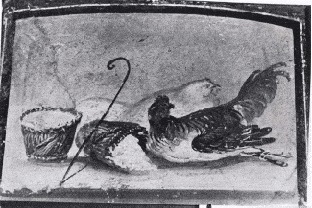
Figure 2. Hen and guinea fowl reclining alongside two wicker baskets of ricotta cheese. Wall painting from Herculaneum, prior to 79 C.E. Museo Archeologico Nazionale, Naples. (Courtesy of Ministero per i Beni e la Attivita Culturali)
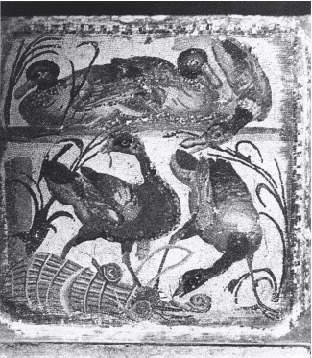
Figure 3. In the lower register, one of a pair of guinea fowl pecks at basketed snails; in the upper, two ducks float in a pond and a third breaks into the lower plane to eat reeds. Mosaic, first century B.C.E.? Church of Santa Maria in Trastevere, Rome. (Photograph courtesy of the Kelsey Museum of Archaeology, detail of Parker #1384)
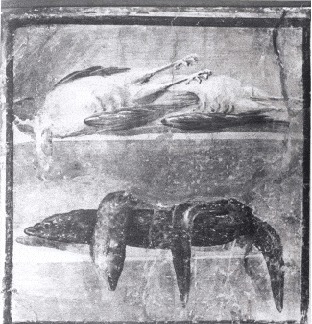
Figure 4. A brace of fowl and a pair of moray eels. Wall painting from Herculaneum (Casa dei Cervi), 45–79 C.E. Museo Archeologico Nazionale, Naples. (Courtesy of Ministero per i Beni e la Attivita Culturali)
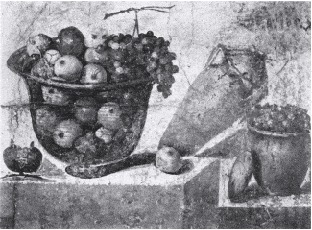
Figure 5. Apples, grapes, and pomegranates. Wall painting from Pompeii (House of Iulia Felix), third-quarter of the first century C.E. Museo Archeologico Nazionale, Naples. (Courtesy of Mini-stero per i Beni e la Attivita Culturali)
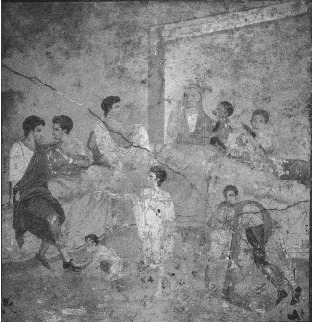
Figure 6. Indoor banqueting scene. Wall painting from Pompeii (Casa del Triclinio), prior to 79 C.E. Museo Archeologico Nazionale, Naples. (Courtesy of Ministero per i Beni e la Attivita Culturali)
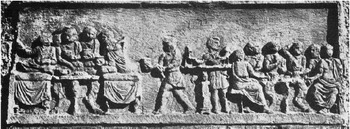
Figure 7. Banqueting scene, with drinking vessels (center). Funerary relief sculpture from the Church of Santo Stefano, Pizzoli (Amiternum), second half of the first century C.E. Deutsches Archäologisches Institut Rom (Neg. 84 VW 935).
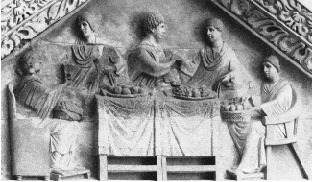
Figure 8. Dinner scene. Funerary relief sculpture in the form of a gable from Neumagen, ca. 225 C.E. Rheinisches Landesmuseum, Trier.
 You have
Access
- 5
- Cited by