Canada's June 28th, 2004, federal election was an exciting and, in several respects a surprising contest. One major surprise was the election campaign itself. Rather than being the predictable, boring event many commentators had anticipated, the campaign was a closely fought battle between a longtime governing party and a new opposition party that had been formed only six months before the election was called. A second surprise, at least for some observers, was turnout, with participation in a national election falling to the lowest level in Canadian history. A third, potentially very significant, surprise was the success of the separatist Bloc Québécois, accompanied by a resurgence of support for Quebec sovereignty. After the election, the future of Canada's national party system, indeed, the future of Canadian democracy, appeared more problematic than had been the case only a few months earlier.
At the beginning of 2004 everything seemed to be going the Liberals' way. Former Finance Minister Paul Martin, Jr. had just replaced Jean Chrétien as Liberal leader and prime minister. Chrétien had led his party to three successive victories, including the highly consequential 1993 contest that had resulted in the virtual annihilation of the Progressive Conservative (PC) Party, the Liberals' principal rival in Canada's “two-party-plus” national party system (Epstein 1964). Chrétien also had galvanized the federalist alliance in the 1995 Quebec sovereignty referendum. Although the referendum proposal had been defeated by an extremely narrow margin, support for sovereignty had gradually receded, and the separatist Parti Québécois (PQ) had been replaced as the government of Quebec by the pro-Canada Liberals. Finally, the economy was in reasonably good shape. When Martin became prime minister, Canada's annual inflation rate was only 2.8%, and its GDP was growing at an impressive 5.3%. The unemployment rate (7.6%), not particularly high by Canadian standards, was trending downward. And, always symbolically important for Canadians, exchange rates showed the “loonie” was strengthening against the American dollar. As finance minister during much of the Chrétien era, Martin was well-positioned to claim credit for the good economic news.
In addition, the Liberals did not seem to have any serious rivals. After their devastating defeat in 1993, the PCs had failed to make a serious comeback. In their place were two regionally based parties, the neo-conservative Reform in the West, and the separatist Bloc Québécois (BQ) in Quebec. By its very nature, the BQ was a non-starter as a federal government, but Reform did aspire to national power. To achieve this goal, the party needed a breakthrough in Ontario, where the Liberals enjoyed overwhelming superiority, winning an average of 98% of that province's parliamentary seats in 1993, 1997, and 2000. The breakthrough would only happen if Reform could attract the small, but consequential, minority of the Ontario electorate that continued to support the PCs.
In its effort to “unite the right,” Reform had rebranded itself as the Canadian Alliance before the 2000 election. When the right did not unite in that contest, the next move was to form yet another new party, the Conservative Party of Canada (CPC). Alliance Leader Stephen Harper was chosen to lead the new party. Although the birth of the CPC was accompanied by the formal dissolution of the old-line Progressive Conservatives, some prominent PCs, including former Prime Minister Joe Clark, refused to go along. Clark denounced the new CPC as ideologically extreme, an unworthy successor to his party's historic tradition of “one-nation” Tory conservatism. Given the evident failure of the CPC's unification efforts, the Liberals could reasonably conclude that a 2004 election would be a ceremonial coronation of their new leader, Paul Martin.
Although elite-level ideological divisions between the new CPC and the PCs gave the Liberals cause for optimism, it bears emphasis that “left-right” ideological discourse normally has limited resonance in Canadian federal elections. The major parties typically have competed by downplaying ideological differences, while emphasizing their ability to “solve problems” (e.g., reduce unemployment, fund health care) and provide voters with a broad array of public services (Clarke et al. 1979, 1996). For their part, most voters have eschewed ideological labels and focused heavily on the rival parties' demonstrated or anticipated performance in office and the character and competence of party leaders. Data from a national survey conducted as part of the authors' Political Support in Canada (PSC) project1
The 2004 study and earlier components of the Political Support in Canada project were funded by the National Science Foundation (U.S.). The authors wish to thank NSF Political Science Program Directors Jim Granato and Frank Scioli for their interest in the project.
indicate that ideological identifications remained the exception in 2004—only 31% of the respondents reported that they use the labels “left” and “right” when they think about parties and politics. If the new Conservative Party was to do well in the election, it would not be because a sizable minority of voters had adopted right-of-center ideological positions. Overall, only 14% said they thought about politics and parties in left-right terms and placed themselves on the left or centerleft, but even fewer, 11%, placed themselves on the right or center-right.
The latter number clearly indicates that the CPC could not rely on the presence of a newly minted cohort of ideologically motivated voters to propel it to power. Rather, it could be successful only if two conditions were met. First, large numbers of voters would have to lose confidence in the ability of the governing Liberals and their new leader “to deliver the goods”—the healthy economy and large assortment of public services that most Canadians demanded. Second, the CPC would have to convince voters that it was both willing and able to supply, not to curtail, those services. As events unfolded, the first of these conditions was soon satisfied when the honesty and competence of Martin and his party were called into serious question. The inability of the CPC to satisfy the second condition was a key factor in an unexpectedly exciting election campaign.
To the Polls
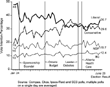
Liberal plans for an uneventful “stroll to the polls” were abruptly overturned on February 10, 2004, when Auditor General Sheila Fraser released a report on $100 million in federal funds that had been spent to advertise the many good things the federal government was doing for Quebeckers. Repaying generous government patronage with acts of blatant corruption, some prominent Quebec Liberals had simply pocketed their share of the money without performing any services for it. When this “sponsorship scandal” broke Liberal poll ratings plummeted, especially in Quebec where disaffected voters flooded to the BQ (see Figure 1). However, despite the scandal, the Liberals maintained a lead over their rivals in national polls, and election planning continued.
Dynamics of Support for Canada's Federal Parties, January–June 2004
The Liberals' next problem was created by their provincial counterparts in Ontario. In their successful 2003 election campaign, the Ontario Liberals had stolen a page from former U.S. president George H. W. Bush's playbook by promising not to increase taxes. Then, in May 2004, just days before the federal election was scheduled to be called, they reneged and introduced substantial new levies to cover major revenue shortfalls in health care. Martin, wagering that widespread unhappiness with the Ontario Liberals would not affect feelings about his federal party, pressed ahead and called the election for June 28th. He had bet wrong. The media focused public attention on problems with the health system and the new Ontario tax, and Liberal support soon fell significantly. The chief beneficiary was the new Conservative Party, but the small social democratic New Democratic Party (NDP) also saw its vote intention share move upward. One week into the campaign numerous ridings in Ontario, the cornerstone of Liberal success in the previous three federal elections, were “up for grabs.” With Ontario in play and Quebec opting strongly for the BQ, the 2004 election had turned into a race that would go right down to the wire.
At mid-point in the campaign several polls indicated that Conservatives had pulled slightly ahead (Figure 1), and some media pundits proclaimed that a Conservative minority government was in the offing. Other commentators, perhaps intuiting something about confidence intervals, proclaimed that the contest was too close to call. The televised debates among the party leaders did nothing to change things. Reminiscent of loud-mouthed talk-show hosts, the leaders repeatedly tried to drown out one another out with off-putting mixtures of accusations and denials. Although some observers concluded that CPC Leader Stephen Harper had bested his rivals, this was clearly a relative judgment.
As the campaign entered the home stretch the Conservatives maintained their slight lead, and even analysts with reputations for being the “smart money” forecast that a Conservative minority government was a likely possibility. How long such a government might last was an important question, but one that attracted little attention outside the common rooms of political science departments.2
When considering the possibility of a Conservative minority government, it is noteworthy that, when faced with a “hung parliament,” Canadian parties historically have not tried to construct European-style cabinet coalition governments. Rather, the party with the most seats has formed a government relying on the ad hoc support of one or more opposition parties to pass legislation in parliament. In this regard, it might be plausibly argued that a Conservative minority government bent on pursuing a rightwing ideological agenda would not have been able to secure support from any of the other parties and, as a result, would have quickly fallen. However, it is not clear that Harper and his colleagues would have obliged their opponents by taking extremist positions and trying to pass ideologically charged legislation. Given the election outcome, the struggle between ideology and pragmatism within a Conservative minority government and, hence, the fate of such a government, must remain matters of conjecture.
In the heat of the campaign, politicians and the press focused on a series of polls that showed the Conservatives poised to knock the Liberals out of office.
3 In the final week of the campaign, Liberal Leader Martin fueled speculation about the possibility of a Conservative government by publicly stating that “common sense dictates the party with the most elected members of parliament should hold power” (National Post, June 24th).
But, more surprises were in store, as the Conservatives promptly obliged their rivals by committing two acts of abject political stupidity. First, they accused Prime Minister Martin of being soft on child pornography. The result was an immediate public backlash, and Harper and his colleagues were heavily criticized for engaging in “gutter politics.” Then, Ralph Kline, Conservative premier of Alberta, told reporters that his government was considering a two-tier health care scheme that involved significant privatization. Health care was already a major issue in the campaign, and the Liberals quickly charged that Kline's statements proved that the Conservatives were “right-wing nuts” who would destroy Canada's cherished system of universal, equal access medical care.
The Liberals then reinforced their message by “going negative” in a massive media barrage. Voters were told that, in addition to unraveling health care and other important strands in the public service safety net, a Conservative government would pursue an intolerant social agenda that would ride roughshod over the rights of women, gays, lesbians, poor people, and various visible minorities. Harper was portrayed as being in league with U.S. President George W. Bush, and it was intimated that Harper wanted to send Canadian troops to Iraq. Voters tempted to support the left-of-center NDP were encouraged to think strategically. By opting for their local Liberal candidate, they could help keep the extremist Conservatives out of office.
In the weekend before polling day, Martin traveled across the country inviting Canadians to join him in his crusade to keep the Conservative ideologues at bay. The Conservative response was curiously tepid and very much “off message.” Rather than maintaining a high national profile and continuing to hammer Martin and other Liberals great and small for years of mismanagement, cronyism, and corruption, while assuring voters of his party's steadfast commitment to maintaining, indeed improving, the country's celebrated public services, Harper quietly retreated to his native Alberta. He remarked to reporters that he was glad the campaign was finally over. It was.
At the Polls
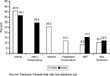
Tallying the ballots showed that, nationwide, 36.7% voted Liberal, 29.6% Conservative, and 15.7% NDP (see Figure 2). In Quebec, the Bloc attracted 48.8% of the vote, and the Liberals 33.9%. The vote totals were a recipe for minority government. Although the Liberals had lost 39 ridings, they remained in power with 135 seats, compared to 99 for the Conservatives, 54 for the BQ, and 19 for the NDP. For its part, the new Conservative Party had captured 21 more seats than the combined total for the Alliance and PCs in 2000, and made a limited breakthrough in Ontario by winning 24 of that province's 106 seats. However, the Conservative popular vote was fully 8.1% less than what the Alliance and PCs had jointly achieved four years earlier. Equally disappointing for Harper and his colleagues, their party's vote share was 8% less than its high point in the campaign polls.
Parties' Vote Shares, 2004 Federal Election
What drove the vote? Recognizing that many voters lack ideological selfidentifications and durable partisan attachments, Canadian political scientists typically have emphasized the importance of short-term forces associated with party leader images and “valence issues”4
The concept of valence issues was developed in Stokes' (1963) classic critique of spatial models of party competition. See also Stokes (1992).
(e.g., Clarke et al.
1979,
1996). As noted earlier, unemployment and health care are classic examples of such issues. Virtually everyone agrees that low levels of joblessness and an effective, adequately funded health care system are “good things,” and political debate focuses on who can best deliver them. Party leaders are evaluated in terms of their ability to address the social and economic problems that define the issue agenda during particular elections. By focusing public attention on valence issues and the qualities of their leaders, the national political parties are able to broker electoral coalitions that transcend the deep, reinforcing regional and ethno-linguistic cleavages that characterize Canadian society.
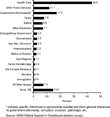
In recent years, analysts have begun to reevaluate the brokerage politics model of electoral choice in light of the post-1993 party system that more closely mirrors these societal cleavages and includes at least one party, the Reform-Alliance-CPC, that has espoused a variety of right-of-center policy positions (Nevitte et al. 2000; Blais et al. 2002). However, the PSC survey data reveal that valence issues such as health care, various other public services, and the economy were dominant concerns in 2004 (Figure 3). The sponsorship scandal and related valence issues of government honesty and accountability also were on some voters' minds. In sharp contrast, “position issues” on which the public and politicians were divided had much less resonance. Thus, although same-sex marriage, abortion, and U.S.-Canada relations all received considerable coverage during the campaign, none of these issues was cited by more than 1% as being preeminent in the election. Similarly small numbers mentioned other “hot button” position issues such as immigration and the national gun registry.
Most Important Issue, 2004 Canadian Federal Election
Previous research has documented that although Canadian voters look closely at the party leaders in their search for cues to guide electoral choice, they often are not particularly impressed by what they see (e.g., Clarke et al. 1996). This was certainly true in 2004. Although Martin had enjoyed wide popularity when first selected as Liberal leader, his image was badly tarnished by the sponsorship scandal. In the PSC pre-election survey, Martin's average rating on a 100-point thermometer scale was only 47 points, and in Quebec it was a dismal 41 points. Many voters also expressed reservations about Conservative Leader Stephen Harper (48 points) and NDP Leader Jack Layton (46 points). BQ Leader Gilles Duceppe, was an exception. He scored 58 points in Quebec, the only province that mattered for him.
Multivariate analyses indicate that the key factors affecting electoral choice in 2004 were similar to those in earlier elections. Controlling for partisanship and several demographics, judgments about which party could handle important (largely valence) issues, and evaluations of the character and competence of party leaders exerted statistically significant, strong, and predictable effects.5
The vote models include measures of party leader affect, party-issue linkages, strategic voting, and federal party identification, as well as variables tapping attitudes toward specific issues such as the sponsorship scandal and same-sex marriage. Socio-demographic controls include age, education, ethnicity/region, gender, and income. For details, see: www.utdallas.edu/~hclarke.
There is also evidence of strategic voting. Overall, 11% said that they voted for a party other than the one they really preferred. Outside of Quebec, a large majority (65%) of these people preferred the NDP, and another 16%, the small Green Party. The Liberals benefited from these strategic decisions, with the probability of casting a Liberal ballot increasing sharply if a voter claimed to have behaved strategically.
6 For example, consider a middle-aged, median-income woman voter who lives in Ontario and has average levels of affect for the party leaders. If this voter identifies with the NDP, favors the NDP on her most important issue, and indicates that she voted sincerely, her probability of casting a Liberal ballot is only .10. However, if she indicates that she behaved strategically, the probability of a Liberal vote climbs to fully .53.
This finding, the late swing to the Liberals in the polls, and the fact that fully 41% of the survey respondents said they decided in the last two weeks of the campaign suggest that the Liberals' plea for strategic voting was effective.
7 Recent research in Britain indicates the incidence of strategic voting is strongly influenced by parties' campaigns. See Clarke et al. (2004).
Viewed more generally, the 2004 evidence reinforces findings from earlier research (e.g., Johnston et al.
1992; Blais et al.
2002) showing that party support in Canada can—and sometimes does—move in consequential ways during election campaigns.
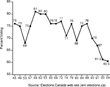
Another feature of electoral choice in 2004 that bears emphasis is the 60.5% turnout rate, the lowest ever (see Figure 4). The low turnout is surprising from the perspective of “soft” rational choice theories which designate a combination of close inter-party competition and policy/ideological divergence among the parties as the principal motor of electoral participation (Blais 2000; see also Clarke et al. 2004). If these theories were the whole story, turnout should have been much higher in 2004. As discussed above, the Liberals and Conservatives ran “neck and neck” in the polls throughout much of the campaign, and media commentators proclaimed the contest “too close to call” as Election Day approached. The 2004 PSC survey data indicate that the electorate responded to this information by giving the Liberals and the Conservatives very similar probabilities of winning—in both cases just slightly better than 50–50.8
Respondents were asked to use a 100-point scale to indicate their opinion about parties' chances to win the federal election in the country as a whole. A score of 50 was explicitly designated as an “even chance.” The mean scores for the Liberals, Conservatives, and NDP were 56, 53, and 27, respectively.
At the same time voters were digesting news about the Liberal-Conservative “horserace,” the Liberals were mounting a massive media blitz to hammer home the policy differences between themselves and the Conservatives.
Turnout in Canadian Federal Elections, 1945–2004
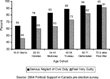
Clearly, other factors were working to suppress turnout. In this regard, longterm declines in electoral participation are evident in many mature democracies (Dalton and Wattenberg 2001), and surveys show that young people are much less likely to think that voting is a serious civic responsibility. The pattern is readily apparent in the 2004 Canadian survey data (Figure 5). Recent studies indicate that these patterns reflect generational differences, not simply life-cycle effects (Pammett and LeDuc 2003; Clarke et al. 2004; Franklin 2004). If so, it seems likely that turnout will decline further in the future as successive generations with relatively low levels of civic duty become increasingly larger proportions of the electorates of Canada and other countries.
Attitudes Toward Not Voting by Age Cohort
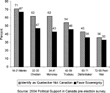
Other significant relationships involving age differences concern Quebeckers' political community self-identifications and their attitudes towards Quebec sovereignty. Echoing earlier findings (Kornberg and Clarke 1992; Clarke, Kornberg, and Wearing 2000), the 2004 PSC survey shows that many Quebeckers, especially those in younger age groups, do not think of themselves as Canadians (Figure 6). This is markedly different from the rest of the country, where very large majorities of all ages identify themselves as Canadian, rather than as Ontarians, Albertans, etc. Equally impressive is the strong age gradient in Quebeckers' attitudes toward sovereignty. Overall, 46% said they would vote “yes” in a future sovereignty referendum, with this figure rising to fully 67% among the youngest group of Quebeckers. To the extent that the age-cohort differences in Figure 6 have generational components, the news is not good for Canada.
Self Identifications and Vote Intentions in Future Quebec Sovereignty Referendum by Age Cohort
Choices Made, Questions Posed
Elections provide answers, but they also pose questions. In the aftermath of the 2004 Canadian election, one important question is how long the new Liberal minority government will last. Although minority governments can have very short half-lives, there are reasons to believe that the present Canadian one may endure for a considerable time. Certainly, the governing Liberals will wish to demonstrate that they have received the electorate's message that they must “clean up their act.” Prime Minister Martin and his colleagues also must address the health care and other social policy issues on which they campaigned with something more creative than the kind of tax increase implemented by their Ontario counterparts. They will need time to accomplish these goals and convince Canadians that they have done so.
The opposition parties also would not be well-served by having voters quickly return to the polls. The new Conservative Party and its leader, Stephen Harper, must demonstrate that they are a constructive opposition and not the right-wing fanatics the Liberals portrayed them as during the 2004 campaign. Survey data clearly show that there is only a small electoral mar ket for explicitly right-wing ideological appeals. If the Conservatives are to establish themselves as a pragmatic center-right party rather than an ideological party of the right, they must learn to play the brokerage politics game with its heavy emphasis on valence issues and credible leadership. The problem for Harper is that playing the brokerage politics game risks alienating his Western base of small “c” economic and social conservatives. Stated otherwise, Harper must become a kind of “Tony Blair from the right,” and this will be possible only if he can convince the ideological hardcore in his party—many of whom are leading party activists—that winning trumps ideology. Can he do so? Is he interested in doing so? The answer to these questions may well determine the future of Canada's national party system.
The NDP also has no strong incentive to try to precipitate an early election. A small party, the NDP lacks the financial resources needed to wage another election in the foreseeable future. Equally important, it is likely that the new Liberal minority government will depend heavily on the NDP for support in parliament. This situation provides the New Democrats with considerable political leverage. Whether they will be able to exploit that leverage to achieve cherished social policy goals remains to be seen.
To an extent, financial constraints also hamper the Bloc Québécois, although it has other reasons for wanting the minority Liberal government to survive for some time. The principal one is to keep the Quebec nationalist pot boiling and highly visible in both Ottawa and Quebec City until there is a Quebec election in which the separatist Parti Québécois can prevail. A new PQ government could then hold yet another sovereignty referendum. Given the resurgence of pro-sovereignty sentiments shown in the 2004 PSC survey, such a referendum might well be the beginning of the end of Canada in its current form. The base of mass support for a sovereign Quebec is substantial and, to the extent that the age-cohort differences documented above have generational components, that base will grow. What is currently lacking is the kind of charismatic leadership provided by an earlier generation of Péquistes such a René Lévesque and Lucien Bouchard. Whether that leadership will emerge may well determine the future of Canada.
Liberal Leader Paul Martin delivers a campaign speech at a community breakfast in Bracebridge a week before Canada's June 28, 2004 federal election. Photo: AP/Tom Hanson.