Introduction
Some people live in conditions so filthy and unhygienic that almost all observers, in whatever culture, would consider them unacceptable. The term “severe domestic squalor”, although confronting, is succinctly descriptive of cases where intervention to clean up a person's domestic environment is deemed necessary for health, safety and quality of life reasons (Snowdon et al., Reference Snowdon, Shah and Halliday2007).
Descriptions of cases of severe squalor can be grouped as follows: (1) where accumulation of items obstructs proper care of a person's domestic environment; (2) where the home is unclean because of failure to get rid of accumulated refuse and dirt; and (3) where both accumulation of heaped useless items and accumulation of garbage and filth have led to unacceptably unclean living conditions.
The prevalence and incidence of domestic squalor in the general populations of different countries and cultures are unknown. Macmillan and Shaw (Reference Macmillan and Shaw1966) estimated, from referrals to a Nottingham (U.K.) psychiatric service, that the incidence of what they called “senile breakdown in standards of personal and environmental cleanliness” was 0.5 per 1000 persons aged 60 years or more (i.e. 24 per year in a population of 50,321). Wrigley and Cooney (Reference Wrigley and Cooney1992) identified 29 cases of “Diogenes syndrome or the senile squalor syndrome” among referrals to an Irish old age psychiatry service, giving an incidence rate of 0.5 per 1000 per year. Each report used the term “incidence” rather than ‘referral rate’.
Halliday et al. (Reference Halliday, Banerjee, Philpot and Macdonald2000) studied cases of squalor referred to a special cleaning team. Seventy cases newly referred during one year were accepted for cleaning, the population of the area being 238,000, of whom 34,000 were aged 65 years or more. Half the occupants identified as living in squalor were aged 65 years or more, pointing to a referral rate of such cases in old age of about 1 per 1000, whereas among younger people it was about 35 per 204,000 (1 per 6000).
Opinions have varied on whether squalor is a common accompaniment to hoarding, which has been defined as the excessive collection and retention of any materials to the point that it impedes day-to-day functioning (Frost and Gross, Reference Frost and Gross1993). Kim et al. (Reference Kim, Steketee and Frost2001) described one third of the homes of 62 “elderly hoarders” as extremely dirty or filthy, and unsanitary because of infestations, feces and rotten food. Frost et al. (Reference Frost, Steketee and Williams2000) referred to complaints about hoarding made to health departments in Massachusetts, U.S.A. by neighbors, fire or police departments, or others. The rate was 0.26 per 1000 people per year. Overall, raters described a moderate to severe public health problem, with unsanitary conditions reported in 88% of cases, and 38% given the highest rating (“heavily cluttered”, “filthy environment”) on a 5-point scale. None was rated as reasonably clean and tidy.
Descriptions of compulsive hoarding appear quite different from those mentioned above, and people who seek treatment specifically for their hoarding are likely to be a very different group from those about whom complaints, or referrals to community services, are made. The prevalence of compulsive hoarding has been reported as 2–4% (Samuels et al., Reference Samuels2008; Iervolino et al., Reference Iervolino2009). Such reports give scant or no data about the extent of uncleanliness in subjects’ dwellings, and do not provide for meaningful estimates of the incidence or prevalence of severe domestic squalor among those referred for behavioral treatments.
The costs of cleaning and of other interventions in cases of severe domestic squalor are considerable. Frost et al. (Reference Frost, Steketee and Williams2000) noted that US$16,000 was expended in cleaning out a house and storing possessions, only to begin the process anew 18 months later. Media publicity has been given to a dwelling near Bondi Beach, Sydney in Australia on which AUS$50,000 or more (in 2010 dollars) has been expended each time it has been cleaned up by the local council. Other costs (personal, health and quality of life) are high but incalculable.
There is good reason to examine the referral rate and prevalence of severe domestic squalor, if only because of the considerable cost implications. However, responsibility for intervening in cases of squalor has been taken by or directed to diverse agencies and therapists, so that the annual rate of referral to any helping agency is likely to be considerably higher than the rate of referral to any one of them (e.g. a psychiatric service). Cases may be dealt with by a housing authority, environmental health officers, psychologists specializing in treatments for hoarding, and various community services, either alone or while coordinating with interventions by others. Often, multiple agencies are involved, but in an unknown proportion of cases no help is sought or provided.
Nevertheless, a service that coordinates assessments and interventions in cases of squalor in a defined catchment area can report on the number of such cases referred to it in set time periods, and this can allow estimates to be made of minimum annual incidence (newly identified cases) and prevalence in the population served. The old age psychiatry service in Central Sydney has collected data, made clinical assessments and (where appropriate) made ratings of the degree of squalor when people in the area have been referred for opinions and intervention. Relevant findings over a ten-year period are presented in this paper.
Methods
During the ten years from 1 January 2000 to 31 December 2009, details have been recorded of all cases of domestic squalor referred to and seen by team members of the old age psychiatry service in Central Sydney (a defined catchment area within the zone of responsibility of the Sydney South West Area Health Service). The population of community-living persons aged 65 years or more in this catchment area is about 18,000 (male/female ratio 1:1.2). Data were collected regarding home ownership and pets, and ratings were made, with the occupants’ consent, of degrees of uncleanliness and clutter within their dwellings. In a small proportion of cases, access to one or more rooms was denied. In almost all cases, the occupants agreed to participate in clinical assessments, but interview arrangements were flexible and, in order to retain cooperation, generally unstructured. Demographic details were recorded. Information and notes were obtained from occupants’ doctors and hospital and community files regarding past and recent psychiatric history and medical conditions. This information, combined with clinical assessments by one or both psychiatrists, a psychiatric registrar, or (in 21 cases) a psychiatric nurse or social worker, allowed full discussion that led to consensus diagnoses or to an agreement that no definite diagnosis of psychiatric disorder should be made. In some cases, diagnoses became clear only after several months of follow-up. No formal assessments of personality were made.
Ratings of uncleanliness and clutter were made by team members using the Living Conditions Rating Scale (LCRS; Samios, Reference Samios1996), which had also been used by Halliday et al. (Reference Halliday, Banerjee, Philpot and Macdonald2000) in their London study. The scale includes 13 items (accessibility, odor, lighting, floors, walls, furniture, kitchen, food, bathroom/toilet, disposal of excreta, vermin, hoarding of similar items, clutter), each rated 0 to 3, to provide an overall rating of domestic environments. In addition, raters recorded their observations of whether occupants were living in mild, moderate or severe squalor. Such ratings were subjective, based on whether team members considered that occupants should be encouraged (and helped if they wished) to organize a clean-up (mild cases), that a clean-up was highly desirable (moderate), or that a clean-up was essential (severe). Independent ratings of 55 referred cases by the authors during development of the ECCS showed 73% complete agreement on whether squalor was mild, moderate or severe. Data about those rated as not living in squalor were not collected.
The authors used findings from a previous study to distinguish cases of what they regarded as mild squalor from those where they believed intervention was definitely indicated (moderate or severe squalor). While developing the ten-item Environmental Cleanliness and Clutter Scale (ECCS; Halliday and Snowdon, Reference Halliday and Snowdon2009), LCRS and ECCS ratings were made by the authors, independently, in 55 dwellings. The mean LCRS score of dwellings judged by them to show moderate squalor was 16.3 (range12–22), while the mean LCRS score of those judged as showing mild squalor was 11.0 (range 7–15). In the present study, the threshold between mild and moderate squalor was set at 15/16, equivalent to >12 on the ECCS (Halliday and Snowdon, Reference Halliday and Snowdon2009). However, where a team member's overall judgment was that a dwelling showed moderate, not mild, squalor but the LCRS score was only 14 or 15, such cases too were included in the moderate squalor group. In the study by Halliday et al. (Reference Halliday, Banerjee, Philpot and Macdonald2000) of dwellings referred for special cleaning services, the mean LCRS score was 17 (SD 6, range 6–34).
The degree of hoarding/clutter was rated from the two relevant LCRS items as major degree (score 3 on either item), moderate (score 2 on either, but less than 3), minimal or absent (score 1 or 0). The LCRS defines hoarding as an “accumulation of similar things”. Raters conceived of clutter as being accumulation of any items (including garbage) in a disorderly fashion.
Team members remained involved in most cases where interventions were agreed to, and they revisited many of the dwellings in due course, if subjects were still living there. One-year follow-up information was obtained in most cases.
Results
Referral rate
Over the ten years of the study, 173 persons (15 in 2009) aged 65 years or more, who were living in squalor, were seen by the Central Sydney old age psychiatry service. In eight dwellings, two persons in this age range were living together and were both included as participants. Thus, a total of 165 dwellings were rated. In two cases, occupants refused access but descriptions by informants made it clear that the living conditions were very unclean. In five other cases, only limited access was permitted, but this was sufficient to allow overall ratings to be made and LCRS scores to be estimated.
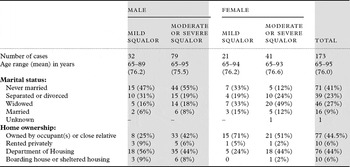
Fifty-three persons were rated as living in mild squalor (LCRS scores ranging from 5 to 15, mean 10.5), while 120 lived in moderate or severe squalor (Table 1). The 67 in moderate squalor had LCRS scores ranging from 14 to 27 (mean 18.3, seven scoring 14 or 15), while 51 of the 53 living in severe squalor were rated on the LCRS and had scores ranging from 17 to 34 (mean 24.1).
Age range, marital status and home ownership of older men and women living in mild or moderate/severe squalor

Referral of 173 persons aged 65 years or more to an old age psychiatry service over ten years in a population of 18,000 equates to an annual referral rate of at least 0.96 per 1000 (1.35 per 1000 males, 0.63 per 1000 females), although the actual incidence of newly developed and identified cases of squalor is likely to be substantially higher. The referral rate of elderly persons living in moderate/severe squalor per 1000 was 0.66 (male 0.96, female 0.42).
Pets lived in 42 (25%) of the 165 homes, but with similar percentages in mildly and moderately/severely unclean homes. There were many cats in one house, 11 birds in another, and four or five animals in three others. Elsewhere there were three or fewer pets. Thus, the referral rate of people with more than three animals in the dwelling was only 5 in 173 (2.9%).
Demographic correlates
Of the 120 subjects living in moderate or severe squalor, 96 (81%) lived alone, while 24 lived with others (27 others – 11 with spouses, 10 with adult children). Living in a boarding house was not regarded as living with others. Of those in mild squalor, 40 (75%) lived alone.
Home ownership differed little between mild and moderate/severe groups (Table 1). Occupants or their closest relatives owned the dwellings in 44.5% of cases.
Of men living in squalor, 53% had never married. Of the women, 19% had never married. Only 16 of the 173 subjects were currently married; all were living with their spouses, four of whom were aged under 65 years.
Diagnoses
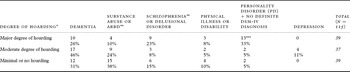
The principal clinical diagnoses made in cases of moderate or severe squalor were: 42 (35%) dementia, 29 (24%) substance abuse or alcohol-related brain damage (ARBD), 18 (15%) schizophrenia or paranoid state, 11 personality disorder (5 identified as obsessive-compulsive), 10 physical illness or disability, 4 depression, and 6 no definite diagnosis (Table 2). Significantly more participants with no definite DSM-IV diagnosis “hoarded” to a major degree when compared with those diagnosed with dementia (χ2 = 9.7, p < 0.01) or with ARBD (χ2 = 14.9, p0 < .001). The diagnostic breakdown among those living in mild squalor was fairly similar (including 42% with dementia, 13% ARBD or substance abuse, 19% psychotic disorder).
Principal clinical diagnosis in relation to degrees of hoarding/clutter in cases of moderate/severe squalor

*In five cases (3 dementia, 1 ARBD, 1 arthritis), no ratings of hoarding/clutter were recorded.
**In two cases of ARBD (minimal or no hoarding), dementia was diagnosed also; in two cases of schizophrenia (no hoarding), alcoholism was diagnosed as well.
***Of the 13, ten were considered to have personality disorders (5 obsessive, 2 paranoid, 3 other) while in three cases no diagnosis or disorder was identified.
ARBD = alcohol related brain damage; DSM-IV = Diagnostic and Statistical Manual of Mental Disorders, 4th edition.
Hoarding/clutter scores were recorded in 142 cases where diagnoses had been made. Of those in moderate or severe squalor, one third each showed major, moderate or minimal/absent degrees of hoarding/clutter (Table 2). Of those in mild squalor, the corresponding numbers were 6, 7 and 20, respectively. Table 3 shows that subjects diagnosed with substance abuse/ARBD or dementia were significantly less likely to present a major degree of hoarding/clutter than those with personality disorder or no diagnosis.
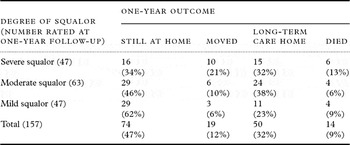
One-year outcome in relation to degree of squalor when first assessed

Outcome
Finally, outcome in cases of severe, moderate and mild squalor is shown in Table 3. Of 157 subjects who had been followed up at one year after first assessment, 47% were still at home (but mostly without much long-term reduction in uncleanliness), 12% had moved (some to live with others), 32% were in long-term care (LTC) homes and 8% had died. In one case, one-year follow-up details were not available.
Of those in moderate or severe squalor who were still at home after one year, half were followed up after a further year. Twelve of the 19 were still at home, eight of them still living in squalor. During the second year, one had died and six had moved to LTC homes.
Discussion
In 2000 to 2009, the referral rate to the Central Sydney old age psychiatry service of older persons living in squalor was 0.96 per 1000 per year. For those living in moderate or severe squalor, where team members considered a dwelling so unclean that intervention was not only desirable but necessary, the rate of new cases was 0.66 per 1000 per year.
Follow-up (Table 3) showed that 0.27 per 1000 (i.e. 41% of those assessed as living in moderate or severe squalor) were still in their own homes one year later, most of which were just as much in need of cleaning and clearing as when first visited. Further follow-up showed that perhaps 10% were still at home and living in squalor after two years (0.07 per 1000). Combining these figures, it is estimated that, at any one time, 1 per 1000 elderly people in Central Sydney has at some time been assessed by the old age psychiatry service and currently lives in moderate or severe squalor.
However, from various sources it is known that a sizeable proportion of those living in squalor in Sydney are never referred to psychiatric services. Unacceptably filthy or cluttered premises come to the attention of landlords, neighbors, health workers and others, and diverse agencies and people may be asked to intervene. Of cases where help is requested, the proportion referred to old age psychiatry in a particular area will depend, first, on whether such a service exists. If it does, referral then depends on whether that service is perceived to be potentially helpful in dealing with problems associated with or arising from living in squalor. Thirdly, it depends on whether there are other agencies or therapists in the area that are willing to help, and whether they wish to intervene without involving psychiatric services. For example, there may be some people who compulsively hoard but who seek a decluttering program or professional organizer service that does not involve contact with psychiatry.
Recommendations of a Reference Group in New South Wales (NSW) led to development of guidelines regarding intervention in cases of severe domestic squalor (Snowdon and Halliday, Reference Snowdon and Halliday2009), and to funding by the NSW Government of a Severe Domestic Squalor (SDS) Project. The project's aim was to provide targeted support within 18 local government areas for persons living in squalor (McDermott and Gleeson, Reference McDermott and Gleeson2009). The service commenced in late 2008, with 157 referrals being accepted during the pilot year, including about ten elderly (S. Graham, personal communication) from the Central Sydney area. The number of referrals to the old age psychiatry service in 2009 was only just below the average number per year in 2000–2008.
Although some younger people were seen by the old age psychiatry service, the data provided above relate only to those aged 65 years or more. Of people referred to the SDS Project (54% of whom lived in public housing), 58% were younger than 65 years of age (range 21–94, mean 62 years; McDermott and Gleeson, Reference McDermott and Gleeson2009). The age range of the people in the South London study whose dwellings were accepted for heavy-duty cleaning was similar (18–94; mean 63 years, with 50% aged <65 years). Most (94%) lived in public housing. Calculations based on these figures and estimates of population numbers in older and younger groups suggest that the rate at which older persons are referred for interventions because of squalor is five times higher than the rate applying to younger adults.
In the SDS and London studies, 55% and 72% of participants, respectively, were male, while in the Sydney study, 64% of referred older adults living in squalor were male.
A limitation of the present study was that structured interviews were not used in making diagnoses. If this had been a protocol requirement, there was good reason to believe that fewer of the occupants would have agreed to be interviewed. Halliday et al. (Reference Halliday, Banerjee, Philpot and Macdonald2000) used a structured interview schedule, but 11% of eligible clients refused or could not be interviewed.
In the present study, clinical assessments (based partly on previous medical history and diagnoses) suggested that 35% of cases of moderate or severe squalor were at least partly attributable to occupants’ dementia, 24% to substance abuse and/or ARBD, and 15% to schizophrenia or delusional disorder, while physical illness or disability was seen as a major factor in 10%. Diagnoses of personality disorder (let alone type of PD) are likely to have been inaccurate in this study, partly through difficulty in completing adequate interviews. Informants and past clinical records were commonly not available, and some participants were reluctant to converse much. In the London study (Halliday et al., Reference Halliday, Banerjee, Philpot and Macdonald2000), in which half the subjects were younger than 65 years, only 22% of the total were diagnosed as having organic mental disorders, 21% had schizophrenia or delusional disorder, and substance abuse was identified in 32% (two-thirds of whom had other mental disorders as well).
It is important to note that in one third of the cases of moderate or severe squalor seen in Central Sydney in the last decade there was minimal or no evidence of hoarding or clutter. These dwellings were rated as filthy, and in 27 out of 39 cases the occupants’ diagnosed health problem was dementia, ARBD and/or substance abuse (Table 2). Among participants who collected items or clutter to a major degree, half were given consensus diagnoses of dementia or schizophrenia, while one third were considered to have personality disorders or no psychiatric diagnosis (Table 2). Researchers focusing on people whose homes are cluttered (as opposed to domestic squalor) record their participants as having obsessive-compulsive disorder (OCD) or other personality disorders much more commonly than other diagnostic categories (Pertusa et al., Reference Pertusa, Fullana, Singh, Alonso, Menchón and Mataix-Cols2008). In contrast, Chiu et al. (Reference Chiu, Chong and Lau2003) in Hong Kong reported that 47% of a series of patients referred to a psychiatric team because of hoarding (where a majority had more than 90% of their floor-space covered by hoarded items) had schizophrenia.
In order to understand why some people accumulate items it is necessary to consider the reasons or impulses that motivate saving and collecting behaviors. Grisham et al. (Reference Grisham, Brown, Liverant and Campbell-Sills2005) argued that, since many individuals appear to derive pleasure from hoarding behavior, “pure hoarding” is best conceptualized as an impulse disorder. Conversely, Maier (Reference Maier2004) commented that the nature of the collecting behavior, when observed in cases of chronic schizophrenia, dementia and brain injuries, does not have the psychopathologic structure of a compulsion or even impulse-control disorder: “It is just motor activity without clear intention or aim.” He noted that resistance towards removing and avoidance of discarding may occur in schizophrenia, depression and dementia as well as in OCD, but also that neglect and clutter may be due to inability to clean up (caused by physical illness, alcoholism, dementia, etc) “without proper hoarding behavior”. He suggested that, for reasons of conceptual accuracy, use of the term “hoarding” should be avoided in such cases.
The Macquarie Concise Dictionary (5th edn, 2009) defines hoarding as “an accumulation of something for preservation or future use”, and this would seem apt in relation to many cases of compulsive hoarding. Other researchers appear to have accepted the broader definition used by Frost and Gross (Reference Frost and Gross1993), quoted in their introduction, thus allowing accumulation on impulse, or through neglect to discard, as being forms of hoarding. Terms such as “clutter”, “garbage” and even “accumulation” do not appear sufficiently inclusive or appropriate. In the absence of a better alternative, we regard the term “hoarding” in its broader sense as adequately encompassing.
There is a paucity of data regarding inappropriate accumulation of animals at home. This study found that only 2.9% of older people identified as living in domestic squalor in Central Sydney had more than three animals in their dwellings. Comparable data from younger populations and those living in rural areas would be of interest. It is hoped that animal welfare organizations will facilitate studies concerning prevalence, associated factors and outcome of interventions in animal hoarding cases.
A main aim of this study was to examine the extent to which services that deal with squalor in old age are needed, and thus to be able to comment on cost implications. The research points to a higher referral rate and prevalence of moderate or severe squalor than had been generally accepted, but this is taking into account only those cases referred to a psychiatric service. The major limitation of this study is that cases were selected for referral. No doubt other types of case (for example, compulsive hoarding), albeit with significant degrees of squalor and/or clutter, were selected for referral elsewhere. In order to better understand etiologies and optimum ways of intervening, there is a need for conceptual clarity and better understanding of the relation between hoarding and squalor.
Conflict of interest
None.
Description of authors’ roles
Collection of data was initiated by the authors, both of whom contributed to gathering of data and writing the paper.
Acknowledgments
The authors thank Dr Jessica Grisham for helpful comments on an earlier draft of this paper. They thank the team members (Anne-Marie Menzies, Kylie Loughlin, James Courtney, Bernice Moran, Daud Saud, Berida Blayney, Brett Simpson, Therese Marsh, Megan Pontin and Maria Warren) who contributed data and observations about subjects and their dwellings. These were discussed when reaching consensus regarding diagnoses as well as when planning interventions.