





Depression is a common but serious illness that affects many areas of an individual’s life, including impairments in physical, occupational and social functioning. Reference Kessler, Berglund, Demler, Jin, Koretz and Merikangas1 By 2030, the World Health Organization predicts that depression will be a leading cause of disease burden worldwide. 2 In the UK, the recommended first-line treatment for mild-to-moderate depression is cognitive behavioural therapy (CBT), and for severe cases this is combined with an antidepressant. 3
The efficacy of depression treatments is evaluated through randomised controlled trials (RCTs), with a primary outcome used to identify statistical or clinical improvement. Despite a range of possible primary outcomes, the most common are symptom-based. Reference Monsour, Mew, Patel, Chee-A-Tow, Saeed and Santos4,Reference Veal, Tomlinson, Cipriani, Bulteau, Henry and Müh5 However, qualitative research suggests that these symptom-based outcomes are not the most important to service users, Reference Kan, Jörg, Buskens, Schoevers and Alma6 who frequently report the importance of social, daily and occupational functioning. Reference Chevance, Ravaud, Tomlinson, Le Berre, Teufer and Touboul7
Quantitative studies have attempted to assess outcome importance, but these have limitations. Reference Molloy, Jin and Wykes8 Ranking methods can rank domains from most to least important, but they do not indicate how much more or less important each domain is. Reference Barr, Forcino, Mishra, Blitzer and Elwyn9 Studies using direct ratings, such as Likert scales, have often found little variation, with many participants rating each domain as the most important. Reference Zimmerman, McGlinchey, Posternak, Friedman, Attiullah and Boerescu10,Reference Demyttenaere, Donneau, Albert, Ansseau, Constant and Van Heeringen11 A simple method that can overcome these limitations is a fixed-point allocation technique that assigns a total number of points between domains. Reference Stolker, Spertus, Cohen, Jones, Jain and Bamberger12,Reference Taylor, Betteridge, Brown, Woolcott, Kivitz and Zerbini13
Personal characteristics might affect the allocation of points. For instance, Stolker et al Reference Stolker, Spertus, Cohen, Jones, Jain and Bamberger12 found that service users’ importance weights given to death as an outcome in cardiovascular studies varied significantly by age, income and ethnicity, while also differing from the weights assigned by clinicians. Clinical factors may also affect outcome value. In a quantitative survey of adults with depression, treatment goals changed between those experiencing their first episode and those with recurrent depression. Reference Chevance, Ravaud, Tomlinson, Le Berre, Teufer and Touboul7 Another quantitative survey found that during acute depression, mood, physical and cognitive symptom outcomes were prioritised, whereas healthcare providers shifted towards functioning outcomes during remission. Reference Baune and Christensen14
We know that demographic characteristics affect depression episodes Reference Bulloch, Williams, Lavorato and Patten15,Reference Carter, Cantrell, Zarotsky, Haynes, Phillips and Alatorre16 and treatment outcomes, Reference McGlinchey, Zimmerman, Posternak, Friedman, Attiullah and Boerescu17,Reference Mills, Suresh, Chang, Mayes, Croarkin and Trivedi18 but they may also affect outcome importance as viewed by both clinicians and people with lived experience of depression. This information could be vital to the design of future trials and potentially to the re-evaluation of the benefits of depression treatments. We adopted the simple point-allocation method, not previously used in depression research, to assess outcome importance by capturing the distance in importance and relative trade-offs between domains. Reference Molloy, Jin and Wykes8 This method aligns with the future construction of stakeholder-weighted composite outcomes. The outcomes in this study were drawn from two completed trials of CBT for depression (CLASSIC Reference Horrell, Goldsmith, Tylee, Schmidt, Murphy and Bonin19 and COBALT Reference Wiles, Thomas, Abel, Ridgway, Turner and Campbell20 ), broadly reflecting outcomes commonly reported in depression trials. Reference Veal, Tomlinson, Cipriani, Bulteau, Henry and Müh5
Importance ratings will be explored between those with lived experience and clinicians and will also, for the first time, evaluate whether stage of depression and sociodemographic characteristics affect priorities. This will provide quantitative data on outcomes that can be used for better trial design in the future.
Method
This cross-sectional survey compared domain importance data from three groups collected via an anonymous online survey. Two service user groups were stratified according to current depression severity: minimally symptomatic (Beck Depression Inventory Second Edition (BDI-II) Reference Beck, Steer and Brown21 score ≤18) and currently symptomatic (BDI-II score ≥19). Clinical studies have used this BDI-II threshold to define those with minimal symptoms by combining the minimal and mild categories. Reference von Glischinski, von Brachel and Hirschfeld22 The third group were clinicians who regularly treat depression, including psychologists, mental health nurses and doctors.
All procedures contributing to this work comply with the ethical standards of the relevant national and institutional committees on human experimentation and with the Helsinki Declaration of 1975, as revised in 2013. Ethical approval was granted by the King’s College London Research Ethics Committee (HR/DP-24/25-45410) and West Midlands South Birmingham Research Ethics Committee (25/WM/0067).
Participants and recruitment
Participants were recruited in the UK between February and October 2025 and were eligible if they were aged 18–75 years, reflecting the age eligibility of the original trials the domains were drawn from. Service users were eligible if they had lived experience of depression, and clinicians were eligible if they worked in a service user-facing role providing care for people with depression.
We recruited individuals who may not have been currently receiving care through charities and social media, as well as previous participants who had consented to future contact from two studies: Remote Assessment of Disease and Relapse-Central Nervous System (RADAR-CNS) and Genetics Links to Anxiety and Depression (GLAD). Clinicians and treatment-seeking service users were recruited via the local UK National Health Service (NHS) (South London and Maudsley NHS Trust) through team visits, posters and the research register. Including clinicians allowed comparisons between lived experience and practitioner perspectives on outcome importance. All interested participants received the participant information sheet and provided electronic written consent via Qualtrics. On completion, participants were offered a £5 Love2Shop voucher.
Measures
Context and grouping variables
Participants recruited through previous studies and the NHS had an established diagnosis of depression. Participants recruited from the community self-reported having depression. No diagnostic screening was conducted in this study; however, current symptom severity was assessed for all service user participants using the BDI-II. Reference Beck, Steer and Brown21 All eligible respondents provided sociodemographic and clinical information, including age, ethnicity, gender, education, employment and relationship status. Service users reported current depression treatment and years since illness onset. Clinicians reported their role, years in role and managerial status.
Importance of domains
Two domain lists were drawn from the published reports of two completed UK-based RCTs (CLASSIC Reference Horrell, Goldsmith, Tylee, Schmidt, Murphy and Bonin19 and COBALT Reference Wiles, Thomas, Abel, Ridgway, Turner and Campbell20 ). CLASSIC was a CBT-based day-group intervention, whereas COBALT evaluated 12–18 sessions of individualised CBT. CBT is the UK’s first-line treatment for depression. 3 Point-allocation tasks become cognitively demanding with more than six to eight domains so we restricted the lists to domains published in the main papers to maintain feasibility. Reference Odu23
Fixed-point allocation task
Participants allocated 100 points across outcome domains, with higher scores indicating greater importance. If domains were of similar importance, they could assign the same points, but totals had to sum to 100 before submission. This method required consideration of relative trade-offs and addressed the limitations of direct rating and ranking methods.
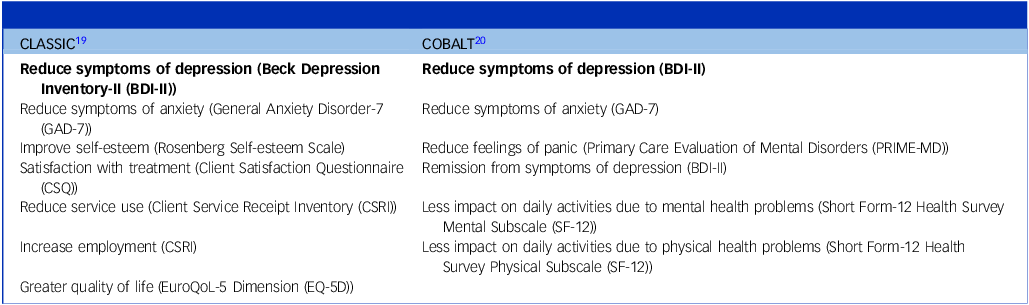
Each participant completed the fixed-point allocation task twice, once for each domain list. The wording of domains was standardised (Table 1) and presented in a fixed order (CLASSIC followed by COBALT). These trials represent recognised, ethically scrutinised outcome sets that influence practice and policy. It is unknown how stakeholders prioritise these domains relative to one another. Service users have reported that their experiences of CBT are too generalised Reference Omylinska-Thurston, McMeekin, Walton and Proctor24 and lack individualisation because the outcomes assessed do not reflect their priorities. Reference McPherson, Wicks and Tercelli25 All analyses were conducted separately for the CLASSIC and COBALT domain lists because they used non-identical domain sets that could not be harmonised for pooled analysis. This allowed comparison of shared domains while examining how stakeholder valuations depended on the specific domain sets presented.
Trial outcome lists

Table 1 Long description
A table comparing two sets of trial outcome lists, CLASSIC and COBALT, with various measures to reduce symptoms and improve quality of life. The table has two columns and six rows. The columns are labeled CLASSIC and COBALT. The rows list different measures: Reduce symptoms of depression (BDI-II), Reduce symptoms of anxiety (GAD-7), Improve self-esteem (Rosenberg Self-esteem Scale), Satisfaction with treatment (Client Satisfaction Questionnaire), Reduce service use (Client Service Receipt Inventory), Increase employment (CSRI), and Greater quality of life (EuroQol-5 Dimension). The CLASSIC column includes measures to reduce symptoms of depression, anxiety, improve self-esteem, satisfaction with treatment, reduce service use, increase employment, and greater quality of life. The COBALT column includes measures to reduce symptoms of depression, anxiety, reduce feelings of panic, remission from symptoms of depression, less impact on daily activities due to mental health problems, and less impact on daily activities due to physical health problems.
Note: Bold indicates the primary outcome of the original trial. Participants were presented with a brief summary for each domain. The measure shown in parenthesis (e.g. BDI-II) is included to indicate the corresponding trial measure and was not shown to participants.
A version of this table including full citations for all outcome measures is provided in Table S1.
Fixed presentation order.
CLASSIC: Reduce service use, increase employment, reduce symptoms of depression, reduce symptoms of anxiety, improve self-esteem, satisfaction with treatment, greater quality of life.
COBALT: Reduce symptoms of depression, remission from symptoms of depression, less impact on daily activities due to mental health problems, less impact on daily activities due to physical health problems, reduce feelings of panic, reduce symptoms of anxiety.
After completing the fixed-point allocation tasks, participants were invited to respond to two optional free-text boxes to explain their point allocations and suggest any missing domains.
Data analysis
Compositional point-allocation data were analysed using an isometric log ratio (ILR) transformation to enable parametric analysis, avoid multicollinearity and produce orthogonal coordinates. Reference Egozcue, Pawlowsky-Glahn, Mateu-Figueras and Barcelo-Vidal26,Reference Aitchison27 Sequential pivot ILR balances were computed separately for each outcome list.
To assess whether the fixed ordering of domains produced an anchoring effect, where participants allocated more points to earlier-listed domains, we fitted simple linear regression models predicting points allocated from item position. A negative association would indicate anchoring, with earlier items receiving more points, whereas a positive association would indicate the opposite with later-listed domains receiving more points. A non-significant regression coefficient would suggest no statisically significant relationship between item position and points allocated.
All analyses were performed using SPSS Statistics version 31 for Windows (IBM Corp, Armonk, New York, USA; https://www.ibm.com/products/spss-statistics).
Analyses were based on complete cases because there were minimal missing sociodemographic and clinical data (0–2 participants per group). The fixed-point allocation task had no missing data. Sample sizes for each analysis are reported in the Supplementary Material available at https://doi.org/10.1192/bjp.2026.10765.
Descriptive analysis
Sociodemographic and clinical characteristics were summarised using descriptive statistics, including N and percentages. The mean, s.d. and median were calculated to describe the relative share of participants’ total points allocated to each domain as compositional data rather than as independent scores.
Comparative analysis
Given the interdependence of the dependent variables, multivariate analysis of covariance (MANCOVA) was used as the primary inferential analysis to examine group differences in outcome importance. The dependent variables were the ILR-transformed point allocations for each domain, and participant group was the independent variable. Models controlled for covariates available across all participants, including age, gender and ethnicity. Post hoc univariate analyses and bootstrapped parameter estimates were considered exploratory.
Predictive analysis
To explore which individual characteristics predicted variation in outcome importance, exploratory multivariate general linear models were fitted. Models for the full sample included the shared covariates of age, gender and ethnicity. Group-specific models additionally included service user variables (employment, current care, estimated years lived with depression and first episode of depression) and clinician variables (current NHS band, managerial status and years in role).
All models were bootstrapped (1000 folds), with statistical significance defined as a 95% bootstrapped confidence interval excluding zero. The Holm–Bonferroni procedure was used to control the family-wise error rate by sequentially adjusting significance thresholds for multiple comparisons. Reference Holm28
Qualitative analysis
Responses were analysed using Braun and Clarke’s thematic analysis Reference Braun and Clarke29 in NVivo15 version 15 for Windows (Lumivero, Denver, Colorado, USA; https://lumivero.com/products/nvivo/2025). At least two coders independently completed each stage, reaching consensus before progressing: familiarising with the data, generating initial codes, collating codes into themes, reviewing themes and defining and naming themes.
A proportionate random subsample of survey completers was invited to independently review the draft thematic findings. Twenty service users and 8 clinicians were invited (12% of each group), and 13 responded (10 service users and 3 clinicians; 46% overall response rate). Feedback was collected via an anonymous survey, with another £5 Love2Shop voucher offered on completion. Themes were refined in response to this feedback aiming to improve their accuracy and relevance.
Patient and public involvement
The proposed research was presented to an National Institute for Health and Care Research (NIHR) Maudsley Biomedical Research Centre (BRC) Service User Advisory Group (SUAG) for consultation during study development. In addition, the NIHR Maudsley’s BRC Feasibility and Acceptability Support Team for Researchers (FAST-R) reviewed and provided feedback on the study protocol and participant-facing documents. An advisory group of adults with lived experience of depression collaborated with the analysis, interpretation and critical review of the manuscript including a lay summary (Supplement P2). People with lived experience are co-authors of this manuscript.
Results
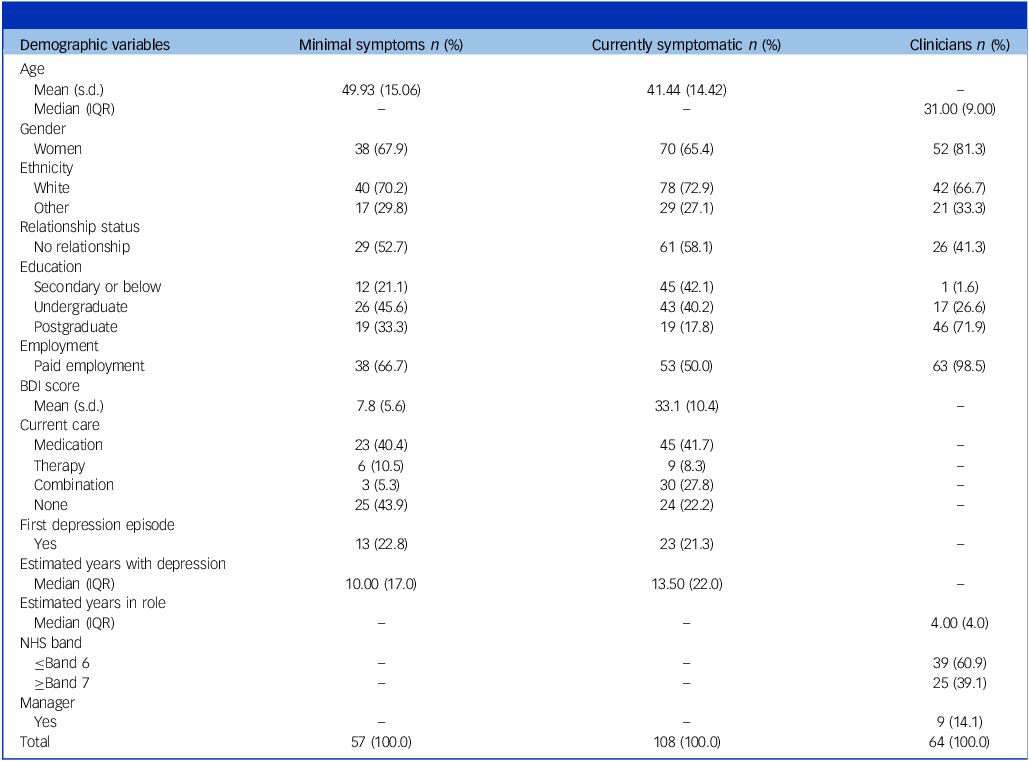
A total of 229 participants completed the survey (57 service users with minimal symptoms, 108 currently symptomatic service users and 64 clinicians). Sociodemographic and clinical characteristics are presented in Table 2.
Demographic information

Table 2 Long description
A table comparing demographic variables among three groups: minimal symptoms, currently symptomatic, and clinicians. The table has 18 rows and 5 columns. Column headers are Demographic variables, Minimal symptoms n (%), Currently symptomatic n (%), and Clinicians n (%). Row labels include Age, Gender, Ethnicity, Relationship status, Education, Employment, BDI score, Current care, First depression episode, Estimated years with depression, Estimated years in role, NHS band, Manager, and Total. Row 1: Age, Mean (s.d.), 49.93 (15.06), 41.44 (14.42), Median (IQR) 31.00 (9.00)-. Row 2: Gender, Women, 38 (67.9), 70 (65.4), 52 (81.3). Row 3: Ethnicity, White, 40 (70.2), 78 (72.9), 42 (66.7). Row 4: Relationship status, No relationship, 29 (52.7), 61 (58.1), 26 (41.3). Row 5: Education, Secondary or below, 12 (21.1), 45 (42.1), 1 (1.6). Row 6: Employment, Paid employment, 38 (66.7), 53 (50.0), 63 (98.5). Row 7: BDI score, Mean (s.d.), 7.8 (5.6), 33.1 (10.4), -. Row 8: Current care, Medication, 23 (40.4), 45 (41.7), -. Row 9: Current care, Therapy, 6 (10.5), 9 (8.3), -. Row 10: Current care, Combination, 3 (5.3), 30 (27.8), -. Row 11: Current care, None, 25 (43.9), 24 (22.2), -. Row 12: First depression episode, Yes, 13 (22.8), 23 (21.3), -. Row 13: Estimated years with depression, Median (IQR), 10.00 (17.0), 13.50 (22.0), -. Row 14: Estimated years in role, Median (IQR), -, -, 4.00 (4.0). Row 15: NHS band, ≤Band 6, -, -, 39 (60.9). Row 16: NHS band, ≥Band 7, -, -, 25 (39.1). Row 17: Manager, Yes, -, -, 9 (14.1). Row 18: Total, -, 57 (100.0), 108 (100.0), 64 (100.0).
Total n may not sum to 229 due to missing data.
Median and IQR are presented for skewed continuous variables. No missing cases for BDI-II score.
BDI, Beck Depression Inventory; IQR, interquartile range; NHS, National Health Service.
Across all groups, participants distributed points across multiple domains rather than prioritising a single domain. Allocations were concentrated across three to four domains (depression symptoms, anxiety symptoms, functioning/activities (where included) and quality of life). Differences between groups were modest.
Descriptive analysis
No primacy anchoring was observed. There was a small positive association between list position and points allocated (Table S4; CLASSIC R 2 = 0.061, F(1, 1601) = 103.750, p < 0.001; COBALT R 2 = 0.174, F(1, 1372) = 289.509 p < 0.001), indicating that later-listed domains tended to receive slightly higher allocations. However, the effect was small.
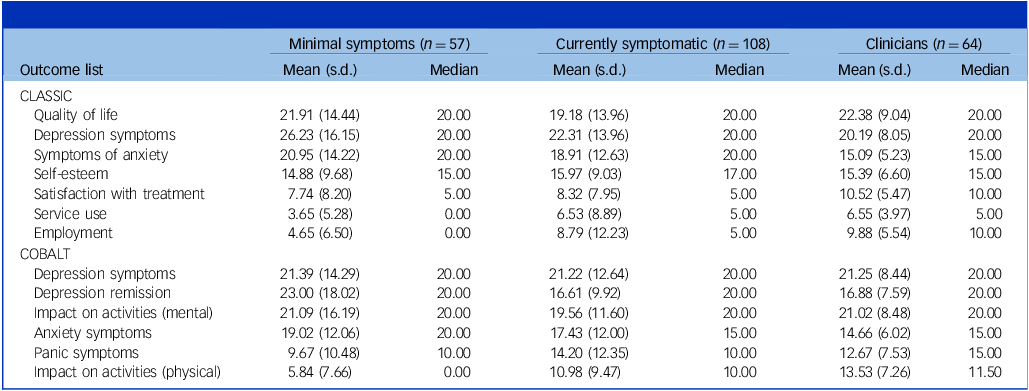
Table 3 presents the mean and median raw points, reflecting the relative share of participants’ total points assigned to each domain within each group. In the CLASSIC domain list, depression symptoms received the highest mean allocation in the minimally symptomatic group (mean = 26.23, s.d. = 16.15, median = 20.00) and the currently symptomatic group (mean = 22.31, s.d. = 13.96, median = 20.00). Clinicians prioritised quality of life (mean = 22.38, s.d. = 9.04, median = 20.00), followed closely by depression symptoms (mean = 20.19, s.d. = 8.05, median = 20.00).
Mean and median points assigned to outcome domains within stakeholder groups

Table 3 Long description
The table presents the mean and median raw points assigned to various outcome domains within three stakeholder groups: Minimal symptoms (n = 57), Currently symptomatic (n = 108), and Clinicians (n = 64). The table is divided into two main domains: CLASSIC and COBALT, each with specific outcome lists. For the CLASSIC domain, the outcomes include Quality of life, Depression symptoms, Symptoms of anxiety, Self-esteem, Satisfaction with treatment, Service use, and Employment. For the COBALT domain, the outcomes include Depression symptoms, Depression remission, Impact on activities (mental), Anxiety symptoms, Panic symptoms, and Impact on activities (physical). Each outcome has corresponding mean and median values for the three groups. For example, in the CLASSIC domain, depression symptoms received the highest mean allocation in the minimally symptomatic group (mean 26.23, s.d. 16.15, median 20.00) and the currently symptomatic group (mean 22.31, s.d. 13.96, median 20.00). Clinicians prioritized quality of life (mean 22.38, s.d. 9.04, median 20.00), followed closely by depression symptoms (mean 20.19, s.d. 8.05, median 20.00).
Mean, s.d. and median values represent the relative share of participants’ total points assigned to each outcome domain as compositional data, rather than independent scores. Participants assigned a total of 100 points; therefore, these values should be interpreted as proportions within a constrained whole, not as standalone quantities.
Descriptions of top and joint top domain choices are provided in Tables S2–S3.
Fixed presentation order.
CLASSIC: Reduce service use, increase employment, reduce symptoms of depression, reduce symptoms of anxiety, improve self-esteem, satisfaction with treatment, greater quality of life.
COBALT: Reduce symptoms of depression, remission from symptoms of depression, less impact on daily activities due to mental health problems, less impact on daily activities due to physical health problems, reduce feelings of panic, reduce symptoms of anxiety.
For the COBALT domain list, depression symptoms received the highest mean allocation in the currently symptomatic group (mean = 21.22, s.d. = 12.64, median = 20.00) and among clinicians (mean = 21.25, s.d. = 8.44, median = 20.00). Minimally symptomatic participants prioritised depression remission (mean = 23.00, s.d. = 18.02, median = 20.00).
As the point-allocation data were ILR transformed, each ILR balance contrasted one domain with the geometric mean of preceding domains. Positive coefficients indicate greater relative importance of the subsequent domain, whereas negative coefficients indicate greater relative importance of the contrasted domain (see Table S5 for interpretative guidance).
Comparative analysis
Assumption checks indicated violations of homogeneity and multivariate normality so Pillai’s Trace was used. The MANCOVA showed that stakeholder groups differed in their overall pattern of point allocations across domains, with the small–moderate multivariate between-group effects that were stronger for the COBALT domain list than for the CLASSIC domain list (Table S6).
For the CLASSIC domain list, univariate tests revealed significant overall group differences for depression symptoms relative to service use and employment (F(2, 219) = 8.995, p < 0.001, partial η2 = 0.076), and for anxiety symptoms relative to service use, employment and depression symptoms (F(2, 219) = 5.691, p = 0.004, partial η2 = 0.049) (Table S7).
Bootstrapped parameter estimates for the minimally symptomatic group did not remain significant after Holm–Bonferroni correction (Table S8). Clinicians placed significantly less importance on depression symptoms relative to service use and employment (B = 0.990, 95% CI 0.317–1.736, p = 0.007) than the currently symptomatic group. Clinicians also placed less importance on anxiety symptoms relative to depression symptoms, service use and employment (B = 0.837, 95% CI 0.272–1.469, p = 0.007) compared with the currently symptomatic group.
For the COBALT domain list, univariate tests revealed significant group differences for depression symptoms, depression remission and the impact on activities (mental) relative to the impact on activities (physical) (F(2, 219) = 12.820, p < 0.001, partial η2 = 0.105), and for anxiety symptoms relative to all preceding domains (F(2, 219) = 5.342, p = 0.005, partial η2 = 0.047). Bootstrapped parameter estimates showed that the minimally symptomatic group assigned greater relative importance to depression symptoms, depression remission and the impact on activities (mental) relative to the impact on activities (physical) than the currently symptomatic group (B = 2.153, 95% CI 0.894–3.503, p < 0.001), whereas clinicians assigned less importance to these outcomes relative to the impact on activities (physical) than the currently symptomatic group (B = −1.000, 95% CI −1.753−0.259, p = .007). Estimated marginal means (EMMs) and EMM pairwise comparisons are presented in Tables S9–S10.
Between-group effects
Predictive analyses examined whether individual characteristics predicted variation in point allocations across the full sample. Age showed significant multivariate effects for both outcome lists (CLASSIC: Pillai’s Trace = 0.191, p < 0.001; COBALT: Pillai’s Trace = 0.097, p < 0.001), indicating small–moderate multivariate effects. So age predicted relative outcome importance irrespective of participant group.
For the CLASSIC domain list, age significantly predicted how participants prioritised symptoms of depression relative to service use and employment outcomes (F(1, 221) = 49.967, p < 0.001, partial η2 = 0.184), and anxiety symptoms relative to depression symptoms, service use and employment (F(1, 221) = 13.806, p < 0.001, partial η2 = 0.059). Bootstrapped parameter estimates showed that older participants placed significantly greater relative importance on depression symptoms relative to service use and employment compared with younger participants (B = −0.097, s.e. = 0.014, p < 0.001, 95% CI −0.126−0.069). Older participants also placed significantly less relative importance on depression symptoms, service use and employment than on anxiety symptoms compared with younger participants (B = −0.046, s.e. = 0.014, p = 0.002, 95% CI −0.073−0.018).
For the COBALT domain list, age significantly predicted how participants prioritised depression symptoms, depression remission and the impact on activities (mental) relative to the impact on activities (physical) (F(1, 221) = 6.684, p = 0.010, partial η2 = 0.029), and panic symptoms relative to all previous outcomes (F(1, 221) = 9.639, p = 0.002, partial η2 = 0.042). Bootstrapped parameter estimates showed that older participants assigned greater relative importance to the previous domains than to panic symptoms compared with younger participants (B = 0.046, s.e. = 0.016, p = 0.007, 95% CI 0.015–0.078).
Within-group effects
Next, predictive analyses examined whether individual characteristics predicted variation in point allocations within each stakeholder group.
Minimal symptoms group
The multivariate test did not reach statistical significance for either outcome list, indicating that sociodemographic and clinical factors did not predict the relative importance assigned to domains.
Currently symptomatic group
Several sociodemographic factors predicted domain importance with small–moderate multivariate effects. Significant multivariate effects were found for age (CLASSIC: Pillai’s Trace = 0.239, p < 0.001; COBALT: Pillai’s Trace = 0.203, p = 0.001) and education (CLASSIC: Pillai’s Trace = 0.150, p = 0.025; COBALT: Pillai’s Trace = 0.128, p = 0.031). For COBALT, estimated years with depression also showed a significant multivariate effect (Pillai’s Trace = 0.130, p = 0.029).
For CLASSIC, age significantly predicted greater importance placed on depression symptoms relative to service use and employment (F(1, 92) = 24.418, p < 0.001, partial η2 = 0.210), with older participants assigning significantly more importance to depression symptoms relative to service use and employment outcomes (B = −0.130, 95% CI −0.175−0.071, p < 0.001).
Education predicted the importance assigned to anxiety symptoms relative to service use, employment and depression outcomes among those with postgraduate-level education (F(1, 92) = 10.004, p = 0.002, partial η2 = 0.098), with postgraduate participants placing significantly less importance on anxiety symptoms relative to previous outcomes than those with an undergraduate education (B = 2.440, 95% CI 0.914–4.071, p = 0.005).
For COBALT, significant univariate effects of age and education were found. However, bootstrapped parameter estimates did not survive Holm–Bonferroni correction.
Clinicians
For CLASSIC, multivariate tests indicated significant overall effects of age and estimated years in role; however, no univariate effects survived Holm–Bonferroni correction.
For COBALT, the multivariate test did not reach statistical significance, indicating that sociodemographic and professional characteristics did not predict the relative importance of outcomes.
Qualitative results
Tables S23–S24 provide further information on the qualitative results.
Question 1 – ‘Could you please briefly describe any reasons for the points you assigned above?’
Participants’ explanations for their point allocations complemented the quantitative results (Table 4). Some described a clear hierarchy of importance, whereas others viewed several outcomes as equally important, reflected by assigning equal points (Theme 1). This was consistent with the tied median point allocations across multiple domains.
Themes from qualitative questions with example quotes

Table 4 Long description
The table has two columns: Theme and Definition. The Theme column lists themes derived from qualitative questions, and the Definition column provides explanations for these themes. The table is divided into two main questions, each with several themes. Question 1 includes themes such as Diversity of perspectives on outcome hierarchy, Remission and recovery from symptoms of depression, Living well with depressive symptoms, and Anxiety as a key component of the experience of depression. Question 2 includes themes such as Rebuilding a sense of self and purpose, Emotional well-being, stability and resilience, Connection, belonging and social participation, and Empowerment through psychoeducation and therapeutic skills. Each theme is accompanied by example quotes that illustrate the participants’ explanations for their point allocations.
Some participants prioritised symptom reduction or remission by assigning more points, considering these outcomes to be the foundation and prerequisites for improvement in other outcomes (Theme 2). This perspective was evident in the minimal symptom group, which had among the highest mean point allocations for symptom- and remission-based outcomes in both outcome lists.
Other participants emphasised day-to-day functioning or quality of life as the key outcome, with some expressing this particularly when remission or recovery would be unachievable (Theme 3). Some clinicians also recognised this emphasis among their service users.
Anxiety and panic symptoms varied in importance (Theme 4). Some participants described them as central to their depression and allocated more points to them, while others reported experiencing fewer anxiety symptoms, so assigned fewer points. Clinicians generally regarded anxiety as secondary to the primary treatment focus of depression symptoms, reflected by clinicians assigning fewer median points to anxiety-based outcomes in both datasets.
Question 2 – ‘Are there any treatment outcomes not described above that would be important to your treatment?’
Participants emphasised outcomes related to identity, emotional stability and sense of purpose, describing the importance of feeling connected, hopeful and able to cope with challenges. There was strong emphasis across all groups on relational and social outcomes, such as rebuilding or creating new relationships and feeling socially connected through activities such as clubs. All groups highlighted the value of gaining skills and understanding of their mental health to recognise and manage future symptom recurrence.
Discussion
This study found both similarities and differences in how outcomes from two exemplar CBT trials were valued. Although RCTs predominantly assume that a single primary outcome reflects trial success, Reference Menon, Praharaj and Andrade30 no group in our study prioritised a single domain. Instead, participants distributed points across multiple domains, challenging the assumption that depression symptoms alone can adequately capture treatment benefit. Our findings complement applied multi-criteria decision modelling (MCDM) work, such as Zhang et al, Reference Zhang, Wykes, Jin, Stringer, Pickles and Cella31 which examines the effects of applying weights such as these to trial data.
Average points allocated
Depression symptoms received high but similar mean point allocations to other domains, with wide standard deviations revealing that some individuals assigned considerably more points to depression symptoms and others far fewer. The fixed-point allocation task required participants to make explicit trade-offs, meaning this variability reflects differences in what participants considered most important. The qualitative findings help explain this variability, with some participants framing symptom reduction or remission as central, whereas others emphasised living well with ongoing symptoms.
Median point allocations, which are less sensitive to outliers, revealed broad consensus across groups. In both lists, the top-rated domains received a median of 20 points, indicating that no single domain was judged to be solely the most important. This challenges the assumption that symptom change alone captures treatment benefit and supports a more holistic approach that recognises multiple domains as important. Reference Pedro Costa, da Silva Brito, Mestre, Matos Pires and José Lopes32
Differences in the importance of depression symptoms
Depression symptoms appeared in both lists but were valued differently across groups. In CLASSIC, clinicians assigned significantly less importance to depression symptoms than currently symptomatic participants, relative to service use and employment. In COBALT, clinicians again assigned lower importance to depression symptoms, remission and impact on activities due to mental health, relative to impact on activities due to physical health, than currently symptomatic participants. This reflects the relative trade-off created by the fixed-point task. Although depression symptoms were present in both trials, the surrounding domain sets differed, shaping the relative comparisons made. Overall, clinicians placed relatively less importance on depression symptoms across both trials compared with currently symptomatic participants, but the expression of this pattern depended on the competing domain sets presented.
Do sociodemographic factors affect outcome importance?
Only the sociodemographic and clinical factors within the currently symptomatic group significantly predicted outcome importance, the group generally recruited into clinical trials as participants. Few quantitative studies have examined stakeholder outcome priorities. Reference Chevance, Ravaud, Tomlinson, Le Berre, Teufer and Touboul7 Currently symptomatic service users with a postgraduate education placed less relative weight on anxiety symptoms. This aligns with broader evidence that sociodemographic factors, including education, shape mental health-related priorities and help-seeking behaviours. Reference Magaard, Seeralan and Schulz33
Older adults consistently prioritised depression symptoms over functional outcomes such as employment, likely reflecting life-stage differences in roles, expectations and concerns. Little research has explored age-related differences in outcome priorities among adults with depression, highlighting a gap for future research. Reference Sittler, Lechner-Meichsner, Wilz and Kessler34 Evidence from other areas shows that age shapes mental health-related priorities, such as younger adults’ greater preference for internet-based interventions. Reference Dorow, Löbner, Pabst, Stein and Riedel-Heller35 Younger adults placed greater importance on panic than older adults, consistent with evidence that younger adults report increased psychological distress linked to stressors like financial stress. Reference Wake and O’Donnell36 As younger adults are less likely to benefit from psychological interventions, Reference Saunders, Suh, Buckman, John, El Baou and Pilling37 relying solely on depression symptom primary outcomes may underrepresent treatment benefit for this group.
Gaps in trial outcome sets
Unlike the variability seen for depression symptoms, quality of life in the CLASSIC list did not differ significantly across stakeholder groups, with all groups assigning a median score of 20 points, making it a highly valued outcome. This aligns with qualitative findings and supports arguments that psychotherapies should target quality of life alongside symptoms. Reference Cuijpers38 However, a review of 450 depression trials found that the EuroQol 5-Dimension questionnaire (EQ-5D), the most frequently used quality-of-life measure, was a primary endpoint in 1% of trials and a secondary endpoint in 7%. Reference Veal, Tomlinson, Cipriani, Bulteau, Henry and Müh5 Participants suggested additional important domains beyond those included in the domain lists, such as social participation and emotional well-being (Table 4). Some of these, such as social functioning, overlap with previous literature, Reference Kan, Jörg, Buskens, Schoevers and Alma6 Reference Chevance, Ravaud, Tomlinson, Le Berre, Teufer and Touboul7 but are also infrequently reported as trial outcomes. Reference Veal, Tomlinson, Cipriani, Bulteau, Henry and Müh5 Our findings highlight a disconnect between stakeholder priorities and current trial practice, emphasising the need to integrate stakeholder priorities into outcome selection to capture stakeholder-important treatment benefits.
Strengths and limitations
This study demonstrates the feasibility of a novel quantitative approach to measuring the importance of outcome domains in depression. However, several limitations should be considered. The online survey may have introduced biases related to computer access and literacy. Domains were presented in a fixed order. Although the task was brief and no anchoring effects were identified, framing or order effects remain possible. Future trials could randomise domain order to mitigate this.
The analysis plan was not preregistered, but analyses followed a consistent compositional data framework with standard diagnostic checks. Bootstrapped parameter estimates and Holm–Bonferroni corrections were applied to reduce the risk of false-positive findings, but the number of analyses conducted means that some smaller associations may still reflect chance. The BDI-II has been criticised for covering only 39% of domains considered important by service users. Reference Veal, Tomlinson, Cipriani, Bulteau, Henry and Müh5 No co-developed, depression-specific outcome measure currently exists, Reference Molloy, Kilcoyne, Belcher and Wykes39 highlighting an area for future development.
This study is based on domains from two UK-based CBT trials and may not be generalisable to other depression trials, although many psychological and pharmacological studies use similar outcomes (e.g. symptoms of depression, functioning and anxiety symptoms). Reference Veal, Tomlinson, Cipriani, Bulteau, Henry and Müh5 Outcome weights are likely to be context- and population-specific and may not generalise to all people with depression. However, this study identified sociodemographic predictors, such as age, and provides empirical evidence that stakeholder-derived weights can be feasibly elicited and applied, supporting future incorporation of stakeholder-prioritised weighting into trials.
All participants were UK-based. Despite a relatively large sample, some demographic categories (e.g. ethnicity) were collapsed to ensure sufficient cell sizes, potentially obscuring further subgroup variation. The advisory group reviewed variables and recommended that some (e.g. current care) not be collapsed despite small numbers. Sensitivity checks confirmed model stability. Larger samples would allow more granular subgroup analysis in future work.
Future directions
These findings challenge the assumption that a single primary outcome adequately captures treatment benefit. While the study identified stakeholder priorities, it also supports the development of stakeholder-weighted composite outcomes that may help balance funder-required and stakeholder-valued outcomes. These could offer a more nuanced alternative by combining multiple domains into a single score that reflects stakeholder priorities. Our results suggest that stakeholders judge symptom-based outcomes as important but also value broader domains of treatment benefit. Future work should test the feasibility of applying these stakeholder-weighted composites in mental health trials, building on existing initiatives to incorporate patient-important outcomes.
Supplementary material
The supplementary material is available online at https://doi.org/10.1192/bjp.2026.10765
Data availability
The data, analytic code and materials associated with this study, including survey instruments and coding frameworks, are available from the corresponding author, N.M., upon reasonable request.
Acknowledgements
We are grateful to the service users and clinicians who shared their time and experiences for this survey. We thank all those who shared their lived experience in shaping this study, including the SUAG and FAST-R for their contributions to the planning, and the study advisory group for their involvement in the analysis, interpretation and critical review of the manuscript. Some members of the advisory group chose not to be named as authors on this manuscript. We acknowledge the support of FAST-R. We thank NIHR BioResource volunteers for their participation and gratefully acknowledge NIHR BioResource centres, NHS Trusts and staff for their contributions. We thank the NIHR, NHS Blood and Transplant and Health Data Research UK as part of the Digital Innovation Hub Programme. The views expressed are those of the author(s) and not necessarily those of the NHS, the NIHR or the Department of Health and Social Care.
Author contributions
N.M. contributed to conceptualisation, methodology, data collection and preparation, quantitative data analysis, qualitative data analysis, writing of the original draft and writing – critical review and editing. T.W. contributed to conceptualisation, methodology, quantitative data analysis, writing – critical review and editing. T.W. and H.J. contributed to supervision. K.B., R.H., K.M. and H.J. contributed to quantitative data analysis and writing – critical review and editing. H.F., A. Madigan, M.M. and A. Mitchell contributed to qualitative data analysis and writing – critical review and editing. All authors read and approved the final manuscript.
Funding
This paper represents independent research funded by the NIHR Maudsley BRC at South London and Maudsley NHS Foundation Trust and King’s College London. N.M., the first author, is in receipt of a PhD studentship from the NIHR BRC at South London and Maudsley NHS Foundation Trust and King’s College London. H.F., A. Madigan, A. Mitchell, M.M. and T.W. acknowledge the support of the same funder. This study received support from the King’s College London Public Engagement Small Grant Scheme to fund the advisory group patient and public involvement activities. Advisory group members, including those who are co-authors of this manuscript, were reimbursed for their time from this grant in line with standard patient and public involvement practice.
Declaration of interest
None.


 Open access


eLetters
No eLetters have been published for this article.